• About

doubtfulsea

~ adventure fantasy

Tag Archives: Tacitus

Runing Things

13 Wednesday Aug 2025

Posted by Ollamh in J.R.R. Tolkien, Language, Tolkien

≈ Leave a comment

Tags

Anglo-Frisian Runes, Balin, Bryggen, divination, Fireworks, Futhark, Futhorc, Gandalf, Harys Dalvi, Kylver Stone, Moria, Robwords, runes, Tacitus, The Lord of the Rings, Thror's Map, Tolkien, Vimose comb

Welcome, as ever, dear readers.

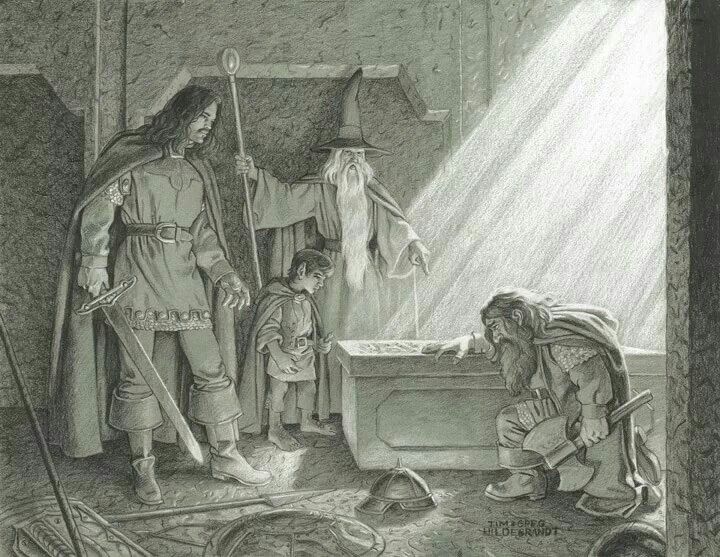
It is a grim moment, in The Lord of the Rings when the company, making its way through the complexity of Moria in near-darkness, save for Gandalf’s staff, reaches this—

“Their feet disturbed a deep dust upon the floor, and stumbled among things lying in the doorway whose shapes they could not at first make out.  The chamber was lit by a wide shaft high in the further eastern wall; it slanted upwards and, far above, a small square patch of blue sky could be seen.  The light of the shaft fell directly on a table in the middle of the room:  a single oblong block, about two feet high, upon which was laid a great slab of white stone.
(the Hildebrandts)

‘It looks like a tomb,’ muttered Frodo, and bent forwards with a curious sense of foreboding, to look more closely at it.  Gandalf came quickly to his side.  On the slab runes were deeply graven:

‘These are Daeron’s Runes, such as were used of old in Moria,’ said Gandalf.  ‘Here it is written in the tongues of Men and Dwarves:

BALIN SON OF FUNDIN

LORD OF MORIA ‘.”  (The Lord of the Rings, Book Two, Chapter 4, “A Journey in the Dark”)

Even if you’re not an expert in early western writing systems, you’ve probably encountered runes before.  They appear to be a Germanic invention, with their first known outside mention thought to be in P. Cornelius Tacitus’ (c.56-c.120 AD) essay on some northern tribes, Germania, where this passage is cited.

“[10] Auspicia sortesque ut qui maxime observant: sortium consuetudo simplex. Virgam frugiferae arbori decisam in surculos amputant eosque notis quibusdam discretos super candidam vestem temere ac fortuito spargunt. Mox, si publice consultetur, sacerdos civitatis, sin privatim, ipse pater familiae, precatus deos caelumque suspiciens ter singulos tollit, sublatos secundum impressam ante notam interpretatur.”

“[the Germans] pay very close attention to auspices and lot-drawing:  the practice of lot-drawing is simple.  They split a branch cut from a fruit tree into splinters and scatter those, marked out with certain signs, on a white robe casually and randomly.  Then a priest of the settlement, if it may be the public consulting of an oracle, but if private, the father of a family himself, having prayed to the gods and raising his eyes to the sky, draws three [splinters] one at a time [and] interprets those drawn according to the mark stamped upon [them] previously.”

(Tactius, Germania, Section 10—my translation.  If you’d like to read the whole text, here’s a useful Victorian translation:  https://archive.org/details/tacitusagricolag00taciiala/page/62/mode/2up )

We don’t know where Tacitus got his information from, but he lived at about the same time as one of the earliest currently-known runic inscriptions, the “Vimose comb”, dated to about 160AD,

(There seem to be two guesses at to what the inscription says—transliterated, it appears to read “harja”, meaning either the obvious “comb” or the less obvious “warrior”.  For more on this and other early rune-marked artifacts, see:  https://en.wikipedia.org/wiki/Vimose_inscriptions and https://en.natmus.dk/historical-knowledge/denmark/prehistoric-period-until-1050-ad/the-early-iron-age/the-weapon-deposit-from-vimose/the-offerings-in-vimose/   Until they sold out, you could even get a bone replica of the comb here:  https://norseimports.com/products/vimose-comb )

so the notae, “marks”, he mentioned could, indeed, be early runes.

We’ve seen runes three times before in the book, each time related to Gandalf and the first letter of his name in runes–
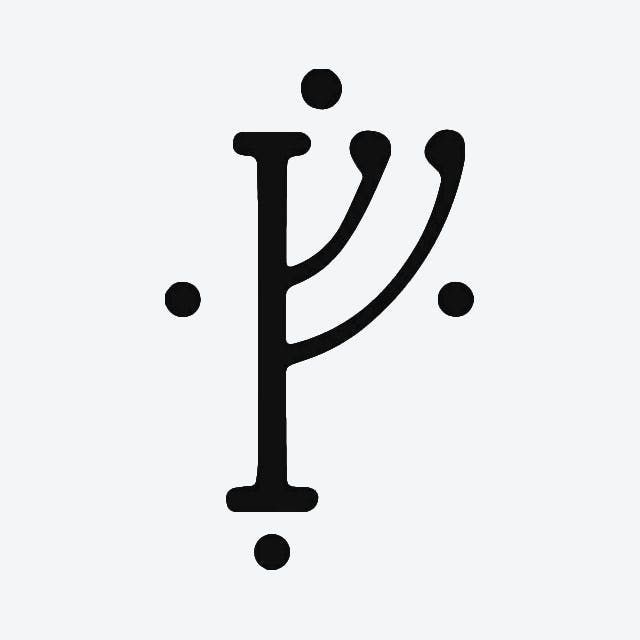
The first is a jolly appearance:
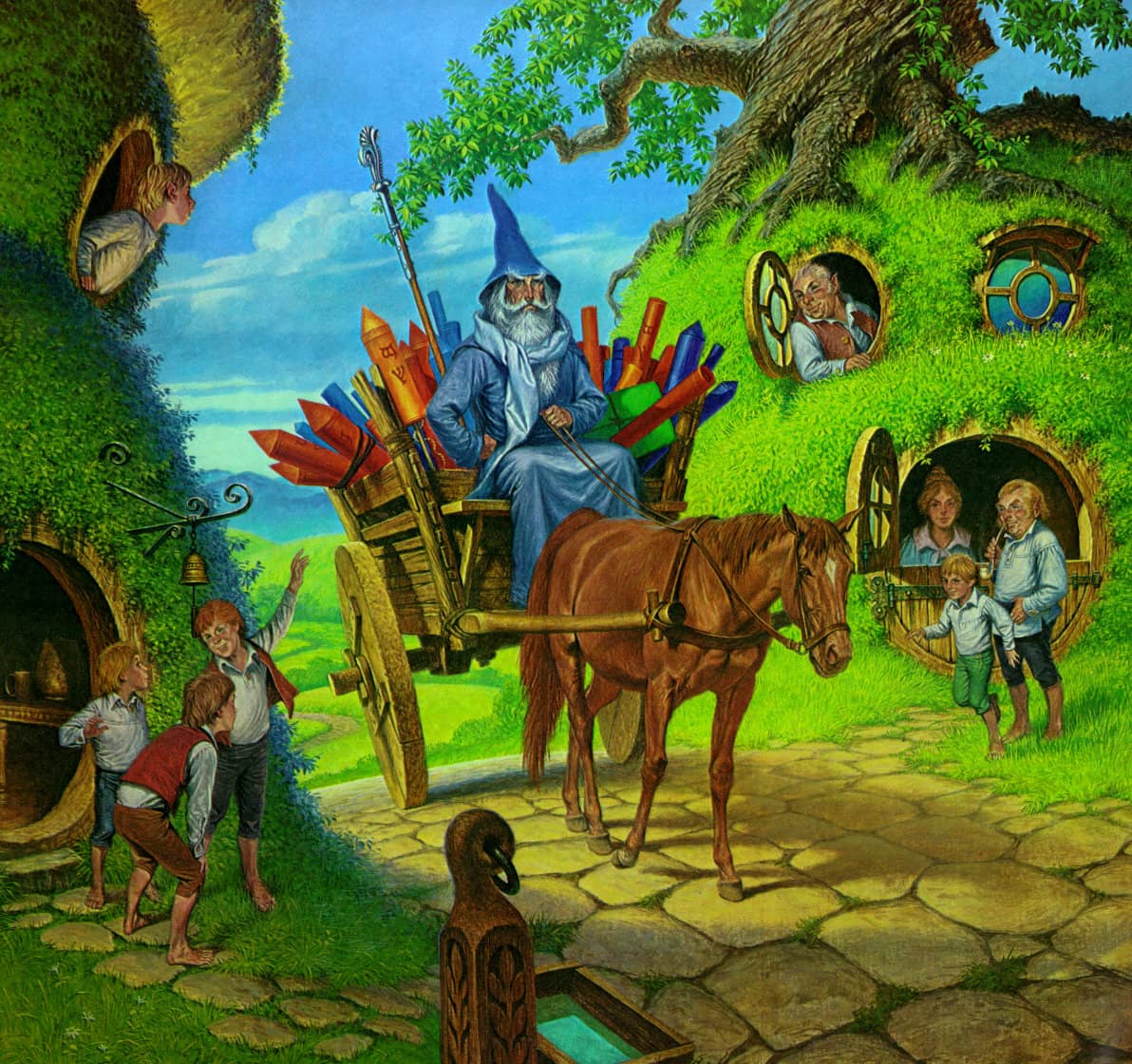
(Darrell K. Sweet, who died, unfortunately, in 2011, but you can see his archived website here:  https://web.archive.org/web/20110131141507/http://www.sweetartwork.com/DKSmainPage.html and read a little more about this very talented illustrator here:  https://en.wikipedia.org/wiki/Darrell_K._Sweet And I couldn’t resist adding this knowledgeable appreciation of his work:  https://blackgate.com/2022/04/17/an-adventure-to-be-had-a-journey-through-the-art-of-darrell-k-sweet/ )

“At the end of the second week in September a cart came in through Bywater from the direction of Brandywine Bridge in broad daylight.  An old man was driving it all alone…It had a cargo of fireworks…At Bilbo’s front door the old man began to unload:  there were great bundles of fireworks of all sorts and shapes, each labeled with a large red G [runic letter] and the elf-rune [see the image above].” (The Fellowship of the Ring, Book One, Chapter 1, “A Long-Expected Party”)

The second is not, being Gandalf’s much-delayed letter to Frodo, still at the Prancing Pony in Bree, instead of being delivered 3 months before to the Shire, meant to alert Frodo to the possibility that he won’t meet them, with some consolation that Strider might appear. (The Fellowship of the Ring, Book One, Chapter 10, “Strider”)

(the Hildebrandts)

And the third is only guessed at as seeming to be a sign from Gandalf on Weathertop:

“ ‘The stroke on the left might be a G-rune with thin branches,’ said Strider.  ‘It might be a sign left by Gandalf, though one cannot be sure…I should say…that they stood for G3, and were a sign that Gandalf was here on October the third:  that is three days ago now.  It would also show that he was in a hurry and danger was at hand, so he had no time or did not dare to write anything longer or plainer.  If that is so, we must be wary.’ “ (The Fellowship of the Ring, Book One, Chapter 11, “A Knife in the Dark”)
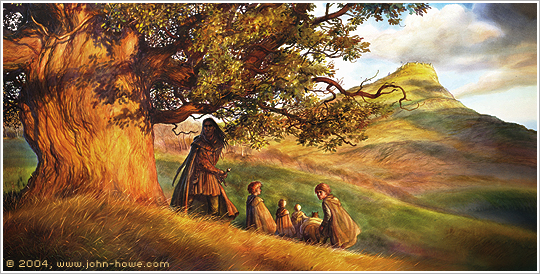
(John Howe)

In our Middle-earth, there are several iterations of runes, with the melodious (modern) names of “Futhark”(Elder and Younger) and “Futhorc”, which get those names, as the word “alphabet” does, from putting together a collection of the first letters of the series in a standard order.  Here’s the Elder Futhark—

It’s easy to see why the letters might be shaped as they were, appearing to be relatively easy to inscribe on things with a knife.  (Or a chisel for the stone inscriptions?)
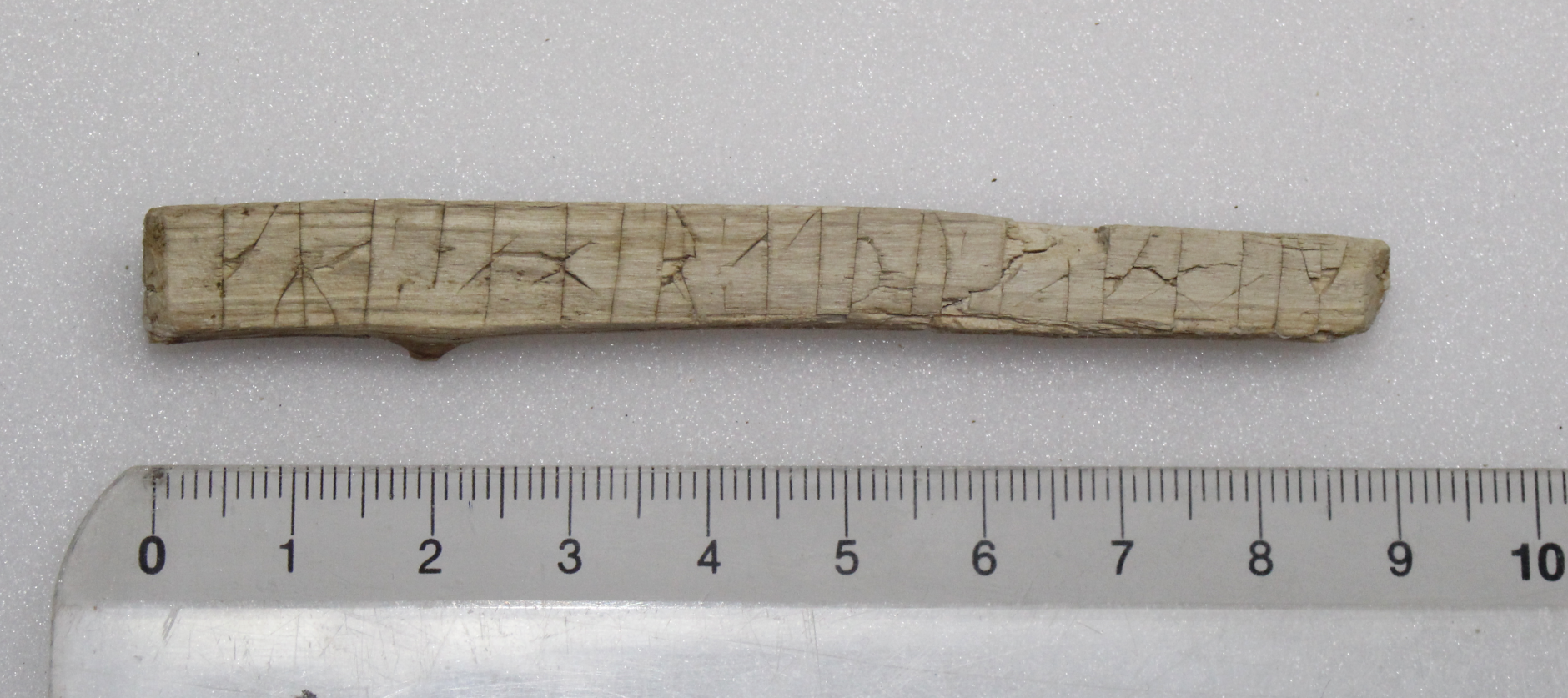
(a 12th-century AD inscription on wood from Bryggen in Norway—one of 670 inscriptions on wood or bone found at the site since 1955—for more see:  https://en.wikipedia.org/wiki/Bryggen_inscriptions  and https://en.wikipedia.org/wiki/Bryggen One of the many amazing things about this second piece is that it underlines just how sophisticated trade could be in northern Europe in the Middle Ages.)
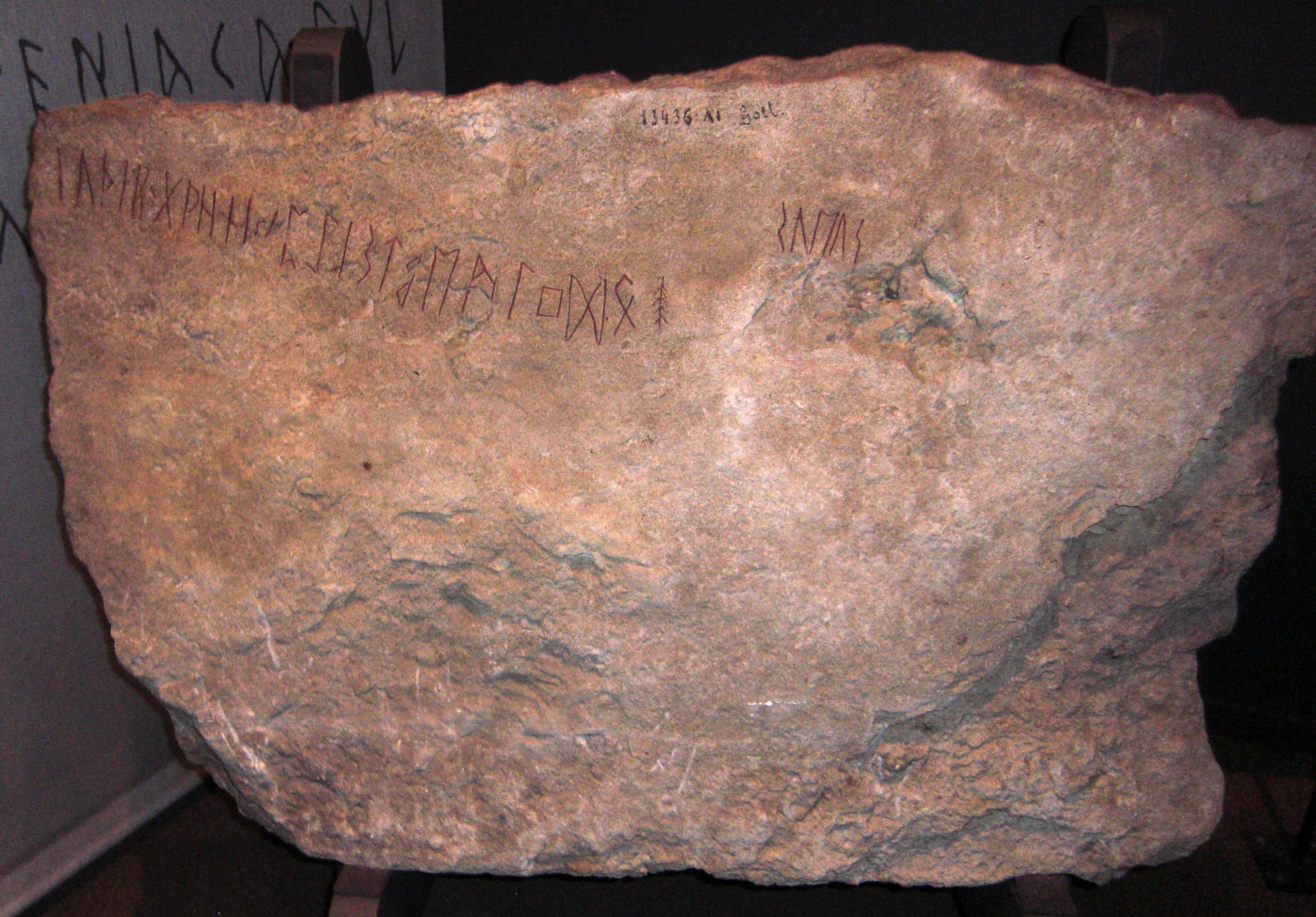
(This is the Kylver Stone from Gotland, Sweden, c.400AD, which lists the Elder Futhark letters.  For more, see:  https://en.wikipedia.org/wiki/Kylver_Stone and you can see from the translation of the runes where “Futhark” came from. )

Tolkien’s own runes, as he tells us, are derived from what are sometimes called the “Anglo-Saxon” or “Anglo-Frisian” Futhorc:

“There is the matter of the Runes.  Those used by Thorin and Co., for special purposes, were comprised of an alphabet of thirty-two letters (full list on application), similar to, but not identical, with the runes of Anglo-Saxon inscriptions.”  (letter to the editor of The Observer, published there 20 February, 1938, Letters, 42)

We can then imagine that this is what must appear as the “moon letters” on Thror’s map—
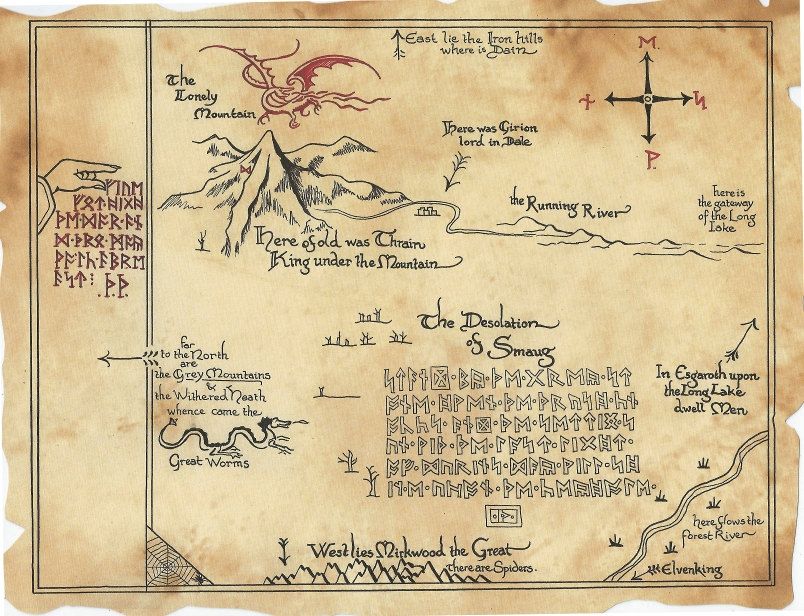
 

And this brings me to my final point.

In my last, in connection with the conlang (constructed language) toki pona, I mentioned the internet site Robwords, one of my favorite places for information and discussion about languages, primarily English, German, and French, but with some surprises (see last week’s “Simple Words” for more).

(This is Rob Watts, of Robwords)

One of those surprises was toki pona, but, in another, Rob made the suggestion that the Roman alphabet, in which I’m writing this posting, was rotten for the English language, being adapted from the Greek alphabet (in turn adapted from the Phoenician alphabet) via the Etruscan alphabet,
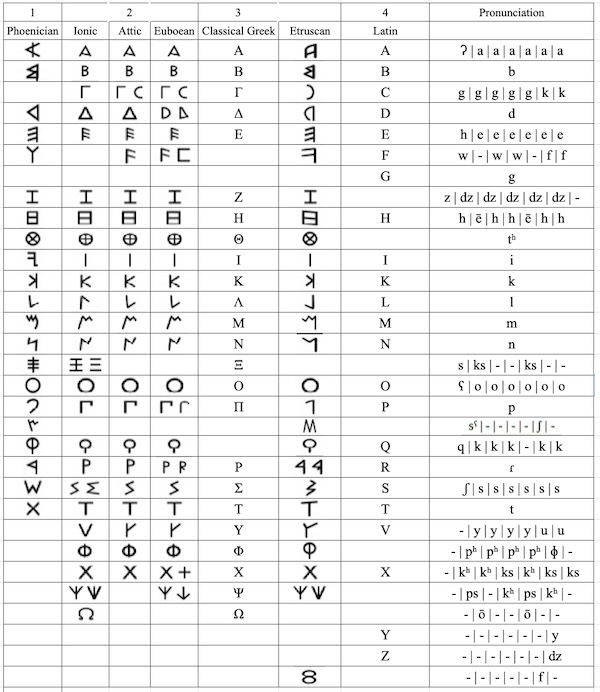
and lacking letters for certain common English sounds like “th” and “sh” and “ng”.

In his playful way, he suggested that we’d be better off with the runic system, and specifically that Anglo-Saxon version, aka Futhorc.
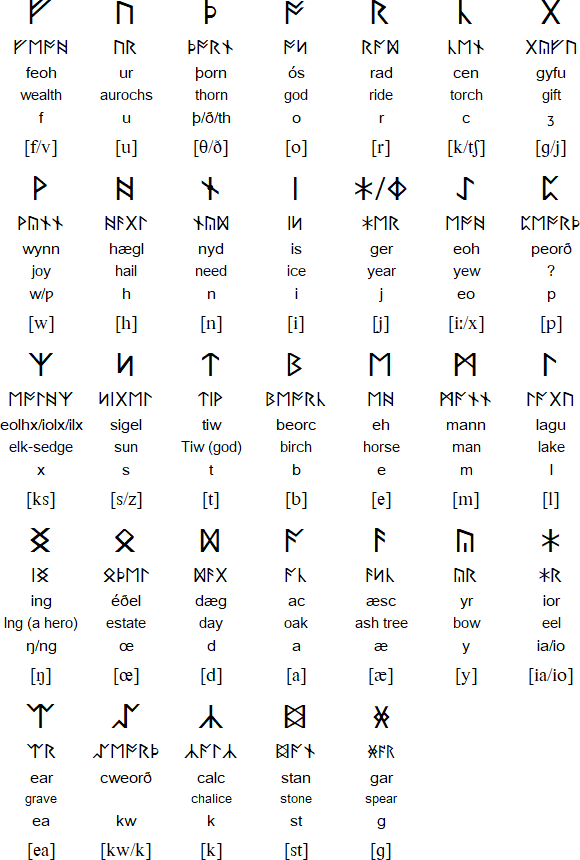
 To prove his point, he cites something familiar to Tolkien readers—

and then proceeds to translate it, showing that it’s not in the language of the dwarves, as one might expect from a dwarvish map, but English (or, if you prefer, “the Common Speech”).
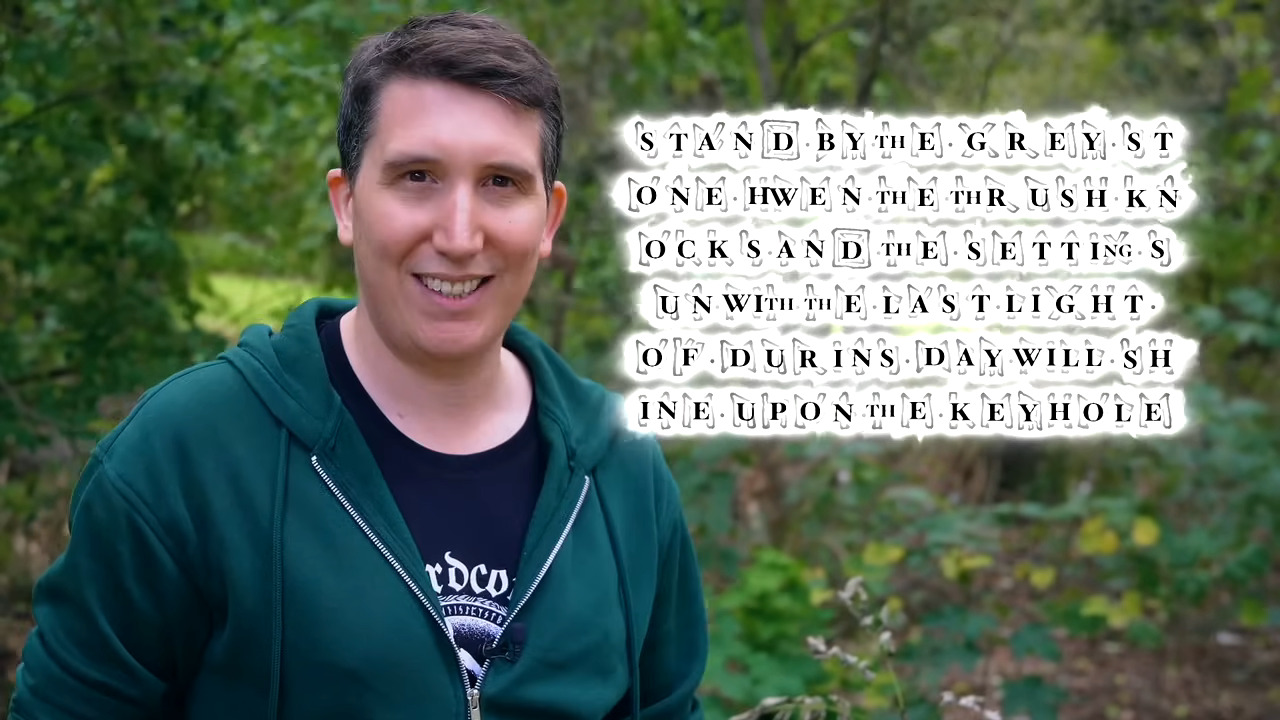
Watch the video, then, and see if you agree with Rob: https://www.youtube.com/watch?v=4npuVmGxXuk

And, if you’d like to try your hand at using the runes, here’s something to help—it’s a link to Harys Dalvi’s Old English runic keyboard:  https://www.harysdalvi.com/futhorc/  Harys Dalvi’s website is full of really interesting language and computer stuff and just plain fun:  https://www.harysdalvi.com/

Thanks, as always, for reading,

(ᚦᚫᛝᚳᛋ᛫ᚫᛋ᛫ᚫᛚᚹᛠᛋ᛫ᚠᚪᚱ᛫ᚱᛁᛁᛞᛁᛝ)

Stay well,

(ᛥᛠ᛫ᚹᛖᛚ)

Try runisizing today,

(ᛏᚱᚫᛁ᛫ᚱᚢᚾᛁᛋᛁᛋᛁᛝ᛫ᛏᚣᛞᛠ)

And remember that, as always, there’s

ᛗᚪᚱ᛫ᛏᚣ᛫ᚳᚢᛗ᛫ᛁᚾ᛫ᛞᚣ᛫ᚳᚣᚱᛋ

O

PS

At “wikiHow” there’s a pronunciation guide and a rather New Age interpretation of the Elder Futhark’s runes.  It’s fun, but, as it sits to the left of such “How” guides as “telekinesis”, and “reading palms”, I myself would stick to the pronunciations!  https://www.wikihow.com/Elder-Futhark-Runes 

PPS

And how could I resist listing this:  https://runicstudies.org/ the website for the American Association for Runic Studies?  If you get hooked on runes—and I think that that would be quite easy to do, especially after playing on Harys’ website—this site has links in all directions.

Hybrids

01 Wednesday Jan 2025

Posted by Ollamh in Uncategorized

≈ Leave a comment

Tags

anglo-saxons, Boudica, chariots, eurasian-steppe, Huns, hybrds, Hybrids, Jacksons The Lord of the Rings, jacksons-lord-of-the-rings, Julius Caesar, Mongols, Normans, Rohirrim, Sarmatians, Scythians, Tacitus, Tolkien, Wainriders

As always, dear readers, welcome.

The title of this piece might suggest electric cars, and it definitely will mention several different wheeled vehicles, but it is actually what I hope is a little study in something Tolkien does wonderfully well:  taking different elements from different times and cultures and so blending them that they become believable new wholes.

Although I don’t always agree with elements in Jackson’s The Lord of the Rings, one thing has always given me pleasure:  the Rohirrim, whether en masse

or a small grouping.

And this is true for Edoras

as well as for Meduseld.

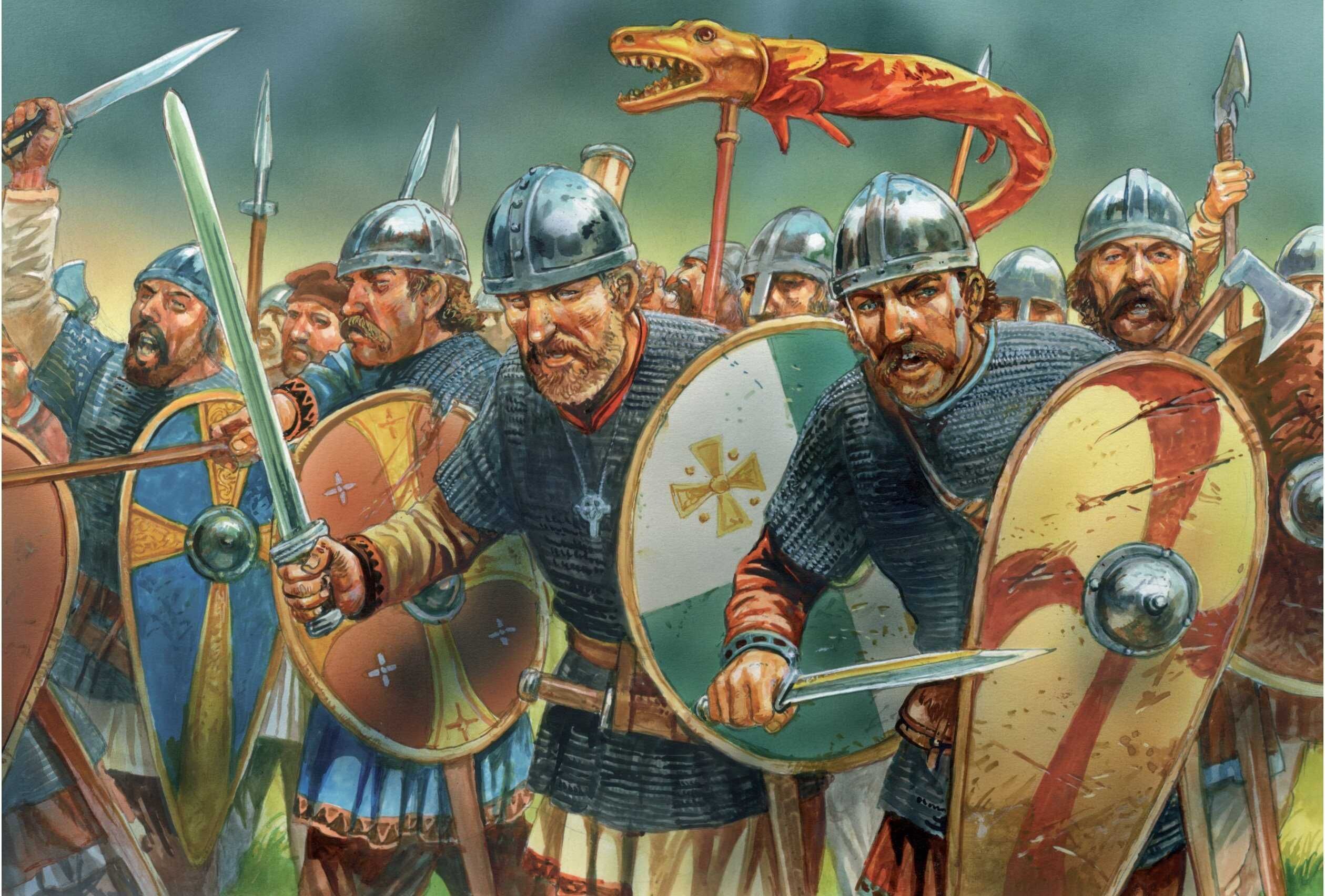
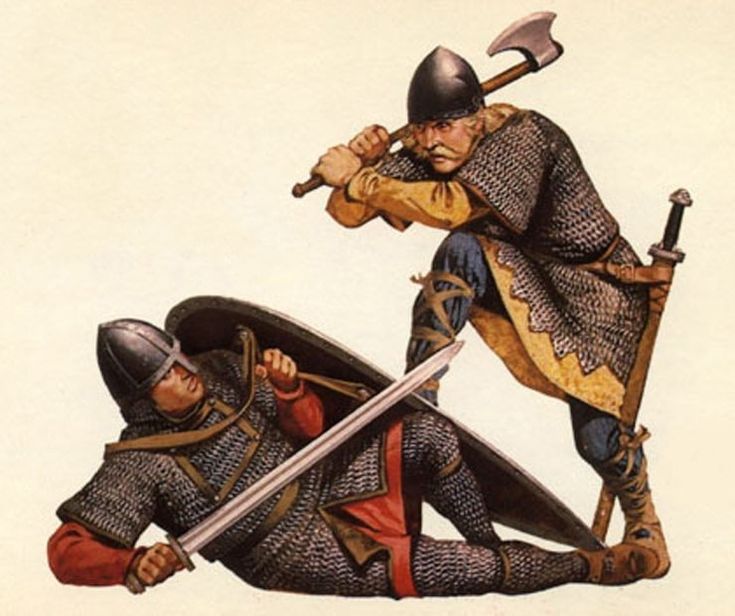
And yet they appear to be a kind of combination of peoples:  on the one hand, Tolkien imagined them to be Anglo-Saxons,

(Peter Dennis)

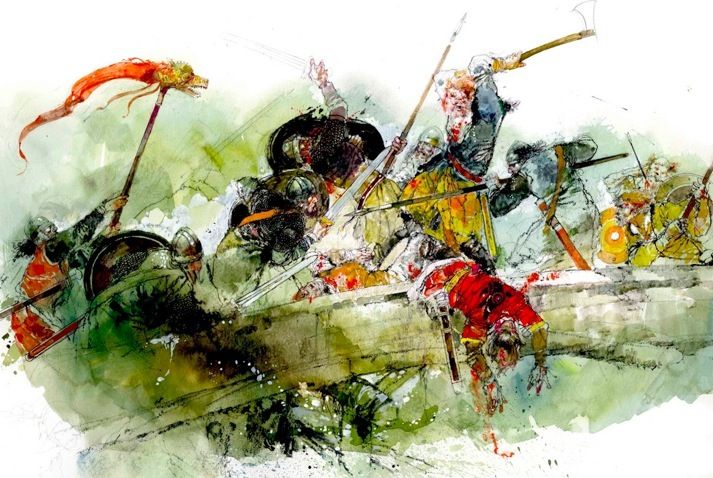
a people who primarily fought on foot, as at their last two major battles, Stamford Bridge,

(Victor Ambrus—who worked for years with the popular British archeology series, Time Team—which is available on YouTube and much recommended)

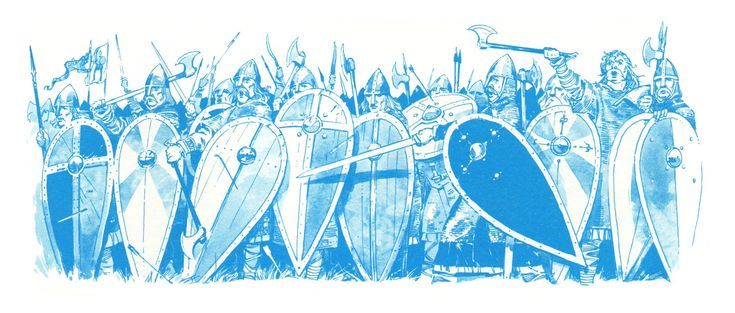
where they defeated another infantry force, the Vikings, and Hastings,

(Artist?)

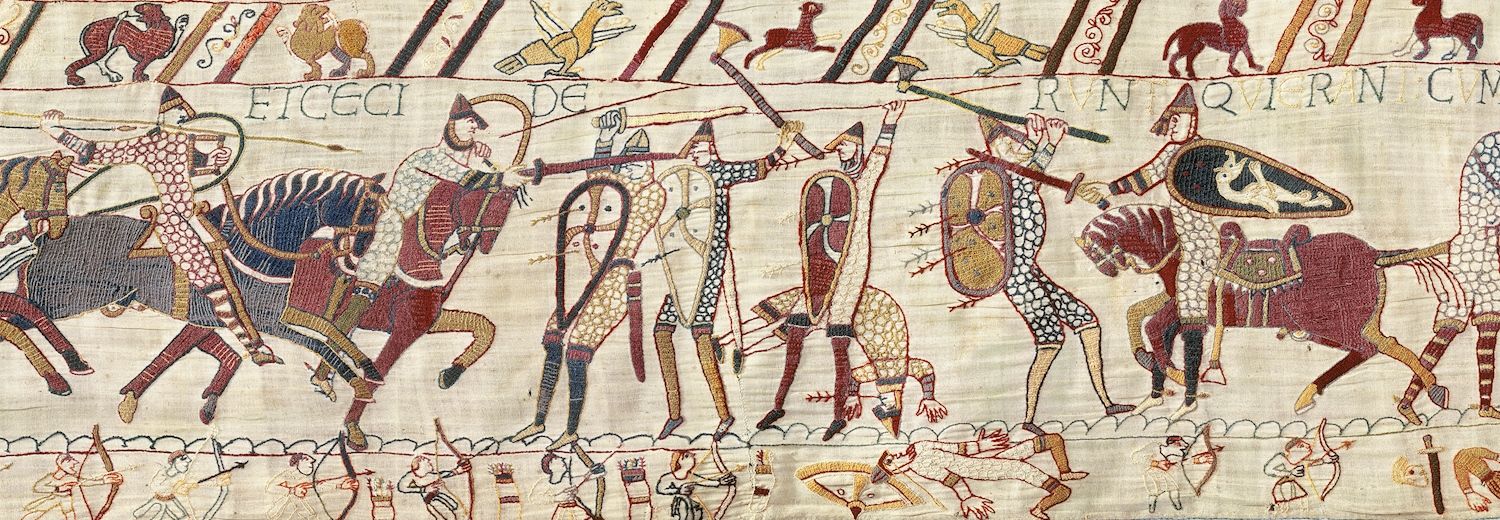
in which they were overwhelmed at the battle’s conclusion by Norman cavalry.

(From the wonderful “Bayeux Tapestry”—actually the “Bayeux Embroidery”—if you’d like to see the whole thing, look here:  https://www.bayeuxmuseum.com/en/the-bayeux-tapestry/discover-the-bayeux-tapestry/explore-online/  To my knowledge, there’s nothing like it from the Middle Ages for depicting a specific series of events in the medieval world.)

On the other hand, the Rohirrim were mounted, more like those Normans who defeated the Anglo-Saxons,

although the language they speak is, basically, a form of Old English, the language of the Anglo-Saxons.  Tolkien imagined them, in fact, as looking like the Normans, as well, describing them in a letter to Rhona Beare:

“The styles of the Bayeux Tapestry (made in England) fit them well enough, if one remembers that the kind of tennis-nets [the] soldiers seem to have on are only a clumsy conventional sign for chain-mail of small rings.”  (letter to Rhona Beare, 14 October, 1958, Letters, 401)

That is, their armor actually can look like this—

(By Angus McBride—and ironic, as, for all that McBride must have painted dozens of figures in chain mail, he once confessed in an interview that it was his least favorite part of illustrating, as the mail took so long to do.)

It’s also interesting to think about them as a people.  Anglo-Saxons were descended from a combination of locals (Romano-British) and various groups of west-Germanic tribesmen who had either been early post-Roman invaders of Britain or Germanic tribesmen brought to Britain to protect the locals from those invaders and who had become colonizers in turn.

But who were the Rohirrim and where did they come from?

“Eorl the Young was lord of the Men of Eotheod.  That land lay near the sources of Anduin, between the furthest ranges of the Misty Mountains and the northernmost parts of Mirkwood.”

(JRRT)

They had not always lived there, however:

“The Eotheod [from Old English, “Horsefolk”] had moved to those regions in the days of King Earnil II [TA 1945-2043] from lands in the vales of Anduin between the Carrock and the Gladden, and they were in origin close akin to the Beornings and the men of the west-eaves of the forest.  The forefathers of Eorl claimed descent from kings in Rhovanion, whose realm lay beyond Mirkwood before the invasions of the Wainriders…They loved best the plains and delighted in horses and in all feats of horsemanship…” (The Lord of the Rings, Appendix A II “The House of Eorl”)

The combination of “They loved best the plains and delighted in horses” makes perfect sense when one thinks about comparative history in our Middle-earth.  Consider the Eurasian Steppe, stretching from western China all the way to the Hungarian puszta.

This is an immense belt of grassland,

some 5000 miles (8000km) wide,

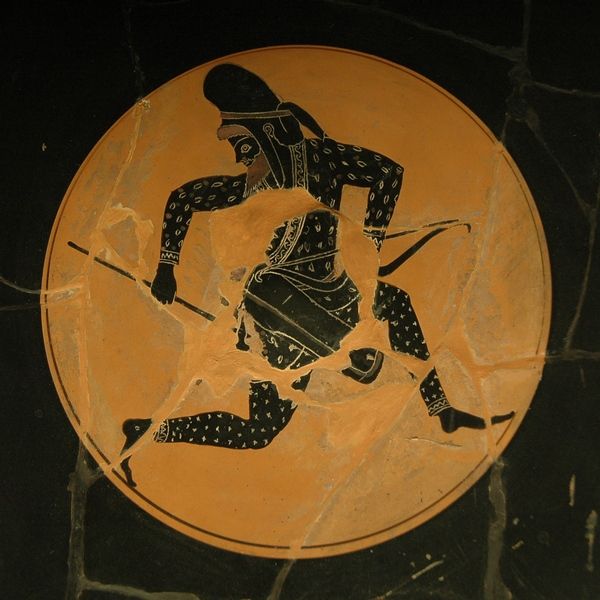
and has been the homeland of numerous horsefolk throughout history, from the Scythians

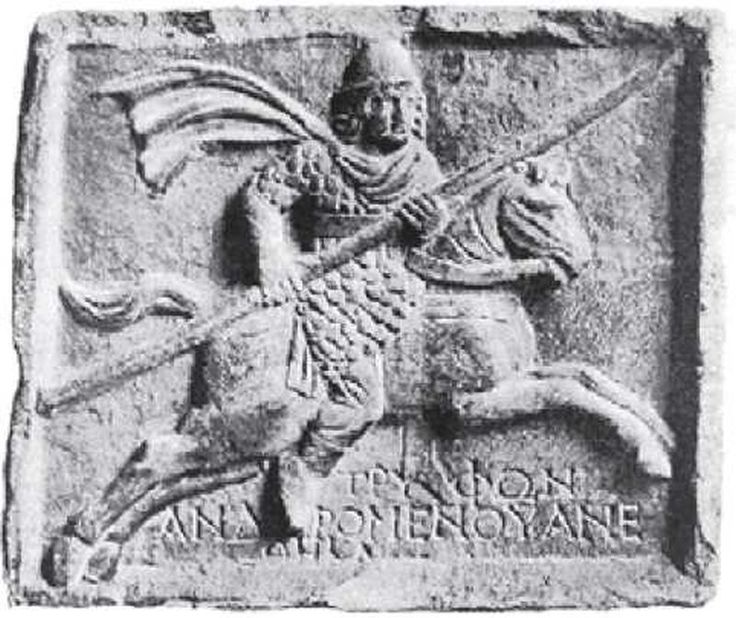
to the Sarmatians

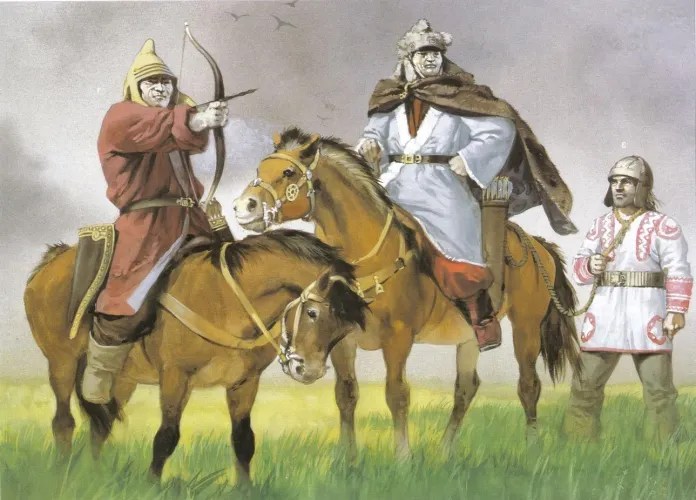
to the Huns

(Angus McBride)

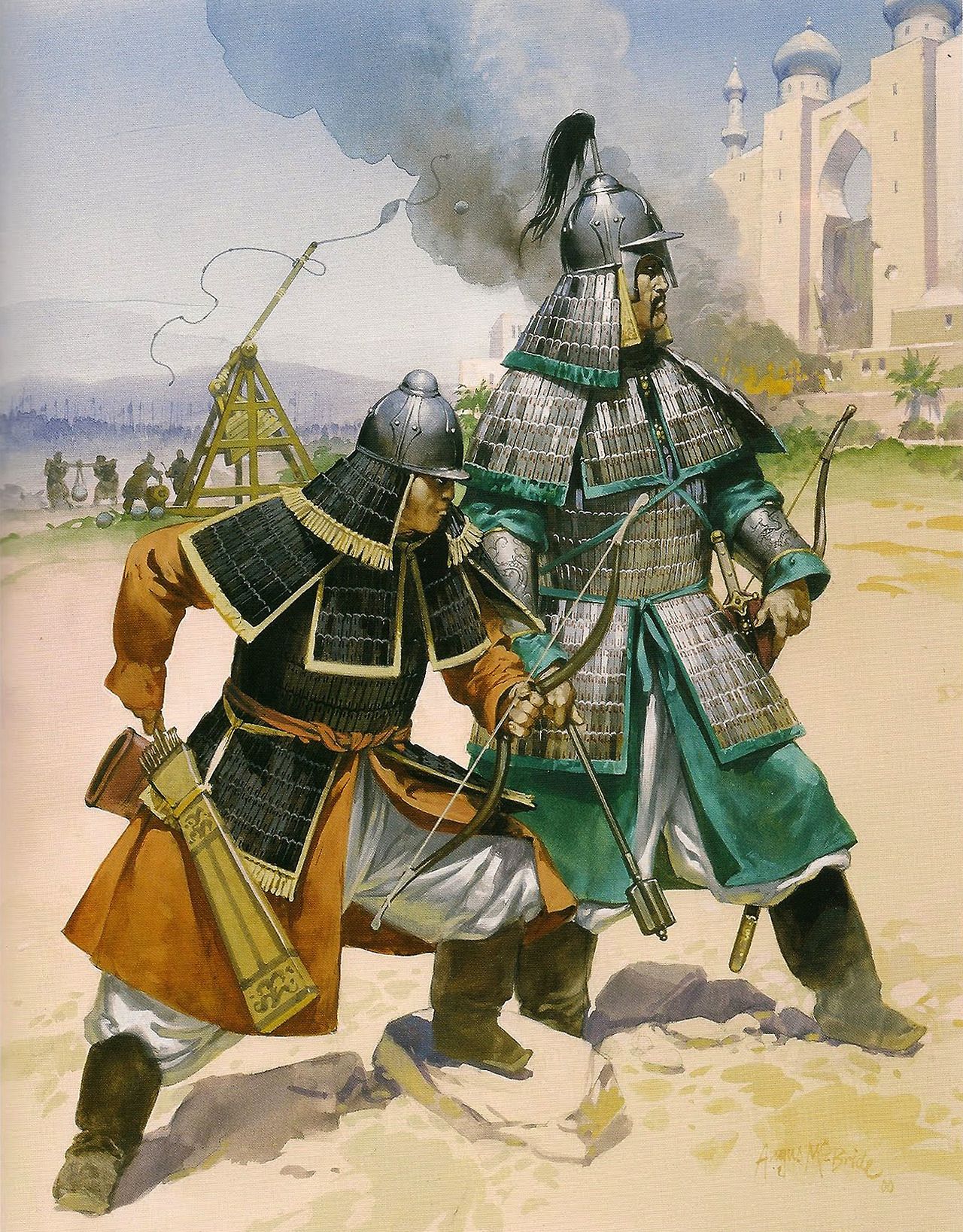
to the Mongols.

(another McBride)

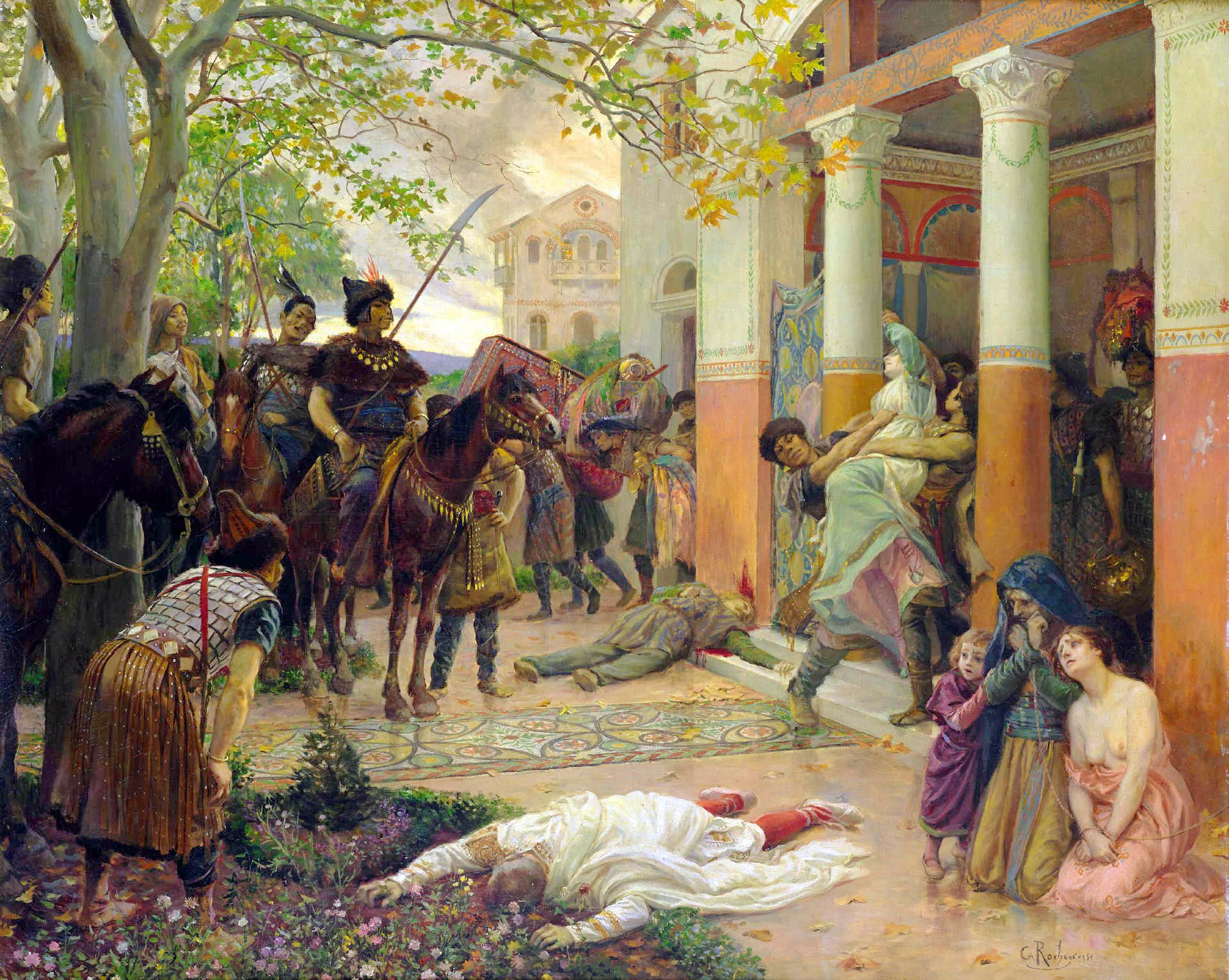
All of these peoples have used the Steppe to graze their herds of horses, sometimes moving west for grazing, sometimes moving west when pressured by others further east, and sometimes as predators, like the Huns, moving west to seek new plunder.

(I haven’t been able to identify an artist for this–it has the look of late-Victorian.)

In two of these cases, whole peoples might be on the move and this is perhaps where Tolkien has gotten part of his description of those Wainriders he mentions:

“The Wainriders were a people, or a confederacy of many peoples, that came from the East; but they were stronger and better armed than any that had appeared before.  They journeyed in great wains, and their chieftains fought in chariots…” 

So, we can imagine that the Eotheod, pressured by the Wainriders, were forced west, as one steppe people is pushed westward by another to the east. 

But Tolkien gives us another—or perhaps additional–possibility:

“Stirred up, as was afterwards seen, by the emissaries of Sauron, they made a sudden assault on Gondor…The people of eastern and southern Rhovanion were enslaved; and the frontiers of Gondor were for that time withdrawn to the Anduin and the Emyn Muil.” (The Lord of the Rings, Appendix A, IV “Gondor and the Heirs of Anarion”)

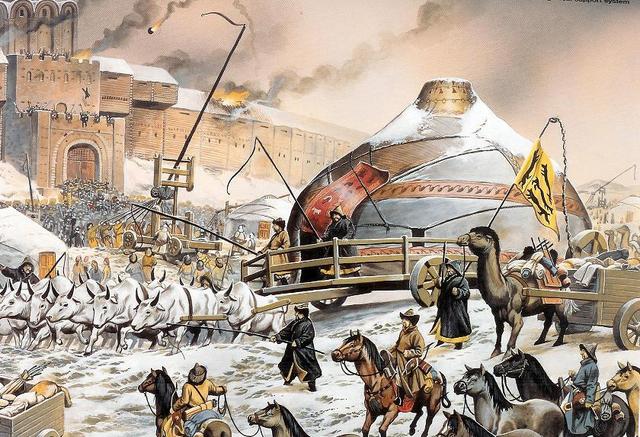
The Wainriders, then, might be both steppe peoples moving westwards, but also predators, like the Huns, or like the Mongols, who were both predators and empire-builders, and here we might see Mongols with their characteristic ger (a large round tent)—on a wagon—perhaps like the Wainriders?

(Wayne Reynolds)

Although there is no mention in our text of the Rohirrim migrating with wagons, it’s clear from parallels in our world that the peoples who crossed the Eurasian Steppe appear to have used them regularly.  But here, like the Rohirrim, we have another odd juxtaposition.  The Rohirrim are Anglo-Saxons on horseback:  cavalry, which was true for all of those migrants across the Steppe in our world.  Chariots, however, although Tolkien says that the Wainrider chiefs fought in them (of which fact this is the only mention) were not part of those other horsefolks’ arsenals.  Where did they come from?

The answer, I think, lies in the period of British history before the Anglo-Saxons and almost before the Romans, among the earlier Celtic settlers of England.  Julius Caesar encountered chariots there and described their use:

Genus hoc est ex essedis pugnae. Primo per omnes partes perequitant et tela coiciunt atque ipso terrore equorum et strepitu rotarum ordines plerumque perturbant, et cum se inter equitum turmas insinuaverunt, ex essedis desiliunt et pedibus proeliantur. 2 Aurigae interim paulatim ex proelio excedunt atque ita currus conlocant ut, si illi a multitudine hostium premantur, expeditum ad quos receptum habeant. 3 Ita mobilitatem equitum, stabilitatem peditum in proeliis praestant, ac tantum usu cotidiano et exercitatione efficiunt uti in declivi ac praecipiti loco incitatos equos sustinere et brevi moderari ac flectere et per temonem percurrere et in iugo insistere et se inde in currus citissime recipere consuerint.

“This is the kind of fighting from chariots.  At first, they ride around in all directions and throw spears and often, by the very frightfulness of the horses and the roar of the wheels, they shake the ranks [of the enemy] and, when they have slipped themselves among the troops of [enemy] cavalry, they leap from the chariots and fight on foot.  Meanwhile, the charioteers move out a little way from the fighting and so place their vehicles that, if they [the dismounted fighters] should be pressed by a large number of the enemy, they may have an easy retreat to them.  Thus, they provide the mobility of cavalry [as well as] the steadiness of infantry in [their] battles and they accomplish so much by daily practice and exercise that they are accustomed to control their stirred-up horses on a sloping and steep place and rein [them] in quickly and to turn [them] and to run along the yoke pole and to stand on the yoke and from there to take themselves back into the vehicles extremely speedily.”  (Caesar, De Bello Gallico, Book IV, Chapter 33—my translation)

(Angus McBride)

Tolkien may have remembered this from his schooldays, when he would first have encountered the text—and he might have found those wagons there, too, although slightly later.  When, in 60-61AD, the Iceni queen, Boudica, led a revolt against Roman rule,

(Peter Dennis)

in the final battle, when the tribesmen advanced towards the Roman formation, as Tacitus (c.56-c.120AD) tells us, their families watched from their wagons, placed behind the battle line (De Vita et Moribus Iulii Agricolae, Chapter 34).  And, as a prelude to the battle, Boudica had ridden among the ranks in a chariot (Chapter 35).

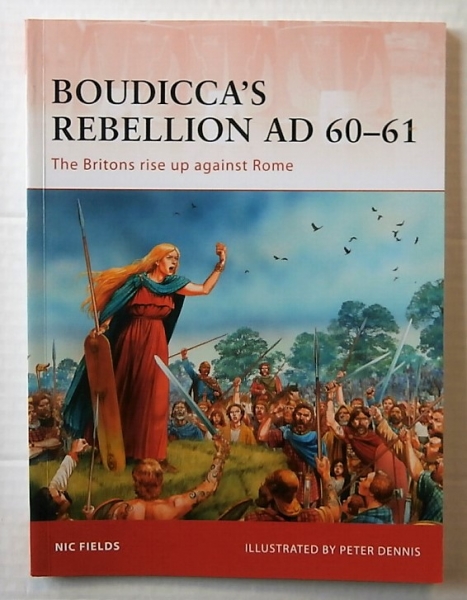
(another Peter Dennis—in fact, if you’d like to know more about this amazing woman, who, for a brief time, had been a real threat to the Romans, you might invest in: 

And so, as in combining Anglo-Saxon and Norman to create the Rohirrim, Tolkien may have taken Steppe people, added Celtic Britons, and produced the Wainriders. 

Thanks, as always for reading.

Stay well,

Remember that a horse will drink, on average, between 5 and 10 gallons (19-38 litres) of water a day,

And remember, as well, that there’s always

MTCIDC

O

Bridges and Battles

04 Wednesday Jan 2017

Posted by Ollamh in Artists and Illustrators, Heroes, J.R.R. Tolkien, Literary History, Military History, Military History of Middle-earth, Narrative Methods

≈ Leave a comment

Tags

Anglo-Saxon, Arnhem, Belisarius, Boromir, bridges, Constantine I, Constantinople, David, Diocletian, Dionysius, Gros, Hal Foster, Harold Godwinson, Horace Vernet, Horatius, Horatius at the Bridge, Justinian, Livy, Marcus Aurelius, Maxentius, Maximianus, Milvian Bridge, Napoleon, Ostrogoths, Pass of Roncevalles, Pegasus Bridge, Pliny the Elder, Pons Sublicius, Prince Valiant, Ravenna, Remagen, River Adige, River Derwent, Roland, Salarian Bridge, San Vitale, Sherlock Holmes, Stamford Bridge, Tacitus, The Council of Elrond, The Lays of Ancient Rome, The Lord of the Rings, The Oath of the Horatii, Thomas Babington Macaulay, Tiber, Tolkien, vikings

Welcome, dear readers, to our first posting for 2017—and a Happy New Year.

In our last, we discussed water-crossings in The Lord of the Rings, but said that our next would be on a more specialized subject, something we thought to call “Battle Bridges”.

This was inspired by this quotation (it’s Boromir speaking, at the Council of Elrond):

“I was in the company that held the bridge, until it was cast down behind us. For only four were saved by swimming: my brother and myself and two others.” (The Fellowship of the Ring, Book 2, Chapter 2, “The Council of Elrond”)

Broken bridges and swimming soldiers made us think of a story told by a number of early historians, including Dionysius of Halicarnassus, Livy, Pliny the Elder, and Tacitus, in which three Roman officers stand as a rearguard at the first bridge over the river Tiber, the Pons Sublicius, and, when two are wounded, the third, Horatius, sends them off, telling them to have the bridge destroyed so that the enemy can’t pursue the defeated Roman army into Rome. When the bridge is gone, Horatius, in his armor and with his arms, leaps into the river and swims to the Roman shore to great acclaim.

1horatiusatbridge.jpg

In the nineteenth century, this story was turned into a poem (a very long ballad) by the historian Thomas Babington, Lord Macaulay (1800-1859),

2macaulay.jpg

entitled “Horatius at the Bridge” (from his 1842 collection, The Lays of Ancient Rome).

3lays1849ed.jpeg

Once upon a time, it was a standard assignment for schoolboys to memorize its approximately 600 lines and we wonder if this might once have been Tolkien’s task, which is why we have Boromir’s remark.

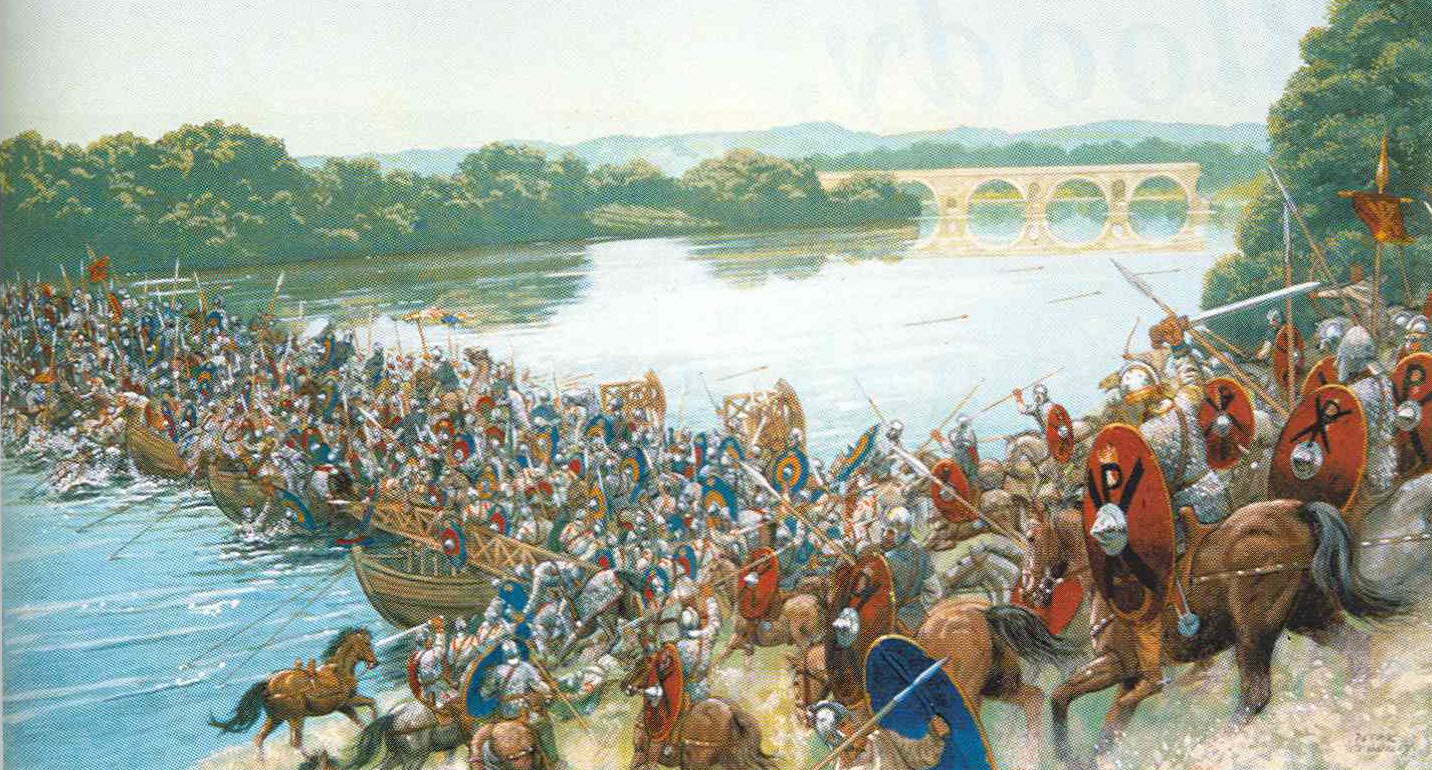
Once we embarked upon the subject of fights at bridges, we found, beginning with the late classical world, that there were lots more out there (our short mental list roared through time to take us as far as the seizing of Pegasus Bridge in the Normandy invasion and the subsequent bridges at Arnhem and Remagen). There was a difficulty, however: we began with an heroic action—one man or a handful against masses. What mostly came to mind was not Horatian one-man stands. Instead, they were only depicted as parts of larger military maneuvers to gain or block a crossing and individuals disappeared. Take, for example the famous battle at the Milvian Bridge, in 312AD, which led not only towards a reconstituted Roman world based upon the east, but also towards the eventual Christianization of the Roman world.

4milvian.jpg

In the civil wars which wracked the late Roman empire, after its division post-284AD by Diocletian,

4adiocletian.jpg

4bdiocletiansdivision.jpg

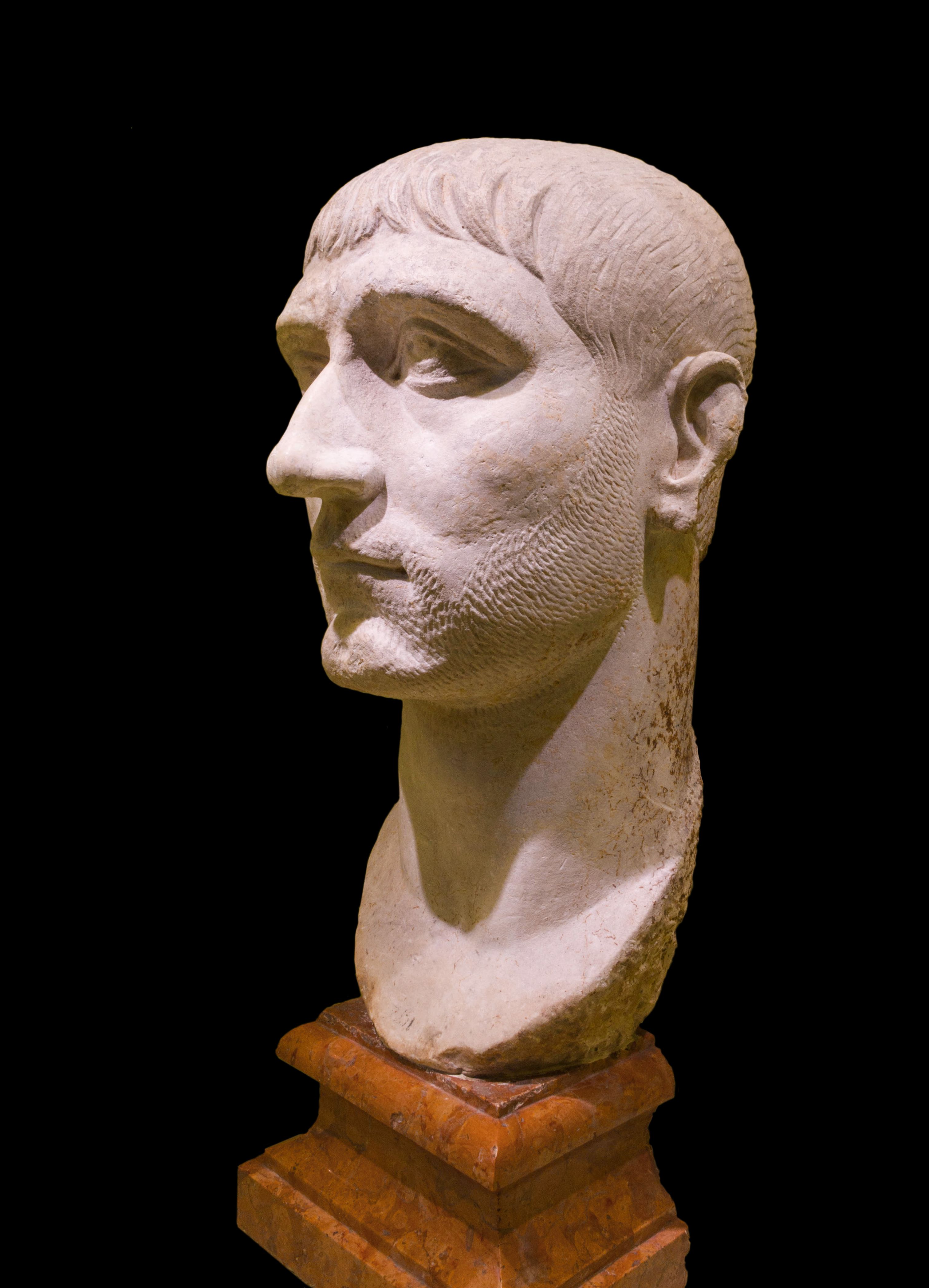
Constantine, the western Augustus (senior emperor)

5Constantine-I-Face.jpg

defeated his rival, Maxentius (who was also his brother-in-law),

6maxentius.jpg

at a bridge outside Rome to become, in time, the sole emperor. Maxentius, who had control of Rome, had planned to block Constantine on the far side of the Tiber, keeping a pontoon bridge available for a retreat, if necessary, since it appears that the actual stone bridge was in the process of being dismantled.

(The Romans were extremely able at producing pontoon bridges—here’s a good illustration from the column of Marcus Aurelius—completed 193AD–)

When that retreat did become necessary, Maxentius was drowned in its midst, the bridge collapsed, and his troops who remained either died on the field or surrendered to Constantine.

4milvian.jpg

In time, Constantine, who believed that the empire’s main focus should actually be on the east, moved the capital to an old Greek colony, called Byzantium, but which he renamed “New Rome”—although it seems that everyone else called it Constantinople.

7constantinople.jpg

This would be the capital of the later Byzantine Empire, which, under the emperor Justinian,

8justinian.jpg

(He’s the one with the bowl of communion bread—the only labeled figure, Maximianus, was the bishop of Ravenna, where this mosaic stands in the church of San Vitale.)

would attempt to reconquer the portions of the old western empire which had fallen into the hands of Germanic invaders.

9germanicinvasions.jpg

Under Justinian’s general, Belisarius,

10belisarius.jpg

(this may or may not be a portrait—it’s a scholarly guess),

the Byzantines struggled for control of Rome against the Ostrogoths.

11ostrogoth.jpg

This struggle included a fight outside of Rome for control of the Salarian Bridge (537AD),

12salarianbridge.jpg

a fight which Belisarius lost, although, for a short time, Justinian’s world was enlarged, if not to the full size of the old empire, at least to include much of the western Mediterranean—quite an accomplishment for the later world of antiquity.

12ajustempire.jpg

And, speaking of late antiquity, if you regularly read our blog, you know that we have a special affection for the work of Hal Foster, who created the late-antique, early-medieval world of Prince Valiant. The combination of bridge and heroic fighting reminded us of one of our favorite illustrations and so we have to include this scene (published 19 June, 1938), in which Val faces a band of Viking raiders.

13valatbridge.jpg

This image, of course, brings us back to Horatius, the single warrior against the mass. As we’ve said, in the intervening centuries there are battles at bridges, but only as one element in larger campaigns and the heroic individual disappears into the ranks. We could think of one, somewhat later, figure, however. He appears, unfortunately nameless, in the other battle of the short reign of Harold Godwinson, at Stamford Bridge, 25 September, 1066. The Anglo-Saxon army raced north from London to oppose a Viking invasion, and defeated the Vikings on the near side of the bridge over the River Derwent, but, to complete their victory, the Anglo-Saxons needed to destroy the surviving force on the far side. in the way stood, in the middle of Stamford Bridge, a single Viking warrior, blocking their advance.

14stamfordbridge.jpg

The Anglo-Saxon Chronicle says that he killed 40 of the enemy before an Anglo-Saxon floated underneath the bridge and stabbed him from beneath with his spear, but, well, as much as we believe in heroic tales…

His stand, however, brings us back to Boromir and his final battle, in which he faces two waves of orcs before he is finally mortally wounded.

15boromirdeath.jpg

No bridge, but this still follows the theme of the brave man standing alone, with no possible help nearby.

16boromirhorn.jpg

(And, of course, Boromir and his horn are meant to remind any good reader of heroic material—particularly medieval—of Roland at the Pass of Roncevalles…)

17roland.jpg

We would leave this theme here, back where it began, with Boromir, except we can’t resist (we’re afraid, when it comes to adventure and heroics, that we appear to have little or no willpower at all!) one final image and the idea behind it. There is no end of discussion about Napoleon, which, we’re sure, would please him no end. For us, however, there is a side of him which is endlessly interesting and that is as a Romantic Figure—a view of himself which he worked very hard, at least early in his life, to promote. The late 18th-century very much looked back to the classical world and, we believe, it did so in part because it loved the dramatic gestures it saw as part of that world. We only have to point out paintings like David’s “The Oath of the Horatii”(those Horatii being the direct ancestor of the one in our post), with its operatic ensemble look, to illustrate this. (To us, this looks so much like the set-up for a stirring quartet, right out of Bellini or Meyerbeer.)

18horatii.jpg

So, during Bonaparte’s brilliant 1796-7 campaign in Italy, there was clearly a classical/Romantic moment. When the French were stalled by their Austrian opponents in crossing the River Adige, Napoleon, to encourage his troops, seized a regimental color and raced alone to the bridge, as Gros (who was actually at the battle) depicted him in his 1797 painting.

19grosarcola.jpg

Vernet, in his 1826 version, continues the heroic theme, but changes the focus a bit—Napoleon now has followers. (And you know, from its dash—and that’s Horace Vernet in general—who, according to Sherlock Holmes, may be a distant relation–that this is a favorite painting of ours.)

20vernetarcola.jpg

In fact, although Bonaparte did seize a color, he never made it to the bridge, either alone or in a crowd. His illustrators, however, influenced, no doubt, by the potential drama—and perhaps by a faint memory of Horatius?—depict a scene which should have happened, in their view of Napoleon as a Romantic Figure. What is most striking, however, is that, unlike Horatius—or Boromir—Bonaparte is not defending a bridge—he is attacking and his heroism comes from that gesture. This certainly fits in with Revolutionary ideology—France had been at war with much of the world since 1792—but it occurs to us that it may also suggest a shift in the approach to heroism. Horatius, given a bridge, is heroic, but passive. Give a bridge to Bonaparte and stand back (at least in iconography)! Is this the image of heroes in the Romantic world which was just coming into being?

But, as ever, we leave this to you, dear readers, to ponder, even as we thank you, as always, for reading.

MTCIDC

CD

The Doubtful Sea Series Facebook Page

The Doubtful Sea Series Facebook Page

  • Ollamh

Categories

  • Artists and Illustrators
  • Economics in Middle-earth
  • Fairy Tales and Myths
  • Films and Music
  • Games
  • Heroes
  • Imaginary History
  • J.R.R. Tolkien
  • Language
  • Literary History
  • Maps
  • Medieval Russia
  • Military History
  • Military History of Middle-earth
  • Narnia
  • Narrative Methods
  • Poetry
  • Research
  • Star Wars
  • Terra Australis
  • The Rohirrim
  • Theatre and Performance
  • Tolkien
  • Uncategorized
  • Villains
  • Writing as Collaborators
Follow doubtfulsea on WordPress.com

Across the Doubtful Sea

Recent Postings

  • A Moon disfigured December 17, 2025
  • On the Roads Again—Once More December 10, 2025
  • (Not) Crossing Bridges December 3, 2025
  • On the Road(s) Again—Again November 26, 2025
  • On the Road(s) Again November 19, 2025
  • To Bree (Part 2) November 12, 2025
  • To Bree (Part 1) November 5, 2025
  • A Plague o’ Both—No, o’ All Your Houses! October 29, 2025
  • It’s in Writing (2:  I’st a Prologue, or a Poesie for a Ring?) October 22, 2025

Blog Statistics

  • 103,217 Views

Posting Archive

  • December 2025 (3)
  • November 2025 (4)
  • October 2025 (5)
  • September 2025 (4)
  • August 2025 (4)
  • July 2025 (5)
  • June 2025 (4)
  • May 2025 (4)
  • April 2025 (5)
  • March 2025 (4)
  • February 2025 (4)
  • January 2025 (5)
  • December 2024 (4)
  • November 2024 (4)
  • October 2024 (5)
  • September 2024 (4)
  • August 2024 (4)
  • July 2024 (5)
  • June 2024 (4)
  • May 2024 (5)
  • April 2024 (4)
  • March 2024 (4)
  • February 2024 (4)
  • January 2024 (5)
  • December 2023 (4)
  • November 2023 (5)
  • October 2023 (4)
  • September 2023 (4)
  • August 2023 (5)
  • July 2023 (4)
  • June 2023 (4)
  • May 2023 (5)
  • April 2023 (4)
  • March 2023 (5)
  • February 2023 (4)
  • January 2023 (4)
  • December 2022 (4)
  • November 2022 (5)
  • October 2022 (4)
  • September 2022 (4)
  • August 2022 (5)
  • July 2022 (4)
  • June 2022 (5)
  • May 2022 (4)
  • April 2022 (4)
  • March 2022 (5)
  • February 2022 (4)
  • January 2022 (4)
  • December 2021 (5)
  • November 2021 (4)
  • October 2021 (4)
  • September 2021 (5)
  • August 2021 (4)
  • July 2021 (4)
  • June 2021 (5)
  • May 2021 (4)
  • April 2021 (4)
  • March 2021 (5)
  • February 2021 (4)
  • January 2021 (4)
  • December 2020 (5)
  • November 2020 (4)
  • October 2020 (4)
  • September 2020 (5)
  • August 2020 (4)
  • July 2020 (5)
  • June 2020 (4)
  • May 2020 (4)
  • April 2020 (5)
  • March 2020 (4)
  • February 2020 (4)
  • January 2020 (6)
  • December 2019 (4)
  • November 2019 (4)
  • October 2019 (5)
  • September 2019 (4)
  • August 2019 (4)
  • July 2019 (5)
  • June 2019 (4)
  • May 2019 (5)
  • April 2019 (4)
  • March 2019 (4)
  • February 2019 (4)
  • January 2019 (5)
  • December 2018 (4)
  • November 2018 (4)
  • October 2018 (5)
  • September 2018 (4)
  • August 2018 (5)
  • July 2018 (4)
  • June 2018 (4)
  • May 2018 (5)
  • April 2018 (4)
  • March 2018 (4)
  • February 2018 (4)
  • January 2018 (5)
  • December 2017 (4)
  • November 2017 (4)
  • October 2017 (4)
  • September 2017 (4)
  • August 2017 (5)
  • July 2017 (4)
  • June 2017 (4)
  • May 2017 (5)
  • April 2017 (4)
  • March 2017 (5)
  • February 2017 (4)
  • January 2017 (4)
  • December 2016 (4)
  • November 2016 (5)
  • October 2016 (6)
  • September 2016 (5)
  • August 2016 (5)
  • July 2016 (5)
  • June 2016 (5)
  • May 2016 (4)
  • April 2016 (4)
  • March 2016 (5)
  • February 2016 (4)
  • January 2016 (4)
  • December 2015 (5)
  • November 2015 (5)
  • October 2015 (4)
  • September 2015 (5)
  • August 2015 (4)
  • July 2015 (5)
  • June 2015 (5)
  • May 2015 (4)
  • April 2015 (3)
  • March 2015 (4)
  • February 2015 (4)
  • January 2015 (4)
  • December 2014 (5)
  • November 2014 (4)
  • October 2014 (6)
  • September 2014 (1)

Blog at WordPress.com.

  • Subscribe Subscribed
    • doubtfulsea
    • Join 78 other subscribers
    • Already have a WordPress.com account? Log in now.
    • doubtfulsea
    • Subscribe Subscribed
    • Sign up
    • Log in
    • Report this content
    • View site in Reader
    • Manage subscriptions
    • Collapse this bar
 

Loading Comments...