Tags
Fantasy, Gandalf, lotr, rhetoric, Saruman, Sauron, speaking villain, The Lord of the Rings, The Ring, Tolkien
As ever, welcome, dear readers.
How do antagonists talk?
If you do a quick search of the internet for discussion on creating villains, you can be almost overwhelmed with all the advice you find. Much is about behavior, but one important point which I’ve seen more than once (I’m quoting here from Gillian Adams’ website) is to avoid: “1. Grandiose Speeches”. (For more of her list, see: https://gillianbronteadams.com/2011/12/villainy-101/ ) Such speeches can easily lead to what beginning writers are often warned against and which is commonly called an “information dump”, where an author employs that grandiose speech to fill in a great deal of plot—often criticized as lazy writing.
Tolkien was certainly, if anything, not a lazy writer and I thought that it would be fun to look at the speech not of one antagonist, but of several, in The Lord of the Rings to see how he portrays their dialogue and, through it, them.
Sauron, the chief antagonist, although he presents the main difficulty in the story has, unfortunately, few lines—just questions and imperatives—but then he’s only an eye—

although I suppose we could take that brevity as implying that, as a character, he is nothing but a strong will, used to making demands on all those around him and expecting instant obedience.
So let’s begin with his (although he doesn’t know it) minion, Saruman—
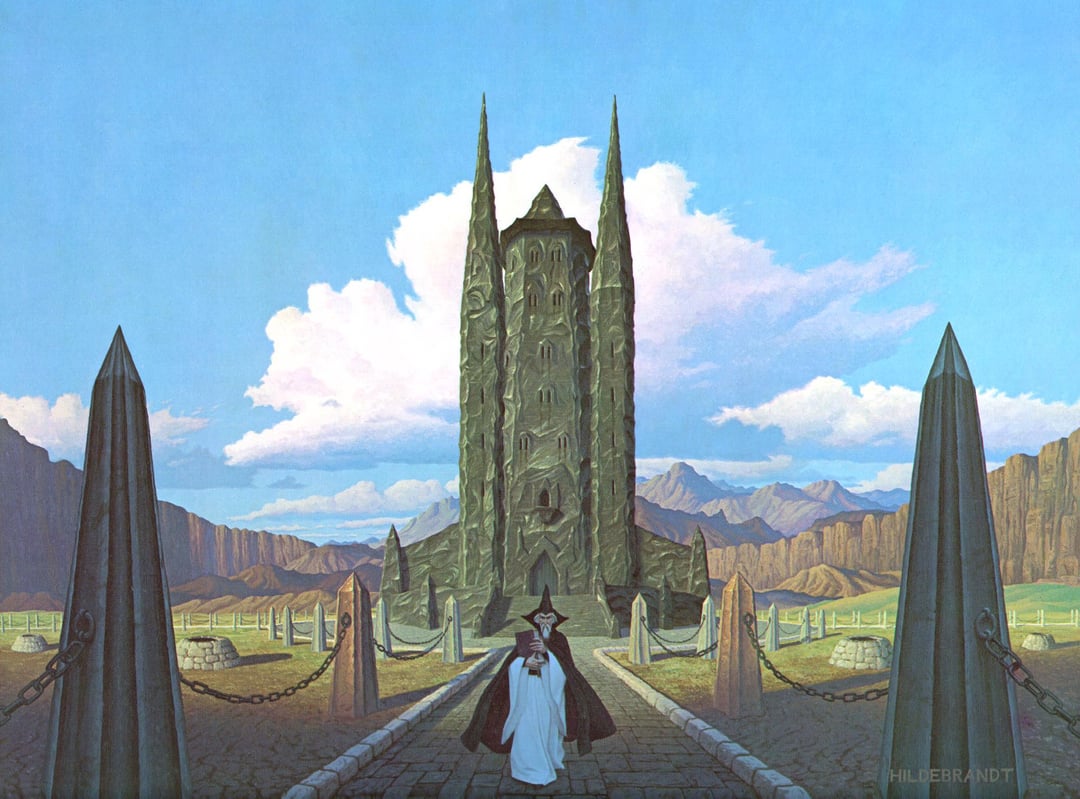
(the Hildebrandts)
as initially reported by Gandalf.
Saruman, although, through Radagast the Brown, has sent for Gandalf, is hardly welcoming:
“ ‘So you have come, Gandalf…For aid? It has seldom been heard of that Gandalf the Grey sought for aid, one so cunning, so wise, wandering about the lands, and concerning himself in every business, whether it belongs to him or not.’”
This leads him to continue:
“ ‘How long, I wonder, have you concealed from me, the head of the Council, a matter of greatest import? What brings you now from your lurking-place in the Shire?’ ”
So, we hear sarcasm,–“so cunning, so wise” and “lurking-place”–but then there’s something more—and it seems characteristic of Saruman that this villain, at least, can be quite roundabout in coming to the point—the real point—of his invitation. But then we’re shown something which begins to look like he’s launching into the Grandiose–
“ He drew himself up then and began to declaim, as if he were giving a speech long rehearsed“ Gandalf begins—and notice that we’re being given stage directions, providing us with an idea not only of Saruman’s posture, but of his tone—this is an oration, not an intimate conversation:
“ ‘The Elder Days are gone. The Middle Days are passing. The Younger Days are beginning. The time of the Elves is over, but our time is at hand: the world of Men, which we must rule. But we must have power, power to order all things as we will, for that the good which only the Wise, can see.’ “
Here, in true oratorical fashion, Saruman provides a preface: three grand ages—and note, as well, that rhetorical pattern of three—of which the first is gone, the second about to be gone, and the third just coming into being. And then he begins to come to his point—but only begins: “the world of Men, which we must rule.” Upon which he then expands: “But we must have power, power to order all things as we will, for that good which only the Wise can see.”
So far, then, this definitely might seem like it was leaning towards the Grandiose—although JRRT has already suggested that Gandalf is aware of that lean by having him say that Saruman seems not to be speaking naturally, but declaiming. At the same time, however, we can also see that, although Saruman’s subject is power, he suggests that Gandalf is his natural confederate in gaining it, attempting flattery—“…we must have power, power to order all things as we will…’ ” and that “we” are the [capital W] Wise.
From declamation, Saruman slips into the more conversational—really conspiratorial—tone:
“ ‘And listen, Gandalf, my old friend and helper!’ he said, [and another stage direction here] coming near and speaking now in a softer voice, ‘I said we, for we it may be, if you will join with me.’ “
From a history lesson, Saruman has quickly exposed his real theme, and he continues:
“ ‘A new Power is rising. Against it the old allies and policies will not avail us at all. There is no hope left in Elves or dying Numenor.’ “
So—not even men—after all, Numenorians—or, rather the descendants of the Numenorians—are men—are enough, and the Elves are just about out of the picture, meaning that, potentially, not only is there no hope left in either of them, but no hope left at all—but hope of what, Saruman has not yet said. He’s about to hint at it, however, continuing his roundabout method:
“ ‘This then is one choice left before you, before us. We may join with that Power. It would be wise, Gandalf. There is hope that way. Its victory is at hand; and there will be rich reward for those that aided it.’ “
Still not saying what that hope might be of—until
“ ‘As the Power grows, its proved friends will also grow; and the Wise, such as you and I, may with patience come at last to direct its courses, to control it.’ “
Saruman’s hope, then, is that he—uh, they—although unable to resist that Power (as Saruman persists in capitalizing it), can come to be its directors—
“ ‘We can bide our time, we can keep our thoughts in our hearts, deploring maybe evils done by the way…’ “
And now, discarding rhetoric, Saruman has begun to reveal himself: once sent by the Valar as a counterbalance to Sauron, to gain his own power, Saruman is willing to act like the very one he was sent against—or worse:
“ ‘…but approving the high and ultimate purpose: Knowledge, Rule, Order; all the things that we have so far striven in vain to accomplish, hindered rather than helped by our weak or idle friends.’ “
If the Valar had meant the Maiar, the Wizards, to oppose Sauron, their purpose was certainly not to gain abstractions like “Knowledge, Rule, Order” (which sounds like something from Orwell’s 1984) and Saruman gives away his own “high and ultimate purpose” in this and underlines it with:
“ ‘There need not be, there would not be, any real change in our designs, only in our means.’ “
Tolkien so far, then, has shown Saruman through his speech as sarcastic, then pompous, acting like a public orator in front of a crowd, although speaking only to Gandalf—then sly, attempting to flatter by suggesting that:
1. Gandalf is his “old friend and helper”
2. and that, if Gandalf goes along, he, too, will be one of “the Wise”
as well as glossing over what Gandalf might object to—“deploring maybe evils done by the way”, to achieve goals which seem the very opposite of that of the Valar—“Knowledge, Rule, Order”, and continuing that slyness by not defining any of those, simply implying that Gandalf must already not only understand them, but have already been a partner in working towards them in the past—although we notice that, although he’s called Gandalf “his old friend”, he has added “and helper”, reducing Gandalf to a subordinate position with that one word.
Still, Saruman continues to be oblique—he talks about the Power, talks about somehow coming to manage and direct it although never suggesting how, but, when Gandalf objects, he comes a little closer to the point—with more stage directions: “drew himself up”, “speaking now in a softer voice”,
“He looked at me sidelong, and paused a while considering. ‘Well, I see that this wise course does not commend itself to you…Not yet? Not if some better way can be contrived?’
He came and laid his long hand on my arm. [Think here about Saruman’s badge—on the shields and helmets of his orcs]
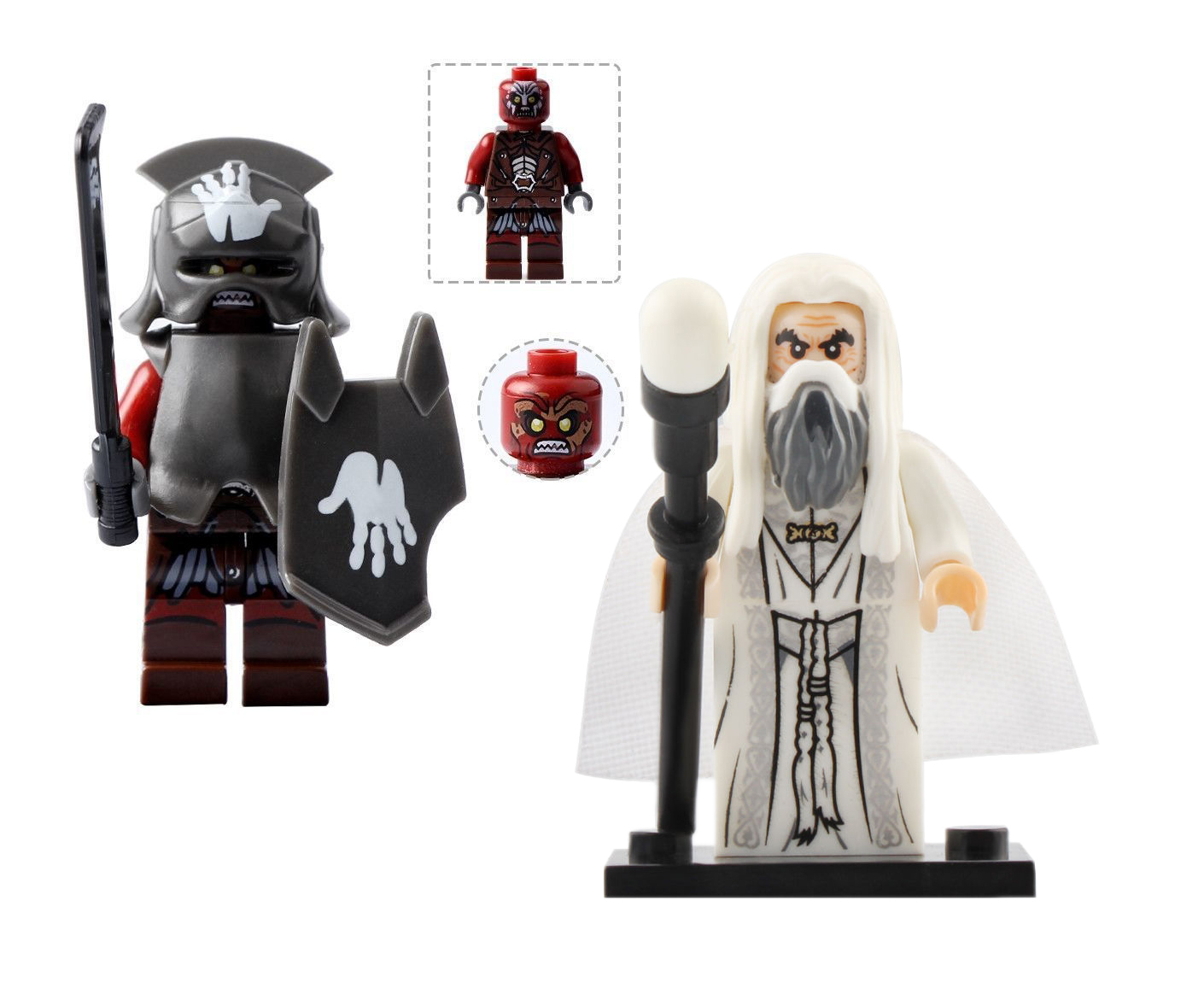
“ ‘And why not, Gandalf?’ he whispered. ‘Why not? The Ruling Ring?’ “
And now we come to the real reason for Saruman’s invitation:
“ ‘If we could command that, then the Power would pass to us. That is in truth why I brought you here. For I have many eyes in my service, and I believe that you know where this precious [from Saruman’s badge to Gollum with one word!]
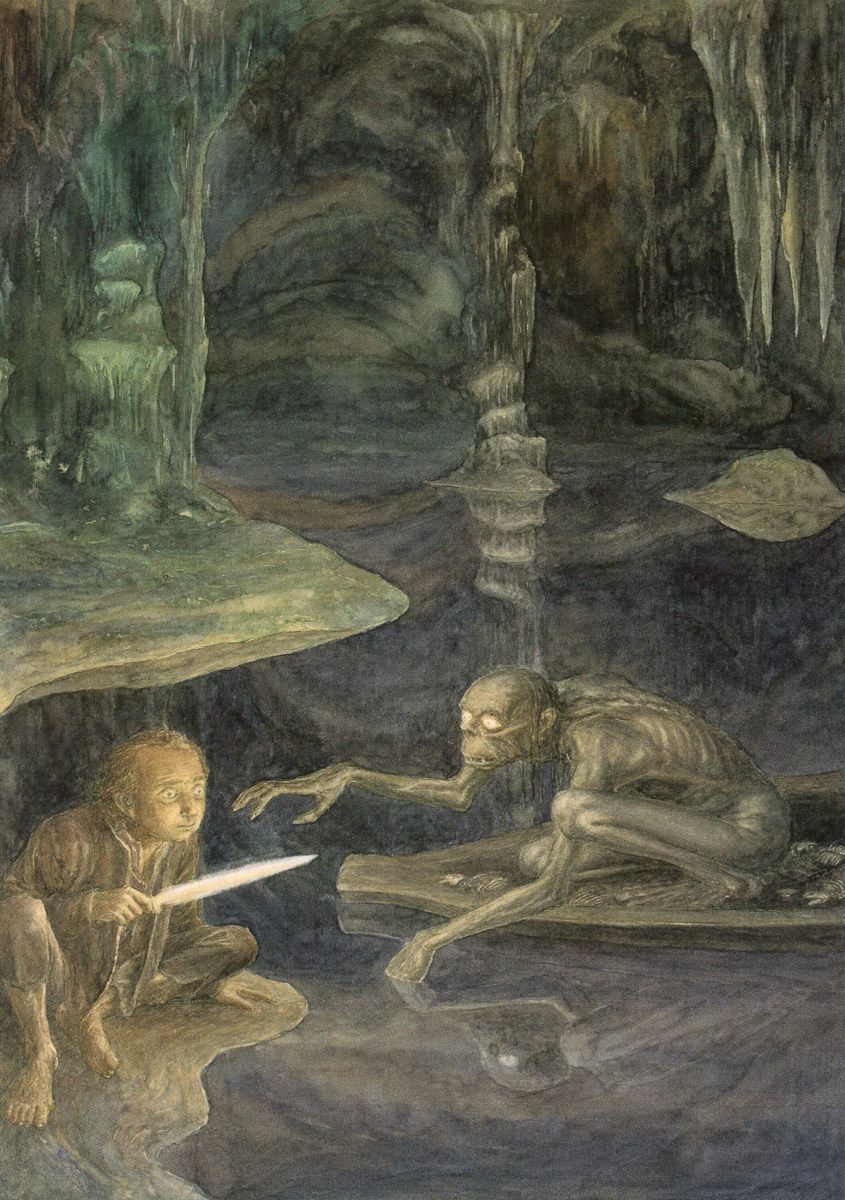
(Alan Lee)
thing now lies. Is it not so? Or why do the Nine ask for the Shire, and what is your business there?’ “
So, so far, we’ve seen Saruman’s speech as sarcastic, pompous/declamatory, sly, and whispering/conspiratorial, but, when Gandalf once more rejects his approach, he takes on one more tone–menace:
“He was cold now and perilous. ‘Yes,’ he said, ‘I did not expect you to show wisdom, even in your own behalf; but I gave you the chance of aiding me willingly, so saving yourself much trouble and pain. The third choice is to stay here, until the end…Until you reveal to me where the One may be found. I may find means to persuade you. Or until it is found in your despite, and the Ruler has time to turn to lighter matters: to devise, say, a fitting reward for the hindrance and insolence of Gandalf the Grey.’ “
(all of the quotations are from The Fellowship of the Ring, Book Two, Chapter 2, “The Council of Elrond”)
What has happened to “my old friend and helper”? and “the Power would pass to us”? Now it’s “I gave you the chance of aiding me” and someone wants to become “the Ruler”. Although Tolkien has provided us with a certain number of physical clues, as in“laid his long hand on my arm”, it’s in his manner of speaking and how it changes throughout the scene that we see Saruman, once the Head of the Maiar, become “Saruman the Wise, Saruman Ring-maker, Saruman of Many Colours!”, traitor to the good people of Middle-earth, far from his original mission, and ultimately not “the Ruler” he foolishly assumes that he will be, with or without Gandalf.
In Part 2, we’ll move from this greater villain to much lesser ones, to see what their speech tells us about them.
As always, thanks for reading.
Stay well,
Beware of people who call you “my old friend”, and then threaten you,
And remember that, as always, there’s
MTCIDC
O
PS
For more on Saruman’s manner of speaking—in his second appearance, when he’s a prisoner in his own tower—see: “By Ear (2)”, 14 May, 2025.
 doubtfulsea