• About

doubtfulsea

~ adventure fantasy

Tag Archives: Sortes Tolkienses

Shadowy

11 Wednesday Sep 2019

Posted by Ollamh in Fairy Tales and Myths, J.R.R. Tolkien, Literary History

≈ Leave a comment

Tags

A Child's Garden of Verses, Adelbert von Chamisso, Andrew Lang, Ausgabe des Fortunatus, Charles Perrault, Fortunatus' fortune-bag, Histoires ou Contes du Temps Passe, J.M. Barrie, Le Petit Poucet, Lord Dunsany, Peter Pan, Peter Schlemihl, Peter Schlemihls Wundersame Geschichte, Robert Louis Stevenson, seven-league boots, Shadow, Siglo de Oro, Sortes Tolkienses, The Charwoman's Shadow, The Grey Fairy Book, The Lord of the Rings, Tolkien

Welcome, dear readers, as always.

We were practicing our sortes tolkienses (one way of finding a topic—by simply slipping a finger into The Lord of the Rings and opening it at that page—it’s not 100% useful, but sometimes…) and came upon the title of Chapter 2 of Book One of The Fellowship of the Ring:  “The Shadow of the Past”.

In the context of the chapter, we see that that shadow is cast by the history of the Ring itself and also by its maker, Sauron.  That, in turn, set us off on thinking about literary shadows…

In 1885, Robert Louis Stevenson (1850-1894)

image1rls.jpg

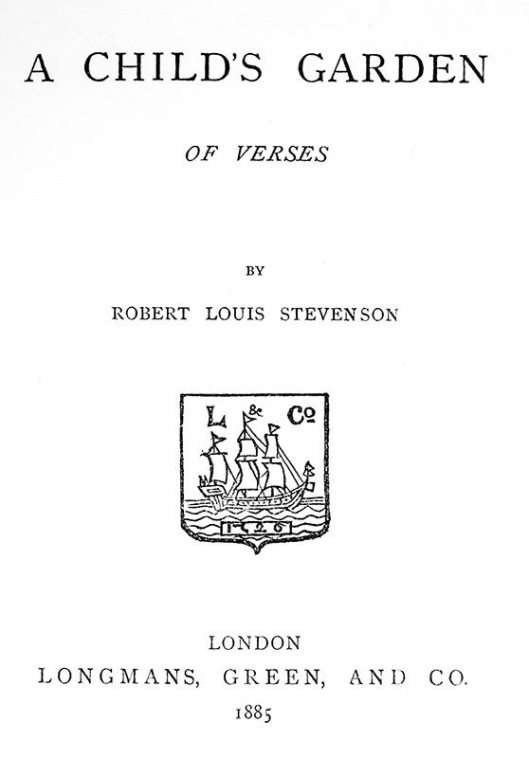
published a collection of poems.

image2achilds.jpg

Poem #19 (if you count the dedication, which is, in fact, a poem) begins:

“I have a little shadow that goes in and out with me,

And what can be the use of him is more than I can see.”

[If you would like your own copy of this volume, follow this LINK.]

In fact, in literature, its use is both visible—and invisible.

In psychology, the shadow is metaphorical, being used to symbolize an unconscious part of the personality.  [For more on this, see this LINK.]

And, visibly—but also invisibly—the shadow as physical object can represent something more, as we find in perhaps the first modern literary use of the shadow in Adelbert von Chamisso’s (1781-1838)
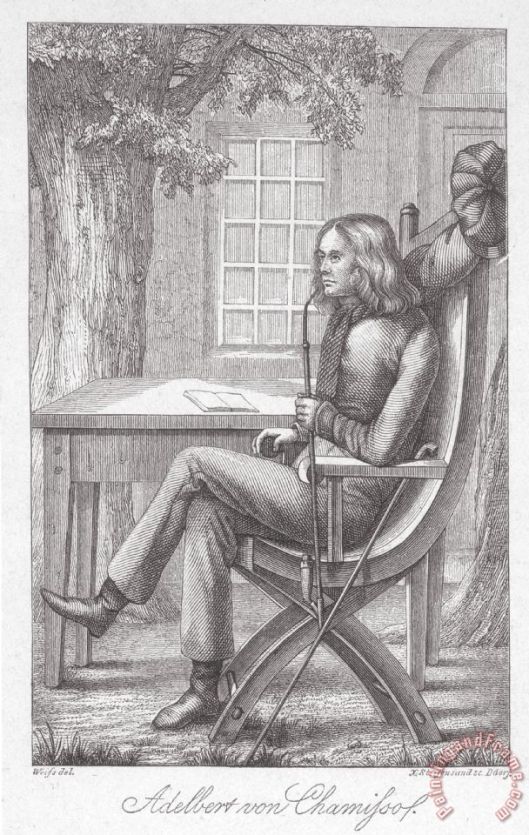
image3avonc.jpg

novella (a short novel), Peter Schlemihls Wundersame Geschichte (1814), “Peter Schlemihl’s Amazing Story”.

image4ps.jpg

Here’s the first English translation, from 1824.

image5firsteng.jpg

In the story, the protagonist, Peter Schlemihl, meets a strange man, who can pull anything out of his pocket—and we mean anything.  As Schlemihl reports:

“If my mind was confused, nay terrified, with these proceedings, how was I overpowered when the next-breathed wish brought from his pocket three riding horses.  I tell you, three great and noble steeds, with saddles and appurtenances!  Imagine for a moment, I pray you, three saddled horses from the same pocket which had before produced a pocket-book, a telescope, an ornamented carpet twenty paces long and ten broad, a pleasure-tent of the same size, with bars and iron-work!”

(This is from the 3rd edition (1861) of that first English translation.)

Impressed, Schlemihl is quickly persuaded to make a trade.  The strange man offers him a magic purse, which he calls “Fortunatus’ fortune-bag”.  This object is based on an old story which seems to appear for the first time in 1509 as Ausgabe des Fortunatus (the “Edition/Issue of Fortunatus”?), in which Fortunatus (as you’ll probably guess, the name means “Lucky”) has both a wishing cap and this bag.  Here’s the title page of that first edition.

image6fort


[If you would like to read one version of the Fortunatus story, here is a link to it from Andrew Lang’s The Grey Fairy Book (1900).]

The purse will always produce ten gold coins when one puts a hand inside, guaranteeing a steady means of wealth for the owner.  In return for this, Schlemihl hands over–his shadow.

image7ps.jpg

This seems an odd trade, but having a magic bag which acts as an endless bank account is certainly no less strange.  Not to be too literal-minded, but beyond the idea that a shadow is a tradable item, it makes us wonder, however:  what could a shadow be made of that it can be removed and collected?

At the beginning of Peter Pan (1904), Peter has lost his shadow and Wendy reattaches it by sewing it on, as if it were simply mobile black cloth and perhaps this is how we might think about it as a physical object, at least for shadow stories.
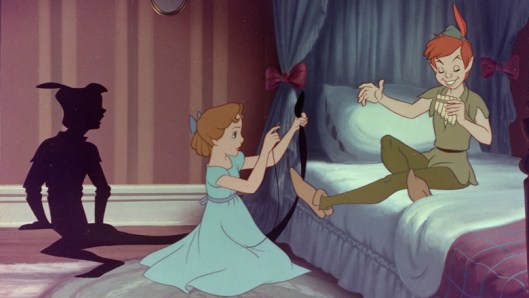
image8asewing.jpg

Although he is pleased with the money, Schlemihl soon realizes the real price he has paid:  when people see that he has no shadow, they avoid him in anything from disgust to horror, which ruins his ability to live anywhere and even to marry the girl he wishes.  The shadow, then, is more than cloth:  it is part of a person’s identity.  If you cast no shadow, you are not quite human.  The real price of the shadow is even higher, however, as Schlemihl learns when the strange man (who is obviously Satan in human form) returns to offer a second bargain:  the Devil will return his shadow in return for his soul.

It’s clear that here Schlemihl has learned his lesson, refusing this offer several times and finally throwing away the “fortune-bag”.  Although he may believe that he is done with magic, magic is not yet done with him, however.  With some of the few coins remaining to him, by accident (or so it seems), he buys a pair of seven-league boots.  (A “league”, classically, is about three miles, so, when he puts them on, each step he takes is at least twenty-one miles.)

image8seven


This element of the story, in turn, is also based on something in another older story, which appears in Charles Perrault’s (1628-1703)

image9perrault.jpg

1697 collection, Histoires ou Contes du Temps Passe,

image10histoires.jpg

“Le Petit Poucet” (maybe “Thumblet”?).  In this story, a character steals a pair of these boots from a pursuing ogre, allowing the thief to cover great distances with every stride.

[If you’d like to read this story, here’s a LINK from a 1901 translation.]

With these boots, Schlemihl never regains his shadow, but eventually gains a peaceful existence studying the natural world (which, in fact, von Chamisso did, as well, becoming a well-known naturalist later in life).

[Here’s a LINK to a translation of the story by Michael Haldane.]

More than a century later, the early modern fantasy writer, Lord Dunsany (1878-1957)

image11ld.jpg

reused the idea of buying or trading shadows in his 1926 novel, The Charwoman’s Shadow.

image12char.jpg

A charwoman, or, simply, “char” (“char” is the same as “chore”, meaning “a task”), in the UK means a kind of cleaning woman.

image13chars.jpg

When it comes to fantasies, the idea that this may be about the shadow not of a princess, or at least a lady in distress, but of an ordinary cleaning lady, is immediately intriguing, but the charwoman isn’t really the main character.  That’s Ramon, the son of an impoverished Spanish nobleman.

To earn money for his sister’s dowry, as well as to find a profession, Ramon apprentices himself to a wizard who deals, among other things, in shadows.  As payment for his learning, Ramon uses his shadow—but, just like Peter Schlemihl before him, quickly comes to regret it.  The charwoman works in the wizard’s house and, as Ramon slowly learns spells, he also learns her story and what has happened to her since she traded away her shadow long before.

In a moment of chivalry (the story takes place in Spain in what’s called the Siglo de Oro, the “Golden Century”—the early 16th to the later 17th centuries–when wealth from the New World made Spain a world power, as well as a leader in the arts), Ramon promises to rescue the Charwoman’s shadow for her.  In the house of a wizard, you can imagine that this won’t be easy, but, eventually, and through ingenuity, he does so, only to discover that—but you should really read the story for yourself.

[Unfortunately, as this book was published in 1926, it’s still under copyright here in the US, so we can’t offer our usual LINK, but we can offer you Peter and Wendy (1911), the novel version of Barrie’s 1904 play—LINK.]

In contrast to shadows which can be traded or lost, what’s interesting to us about Sauron’s shadow is that it’s no more than a suggestion of the appearance of its owner, who, although he casts that shadow over all of Middle-earth, never appears physically in the novel.  The Nazgul—shadowy figures themselves—represent him, but Sauron himself is never more than a shadow and, in fact, when he is eventually destroyed, it’s his shadow we see broken and swept away:

“And as the Captains gazed south to the Land of Mordor, it seemed to them that, black against the pall of cloud, there rose a huge shape of shadow, impenetrable, lightning-crowned, filling all the sky.  Enormous it reared above the world, and stretched out towards them a vast threatening hand, terrible but impotent:  for even as it leaned over them, a great wind took it, and it was all blown away, and passed; and then a hush fell.”  (The Return of the King, Book Six, Chapter 4, “The Field of Cormallen”)

That “little shadow”, then, certainly has more uses than the child in Stevenson’s poem will ever see.

Thanks, as ever, for reading.

MTCIDC

CD

Tintinnabulations

24 Wednesday May 2017

Posted by Ollamh in Fairy Tales and Myths, J.R.R. Tolkien, Literary History, Narrative Methods

≈ Leave a comment

Tags

Asfaloth, bells, Child Ballad, dance, Edgar Allan Poe, Glorfindel, Headless Horseman, Joan of Arc, John Howe, Medieval, Minas Tirith, Morris Dance, Nazgul, Sir Gawain and the Green Knight, Sortes Tolkienses, Sortes Vergilianae, sun-down bells, The Hobbit, The Legend of Sleepy Hollow, The Lord of the Rings, Thomas the Rymer, tocsin, Tower of Echthelion

Welcome, once more, dear readers.

The sources of our postings come from all sorts of places. Sometimes, we are reading something and we have an idea, or we spot an image or see a film. Sometimes, it’s from a friend’s e-mail, or reaction to an earlier posting. Sometimes they come from our sortes tolkienses. If you’ve missed our original posting where we invented this, it’s based upon an ancient fortune-telling method, where one closes one’s eyes, opens an important book, like the Aeneid or the Bible, puts one’s finger on a verse—and hopes that it tells you something about the day or the future. In our case, we use The Lord of the Rings or The Hobbit.

And what did we find today? This, from The Lord of the Rings—

“Hand in hand they went back into the City, the last to pass the Gate before it was shut; and as they reached the Lampwrights’ Street all the bells in the towers tolled solemnly.” (The Return of the King, Book Five, Chapter 1, “Minas Tirith”)

These are the “sun-down bells”, as Pippin learns from Bergil, son of Beregond. Bergil is a boy of Minas Tirith and has just given Pippin a tour of the city.

“Sun-down bells” made us think first about the bells of Minas Tirith, and then about bells in Middle-earth in general, and we could easily pick out three kinds.

To begin with, there are the city bells. Or, rather, where are the city bells? The text says “in the towers”. In the medieval world in which we so often find illustrations and parallels to Middle-earth, those bells are commonly in church belfries.

image1medievalbell.png

image2ringing.jpg

image3belltower.jpg

Minas Tirith clearly has towers—and, in fact, is a towering place—literally:

“…the Tower of Echthelion, standing high within the topmost wall, shone out against the sky, glimmering like a spike of pearl and silver, tall and fair and shapely, and its pinnacle glittered as if it were wrought of crystals; and white banners broke and fluttered from the battlements in the morning breeze, and high and far he heard a clear ringing as of silver trumpets.” (The Return of the King, Book Five, Chapter 1, “Minas Tirith”)

Because there are no churches—or even temples—in Minas Tirith, by examining some images of the city, from John Howe’s painting to the model used in the films, we can pick out towers here and there and some of those, we might imagine, could hold bells.

image4howe

image5mtIn our medieval world, such bells had a number of functions. Not only did they ring the hours of the medieval Christian day, but they could also sound a warning, called the “tocsin”, and signal that the day was over and that fires should be covered for the night, the “curfew”—rather like the “sun-down” bells in Minas Tirith. Joan of Arc (c.1412-1431) said that she could sometimes hear the sound of angelic voices, inspiring her to drive the English out of France, in her village bell.
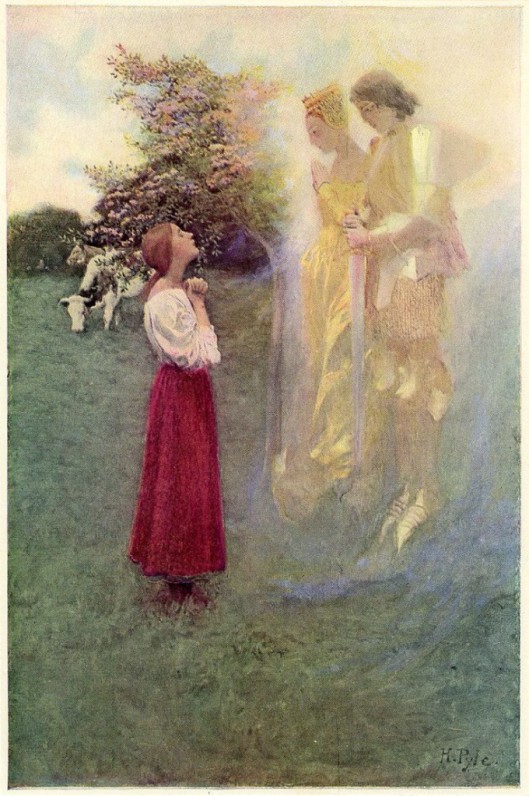
image6joan.jpg

There are other uses—and places—for bells in Middle-earth, however. In The Fellowship of the Ring, Book One, Chapter 1, “A Long-Expected Party”, they turn up at an impromptu dance:

“Master Everard Took and Miss Melilot Brandybuck got on a table and with bells in their hands began to dance the Springle-ring: a pretty dance, but rather vigorous.”

The wording of this sounds like it came from the “society section” of a newspaper, as not only are the hobbits’ names given, but given with their social titles—“Master” and “Miss”—to show that they are unmarried.

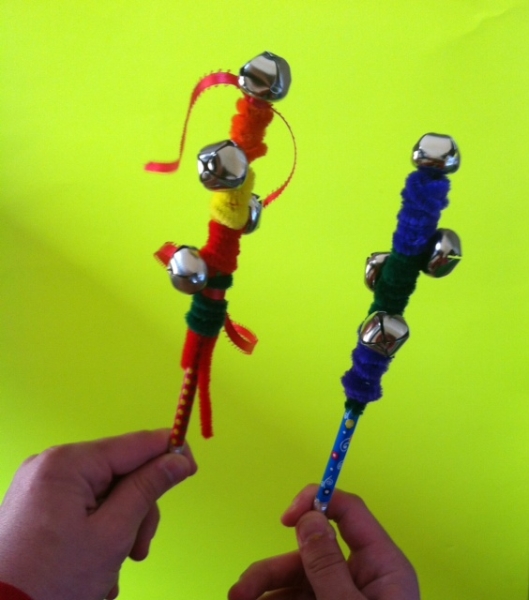
The boisterous dance, being energetic and accompanied by bells, makes us think of traditional English Morris dances, where the dancers not only strap bells to their arms and legs, but occasionally carry sticks with bells attached to them.

image7morrisOLYMPUS DIGITAL CAMERAimage9jinglestick

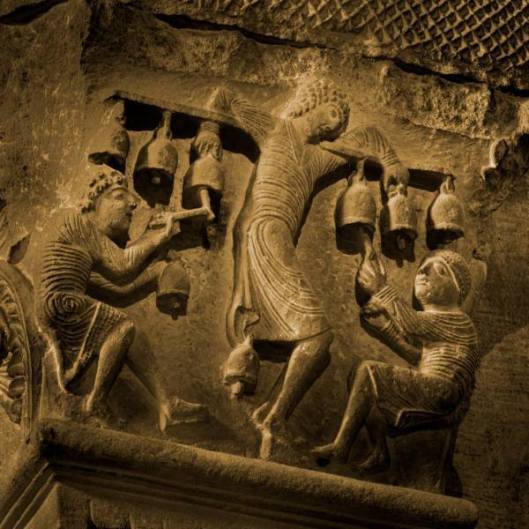
This also makes us think about medieval music bands, which could include a percussionist who played bells.

image10medbellersimage11bellplayers

A further use is as decoration—and perhaps as something more. When Aragorn is leading the hobbits, with the wounded Frodo, towards Rivendell, they heard “a sound that brought sudden fear back into their hearts: the noise of hoofs behind them.” The fear is, of course, of pursuing Nazgul, depicted here first in an Alan Lee sketch, and then in a painting which we believe is by the Hildebrandts, of one of the Ringwraiths almost riding down Farmer Cotton.

image12nazgulimage13nazgul

[We are always struck, by the way, how the Nazgul bear a certain resemblance to the “Headless Horseman” from Washington Irving’s (1783-1859) story, “The Legend of Sleepy Hollow” (1820). Walt Disney made a musical version of this in 1949, which was shown on Disney tv programs in later years, around Halloween, and the image of the Horseman could always give us nightmares.]

image14headlessh

What Aragorn and the hobbits are actually hearing is the horse of the Elf lord, Glorfindel, Asfaloth—

“The sound of the hoofs drew nearer. They were going fast, with a light clppety-clippety-clip. Then, faintly, as if it was blown away from them by the breeze, they seemed to catch a dim ringing, as of small bells tinkling.” (The Fellowship of the Ring, Book One, Chapter 12, “Flight to the Ford”)

image15glorf

Although Frodo never explains why he says this, he exclaims, “That does not sound like a Black Rider’s horse…” The only difference in sound clearly is coming from the bells, perhaps on Asfaloth’s halter or bridle—or perhaps on his mane, as in the case of what might be a source for those bells, Child ballad 37 (we’re quoting from Variant A). 37 is called “Thomas Rymer” and describes the meeting of the actual 13th-century Thomas of Earlston with the Queen of Elfland. [We include a LINK here to the useful Wiki entry.)

image16tther

In the ballad, her horse is described as having

“At ilke tett [“every tuft/lock”] of her horse’s mane

Hung fifty silver bells and nine.”

We are always careful never to say, without documentary evidence, that such-and-such is “definitely” the source for something in JRRT, but this particular detail seems to line up so well:

  1. Glorfindel is an Elf
  2. so is the unnamed Queen
  3. each has bells on his/her horse

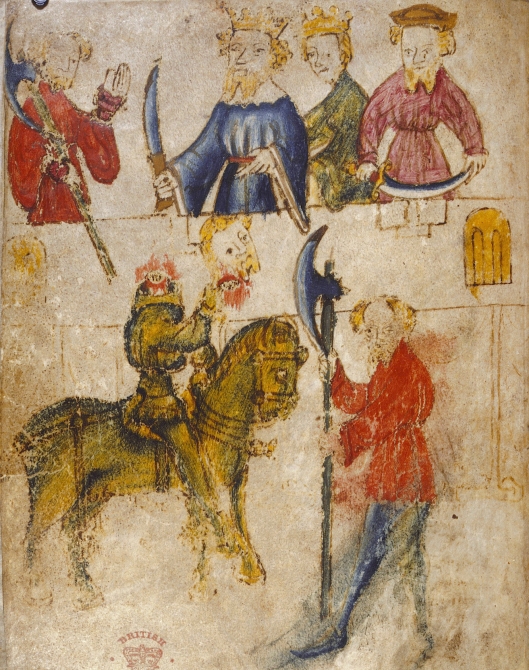
And these bells suggest—at least to Frodo—something unworldly, but, unlike the Nazgul, something positive. We can add to this another—okay, undeniable—source, and our evidence for this is JRRT himself. In 1925, Tolkien (in collaboration with E.V. Gordon) published an edition of the 14th-century Middle English poem, Sir Gawain and the Green Knight.

image17greenknight

The Green Knight is an enchanted being and part of his magic lies in his greenness and in the elaborate decoration of himself and his horse, including

“Ther mony bellez ful bry3t of brende golde rungen” (line 195)

This is only a preliminary investigation—done out of our heads, rather than from a thorough scouring of the text—so, can you, dear readers, think of other bells in The Lord of the Rings? We could think of two references in The Hobbit—but we leave it to you to guess where they are (and to find more?).

And thanks, as always, for reading.

MTCIDC

CD


PS

We include a LINK here to an appropriate poem which uses our title, Edgar Allan Poe’s, “The Bells” (1849).

And Whither Then?

25 Wednesday Nov 2015

Posted by Ollamh in Artists and Illustrators, Fairy Tales and Myths, J.R.R. Tolkien, Narrative Methods

≈ 1 Comment

Tags

Adrien Guignet, Aeneid, art, bibliomancy, Bilbo, Birth of Venus, Bouguereau, chimp painting, Chinese, critics, Cumae, Delphi, Etruscans, Frodo, future, Genesis, Greeks, Homer, Impressionism, It's a dangerous business going out your door, Joseph, Kansas City Royals, Monet, New York Mets, Oedipus, plastrons, prophetic, prophetic books, Pythia, Romans, Scapula, Sibyls, Sortes Tolkienses, Sortes Vergilianae, the Bible, The Lord of the Rings, The New Testament, Tolkien, Vergil, World Series, Zhang Dynasty

“It’s a dangerous business, Frodo, going out your front door. You step onto the Road, and if you don’t keep your feet, there’s no knowing where you might be swept off to.” (The Fellowship of the Ring, Book 1, Chapter 3)

Dear Readers,

Welcome, as always. In this posting, we want to propose an aid for that dangerous business to which Frodo is referring when he quotes Bilbo.

The desire to know what will happen next makes for good novel readers—and writers—but it’s also an ancient human desire.

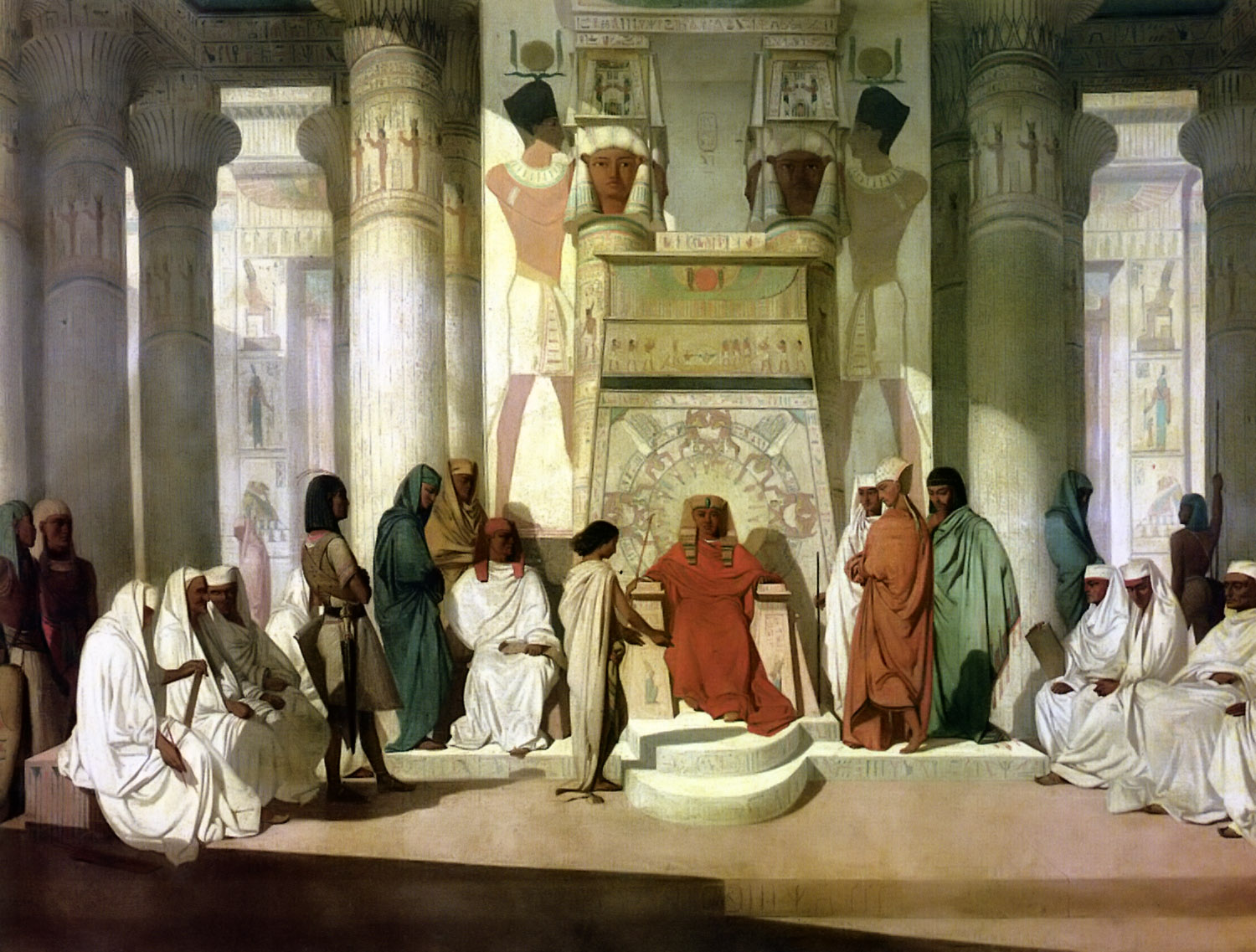
The Old Testament gives us a pharaoh with dreams, which Joseph interprets (Genesis 41-44) and which provides us with this splendid picture by Adrien Guignet (1816-1854).

Joseph Explaining the Dream to Pharoah, Jean Adrien Guignet

(This is an example of a whole world of painting which was devalued and declared stuffy and old-fashioned and pompous once Impressionism—which was originally mocked as just that, “impressions” rather than paintings—gained a foothold among art-buyers and the more progressive art critics. To us, although it may not have the wonderful fragmentations and color-freshness of those later painters, such older works have great importance historically—it’s the yin to the Impressionists’ yang, after all—and the over-the-top quality of some things—like this “Birth of Venus” by Bouguereau—1825-1905—has, we think, its own loopy charm.

The_Birth_of_Venus_by_William-Adolphe_Bouguereau_(1879)

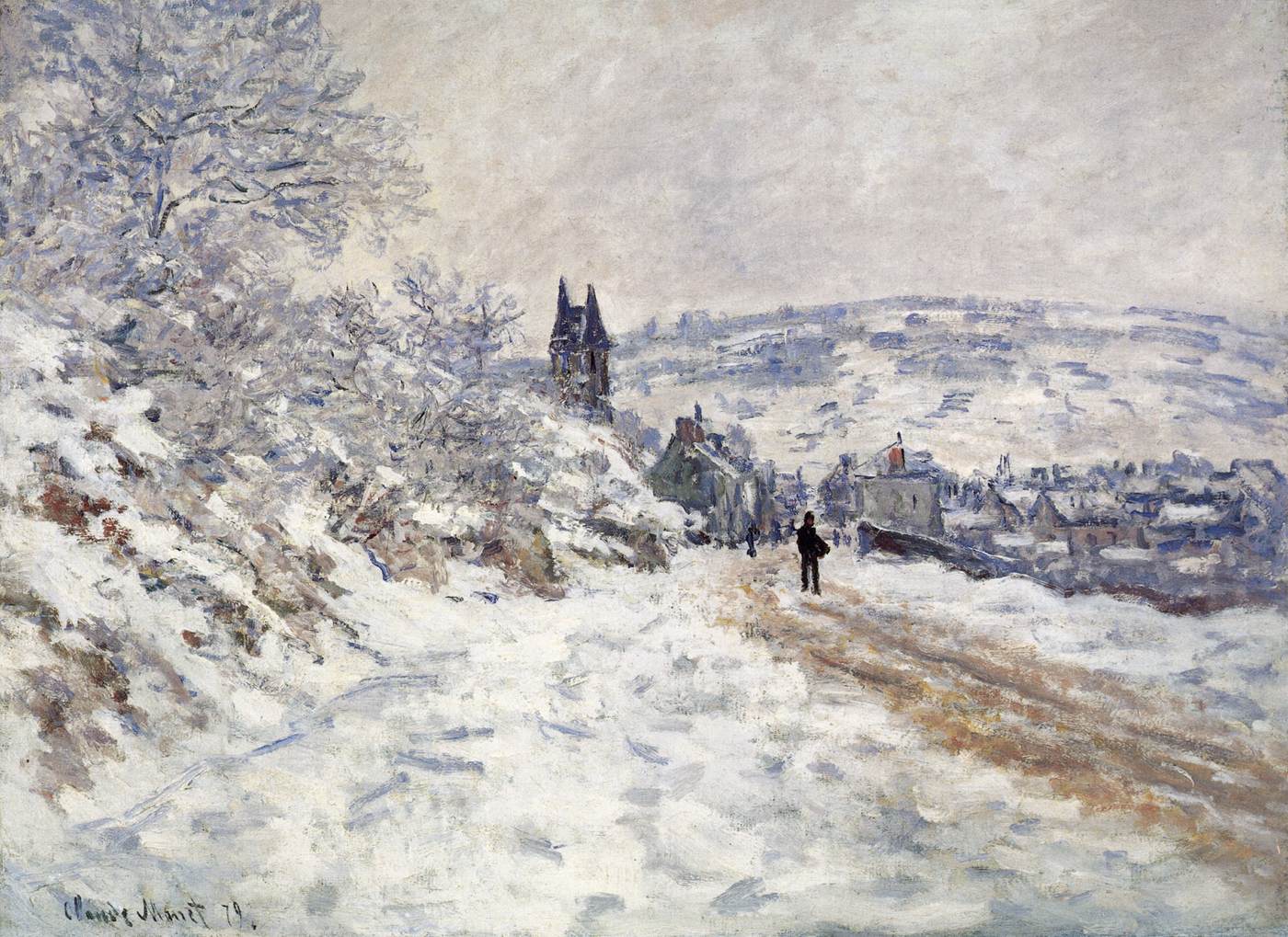
You see what we mean about yin/yang, however, when we compare it with this Monet, painted in the same year—1879. If you were brought up on academic painters like Bouguereau, Monet’s work must have looked like chimp paintings!

1vethe2

maxresdefault)

The Chinese of the Zhang Dynasty (1500-1000BC) used turtle plastrons and cow shoulder blades to consult about the future.

Shang_dynasty_inscribed_tortoise_plastron

Shang_dynasty_inscribed_scapula

The Greeks had a number of prophetic sites, like Delphi, with its Pythia.

Pythia

And the Romans had several methods, beginning with what they inherited from their big brothers to the north, the Etruscans.

liver

And, yes, this is a sheep’s liver, done in bronze. What does it do? Lots of discussion about that! It appears to have gods and perhaps constellations, or at least the sky, involved. (For more and some useful references, google “liver of Piacenza”)

The Romans consulted the insides of selected animals

haruspex

and the flying patterns of birds

romrem

although this could lead to the occasional argument

romrem1

as well as their own counterpart to people like the Pythia at Delphi, the Sibyls. One Sibyl, who was reputed to live at Cumae, even had a collection of prophetic books which talked about the future.

CumaeanSibyl

Later Romans also consulted a particular book, Vergil’s Aeneid, the idea being that you would open the book (a scroll, early on, a book—a codex—in later imperial times), close your eyes, run your finger along the lines and stop—and the line your finger was on would tell you something about the future. This is a form of bibliomancy, or telling the future by using a book. Ancients might choose Homer, or, in this case, Vergil (the Aeneid) or, for the Judeo-Christian tradition, the Bible. If you use Vergil, the practice is called Sortes Vergilianae (“Vergilian lots”—that is to say, not building sites—although one could build an interpretation upon one—but things used to determine the fate of something).

Today, we, as Tolkien fans, propose to add another text, suggesting Sortes Tolkienses (SOR-tes tol-kee-EN-ses). Pick up your copy of The Lord of the Rings, and ask it a question. Then close your eyes, open the book (make sure that it is rightsideup before you do this—although perhaps upsidedown would provide a greater-yet feel of randomness), run your index finger down the page, stop, open eyes, and read.

For our first try, we asked it who would win this year’s World Series, the New York Mets or the Kansas City Royals.

Hmm. Page 351 of the 2004 HarperCollins edition.

“…Frodo felt that he was in a timeless land that did not fade or change or fall into forgetfulness.”

Well, this is the 111th World Series—that would certainly suggest a kind of timelessness, we supposed. Then there was that business about not fading or changing—which team had won the Series last? A quick flick through statistics gave us the Royals in 1985 and the Mets in 1986. Okay. Does that mean that, since the Mets won more recently, that wouldn’t change?

Should we try again? Influenced by the rash Oedipus, asking the Pythia only one question and not pausing for clarification, we decided that it meant the Mets.

But then the Royals won.

So, we leave it to you, dear readers. You consult the Sortes Tolkienses—just make sure that the course of your life—or your team—doesn’t depend upon it!

Thanks, as always, for reading.

MTCIDC

CD

PS

There is a very entertaining experiment with the more established Sortes Vergilianae to be found by googling timesonline.typepad.com/dons_life/2012/03/sortes-virgilianae.html—an essay by the ever-lively Mary Beard.

The Doubtful Sea Series Facebook Page

The Doubtful Sea Series Facebook Page

  • Ollamh

Categories

  • Artists and Illustrators
  • Economics in Middle-earth
  • Fairy Tales and Myths
  • Films and Music
  • Games
  • Heroes
  • Imaginary History
  • J.R.R. Tolkien
  • Language
  • Literary History
  • Maps
  • Medieval Russia
  • Military History
  • Military History of Middle-earth
  • Narnia
  • Narrative Methods
  • Poetry
  • Research
  • Star Wars
  • Terra Australis
  • The Rohirrim
  • Theatre and Performance
  • Tolkien
  • Uncategorized
  • Villains
  • Writing as Collaborators
Follow doubtfulsea on WordPress.com

Across the Doubtful Sea

Recent Postings

  • A Moon disfigured December 17, 2025
  • On the Roads Again—Once More December 10, 2025
  • (Not) Crossing Bridges December 3, 2025
  • On the Road(s) Again—Again November 26, 2025
  • On the Road(s) Again November 19, 2025
  • To Bree (Part 2) November 12, 2025
  • To Bree (Part 1) November 5, 2025
  • A Plague o’ Both—No, o’ All Your Houses! October 29, 2025
  • It’s in Writing (2:  I’st a Prologue, or a Poesie for a Ring?) October 22, 2025

Blog Statistics

  • 103,201 Views

Posting Archive

  • December 2025 (3)
  • November 2025 (4)
  • October 2025 (5)
  • September 2025 (4)
  • August 2025 (4)
  • July 2025 (5)
  • June 2025 (4)
  • May 2025 (4)
  • April 2025 (5)
  • March 2025 (4)
  • February 2025 (4)
  • January 2025 (5)
  • December 2024 (4)
  • November 2024 (4)
  • October 2024 (5)
  • September 2024 (4)
  • August 2024 (4)
  • July 2024 (5)
  • June 2024 (4)
  • May 2024 (5)
  • April 2024 (4)
  • March 2024 (4)
  • February 2024 (4)
  • January 2024 (5)
  • December 2023 (4)
  • November 2023 (5)
  • October 2023 (4)
  • September 2023 (4)
  • August 2023 (5)
  • July 2023 (4)
  • June 2023 (4)
  • May 2023 (5)
  • April 2023 (4)
  • March 2023 (5)
  • February 2023 (4)
  • January 2023 (4)
  • December 2022 (4)
  • November 2022 (5)
  • October 2022 (4)
  • September 2022 (4)
  • August 2022 (5)
  • July 2022 (4)
  • June 2022 (5)
  • May 2022 (4)
  • April 2022 (4)
  • March 2022 (5)
  • February 2022 (4)
  • January 2022 (4)
  • December 2021 (5)
  • November 2021 (4)
  • October 2021 (4)
  • September 2021 (5)
  • August 2021 (4)
  • July 2021 (4)
  • June 2021 (5)
  • May 2021 (4)
  • April 2021 (4)
  • March 2021 (5)
  • February 2021 (4)
  • January 2021 (4)
  • December 2020 (5)
  • November 2020 (4)
  • October 2020 (4)
  • September 2020 (5)
  • August 2020 (4)
  • July 2020 (5)
  • June 2020 (4)
  • May 2020 (4)
  • April 2020 (5)
  • March 2020 (4)
  • February 2020 (4)
  • January 2020 (6)
  • December 2019 (4)
  • November 2019 (4)
  • October 2019 (5)
  • September 2019 (4)
  • August 2019 (4)
  • July 2019 (5)
  • June 2019 (4)
  • May 2019 (5)
  • April 2019 (4)
  • March 2019 (4)
  • February 2019 (4)
  • January 2019 (5)
  • December 2018 (4)
  • November 2018 (4)
  • October 2018 (5)
  • September 2018 (4)
  • August 2018 (5)
  • July 2018 (4)
  • June 2018 (4)
  • May 2018 (5)
  • April 2018 (4)
  • March 2018 (4)
  • February 2018 (4)
  • January 2018 (5)
  • December 2017 (4)
  • November 2017 (4)
  • October 2017 (4)
  • September 2017 (4)
  • August 2017 (5)
  • July 2017 (4)
  • June 2017 (4)
  • May 2017 (5)
  • April 2017 (4)
  • March 2017 (5)
  • February 2017 (4)
  • January 2017 (4)
  • December 2016 (4)
  • November 2016 (5)
  • October 2016 (6)
  • September 2016 (5)
  • August 2016 (5)
  • July 2016 (5)
  • June 2016 (5)
  • May 2016 (4)
  • April 2016 (4)
  • March 2016 (5)
  • February 2016 (4)
  • January 2016 (4)
  • December 2015 (5)
  • November 2015 (5)
  • October 2015 (4)
  • September 2015 (5)
  • August 2015 (4)
  • July 2015 (5)
  • June 2015 (5)
  • May 2015 (4)
  • April 2015 (3)
  • March 2015 (4)
  • February 2015 (4)
  • January 2015 (4)
  • December 2014 (5)
  • November 2014 (4)
  • October 2014 (6)
  • September 2014 (1)

Blog at WordPress.com.

  • Subscribe Subscribed
    • doubtfulsea
    • Join 78 other subscribers
    • Already have a WordPress.com account? Log in now.
    • doubtfulsea
    • Subscribe Subscribed
    • Sign up
    • Log in
    • Report this content
    • View site in Reader
    • Manage subscriptions
    • Collapse this bar
 

Loading Comments...