• About

doubtfulsea

~ adventure fantasy

Tag Archives: Scimitar

Swords Drawn

02 Wednesday Jul 2025

Posted by Ollamh in Uncategorized

≈ Leave a comment

Tags

Anduril, arthur-hughes, bent-swords, Fafnir, George Macdonald, Glamdring, Goblins, great-goblin, Howard Pyle, King Edward's Horse, NC Wyeth, Orcrist, Scimitar, Sigurd, Sigurd Portal, swords, The Hobbit, Tolkien, William Morris

Welcome, dear readers, as always.

Every time I read or teach The Hobbit, I come to this passage:

“There in the shadows on a large flat stone sat a tremendous goblin with a huge head, and armed goblins were standing round him carrying the axes and the bent swords which they use.”  (The Hobbit, Chapter 4, “Over Hill and Under Hill”)

and I wonder: what does Tolkien mean by “bent swords”?

As a medievalist, and as someone who grew up in the world of illustrators like Howard Pyle (1853-1911)

and NC Wyeth (1882-1945),

as well as an avid reader of the stories of William Morris (1834-1896),

it’s not surprising that Tolkien’s works so often include swords, although perhaps the first sword he met may have been in Andrew Lang’s (1844-1912) The Red Fairy Book, 1890, where, in the last chapter, he would have found Sigurd and a, to us, strangely-familiar sword—

“ONCE upon a time there was a King in the North who had won many wars, but now he was old. Yet he took a new wife, and then another Prince, who wanted to have married her, came up against him with a great army. The old King went out and fought bravely, but at last his sword broke, and he was wounded and his men fled. But in the night, when the battle was over, his young wife came out and searched for him among the slain, and at last she found him, and asked whether he might be healed. But he said ‘ No,’ his luck was gone, his sword was broken, and he must die. And he told her that she would have a son, and that son would be a great warrior, and would avenge him on the other King, his enemy. And he bade her keep the broken pieces of the sword, to make a new sword for his son, and that blade should be called Gram.”  (“The Story of Sigurd”, 357  If you don’t have your own copy of Lang’s collection, here it is for you:  https://archive.org/details/redfairybook00langiala/redfairybook00langiala/mode/2up courtesy of the invaluable Internet Archive.  If  you don’t know this source, and you enjoy this blog, you should check it out.  It has the most remarkable things, even including a very good selection of silent films and film classics, like Kurosawa’s “The Seven Samurai”, 1954, which, for me—and for George Lucas—is a model for adventure films and you can see it here for free:  https://archive.org/details/seven-samurai-1954_202402 )

Yes, “the sword that was broken”—Anduril—and Sigurd has it reforged—and uses it to kill Fafnir, the dragon.

(This is from the “Sigurd Portal” of a  lost stave—wooden—church from Hylestad, in Norway, dating c1200AD.  Fortunately, the doorway carvings were saved and they show in detail the story of Sigurd.  Here’s where you can read more:  https://sites.pitt.edu/~dash/sigurddoor.html#location and here:  https://en.wikipedia.org/wiki/Hylestad_stave_church )

In his own life, Tolkien would have been personally familiar with swords.  When he was a member, briefly, of King Edward’s Horse,

in 1912, he would have been issued with this, the Pattern 1908 cavalry sword.

To me, it’s rather a strange weapon, seemingly designed only to stab,

whereas earlier cavalry blades might be used both to stab and to slash (very useful in chasing off enemy infantry)

Then, a new 2nd lieutenant in 1915,
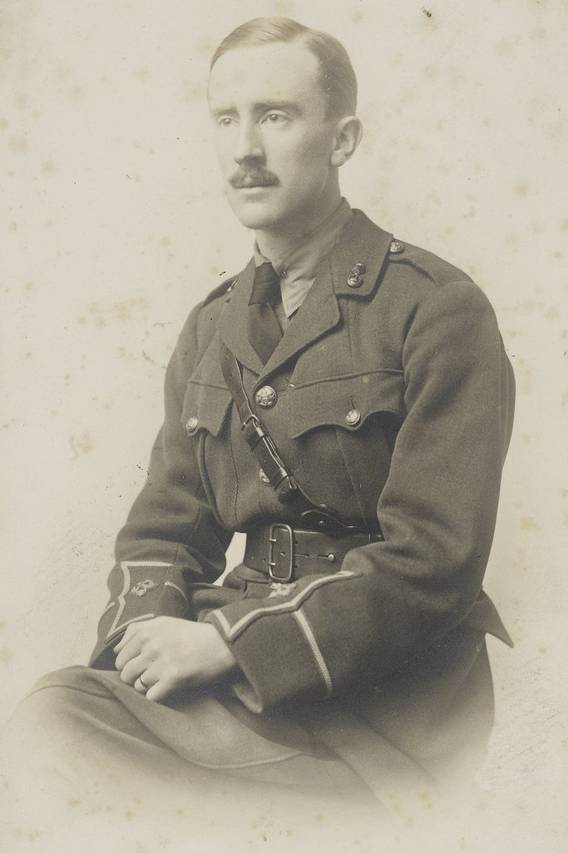
JRRT would have had to buy himself the Pattern 1897 infantry officer’s sword

(as there were an increasing number of new officers from families who couldn’t afford it, there was a kind of subscription created to help such officers acquire a required piece of equipment.  For more on just what was required of officers, who had to provide their own kit, see Field Service Manual 1914, pages 16-18, here (and yes, again, it’s from the Internet Archive):  https://archive.org/details/fieldservicemanu00greauoft/page/n11/mode/2up )

These, as you can see, are straight-bladed swords, however.

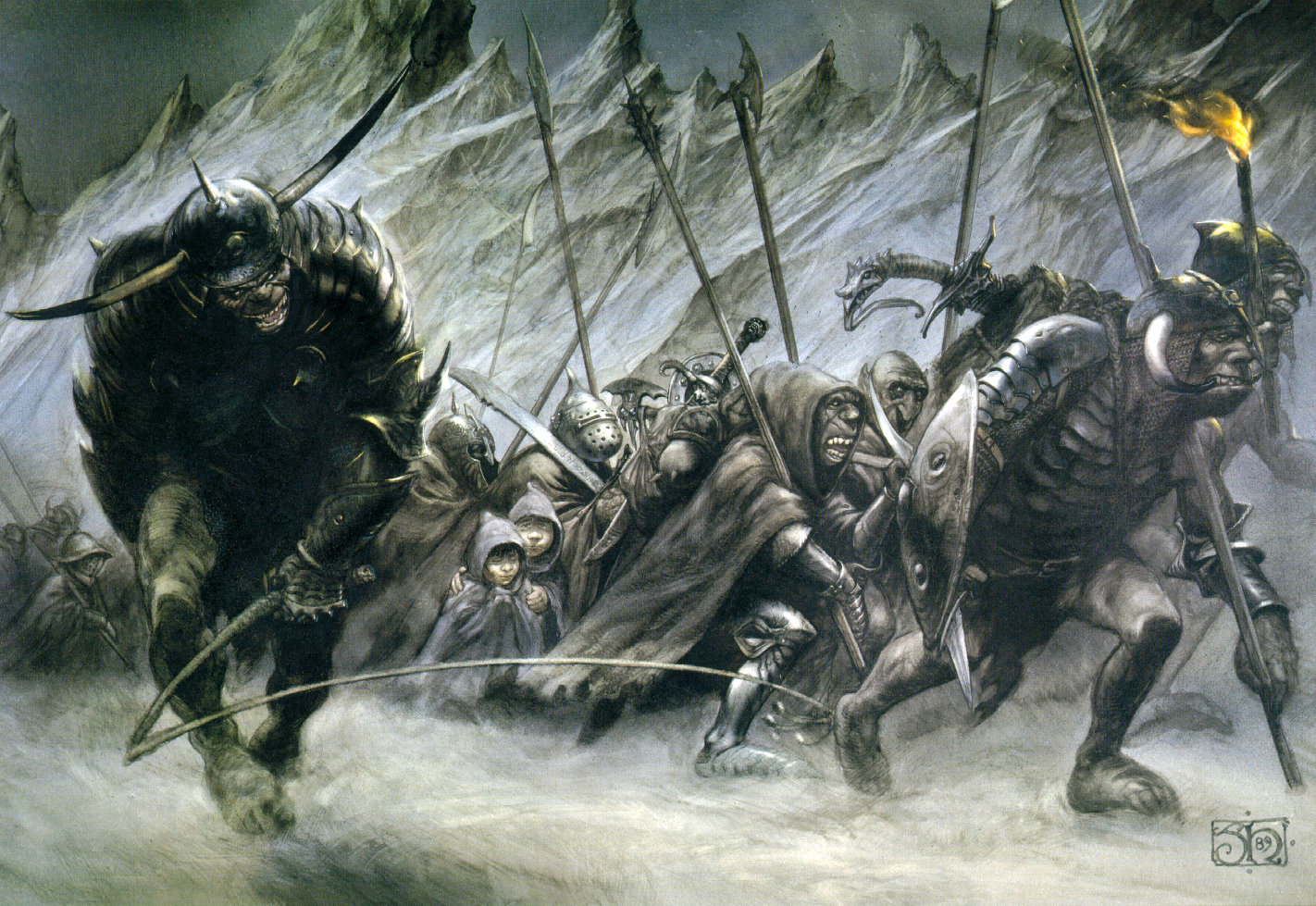
Tolkien’s earliest experience with goblins was probably with George MacDonald’s (1824-1905) The Princess and the Goblin (1871/2), and he likens his own later goblins/orcs to them (see Letters, 267, 279).
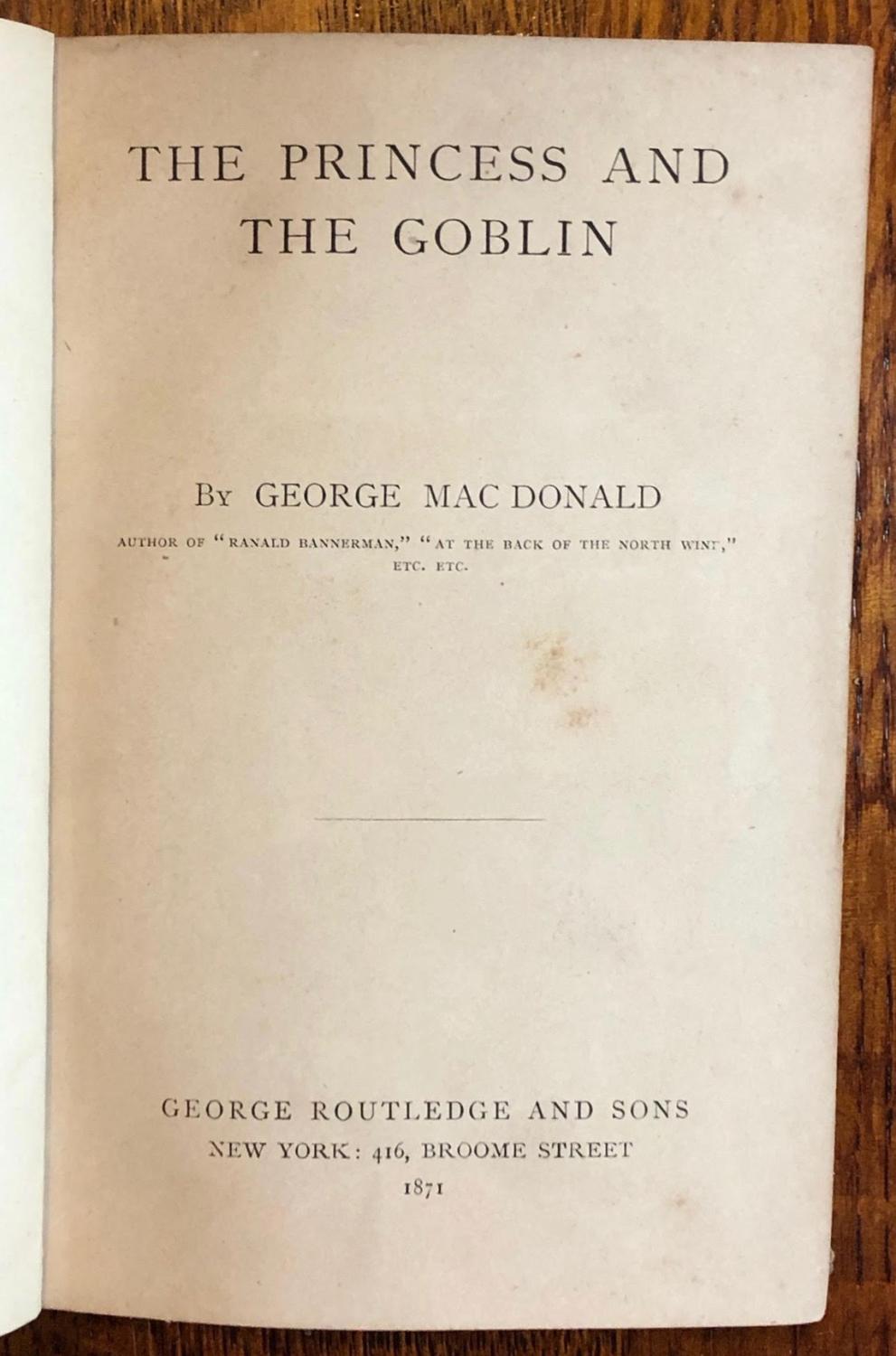
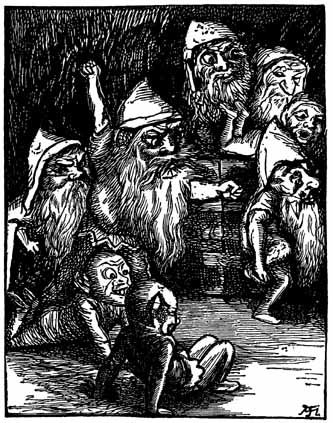
The illustrations are by Arthur Hughes (1832-1915) and, as far as I can see, there’s not a bent sword among them  (If you don’t know the story, here’s the text, but without its original illustrations, alas: https://www.gutenberg.org/cache/epub/708/pg708-images.html )
If we try some Tolkien goblin illustrators, we find Justin Gerard’s version of the scene with the Great Goblin, where there are a few pole arms off to the left, but the only sword must be Orcrist.

(Justin Gerard—you can see more of his work here:  https://www.artstation.com/justingerardillustration and here:  https://www.justingerard.com/the-art-of-justin-gerard )

Here’s John Howe’s version of the scene—
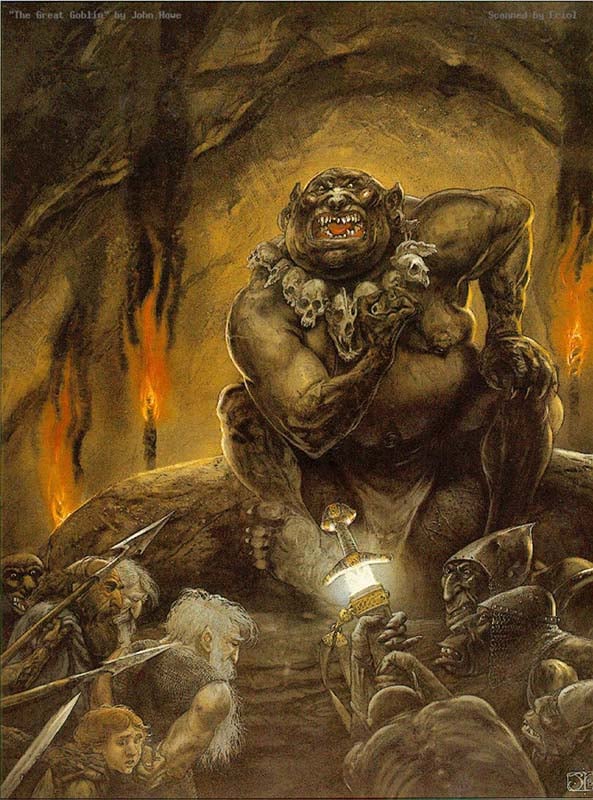
with Orcrist peeking out of its scabbard and a straight sword and a couple of spears off to the left.

Then there’s Alan Lee’s, with the seemingly inevitable Orcrist, but with, just below it, perhaps a sabre—a curved sword

and we see this again in Lee’s depiction of Bilbo’s encounter with the goblin door guards.

In Michael Hague’s illustration for the escape from the Great Goblin’s throne room,

we see both Orcrist and Glamdring, along with one more seemingly curved sword.

Are any of these, however, an example of a “bent sword”?  Archaeologists have discovered numerous ancient swords which appear to have been “sacrificed” by being bent–
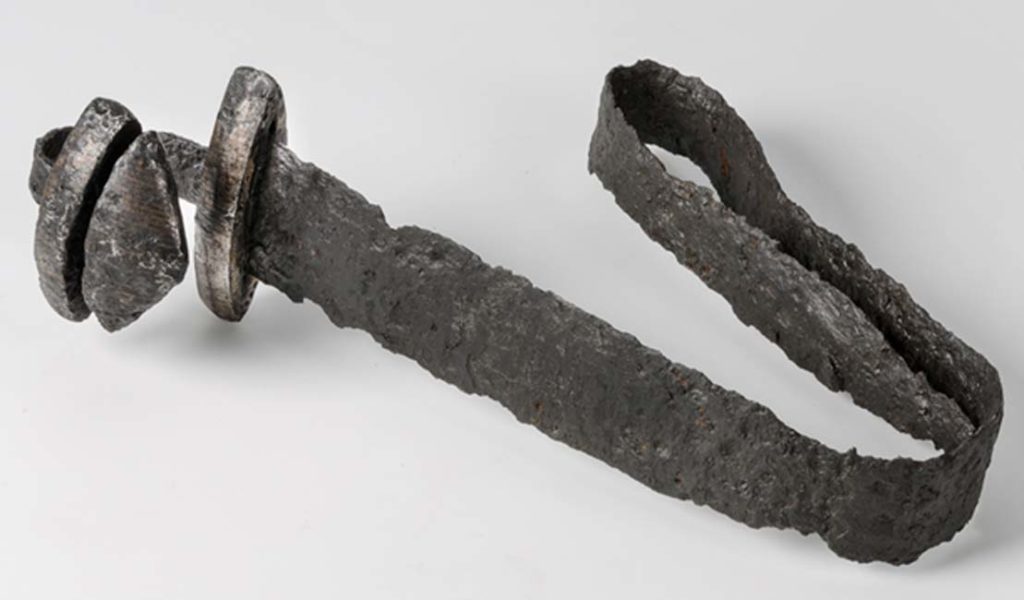
but this is hardly what Tolkien meant.  Then there is what might be taken literally for a “bent sword”—

from Jackson’s The Lord of the Rings, but I must say, this looks pretty improbable as a sword—if you see how the grip is shaped, that spike at the end if pointing upwards:  what could it possibly be for?  In fact, when one sees a chart of swords from the films, I’m not sure about many of them as useful weapons—

Those to the left share patterns with swords from our Middle-earth, both those on the right look like they might be dramatic over a fireplace, but I’d question their use as practical weapons.

So what might this “bent sword” be?  Some of the swords in the illustrations above would suggest that their artists believed that, by “bent”, Tolkien meant “curved”.  One possibility:  we know that Tolkien had read or had read to him at least one of Andrew Lang’s fairy books (the Red Fairy Book, as mentioned above), but perhaps he had also seen Lang’s Arabian Nights Entertainments (1898) in which there are a number of illustrations with scimitars in them—

(Here’s a copy of the book for you:  https://archive.org/details/arabiannightsent00lang/page/n9/mode/2up )

Scimitars are curved and, barring silly ones like those in Disney’s Aladdin—which look more like something used for carving meat–

are both deadly and would seem very exotic, if not alien,

in contrast to very medieval swords like Orcrist and Glamdring.

I doubt that we’ll ever know exactly what JRRT had in mind, but, if I had to illustrate “armed goblins…carrying axes and the bent swords…” I might consider drawing—in both senses—such blades.

Stay well,

Avoid inviting caves, even if Stone Giants are playing dodge ball outside,

And remember that, as always, there’s

MTCIDC

O

PS

I’ve just discovered a contemporary illustrator who clearly enjoys the dramatic style of artists like Pyle and Wyeth, as well as French historical artists, like Meissonier (1815-1891).  This is Ugo Pinson (1987-) and here is a sample of his work.
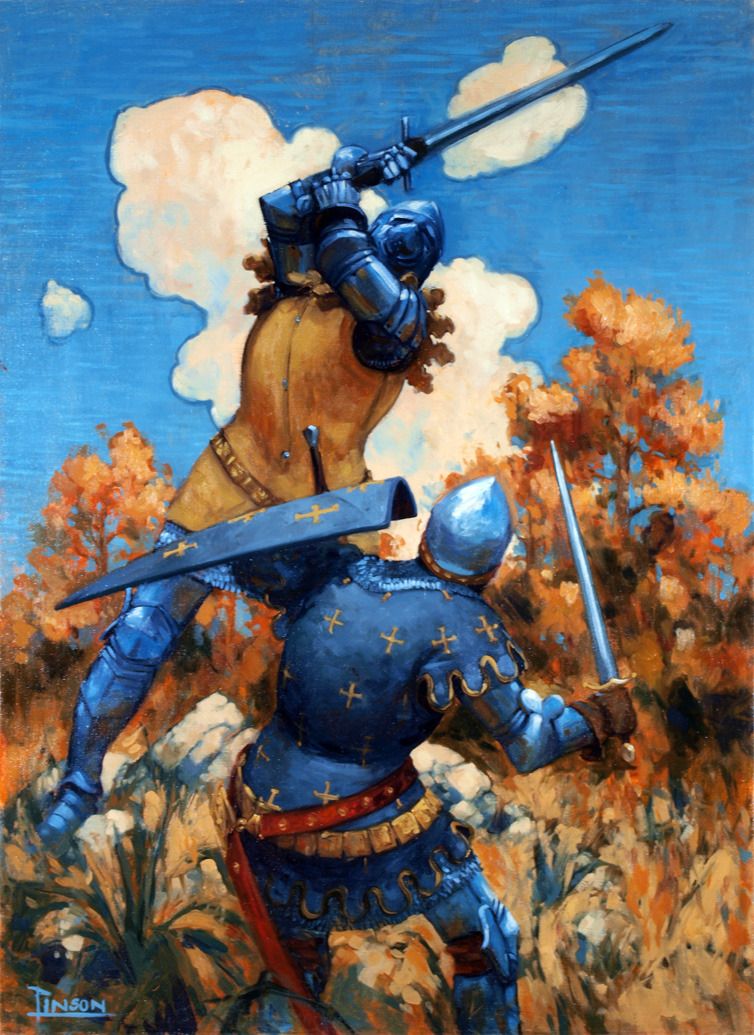
He has illustrated book covers as well as several graphic novels and done illustrations for the “Witcher” series.  His sketches alone show his skill and talent.  You can see more samples here:  https://duckduckgo.com/?q=ugo+pinson&iar=images&iai=http%3A%2F%2Fbdzoom.com%2Fwp-content%2Fuploads%2F2016%2F07%2F13427953_10154226704759687_4371726455862878086_n.jpg 

Orc Arsenal.1

26 Wednesday Sep 2018

Posted by Ollamh in Artists and Illustrators, Fairy Tales and Myths, Heroes, J.R.R. Tolkien, Literary History, Military History, Military History of Middle-earth, The Rohirrim

≈ Leave a comment

Tags

Alan Lee, And Inquiry Into Ancient Armour, Angus McBride, arming sword, Battle Axe, English Longbowmen, Eowyn, Falchion, Gladius, Gondor, Hildebrandts, Howard Pyle, John Howe, King Arthur, Longbow, Mace, Medieval, Mongols, Morning Star, Orcs, Pelennor, Pitt-Rivers Museum, Robert Louis Stevenson, Rohirrim, Scimitar, Sir Arthur Conan Doyle, Sir Samuel Meyrick, Ted Nasmith, The Black Arrow, The Lord of the Rings, The White Company, Tolkien, Victorian, Wallace Collection, War Hammer, Weaponry, Witch-King of Angmar

Welcome, dear readers, as always.

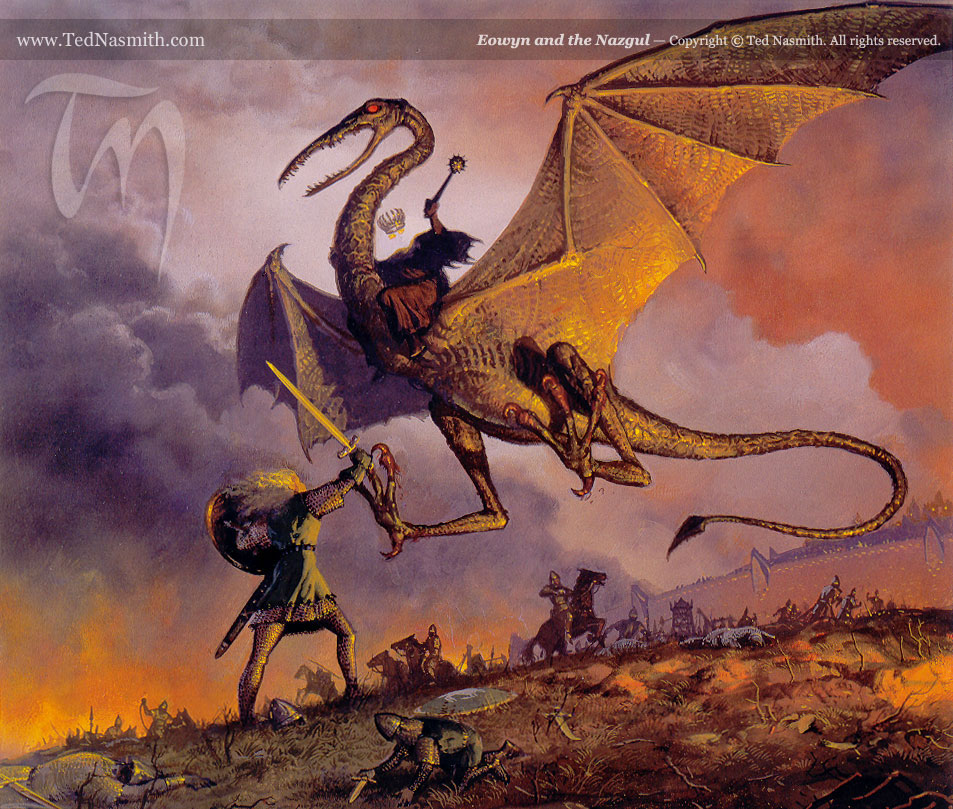
“The great shadow descended like a falling cloud.  And behold! It was a winged creature…

Upon it sat a shape, black-mantled, huge and threatening…A great black mace he wielded.”

(The Return of the King, Book Five, Chapter 6, “The Battle of the Pelennor Fields”)

This is clearly a scene which has caught the attention, over the years, of many artists, starting, we’d guess, with the Hildebrandts.

image1hild.jpg


Then others, like Angus McBride and Ted Nasmith,

image2am.jpg

image3nasmith.jpg

And Alan Lee and John Howe,


image4aleeimage4bhowe

as well as many very good artists whom we don’t know by name—

image4cimage5image6image7


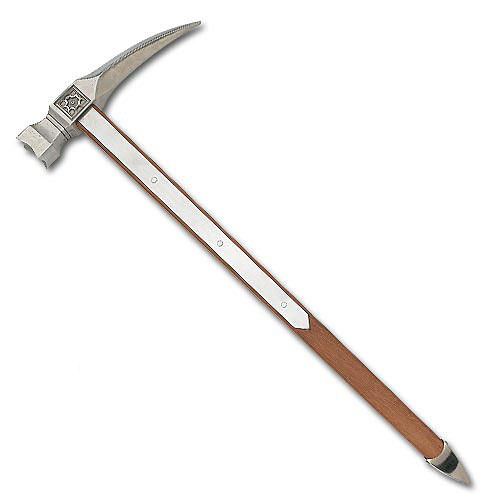
Of these, all but Lee and the unknown sixth artist follow JRRT’s description more or less closely.  Number 6—it’s a little unclear– but he might be carrying a war hammer of some sort,

image8warhammer.jpg

rather than a mace.

image9mace.jpg

image10mace.jpg

(These last two are basic patterns of a mace.)

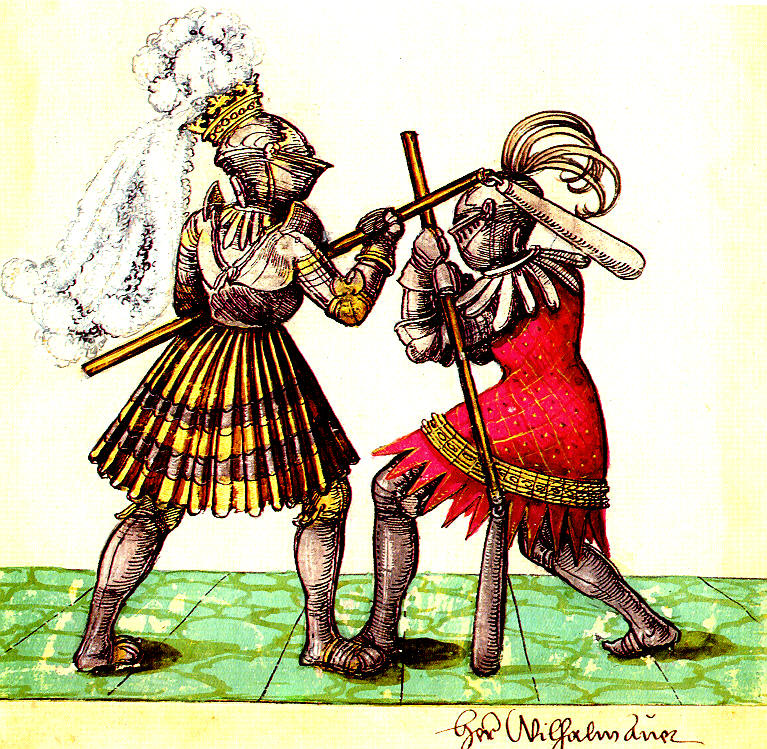
The Lee is, well, we’re not sure what it seems to be.  It sort of looks like a battle axe

image11battleaxe.jpg

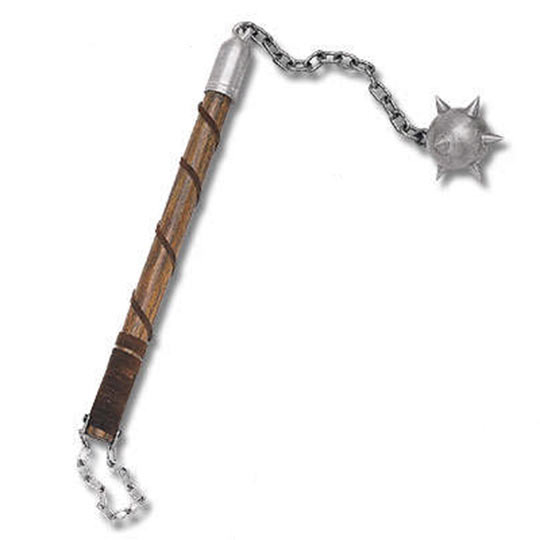
but also like what was called a “morning star”,

image12mornin.jpg
which should, we think, belong to the flail family.


image13flail

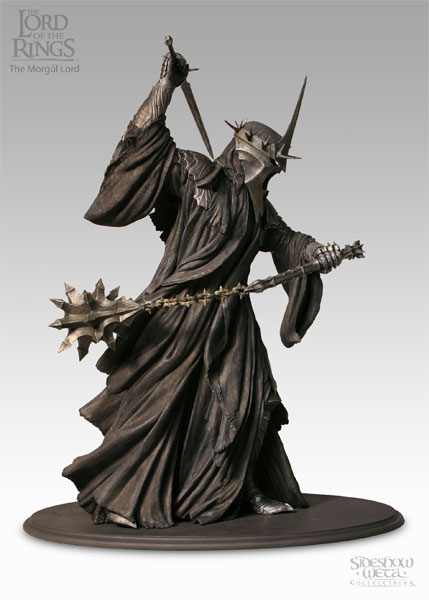
This rather fits in with the P Jackson image, shown in this model (and note that sword—definitely not in the original description—which is in his other hand).

image14mace.jpg

This difference made us curious about the weapons the Rohirrim—and the Gondorians—face and, in particular, those of the orcs.  The Hildebrandts

image15captured


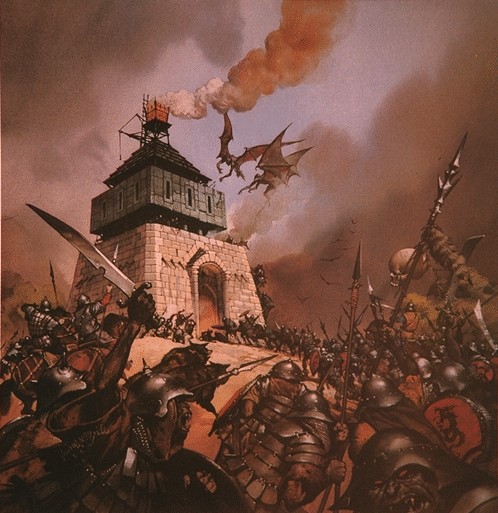
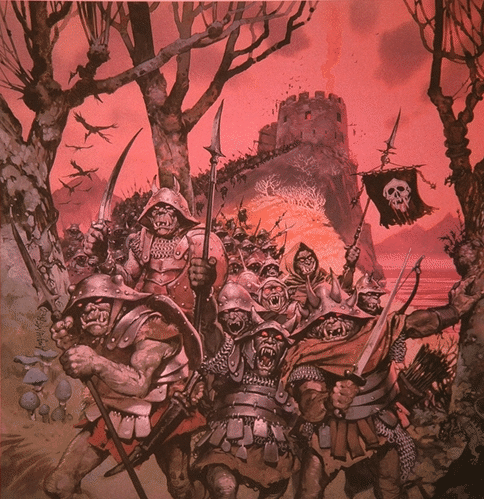
provide us with odd-looking spears and what might appear to be scimitars


image16scim

but might be the suggestion of a medieval sword called a falchion.

image17falchion

McBride, who spent much of his artistic career illustrating military subjects, gives us weapons (mostly) less fanciful.

image18mcbimage19mcb

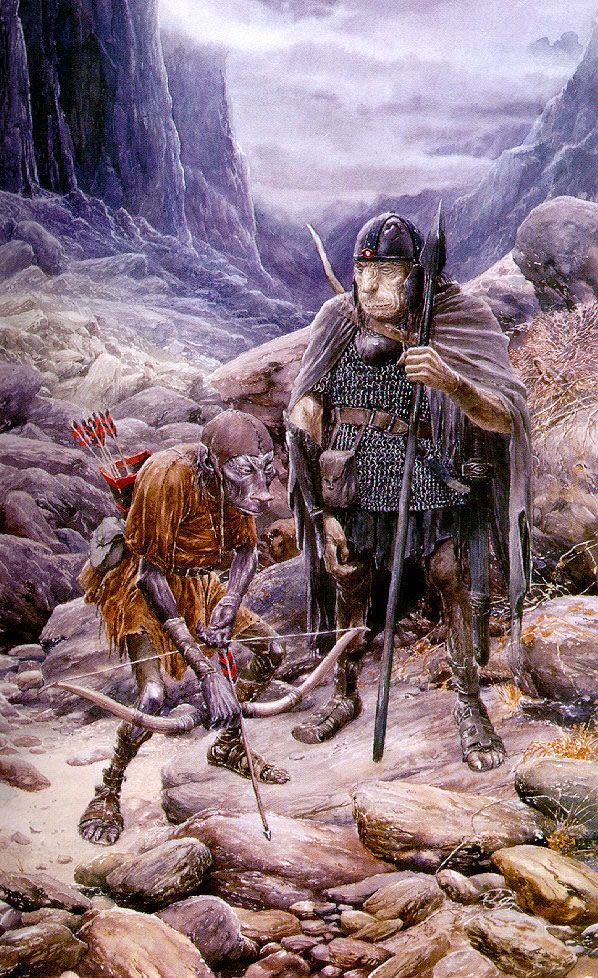
Lee

image19lee

and Howe

image20howe

veer between the practical and the fantastic and the films clearly follow them—

image21orcimage22orcimage23orc

How does JRRT describe the orc weaponry?

The first armed orc we see appears in Moria:

“His broad flat face was swart, his eyes were like coals, and his tongue was red; he wielded a great spear…Sam, with a cry, hacked at the spear-shaft, and it broke.  But even as the orc flung down the truncheon and swept out his scimitar…” (The Fellowship of the Ring, Book Two, Chapter 5, “The Bridge of Khazad-dum”)

The orcs who pursue the Fellowship through Moria have similar weapons:

“Beyond the fire he saw swarming black figures:  there seemed to be hundreds of orcs.  They brandished spears and scimitars which shone red as blood in the firelight.”

After the death of Boromir, however, Aragorn, Gimli, and Legolas find a different kind of orc:

“There were four goblin-soldiers of greater stature, swart, slant-eyed, with thick legs and large hands.  They were armed with short broad-bladed swords, not with the curved scimitars usual with Orcs: and they had bows of yew, in length and shape like the bows of Men.” (The Two Towers, Book Three, Chapter 1, “The Departure of Boromir”)

So far, we’ve seen spears

image24spears

and scimitars

image25scim

and now we can add to that “short broad-bladed swords”.  Perhaps Tolkien is thinking of the medieval “arming sword”

image26arming

or even the Roman gladius?

image27gladius.jpg

When we add “bows of yew, in length and shape like the bows of Men”, we immediately see the classic English longbow.

image28longbowman.jpg

This doesn’t quite match with the first orc bowman we see in the films, however, “Lurtz”—

image29lurtz.jpg

image30lurtz.jpg

who appears to have some sort of recurved bow, possibly composite, of the sort the Mongols used

image31mongol

even though, from the white hand on his face, he is supposed to be one of those “goblin-soldiers” from Isengard.

As we were looking through Tolkien’s text, we wondered where he would have gotten his ideas for weapons from.  If the basis, as we imagine it, would have been his background in medieval literature, then he might have gone to the library and found an old standard work, Sir Samuel Meyrick’s (1783-1848)

image32meyrick.jpg

An Inquiry Into Ancient Armour, As It Existed in Europe, Particularly in Great Britain, From the Norman Conquest to the Reign of Charles the Second, first published in 1824.  (Here’s a LINK if you’d like to look at this text for yourself.)

image33mey

Meyrick was the first great English specialist in armor and the later editions of his work (in 3 volumes) have wonderful early hand-colored plates, all based upon surviving armor, tombs, manuscripts, and any other period materials he could gather.

image34meyill.jpg

If JRRT wanted to see such things for himself, he would have found more exotic weapons in the Pitt-Rivers Museum in Oxford,

image35pittriversimage36pitt

or he could have traveled up to London to see the Wallace Collection

image37wallaceimage38wallace

or, best of all, he could have visited the Tower of London, with its massive collection (the organizing of which had earned Meyrick his knighthood in 1832) of medieval arms and armor, which had been available to the public in some form even before Meyrick’s time—here’s a Victorian tour.

image39tower

image40towerimage41tower

It could have been all of the above, of course, but it seems to us that the descriptions we’re reading are actually not really very specific—“mace”, “spear”, “scimitar”—only those short swords and bows suggest anything more detailed.  Perhaps, then, Tolkien was inspired by something else—perhaps he had read, perhaps even possessed, as a boy, books like Howard Pyle’s 1903 The Story of King Arthur and His Knights

image42pyle

and been inspired by its illustrations.

image43pyle

There were plenty of illustrated tales like this—Conan Doyle’s The White Company (first published in serial form in 1891),

image44whitecompany.jpg

or Robert Louis Stevenson’s The Black Arrow (serial 1883, book 1888).

image45blackarrow.jpg

With any and all of that background, we wonder what he might have made of this, however, an orc sword from the films which looks more like something manufactured from a car part than the product of a medieval armorer…

image46sword.jpg

Thanks, as ever, for reading.

MTCIDC

CD

ps

If car part weapons don’t bother you, you might be interested in this LINK—it’s an early article on ideas for weapons and armor for the Jackson films.

The Doubtful Sea Series Facebook Page

The Doubtful Sea Series Facebook Page

  • Ollamh

Categories

  • Artists and Illustrators
  • Economics in Middle-earth
  • Fairy Tales and Myths
  • Films and Music
  • Games
  • Heroes
  • Imaginary History
  • J.R.R. Tolkien
  • Language
  • Literary History
  • Maps
  • Medieval Russia
  • Military History
  • Military History of Middle-earth
  • Narnia
  • Narrative Methods
  • Poetry
  • Research
  • Star Wars
  • Terra Australis
  • The Rohirrim
  • Theatre and Performance
  • Tolkien
  • Uncategorized
  • Villains
  • Writing as Collaborators
Follow doubtfulsea on WordPress.com

Across the Doubtful Sea

Recent Postings

  • Through a glass… January 7, 2026
  • Heffalumps? December 31, 2025
  • We Three Kings December 24, 2025
  • A Moon disfigured December 17, 2025
  • On the Roads Again—Once More December 10, 2025
  • (Not) Crossing Bridges December 3, 2025
  • On the Road(s) Again—Again November 26, 2025
  • On the Road(s) Again November 19, 2025
  • To Bree (Part 2) November 12, 2025

Blog Statistics

  • 104,049 Views

Posting Archive

  • January 2026 (1)
  • December 2025 (5)
  • November 2025 (4)
  • October 2025 (5)
  • September 2025 (4)
  • August 2025 (4)
  • July 2025 (5)
  • June 2025 (4)
  • May 2025 (4)
  • April 2025 (5)
  • March 2025 (4)
  • February 2025 (4)
  • January 2025 (5)
  • December 2024 (4)
  • November 2024 (4)
  • October 2024 (5)
  • September 2024 (4)
  • August 2024 (4)
  • July 2024 (5)
  • June 2024 (4)
  • May 2024 (5)
  • April 2024 (4)
  • March 2024 (4)
  • February 2024 (4)
  • January 2024 (5)
  • December 2023 (4)
  • November 2023 (5)
  • October 2023 (4)
  • September 2023 (4)
  • August 2023 (5)
  • July 2023 (4)
  • June 2023 (4)
  • May 2023 (5)
  • April 2023 (4)
  • March 2023 (5)
  • February 2023 (4)
  • January 2023 (4)
  • December 2022 (4)
  • November 2022 (5)
  • October 2022 (4)
  • September 2022 (4)
  • August 2022 (5)
  • July 2022 (4)
  • June 2022 (5)
  • May 2022 (4)
  • April 2022 (4)
  • March 2022 (5)
  • February 2022 (4)
  • January 2022 (4)
  • December 2021 (5)
  • November 2021 (4)
  • October 2021 (4)
  • September 2021 (5)
  • August 2021 (4)
  • July 2021 (4)
  • June 2021 (5)
  • May 2021 (4)
  • April 2021 (4)
  • March 2021 (5)
  • February 2021 (4)
  • January 2021 (4)
  • December 2020 (5)
  • November 2020 (4)
  • October 2020 (4)
  • September 2020 (5)
  • August 2020 (4)
  • July 2020 (5)
  • June 2020 (4)
  • May 2020 (4)
  • April 2020 (5)
  • March 2020 (4)
  • February 2020 (4)
  • January 2020 (6)
  • December 2019 (4)
  • November 2019 (4)
  • October 2019 (5)
  • September 2019 (4)
  • August 2019 (4)
  • July 2019 (5)
  • June 2019 (4)
  • May 2019 (5)
  • April 2019 (4)
  • March 2019 (4)
  • February 2019 (4)
  • January 2019 (5)
  • December 2018 (4)
  • November 2018 (4)
  • October 2018 (5)
  • September 2018 (4)
  • August 2018 (5)
  • July 2018 (4)
  • June 2018 (4)
  • May 2018 (5)
  • April 2018 (4)
  • March 2018 (4)
  • February 2018 (4)
  • January 2018 (5)
  • December 2017 (4)
  • November 2017 (4)
  • October 2017 (4)
  • September 2017 (4)
  • August 2017 (5)
  • July 2017 (4)
  • June 2017 (4)
  • May 2017 (5)
  • April 2017 (4)
  • March 2017 (5)
  • February 2017 (4)
  • January 2017 (4)
  • December 2016 (4)
  • November 2016 (5)
  • October 2016 (6)
  • September 2016 (5)
  • August 2016 (5)
  • July 2016 (5)
  • June 2016 (5)
  • May 2016 (4)
  • April 2016 (4)
  • March 2016 (5)
  • February 2016 (4)
  • January 2016 (4)
  • December 2015 (5)
  • November 2015 (5)
  • October 2015 (4)
  • September 2015 (5)
  • August 2015 (4)
  • July 2015 (5)
  • June 2015 (5)
  • May 2015 (4)
  • April 2015 (3)
  • March 2015 (4)
  • February 2015 (4)
  • January 2015 (4)
  • December 2014 (5)
  • November 2014 (4)
  • October 2014 (6)
  • September 2014 (1)

Blog at WordPress.com.

  • Subscribe Subscribed
    • doubtfulsea
    • Join 78 other subscribers
    • Already have a WordPress.com account? Log in now.
    • doubtfulsea
    • Subscribe Subscribed
    • Sign up
    • Log in
    • Report this content
    • View site in Reader
    • Manage subscriptions
    • Collapse this bar
 

Loading Comments...