• About

doubtfulsea

~ adventure fantasy

Tag Archives: Louis XIII

Theme and Variations.4

11 Wednesday Jul 2018

Posted by Ollamh in Artists and Illustrators, Fairy Tales and Myths, Films and Music, Literary History, Narrative Methods

≈ Leave a comment

Tags

A Trip to the Moon, Alexandre Dumas, Arthur Rackham, Cendrillon, Charles Perrault, Charles S Evans, Cinderella, Cinderella 1899, Cinderella 1911, Cinderella 1912, Cinderella 1914, Contes de Ma Mere L'Oye, Film, Florence La Badie, Georges Melies, Gustave Dore, Henri IV, Histoires ou Contes du Temps Passe, Hugo, Le Voyage dan la Lune, Louis XIII, Mary Pickford, silent film, Sleeping Beauty, The Invention of Hugo Cabret, The Three Musketeers

Welcome, dear readers, as ever.

This is the next-to-last in a little series on several of the fairy tales of Charles Perrault (1628-1703) from his 1697 collection, Histoires ou Contes du Temps Passe (“Stories or Tales of Past Time”), better known by a kind of subtitle, Contes de Ma Mere L’Oye (“Tales of My Mother Goose”).

image1chasp

So far, we’ve devoted two posts to “Sleeping Beauty” (actually called by Perrault “La Belle au Bois Dormant”—“The Beautiful Girl in the Sleeping Wood”), covering everything from 19th-century theatrical performances to book illustrations to Disney.
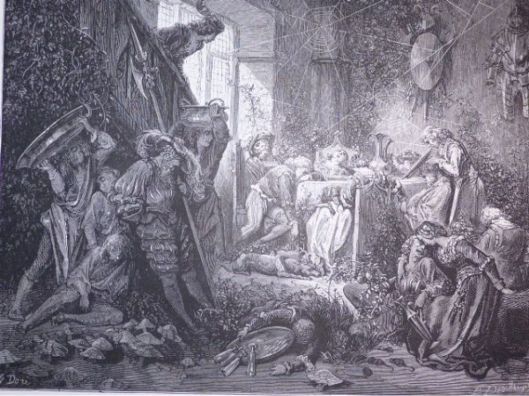
image2belle.jpg

In the third post, we began to look at “Cinderella”, more specifically in opera, from Isouard’s 1810 Cendrillon to Viardot’s 1904 Cendrillon.

Now, in this post, we want to look at “Cinderella” in film, beginning with the 1899 work of Georges Melies (1861-1938)
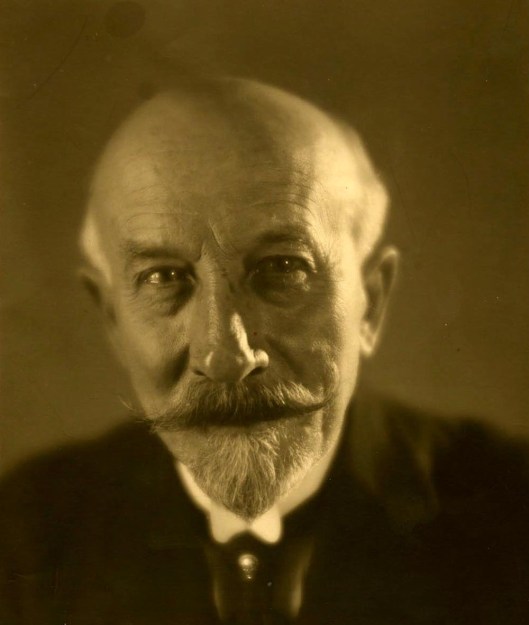
image3melies.jpg

whom you may know from the 2011 film Hugo
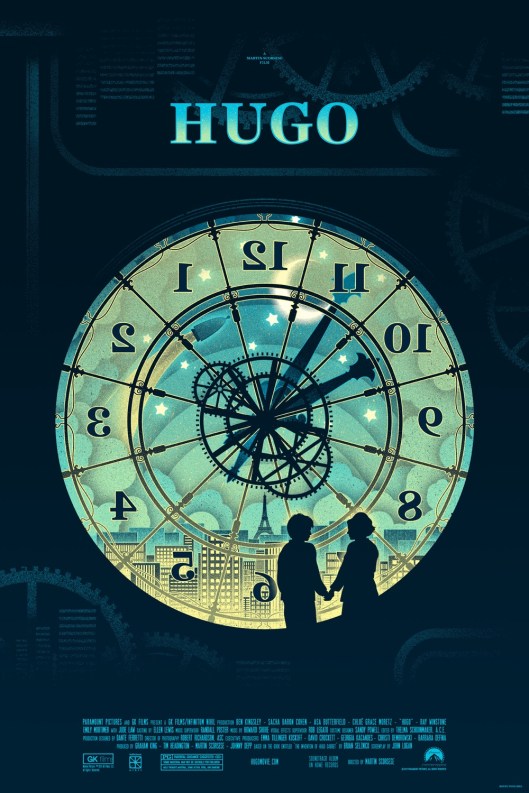
image4hugoposter.jpg

based upon Brian Selznick’s 2007 wonderfully inventive novel, The Invention of Hugo Cabret.
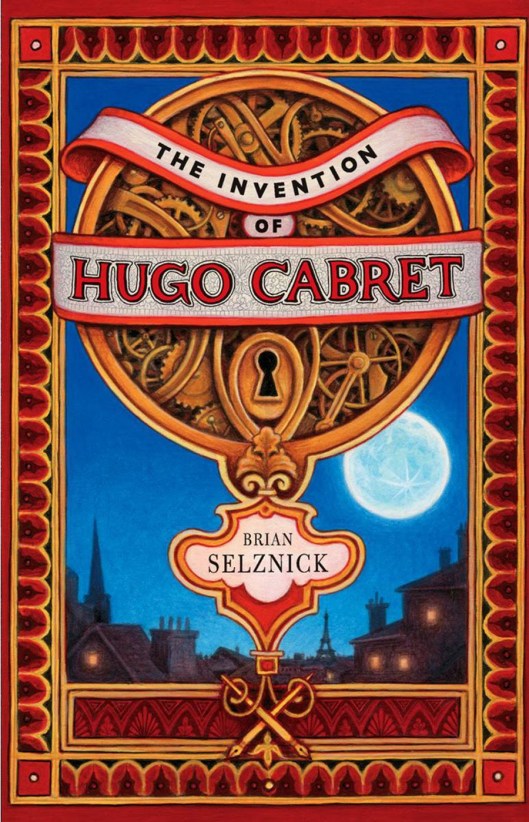
image5hcabret.jpg

Even if you aren’t familiar with Melies, you may recognize his work in this image

image6moon.jpg

from his 1902 science fiction film, Le Voyage dans La Lune (“The Trip to the Moon”), thought by scholars to be the first science fiction film (or at least first surviving such film.  Silent film historians estimate that only about 10% of all silent films made are still available to us.  Here’s a LINK to the film so that you can enjoy it for yourself).

Cendrillon was Melies’ most elaborate film to date and was a commercial success, even though only just under 6 minutes long—which says something for the expectations of the movie-going public of 1899.
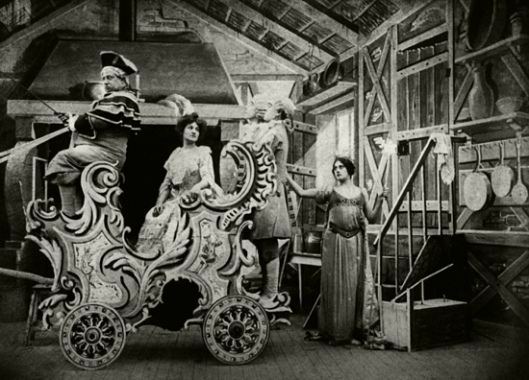
image7cend.png

As it is so short, it has only a couple of scenes—the kitchen in Cinderella’s house, the palace ballroom, Cinderella’s room, and what appears to be the outside of the palace—and very much depends upon the viewer already knowing the basic story (it begins, for example, with a very fancily-dressed woman leaving the kitchen and the sudden appearance of the Fairy Godmother, with no introduction at all).  Its greatest strength, for us, is in its transformation scenes (a Melies’ specialty), particularly the change of rats/mice into coachmen and footmen. (And here’s a LINK to the film, see if you agree with the 1899 audience.)

image8trans.jpg

Our second film is from 1911 and is nearly 15 minutes long, meaning that it actually has time to tell the story, if not in a leisurely fashion, at least in a more complete one than the Melies.  This is a US version of the story, starring an early popular favorite, Florence La Badie (or Labadie).
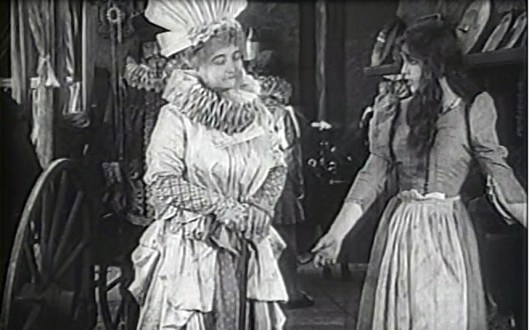
image9aflo.jpg

Forgotten except by silent film enthusiasts, La Badie was a hardworking dare-devil, appearing in nearly 200 films between 1909 and her death in 1917, and doing most of her own stunts.  She was also someone who personified a new look for young women in the years leading up to the Great War—as this portrait (and there are more like it) shows.

image9flo


If you follow this LINK, you can see not only the actress, but a “Cinderella” which has almost everything we would expect from the Perrault original.

Florence La Badie had gotten into films through the suggestion of an acting friend, Mary Pickford,
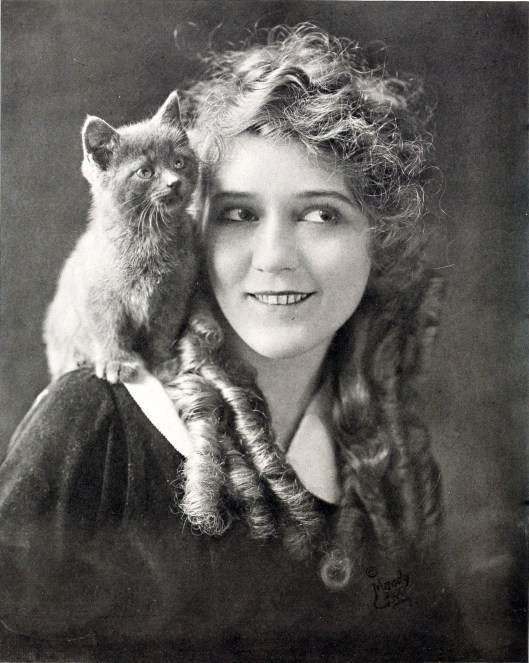
image10pick


who starred in our next Cinderella, in 1914.

image11cind

Two things strike us about this:

  1. it’s over 50 minutes long—a great advance from the 1911 15 minutes
  2. the advertising seems to suggest that the audience of 1914 was expected to visit the theatre to see Mary Pickford in Cinderella, rather than Cinderella in which Mary Pickford plays the title role. For us, this foreshadows the obsession with film celebrities which is still with us today.
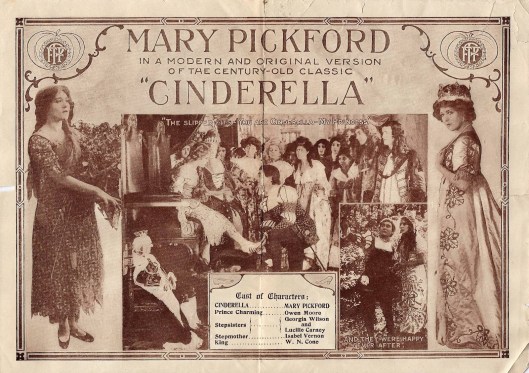
image12pick

This version, with its almost luxurious length, has plenty of time not only to tell the Perrault story, but to makes two additions to the plot:  Cinderella actually meets the prince before the ball, near her home and they fall in love—but are then separated; the stepsisters visit a fortune-teller, who informs them cryptically that one of their family will be successful at the ball.  (Here’s a LINK so that you can enjoy this more elaborate version.)

In the midst of these US versions, Georges Melies issued a second one himself.  At about 24 minutes long, it is much grander than his 1899 production, spending nearly a quarter of its length on the transformation of Cinderella from kitchen maid to grand lady alone.  The contrast between the 1899 pumpkin coach and the 1913 one illustrates this nicely.

image13acoach.jpg

image13melies2

It did not enjoy the success of the 1899 original, perhaps because, the weight of production values was simply too heavy for the little story inside, which was smothered by all of the plumed hats and sweeping bows.  We admit that we find this version a little slow, but the creation of the pumpkin coach is still as impressive to us as it must have been in 1913.  Here’s a LINK so that you can judge for yourself. It’s dated 1912, by the way, when the film was made, but it premiered in 1913, so we are sticking to the later date.

It has been suggested that Melies, in the look of this later take on the story, was influenced by the work of Gustave Dore (Do-RAY) (1832-1883).

image14dore.jpg

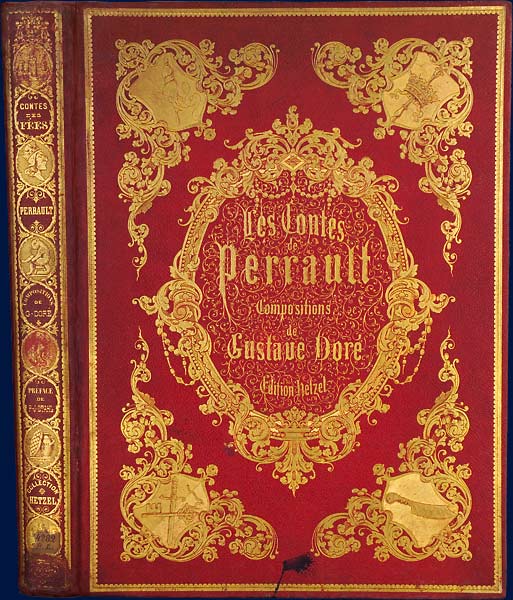
In 1867, Dore—a well-known illustrator–among other things–published Les Contes de Perrault, dessins par Gustave Dore. image15contes
Here’s one of the three illustrations done for the story.
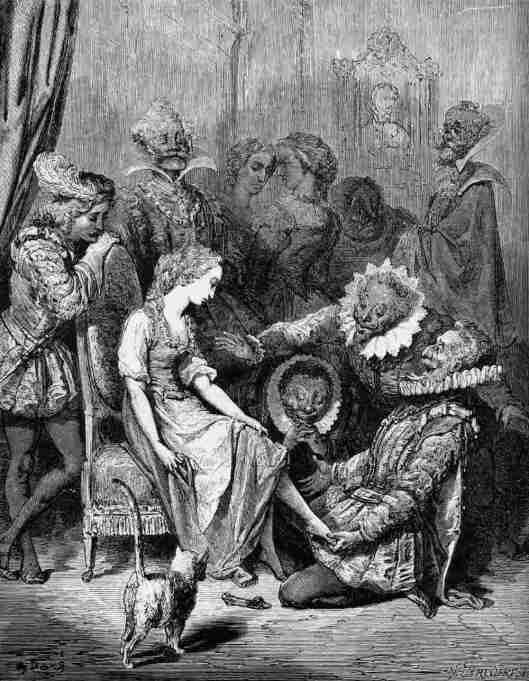
image16cend

To us, however, Melies thinks of the story taking place in the time of Louis XIII (reigned 1610-1643), when Dumas’ “Musketeers” novels are set (with a little 18th-century addition here and there).
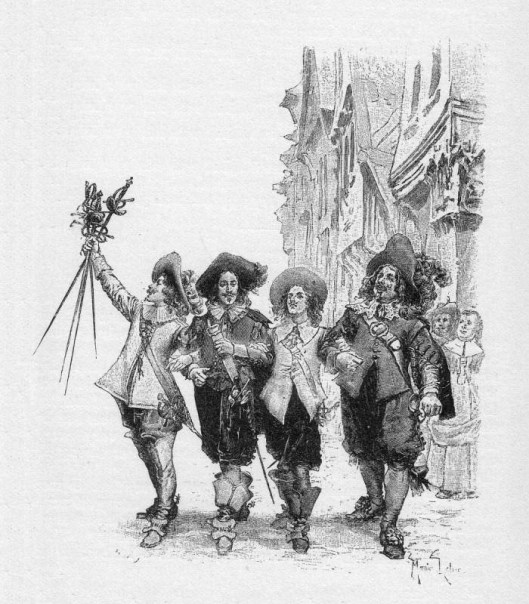
image17musk

Dore would appear to be setting it earlier, in the time of Louis’ father, Henri IV (reigned 1589-1610).
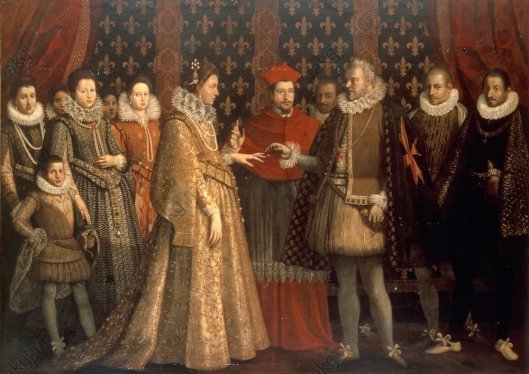
image18henri4

One of our very favorite illustrators, Arthur Rackham (1867-1939),

image19ar

tackled both “Cinderella” in 1919 and “Sleeping Beauty” in 1920, with retellings by Charles S. Evans.  Always original and surprising in his approach, Rackham here has produced what we believe to be two of his most inspired works—we’ll talk about them, as well as more versions of “Cinderella”, in our next.

But we’ll finish this post with one more image—as a teaser…
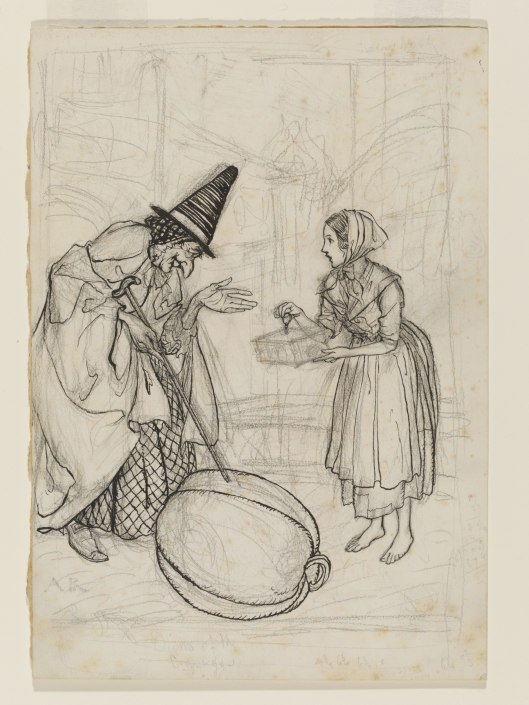
image20sketch

And thank you, as ever, for reading.

MTCIDC

CD

One for All…

24 Wednesday Aug 2016

Posted by Ollamh in Films and Music, Literary History, Military History, Narrative Methods

≈ Leave a comment

Tags

Alexandre Dumas, Aramis, Athos, battle of Fontenoy, Cardinal Richelieu, D'Artagnan, French Revolution, Garde Republicaine, Harpers Ferry, La Rochelle, Louis XIII, Louis XIV, Louis XV, Louis XVI, Louis XVIII, Musket, Musketeers, Porthos, Richard Lester, Royal Heralds, tabard, The Count of Monte Cristo, The Three Musketeers, Twenty Years After, Vicomte de Bragelonne

Dear Readers,

Welcome, as always.

In our last, we said that we were having a little holiday from the works of JRRT and we’re continuing that break in this posting, as well. After all, although we have a deep affection and admiration for them, we began this blog with the intention of focusing upon adventure in general.

In this, we want to look at musketeers—three, in fact, plus a fourth, who, although he lacks an official position in their company, has the heart of one.

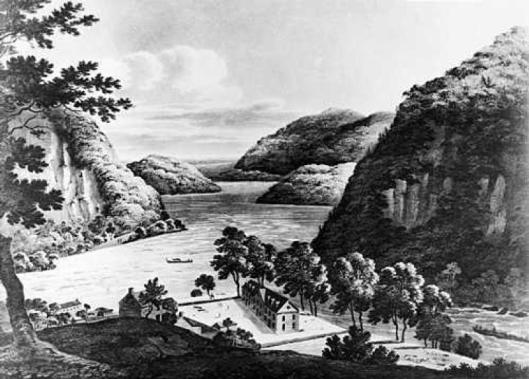
A musket is now a generic word for a pre-breech-loading long arm, like this one—

harpersferry1809

made at the Harpers Ferry arsenal in 1809.

harpersferryearly

Once upon a time, however, a musket was a specific weapon, a heavier firearm which was supported on a wooden rest.

Musketeer

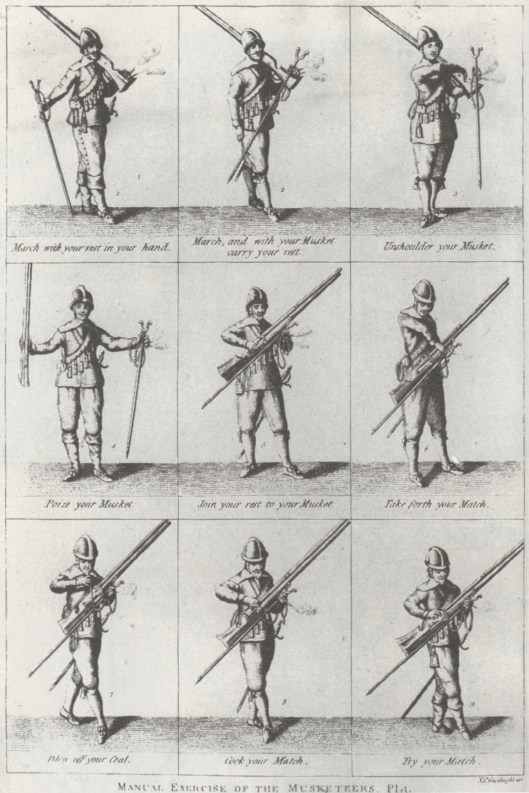
Such weapons were inaccurate at any distance and, in time, soldiers were gradually trained to load and fire in groups, to have more effect upon the enemy.

Manual_of_the_Musketeer,_17th_Century

military-musketeers-thirty-years-war-1618-1648-drawing-by-anton-hoffmann-bjn61w

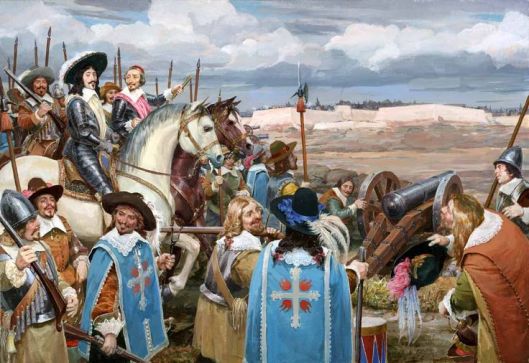
Certain cavalry were issued lighter versions of such muskets and, in 1622, one company—later two—was formed as a bodyguard for the young Louis XIII.

0_Louis_XIII_en_costume_de_deuil_-_Frans_Pourbus_le_Jeune_(2)

At this time, the idea of uniforms was only beginning to appear and so these men would have worn whatever they wished (probably a fancier version of period civilian clothes—they were guarding the king, after all).

e7670396c9d2d92bdb277a8dd2fbfdc9

To identify them as belonging to the king’s household, however, they were issued with a kind of loose overgarment called a tabard, which we can still see today as worn by the Royal Heralds of Elizabeth II.

Pursuivant_tabardHeralds-at-the-Garter-Service-Julian-Calder-1024x681fae2a692a2dfd52e3931b64ed85bf5ab

One of these musketeers was named D’Artagnan (1611-1673)

invalides-mousquetaires-portrait-du-vrai-dartagnan-mais-aucune-preuve-dauthenticitc3a9

and, in 1700—27 years after his death at the siege of Maastricht in 1673—a well-known French author of the period, Courtilz de Sandras (1644-1712), published a semi-fictionalized “memoir” by D’Artagnan, supposedly based upon D’Artagnan’s papers.

Courtilz_Mémoires_titreWP

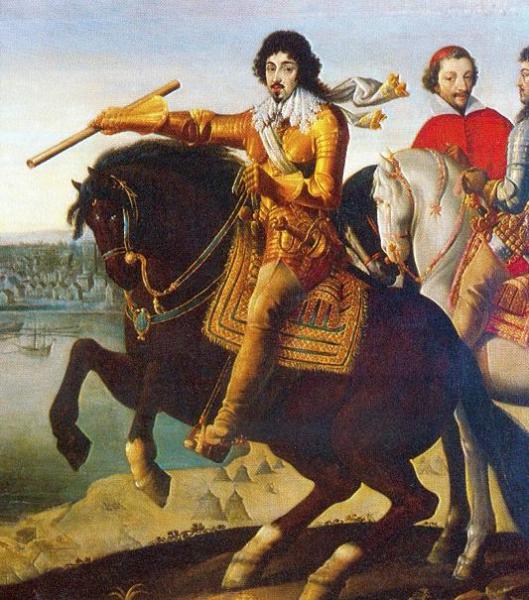
It depicted his adventures in a complex world of king and the man behind the king, Louis XIII and his prime minister, Cardinal Richelieu, and the court politics and foreign wars of the era.

Philippe_de_Champaigne_-_Louis_XIII_Crowned_by_Victory_(Siege_of_La_Rochelle,_1628)_-_WGA4712

index

And, in this equestrian portrait, you can see the Cardinal literally behind the king.

Louis_XIII_Richelieu_devant_La_Rochelle

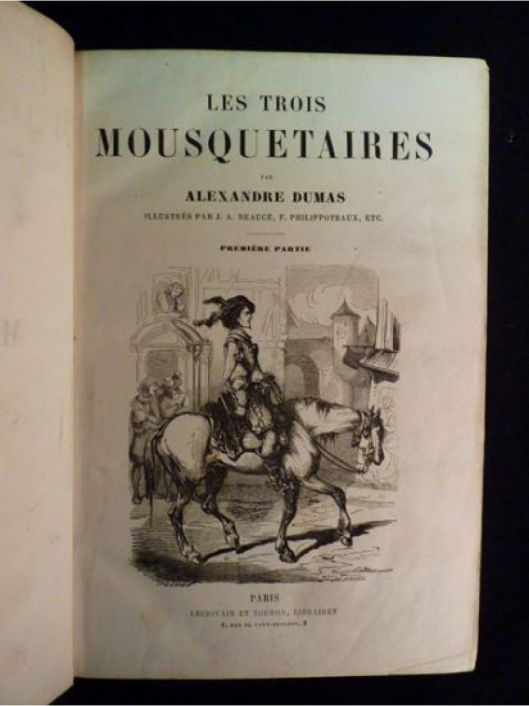
In 1844, there appeared a totally fictionalized account by Alexandre Dumas (1802-1870),

000101

The Three Musketeers,

h-1200-dumas_alexandre_les-trois-mousquetaires_1850_0_34725

which proved so successful that Dumas produced two sequels, Twenty Years After (1845), and The Vicomte de Bragelonne (1847). The success of the first book was such that, since its publication, well—just google “The Three Musketeers in film”! The story of a young man from an impoverished noble family coming to Paris and how, through luck and bravery, he becomes a musketeer, is clearly irresistible—certainly for us! (And Dumas had the gift to do this more than once—he is also the author of the equally-irresistible The Count of Monte Cristo—google that to see its history.)

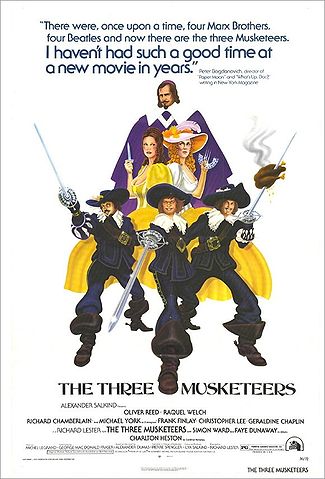
We have read various versions of this since childhood, from comic books to school texts in French, but, of all of the film versions, our favorite is the 2-part Richard Lester adaptation (script by one of our favorite historical novelists, George Macdonald Fraser—more about him in a future posting) of 1973-1974.

Three_Musketeers_1974

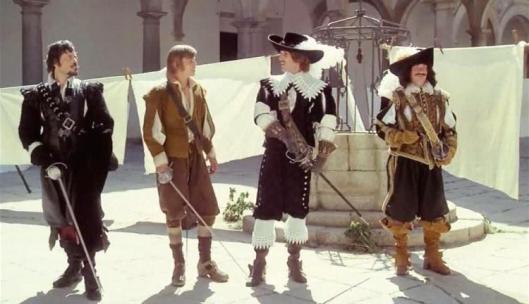
This is a version which keeps some of our favorite scenes—the duel in the convent courtyard, where D’Artagnan proves his courage to his new friends-to-be among the Musketeers, Athos, Porthos, and Aramis,

TheThreeMusketeers099

and the wager of the four friends to defend the bastion at the siege of La Rochelle while having breakfast there,

e988a9ce178db360466105fc18acd73d

but is, on the whole, a very light-hearted telling of the story (after all, Lester was famous for being the director of several earlier films starring the Beatles—the original idea even being that John, Paul, George, and Ringo were to be the Musketeers), set against a very grainy depiction of the world of the 1620s (which we find very convincing).

As for the real Musketeers, they had a long career as part of the King’s household guards, from the time of Louis XIII

68f4383f6ba85134f5c8c8b58a9d4613

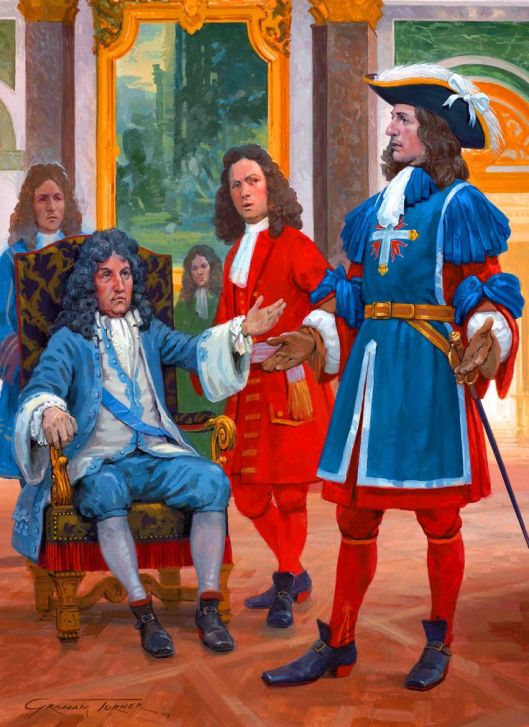
through that of Louis XIV

musketeerlouisxiv

through a famous charge at the battle of Fontenoy (1745) in the time of Louis XV.

15bba6ef186f1f2774c2be4c1f2761c2

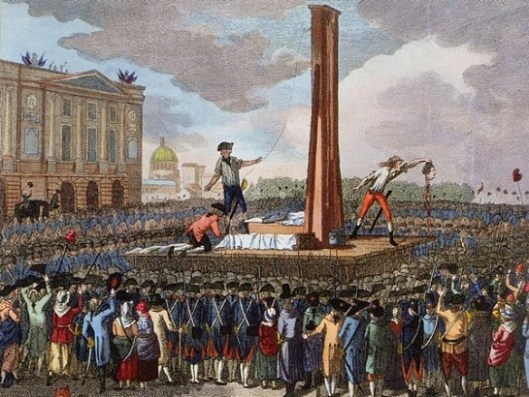
They were swept away at the time of the French Revolution, along with their master, Louis XVI,

executionlxvi

but restored in 1814 by his royal successor, Louis XVIII.

louisxviiimusket

In this new edition of the Musketeers, there appeared for a short time a recruit named Dumas,

Alexandre_Dumas_par_Achille_Devéria_(1829)

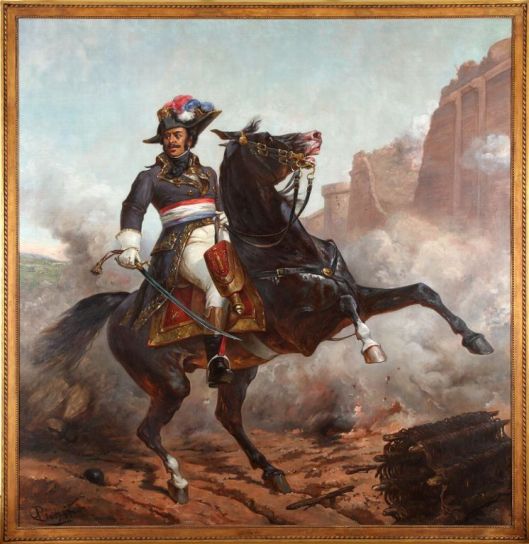
but, unlike his father (1762-1806), a famous general of the French revolutionary period,

generaldumas

he had another career waiting for him…

Thanks, as always, for reading.

MTCIDC

CD

PS

That last reincarnation of the Musketeers was a brief one: they were finally abolished in 1816. We can’t resist, in this ps, showing you a kind of descendant, however—at least in looking French and splendid. Here is the Garde republicaine in Paris. Its name tells you that, although monarchy might be dead in France, guards are certainly not.

la-musique-de-la-garde-republicaine


The Doubtful Sea Series Facebook Page

The Doubtful Sea Series Facebook Page

  • Ollamh

Categories

  • Artists and Illustrators
  • Economics in Middle-earth
  • Fairy Tales and Myths
  • Films and Music
  • Games
  • Heroes
  • Imaginary History
  • J.R.R. Tolkien
  • Language
  • Literary History
  • Maps
  • Medieval Russia
  • Military History
  • Military History of Middle-earth
  • Narnia
  • Narrative Methods
  • Poetry
  • Research
  • Star Wars
  • Terra Australis
  • The Rohirrim
  • Theatre and Performance
  • Tolkien
  • Uncategorized
  • Villains
  • Writing as Collaborators
Follow doubtfulsea on WordPress.com

Across the Doubtful Sea

Recent Postings

  • A Moon disfigured December 17, 2025
  • On the Roads Again—Once More December 10, 2025
  • (Not) Crossing Bridges December 3, 2025
  • On the Road(s) Again—Again November 26, 2025
  • On the Road(s) Again November 19, 2025
  • To Bree (Part 2) November 12, 2025
  • To Bree (Part 1) November 5, 2025
  • A Plague o’ Both—No, o’ All Your Houses! October 29, 2025
  • It’s in Writing (2:  I’st a Prologue, or a Poesie for a Ring?) October 22, 2025

Blog Statistics

  • 103,229 Views

Posting Archive

  • December 2025 (3)
  • November 2025 (4)
  • October 2025 (5)
  • September 2025 (4)
  • August 2025 (4)
  • July 2025 (5)
  • June 2025 (4)
  • May 2025 (4)
  • April 2025 (5)
  • March 2025 (4)
  • February 2025 (4)
  • January 2025 (5)
  • December 2024 (4)
  • November 2024 (4)
  • October 2024 (5)
  • September 2024 (4)
  • August 2024 (4)
  • July 2024 (5)
  • June 2024 (4)
  • May 2024 (5)
  • April 2024 (4)
  • March 2024 (4)
  • February 2024 (4)
  • January 2024 (5)
  • December 2023 (4)
  • November 2023 (5)
  • October 2023 (4)
  • September 2023 (4)
  • August 2023 (5)
  • July 2023 (4)
  • June 2023 (4)
  • May 2023 (5)
  • April 2023 (4)
  • March 2023 (5)
  • February 2023 (4)
  • January 2023 (4)
  • December 2022 (4)
  • November 2022 (5)
  • October 2022 (4)
  • September 2022 (4)
  • August 2022 (5)
  • July 2022 (4)
  • June 2022 (5)
  • May 2022 (4)
  • April 2022 (4)
  • March 2022 (5)
  • February 2022 (4)
  • January 2022 (4)
  • December 2021 (5)
  • November 2021 (4)
  • October 2021 (4)
  • September 2021 (5)
  • August 2021 (4)
  • July 2021 (4)
  • June 2021 (5)
  • May 2021 (4)
  • April 2021 (4)
  • March 2021 (5)
  • February 2021 (4)
  • January 2021 (4)
  • December 2020 (5)
  • November 2020 (4)
  • October 2020 (4)
  • September 2020 (5)
  • August 2020 (4)
  • July 2020 (5)
  • June 2020 (4)
  • May 2020 (4)
  • April 2020 (5)
  • March 2020 (4)
  • February 2020 (4)
  • January 2020 (6)
  • December 2019 (4)
  • November 2019 (4)
  • October 2019 (5)
  • September 2019 (4)
  • August 2019 (4)
  • July 2019 (5)
  • June 2019 (4)
  • May 2019 (5)
  • April 2019 (4)
  • March 2019 (4)
  • February 2019 (4)
  • January 2019 (5)
  • December 2018 (4)
  • November 2018 (4)
  • October 2018 (5)
  • September 2018 (4)
  • August 2018 (5)
  • July 2018 (4)
  • June 2018 (4)
  • May 2018 (5)
  • April 2018 (4)
  • March 2018 (4)
  • February 2018 (4)
  • January 2018 (5)
  • December 2017 (4)
  • November 2017 (4)
  • October 2017 (4)
  • September 2017 (4)
  • August 2017 (5)
  • July 2017 (4)
  • June 2017 (4)
  • May 2017 (5)
  • April 2017 (4)
  • March 2017 (5)
  • February 2017 (4)
  • January 2017 (4)
  • December 2016 (4)
  • November 2016 (5)
  • October 2016 (6)
  • September 2016 (5)
  • August 2016 (5)
  • July 2016 (5)
  • June 2016 (5)
  • May 2016 (4)
  • April 2016 (4)
  • March 2016 (5)
  • February 2016 (4)
  • January 2016 (4)
  • December 2015 (5)
  • November 2015 (5)
  • October 2015 (4)
  • September 2015 (5)
  • August 2015 (4)
  • July 2015 (5)
  • June 2015 (5)
  • May 2015 (4)
  • April 2015 (3)
  • March 2015 (4)
  • February 2015 (4)
  • January 2015 (4)
  • December 2014 (5)
  • November 2014 (4)
  • October 2014 (6)
  • September 2014 (1)

Blog at WordPress.com.

  • Subscribe Subscribed
    • doubtfulsea
    • Join 78 other subscribers
    • Already have a WordPress.com account? Log in now.
    • doubtfulsea
    • Subscribe Subscribed
    • Sign up
    • Log in
    • Report this content
    • View site in Reader
    • Manage subscriptions
    • Collapse this bar
 

Loading Comments...