Tags
Asfaloth, bells, Child Ballad, dance, Edgar Allan Poe, Glorfindel, Headless Horseman, Joan of Arc, John Howe, Medieval, Minas Tirith, Morris Dance, Nazgul, Sir Gawain and the Green Knight, Sortes Tolkienses, Sortes Vergilianae, sun-down bells, The Hobbit, The Legend of Sleepy Hollow, The Lord of the Rings, Thomas the Rymer, tocsin, Tower of Echthelion
Welcome, once more, dear readers.
The sources of our postings come from all sorts of places. Sometimes, we are reading something and we have an idea, or we spot an image or see a film. Sometimes, it’s from a friend’s e-mail, or reaction to an earlier posting. Sometimes they come from our sortes tolkienses. If you’ve missed our original posting where we invented this, it’s based upon an ancient fortune-telling method, where one closes one’s eyes, opens an important book, like the Aeneid or the Bible, puts one’s finger on a verse—and hopes that it tells you something about the day or the future. In our case, we use The Lord of the Rings or The Hobbit.
And what did we find today? This, from The Lord of the Rings—
“Hand in hand they went back into the City, the last to pass the Gate before it was shut; and as they reached the Lampwrights’ Street all the bells in the towers tolled solemnly.” (The Return of the King, Book Five, Chapter 1, “Minas Tirith”)
These are the “sun-down bells”, as Pippin learns from Bergil, son of Beregond. Bergil is a boy of Minas Tirith and has just given Pippin a tour of the city.
“Sun-down bells” made us think first about the bells of Minas Tirith, and then about bells in Middle-earth in general, and we could easily pick out three kinds.
To begin with, there are the city bells. Or, rather, where are the city bells? The text says “in the towers”. In the medieval world in which we so often find illustrations and parallels to Middle-earth, those bells are commonly in church belfries.


Minas Tirith clearly has towers—and, in fact, is a towering place—literally:
“…the Tower of Echthelion, standing high within the topmost wall, shone out against the sky, glimmering like a spike of pearl and silver, tall and fair and shapely, and its pinnacle glittered as if it were wrought of crystals; and white banners broke and fluttered from the battlements in the morning breeze, and high and far he heard a clear ringing as of silver trumpets.” (The Return of the King, Book Five, Chapter 1, “Minas Tirith”)
Because there are no churches—or even temples—in Minas Tirith, by examining some images of the city, from John Howe’s painting to the model used in the films, we can pick out towers here and there and some of those, we might imagine, could hold bells.

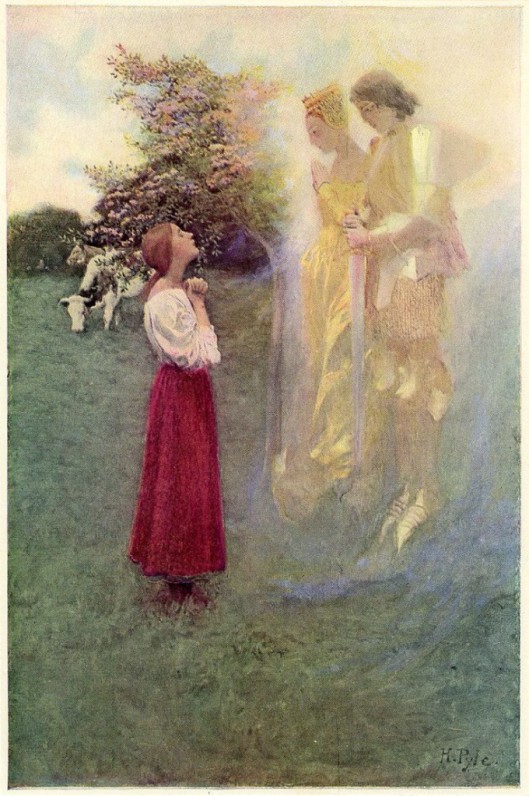
 In our medieval world, such bells had a number of functions. Not only did they ring the hours of the medieval Christian day, but they could also sound a warning, called the “tocsin”, and signal that the day was over and that fires should be covered for the night, the “curfew”—rather like the “sun-down” bells in Minas Tirith. Joan of Arc (c.1412-1431) said that she could sometimes hear the sound of angelic voices, inspiring her to drive the English out of France, in her village bell.
There are other uses—and places—for bells in Middle-earth, however. In The Fellowship of the Ring, Book One, Chapter 1, “A Long-Expected Party”, they turn up at an impromptu dance:
“Master Everard Took and Miss Melilot Brandybuck got on a table and with bells in their hands began to dance the Springle-ring: a pretty dance, but rather vigorous.”
The wording of this sounds like it came from the “society section” of a newspaper, as not only are the hobbits’ names given, but given with their social titles—“Master” and “Miss”—to show that they are unmarried.
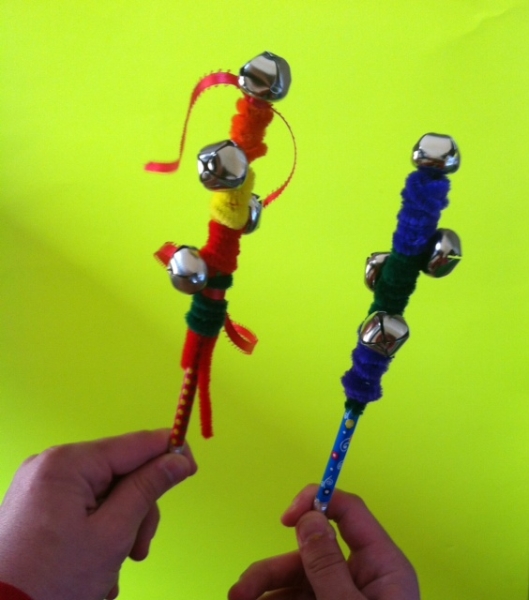
The boisterous dance, being energetic and accompanied by bells, makes us think of traditional English Morris dances, where the dancers not only strap bells to their arms and legs, but occasionally carry sticks with bells attached to them.


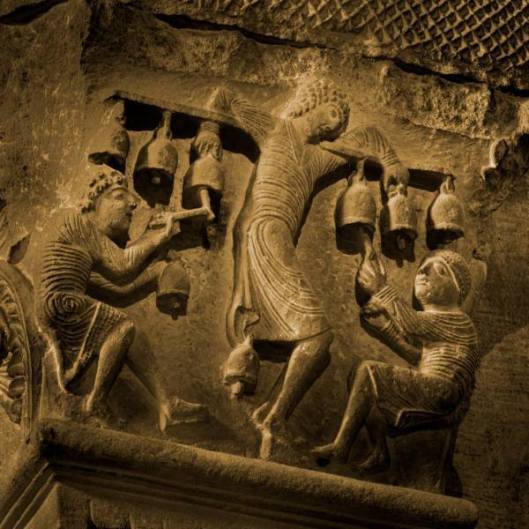
This also makes us think about medieval music bands, which could include a percussionist who played bells.

A further use is as decoration—and perhaps as something more. When Aragorn is leading the hobbits, with the wounded Frodo, towards Rivendell, they heard “a sound that brought sudden fear back into their hearts: the noise of hoofs behind them.” The fear is, of course, of pursuing Nazgul, depicted here first in an Alan Lee sketch, and then in a painting which we believe is by the Hildebrandts, of one of the Ringwraiths almost riding down Farmer Cotton.


[We are always struck, by the way, how the Nazgul bear a certain resemblance to the “Headless Horseman” from Washington Irving’s (1783-1859) story, “The Legend of Sleepy Hollow” (1820). Walt Disney made a musical version of this in 1949, which was shown on Disney tv programs in later years, around Halloween, and the image of the Horseman could always give us nightmares.]

What Aragorn and the hobbits are actually hearing is the horse of the Elf lord, Glorfindel, Asfaloth—
“The sound of the hoofs drew nearer. They were going fast, with a light clppety-clippety-clip. Then, faintly, as if it was blown away from them by the breeze, they seemed to catch a dim ringing, as of small bells tinkling.” (The Fellowship of the Ring, Book One, Chapter 12, “Flight to the Ford”)

Although Frodo never explains why he says this, he exclaims, “That does not sound like a Black Rider’s horse…” The only difference in sound clearly is coming from the bells, perhaps on Asfaloth’s halter or bridle—or perhaps on his mane, as in the case of what might be a source for those bells, Child ballad 37 (we’re quoting from Variant A). 37 is called “Thomas Rymer” and describes the meeting of the actual 13th-century Thomas of Earlston with the Queen of Elfland. [We include a LINK here to the useful Wiki entry.)

In the ballad, her horse is described as having
“At ilke tett [“every tuft/lock”] of her horse’s mane
Hung fifty silver bells and nine.”
We are always careful never to say, without documentary evidence, that such-and-such is “definitely” the source for something in JRRT, but this particular detail seems to line up so well:
- Glorfindel is an Elf
- so is the unnamed Queen
- each has bells on his/her horse
And these bells suggest—at least to Frodo—something unworldly, but, unlike the Nazgul, something positive. We can add to this another—okay, undeniable—source, and our evidence for this is JRRT himself. In 1925, Tolkien (in collaboration with E.V. Gordon) published an edition of the 14th-century Middle English poem, Sir Gawain and the Green Knight.
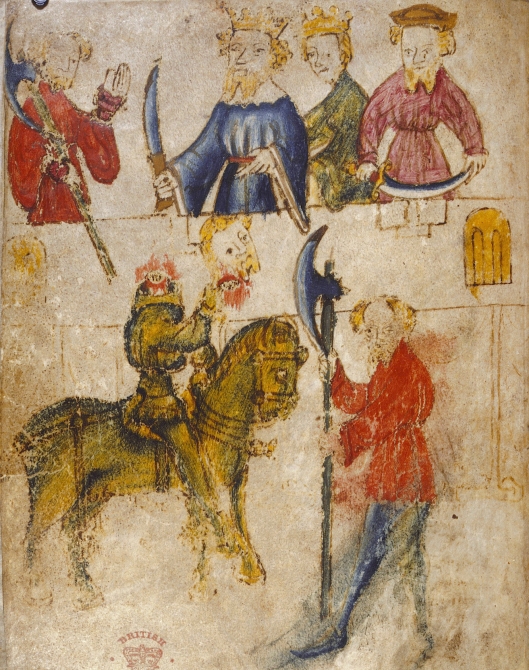
The Green Knight is an enchanted being and part of his magic lies in his greenness and in the elaborate decoration of himself and his horse, including
“Ther mony bellez ful bry3t of brende golde rungen” (line 195)
This is only a preliminary investigation—done out of our heads, rather than from a thorough scouring of the text—so, can you, dear readers, think of other bells in The Lord of the Rings? We could think of two references in The Hobbit—but we leave it to you to guess where they are (and to find more?).
And thanks, as always, for reading.
MTCIDC
CD
PS
We include a LINK here to an appropriate poem which uses our title, Edgar Allan Poe’s, “The Bells” (1849).
 doubtfulsea