• About

doubtfulsea

~ adventure fantasy

Tag Archives: Excalibur

Watery Connections?

13 Wednesday Nov 2024

Posted by Ollamh in Uncategorized

≈ Leave a comment

Tags

books, Excalibur, Fantasy, King Arthur, Tolkien

As ever, dear readers, welcome.

Dennis, the politicized peasant,

 has something to say:

“ARTHUR: I am your king!

WOMAN: Well, I didn’t vote for you.

ARTHUR: You don’t vote for kings.

WOMAN: Well, how did you become King, then?

ARTHUR: The Lady of the Lake,…

[angels sing]

…her arm clad in the purest shimmering samite, held aloft Excalibur from the bosom of the water signifying by Divine Providence that I, Arthur, was to carry Excalibur.

[singing stops]

That is why I am your king!

DENNIS: Listen. Strange women lying in ponds distributing swords is no basis for a system of government. Supreme executive power derives from a mandate from the masses, not from some farcical aquatic ceremony.

ARTHUR: Be quiet!

DENNIS: Well, but you can’t expect to wield supreme executive power just ’cause some watery tart threw a sword at you!”  (Monty Python and the Holy Grail, Scene 3, “Repression is Nine Tenths of the Law?”  which you can read here:  http://www.montypython.50webs.com/scripts/Holy_Grail/Scene3.htm  

In case you are wondering what “samite” is, see
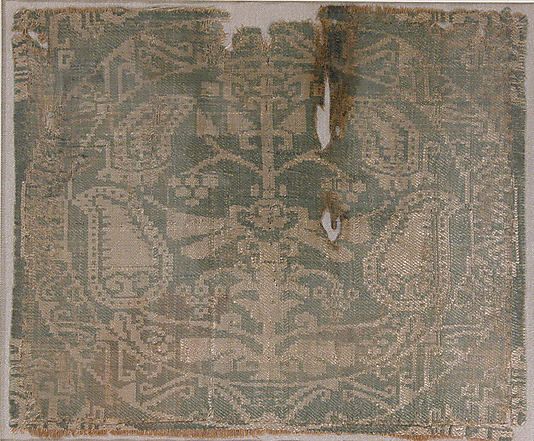
and:  https://en.wikipedia.org/wiki/Samite

The Pythons, by the way, look to be mocking lines from “The Passing of Arthur”, a poem in Tennyson’s long series of Arthurian poems Idylls of the King here, where the dying Arthur commands his one surviving knight, Sir Bedivere, to toss his sword, Excalibur, into the local lake.  Bedivere is tempted not to, but, on his third try, he does so and

“So flashed and fell the brand Excalibur:
But ere he dipt the surface, rose an arm
Clothed in white samite, mystic, wonderful,
And caught him by the hilt, and brandished him
Three times, and drew him under in the mere.”
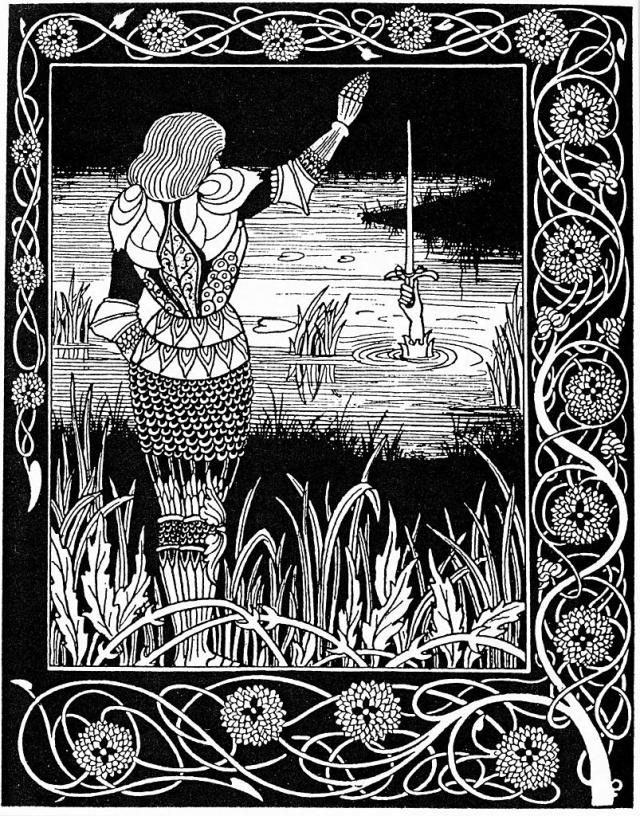
For the whole of the poem see:  https://d.lib.rochester.edu/camelot/text/tennyson-passing-of-arthur   Arthur had received the sword from this same Lady in “The Coming of Arthur”, which you can read here:  https://d.lib.rochester.edu/camelot/text/tennyson-coming-of-arthur  These are both drawn from the excellent Arthurian website which, if you don’t know it and are interested in Arthur, you need to:  https://d.lib.rochester.edu/camelot-project  There’s some confusion about Arthur and his swords, which you can read about here:  https://en.wikipedia.org/wiki/Excalibur )

“Strange women lying in ponds” is the Pythons’ way of mentioning a rather common phenomenon we see in various forms both in folklore and in literature which is influenced by it, everything from classical water nymphs, naiads,

to mermaids

to the Rhinemaidens (Rheintoechter—“Rhine Daughters”) who appear in the “Ring Cycle”, Der Ring des Nibelungen, the 4-part series of Germanic mythological operas of Richard Wagner (1813-1883).
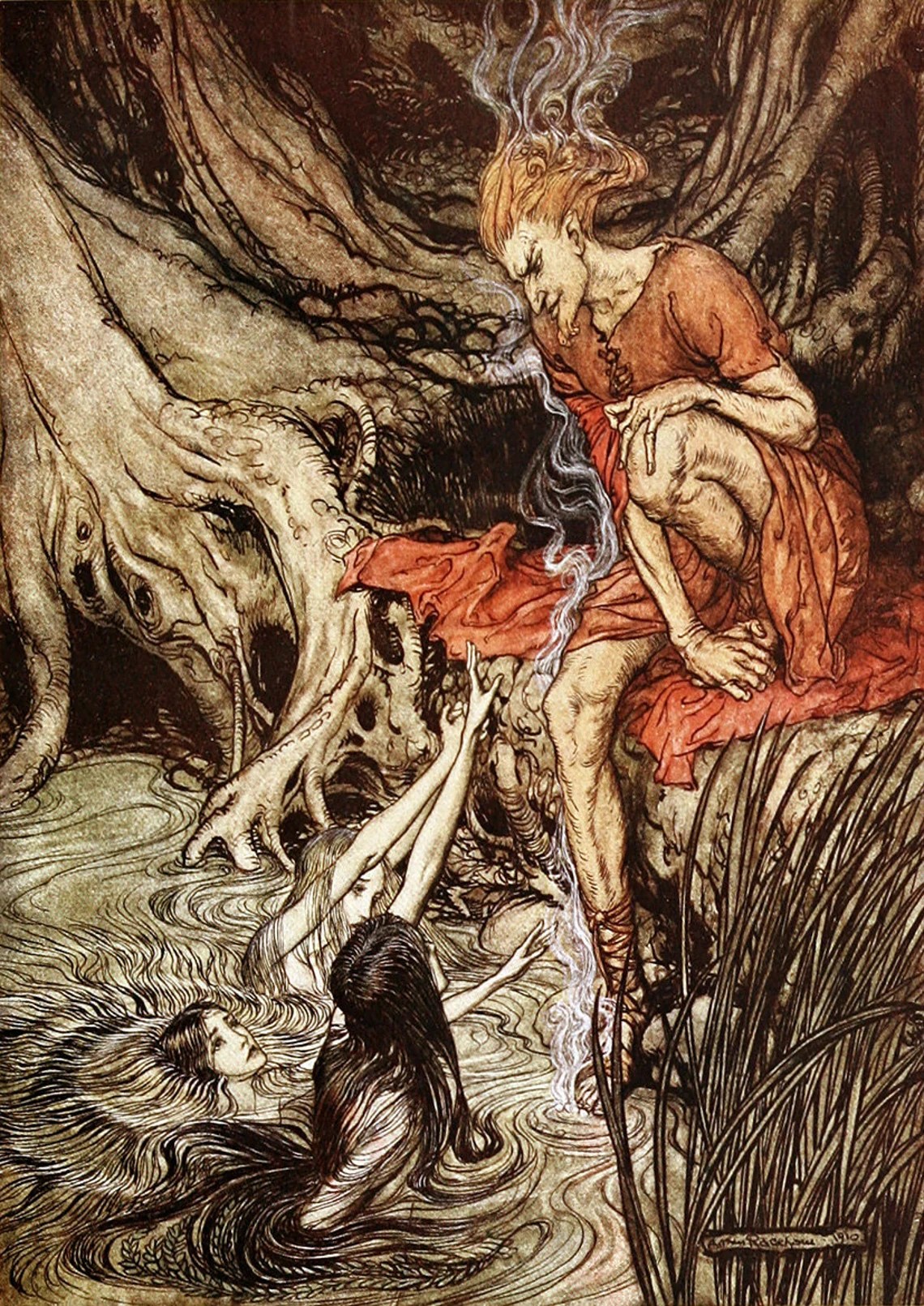
(Here chatting with the trickster god, Loge, an illustration by Arthur Rackham, 1867-1939.  You can see all of his illustrations to Wagner’s story here:  https://archive.org/details/rhinegoldvalkyri00wagn )

They are the guardians of the mysterious, but powerful “Rheingold”

which the dwarf, Alberich,
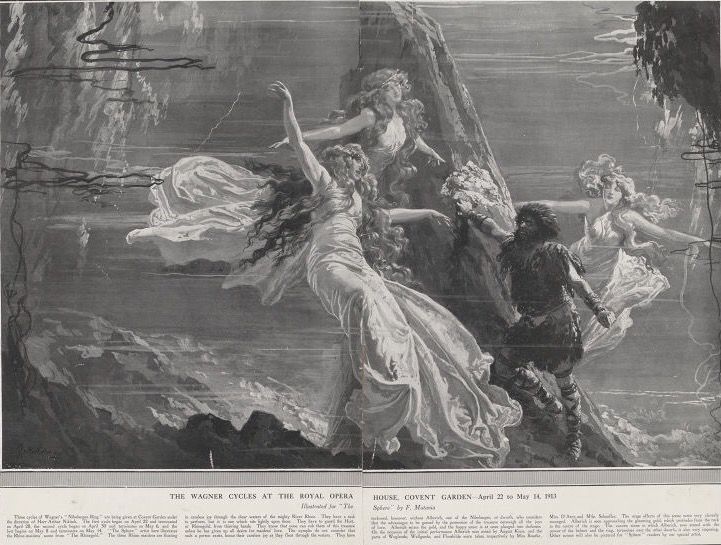
steals from them and fashions into a ring containing all the power of the original gold, which would enable its possessor to rule the world.

With another Ring in mind, there is, I would suggest, a bit more than a faint resemblance here between Wagner’s story and Tolkien’s, although Tolkien, seemingly fairly knowledgeable about Wagner’s work from early in his school days (see Carpenter Tolkien, 52) was very clear about just how faint that resemblance was as far as he was concerned:

“Both rings were round, and there the resemblance ceases.”  (from a letter to Allen & Unwin, 23 February, 1961, Letters, 436)

But might there be at least a little more similarity than that?

One fact is obvious:  Tolkien’s is a circlet which embodies tremendous power, just as the Nibelungen ring does, although that power wasn’t in the material from which it was made, but in the maker, Sauron. 

Alberich’s ring, like Sauron’s, has not remained with him, coming first into the possession of the god Wotan, and then into the possession of a dragon, Fafner (formerly a giant), then into that of his killer,  Siegfried (who also happens to be Wotan’s grandson), and then into that of the Valkyrie, Bruennhilde, Siegfried’s lover, who, leaping onto Siegfried’s funeral pyre, leaves the Ring to be collected from her ashes by the Rhinemaidens while, meanwhile, there is a cataclysm in the background and Valhalla, the home of the gods, is destroyed, along with the gods—“die Goetterdaemmerung”—literally “the gods’ dusk”. 

That ring isn’t destroyed, but we can certainly note that combination of the ring changing hands and huge destruction associated with that act—

“And even as he spoke the earth rocked beneath their feet.  Then rising swiftly up, far above the Towers of the Black Gate, high above the mountains, a vast soaring darkness sprang into the sky, flickering with fire.  The earth groaned and quaked.  The Towers of the Teeth swayed, tottered and fell down; the mighty rampart crumbled; the Black Gate was hurled in ruin; and from far away, now dim, now growing, now mounting to the clouds, there came a drumming rumble, a roar, a long echoing roll of ruinous noise.”  (The Return of the King, Book Six, Chapter 4, “The Field of Cormallen”)

(Ted Nasmith)

As well, coming back to the beginning of this posting, there is also a water association.  In fact, two:

1. after the defeat of Sauron at the foot of Orodruin, in which Isildur took the Ring from Sauron:

“…It fell into the Great River, Anduin, and vanished.  For Isildur was marching north along the east bank of the River, and near the Gladden Fields he was waylaid by the Orcs of the Mountains, and almost all his folk were slain.  He leaped into the waters, but the Ring slipped from his finger as he swam, and there the Orcs saw him and killed him with arrows…And there in the dark pools amid the Gladden Fields…the Ring passed out of knowledge and legend…”

2. but, many years later, two “akin to the fathers of the fathers of the Stoors”

“…took a boat and went down to the Gladden Fields…There Smeagol got out and went nosing about the banks but Deagol sat in the boat and fished.  Suddenly a great fish took his hook, and before he knew where he was, he was dragged out and down into the water, to the bottom.  Then he let go of his line, for he thought he saw something shining in the river-bed; and holding his breath he grabbed at it.

Then up he came spluttering, with weeds in his hair and a handful of mud; and he swam to the bank.  And behold!  when he washed the mud away, there in his hand lay a beautiful golden ring…” (The Fellowship of the Ring, Book One, Chapter 2, “The Shadow of the Past”)

To steal the Rhinegold from the Rhinemaidens, Alberich the dwarf has dived into the Rhine.
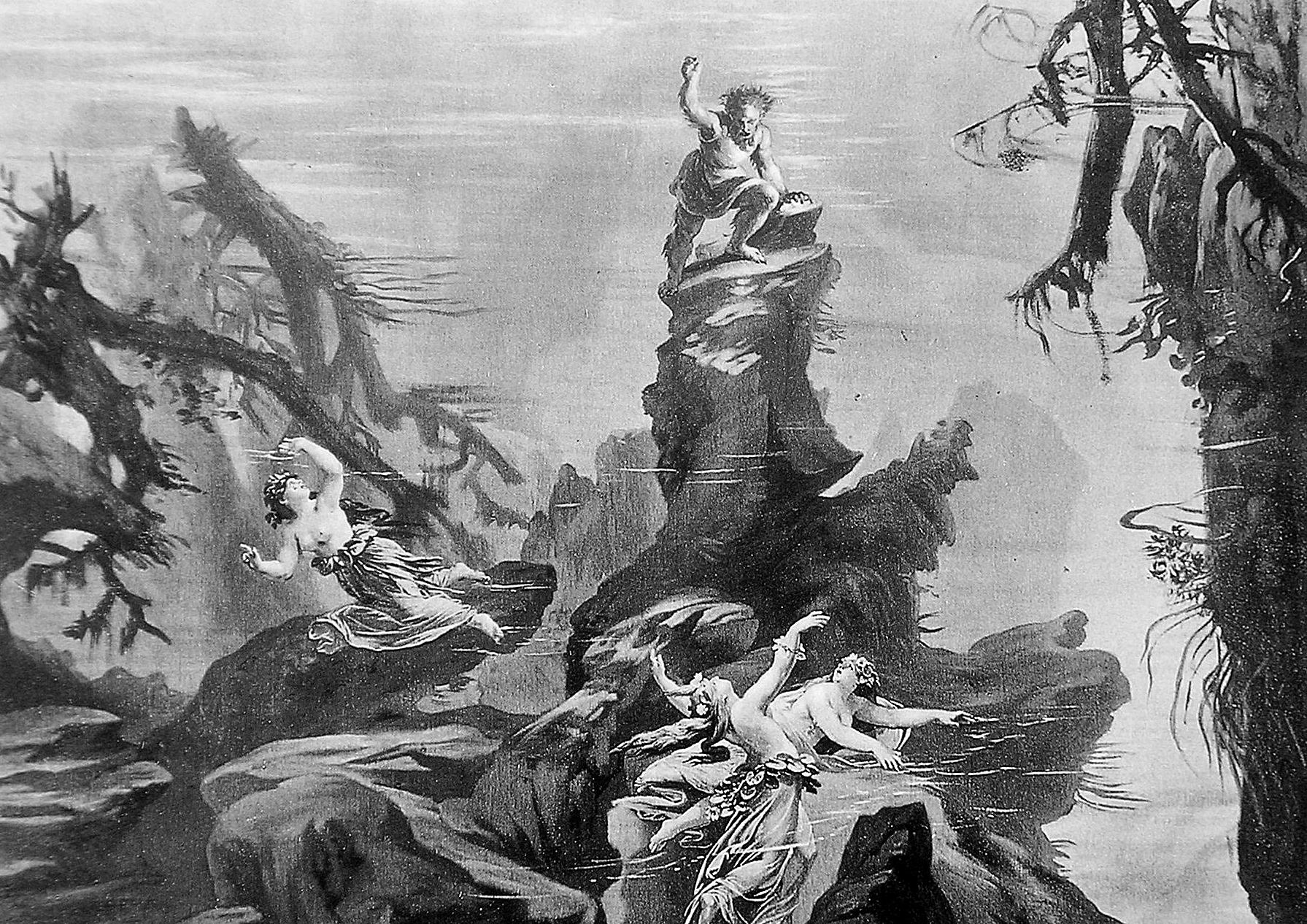
His son, Hagen, trying to regain the ring, is dragged into the river and drowned by them, even as they keep the ring.

Might we imagine, then, that the death of Gollum and all which precedes it is—perhaps—somehow a bit more related to Wagner’s story than JRRT was comfortable with?

(Ted Nasmith)

As ever, thanks for reading.

Stay well,

Stay dry,

And remember that there’s always

MTCIDC

O

A Tale of Two Swords

19 Wednesday Jun 2019

Posted by Ollamh in Fairy Tales and Myths, Imaginary History, Military History

≈ Leave a comment

Tags

Charles X, Crusades, Excalibur, French Revolution, Gesta Henrici II et Gesta Regis Ricardi, Glastonbury, King Arthur, King Tancred, Lady of the Lake, Lecce, Lionheart, Louis IX, Louis Philipe, Louis XIV, Louis XV, Louis XVI, Louis XVIII, Medieval, mosaic, Napoleon, Norman, Otranto, Rex Arturus, Richard I of England, Roger of Howden, swords, Third Crusade

So we were reading this really interesting book, Christopher Tyerman’sngcce How to Plan a Crusade, when, on pages 244-5, we came across this:  “While Louis prayed to the relics of the Passion, Richard had carried the sword Excalibur.”  And we said, “What?  Excalibur?”

Welcome, as always, dear readers.  In this post, we want to talk a bit about two historic—or mythical– swords, inspired, as we were, by that reference and by two kings involved with them.

The “Louis” in the passage above is Louis IX (1214-1270) of France,

image1sealoflouisix.jpg

aka St Louis, a saint of both the Catholic and Anglican churches, who led several crusades in the mid-13th century, but not very successfully, being taken prisoner during the first (1250) and dying of a fever during the second (1270).

The “Richard” is Richard I of England (1157-1199), also called “Lionheart”.

image2rich.jpg

He was also a crusader, having been one of the dominant figures in the earlier Third Crusade (1189-1192).

image3crus.jpg

But how do we know that Richard had “Excalibur”?  And how did he acquire it?

We begin with the passage from a contemporary of Richard’s, Roger of Howden (?-1201?), who has left us a history known as Gesta Henrici II et Gesta Regis Ricardi, “The Deeds/Acts of Henry II and the Deeds/Acts of King Richard”.  This begins in the 8th century and covers the period up to 1201, which is presumed to be the year of Roger’s death.  Roger went on the Third Crusade with Richard, although he left it early.  He either observed or heard about this event, which took place in 1191:

“Et contra rex Angliae dedit regi Tancredo gladium illum optimum quem Britones Caliburne[m?] vocant qui fuerat gladius Arthuri quondam nobilis regis Angliae.”

“And, in return, the King of England gave to King Tancred that best of swords, which the Britons call ‘Calibern’, which had been the sword of Arthur, the one-time noble king of England.”

(The Latin text comes from page 392 of a collection of earlier English historians, entitled “Rerum Anglicarum Scriptores Post Bedam Praecipui”,–something like, “Writers of/on English Affairs in Particular After Bede”–which was published in London in 1596).

“King Tancred” (1138-1194) was the Norman ruler of Sicily from 1189-1194, just when Richard and his fellow Crusaders had reached that part of the world on their way eastward.

image4tanc.jpg

Tancred gave Richard a number of ships to help with transport and we might suppose that this was part of a reciprocal process.  Remarkably for this early time, we have what appears to be concrete evidence not only that King Arthur was a well-known figure in southern Italy, but perhaps known to Tancred himself.

Tancred had been born in 1138 in Lecce (on the right-hand side of the map, just inland)

image5map.jpg

and just a few miles south is Otranto, with its cathedral (below Lecce on the map).

image6otrantocathedral.jpg

The main floor of that cathedral is covered by an enormous mosaic, installed between 1163 and 1165.

image7mosaic.jpg

image8mosaic.jpg

In that mosaic is a figure labeled “Rex Arturus”.

image9rexarturus.jpg

We’ve answered our first question, sort of:  “How do we know that Richard had Excalibur?”  But, again, how did he acquire it?  Unfortunately, the only reference to Richard and the sword is the one we’ve quoted.

One thought, however.  About 1191, the monks of Glastonbury Abbey

image10glastonbury.jpg

excavated a grave which

image11tombsite.jpg

supposedly included a lead cross which read:

“Hic jacet sepultus inclytus rex Arthurius in insula avallonia cum Wennevereia uxore sua secunda”

“Here lies buried the renowned king Arthurius on the Avalonian island with Guinevere his second wife”

(Latin text from Giraldus Cambrensis, Speculum Ecclesiae, Chapter IX.)

Giraldus himself had been shown this cross by the Abbot, as he tells us.  (For a more complete version of this story, in an English translation, please see this LINK.)

Modern research suggests that this was a fake, intended to boost the fortunes of a fading religious site, badly damaged by fire in 1184, but suppose that, to increase their patronage, the monks had added another level to their sham and “found” a sword, which they had then sent to Richard, who carried it off on his journey to the East.

(For more on the fakery, see, for example, this LINK.)

Louis IX, as we mentioned, died on campaign in 1270.  His son, Philip, was with him at the time, but sailed back to France after his father’s death and was crowned Philip III in 1271.  Our sources are vague here (they don’t always get the year right, for example), but all report that, for the first time, a special sword was used in the coronation ceremony.  This was the so-called “sword of Charlemagne”, named “Joyeuse” (the “happy one”), which is mentioned in the 11th-century Chanson de Roland:

“Si ad vestut sun blanc osberc sasfret,
Laciet sun elme, ki est a or gemmet,
Ceinte Joiuse, unches ne fut sa per,
Ki cascun jur muet.XXX. clartez.”

“[Charlemagne] was wearing his fine white coat of mail and his helmet with gold-studded stones; by his side hung Joyeuse, and never was there a sword to match it; its colour changed thirty times a day.”

(The translator for this was not identified at the site and we would make one small change—“clartez” might be better as “sheen/brightness” instead of “colour”.)

image12sword.jpg

This, one of the few remaining pieces of the royal regalia, is, in fact, a mixture of a number of different periods, all the way up to Charles X (reigned 1824-1830), and experts argue over whether it is actually possible to date any part of it as early as Charlemagne’s time (see this LINK for more).

What isn’t questioned is that some version of this sword, at least, was used as part of the crowning ritual of French kings for centuries and its association with Charlemagne was as important for French history as linking something to King Arthur for English.

We haven’t managed to locate any medieval manuscript illustration which depicts a French coronation with the sword in place, but, when it comes to “The Sun King”, that is, Louis XIV, you can see that’s its hanging from his left side.

image13louisxiv.jpg

The same is true for Louis XV

image14louisxv.jpeg

and for that most unwarlike monarch, Louis XVI.

imagexvlouisxvi.jpg

The French Revolution brought the crowning of kings to a halt, of course,

image16execution.jpg

but Napoleon, all too aware both of the past and of his need to establish himself as the legitimate heir to the previous kings, brought it back, as you can see in this really over the top portrait.

image17nappy.jpg

When the younger brothers of the executed Louis XVI, Louis XVIII (1755-1824)

image18louisxviii.jpg

and Charles X (1757-1836)

image19chas.jpg

became king successively in 1814 and 1824, one can still see the sword—although apparently Napoleon’s craftsmen had fiddled with it, as did those of Charles.   His successor, Louis Philipe (1773-1850), who belonged to a cousin branch of the royal family, broke the tradition for good and the sword disappeared into history—and the Louvre, where it’s now on display.

And this brings us back to Excalibur.  The tradition is a little murky, but the medieval sources are pretty clear that Excalibur had come from “The Lady of the Lake” and, as Arthur lay, gravely, perhaps fatally wounded, he commanded one of his knights, Griflet or Bedivere, according to the tradition, to return it to the Lady, which he finally, and very reluctantly, did.

image20lake.jpg

With this, Excalibur disappears from the story—until Richard is reported giving it to the king of Sicily and our story—briefly—begins again.

Thanks, as always, for reading and

MTCIDC

CD

The Doubtful Sea Series Facebook Page

The Doubtful Sea Series Facebook Page

  • Ollamh

Categories

  • Artists and Illustrators
  • Economics in Middle-earth
  • Fairy Tales and Myths
  • Films and Music
  • Games
  • Heroes
  • Imaginary History
  • J.R.R. Tolkien
  • Language
  • Literary History
  • Maps
  • Medieval Russia
  • Military History
  • Military History of Middle-earth
  • Narnia
  • Narrative Methods
  • Poetry
  • Research
  • Star Wars
  • Terra Australis
  • The Rohirrim
  • Theatre and Performance
  • Tolkien
  • Uncategorized
  • Villains
  • Writing as Collaborators
Follow doubtfulsea on WordPress.com

Across the Doubtful Sea

Recent Postings

  • A Moon disfigured December 17, 2025
  • On the Roads Again—Once More December 10, 2025
  • (Not) Crossing Bridges December 3, 2025
  • On the Road(s) Again—Again November 26, 2025
  • On the Road(s) Again November 19, 2025
  • To Bree (Part 2) November 12, 2025
  • To Bree (Part 1) November 5, 2025
  • A Plague o’ Both—No, o’ All Your Houses! October 29, 2025
  • It’s in Writing (2:  I’st a Prologue, or a Poesie for a Ring?) October 22, 2025

Blog Statistics

  • 103,228 Views

Posting Archive

  • December 2025 (3)
  • November 2025 (4)
  • October 2025 (5)
  • September 2025 (4)
  • August 2025 (4)
  • July 2025 (5)
  • June 2025 (4)
  • May 2025 (4)
  • April 2025 (5)
  • March 2025 (4)
  • February 2025 (4)
  • January 2025 (5)
  • December 2024 (4)
  • November 2024 (4)
  • October 2024 (5)
  • September 2024 (4)
  • August 2024 (4)
  • July 2024 (5)
  • June 2024 (4)
  • May 2024 (5)
  • April 2024 (4)
  • March 2024 (4)
  • February 2024 (4)
  • January 2024 (5)
  • December 2023 (4)
  • November 2023 (5)
  • October 2023 (4)
  • September 2023 (4)
  • August 2023 (5)
  • July 2023 (4)
  • June 2023 (4)
  • May 2023 (5)
  • April 2023 (4)
  • March 2023 (5)
  • February 2023 (4)
  • January 2023 (4)
  • December 2022 (4)
  • November 2022 (5)
  • October 2022 (4)
  • September 2022 (4)
  • August 2022 (5)
  • July 2022 (4)
  • June 2022 (5)
  • May 2022 (4)
  • April 2022 (4)
  • March 2022 (5)
  • February 2022 (4)
  • January 2022 (4)
  • December 2021 (5)
  • November 2021 (4)
  • October 2021 (4)
  • September 2021 (5)
  • August 2021 (4)
  • July 2021 (4)
  • June 2021 (5)
  • May 2021 (4)
  • April 2021 (4)
  • March 2021 (5)
  • February 2021 (4)
  • January 2021 (4)
  • December 2020 (5)
  • November 2020 (4)
  • October 2020 (4)
  • September 2020 (5)
  • August 2020 (4)
  • July 2020 (5)
  • June 2020 (4)
  • May 2020 (4)
  • April 2020 (5)
  • March 2020 (4)
  • February 2020 (4)
  • January 2020 (6)
  • December 2019 (4)
  • November 2019 (4)
  • October 2019 (5)
  • September 2019 (4)
  • August 2019 (4)
  • July 2019 (5)
  • June 2019 (4)
  • May 2019 (5)
  • April 2019 (4)
  • March 2019 (4)
  • February 2019 (4)
  • January 2019 (5)
  • December 2018 (4)
  • November 2018 (4)
  • October 2018 (5)
  • September 2018 (4)
  • August 2018 (5)
  • July 2018 (4)
  • June 2018 (4)
  • May 2018 (5)
  • April 2018 (4)
  • March 2018 (4)
  • February 2018 (4)
  • January 2018 (5)
  • December 2017 (4)
  • November 2017 (4)
  • October 2017 (4)
  • September 2017 (4)
  • August 2017 (5)
  • July 2017 (4)
  • June 2017 (4)
  • May 2017 (5)
  • April 2017 (4)
  • March 2017 (5)
  • February 2017 (4)
  • January 2017 (4)
  • December 2016 (4)
  • November 2016 (5)
  • October 2016 (6)
  • September 2016 (5)
  • August 2016 (5)
  • July 2016 (5)
  • June 2016 (5)
  • May 2016 (4)
  • April 2016 (4)
  • March 2016 (5)
  • February 2016 (4)
  • January 2016 (4)
  • December 2015 (5)
  • November 2015 (5)
  • October 2015 (4)
  • September 2015 (5)
  • August 2015 (4)
  • July 2015 (5)
  • June 2015 (5)
  • May 2015 (4)
  • April 2015 (3)
  • March 2015 (4)
  • February 2015 (4)
  • January 2015 (4)
  • December 2014 (5)
  • November 2014 (4)
  • October 2014 (6)
  • September 2014 (1)

Blog at WordPress.com.

  • Subscribe Subscribed
    • doubtfulsea
    • Join 78 other subscribers
    • Already have a WordPress.com account? Log in now.
    • doubtfulsea
    • Subscribe Subscribed
    • Sign up
    • Log in
    • Report this content
    • View site in Reader
    • Manage subscriptions
    • Collapse this bar
 

Loading Comments...