Tags
bacon and eggs, being eaten, Eating, Fantasy, Goblins, Gollum, seed-cake, Smaug, snails, spiders, The Hobbit, Tolkien, Tolkien as hobbit, trolls
Dear readers, welcome, as always.
When Tolkien admitted that he was a hobbit, he defined them—and himself—in part in this way:
“…I like gardens, trees and unmechanized farmlands; I smoke a pipe, and like good plain food (unrefrigerated), but detest French cooking… “ (from a letter to Deborah Webster, 25 October, 1958, Letters, 411)
This follows, of course, his description in “Concerning Hobbits” in the Prologue to The Lord of the Rings:
“Their faces were as a rule good-natured rather than beautiful, broad, bright-eyed, red-cheeked, with mouths apt to laughter, and to eating and drinking. And laugh they did, and eat, and drink, often and heartily, being fond of simple jests at all times, and of six meals a day (when they could get them).”
And this is an extension of the description in the first chapter, “An Unexpected Party”, of The Hobbit:
“[they] have long clever brown fingers, good-natured faces, and laugh deep fruity laughs (especially after dinner, which they have twice a day when they can get it).”
This propensity for the consumption of comestibles—and for the reporting of and description of eating and all that might go with it—is more, in The Hobbit, than simply a fond look at a foible, however. In fact, it is a theme which seems, at times to dominate the book—and we see this practically on the first page of the novel, not only in that mention of multiple dinners, but even in the fact that hobbit laughs are “fruity”.
The opening setting itself announces the theme: “Bilbo Baggins was standing at his door after breakfast…” and soon Bilbo is resisting Gandalf’s proposal of an adventure by saying “Nasty disturbing uncomfortable things! Make you late for dinner!” (The Hobbit, Chapter 1, “An Unexpected Party”)

(the Hildebrandts)
There follows the rattled Bilbo’s invitation to Gandalf to come to tea (after which he consoles himself with “a cake or two and a drink of something”), and then the party from the chapter title, which includes not only a major depletion of Bilbo’s pantry (or pantries, as the narrator has already informed us that Bilbo’s house has “lots of these”), but even a kind of heroic catalogue of what’s called for and which Bilbo seems able to supply including: tea, beer, seed-cake, coffee, scones, ale, porter, red wine, raspberry jam, apple-tart, mince-pies, cheese, pork-pie, salad, eggs, chicken, and pickles (and a single biscuit—that is, cookie, for Bilbo).
The chapter ends with one last burst of food-talk as Bilbo offers bed and breakfast to the dwarves (as a way of seeing them off) and Thorin orders breakfast as if Bilbo were running an inn:
“But I agree about bed and breakfast. I like six eggs with my ham, when starting on a journey: fried not poached, and mind you don’t break ‘em.”

(Eggs and ham—those eggs will appear again, but with bacon, when Bilbo, more than once, yearns for them. This is from a rather mouth-watering website called “The English Kitchen”, which you can visit here: https://www.theenglishkitchen.co/2020/04/proper-ham-eggs.html And, as, when you search for a useful image of ham and eggs, you suddenly find yourself surrounded by images of Dr. Seuss’ wonderful Green Eggs and Ham, you can it read here: https://ia601502.us.archive.org/20/items/green-eggs-and-ham_202211/GreenEggs%20Ham.pdf )
And Bilbo goes off the bed annoyed not only at Thorin, but at all of the other dwarves, who have made similar orders.
After that opening, it’s not surprising that Chapter 2 begins with a still-annoyed Bilbo, faced with a mountain of dirty dishes, the remains of a breakfast he didn’t fix, but, cleaning up, he enjoys his own first breakfast and is starting on a second one when Gandalf appears and Bilbo is suddenly off on the adventure which takes up the rest of the book.
Food soon appears again as one of their ponies “got into the river before they could catch him…and all the baggage that he carried was washed away off him. Of course it was mostly food, and there was mighty little left for supper, and less for breakfast.” (Chapter 2)
But then the eating theme takes a different and disturbing turn: trolls

(JRRT)
who, though currently munching mutton, have “…et a village and a half between yer, since we come down from the mountains” and soon, like amateur chefs on “The Great Goblin Bake Off”, are discussing how to prepare dwarf—will it be roasting? boiling? before the judge, one Gandalf, decides the argument by tricking them into being exposed to the sun and turned to stone.

(JRRT)
This is, in its way, a mirror to the original eating idea, in which the protagonists who do the consuming are at risk of becoming a potential article for consumption and we’ll see this repeated more than once with:
1. the goblins (Chapter 4): “For goblins eat horses and ponies and donkeys (and other much more dreadful things), and they are always hungry.”

(Alan Lee)
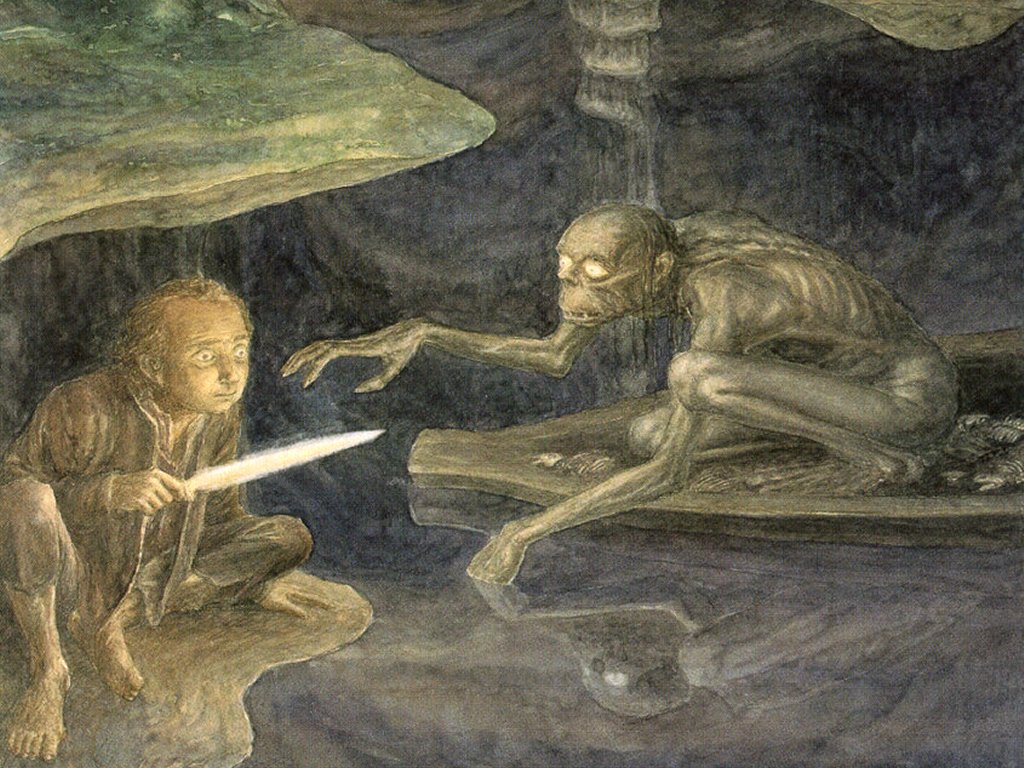
2. Gollum (Chapter 5): “He was looking out of his pale lamp-eyes for blind fish, which he grabbed with his long fingers as quick as thinking. Goblin he thought good, when he could get it…” and there’s the possibility that Bilbo might be on the menu—if he loses the riddle contest.

(Alan Lee)
3. the spiders (Chapter 8): “ ‘What nasty thick skins they [the dwarves] have to be sure, but I’ll wager there is good juice inside.’ ‘Aye, they’ll make fine eating, when they’ve hung a bit…’ ”

(and another Alan Lee)
4. and, of course, Smaug (Chapter 12): “ ‘Let me tell you I ate six ponies last night and I shall catch and eat all the others before long…I know the smell (and taste) of dwarf…Girion Lord of Dale is dead, and I have eaten his people like a wolf among sheep…’ “

(JRRT)
On the other side (the eating, not eaten), however, there are:
1. supper with the Rivendell elves (Chapter 3)

(JRRT)
2. rabbit, hare, and sheep with the eagles (Chapter 6)

(JRRT)
3. meals with Beorn (Chapter 7)

(Ted Nasmith)
4. starving in Mirkwood while being tantalized by elvish feasts (Chapter 8)

(another elf king, in an illustration by A.W. Bayes, 1831-1909)
5. prison rations in the dungeons of Thranduil, the king of the forest elves (Chapter 9)—as well as food stolen by Bilbo

(a generic dungeon as, so far, I haven’t discovered a useful illustration of the original situation)
6. feasts in Lake-town (Chapter 10)

(JRRT)
7. a gourmet diet of snails (Chapter 11)

(Alan Lee)
8. and even the threat of siege and starvation (Chapter 15)—

(Alan Lee)
Given that so much of the text is handed over to eating and drinking, it’s surprising that the conclusion of the story doesn’t have Gandalf returning (with Balin) to tea some years later—

(Alan Lee)
could it be that even that academic hobbit is finally full?
As always, thanks for reading.
Stay well,
One slice of cake should do, I think, don’t you? Or maybe two?

And remember that, as always, there’s
MTCIDC
O





 doubtfulsea