• About

doubtfulsea

~ adventure fantasy

Tag Archives: Dr Seuss

Bogged Down

20 Wednesday Aug 2025

Posted by Ollamh in Uncategorized

≈ Leave a comment

Tags

Barrow-wight, bog bodies, bog sacrifices, bogs, Danish National Museum, de-bello-gallico, Dr Seuss, Fionn mac Cumhaill, Frodo, heroic burials, human sacrifice, La Tene, sacrificial-objects, The Lord of the Rings, Thomas Pennant, Tolkien, Tom Bombadil, Vimose

As always, dear readers, welcome.

What’s going on here?

“He turned, and there in the cold glow he saw lying beside him Sam, Pippin, and Merry.  They were on their backs, and their faces looked deadly pale; and they were clad in white.  About them lay many treasures, of gold maybe, though in that light they looked cold and unlovely.  On their heads were circlets, gold chains were about their waists, and on their fingers were many rings.  Swords lay by their sides, and shields were at their feet.  But across their three necks lay one long naked sword.”  (The Fellowship of the Ring, Book One, Chapter 8, “Fog on the Barrow Downs”)
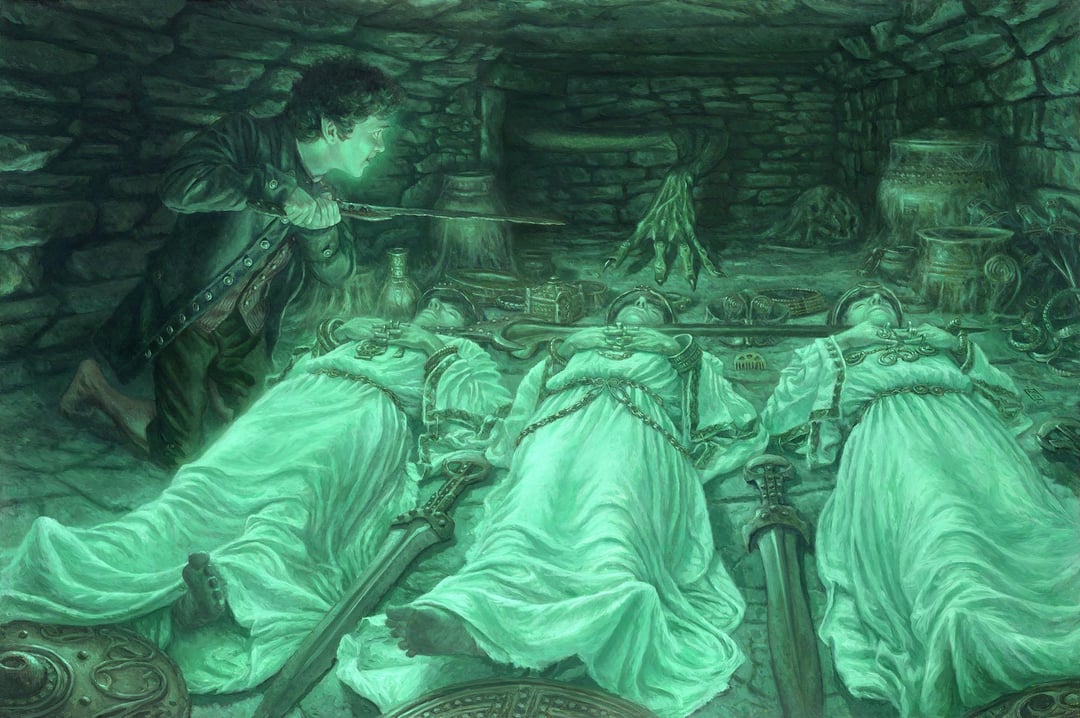
(Matthew Stewart–you can see more of his impressive work here: https://www.matthew-stewart.com/ I like his dragons especially.)

This might appear to look like an early heroic burial, with grave goods piled up,

like this chieftain’s grave from 530BC, found near Hochdorf an der Enz in Baden-Wuerttemberg, Germany—which even has this beautiful wagon (reconstructed—for more see:  https://en.wikipedia.org/wiki/Hochdorf_Chieftain%27s_Grave ).

There is a difficulty, however:  none of the hobbits is dead—although that sword across three of their necks suggests that they soon will be.

And I would further suggest that what we’re looking at is the scene of a potential human sacrifice—especially if we add what the narrator calls an “incantation” on the part of the Barrow-wight:

“Cold be hand and heart and bone,

And cold be sleep under stone:

Never more to wake on stony bed,

Never, till the Sun fails and the Moon is dead.

In the black wind the stars shall die,

And still on gold here let them lie,

Till the dark lord lifts his hand

Over dead sea and withered land.”

Human sacrifice had certainly been practiced in Middle-earth.  We know that Sauron, defeated temporarily, corrupts the king of Numenor, Tar-Calion (also known as Ar-Pharazon), preaching the worship of the fallen Vala, Morgoth:

“A new religion, and worship of the Dark, with its temple under Sauron arises.  The faithful are persecuted and sacrificed.  The Numenoreans carry their evil also to Middle-earth and there become cruel and wicked lords of necromancy, slaying and tormenting men… “ (letter to Milton Waldman, late 1951, Letters, 216-217—for more on this see “Melkor/Morgoth/Melqart” 29 June, 2022)

I suspect that Tolkien’s own first experience with such sacrifices may have come from a boyhood reading Julius Caear’s (100-44BC) De Bello Gallico, where he would have found:

“Natio est omnis Gallorum admodum dedita religionibus, atque ob eam causam, qui sunt adfecti gravioribus morbis quique in proeliis periculisque versantur, aut pro victimis homines immolant aut se immolaturos vovent administrisque ad ea sacrificia druidibus utuntur, quod, pro vita hominis nisi hominis vita reddatur, non posse deorum immortalium numen placari arbitrantur, publiceque eiusdem generis habent instituta sacrificia. Alii immani magnitudine simulacra habent, quorum contexta viminibus membra vivis hominibus complent; quibus succensis circumventi flamma exanimantur homines.”

“The whole nation of the Gauls is completely devoted to religious practices and because of this, those who are afflicted with very serious illnesses and those who are involved in battles and dangers either sacrifice men in place of animal victims or pledge that they will sacrifice them and use the druids as the priests for those sacrifices because they think that, unless the life of a person is paid back for the life of a person, the divine will of the immortal gods can’t be appeased and they [even] have sacrifices set up of the same kind at public expense.  Others have images of immense size of which the chambers, woven of willow withies, are filled with living people.   [So that], when they are set alight, the people, surrounded by flame, are killed.”  (De Bello Gallico, Book VI, Sec.16, my translation—you can read more at the invaluable Sacred Texts site here in a parallel Latin/English text:  https://sacred-texts.com/cla/jcsr/index.htm ) 

(This is from Thomas Pennant’s, 1726-1798, A Tour of Wales, 1778.  Pennant was a naturalist, antiquarian, traveler, etc etc and one of those wonderful 18th people seemingly interested in everything and eager to report what they discovered.  You can read about him here:  https://en.wikipedia.org/wiki/Thomas_Pennant but don’t forget to read about his draftsman, Moses Griffith, an equally impressively-talented man:  https://en.wikipedia.org/wiki/Moses_Griffith_(artist) There is even a Thomas Pennant Society:  https://www.cymdeithasthomaspennant.com/eng/t-p.html And you can read the Tour itself here:  https://archive.org/details/toursinwales00penngoog/page/n8/mode/2up  For more on the idea of the “wicker man”, see:  https://en.wikipedia.org/wiki/Wicker_man  )

The Romans, with very rare (and early) exceptions, frowned upon human sacrifice, but northern people, before being overwhelmed by the Romans, or too far north for them to conquer effectively, could, as in the case of the Gauls mentioned above, have a different approach to their gods.

Unfortunately, as they were not, like the Romans, extremely literate, what little description we have comes from people like Caesar, curious (and probably horrified) outsiders—and perhaps also propagandists, who wanted to paint those outside the Mediterranean world as savages and therefore worthy of nothing more than conquest.

We do, however, have other and very vivid evidence in the form of archaeological discoveries.

One of these turned up in my last posting, the “Vimose comb” (see “Runing Things”, 13 August, 2025).

The “-mose” in Vimose means “bog/wetland/moorland” in modern Danish, descended from “mosi” in Old Norse and this immediately tells us about a different method of making a sacrifice—and not necessarily a human one—dropping it into water.

Without local explanation, we can only guess what was thought to happen when the object was deposited.  For myself, I’ve always thought of the pool in the story of Fionn mac Cumhaill. 
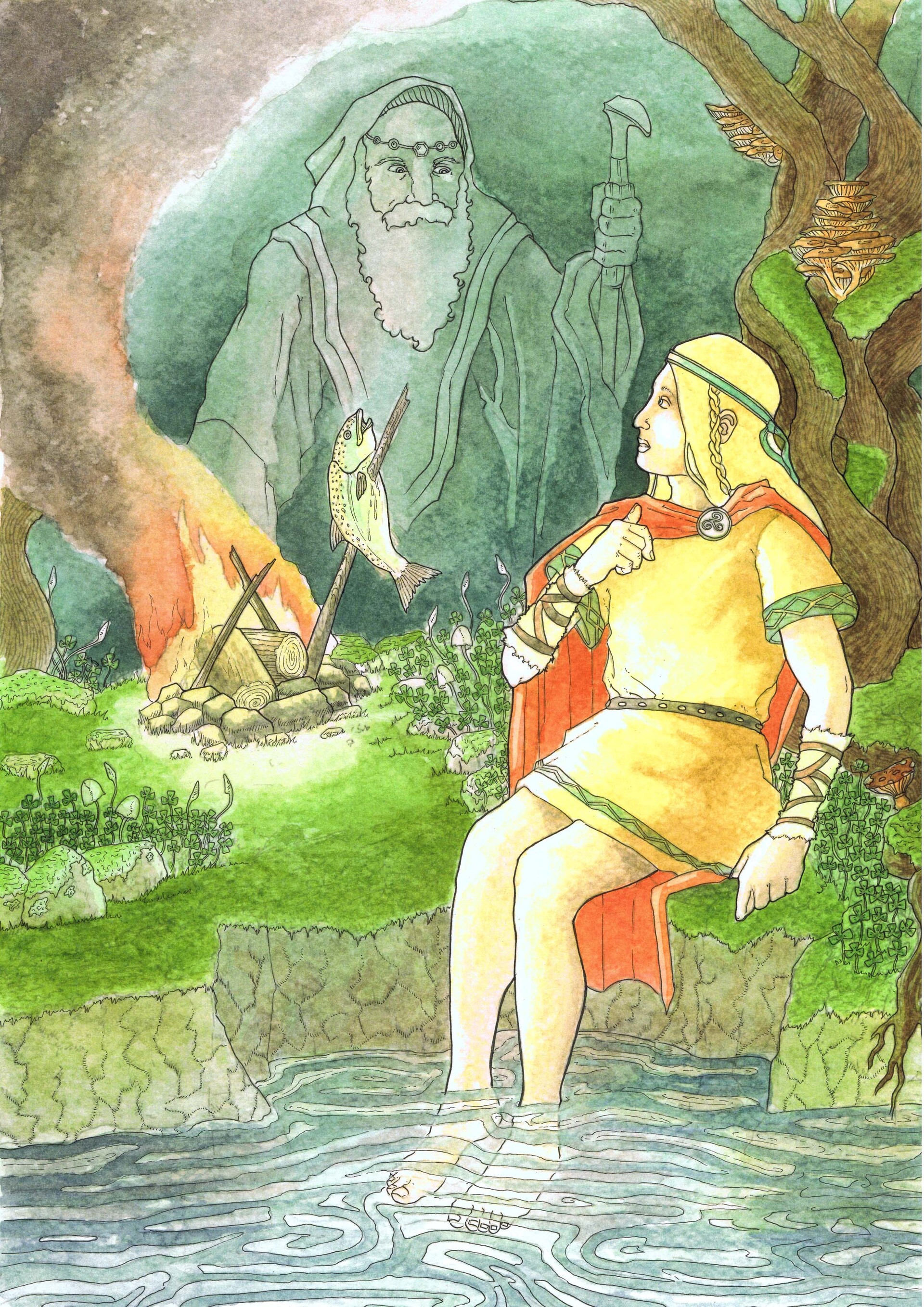
(Marga Gomila—you can see drafts of this work at:  https://margagomila.artstation.com/projects/OmEwgv )

This was connected with the otherworld and nuts from hazel trees would fall into the pool from that otherworld, to be consumed by a salmon in our world.  Cooking the salmon (caught in this world), Fionn, then a boy, burned his thumb and, putting it into his mouth, gained supernatural knowledge thereby.  (See for more:  https://en.wikipedia.org/wiki/Fionn_mac_Cumhaill and:  https://en.wikipedia.org/wiki/Wells_in_the_Irish_Dindsenchas There is a similar story attached to the Germanic hero, Sigurd, which you can read in the form Tolkien probably first read it:  https://www.gutenberg.org/cache/epub/540/pg540-images.html )

So, were these earlier sacrificers dropping in their treasures in hopes of sending them out of this world, presumably to the place where their gods lived?

Certainly the person who dropped the comb into the Vimose must have had some such hope and that person was hardly alone as, to date, about 2500 objects have been recovered from the site.  (For more on Vimose, check out this very interesting site:  https://ageofarthur.substack.com/p/the-homeland-of-the-angles-and-the See, as well, the Danish National Museum site, with all sorts of short articles on Vimose and other places:  https://en.natmus.dk/historical-knowledge/denmark/prehistoric-period-until-1050-ad/the-early-iron-age/the-weapon-deposit-from-vimose/the-offerings-in-vimose/ )

And it’s not the only site.  From Ireland eastwards through much of Germany, there are sites, some more specific, like La Tene, in Switzerland, where there was a huge cache of swords,

(no citation, but it looks like a Peter Connolly)

and Hjortspring, in Denmark, where there was a boat,

and Dejbjerg, also in Denmark, where there was a wagon.

There are animal sacrifices,

(Miroslaw Kuzma–as a sometime horseman, I hesitated to include this illustration.)

but the most sinister deposits are human ones,
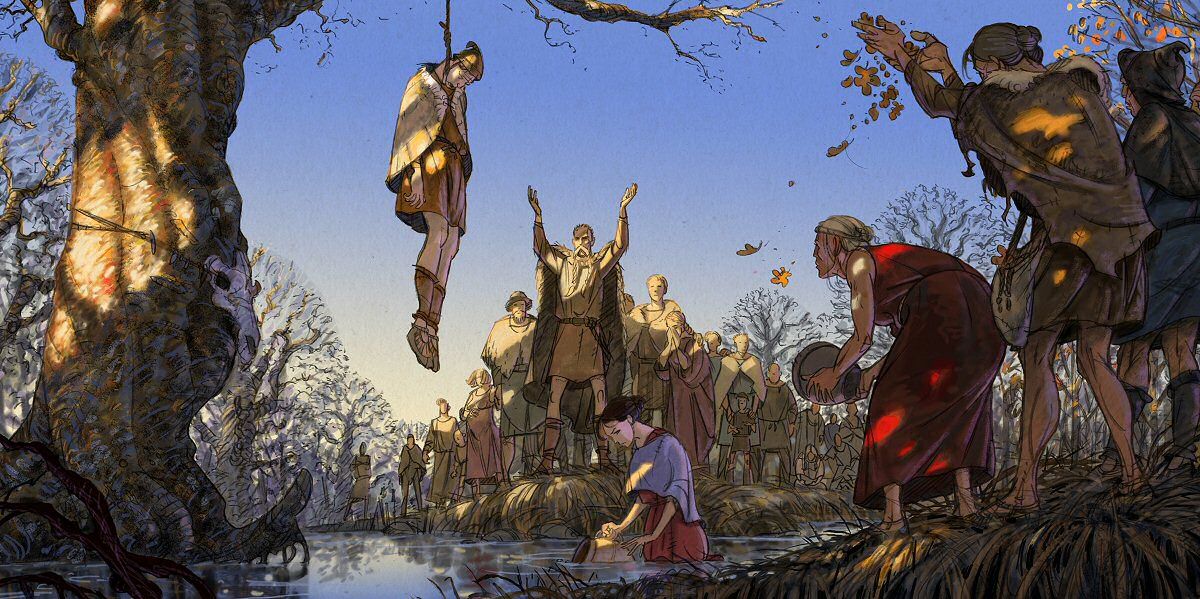
some of whose well-preserved remains would probably have worried those who believed that, once the victim had been dealt with, and sunk in the water, the sacrifice would have been accepted and then the next step would be a god’s.  (For more on so-called “bog bodies”, see:  https://en.wikipedia.org/wiki/Bog_body )
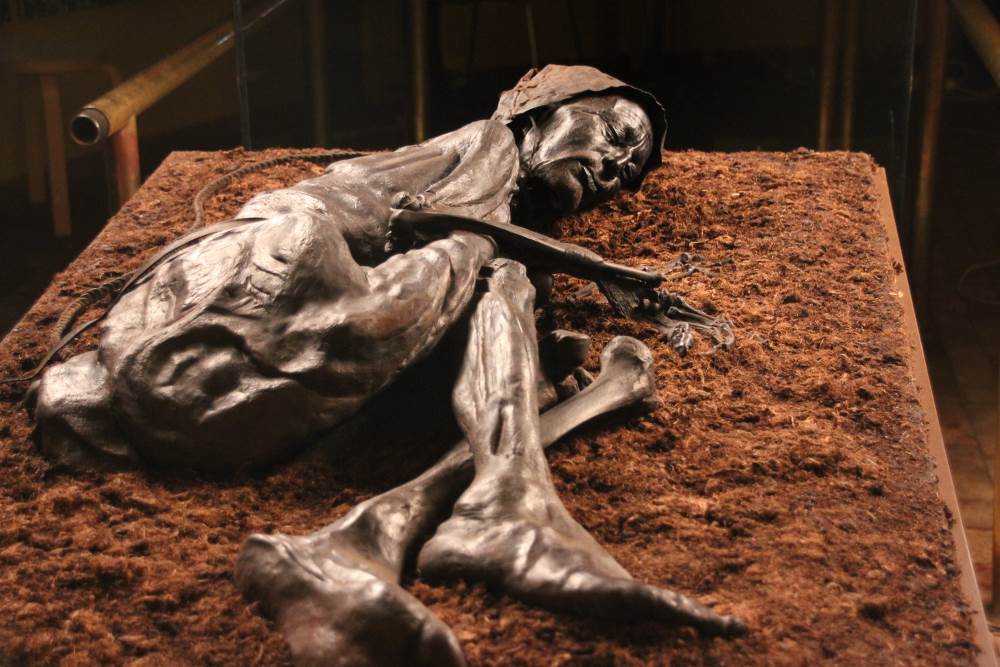
Although Frodo was responsible for halting what may have been about to be a sacrifice—

“But the courage that had been awakened in him was now too strong:  he could not leave his friends so easily.  He wavered, groping in his pocket, and then fought with himself again; and as he did so the arm crept nearer.  Suddenly resolve hardened in him, and he seized a short sword that lay beside him, and kneeling, he stooped low over the bodies of his companions.  With what strength he had he hewed at the crawling arm near the wrist, and the hand broke off; but at the same moment the sword splintered up to the hilt.  There was a shriek and the light vanished.  In the dark there was a snarling noise.”

It was the appearance of Tom Bombadil, summoned by Frodo, who rescued them all—

“There was a loud rumbling sound, as of stones rolling and falling, and suddenly light streamed in, real light, the plain light of day.  A low door-like opening appeared at the end of the chamber beyond Frodo’s feet; and there was Tom’s head (hat, feather, and all) framed against the light of the sun rising red behind him.”

And there was Tom’s incantation—

“Get out, you old Wight!  Vanish in the sunlight!

Shrivel like the cold mist, like the winds go wailing,

Out into the barren lands far beyond the mountains!

Come never here again!  Leave your barrow empty!

Lost and forgotten be, darker than the darkness,

Where gates stand for ever shut, till the world is mended.”  (The Fellowship of the Ring, Book One, Chapter 8, “Fog on the Barrow-downs”)

I wonder whether, about to be consecrated to a god we no longer know of, a victim might have called upon his/her gods, hoping for a similar rescue?

Thanks for reading, as ever.

Stay well,

Avoid barrows—unless they’re wheeled,
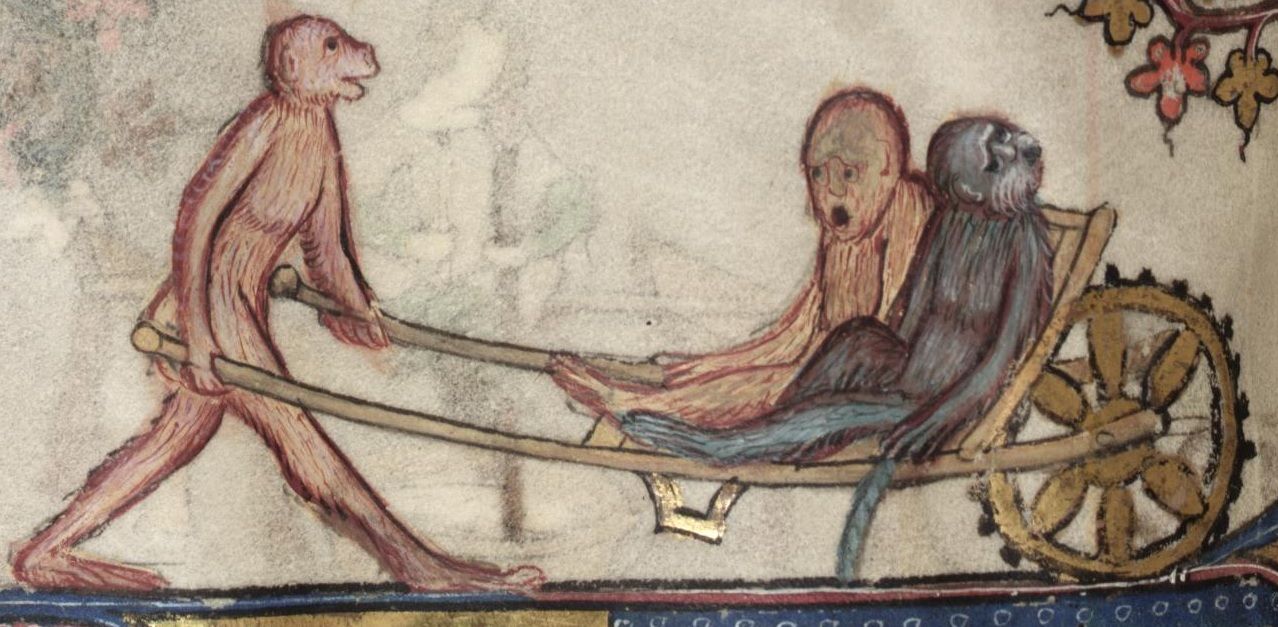
(Is this by a medieval Dr. Seuss?)

Definitely stay out of bogs,

And remember that, as always, there’s

MTCIDC

O

PS

If you’re interested in a scientific explanation for the surprising preservation of some bodies, see:

https://en.natmus.dk/historical-knowledge/denmark/prehistoric-period-until-1050-ad/the-early-iron-age/the-woman-from-huldremose/the-chemistry-of-the-bog-bodies/

See-r (2)

17 Wednesday Apr 2019

Posted by Ollamh in J.R.R. Tolkien, Literary History, Narrative Methods

≈ Leave a comment

Tags

Apollo, Babylonian, Claros, Delphi, Didyma, Dodona, Dr Seuss, epic metre, Etruscan, Extispicy, Flamen, Galadrien, Greek, Gustave Moreau, Haruspex, King Galdaran, Mirror of Galadriel, Oracle, Pytho, Rome, Romulus and Remus, Star Wars, The Lord of the Rings, Theogony, Tolkien, Yoda

Here we are again, dear readers, welcoming you to the second half of that posting with the odd name—or at least the odd spelling.

In the first half of this, we began with questions about Galadriel’s mirror: where did it come from? What was it doing in the text?

image1galad.jpg

We saw that it had begun life in a manuscript note as the mirror of “King Galdaran”, but then became the mirror of “Galadrien” as JRRT smoothed and polished both the scene and the character.   In that earlier note—a kind of shorthand plot summary—it’s stated that, “King Galdaran says the mirror shows past, present, and future, and the skill needed to decide which…”—that is, one needs skill to decide which might be past, present, or future. Such skill, especially to read the future, led us to thinking about the history of attempting to read the future, and we briefly discussed the use of turtle plastrons (the underside of a turtle) and ox shoulder blades, then number patterns, in ancient China, dreams in Egypt, and the insides of certain animals in Babylon.

In this posting, we want to take that history a bit farther.

Just as the Babylonians practiced extispicy—the examination of the intestines of certain animals or birds—so did the Etruscans, whom we think of as Rome’s “big brothers”, as many Roman practices and customs appear to have been borrowed from them. In our last, we showed a Babylonian model of a sheep’s liver,

image2bab.jpg

presumably used as a guide to reading an actual liver. Here’s a bronze Etruscan model, with various areas marked off and labeled.

image3liver.jpg

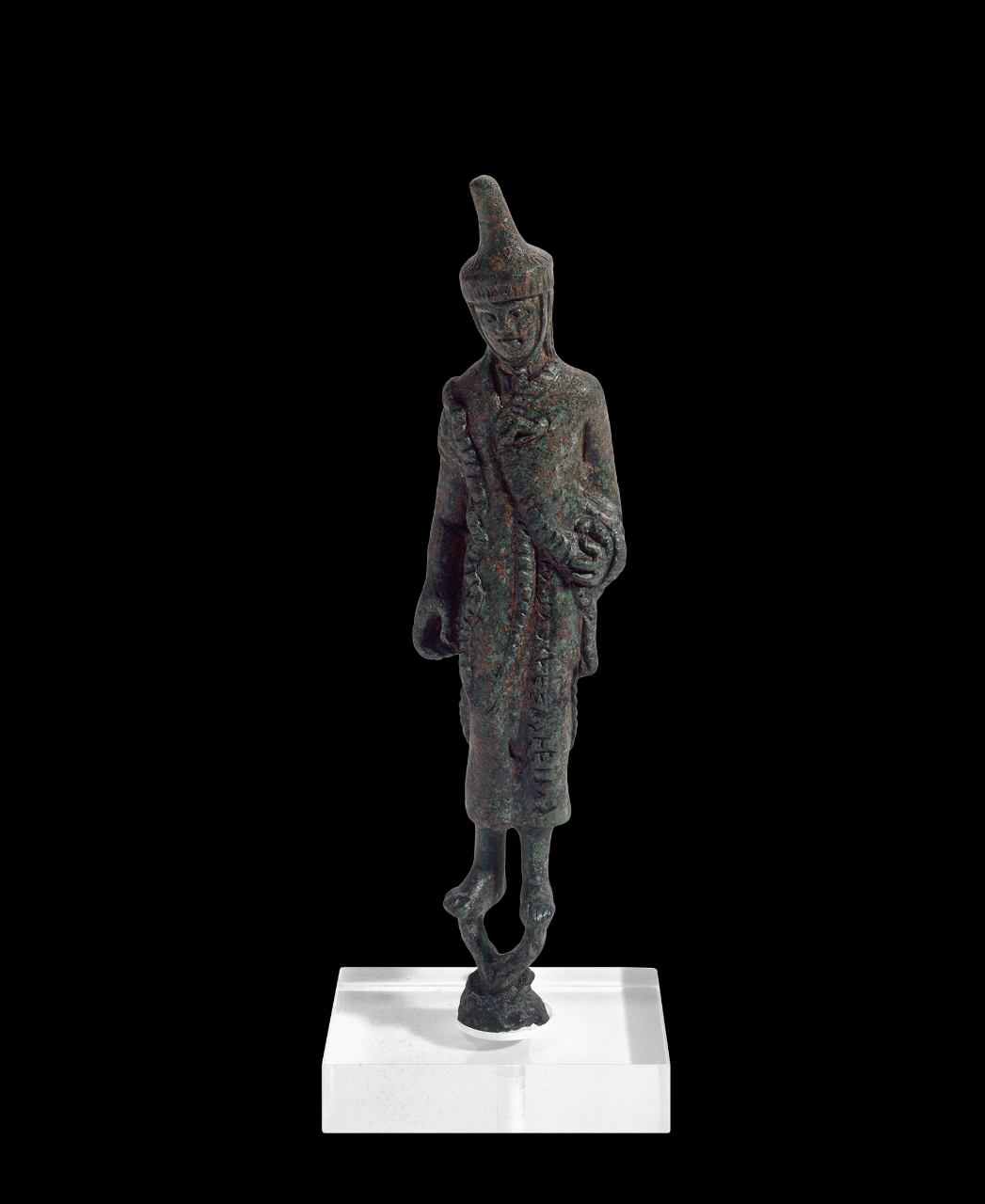
And here’s a fourth-century bc bronze model of an Etruscan priest, a “haruspex”, the Romans would have called him.

image4haru.png

(Sometimes, even though we spend a great deal of time in the classical world, there are things which will always seem a little odd—the hat on this fellow can’t help but remind us of something from Dr Seuss,

image5cat.png

just as that on a Roman flamen—a kind of priest—makes us think of a certain propeller helmet…)

image6famen.jpg

image7prop.jpg

Romans borrowed the custom from the Etruscans, it seems, and also read bird-signs. In fact, it was a disagreement over the interpretation of a flight of birds which may have sparked the murder of one of the founders of Rome, Remus, by his twin brother, Romulus.

image8rom.jpg

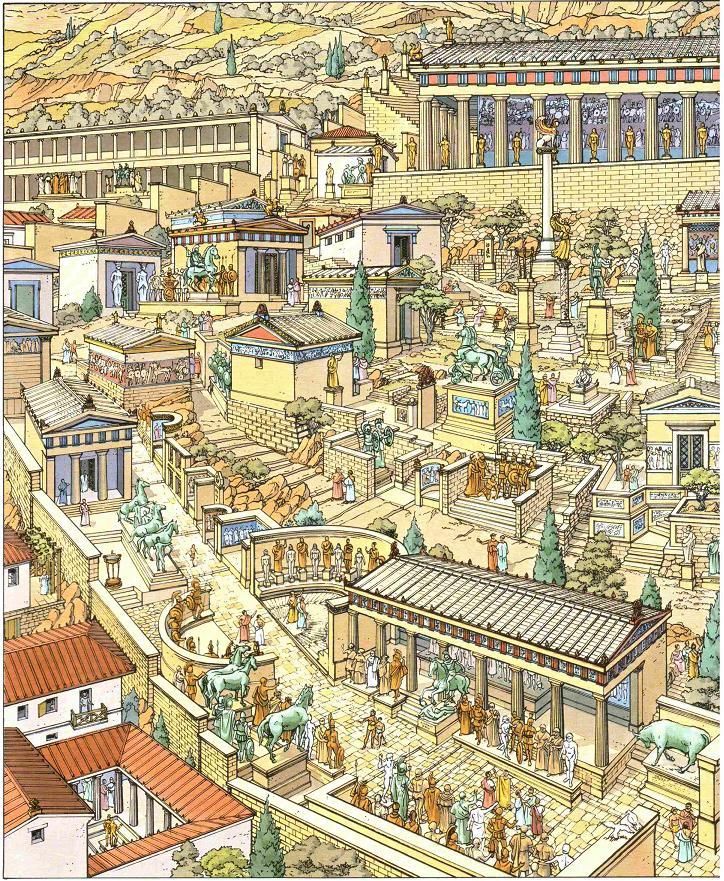
Besides Etruscan and home-grown methods of trying to find out about the future, the Romans also continued the Greek tradition of visiting prophetic shrines. The most famous were dedicated to Apollo

image9apollo.jpg

and were located (see map below—west to east)

image10map.png

at Delphi

image11delphi.jpg

Claros

image12claros.jpg

and Didyma.

image13didyma.JPG

There was also a well-known shrine dedicated to Zeus at Dodona,

image14do.jpg

but the oracle at Delphi was perhaps the most famous.

image15del.jpg

image16del.jpg

It’s not always clear how these places worked. The oracle at Dodona, for example, may have used two methods: sacred doves and the wind in the leaves of the enclosed grove you see in the picture. At Delphi, a pilgrim waited to pose a question to the priestess, called the “Pytho”

image17pythia.jpg

and, if she chose to respond, it was in the standard Greek epic metre, dactylic hexameter. Her answers were famously riddling and ambiguous, as when she told Croesus, the king of Lydia that, if he went to war with the Persians, a kingdom would fall (guess whose!).   To interpret such a response correctly would have taken King Galdaran’s response that, to interpret what his mirror told, one must have skill to decide just what the future might be.

When it comes to Galadrien/Galadriel, it’s not skill which she lacks, but rather she practices a kind of caution in interpretation:

“Many things I can command the Mirror to reveal…and to some I can show what they desire to see. But the Mirror will also show things unbidden, and those are often stranger and more profitable than things which we wish to behold. What you will see, if you leave the Mirror free to work, I cannot tell. For it shows things that were, and things that are, and things that may yet be. But which it is that he sees, even the wisest cannot always tell.” (The Fellowship of the Ring, Book Two, Chapter 7, “The Mirror of Galadriel”)

(We can’t resist a footnote here. In the early Greek poem, Theogony, the poet Hesiod tells us that he was a shepherd on a hillside when he was visited by the Muses, who told him that they could say many false things as if they were true, but could also speak the truth when they felt like it. They then gave him a staff and inspired him to make songs about things in the future, as well as things in the past, all of which sounds rather familiar here. Here’s a LINK if you’d like to read the story. And here’s a rather over-the-top painting by Gustave Moreau, (1826-1898.)

image18moreau.jpg

What Sam sees he finds deeply disturbing—the industrialization of the Shire—and it so disturbing that he leaps up and shouts that he must go home. What Frodo sees is more complex—perhaps Gandalf, what looks to be the arrival of the Numenorians to found Gondor, and, finally, the Eye, ever restless, ever searching.

So why is the Mirror here? We would suggest, tentatively, for several reasons:

  1. first, because this is a kind of turning point in the story: after the pursuit through Moria and the death of Gandalf (as far as the Fellowship knows), this is the first breathing space which the company has had and it’s a very safe and peaceful one—for the moment. As Celeborn says:

“Now is the time…when those who wish to continue the Quest must harden their hearts to leave this land. Those who no longer wish to go forward may remain here, for a while. But whether they stay or go, none can be sure of peace.” (The Fellowship of the Ring, Book Two, Chapter 8, “Farewell to Lorien”)

After so much struggle and the loss of a major figure, it’s clearly a good moment to rest, take stock, and look towards the future.

  1. second, Galadriel had earlier probed each of the company, testing their minds and finding out just who they were—sometimes to their discomfort, if not distress. Now the company is narrowed to just two: the ring-bearer and his servant, and here at her Mirror, she offers them a final test, but we can imagine that, unlike her earlier probing, this is much more free-form and ambiguous, as if she had allowed the two to make up their own tests. For Sam, it’s the possible ruination of what he loves most in the world, the Shire, and he almost fails, until Galadriel gently upbraids him:

“You did not wish to go home without your master before you looked in the Mirror, and yet you knew that evil things might well be happening in the Shire.”

Frodo’s test is less focused upon a place or event. Rather, it was a kind of suggestion of the past (Gondor), with the implication that that past’s continuation depends upon confronting the present danger, which is not to be underestimated. Galadriel’s words to Sam underline this:

“Remember that the Mirror shows many things, and not all have yet come to pass. Some never come to be, unless those that behold the visions turn aside from their path to prevent them.”

Shaken, both pass the test, it seems.

  1. by implying that what Sam and Frodo see might actually happen, the author adds an extra note of urgency to the story, something always to be felt after that moment: the Shire could be in danger, Frodo may have to confront Sauron, directly or indirectly.

But you’ll notice that, taking Galadriel’s lead, we wrote “could be” and “may have to”, rather than “will be” and “must” and here we hear the voice of a wise person from another epic adventure.

image19starwars.jpg

image20yoda.jpg

Thanks, as always, for reading, and, as ever,

MTCIDC

CD

The Doubtful Sea Series Facebook Page

The Doubtful Sea Series Facebook Page

  • Ollamh

Categories

  • Artists and Illustrators
  • Economics in Middle-earth
  • Fairy Tales and Myths
  • Films and Music
  • Games
  • Heroes
  • Imaginary History
  • J.R.R. Tolkien
  • Language
  • Literary History
  • Maps
  • Medieval Russia
  • Military History
  • Military History of Middle-earth
  • Narnia
  • Narrative Methods
  • Poetry
  • Research
  • Star Wars
  • Terra Australis
  • The Rohirrim
  • Theatre and Performance
  • Tolkien
  • Uncategorized
  • Villains
  • Writing as Collaborators
Follow doubtfulsea on WordPress.com

Across the Doubtful Sea

Recent Postings

  • A Moon disfigured December 17, 2025
  • On the Roads Again—Once More December 10, 2025
  • (Not) Crossing Bridges December 3, 2025
  • On the Road(s) Again—Again November 26, 2025
  • On the Road(s) Again November 19, 2025
  • To Bree (Part 2) November 12, 2025
  • To Bree (Part 1) November 5, 2025
  • A Plague o’ Both—No, o’ All Your Houses! October 29, 2025
  • It’s in Writing (2:  I’st a Prologue, or a Poesie for a Ring?) October 22, 2025

Blog Statistics

  • 103,193 Views

Posting Archive

  • December 2025 (3)
  • November 2025 (4)
  • October 2025 (5)
  • September 2025 (4)
  • August 2025 (4)
  • July 2025 (5)
  • June 2025 (4)
  • May 2025 (4)
  • April 2025 (5)
  • March 2025 (4)
  • February 2025 (4)
  • January 2025 (5)
  • December 2024 (4)
  • November 2024 (4)
  • October 2024 (5)
  • September 2024 (4)
  • August 2024 (4)
  • July 2024 (5)
  • June 2024 (4)
  • May 2024 (5)
  • April 2024 (4)
  • March 2024 (4)
  • February 2024 (4)
  • January 2024 (5)
  • December 2023 (4)
  • November 2023 (5)
  • October 2023 (4)
  • September 2023 (4)
  • August 2023 (5)
  • July 2023 (4)
  • June 2023 (4)
  • May 2023 (5)
  • April 2023 (4)
  • March 2023 (5)
  • February 2023 (4)
  • January 2023 (4)
  • December 2022 (4)
  • November 2022 (5)
  • October 2022 (4)
  • September 2022 (4)
  • August 2022 (5)
  • July 2022 (4)
  • June 2022 (5)
  • May 2022 (4)
  • April 2022 (4)
  • March 2022 (5)
  • February 2022 (4)
  • January 2022 (4)
  • December 2021 (5)
  • November 2021 (4)
  • October 2021 (4)
  • September 2021 (5)
  • August 2021 (4)
  • July 2021 (4)
  • June 2021 (5)
  • May 2021 (4)
  • April 2021 (4)
  • March 2021 (5)
  • February 2021 (4)
  • January 2021 (4)
  • December 2020 (5)
  • November 2020 (4)
  • October 2020 (4)
  • September 2020 (5)
  • August 2020 (4)
  • July 2020 (5)
  • June 2020 (4)
  • May 2020 (4)
  • April 2020 (5)
  • March 2020 (4)
  • February 2020 (4)
  • January 2020 (6)
  • December 2019 (4)
  • November 2019 (4)
  • October 2019 (5)
  • September 2019 (4)
  • August 2019 (4)
  • July 2019 (5)
  • June 2019 (4)
  • May 2019 (5)
  • April 2019 (4)
  • March 2019 (4)
  • February 2019 (4)
  • January 2019 (5)
  • December 2018 (4)
  • November 2018 (4)
  • October 2018 (5)
  • September 2018 (4)
  • August 2018 (5)
  • July 2018 (4)
  • June 2018 (4)
  • May 2018 (5)
  • April 2018 (4)
  • March 2018 (4)
  • February 2018 (4)
  • January 2018 (5)
  • December 2017 (4)
  • November 2017 (4)
  • October 2017 (4)
  • September 2017 (4)
  • August 2017 (5)
  • July 2017 (4)
  • June 2017 (4)
  • May 2017 (5)
  • April 2017 (4)
  • March 2017 (5)
  • February 2017 (4)
  • January 2017 (4)
  • December 2016 (4)
  • November 2016 (5)
  • October 2016 (6)
  • September 2016 (5)
  • August 2016 (5)
  • July 2016 (5)
  • June 2016 (5)
  • May 2016 (4)
  • April 2016 (4)
  • March 2016 (5)
  • February 2016 (4)
  • January 2016 (4)
  • December 2015 (5)
  • November 2015 (5)
  • October 2015 (4)
  • September 2015 (5)
  • August 2015 (4)
  • July 2015 (5)
  • June 2015 (5)
  • May 2015 (4)
  • April 2015 (3)
  • March 2015 (4)
  • February 2015 (4)
  • January 2015 (4)
  • December 2014 (5)
  • November 2014 (4)
  • October 2014 (6)
  • September 2014 (1)

Blog at WordPress.com.

  • Subscribe Subscribed
    • doubtfulsea
    • Join 78 other subscribers
    • Already have a WordPress.com account? Log in now.
    • doubtfulsea
    • Subscribe Subscribed
    • Sign up
    • Log in
    • Report this content
    • View site in Reader
    • Manage subscriptions
    • Collapse this bar
 

Loading Comments...