• About

doubtfulsea

~ adventure fantasy

Tag Archives: clocks

Peace! Count the Clock!

25 Wednesday Oct 2017

Posted by Ollamh in J.R.R. Tolkien, Literary History, Narrative Methods

≈ Leave a comment

Tags

ABC Alphabetical Railway Giude, Agatha Christie, anachronism, Bag End, Bradshaw's Railway Companion, clocks, Egyptian, feudalism, Gros Horloge, hour glases, Liverpool and Manchester Railway, Macbeth, Medieval, Normandy, Pope Sylvester II, railways, Rouen, Salisbury Cathedral clock, Shakespeare, sundial, The Lord of the Rings, Tolkien, Wapping tunnel, water clocks, Wells Cathedral

Welcome, as always, dear readers.

In our last, we puzzled over something in the entryway to Bag End.

image1bagend.png

It’s that thing to the left of the door.   It looks rather like a clock (which is what we thought before examining it more closely), but it is, in fact, a barometer—and a very puzzling thing for Bilbo to have, as we suggested.

On the right hand wall, however, there is another puzzling object:  an actual clock.

In our world, of course, this is no puzzle at all, clocks being so common.  In fact, our major way of indicating time in English is to say, “It’s 11 o’clock”, where “o’clock” is a contracted form of “of the clock”.  Even if, like many in our world, you get your time from your phone, you’ll still say this, won’t you?

image2cell.png

This has been the case since the 16th century, as we can see in Shakespeare’s plays—including moments when characters who live in times before clocks still talk about them, as in Macbeth, Act II, Scene 4, where Macbeth’s cousin, Ross, says to an Old Man, “By th’clock ‘tis day”, when the historical Macbeth lived in the 11th century AD, perhaps 200 and more years before clocks began to appear in western Europe.

Although we’ve seen it regularly cited that Pope Sylvester II
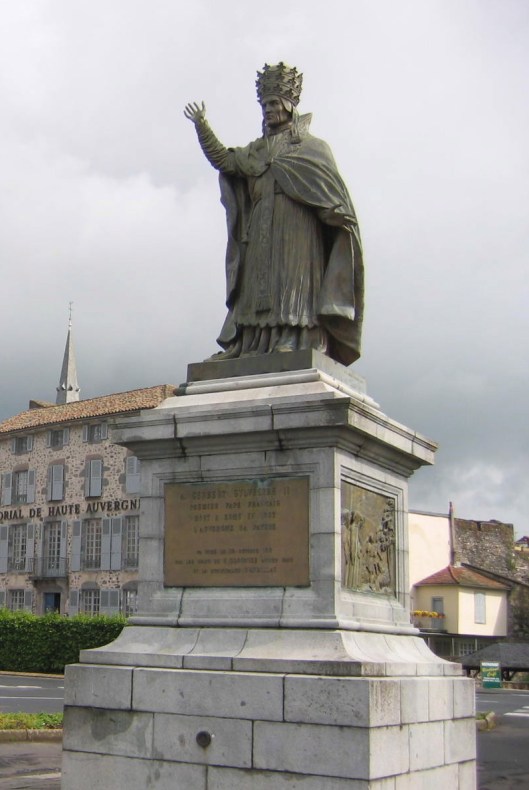
image3sylvester2.jpg

invented the first mechanical clock in the 990s AD, we have yet to see anything in the way of concrete evidence that this is so.  Rather, we see the first clocks to have appeared in the later 14th century, including the Salisbury Cathedral clock, which perhaps dates from 1386.
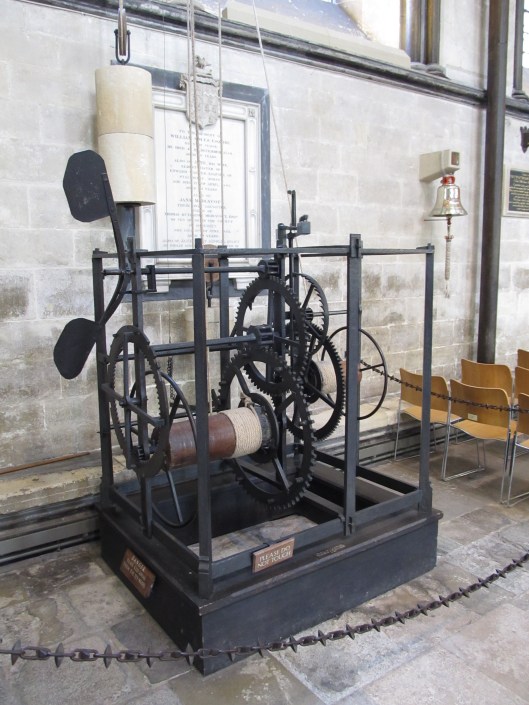
image4salisbury

Likewise there is the clock of Wells Cathedral, tentatively dated to about the same time
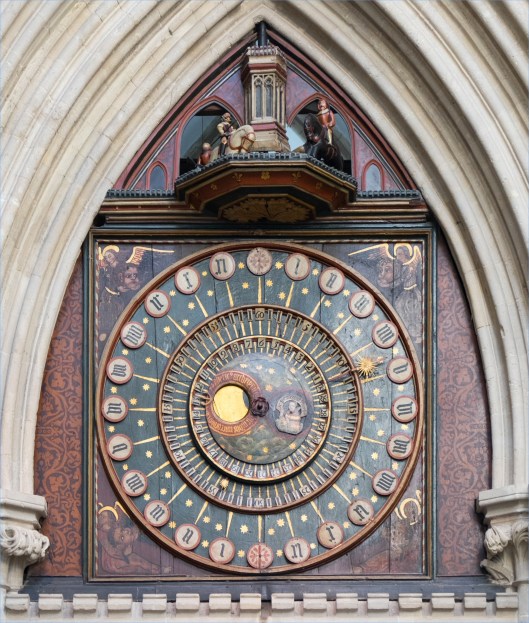
image5wells.jpg

or the Gros Horloge in Rouen, in Normandy, whose internal workings date from 1389.


And the pendulum clock—which is what is visible on the right hand wall of Bag End—is an even later invention, credited to the Dutch scientist of the mid-17th century, Christian Huygens.
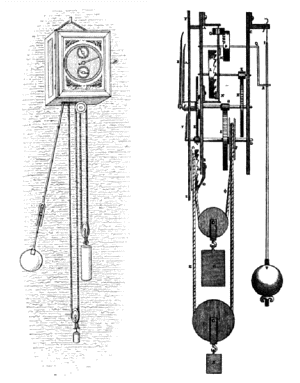
image7pendulumimage8huygens


Long before such devices, people marked time by such things as hour glasses (possibly medieval? Lots of discussion about this, but there is documentation that medieval ships’ captains began to use them)

image9hourglass.jpg

and water clocks (used in Athenian court rooms to control speeches—when citations of established law were read in court, the order was to “stop the clock”, as reading law as evidence clearly wasn’t considered to be part of a speech)
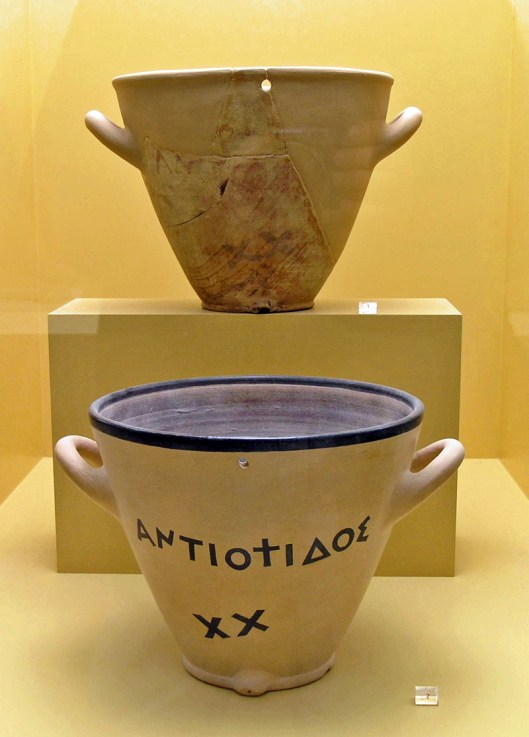
image10clepsydra.jpg

and even put the sun to work, using its moving shadow to tell the time.  (This is the earliest sundial we’ve seen—it’s Egyptian, from the 13th century BC)

image11egyptsundial.jpg

(And just a linguistic footnote on “telling time” as a sort of pun.  On the one hand, we read time off a device—and, if asked, aloud—so that we are “telling—that is reciting—the time”.  At the same time, an older usage of the verb “to tell” was “to count”.  This is preserved in the “teller” in a bank, by someone “telling” a rosary, and by “tolling” a bell.  It can also be seen in other Germanic languages, like Danish, which has the verb “taelle”, “to count”, and German, “zaehlen”.  So, when you “tell” time, you’re both deciphering the information from a device—possibly aloud—and doing so by counting.)

All of which leads us back to Bilbo’s clock, on a wall in the Shire.

As far as we can tell, at the end of the Third Age, the Shire was primarily a non-feudal medieval agricultural world.
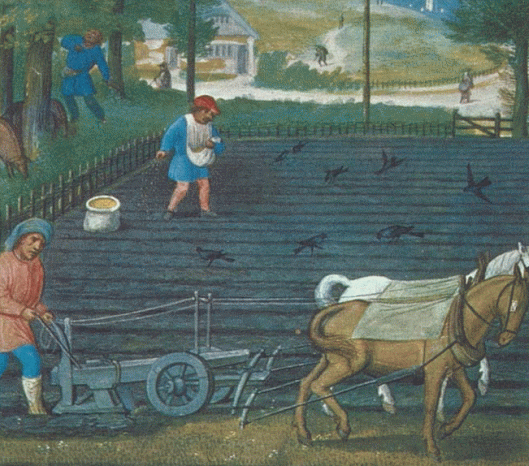
image12medievalplowing.gif

Such worlds are, considering how much the sun is involved in growing things like grain,

image13medreaping.jpg

governed by daylight, which is, on the whole, easy to mark and measure.  (A difficulty for sundials, of course, is that the sun changes position throughout the year and the hours of daylight can vary greatly.  Perhaps this is why there is a famous sundial motto:  “Horas non numero nisi serenas”—“I count only the fair—that is, sunny—hours”.)

image14sundial.jpg

So why is there a pendulum clock on that wall?

A partial answer might be the same as that for the barometer:  JRRT is recreating something from his own past, or even from his present—the big dial looks later to us than the 1890s.  Just as in the case of that reference to Bilbo shrieking “like the whistle of an engine coming out of a tunnel” (The Hobbit, Chapter One, “An Unexpected Party”), it mirrors Tolkien’s own world—a world in which railways in Britain were a major influence on changes in marking time.

Railways had begun to appear in 1830, with the Liverpool and Manchester Railway.

image15earliestrr.jpg

(And here, by the way, is an engineering marvel of the time—the 1.25-mile long Wapping tunnel, dug to allow the railway’s passage into Liverpool and the first such tunnel to be constructed under a city.  Seeing this 1831 illustration, it’s easy to imagine what kind of shriek Bilbo must have made!)
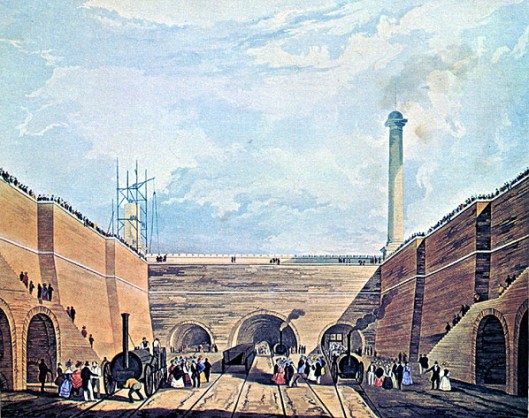
image16wappingtunnel.jpg

By 1840, building and traffic had increased dramatically and, as the rail lines stretched across England, an awkwardness appeared:  there was no uniform time standard.  Towns close to each other might share the same time, but those between London and Liverpool, say, had their own methods of marking time and so attempting to produce a dependable schedule for a train’s journey was nearly an impossibility along the 178 miles (287km) between the two cities.
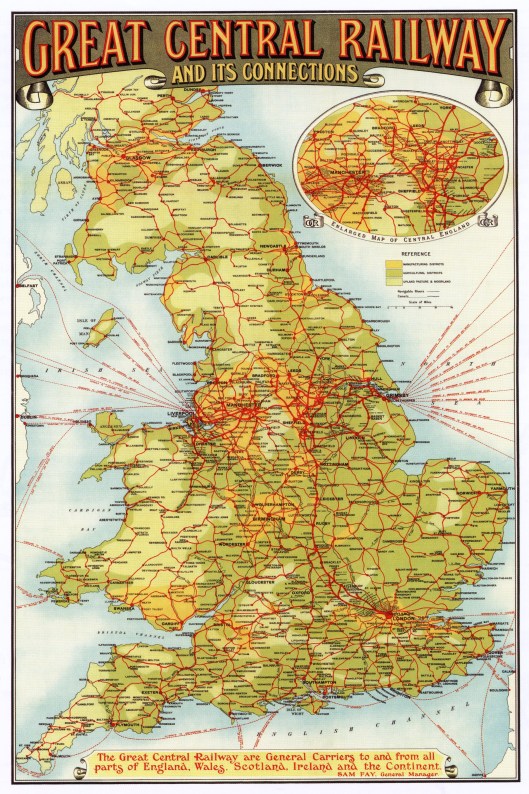
image17railwaymap.jpg

Those in charge of the early railways quickly saw the difficulty and began, as early as 1840, to standardize the measurement of time along their routes.  By the late 1850s, standardization had been mainly achieved—although it was only in the 1880s that the government stepped in to complete the progress.

This regularizing of time produced, on the one hand, standard railway timetable books, like Bradshaw’s Railway Companion
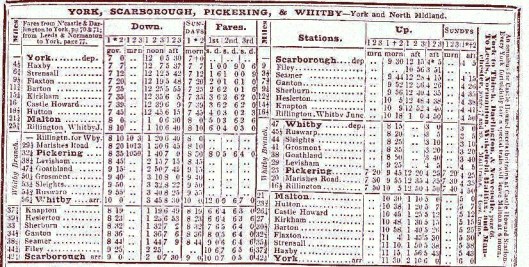
image18abradshaw.jpg


(first published in 1839 and often consulted by Watson and Holmes on their extra-London adventures) and The ABC Alphabetical Railway Guide
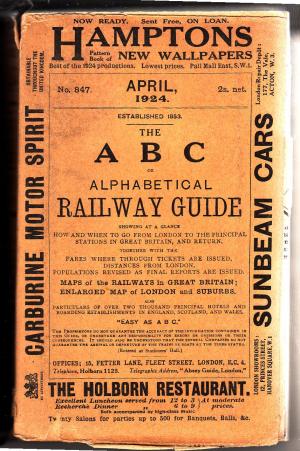
image18rrguide1924.jpg


(first published in 1853 and the basis of Agatha Christie’s 1936 novel, The ABC Murders).  On the other hand, it also produced standardized time in general, eventually going global, something which the industrial revolution increasingly demanded as part of its production cycle and now so deeply ingrained that virtually everything we do is influenced by it and we even incorporate it into our bodies, either tying it to our wrists

image19earlywatch.jpg

or wear it as part of our clothing.

image20cellinpocket.jpg

Work, school, even fun (movies begin on time schedules, television is one long schedule, as well as certain elements of the internet—although the internet does offer the subversive possibility of doing things “on your own time”), all of it moves to the measured tick of time.   In 1937, the year after Agatha Christie’s novel based upon railway timetables was published, JRRT would have felt it, from his lecture schedule to the evening radio broadcasts of the BBC.

Almost as if it were a gathering force of the MODERN WORLD, then, the measurement and standardization of time has crept up, from the later medieval world on.  We can see that Shakespeare was influenced by it—in Julius Caesar (1599?), Act II, the jumpy Brutus and Cassius listen to the sound of a clock striking three—in a world where there would be no clocks to strike for almost 1400 years (but providing us with the title of this post).  Is it any wonder, then, that clocks could have slipped into Middle-earth?  And, besides, they do have a use for Bilbo—how else could he shout to the dwarves as he left them, “If ever you are passing my way…don’t wait to knock!  Tea is at four…” (The Hobbit, Chapter Eighteen, “The Return Journey”)?

Thanks, as ever, for reading.

MTCIDC

CD

About That PS

18 Wednesday Oct 2017

Posted by Ollamh in J.R.R. Tolkien, Narrative Methods

≈ Leave a comment

Tags

anachronism, Bag End, banjo clock, barometer, clocks, Edwardian, Evangelista Torricelli, Hobbiton, Lucien Vidie, Middle-earth, Oxford, railway, The Hobbit, The Lord of the Rings, Tolkien, Victorian

Welcome, as always, dear readers.

In a PS to our last posting, we showed this illustration

image1bagend.jpg

and asked you if you saw something peculiar about it.

In fact, there are two peculiar things about it.  Look to the left of the door.  What is that?   At first, we were inclined to imagine that it was a clock of a style known as a “banjo clock”.

image2banjoclock.jpg

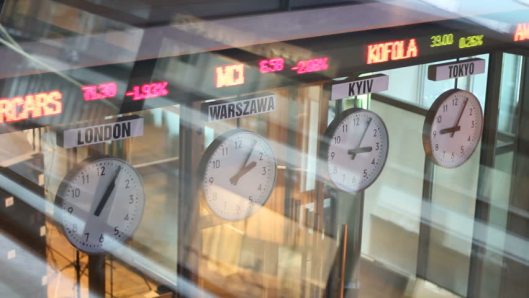
But there was also a clock on the right hand wall, and, unless Bag End was like a stock exchange, with clocks showing various times around the world,

image3stockclocks.jpg

(image the one on the left being “Shire Time”, while the one on the right is “Mordor Time”!)

why would Bilbo have two clocks?

There’s also the technical problem:  banjo clocks—maybe all clocks?—which have pendulums need to use gravity to help in their swing.  If the object on Bilbo’s wall is a clock, it’s upside down and therefore—

and so, after lots of searching to see if we could match it somehow, we were scratching our collective heads when we realized that it wasn’t a clock at all, but a barometer—and a distinctively Victorian one, which fits in with our suggestion in a recent posting that JRRT was using his memories of his Victorian/Edwardian childhood as the basis of Bag End.

image4vicbar.jpg

So, what’s a barometer and why might Bilbo have one?

The simplest answer to the first of those is that a barometer measures atmospheric pressure.  That measurement, in turn, can tell you about changes in weather:  low pressure, it’s more likely to rain, high pressure, not.  Here’s a basic chart to explain.

image5airpressure.jpg

One odd thing about Bilbo’s is that, commonly, barometers are combined with thermometers in patterns of the sort you see on the Bag End wall, whereas this one appears to be by itself.

image6bar.jpg

The really odd thing, however, is that he has one to begin with.  The first barometers date from the 1640s, being an offshoot of trying to understand the concept of a vacuum.

image7aboutvacuums.png

It was only in the 1840s that someone (Lucien Vidie) postulated that air pressure changes—measurable by this device– could signal weather changes.  For Bilbo to have such a thing in a Middle-earth which appears to be almost entirely devoid both of science as we understand it and of mechanical technology, is a puzzle at best.   Who made it?  How did he obtain it?  And last—and hardest—what did he do with it?

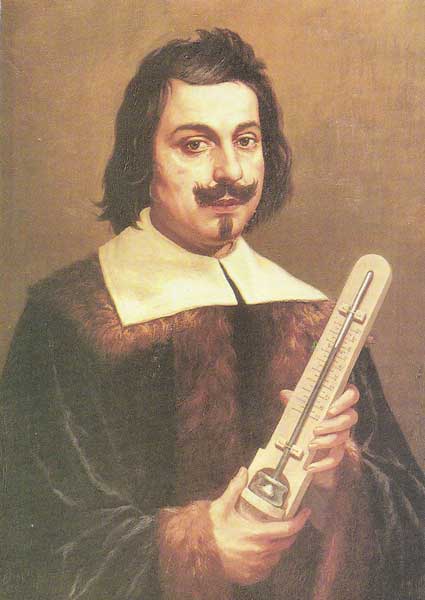
Of course, as we have discussed in past postings, there are whole areas of knowledge about Middle-earth about which we have little or no information and it’s been fun for us to try to reconstruct things using parallels from our own world, combined with the little we do know.  That first barometer was, we presume, handmade by Evangelista Torricelli (1608-1647).

image7atorricelli.jpg


It appears to have been, basically, a long glass tube, attached to a piece of wood by white metal fittings.  The hobbits have glass windows, so the art of glass-blowing exists in their world.  The wood and metal could be used in many other settings.  Once the concept was understood, it would be easy to see someone taking already available techniques and materials and creating the object.

But who made it?  When it came to ingenuity in craft, JRRT suggests the dwarves—with the men of Dale as fellow-workers or perhaps as middlemen.  As Thorin says of the past:

“Altogether those were good days for us, and the poorest of us had money to spend and to lend, and leisure to make beautiful things just for the fun of it, not to speak of the most marvelous and magical toys, the like of which is not to be found in the world now-a-days…the toy market of Dale was the wonder of the North.” (The Hobbit, Chapter One, “An Unexpected Party”)

How did Bilbo acquire it?  He had come to be known in Hobbiton as unlike other hobbits—his mother, after all, was the famous Belladonna Took (for her history—or, rather, her mystery–see The Hobbit, Chapter 1) and, after his travels, “he took to writing poetry and visiting elves”.  Perhaps the barometer came from one of his trips?  Or had it been sent to him?

If we take the preparations for the famous joint-birthday-party at the opening of The Lord of the Rings as a clue, there must have been at least a small degree of commerce between the Shire and the dwarves of the Lonely Mountain and the rebuilt town of Dale:

“On this occasion the presents were unusually good…There were toys the like of which they had never seen before, all beautiful and some obviously magical.  Many of them had indeed been ordered a year before, and had come all the way from the Mountain and from Dale, and were of real dwarf-make.” (The Fellowship of the Ring, Book One, Chapter 1, “A Long-Expected Party).

But then there is that third question:  what did he do with it?  As far as we can currently determine from The Hobbit and The Lord of the Rings, neither Bilbo nor Frodo nor even Gandalf ever mentions a barometric reading, or is concerned that the pressure is dropping.

So what are we to make of this?

For all that JRRT was increasingly careful about this, there a few anachronisms in his work.  In The Hobbit, there is the well-known one of Bilbo’s reaction to Thorin’s explanation of the dangers of future burglary:

“At may never return he began to feel a shriek coming up inside, and very soon it burst out like the whistle of an engine coming out of a tunnel.” (The Hobbit, Chapter One, “An Unexpected Party”)

Although JRRT himself considered changing this for the 1966 revision, Douglas Anderson, in The Annotated Hobbit, 47-48, argues that this doesn’t have to be an anachronism at all:

“…for Tolkien as narrator was telling this story to his children in the early 1930s, and they lived in a world where railway trains were a very important feature of life.”

In fact, built in 1844, the first railway station in Oxford was almost a century old when The Hobbit was published in 1937.

image8grandpointstation.JPG

(And we can’t resist this quotation from Jackson’s Oxford Journal for 15 June, 1844, which describes the arrival of the first train as “one of those rampageous, dragonnading fire-devils”.  Clearly, dragons and railroads have a long history together!)

So, is this just a slip on JRRT’s part?  Perhaps he had a barometer in his past, next to a door, and, in his urge to fill up the wall space of Bag End, he simply filled in what he already knew?  We can only shrug—and, in our next, wonder about that clock on the wall to the right:  what’s it doing in Middle-earth?

Thanks, as ever, for reading.

MTCIDC

CD

The Doubtful Sea Series Facebook Page

The Doubtful Sea Series Facebook Page

  • Ollamh

Categories

  • Artists and Illustrators
  • Economics in Middle-earth
  • Fairy Tales and Myths
  • Films and Music
  • Games
  • Heroes
  • Imaginary History
  • J.R.R. Tolkien
  • Language
  • Literary History
  • Maps
  • Medieval Russia
  • Military History
  • Military History of Middle-earth
  • Narnia
  • Narrative Methods
  • Poetry
  • Research
  • Star Wars
  • Terra Australis
  • The Rohirrim
  • Theatre and Performance
  • Tolkien
  • Uncategorized
  • Villains
  • Writing as Collaborators
Follow doubtfulsea on WordPress.com

Across the Doubtful Sea

Recent Postings

  • A Moon disfigured December 17, 2025
  • On the Roads Again—Once More December 10, 2025
  • (Not) Crossing Bridges December 3, 2025
  • On the Road(s) Again—Again November 26, 2025
  • On the Road(s) Again November 19, 2025
  • To Bree (Part 2) November 12, 2025
  • To Bree (Part 1) November 5, 2025
  • A Plague o’ Both—No, o’ All Your Houses! October 29, 2025
  • It’s in Writing (2:  I’st a Prologue, or a Poesie for a Ring?) October 22, 2025

Blog Statistics

  • 103,208 Views

Posting Archive

  • December 2025 (3)
  • November 2025 (4)
  • October 2025 (5)
  • September 2025 (4)
  • August 2025 (4)
  • July 2025 (5)
  • June 2025 (4)
  • May 2025 (4)
  • April 2025 (5)
  • March 2025 (4)
  • February 2025 (4)
  • January 2025 (5)
  • December 2024 (4)
  • November 2024 (4)
  • October 2024 (5)
  • September 2024 (4)
  • August 2024 (4)
  • July 2024 (5)
  • June 2024 (4)
  • May 2024 (5)
  • April 2024 (4)
  • March 2024 (4)
  • February 2024 (4)
  • January 2024 (5)
  • December 2023 (4)
  • November 2023 (5)
  • October 2023 (4)
  • September 2023 (4)
  • August 2023 (5)
  • July 2023 (4)
  • June 2023 (4)
  • May 2023 (5)
  • April 2023 (4)
  • March 2023 (5)
  • February 2023 (4)
  • January 2023 (4)
  • December 2022 (4)
  • November 2022 (5)
  • October 2022 (4)
  • September 2022 (4)
  • August 2022 (5)
  • July 2022 (4)
  • June 2022 (5)
  • May 2022 (4)
  • April 2022 (4)
  • March 2022 (5)
  • February 2022 (4)
  • January 2022 (4)
  • December 2021 (5)
  • November 2021 (4)
  • October 2021 (4)
  • September 2021 (5)
  • August 2021 (4)
  • July 2021 (4)
  • June 2021 (5)
  • May 2021 (4)
  • April 2021 (4)
  • March 2021 (5)
  • February 2021 (4)
  • January 2021 (4)
  • December 2020 (5)
  • November 2020 (4)
  • October 2020 (4)
  • September 2020 (5)
  • August 2020 (4)
  • July 2020 (5)
  • June 2020 (4)
  • May 2020 (4)
  • April 2020 (5)
  • March 2020 (4)
  • February 2020 (4)
  • January 2020 (6)
  • December 2019 (4)
  • November 2019 (4)
  • October 2019 (5)
  • September 2019 (4)
  • August 2019 (4)
  • July 2019 (5)
  • June 2019 (4)
  • May 2019 (5)
  • April 2019 (4)
  • March 2019 (4)
  • February 2019 (4)
  • January 2019 (5)
  • December 2018 (4)
  • November 2018 (4)
  • October 2018 (5)
  • September 2018 (4)
  • August 2018 (5)
  • July 2018 (4)
  • June 2018 (4)
  • May 2018 (5)
  • April 2018 (4)
  • March 2018 (4)
  • February 2018 (4)
  • January 2018 (5)
  • December 2017 (4)
  • November 2017 (4)
  • October 2017 (4)
  • September 2017 (4)
  • August 2017 (5)
  • July 2017 (4)
  • June 2017 (4)
  • May 2017 (5)
  • April 2017 (4)
  • March 2017 (5)
  • February 2017 (4)
  • January 2017 (4)
  • December 2016 (4)
  • November 2016 (5)
  • October 2016 (6)
  • September 2016 (5)
  • August 2016 (5)
  • July 2016 (5)
  • June 2016 (5)
  • May 2016 (4)
  • April 2016 (4)
  • March 2016 (5)
  • February 2016 (4)
  • January 2016 (4)
  • December 2015 (5)
  • November 2015 (5)
  • October 2015 (4)
  • September 2015 (5)
  • August 2015 (4)
  • July 2015 (5)
  • June 2015 (5)
  • May 2015 (4)
  • April 2015 (3)
  • March 2015 (4)
  • February 2015 (4)
  • January 2015 (4)
  • December 2014 (5)
  • November 2014 (4)
  • October 2014 (6)
  • September 2014 (1)

Blog at WordPress.com.

  • Subscribe Subscribed
    • doubtfulsea
    • Join 78 other subscribers
    • Already have a WordPress.com account? Log in now.
    • doubtfulsea
    • Subscribe Subscribed
    • Sign up
    • Log in
    • Report this content
    • View site in Reader
    • Manage subscriptions
    • Collapse this bar
 

Loading Comments...