As ever, dear readers, welcome.
Two postings ago, we had been discussing how time is marked in The Hobbit. After a one-post interlude—a book review—we were intending to extend our discussion (as our original plan was) to The Lord of the Rings, but something caught our attention and, in this posting, we’re still interluding—although it is about The Hobbit.
We had just set off from Bag End with Bilbo and the dwarves and noticed this:
“At first they had passed through hobbit-lands, a wide respectable country inhabited by decent folk, with good roads, an inn or two, and now and then a dwarf or a farmer ambling by on business. Then they came to lands where people spoke strangely, and sang songs Bilbo had never heard before. Now they had gone on far into the Lone-lands, where there were no people left, no inns, and the roads grew steadily worse. Not far ahead were dreary hills, rising higher and higher, dark with trees. On some of them were old castles with an evil look, as if they had been built by wicked people.” (The Hobbit, Chapter 2, “Roast Mutton”)
The company passes over an ancient bridge:
“Somewhere behind the grey clouds the sun must have gone down, for it began to get dark as they went down into a deep valley with a river at the bottom. Wind got up, and willows along its banks bent and sighed. Fortunately the road went over an ancient stone bridge, for the river, swollen with the rains, came rushing down from the hills and mountains in the north.”
They go on till Bilbo and the dwarves reach the trolls.
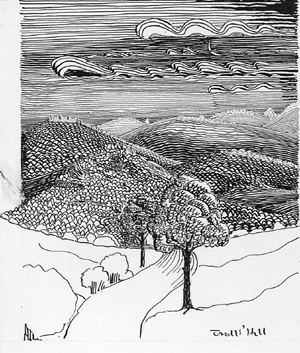
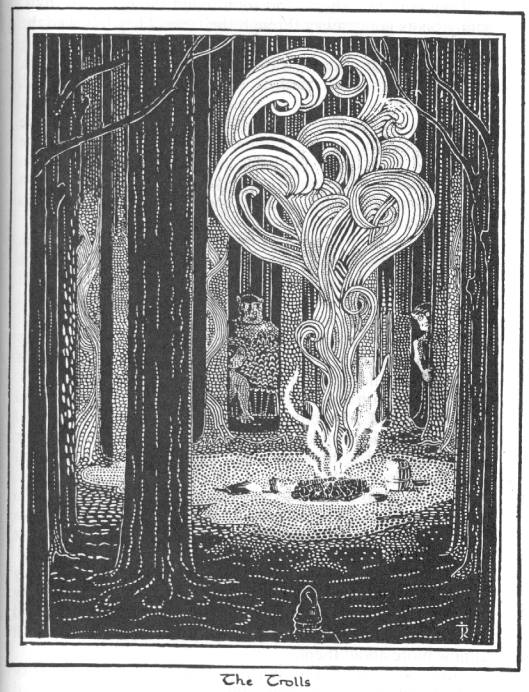
(drawings by JRRT)
Here, though, we want to pause for a moment and look back, and, like any careful—and curious—traveler, consult a map.

First—and this is something we noted in that previous post—there is really no hard evidence for just how long this leg of the trip took. All we are given are “At first”, “now and then”, “Then”, and “Now”, and the sense of distance comes to us as much through landscape changes as from those vague words: from “hobbit-lands” to “lands where people spoke strangely…” then “Now they had gone far into the Lone-lands”.
Second, looking at that map, there are certain puzzling words in that description of travel. The description twice says “roads”, at first “good roads”, then, as the journey goes eastwards, “the roads grew steadily worse”. Our map, however, shows only one road, the East or East/West Road, the history of which goes far into the history of Middle-earth and which we have always imagined that JRRT modeled on the remains of Roman roads one could still walk in England in his time—and even today.
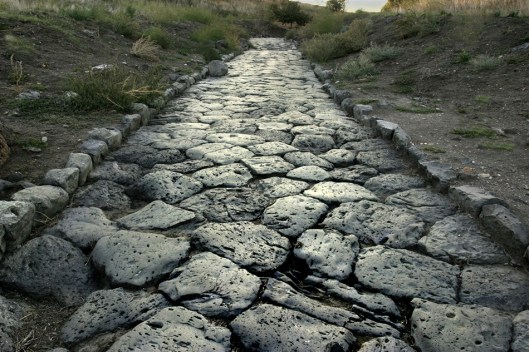
(Here’s a LINK to a very good basic article on constructing roads in Roman Britain.)
And then there is this:
“Not far ahead were dreary hills, rising higher and higher, dark with trees. On some of them were old castles with an evil look, as if they had been built by wicked people.”
As far as we know, there are no “castles” in Middle-earth—the East Road does skirt Weathertop. As Aragorn says:
“The Old Road, which we have left far away on our right, runs to the south of it and passes not far from its foot.” (The Fellowship of the Ring, Book One, Chapter 11, “A Knife in the Dark”)
And perhaps his description might—very roughly—fit a (ruined) castle:
“…in the first days of the North Kingdom, they built a great watch-tower on Weathertop, Amon Sul they called it. It was burned and broken, and nothing remains of it now but a tumbled ring, like a rough crown on the old hill’s head.”
As it was destroyed in the conflict against the Witch King of Angmar, we would certainly agree that “wicked people” had once been involved in its history.
Our puzzlement is not just about what appears in the text, however. There is also what’s missing (most of it shown on the map):
- the bridge over the Brandywine which appears in the first paragraph of “The Scouring of the Shire”
- any mention of the Greenway, which crosses the East Road at Bree
- and then there is Bree itself
Of course, this is back-reading. We are looking at a map which is descended from one which JRRT gradually built up over time in the years after The Hobbit, when Middle-earth continued to grow and grow in his imagination and hence in his fiction. (For an extensive view of his work as a world-creator, see this intelligent and extremely useful volume by Karen Wynn Fonstad,

which deals with the whole history of Middle-earth in chronological order. For The Lord of the Rings, we would recommend this, by Barbara Strachey,

which has been our guide on a number of trips along Frodo’s route.)
As well, it’s good to remember that, for the most part, the company in The Hobbit is traveling at its own speed, a speed determined primarily by the countryside they cross and their trip seems—if occasionally miserable—almost leisurely, especially in comparison with The Lord of the Rings, in which so much of the first volume in particular lays out a route along which several of the main protagonists are driven by evil pursuers. The journey itself, in the latter, becomes, day by day, the focus of the narrative as they attempt to escape the Nazgul and that day-by-day quality is intensified after the wounding of Frodo on Weathertop, as he begins to fade and his friends are desperate to reach Rivendell.
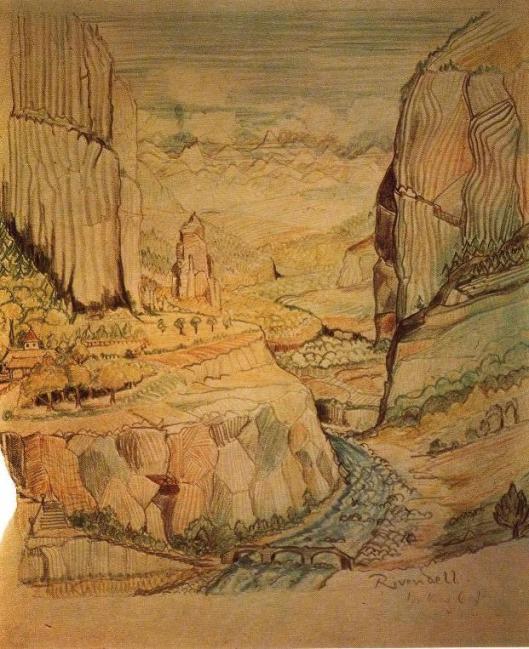
The contrast between the two stories is especially striking here, as Bilbo and company are mocked and sung to by invisible elves in The Hobbit (Chapter 3, “A Short Rest”) as they ride down into the valley, whereas, in The Lord of the Rings (The Fellowship of the Ring, Book One, Chapter 12, “Flight to the Ford”), we see this (by the excellent Ted Nasmith)—

This change in the narrative emphasis, from discrete events along a route in The Hobbit, to an emphasis upon the journey itself, will bring us back to our original discussion on the marking of time—moving now from the earlier book to The Lord of the Rings in our next posting.
Thanks, as always, for reading and
MTCIDC
CD
PS
We would guess, by the way, that that “ancient stone bridge” mentioned above is the so-called “Last Bridge”, which Glorifindel calls “the Bridge of Mitheithel” (The Fellowship of the Ring, Book One, Chapter 12, “Flight to the Ford”) and which crosses the River Hoarwell (“Mitheithel” to the elves) on the East Road.
PPS
If you grew up, as we did, hearing the song we hinted at in our title, you might want to learn more at this LINK…
 doubtfulsea