• About

doubtfulsea

~ adventure fantasy

Monthly Archives: June 2025

Starre-crost

25 Wednesday Jun 2025

Posted by Ollamh in Uncategorized

≈ Leave a comment

Tags

Beowulf, Bilbo, Cirdan, Dorothy, Fantasy, Gandalf, Herakles, Kansas, King Arthur, lotr, Mulan, Narya, Rings of Power, Superman, The Grey Havens, The Hobbit, The Rings of Power, Tolkien, tornado, Valar

As always, dear readers, welcome.

In adventure stories, heroes—and heroines– seem to appear in all sorts of ways.

Sometimes, it seems that they are just born for adventure, like Herakles, who,
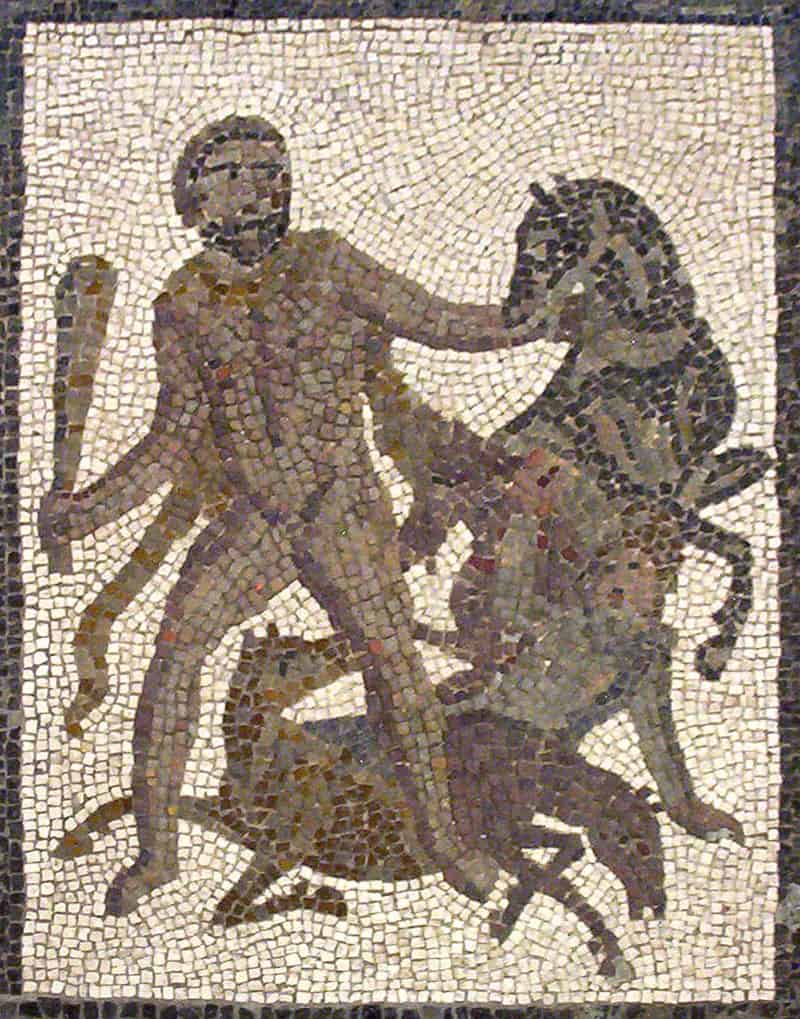
although apparently the offspring of two mortals, Alkmene and Amphitryon, was actually the son of Zeus.

Others belong to noble families, where heroism is expected of them, like Beowulf, nephew of the king of the Geats.
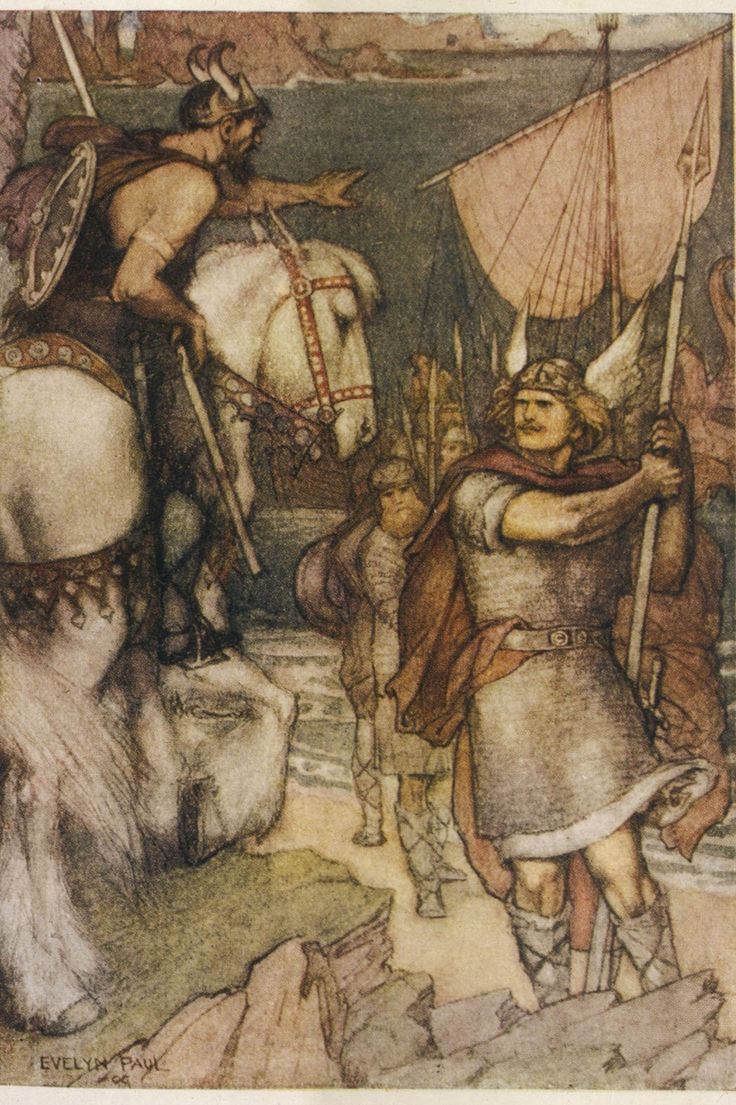
(Here, meeting the Danish coastguard—but we just can’t escape those Wagnerian winged helmets, can we?)

Then there is Mulan, who, pretending to be a man, replaces her father in the army and serves valiantly for twelve years.

(As you can see from the label, this comes from a site called “Chinese Posters.net”—and it’s quite a site:  5100 propaganda posters from the Chinese past.  Here’s the address:  https://chineseposters.net/ For more on the original but probably fictional Mulan, see:  https://www.worldhistory.org/article/1596/mulan-the-legend-through-history/ and https://mulanbook.com/pages/northern-wei/ballad-of-mulan/ and https://en.m.wikisource.org/wiki/Translation:Ballad_of_Mulan –two versions of the early “Ballad of Mulan)

A common motif is that of the apparent good-for-nothing—or at least for not much—who turns out to be of heroic material.  I immediately think of King Arthur, who is, basically, a servant until he fetches that sword from the stone/anvil.

Heroes and heroines, then, can be anything from a demigod to a nobleman to a good girl who loves her father to a good-for-nothing who is more than he seems, and set out on adventures or, as in the case of Arthur, adventure finds them.

Ordinary—or seemingly ordinary—people can also be pulled into adventures, as Bilbo is.
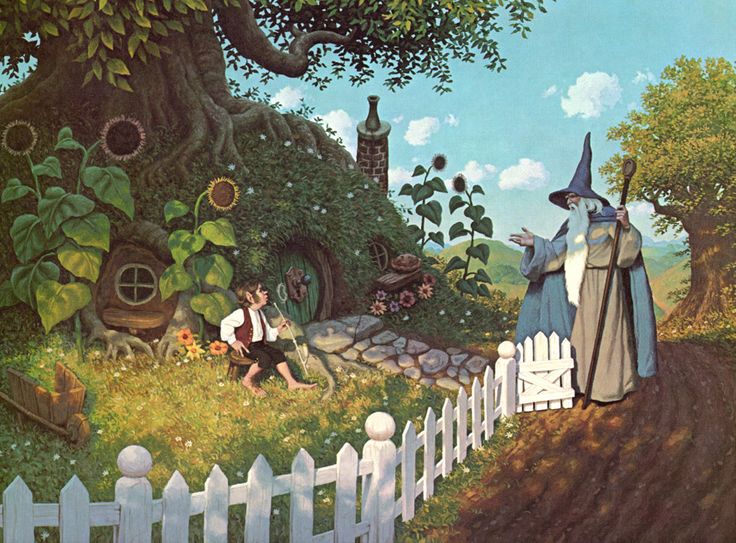
(the Hildebrandts)

Then there are people who are literally dropped into adventures,
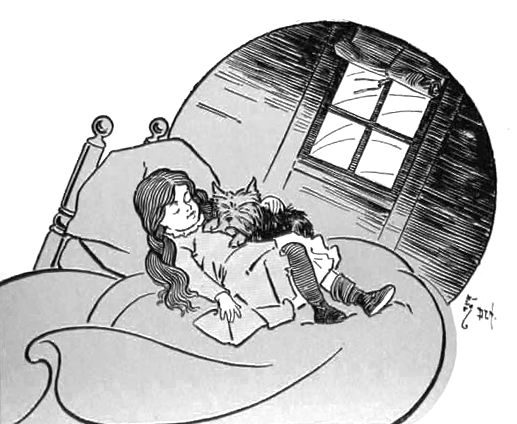
(WW Denslow)

sometimes beginning those adventures in a very dramatic—and ultimately decisive—way.

Dorothy, of course, has been whirled by a tornado from Kansas to Oz,
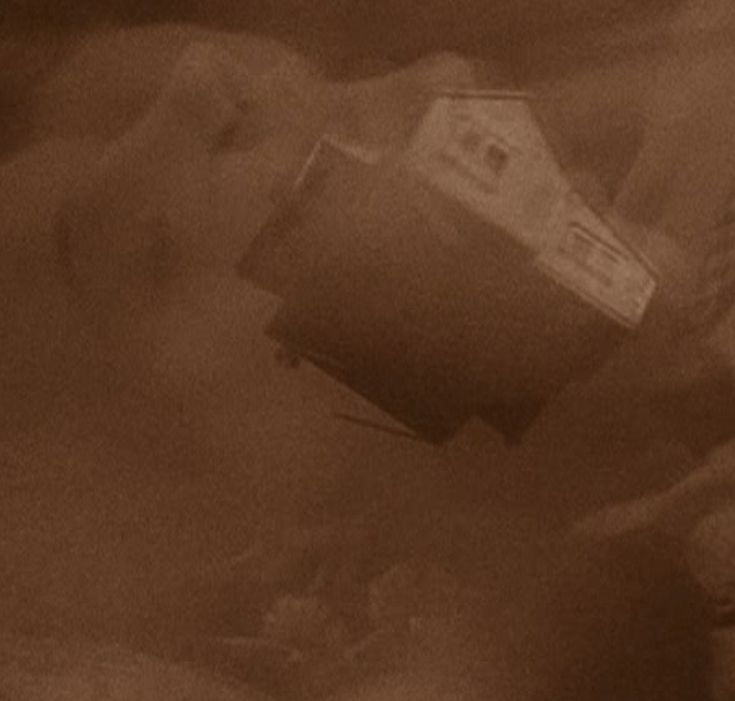
(from the 1939 film)

but, when she arrives in Oz in the film, Glinda, the Good Witch of the North
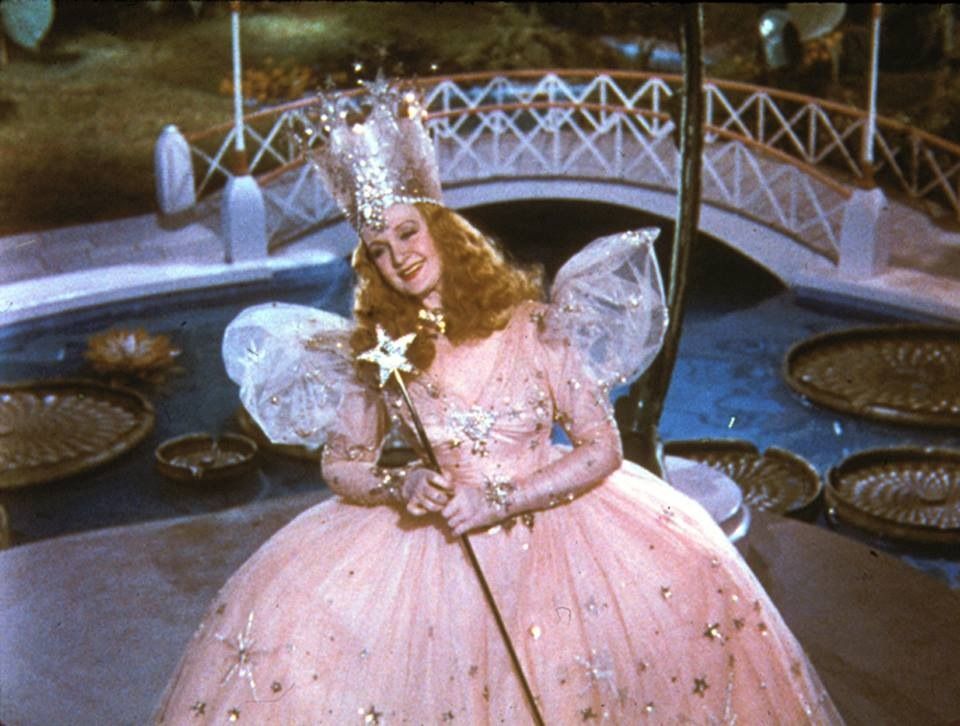
(also from the film)

sings:

“Come out, come out, wherever you are and meet the young lady

Who fell from a star.

She fell from the sky, she fell very far and Kansas, she says,

Is the name of that star.”

Not true, of course, of Dorothy, (although Kansas has its beauties, no doubt), but it is true of another hero, Superman,

who had been shipped in a rocket by his parents from the dying planet, Krypton, and discovered in a field by Ma and Pa Kent, who would become his foster parents.

If you read this blog regularly, you know that I don’t find negative reviews which are nothing but hatchet jobs

at all helpful and, in my own reviews, I try to understand what it is that the creators attempted to do and react to that, being aware, of course, that I do have my own perspective on things.  I also buy DVDs of everything I can, so that I can watch things more than once before I review. 

I’ve now seen “Rings of Power”, both seasons,

only once, so I’m not going to attempt to review the whole two seasons here.  Certainly there have been some very impressive visuals and some very good acting.  I’m not sure how I feel about the two as a whole—some of the plot I found rather confusing and I’m not sure how I feel about proto-hobbits with Irish accents, although the idea of using proto-hobbits was, I thought, pretty ingenious—but I want to end this posting by talking about Gandalf.

He first appears—like Dorothy in Oz, but even more so like the baby Superman, in a dramatic fashion, having been conveyed in which appears to be a kind of meteor which roars across the sky and slams into the earth, leaving a fiery crater.
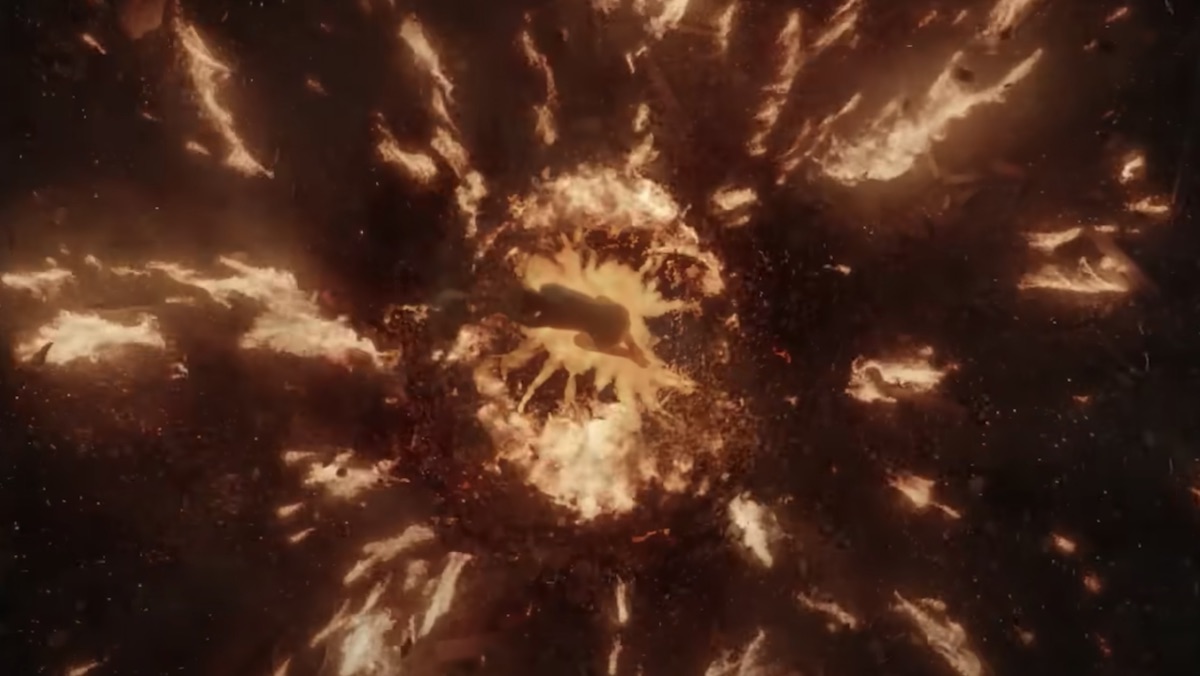
(Thank goodness that, whoever sent him, dressed him in underpants so that he wouldn’t embarrass himself or us when he stood up.)

At first, he seems stricken and quite clueless, not even really having language at first, although certainly having great powers, and it takes two seasons for him to begin to understand himself and what he’s been sent to do and I suspect that this stricken quality comes from a hint in Christopher/JRR Tolkien’s Unfinished Tales, where, under “The Istari” we find:

“For it is said indeed that being embodied the Istari had need to learn much anew by slow experience…” (Unfinished Tales, 407)

I understand that the creators of the series were somewhat hampered in their work—should they want to be as faithful as possible to Tolkien—because they were restricted in their sources, being confined, in this case, to The Lord of the Rings and its appendices.  And, at first glance, the appearance in Middle-earth of the Istari does seem rather vague.

In Appendix B, “The Third Age”, of The Lord of the Rings, we read:

“When maybe a thousand years had passed, and the first shadow had fallen on Greenwood the Great, the Istari or Wizards appeared in Middle-earth.  It was afterwards said that they came out of the Far West and were messengers sent to contest the power of Sauron, and to unite all those who had the will to resist him…” 

No meteors are mentioned, but no other means of transport, either, yet turn the page and we then read:

“Gil-galad before he died gave his ring to Elrond; Cirdan later surrendered his to Mithrandir (aka Gandalf).  For Cirdan saw further and deeper than any other in Middle-earth, and he welcomed Mithrandir at the Grey Havens, knowing whence he came and wither he would return.”  

If you know The Lord of the Rings, you know that the Grey Havens is a seaport on the west coast of Middle-earth:  it’s where Gandalf and others, including Frodo, depart for the Uttermost West—that is, Valinor.

(Ted Nasmith and a gorgeous view)

In fact, it was the Valar who had sent the Istari in the first place, as we know from Unfinished Tales, 406:

“For with the consent of Eru they sent members of their own high order, but clad in bodies as of Men, real and not feigned…”

And thus, from the source to which I’m informed the creators were confined, they would have learned that the Istari had sailed to Middle-earth, not been shot across the sky like Dorothy or Superman.  Why make such a change, especially as, because Cirdan recognizes Gandalf’s worth, he gives him one of the original Elvish rings, Narya, which turns up on his hand in the subsequent The Lord of the Rings?

The title of this posting is a quotation from Shakespeare, from the prologue to “An EXCELLENT conceited Tragedie OF Romeo and Juliet” (as the First Quarto title page reads) in which the Prologue says of the protagonists:  “A paire of starre-crost Louers tooke their life”. 

The creators of The Rings of Power, even with evidence available to them, have veered away from that evidence with no explanation as to why they have made such a choice.  What else may they have chosen to change and how might that affect JRRT’s view of the earlier history of Middle-earth, as well as ours?

As I begin my second viewing of The Rings of Power, then, I’ll be curious to see if another Shakespeare quotation, this from “The Tragedie of Julius Caesar”, Act 1, Scene 1, when Cassius, the leader of the plot against Julius Caesar, is trying to persuade Brutus to join him, may apply to the creators and their work:

“The fault (deere Brutus) is not in our Starres,

But in our Selues…”

Thanks, as always, for reading.

Stay well,

Think about what Cassius is telling us about horoscopes,

And remember that, as always, there’s

MTCIDC

O

To Horse!

18 Wednesday Jun 2025

Posted by Ollamh in Uncategorized

≈ Leave a comment

Tags

Agincourt, bicycle, Boer War, cavalry charges, Charge of the Light Brigade, Cu Chulainn, Dwarves, Fredegunda, Gregory of Tours, heavy artillery, Historia Francorum, Hobbits, horses, King Edward's Horse, lotr, machine gun, machine-guns, Nazgul, Normans, Pegasus, Rohirrim, Russian Civil War, signals officer, Sleipnir, The Hobbit, Tolkien, Valkyries

In a colleague’s office, I once saw this on his wall—

“Proletariat, to horse!”

It’s a recruiting poster from the Russian civil war (1918-1922), showing the Reds trying to raise cavalry for their armies, but, at the time this call came, the military world was changing and, although horsemen would still appear, very sporadically, on battlefields, for some years to come, the day of events like this—

was rapidly coming to a close.

It didn’t happen all at once, however.  As you can imagine, traditional cavalrymen—those who believed that swinging a sword in a valiant charge was the point of cavalry—

fought back.  The evidence was against them, however, in two ways.

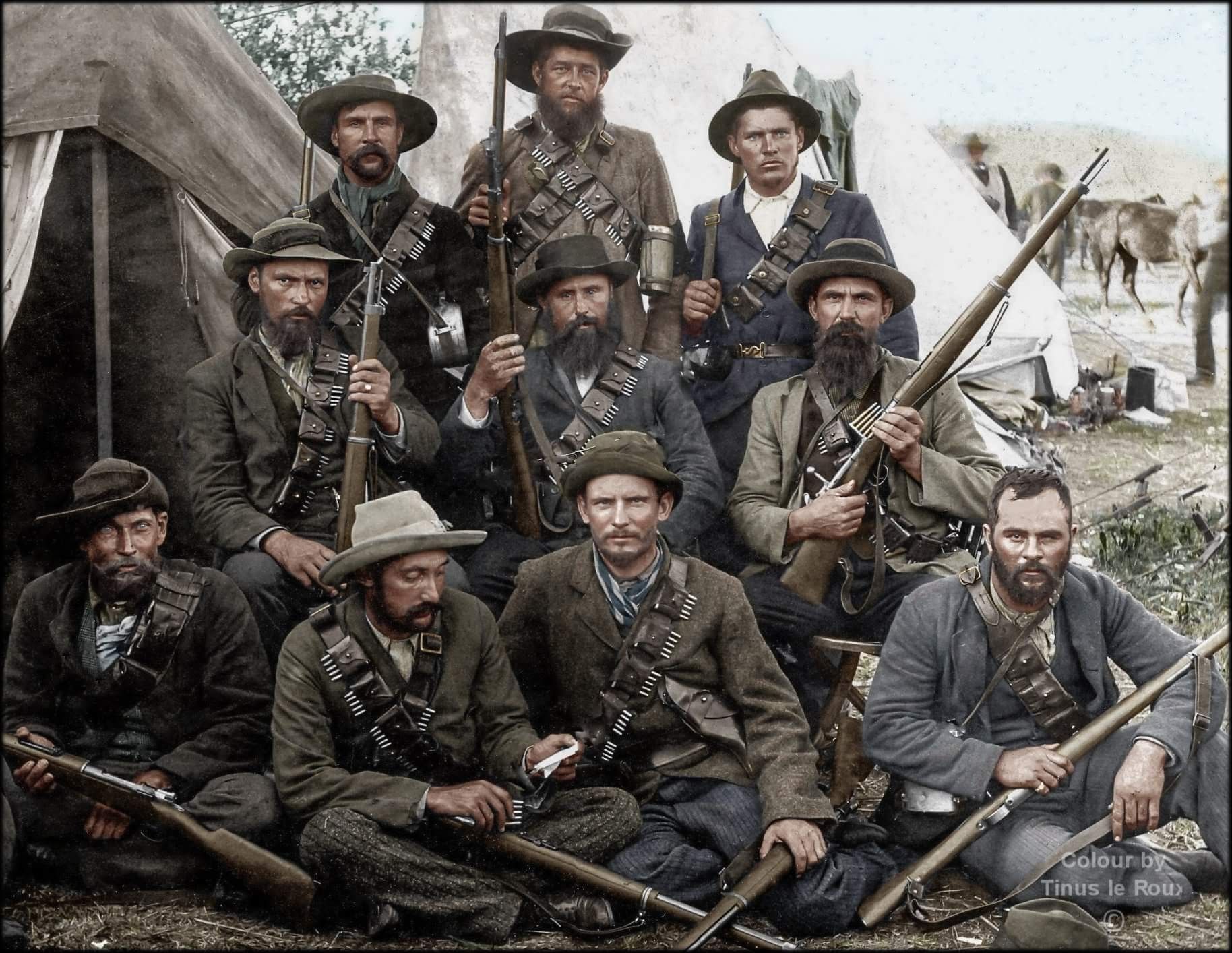
First, in the case of the British, there had been the Boers,

with whom the British had fought a war, from 1899-1902.  The Boers (Dutch for “farmers”) had been militia—men obliged by law to defend the state upon demand.  Across the wide open spaces of so much of South Africa, they had fought as mounted infantry, using horses as a means of moving from place to place, then dismounting for combat and, if things didn’t go their way, mounting up and escaping.

To counter this, especially in the later phases of the war, the British were forced to develop their own mounted infantry,

which suggested to some military theorists at the time that the wave of the future was not in sword-swingers, but in riflemen, who could rapidly move to where they were needed, but employ horses for transport, not for gallant charges.  (This also led to the rise of units mounted entirely on bicycles,

but we can imagine the off-road difficulties for early machines and, although there were bicycle units as late as WW2, they never had the popularity—or the dash—of horsemen.)

The second piece of evidence lies in technological change. 

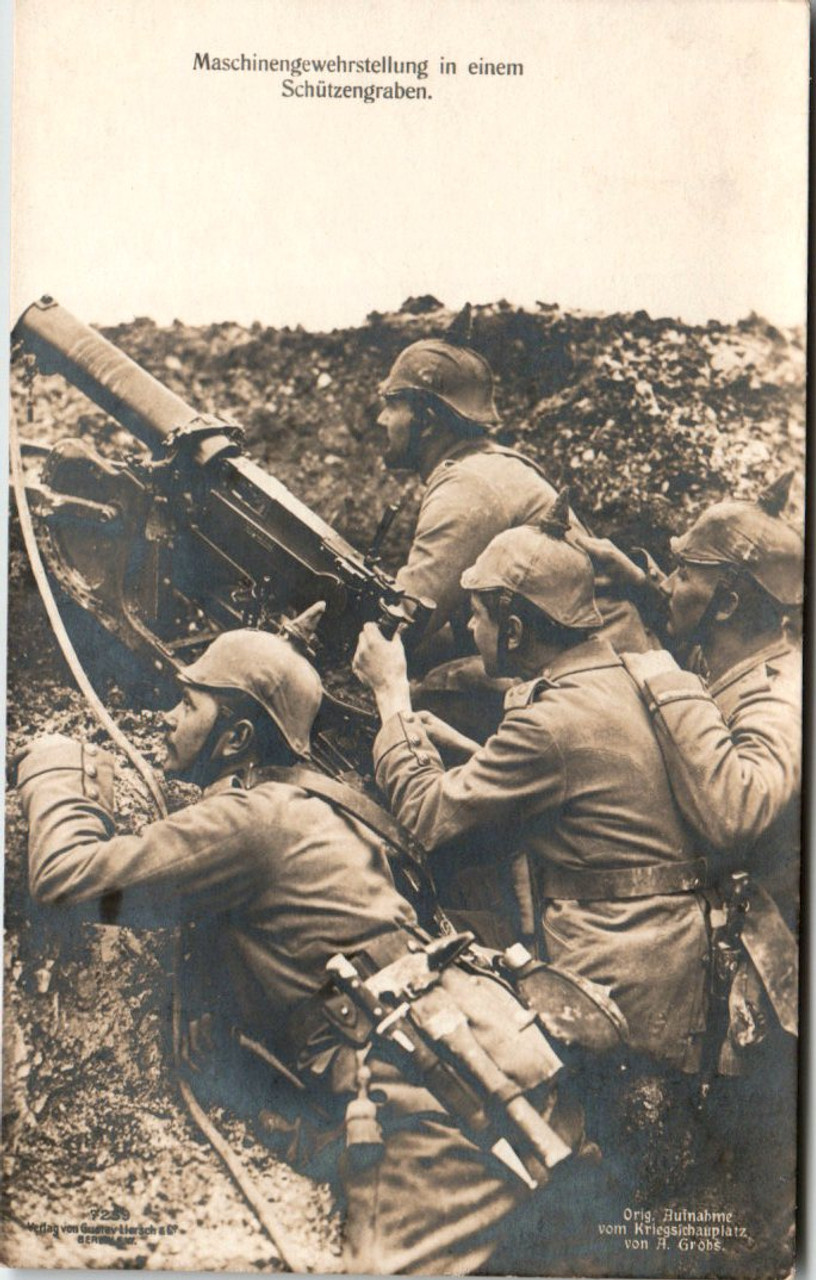
With the coming of the 20th century, machine guns, sometimes firing as many as 600 rounds (shots) per minute,

appeared in increasing numbers and artillery was developed to become more accurate at greater distances.

In self-defense, soldiers would be forced to take cover wherever they could,

at first in holes simply scraped out of the ground, but, in time, in very sophisticated lines, shored up with wood and metal and sandbags.

On the Western Front, where everyone was dug into the ground, and being in the open could mean instant destruction, there simply wasn’t a place for old-fashioned cavalry, for all that there were still lots of old-fashioned cavalrymen in the army—like the first commander of the British in France in 1914, Sir John French.

Imagine, then, that this was all happening when Tolkien was very young—when the Boer War ended, in 1902, for instance, he would have been only 10.

(JRRT and his brother, Hillary, in 1905)

His own military career had begun at King Edward’s School in Birmingham, when he entered the new Cadet Corps in 1907.

(For more, see this essay by John Garth: https://johngarth.wordpress.com/2014/03/05/tolkien-at-fifteen-a-warrior-to-be/ )

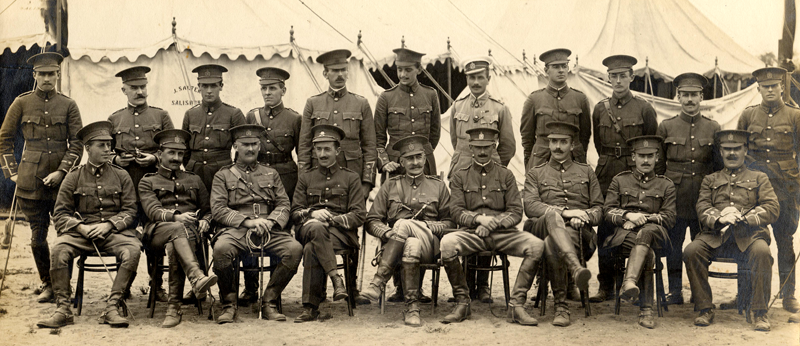
Then, in the summer of 1912, he was briefly a member of a territorial (a sort of national guard unit) cavalry regiment, King Edward’s Horse.  (The reference here is to Carpenter’s J.R.R.Tolkien, 66.  John Garth later added detail to this, but subsequently qualified it, saying that his evidence was faulty.  See:  https://oxfordinklings.blogspot.com/2009/06/tolkien-and-horses.html )

(Officers of the regiment about 1916)

It was clearly an indication of the drop in the use of cavalry, however, when JRRT began his second enlistment not in a cavalry, but an infantry regiment, the Lancashire Fusiliers, in which he was commissioned as a 2nd Lieutenant in 1915.

In his brief battlefield career, he was the signals officer for his battalion, the 11th.  In the advance into the Somme in July, 1916, Tolkien, although armed with a revolver,

would have been too busy to do any fighting as his work involved

“More code, flag and disc signaling, the transmission of messages by heliograph and lamp, the use of signal rockets and field-telephones, even how to handle carrier pigeons…” (Carpenter, 86)

To ask for reinforcements, as well as to avoid artillery fire which could be called in to fend off German counterattacks, but which might hit friendly troops instead, it was extremely necessary for attacking units to let their positions and situations be known as often as possible, so JRRT would have been more than a little occupied during the months (1 July-18 November, 1916) of the very costly (nearly 58,000 British casualties the first day alone) offensive.  Fortunately for him—and for us—he fell ill with so-called “trench fever” and left France for good early in November, going home to England and, ultimately, to Middle-earth.

Although his military service in the field was relatively brief, and his career with cavalry even briefer (he resigned from King Edward’s Horse in January, 1913), we see horses everywhere in Middle-earth, from the ponies of the dwarves in The Hobbit

(from Painting Valley—no artist listed)

to the horses of the Nazgul in The Lord of the Rings.

(with the Gaffer, one of my favorite illustrations by Denis Gordeev)

But, although cavalry might have been only a brief flirtation for Tolkien, horses had been part of his life since its beginnings.  Part of this would have been mundane—it was only after the Great War that the internal combustion engine really began to dominate the streets.  When JRRT was young, Birmingham and London, as well as Berlin, Paris, and New York, would have looked like this—

His early reading would have given him Bellerophon on Pegasus,

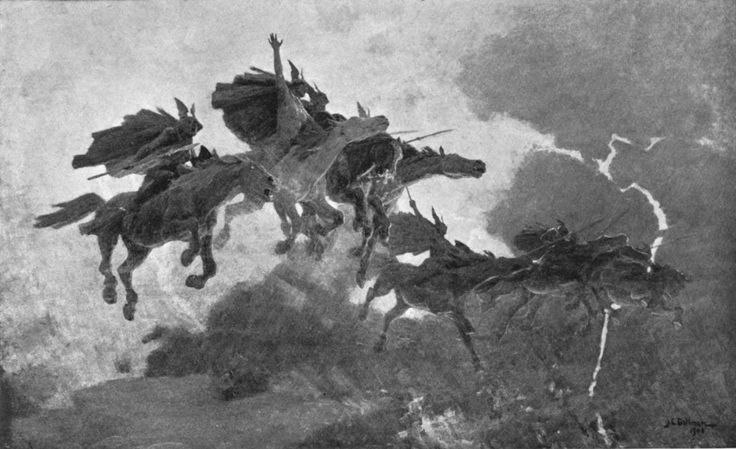
to which would have been added the Valkyries,

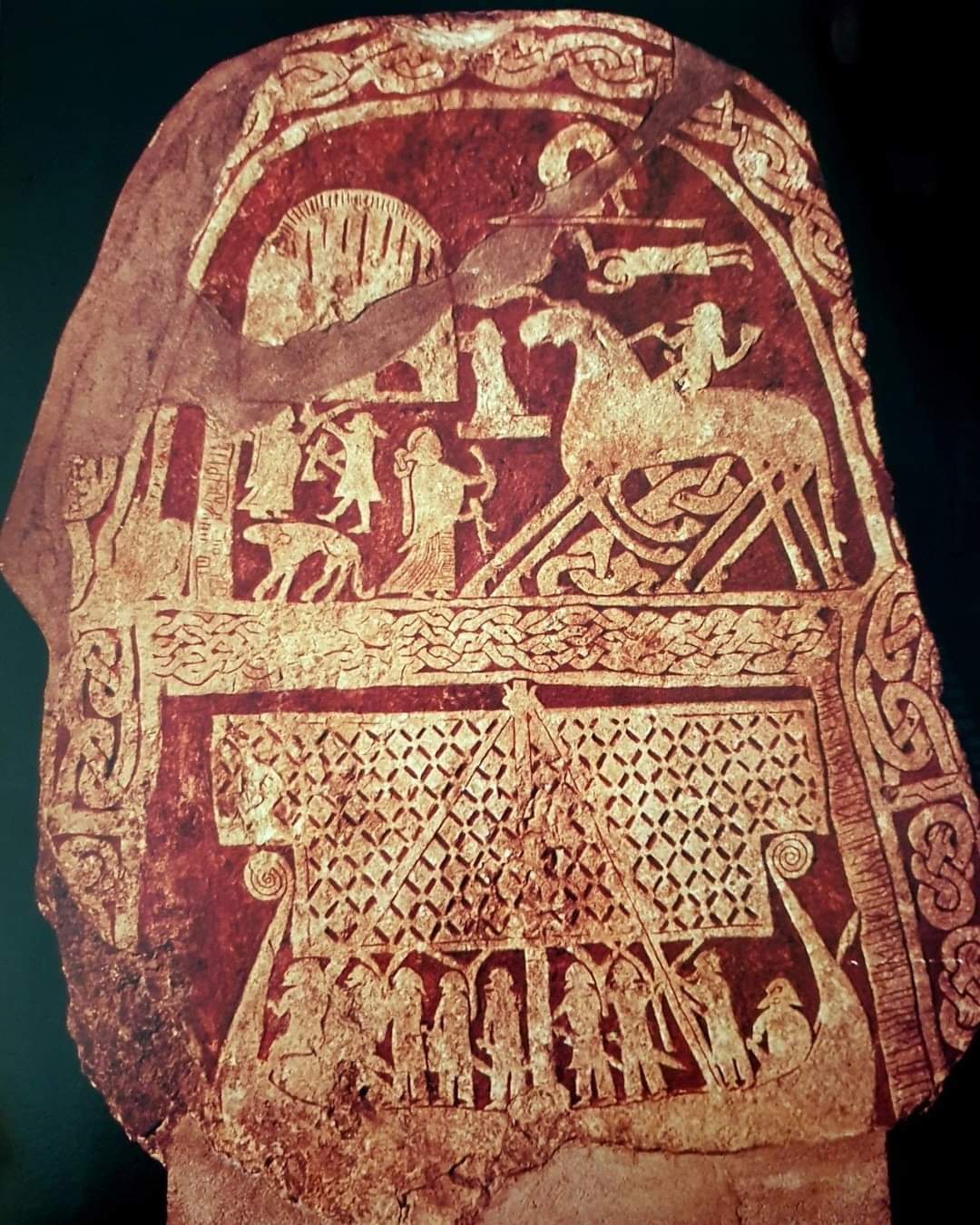
and, in time, Sleipnir, Odin’s 8-legged steed,

(This is the Tjaengvide image stone, one of a group of runic stones, called the “Sigurd stones”, found in Sweden and dated to between 700 and 1100AD.  You can read more about it here:  https://en.wikipedia.org/wiki/Tj%C3%A4ngvide_image_stone You can read about the other stones here:  https://en.wikipedia.org/wiki/Sigurd_stones  Tolkien would first have heard about Sigurd from Andrew Lang’s The Red Fairy Book, 1890, which you can find here:   https://archive.org/details/redfairybook00langiala/redfairybook00langiala/mode/2up  Sigurd himself possessed the offspring of Sleipnir, Grani, which you can read about here:  https://en.wikipedia.org/wiki/Grani )

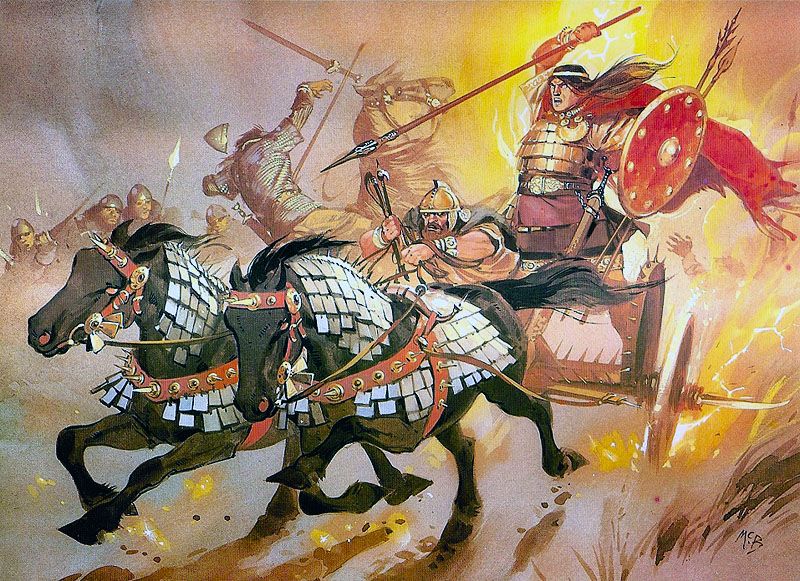
and further medieval reading would have filled his mind with mythic and magic horses, like Cu Chulainn, the Irish hero’s, chariot pair, water horses named Liath Macha and Dub Sainglend (although he wasn’t very enthusiastic about Old Irish literature which, I suspect, he found much wilder and stranger and more disturbing than, say, the Welsh Mabinogion, which you can read about here:    https://en.wikipedia.org/wiki/Mabinogion )

(a rather over-the-top image by the usually dependable Angus McBride—someone should have mentioned to him that, although “Dub” means “black”, Liath means “grey”.  Cu Chulainn is one of my favorite ancient berserkers—to mix cultures—and, if you don’t know him, you can begin to read about him here:  https://en.wikipedia.org/wiki/C%C3%BA_Chulainn )

But there are magical horses in many places—see https://en.wikipedia.org/wiki/List_of_horses_in_mythology_and_folklore for many more, with at least many of the medieval, he would have been familiar. 

And while we’re speaking of Middle-earth and horses, we need to mention the Normans, who, combined with the Anglo-Saxons for language, were the basis of the Rohirrim–

“The Rohirrim were not ‘medieval’ in our sense.  The styles of the Bayeux Tapestry…fit them well enough…” (letter to Rhona Beare, 14 October, 1958, Letters, 401)

The Rohirrim, in turn, lead us back to the opening of this posting.  Although, in Tolkien’s day, cavalry and glorious charges,

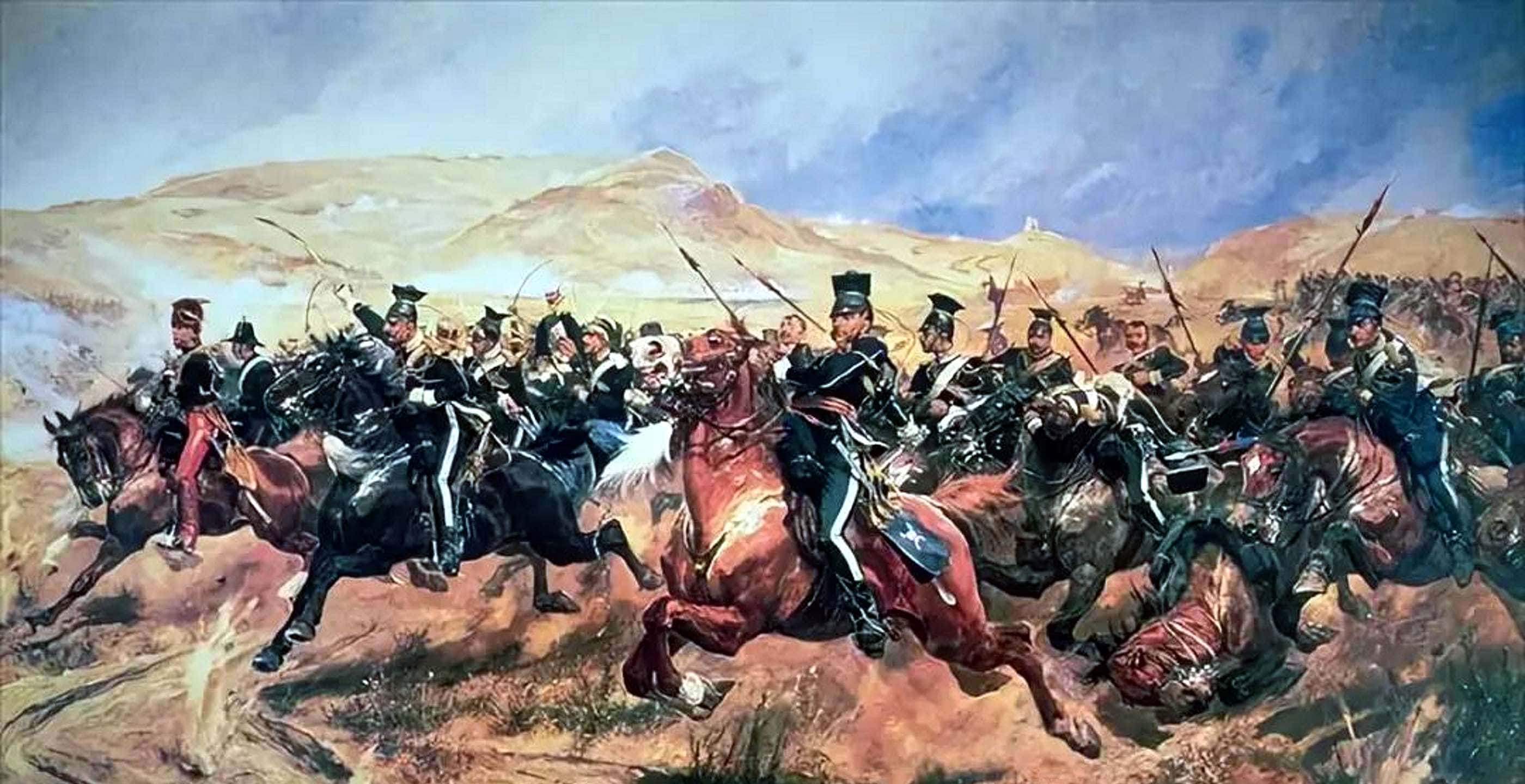
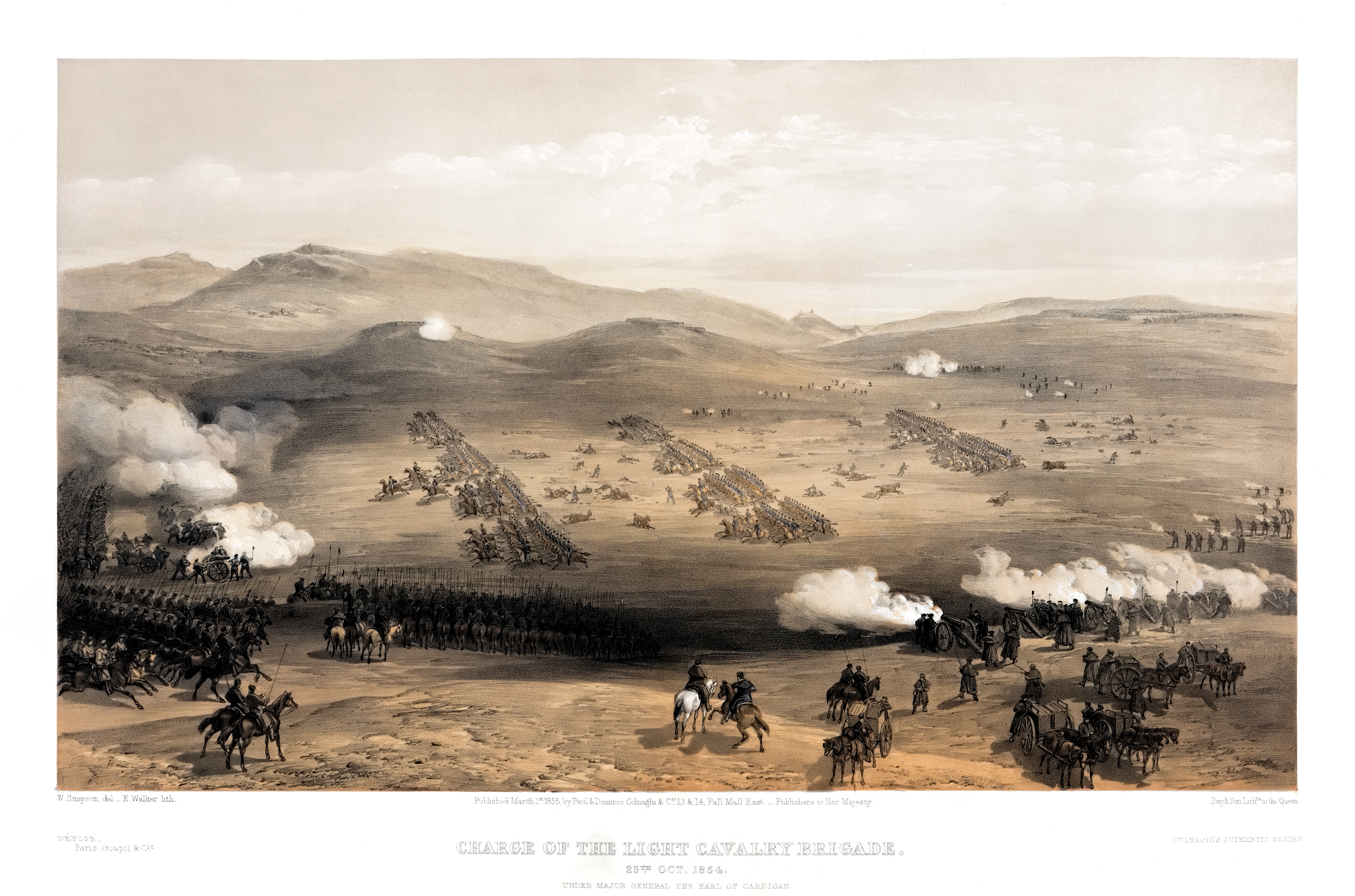
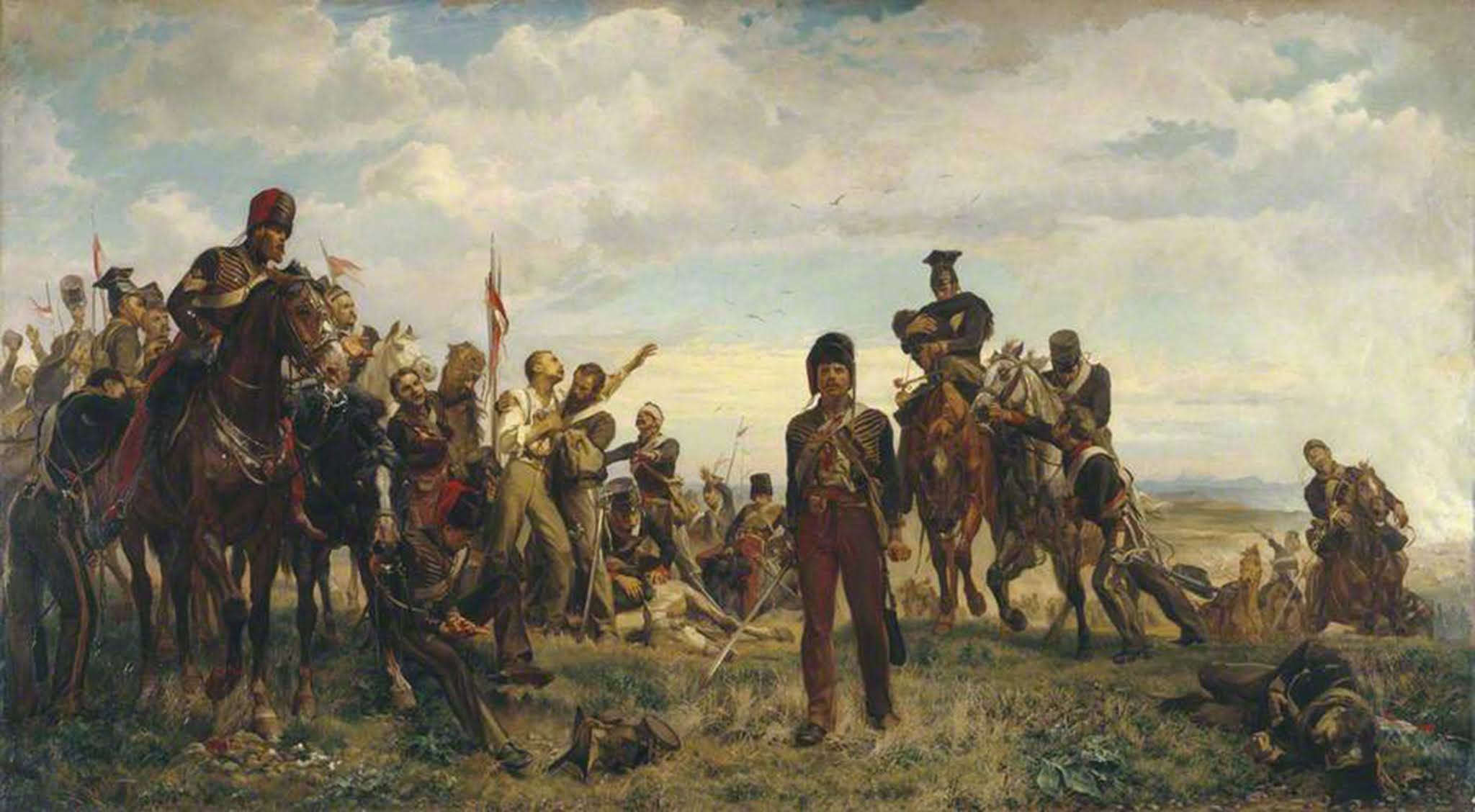
like that of the British Light Brigade at Balaclava in 1854, commemorated in Tennyson’s poem, were almost at the end of their military usefulness, for a Romantic, like Tolkien, the idea of such a charge was still a powerful image and one he couldn’t resist, depicting the heroic Rohirrim assembling

(from the Jackson film)

and roaring down on the unsuspecting orcs. 

(Abe Papakhian)

JRRT was writing medieval fantasy, however, but, as I’m always interested in “what if’s”, here I’m remembering what actually happened to that Light Brigade charge, an attack made in the teeth of Russia artillery.

The consequence was that, out of 609 men who rode towards the Russians, only 198 returned, and Lady Butler’s picture, “Balaclava the Return 25 October 1854” (1911) sums up the actual aftermath of that charge.

There’s evidence in the destruction of the Causeway Forts that Sauron’s army had some sort of blasting powder—suppose, instead of using it just as a siege tool, it had been employed with some sort of projectile propelled by it out of a tube—what might that have done to the Rohirrim’s valiant attack? 

Or even using the technique of the English army against the French at Agincourt, in our medieval world of 1415AD:  pointed stakes to threaten horses, behind which stood massed bowmen:  what would have been the outcome of that?

(Angus Mcbride)

475 horses were lost in the Charge of the Light Brigade.  Military progress so often just means more killing, but the replacement of horses with machines seems to me, who loves horses, a turn for the better.   At the same time, with Tolkien, I can feel the attraction for wild charges with swords at top speed (although cavalry did better when, at most, it went in at the canter—galloping causes loss of formation which can blunt the effect of such an attack), but, as in the charge of the Rohirrim, I’m glad if they only appear in fiction—and far from modern weaponry.

Thanks, as ever, for reading,

Stay well,

Remember that there’s a special spot, just behind the poll (top of the head), which, if scratched in the right place, makes many horses happy,

And remember, as well, that there’s always

MTCIDC

O

PS

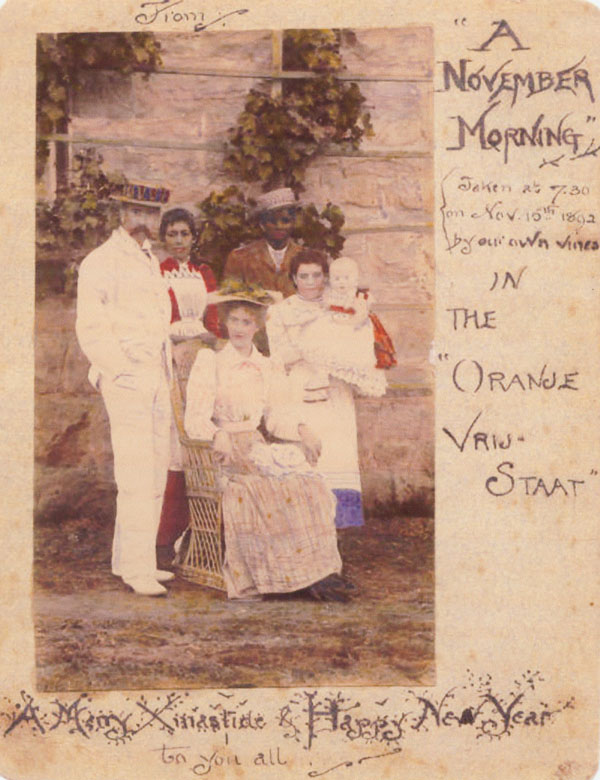
One of those little “what if” quirks of history–Tolkien’s immediate family had been in the Orange Free State at the time of his birth, in 1892.  Tolkien’s father, Arthur, was manager of the Bloemfontein branch there of the Bank of Africa.  The Orange Free State was one of the Boer republics attacked by Britain in the Boer War of 1899-1902. If Tolkien’s mother hadn’t brought JRRT and his brother, Hilary, back to England, in 1895, and Arthur hadn’t died of the effects of rheumatic fever in 1896,

Tolkien might have been in the Orange Free State when Bloemfontein was occupied by the British on 13 March, 1900.  (You can see early film of the Scots Guards marching in here:  https://www.youtube.com/watch?v=DHy2cEFwlIo )

PPS

In last week’s posting, I mentioned the story of the wonderfully bloodthirsty Frankish queen Fredegunda, as she appears in Gregory of Tours Historia Francorum.  I wrote there that you might read about her assassination of Bishop Praetextatus and her cold-blooded visit to him on his deathbed afterwards—but it required reading Gregory’s 6th-century Latin, as I didn’t provide a translation.  It seemed lazy of me not to include one of that scene, however, so here it is with the original Latin.  As always, I could smooth this out, but I prefer to stick as close as I can to the text, to give you a better feel for what’s actually been written.

Advenientem autem dominicae resurrectionis diae, cum sacerdos ad implenda aeclesiastica officia ad aeclesiam maturius properasset, antefanas iuxta consuetudinem incipere per ordinem coepit. Cumque inter psallendum formolae decumberet, crudelis adfuit homicida, qui episcopum super formolam quiescentem, extracto baltei cultro, sub ascella percutit. Ille vero vocem emittens, ut clerici qui aderant adiuvarent, nullius ope de tantis adstantibus est adiutus. At ille plenas sanguine manus super altarium extendens, orationem fundens et Deo gratias agens, in cubiculo suo inter manus fidelium deportatus et in suo lectulo collocatus est. Statimque Fredegundis cum Beppoleno duce et Ansovaldo adfuit, dicens: ‘Non oportuerat haec nobis ac reliquae plebi tuae, o sancte sacerdos, ut ista tuo cultui evenirent. Sed utinam indicaretur, qui talia ausus est perpetrare, ut digna pro hoc scelere supplicia susteneret’. Sciens autem ea sacerdos haec dolose proferre, ait: ‘Et quis haec fecit nisi his, qui reges interemit, qui saepius sanguinem innocentem effudit, qui diversa in hoc regno mala commisit?’ Respondit mulier: ‘Sunt aput nos peritissimi medici, qui hunc vulnere medere possint. Permitte, ut accedant ad te’. Et ille: ‘Iam’, inquid, ‘me Deus praecepit de hoc mundo vocare. Nam tu, qui his sceleribus princeps inventa es, eris maledicta in saeculo, et erit Deus ultur sanguinis mei de capite tuo’. Cumque illa discederit, pontifex, ordinata domo sua, spiritum exalavit. 

“However, with the coming of the day of [Our] Lord’s resurrection, when the priest [Praetextatus] had hurried early to the church to fulfill [his] ecclesiastical duties, he started to begin [the] antiphons according to custom [in their proper] order.  And when, between the psalms, he was lying on a bench, a cruel murderer appeared, who, when a knife had been pulled from [his] belt, struck the bishop, resting on the bench, under the armpit.  He [the bishop], however, [although] shouting so that the clergy who were present might help him, was aided with help of none from so many being present.  Yet he, stretching his hands, full of blood, above the altar, pouring [out] a prayer and thanking God, was carried off into his bedchamber by the hands of [his] faithful [followers] and placed on his bed.  And straightaway Fredegunda, with the Duke Beppolenus and Ansovaldus, appeared, saying, ‘Oh holy priest, this was not right for us and for the rest of your people that such things should happen in your worshipping.  But would that it would be revealed who had dared to carry out such things that he should suffer punishment worthy of this crime.’  The priest, knowing, however, that she was speaking of these things deceptively, said, ‘And who has done these things if not [the one] who has killed kings, who very often has poured out innocent blood, who has committed many evil deeds in this kingdom’  The woman replied:  ‘There are in our household highly experienced doctors who would be able to heal this wound.  Allow [it] that they may come to you.’  And he [said]:    ‘God has decreed to call me from this world.  On the other hand, you who have been exposed as chief in these crimes, you will be cursed in the future and God will be the avenger of my blood on your head.’  And when she had left, the bishop, affairs arranged in his house, breathed out his spirit.”

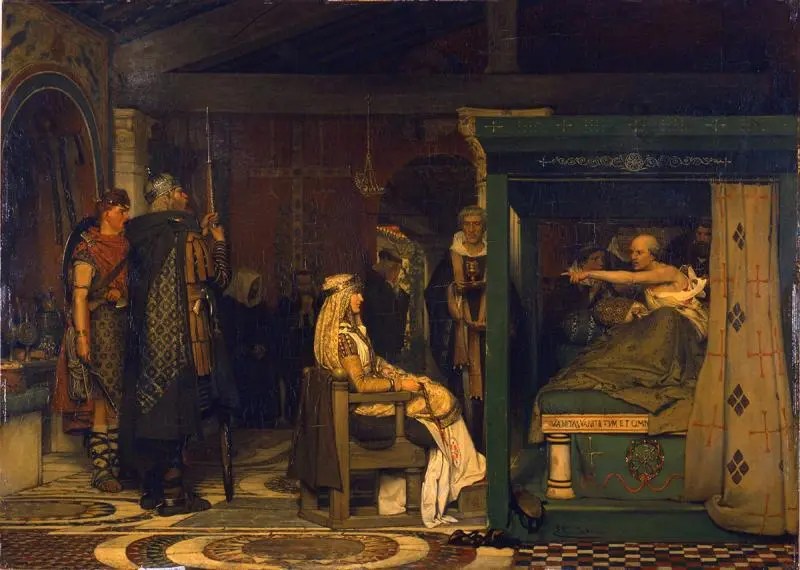
And how could I not include Alma-Tadema’s illustration?

Freddie

11 Wednesday Jun 2025

Posted by Ollamh in Uncategorized

≈ Leave a comment

As always, welcome, dear readers.

The title of this posting might lead you to think, if you’re a fan of fantasy/romantic comedies, of Fat Freddie,

the feckless elder brother of Tom Hanks in

In fact, although the name is the same, where it comes from is from a different category altogether.

As his correspondence shows us more than once, Tolkien was very particular about names, both of places and people, in his work.

“I hope you and the Foreign Rights Dept., will forgive my now at length writing to you about the Dutch translation.  The matter is (to me) important; it has disturbed and annoyed me greatly…

In principle I object as strongly as is possible to the ‘translation’ of the nomenclature at all (even by a competent person)…

May I say now at once that I will not tolerate any similar tinkering with the personal nomenclature.”  (from a letter to Rayner Unwin, 3 July, 1956, Letters, 359, 361)

Although it seems obvious why he might feel this way—it was his work, after all, and why would he approve of anyone making changes to it?–he adds another cogent reason—implying, as he does so, who would be competent enough to match his work–and would be able to take the time to develop it?

“That this is a ‘imaginary’ world does not give him [a translator] any right to remodel it according to his fancy, even if he could in a few months create a new coherent structure which it took me years to work out.”

Of course, Tolkien, maintaining the fiction that he is the editor and translator, rather than author, of his work, himself translated names, as he tells us that Samwise was actually Banazir, for instance (see The Lord of the Rings, Appendix F, II, “On Translation”).

But numbers of the personal names in Tolkien’s work are not translations—or even his creations—and their sources always interest me, as I began to talk about in “Drogo?”, 26 February, 2025.

We know that the names of The Hobbit’s dwarves and even Gandalf’s name come from the Old Norse of the Voeluspa (the “Prophecy of the Seeress”) in the Poetic Edda (you can read more about that here:  https://en.wikipedia.org/wiki/V%C3%B6lusp%C3%A1 and you can read an older translation—1906–of it here:  https://www.gutenberg.org/files/14726/14726-h/14726-h.htm#VOLUSPA_THE_VALAS_PROPHECY ).

Another Tolkien source for names, however, is pure Germanic.  As JRRT tells us in Appendix F, II, “On Translation” of The Lord of the Rings:

“In some old families, especially those of Fallohide origin, such as the Tooks and the Bolgers, it was, however, the custom to give high-sounding first-names.  Since most of these seem to have been drawn from legends of the past, of Men as well as of Hobbits, and many while now meaningless to Hobbits closely resembled the names of Men in the Vale of Anduin, or in Dale, or in the Mark, I have turned them into those old names, largely of Frankish or Gothic origin, that are still used by us or are met in our histories.”

So, take the “Freddie” of this posting’s title.  This is Fredegar Bolger—“Fatty”—the friend of Frodo, who is involved in his removal to Crickhollow (see The Fellowship of the Rings, Book One, Chapter 3, “Three is Company” ).

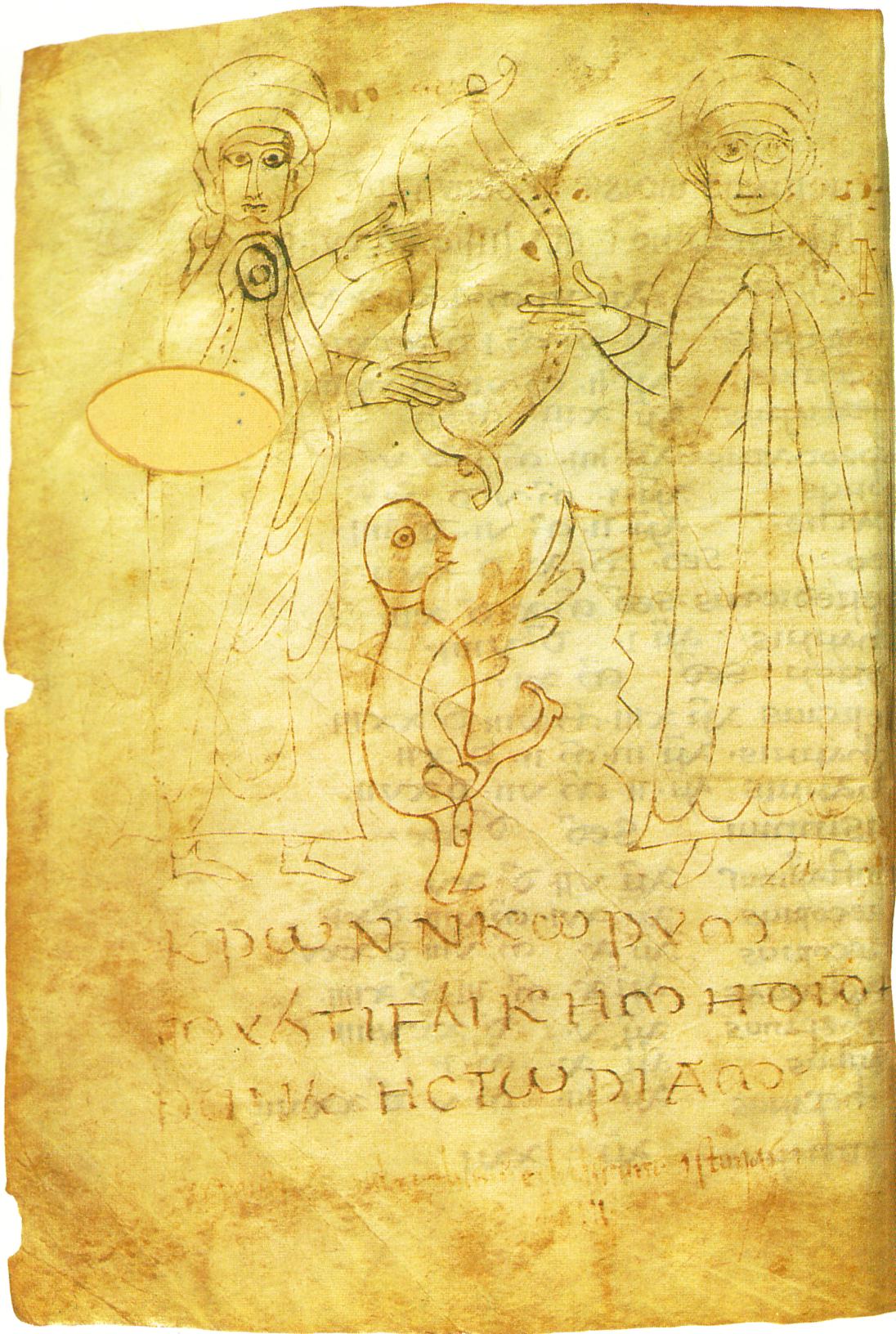
I can locate no reference to its origins in Tolkien’s Letters, usually a good source for all sorts of background material, but, taking his hint of his use of “old names, largely of Frankish or Gothic origin”, we find the well-known 7th-century AD Chronicle of Fredegar, a 4-book compilation of Frankish history,

which we can certainly imagine Tolkien the medievalist would have known about—especially as he says—and shows–a distinct taste for other early Germanic names in the Bolger family:  Adalbert, Adalgar, Alfrida, Filibert, Gerda, Gundabald, Gundabad, Gundahar, Heribald, Herugar, Odovacar, Rudibert, Rudigar, Rudolph, Theobald, Wilibald, Wilimar.  He’s also slipped in a famous name:  Odovacar—aka Odovacer or Odoacer, the late 5th-century AD Gothic

(There’s argument about his origins—see: https://en.wikipedia.org/wiki/Odoacer ), ruler of northern Italy under the eastern Romans.  He deposed Romulus, the last western emperor, in 476, replacing him with—himself,

but, who was, in turn, replaced by Theodoric—reportedly by being cut nearly in two by Theodoric himself (this detail being from the early 7th-century Byzantine historian, John of Antioch—you can read a translation of his depiction of the murder here:   https://eprints.whiterose.ac.uk/id/eprint/195321/1/10.1515_ang-2022-0056.pdf on pages 382-383.)

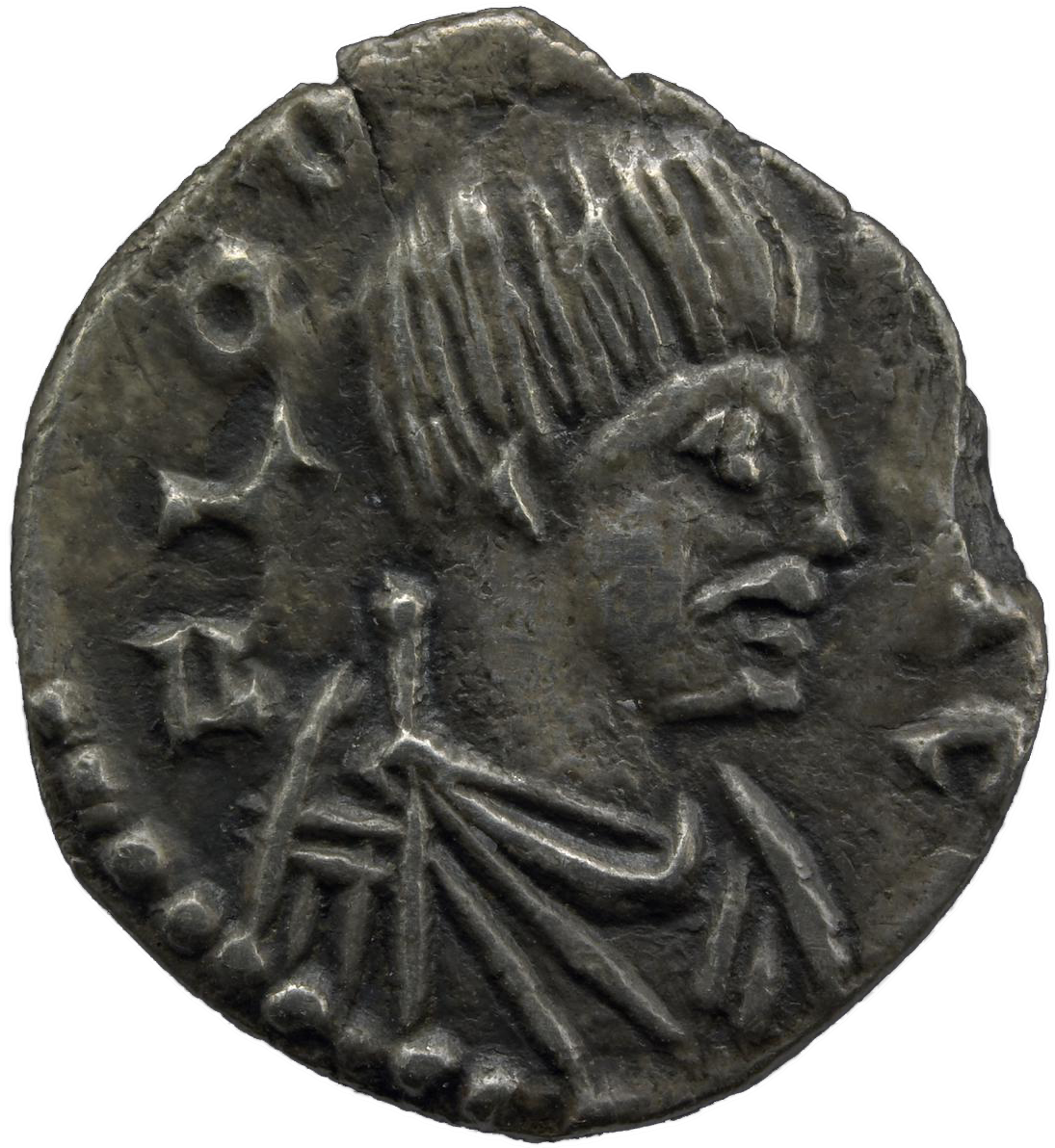
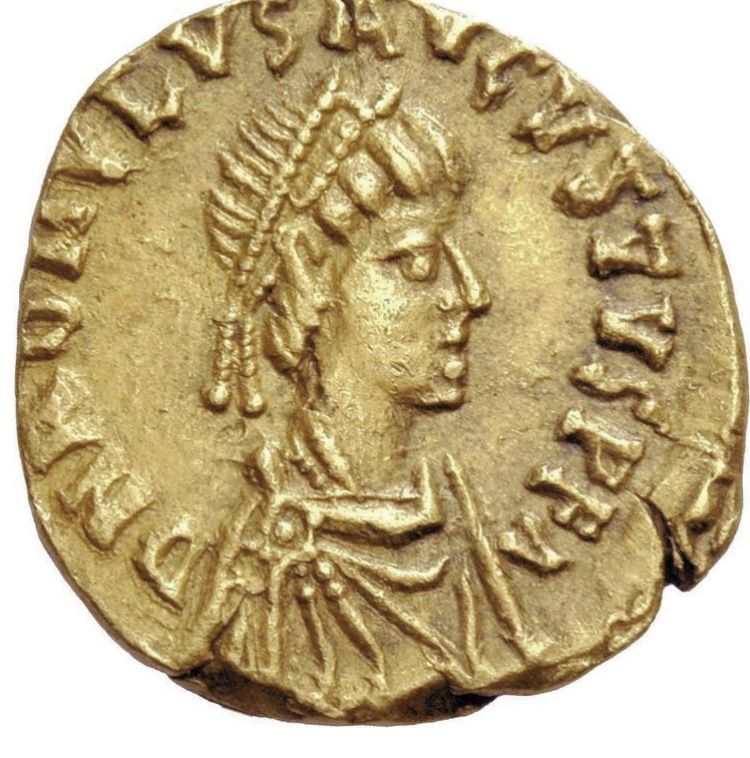
(I’ve always valued this coin as a perfect example of the shift of power from Roman to Germanic rulers in the West.  On the surface, it looks late Roman:

1. its inscription is in Latin:  “Rex Theodoricus Pius Princ[eps] I[nvictus] S[emper]”—“King Theodoric Righteous Head of State Always Unbeaten”

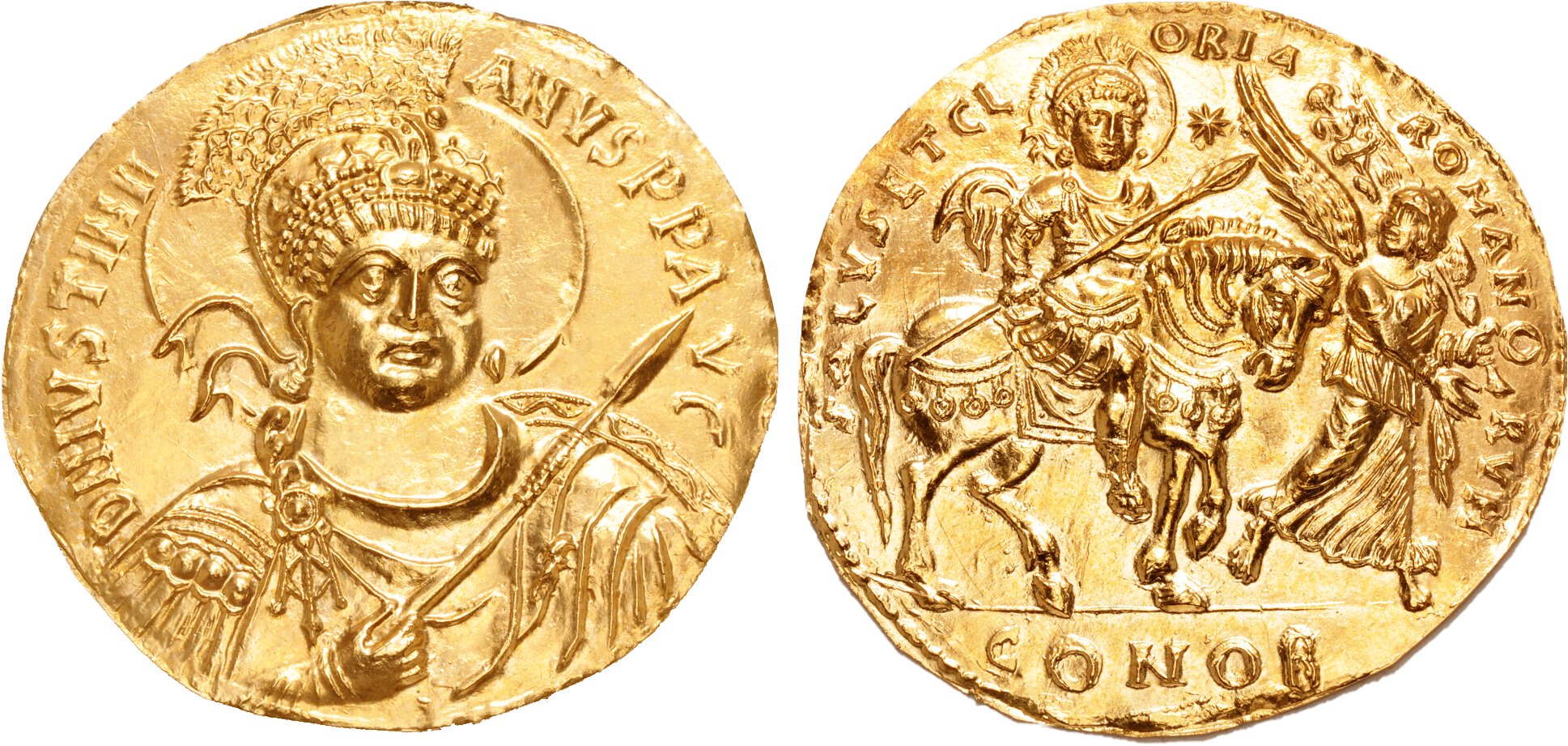
2. he’s dressed for the part—with late Roman armor and a military cloak over his left shoulder and pinned on the right—like the Eastern emperor, Justinian, on this medallion

3. he has, perched (probably on a scepter) on his left hand like a pet bird, a figure of Nike, the ancient goddess of victory—and you can see her dancing in front of Justinian

4. but then there are those touches of something else—

  a. the word “rex” was not a word a Roman ruler would ever use of himself, from the overthrow of the last of the Etruscan kings in 509BC being a term synonymous with “bloody tyrant”—which is why the later rulers of Rome from Augustus’ successor, Tiberius on, used “imperator”—“holder of state authority” instead

  b. Theodoricus looks like a good Greco-Roman name, combining “theos”, “god (Zeus originally)” with the root “dor-“ “gift”, so “Giftofgod”, but there is another possibility:  this could also be a Gothic compound—“theuda”—“of the people”—and “reiks”—“ruler”—another way of saying “king”

  c. and notice Theodoric’s upper lip—a droopy Germanic mustache like this one worn by the later Harold, last Anglo-Saxon king of England–

to our right is William, Duke of Normandy, distinguished by not wearing a Germanic mustache.  You’ll also notice that Odoacer also displays such a characteristic piece of lip-decoration.)

There is another Freddie associated with Fredegar’s work.  This is Fredegunda (often referred to in modern texts as “Fredegund”),

(A very worn portrait on her tomb in the Basilica of St Denis, Paris)

wife of Chilperic I, king of that part of the Frankish world called Neustria,

in the later 6th century AD.  Unlike Fredegar Bolger, seemingly a peaceful person, Fredegunda was credited with about a dozen assassinations (including that of Bishop Praetextatus, stabbed while, of all times, celebrating Easter mass in his cathedral at Rouen in 586AD.)

(A wonderfully sinister scene by the Victorian historical painter, Lawrence Alma-Tadema, 1836-1912.  It’s based upon one of Fredegar’s sources, the Historia Francorum, “The History of the Franks”, by Gregory of Tours, 538-594.  In this telling, Fredegunda comes to Praetextatus’ deathbed and offers him medical help, while calmly listening to him curse his murderer.)

She seems to have been quite a monster, even attempting to murder her own daughter, Rigunth[a] in a fit of jealousy by trying to break her neck while she was reaching into a treasure chest—

For more on her, see:  https://en.wikipedia.org/wiki/Fredegund  The queen’s assassination and visit to the dying bishop is in Gregory, Book VIII, Chapter 31, which, if you’re a Latin reader, you can find here:  https://www.thelatinlibrary.com/gregorytours/gregorytours8.shtml

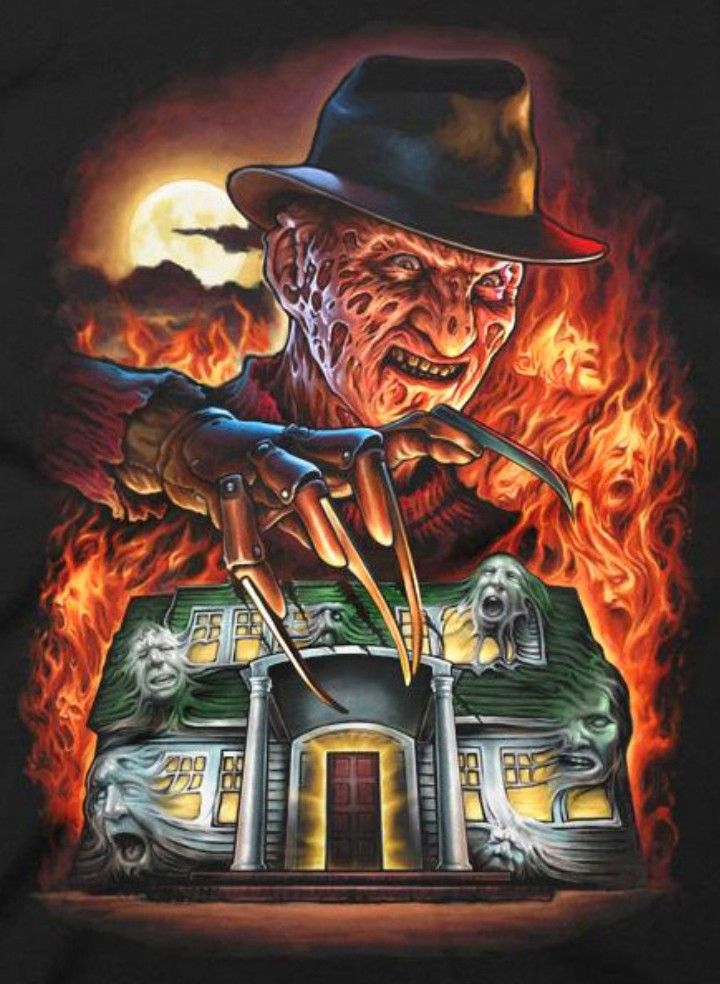
But her impressive violence reminded me of another Freddie—or Freddy–

from not just one film, but from a series,

and I wonder if the queen, who also seems to have been a bit of a seductress, might have found that Mr. Krueger, though not in her social circle, was a tempting conquest—or, better, collaborator—although, if I were he, I would always be a little anxious when the queen played with knives.

(another Alma-Tadema—here we see Fredegunda, who has just been dumped by Chilperic for a Visigothic princess, Galswintha, watching their wedding—and thinking…)

As ever, thanks for reading.

Stay well,

That old furnace in the basement is just that:  an old furnace,

And remember that, as always, there’s

MTCIDC

O

PS

A funny little detail, but which might have been a private joke for JRRT:  in the Bolger family tree, in Appendix C of The Lord of the Rings, we note that Willibald Bolger married Prisca Baggins.  Prisca was JRRT’s pet name for his daughter, Priscilla—

Babeling

04 Wednesday Jun 2025

Posted by Ollamh in Uncategorized

≈ Leave a comment

Tags

allergory, Common Speech, languages of Middle-earth, Monsters and the Critics, Tolkien, Tower of Babel

Dear readers, welcome, as always.

For someone who claimed that he disliked allegory (see, for example, his letter to Milton Waldman, late 1951, Letters, 204), it might seem odd that Tolkien devised one, which we can read near the beginning of “Beowulf:  the Monsters and the Critics”:

“A man inherited a field in which was an accumulation of old stone, part of an older hall.  Of the old stone some had already been used in building the house in which he actually lived, not far from the old house of his fathers.  Of the rest he took some and built a tower.  But his friends coming perceived at once (without troubling to climb the steps) that these stones had formerly belonged to a more ancient building.   So they pushed the tower over, with no little labour, in order to look for hidden carvings and inscriptions, or to discover when the man’s distant forefathers had obtained their building material.” (7-8)

Tolkien goes on to explain his allegory as being about Beowulf and its critics over the years, including more recent ones—

“To reach these we must pass in rapid flight over the heads of many decades of critics.”

It’s the beginning of the next sentence which then interests me:  “As we do so a conflicting babel mounts up to us…” (8)

From that word “babel”, we can see where Tolkien probably acquired his central image–

(from the early 15th-century Bedford Hours—for more see:  https://en.wikipedia.org/wiki/Bedford_Hours )

and its basis–

“1 Erat autem terra labii unius, et sermonum eorumdem.2 Cumque proficiscerentur de oriente, invenerunt campum in terra Senaar, et habitaverunt in eo.3 Dixitque alter ad proximum suum: Venite, faciamus lateres, et coquamus eos igni. Habueruntque lateres pro saxis, et bitumen pro cæmento:4 et dixerunt: Venite, faciamus nobis civitatem et turrim, cujus culmen pertingat ad cælum: et celebremus nomen nostrum antequam dividamur in universas terras.5 Descendit autem Dominus ut videret civitatem et turrim, quam ædificabant filii Adam,6 et dixit: Ecce, unus est populus, et unum labium omnibus: cœperuntque hoc facere, nec desistent a cogitationibus suis, donec eas opere compleant.7 Venite igitur, descendamus, et confundamus ibi linguam eorum, ut non audiat unusquisque vocem proximi sui.8 Atque ita divisit eos Dominus ex illo loco in universas terras, et cessaverunt ædificare civitatem.9 Et idcirco vocatum est nomen ejus Babel, quia ibi confusum est labium universæ terræ: et inde dispersit eos Dominus super faciem cunctarum regionum.”

“The earth was of one language, however, and of the same speech.  And when they were setting forth from the east, they found a plain in the land of Senaar and they settled in that [place].  And one said to his neighbor, ‘Come, let us make bricks and bake them with fire.’  And they had bricks in place of stones and pitch in place of cement.  And they said, ‘Come, let us make a city and tower for ourselves, whose top may reach the sky; and let us glorify our name before we may be split up into all the lands.’  The Lord came down, however, so that he might see the city and the tower which the sons of Adam were building and said:  “Look—there is one people and language for all.  They have begun to do this nor will they desist from their plans until they may fill them with [their] labor.  Come, therefore.  Let us go down and confuse their speech there so that each one may not hear [i.e. understand] the tongue of his neighbor.’  And so the Lord split them up from that place into many lands and they stopped building the city.  And on account of that the name of this [place] has been called “Babel” since there the speech of the whole land has been confused and thence the Lord scattered them over the surface of all the regions.” (Genesis 11.1-9, my translation—the meaning of “Babel” and its origin have been the subject of scholarly argument—see:    https://en.wikipedia.org/wiki/Tower_of_Babel  )

It’s interesting, however, to see that this is a tower of Babel in reverse:  instead of it being built, it is being pulled down—although, as in the case of the Biblical tower, events around the tower produce confusion:  in the case of Babel, linguistic; in the case of Tolkien’s tower, critical, with so many differing opinions about approaches to Beowulf.

In our world, Tolkien had early been concerned with the fact that the earth was full of languages, Biblically created or not, for which he believed that a common language, a lingua franca, might be a cure, a cure he believed might lie in Esperanto:

“Personally I am a believer in an ‘artificial’ language, at any rate for Europe—a believer, that is, in its desirability, as the one thing antecedently necessary for uniting Europe, before it is swallowed by non-Europe; as well as for many other good reasons—a believer in its possibility because the history of the world seems to exhibit, as far as I know it, both an increase in human control of (or influence upon) the uncontrollable, and a progressive widening of the range of more or less uniform languages.  Also I particularly like Esperanto…” (“A Secret Vice”, in Tolkien, The Monsters and the Critics, 198.  For more on Esperanto, see:  https://en.wikipedia.org/wiki/Esperanto and https://ia800205.us.archive.org/13/items/esperantotheuniv00ocon/esperantotheuniv00ocon.pdf          and for more on Tolkien and the subject, see:  Arden R. Smith, “Tolkien and Esperanto”, Journal of the Marion E. Wade Center, Vol.17 (2000), 27-46) 

For Europe perhaps one language, then, but, for Middle-earth?

If we only think of those spoken or mentioned in The Lord of the Rings, we find numerous languages—not surprising for someone who more than once had said that he created people so that there would be someone to speak his languages (see, for example, his letter to Houghton Mifflin, 30 June, 1955, Letters, 319—note:  this is only a rough list for a much more complicated subject—for more, see, for example, The Lord of the Rings, Appendix F, I, “The Languages and Peoples of the Third Age”).  Here is a basic roster:

1. the Elves (Quenya and Sindarin—for more, see:  https://en.wikipedia.org/wiki/Elvish_languages_of_Middle-earth )

2. the Dwarves (Khuzdul)—for a very good, linguistically-based essay on this, see:  https://en.wikipedia.org/wiki/Khuzdul

3. the Rohirrim (Rohirric—or Rohanese—or simply Rohan—see this essay for more on the various possible names for the language:  https://tolkiengateway.net/wiki/Rohanese )  The Hobbits appear to have spoken at some point in their history a related language—see Appendix F “Of Hobbits” for more.

4. the Dunlendings and the Wild Men of Druadan Forest (?  descended from very early humans in Middle-earth—in Appendix F, Tolkien describes their language:  “Wholly alien was the speech of the Wild Men of Druadan Forest.  Alien, too, or remotely akin, was the language of the Dunlendings.”)

5. the Ents (seemingly invented their own language, described in Appendix F as “…unlike all others:  slow, sonorous, agglomerated, repetitive, indeed long-winded…”)

6. men (here meaning descendants of the Numeroreans—Westron—complicated—see Appendix F “Of Men” for some of that complication)

7. Orcs (“it is said that they had no language of their own, but took what they could of other tongues and perverted it to their own liking”—to which would be added the “Black Speech”, invented by Sauron as—yes, a lingua orca, or common speech—see Appendix F, “Of Other Races”, “Orcs and the Black Speech”)

8. to which we might add the languages of the Easterlings and the Haradrim

And here we’re back to Babel again.

(Gustave Dore, from his very dramatic illustrations for La Bible)

People in Middle-earth can revert to their own languages—

“…Following the winding way up the green shoulders of the hills, they came at last to the wide wind-swept walls and the gates of Edoras.

There sat many men in bright mail, who sprang at once to their feet and barred the way with spears.  ‘Stay, strangers here unknown!’ they cried in the tongue of the Riddermark, demanding the names and errand of the strangers.”

“ ‘Well do I understand your speech…yet few strangers do so.  Why then do you not speak in the Common Tongue, as is the custom in the West, if you wish to be answered?’ “  (The Two Towers, Book Three, Chapter 6, “The King of the Golden Hall”)

Here Gandalf reveals, that, just as there was Tolkien’s Esperanto in our world, in Middle-earth there was clearly an equivalent:  “the Common Tongue”.  Descended from the language of the Numenorean invaders of Middle-earth (letter to Naomi Mitchison, 25 April, 1954, Letters, 264), this was just what its name says:  it was the common speech of a majority of the people in western Middle-earth—along with the exceptions listed above.  To JRRT, it was also the equivalent of the English into which the text had been “translated”.  In that same letter to Naomi Mitchison, Tolkien wrote:

“If it will interest you, I will send you a copy (rather rough) of the matter dealing with Languages (and Writing), Peoples and Translation.

The latter has given me much thought.  It seems seldom regarded by other creators of imaginary worlds, however gifted as narrators (such as Eddison).  But then I am a philologist, and much though I should like to be more precise on other cultural aspects and features, that is not within my competence.  Anyway ‘language’ is the most important, for the story has to be told, and the dialogue conducted in a language; but English cannot have been the language of any people at that time.  What I have, in fact, done, is to equate the Westron or wide-spread Common Speech of the Third Age with English; and translate everything, including names such as The Shire, that was in Westron into English terms…” (263-264)

In other words, what Tolkien has done is exactly the opposite of what the Lord was said to have done.  The account in Genesis tells us that, by “confundens ibi linguam eorum”—“confusing there their language”, the Lord intentionally had caused chaos, breaking up the single people into many groups, each speaking its own language and therefore unable to collaborate in continuing their daring construction.  JRRT, by writing—he would say “translating”—his work almost entirely in English (Tolkien had added in the letter to Mitchison “Languages quite alien to the C[ommon] S[peech] have been left alone), has produced a work in which he has brought together the speakers of a number of different languages, combining them into one, in order to produce what—pardon the pun—is a towering achievement.

(This image has produced a fair amount of confusion, it seems, on the internet—in some sources it’s labeled as by Rudolf von Ems, but sometimes another image of the building of the tower is substituted.  For the moment, I’ll go with Rudy c.1370—but check out this site for more Babel-building:  https://www.babelstone.co.uk/Blog/2007/01/72-views-of-tower-of-babel.html labeled as 72 views of the tower )

Thanks, as always, for reading.

Stay well,

Consider how dull the world would be with only one language, instead of the more than 7000 currently spoken (see:  https://www.worldatlas.com/society/how-many-languages-are-there-in-the-world.html ),

And remember, in any language you like—including Entish—that there’s

MTCIDC

O
PS

For more on the languages of Tolkien, there are a number of useful sites such as:  https://ardalambion.net/ .

The Doubtful Sea Series Facebook Page

The Doubtful Sea Series Facebook Page

  • Ollamh

Categories

  • Artists and Illustrators
  • Economics in Middle-earth
  • Fairy Tales and Myths
  • Films and Music
  • Games
  • Heroes
  • Imaginary History
  • J.R.R. Tolkien
  • Language
  • Literary History
  • Maps
  • Medieval Russia
  • Military History
  • Military History of Middle-earth
  • Narnia
  • Narrative Methods
  • Poetry
  • Research
  • Star Wars
  • Terra Australis
  • The Rohirrim
  • Theatre and Performance
  • Tolkien
  • Uncategorized
  • Villains
  • Writing as Collaborators
Follow doubtfulsea on WordPress.com

Across the Doubtful Sea

Recent Postings

  • A Moon disfigured December 17, 2025
  • On the Roads Again—Once More December 10, 2025
  • (Not) Crossing Bridges December 3, 2025
  • On the Road(s) Again—Again November 26, 2025
  • On the Road(s) Again November 19, 2025
  • To Bree (Part 2) November 12, 2025
  • To Bree (Part 1) November 5, 2025
  • A Plague o’ Both—No, o’ All Your Houses! October 29, 2025
  • It’s in Writing (2:  I’st a Prologue, or a Poesie for a Ring?) October 22, 2025

Blog Statistics

  • 103,189 Views

Posting Archive

  • December 2025 (3)
  • November 2025 (4)
  • October 2025 (5)
  • September 2025 (4)
  • August 2025 (4)
  • July 2025 (5)
  • June 2025 (4)
  • May 2025 (4)
  • April 2025 (5)
  • March 2025 (4)
  • February 2025 (4)
  • January 2025 (5)
  • December 2024 (4)
  • November 2024 (4)
  • October 2024 (5)
  • September 2024 (4)
  • August 2024 (4)
  • July 2024 (5)
  • June 2024 (4)
  • May 2024 (5)
  • April 2024 (4)
  • March 2024 (4)
  • February 2024 (4)
  • January 2024 (5)
  • December 2023 (4)
  • November 2023 (5)
  • October 2023 (4)
  • September 2023 (4)
  • August 2023 (5)
  • July 2023 (4)
  • June 2023 (4)
  • May 2023 (5)
  • April 2023 (4)
  • March 2023 (5)
  • February 2023 (4)
  • January 2023 (4)
  • December 2022 (4)
  • November 2022 (5)
  • October 2022 (4)
  • September 2022 (4)
  • August 2022 (5)
  • July 2022 (4)
  • June 2022 (5)
  • May 2022 (4)
  • April 2022 (4)
  • March 2022 (5)
  • February 2022 (4)
  • January 2022 (4)
  • December 2021 (5)
  • November 2021 (4)
  • October 2021 (4)
  • September 2021 (5)
  • August 2021 (4)
  • July 2021 (4)
  • June 2021 (5)
  • May 2021 (4)
  • April 2021 (4)
  • March 2021 (5)
  • February 2021 (4)
  • January 2021 (4)
  • December 2020 (5)
  • November 2020 (4)
  • October 2020 (4)
  • September 2020 (5)
  • August 2020 (4)
  • July 2020 (5)
  • June 2020 (4)
  • May 2020 (4)
  • April 2020 (5)
  • March 2020 (4)
  • February 2020 (4)
  • January 2020 (6)
  • December 2019 (4)
  • November 2019 (4)
  • October 2019 (5)
  • September 2019 (4)
  • August 2019 (4)
  • July 2019 (5)
  • June 2019 (4)
  • May 2019 (5)
  • April 2019 (4)
  • March 2019 (4)
  • February 2019 (4)
  • January 2019 (5)
  • December 2018 (4)
  • November 2018 (4)
  • October 2018 (5)
  • September 2018 (4)
  • August 2018 (5)
  • July 2018 (4)
  • June 2018 (4)
  • May 2018 (5)
  • April 2018 (4)
  • March 2018 (4)
  • February 2018 (4)
  • January 2018 (5)
  • December 2017 (4)
  • November 2017 (4)
  • October 2017 (4)
  • September 2017 (4)
  • August 2017 (5)
  • July 2017 (4)
  • June 2017 (4)
  • May 2017 (5)
  • April 2017 (4)
  • March 2017 (5)
  • February 2017 (4)
  • January 2017 (4)
  • December 2016 (4)
  • November 2016 (5)
  • October 2016 (6)
  • September 2016 (5)
  • August 2016 (5)
  • July 2016 (5)
  • June 2016 (5)
  • May 2016 (4)
  • April 2016 (4)
  • March 2016 (5)
  • February 2016 (4)
  • January 2016 (4)
  • December 2015 (5)
  • November 2015 (5)
  • October 2015 (4)
  • September 2015 (5)
  • August 2015 (4)
  • July 2015 (5)
  • June 2015 (5)
  • May 2015 (4)
  • April 2015 (3)
  • March 2015 (4)
  • February 2015 (4)
  • January 2015 (4)
  • December 2014 (5)
  • November 2014 (4)
  • October 2014 (6)
  • September 2014 (1)

Blog at WordPress.com.

  • Subscribe Subscribed
    • doubtfulsea
    • Join 78 other subscribers
    • Already have a WordPress.com account? Log in now.
    • doubtfulsea
    • Subscribe Subscribed
    • Sign up
    • Log in
    • Report this content
    • View site in Reader
    • Manage subscriptions
    • Collapse this bar
 

Loading Comments...