Welcome, as ever, dear readers.
As I believe I’ve reported before, I’ve been rewatching Jackson’s The Lord of the Ring films after a number of years and something struck me in his The Fellowship of the Ring which has brought to mind Tolkien’s own remarks about going from book to film.
In 1958, it was proposed to make a film of The Lord of the Rings. Tolkien, via Forrest J. Ackerman, was sent a story-line created by a “Mr. Zimmerman” and spent a good deal of time reading through and commenting. There are only some sections of this commentary available to us in Letters, but these suggest that what he read seriously dismayed and displeased him:
“The commentary goes along page by page, according to the copy of Mr. Zimmerman’s work, which was left with me, and which I now return. I earnestly hope that someone will take the trouble to read it.
If Z and/or others do so, they may be irritated or aggrieved by the tone of many of my criticisms. If so, I am sorry (though not surprised). But I would ask them to make an effort of imagination sufficient to understand the irritation (and on occasion the resentment) of an author, who finds, increasingly as he proceeds, his work treated as it would seem carelessly in general, in places recklessly, and with no evident signs of any appreciation of what it is all about…
The canons of narrative art in any medium cannot be wholly different; and the failure of poor films is often precisely in exaggeration, and in the intrusion of unwarranted matter owing to not perceiving where the core of the original lies.” (from an undated—June, 1958—letter to Forrest J. Ackerman, Letters, 389-390)
As I watched, I found myself thinking about what Tolkien wrote and about, of all things, romance, but, as it’s Valentine’s Day, 14 February, what could be more appropriate for a posting?
Valentine’s Day was once celebrated in the Christian calendar as the occasion of the martyrdom of Valentinus, a 3rd-century AD priest, the date first (perhaps) officially appearing in the 8th-century Gelasian Sacramentary,

aka the Liber Sacramentorum Ecclesiae Romanae, where you’ll find, inLiber Secundus, XI, “Orat. in Natali Valentini, Vitalis, Feliculae”–“Prayers on the Martyrdom of Valentinus, Vitalis, and Felicula”, dated for “xvi Kal. Martias”—that is, 14 February. (You can read it here: https://books.google.com/books?id=S-20jhQQZBMC&dq=sacramentary&pg=RA3-PA1#v=onepage&q=sacramentary&f=false The Gelasius mentioned is a 5th-century pope who probably had nothing whatever to do with the book—for more see: https://en.wikipedia.org/wiki/Gelasian_Sacramentary )
Valentinus was squeezed out of the ecclesiastical calendar in 1969 (which you can read about here: https://aleteia.org/2022/02/09/why-is-st-valentines-feast-day-not-on-the-churchs-calendar/ ), but St Valentine’s day has been part of Western romantic tradition since at least the later Middle Ages and began to become a commercial success in the 19th century, when preprinted cards first appeared.
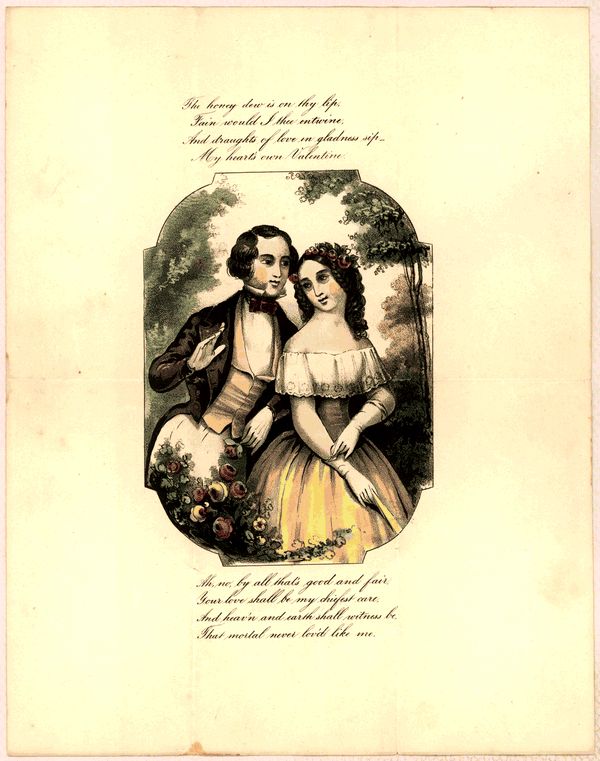
(And I can’t resist this—possibly the first printed valentine—which dates, in fact, to 1797.

See this for more: https://www.bbc.co.uk/ahistoryoftheworld/objects/L1NM_6mWRymAMKXcRDlXJA
and see this for more on early commercial valentines: http://www.go-star.com/antiquing/early-valentines.htm )
The romance I want to talk about in this posting, however, comes from a different time although, according to its author, Tolkien, not from a different place.
In a way, it’s actually a kind of echo-romance, in which the first part happened some 6500 years before the second part, in the First Age of Middle-earth, but many of its conditions were the same.
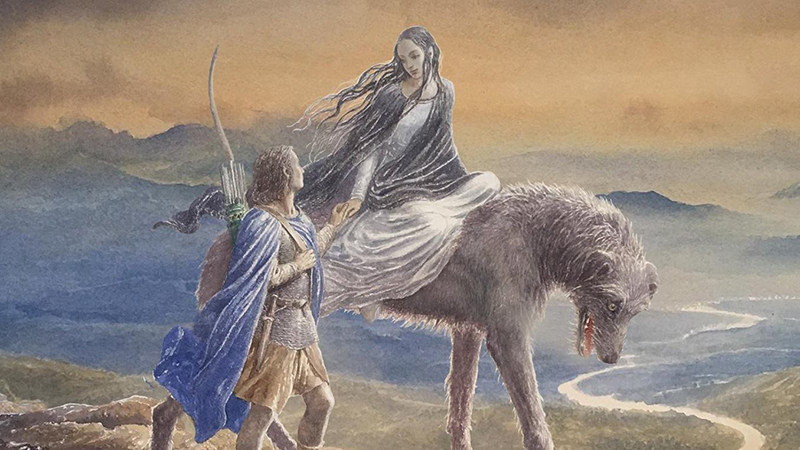
(Alan Lee)
A note, however: this is a very complex story, which JRRT developed over many years, appearing in one form in the Silmarillion, 1977,
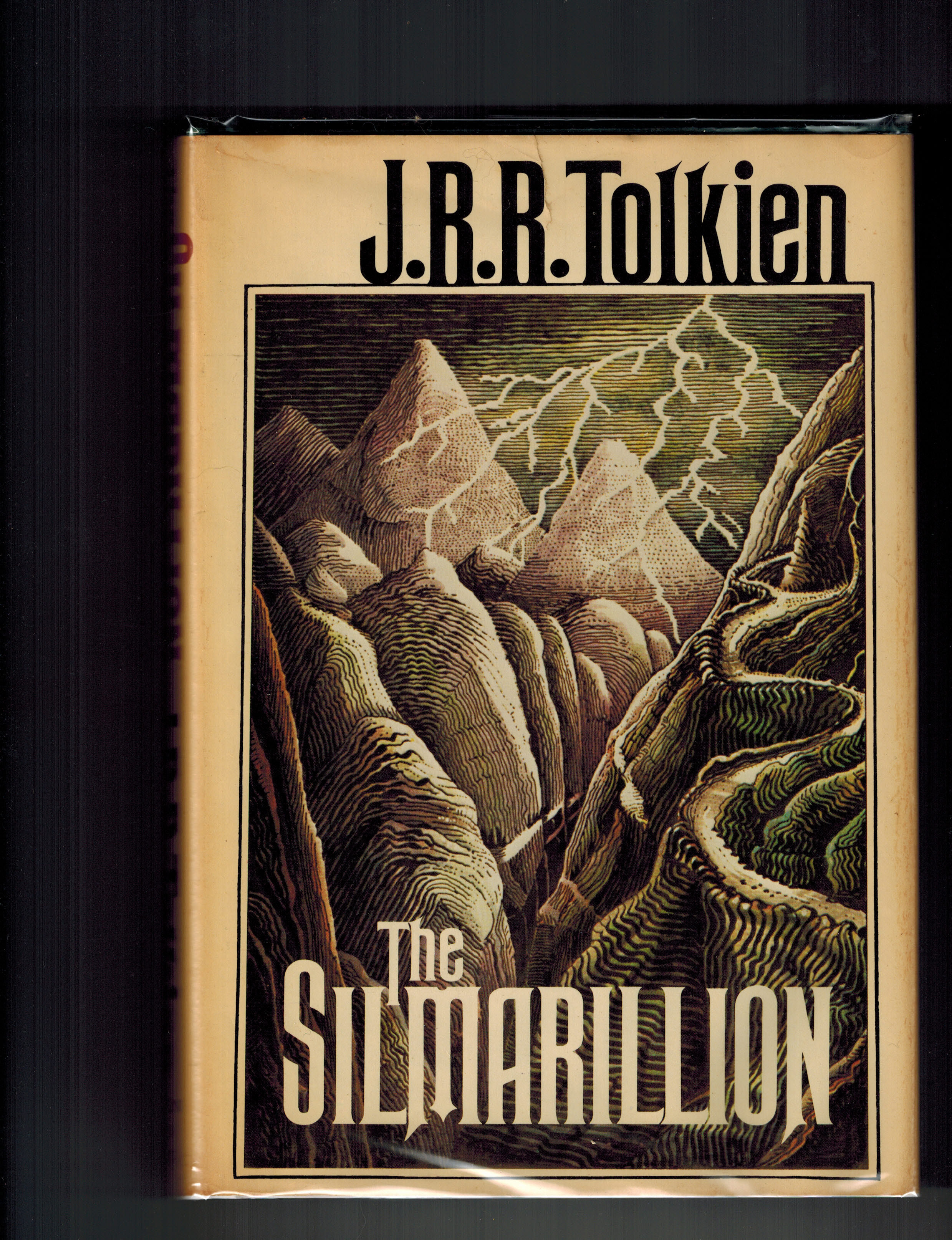
and in a multiform, Beren and Luthien, 2017, both versions edited by Christopher Tolkien.

For my purposes, I’m going to compress the story into the simplest form possible—something like this:
1. Beren is a mortal, who falls in love with Luthien, an elven immortal and the daughter of Thingol, king of Doriath
2. Thingol sets Beren a task: for Beren to wed Luthien, he must retrieve one of the Silmarils from the crown of Morgoth
3. Beren, with Luthien’s help, finally manages to do this and can marry Luthien, but, later, is killed and Luthien goes to the Halls of Mandos (basically, the ruler of the dead) and manages, through song (yes, Orpheus and Eurydice is in there somewhere)

to regain him, but is faced with a choice: she can retain her immortality and go on to Valinor, the home of the immortal Valar, without Beren, or she can go back to Middle-earth with Beren, become mortal, and die
4. She stays with Beren and, from that comes “the Choice of Luthien”—giving up immortality to remain with a mortal loved one
This brings us to the echo: Aragorn and Arwen, the many details of which you can read in Appendix A, V, in The Lord of the Rings, “Here Follows a Part of the Tale of Aragorn and Arwen”, but, in simplified form:
1. Aragorn, a mortal, falls in love with Arwen, an elf and daughter of Elrond
2. Elrond sets the condition that only if Aragorn can make himself king of Gondor and Arnor can he marry Arwen
3. we know how this turns out: Aragorn eventually becomes king and gains Arwen

(the Hildebrandts)
4. but she, too, must make the “Choice of Luthien” and, as JRRT tells us:
“When the Great Ring was unmade and the Three were shorn of their power, then Elrond grew weary at last and forsook Middle-earth, never to return. But Arwen became as a mortal woman, and yet it was not her lot to die until all that she had gained was lost.” (The Lord of the Rings, Appendix A, V,
“Here Follows a Part of the Tale of Aragorn and Arwen”)
It’s clear that this choice, once made, is irrevocable, as Arwen tells the fading Aragorn, when he suggests that she can still make the journey to Valinor after his passing:
“Nay, dear lord…that choice is long over. There is now no ship that would bear me hence, and I must indeed abide the Doom of Men, whether I will or I nill: the loss and the silence.”
And, to me, this is what takes Tolkien’s story from being a wonderful fantasy to a higher level: heroic people here make choices which will bring bitter loss, but still choose to make them: Frodo to save the Shire, as he tells us he originally hoped, Arwen to remain with Aragorn, fully aware of the consequences. It’s grown-up romance and Arwen’s choice is central to that.
In Jackson’s film of The Fellowship of the Ring, however, we’re shown a completely different reason for Arwen’s choice: she trades her immortality for Frodo’s life. Here’s what happens in Scene 21:
“Frodo suddenly becomes very weak as Arwen lies [sic] him on the ground.
ARWEN: No! Frodo! No! Frodo don’t give in, not now.
Tears spring into her eyes as she hugs him.
ARWEN
VOICE: What grace has given me, let it pass to him. Let him be spared.
Visions of Rivendell appear. Frodo appears sleeping in the visions.
ARWEN
VOICE: Save him.
ELROND: (face appears in the vision) Lasto beth non. Tolo dan na ngalad. (Hear my voice, come back to the light)” (You can read the whole text of the film here: http://www.ageofthering.com/atthemovies/scripts/fellowshipofthering1to4.php )
Much of Tolkien’s criticism of “Mr. Zimmerman’s” script is that, as he says, it shows “no evident appreciation of what it is all about”. In this case, this is Arwen’s sacrifice not for someone she, in the book, will not meet at this point in the story, the script-writers having replaced the actual character who attempts to rescue Frodo, the elf lord Glorfindel, with Arwen, but her sacrifice of her immortality for her love, Aragorn, just as Luthien had done for Beren, thousands of years before. The echo, besides its poignancy, is intentional on Tolkien’s part:
“Arwen is not ‘a re-incarnation’ of Luthien…but a descendant very like her in looks, character, and fate. When she weds Aragorn…she ‘makes the choice of Luthien’…” (draft of a letter to Peter Hastings, September, 1954, Letters, 288)
In 1963, Tolkien tried to explain not her choice, which, to him, was evident, but the reason behind Frodo’s ability to pass to the West:
“It is not made explicit how she could arrange this. She could not of course just transfer her ticket on the boat like that! For any except those of the Elvish race ‘sailing was not permitted, and any exception required ‘authority’, and she was not in direct communication with the Valar, especially not since her choice to become ‘mortal’.” (from the drafts of a letter to Mrs. Eileen Elgar, September, 1963, Letters, 462)
Eventually, he suggests that Gandalf must have been involved, but what’s important here—and for the romance with which I began—is that Arwen’s surrender of her immortality was not a generous act to save a fading hobbit, but rather the renewal of a sacrifice made for the same reason by a distant ancestor, Luthien (who is also, in fact, a distant ancestor of Aragorn, as well), many years earlier. As I said before, it’s grown-up romance and her choice is central to that.
All of that being said, happy Valentine’s Day.
Thanks, as always, for reading.
Stay well,
Be glad for saints—the good ones have much to teach us,
And remember that, as always, there’s
MTCIDC
O
PS
There is, in fact, competition for the title of St. Valentine of the cards, flowers, and chocolate. See: https://en.wikipedia.org/wiki/Saint_Valentine )
 doubtfulsea