• About

doubtfulsea

~ adventure fantasy

Monthly Archives: February 2024

The Unquiet of the World

29 Thursday Feb 2024

Posted by Ollamh in Uncategorized

≈ Leave a comment

Tags

Fantasy, J.R.R. Tolkien, literature, lord-of-the-rings, Tolkien

As always, dear readers, welcome.

We know that Tolkien had mixed feelings about allegory.  As he wrote in a long, detailed description of his work to Milton Waldman in 1951:

“I dislike Allegory—the conscious and intentional allegory—yet any attempt to explain the purport of myth or fairytale must use allegorical language.  (And, of course, the more ‘life’ a story has the more readily will it be susceptible of allegorical interpretations:  while the better a deliberate allegory is made the more nearly will it be acceptable just as a story.)” (from the typescript of a letter to Milton Waldman, late in 1951, Letters, 204)

This has made me think about Saruman and the Shire.

Defeated at the end of the Second Age, it’s easy to see from a map why Sauron returned to Mordor as his refuge.

It’s clearly a natural fortress, protected on three sides by forbidding mountain ranges pierced by only two gates, the Morannon

(the Hildebrandts)

and Minas Morgul (formerly Minas Ithil).

(another Hildebrandts)

His command center, the Barad-dur, was located there.

(and yet another Hildebrandts)

Sited near an active volcano, Mt. Doom,

(This is actually Villarrica in Chile erupting in March, 2015.)

it was also a blighted land, nearly waterless and bleak.

(This is the Parque Nacional de Timanfaya on the island of Lanzarote in the Canary Islands.  As someone who loves the US Southwest, I find this place absolutely stunning, but, imagining it marched across by companies of orcs and suffered across by Sam and Frodo, it might easily stand in for Mordor.)

Although at the time of The Lord of the Rings it has become a vast camp,
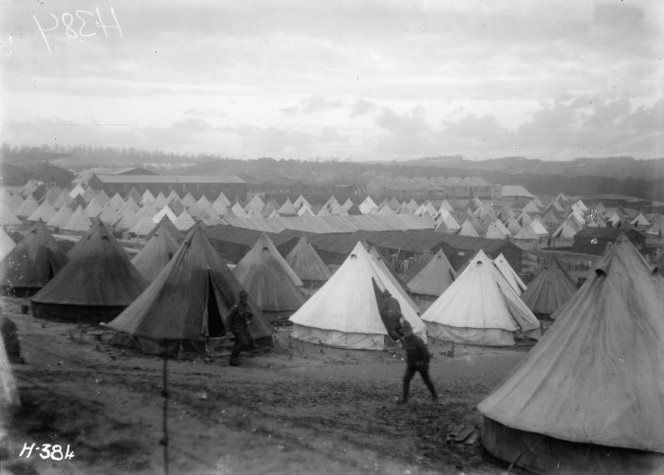
filled with all of the tents and workshops and stables which an army like Sauron’s would require, I have no sense that it was ever anything more than as it must have looked even in the Second Age:  bleak and waterless and dominated to the north by Mt Doom, a vast volcanic plain.  Sauron hadn’t intended to blight it.  Nature had already made it that way and it was useful for what he required:  protection from prying eyes and invading troops and space to spread his growing forces.  (Although I wonder about his water supply—Sam and Frodo are lucky to find the trickle they do—and even “dark pools fed by threads of water trickling down from some source higher up the valley”—by the western mountain wall—The Return of the King, Book Six, Chapter 2, “The Land of Shadow”.  Food seems to have been supplied by slave farms to the south and southeast, also briefly described in this chapter.  Ever-practical Sam wonders about all of this:  “ ‘Pretty hopeless, I call it—saving that where there’s such a lot of folk there must be wells or water, not to mention food.’ “ )

In contrast, there was the Shire—

(JRRT)

As Tolkien imagined it:

“The Shire is placed in a water and mountain situation and a distance from the sea and a latitude that would give it a natural fertility, quite apart from the stated fact that it was a well-tended region when they [the hobbits] took it over…” (letter to Naomi Mitchison, 25 September, 1954, Letters, 292)

It was based, as he stated more than once, on

“…a Warwickshire village of about the period of the Diamond Jubilee [the 60th anniversary of Queen Victoria’s ascension to the throne, 1897]…” (letter to Allen & Unwin, 12 December, 1955, Letters, 334)

which, although the actual village, Sarehole, was just south of the booming manufacturing center of Birmingham, Tolkien describes this world as “…in a pre-mechanical age.”  (letter to Deborah Webster, 25 October, 1958, Letters, 411)

And, to Tolkien, this was

“…in the quiet of the world, when there was less noise and more green…” (The Hobbit, Chapter One, “An Unexpected Party”)

But then Saruman arrives, telling the hobbits:

“ ‘One ill turn deserves another…It would have been a sharper lesson, if only you had given me a little more time and more Men.  Still I have already done much that you will find it hard to mend or undo in your lives.  And it will be pleasant to think of that and set it against my injuries.’ ” (The Return of the King, Book Six, Chapter 8, “The Scouring of the Shire”)

It’s clear from the description given us in “The Scouring of the Shire”, however, that what Saruman intends isn’t just wanton destruction, but something more complex:  a complete reorganization of the Shire.  Part of that is a social restructuring, where a form of communism is forced upon the population.  Monitoring that is the apparatus of a police state, with many rules, a curfew, and a number of the hobbits themselves being recruited to the “Shirriffs”.   But there’s more:

“The pleasant row of old hobbit-holes in the bank on the north side of the Pool were deserted, and their little gardens that used to run down bright to the water’s edge were rank with weeds.  Worse, there was a whole line of the ugly new houses all along Pool Side, where the Hobbiton Road ran close to the bank.  An avenue of trees had stood there.  They were all gone.  And looking with dismay up the road towards Bag End they saw a tall chimney of brick in the distance.  It was pouring out black smoke into the evening air.”

Thus, what Saruman was clearly intending wasn’t just desolation, like Mordor, but rather something more like the imaginary Coketown of Charles Dickens’ Hard Times, 1854:

“It was a town of red brick, or of brick that would have been red if the smoke and ashes had allowed it; town of machinery and tall chimneys, out of which interminable serpents of smoke trailed themselves for ever and ever, and never got uncoiled.  It had a black canal in it, and a river that ran purple with ill-smelling dye, and vast piles of building full of windows where there was a rattling and a trembling all day long, and where the piston of the steam-engine worked monotonously up and down, like the head of an elephant in a state of melancholy madness.  It contained several large streets all very like one another, and many small streets still more like one another, inhabited by people equally like one another, who all went in and out at the same hours, with the same sound upon the same pavements, to do the same work, and to whom every day was the same as yesterday and to-morrow, and every year the counterpart of the last and the next.”   (Hard Times, Chapter 5, “The Keynote” which you can read here:  https://www.gutenberg.org/files/786/786-h/786-h.htm )

Tolkien more than once lamented the passing of the “quiet of the world” and his Shire, which he described in a letter as “where an ordered, civilized, if simple and rural life is maintained” embodied for him that quiet.  (from that same letter to Milton Waldman, late 1951, Letters, 219)

And so, although JRRT wrote, in a letter to the editor of New Republic, Michael Straight, that:

“There is no special reference to England in the ‘Shire’…there is no post-war reference.”

at the same time, he adds:

“…the spirit of ‘Isengard’, if not of Mordor, is of course always cropping up.” (draft of a letter to Michael Straight, “probably January or February 1956, Letters, 340)

We know what that spirit is inspired by, as Treebeard tells us:

“He has a mind of metal and wheels; and he does not care for growing things, except as far as they serve him for the moment.” (The Two Towers, Book Three, Chapter 4, “Treebeard”)

Isengardism—or Sarumanism (a word JRRT himself employs in that same letter to Naomi Mitchison quoted above, saying that he is not a ‘reformer’ (by exercise of power) since it seems doomed to Sarumanism”) to Tolkien meant brutal change—in this case, in the conversion of the Shire into a mini-industrial state, run by a Stalinist tyrant and a cowed population.  Considering Tolkien’s sadness at the conversion of the rural world of his childhood into the industrial world of his present, might we not then see what Saruman does to the Shire as rather like allegory as Tolkien once defined it:

“Of course, Allegory and Story converge, meeting somewhere in Truth.”?  (letter to Sir Stanley Unwin, 31 July, 1947, Letters, 174)

Thanks, as ever, for reading.

Stay well,

Think green thoughts,

And remember that, as always, there’s

MTCIDC

O

What If? (2)

21 Wednesday Feb 2024

Posted by Ollamh in Uncategorized

≈ Leave a comment

Tags

Fantasy, J.R.R. Tolkien, lord-of-the-rings, The Lord of the Rings, Tolkien

Welcome, dear readers, as ever.

In the Star Wars fan world, there has been a lot of recent chatter about a Star Wars “What If?” film.  So far, it seems to be just chatter, but the speculation has gone in all sorts of directions and some very creative people have even produced potential posters, like this one—

with Anakin in his Darth Vader suit, which is real, but Obi Wan and Ahsoka as Imperial officers—a very grim idea.  (For more on possible scenarios, see:  https://thedirect.com/article/star-wars-what-if-disney-plus-2024  I think my favorite is the idea of Jar Jar Binks as a Sith lord—

see this especially silly version here:  https://www.youtube.com/watch?v=dB4sKebTr5k  )

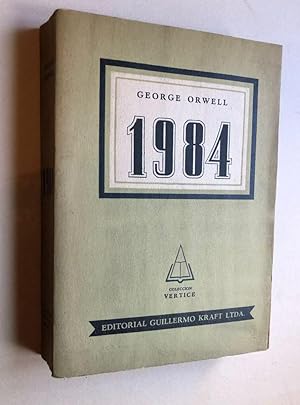
What Ifs are common in the world of fictions of all sorts, from Sci-Fi to Historical, and I’ll bet that you can immediately produce a few titles—from 1984

(a very complex “What If?” in which, unlike many of the genre, we don’t begin with actual history taking a left turn, as in something like some of Harry Turtledove’s books, where, for instance, the South has won the Civil War,

but a world in which something has changed things earlier, producing a series of three large warring states, at least one of which, Oceania, is a reflection of a kind of Stalinist UK)

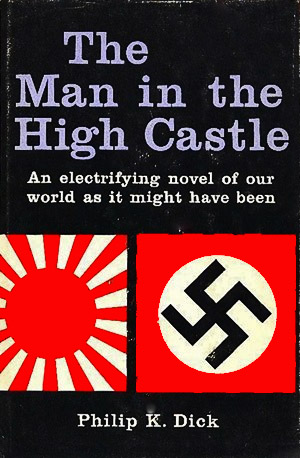
to The Man in the High Castle,

as well as many more. 

It’s always an interesting approach to a story and, when well done, can be anything from entertaining to disturbing.  One which comes to mind as a dead failure, however, might begin with this:

“ ‘I have come,’ he said.  ‘But I do not choose now to do what I came to do.  I will not do this deed.  The Ring is mine!’ And suddenly, as he set it on his finger, he vanished from Sam’s sight.”  (The Return of the King, Book Six, Chapter 3, “Mount Doom”.)

(Alan Lee)

We all know what happens next.  Sauron is suddenly not so sure of his triumph:

“And far away, as Frodo put on the Ring and claimed it for his own, even in Sammath Naur the very heart of his realm, the Power in Barad-dur was shaken, and the Tower trembled from its foundations to its proud and bitter crown.”

But then:

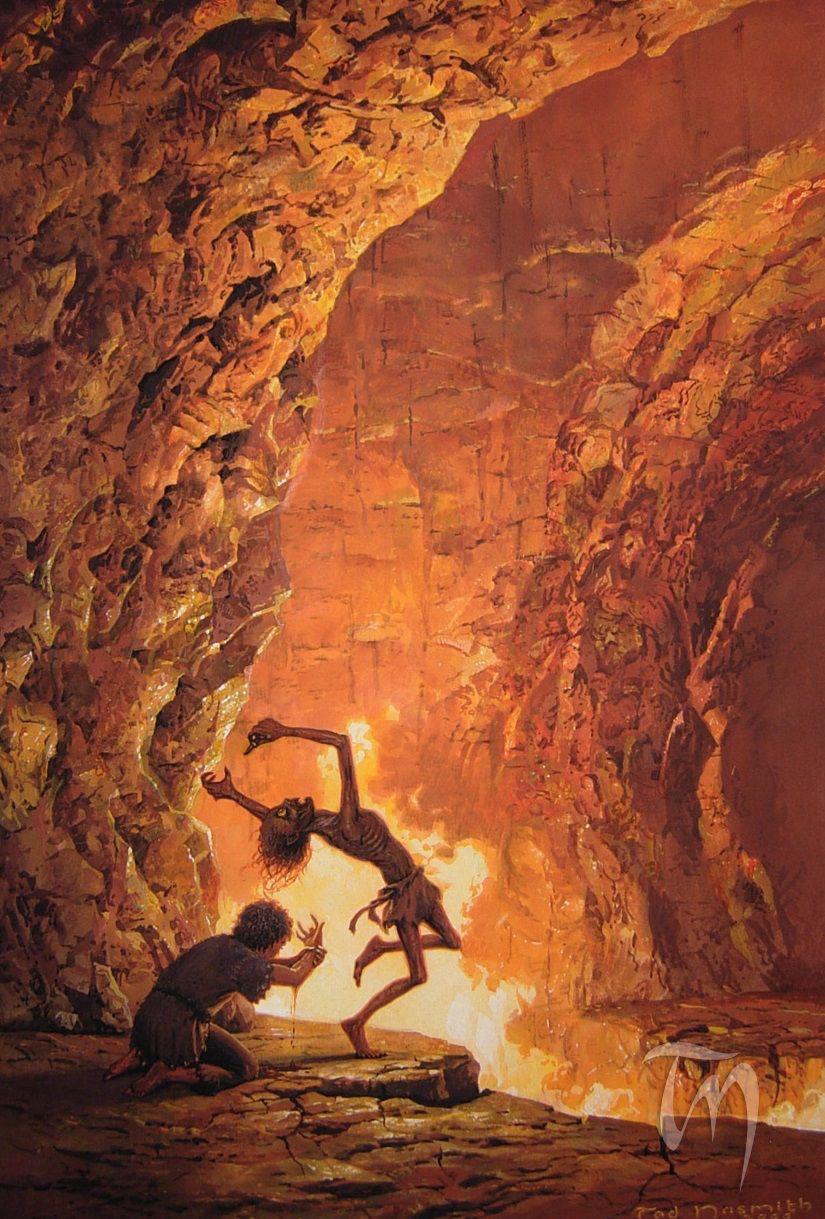
“Suddenly Sam saw Gollum’s long hands draw upwards towards his mouth; his white fangs gleamed, and snapped as they bit.  Frodo gave a cry, and there he was, fallen upon his knees at the chasm’s edge.  But Gollum, dancing like a mad thing, held aloft the ring, a finger still thrust through its circle.”

And then:

“ ‘Precious, precious, precious!’ Gollum cried.  ‘My Precious!  O my Precious!’  And with that, even as his eyes were lifted up to gloat on his prize, he stepped too far, toppled, wavered for a moment on the brink, and then with a shriek he fell.  Out of the depths came his last wail Precious, and he was gone.”

(Ted Nasmith)

In a brief space, we’re confronted with not one, but two, What Ifs, but let’s deal with the second one first, as, after all, Gollum had actually had control of the Ring long before Frodo even became aware of it—for 478 years.  During that time, what had he done with it and himself?

1. he had murdered a friend to obtain it

2. taking up eaves-dropping and petty theft, he’d eventually been exiled from his people

3. finally, he had crept under the Misty Mountains, where he lived on a diet of fish and goblins (when he could catch one) until he lost the Ring (or, perhaps more correctly, the Ring lost him) 80 years before The Lord of the Rings.

The only use he seems to have had for the Ring all that time was as a kind of cloaking device.  I think that we can presume that, had he successfully escaped Sam and Frodo, he would have been quickly apprehended by Sauron’s agents and deprived of his Precious, and worse.

This leaves us with Frodo—and yet we shouldn’t forget the Ring’s other previous possessors.  First, there was Isildur, who cut the Ring from Sauron’s hand at the Battle of Dagorlad—only to have it betray him to orc archers at the Gladden Fields.  Perhaps he hadn’t time to do anything with it, having held it so briefly, it being only 2 years after Dagorlad, but Tolkien never shows him doing anything more than wearing it as a kind of trophy.

And then, of course, there is Bilbo, who, in fact, uses it rather as Gollum did, to disappear from time to time, both in the adventure to the Lonely Mountain and back again and in the years afterwards.  If a king who had actually defeated Sauron did nothing with the Ring’s power, what could one expect from a hobbit?

This brings us back to Frodo.  He is recorded as having put the Ring on only twice:  at Weathertop, when he was almost mortally wounded by one of the Nazgul, and, later, on Amon Hen, where he was terrified by the sudden attention of Sauron:

“And suddenly he felt the Eye.  There was an eye in the Dark Tower that did not sleep.  He knew that it had become aware of his gaze.  A fierce eager will was there.  It leaped towards him; almost like a finger he felt it, searching for him.  Very soon it would nail him down, know just exactly where he was.  Amon Lhaw it touched.  It glanced upon Tol Brandir—he threw himself down from the search, crouching, covering his head with his grey hood.” (The Fellowship of the Ring, Book Two, Chapter 10, “The Breaking of the Fellowship”)

The problem is that, as JRRT explains:

“[Sauron] rules a growing empire from the great dark tower of Barad-dur in Mordor, near to the Mountain of Fire, wielding the One Ring.

But to achieve this he had been obliged to let a great part of his own inherent power…pass into the One Ring.  While he wore it, his power on earth was actually enhanced.  But even if he did not wear it, that power existed and was in ‘rapport’ with himself:  he was not ‘diminished’.”

And yet—

“Unless some other seized it and became possessed of it.”

There is, however, a condition to this—

“If that happened, the new possessor could (if sufficiently strong and heroic by nature) challenge Sauron, become master of all that he had learned or done since the making of the One Ring, and so overthrow him and usurp his place.”

At the same time:

“Also so great was the Ring’s power of lust, that anyone who used it became mastered by it; it was beyond the strength of any will (even his own) to injure it, cast it away, or neglect it.” (draft of a letter to Milton Waldman, “late in 1951”, Letters, 214)

It appears, then, that the Ring enhances the power of him who holds it—but consider those who had, beyond Sauron—what power did any of them, besides Isildur, have?  And what power did Isildur have, when, faced with the Ring’s destruction, as Elrond tells us:

“ ‘Isildur took it, as should not have been.  It should have been cast then into Orodruin’s fire nigh at hand where it was made.  But few marked what Isildur did.  He alone stood by his father in that last mortal contest; and by Gil-galad only Cirdan stood, and I.  But Isildur would not listen to our counsel…

…and therefore whether we would or no, he took it to treasure it.  But soon he was betrayed by it to his death; and so it is named in the North Isildur’s Bane.  Yet death maybe was better than what else might have befallen him.”  (The Fellowship of the Ring, Book Two, Chapter 2, “The Council of Elrond”)

If Gollum used it for burglary and Bilbo for concealment and Isildur is brought to his death by it—and might have fared worse, had he lived—what would have been the fate of Frodo, had he been able to retain the Ring, as he attempted, at the last minute, to do?  Heroic he might be, but with a strength to equal Sauron’s?

I suspect that the consequences would have been the same as those of the Gollum What If and as described by the Mouth of Sauron in his gloating threat to Gandalf when it was suggested that Frodo was in Sauron’s hands:

“And now he shall endure the slow torment of years, as long and slow as our arts in the Great Tower can contrive, and never be released unless maybe when he is changed and broken…” (The Return of the King, Book Five, Chapter 10, “The Black Gate Opens”)

For all that Frodo suffers from the Ring before and after Gollum’s attack, better those sufferings than that possible What If.

Thanks, as ever, for reading.

Stay well,

Say with Faramir, “Not if I found it on the highway would I take it”,

And remember that, as always, there’s

MTCIDC

O

Romance

14 Wednesday Feb 2024

Posted by Ollamh in Uncategorized

≈ Leave a comment

Tags

books, Fantasy, lord-of-the-rings, The Lord of the Rings, Tolkien

Welcome, as ever, dear readers.

As I believe I’ve reported before, I’ve been rewatching Jackson’s The Lord of the Ring films after a number of years and something struck me in his The Fellowship of the Ring which has brought to mind Tolkien’s own remarks about going from book to film.

In 1958, it was proposed to make a film of The Lord of the Rings.  Tolkien, via Forrest J. Ackerman, was sent a story-line created by a “Mr. Zimmerman” and spent a good deal of time reading through and commenting.  There are only some sections of this commentary available to us in Letters, but these suggest that what he read seriously dismayed and displeased him:

“The commentary goes along page by page, according to the copy of Mr. Zimmerman’s work, which was left with me, and which I now return.  I earnestly hope that someone will take the trouble to read it.

If Z and/or others do so, they may be irritated or aggrieved by the tone of many of my criticisms.  If so, I am sorry (though not surprised).  But I would ask them to make an effort of imagination sufficient to understand the irritation (and on occasion the resentment) of an author, who finds, increasingly as he proceeds, his work treated as it would seem carelessly in general, in places recklessly, and with no evident signs of any appreciation of what it is all about…

The canons of narrative art in any medium cannot be wholly different; and the failure of poor films is often precisely in exaggeration, and in the intrusion of unwarranted matter owing to not perceiving where the core of the original lies.” (from an undated—June, 1958—letter to Forrest J. Ackerman, Letters, 389-390)

As I watched, I found myself thinking about what Tolkien wrote and about, of all things, romance, but, as it’s Valentine’s Day, 14 February, what could be more appropriate for a posting?

Valentine’s Day was once celebrated in the Christian calendar as the occasion of the martyrdom of Valentinus, a 3rd-century AD priest, the date first (perhaps) officially appearing in the 8th-century Gelasian Sacramentary,

aka the Liber Sacramentorum Ecclesiae Romanae, where you’ll find, inLiber Secundus, XI, “Orat. in Natali Valentini, Vitalis, Feliculae”–“Prayers on the Martyrdom of Valentinus, Vitalis, and Felicula”, dated for “xvi Kal. Martias”—that is, 14 February.  (You can read it here:  https://books.google.com/books?id=S-20jhQQZBMC&dq=sacramentary&pg=RA3-PA1#v=onepage&q=sacramentary&f=false  The Gelasius mentioned is a 5th-century pope who probably had nothing whatever to do with the book—for more see:  https://en.wikipedia.org/wiki/Gelasian_Sacramentary )

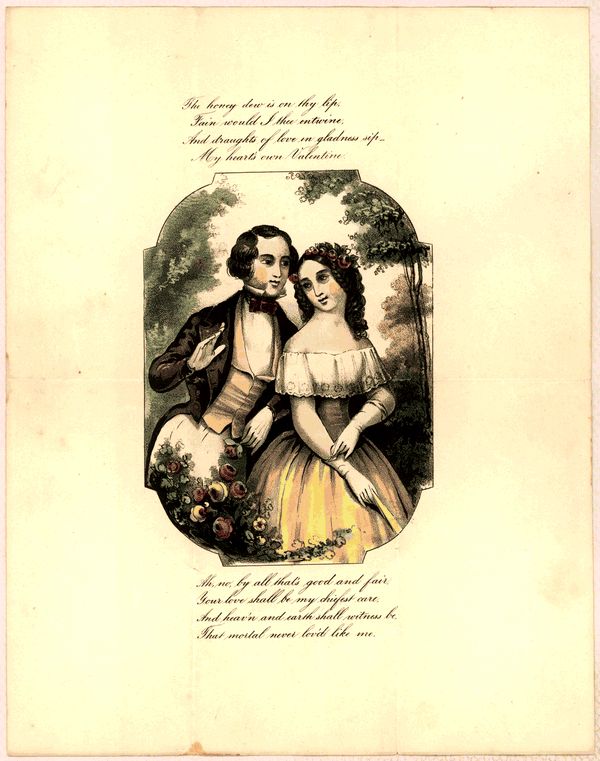
Valentinus was squeezed out of the ecclesiastical calendar in 1969 (which you can read about here:  https://aleteia.org/2022/02/09/why-is-st-valentines-feast-day-not-on-the-churchs-calendar/ ), but St Valentine’s day has been part of Western romantic tradition since at least the later Middle Ages and began to become a commercial success in the 19th century, when preprinted cards first appeared.

(And I can’t resist this—possibly the first printed valentine—which dates, in fact, to 1797.

See this for more:  https://www.bbc.co.uk/ahistoryoftheworld/objects/L1NM_6mWRymAMKXcRDlXJA

and see this for more on early commercial valentines:  http://www.go-star.com/antiquing/early-valentines.htm )

The romance I want to talk about in this posting, however, comes from a different time although, according to its author, Tolkien, not from a different place.

In a way, it’s actually a kind of echo-romance, in which the first part happened some 6500 years before the second part, in the First Age of Middle-earth, but many of its conditions were the same. 

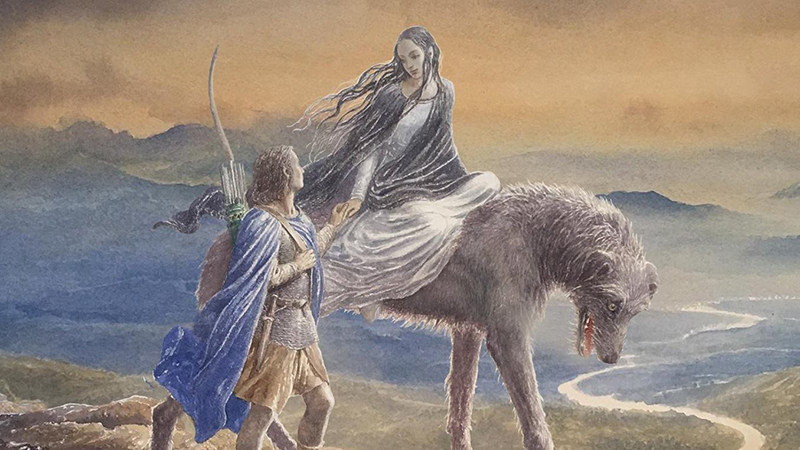
The Tale of Beren and Lúthien, by J.R.R. Tolkie

(Alan Lee)

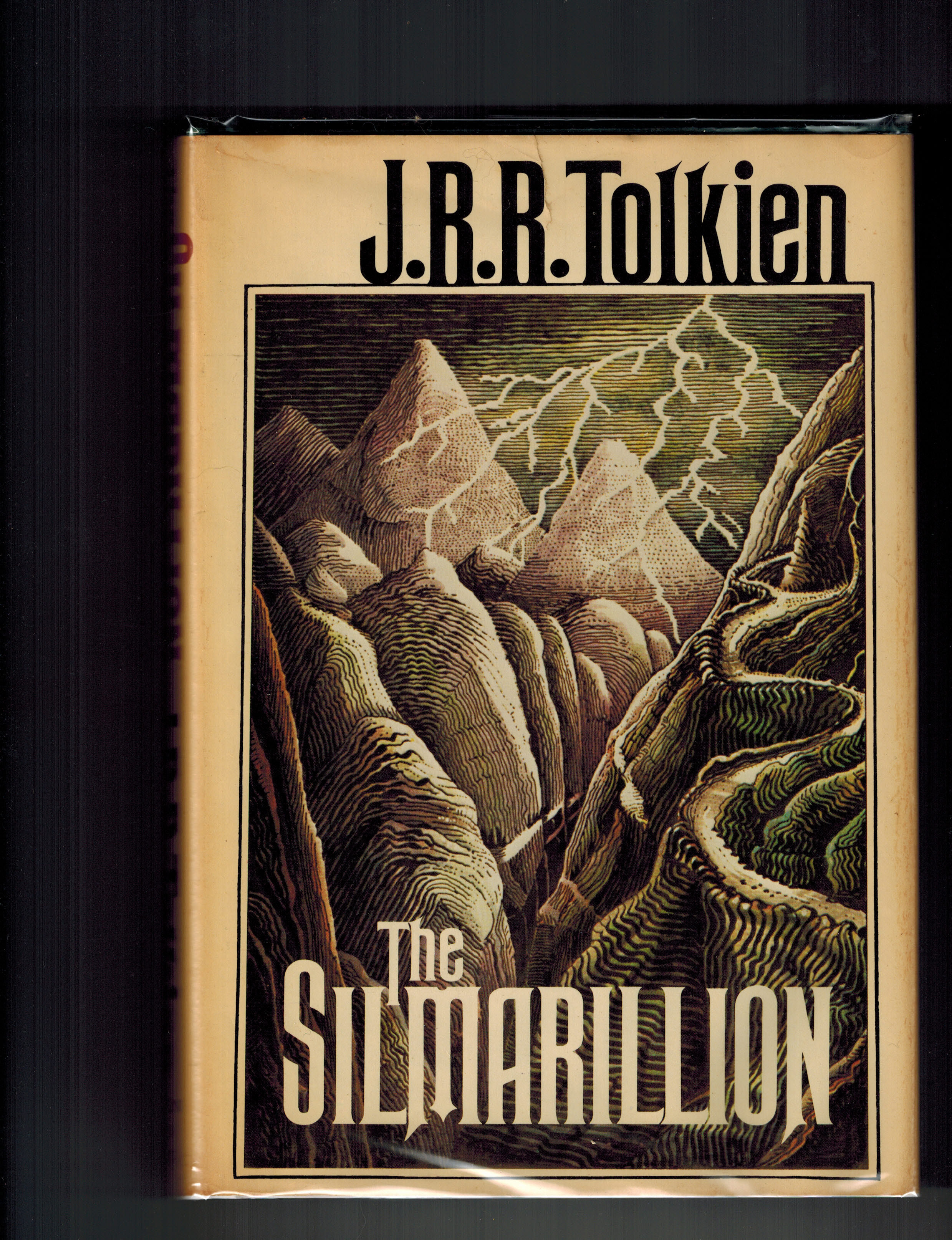
A note, however:   this is a very complex story, which JRRT developed over many years, appearing in one form in the Silmarillion, 1977,

and in a multiform, Beren and Luthien, 2017, both versions edited by Christopher Tolkien.

For my purposes, I’m going to compress the story into the simplest form possible—something like this:

1. Beren is a mortal, who falls in love with Luthien, an elven immortal and the daughter of Thingol, king of Doriath

2. Thingol sets Beren a task:  for Beren to wed Luthien, he must retrieve one of the Silmarils from the crown of Morgoth

3. Beren, with Luthien’s help, finally manages to do this and can marry Luthien, but, later, is killed and Luthien goes to the Halls of Mandos (basically, the ruler of the dead) and manages, through song (yes, Orpheus and Eurydice is in there somewhere)

to regain him, but is faced with a choice:  she can retain her immortality and go on to Valinor, the home of the immortal Valar, without Beren, or she can go back to Middle-earth with Beren, become mortal, and die

4. She stays with Beren and, from that comes “the Choice of Luthien”—giving up immortality to remain with a mortal loved one

This brings us to the echo:  Aragorn and Arwen, the many details of which you can read in Appendix A, V, in The Lord of the Rings, “Here Follows a Part of the Tale of Aragorn and Arwen”, but, in simplified form:

1. Aragorn, a mortal, falls in love with Arwen, an elf and daughter of Elrond

2. Elrond sets the condition that only if Aragorn can make himself king of Gondor and Arnor can he marry Arwen

3. we know how this turns out:  Aragorn eventually becomes king and gains Arwen

(the Hildebrandts)

4. but she, too, must make the “Choice of Luthien” and, as JRRT tells us:

“When the Great Ring was unmade and the Three were shorn of their power, then Elrond grew weary at last and forsook Middle-earth, never to return.  But Arwen became as a mortal woman, and yet it was not her lot to die until all that she had gained was lost.”  (The Lord of the Rings, Appendix A, V,
“Here Follows a Part of the Tale of Aragorn and Arwen”)

It’s clear that this choice, once made, is irrevocable, as Arwen tells the fading Aragorn, when he suggests that she can still make the journey to Valinor after his passing: 

“Nay, dear lord…that choice is long over.  There is now no ship that would bear me hence, and I must indeed abide the Doom of Men, whether I will or I nill:  the loss and the silence.”

And, to me, this is what takes Tolkien’s story from being a wonderful fantasy to a higher level:  heroic people here make choices which will bring bitter loss, but still choose to make them:  Frodo to save the Shire, as he tells us he originally hoped, Arwen to remain with Aragorn, fully aware of the consequences.   It’s grown-up romance and Arwen’s choice is central to that.

In Jackson’s film of The Fellowship of the Ring, however, we’re shown a completely different reason for Arwen’s choice:  she trades her immortality for Frodo’s life.  Here’s what happens in Scene 21:

“Frodo suddenly becomes very weak as Arwen lies [sic] him on the ground.

ARWEN:  No! Frodo! No!  Frodo don’t give in, not now.

Tears spring into her eyes as she hugs him.

ARWEN

VOICE:  What grace has given me, let it pass to him.  Let him be spared.

Visions of Rivendell appear.  Frodo appears sleeping in the visions.

ARWEN

VOICE:  Save him.

ELROND:  (face appears in the vision)  Lasto beth non.  Tolo dan na ngalad.  (Hear my voice, come back to the light)” (You can read the whole text of the film here:  http://www.ageofthering.com/atthemovies/scripts/fellowshipofthering1to4.php )

Much of Tolkien’s criticism of “Mr. Zimmerman’s” script is that, as he says, it shows “no evident appreciation of what it is all about”.  In this case, this is Arwen’s sacrifice not for someone she, in the book, will not meet at this point in the story, the script-writers having replaced the actual character who attempts to rescue Frodo, the elf lord Glorfindel, with Arwen, but her sacrifice of her immortality for her love, Aragorn, just as Luthien had done for Beren, thousands of years before.  The echo, besides its poignancy, is intentional on Tolkien’s part:

“Arwen is not ‘a re-incarnation’ of Luthien…but a descendant very like her in looks, character, and fate.  When she weds Aragorn…she ‘makes the choice of Luthien’…” (draft of a letter to Peter Hastings, September, 1954, Letters, 288)

In 1963, Tolkien tried to explain not her choice, which, to him, was evident, but the reason behind Frodo’s ability to pass to the West:

“It is not made explicit how she could arrange this.  She could not of course just transfer her ticket on the boat like that!  For any except those of the Elvish race ‘sailing was not permitted, and any exception required ‘authority’, and she was not in direct communication with the Valar, especially not since her choice to become ‘mortal’.”  (from the drafts of a letter to Mrs. Eileen Elgar, September, 1963, Letters, 462)

Eventually, he suggests that Gandalf must have been involved, but what’s important here—and for the romance with which I began—is that Arwen’s surrender of her immortality was not a generous act to save a fading hobbit, but rather the renewal of a sacrifice made for the same reason by a distant ancestor, Luthien (who is also, in fact, a distant ancestor of Aragorn, as well), many years earlier.  As I said before, it’s grown-up romance and her choice is central to that.

All of that being said, happy Valentine’s Day.

Thanks, as always, for reading.

Stay well,

Be glad for saints—the good ones have much to teach us,

And remember that, as always, there’s

MTCIDC

O
PS

There is, in fact, competition for the title of St. Valentine of the cards, flowers, and chocolate.  See:  https://en.wikipedia.org/wiki/Saint_Valentine )

Marking Time

07 Wednesday Feb 2024

Posted by Ollamh in Uncategorized

≈ Leave a comment

Welcome, as always, dear readers.

In the world of things like this—

a question like this and its reply, seem completely normal:

“ ‘Where am I, and what is the time?’ he said aloud to the ceiling.

‘In the house of Elrond, and it is ten o’clock in the morning,’ said a voice.  ‘It is the morning of October the twenty-fourth, if you want to know.’ “  (The Fellowship of the Rings, Book Two, Chapter 1, “Many Meetings”)

This is Middle-earth, however, late in the Third Age, and, although the responder can be certain of where he is and perhaps what the date is (after all, the narrator mentions, in the Prologue, that “Meriadoc…for his Reckoning of Years…discussed the relation of the calendars of the Shire and Bree to those of Rivendell, Gondor, and Rohan.” indicating that a good number of such must have been available), how does he know the time to the hour?

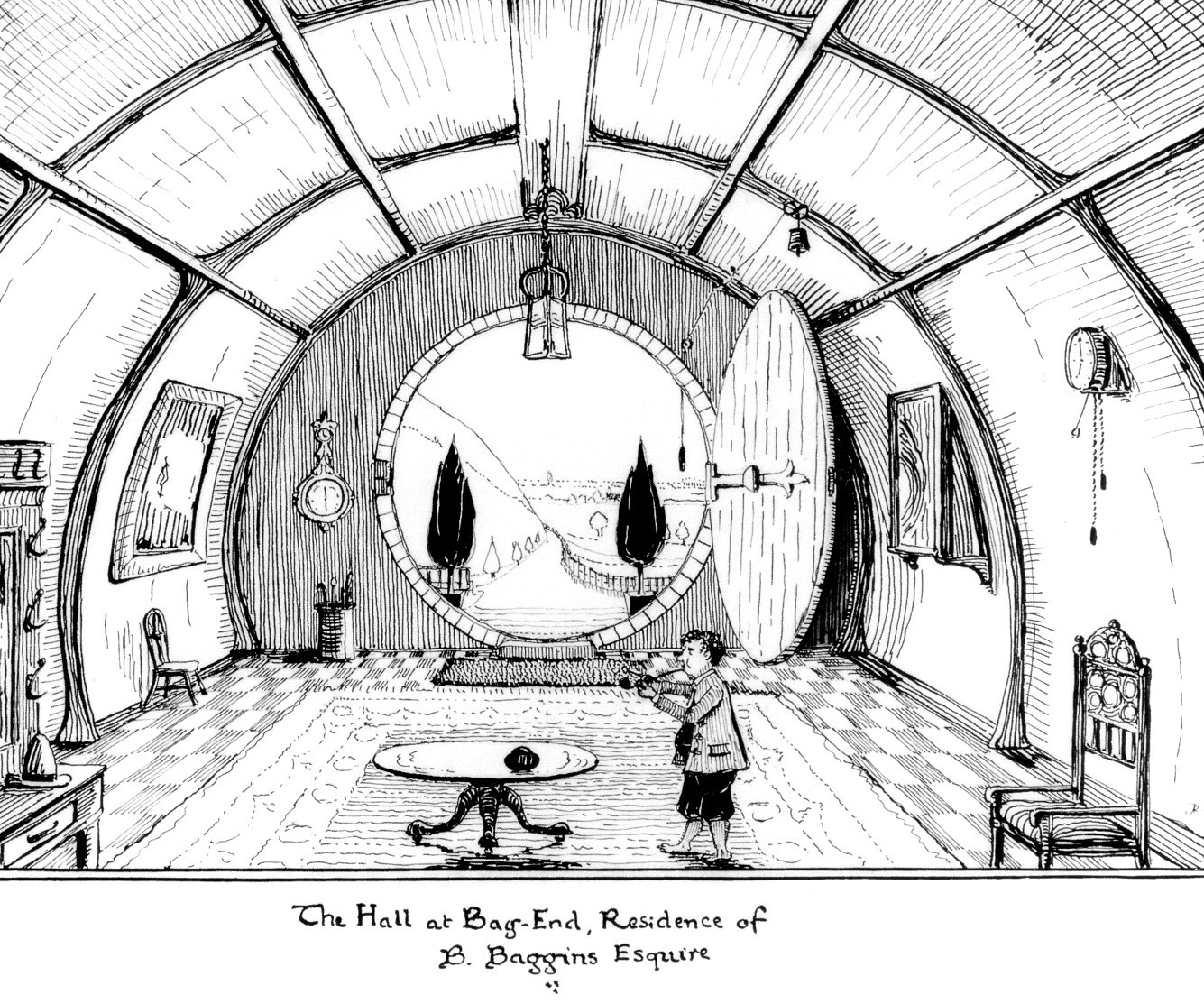
As discussed in a long-ago posting (“Peace!  Count the Clock!” 25 October, 2017), Bilbo has a kind of wall clock at Bag End—

(That’s it, on the right hand wall—that thing to the left of the door is clearly a barometer, although it’s never mentioned in the text.)

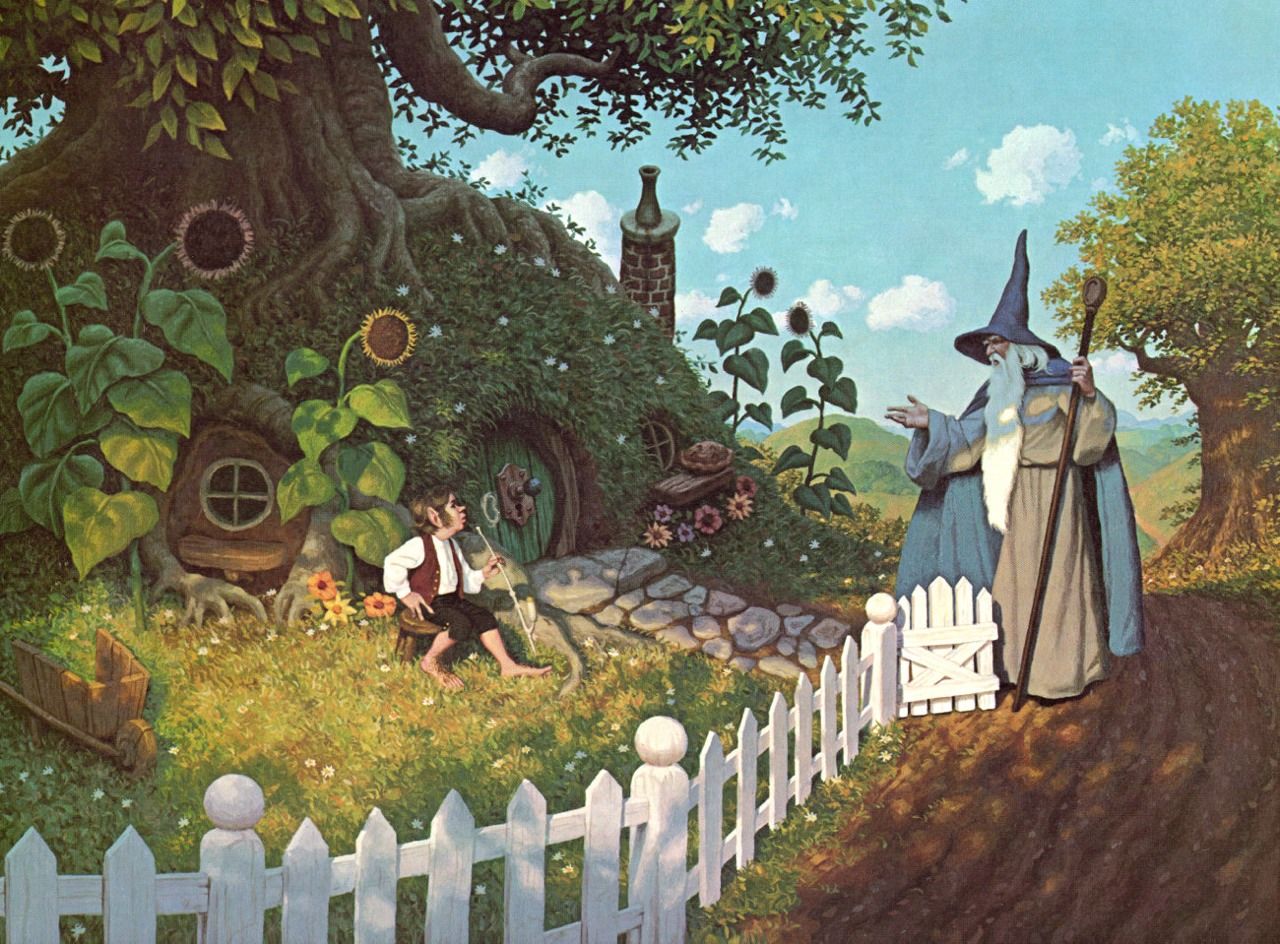
and presumably that’s how he knows that tea is at 4 o’clock when he nervously invites Gandalf in his effort to avoid an ADVENTURE in Chapter 1 of The Hobbit.

(One of my favorites by the Hildebrandts)

There is no mention of a clock in Rivendell, however, which brings us back to the question of anachronisms, something which first pops up in relation to various lines in both the first and second versions of The Hobbit, with everything from tomatoes to steam engines, not to mention matches.

Suppose, however, that Gandalf hasn’t consulted an (unmentioned) wall clock, but something completely different, which descends from early clocks–

a pocket watch.

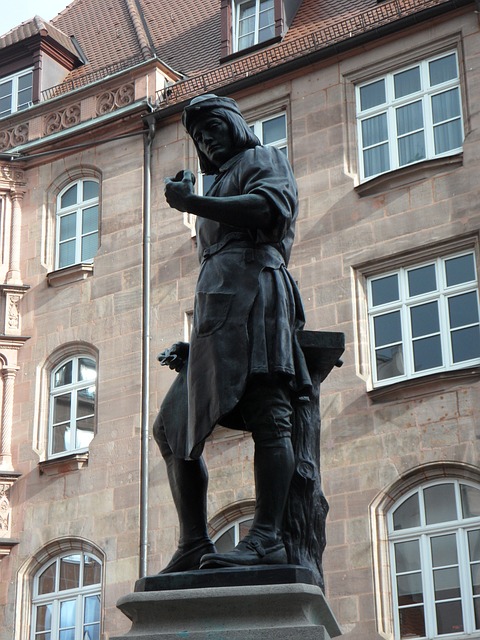
It’s also never mentioned, of course, but the Middle-earth of The Lord of the Rings is really a kind of late-medieval world and it’s in that world in our Middle-earth (which JRRT maintained is a direct descendant of his) that a Nueremberg clockmaker and inventor, Peter Henlein (1485-1545),

(As is the case with so many creative people of the more distant past, there is no known image of Henlein—this is a statue raised to him in Nueremberg in 1905.)

is credited, in his own time, with the invention of the pocket watch (see:  https://en.wikipedia.org/wiki/Peter_Henlein  although the copy of the work cited which I could obtain of Johannes Cochlaeus’ Cosmographia Pomponii Melae, 1512, which you can find here:  https://archive.org/details/cosmographiapomp00mela/page/n3/mode/2up seems to lack the appendix in which Henlein is mentioned). 

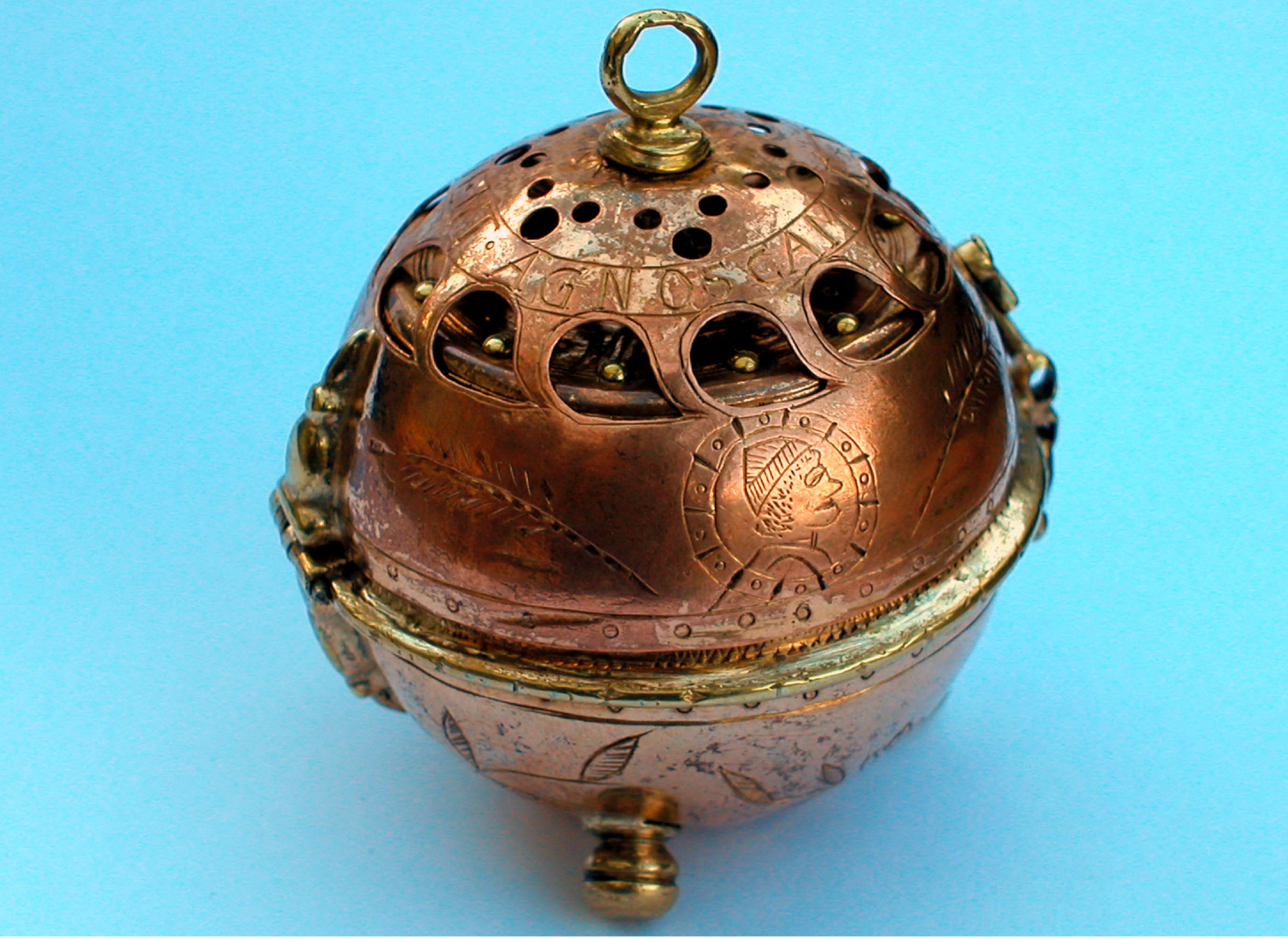
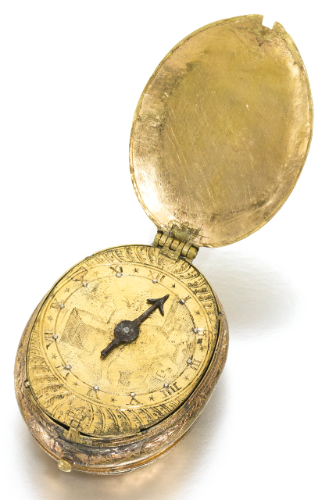
Here is an example—perhaps by Henlein himself.

This is made in the shape of a pomander—a container for an aromatic substance.   In a world before mid-19th-century germ theory, people believed that miasma, “bad smell”, was the spreader of disease, and so carrying/wearing an object like this, stuffed with something sweet-smelling, would be (one hoped) a preventative.  And, even if the air wasn’t plague-carrying, the streets and rivers around cities were often full of sewerage, so this might at least keep the nose from being overwhelmed by general environmental stinks.  (You can read more about this here:  https://en.wikipedia.org/wiki/Pomander )

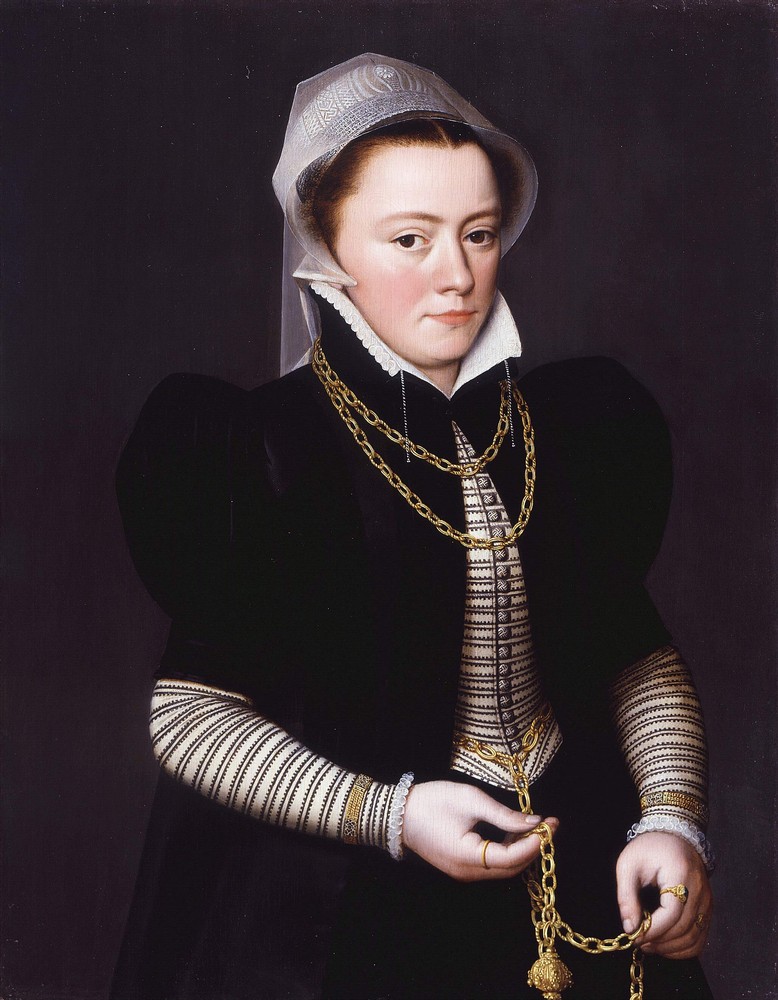
(A painting from the mid-1560s by Pieter Janz Pourbus, c.1523-1584)

You can see, then, how this could easily be converted into a watch case and carried the same way, suspended somehow from the body, as in the Pourbus portrait.  Unlike a wall clock, with its pendulum and weights to keep it going, this early watch was based upon a wound-up spring, a mainspring, an ingenious idea in itself.  (For more on pocket watches in general, see the very useful:  https://en.wikipedia.org/wiki/Pocket_watch )

You can also imagine that this wasn’t something ordinary people owned, being made specifically for the well-to-do and even when they became more common, by Shakespeare’s time, they were still a status symbol, as Malvolio, the ambitious Puritan steward in Twelfth Night, 1601-2?,

(By Daniel Maclise, 1806-1870)

demonstrates, when he sees himself as married to his countess, Olivia.  In his delusion (brought on by others, out to humble him for their own amusement), he fancies that he sends for the countess’ uncle, Sir Toby Belch (not one of Shakespeare’s subtler names)–

“Mal. Seauen of my people with an obedient start,

make out for him: I frowne the while, and perchance

winde vp my watch, or play with my [–] some rich Iewell:

Toby approaches; curtsies there to me.”

(Twelfth Night, Actus Secundus, Scaena Quinta.  If you read this blog regularly, you know that I always try to use the earliest source for quotations and, with Elizabethan/Jacobean English, this means using a text from the Internet Shakespeare site, as its spelling is a good prompting as to Elizabethan pronunciation, which is the ancestor of our later speech, but definitely a much richer sound than at least Received (American) Standard.  This is from the “First Quarto”, 1623, which you can find here:  https://internetshakespeare.uvic.ca/doc/TN_F1/index.html   For more on Elizabethan pronunciation, see, for example:  https://www.youtube.com/watch?v=WeW1eV7Oc5A  This is from one of my favorite on-line language sites, NativLang.  If you, like me, are fascinated by any and every language, this is a site you will very much enjoy.)

Now consider Gandalf’s voluminous robes—

If you could peer just inside, could you imagine that he had one of these

and, when Frodo asked the time, Gandalf reached in to consult it?

Thanks, as ever, for reading.

Stay well,

Remember what the thief of time is,

And remember, as well that there’s always

MTCIDC

O

PS

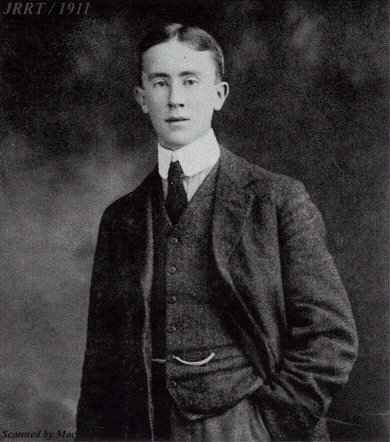
A cursory search through the various Tolkien portraits on-line never reveals a wrist watch, but numerous vests (and possibly trouser watch pockets, called “fobs”). 

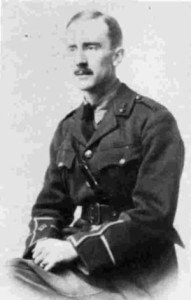
Could Tolkien have followed the pre-Great War men’s fashion (changed for many by the use of wrist watches during the War)

and continued himself to wear the pocket watch which we see in this early photograph?

The Doubtful Sea Series Facebook Page

The Doubtful Sea Series Facebook Page

  • Ollamh

Categories

  • Artists and Illustrators
  • Economics in Middle-earth
  • Fairy Tales and Myths
  • Films and Music
  • Games
  • Heroes
  • Imaginary History
  • J.R.R. Tolkien
  • Language
  • Literary History
  • Maps
  • Medieval Russia
  • Military History
  • Military History of Middle-earth
  • Narnia
  • Narrative Methods
  • Poetry
  • Research
  • Star Wars
  • Terra Australis
  • The Rohirrim
  • Theatre and Performance
  • Tolkien
  • Uncategorized
  • Villains
  • Writing as Collaborators
Follow doubtfulsea on WordPress.com

Across the Doubtful Sea

Recent Postings

  • Heffalumps? December 31, 2025
  • We Three Kings December 24, 2025
  • A Moon disfigured December 17, 2025
  • On the Roads Again—Once More December 10, 2025
  • (Not) Crossing Bridges December 3, 2025
  • On the Road(s) Again—Again November 26, 2025
  • On the Road(s) Again November 19, 2025
  • To Bree (Part 2) November 12, 2025
  • To Bree (Part 1) November 5, 2025

Blog Statistics

  • 103,985 Views

Posting Archive

  • December 2025 (5)
  • November 2025 (4)
  • October 2025 (5)
  • September 2025 (4)
  • August 2025 (4)
  • July 2025 (5)
  • June 2025 (4)
  • May 2025 (4)
  • April 2025 (5)
  • March 2025 (4)
  • February 2025 (4)
  • January 2025 (5)
  • December 2024 (4)
  • November 2024 (4)
  • October 2024 (5)
  • September 2024 (4)
  • August 2024 (4)
  • July 2024 (5)
  • June 2024 (4)
  • May 2024 (5)
  • April 2024 (4)
  • March 2024 (4)
  • February 2024 (4)
  • January 2024 (5)
  • December 2023 (4)
  • November 2023 (5)
  • October 2023 (4)
  • September 2023 (4)
  • August 2023 (5)
  • July 2023 (4)
  • June 2023 (4)
  • May 2023 (5)
  • April 2023 (4)
  • March 2023 (5)
  • February 2023 (4)
  • January 2023 (4)
  • December 2022 (4)
  • November 2022 (5)
  • October 2022 (4)
  • September 2022 (4)
  • August 2022 (5)
  • July 2022 (4)
  • June 2022 (5)
  • May 2022 (4)
  • April 2022 (4)
  • March 2022 (5)
  • February 2022 (4)
  • January 2022 (4)
  • December 2021 (5)
  • November 2021 (4)
  • October 2021 (4)
  • September 2021 (5)
  • August 2021 (4)
  • July 2021 (4)
  • June 2021 (5)
  • May 2021 (4)
  • April 2021 (4)
  • March 2021 (5)
  • February 2021 (4)
  • January 2021 (4)
  • December 2020 (5)
  • November 2020 (4)
  • October 2020 (4)
  • September 2020 (5)
  • August 2020 (4)
  • July 2020 (5)
  • June 2020 (4)
  • May 2020 (4)
  • April 2020 (5)
  • March 2020 (4)
  • February 2020 (4)
  • January 2020 (6)
  • December 2019 (4)
  • November 2019 (4)
  • October 2019 (5)
  • September 2019 (4)
  • August 2019 (4)
  • July 2019 (5)
  • June 2019 (4)
  • May 2019 (5)
  • April 2019 (4)
  • March 2019 (4)
  • February 2019 (4)
  • January 2019 (5)
  • December 2018 (4)
  • November 2018 (4)
  • October 2018 (5)
  • September 2018 (4)
  • August 2018 (5)
  • July 2018 (4)
  • June 2018 (4)
  • May 2018 (5)
  • April 2018 (4)
  • March 2018 (4)
  • February 2018 (4)
  • January 2018 (5)
  • December 2017 (4)
  • November 2017 (4)
  • October 2017 (4)
  • September 2017 (4)
  • August 2017 (5)
  • July 2017 (4)
  • June 2017 (4)
  • May 2017 (5)
  • April 2017 (4)
  • March 2017 (5)
  • February 2017 (4)
  • January 2017 (4)
  • December 2016 (4)
  • November 2016 (5)
  • October 2016 (6)
  • September 2016 (5)
  • August 2016 (5)
  • July 2016 (5)
  • June 2016 (5)
  • May 2016 (4)
  • April 2016 (4)
  • March 2016 (5)
  • February 2016 (4)
  • January 2016 (4)
  • December 2015 (5)
  • November 2015 (5)
  • October 2015 (4)
  • September 2015 (5)
  • August 2015 (4)
  • July 2015 (5)
  • June 2015 (5)
  • May 2015 (4)
  • April 2015 (3)
  • March 2015 (4)
  • February 2015 (4)
  • January 2015 (4)
  • December 2014 (5)
  • November 2014 (4)
  • October 2014 (6)
  • September 2014 (1)

Blog at WordPress.com.

  • Subscribe Subscribed
    • doubtfulsea
    • Join 78 other subscribers
    • Already have a WordPress.com account? Log in now.
    • doubtfulsea
    • Subscribe Subscribed
    • Sign up
    • Log in
    • Report this content
    • View site in Reader
    • Manage subscriptions
    • Collapse this bar
 

Loading Comments...