• About

doubtfulsea

~ adventure fantasy

Monthly Archives: January 2024

Arabian Nights for Days

31 Wednesday Jan 2024

Posted by Ollamh in Uncategorized

≈ Leave a comment

Tags

book-review, book-reviews, books, Fantasy, reading

As always, dear readers, welcome.

C.S. Lewis once remarked that, “You can’t get a cup of tea large enough or a book long enough to suit me.”  (from a transcript of a lecture given by Lewis’ sometime editor and biographer, Walter Hooper—here’s the whole piece:  https://www.historyspage.com/post/cs-lewis-inklings-memories-walter-hooper )

Considering my affection, not only for
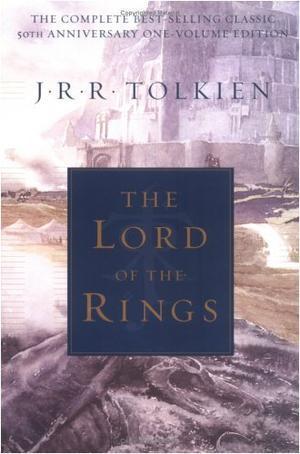
but

and such works as these,

as well as a life-long love of

(but such a small cup!),

it’s clear that I’m in whole-hearted agreement with “Jack”, as his brother, “Warnie”, had named him in childhood.
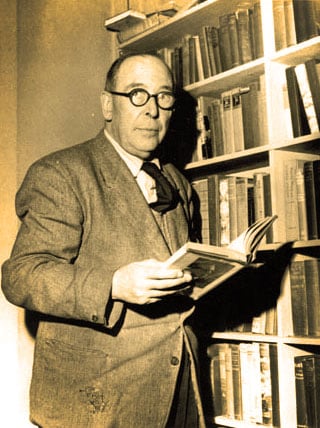
In this spirit, during the early fall, I embarked upon a project I’ve long told myself I would do:  read the whole of The Thousand Nights and One Night—in translation, unfortunately.

I began with this introduction—

From earlier work (and postings) on the origins of “contes des fees”, as early French authors—the creators of our literary stories, like “La Belle et La Bete”, originally written by Gabrielle-Suzanne Barbot de Villeneuve in 1740, but better known by the revised 1756 version of Jeanne-Marie Leprince de Beaumont–called them—I knew something of the story of how English-speakers first encountered The Arabian Nights in the so-called “Grub Street” edition of 1706, itself an anonymous translation of Antoine Galland’s (1646-1715)
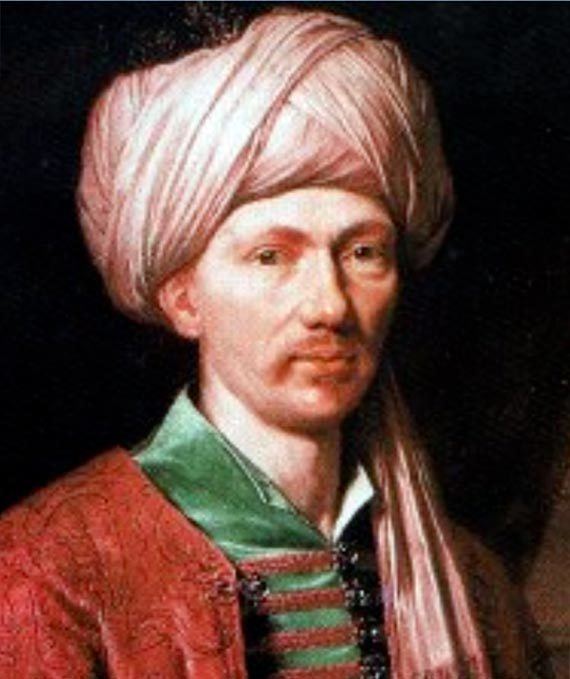
Les Mille et Une Nuits of 1704-1717.
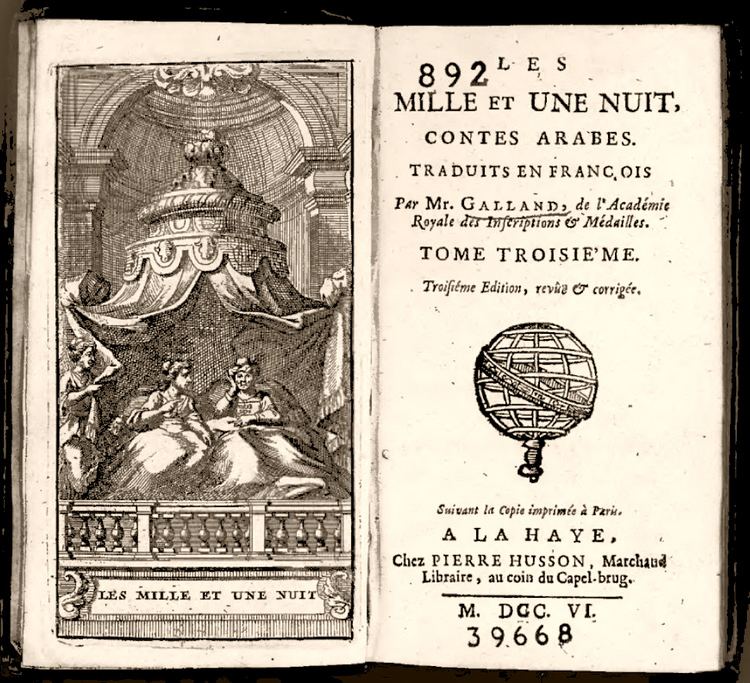
I soon discovered, however, just how much more there was to know.  In chapters with intriguing titles like “Beautiful Infidels” and “Oceans of Story”, the author, Robert Irwin, laid out the complex history of this vast collection, which most of us know from tales which aren’t even in the main collection, “orphan stories” like “Aladdin”

(Albert Robida, 1848-1926)

and “Ali Baba and the Forty Thieves.” 

(Edmond Dulac, 1882-1953)

(For more on translations, see: https://en.wikipedia.org/wiki/Les_mille_et_une_nuits and https://en.wikipedia.org/wiki/Translations_of_One_Thousand_and_One_Nights )

Armed with the knowledge Irwin provided, it was time to begin reading.  I chose what seemed the best translation in English, by Malcolm C. Lyons, in a set of four Penguin volumes and launched into the first.
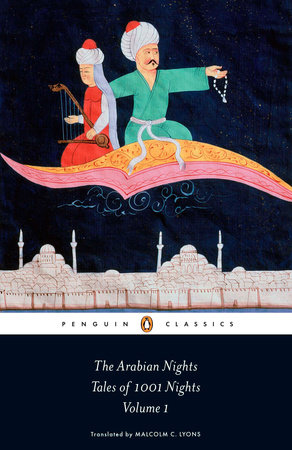
I imagine that you know the general frame:  King Shahryar learns that his wife is unfaithful.   To keep himself from being cuckolded again, he marries a new bride every night and has her beheaded the next morning.  His Vizier’s daughter Shahrazad, decides to stop this by marrying the Sultan but then, telling one story after another, to keep him so interested night after night by stopping a story at the night’s end without finishing, to force him to suspend his murderous habit to find out what happened next. 
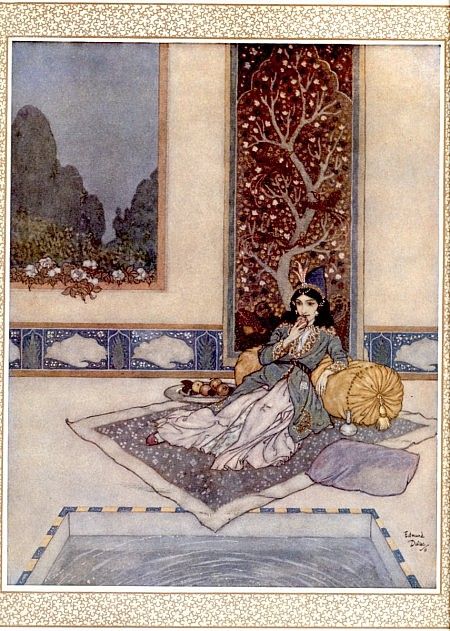
(Another Dulac.  If you’d like to see more of his gorgeous illustrations, look here:  https://www.gutenberg.org/cache/epub/51432/pg51432-images.html )

Finally, after 1001 stories (or perhaps a few more), he decides not to continue murdering brides, Shahrazad is saved, and, presumably, lives happily ever after (really?  Could you ever trust this man not to change his mind?).

I’ve just finished Volume 1 and set off into Volume 2

and it’s been an extremely interesting experience.  Unlike a long novel, like War and Peace, where we follow the adventures of a few main characters—Natasha, Pierre, and Andrei—even when surrounded by a host of other characters (and Tolstoy’s book has a flood of them), in The Arabian Nights, except for the shell characters—the king, the story-teller, and the story-teller’s sister, who can act as a prompter–the main characters can change often, sometimes making it difficult to remember who is doing what with or to whom.  More than once, I had to turn back a page, scan paragraphs, asking myself, “Who is Ali ibn Ishaq again?” or “Is this the brother—or is it brother-in-law?  And is this the same slave who…?”  As well, this unexpurgated text is filled with poetry, some of which is reflective of something going on in the story, some—maybe more than some—is simply poetry which has been inserted into the text.  Because it might be part of the story, I continued to read it, but often it was just what it appeared to be:  poetry inserted for some reason I didn’t understand into the text. 

At the same time, as story spawned story, stories were interwoven, stories linked themselves here and there into complex narratives, there was a certain hypnotic quality to it which kept me reading, not so much because the characters had looped me in as that the method of telling itself had.  I might not care about why X was beheaded, but I was certainly interested to understand how the story had turned in that direction and he was.  In other words, just as Shahrazad had seduced the king with her telling into wanting more and more, so she had seduced me into reading on, always wondering, “Where is this going and how will it end?”  And—just as interesting—“How will we move to the next story?”

At over 950 pages on average for each of 4 volumes, each of these would surely have (at least temporarily) satisfied C.S. Lewis—but where would we ever find a tea cup large enough to keep him—and me—going?

Thanks, as ever, for reading.

Stay well,

Uncork no bottle unless you’ve already planned how to deal with the djinn inside,

And know that, as always, there’s

MTCIDC

O

Down the Hole

24 Wednesday Jan 2024

Posted by Ollamh in Uncategorized

≈ Leave a comment

Tags

book-review, books, Fantasy, J.R.R. Tolkien, Tolkien

As ever, welcome, dear readers.

“In another moment down went Alice after it, never once considering how in the world she was to get out again.

The rabbit-hole went straight on like a tunnel for some way, and then dipped suddenly down, so suddenly that Alice had not a moment to think about stopping herself before she found herself falling down what seemed to be a very deep well.” (Alice’s Adventures in Wonderland, Chapter One, “Down the Rabbit-hole”  and you can have your own copy of the second version of the first—1865-66 edition here:  https://ia600505.us.archive.org/27/items/alicesadventur00carr/alicesadventur00carr.pdf and read about why I wrote “1865-66 edition” and much more here:   https://en.wikipedia.org/wiki/Alice%27s_Adventures_in_Wonderland )

(I discovered this image on two different pinterest sites, one in Korean, the other under the name “Ree Smith”, but with no artist identified, alas.   I love all puppets and shadow puppets in particular and this so reminded me of the work of Lotte Reiniger (1899-1981) and her “Adventures of Prince Achmed”, 1926,

that it made me wish that she had made an “Alice”.  To learn more about Reiniger and her work, see:  https://silentfilm.org/the-adventures-of-prince-achmed-1/   The original film hasn’t survived as such, but to see a reconstruction by a passionate amateur—and it’s a remarkable work—look here:  https://archive.org/details/prince-achmed-english-subtitles  )

As you can see from where I’ve just gone, English has adopted “down the rabbit hole” to mean “digressive”, which, in turn, comes from the Latin verb, digredior, “to go away from”, (literally, “to walk away from”, being a combination of dis, “apart/away from” plus gradus, “a step”)—and look, have I just begun to do a mini-rabbit hole again?

I, myself, in writing nearly 500 postings, have happily fallen down almost innumerable such holes, and this posting began with a tumble down another.

I was delighted to learn, last autumn, that there was to be a new edition of Carpenter/Tolkien’s 1981 The Letters of J.R.R. Tolkien, a mainstay for anyone with a strong interest, not only in Tolkien and his work, but in the writing of fantasy in general.

Humphrey Carpenter (1946-2005), with the aid of Christopher Tolkien, had done—as in his biography of Tolkien, 1977—an amazing job of collecting the materials (for a brief, affectionate obituary of Carpenter, see:  https://www.theguardian.com/news/2005/jan/05/guardianobituaries.booksobituaries ), but as we learn, he had done almost too good a job and the publisher was forced to have rather significant cuts made.  This new edition includes both material cut from letters and a series of letters cut from that original addition, as well.

Needless to say, it arrived and I was paging through it when I came across this rather mystifying reference in a letter to Christopher from 29 November, 1944:

“Very trying having your chief audience Ten Thousand Miles away, on or off The Walloping Window-blind.” (to Christopher Tolkien, 29 November, 1944, Letters, 147)

Unusually for Carpenter, there was no endnote as to what this was a reference, so—oh yes, yet again, a rabbit hole plunge, which revealed this:


“A capital ship for an ocean trip

Was “The Walloping Window-blind;”

No gale that blew dismayed her crew

Or troubled the captain’s mind.

The man at the wheel was taught to feel

Contempt for the wildest blow,

And it often appeared, when the weather had cleared,

That he’d been in his bunk below.

The boatswain’s mate was very sedate,

Yet fond of amusement, too;

And he played hop-scotch with the starboard watch

While the captain tickled the crew.

And the gunner we had was apparently mad,

For he sat on the after-rail,

And fired salutes with the captain’s boots,

In the teeth of the booming gale.

The captain sat in a commodore’s hat,

And dined, in a royal way,

On toasted pigs and pickles and Jigs

And gummery bread, each day.

But the cook was Dutch, and behaved as such;

For the food .that he gave the crew

Was a number of tons of hot-cross buns,

Chopped up with sugar and glue.

And we all felt ill as mariners will,

On a diet that’s cheap and rude;

And we shivered and shook as we dipped the cook

In a tub of his gluesome food.

Then nautical pride we laid aside,

And we cast the vessel ashore

On the Gulliby Isles, where the Poohpooh smiles,

And the Anagazanders roar.

Composed of sand was that favored land,

And trimmed with cinnamon straws;

And pink and blue was the pleasing hue

Of the Tickletoeteaser’s claws.

And we sat on the edge of a sandy ledge

And shot at the whistling bee;

And the Binnacle-bats wore water-proof hats

As they danced in the sounding sea.

On rubagub bark, from dawn to dark,

We fed, till we all had grown

Uncommonly shrunk, when a Chinese junk

Came by from the torriby zone.

She was stubby and square, but we didn’t much care,

And we cheerily put to sea;

And we left the crew of the junk to chew

The bark of the rubagub tree.”

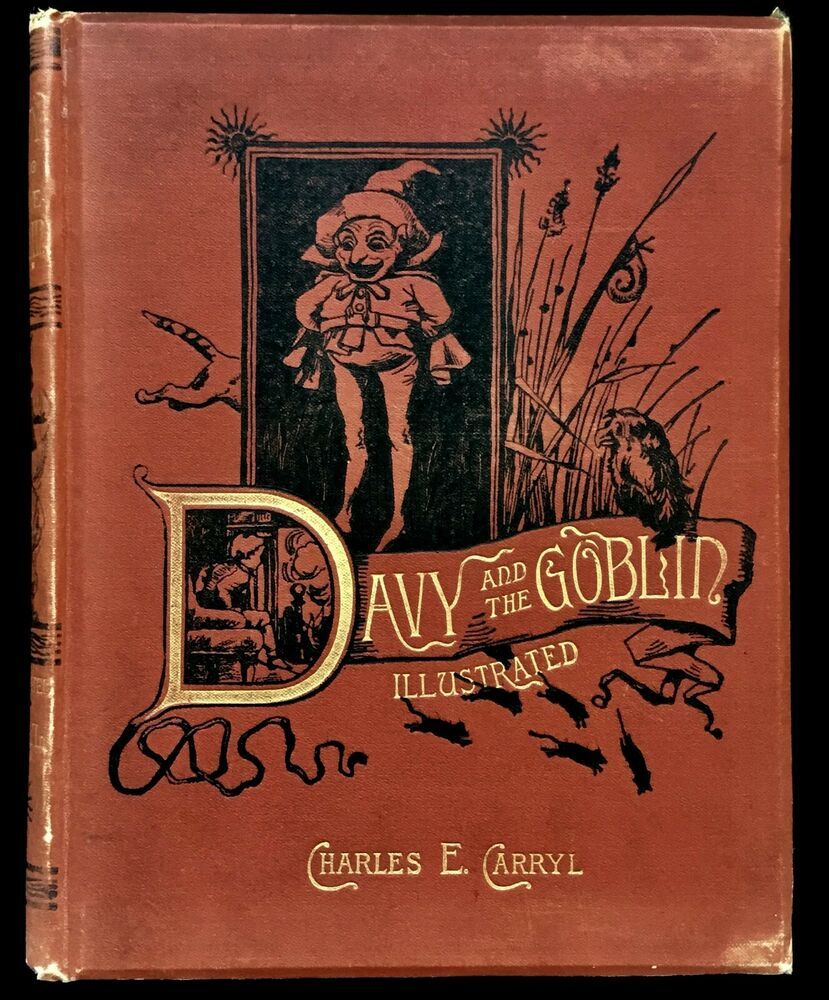
This is quoted from Davy and the Goblin, 1884-5,

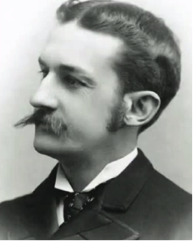
by Charles E. Carryl (1841-1920), a later-Victorian/Edwardian American children’s author.

(You can read your own copy here:  https://archive.org/details/davythegoblinorw00carriala , finding the poem on pages 89-90.  There are free-floating copies of this poem at various sites, but often oddly adulterated, so, if you wish to read what Carryl wrote, here it is.)

Carryl subtitled this, “or, What Followed Reading ‘Alice’s Adventures in Wonderland’ “ and the text consists of the Goblin of the title leading the Davy of the title on a “Believing Voyage”.  This is stocked with a series of characters, some from children’s literature like Sinbad and Robinson Crusoe, some fantastical creatures, including a Whale in a Waistcoat and talking waves, and the perhaps inevitable fairies, although their queen is rather more like the Queen of Hearts in Alice than something dreamlike.  

The Goblin’s goal is to persuade Davy, who has apparently maintained that he “doesn’t believe in fairies, nor in giants, nor in goblins, nor in anything the story-books tell you.”  to change his mind on the subject.  Perhaps I’m an inattentive reader, but I’m not sure that, when Davy awakes at the end of Chapter XIV (another inevitability, at least given Alice as an influence), he’s any more a believer than he was in Chapter I, but the whimsy involved has a certain charm and Carryl can get a catchy prosodic pattern going, as in “The Walloping Window-blind”.  Although that subtitle suggests not only Carroll’s episodic—perhaps even picaresque—narrative and certainly there’s something Carrollish about the poems scattered throughout, I would suggest two other influences upon the verses:  Edward Lear (1812-1888) and W.S. Gilbert (1836-1911), in such items as Gilbert’s “The Yarn of the Nancy Bell” (see:  https://allpoetry.com/The-Yarn-of-the-Nancy-Bell )–but I sense another rabbit hole dead ahead!

As always, thanks for reading,

Stay well,

Resist puns, when possible—Carryl can’t,

And remember that, as always there’s

MTCIDC

O

Pratchetty

18 Thursday Jan 2024

Posted by Ollamh in Uncategorized

≈ Leave a comment

As ever, dear readers, welcome.

It was that sad moment:  I’d come to the last page of an enjoyable book:  Terry Pratchett’s Feet of Clay, 1996.

But there was a sadder moment:  I’d finally read the entire “Disc World” series, all 41 novels. 

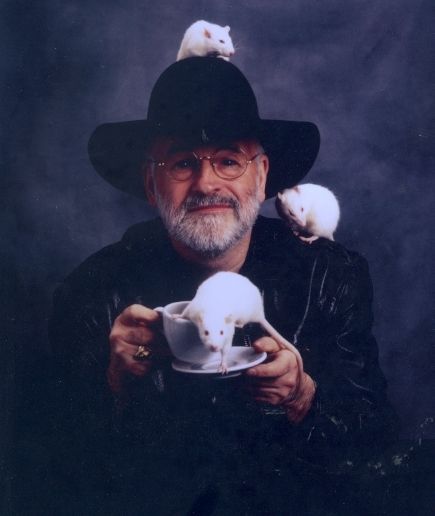
I came late to the work of (Sir) Terry Pratchett (1948-2015)

and Disc World, which he came clearly on time to, in 1983, with the first in the long series, The Colour of Magic.

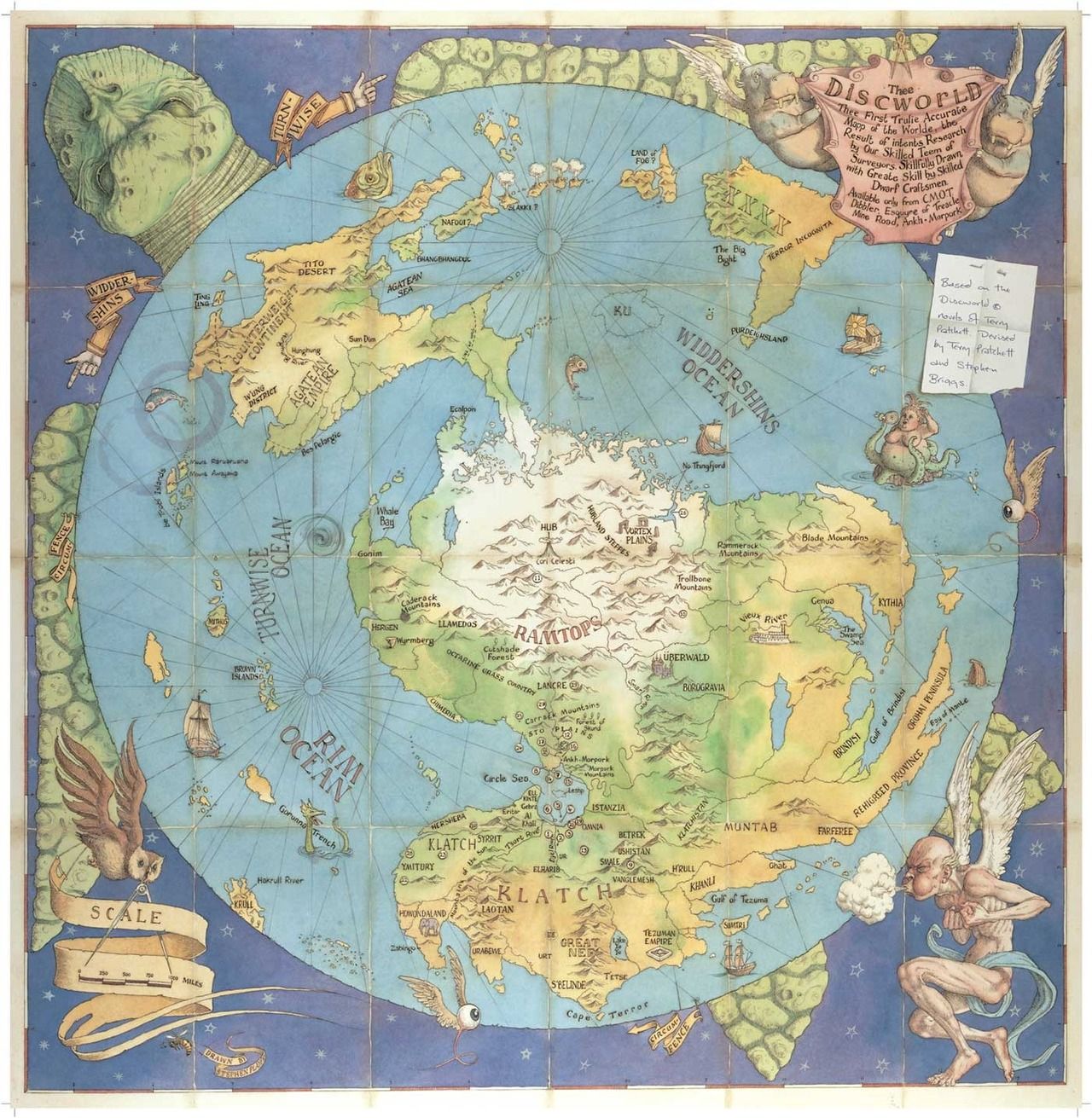
It has been through numerous reprintings since, with all sorts of covers, but this is the first edition and the cover is significant, being a depiction of just what Disc World looks like:

1. at base, a monstrous turtle, Great A’Tuin, who is swimming through space

2. mounted on Great A’Tuin are four elephants—Berilia, Tubul, Great T’Phon, and Jerakeen

3. and, placed atop the pachyderms is Disc World itself, which is a couple of continents, a scattering of islands, and seas, always with the danger of being swept off at the edge

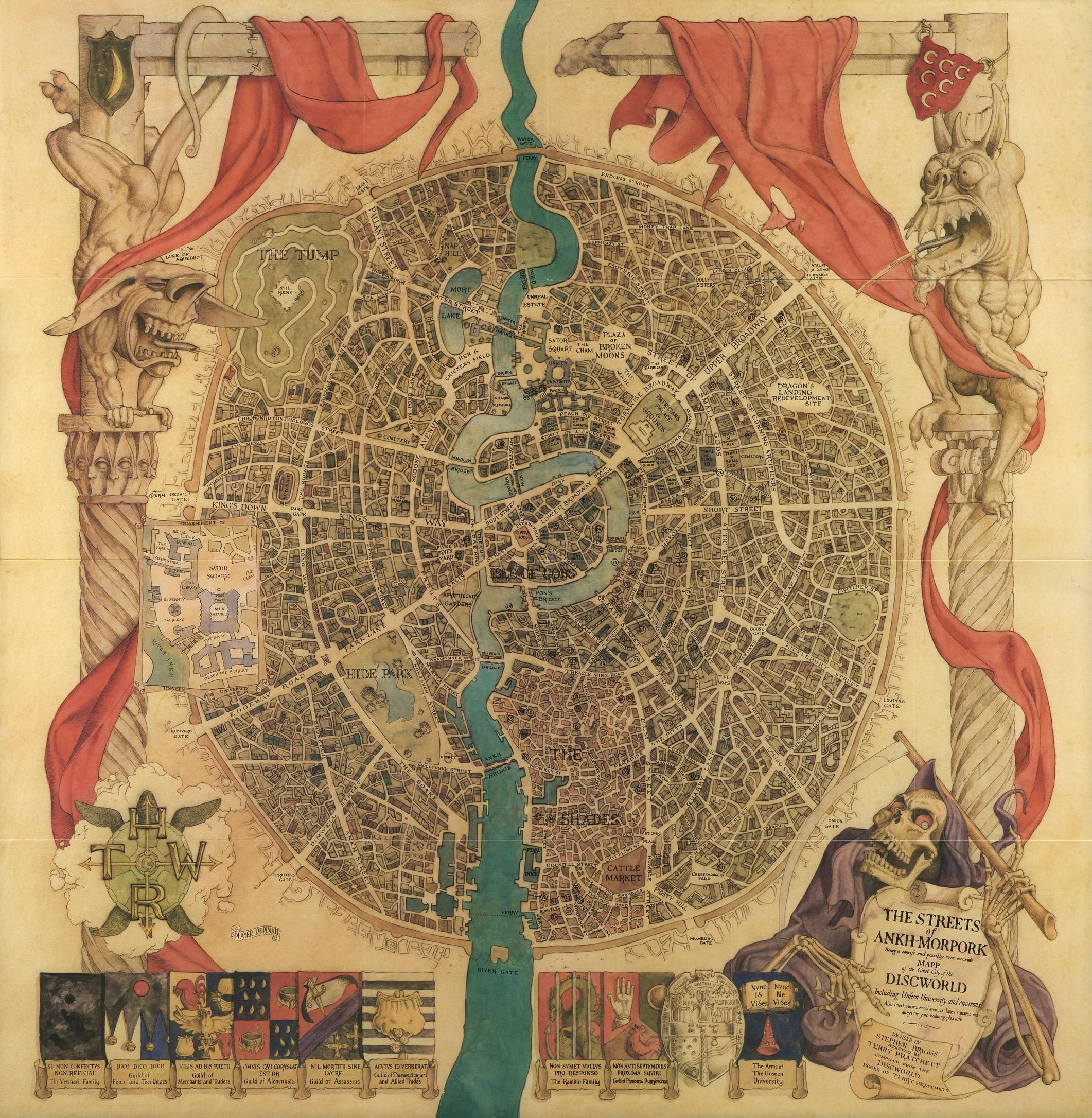
And on the surface lie the towns and cities, a major one being Ankh-Morpork, the scene of numerous volumes in the series,

an ancient conurbation dissected by a river, the Ankh, which is, at best, mostly slow-flowing sludge.  On one bank lie the affluent, on the other, the effluent, as Pratchett might say, all under the direction of the Patrician, an unelected replacement for a line of increasingly difficult kings and his modest force of  peace-keepers, the Watch, directed, in time, by Samuel Vimes, who not only becomes Sir in the course of the books, but is also discovered to be directly descended from the reason Ankh-Morpork no longer suffers under difficult kings—oh, and he marries a duchess, who, among other things, is involved in a dragon-adoption charity.

(Which painting bears a faint resemblance to a certain lesser-known work by the obscure Dutch painter, Rembrandt)

As you can see from the chart above, there is a certain method in what could easily appear to be madness:  a series of series-within-series, based upon sets of characters:  wizards, witches, Tiffany Aching (and her sometime-allies the Nac Mac Feegle), Death, the City Watch, and Moist von Lipwig.  Wizards, the City Watch, and Moist Von Lipwig are all associated (sometimes rather loosely) with Ankh-Morpork.  Witches andTiffany are more or less country people and Death (who ALWAYS SPEAKS IN CAPITAL LETTERS) is, as in real life, alas, everywhere.

As you can tell, Pratchett is given to rather bizarre names, and it was with one of these, Moist Von Lipwig, that I began my Pratchettry in the first novel in which he appears, Going Postal, 2004.

You can also see that book titles can vary from the mystical I Shall Wear Midnight to suggestive plays on words, like Equal Rites and the present Going Postal, which, although it doesn’t include homicidal mail workers, does have to do with Ankh-Morpork’s postal system and how the ingenious conman, Moist Von Lipwig, saves it with the help of everyone from another charity worker (and chain-smoker) Adora Belle to a Golem, Mr. Pump.

(Footnote on “golem”:  if you’re not acquainted with this term, it comes from Jewish religious and folklore:  a creature made, commonly, from earth (clay, mud) and given animation, if not life, often for a specific task.  For more—lots more—see:  https://en.wikipedia.org/wiki/Golem .  I first met a golem in a still from the 1915 horror film, Der Golem, which, unfortunately, doesn’t survive complete. 

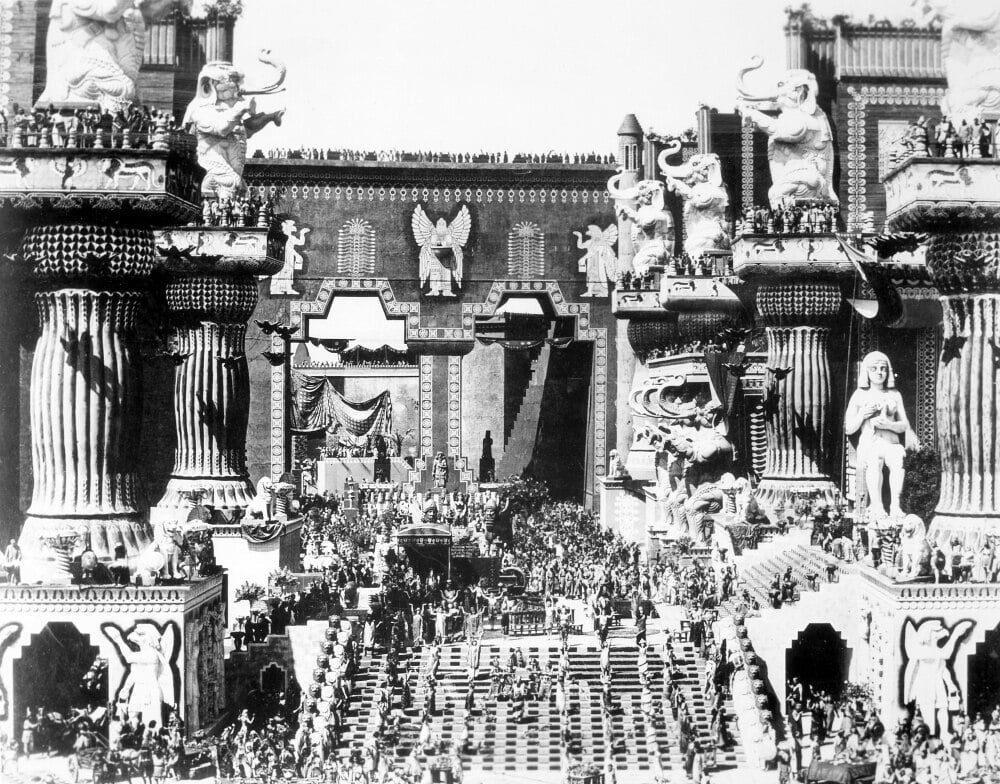
You can see a fragment here:  https://archive.org/details/silent-der-golem-aka-the-golem  This was actually eventually a trilogy, along with The Golem and the Dancing Girl, 1917, which is lost, and the 1920 The Golem and How He Came Into the World which you can see complete here:  https://www.youtube.com/watch?v=vmSoAq80HcM If you’re not familiar with silent film, dialogue is conveyed by printed cards and by (for us) rather exaggerated acting, and there was music commonly played—just like a modern soundtrack—during the film.  This music was live, from an improviser at piano or organ to, in the case of rather grand films, a score especially written for the film and played by an orchestra, like that for D.W. Griffith’s 1916 Intolerance.

And you can see Griffith’s film here:  https://www.youtube.com/watch?v=lv6u3d99SKk  Again, if you’re not used to silent film, it might take a while to get used to, often being sentimental to the point of being soppy, by our standards, but it’s a wonderful art form, coming directly from the late Victorian stage, and certainly worth your time. )

Golems are only one form of supernatural to appear regularly in Pratchett’s work.  There are also vampires (many who have taken “the pledge” and no longer drink human blood) and werewolves and entire complex communities of dwarves, as well.

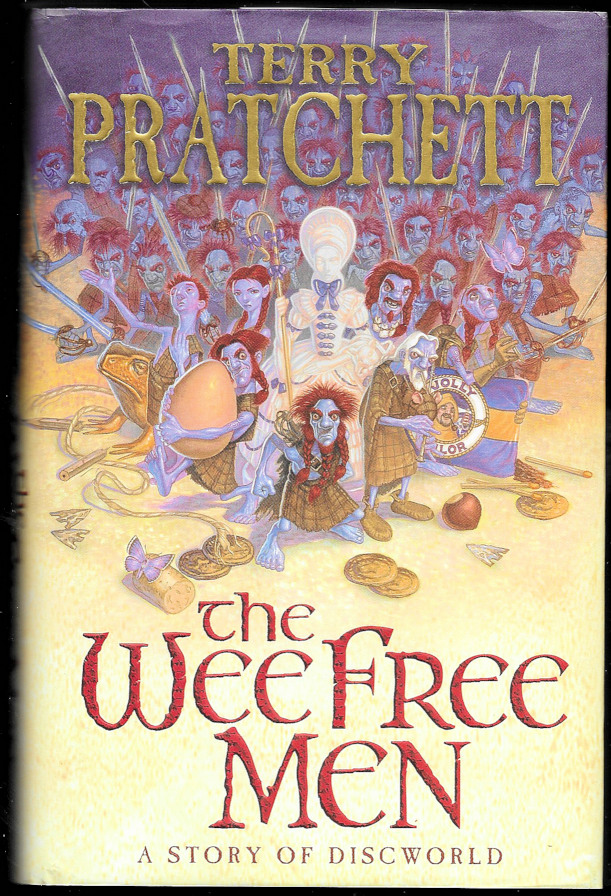
What I especially have enjoyed in these novels, besides the very thoughtful way in which Pratchett constructs characters—often people—even vampires—with worries and doubts, is the humor—much of it appearing in footnotes—and the occasional philosophic moments.  Tiffany Aching’s Nac Mac Feegle—first seen in The Wee Free Men, 2003, for example,

tiny, feisty creatures who speak a kind of Lallans—that is, Scots English—and are fantastically brave, primarily because they have made the decision to believe, unlike people in this world in general, that, rather than being alive and fearing death, they are already dead and that, consequently, anything goes (and usually does). 

Summarizing a Pratchett novel is possible—see, for example:  https://en.wikipedia.org/wiki/Going_Postal –but, to me, this seems like the sort of thing he would mock—probably in a footnote, and it’s better to try one out for yourself.  I have a number of favorites I would recommend, starting with Going Postal, to which I would add Interesting Times, The Wee Free Men, and Small Gods.  There is a very good film adaptation of Going Postal, which I would also recommend. 

But—in very much a Pratchetty situation—I’ve just looked back at that chart and realized that—I’ve somehow miscounted.   Where did The Amazing Maurice and His Educated Rodents, 2001, come from?

Somehow, I’ve managed to miss this and so have only read 40 of 41 novels.  I suppose that this is what Tolkien calls a “eucatastrophe”—that is, a situation in which things look glum, but then suddenly turn out for the best, something which I think Pratchett would approve of (with an ironic footnote, however).

Thanks, as ever, for reading,

Stay well,

Consider adopting the philosophic position of the Nac Mac Feegle,

And know that, as always, there’s

MTCIDC

O

No Names, No…

10 Wednesday Jan 2024

Posted by Ollamh in Uncategorized

≈ Leave a comment

As always, dear readers, welcome.

Looking back on nearly 500 postings, I see that names have popped up as a subject more than once.  As far back as 26 August, 2015, there was “What’s In a Name?”, a title which turned up again on 27 July, 2016.  Then there was “In a Name”, 2 March, 2022, and “Name of the Game, Game of the Name”, 10 May 2023.

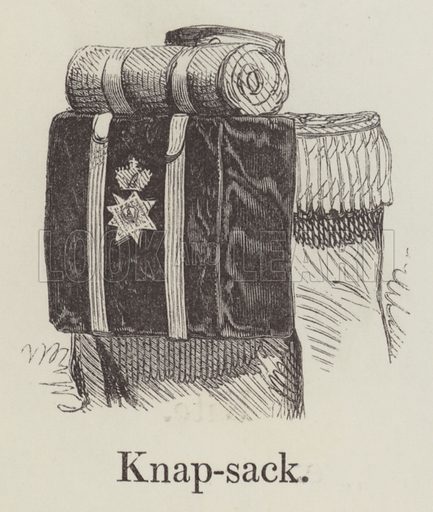
And here is that theme again, the title coming from an old British Army expression, “No Names No Pack Drill”.  A pack drill was a fairly mild form of punishment, in which the offender was assigned a certain number of hours of sentry-go while wearing a pack which had been especially heavily-weighted (bricks being one possibility). 

(Imagine wearing this, loaded with bricks, and marching back and forth with it on your back for hours)

Thus, if the sergeant in charge of discipline had no name reported to him, the offender escaped.

It’s clear, however, that I can’t escape names, something which I find students struggling with when we read the Odyssey and suddenly they’re confronted with Agamemnon

(about to become “the late Agamemnon”, murdered by his wife and her BF)

and the suitors of Penelope, with names like Antinoos (an-TI-noe-os) and Eurymachos (eh-oo-RUH-mahk-os—that is, an-TIH-noe-os and eu-RIH-makh-os, in English),

(and more mayhem—about to become “former suitors” thanks to Odysseus and his son, Telemachos—teh-LEH-makh-os)

or Beowulf, with names which look quite unpronounceable, like that of Beowulf’s father, Ecgtheow (EDGE-theh-oh).

(Not Ecgtheow, but Beowulf himself, when he first encounters a Danish coast guard—this is from the era of illustration when anyone vaguely Norse was required to wear a helmet decorated with wings or horns)

Tolkien had become accustomed to those Greek names when still a school boy, writing to Robert Murray, SJ, in a letter of 2 December, 1953:  “I was brought up in the Classics, and first discovered the sensation of literary pleasure in Homer.”  (Letters, 258)

Names in Homer can sometimes seem very appropriate—Antinoos, one of the leaders of Penelope’s suitors and a definite villain, has one that can mean “he who sets his mind in opposition” and the ocean-going magical people who finally send Odysseus back home, the Phaiakians, often have names like Pontonoos, “he whose mind is on the sea” or Nausithoos, “Swift-ship”.   Sometimes they seem puzzling:  why is the other leader of the suitors called Eurymachos, “he who fights broadly/widely” when he has, as far as we know, never done any fighting at all?  And why is that Cyclops called Polyphemos, “the very-well known”?  If he were, why would Odysseus have visited him, lost six of his crew to the Cyclops’ voracious appetite, and barely escaped by hiding under a sheep?

Although Tolkien, as an undergraduate at Oxford, was seduced away from Classics, as he tells us in a letter to W.H. Auden of 7 June, 1955 (see Letters, 312-313) by other languages (Welsh, Finnish), a process begun even earlier with Anglo-Saxon and Gothic, I would suggest that his early association with Homer and the possibilities which names might present, both as to character and to language, endured. As he says in the same letter:

“All this only as background to the stories, though languages and names are for me inextricable from the stories.  They are and were so to speak an attempt to give a background or a world in which my expressions of linguistic taste could have a function.  The stories were comparatively late in coming.” 

(This interest in naming could also lead him to be critical of another fantasy writer, E.R. Eddison, 1882-1945,

of whom he wrote “I read his works with great enjoyment for their sheer literary merit…Incidentally, I though his nomenclature slipshod and often inept.”  From a letter to Caroline Everett, 24 June, 1957, Letters, 372.  You can see what you think about Eddison’s way with names by reading The Worm Ouroboros, 1922, here:  https://ia801304.us.archive.org/10/items/1924EddisonTheWormOuroborus/1924__eddison___the_worm_ouroborus.pdf )

For JRRT, then, names were as crucial to the text as the plot and, as a long-time reader of his work and as someone who has spent an equally long time studying and teaching languages, I find that my admiration for his care and patience in developing them has grown with my reading.  It’s no wonder, for example, that he is so up in arms at the Dutch translator of The Lord of the Rings, who thought not only to translate the text, but the toponyms (place names) as well:

“In principal I object as strongly as is possible to the ‘translation’ of the nomenclature at all (even by a competent person).  I wonder why a translator should think himself called on or entitled to do any such thing.  That this is an ‘imaginary’ world does not give him any right to remodel it according to his fancy, even if he could in a few months create a new coherent structure which it took me years to work out.”  (letter to Rayner Unwin, 3 July, 1956, Letters, 359)

And there, in that phrase, “coherent structure”, you see what Tolkien was always aiming for:  his names, both of places and people, had to be consistent not only with the language they spoke, but also with the culture in which they lived—horse people like the Rohirrim can have names like Eowyn, perhaps ”delight in horses” and Eomer, “famous for horses”—and the history in which they lived.  (And, as JRRT pretended that his Middle-earth work was translated, he then had the added fun of turning original names he had invented, like those of Banazir and Ranugad, into what he said were their English equivalents, “Samwise” and “Hamfast”—Sam and the Gaffer.  See “Banazir and Ranugad”, 11 November, 2020 for more.)

If you’re a regular reader of this blog, you probably will remember that, some time last spring, I decided that my knowledge of the history of science fiction was not what I would like it to be, and so I began a long-term project of going at least back to Jules Verne (1828-1905)

and reading—or rereading—as widely as I could, including translations from other languages, to give myself as wide an experience as I could.  So far, I’ve added about three dozen books and a number of short stories to my ongoing bibliography with an uncounted number to go, but I admit that I’m not systematically chronological and recently, I decided to reread Frank Herbert’s (1920-1986)

original Dune trilogy (1965-1976).

I’ve only begun, and I’m finding it as complex and interesting as I remembered it, but, trained by JRRT, I was struck by what seemed like a very odd soup of names—Bene Gesserit, Muad’Dib, Shaddam IV, Atreides, Paul, Duke Leto, Jessica, Mother Gaius Helen, Thufir Hawat, and, strangest-sounding to me of all, Duncan Idaho—all within the first 30 or so pages.  Some of the names were very familiar—Atreides is “the family of Atreus”, which includes the ill-fated Agamemnon and his less-than-distinguished younger brother, Menelaus.  Leto, to me, isn’t a duke, but the mother of Apollo and his twin sister, Artemis.  Gaius (also spelled Caius) is a common male Roman praenomen, that is, first name, as in Caius Iulius Caesar, or the emperor we commonly call by his childhood nickname, Caligula, who was another C/Gaius.  Muad’Dib, with its glottal stop marker, suggests Arabic and Shaddam makes me think Persian (especially as he’s called Padishah, Persian “master king”  so “king of kings”).  Duncan Idaho?  Duncan is an Anglicized version of Irish/Gaelic Donnchadh, about which there is scholarly disagreement (see:  https://en.wikipedia.org/wiki/Duncan_(given_name) )  Idaho—well, see this:  https://en.wikipedia.org/wiki/Idaho   And then there’s Bene Gesserit.  Bene is a Latin adverb, “well”.  Gesserit is either the 3rd person singular, future perfect active indicative, or third person singular, perfect active subjunctive of the verb gero, with a variety of meanings around the idea of managing something, as in the standard phrase bellum gerere, “to wage war”.  Thus, as a phrase, it should mean either “he/she/it will have managed well” or “she/he/it would have managed well”. 

Tolkien was a science fiction reader himself (see Letters, 530 and “Sci-Fi”, 22 September, 2021), so I wonder, knowing how he felt about a certain creative lack in Eddison, what he would have said about this soup?

Thanks, as ever, for reading.

Stay well,

Manage things well,

And remember that there’s always

MTCIDC

O

PS

For more on names in Homer, Tolkien, and elsewhere, see “In a Name”, 2 March, 2022, here:   https://doubtfulsea.com//?s=whats+in+a+name&search=Go

Appeasement

03 Wednesday Jan 2024

Posted by Ollamh in Uncategorized

≈ Leave a comment

As always, dear readers, welcome.

As much as Tolkien, with justification, I think, denied external, historical influences on his work (and especially so, when, for example, it was suggested to him that the Ring was a stand-in for the atomic bomb—although he makes a grim reference to that possibility in a letter of 24 October, 1952, to Rayner Unwin—see Letters, 239), still, he was a highly intelligent, thoughtful, and sensitive man in a very complex era, one haunted, in part, by the disaster of 1914-1918, with its approximate 30,000,000 casualties,

(Tyne Cot Cemetery in southern Belgium, a heart-breaking place with 11,965 graves, of which 8,369 are of soldiers never identified)

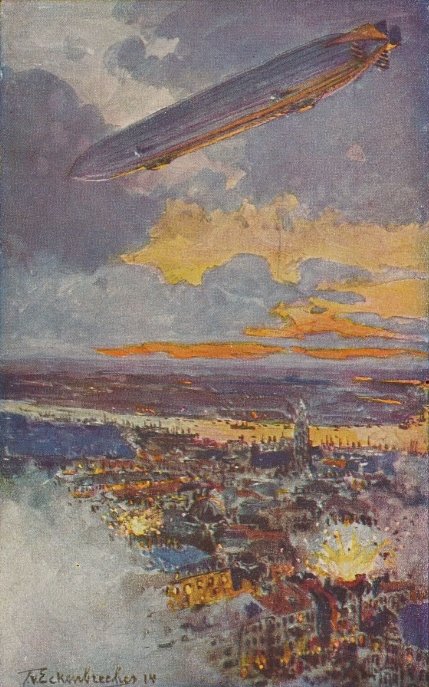
and the understandable fear of another such which would bring as much, if not more, ruin, as that war had brought about even more destructive weapons than the later-19th-century machine gun—war in the air, including the first hint of terror bombing

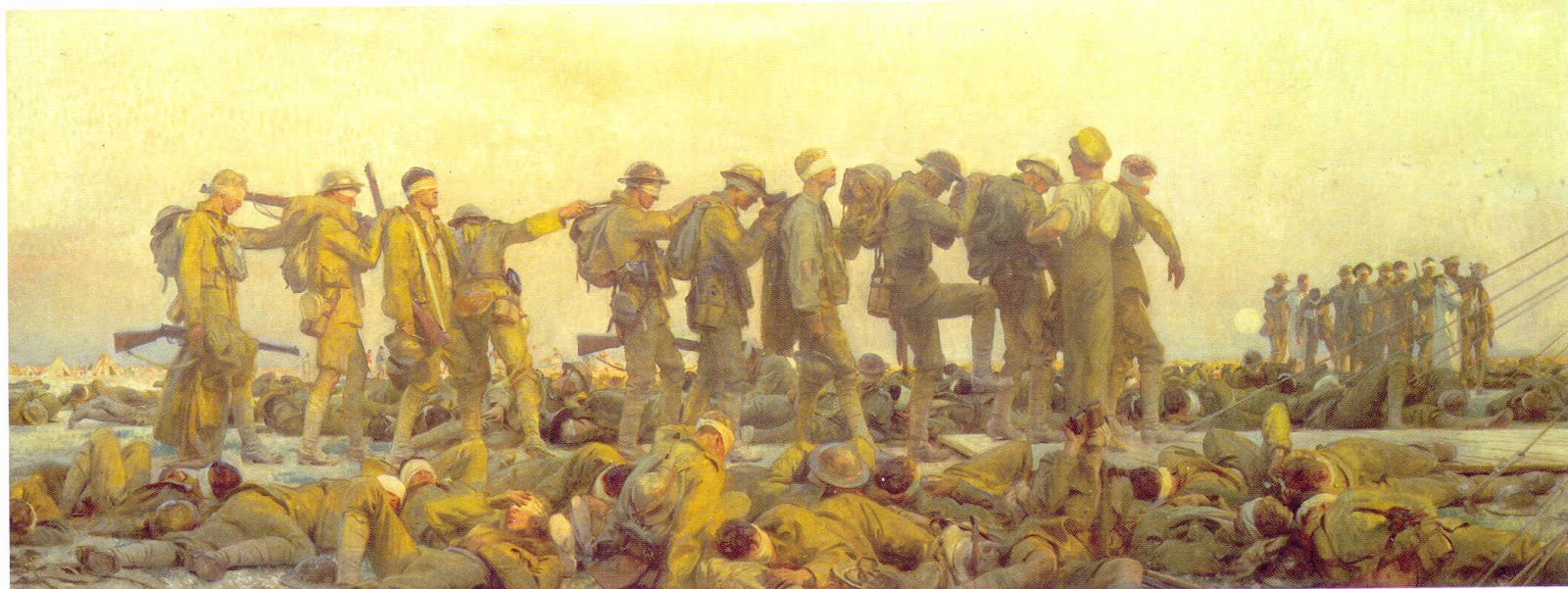
and the extensive use of chemical weapons.  (For more detail, see:  https://www.britannica.com/story/the-great-war-infographic-of-deaths-and-milestones )

(The brilliant society and landscape painter, John Singer Sargent’s“Gassed”, 1919)

Thus, when I recently re-read this passage, it set me to thinking:

“The Rabble of Gondor and its deluded allies shall withdraw at once beyond the Anduin, first taking oaths never again to assail Sauron the Great in arms, open or secret.  All lands east of the Anduin shall be Sauron’s for ever, solely.  West of the Anduin as far as the Misty Mountains and the Gap of Rohan shall be tributary to Mordor, and men there shall bear no weapons, but shall have leave to govern their own affairs.  But they shall help to rebuild Isengard which they have wantonly destroyed, and that shall be Sauron’s, and there his lieutenant shall dwell:  not Saruman, but one more worthy of trust.” (The Return of the King, Book Five, Chapter 10, “The Black Gate Opens”)

The seemingly-doomed expedition to confront Sauron has marched out of the ruined Minas Tirith

and north, to the Morannon, the Black Gate,

(the Hildebrandts)

where it meets an emissary, the Mouth of Sauron.

(by Douglas Beekman. This scene is badly mismanaged in the Jackson film, with the emissary being struck down, which is a gross violation of the chivalry which stated that such emissaries were protected by custom—of which the Mouth of Sauron, flinching, reminds Aragorn–and is far from what JRRT wrote.)

The Mouth of Sauron believes he has shaken Gandalf and his allies when he has presented them with what appears to be Frodo’s “Dwarf-coat, elf-cloak, blade of the downfallen West” and he suggests that the owner will be in torment for years unless they yield to Sauron’s terms—which Gandalf, after seeming to waver, then rejects, saying to Sauron’s emissary, “Get you gone, for your embassy is over and death is near to you.”

In the course of their brief dialogue, however, Gandalf has raised a point which made me think of an historical bargaining session, something Tolkien would have read about in the newspapers and seen in newsreels in the cinema, a meeting in late September, 1938, in Munich, Germany, among Adolf Hitler, Benito Mussolini, Edouard Daladier, and Neville Chamberlain.

Hitler had already assimilated Austria in March, 1938, during the event called the Anschluss (AHN-shluss, literally, in German, a “connection”)

and was now aiming to do the same to the young state of Czechoslovakia.  That lurking fear of another war was behind the West’s scramble to do something to stop a new conflict brought about that meeting, as well as the so-called “Munich Agreement”, then signed by the four representatives, which, basically, handed Hitler much of Czechoslovakia, while signaling that the Western allies weren’t willing to fight to keep him from grabbing the rest.  

And here we see a difference between Sauron and Hitler.  When Gandalf says to the Mouth of Sauron:

“And if indeed we rated the prisoner so high, what surety have we that Sauron, the Base Master of Treachery, will keep his part?”

The reply is:

“Do not bandy words in your insolence with the Mouth of Sauron!…Surety you crave!  Sauron gives none.  If you sue for clemency you must first do his bidding.  These are his terms.  Take them or leave them.”

Hitler had said that he would be satisfied and even signed an agreement, separate from the Munich Agreement, with Chamberlain, the British Prime Minister, which included these words:

“” … We regard the agreement signed last night and the Anglo-German Naval Agreement as symbolic of the desire of our two peoples never to go to war with one another again”. 

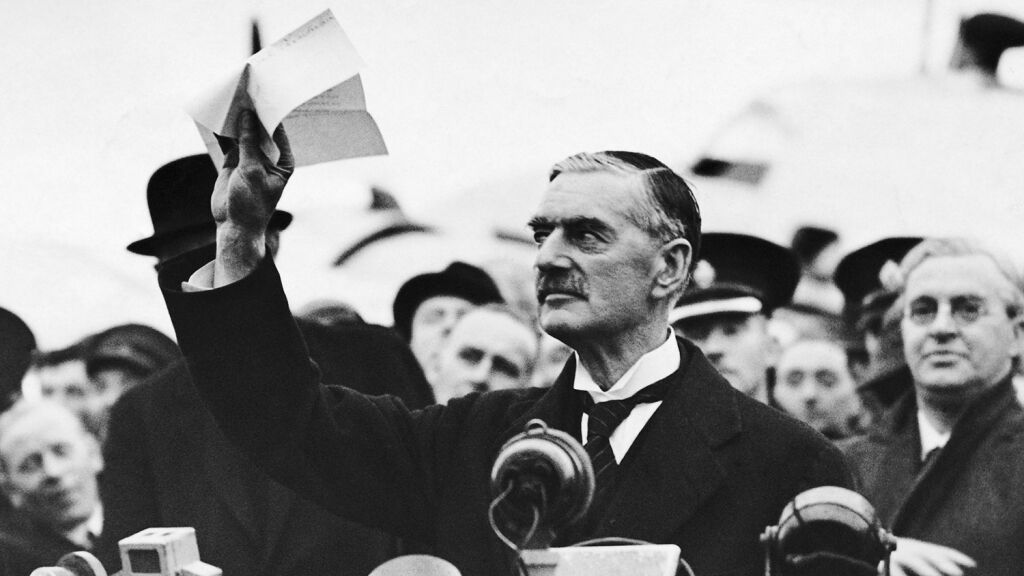
And Chamberlain took this back to London, waving it over his head at the airport in a famous gesture as he addressed a crowd.

You can hear Chamberlain address that crowd here:  https://www.youtube.com/watch?v=WMtG38ZKf3U

(As you can imagine, this is an extremely simplified version of events.  If you would like to have a much more detailed version, see:  https://en.wikipedia.org/wiki/Munich_Agreement )

The worth of Hitler’s words came quickly:  in March, 1939, he invaded the remaining portion of Czechoslovakia.

In September, 1939, he invaded Poland and World War II, which the West had compromised itself to avoid, would begin.

Looking at the map of Middle-earth,

we can see that Sauron’s terms would have:

1. reduced Rohan and Gondor to puppet states, to be ruled over by Sauron’s viceroy

2. stripped them of all future power to resist whatever that viceroy (meaning Sauron, of course) would have demanded, for all that the terms said that they could rule themselves.

What happened in Munich in September, 1938, rather than stopping a coming war, simply told the one who would pursue that war that the West was willing to sacrifice a great deal—even another country—to keep the peace.  Was Tolkien at least marginally influenced by all of this?  And, in a terrible “What If?” can we imagine a West had Gandalf and his allies given in to Sauron’s terms? Would Sauron have been content?

Thanks, as ever, for reading.

Stay well,

Beware the promises of dictators,

And know that, as always, there’s

MTCIDC

O
PS

As this is the first posting of the new year, as gloomy as this is, I don’t want it to suggest an omen.  I’ve written that John Singer Sargent was, along with being a society painter, a landscape painter, usually in water colors, so here’s one of my favorites as, I hope, a more cheerful theme for the year to come—“Palms”, 1917

The Doubtful Sea Series Facebook Page

The Doubtful Sea Series Facebook Page

  • Ollamh

Categories

  • Artists and Illustrators
  • Economics in Middle-earth
  • Fairy Tales and Myths
  • Films and Music
  • Games
  • Heroes
  • Imaginary History
  • J.R.R. Tolkien
  • Language
  • Literary History
  • Maps
  • Medieval Russia
  • Military History
  • Military History of Middle-earth
  • Narnia
  • Narrative Methods
  • Poetry
  • Research
  • Star Wars
  • Terra Australis
  • The Rohirrim
  • Theatre and Performance
  • Tolkien
  • Uncategorized
  • Villains
  • Writing as Collaborators
Follow doubtfulsea on WordPress.com

Across the Doubtful Sea

Recent Postings

  • A Moon disfigured December 17, 2025
  • On the Roads Again—Once More December 10, 2025
  • (Not) Crossing Bridges December 3, 2025
  • On the Road(s) Again—Again November 26, 2025
  • On the Road(s) Again November 19, 2025
  • To Bree (Part 2) November 12, 2025
  • To Bree (Part 1) November 5, 2025
  • A Plague o’ Both—No, o’ All Your Houses! October 29, 2025
  • It’s in Writing (2:  I’st a Prologue, or a Poesie for a Ring?) October 22, 2025

Blog Statistics

  • 103,189 Views

Posting Archive

  • December 2025 (3)
  • November 2025 (4)
  • October 2025 (5)
  • September 2025 (4)
  • August 2025 (4)
  • July 2025 (5)
  • June 2025 (4)
  • May 2025 (4)
  • April 2025 (5)
  • March 2025 (4)
  • February 2025 (4)
  • January 2025 (5)
  • December 2024 (4)
  • November 2024 (4)
  • October 2024 (5)
  • September 2024 (4)
  • August 2024 (4)
  • July 2024 (5)
  • June 2024 (4)
  • May 2024 (5)
  • April 2024 (4)
  • March 2024 (4)
  • February 2024 (4)
  • January 2024 (5)
  • December 2023 (4)
  • November 2023 (5)
  • October 2023 (4)
  • September 2023 (4)
  • August 2023 (5)
  • July 2023 (4)
  • June 2023 (4)
  • May 2023 (5)
  • April 2023 (4)
  • March 2023 (5)
  • February 2023 (4)
  • January 2023 (4)
  • December 2022 (4)
  • November 2022 (5)
  • October 2022 (4)
  • September 2022 (4)
  • August 2022 (5)
  • July 2022 (4)
  • June 2022 (5)
  • May 2022 (4)
  • April 2022 (4)
  • March 2022 (5)
  • February 2022 (4)
  • January 2022 (4)
  • December 2021 (5)
  • November 2021 (4)
  • October 2021 (4)
  • September 2021 (5)
  • August 2021 (4)
  • July 2021 (4)
  • June 2021 (5)
  • May 2021 (4)
  • April 2021 (4)
  • March 2021 (5)
  • February 2021 (4)
  • January 2021 (4)
  • December 2020 (5)
  • November 2020 (4)
  • October 2020 (4)
  • September 2020 (5)
  • August 2020 (4)
  • July 2020 (5)
  • June 2020 (4)
  • May 2020 (4)
  • April 2020 (5)
  • March 2020 (4)
  • February 2020 (4)
  • January 2020 (6)
  • December 2019 (4)
  • November 2019 (4)
  • October 2019 (5)
  • September 2019 (4)
  • August 2019 (4)
  • July 2019 (5)
  • June 2019 (4)
  • May 2019 (5)
  • April 2019 (4)
  • March 2019 (4)
  • February 2019 (4)
  • January 2019 (5)
  • December 2018 (4)
  • November 2018 (4)
  • October 2018 (5)
  • September 2018 (4)
  • August 2018 (5)
  • July 2018 (4)
  • June 2018 (4)
  • May 2018 (5)
  • April 2018 (4)
  • March 2018 (4)
  • February 2018 (4)
  • January 2018 (5)
  • December 2017 (4)
  • November 2017 (4)
  • October 2017 (4)
  • September 2017 (4)
  • August 2017 (5)
  • July 2017 (4)
  • June 2017 (4)
  • May 2017 (5)
  • April 2017 (4)
  • March 2017 (5)
  • February 2017 (4)
  • January 2017 (4)
  • December 2016 (4)
  • November 2016 (5)
  • October 2016 (6)
  • September 2016 (5)
  • August 2016 (5)
  • July 2016 (5)
  • June 2016 (5)
  • May 2016 (4)
  • April 2016 (4)
  • March 2016 (5)
  • February 2016 (4)
  • January 2016 (4)
  • December 2015 (5)
  • November 2015 (5)
  • October 2015 (4)
  • September 2015 (5)
  • August 2015 (4)
  • July 2015 (5)
  • June 2015 (5)
  • May 2015 (4)
  • April 2015 (3)
  • March 2015 (4)
  • February 2015 (4)
  • January 2015 (4)
  • December 2014 (5)
  • November 2014 (4)
  • October 2014 (6)
  • September 2014 (1)

Blog at WordPress.com.

  • Subscribe Subscribed
    • doubtfulsea
    • Join 78 other subscribers
    • Already have a WordPress.com account? Log in now.
    • doubtfulsea
    • Subscribe Subscribed
    • Sign up
    • Log in
    • Report this content
    • View site in Reader
    • Manage subscriptions
    • Collapse this bar
 

Loading Comments...