Tags
anachronism, Bag End, banjo clock, barometer, clocks, Edwardian, Evangelista Torricelli, Hobbiton, Lucien Vidie, Middle-earth, Oxford, railway, The Hobbit, The Lord of the Rings, Tolkien, Victorian
Welcome, as always, dear readers.
In a PS to our last posting, we showed this illustration

and asked you if you saw something peculiar about it.
In fact, there are two peculiar things about it. Look to the left of the door. What is that? At first, we were inclined to imagine that it was a clock of a style known as a “banjo clock”.

But there was also a clock on the right hand wall, and, unless Bag End was like a stock exchange, with clocks showing various times around the world,
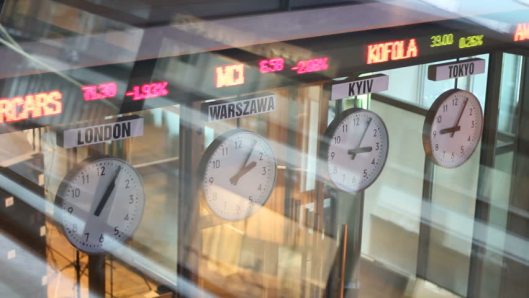
(image the one on the left being “Shire Time”, while the one on the right is “Mordor Time”!)
why would Bilbo have two clocks?
There’s also the technical problem: banjo clocks—maybe all clocks?—which have pendulums need to use gravity to help in their swing. If the object on Bilbo’s wall is a clock, it’s upside down and therefore—
and so, after lots of searching to see if we could match it somehow, we were scratching our collective heads when we realized that it wasn’t a clock at all, but a barometer—and a distinctively Victorian one, which fits in with our suggestion in a recent posting that JRRT was using his memories of his Victorian/Edwardian childhood as the basis of Bag End.

So, what’s a barometer and why might Bilbo have one?
The simplest answer to the first of those is that a barometer measures atmospheric pressure. That measurement, in turn, can tell you about changes in weather: low pressure, it’s more likely to rain, high pressure, not. Here’s a basic chart to explain.

One odd thing about Bilbo’s is that, commonly, barometers are combined with thermometers in patterns of the sort you see on the Bag End wall, whereas this one appears to be by itself.

The really odd thing, however, is that he has one to begin with. The first barometers date from the 1640s, being an offshoot of trying to understand the concept of a vacuum.

It was only in the 1840s that someone (Lucien Vidie) postulated that air pressure changes—measurable by this device– could signal weather changes. For Bilbo to have such a thing in a Middle-earth which appears to be almost entirely devoid both of science as we understand it and of mechanical technology, is a puzzle at best. Who made it? How did he obtain it? And last—and hardest—what did he do with it?
Of course, as we have discussed in past postings, there are whole areas of knowledge about Middle-earth about which we have little or no information and it’s been fun for us to try to reconstruct things using parallels from our own world, combined with the little we do know. That first barometer was, we presume, handmade by Evangelista Torricelli (1608-1647).
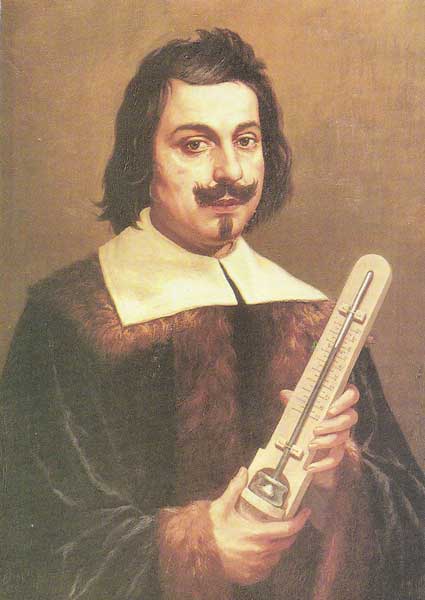
It appears to have been, basically, a long glass tube, attached to a piece of wood by white metal fittings. The hobbits have glass windows, so the art of glass-blowing exists in their world. The wood and metal could be used in many other settings. Once the concept was understood, it would be easy to see someone taking already available techniques and materials and creating the object.
But who made it? When it came to ingenuity in craft, JRRT suggests the dwarves—with the men of Dale as fellow-workers or perhaps as middlemen. As Thorin says of the past:
“Altogether those were good days for us, and the poorest of us had money to spend and to lend, and leisure to make beautiful things just for the fun of it, not to speak of the most marvelous and magical toys, the like of which is not to be found in the world now-a-days…the toy market of Dale was the wonder of the North.” (The Hobbit, Chapter One, “An Unexpected Party”)
How did Bilbo acquire it? He had come to be known in Hobbiton as unlike other hobbits—his mother, after all, was the famous Belladonna Took (for her history—or, rather, her mystery–see The Hobbit, Chapter 1) and, after his travels, “he took to writing poetry and visiting elves”. Perhaps the barometer came from one of his trips? Or had it been sent to him?
If we take the preparations for the famous joint-birthday-party at the opening of The Lord of the Rings as a clue, there must have been at least a small degree of commerce between the Shire and the dwarves of the Lonely Mountain and the rebuilt town of Dale:
“On this occasion the presents were unusually good…There were toys the like of which they had never seen before, all beautiful and some obviously magical. Many of them had indeed been ordered a year before, and had come all the way from the Mountain and from Dale, and were of real dwarf-make.” (The Fellowship of the Ring, Book One, Chapter 1, “A Long-Expected Party).
But then there is that third question: what did he do with it? As far as we can currently determine from The Hobbit and The Lord of the Rings, neither Bilbo nor Frodo nor even Gandalf ever mentions a barometric reading, or is concerned that the pressure is dropping.
So what are we to make of this?
For all that JRRT was increasingly careful about this, there a few anachronisms in his work. In The Hobbit, there is the well-known one of Bilbo’s reaction to Thorin’s explanation of the dangers of future burglary:
“At may never return he began to feel a shriek coming up inside, and very soon it burst out like the whistle of an engine coming out of a tunnel.” (The Hobbit, Chapter One, “An Unexpected Party”)
Although JRRT himself considered changing this for the 1966 revision, Douglas Anderson, in The Annotated Hobbit, 47-48, argues that this doesn’t have to be an anachronism at all:
“…for Tolkien as narrator was telling this story to his children in the early 1930s, and they lived in a world where railway trains were a very important feature of life.”
In fact, built in 1844, the first railway station in Oxford was almost a century old when The Hobbit was published in 1937.

(And we can’t resist this quotation from Jackson’s Oxford Journal for 15 June, 1844, which describes the arrival of the first train as “one of those rampageous, dragonnading fire-devils”. Clearly, dragons and railroads have a long history together!)
So, is this just a slip on JRRT’s part? Perhaps he had a barometer in his past, next to a door, and, in his urge to fill up the wall space of Bag End, he simply filled in what he already knew? We can only shrug—and, in our next, wonder about that clock on the wall to the right: what’s it doing in Middle-earth?
Thanks, as ever, for reading.
MTCIDC
CD
 doubtfulsea