• About

doubtfulsea

~ adventure fantasy

Tag Archives: lord-of-the-rings

Orc Logistics

07 Tuesday May 2024

Posted by Ollamh in Uncategorized

≈ Leave a comment

Tags

Fantasy, J.R.R. Tolkien, lord-of-the-rings, The Lord of the Rings, Tolkien

As always, dear readers, welcome.

Sauron, although he rather rashly placed much of his power (as well as his life force) in what is, basically, a magic ring, has always struck me as rather a practical person when it comes to war and foreign affairs.  In order to conquer the West, he’s:

1. turned his rather bleak realm into a giant military camp

2. brought back the final destroyer of Arnor, the Witch King of Angmar, as his chief lieutenant

3. made treaties with peoples to the east and south to bolster his already extensive armies and cleverly turned pirates loose to raid the southern shores of Gondor to distract his opponents and force them to divide their forces

4. corrupted one of the West’s traditional allies, Saruman, turning him into a kind of “Mini Me”
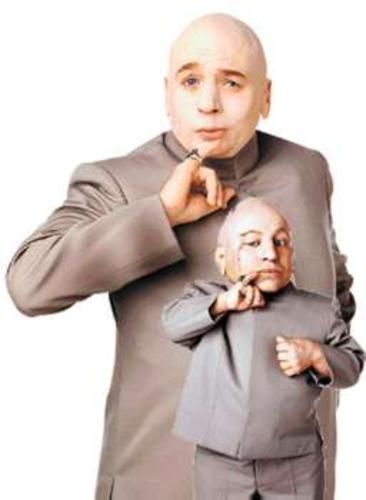
 

5. weakened another, Rohan, through a spy in the king’s court, Grima, who has somehow turned that king into a prematurely-aged man

6. worked on the mind of the commander of Gondor, Denethor, using an ancient communications device, making him suspicious of his younger son and promoting a defeatist attitude

As well, he seems quite aware of what we call geo-politics, as we see in his demands at the Black Gate:

“ ‘The rabble of Gondor and its deluded allies shall withdraw at once beyond the Anduin, first taking oaths never again to assail Sauron the Great in arms, open or secret.  All lands east of the Anduin shall be Sauron’s for ever, solely.  West of the Anduin as far as the Misty Mountains and the Gap of Rohan shall be tributary to Mordor, and men there shall bear no weapons, but shall have leave to govern their own affairs.  But they shall help to rebuild Isengard which they have wantonly destroyed, and that shall be Sauron’s and there his lieutenant shall dwell:  not Saruman, but one more worthy of trust.”  (The Return of the King, Book Five, Chapter 10, “The Black Gate Opens”)

Reading this passage, however, I’m puzzled:

“Time passed.  At length watchers on the walls could see the retreat of the out-companies.  Small bands of weary and often wounded men came first with little order; some were running wildly as if pursued.  Away to the eastward the distant fires flickered, and now it seemed that here and there they crept across the plain.  Houses and barns were burning.  Then from many points little rivers of red flame came hurrying on, winding through the gloom, converging towards the line of the broad road that led from the City-gate to Osgiliath.”  (The Return of the King, Book 5, Chapter 4, “The Siege of Gondor”)

As we know, JRRT himself had been a soldier, though perhaps a reluctant one,
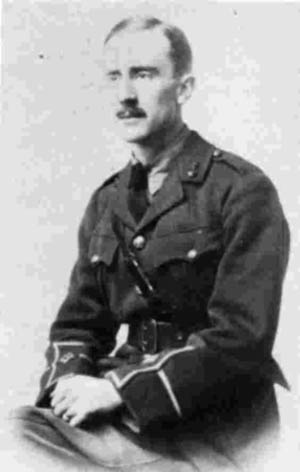
and thus would have been well aware of the saying, sometimes attributed to Napoleon, that “an army marches on its stomach”.  In 1916, such an army needed massive supply dumps,
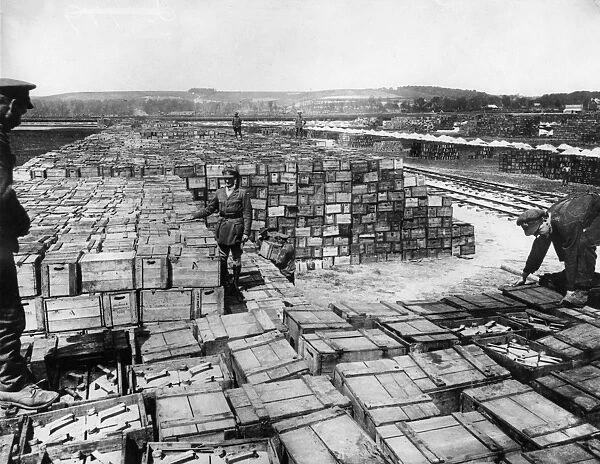
which needed railroads to bring food and ammunition to them.
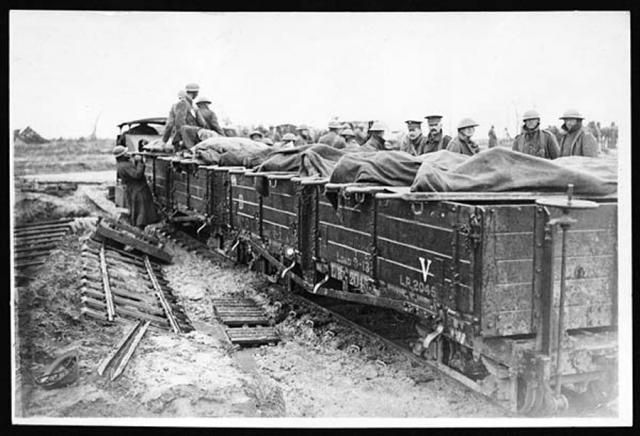
From there, wagons

and, in time, early trucks,

then mules and horses would have taken supplies farther forward

and, from there, the troops themselves might have formed what were called “carrying parties”.

Image7:  carrying
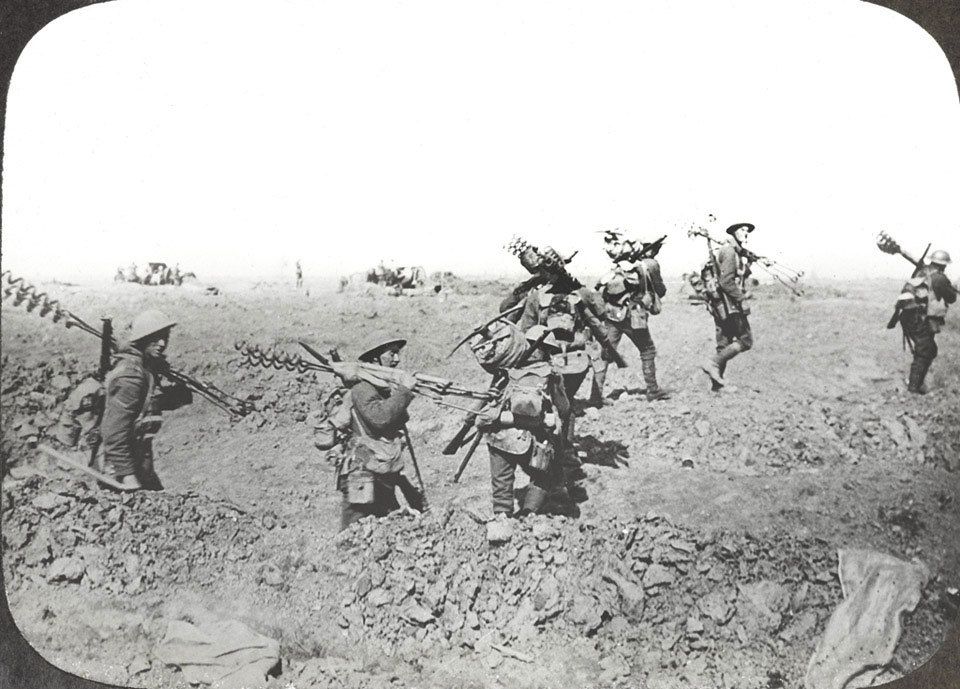
(This is actually a “wiring party”, with its “screw pickets”, which were twisted into the ground and used to hold up the barbed wire, but it can stand in for a “carrying party”.  For more on “wiring parties”, see:  https://en.wikipedia.org/wiki/Wiring_party  )

One fact alone might suggest how big the task of keeping the British Army supplied :  “By 1918, the British were sending over 67 million lbs (30 million kg) of meat to the Western Front each month.”  (This is from an article entitled “The Food That Fuelled the Front” from the Imperial War Museum website, which you can see here:  https://www.iwm.org.uk/history/the-food-that-fuelled-the-front  )

This was a vast, modern army, with all the modern technology available in 1918 to enable resupply (such supplying is called “logistics”).  Sauron’s army is of a much earlier time, its basis seemingly infantry, armed with swords, spears, and bows,
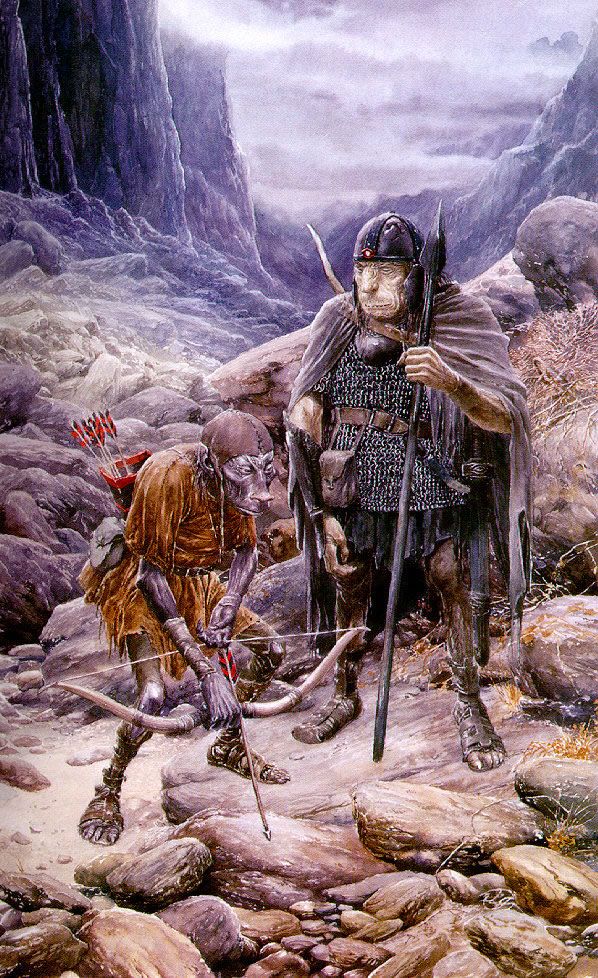
(Alan Lee)

assisted by a certain number of oliphaunts,

(Alan Lee)

horsemen,
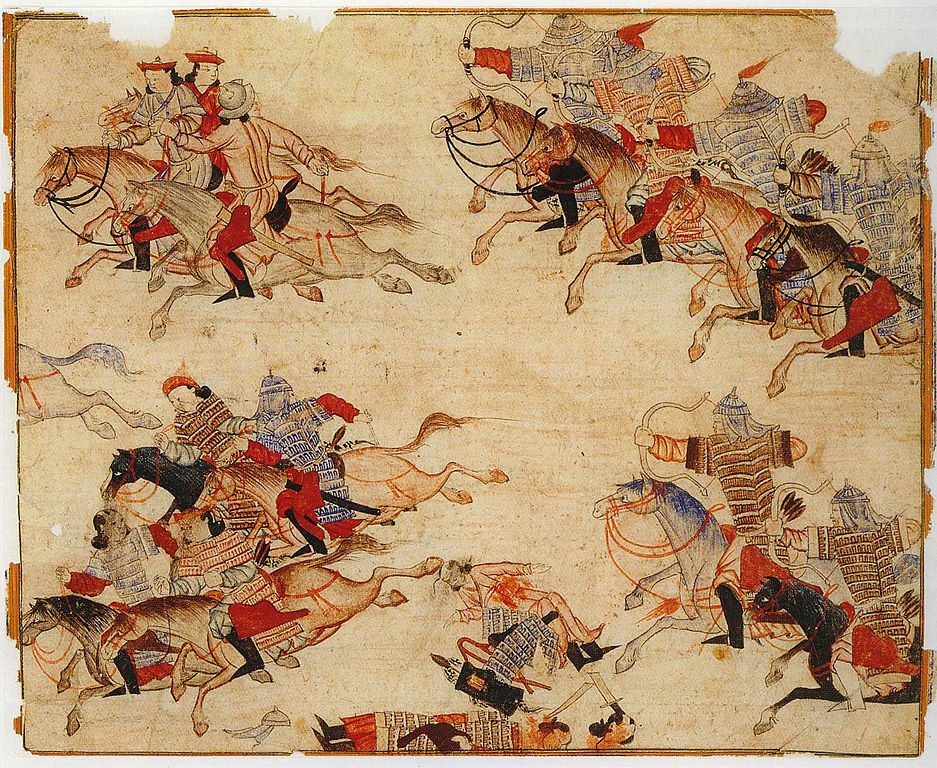
(These are actually Mongols, but all the text says is “Before them went a great cavalry of horsemen moving like ordered shadows…”  The Two Towers, Book Four, Chapter 8, “The Stairs of Cirith Ungol”, leaving it up to us to imagine what they might have looked like.)

and perhaps a warband of wargs,

(Artist?)

yet its basic needs would have been the same as those of the British Army in which Tolkien served.

To provide a parallel a bit closer to The Lord of the Rings, we might imagine an earlier army, like the army of New Kingdom Egypt

as we might have seen it marching to fight the Hittites

(Angus McBride)

at the Battle of Kadesh, in the summer of 1274BC. 

No oliphaunts or cavalry (or wargs) in support, but definitely chariots, maybe 2000 of them.

(Again, Angus McBride, one of my favorite military artists of the 20th century). 

The Egyptian army of Rameses II

may have numbered about 20,000, with as many as 4,000 chariot horses, and here are some potential logistic figures for such an earlier army—

Thinking of water alone, the average modern horse will drink 5-10 gallons (19-38 ltrs) of water a day, depending on working conditions, and that same horse needs to eat 15-20 pounds  (7-9 kg) of hay.  An average present-day American eats about 5.5  pounds (2.5 kg) of food per day and drinks 2 quarts (2 ltrs) of water.  On the one hand, ancient Egyptians were somewhat smaller than we are and probably less well-fed to begin with, but, on the other, that water requirement is an average and doesn’t factor in  marching for miles on dusty summertime roads in the Middle East.

Could Rameses’ army have carried enough supplies with it for the long march (perhaps about 500 miles—about 805km)?  Rameses would have had available to him no trains or trucks, but the ancient Egyptians had carts (probably pulled by oxen, as were their plows)

and certainly used pack mules.
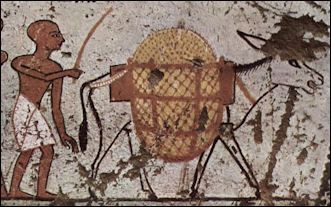
As to possible baggage camels,
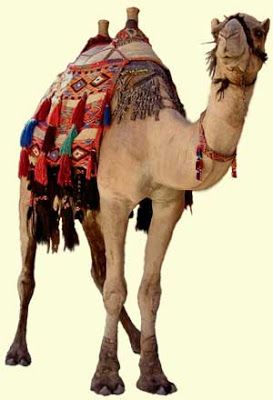
there is a lot of scholarly argument about their use.  Although camel remains (a few depictions, bones, rope from camel hair) are there, there doesn’t appear to be any clear evidence for the use of camels as carriers until much later.  Food—the ordinary Egyptian diet was simple, including barley bread

and beer (also made from barley),

so large supplies of barley flour might be carried, but how to carry—and preserve–beer?  Water could be substituted, but could it be carried?  Or would the Egyptians have done as armies have done throughout history and foraged, picking up supplies of food and drink from the locals, willingly or unwillingly?  Both Rameses II’s and Sauron’s armies had horses, but add oliphaunts in Sauron’s, and all in need of fodder, this would include, in season, cutting grass

and, in and out of season, probably looting barns and granaries, as well.

Consider, then, Sauron’s armies and the Pelennor into which they had broken. 

We don’t know their numbers, but it’s clear that they are enormous, far outnumbering the defenders of Minas Tirith.   And this is what puzzles me.  Tolkien was certainly aware of such needs in general—as he once wrote:  “I am not incapable of or unaware of economic thought…” (letter to Naomi Mitchison, 25 September, 1954, Letters, 292).   And yet—

“It drew now to evening by the hour, and the light was so dim that even far-sighted men upon the Citadel could discern little clearly out upon the fields, save only the burnings that ever multiplied, and the lines of fire that grew in length and speed.”

Perhaps the army brought some provisions with it (Saruman and Sauron’s orcs seem to have had something like field rations, as we learn after they carry off Merry and Pippin), but, if the siege of Minas Tirith had proved to be a long one, what would such a vast host and its beasts have eaten, having destroyed the nearest source of food and fodder?  We’ve seen that Sauron was shrewd and showed a great amount of foresight in his pre-war preparations, so my only answer is a question:   did JRRT, who certainly had a taste for the dramatic moment–think of the way in which the Rohirrim appear at the edge of the Rammas Echor–

deliberately sacrifice economics for drama?  We’ll probably never know for certain, but, if you stand for a moment, on the wall of the first circle of Minas Tirith in the darkness, and see those fires spread across the Pelennor…
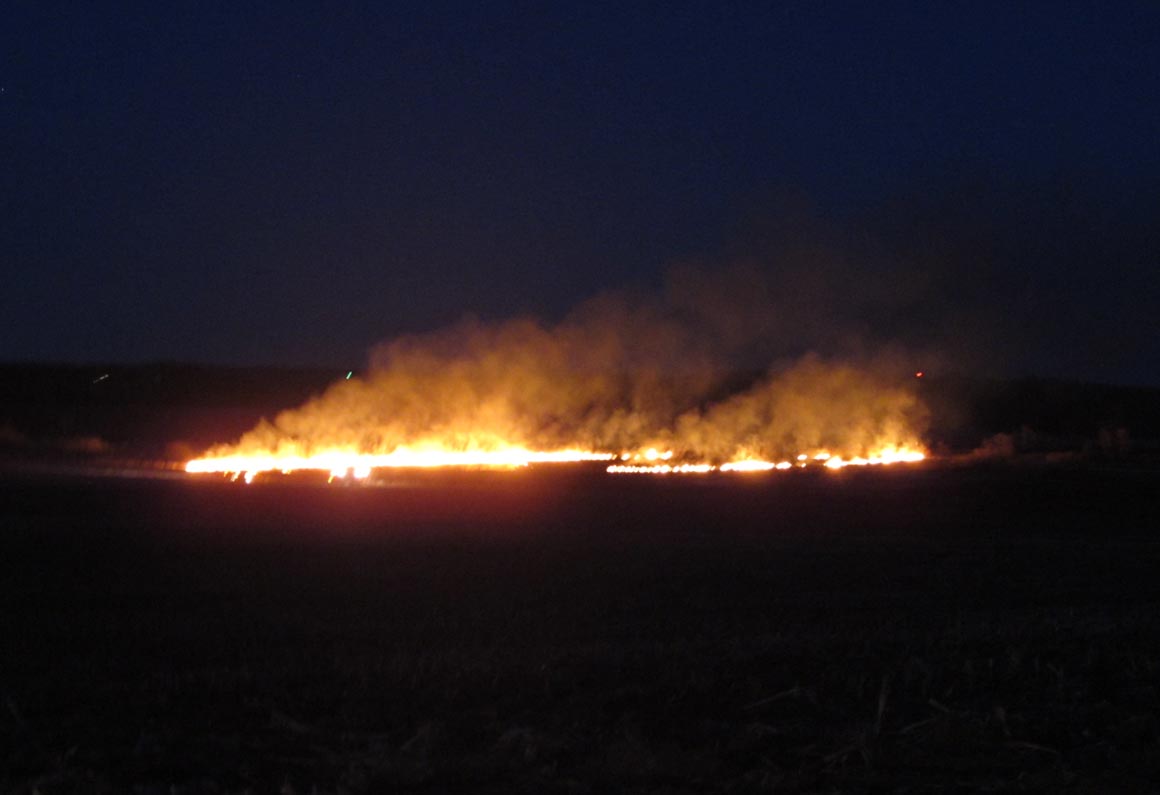
As always, thanks for reading.

Stay well,

If you have a yen for conquest, remember to pack a lunch (with carrots for your horse, of course),

And remember that, as always, there’s

MTCIDC

O

Setting Boundaries

27 Wednesday Mar 2024

Posted by Ollamh in Uncategorized

≈ Leave a comment

Tags

books, Fantasy, J.R.R. Tolkien, lord-of-the-rings, Tolkien

Welcome, dear readers, as always.

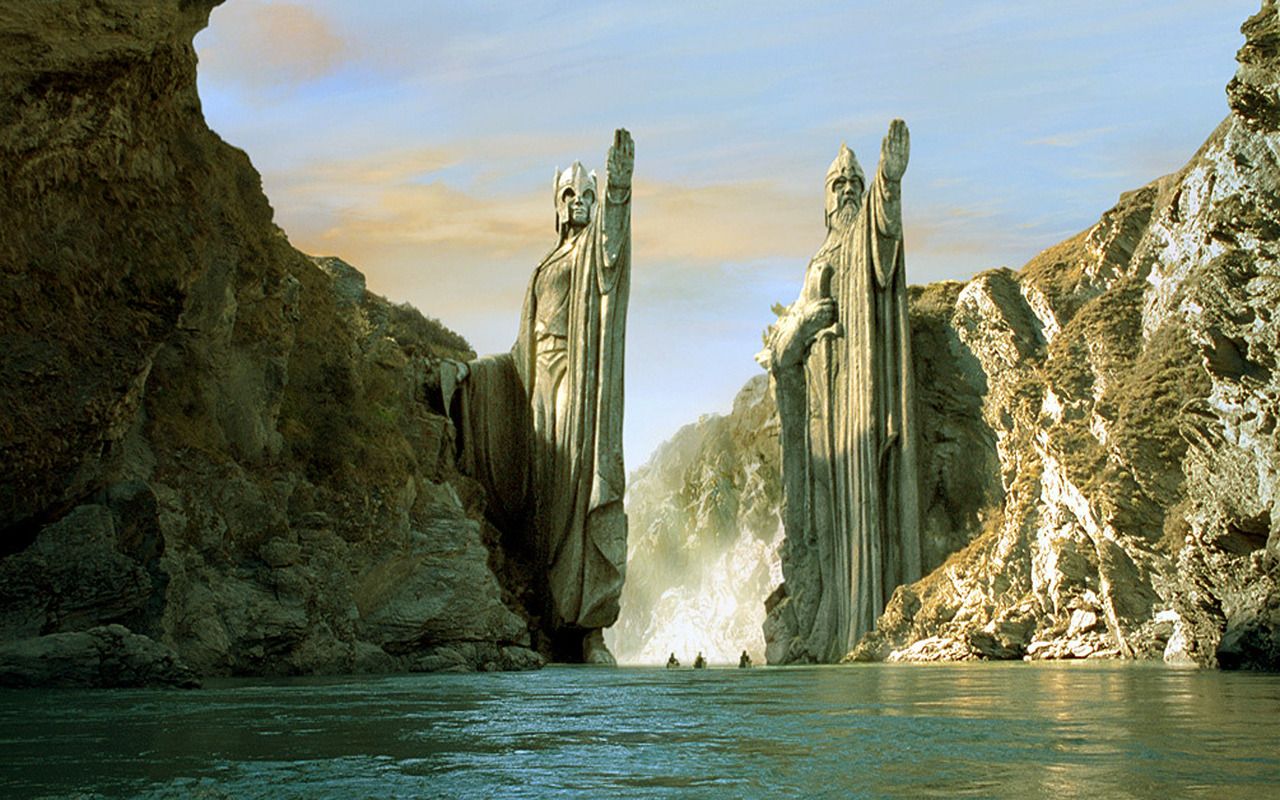
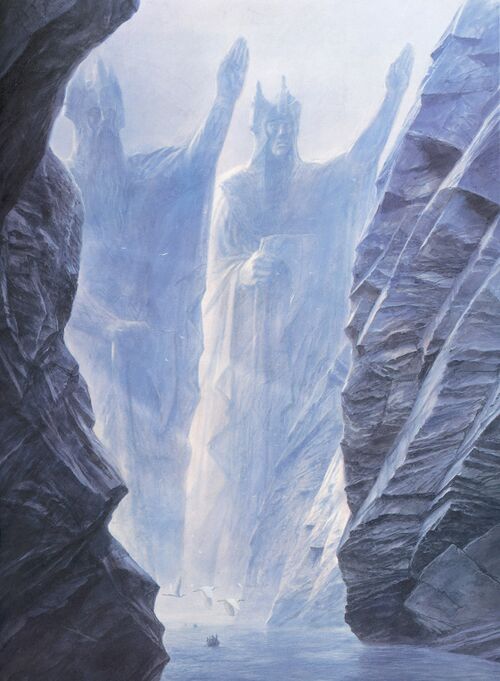
“ ‘Behold the Argonath, the Pillars of the Kings!’ cried Aragorn…

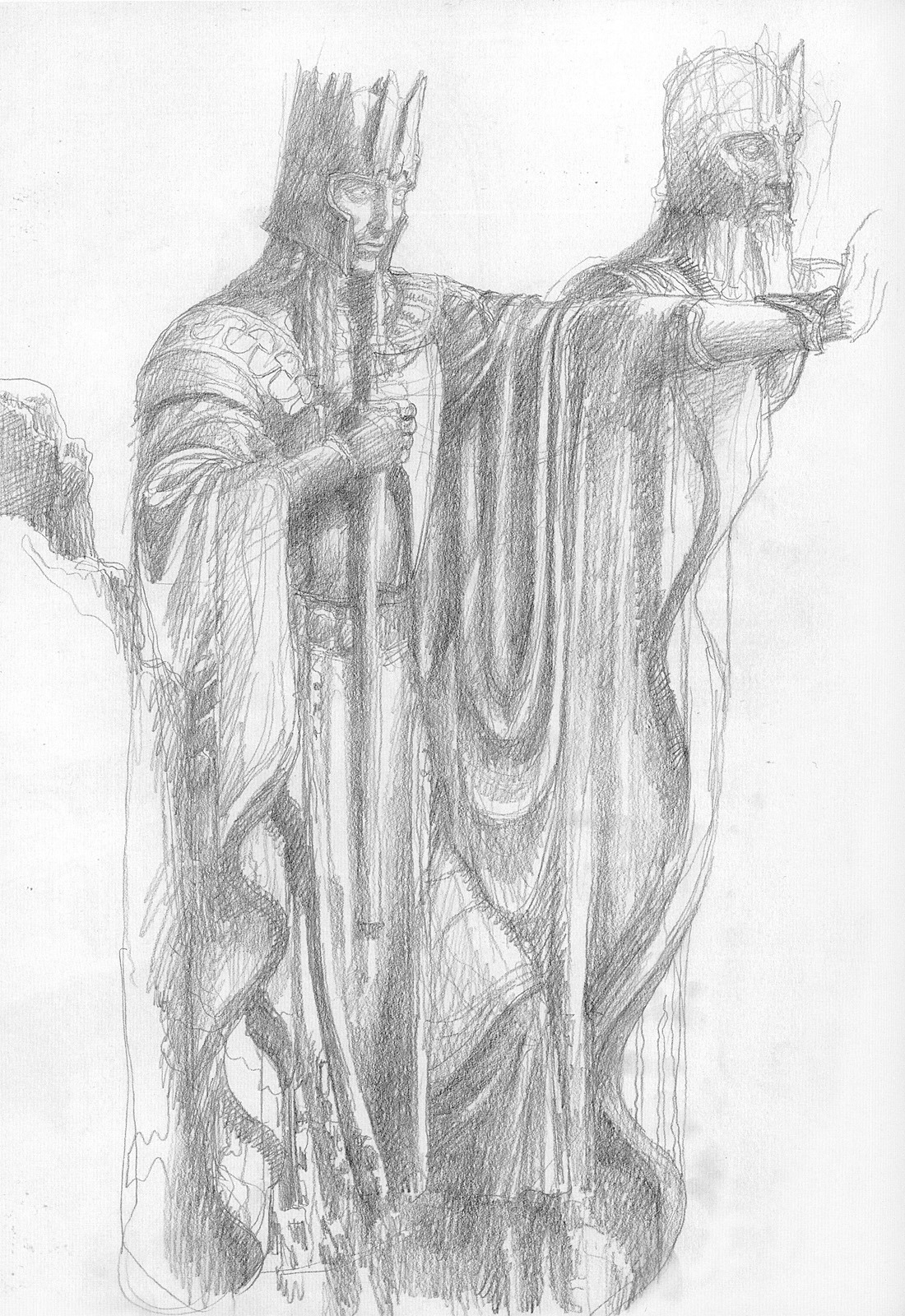
As Frodo was born towards them the great pillars rose like towers to meet him.  Giants they seemed to him, vast grey figures silent but threatening.  Then he saw that they were indeed shaped and fashioned:  the craft and power of old had wrought upon them, and still they preserved through the suns and rains of forgotten years the mighty likenesses in which they had been hewn.  Upon great pedestals founded in the deep waters stood two great kings of stone:  still with blurred eyes and crannied brows they frowned upon the North.  The left hand of each was raised palm outwards in gesture of warning; in each right hand there was an axe; upon each head there was a crumbling helm and crown.  Great power and majesty they still wore, the silent wardens of a long-vanished kingdom…” (The Fellowship of the Ring, Book Two, Chapter 9, “The Great River”)

There are a number of illustrations of this, from the Hildebrandts

to John Howe

to Alan Lee

to J.C. Barquet

and more, including in Jackson’s The Lord of the Rings,

where, in the sometimes perverse method of the films, one figure has a sword, rather than the axe which Tolkien had specifically described (true of the Alan Lee sketch, as well).  Reviewing this short list, however, the first two of these seem to portray the kings with a more peaceably raised left hand, whereas the others more clearly portray what the author wanted:  “The left hand of each was raised outwards in a gesture of warning…”

These figures, in fact, are boundary markers, set up by the Gondorian king Minalcar (later crowned as Romendacil II) some time during his regency (TA1240-1304—see The Lord of the Rings, Appendix A, (ii) “The Southern Line[:] Heirs of Anarion” and (iv) “Gondor and the Heirs of Anarion”) and the gesture is clearly meant as a warning to potential invaders.

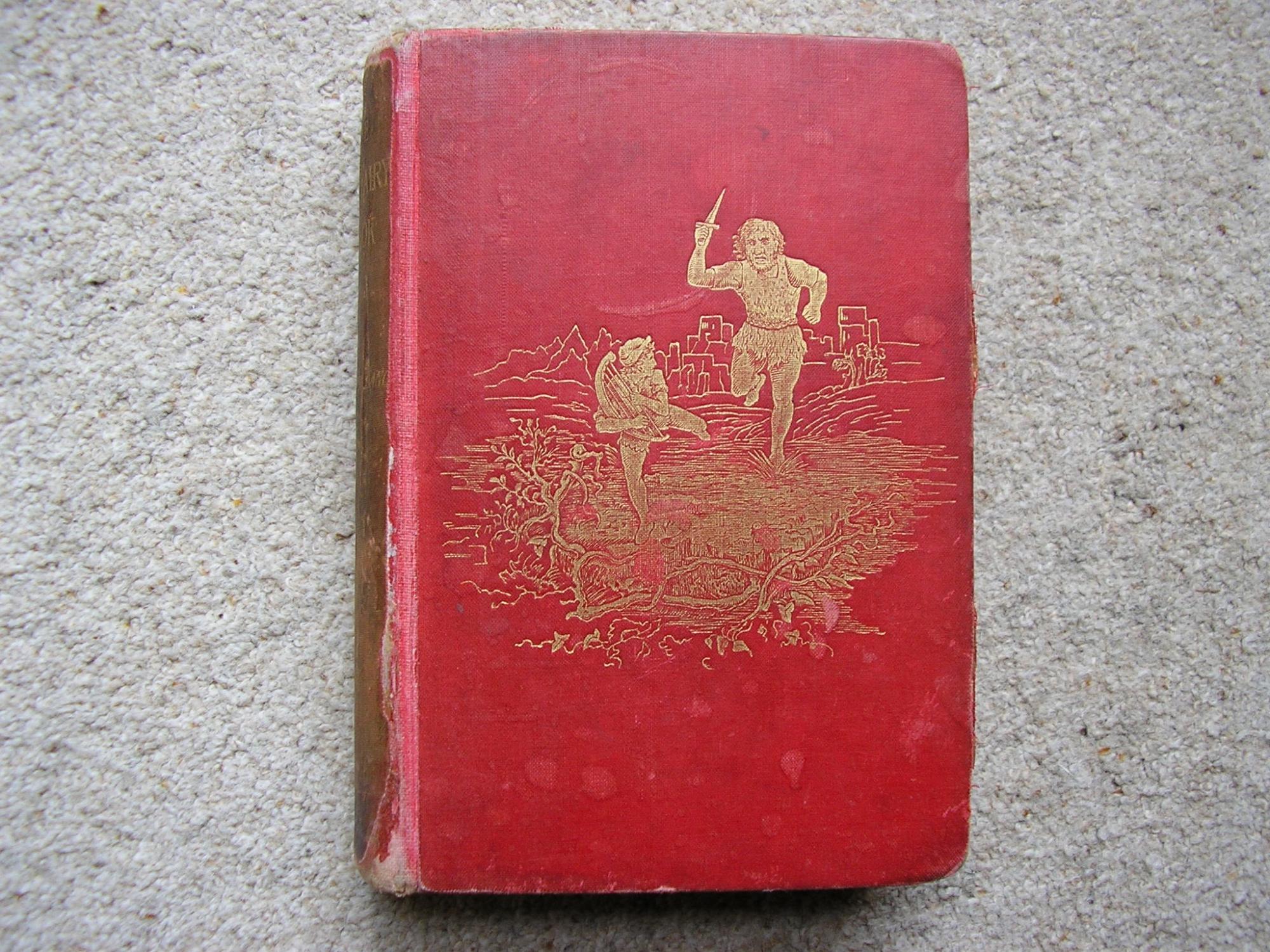
More than once, in past postings, I’ve suggested influences upon Tolkien, from The Red Fairy Book of his childhood,

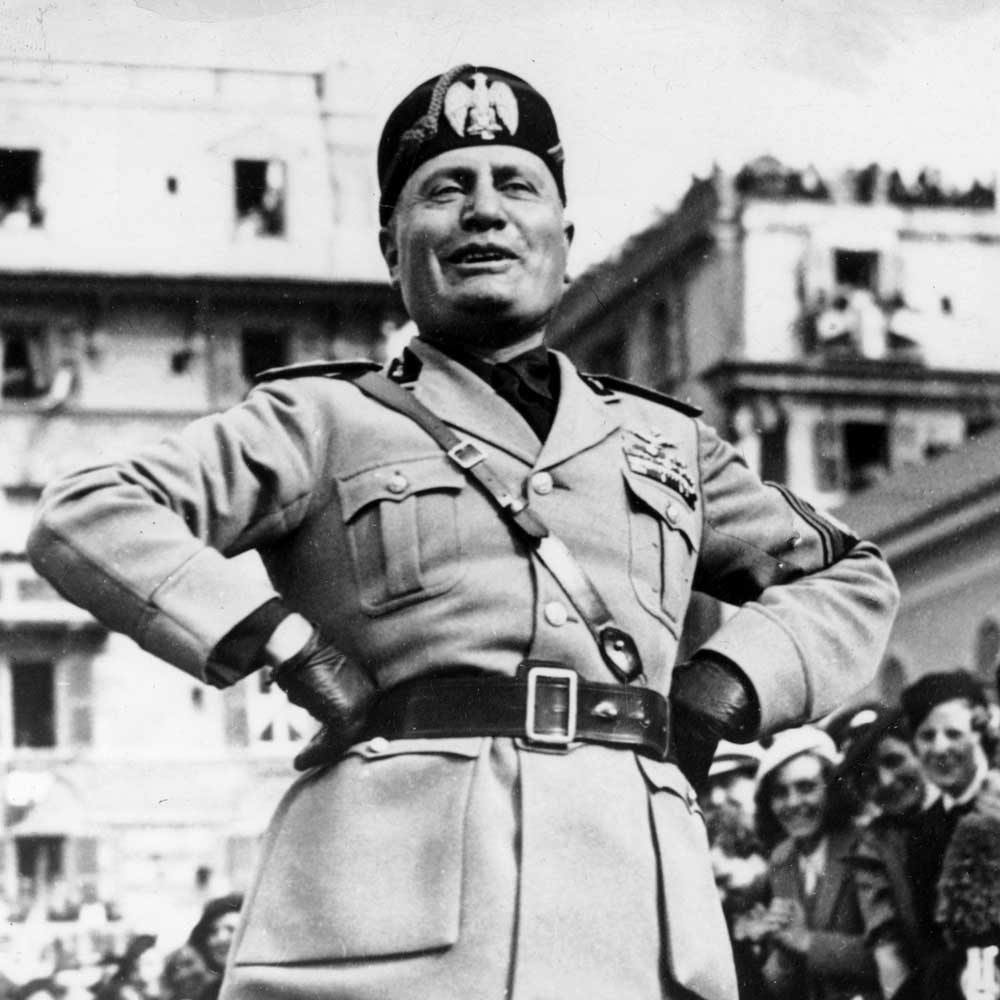
to Mussolini as a possible Saruman model.

In this posting, however, I’m moving forward, perhaps seeing a Tolkien model for something erected long after Tolkien’s death in 1973.

It begins with a bit of history in JRRT’s lifetime.

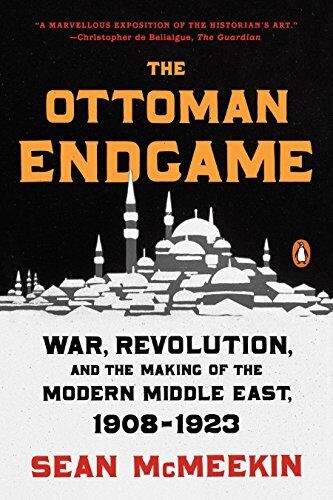
At the end of the Great War (aka “World War I”), the Middle East, the majority of it the fading Ottoman Empire, was very much in flux, with France and Britain struggling diplomatically to extend their influence over Syria, Lebanon, and the area then known as Palestine, as well as farther inland.  (For more on this, see David Fromkin’s The Peace to End All Peace, 1989,

and Sean McMeekin’s The Ottoman Endgame, 2016)

Farther north, and encouraged by the victorious Allies, Greece had invaded Turkey, hoping to expand Greece beyond its current boundaries.

This led to a number of bloody encounters between the two sides, with the Greeks advancing to within 50 miles (80km) of the capital at Ankara in the late summer of 1921 before being stopped at the climactic battle in the area of the Sakarya River.  When the Greeks finally withdrew, they had suffered 23,000 casualties (plus perhaps as many as 15,000 prisoners) against Turkish totals of 22,000 casualties and 1,000 prisoners.  This withdrawal turned into a scorched earth retreat towards the Aegean coast and ultimate evacuation of the Greek army along with thousands of civilians from Asia Minor.  (For more see:  https://www.historynet.com/the-battle-that-made-kemal-ataturk/ ) 

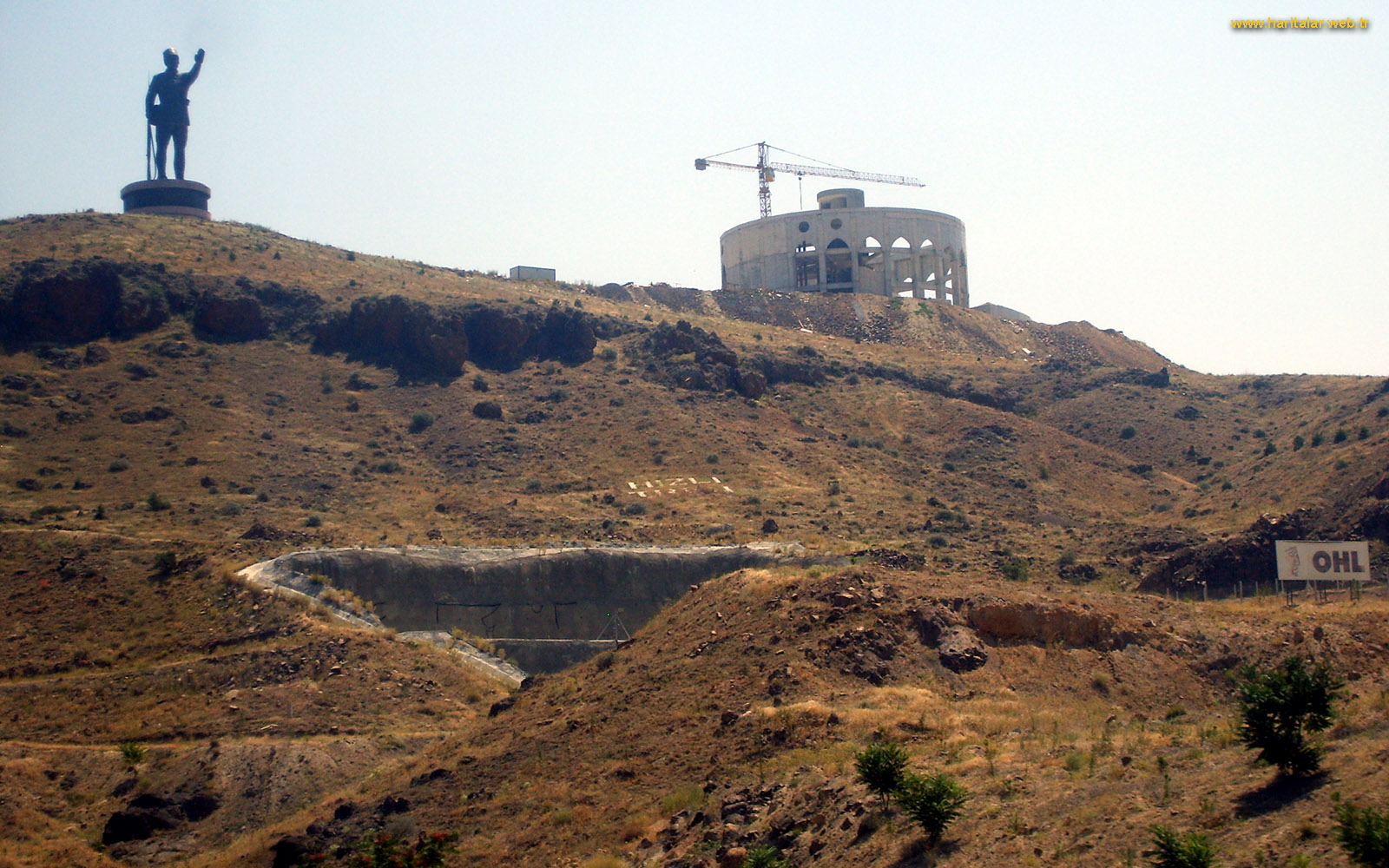
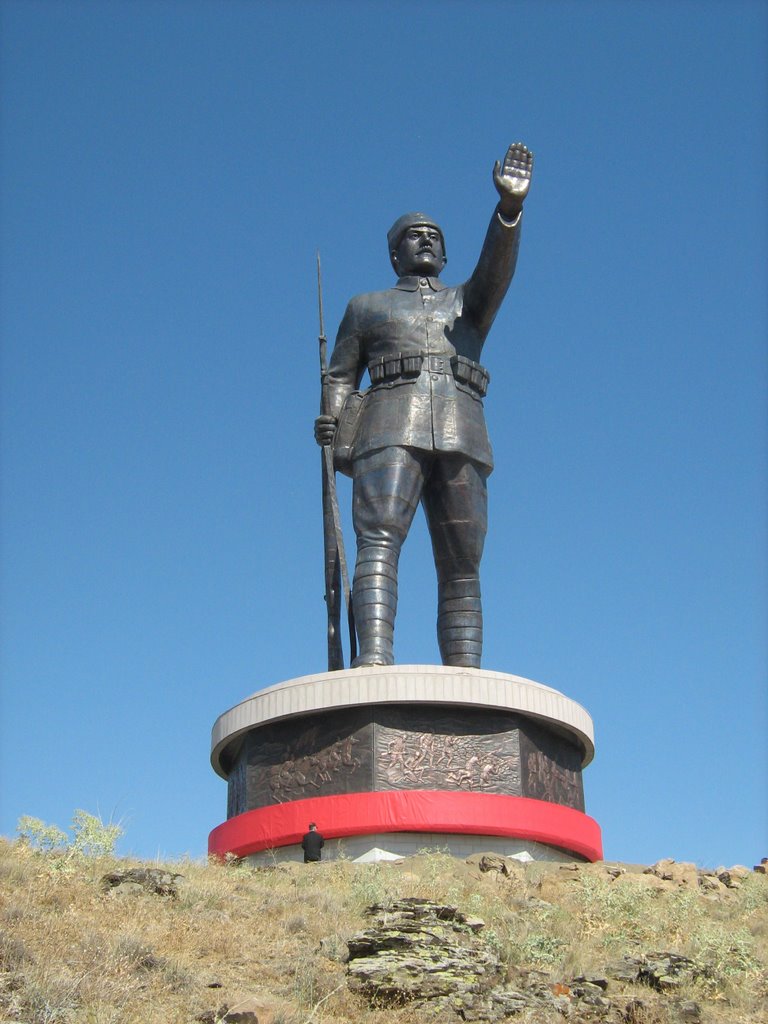
In 2015, the Turkish government established the Battle of Sakarya National Historic Park, but, in 2008, several private companies had already commemorated the battle by commissioning a statue of a Turkish infantryman to be placed on a height (Karaltepe) looking westward in the direction from which the Greek army had come.

 It’s not a boundary marker, per se, as the Argonath is meant to be, but, by marking the line of Turkish resistance to the Greek invasion, it has somewhat of the same effect.  And, though not gigantic, like the Gondorian figures, it’s over 100 feet (31m) tall on its base and the pose certainly reminds me of what Frodo sees in the river ahead,

even if it doesn’t produce the same emotional reaction as it did members of the Fellowship:

“Awe and fear fell upon Frodo, and he cowered down, shutting his eyes and not daring to look up as the boat drew near.  Even Boromir bowed his head as the boats whirled by, frail and fleeting as little leaves, under the enduring shadow of the sentinels of Numenor.”

Had the designers of the Turkish monument read The Fellowship of the Ring, or perhaps had seen the Jackson movie?

Thanks for reading, as ever.

Stay well,

What ancient monument might awe you?

And remember that, as always, there’s

MTCIDC

O
ps

In answer to my own question, I’ve always loved this—

It’s often called “the mourning Athena”, but I imagine that the goddess isn’t grieving, but reading a boundary stone and, armed with helmet and spear, seems ready to defend her city from any who would violate that boundary.  It’s nowhere near the monumental size of those images discussed above, being only about 1 ½ feet (.48m) high, but, with a goddess, does size matter?

Glittering Caves, or, Cheese, Hobbit!

13 Wednesday Mar 2024

Posted by Ollamh in Uncategorized

≈ Leave a comment

Tags

Fantasy, J.R.R. Tolkien, lord-of-the-rings, The Lord of the Rings, travel

Welcome, dear readers, as ever.

In a letter to a “Mr. Wrigley”, Tolkien made this remark:

“I fear you may be right that the search for the sources of The Lord of the Rings is going to occupy academics for a generation or two.  I wish this need not be so.  To my mind it is the particular use in a particular situation of any motive, whether invented, deliberately borrowed, or unconsciously remembered that is the most interesting thing to consider.”  (letter to Mr. Wrigley, 25 May, 1972, Letters, 587)

I would like to add:  not just unconsciously remembered, but also consciously, as in the Caves of Aglarond.

“Strange are the ways of Men, Legolas!” Gimli suddenly burst out, continuing:  “Here they have one of the marvels of the Northern World, and what do they say of it?  Caves, they say!  Caves!  Holes to fly to in time of war, to store fodder in!  My good Legolas, do you know that the caverns of Helm’s Deep are vast and beautiful?  There would be an endless pilgrimage of Dwarves, merely to gaze at them, if such things were known to be.  Aye indeed, they would pay pure gold for a brief glance!”  (The Two Towers, Book Three, Chapter 8, “The Road to Isengard”)

Gimli and Legolas have just survived Saruman’s failed attack on Helm’s Deep,

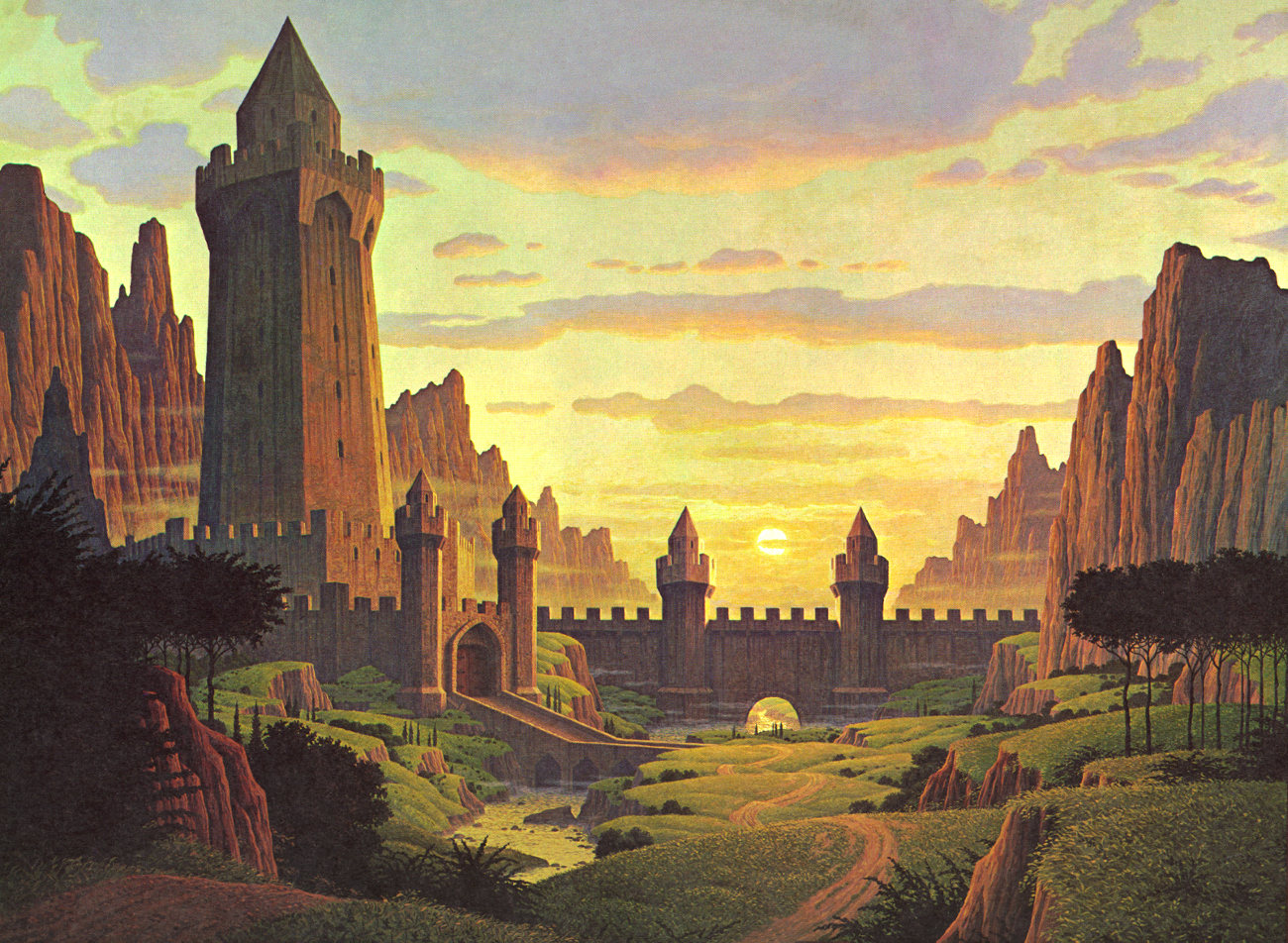
(the Hildebrandts)

where Gimli, separated from his companions, has taken refuge in the very caves he is now raving about.

(Ted Nasmith—and, as ever, he has chosen a moment no one else has thought to illustrate—one of the many reasons I so admire his work)

As Gimli goes on—and he does for half a page—we hear of

“immeasurable halls, filled with an everlasting music of water that tinkles into pools, as fair as Kheled-zaram in the starlight…gems and crystals and veins of precious ore glint in the polished walls; and the light glows through folded marbles, shell-like, translucent as the living hands of Queen Galadriel.”

Remembering Gimli’s ultimate request from Galadriel—a strand of her hair:

“…which surpasses the gold of the earth as the stars surpass the gems of the mine.” (The Fellowship of the Ring, Book Two, Chapter 8, “Farewell to Lorien”)

this is an impressive comparison.  But, for all of JRRT’s wonderful imagination, in fact these caves, although perhaps embroidered by that imagination, were based upon a real place, as Tolkien tells us in a letter:

“I was most pleased by your reference to the description of ‘glittering caves’.  No other critic, I think, has picked it out for special mention.  It may interest you to know that the passage was based on the caves in Cheddar Gorge and was written just after I had revisited these in 1940 but was still coloured by my memory of them much earlier before they became so commercialized.  I had been there during my honeymoon nearly thirty years earlier.”  (letter to P. Rorke, SJ, 4 February, 1971, Letters, 572)

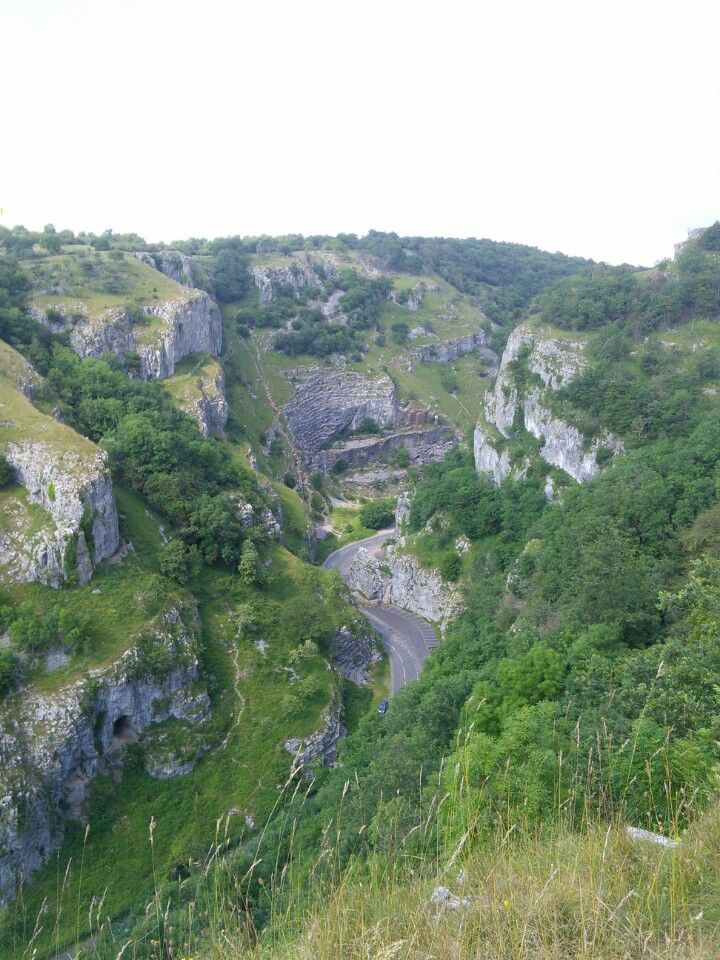
Cheddar Gorge is a natural feature in Dorset, in southwest England in the area of the Mendip Hills.

A gorge is a kind of valley and Cheddar Gorge is one which has cut through layers of limestone to form it.

As you can see, this is spectacular in itself, but there is an attraction within the attraction:  a series of caves in the limestone and this is the sort of thing which Tolkien might have seen on his two visits—

which then inspired Gimli’s impassioned speech (which, by the way, is totally unnecessary to the plot, but which brilliantly illuminates (sorry!) Gimli’s character and adds to his growing friendship with Legolas, who, persuaded by the dwarf’s rhetoric, pledges to return to the caves with him—in return for visiting Fangorn Forest with Legolas).

For those who love cheese, there is another connection here, of course:  billed as “the world’s most popular cheese”, there is Cheddar, a tangy, solid variety, which seems to have originated—yes, in the village of Cheddar, just below the Gorge (and it has been suggested that some of the caves were used to age the cheese in the past).

In a left (or perhaps wrong) turn from Tolkien’s “the particular use in a particular situation of any motive, whether invented, deliberately borrowed, or unconsciously remembered that is the most interesting thing to consider”, I found that, once I made the association:  Caves of Aglarond, Cheddar Gorge, my next step was directly to Cheddar Cheese and, from there, to another English cheese, Wensleydale, made to the northeast, in Yorkshire.

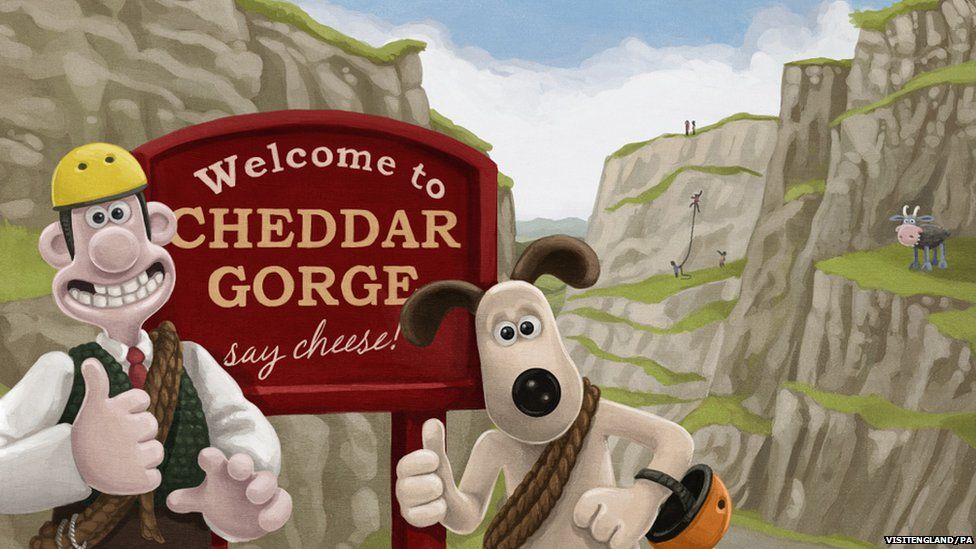
And here’s where cheese and hobbits became intertwined with the characters most devoted to Wensleydale, Wallace and his skeptical dog, Gromit.

These are the brilliant stop-motion creations of Nick Park,

beginning with the pair’s first adventure, “A Grand Day Out” (1989)

in which, in search of a cheese holiday,

they visit the moon in a ramshackle rocket which Wallace (a part-time inventor) built for the trip.

Since then, they have had a number of adventures—“The Wrong Trousers” (1993), “A Close Shave” (1995), and “A Matter of Loaf and Death” (2008), all shorts, along with a feature-length film, “The Curse of the Were-Rabbit” (2005).  If you don’t know them, you can see “A Grand Day Out” for free at the wonderful Internet Archive:  https://archive.org/details/agranddayout_202001 and, if this delights you as much as it’s always delighted me, you can see more at the Archive under “Aardman Animations”, including a series of very short films highlighting some of Wallace’s inventions:  https://archive.org/details/94920

This is very much English humor:  wacky, but played straight, as if visiting the Moon in search of exotic cheese is a perfectly normal thing to do.  I don’t know if JRRT would have enjoyed Wallace and Gromit, but he says this of hobbits:

“…I am personally immensely amused by hobbits as such, and can contemplate them eating and making their rather fatuous jokes indefinitely…” (letter to D.A. Furth, 24 July, 1938, Letters, 49)

so perhaps the adventures of two eccentrics—well, one eccentric and one very sensible canine–

would tickle him.  As I was writing this, I discovered, however, that someone else had already made the association of Cheddar (Gorge) and Wallace and Gromit, at least–

Thanks for reading, as always,

Stay well,

Squirrel away, as Wallace does, Jacob’s Cream Crackers—you just shouldn’t run out,

And remember that there’s always

MTCIDC

O

PS

For more on Cheddar Gorge, see:  https://en.wikipedia.org/wiki/Cheddar_Gorge   For more on Cheddar cheese see:  https://en.wikipedia.org/wiki/Cheddar_cheese

Seem Fairer

06 Wednesday Mar 2024

Posted by Ollamh in Uncategorized

≈ Leave a comment

Tags

books, Fantasy, J.R.R. Tolkien, lord-of-the-rings, Tolkien

As ever, dear readers, welcome.

If you flip to the back of The Letters of J.R.R. Tolkien,

and page through the index to the aitches, you’ll find five references to Adolf Hitler.  The first, to his son, Michael, simply mentions the idea that Hitler must soon attack Britain (letter to Michael Tolkien, 12 January, 1941, Letters, 64).  The third is to another son, Christopher, and makes a brief reference to Stalin and Hitler (letter to Christopher Tolkien, 22 August, 1944, Letters, 131).  Both of these are neutral in tone.  The second, however, has more the tone of a rant:

“Anyway, I have in this War a burning private grudge—which would probably make me a better soldier at 49 than I was at 22:  against that ruddy little ignoramus Adolf Hitler (for the odd thing about demonic inspiration and impetus is that it in no way enhances the purely intellectual stature:  it chiefly affects the mere will).”  (letter to Michael Tolkien, 9 June, 1941, Letters, 77)

And the fourth and fifth (in the same letter) have a similar tone:

“We knew that Hitler was a vulgar and ignorant little cad, in addition to any other defects (or the source of them)…” (letter to Christopher Tolkien, 23-25 September, 1944, Letters, 133)

Both of which are entirely understandable, of course.  In terms of his family, two of his sons were involved in the Second World War, Michael as an anti-aircraft gunner, Christopher as a pilot, and Tolkien worried very much about both, as various letters to them make very plain.

That “burning private grudge”, however, was about something entirely different—and characteristic of JRRT—was his anger at the Nazi perversion of what he thought of as “that noble northern spirit”, as he says in that letter to Michael:

“Ruining, perverting, misapplying, and making for ever accursed, that noble northern spirit, a supreme contribution to Europe, which I have ever loved and tried to present in its true light.”

This being under the direction of:

“…a man inspired by a mad, whirlwind, devil:  a typhoon, a passion:  that makes the poor old Kaiser look like an old woman knitting.”

For all that Tolkien descends to name-calling (not his usual method of dealing with whom or what he doesn’t like), there is a certain—I won’t call it respect—but wary awe of someone he calls a “mad, whirlwind, devil” and, as always when I think about JRRT, his time, and his influences, I wonder about how he his impression of that “vulgar and ignorant little cad”—and “whirlwind devil”—might have influenced his work.

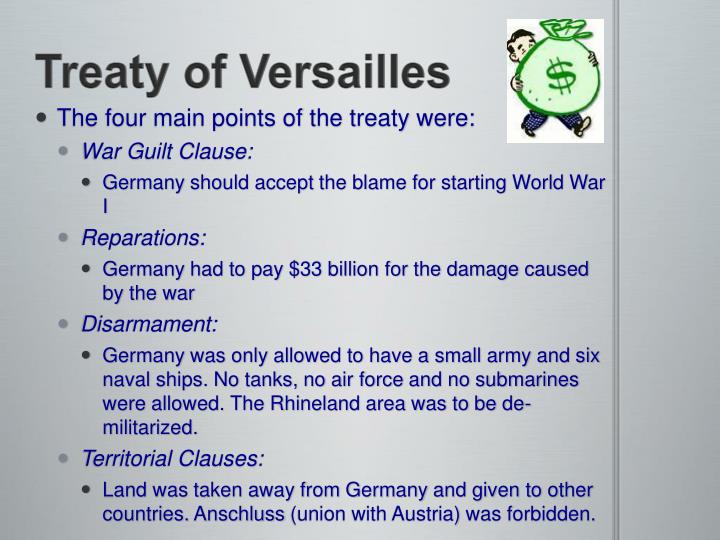
Germany after the Great War was economically and socially in ruins.  The 1919 Treaty of Versailles, blaming Germany for the war and designed to exact severe punishment for that, had done much to put her in that condition.

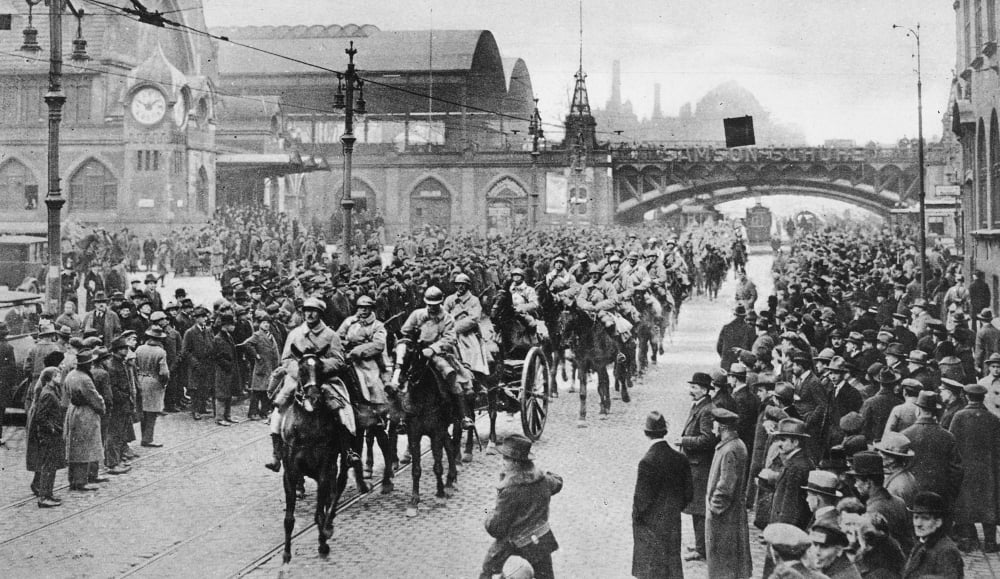
When Germany was unable to pay the amount demanded on time, parts of western Germany were then occupied by several of the Allies.

Bankruptcy, monetary depreciation,

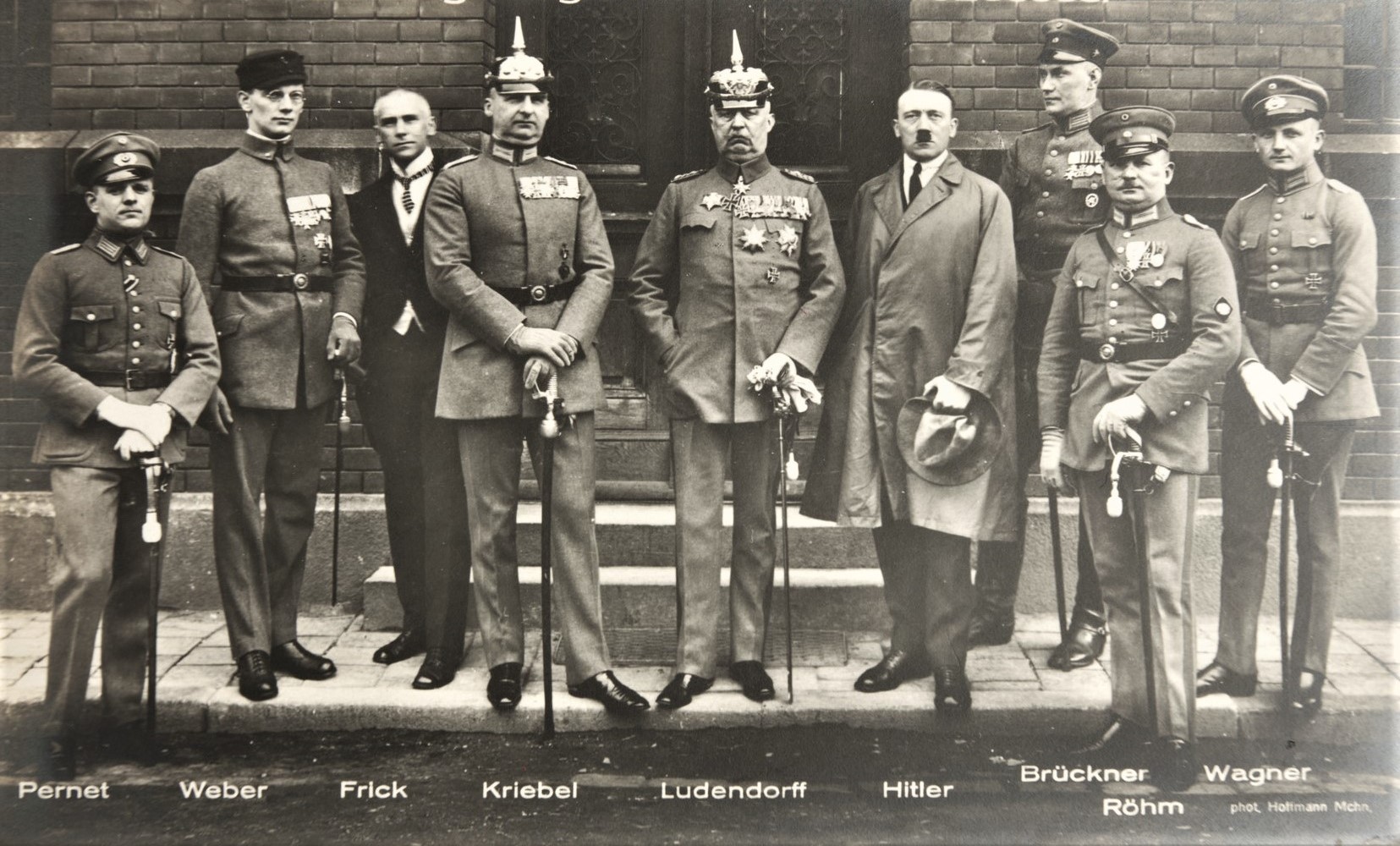
and ideas of revolution swirled—including a brief attempt at revolution in Munich, in 1923.

The leader of this attempt was an ex-serviceman named Hitler.

With a sympathetic court, instead of being executed for treason, he was given a light sentence and soon was out on the streets again, presenting himself not as a violent revolutionary, but as a reformer, someone who was working to bring his country back from the wreckage it has suffered from war, a brutal treaty, a ruined economy, and social unrest (some of which he himself had inspired—and would continue to inspire).

In time, he was so successful at this that he became his country’s director, under the very neutral title of Fuehrer, “Leader” and the economy did improve, living conditions did improve—

but under all of this improvement was something else and here I’m immediately reminded of Sauron:

“Sauron was of course not ‘evil’ in origin…until he became the main representative of Evil of later ages.  But at the beginning of the Second Age he was still beautiful to look at, or could still assume a beautiful visible shape—and was not indeed wholly evil, not unless all ‘reformers’ who want to hurry up with ‘reconstruction’ and ‘reorganization’ are wholly evil, even before pride and the lust to exert their will eat them up.” (draft of a letter to Peter Hastings, September, 1954, Letters, 284)

“But many of the Elves listened to Sauron.  He was still fair in that early time, and his motives and those of the Elves seemed to go partly together:  the healing of the desolate lands.  Sauron found their weak point, suggesting that, helping one another, they could make Western Middle-earth as beautiful as Valinor.” (to Milton Waldman, typescript, “late 1951”, Letters, 212)

And here are the consequences:

“[Sauron] lingers in Middle-earth.  Very slowly, beginning with fair motives:  the reorganizing and rehabilitation of the ruin of Middle-earth, ‘neglected by the gods’, he becomes a reincarnation of Evil, and a thing lusting for Complete Power—and so consumed ever more fiercely with hate (especially of gods and Elves).  All through the twilight of the Second Age the Shadow is growing in the East of Middle-earth, spreading its sway more and more over Men…” (to Milton Waldman, typescript, “late 1951”, Letters, 211)

The title of this posting, as I’ll bet you all know, is part of a remark which Frodo makes just after Strider has appeared and approached him at The Prancing Pony in Bree:

(the Hildebrandts)

“You have frightened me several times tonight, but never in the way that the servants of the Enemy would, or so I imagine.  I think that one of his spies would—well, seem fairer and feel fouler, if you understand.”

To which Strider makes a reply one would never expect Hitler—or Sauron– to have made—

“ ‘I see,’ laughed Strider.  ‘I look foul and feel fair.  Is that it?’ “

As always, thanks for reading.

Stay well,

When it comes to reformers, it might always be wise to question their ultimate motives,

And remember that, as always, there’s

MTCIDC

O
The Unquiet of the World

29 Thursday Feb 2024

Posted by Ollamh in Uncategorized

≈ Leave a comment

Tags

Fantasy, J.R.R. Tolkien, literature, lord-of-the-rings, Tolkien

As always, dear readers, welcome.

We know that Tolkien had mixed feelings about allegory.  As he wrote in a long, detailed description of his work to Milton Waldman in 1951:

“I dislike Allegory—the conscious and intentional allegory—yet any attempt to explain the purport of myth or fairytale must use allegorical language.  (And, of course, the more ‘life’ a story has the more readily will it be susceptible of allegorical interpretations:  while the better a deliberate allegory is made the more nearly will it be acceptable just as a story.)” (from the typescript of a letter to Milton Waldman, late in 1951, Letters, 204)

This has made me think about Saruman and the Shire.

Defeated at the end of the Second Age, it’s easy to see from a map why Sauron returned to Mordor as his refuge.

It’s clearly a natural fortress, protected on three sides by forbidding mountain ranges pierced by only two gates, the Morannon

(the Hildebrandts)

and Minas Morgul (formerly Minas Ithil).

(another Hildebrandts)

His command center, the Barad-dur, was located there.

(and yet another Hildebrandts)

Sited near an active volcano, Mt. Doom,

(This is actually Villarrica in Chile erupting in March, 2015.)

it was also a blighted land, nearly waterless and bleak.

(This is the Parque Nacional de Timanfaya on the island of Lanzarote in the Canary Islands.  As someone who loves the US Southwest, I find this place absolutely stunning, but, imagining it marched across by companies of orcs and suffered across by Sam and Frodo, it might easily stand in for Mordor.)

Although at the time of The Lord of the Rings it has become a vast camp,

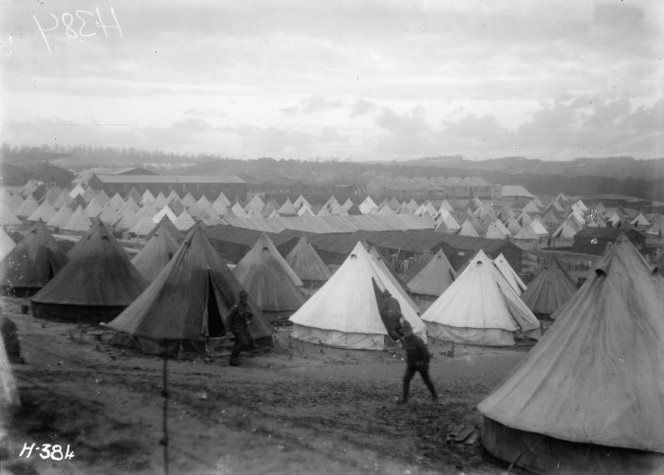
filled with all of the tents and workshops and stables which an army like Sauron’s would require, I have no sense that it was ever anything more than as it must have looked even in the Second Age:  bleak and waterless and dominated to the north by Mt Doom, a vast volcanic plain.  Sauron hadn’t intended to blight it.  Nature had already made it that way and it was useful for what he required:  protection from prying eyes and invading troops and space to spread his growing forces.  (Although I wonder about his water supply—Sam and Frodo are lucky to find the trickle they do—and even “dark pools fed by threads of water trickling down from some source higher up the valley”—by the western mountain wall—The Return of the King, Book Six, Chapter 2, “The Land of Shadow”.  Food seems to have been supplied by slave farms to the south and southeast, also briefly described in this chapter.  Ever-practical Sam wonders about all of this:  “ ‘Pretty hopeless, I call it—saving that where there’s such a lot of folk there must be wells or water, not to mention food.’ “ )

In contrast, there was the Shire—

(JRRT)

As Tolkien imagined it:

“The Shire is placed in a water and mountain situation and a distance from the sea and a latitude that would give it a natural fertility, quite apart from the stated fact that it was a well-tended region when they [the hobbits] took it over…” (letter to Naomi Mitchison, 25 September, 1954, Letters, 292)

It was based, as he stated more than once, on

“…a Warwickshire village of about the period of the Diamond Jubilee [the 60th anniversary of Queen Victoria’s ascension to the throne, 1897]…” (letter to Allen & Unwin, 12 December, 1955, Letters, 334)

which, although the actual village, Sarehole, was just south of the booming manufacturing center of Birmingham, Tolkien describes this world as “…in a pre-mechanical age.”  (letter to Deborah Webster, 25 October, 1958, Letters, 411)

And, to Tolkien, this was

“…in the quiet of the world, when there was less noise and more green…” (The Hobbit, Chapter One, “An Unexpected Party”)

But then Saruman arrives, telling the hobbits:

“ ‘One ill turn deserves another…It would have been a sharper lesson, if only you had given me a little more time and more Men.  Still I have already done much that you will find it hard to mend or undo in your lives.  And it will be pleasant to think of that and set it against my injuries.’ ” (The Return of the King, Book Six, Chapter 8, “The Scouring of the Shire”)

It’s clear from the description given us in “The Scouring of the Shire”, however, that what Saruman intends isn’t just wanton destruction, but something more complex:  a complete reorganization of the Shire.  Part of that is a social restructuring, where a form of communism is forced upon the population.  Monitoring that is the apparatus of a police state, with many rules, a curfew, and a number of the hobbits themselves being recruited to the “Shirriffs”.   But there’s more:

“The pleasant row of old hobbit-holes in the bank on the north side of the Pool were deserted, and their little gardens that used to run down bright to the water’s edge were rank with weeds.  Worse, there was a whole line of the ugly new houses all along Pool Side, where the Hobbiton Road ran close to the bank.  An avenue of trees had stood there.  They were all gone.  And looking with dismay up the road towards Bag End they saw a tall chimney of brick in the distance.  It was pouring out black smoke into the evening air.”

Thus, what Saruman was clearly intending wasn’t just desolation, like Mordor, but rather something more like the imaginary Coketown of Charles Dickens’ Hard Times, 1854:

“It was a town of red brick, or of brick that would have been red if the smoke and ashes had allowed it; town of machinery and tall chimneys, out of which interminable serpents of smoke trailed themselves for ever and ever, and never got uncoiled.  It had a black canal in it, and a river that ran purple with ill-smelling dye, and vast piles of building full of windows where there was a rattling and a trembling all day long, and where the piston of the steam-engine worked monotonously up and down, like the head of an elephant in a state of melancholy madness.  It contained several large streets all very like one another, and many small streets still more like one another, inhabited by people equally like one another, who all went in and out at the same hours, with the same sound upon the same pavements, to do the same work, and to whom every day was the same as yesterday and to-morrow, and every year the counterpart of the last and the next.”   (Hard Times, Chapter 5, “The Keynote” which you can read here:  https://www.gutenberg.org/files/786/786-h/786-h.htm )

Tolkien more than once lamented the passing of the “quiet of the world” and his Shire, which he described in a letter as “where an ordered, civilized, if simple and rural life is maintained” embodied for him that quiet.  (from that same letter to Milton Waldman, late 1951, Letters, 219)

And so, although JRRT wrote, in a letter to the editor of New Republic, Michael Straight, that:

“There is no special reference to England in the ‘Shire’…there is no post-war reference.”

at the same time, he adds:

“…the spirit of ‘Isengard’, if not of Mordor, is of course always cropping up.” (draft of a letter to Michael Straight, “probably January or February 1956, Letters, 340)

We know what that spirit is inspired by, as Treebeard tells us:

“He has a mind of metal and wheels; and he does not care for growing things, except as far as they serve him for the moment.” (The Two Towers, Book Three, Chapter 4, “Treebeard”)

Isengardism—or Sarumanism (a word JRRT himself employs in that same letter to Naomi Mitchison quoted above, saying that he is not a ‘reformer’ (by exercise of power) since it seems doomed to Sarumanism”) to Tolkien meant brutal change—in this case, in the conversion of the Shire into a mini-industrial state, run by a Stalinist tyrant and a cowed population.  Considering Tolkien’s sadness at the conversion of the rural world of his childhood into the industrial world of his present, might we not then see what Saruman does to the Shire as rather like allegory as Tolkien once defined it:

“Of course, Allegory and Story converge, meeting somewhere in Truth.”?  (letter to Sir Stanley Unwin, 31 July, 1947, Letters, 174)

Thanks, as ever, for reading.

Stay well,

Think green thoughts,

And remember that, as always, there’s

MTCIDC

O

What If? (2)

21 Wednesday Feb 2024

Posted by Ollamh in Uncategorized

≈ Leave a comment

Tags

Fantasy, J.R.R. Tolkien, lord-of-the-rings, The Lord of the Rings, Tolkien

Welcome, dear readers, as ever.

In the Star Wars fan world, there has been a lot of recent chatter about a Star Wars “What If?” film.  So far, it seems to be just chatter, but the speculation has gone in all sorts of directions and some very creative people have even produced potential posters, like this one—

with Anakin in his Darth Vader suit, which is real, but Obi Wan and Ahsoka as Imperial officers—a very grim idea.  (For more on possible scenarios, see:  https://thedirect.com/article/star-wars-what-if-disney-plus-2024  I think my favorite is the idea of Jar Jar Binks as a Sith lord—

see this especially silly version here:  https://www.youtube.com/watch?v=dB4sKebTr5k  )

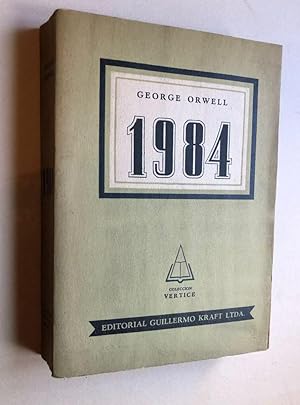
What Ifs are common in the world of fictions of all sorts, from Sci-Fi to Historical, and I’ll bet that you can immediately produce a few titles—from 1984

(a very complex “What If?” in which, unlike many of the genre, we don’t begin with actual history taking a left turn, as in something like some of Harry Turtledove’s books, where, for instance, the South has won the Civil War,

but a world in which something has changed things earlier, producing a series of three large warring states, at least one of which, Oceania, is a reflection of a kind of Stalinist UK)

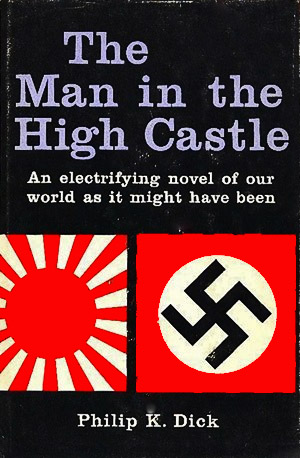
to The Man in the High Castle,

as well as many more. 

It’s always an interesting approach to a story and, when well done, can be anything from entertaining to disturbing.  One which comes to mind as a dead failure, however, might begin with this:

“ ‘I have come,’ he said.  ‘But I do not choose now to do what I came to do.  I will not do this deed.  The Ring is mine!’ And suddenly, as he set it on his finger, he vanished from Sam’s sight.”  (The Return of the King, Book Six, Chapter 3, “Mount Doom”.)

(Alan Lee)

We all know what happens next.  Sauron is suddenly not so sure of his triumph:

“And far away, as Frodo put on the Ring and claimed it for his own, even in Sammath Naur the very heart of his realm, the Power in Barad-dur was shaken, and the Tower trembled from its foundations to its proud and bitter crown.”

But then:

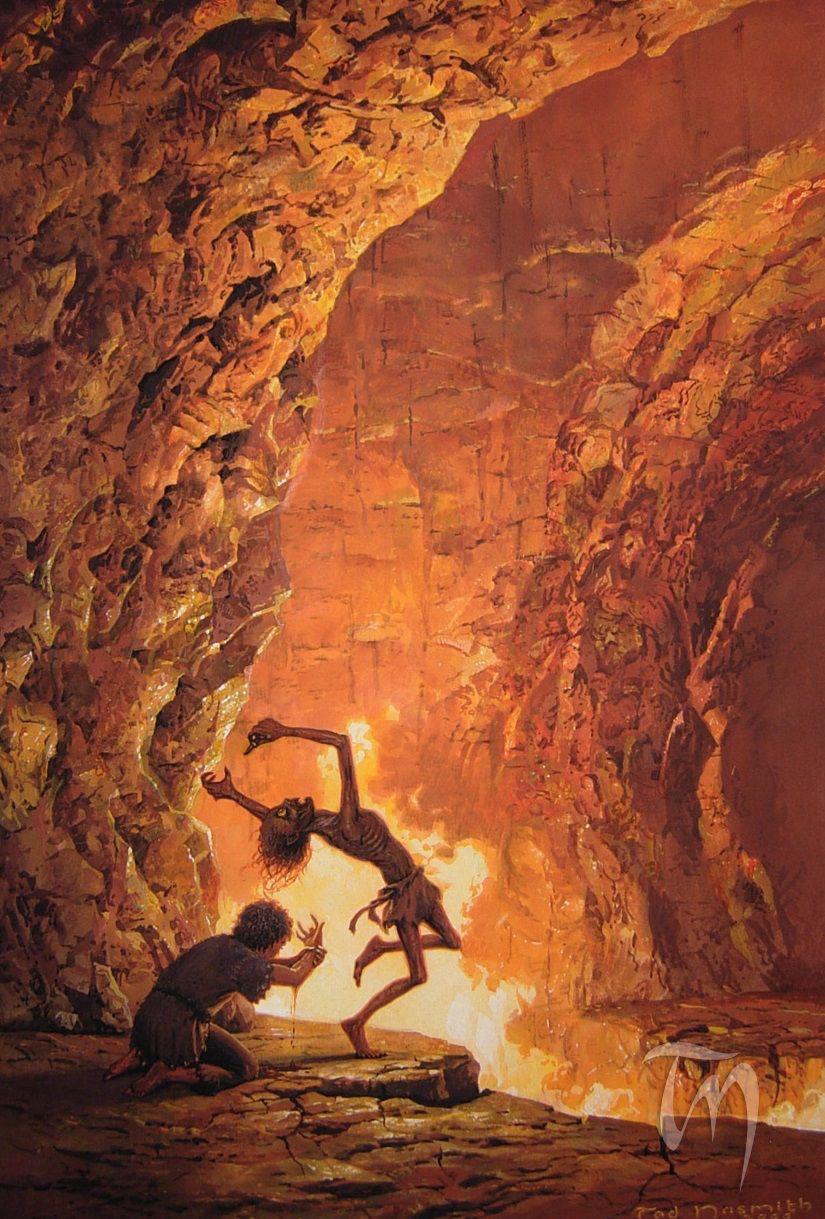
“Suddenly Sam saw Gollum’s long hands draw upwards towards his mouth; his white fangs gleamed, and snapped as they bit.  Frodo gave a cry, and there he was, fallen upon his knees at the chasm’s edge.  But Gollum, dancing like a mad thing, held aloft the ring, a finger still thrust through its circle.”

And then:

“ ‘Precious, precious, precious!’ Gollum cried.  ‘My Precious!  O my Precious!’  And with that, even as his eyes were lifted up to gloat on his prize, he stepped too far, toppled, wavered for a moment on the brink, and then with a shriek he fell.  Out of the depths came his last wail Precious, and he was gone.”

(Ted Nasmith)

In a brief space, we’re confronted with not one, but two, What Ifs, but let’s deal with the second one first, as, after all, Gollum had actually had control of the Ring long before Frodo even became aware of it—for 478 years.  During that time, what had he done with it and himself?

1. he had murdered a friend to obtain it

2. taking up eaves-dropping and petty theft, he’d eventually been exiled from his people

3. finally, he had crept under the Misty Mountains, where he lived on a diet of fish and goblins (when he could catch one) until he lost the Ring (or, perhaps more correctly, the Ring lost him) 80 years before The Lord of the Rings.

The only use he seems to have had for the Ring all that time was as a kind of cloaking device.  I think that we can presume that, had he successfully escaped Sam and Frodo, he would have been quickly apprehended by Sauron’s agents and deprived of his Precious, and worse.

This leaves us with Frodo—and yet we shouldn’t forget the Ring’s other previous possessors.  First, there was Isildur, who cut the Ring from Sauron’s hand at the Battle of Dagorlad—only to have it betray him to orc archers at the Gladden Fields.  Perhaps he hadn’t time to do anything with it, having held it so briefly, it being only 2 years after Dagorlad, but Tolkien never shows him doing anything more than wearing it as a kind of trophy.

And then, of course, there is Bilbo, who, in fact, uses it rather as Gollum did, to disappear from time to time, both in the adventure to the Lonely Mountain and back again and in the years afterwards.  If a king who had actually defeated Sauron did nothing with the Ring’s power, what could one expect from a hobbit?

This brings us back to Frodo.  He is recorded as having put the Ring on only twice:  at Weathertop, when he was almost mortally wounded by one of the Nazgul, and, later, on Amon Hen, where he was terrified by the sudden attention of Sauron:

“And suddenly he felt the Eye.  There was an eye in the Dark Tower that did not sleep.  He knew that it had become aware of his gaze.  A fierce eager will was there.  It leaped towards him; almost like a finger he felt it, searching for him.  Very soon it would nail him down, know just exactly where he was.  Amon Lhaw it touched.  It glanced upon Tol Brandir—he threw himself down from the search, crouching, covering his head with his grey hood.” (The Fellowship of the Ring, Book Two, Chapter 10, “The Breaking of the Fellowship”)

The problem is that, as JRRT explains:

“[Sauron] rules a growing empire from the great dark tower of Barad-dur in Mordor, near to the Mountain of Fire, wielding the One Ring.

But to achieve this he had been obliged to let a great part of his own inherent power…pass into the One Ring.  While he wore it, his power on earth was actually enhanced.  But even if he did not wear it, that power existed and was in ‘rapport’ with himself:  he was not ‘diminished’.”

And yet—

“Unless some other seized it and became possessed of it.”

There is, however, a condition to this—

“If that happened, the new possessor could (if sufficiently strong and heroic by nature) challenge Sauron, become master of all that he had learned or done since the making of the One Ring, and so overthrow him and usurp his place.”

At the same time:

“Also so great was the Ring’s power of lust, that anyone who used it became mastered by it; it was beyond the strength of any will (even his own) to injure it, cast it away, or neglect it.” (draft of a letter to Milton Waldman, “late in 1951”, Letters, 214)

It appears, then, that the Ring enhances the power of him who holds it—but consider those who had, beyond Sauron—what power did any of them, besides Isildur, have?  And what power did Isildur have, when, faced with the Ring’s destruction, as Elrond tells us:

“ ‘Isildur took it, as should not have been.  It should have been cast then into Orodruin’s fire nigh at hand where it was made.  But few marked what Isildur did.  He alone stood by his father in that last mortal contest; and by Gil-galad only Cirdan stood, and I.  But Isildur would not listen to our counsel…

…and therefore whether we would or no, he took it to treasure it.  But soon he was betrayed by it to his death; and so it is named in the North Isildur’s Bane.  Yet death maybe was better than what else might have befallen him.”  (The Fellowship of the Ring, Book Two, Chapter 2, “The Council of Elrond”)

If Gollum used it for burglary and Bilbo for concealment and Isildur is brought to his death by it—and might have fared worse, had he lived—what would have been the fate of Frodo, had he been able to retain the Ring, as he attempted, at the last minute, to do?  Heroic he might be, but with a strength to equal Sauron’s?

I suspect that the consequences would have been the same as those of the Gollum What If and as described by the Mouth of Sauron in his gloating threat to Gandalf when it was suggested that Frodo was in Sauron’s hands:

“And now he shall endure the slow torment of years, as long and slow as our arts in the Great Tower can contrive, and never be released unless maybe when he is changed and broken…” (The Return of the King, Book Five, Chapter 10, “The Black Gate Opens”)

For all that Frodo suffers from the Ring before and after Gollum’s attack, better those sufferings than that possible What If.

Thanks, as ever, for reading.

Stay well,

Say with Faramir, “Not if I found it on the highway would I take it”,

And remember that, as always, there’s

MTCIDC

O

Romance

14 Wednesday Feb 2024

Posted by Ollamh in Uncategorized

≈ Leave a comment

Tags

books, Fantasy, lord-of-the-rings, The Lord of the Rings, Tolkien

Welcome, as ever, dear readers.

As I believe I’ve reported before, I’ve been rewatching Jackson’s The Lord of the Ring films after a number of years and something struck me in his The Fellowship of the Ring which has brought to mind Tolkien’s own remarks about going from book to film.

In 1958, it was proposed to make a film of The Lord of the Rings.  Tolkien, via Forrest J. Ackerman, was sent a story-line created by a “Mr. Zimmerman” and spent a good deal of time reading through and commenting.  There are only some sections of this commentary available to us in Letters, but these suggest that what he read seriously dismayed and displeased him:

“The commentary goes along page by page, according to the copy of Mr. Zimmerman’s work, which was left with me, and which I now return.  I earnestly hope that someone will take the trouble to read it.

If Z and/or others do so, they may be irritated or aggrieved by the tone of many of my criticisms.  If so, I am sorry (though not surprised).  But I would ask them to make an effort of imagination sufficient to understand the irritation (and on occasion the resentment) of an author, who finds, increasingly as he proceeds, his work treated as it would seem carelessly in general, in places recklessly, and with no evident signs of any appreciation of what it is all about…

The canons of narrative art in any medium cannot be wholly different; and the failure of poor films is often precisely in exaggeration, and in the intrusion of unwarranted matter owing to not perceiving where the core of the original lies.” (from an undated—June, 1958—letter to Forrest J. Ackerman, Letters, 389-390)

As I watched, I found myself thinking about what Tolkien wrote and about, of all things, romance, but, as it’s Valentine’s Day, 14 February, what could be more appropriate for a posting?

Valentine’s Day was once celebrated in the Christian calendar as the occasion of the martyrdom of Valentinus, a 3rd-century AD priest, the date first (perhaps) officially appearing in the 8th-century Gelasian Sacramentary,

aka the Liber Sacramentorum Ecclesiae Romanae, where you’ll find, inLiber Secundus, XI, “Orat. in Natali Valentini, Vitalis, Feliculae”–“Prayers on the Martyrdom of Valentinus, Vitalis, and Felicula”, dated for “xvi Kal. Martias”—that is, 14 February.  (You can read it here:  https://books.google.com/books?id=S-20jhQQZBMC&dq=sacramentary&pg=RA3-PA1#v=onepage&q=sacramentary&f=false  The Gelasius mentioned is a 5th-century pope who probably had nothing whatever to do with the book—for more see:  https://en.wikipedia.org/wiki/Gelasian_Sacramentary )

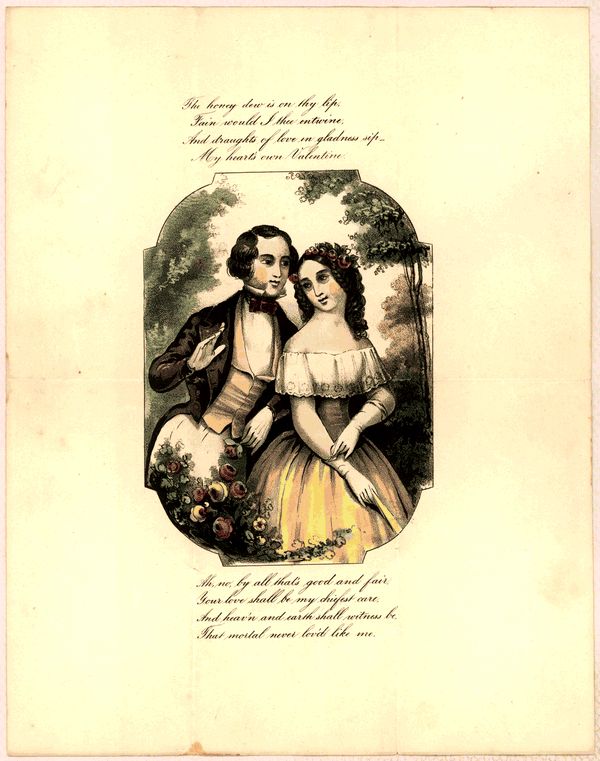
Valentinus was squeezed out of the ecclesiastical calendar in 1969 (which you can read about here:  https://aleteia.org/2022/02/09/why-is-st-valentines-feast-day-not-on-the-churchs-calendar/ ), but St Valentine’s day has been part of Western romantic tradition since at least the later Middle Ages and began to become a commercial success in the 19th century, when preprinted cards first appeared.

(And I can’t resist this—possibly the first printed valentine—which dates, in fact, to 1797.

See this for more:  https://www.bbc.co.uk/ahistoryoftheworld/objects/L1NM_6mWRymAMKXcRDlXJA

and see this for more on early commercial valentines:  http://www.go-star.com/antiquing/early-valentines.htm )

The romance I want to talk about in this posting, however, comes from a different time although, according to its author, Tolkien, not from a different place.

In a way, it’s actually a kind of echo-romance, in which the first part happened some 6500 years before the second part, in the First Age of Middle-earth, but many of its conditions were the same. 

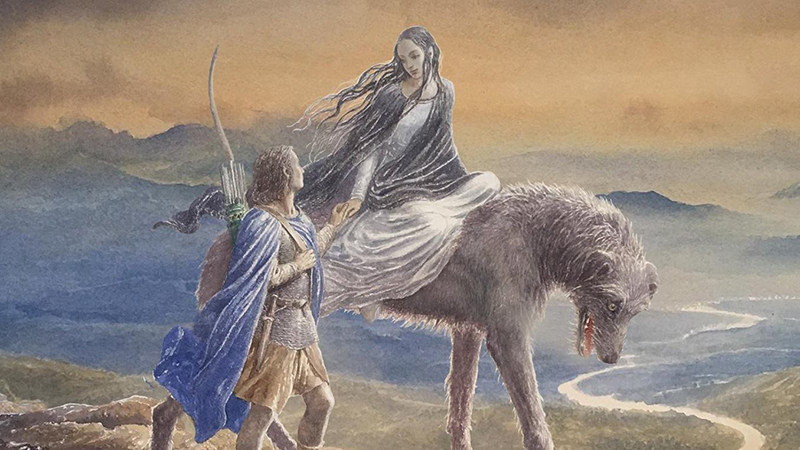
The Tale of Beren and Lúthien, by J.R.R. Tolkie

(Alan Lee)

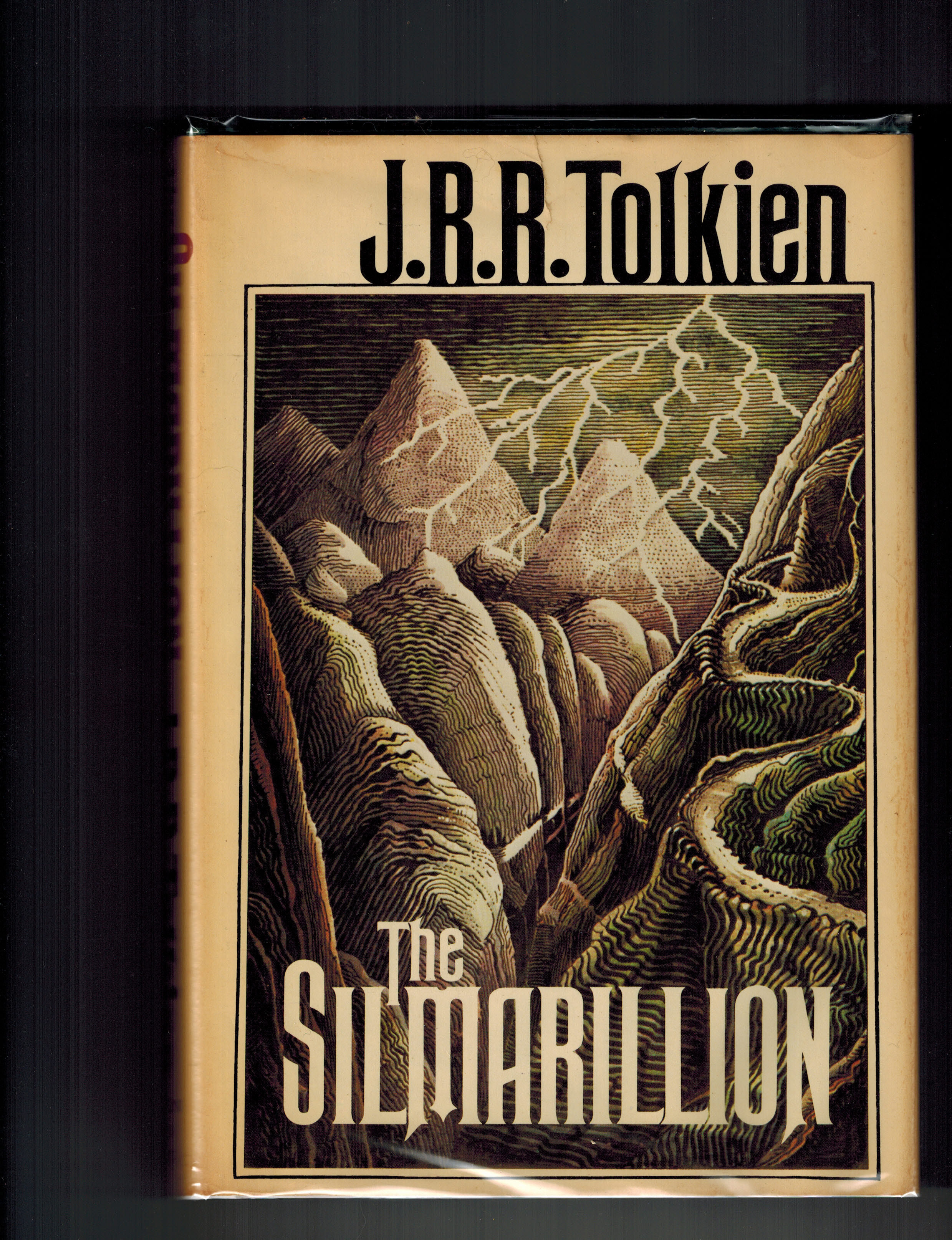
A note, however:   this is a very complex story, which JRRT developed over many years, appearing in one form in the Silmarillion, 1977,

and in a multiform, Beren and Luthien, 2017, both versions edited by Christopher Tolkien.

For my purposes, I’m going to compress the story into the simplest form possible—something like this:

1. Beren is a mortal, who falls in love with Luthien, an elven immortal and the daughter of Thingol, king of Doriath

2. Thingol sets Beren a task:  for Beren to wed Luthien, he must retrieve one of the Silmarils from the crown of Morgoth

3. Beren, with Luthien’s help, finally manages to do this and can marry Luthien, but, later, is killed and Luthien goes to the Halls of Mandos (basically, the ruler of the dead) and manages, through song (yes, Orpheus and Eurydice is in there somewhere)

to regain him, but is faced with a choice:  she can retain her immortality and go on to Valinor, the home of the immortal Valar, without Beren, or she can go back to Middle-earth with Beren, become mortal, and die

4. She stays with Beren and, from that comes “the Choice of Luthien”—giving up immortality to remain with a mortal loved one

This brings us to the echo:  Aragorn and Arwen, the many details of which you can read in Appendix A, V, in The Lord of the Rings, “Here Follows a Part of the Tale of Aragorn and Arwen”, but, in simplified form:

1. Aragorn, a mortal, falls in love with Arwen, an elf and daughter of Elrond

2. Elrond sets the condition that only if Aragorn can make himself king of Gondor and Arnor can he marry Arwen

3. we know how this turns out:  Aragorn eventually becomes king and gains Arwen

(the Hildebrandts)

4. but she, too, must make the “Choice of Luthien” and, as JRRT tells us:

“When the Great Ring was unmade and the Three were shorn of their power, then Elrond grew weary at last and forsook Middle-earth, never to return.  But Arwen became as a mortal woman, and yet it was not her lot to die until all that she had gained was lost.”  (The Lord of the Rings, Appendix A, V,
“Here Follows a Part of the Tale of Aragorn and Arwen”)

It’s clear that this choice, once made, is irrevocable, as Arwen tells the fading Aragorn, when he suggests that she can still make the journey to Valinor after his passing: 

“Nay, dear lord…that choice is long over.  There is now no ship that would bear me hence, and I must indeed abide the Doom of Men, whether I will or I nill:  the loss and the silence.”

And, to me, this is what takes Tolkien’s story from being a wonderful fantasy to a higher level:  heroic people here make choices which will bring bitter loss, but still choose to make them:  Frodo to save the Shire, as he tells us he originally hoped, Arwen to remain with Aragorn, fully aware of the consequences.   It’s grown-up romance and Arwen’s choice is central to that.

In Jackson’s film of The Fellowship of the Ring, however, we’re shown a completely different reason for Arwen’s choice:  she trades her immortality for Frodo’s life.  Here’s what happens in Scene 21:

“Frodo suddenly becomes very weak as Arwen lies [sic] him on the ground.

ARWEN:  No! Frodo! No!  Frodo don’t give in, not now.

Tears spring into her eyes as she hugs him.

ARWEN

VOICE:  What grace has given me, let it pass to him.  Let him be spared.

Visions of Rivendell appear.  Frodo appears sleeping in the visions.

ARWEN

VOICE:  Save him.

ELROND:  (face appears in the vision)  Lasto beth non.  Tolo dan na ngalad.  (Hear my voice, come back to the light)” (You can read the whole text of the film here:  http://www.ageofthering.com/atthemovies/scripts/fellowshipofthering1to4.php )

Much of Tolkien’s criticism of “Mr. Zimmerman’s” script is that, as he says, it shows “no evident appreciation of what it is all about”.  In this case, this is Arwen’s sacrifice not for someone she, in the book, will not meet at this point in the story, the script-writers having replaced the actual character who attempts to rescue Frodo, the elf lord Glorfindel, with Arwen, but her sacrifice of her immortality for her love, Aragorn, just as Luthien had done for Beren, thousands of years before.  The echo, besides its poignancy, is intentional on Tolkien’s part:

“Arwen is not ‘a re-incarnation’ of Luthien…but a descendant very like her in looks, character, and fate.  When she weds Aragorn…she ‘makes the choice of Luthien’…” (draft of a letter to Peter Hastings, September, 1954, Letters, 288)

In 1963, Tolkien tried to explain not her choice, which, to him, was evident, but the reason behind Frodo’s ability to pass to the West:

“It is not made explicit how she could arrange this.  She could not of course just transfer her ticket on the boat like that!  For any except those of the Elvish race ‘sailing was not permitted, and any exception required ‘authority’, and she was not in direct communication with the Valar, especially not since her choice to become ‘mortal’.”  (from the drafts of a letter to Mrs. Eileen Elgar, September, 1963, Letters, 462)

Eventually, he suggests that Gandalf must have been involved, but what’s important here—and for the romance with which I began—is that Arwen’s surrender of her immortality was not a generous act to save a fading hobbit, but rather the renewal of a sacrifice made for the same reason by a distant ancestor, Luthien (who is also, in fact, a distant ancestor of Aragorn, as well), many years earlier.  As I said before, it’s grown-up romance and her choice is central to that.

All of that being said, happy Valentine’s Day.

Thanks, as always, for reading.

Stay well,

Be glad for saints—the good ones have much to teach us,

And remember that, as always, there’s

MTCIDC

O
PS

There is, in fact, competition for the title of St. Valentine of the cards, flowers, and chocolate.  See:  https://en.wikipedia.org/wiki/Saint_Valentine )

Newer posts →

The Doubtful Sea Series Facebook Page

The Doubtful Sea Series Facebook Page

  • Ollamh

Categories

  • Artists and Illustrators
  • Economics in Middle-earth
  • Fairy Tales and Myths
  • Films and Music
  • Games
  • Heroes
  • Imaginary History
  • J.R.R. Tolkien
  • Language
  • Literary History
  • Maps
  • Medieval Russia
  • Military History
  • Military History of Middle-earth
  • Narnia
  • Narrative Methods
  • Poetry
  • Research
  • Star Wars
  • Terra Australis
  • The Rohirrim
  • Theatre and Performance
  • Tolkien
  • Uncategorized
  • Villains
  • Writing as Collaborators
Follow doubtfulsea on WordPress.com

Across the Doubtful Sea

Recent Postings

  • A Moon disfigured December 17, 2025
  • On the Roads Again—Once More December 10, 2025
  • (Not) Crossing Bridges December 3, 2025
  • On the Road(s) Again—Again November 26, 2025
  • On the Road(s) Again November 19, 2025
  • To Bree (Part 2) November 12, 2025
  • To Bree (Part 1) November 5, 2025
  • A Plague o’ Both—No, o’ All Your Houses! October 29, 2025
  • It’s in Writing (2:  I’st a Prologue, or a Poesie for a Ring?) October 22, 2025

Blog Statistics

  • 103,228 Views

Posting Archive

  • December 2025 (3)
  • November 2025 (4)
  • October 2025 (5)
  • September 2025 (4)
  • August 2025 (4)
  • July 2025 (5)
  • June 2025 (4)
  • May 2025 (4)
  • April 2025 (5)
  • March 2025 (4)
  • February 2025 (4)
  • January 2025 (5)
  • December 2024 (4)
  • November 2024 (4)
  • October 2024 (5)
  • September 2024 (4)
  • August 2024 (4)
  • July 2024 (5)
  • June 2024 (4)
  • May 2024 (5)
  • April 2024 (4)
  • March 2024 (4)
  • February 2024 (4)
  • January 2024 (5)
  • December 2023 (4)
  • November 2023 (5)
  • October 2023 (4)
  • September 2023 (4)
  • August 2023 (5)
  • July 2023 (4)
  • June 2023 (4)
  • May 2023 (5)
  • April 2023 (4)
  • March 2023 (5)
  • February 2023 (4)
  • January 2023 (4)
  • December 2022 (4)
  • November 2022 (5)
  • October 2022 (4)
  • September 2022 (4)
  • August 2022 (5)
  • July 2022 (4)
  • June 2022 (5)
  • May 2022 (4)
  • April 2022 (4)
  • March 2022 (5)
  • February 2022 (4)
  • January 2022 (4)
  • December 2021 (5)
  • November 2021 (4)
  • October 2021 (4)
  • September 2021 (5)
  • August 2021 (4)
  • July 2021 (4)
  • June 2021 (5)
  • May 2021 (4)
  • April 2021 (4)
  • March 2021 (5)
  • February 2021 (4)
  • January 2021 (4)
  • December 2020 (5)
  • November 2020 (4)
  • October 2020 (4)
  • September 2020 (5)
  • August 2020 (4)
  • July 2020 (5)
  • June 2020 (4)
  • May 2020 (4)
  • April 2020 (5)
  • March 2020 (4)
  • February 2020 (4)
  • January 2020 (6)
  • December 2019 (4)
  • November 2019 (4)
  • October 2019 (5)
  • September 2019 (4)
  • August 2019 (4)
  • July 2019 (5)
  • June 2019 (4)
  • May 2019 (5)
  • April 2019 (4)
  • March 2019 (4)
  • February 2019 (4)
  • January 2019 (5)
  • December 2018 (4)
  • November 2018 (4)
  • October 2018 (5)
  • September 2018 (4)
  • August 2018 (5)
  • July 2018 (4)
  • June 2018 (4)
  • May 2018 (5)
  • April 2018 (4)
  • March 2018 (4)
  • February 2018 (4)
  • January 2018 (5)
  • December 2017 (4)
  • November 2017 (4)
  • October 2017 (4)
  • September 2017 (4)
  • August 2017 (5)
  • July 2017 (4)
  • June 2017 (4)
  • May 2017 (5)
  • April 2017 (4)
  • March 2017 (5)
  • February 2017 (4)
  • January 2017 (4)
  • December 2016 (4)
  • November 2016 (5)
  • October 2016 (6)
  • September 2016 (5)
  • August 2016 (5)
  • July 2016 (5)
  • June 2016 (5)
  • May 2016 (4)
  • April 2016 (4)
  • March 2016 (5)
  • February 2016 (4)
  • January 2016 (4)
  • December 2015 (5)
  • November 2015 (5)
  • October 2015 (4)
  • September 2015 (5)
  • August 2015 (4)
  • July 2015 (5)
  • June 2015 (5)
  • May 2015 (4)
  • April 2015 (3)
  • March 2015 (4)
  • February 2015 (4)
  • January 2015 (4)
  • December 2014 (5)
  • November 2014 (4)
  • October 2014 (6)
  • September 2014 (1)

Blog at WordPress.com.

  • Subscribe Subscribed
    • doubtfulsea
    • Join 78 other subscribers
    • Already have a WordPress.com account? Log in now.
    • doubtfulsea
    • Subscribe Subscribed
    • Sign up
    • Log in
    • Report this content
    • View site in Reader
    • Manage subscriptions
    • Collapse this bar
 

Loading Comments...