• About

doubtfulsea

~ adventure fantasy

Tag Archives: Justinian

Bridges and Battles

04 Wednesday Jan 2017

Posted by Ollamh in Artists and Illustrators, Heroes, J.R.R. Tolkien, Literary History, Military History, Military History of Middle-earth, Narrative Methods

≈ Leave a comment

Tags

Anglo-Saxon, Arnhem, Belisarius, Boromir, bridges, Constantine I, Constantinople, David, Diocletian, Dionysius, Gros, Hal Foster, Harold Godwinson, Horace Vernet, Horatius, Horatius at the Bridge, Justinian, Livy, Marcus Aurelius, Maxentius, Maximianus, Milvian Bridge, Napoleon, Ostrogoths, Pass of Roncevalles, Pegasus Bridge, Pliny the Elder, Pons Sublicius, Prince Valiant, Ravenna, Remagen, River Adige, River Derwent, Roland, Salarian Bridge, San Vitale, Sherlock Holmes, Stamford Bridge, Tacitus, The Council of Elrond, The Lays of Ancient Rome, The Lord of the Rings, The Oath of the Horatii, Thomas Babington Macaulay, Tiber, Tolkien, vikings

Welcome, dear readers, to our first posting for 2017—and a Happy New Year.

In our last, we discussed water-crossings in The Lord of the Rings, but said that our next would be on a more specialized subject, something we thought to call “Battle Bridges”.

This was inspired by this quotation (it’s Boromir speaking, at the Council of Elrond):

“I was in the company that held the bridge, until it was cast down behind us. For only four were saved by swimming: my brother and myself and two others.” (The Fellowship of the Ring, Book 2, Chapter 2, “The Council of Elrond”)

Broken bridges and swimming soldiers made us think of a story told by a number of early historians, including Dionysius of Halicarnassus, Livy, Pliny the Elder, and Tacitus, in which three Roman officers stand as a rearguard at the first bridge over the river Tiber, the Pons Sublicius, and, when two are wounded, the third, Horatius, sends them off, telling them to have the bridge destroyed so that the enemy can’t pursue the defeated Roman army into Rome. When the bridge is gone, Horatius, in his armor and with his arms, leaps into the river and swims to the Roman shore to great acclaim.
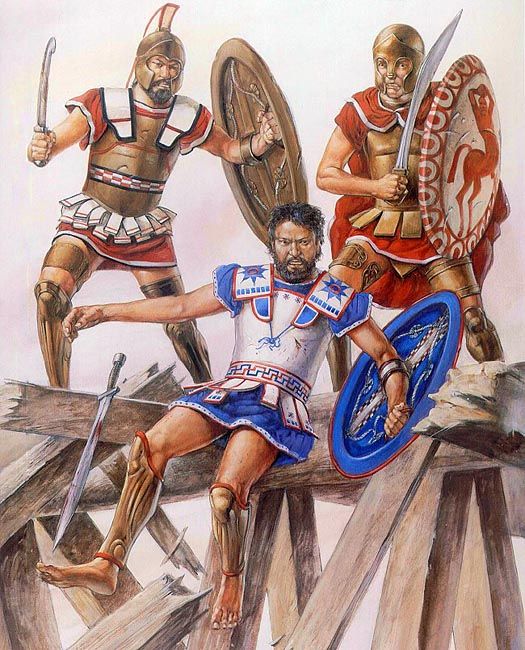
1horatiusatbridge.jpg

In the nineteenth century, this story was turned into a poem (a very long ballad) by the historian Thomas Babington, Lord Macaulay (1800-1859),

2macaulay.jpg

entitled “Horatius at the Bridge” (from his 1842 collection, The Lays of Ancient Rome).

3lays1849ed.jpeg

Once upon a time, it was a standard assignment for schoolboys to memorize its approximately 600 lines and we wonder if this might once have been Tolkien’s task, which is why we have Boromir’s remark.

Once we embarked upon the subject of fights at bridges, we found, beginning with the late classical world, that there were lots more out there (our short mental list roared through time to take us as far as the seizing of Pegasus Bridge in the Normandy invasion and the subsequent bridges at Arnhem and Remagen). There was a difficulty, however: we began with an heroic action—one man or a handful against masses. What mostly came to mind was not Horatian one-man stands. Instead, they were only depicted as parts of larger military maneuvers to gain or block a crossing and individuals disappeared. Take, for example the famous battle at the Milvian Bridge, in 312AD, which led not only towards a reconstituted Roman world based upon the east, but also towards the eventual Christianization of the Roman world.

4milvian.jpg

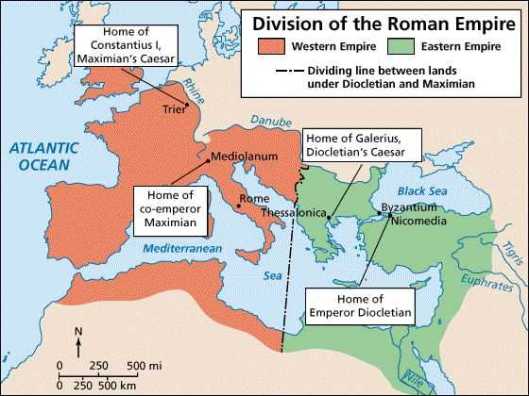
In the civil wars which wracked the late Roman empire, after its division post-284AD by Diocletian,
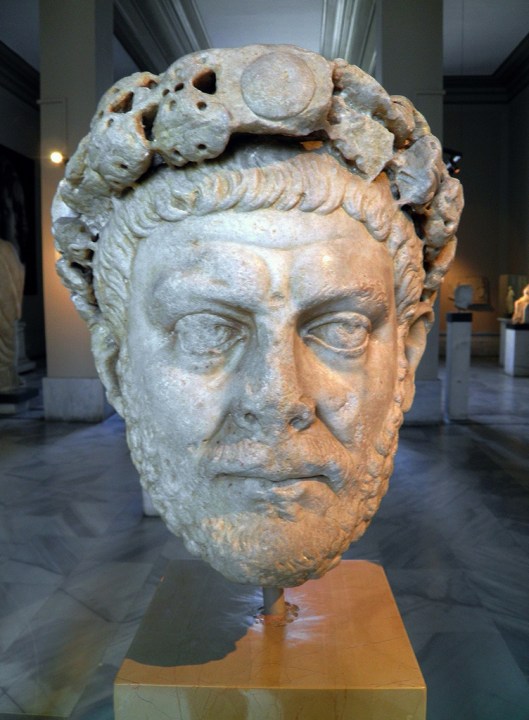
4adiocletian.jpg

4bdiocletiansdivision.jpg

Constantine, the western Augustus (senior emperor)

5Constantine-I-Face.jpg

defeated his rival, Maxentius (who was also his brother-in-law),

6maxentius.jpg

at a bridge outside Rome to become, in time, the sole emperor. Maxentius, who had control of Rome, had planned to block Constantine on the far side of the Tiber, keeping a pontoon bridge available for a retreat, if necessary, since it appears that the actual stone bridge was in the process of being dismantled.

(The Romans were extremely able at producing pontoon bridges—here’s a good illustration from the column of Marcus Aurelius—completed 193AD–)

When that retreat did become necessary, Maxentius was drowned in its midst, the bridge collapsed, and his troops who remained either died on the field or surrendered to Constantine.

4milvian.jpg

In time, Constantine, who believed that the empire’s main focus should actually be on the east, moved the capital to an old Greek colony, called Byzantium, but which he renamed “New Rome”—although it seems that everyone else called it Constantinople.
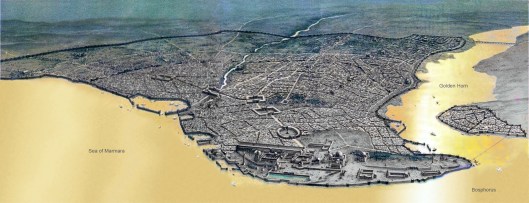
7constantinople.jpg

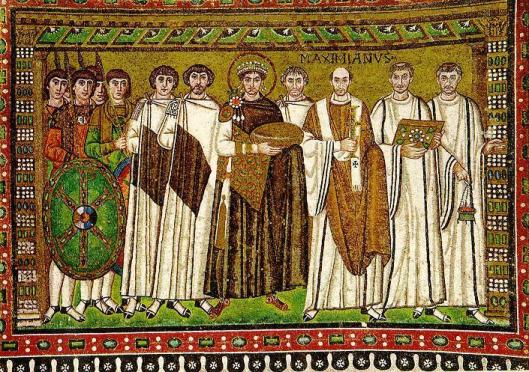
This would be the capital of the later Byzantine Empire, which, under the emperor Justinian,
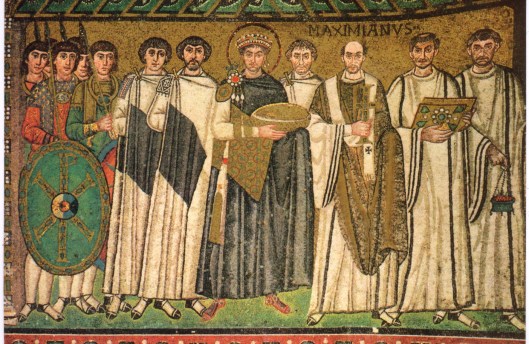
8justinian.jpg

(He’s the one with the bowl of communion bread—the only labeled figure, Maximianus, was the bishop of Ravenna, where this mosaic stands in the church of San Vitale.)

would attempt to reconquer the portions of the old western empire which had fallen into the hands of Germanic invaders.
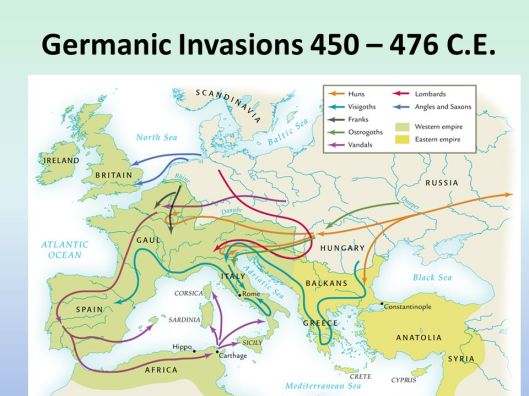
9germanicinvasions.jpg

Under Justinian’s general, Belisarius,
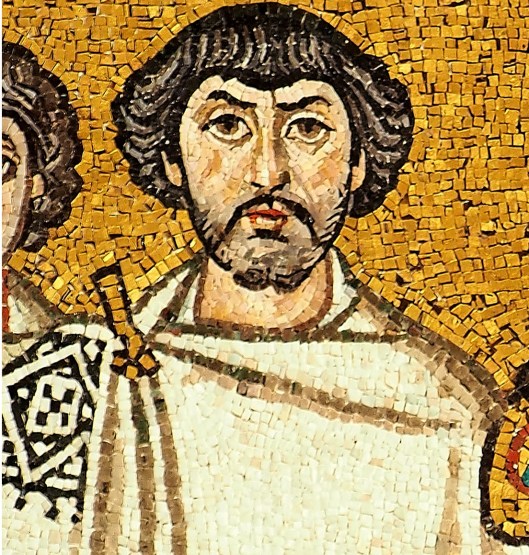
10belisarius.jpg

(this may or may not be a portrait—it’s a scholarly guess),

the Byzantines struggled for control of Rome against the Ostrogoths.

11ostrogoth.jpg

This struggle included a fight outside of Rome for control of the Salarian Bridge (537AD),
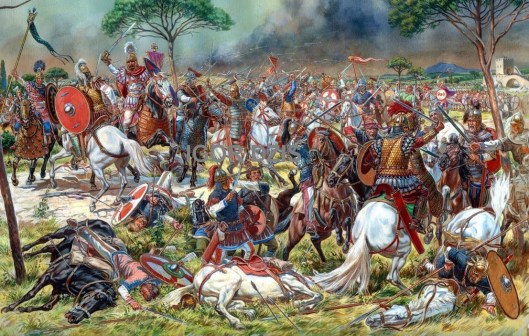
12salarianbridge.jpg

a fight which Belisarius lost, although, for a short time, Justinian’s world was enlarged, if not to the full size of the old empire, at least to include much of the western Mediterranean—quite an accomplishment for the later world of antiquity.
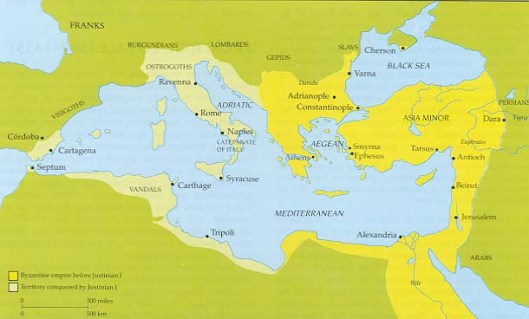
12ajustempire.jpg

And, speaking of late antiquity, if you regularly read our blog, you know that we have a special affection for the work of Hal Foster, who created the late-antique, early-medieval world of Prince Valiant. The combination of bridge and heroic fighting reminded us of one of our favorite illustrations and so we have to include this scene (published 19 June, 1938), in which Val faces a band of Viking raiders.
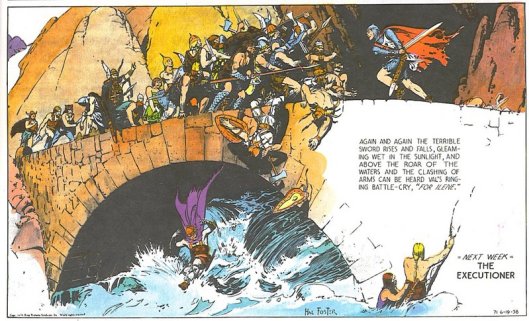
13valatbridge.jpg

This image, of course, brings us back to Horatius, the single warrior against the mass. As we’ve said, in the intervening centuries there are battles at bridges, but only as one element in larger campaigns and the heroic individual disappears into the ranks. We could think of one, somewhat later, figure, however. He appears, unfortunately nameless, in the other battle of the short reign of Harold Godwinson, at Stamford Bridge, 25 September, 1066. The Anglo-Saxon army raced north from London to oppose a Viking invasion, and defeated the Vikings on the near side of the bridge over the River Derwent, but, to complete their victory, the Anglo-Saxons needed to destroy the surviving force on the far side. in the way stood, in the middle of Stamford Bridge, a single Viking warrior, blocking their advance.

14stamfordbridge.jpg

The Anglo-Saxon Chronicle says that he killed 40 of the enemy before an Anglo-Saxon floated underneath the bridge and stabbed him from beneath with his spear, but, well, as much as we believe in heroic tales…

His stand, however, brings us back to Boromir and his final battle, in which he faces two waves of orcs before he is finally mortally wounded.
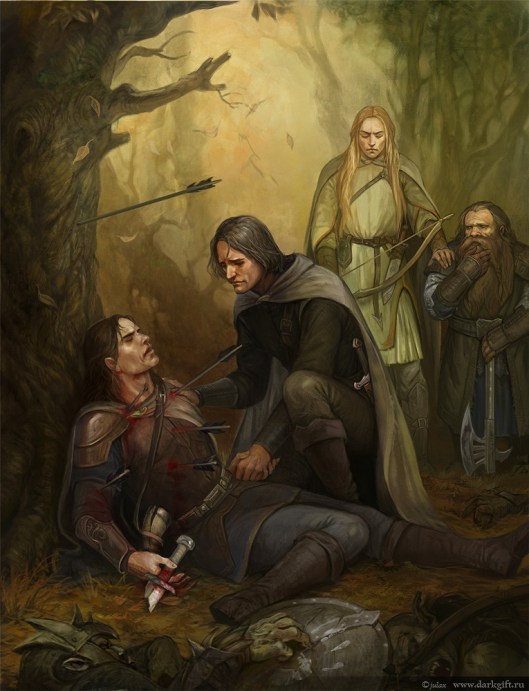
15boromirdeath.jpg

No bridge, but this still follows the theme of the brave man standing alone, with no possible help nearby.
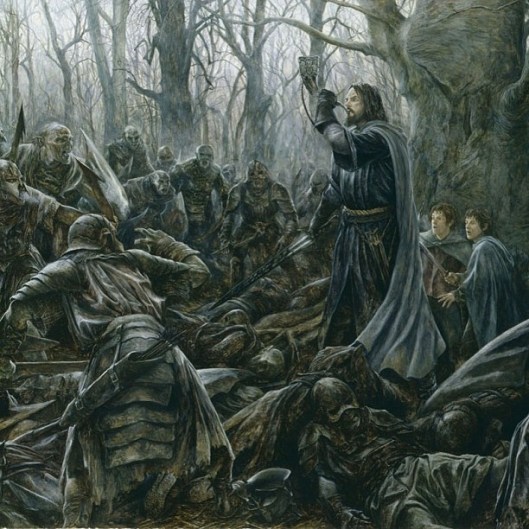
16boromirhorn.jpg

(And, of course, Boromir and his horn are meant to remind any good reader of heroic material—particularly medieval—of Roland at the Pass of Roncevalles…)
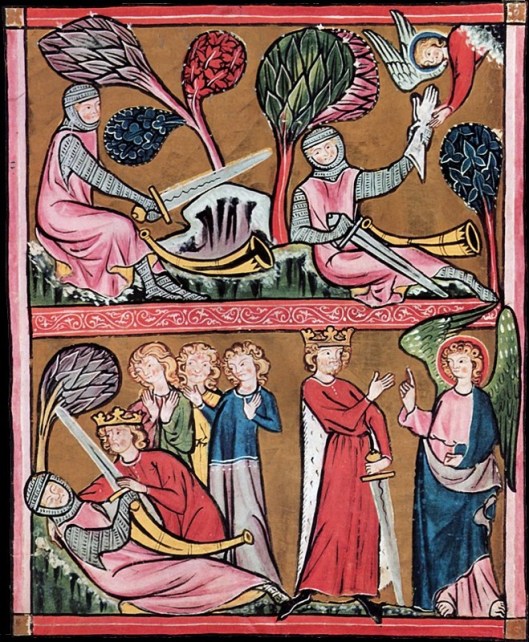
17roland.jpg

We would leave this theme here, back where it began, with Boromir, except we can’t resist (we’re afraid, when it comes to adventure and heroics, that we appear to have little or no willpower at all!) one final image and the idea behind it. There is no end of discussion about Napoleon, which, we’re sure, would please him no end. For us, however, there is a side of him which is endlessly interesting and that is as a Romantic Figure—a view of himself which he worked very hard, at least early in his life, to promote. The late 18th-century very much looked back to the classical world and, we believe, it did so in part because it loved the dramatic gestures it saw as part of that world. We only have to point out paintings like David’s “The Oath of the Horatii”(those Horatii being the direct ancestor of the one in our post), with its operatic ensemble look, to illustrate this. (To us, this looks so much like the set-up for a stirring quartet, right out of Bellini or Meyerbeer.)
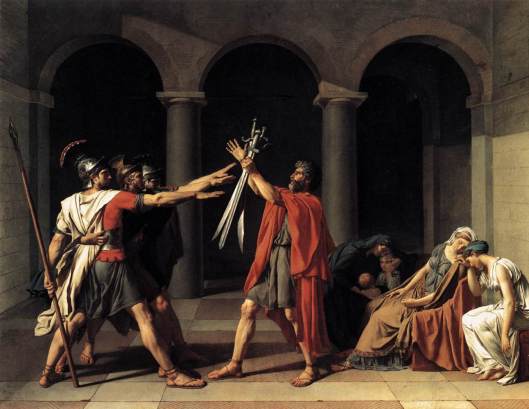
18horatii.jpg

So, during Bonaparte’s brilliant 1796-7 campaign in Italy, there was clearly a classical/Romantic moment. When the French were stalled by their Austrian opponents in crossing the River Adige, Napoleon, to encourage his troops, seized a regimental color and raced alone to the bridge, as Gros (who was actually at the battle) depicted him in his 1797 painting.
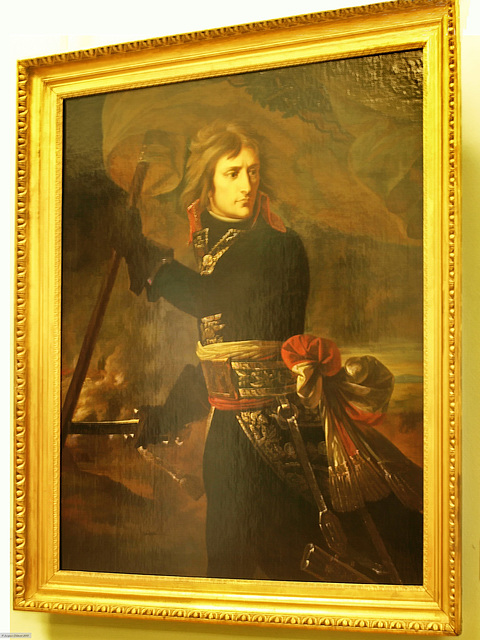
19grosarcola.jpg

Vernet, in his 1826 version, continues the heroic theme, but changes the focus a bit—Napoleon now has followers. (And you know, from its dash—and that’s Horace Vernet in general—who, according to Sherlock Holmes, may be a distant relation–that this is a favorite painting of ours.)
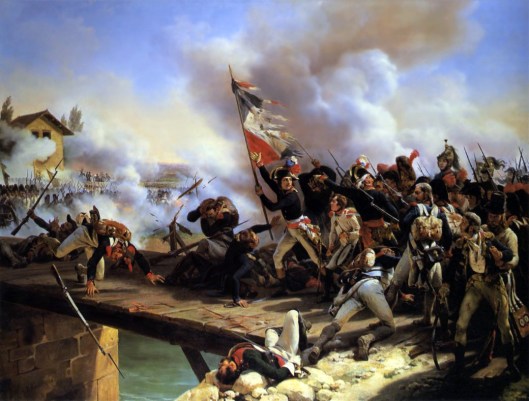
20vernetarcola.jpg

In fact, although Bonaparte did seize a color, he never made it to the bridge, either alone or in a crowd. His illustrators, however, influenced, no doubt, by the potential drama—and perhaps by a faint memory of Horatius?—depict a scene which should have happened, in their view of Napoleon as a Romantic Figure. What is most striking, however, is that, unlike Horatius—or Boromir—Bonaparte is not defending a bridge—he is attacking and his heroism comes from that gesture. This certainly fits in with Revolutionary ideology—France had been at war with much of the world since 1792—but it occurs to us that it may also suggest a shift in the approach to heroism. Horatius, given a bridge, is heroic, but passive. Give a bridge to Bonaparte and stand back (at least in iconography)! Is this the image of heroes in the Romantic world which was just coming into being?

But, as ever, we leave this to you, dear readers, to ponder, even as we thank you, as always, for reading.

MTCIDC

CD
“A kind of proud, venerable, but increasingly impotent Byzantium”

01 Wednesday Jun 2016

Posted by Ollamh in Artists and Illustrators, J.R.R. Tolkien, Literary History, Maps, Military History, Military History of Middle-earth, Narrative Methods

≈ Leave a comment

Tags

Adventure, Byzantine Empire, Byzantium, Constantinople, Gondor, Justinian, Megara, Mehmet II, Milton Waldman, Minas Arnor, Minas Tirith, Mont Saint Michel, Ottoman Empire, Ted Nasmith, The Lord of the Rings, The Tower of Guard, Theodosian walls, Theodosius, Tolkien

Welcome, as always, dear readers.

The title of this posting is taken from a very long letter (10,000 words), written to Milton Waldman probably in 1951 (Letters No.131, 157). Waldman represented the English publisher, Collins, which had expressed an interest in The Lord of the Rings and The Silmarillion when Allen & Unwin had been hesitant. Determined to justify the simultaneous publication of both, Tolkien wrote in great detail about the general narrative, with an emphasis upon the religious aspects.

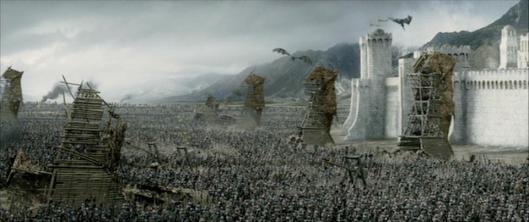
In the process, he likened Gondor to the Byzantine empire, a comparison which immediately attracted our attention. We ourselves had suggested in an earlier posting that the attack on its capital, Minas Tirith, had been like the siege of the Byzantine capital, Constantinople.

attackongondor.jpg

8da792d4aac58fe51f8ddf1aefa36048.jpg

What was JRRT thinking of when he likened the two?

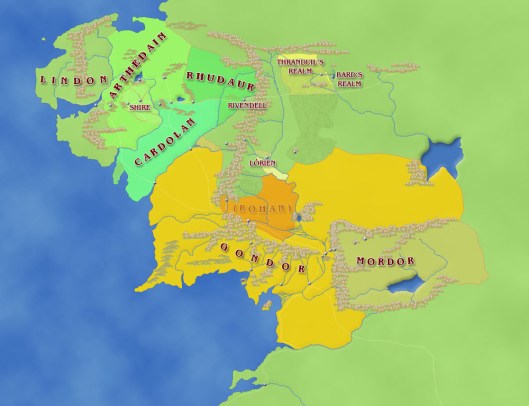
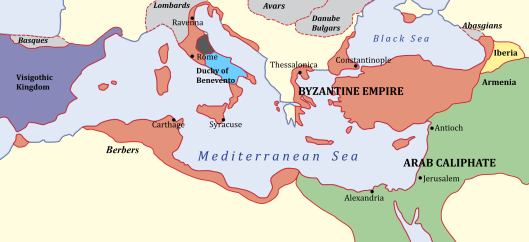
First, they both were—or had been—large kingdoms—in the case of Byzantium, an empire, really, as these maps demonstrate.

gondor1050height.jpg

2000px-Byzantiumby650AD.svg.png

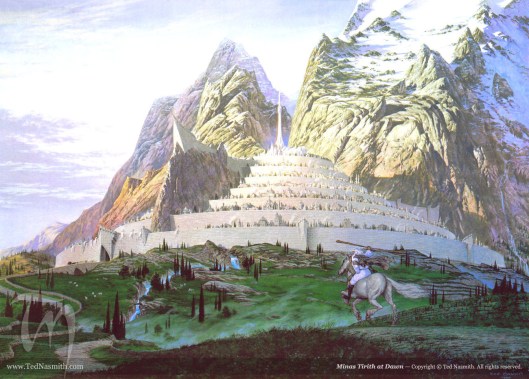
Their capitals were both of great age. Minas Tirith, “The Tower of Guard”, had been built originally as Minas Anor, “Tower of the Sun” in SA 3320 by Anarion, the younger son of Elendil, but only became the capital of Gondor in TA1640, after Osgiliath had been devastated by a plague. If we add its time in the Second Age (121 years) to the whole of the Third Age (3021 years), we reach a total of 3142 years at the defeat of Sauron. (For comparison, we might look at Athens, whose continuous habitation began before 3000BC, giving it a more-than-5000-year history.)

Constantinople, is old, by anyone’s standards, having been founded in 667BC as a Greek colony (there’s a bit of argument over the dating of this, which is typical of such things), and is still inhabited (and an absolutely amazing place!), but a bit younger than Minas Tirith at the time of The Lord of the Rings by some 500 years or so.

Third, there is the matter of the elaborate construction of these capitals.

“For the fashion of Minas Tirith was such that it was built on seven levels, each delved into the hill, and about each was set a wall, and in each wall was a gate. But the gates were not set in a line: the Great Gate in the City Wall was at the east point of the circuit, but the next faced half south, and the third half north, and so to and fro upwards; so that the paved way that climbed towards the Citadel turned first this way and then that across the face of the hill. And each time that it passed the line of the Great Gate it went through an arched tunnel, piercing a vast pier of rock whose huge out-thrust bulk divided in two all of the circles of the City save the first. For partly in the primeval shaping of the hill, partly by the mighty craft and labour of old, there stood up from the rear of the wide court behind the Gate a towering bastion of stone, its edge sharp as a ship-keel facing east. Up it rose, even to the level of the topmost circle, and there was crowned with a battlement; so that those in the Citadel might, like mariners in a monstrous ship, look from its peak sheer down upon the Gate seven hundred feet below.”

The Lord of the Rings, Book 5, Chapter 1, “Minas Tirith”

Here’s one of our favorite paintings (by Ted Nasmith—one of our favorite Tolkien artists).

TN-Minas_Tirith_at_Dawn.jpgnaismith.jpg

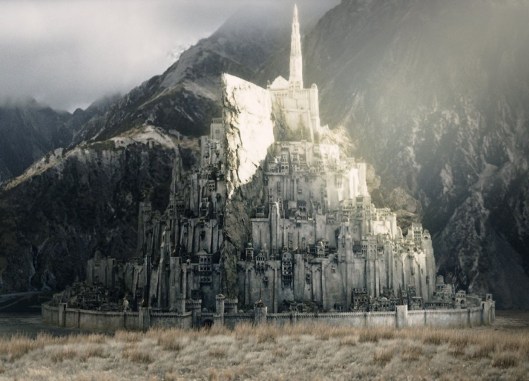
And here’s the film.

ROTK-Minas-Tirith.jpg

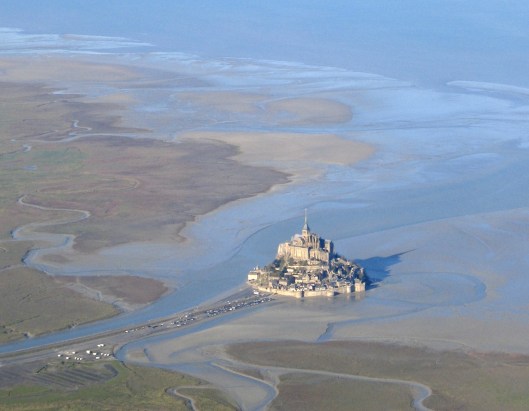
The designers have said that they were influenced by the look of Mont Saint Michel, a medieval monastery just off the coast of Normandy in France.

Mont_St_Michel_3,_Brittany,_France_-_July_2011.jpg

MtStMichel_avion.jpg

The complex nature of the place is captured in this diagram.

minas-tirith-diagram.0.jpg

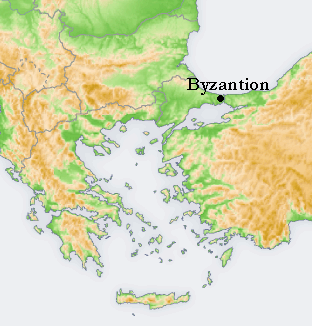
Byzantium (or, Constantinople, its later name) began its life, as we said, as a colony of the Greek mainland city of Megara. In the 4th century AD, the Roman emperor Constantine I, the last survivor in a long civil war, chose the site for his new capital. As much of the weight, both of commerce and defense, lay in the eastern part of the Roman world by this time, he chose very wisely: his new city was placed to control trade with the rich Black Sea region and to provide a strategic jumping-off point for dealing with invaders and emerging kingdoms in Asia Minor.

Locator_map_Byzantion.PNG

The position was also well-chosen for defense, being at the end of a peninsula—the main strategy then being its walling-off from the mainland.

constantin.jpg

There is, of course, a big difference here between the 7 levels and 7 gates of Minas Tirith and the two walls—the older inner 4th-century one of Constantine and the slightly-later (early 5th century) walls of Theodosius II. Nevertheless, those later walls were well-constructed, in two successive lines, with a moat on the outside.

Theodosian Walls.jpg

The Theodosian walls were about a mile-and-half from the older, Constantine wall, encompassing a population which, at its height, may have been over 400,000 in number. By the time of its fall to the Ottoman army in 1453, that number had dropped to perhaps only 50,000, which reflected the gradual shrinking of the empire from its greatest size, in the 6th century

Byzantine-empire.6thc.gif

under the emperor Justinian

justinian.jpg

when it encompassed the majority of the Mediterranean basin, to its last, worn-out phase in the early 15th century, when it controlled a few scattered outposts, but mainly the area directly around the capital.

constantinople-world-map.jpg

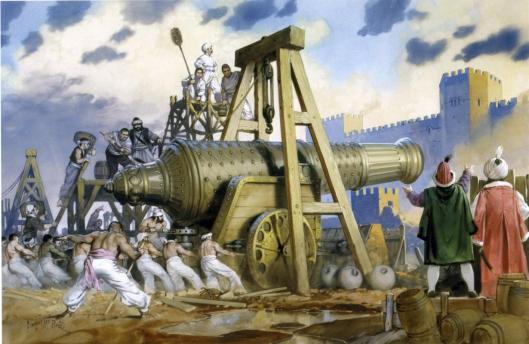
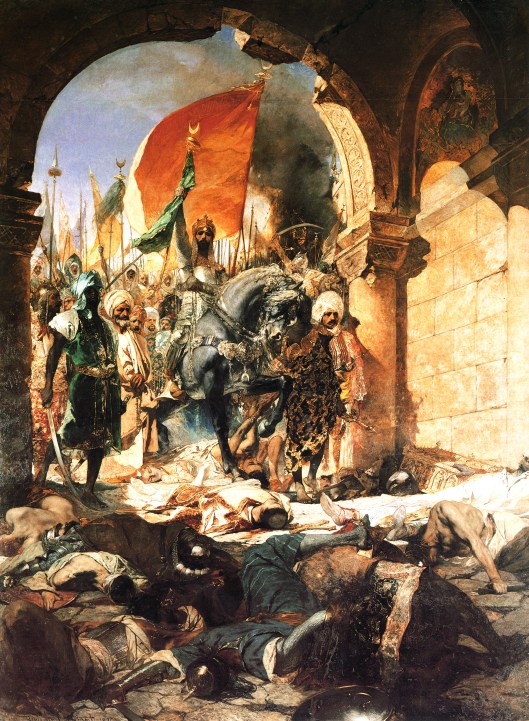
This shrinking of the empire and of its population proved disastrous for the capital. When the Ottoman army, under Mehmet II, arrived outside the walls in the spring of 1453, the imperial government could only provide 7000 defenders, 2000 of whom were foreigners, to defend about 3 and ½ miles of wall (that’s 5 ½ km). Against them were anywhere from 50 to 80,000 attackers, who brought with them (or cast on the spot), massive artillery pieces and, after a 53-day siege, broke into the city and put an end to an empire which had lasted for over 1100 years.

Illustration-of-angus-mcbride-showing-the-ottoman-cannon-basilica-during-the-siege-of-constantinople-in-1453-ad.jpg

Benjamin-Constant-The_Entry_of_Mahomet_II_into_Constantinople-1876.jpg

And this is the last sad similarity with Gondor and its capital, as we see through Pippin’s eyes:

“Pippin gazed in growing wonder at the great stone city, vaster and more splendid than anything that he had dreamed of, greater and stronger than Isengard, and far more beautiful. Yet is was in truth falling year by year into decay, and already it lacked half the men that could have dwelt at ease there. In every street they passed some great house or court over whose doors and arched gates were carved many fair letters of strange and ancient shapes: names Pippin guessed of great men and kindreds that had once dwelt there; and yet now they were silent, and no footsteps rang on their wide pavements, nor voice was heard in their halls, nor any face looked out from door or empty window.”

The Lord of the Rings, Book 5, Chapter 1, “Minas Tirith”

And, just as in the case of Constantinople, the capital of Gondor was hard-pressed to defend itself. Luckily for it, however, there was an uncrowned king with a ghostly army, a brave reinforcement of southern yeomen, a mass of wild horsemen from the north, a wizard, and the fulfillment of an ancient prophecy about a witch king to aid it in its hour of need…

Thanks, as always, for reading.

MTCIDC

CD
The Doubtful Sea Series Facebook Page

The Doubtful Sea Series Facebook Page

  • Ollamh

Categories

  • Artists and Illustrators
  • Economics in Middle-earth
  • Fairy Tales and Myths
  • Films and Music
  • Games
  • Heroes
  • Imaginary History
  • J.R.R. Tolkien
  • Language
  • Literary History
  • Maps
  • Medieval Russia
  • Military History
  • Military History of Middle-earth
  • Narnia
  • Narrative Methods
  • Poetry
  • Research
  • Star Wars
  • Terra Australis
  • The Rohirrim
  • Theatre and Performance
  • Tolkien
  • Uncategorized
  • Villains
  • Writing as Collaborators
Follow doubtfulsea on WordPress.com

Across the Doubtful Sea

Recent Postings

  • A Moon disfigured December 17, 2025
  • On the Roads Again—Once More December 10, 2025
  • (Not) Crossing Bridges December 3, 2025
  • On the Road(s) Again—Again November 26, 2025
  • On the Road(s) Again November 19, 2025
  • To Bree (Part 2) November 12, 2025
  • To Bree (Part 1) November 5, 2025
  • A Plague o’ Both—No, o’ All Your Houses! October 29, 2025
  • It’s in Writing (2:  I’st a Prologue, or a Poesie for a Ring?) October 22, 2025

Blog Statistics

  • 103,198 Views

Posting Archive

  • December 2025 (3)
  • November 2025 (4)
  • October 2025 (5)
  • September 2025 (4)
  • August 2025 (4)
  • July 2025 (5)
  • June 2025 (4)
  • May 2025 (4)
  • April 2025 (5)
  • March 2025 (4)
  • February 2025 (4)
  • January 2025 (5)
  • December 2024 (4)
  • November 2024 (4)
  • October 2024 (5)
  • September 2024 (4)
  • August 2024 (4)
  • July 2024 (5)
  • June 2024 (4)
  • May 2024 (5)
  • April 2024 (4)
  • March 2024 (4)
  • February 2024 (4)
  • January 2024 (5)
  • December 2023 (4)
  • November 2023 (5)
  • October 2023 (4)
  • September 2023 (4)
  • August 2023 (5)
  • July 2023 (4)
  • June 2023 (4)
  • May 2023 (5)
  • April 2023 (4)
  • March 2023 (5)
  • February 2023 (4)
  • January 2023 (4)
  • December 2022 (4)
  • November 2022 (5)
  • October 2022 (4)
  • September 2022 (4)
  • August 2022 (5)
  • July 2022 (4)
  • June 2022 (5)
  • May 2022 (4)
  • April 2022 (4)
  • March 2022 (5)
  • February 2022 (4)
  • January 2022 (4)
  • December 2021 (5)
  • November 2021 (4)
  • October 2021 (4)
  • September 2021 (5)
  • August 2021 (4)
  • July 2021 (4)
  • June 2021 (5)
  • May 2021 (4)
  • April 2021 (4)
  • March 2021 (5)
  • February 2021 (4)
  • January 2021 (4)
  • December 2020 (5)
  • November 2020 (4)
  • October 2020 (4)
  • September 2020 (5)
  • August 2020 (4)
  • July 2020 (5)
  • June 2020 (4)
  • May 2020 (4)
  • April 2020 (5)
  • March 2020 (4)
  • February 2020 (4)
  • January 2020 (6)
  • December 2019 (4)
  • November 2019 (4)
  • October 2019 (5)
  • September 2019 (4)
  • August 2019 (4)
  • July 2019 (5)
  • June 2019 (4)
  • May 2019 (5)
  • April 2019 (4)
  • March 2019 (4)
  • February 2019 (4)
  • January 2019 (5)
  • December 2018 (4)
  • November 2018 (4)
  • October 2018 (5)
  • September 2018 (4)
  • August 2018 (5)
  • July 2018 (4)
  • June 2018 (4)
  • May 2018 (5)
  • April 2018 (4)
  • March 2018 (4)
  • February 2018 (4)
  • January 2018 (5)
  • December 2017 (4)
  • November 2017 (4)
  • October 2017 (4)
  • September 2017 (4)
  • August 2017 (5)
  • July 2017 (4)
  • June 2017 (4)
  • May 2017 (5)
  • April 2017 (4)
  • March 2017 (5)
  • February 2017 (4)
  • January 2017 (4)
  • December 2016 (4)
  • November 2016 (5)
  • October 2016 (6)
  • September 2016 (5)
  • August 2016 (5)
  • July 2016 (5)
  • June 2016 (5)
  • May 2016 (4)
  • April 2016 (4)
  • March 2016 (5)
  • February 2016 (4)
  • January 2016 (4)
  • December 2015 (5)
  • November 2015 (5)
  • October 2015 (4)
  • September 2015 (5)
  • August 2015 (4)
  • July 2015 (5)
  • June 2015 (5)
  • May 2015 (4)
  • April 2015 (3)
  • March 2015 (4)
  • February 2015 (4)
  • January 2015 (4)
  • December 2014 (5)
  • November 2014 (4)
  • October 2014 (6)
  • September 2014 (1)

Blog at WordPress.com.

  • Subscribe Subscribed
    • doubtfulsea
    • Join 78 other subscribers
    • Already have a WordPress.com account? Log in now.
    • doubtfulsea
    • Subscribe Subscribed
    • Sign up
    • Log in
    • Report this content
    • View site in Reader
    • Manage subscriptions
    • Collapse this bar
 

Loading Comments...