Tags
Welcome, dear readers, as always.
If you’re a regular reader, you know that I have begun a (definitely!) long-term project to deepen my knowledge of Science Fiction. I’ve read Sci-Fi since childhood, but totally unscientifically (sorry!), and, being interested in both Fantasy and Sci-Fi, I thought that it was more than time to have a better grasp of it and its (as I’ve found out) complicated history.
Although I’m still reading somewhat haphazardly—when I find an author whose work catches my attention, I catch myself reading more than one representative—see novels by L. Sprague de Camp (1907-2000), including those in collaboration with Fletcher Pratt (1897-1956)—like Lest Darkness Fall, 1941,

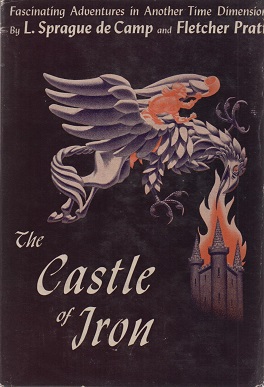
or The Castle of Iron, 1950,
I am developing a chronological list, and, so far, have read about three dozen novels and maybe a dozen short stories, my most recent novel being Dune, 1965,
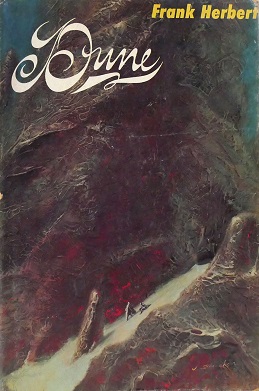
about which I’ve already written one posting (see “No Names, No…”, 10 January, 2024). It’s an impressive beginning, full of vividly imagined things, especially anything and everything about the desert planet of Arrakis, its native inhabitants, their environment, and their survival in it. It’s easy to see how some early reviewers compared it to The Lord of the Rings for its depth of detail. In my earlier posting, I admitted to being less convinced by the names, which sometimes seem rather haphazard—something which Tolkien would never allow (and actually criticized in the work of E.R. Eddison, 1882-1945—see a letter to Caroline Everett, 24 June, 1957, Letters, 372)—and this brings me to the subject of this posting, which is about Chakobsa—not “Shikwoshir”, or “Shikowschir”, or even “Schakobsche” or “Farschipse”, all possible names for a Northwest Caucasian language (or perhaps invented dialect based upon one of the languages—see https://en.wikipedia.org/wiki/Chakobsa )–but one of the principal languages of Dune.
The first film based upon Dune appeared in 1984

and was not a success—I remember seeing it, but have virtually no memory of what I saw. (For more on the tribulations of making a film of the novel, see: https://en.wikipedia.org/wiki/Dune_(1984_film) ) If anyone spoke anything other than standard English, I couldn’t say. There was a difference, however, in Dune, 2021,
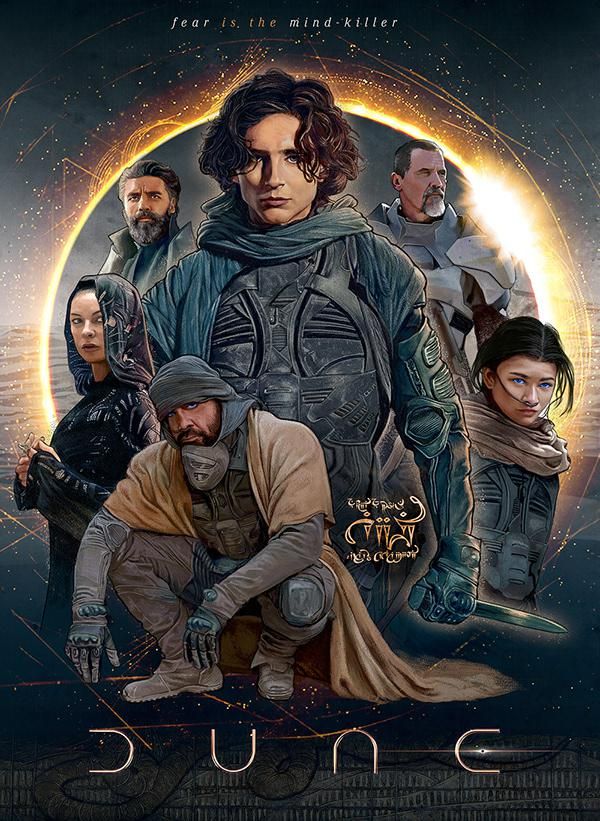
where, although English substitutes for Galach, the standard universal language (like the Common Speech of Middle-earth), the language of the natives of Arrakis, the Fremen, is in need of subtitles. (And there seems to be a bit of confusion here about what they actually speak, which even one of its creators, in an aside in a recording, admits: https://dune.fandom.com/wiki/%22Neo-Chakobsa%22_(2020s_film_series)?file=Work_Stream_6-_Translating_into_Chakobsa%2C_Part_1 ) The language we hear most about—and which appears even more frequently in Dune 2, 2023,
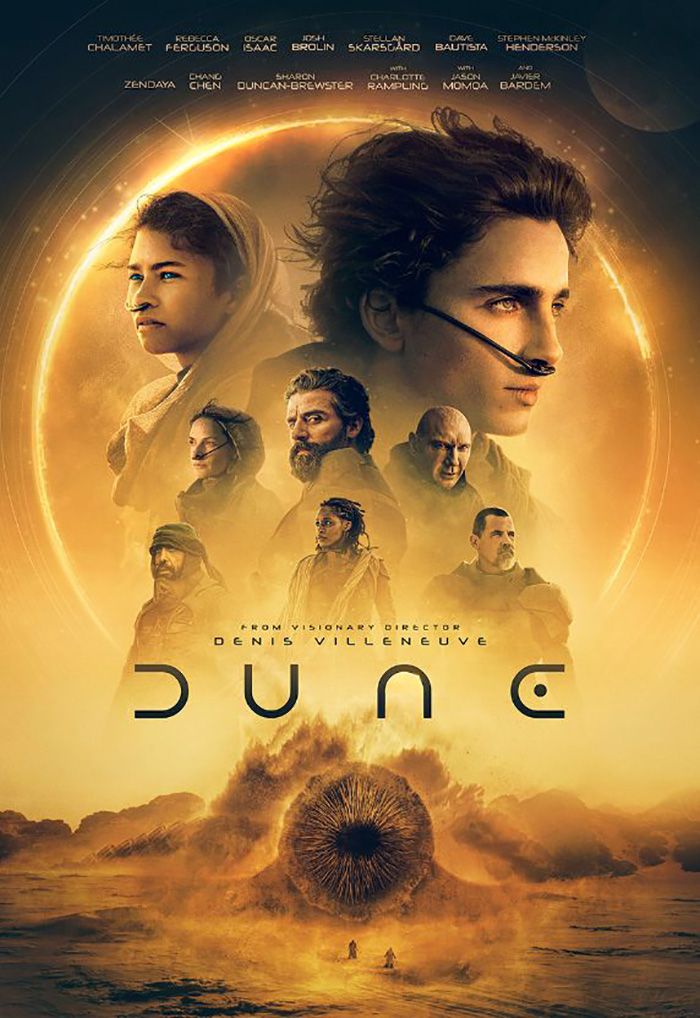
was named by the original author, Frank Herbert (1920-1986), after that Northwest Causcasian language, Chakobsa, but, linguistically, has nothing to do with it. Instead, it was a gallimaufry (a wonderful word in itself, meaning “a hodgepodge”—see: https://www.etymonline.com/word/gallimaufry where you’ll discover that it’s actually one of those etymologies with a question mark after it). As Herbert’s son, Brian, says of the linguistic constructions in Dune in general:
“ The words and names in Dune are from many tongues, including Navajo, Latin, Chakobsa (a language found in the Caucasus), the Nahuatl dialect of the Aztecs, Greek, Persian, East Indian, Russian, Turkish, Finnish, Old English, and, of course, Arabic.” (Dune, “Afterword”, 878 in the Ace edition)
There is a great difference, however, between Herbert’s approach to language and that of the language created for the Fremen in the two films and the latter approach might be seen as coming directly from JRRT’s method of language construction.
In 1931, Tolkien gave a lecture to the Johnson Society at Pembroke College, Oxford.

Daringly entitled “A Secret Vice”, it was an essay about his own “vice”, the creation of languages. In it, he used his own early experiences with everything from Esperanto to “Nevbosh”, expressing not only his long interest, but also his ideas about the possibilities to be found in such a hobby, including:
“…various other interests in the hobby. There is the purely philological (a necessary part of the completed whole though it may be developed for its own sake): you may, for instance, construct a pseudo-historical background and deduce the form you have actually decided on from an antecedent and different form (conceived in outline); or you can posit certain tendencies of development and see what sort of form this will produce. In the first case you discover what sort of general tendencies of change produce this a given character; in the second you discover the character produced by given tendencies. Both are interesting, and their exploration gives one a much greater precision and sureness in construction—in the technique in fact of producing an effect you wish to produce for its own sake.” (Tolkien, A Secret Vice: Tolkien on Invented Languages, edited by Dimitra Fimi & Andrew Higgins, Harper/Collins, 2016, 25)
I was reminded of this passage when I watched a brief interview with the creators of Chakobsa, Jessie and David Peterson, which you can see here: https://www.bbc.com/reel/video/p0hg5n6z/dune-and-the-art-of-creating-a-fictional-language . David was the creator of Valyrian and Dothraki for A Game of Thrones, as well as the author of a very entertaining and informative book on the subject of constructed languages (“conlang” for short), The Art of Language Invention (Penguin, 2015).

(For more on Valyrian, see: https://en.wikipedia.org/wiki/Valyrian_languages . For more on Dothraki, see: https://en.wikipedia.org/wiki/Dothraki_language )
In the interview, Jessie talks about the “evolutionary method” of designing a language—that is, just like Tolkien, creating an older version of the language which you then “age”, using standard linguistic methods for consistent change over time. We see an example of this in an interview the Petersons did with IndieWire:
“The most everyday terms in any language — things like “hello” and “goodbye” — are often ones that have the most history behind them. ‘You don’t try to come up with a way to say hello. You try to come up with what would have been a common phrase that was repeated when you saw someone and which ended up getting reduced to a smaller form,’ Jessie Peterson said. “
All of this was trickier, of course, for the Petersons, since, unlike Tolkien, the language they were employed to build already had some chosen, if not invented, elements—words from Herbert’s gallimaufry—which they were obliged to begin with. In the same interview with IndieWire, David Peterson had this to say about such difficulties:
”Peterson traced the longest existing phrase in Chakobsa, a funeral rite spoken for Jamis (Babs Olusanmokun) as his water is given to the well at Sietch Tabr, to a Romani nursery rhyme.
‘He just changed the meaning and said that it had something to do with water,’ Peterson told IndieWire. “A lot of [Chakobsa] is just borrowed kind of haphazardly from different languages. We just had to come up with our own system and incorporate it as best we could.” (You can read the whole interview here: https://www.indiewire.com/features/craft/dune-fremen-langauge-how-to-speak-1234958145/ )
An interesting feature in Tolkien’s language invention—and perhaps eventually crucial—
“I might fling out the view that for perfect construction of an art-language it is found necessary to construct at least in outline a mythology concomitant. Not solely because some pieces of verse will inevitably be part of the (more or less) completed structure, but because the making of language and mythology are related functions (coeval and congenital, not related as disease to health, or as by-products to main manufacture); to give your language an individual flavour, it must have woven into it the threads of an individual mythology, individual while working within the scheme of natural human mythopoeia, as your word-form may be individual while working within the hackneyed limits of human, even European, phonetics. The converse indeed is true, your language construction will breed a mythology.” (Tolkien, A Secret Vice, 23-24)
So far, David, and now David and Jessie, Peterson have worked to create languages for other people’s stories and mythologies. I wonder what they might produce if they constructed a language—or languages—for a story of their own?
As always, thanks for reading.
Stay well,
So shiira isim un-rauqizak,
And remember that, as ever, there’s
MTCIDC
O
PS
If creating languages interests you, have a look at Jessie Peterson’s website here: https://www.quothalinguist.com/about-me/
 doubtfulsea