• About

doubtfulsea

~ adventure fantasy

Tag Archives: Black Plague

A Plague o’ Both—No, o’ All Your Houses!

29 Wednesday Oct 2025

Posted by Ollamh in Uncategorized

≈ Leave a comment

Tags

Black Death, Black Plague, black ship rat, flea, Great Fire of London, great-london-fire, Halloween, History, miasma, plague, plague doctor, plague pits, Roger Bacon, Romeo and Juliet, Shakespeare, Trick or Treat, Yersinia Pestis

As always, dear readers, welcome.

It’s almost Halloween again, one of my favorite holidays, when children dress up in various costumes and wander the streets in groups, demanding treats and threatening tricks,

while older people, themselves in costume, attend parties.

People dress up as monsters, vampires, and superheroes, but, recently, I’ve also seen a few of these—

a costume which you can actually buy on Amazon.
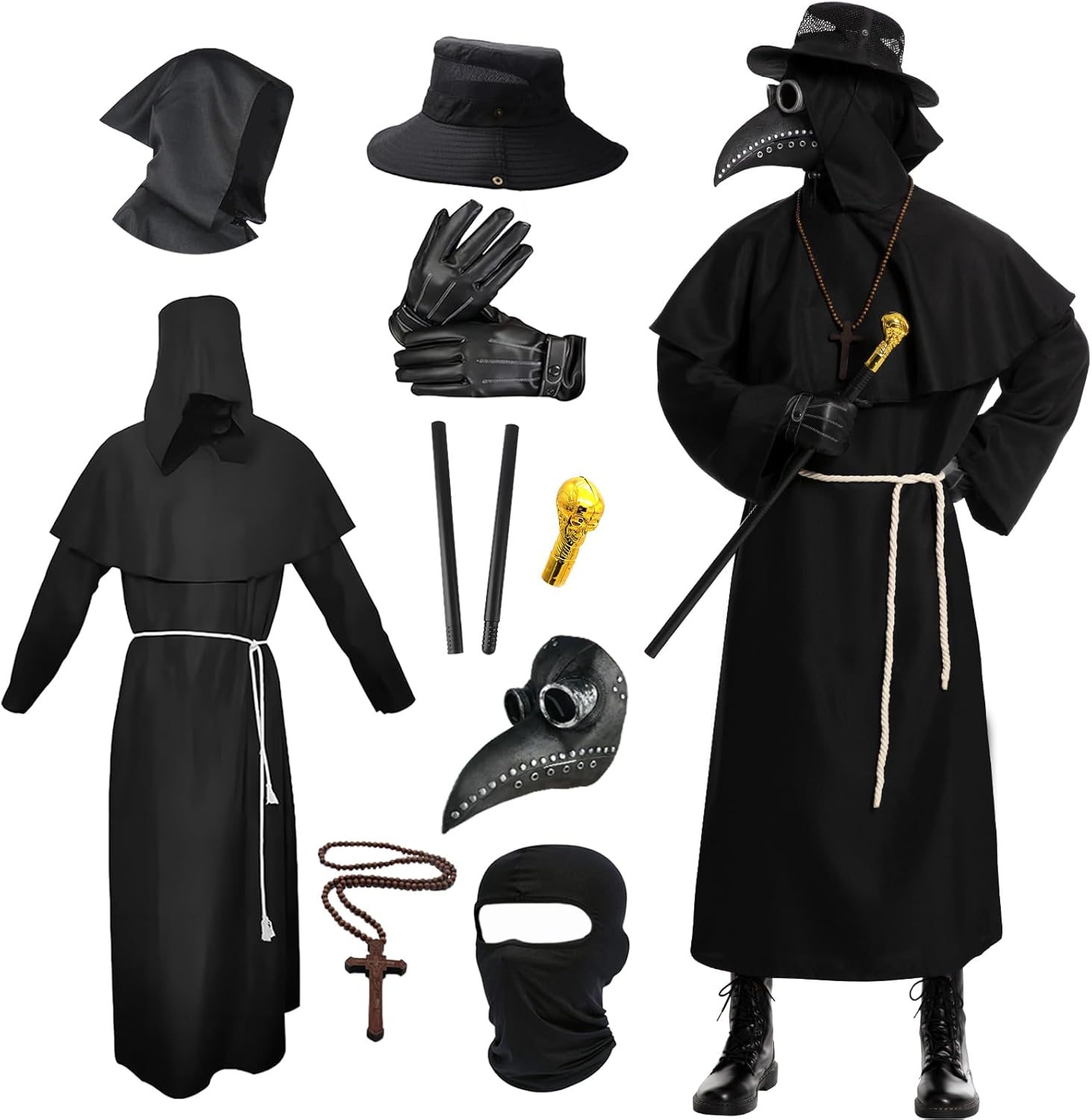
It’s a very haunting image:  crowlike, and yet not, and it struck me as an interesting basis for this year’s Halloween posting.

But what is it?

If you don’t know, I’ve given you a clue in that (modified) quotation I’ve used as a title.

In Act III, Scene 1, of Shakespeare’s The Most Excellent and Lamentable Tragedy of Romeo and Juliet, 1591/95, as the 2nd Quarto (1599) has it,
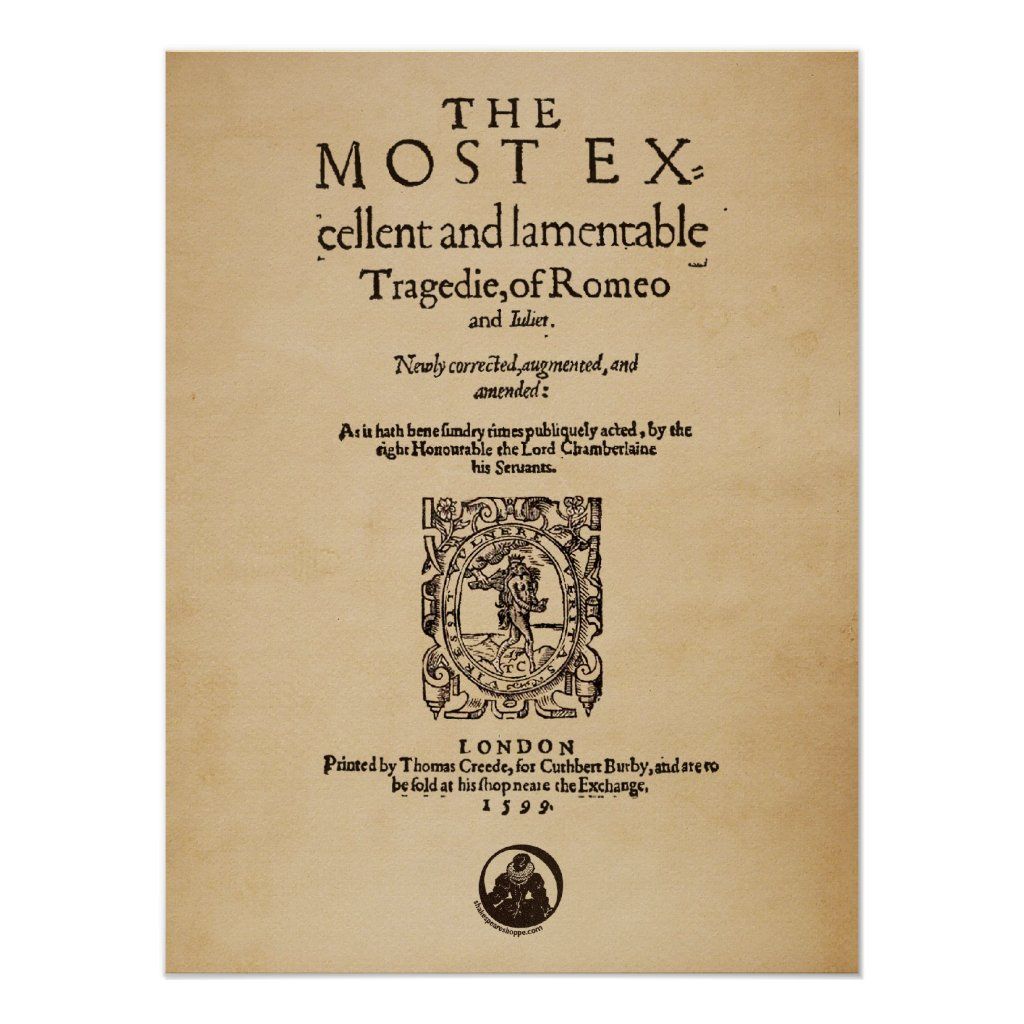
Romeo’s best friend and perhaps the sanest character in the play, Mercutio, has been mortally wounded.  Dying, he curses both of the feuding families, wishing that a plague would take them both.

In Shakespeare’s England, this was not a random remark.  Since its original appearance, in 1348, when it may have killed as many as 40-60% of the population, the Black Plague (aka the Black Death) had

reappeared over the next couple of centuries, killing 30,000 in London, in 1603 alone,
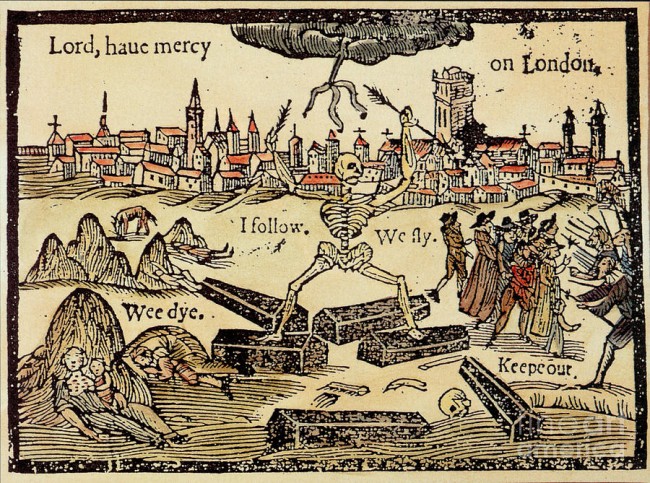
before its grand finale (or nearly), in 1665-6,when it was responsible for perhaps 100,000 deaths there.
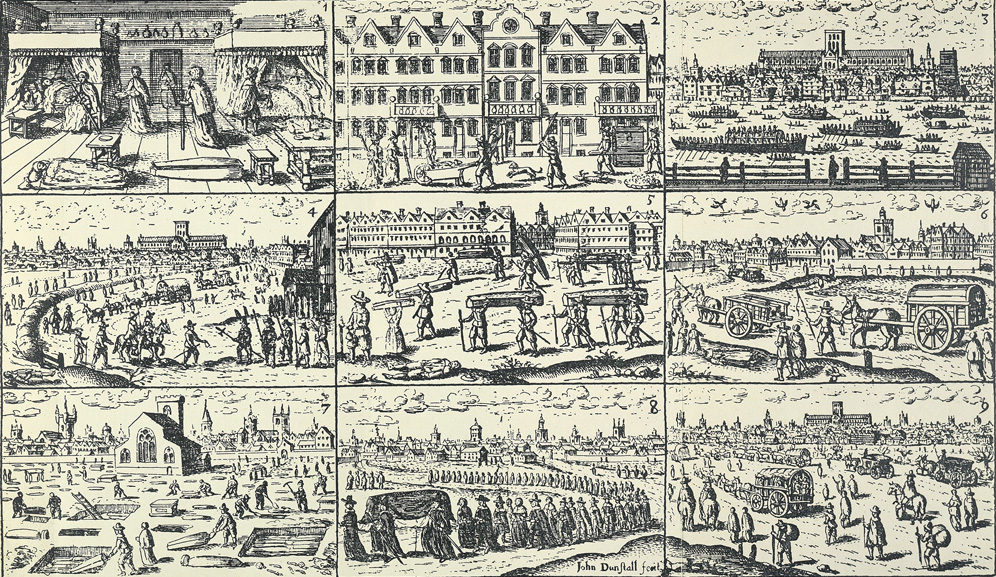
(And, in 1666, came the great fire, which destroyed much of the city—it’s a wonder that everyone surviving didn’t attempt to flee to anywhere as far away as they could.

For the fire, I recommend J. Draper’s short presentation here:  https://www.youtube.com/watch?v=4bvB_gJThYk   with one correction.  She says that the artist/engraver Wenceslaus Hollar was Dutch when, in fact, he was a Czech.  See:  https://en.wikipedia.org/wiki/Wenceslaus_Hollar  Otherwise, I have nothing but praise for Draper, who does proper research and wanders the London area , looking for odd and interesting aspects of London’s—and English—history which she then presents in creative ways.  For her grim and striking view of the Black Death, see:  https://www.youtube.com/watch?v=Ybh1jSZLIKY  )

Medieval science was not really even in its infancy—although there were highly intelligent and thoughtful men struggling to look at the world without superstition or religion, like Friar Roger Bacon, 1214-1294.

(an imaginary image—we have no known portrait)

Medical science, such as existed, followed the classical world and believed that communicable diseases were spread through miasma—that is, through “bad air”,

which isn’t such a far-fetched idea:  rotting things, dead things, stink, so death and bad smells are easily associated.

In fact, the Black Plague was—and is–a bacterium, Yersinia Pestis,

which lives in the gut of fleas,

which inhabited what was called the “black ship rat”,

which traveled on trading vessels from the Far East in the 14th century,

and eventually came, either directly on rats, or indirectly by a human carrier, to England, causing havoc on and off, for several centuries.

Needless to say, in a packed city, like London,

rats and their passengers could easily spread out and, in doing so, would spread the bacterium through the bites of those fleas. 

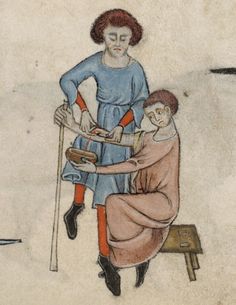
Medical men of that world, however, could make no such connections.  They only saw the horrible symptoms—including the swelling of the lymph nodes, attempting to defend the body—the buboes of bubonic plague—

(This is such a gross image that I almost didn’t include it, but it’s very helpful in explaining what exactly was going on in the body, so…)

The plague produced fever, chills, vomiting, violent headaches—and all that doctors could do was what they did for almost anything:  try to balance the humors—the basic elements of the body—which included bleeding, a treatment which actually weakened the body.
Because the real agent of contagion wasn’t understood, doctors could only be brave and deal with their patients as best they could—and contract the disease themselves—or could attempt to protect themselves, which brings us to this image again—
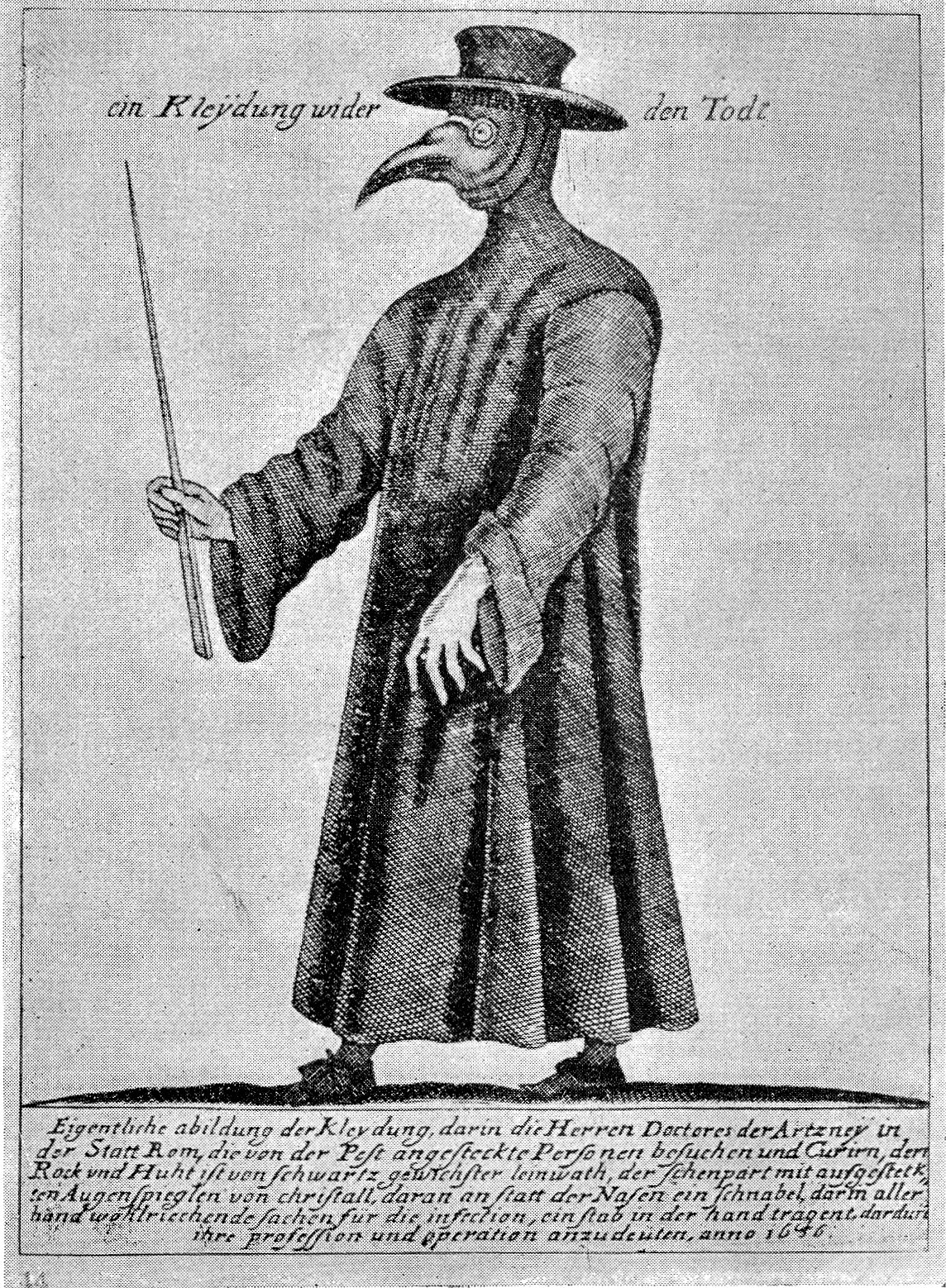
(appropriately titled “the clothing against death”, implying the Black Death)

This diagram

(with some strange English—it appears to be a translation—I’ve seen one copy in which the text is in Russian– gives you a general idea of how a doctor might attempt to ward off infection, including basics which had to do with bad air, like carrying a pomander—a little vessel containing strong-smelling herbs to fend off that air—

which someone might carry simply to ward off the bad smells of a time when streets in cities often had the equivalent of open sewers, as well as might be employ ed as a fashion accessory—for more on pomanders, see:   https://en.wikipedia.org/wiki/Pomander )

as well as that beaky thing—which is really a kind of early surgical mask

combined with a pomander—the beak being stuffed with those protective herbs.  And, as who knows what can get in through the eyes, add crystalline lenses to the beak.

Gloves and a long coat, sometimes waxed, probably as much for water-proofing as against floating miasma, and a broad-brimmed hat to cover the head, complete the outfit.  Oh—and a rod for probing the infected, plus a light source—medieval/Renaissance houses being notoriously dim. 

Note, however, that, whoever designed this modern version hadn’t done quite enough research:  that’s a 19th-century kerosene lantern.  Here’s a lantern of a sort which would be likely—

(This is an Elizabethan image of a city watchman, armed with a spear, followed by a dog, and carrying a bell to sound the hours.)

And so, when you see someone dressed like this at a party, you can confidently ask, “Tell me, doctor, is the plague spreading and should I flee the city?”

although he may respond by offering you not a pomander, but one of these, instead.
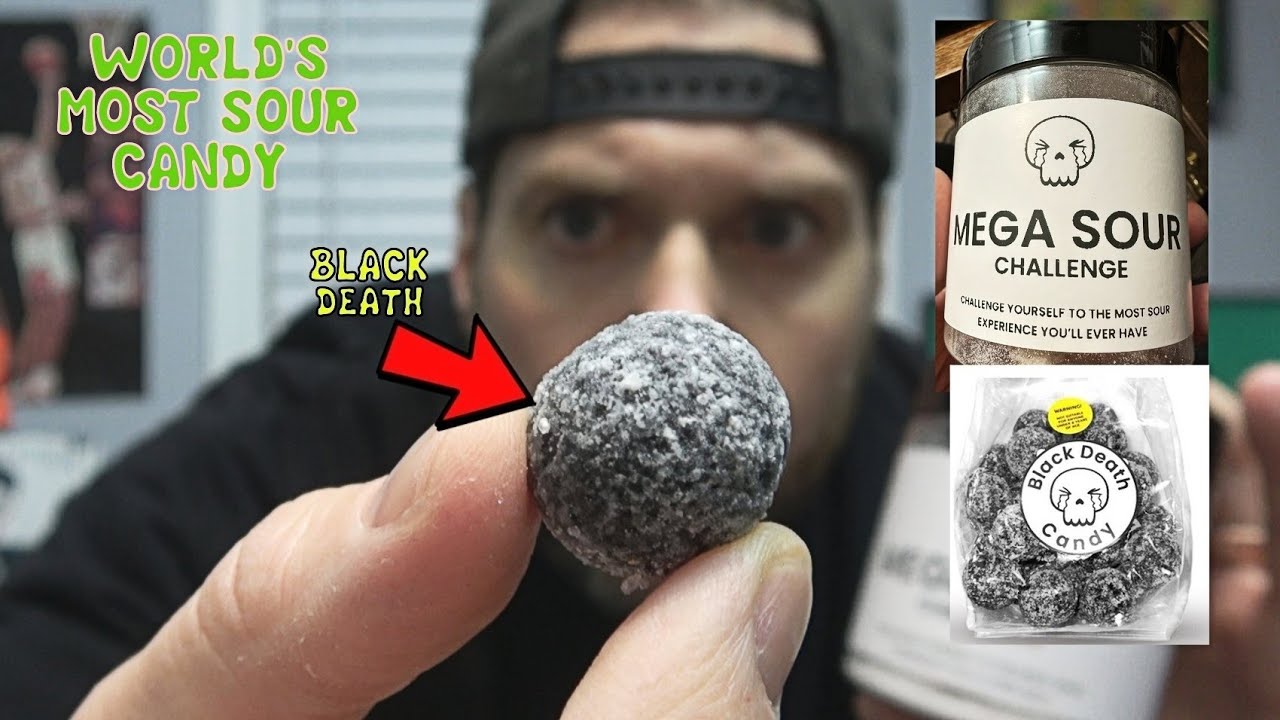
Thanks, as always for reading.  Happy Halloween, if you celebrate it.
Stay well,

Avoid miasma like the plague,

And remember that, as always, there’s

MTCIDC

O

PS

There is now some argument about the gear of such doctors.  See:  https://en.wikipedia.org/wiki/Plague_doctor  and https://www.livescience.com/plague-doctors.html   Plague could actually take several forms.  See:  https://www.britannica.com/science/plague   Because cemeteries—and grave-diggers were often overwhelmed, mass graves in unconsecrated ground began to be common—and now are sometimes happened upon unexpectedly.  See recent London plague pit discoveries:  https://www.cityam.com/after-crossrails-gruesome-discovery-weve-mapped-every-one-londons-plague-pits-do-you-work/

Healings (1)

02 Wednesday Aug 2017

Posted by Ollamh in J.R.R. Tolkien, Literary History, Narrative Methods

≈ Leave a comment

Tags

18th Century Medicine, 19th Century Medicine, Akria Kurosawa, al-Zahrawi, Arab Medicine, arrows, Black Plague, Boromir, Charles Dickens, Elrond, Frodo, gask mask, Greco-Roman, Hans Janssen, Henry V, London, Louis Pasteur, malaria, miasma, Micrographia, Morgul Knife, Our Mutual Friend, Prince Hal, Robert Hooke, Sir Joseph Lister, Thames, The Lord of the Rings, Throne of Blood, Tolkien, Toshiro Mifune, Victorian disease, Zacharias Janssen

Welcome, as always, dear readers.
Not long ago, we had a posting about Frodo’s wound from a Morgul-knife and the extraction of an arrow from the skull of Prince Hal, the future Henry V.
image1morgul.jpg
image2halswound.jpg
This, in turn, has led us to think about the kinds of wounds we see among the major characters of The Lord of the Rings and their cures—and about their creator.
The first one wounded is, of course, Frodo. In his case, it’s not so much the original knife wound, but the aftermath—the point of the blade which, as Gandalf describes it, “was deeply buried, and it was working inwards.” (The Fellowship of the Ring, Book Two, Chapter 1, “Many Meetings”). This, then, was no ordinary fighting knife, but the equivalent of the injection of a kind of poison or even parasite—“They tried to pierce your heart with a Morgul-knife which remains in the wound.”
Treatment was surgical—“Then Elrond removed a splinter…”—just as in the case of the young Prince Hal. We have no idea what else Elrond might have done, but, in Hal’s case, the surgeon was extremely careful to prevent infection. Any good medieval doctor would have been well aware of the danger and would have recognized the symptoms, but, once infection would have set in, would have been at a loss as to how to prevent the consequences. If a limb had been affected, he would have amputated, hoping to have pinched off the infection.
image3amputation.png
As Hal’s was a head wound, well, all the doctor could have done was what he did—keep the wound clean until the healing was clearly going well.
The difficulty was, medieval doctors could be aware of infection and could even try various methods to prevent it, but they had no accurate idea of what it was and where it came from. In their world, infection was either a mystery (possibly divinely inflicted) or, in the case of infectious disease, caused by something which they called miasma, an ancient Greek word which means, in fact, “pollution” (often “ritual pollution”).
This miasma was believed to be caused by rotting matter and was to be found in the air—and, in a world of open sewers in towns,
image4astreet.jpg
the “bad air” (where the word “malaria” comes from), would have been everywhere, especially when plague hit and burial services were quickly overwhelmed.
image4medburial.jpg
Part of the problem lay in the reliance upon ancient, outdated medical ideas, derived from Greco-Roman sources. Part, however, lay with the lack of tools available.
The medieval doctor had only his naked eyes with which to observe and to diagnose illness. The microscope was the invention of two Dutchmen, father and son Zacharias and Hans Janssen, in the 1590s.
image5janssen.jpg
Just seeing what’s there wasn’t enough, however, although what could be seen was absolutely amazing to people who had no idea what existed in worlds beyond this one. In 1665, the English polymath, Robert Hooke (1635-1703), published Micrographia, with a series of engravings of things seen under magnification which must have astounded people.
image6micro.gif
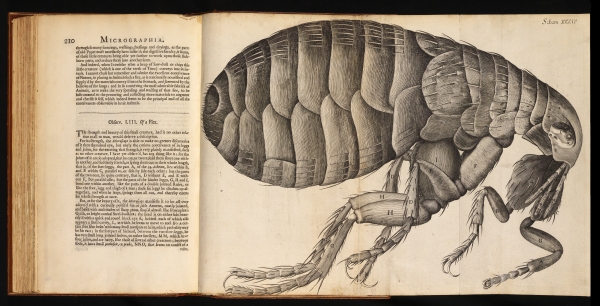
Just look at this flea, for example.
image7flea.jpg
Ironically, in the gut of this flea could be the bacterium Yersinia Pestis,
image8yersinia.png
which is the basis of black plague—but everyone in 1665 knew that the plague was caused by miasma—which was still the theory for infectious diseases in Victorian days, as this cartoon shows. (Death is here depicted as one of the scavengers of the river, major characters in Charles Dickens’ last completed novel, Our Mutual Friend, 1864-65.)
image9thames.jpg
The Thames, was filled with sewage, chemicals, refuse, dead animals, the overflow of cattle markets, and anything else horrible one might imagine. Of course it stank—in the summer of 1858 in fact, the smell was so overpowering that Parliament adjourned and fled its handsome and nearly-new home. One imagines that this was as much in fear of what that smell might portend as disgust at the odor.
image10greatstink.jpg
It was only in the mid-19th century that the work of scientists like Louis Pasteur (1822-1895)
image11pasteur.jpg
began the process of retiring the miasma theory in favor of the theory still used in the early 21st century, the germ theory. This was not an overnight process: the medical profession was very cautious and some members clung to outdated beliefs long after they could see that the efforts of forward-looking surgeons like Sir Joseph Lister (1827-1912) drastically cut the number of deaths directly related to the dangers of surgery before his changes.
image12lister.jpg
Lister believed that, by sterilizing the operating room and the instruments with carbolic acid (we would call it “phenol”, a petroleum derivative), as well as aggressive handwashing and careful and frequent cleansing of wounds, lives could be saved—and they were.
image13listerphenol.jpg
That Prince Hal’s surgeon, lacking knowledge of germs, could still be as energetic as he was in keeping Hal’s horrible wound clean, must be remembered when we imagine that medieval doctors were nothing more than ignorant charlatans. Some, at least, were observant and creative, even as they struggled to save their patients from dangers understood from their outcome, rather than from their origins.
(And so, if you remember that the medieval medical community believed that “bad air” carried disease, that crow-like mask which can be seen on late illustrations of “plague doctors” isn’t silly: the “beak”, packed with what they believed were “healthy” herbs, was meant to act as a filter against that air.
image14apldr.JPG
In fact, that idea wasn’t so far from the idea of World War One gas masks, which also carried a filter to cleanse the air of the poisonous gases—real ones, this time—with which both sides sometimes tried to flood the enemy’s trenches.)
image14bgasmask.jpg
Prince Hal’s arrow reminds us of the second wounding in The Lord of the Rings, this one fatal: Boromir.
image14boromir.jpg
Unlike Prince Hal, there was no possibility of extraction: Boromir had been hit multiple times: “…Aragorn saw that he was pierced with many black-feathered arrows.” (The Two Towers,, Book One, Chapter 1, “The Departure of Boromir”) And Ted Nasmith’s illustration tells it all—just look how pale Boromir is—he’s dying from blood loss.
[This always reminds us of the death of Toshiro Mifune as the Macbeth figure in Kurosawa’s wonderful 1957 film, Throne of Blood.)
image15throneofblood.png
As in the case of infection, only so much could be done for the sufferer in the medieval world. Arrows could be extracted, but, if they were barbed,
image16barbedarrow.jpg
they caused more damage coming out than going in—although a brilliant Arab doctor, whom we’ve mentioned before, al-Zahrawi, had invented an “arrow spoon” for this very problem. (We once saw this demonstrated, but we currently have no illustration, unfortunately. In the near future, however, we’re going to have a feature on JRRT’s Haradrim/Corsairs of Umbar vs actual medieval Arabic culture, where we’ll include discussion of the brilliant intellectual life of the Arabic world from Spain to the Middle East.)
After Boromir’s death, our next injury would be not a physical, but a psychological (or magical?) one. Pippin, peeping into a palantir, has had an encounter with Sauron and it hasn’t been a pleasant one:
“Then suddenly he seemed to see me, and he laughed at me. It was cruel. It was like being stabbed with knives….Then he gloated over me. I felt I was falling to pieces.” (The Two Towers, Book Three, Chapter 11, “The Palantir”)
In response, Gandalf commands Pippin to look at him:
“Pippin looked up straight into his eyes. The wizard held his gaze for a moment in silence. Then his face grew gentler, and the shadow of a smile appeared. He laid his hand softly on Pippin’s head. ‘All right!’ he said. ‘Say no more! You have taken no harm.’ ”
Pippin has escaped, then, though Gandalf has said that it was a close call: “You have been saved, and all your friends too, mainly by good fortune, as it is called.”
Our next injury—that of Faramir—won’t be so easy… But that’s for next time!
Thanks, as always, for reading—in “Healings.2”, we’ll look at other wounds in The Lord of the Rings, then move on to another war and one of its millions of victims…

MTCIDC
CD

The Doubtful Sea Series Facebook Page

The Doubtful Sea Series Facebook Page

  • Ollamh

Categories

  • Artists and Illustrators
  • Economics in Middle-earth
  • Fairy Tales and Myths
  • Films and Music
  • Games
  • Heroes
  • Imaginary History
  • J.R.R. Tolkien
  • Language
  • Literary History
  • Maps
  • Medieval Russia
  • Military History
  • Military History of Middle-earth
  • Narnia
  • Narrative Methods
  • Poetry
  • Research
  • Star Wars
  • Terra Australis
  • The Rohirrim
  • Theatre and Performance
  • Tolkien
  • Uncategorized
  • Villains
  • Writing as Collaborators
Follow doubtfulsea on WordPress.com

Across the Doubtful Sea

Recent Postings

  • A Moon disfigured December 17, 2025
  • On the Roads Again—Once More December 10, 2025
  • (Not) Crossing Bridges December 3, 2025
  • On the Road(s) Again—Again November 26, 2025
  • On the Road(s) Again November 19, 2025
  • To Bree (Part 2) November 12, 2025
  • To Bree (Part 1) November 5, 2025
  • A Plague o’ Both—No, o’ All Your Houses! October 29, 2025
  • It’s in Writing (2:  I’st a Prologue, or a Poesie for a Ring?) October 22, 2025

Blog Statistics

  • 103,217 Views

Posting Archive

  • December 2025 (3)
  • November 2025 (4)
  • October 2025 (5)
  • September 2025 (4)
  • August 2025 (4)
  • July 2025 (5)
  • June 2025 (4)
  • May 2025 (4)
  • April 2025 (5)
  • March 2025 (4)
  • February 2025 (4)
  • January 2025 (5)
  • December 2024 (4)
  • November 2024 (4)
  • October 2024 (5)
  • September 2024 (4)
  • August 2024 (4)
  • July 2024 (5)
  • June 2024 (4)
  • May 2024 (5)
  • April 2024 (4)
  • March 2024 (4)
  • February 2024 (4)
  • January 2024 (5)
  • December 2023 (4)
  • November 2023 (5)
  • October 2023 (4)
  • September 2023 (4)
  • August 2023 (5)
  • July 2023 (4)
  • June 2023 (4)
  • May 2023 (5)
  • April 2023 (4)
  • March 2023 (5)
  • February 2023 (4)
  • January 2023 (4)
  • December 2022 (4)
  • November 2022 (5)
  • October 2022 (4)
  • September 2022 (4)
  • August 2022 (5)
  • July 2022 (4)
  • June 2022 (5)
  • May 2022 (4)
  • April 2022 (4)
  • March 2022 (5)
  • February 2022 (4)
  • January 2022 (4)
  • December 2021 (5)
  • November 2021 (4)
  • October 2021 (4)
  • September 2021 (5)
  • August 2021 (4)
  • July 2021 (4)
  • June 2021 (5)
  • May 2021 (4)
  • April 2021 (4)
  • March 2021 (5)
  • February 2021 (4)
  • January 2021 (4)
  • December 2020 (5)
  • November 2020 (4)
  • October 2020 (4)
  • September 2020 (5)
  • August 2020 (4)
  • July 2020 (5)
  • June 2020 (4)
  • May 2020 (4)
  • April 2020 (5)
  • March 2020 (4)
  • February 2020 (4)
  • January 2020 (6)
  • December 2019 (4)
  • November 2019 (4)
  • October 2019 (5)
  • September 2019 (4)
  • August 2019 (4)
  • July 2019 (5)
  • June 2019 (4)
  • May 2019 (5)
  • April 2019 (4)
  • March 2019 (4)
  • February 2019 (4)
  • January 2019 (5)
  • December 2018 (4)
  • November 2018 (4)
  • October 2018 (5)
  • September 2018 (4)
  • August 2018 (5)
  • July 2018 (4)
  • June 2018 (4)
  • May 2018 (5)
  • April 2018 (4)
  • March 2018 (4)
  • February 2018 (4)
  • January 2018 (5)
  • December 2017 (4)
  • November 2017 (4)
  • October 2017 (4)
  • September 2017 (4)
  • August 2017 (5)
  • July 2017 (4)
  • June 2017 (4)
  • May 2017 (5)
  • April 2017 (4)
  • March 2017 (5)
  • February 2017 (4)
  • January 2017 (4)
  • December 2016 (4)
  • November 2016 (5)
  • October 2016 (6)
  • September 2016 (5)
  • August 2016 (5)
  • July 2016 (5)
  • June 2016 (5)
  • May 2016 (4)
  • April 2016 (4)
  • March 2016 (5)
  • February 2016 (4)
  • January 2016 (4)
  • December 2015 (5)
  • November 2015 (5)
  • October 2015 (4)
  • September 2015 (5)
  • August 2015 (4)
  • July 2015 (5)
  • June 2015 (5)
  • May 2015 (4)
  • April 2015 (3)
  • March 2015 (4)
  • February 2015 (4)
  • January 2015 (4)
  • December 2014 (5)
  • November 2014 (4)
  • October 2014 (6)
  • September 2014 (1)

Blog at WordPress.com.

  • Subscribe Subscribed
    • doubtfulsea
    • Join 78 other subscribers
    • Already have a WordPress.com account? Log in now.
    • doubtfulsea
    • Subscribe Subscribed
    • Sign up
    • Log in
    • Report this content
    • View site in Reader
    • Manage subscriptions
    • Collapse this bar
 

Loading Comments...