Tags
As ever, dear readers, welcome.
Dennis, the politicized peasant,

has something to say:
“ARTHUR: I am your king!
WOMAN: Well, I didn’t vote for you.
ARTHUR: You don’t vote for kings.
WOMAN: Well, how did you become King, then?
ARTHUR: The Lady of the Lake,…
[angels sing]
…her arm clad in the purest shimmering samite, held aloft Excalibur from the bosom of the water signifying by Divine Providence that I, Arthur, was to carry Excalibur.
[singing stops]
That is why I am your king!
DENNIS: Listen. Strange women lying in ponds distributing swords is no basis for a system of government. Supreme executive power derives from a mandate from the masses, not from some farcical aquatic ceremony.
ARTHUR: Be quiet!
DENNIS: Well, but you can’t expect to wield supreme executive power just ’cause some watery tart threw a sword at you!” (Monty Python and the Holy Grail, Scene 3, “Repression is Nine Tenths of the Law?” which you can read here: http://www.montypython.50webs.com/scripts/Holy_Grail/Scene3.htm
In case you are wondering what “samite” is, see
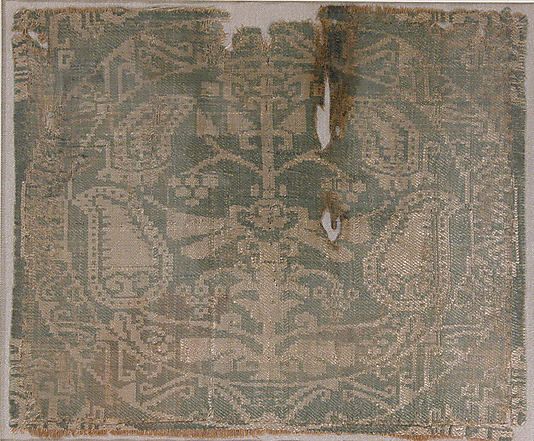
and: https://en.wikipedia.org/wiki/Samite
The Pythons, by the way, look to be mocking lines from “The Passing of Arthur”, a poem in Tennyson’s long series of Arthurian poems Idylls of the King here, where the dying Arthur commands his one surviving knight, Sir Bedivere, to toss his sword, Excalibur, into the local lake. Bedivere is tempted not to, but, on his third try, he does so and
“So flashed and fell the brand Excalibur:
But ere he dipt the surface, rose an arm
Clothed in white samite, mystic, wonderful,
And caught him by the hilt, and brandished him
Three times, and drew him under in the mere.”
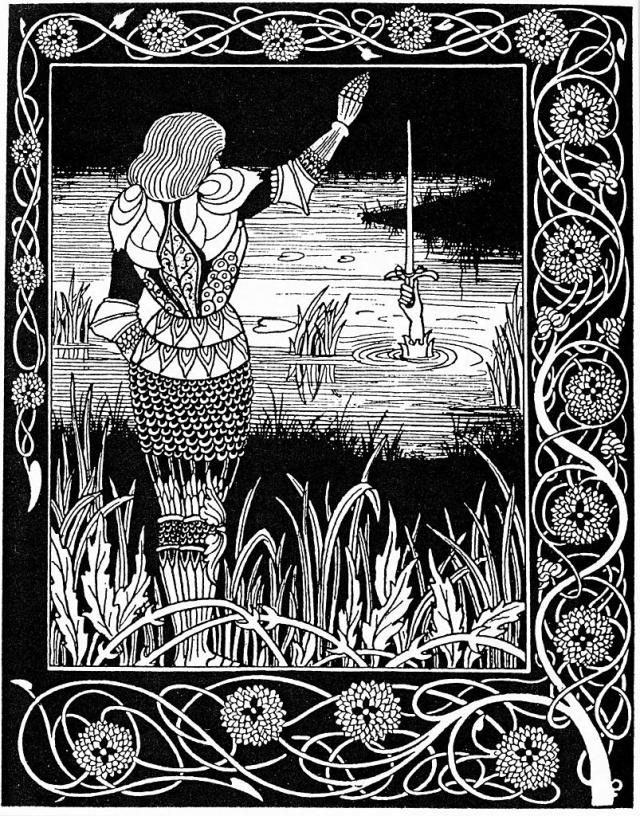
For the whole of the poem see: https://d.lib.rochester.edu/camelot/text/tennyson-passing-of-arthur Arthur had received the sword from this same Lady in “The Coming of Arthur”, which you can read here: https://d.lib.rochester.edu/camelot/text/tennyson-coming-of-arthur These are both drawn from the excellent Arthurian website which, if you don’t know it and are interested in Arthur, you need to: https://d.lib.rochester.edu/camelot-project There’s some confusion about Arthur and his swords, which you can read about here: https://en.wikipedia.org/wiki/Excalibur )
“Strange women lying in ponds” is the Pythons’ way of mentioning a rather common phenomenon we see in various forms both in folklore and in literature which is influenced by it, everything from classical water nymphs, naiads,

to mermaids

to the Rhinemaidens (Rheintoechter—“Rhine Daughters”) who appear in the “Ring Cycle”, Der Ring des Nibelungen, the 4-part series of Germanic mythological operas of Richard Wagner (1813-1883).
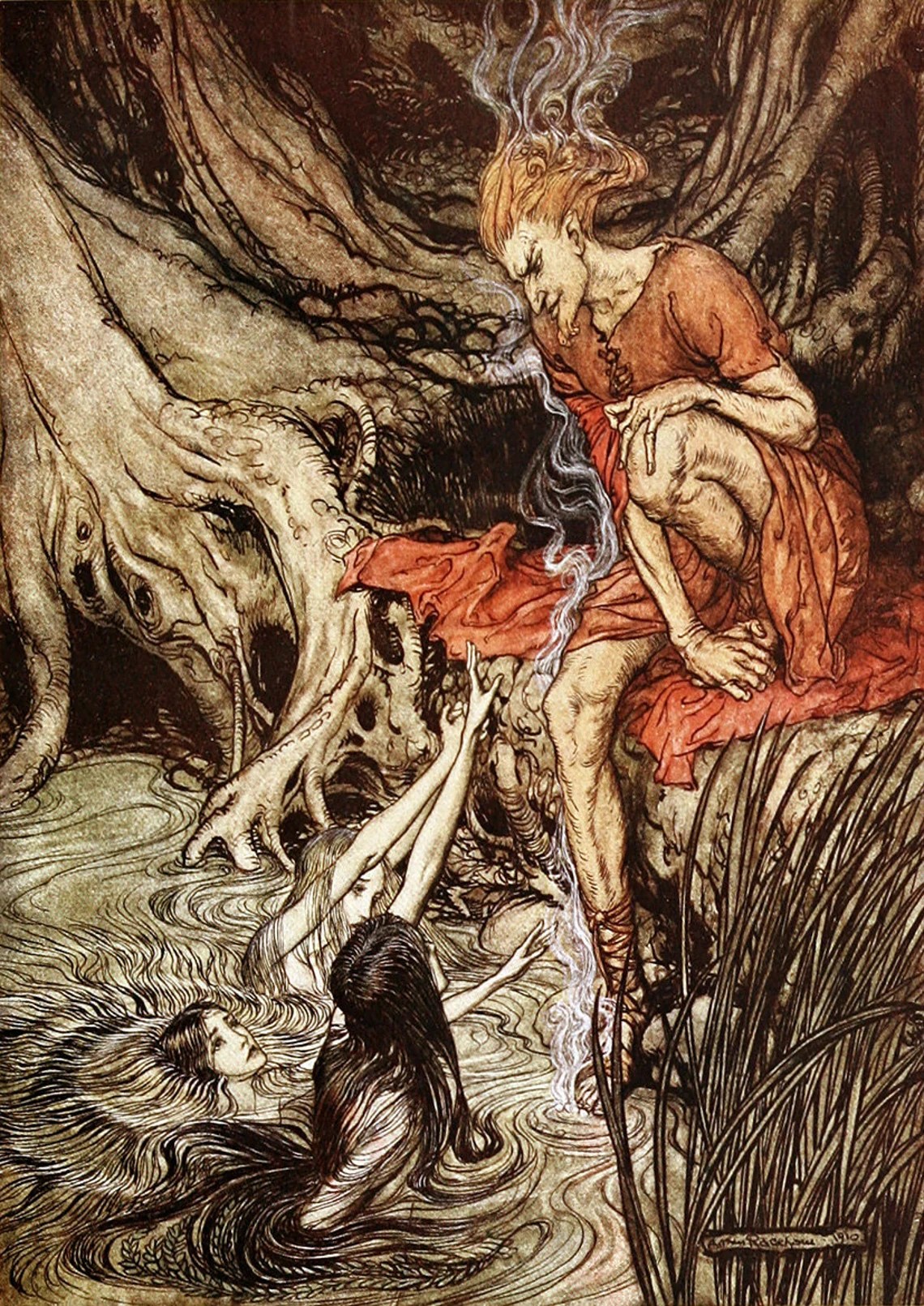
(Here chatting with the trickster god, Loge, an illustration by Arthur Rackham, 1867-1939. You can see all of his illustrations to Wagner’s story here: https://archive.org/details/rhinegoldvalkyri00wagn )
They are the guardians of the mysterious, but powerful “Rheingold”

which the dwarf, Alberich,
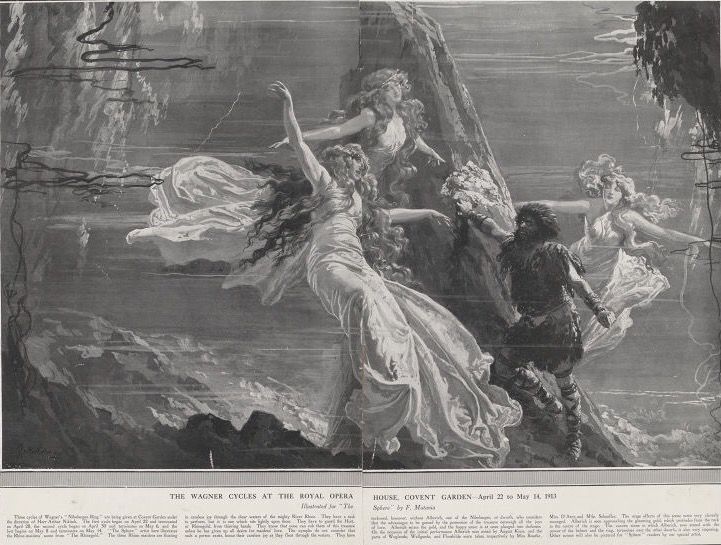
steals from them and fashions into a ring containing all the power of the original gold, which would enable its possessor to rule the world.

With another Ring in mind, there is, I would suggest, a bit more than a faint resemblance here between Wagner’s story and Tolkien’s, although Tolkien, seemingly fairly knowledgeable about Wagner’s work from early in his school days (see Carpenter Tolkien, 52) was very clear about just how faint that resemblance was as far as he was concerned:
“Both rings were round, and there the resemblance ceases.” (from a letter to Allen & Unwin, 23 February, 1961, Letters, 436)
But might there be at least a little more similarity than that?
One fact is obvious: Tolkien’s is a circlet which embodies tremendous power, just as the Nibelungen ring does, although that power wasn’t in the material from which it was made, but in the maker, Sauron.
Alberich’s ring, like Sauron’s, has not remained with him, coming first into the possession of the god Wotan, and then into the possession of a dragon, Fafner (formerly a giant), then into that of his killer, Siegfried (who also happens to be Wotan’s grandson), and then into that of the Valkyrie, Bruennhilde, Siegfried’s lover, who, leaping onto Siegfried’s funeral pyre, leaves the Ring to be collected from her ashes by the Rhinemaidens while, meanwhile, there is a cataclysm in the background and Valhalla, the home of the gods, is destroyed, along with the gods—“die Goetterdaemmerung”—literally “the gods’ dusk”.

That ring isn’t destroyed, but we can certainly note that combination of the ring changing hands and huge destruction associated with that act—
“And even as he spoke the earth rocked beneath their feet. Then rising swiftly up, far above the Towers of the Black Gate, high above the mountains, a vast soaring darkness sprang into the sky, flickering with fire. The earth groaned and quaked. The Towers of the Teeth swayed, tottered and fell down; the mighty rampart crumbled; the Black Gate was hurled in ruin; and from far away, now dim, now growing, now mounting to the clouds, there came a drumming rumble, a roar, a long echoing roll of ruinous noise.” (The Return of the King, Book Six, Chapter 4, “The Field of Cormallen”)

(Ted Nasmith)
As well, coming back to the beginning of this posting, there is also a water association. In fact, two:
1. after the defeat of Sauron at the foot of Orodruin, in which Isildur took the Ring from Sauron:
“…It fell into the Great River, Anduin, and vanished. For Isildur was marching north along the east bank of the River, and near the Gladden Fields he was waylaid by the Orcs of the Mountains, and almost all his folk were slain. He leaped into the waters, but the Ring slipped from his finger as he swam, and there the Orcs saw him and killed him with arrows…And there in the dark pools amid the Gladden Fields…the Ring passed out of knowledge and legend…”
2. but, many years later, two “akin to the fathers of the fathers of the Stoors”
“…took a boat and went down to the Gladden Fields…There Smeagol got out and went nosing about the banks but Deagol sat in the boat and fished. Suddenly a great fish took his hook, and before he knew where he was, he was dragged out and down into the water, to the bottom. Then he let go of his line, for he thought he saw something shining in the river-bed; and holding his breath he grabbed at it.
Then up he came spluttering, with weeds in his hair and a handful of mud; and he swam to the bank. And behold! when he washed the mud away, there in his hand lay a beautiful golden ring…” (The Fellowship of the Ring, Book One, Chapter 2, “The Shadow of the Past”)
To steal the Rhinegold from the Rhinemaidens, Alberich the dwarf has dived into the Rhine.
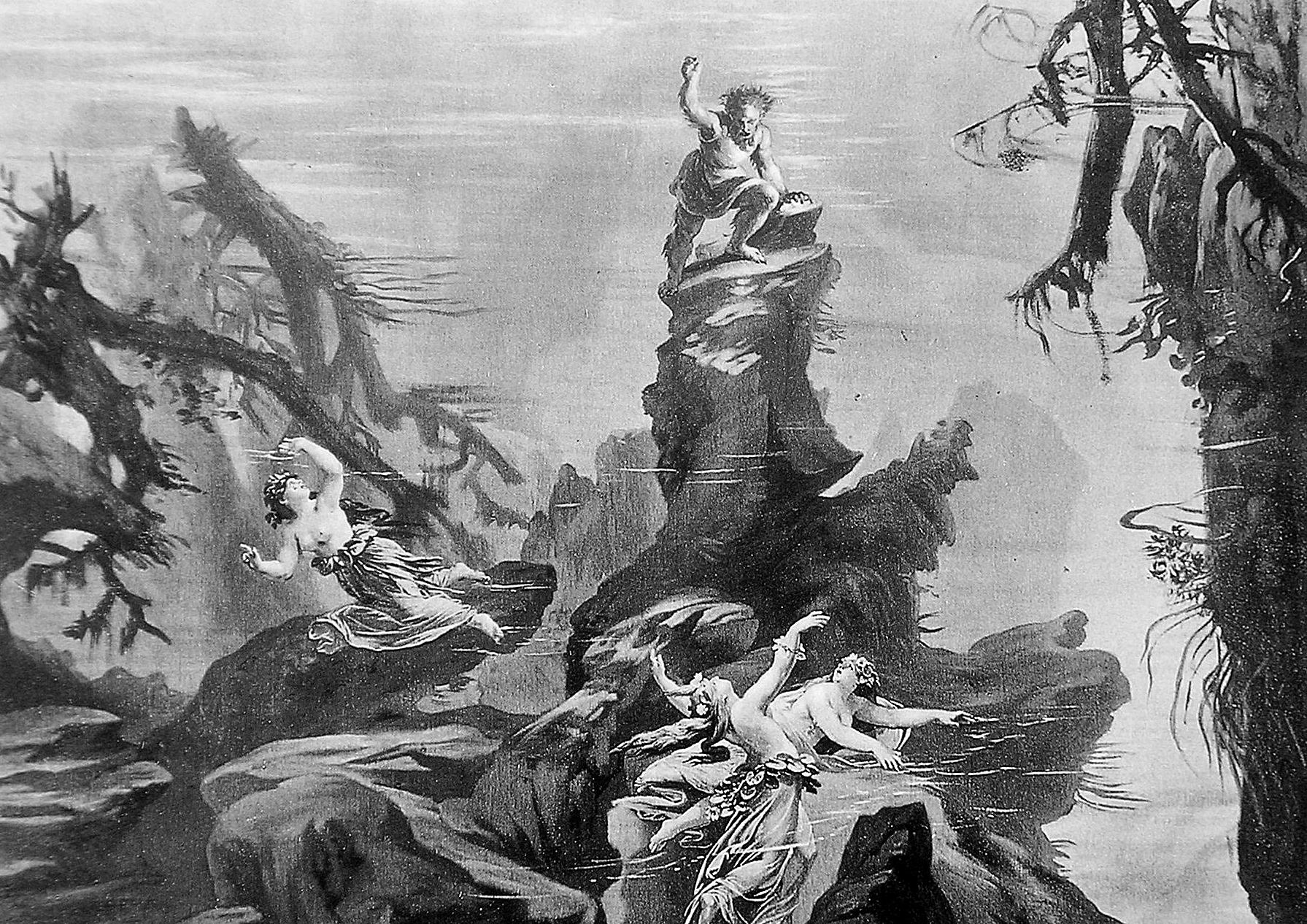
His son, Hagen, trying to regain the ring, is dragged into the river and drowned by them, even as they keep the ring.

Might we imagine, then, that the death of Gollum and all which precedes it is—perhaps—somehow a bit more related to Wagner’s story than JRRT was comfortable with?

(Ted Nasmith)
As ever, thanks for reading.
Stay well,
Stay dry,
And remember that there’s always
MTCIDC
O
 doubtfulsea