Welcome, dear readers, as always.
When I was very little, many things puzzled me. Among them was this from a Christmas carol:
“Don we now our gay apparel.
(assorted tra-la-las)
Troll the ancient Yuletide carol.”
(further fa-la-las, etc)
(“Deck the Halls”—for its interesting and fairly recent—1862—history, see: https://en.wikipedia.org/wiki/Deck_the_Halls )
I suppose I wondered who “Don” was (which I heard as Don Wenow, possibly a Spanish grandee?), but what really confused me was what trolls had to do with Christmas.
I had first met a troll here—
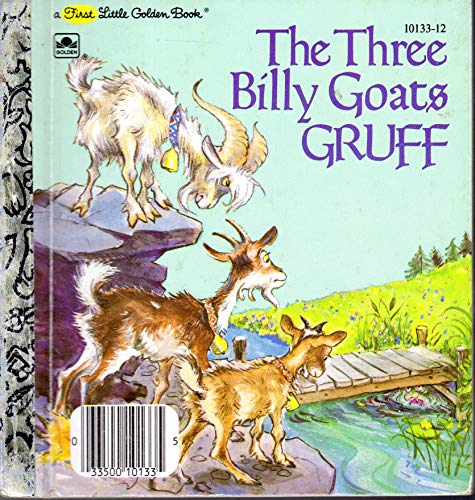
in a “Little Golden Book”—a small children’s book with, as you can see, a single story. Although I didn’t understand that word “Gruff”, I liked the story which, if you don’t know it, is a simple folktale:
1. three goats of increasing size lived in a meadow by a stream

2. across the stream was a lusher meadow, the stream being crossed by a bridge
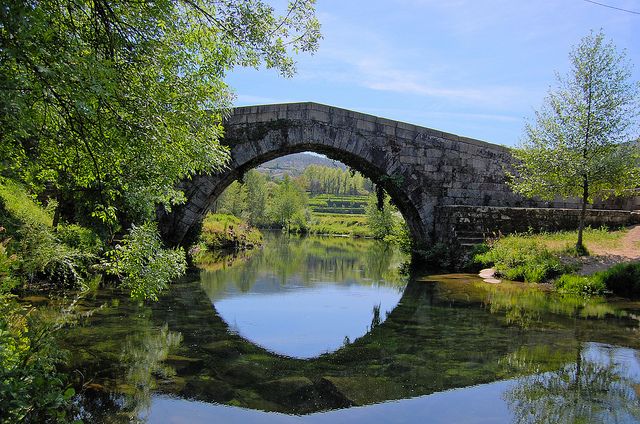
3. under the bridge lived a troll

(from the Rolozo Tolkien site—no artist listed—and be careful if you go looking for trolls on the internet or you might end up with this–)

4. the smallest/youngest goat attempts to cross the bridge but is threatened by the troll. The goat says wait for my brother—he’s larger and therefore will provide a better meal. The troll agrees, the second goat appears, says the same thing, and the troll—who has yet to catch on, but that’s trolls for you—agrees again. And, even if you don’t know this story, you being one of my readers (unless, of course, you’re a troll, in which case, although you’re certainly welcome to join us, take notes!) will guess right away that the third, and largest, goat butts the troll into the stream, where he drowns.
But what is a troll, other than a rather dim creature with a taste for goats and a damp residence?
I’ve always assumed that they were Scandinavian and, consulting my Old Norse dictionary (Cleaseby and Gudbrand Vigfusson, 1874—here’s a copy for you here: https://cleasby-vigfusson-dictionary.vercel.app/ ), I find “A giant, fiend, demon, a generic term”, along with all sorts of expressions, compounds, and place names associated with them, adding this: “a werewolf, one possessed by demons”.
Giants, fiends, and demons are found everywhere in old stories (in my long-term reading of the whole of The Thousand and One Nights, I meet them on a regular basis), but the ancestry of this particular tale certainly places at least one troll squarely in Norway, as it first appeared in Asbjornsen and Moe’s Norske Folkeeventyr (1841-44)—“Norwegian Folktales”.

(This is the second edition of 1852.)
In turn, selections from this were translated by George Webbe Dasent (1817-1896) as Popular Tales from the Norse (1859)—here’s a copy for you: https://www.gutenberg.org/cache/epub/8933/pg8933-images.html

And here, as Number XXXVII, we find the story.
This is where I first met a troll—could that have been true for Tolkien, as well? Let’s have a look at the possibility.
When we think of trolls and JRRT, I imagine the first thing which comes into readers’ minds is the near-disaster of Bilbo and the dwarves with William, Bert, and Tom in a glade—
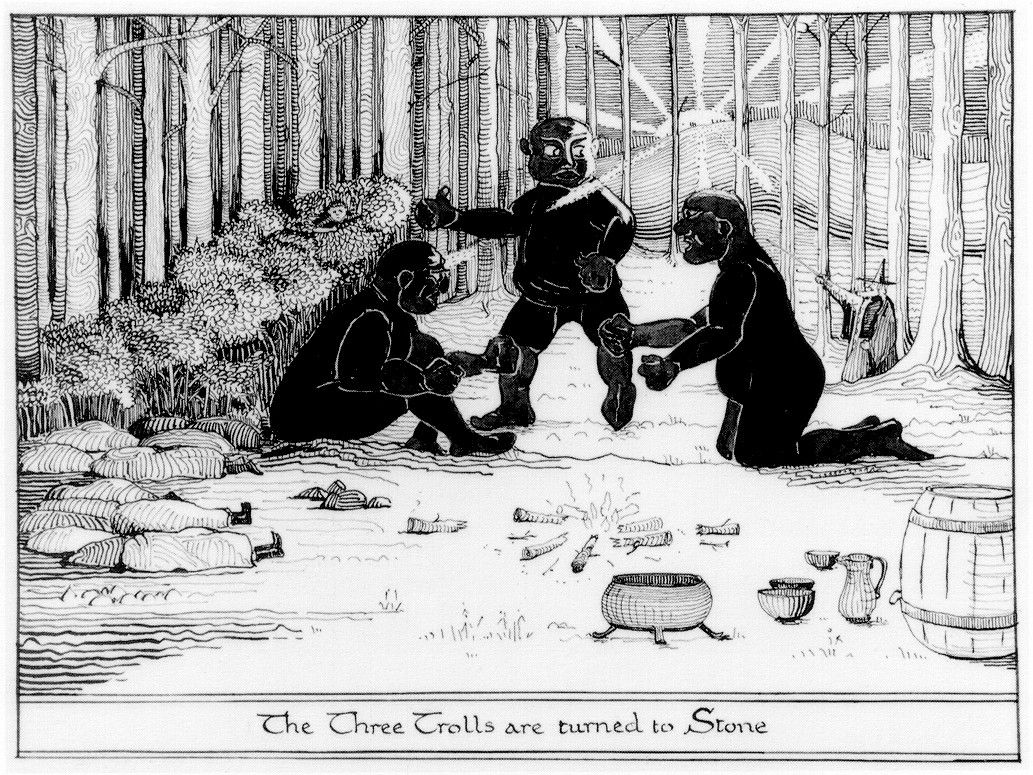
(JRRT)
“But they were trolls. Obviously trolls. Even Bilbo, in spite of his sheltered life, could see that: from the great heavy faces of them, and their size, and the shape of their legs, not to mention their language, which was not drawing-room fashion at all, at all.” (The Hobbit, Chapter 2, “Roast Mutton”)
That language was described by Douglas Anderson in his The Annotated Hobbit as “comic, lower-class speech”—but, more specifically, it’s the language of music hall comics, commonly lower-class Londoners, cockneys—
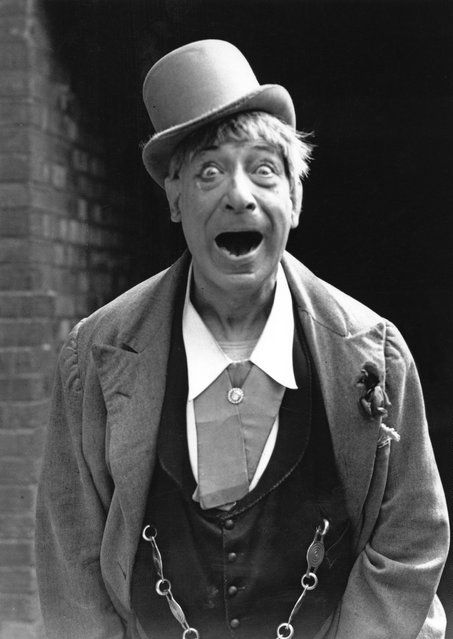
(This is Harry Champion, 1865-1942, a well-known performer in music halls, and, with that expression, half-way to becoming a troll himself.)
which is hardly what we’d expect of creatures William describes as “come down from the mountains”, where we might hear them speaking the kind of rural English you hear in Sean Astin’s Sam in Jackson’s The Lord of the Rings,

based upon southwestern speech, but generalized to a degree and called “mummershire” in England.
Tolkien once described himself as having “a very simple sense of humour (which even my appreciative critics find tiresome)” (from a letter to Deborah Webster, 25 October, 1958, Letters, 412), which might be true in general, but I find the juxtaposition of creatures from Norse mythology doing a kind of music hall routine a wonderfully grimly comic combination, particularly as, during that routine, they were about to kill and eat the dwarves—and Bilbo, too. (I especially like William’s specific detail that “You’ve et a village and a half between yer, since we come down from the mountains.”)
Sometimes it’s clear that Tolkien’s very early experiences with stories has influenced his later writing—as much as he can be prickly on the subject—as in the case of Moria and “Soria Moria Castle”, of which he says:
“It was there, as I remember, a casual ‘echo’ of Soria Moria Castle in one of the Scandinavian tales translated by Dasent. (The tale had no interest for me: I had already forgotten it and have never since looked at it. It was thus merely the source of the sound-sequence moria, which might have been found or composed elsewhere.) I liked the sound-sequence; it alliterated with ‘mines’, and it connected itself with the MOR element in my linguistic construction.” (drafts for a letter to ‘Mr. Rang’, August, 1967, Letters, 541)
For us, however, the important phrase here is “one of the Scandinavian tales translated by Dasent”. And here, as well, we have a small problem. A volume we know must have formed part of Tolkien’s reading experience was Andrew Lang’s 1890 The Red Fairy Book,

and “Soria Moria Castle” appears there as the third story in the volume. (Here’s a copy for you of the first edition: https://archive.org/details/redfairybook00langiala/redfairybook00langiala/page/n15/mode/2up ) Although, in his introduction, Lang credits the translators of other tales, he doesn’t credit Dasent for this story. Instead, at the story’s end, there’s a footnote citing “P.C. Asbjornsen”, who, along with Moe, was the source for Dasent’s work. And yet, when one compares the text in Lang with that in Dasent, although the basic story is the same, there are differences, beginning with the first sentence.
In Lang, it reads:
“There was once upon a time a couple of folks who had a son called Halvor.”
And, in Dasent, that reads:
“Once on a time there was a poor couple who had a son whose name was Halvor.”
What’s going on here? My guess is that there’s been some editing by Lang or by his wife, who, in reality, quietly took over the series, almost from the beginning, as Lang acknowledges in the introduction to The Lilac Fairy Book, 1910 (for more on this see: https://en.wikipedia.org/wiki/Lang%27s_Fairy_Books ).
Reading on, we see that Halvor comes face to face (to face to face to face to face, as the troll has three heads) with a troll—in fact, there are several trolls—the next with six heads and a third with 9,

but these are not in the least like William, Bert, and Tom, being more like the giant in “Jack and the Beanstalk” with his “Fee-Fi-Fo-Fum, I smell the blood of an Englishman”, saying, “Hutetu! It smells of a Christian man’s blood here!”
One form of “Soria Moria Castle”, even with a differing text, occurs both in Dasent and Lang, but “Three Billy Goats Gruff” only appears in Dasent, leaving us with a puzzle: did Tolkien read (or have read to him by his loving mother) “Soria Moria Castle” in Lang, in which case his trolls may come from that story, or did he have a copy of Dasent available and the trolls appeared, not only from “Soria Moria Castle”, but might also have done so (in a dimmer form) in “Three Billy Goats Gruff”?
And what about that other troll, the one in
“Troll the ancient Yuletide carol.”?
If we can believe the anti-Christian view of trolls in “Soria Moria Castle”, it’s doubtful that they would be associated with Christmas. Etymonline says (along with a brief discussion of the use of the word in fishing, which doesn’t seem apropos), “sing in a full, rolling voice”, although one can picture very large trolls with large voices, I wonder what they’d sing? (See the song of the goblins in Chapter 4 of The Hobbit, “Over Hill and Under Hill” for a possible model?)
Now all I have to wonder about is who Don Wenow was and how he might be related to Christmas.
As ever, thanks for reading.
Stay well,
If you sing carols, you might consider the identity of Round John Virgin,
And remember that, as always, there’s
MTCIDC
PS
As you’ll recall, William, Bert, and Tom soon have an early morning experience with Gandalf which leaves them petrified. Have a look at this important contribution to what happens to them and why: https://hatchjs.com/why-do-trolls-turn-to-stone/
 doubtfulsea