Tags
decay, Ents, Entwives, Fangorn, Fangorn Forest, Laurelindorenan, Lothlorien, Minas Tirith, Ronald Foerster, Samwise Gamgee, Ted Sandyman, The Green Dragon, The Lord of the Rings, Tolkien, trees
Welcome, dear readers, as ever.
A posting or two ago, we had been talking about the symbolic uses of trees in Middle-earth, mostly as symbols of decay and regeneration.
Without going into a lengthy essay, we thought we had said what we could. But we had forgotten something—or, rather, someone.
While gossiping in The Green Dragon, Sam, slowly becoming annoyed at Ted Sandyman’s skepticism about the out-of-the-ordinary, replied to Ted’s “There’s only one Dragon in Bywater, and that’s Green”, by asking:
“But what about these Tree-men, these giants, as you might call them? They do say that one bigger than a tree was seen up away beyond the North Moors not long back.”
Ted is not convinced, and Sam presses on: “But this one was as big as an elm tree, and walking—walking seven yards to a stride, if it was an inch.””
“Then I bet it wasn’t an inch. What he saw was an elm tree, as like as not.”
Undaunted, Sam continues: ‘But this one was walking, I tell you; and there ain’t no elm on the North Moors.’ “ (The Fellowship of the Ring, Book 1, Chapter 2, “The Shadow of the Past”)
The topic shifts in another direction, with Ted still not persuaded, but we readers were struck by what Sam just said. As always with JRRT, the texts are so rich that one is always falling upon something read sometimes many times before, but somehow not seen, and this was one of them. (And, as always, we can hear Sherlock Holmes disdainfully commenting, “You see, but you do not observe.”) If the North Moors are like moors in our world, they are wild and windswept
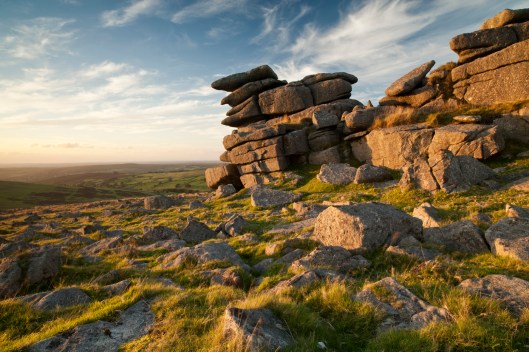
with virtually no trees, except in hollows and streambeds. And certainly no elms
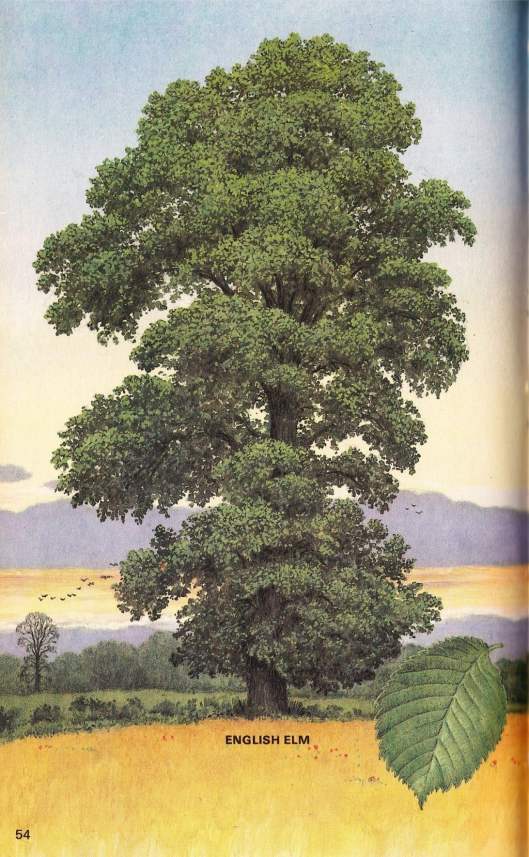
as Sam says. Ted Sandyman dismisses Sam’s assertion, suggesting that it was an illusion or maybe an elm, but we know better: it was an Ent.
When Merry and Pippin meet their first, he is very vividly described:
“They found that they were looking at a most extraordinary face. It belonged to a large Man-like, almost Troll-like figure, at least fourteen feet high, very sturdy, with a tall head, and hardly any neck. Whether it was clad in stuff like green and grey bark, or whether that was its hide, was difficult to say. At any rate the arms, at a short distance from the trunk, were not wrinkled, but covered with a brown smooth skin. The large feet had seven toes each. The lower part of the long face was covered with a sweeping grey beard, busy, almost twiggy at the roots, thick and mossy at the ends. But at the moment the hobbits noted little but the eyes. These deep eyes were now surveying them, slow and solemn, but very penetrating. They were brown, shot with a green light.” (The Two Towers, Book Three, Chapter 4, “Treebeard”)
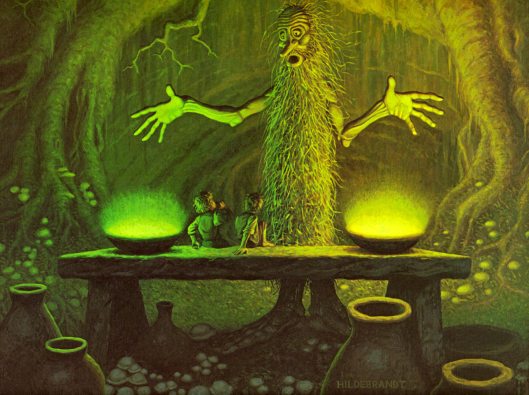
We are not so mathematically sophisticated as to be able to determine, from those fourteen feet of height, the length of the Ent’s stride, unfortunately, but we are later told that this Ent, who is, of course, Treebeard, can move at quite a ground-eating speed, having, by the time he brings the two hobbits to Wellinghall, come “about seventy thousand ent-strides.”
(Actually, if, as Sam says above, an Ent’s stride was 7 yards, with 3 feet in a yard times 70,000, Treebeard has brought them about 280 miles (450 km) in a few hours!)
Treebeard formed part of our previous discussion, suggesting not only was his forest, Fangorn, in decline, but likewise Lothlorien:
“Do not risk getting entangled in the woods of Laurelindorenan! That is what the Elves used to call it, but now they make the name shorter: Lothlorien they call it. Perhaps they are right: maybe it is fading, not growing…They are falling rather behind the world in there, I guess…Neither this country, nor anything else outside the Golden Wood, is what it was when Celeborn was young.”
The decline of Treebeard’s world appears to come from two causes. First, there is an elderly and declining population of Ents:
“We are tree-herds, we old Ents. Few enough of us are left now…Some of my kind look just like trees now, and need something great to rouse them; and they speak only in whispers…
Hence, part of the Entish population is fading into the trees they herd. The other reason is more delicate. The Ents, although deeply attached to the trees, are, in fact, more like humans: they have two genders, suggesting that they reproduce the way mammals do. Unfortunately, something has gone wrong and the female half of the species has disappeared. As Treebeard explains:
“When the world was young…the Ents and the Entwives…walked together and they housed together…But our hearts did not go on growing in the same way: the Ents gave their love to things that they met in the world, and the Entwives gave their thought to other things…So the Entwives made gardens to live in. But we Ents went on wandering, and we only came to the gardens now and again…”
After ages pass, the Ents try to see the Entwives again, but:
“We crossed over Anduin and came to their land; but we found a desert: it was all burned and uprooted, for war had passed over it. But the Entwives were not there.”
And, from that time, the Ents have been without the Entwives and the implication must be that, although some of the trees, as Fangorn says, are “getting Entish”, unless the Entwives are found, there will be no young Ents to continue their line into the future. As Treebeard says, “…there were never many of us and we have not increased. There have been no Entings—no children, you would say, not for a terrible long count of years.”
All of this fits in with the theme we suggested in our previous posting: trees can symbolize the decline of Middle-earth, not only in their hostility, but, in the case of the Ents (who are almost trees), through what amounts to infertility, just like Minas Tirith, with half its buildings empty.
Treebeard holds little hope of the future, as well:
“We believe that we may meet [the Entwives] again in a time to come, and perhaps we shall find a land where we can live together and both be content. But it is foreboded that that will only be when we have both lost all that we now have…”
In that previous posting, we also suggested that the defeat of Sauron and the return of the rightful king brought about new growth and regeneration, something seen in the vegetation from the White Tree sapling in Minas Tirith to the phenomenal new fertility of the Shire. In the case of the Ents, however, there appears to be no happy ending, as, taking his farewell of Merry and Pippin, Treebeard says wistfully:
“Fare you well! But if you hear news up in your pleasant land, in the Shire, send me word! You know what I mean: word or sight of the Entwives.” (The Two Towers, Book Three, Chapter 10, “The Voice of Saruman”)
And yet—if we return to that conversation between Ted Sandyman and Sam, perhaps there is news for Treebeard. As far as we know, what Ents there are now in Middle-earth—including the three eldest, Fangorn, Finglas, and Fladrif—all seem to live in the forest of Fangorn—so who is that “Tree-man, giant, one bigger than a tree…big as an elm tree and walking—walking seven yards to a stride” which Sam’s cousin Hal saw “up away beyond the North Moor not long back”? The Lord of the Rings ends without our ever finding out, so we guess we can only hope that, one day, Merry and Pippin sent word.
Thanks, as always, for reading.
MTCIDC
CD
PS
We happened upon this illustration by Ronald Foerster of an Entwife—what do you think?

 doubtfulsea