• About

doubtfulsea

~ adventure fantasy

Tag Archives: Quintilian

Beaux Gestes? (2)

27 Wednesday Apr 2016

Posted by Ollamh in Artists and Illustrators, Fairy Tales and Myths, J.R.R. Tolkien, Villains

≈ 1 Comment

Tags

19th-century tombs, Cicero, Galadriel, Gandalf, Grey Havens, Hildebrandts, Istari, Mourning, Queen Victoria, Quintilian, Saruman, Scouring of the Shire, The Lord of the Rings, The Mirror of Galadriel, Theatrical gesture, Tolkien, Valar

Welcome, as always, dear readers.

In our last, we commenced a small examination of gesture in The Lord of the Rings, relating specifically to Galadriel and Saruman. We began with Galadriel

galadriel.jpg

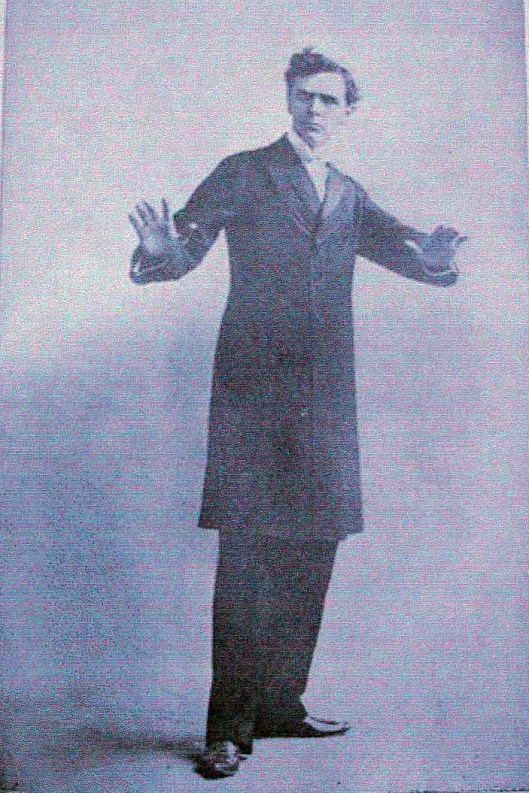
and her rejection of Sauron. JRRT describes it in this way: “She lifted up her white arms, and spread out her hands towards the East in a gesture of rejection and denial.” In that post, we said that her gesture seemed theatrical, almost melodramatic, and we suggested that JRRT had been influenced by what we imagined he had seen on stage and on screen late in the 19th and into the 20th centuries, a time when such broad gestures were still considered the best way to convey strong emotion. This mode was, we proposed, ultimately based upon the writings of two ancient Romans, Cicero and Quintilian, who lived between the years 100BC and 100AD. In their day and up to the 20th century, the only magnification available to allow speakers to be heard over crowds was the human voice. Thus, a range of gestures emphatic enough to be seen and clear enough to be understood at a distance was an important component of effective speaking and such gestures were adopted and adapted by actors and used and reused for many centuries to come.

Because none of the illustrations based upon “The Mirror of Galadriel” depicts this gesture, we used a photograph from an 1898 book on public speaking to provide the sense of what we believe we were meant to see.

Repulsion.jpg

In our last, we also suggested that Galadriel’s gesture was linked to one of Saruman’s—in fact, his last gesture on Middle Earth, as far as we know.

In sudden resentment at the contemptuous treatment consistently dealt him by Saruman, Grima Wormtongue has drawn a hidden knife and cut the wizard’s throat.

“To the dismay of those that stood by, about the body of Saruman a grey mist gathered, and rising slowly to a great height like smoke from a fire, as a pale shrouded figure it loomed over the Hill. For a moment it wavered, looking to the West; but out of the West came a cold wind, and it bent away, and with a sigh dissolved into nothing.” The Lord of the Rings, Book 6, Chapter viii.

jwyatt-sarumande.jpg

Saruman had been one of the Istari, as Tolkien describes them all in describing Gandalf:

“There are naturally no precise modern terms to say what he was. I wd. venture to say that he was an incarnate ‘angel’—strictly an angelos: that is, with the other Istari, wizards, ‘those who know’, an emissary from the Lords of the West, sent to Middle-earth, as the great crisis of Sauron loomed on the horizon. By ‘incarnate’ I mean they were embodied in physical bodies capable of pain, and weariness, and of afflicting the spirit with physical fear, and of being ‘killed’, though supported by the angelic spirit they might endure long, and only show slowly the wearing of care and labour.” Letter to Robert Murray, S.J. (draft), 4 November, 1954.

Saruman, then, as another of the Istari, can be killed—and is, but what then? In his battle with the Balrog, it appears that Gandalf has met his end. He returns, however, suggesting that his physical body might be capable of the repair which Galadriel administers in Lorien.  As JRRT says in the same letter, “He was sent by a mere prudent plan of the angelic Valar or governors; but Authority had taken up this plan and enlarged it, at the moment of its failure.”—that is, Gandalf’s apparent death.

As Gandalf puts it, “I was the enemy of Sauron”, and, with Sauron defeated, apparently conclusively, Gandalf is allowed to return to the West, to do or be what, is never explained.   It is a privilege, clearly, since it is granted only to High Elves and, with special dispensation, to Bilbo and Frodo.

This brings us back to Saruman’s gesture: “For a moment it wavered, looking to the West; but out of the West came a cold wind, and it bent away, and with a sigh dissolved into nothing.”

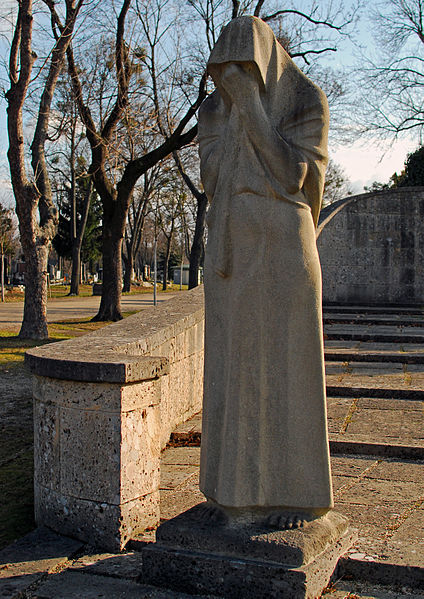
In a way, what we see here is actually a lack of gesture—it is a wavering, with a sense of hope, perhaps? Almost as if Saruman is appealing for pardon? As in the case, of Galadriel, we have no artist’s depiction of this, but we’ve used the clue of “a pale shrouded figure”, as well as that wavering, to imagine that this is someone in mourning and so we can offer several figures from later 19th-century tombs as a possible image.

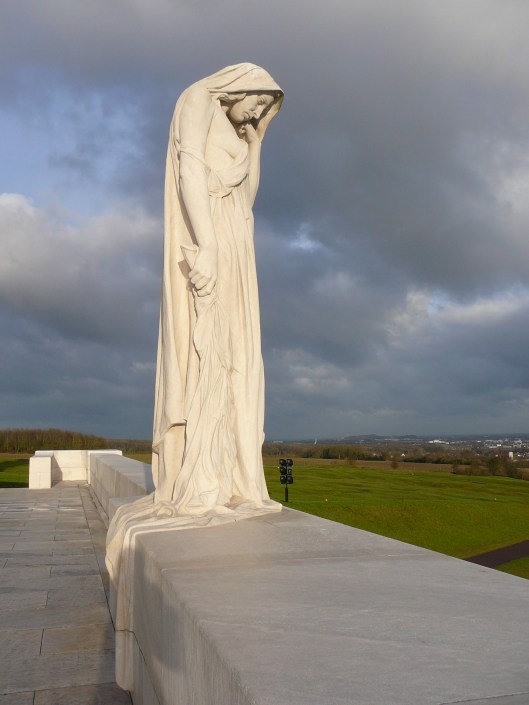
d5717eeaa95186cd2e3d95447d215e2f.jpgp1140386.jpg

Statue-to-Mourning-Zentralfriedhof-Vienna.jpg

It’s interesting that these all are female, as if this is one of the expected jobs of 19th-century women, to be the Mourners in Chief. We suppose that, since Queen Victoria mourned for her husband Albert from his death in 1861 to her own death in 1901, this shouldn’t be surprising, but we are planning a later posting about mourning in The Lord of the Rings which will examine the subject within certain western traditions in more depth.

Queen-Victoria-Her-Latest-Portrait-1900_tr_4643_566.jpg

In the meantime, we return to Galadriel to match these two gestures. Saruman had failed because he had accepted the East and the deceptive words of Sauron. His fate, then, is to be met with a cold wind and to dissolve, with a sigh, into nothing, rejected by the West from which he had been sent, several thousand years before. Galadriel, on the other hand, by protecting her people and rejecting Sauron, had been accepted back into the West and the last we see of her is aboard a ship at the Grey Havens, bound for her reward.

ghavens.jpg

Thanks for reading, as always.

MTCIDC

CD

PS

We couldn’t resist this final image: the Hildebrandts with the painting.

haven-c.jpg

For all of the wonderful paintings he and his brother have given us, may Tim Hildebrandt (1939-2006) have been given a safe passage to the West, as well.

 

Beaux Gestes? (1)

20 Wednesday Apr 2016

Posted by Ollamh in J.R.R. Tolkien, Narrative Methods, Theatre and Performance

≈ Leave a comment

Tags

Cicero, David Garrick, Edmund Burke, Elizabethan, Film, Galadriel, Globe theatre, Hamlet, Hildebrandt, Mirror of Galadriel, Quintilian, rejection, Roman theatre, The Argonath, The Lord of the Rings, The Phantom of the Opera, The Popular Entertainer and Self-Instructor in Elocution, theatre, Theatrical gesture, Tolkien

Dear Readers, welcome, as always.

In this posting, we want to begin to consider a pair of contrasting gestures in The Lord of the Rings, where they may come from, and how they may mirror each other.

We begin with Galadriel in The Fellowship of the Ring, Book II, Chapter 7, “The Mirror of Galadriel”.

In this scene, she has offered Frodo and Sam the chance to look into what appears to be a small pool of enchanted water, where she tells Frodo “You may learn something, and whether what you see be fair or evil, that may be profitable, and yet it may not. Seeing is both good and perilous.”

9ae941056ddb6946598d98690668e844.jpg

Sam goes first and endures a nightmarish depiction of the future of the Shire—although Galadriel warns him that it is perhaps potential, not fated future.

Frodo has, in turn, an even worse experience: the eye of Sauron himself appears and Frodo can feel that it is trying to discover the Ring.   It is something of which Galadriel herself is well aware, but she comforts Frodo, saying, “…I perceive the Dark Lord and know his mind, or all of his mind that concerns the Elves. And he gropes ever to see me and my thought. But the door is still closed!”

To emphasize this, “She lifted up her white arms, and spread out her hands towards the East in a gesture of rejection and denial.”

Repulsion.jpg

To modern people, like us, trying to visualize what Galadriel is doing , this might seem a very “theatrical” gesture. The closest we could find in our image bank of Galadriel actually doing it wasn’t more than a suggestion.

galadriel.jpg


And, in fact, the image we’ve chosen (obviously not Galadriel!) to depict this comes from a book published in 1898, with the intriguing title, The Popular Entertainer and Self-Instructor in Elocution.

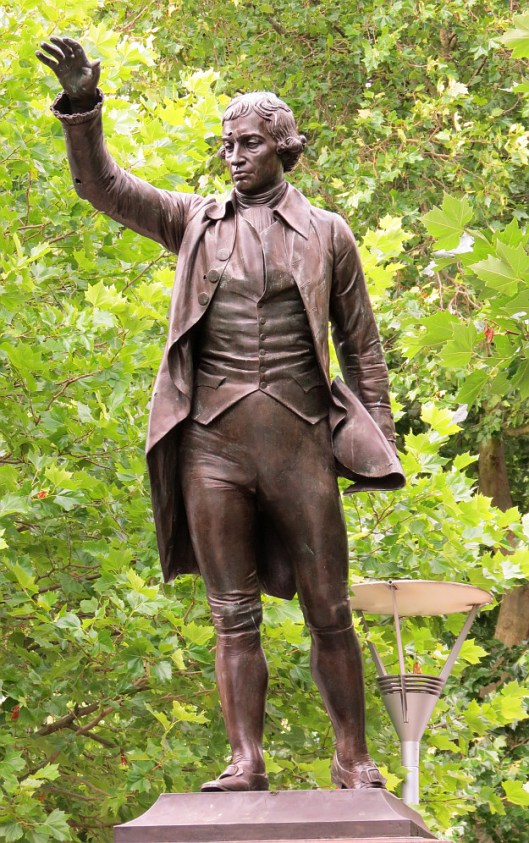
This brings us back to a time in history when public speaking was a polished art and men (primarily—although the women’s rights movement from the mid-19th century had its speakers, as well) practiced stylized gestures to help them convey their meaning in lecture halls, theatres, and open spaces. Older public statues sometimes capture such a speaker in mid-gesture—as in this of the British intellectual and politician, Edmund Burke, in Bristol.

bristolbroadquayburke.jpg

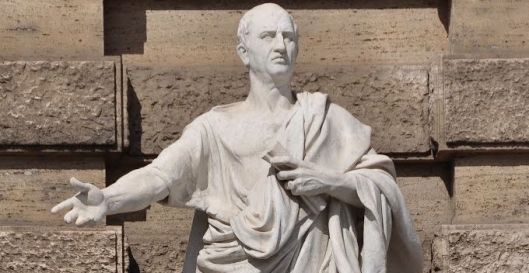
Such combinations of gesture and speech are derived from a tradition which stretches all the way back to the last century BC/first century AD in the works of the Roman orators/writers Cicero

cicero.jpg

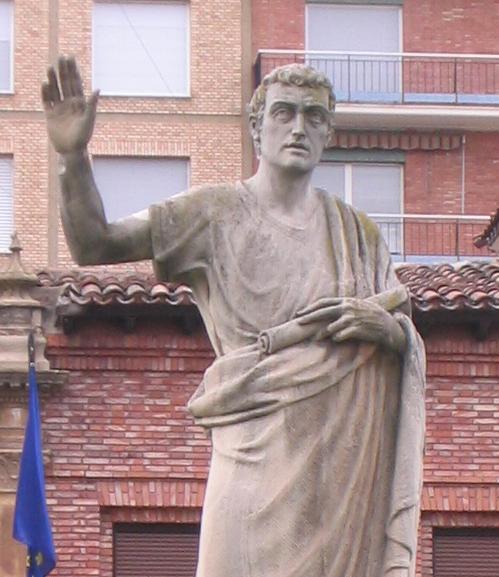
And Quintilian.

QuintWikiImage.JPG

These men described the art of public speaking, and Quintilian, in particular, discusses the use of gesture to expand and underline the spoken text emotionally. This tradition was continued from the Renaissance and beyond initially in translations of the two into local languages, but then in expansions of their ideas. Such gestures were also found useful for the young popular theatre and continued to form part of an actor’s training into the twentieth century. Here, for instance, is the 18th-century actor, David Garrick, in a role for which he was famous, Hamlet. And you’ll notice that same gesture of rejection: arms extended, hands spread.

davidgarrickashamlet.jpg

(This is not, by the way, the same gesture we see depicted on the Argonath. That seems to us more to convey the message: Stop! You have reached the boundary of Gondor—go no farther!

argonath hildebrandt.jpg

This is the Hildebrandt twins rather mild version. A fiercer one would be that from the film.)

argonathfilm.jpg

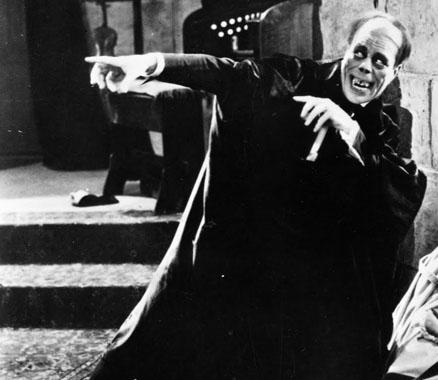
To us, such gestures may seem very overdone, if not downright silly—as in this from the 1925 film of The Phantom of the Opera.

lchaneysrphantom

And it is probably film itself which has changed our view. Originally, these gestures were developed to extend a speaker’s ability to convey thought and feeling in a public space—a big place where there was no elaborate sound system with microphones and speakers to help.

cicerovscatiline.jpg

In a big, noisy place like an Elizabethan theatre, such an extension would have proved just as useful.

Hodge's_conjectural_Globe_reconstruction.jpg

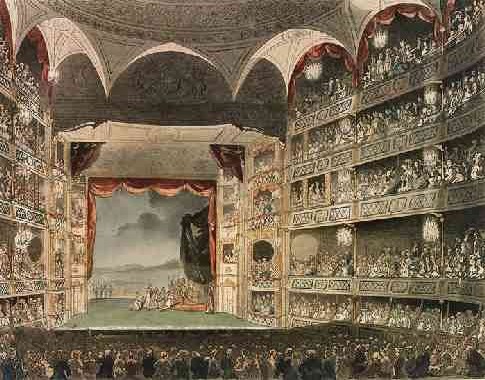
And, until artificial vocal magnification was invented in the 20th century, it would have continued to help.

Theatre_drury_lane2.jpg

sadlers_wells_interior_rowlandson_microcosm_1810.jpg

Film began as an offshoot of the stage—after all, what other model was there for actors? Film was much more intimate than the stage, however, even before sound films arrived at the very end of the 1920s. The heavy make-up and big, stylized gestures brought over from earlier drama must have seemed even more exaggerated, in time, to audiences, and everything was gradually scaled down. What Tolkien saw as a young man,

hunchback.jpg

however, having been born in 1893, would have been the product of that earlier time—a time all the way back to the Romans—and thus, when he wants to depict strong emotion, he clearly uses what would have been more appropriate for an older time, just as he uses older language, borrowed from people like William Morris and Tennyson, when he wants to add a certain weight to the words.

In our second posting, we want to continue our exploration with what we feel to be an opposing gesture—and the final gesture—of Saruman.

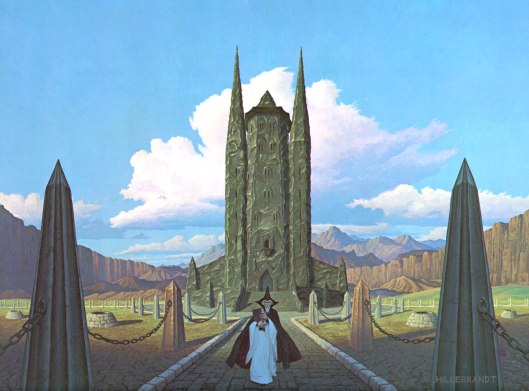
greg-hildebrandt-isengard-orthanc-saruman-607429-1300x962.jpg

Thanks, as always, for reading.

MTCIDC

CD

The Doubtful Sea Series Facebook Page

The Doubtful Sea Series Facebook Page

  • Ollamh

Categories

  • Artists and Illustrators
  • Economics in Middle-earth
  • Fairy Tales and Myths
  • Films and Music
  • Games
  • Heroes
  • Imaginary History
  • J.R.R. Tolkien
  • Language
  • Literary History
  • Maps
  • Medieval Russia
  • Military History
  • Military History of Middle-earth
  • Narnia
  • Narrative Methods
  • Poetry
  • Research
  • Star Wars
  • Terra Australis
  • The Rohirrim
  • Theatre and Performance
  • Tolkien
  • Uncategorized
  • Villains
  • Writing as Collaborators
Follow doubtfulsea on WordPress.com

Across the Doubtful Sea

Recent Postings

  • A Moon disfigured December 17, 2025
  • On the Roads Again—Once More December 10, 2025
  • (Not) Crossing Bridges December 3, 2025
  • On the Road(s) Again—Again November 26, 2025
  • On the Road(s) Again November 19, 2025
  • To Bree (Part 2) November 12, 2025
  • To Bree (Part 1) November 5, 2025
  • A Plague o’ Both—No, o’ All Your Houses! October 29, 2025
  • It’s in Writing (2:  I’st a Prologue, or a Poesie for a Ring?) October 22, 2025

Blog Statistics

  • 103,201 Views

Posting Archive

  • December 2025 (3)
  • November 2025 (4)
  • October 2025 (5)
  • September 2025 (4)
  • August 2025 (4)
  • July 2025 (5)
  • June 2025 (4)
  • May 2025 (4)
  • April 2025 (5)
  • March 2025 (4)
  • February 2025 (4)
  • January 2025 (5)
  • December 2024 (4)
  • November 2024 (4)
  • October 2024 (5)
  • September 2024 (4)
  • August 2024 (4)
  • July 2024 (5)
  • June 2024 (4)
  • May 2024 (5)
  • April 2024 (4)
  • March 2024 (4)
  • February 2024 (4)
  • January 2024 (5)
  • December 2023 (4)
  • November 2023 (5)
  • October 2023 (4)
  • September 2023 (4)
  • August 2023 (5)
  • July 2023 (4)
  • June 2023 (4)
  • May 2023 (5)
  • April 2023 (4)
  • March 2023 (5)
  • February 2023 (4)
  • January 2023 (4)
  • December 2022 (4)
  • November 2022 (5)
  • October 2022 (4)
  • September 2022 (4)
  • August 2022 (5)
  • July 2022 (4)
  • June 2022 (5)
  • May 2022 (4)
  • April 2022 (4)
  • March 2022 (5)
  • February 2022 (4)
  • January 2022 (4)
  • December 2021 (5)
  • November 2021 (4)
  • October 2021 (4)
  • September 2021 (5)
  • August 2021 (4)
  • July 2021 (4)
  • June 2021 (5)
  • May 2021 (4)
  • April 2021 (4)
  • March 2021 (5)
  • February 2021 (4)
  • January 2021 (4)
  • December 2020 (5)
  • November 2020 (4)
  • October 2020 (4)
  • September 2020 (5)
  • August 2020 (4)
  • July 2020 (5)
  • June 2020 (4)
  • May 2020 (4)
  • April 2020 (5)
  • March 2020 (4)
  • February 2020 (4)
  • January 2020 (6)
  • December 2019 (4)
  • November 2019 (4)
  • October 2019 (5)
  • September 2019 (4)
  • August 2019 (4)
  • July 2019 (5)
  • June 2019 (4)
  • May 2019 (5)
  • April 2019 (4)
  • March 2019 (4)
  • February 2019 (4)
  • January 2019 (5)
  • December 2018 (4)
  • November 2018 (4)
  • October 2018 (5)
  • September 2018 (4)
  • August 2018 (5)
  • July 2018 (4)
  • June 2018 (4)
  • May 2018 (5)
  • April 2018 (4)
  • March 2018 (4)
  • February 2018 (4)
  • January 2018 (5)
  • December 2017 (4)
  • November 2017 (4)
  • October 2017 (4)
  • September 2017 (4)
  • August 2017 (5)
  • July 2017 (4)
  • June 2017 (4)
  • May 2017 (5)
  • April 2017 (4)
  • March 2017 (5)
  • February 2017 (4)
  • January 2017 (4)
  • December 2016 (4)
  • November 2016 (5)
  • October 2016 (6)
  • September 2016 (5)
  • August 2016 (5)
  • July 2016 (5)
  • June 2016 (5)
  • May 2016 (4)
  • April 2016 (4)
  • March 2016 (5)
  • February 2016 (4)
  • January 2016 (4)
  • December 2015 (5)
  • November 2015 (5)
  • October 2015 (4)
  • September 2015 (5)
  • August 2015 (4)
  • July 2015 (5)
  • June 2015 (5)
  • May 2015 (4)
  • April 2015 (3)
  • March 2015 (4)
  • February 2015 (4)
  • January 2015 (4)
  • December 2014 (5)
  • November 2014 (4)
  • October 2014 (6)
  • September 2014 (1)

Blog at WordPress.com.

  • Subscribe Subscribed
    • doubtfulsea
    • Join 78 other subscribers
    • Already have a WordPress.com account? Log in now.
    • doubtfulsea
    • Subscribe Subscribed
    • Sign up
    • Log in
    • Report this content
    • View site in Reader
    • Manage subscriptions
    • Collapse this bar
 

Loading Comments...