Tags
American Civil War, American Revolution, Concord, Don Troiani, Germantown, grenadiers, H. Charles McBarron, Harper's Monthly, Howard Pyle, Illustration, John Trumbull, Joseph Warren, King Arthur, Lexington, Pirates, Richard Simkin, The Battle of Bunker Hill, The Battle of Nashville, The Lord of the Rings, The Rohirrim, The Salem Wolf, Tolkien
Welcome, dear readers, as always.
Today’s post takes us to the question of what we like and why and how such likes may push us—who, we realize, are a little stiff on the subject of accuracy—to accept things which, if our feelings weren’t engaged, we would briskly reject.
We begin by looking at a painting by one of our favorite late Victorian/Edwardian illustrators, Howard Pyle (1853-1911).

If you’re a regular reader (and we hope you are—or will be!), you’ll have seen his work on our pages any number of times, from his King Arthur illustrations (and here’s a LINK to a free 1922 reprint at the Internet Archive)

to his pirates (and here’s a LINK to a later—c.1921—collection of Pyle’s pictures and writings on pirates at Internet Archive).

Pyle also wrote and illustrated original fiction—just look at this haunting picture from a short story, “The Salem Wolf”, which was published in the December, 1909, issue of Harper’s Monthly Magazine.
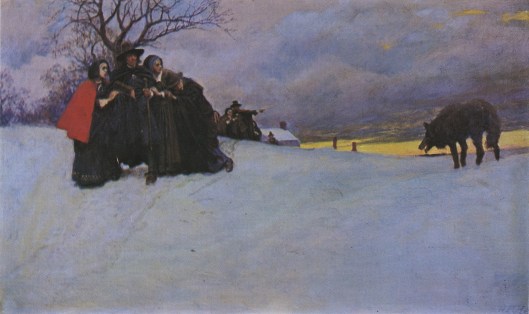
(And here’s a LINK to the story at Internet Archive)
Pyle also painted stand-alone historical pictures, such as this of “The Battle of Nashville” (1907).

And we’re lucky to have a photograph of the artist at work on this very picture.

Besides American Civil War pictures, Pyle painted several based upon incidents of the American Revolution, such as this, of the assault on the Chew House, at the Battle of Germantown (4 October, 1777).
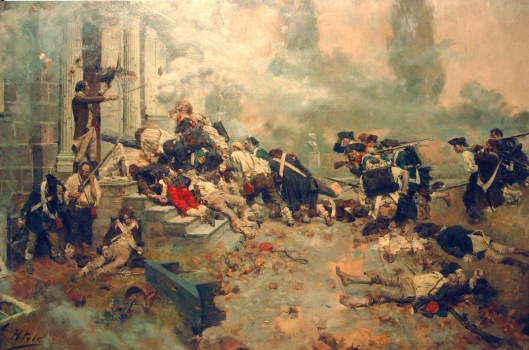
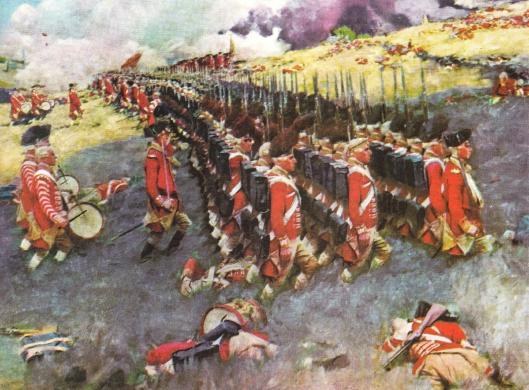
Another of his pictures of the Revolution is the subject of this post, “The Battle of Bunker Hill” (1897).
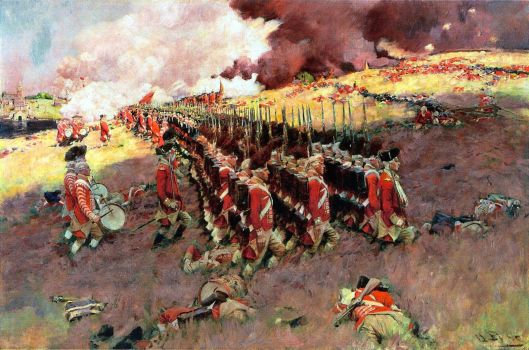
We’re not sure when one of us first saw this picture—childhood, we’d guess—but we were immediately bowled over by it. It’s the adventure of it: those long ranks of redcoats stoically marching up the hill, drums beating behind. It’s not a sanitized picture—just look up the hill and all around you can see the wreck of the earlier British attacks—but its emphasis is upon the courage it must take to do what those soldiers did.
This was, in fact, the third battle of the American Revolution. The war had begun in mid-April, 1775, when a raiding party of British troops, ordered to disrupt local preparations for defense, fought two skirmishes with local militia, at Lexington
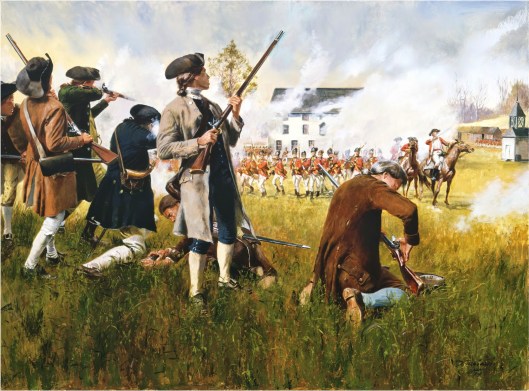
and Concord,

two rural settlements some twenty miles or so west of Boston.
When the British withdrew into Boston itself, those locals, who had grown in numbers to about 15,000, drawn from all over New England, blockaded the town and there was a period of stalemate, while both sides were reinforced. When it was clear that the locals had seized a nearby hill and were planning to plant artillery there which would then be capable of bombarding Boston, the British were forced to move. Their choice was to attack that hill, which was named “Breed’s Hill” but, through an historical mix-up, the battle was named for the hill to its rear, “Bunker Hill”.

Initially, the British plan was to have part of its force make a feint—a fake attack—against the main part of the hill, where the locals had built an open-backed fortification, called a redoubt, while the real attack was to push through the weaker local left and curve around to hit the locals from the rear.
By underestimating the defense, the British soon suffered over a thousand casualties to the local 450. As the assaults were driven back, the British plan changed and the main attack was to be uphill, straight at the redoubt and this is what is depicted in Pyle’s painting, specifically the advance of the 52nd Foot (“Foot” is 18th-century shorthand for “regiment of infantry”).
This is not the first well-known painting of the battle, however. In the first third of the 19th century, John Trumbull (1756-1843), a prominent American artist, painted several versions of a work entitled, “The Death of General Warren at the Battle of Bunker’s Hill, June 17, 1775”.

This picture belongs to what we might call both the “heroic school” and the “portrait school”, the former because of a certain flashy quality (look at the way the wind seems to be whipping everything—and where are those flames on the right coming from?), the latter because, not only is the local officer, Joseph Warren depicted, but so are a number of other figures—two of the British generals, two British majors, and a number of more minor participants.
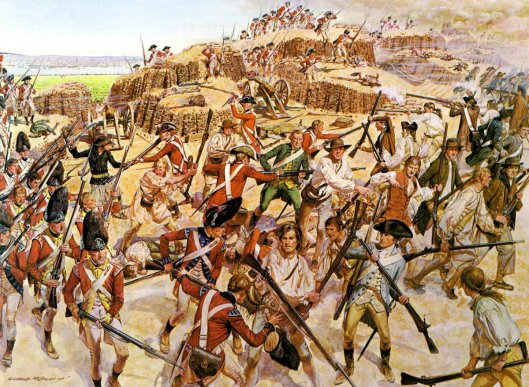
Bunker Hill remained—and remains—a popular subject for historical painters, most of them depicting events from the local side. Here is one version, by the distinguished 20th-century American military artist, H. Charles McBarron (1902-1992).
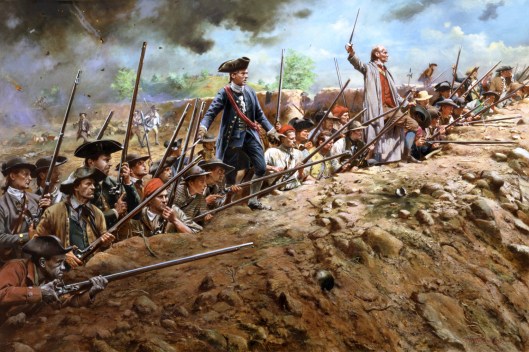
And here are two by one of our favorite contemporary American Civil War artists, Don Troiani (1949-).

All pictures are not from the viewpoint of the colonists, however. The late-Victorian/Edwardian British military artist, Richard Simkin (1850-1926), gave us this view.

Of all of these images, the Trumbull has drawn upon his memory and upon his sketchbooks, too, we bet, to give a general impression of the look of the soldiers, but, although he was part of the colonial force besieging Boston, he only saw the battle through a telescope. McBarron was a collector of uniforms and equipment, as is Troiani, and their works are painstakingly accurate. Simkin, although he, too, was a collector, came from an earlier time, just at the beginning of serious research on weapons and uniforms of the past, and, therefore, certain elements in his picture—the plumes and cords on his men’s bearskins and those packs (left behind in Boston, in reality), for instance—are not correct. Even so, his picture is far more accurate than Pyle’s, which is full of mistakes, in everything from the uniforms and equipment to those grenadiers (those guys in the fuzzy hats in the center), who shouldn’t be there at all, having been detached to form part of the right wing assault force.
And yet the Pyle is still our favorite depiction of the battle. Why? Because it feels right: it’s a 19th-century image of courage and discipline, and appeals to our romantic souls, even though there are casualties strewn about, which, to us, only serves to emphasize the bravery and stick-to-it-iveness of those solid infantry.
And this is where JRRT comes in. We’ve said before: our favorite part of P. Jackson’s films is anything to do with the Rohirrim.

The fact that, in the books, they live in wide, grassy plains (unavailable in New Zealand) and that their capital, Edoras, does not have “a dike and mighty wall and thorny fence” in the films, along with any other details it would be easy to extract from The Lord of the Rings, doesn’t matter to us in the least. The depiction in the films feels right and we’re content with that, even when there are other parts of the films where we have other reactions. Simple (and perhaps surprising to us) as that.
So, dear readers, do you have similar reactions? And to what? We’d love to hear!
And thanks, as always, for reading.
MTCIDC
CD
 doubtfulsea