• About

doubtfulsea

~ adventure fantasy

Tag Archives: fairy-tales

Hair Today

30 Wednesday Apr 2025

Posted by Ollamh in Uncategorized

≈ Leave a comment

Tags

Andrew Lang, Basile, d'Urfey, de-caumont, fairy-tales, friederich-schulz, Gingerbread, Grimm Brothers, Munchkins, Pentamerone, Persinette, Petrosinella, rampion, Rapunzel, Rock Parsley, Romeo and Juliet, Seurat, Shahnameh, Tolkien

As always, dear readers, welcome.

I often pass by a very unusual house, one which I would find hard to describe—perhaps something the Munchkins might build,

combined with a gingerbread house,

in the spotty colors and patterns of a Seurat pointillismist painting.
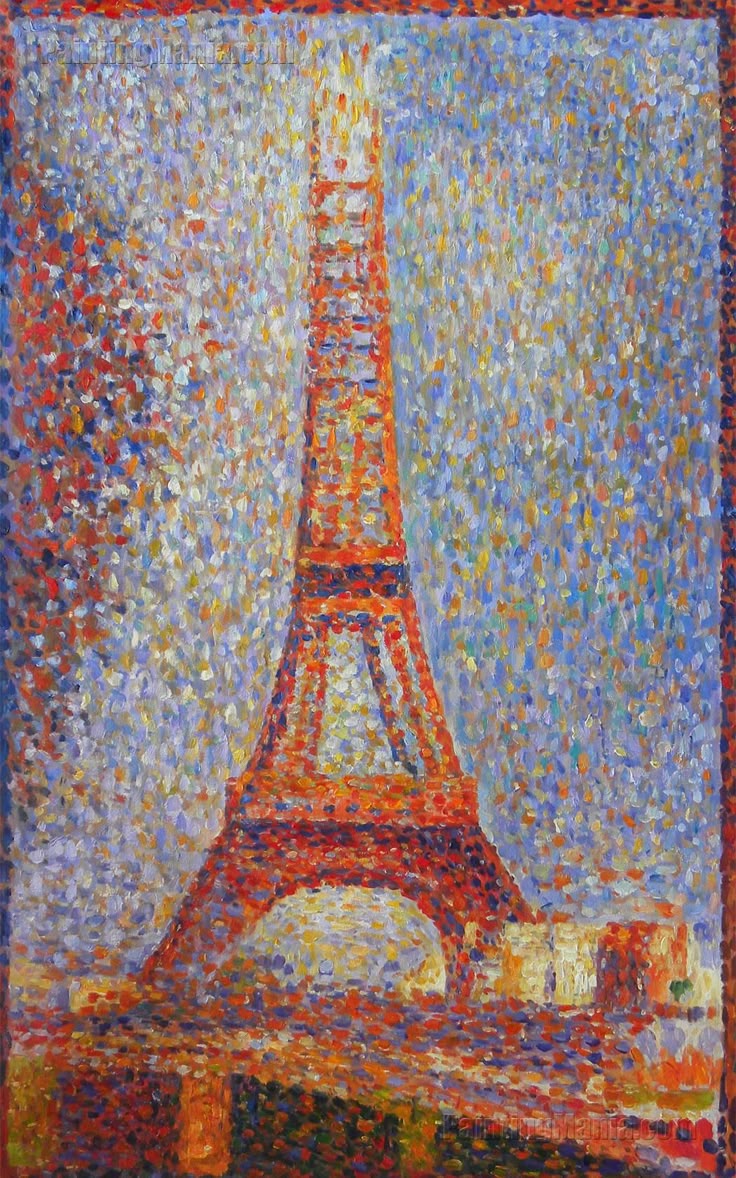
(Seurat, “La Tour Eiffel” , 1889—if you like the look of this, see:  https://www.georgesseurat.net/  for lots more—and, for more about this painting:  https://artincontext.org/the-eiffel-tower-by-georges-seurat/ )

All of that might make you slam on the brakes and drive as slowly as possible past, but there’s an added detail—for the past year, there has been a ladder propped from the ground to a closed window on the second floor.  It’s not anything exotic, just a plain aluminum extension ladder.

When I first spotted it, I probably thought:  fixing a storm window or painting trim and didn’t think about it again. 

But, after seeing it for a year, and remembering what the house looks like, I began to consider other possibilities—and I’m sure that, with that combination, you’re considering them, too. 

Dismissing fire drills, it struck me that, as the house has a fairy tale look, it must have something to do with such stories,

First, ir could be something Romeo and Julietesque—but, instead of standing under her balcony

and then scaling it,
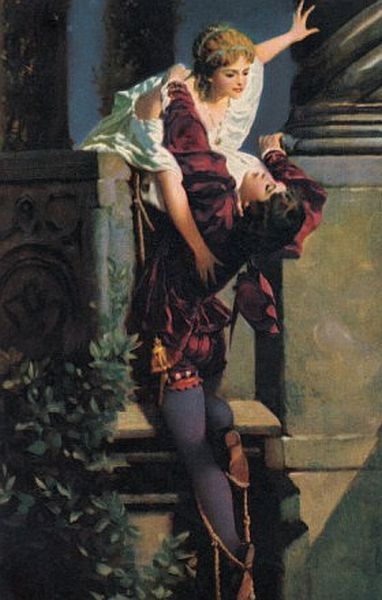
Romeo stopped by the local hardware store and properly equipped himself.    (They eloped, as planned, this time, without the tragic ending, where everyone’s been stabbed or poisoned.)

Or—not Romeo and Juliet, but Rapunzel and her (fill in name here—“Charming” being a common place-holder) Prince, who is, for a change, a little more considerate than the usual prince in the story..

After all, have you ever had your hair pulled?  Granted, if you’ve got fifteen feet or more of it—but wait—let’s go back a bit.

(Although, in an interesting variant of this theme, from Ferdowsi’s  10th/11th-century epic poem “Shahnameh”, a prince, Zal, when offered a princess, Rudaba’s,, hair as a means of escalade, takes a lariat from a retainer, instead.  See:  https://archive.org/details/shahnama01firduoft/page/270/mode/2up  )

It all seems to begin with a late Renaissance story collection, Giambattista Basile’s (1583-1632 )
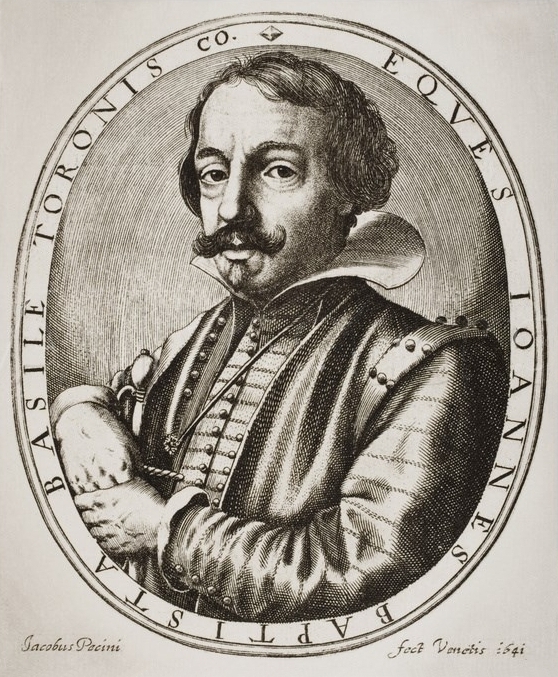
 Pentamerone.

(so far the earliest printing I can find—as you can see, it’s dated 1749—but it gives away a secret:  Giambattista Basile was actually Gian Alesio Abbattutis—although “abbattuto” in modern Italian means “depressed”—so was his work, like Thomas d’Urfey’s subtitle to his “Wit and Mirth”—“ or Pills to Purge Melancholy”,  an eventual 6-volume collection of poems and songs, published between 1698 and 1720, an attempt to relieve despair?  You can see all six of d’Urfey’s volumes here:  https://archive.org/details/imslp-and-mirth-or-pills-to-purge-melancholy-durfey-thomas/PMLP144559-Vol._1/page/n5/mode/2up  Don’t be confused by the spelling of the subtitle of the Basile, by the way:  this is the southern Italian/Sicilian spelling of “conto”—“story”, so it means “the story of stories”, meaning “the very best of stories” .)

published posthumously by his sister, Adriana, in two volumes, in 1634 and 1636.

Its title means something like “Five Days” and the title comes from the framing story—which you can read about here:  https://en.wikipedia.org/wiki/Pentamerone  In sum, ten story-tellers are hired each to tell one story a day for five days, making a total of fifty stories.

The first story on the second day is “Petrosinella”—“Parsley”, the title coming from the name of the main character.  (The modern Italian word is “prezzemolo” so I’m assuming that this is dialectal/archaic or both.  Pliny, in his Natural History, Book XX, Chapter 47, mentions “petroselinon”—the Latin form being “petroselinum”—“rock (petra) parsley”, so I’m guessing that “Petrosinella” is what is called a metathetic form, where part of the word has been transposed with another, like “calvary” for “cavalry”.  Maybe also confused with the Italian diminutive ending “-ella”, as if the meaning is “Little Parsley”.  If you’d like to read what Pliny has to say about it—including being useful for snake bite, see:   https://www.perseus.tufts.edu/hopper/text?doc=Perseus%3Atext%3A1999.02.0137%3Abook%3D20%3Achapter%3D47 )

A brief summary of the plot:

A pregnant woman repeatedly visits the garden of an orca (ogress—now, however, a killer whale—not what Basile had in mind, I’m sure)) to steal parsley,   The ogress catches her, but lets her go on condition that the ogress  gets the child.  Sounds familiar, doesn’t it?  Eventually, she gets the child, whom she puts into a tower with only one high window and visits her by using the girl’s hair.

And, if you know “Rapunzel”, you know what happens next—prince, etc—but then the story becomes quite different, with Petrosinella and the prince escaping and the ogress eventually being killed.  (Here’s the whole story for you in  J.E. Taylor’s  1847 translation in a 1911 illustrated reprinting:  https://archive.org/details/31383047427094/page/82/mode/2up )

Well, until the later part of the story, this looks more or less familiar, but, if this is the Rapunzel story, why is the main character called “Parsley”?

For that, we need to move to its next incarnation, “Persinette”, by Charlotte-Rose de Caumont de la Force, who published her version of the story, which she claimed was original, in a volume the title of which suggests that she had, in fact, read Basile:  Les Contes des Contes (1698), making a slight change by pluralizing that first story in Basile’s subtitle, not to mention the fact that her heroine is named “Little Parsley” (“Persinette”—although one might expect “Persilette”, as the French word for parsley is “persil”).

A major difference between this and Basile’s text is that de Caumont’s is much more elaborate—including the detail that parsley was not available at that time and that the Fairy (no longer an ogress) has had to have it imported from India!  Much of the basic story we read in Basile is there—the hair, the tower, but more has been added, beginning with it being Persinette’s father-to-be who steals the parsley, rather than her mother, the fact that the Fairy causes the tower to appear by magic, that, finding Persinette to be pregnant, the Fairy isolates her in a cottage by the sea, that Persinette has twins there, that the Fairy tricks the prince, who leaps from the tower and is blinded—so much more of which fits in with the familiar Rapunzel story.  (Here’s a summary:  https://en.wikipedia.org/wiki/Persinette  but, for the complete story, so far I’ve only managed to find a 1785 French version, which, if you have some French—with 18th-century spelling conventions—you can read here:  https://en.wikipedia.org/wiki/Persinette )

But, although there are lots more familiar details here, we’re still in the land of parsley—how did we move  to “rapunzel”—which isn’t parsley, but something called “rampion”?

This is an edible plant, once commonly grown and eaten, but now seems to have lost its popularity (for more, see here:  https://botanical.com/botanical/mgmh/r/rampio03.html  And a more scientific description here:  https://www.missouribotanicalgarden.org/PlantFinder/PlantFinderDetails.aspx?taxonid=278824 )

The answer to the question of name change is:  we move from Italian to French to German, as rampion replaces parsley in Friedrich Schulz’ 1790 collection Kleine Romane, “Little Novels”, in which he included his translation of de Caumont (available here in a transcription from the Fraktur (old German script) of the original:  https://babel.hathitrust.org/cgi/ssd?id=chi.81388905;page=ssd;view=plaintext;seq=281;num=271#seq281  and pages beyond–I’ve done a quick survey of the text, which sticks  pretty closely to the French—except for that “rapunzel”, which is noted to be a rare plant, just as the parsley is in de Caumont, although the Fairy doesn’t get it from India.) 

This, in turn, was used by the Grimm brothers in the first edition of Kinder und Hausmaerchen (something like “Children’s and Domestic Wonder-tales”) in 1812.

But one more but—how does the story come into English?

The first “translation” of the Grimm brothers’ work is the two volumes by Edgar Taylor, published in 1823 and 1826.

This is, in fact, only a selection, and doesn’t include “Rapunzel”, possibly because of Rapunzel’s pregnancy out of wedlock.  As far as I can currently determine, the first English translation to include the story is the Edward H. Wehnert Household Stories, 1853, in two volumes, “Rapunzel” being in the first, and you can read it here:  https://archive.org/details/householdstorie01grimgoog/page/n6/mode/2up?view=theater

From there we can move to  Margaret Hunt’s 1884 translation in 2 volumes (here:  https://archive.org/details/grimmshouseholdt01grim/page/n3/mode/2up?view=theater  for volume 1 and here:  https://archive.org/details/grimmshouseholdt2grim/page/n7/mode/2up for volume 2.  This translation is noted in particular as it includes the Grimms’ editiorial notes, the first edition to do so.)

And, interesting–this edition had an introduction by Andrew Lang, who then included it in his 1890 The Red Fairy Book (https://www.gutenberg.org/files/540/540-h/540-h.htm ), where JRRT probably read it, as we know he knew other stories from the volume.

So, why is that ladder there?  An updated fairy tale?   Or just an absent-minded repairman?  I’d prefer to think the former, although, in comparison with that long column of golden hair in the old stories

an aluminum extension ladder seems awfully drab.

Thanks, as ever, for reading.

Stay well,

If you’re acrophobic, best to seek adventure among dwarves,

And remember that, as always, there’s

MTCIDC

O

PS

The change from “parsley” to “rampion”—and even which plant is “rampion”—has been the subject of scholarly discussion.  See:   https://writinginmargins.weebly.com/home/what-is-the-plant-in-rapunzel  .Edward Taylor, in his 1846 collection, The Fairy Ring, even decided that either name was inappropriate for his British readers and changed her name to “Violet”!  You can read his version here:  https://babel.hathitrust.org/cgi/ssd?id=uc1.31158001207546;page=ssd;view=plaintext;seq=367;num=321#seq367  

PPS

If you would like to compare various English translations, from 1823 to 1927, see:  https://archive.org/details/householdstorie01grimgoog/page/n6/mode/2up?view=theate

Spinning a Tale

11 Wednesday Dec 2024

Posted by Ollamh in Uncategorized

≈ Leave a comment

Tags

fairy-tales, perrault, Sleeping Beauty, spindle, uncle-andy

As ever, dear readers, welcome.

“Cependant les fées commencèrent à faire leurs dons à la princesse. La plus jeune lui donna pour don qu’elle serait la plus belle personne du monde ; celle d’après, qu’elle aurait de l’esprit comme un ange ; la troisième, qu’elle aurait une grâce admirable à tout ce qu’elle ferait ; la quatrième, qu’elle danserait parfaitement bien ; la cinquième, qu’elle chanterait comme un rossignol ; et la sixième, qu’elle jouerait de toutes sortes d’instruments dans la dernière perfection. Le rang de la vieille fée étant venu, elle dit, en branlant la tête encore plus de dépit que de vieillesse, que la princesse se percerait la main d’un fuseau, et qu’elle en mourrait.”

“Nevertheless the fairies began to make their gifts to the princess.  The youngest gave her as a gift that she would be the most beautiful person in the world.  The next, that she would have the soul of an angel.  The third, that she would have an admirable grace in everything which she would do.  The fourth that she would play all manner of instruments to the utmost perfection.  The turn of the old fairy being come, she said, shaking her head more in spite than from age, that the princess would pierce her hand on a spindle and that she would die of it.”  (My translation, as with all of the text in this posting, based upon Feron’s 1902 edition of the Les Contes de Perrault which you can read here:  https://fr.wikisource.org/wiki/Contes_de_Perrault_(%C3%A9d._1902)/La_Belle_au_Bois_dormant )

You know this story—although you may know it by its English name, “Sleeping Beauty” and not by its original name “La Belle au Bois Dormant”—the “Beautiful Girl in the Sleeping Forest”—although that translation is wonderfully—and a little testily–argued over here:  https://forum.wordreference.com/threads/la-belle-au-bois-dormant.3158165/  For all that people joust over whether that present participle/adjective, “dormant” can modify “Belle”, I prefer the idea that, as Beauty has fallen asleep, so the whole world around her has joined in the enchantment, as the story says—and so even the woods are drowsing till the prince arrives.)

 This story first appeared in Charles Perrault’s (1628-1703)

 1697 collection Histoires ou Contes du Temps passé, avec des moralites—“Stories or Tales of Past Time, with Morals”, which sounds pretty dry—until you reach the subtitle:  Les Contes de ma Mere L’Oye—“The Tales of My Mother Goose” and suddenly we’ve passed into another Time Past entirely.

(As you can see, an early edition—1742—but not a first)

I’ve always loved the story, but, when I was small, there was one thing which I didn’t understand—  what was a “fuseau”—a “spindle”?

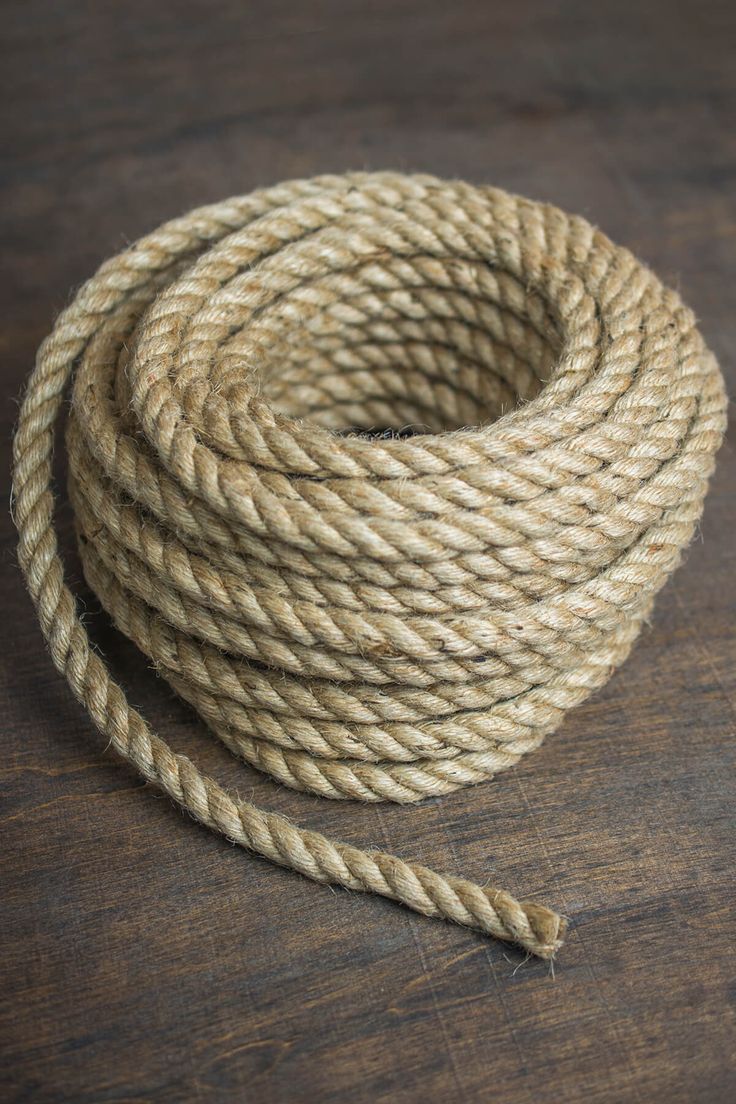
In my last posting, we had been briefly in Sam Gamgee’s uncle Andy’s rope walk

where we had been talking about how rope

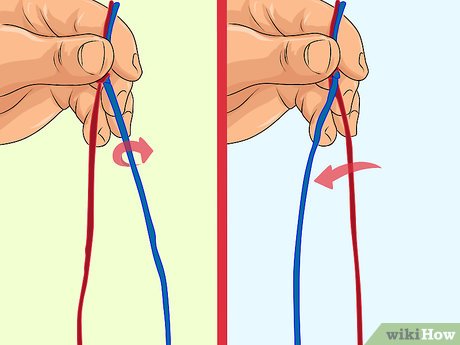
 is made, with likening the twisting of the fibers

 to that of making thread.

(If you’d like to know more about making rope, have a look at this very informative WikiHow feature: https://www.wikihow.com/Make-Rope )

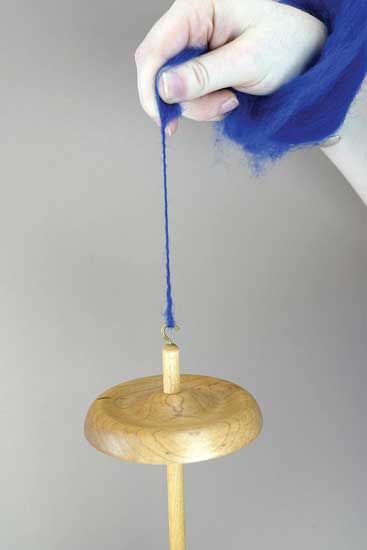
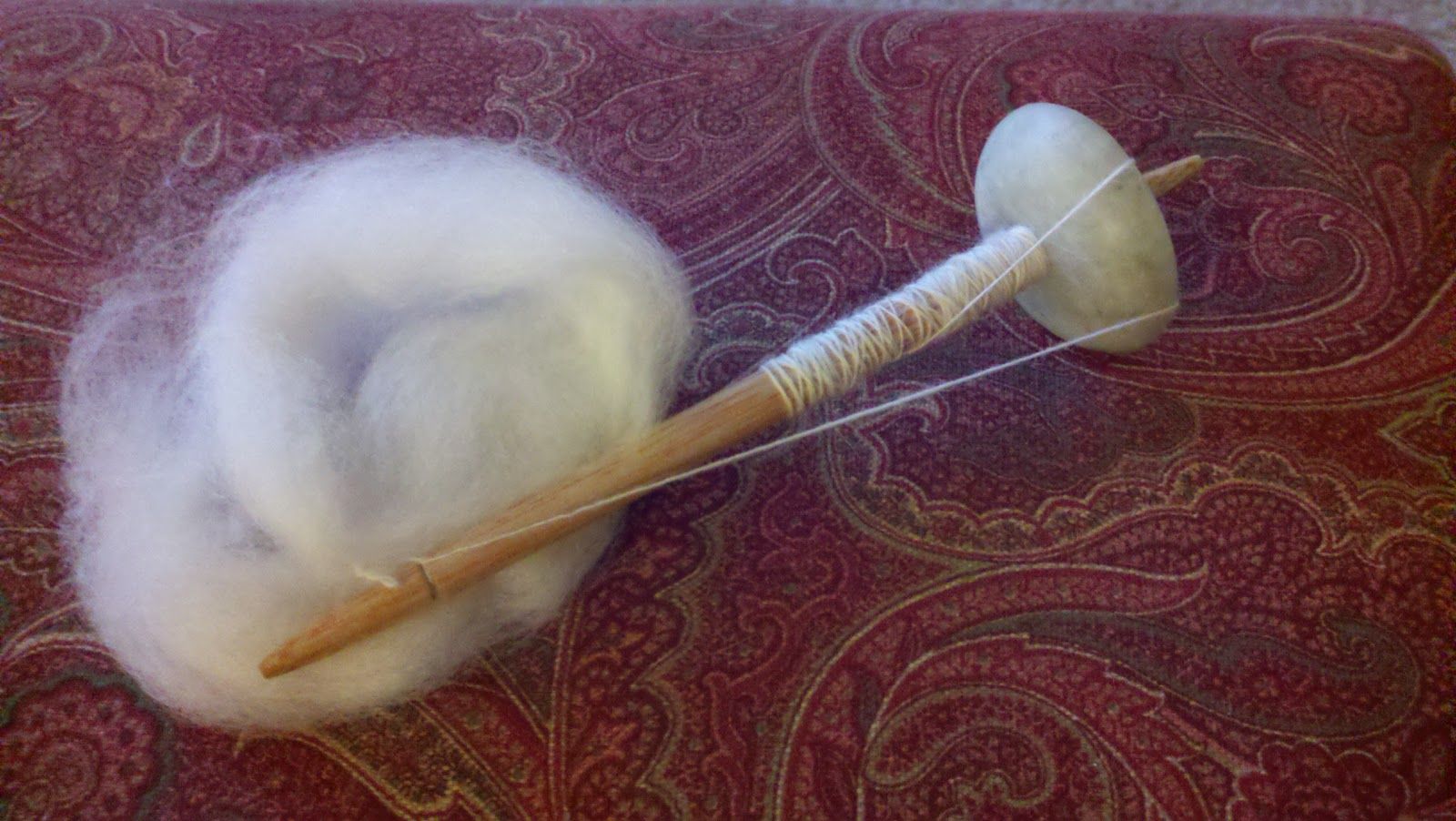
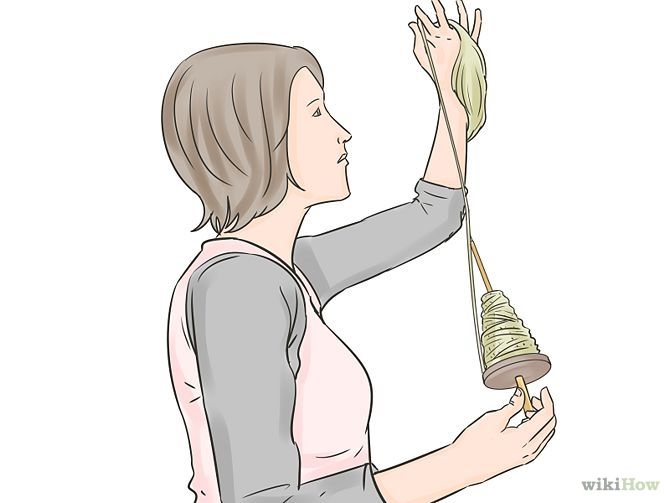
The simplest way to do this is to use a drop spindle—and here’s that “fuseau”–which allows gravity to do much of the work for you—

(Here’s the whole spindle)

(And here’s a WikiHow on spinning thread—which includes both a drop spindle and a spinning wheel:  https://www.wikihow.com/Spin-Wool  And there’s a YouTube video imbedded to make the process clearer.)

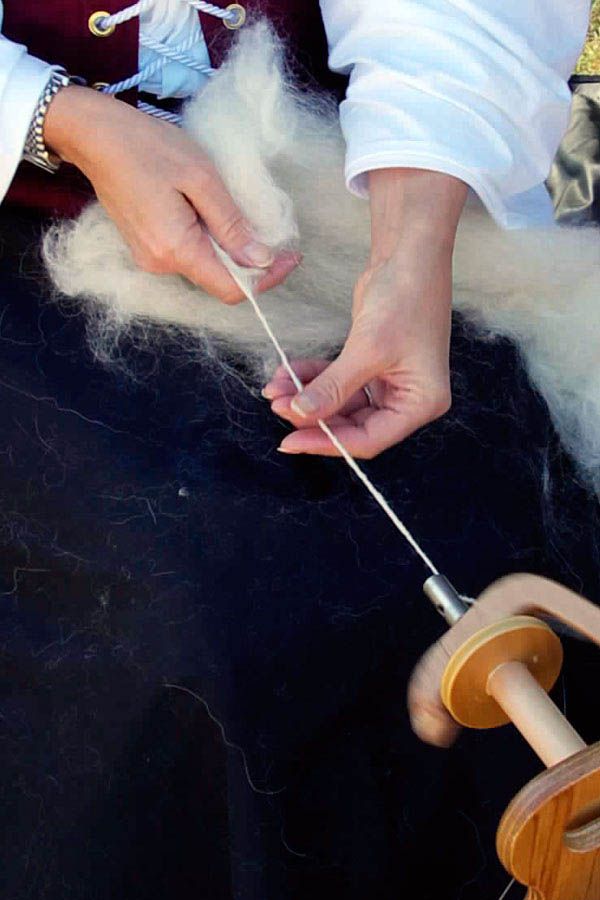
This is only a later part of the process of making cloth, which begins, of course, with shearing a sheep.

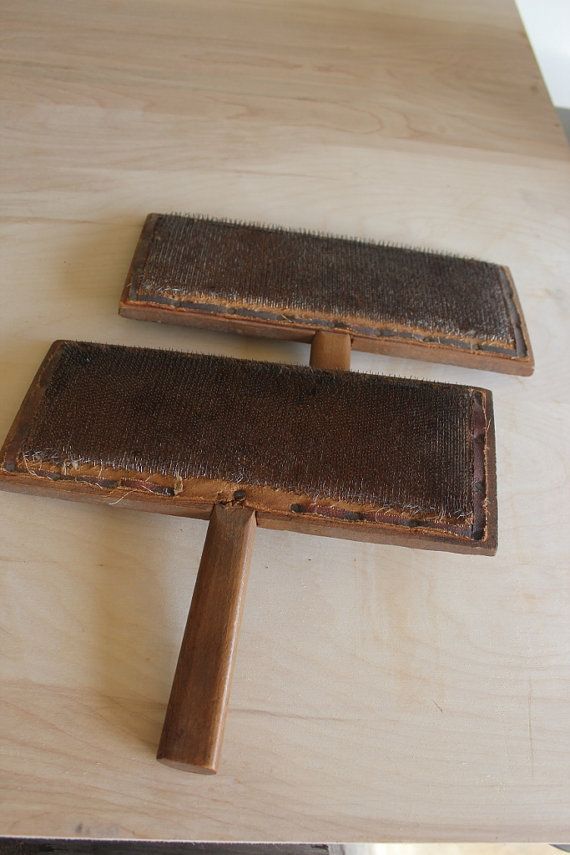
Then the fleece needs to be cleaned and the fibers need to be organized, with a pair of carding combs—

but here’s the whole process, in an 18th-century setting.

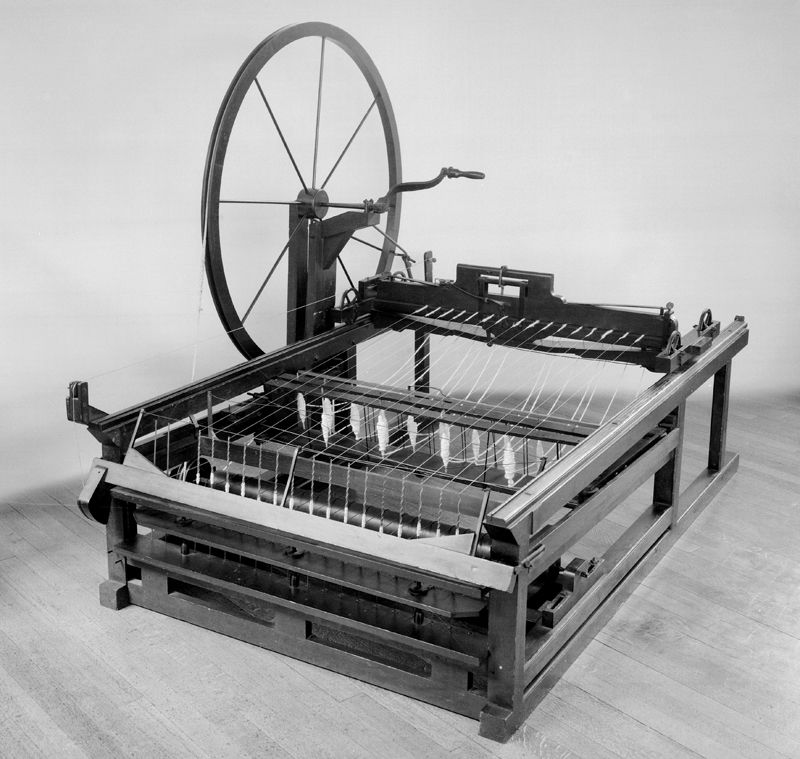
It’s a very labor-intensive process, as you can imagine, and you can see why the Industrial Revolution had, among its earliest inventions, the “Spinning Jenny”, which allowed one person to use a simple machine to produce numerous spools of thread at the same time, where a previous spinster (meaning someone who spins, not an unmarried woman, necessarily) could only produce one spool at a time and, at the time, it was said that it took five spinsters to keep a weaver busy.

(There was no “Jenny” by the way—it’s really “ginny”—18th-century Northeast English for “engine”—that is, in period technology, “machine”.)

In the story:

“Le roi, pour tâcher d’éviter le malheur annoncé par la vieille, fit publier aussitôt un édit par lequel il défendait à toutes personnes de filer au fuseau, ni d’avoir des fuseaux chez soi, sur peine de vie.”

“The king, to try to avoid the curse pronounced by the old fairy, immediately had an edict published by which he forbade anyone from spinning with a spindle, nor to have spindles in the home, on pain of death.” 

But, inevitably—this is a fairy tale, after all—when she is 15 or 16, the princess, exploring a family country house, discovers a room in which an old woman is using a spindle (and, surprisingly, unlike that which our suspicious modern minds would expect, the old woman is an innocent, as the text says that she simply hadn’t heard of the king’s proclamation) and, piercing her hand, the princess simply falls victim to the curse—and the counter-spell which puts her to sleep.

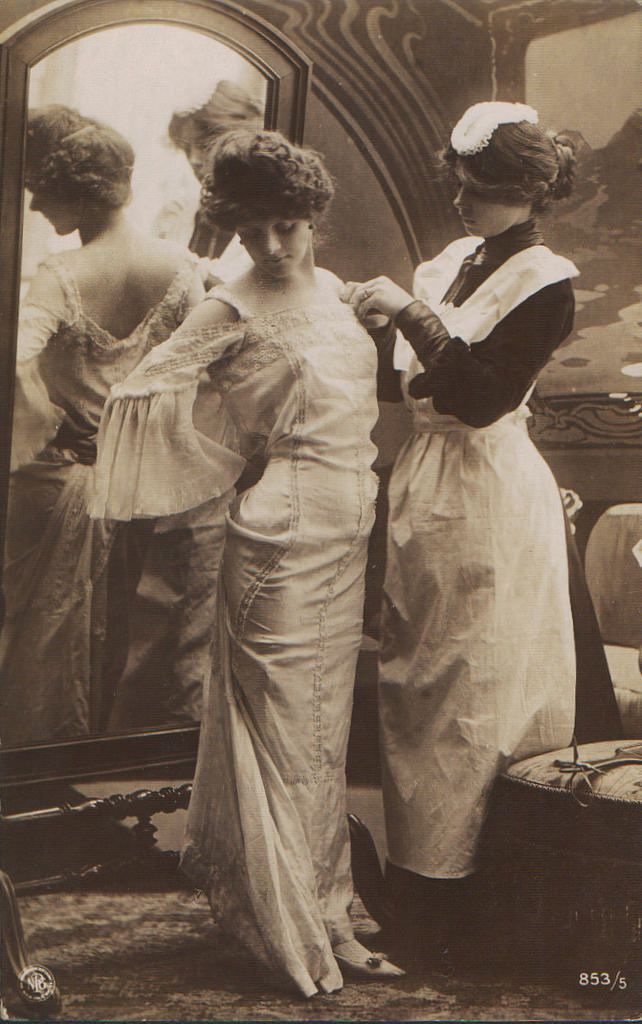
Why a spindle?  I’m sure that there are all sorts of Freudian explanations for this, but what I imagine Perrault—or whoever may have told the tale which he had once heard—if there ever was a real “ma Mere L’Oye”—thought was that, in the world of royalty, where clothes magically appeared in the hands of your servants,

(a much later image, but you get the idea)

a spindle might have seemed like a pretty—and novel—toy, as the princess exclaims, seeing the old woman at work:

“ ‘Ah ! que cela est joli !’ reprit la princesse ; ‘comment faites-vous ? donnez-moi que je voie si j’en ferais bien autant.’ “

“ ‘How pretty that is!…’How do you do it?  Give it to me so that I may see if I may do it as well.’ “

And, reaching for it, as she’s a little “etourdie”—“scatterbrained” (or, more gently, “thoughtless”)—

“elle s’en perça la main et tomba évanouie.”—“she pierced her hand and fainted.”

Now as the youngest fairy, who has hidden behind a curtain, sensing trouble when the old fairy appears, has decreed, a century will pass, and the country house and all in and around it—including the forest which surrounds it– will sleep.

Thanks, as always, for reading.

Stay well,

Avoid antagonizing elderly fairies,

And remember that, as always, there’s

MTCIDC

O

PS

In this season of Tchaikovsky’s “Nutcracker”, don’t forget that he also wrote a “Sleeping Beauty” ballet, which has its own wonderful music, which you can hear—and see–here:   https://www.youtube.com/watch?v=w7qLg1lOfrw

Wolfing

11 Wednesday Sep 2024

Posted by Ollamh in Uncategorized

≈ Leave a comment

Tags

book-review, fairy-tales, Fiction, picture-books

Welcome, dear readers, as always.

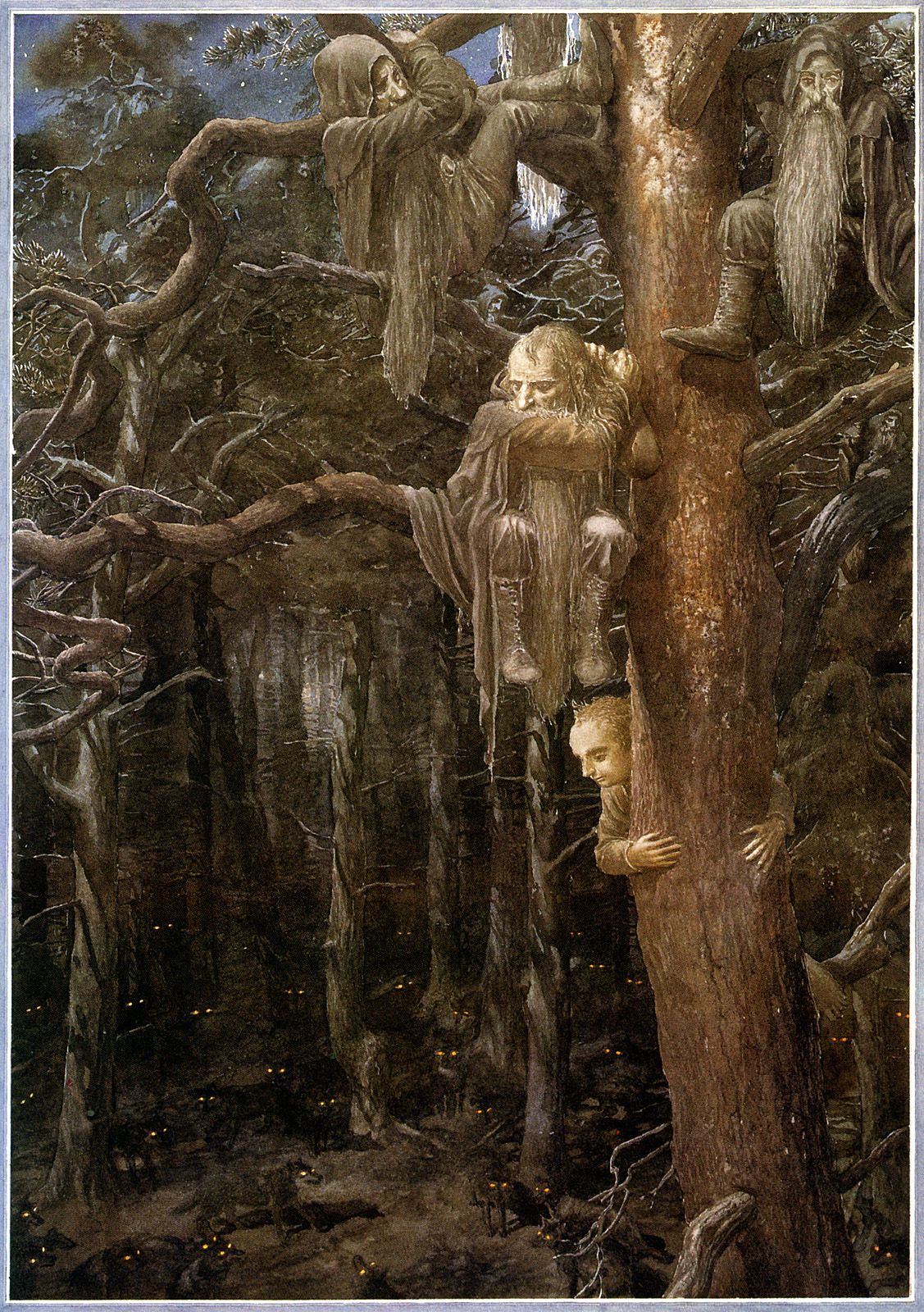
“All of a sudden they heard a howl away down hill, a long shuddering howl.  It was answered by another away to the right and a good deal nearer to them; then by another not far away to the left.  It was wolves howling at the moon, wolves gathering together!”  (The Hobbit, Chapter 6, “Out of the Frying Pan Into the Fire”)

(Alan Lee)

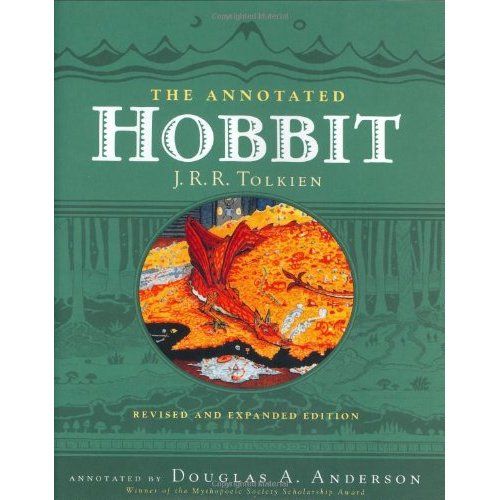
In his invaluable The Annotated Hobbit,

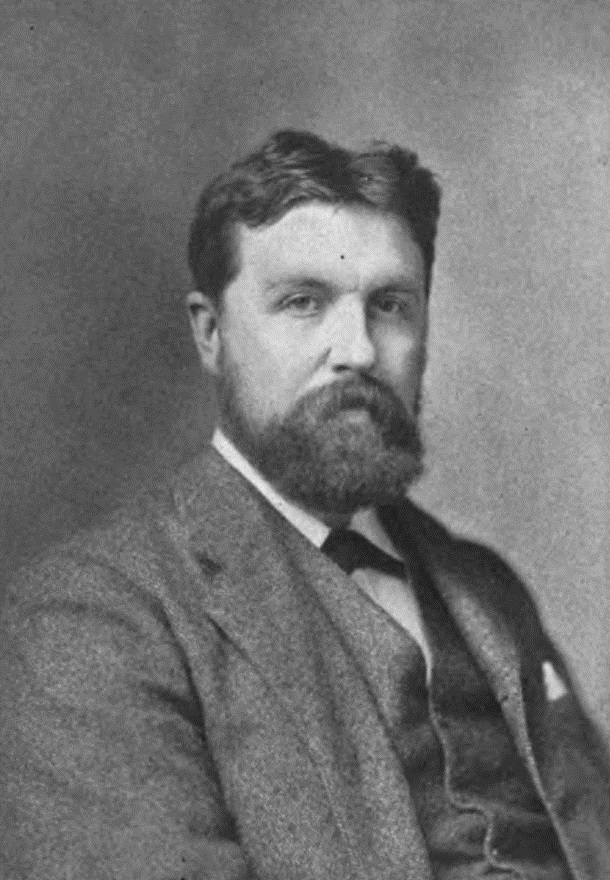
Douglas Anderson points to a letter by Tolkien suggesting an influence, if not inspiration, for this scene of wargs (i.e. wolves) vs treed dwarves (and hobbit), as JRRT tells us:

“Though the episode of the ‘wargs’ is in part derived from a scene in S.R. Crockett’s The Black Douglas, probably his best romance and anyway one that deeply impressed me in school-days, though I have never looked back again.  It includes Gil de Rez as a Satanist.” (“from a letter to Michael Tolkien…sometime after Aug.25, 1967”, Letters, 550)

Published in 1899, The Black Douglas,

Is one of a series of Scots historical novels by S(amuel).R(utherford). Crockett (1859-1914),

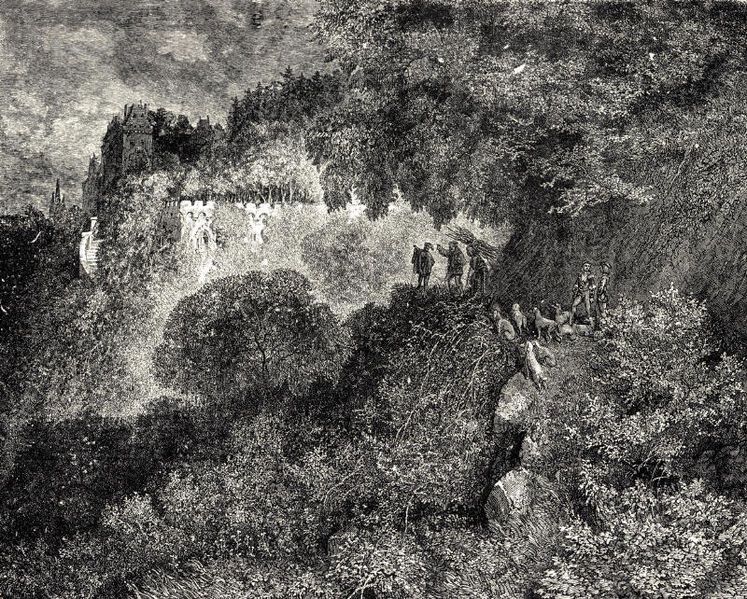
based upon actual events—in this case, it has, as a basis, the short life and judicial murder of William, the 6th Earl of Douglas and his younger brother, David, in 1440.  It also has supernatural elements, however, including the sinister (but historical) figure of Gilles de Rais (c.1405-1440–Tolkien was clearly spelling from memory), one-time companion of Joan of Arc, who appears to be a werewolf, and, it’s a scene where the protagonists are attacked by werewolves

to which JRRT was referring—although the three don’t climb trees, but put their backs to them to fight on the ground, killing many of their attackers (and not being rescued by eagles—it’s Chapter XLIX and you can read it here:  https://dn790000.ca.archive.org/0/items/blackdouglas00croc/blackdouglas00croc.pdf ).

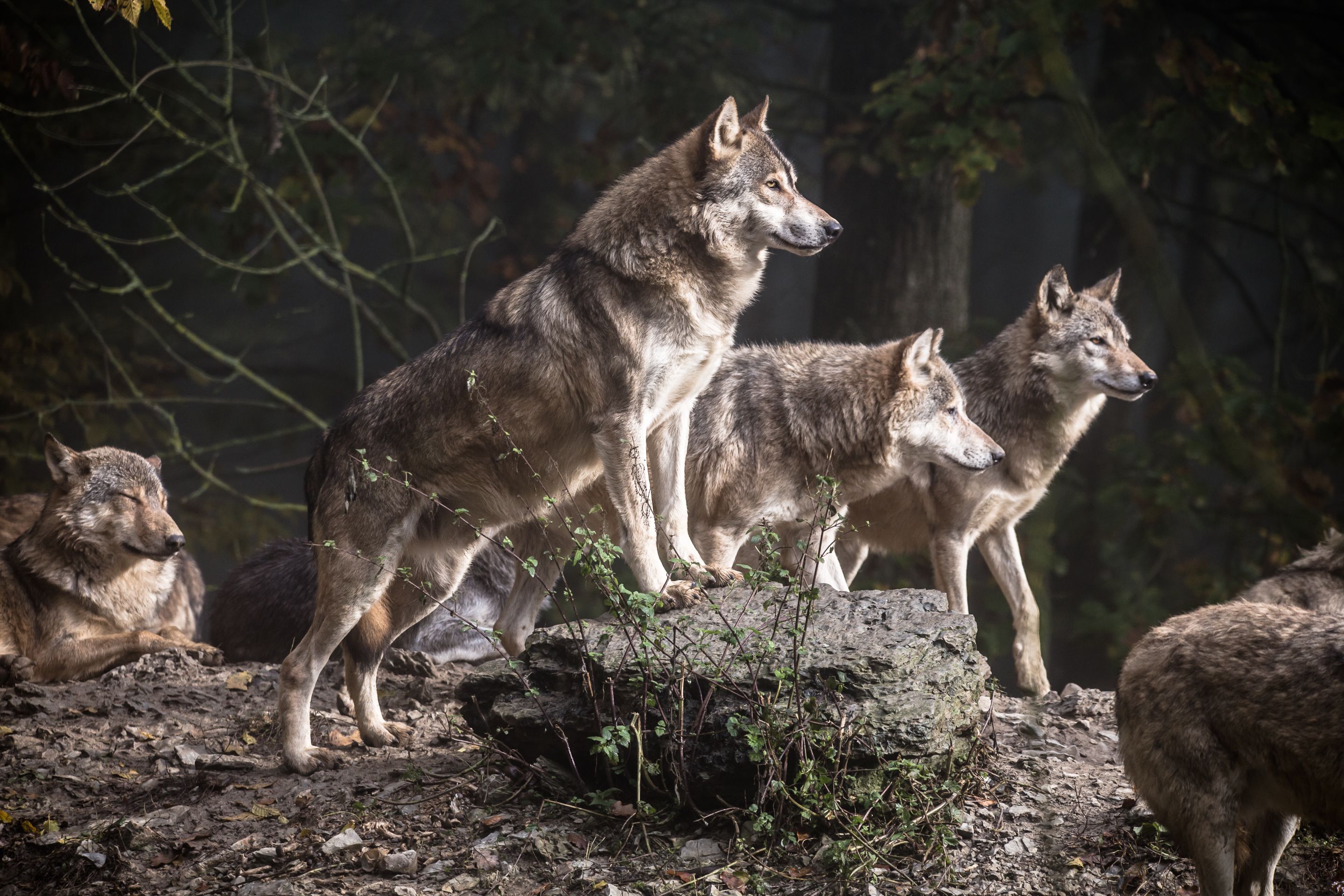
Wolves—or wargs—as we see in The Hobbit, are pack animals.

Crockett imagined even werewolves as behaving like the wolves they turn into and this led me to a question which occurred when, recently, as part of an exercise in story-telling, I asked a class to tell me the story of “The Three Little Pigs”. 

I’m sure that you know it, with its typical for Western fairy tales pattern of 3s:   porcine architecture—straw,

sticks, bricks–attempts by the wolf to enter, replies by the pigs, subsequent action by the wolf and his parboiled demise.

 Because of its simplicity and that pattern, it’s very useful as a subject for helping students to learn how stories work and how even such a simple story is built upon such basic narrative principles as foreshadowing and repetition to build tension.

But, the 3 pigs sing mockingly in the 1933 Disney version,

“Who’s afraid of the big, bad wolf,

Big, bad wolf,

Big, bad wolf?

Who’s afraid of the big, bad wolf?

Tra la la la la!”

(There’s actually a much longer song and you can read it here:  https://www.lyrics.com/lyric/27101857/Disney/Who%27s+Afraid+of+the+Big+Bad+Wolf and hear and see it here:  https://www.youtube.com/watch?v=leAh00n3hno )

and that made me notice something odd:  not “Big, bad wolves”—what happened to the pack?

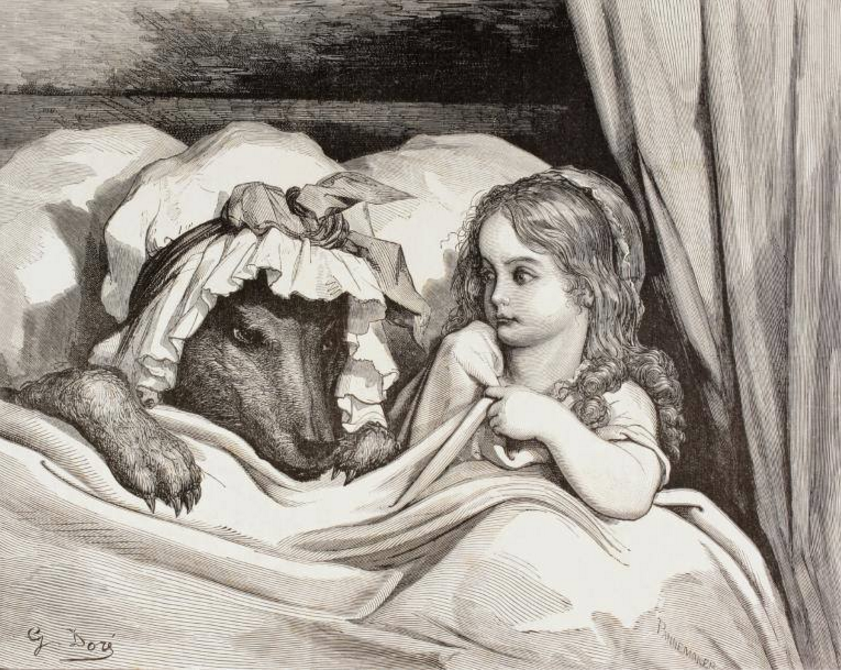
The idea of the “lone wolf” turns up in other fairy tales—think of “Little Red Riding Hood” for example,

(Perhaps my favorite illustration, by Gustave Dore—LRR seems to have a rather skeptical look—perhaps because in the version Dore illustrated, the last line of the story is:  “Et en disant ces mots, le méchant loup se jeta sur le petit Chaperon rouge, et la mangea.”—“And, in saying these words, the wicked wolf threw himself upon Little Red Riding Hood and ate her.”)

where a single wolf meets Red, and the perhaps less familiar “The Wolf and the Seven Kids”.

(This is by a well-known Victorian illustrator, Walter Crane, 1845-1915, from an 1882 collection of the Grimm fairy tales which you can see here:  https://en.wikisource.org/wiki/Household_stories_from_the_collection_of_the_Bros_Grimm_(L_%26_W_Crane)/The_Wolf_and_the_Seven_Little_Goats  You can also read a translation at this site, which is specifically devoted to the works of the Grimms:  https://www.grimmstories.com/en/grimm_fairy-tales/the_wolf_and_the_seven_little_goats )

Traditional fairy tales all have variants—sometimes numerous ones—and some appear even on a world-wide basis, like “Cinderella” (see an ancient Chinese version here:   https://www.ancient-origins.net/news-myths-legends/fish-wish-your-heart-makes-2200-year-old-tale-chinese-cinderella-003506 ), but a little preliminary research has suggested another possibility. 

Unlike other fairy tales, although scholars believe “The Three Little Pigs” to be an old story, I was surprised to learn that its first citation is only to an 1853 volume with a title which would not suggest that such a story would be included:  English Forests and Forest Trees, Historical, Legendary, and Descriptive.  It’s to be found in Chapter IX, “Dartmoor Forest” and, even more surprising, the characters aren’t pigs, but pixies, the villain of the piece isn’t a wolf, but a fox, and the houses are made of wood, stone, and iron.   You can read it here:  https://ia601307.us.archive.org/13/items/englishforestsa01unkngoog/englishforestsa01unkngoog.pdf on pages 189-190.

The version familiar to most of us first appears in the fifth edition of James Halliwell-Phillipps’ The Nursery Rhymes of England (1886), in which the third little pig (who survives, as his two brothers do not) has a lot more to do than in what must have been the simplified version I knew as a child—and this actually closely matches the Dartmoor version (except for the pixies and the fox).  You can read it here:  https://archive.org/details/nurseryrhymesofe00hall/page/36/mode/2up on pages 37-41.  (For an entertaining essay on Halliwell-Phillipps and his work, see:  https://reactormag.com/questionable-scholars-and-rhyming-pigs-j-o-halliwell-phillipps-the-three-little-pigs/  )

It’s admittedly just a guess on my part, Halliwell-Phillipps doesn’t credit a source, and, instead of a fox as the villain, there’s a wolf, but both stories, have the same pattern of threes, although building materials differ, and the three pixies have a different identity, but what we see here is the same story, which made me wonder:

  1. Did “pixies” become (possibly through mishearing of an oral telling) “pigsies”—that is, “little pigs”?
  2. Did the fox become a wolf because wolves can be quite large

(by NatsumeWolf—you can see more of her art here:  https://www.furaffinity.net/gallery/natsumewolf/ )

and therefore more menacing in a story than a diminutive, but tricky, fox?

As well, that wolf in “Little Red Riding Hood” appears in Charles Perrault’s late-17th century story collection, Histoires ou Contes du Temps passe, first translated into English in the early 18th century, appearing, as well, along with “The Wolf and the Seven Kids”, in the Grimms’ early 19th century Kinder und Hausmaerchen, first translated into English in the 1820s, both being, therefore, readily available.  So, could that frightening wolf from other stories perhaps have been leaning over Halliwell-Phillipps’ shoulder, pushing him to replace the fox, even as he turned pixies into pigsies?  After all, he had nothing to lose but his pack…

Thanks, as ever, for reading.

Stay well,

If threatened by a wolf, try to out-fox him,

And remember that there’s always

MTCIDC

O

PS

For another, rather eerie story with—well, no spoiler alert, just read it: https://ia601303.us.archive.org/8/items/thetoysofpeacean01477gut/1477-h/1477-h.htm

This is by HH Munro, 1870-1916, who used the pen name “Saki”.  I’ve mentioned him before, but I’m sure to mention him and his witty and sometimes weird short stories again in the future.

The Doubtful Sea Series Facebook Page

The Doubtful Sea Series Facebook Page

  • Ollamh

Categories

  • Artists and Illustrators
  • Economics in Middle-earth
  • Fairy Tales and Myths
  • Films and Music
  • Games
  • Heroes
  • Imaginary History
  • J.R.R. Tolkien
  • Language
  • Literary History
  • Maps
  • Medieval Russia
  • Military History
  • Military History of Middle-earth
  • Narnia
  • Narrative Methods
  • Poetry
  • Research
  • Star Wars
  • Terra Australis
  • The Rohirrim
  • Theatre and Performance
  • Tolkien
  • Uncategorized
  • Villains
  • Writing as Collaborators
Follow doubtfulsea on WordPress.com

Across the Doubtful Sea

Recent Postings

  • Through a glass… January 7, 2026
  • Heffalumps? December 31, 2025
  • We Three Kings December 24, 2025
  • A Moon disfigured December 17, 2025
  • On the Roads Again—Once More December 10, 2025
  • (Not) Crossing Bridges December 3, 2025
  • On the Road(s) Again—Again November 26, 2025
  • On the Road(s) Again November 19, 2025
  • To Bree (Part 2) November 12, 2025

Blog Statistics

  • 104,101 Views

Posting Archive

  • January 2026 (1)
  • December 2025 (5)
  • November 2025 (4)
  • October 2025 (5)
  • September 2025 (4)
  • August 2025 (4)
  • July 2025 (5)
  • June 2025 (4)
  • May 2025 (4)
  • April 2025 (5)
  • March 2025 (4)
  • February 2025 (4)
  • January 2025 (5)
  • December 2024 (4)
  • November 2024 (4)
  • October 2024 (5)
  • September 2024 (4)
  • August 2024 (4)
  • July 2024 (5)
  • June 2024 (4)
  • May 2024 (5)
  • April 2024 (4)
  • March 2024 (4)
  • February 2024 (4)
  • January 2024 (5)
  • December 2023 (4)
  • November 2023 (5)
  • October 2023 (4)
  • September 2023 (4)
  • August 2023 (5)
  • July 2023 (4)
  • June 2023 (4)
  • May 2023 (5)
  • April 2023 (4)
  • March 2023 (5)
  • February 2023 (4)
  • January 2023 (4)
  • December 2022 (4)
  • November 2022 (5)
  • October 2022 (4)
  • September 2022 (4)
  • August 2022 (5)
  • July 2022 (4)
  • June 2022 (5)
  • May 2022 (4)
  • April 2022 (4)
  • March 2022 (5)
  • February 2022 (4)
  • January 2022 (4)
  • December 2021 (5)
  • November 2021 (4)
  • October 2021 (4)
  • September 2021 (5)
  • August 2021 (4)
  • July 2021 (4)
  • June 2021 (5)
  • May 2021 (4)
  • April 2021 (4)
  • March 2021 (5)
  • February 2021 (4)
  • January 2021 (4)
  • December 2020 (5)
  • November 2020 (4)
  • October 2020 (4)
  • September 2020 (5)
  • August 2020 (4)
  • July 2020 (5)
  • June 2020 (4)
  • May 2020 (4)
  • April 2020 (5)
  • March 2020 (4)
  • February 2020 (4)
  • January 2020 (6)
  • December 2019 (4)
  • November 2019 (4)
  • October 2019 (5)
  • September 2019 (4)
  • August 2019 (4)
  • July 2019 (5)
  • June 2019 (4)
  • May 2019 (5)
  • April 2019 (4)
  • March 2019 (4)
  • February 2019 (4)
  • January 2019 (5)
  • December 2018 (4)
  • November 2018 (4)
  • October 2018 (5)
  • September 2018 (4)
  • August 2018 (5)
  • July 2018 (4)
  • June 2018 (4)
  • May 2018 (5)
  • April 2018 (4)
  • March 2018 (4)
  • February 2018 (4)
  • January 2018 (5)
  • December 2017 (4)
  • November 2017 (4)
  • October 2017 (4)
  • September 2017 (4)
  • August 2017 (5)
  • July 2017 (4)
  • June 2017 (4)
  • May 2017 (5)
  • April 2017 (4)
  • March 2017 (5)
  • February 2017 (4)
  • January 2017 (4)
  • December 2016 (4)
  • November 2016 (5)
  • October 2016 (6)
  • September 2016 (5)
  • August 2016 (5)
  • July 2016 (5)
  • June 2016 (5)
  • May 2016 (4)
  • April 2016 (4)
  • March 2016 (5)
  • February 2016 (4)
  • January 2016 (4)
  • December 2015 (5)
  • November 2015 (5)
  • October 2015 (4)
  • September 2015 (5)
  • August 2015 (4)
  • July 2015 (5)
  • June 2015 (5)
  • May 2015 (4)
  • April 2015 (3)
  • March 2015 (4)
  • February 2015 (4)
  • January 2015 (4)
  • December 2014 (5)
  • November 2014 (4)
  • October 2014 (6)
  • September 2014 (1)

Blog at WordPress.com.

  • Subscribe Subscribed
    • doubtfulsea
    • Join 78 other subscribers
    • Already have a WordPress.com account? Log in now.
    • doubtfulsea
    • Subscribe Subscribed
    • Sign up
    • Log in
    • Report this content
    • View site in Reader
    • Manage subscriptions
    • Collapse this bar
 

Loading Comments...