As always, dear readers, welcome.
I don’t know how Tolkien thought about ballads in general, but, about what was termed a modern “ballad”, The Ballad of the White Horse, 1911,
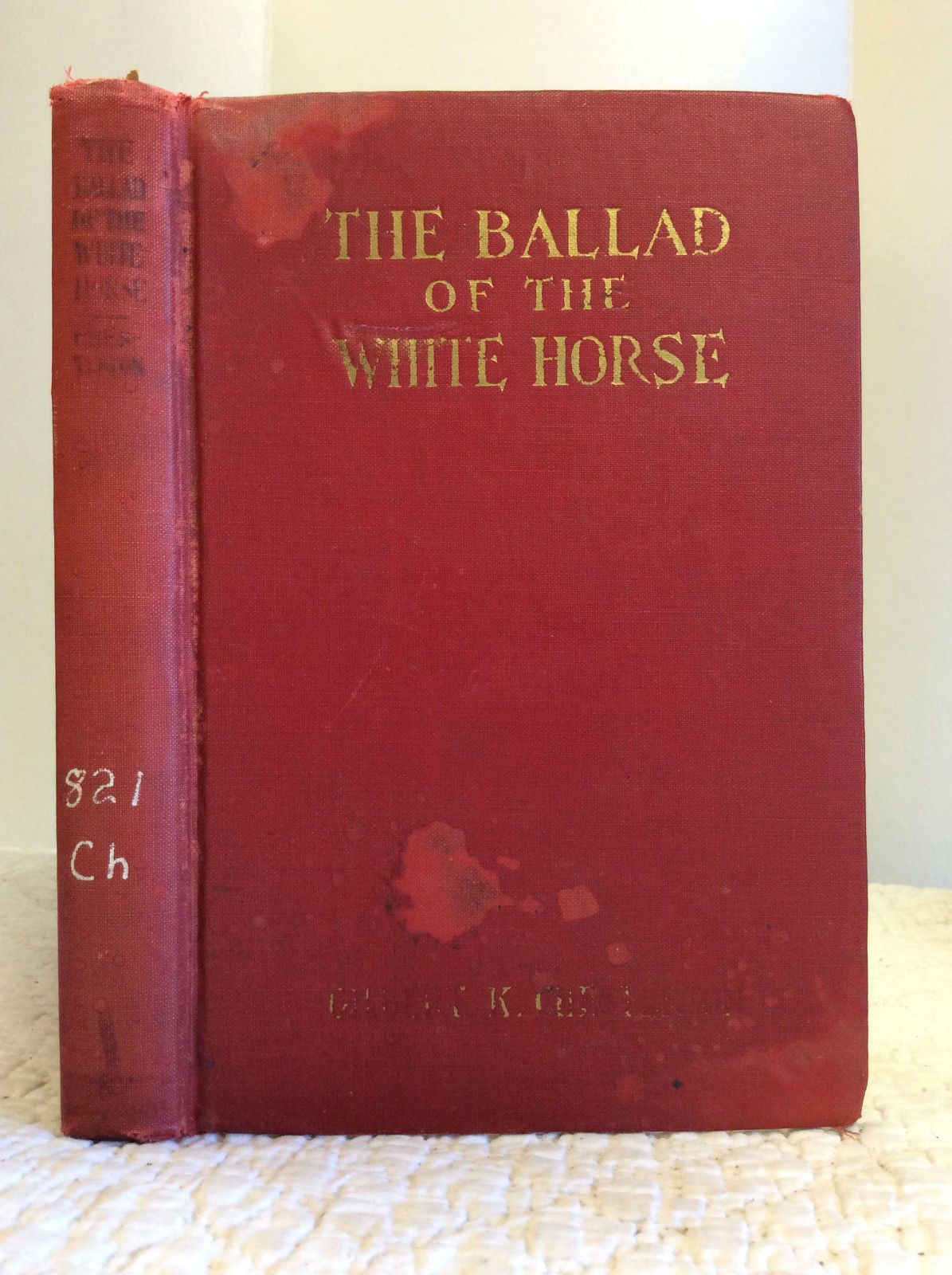
by its author, G.K. Chesterton (1874-1936),

he had this to say:
“P[riscilla]…has been wading through The Ballad of the White Horse for the last many nights; and my efforts to explain the obscurer parts to her convince me that it is not as good as I thought. The ending is absurd. The brilliant smash and glitter of the words and phrases (when they come off, and not mere loud colours) cannot disguise the fact that G.K.C. knew nothing whatever about the ‘North’, heathen or Christian.” (from an airgraph to Christopher Tolkien, 3 September, 1944, Letters, 131)
For myself, I would say that, although I’ve been reading (and singing) old ballads for a long time, I don’t think of them as having “smash and glitter”, but rather, at their best, being plain and, often, grim—and perhaps it’s in part why they have the lure they do—and have had, since at least early Romanticism. I’m presuming that that’s a reason why, for example, following collectors who date back at least to the early 18th century, Sir Walter Scott (1770-1832),
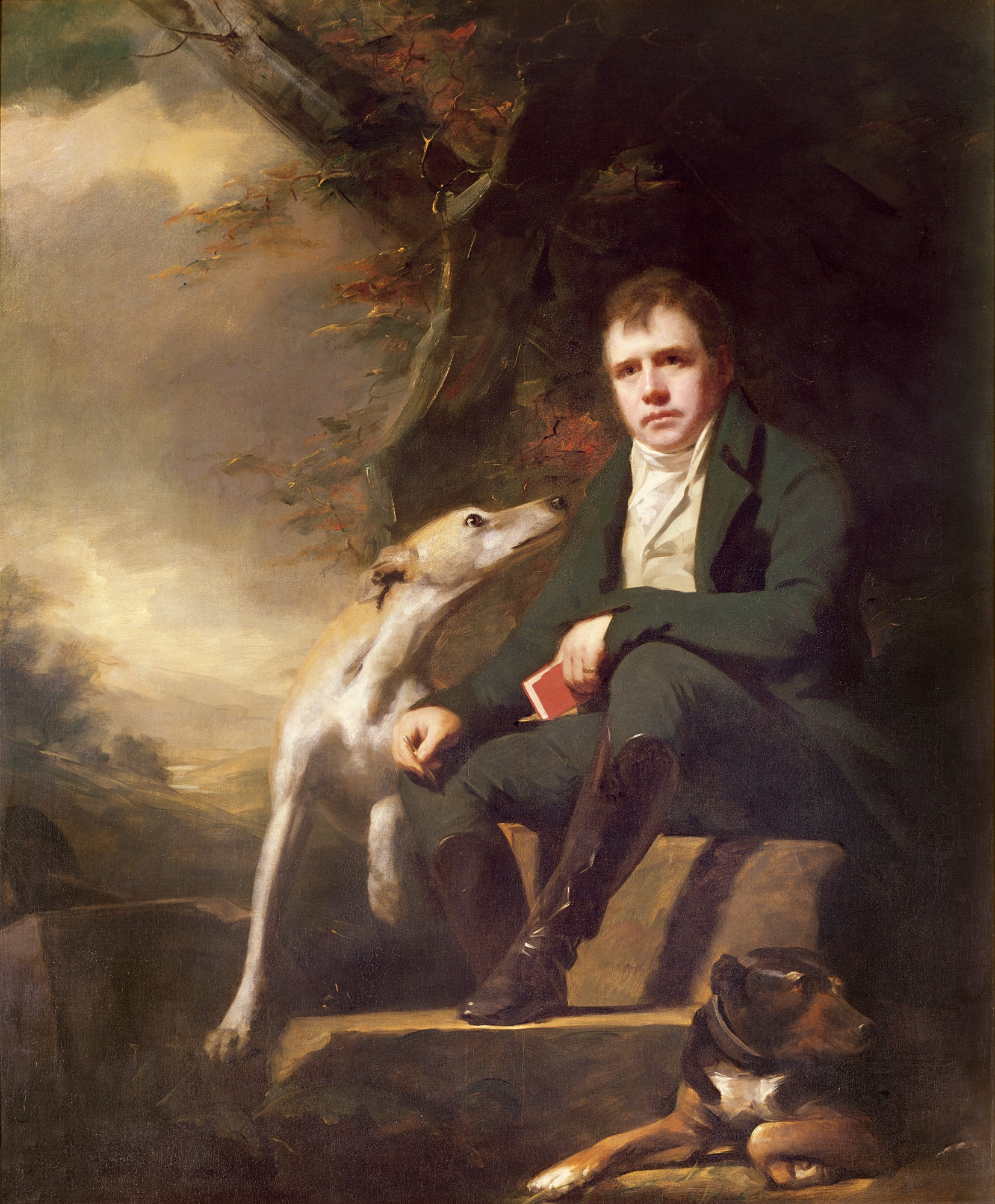
(portrait by Sir Henry Raeburn—who clearly captured Scott as Scott wanted to be remembered—a reader in a romantic atmosphere—with his dogs)
published Minstrelsy of the Scottish Border (1802-1830—Scott kept revising and revising),

which included not only ballads he had personally collected or had from others, but also contemporary imitations of what he admired. (There’s a very useful article here: https://en.wikipedia.org/wiki/Minstrelsy_of_the_Scottish_Border on Scott and his working methods and even a site about a combined Scots/German project on the collection here: http://walterscott.eu/ )
One of the ballads was clearly in the mind of another author, William Wordsworth (1770-1850),
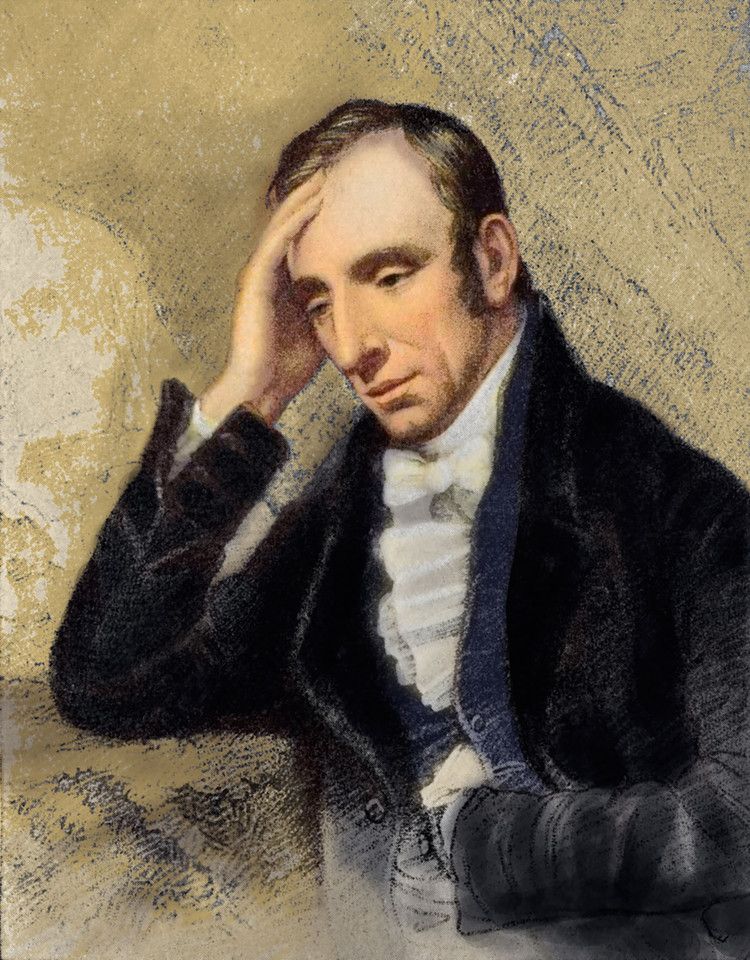
“The Dowie Dens o Yarrow” (in modern English, perhaps something like “The Gloomy/Melancholy Dells of Yarrow”), when he wrote a very interesting poem in 1803, “Yarrow Unvisited”.
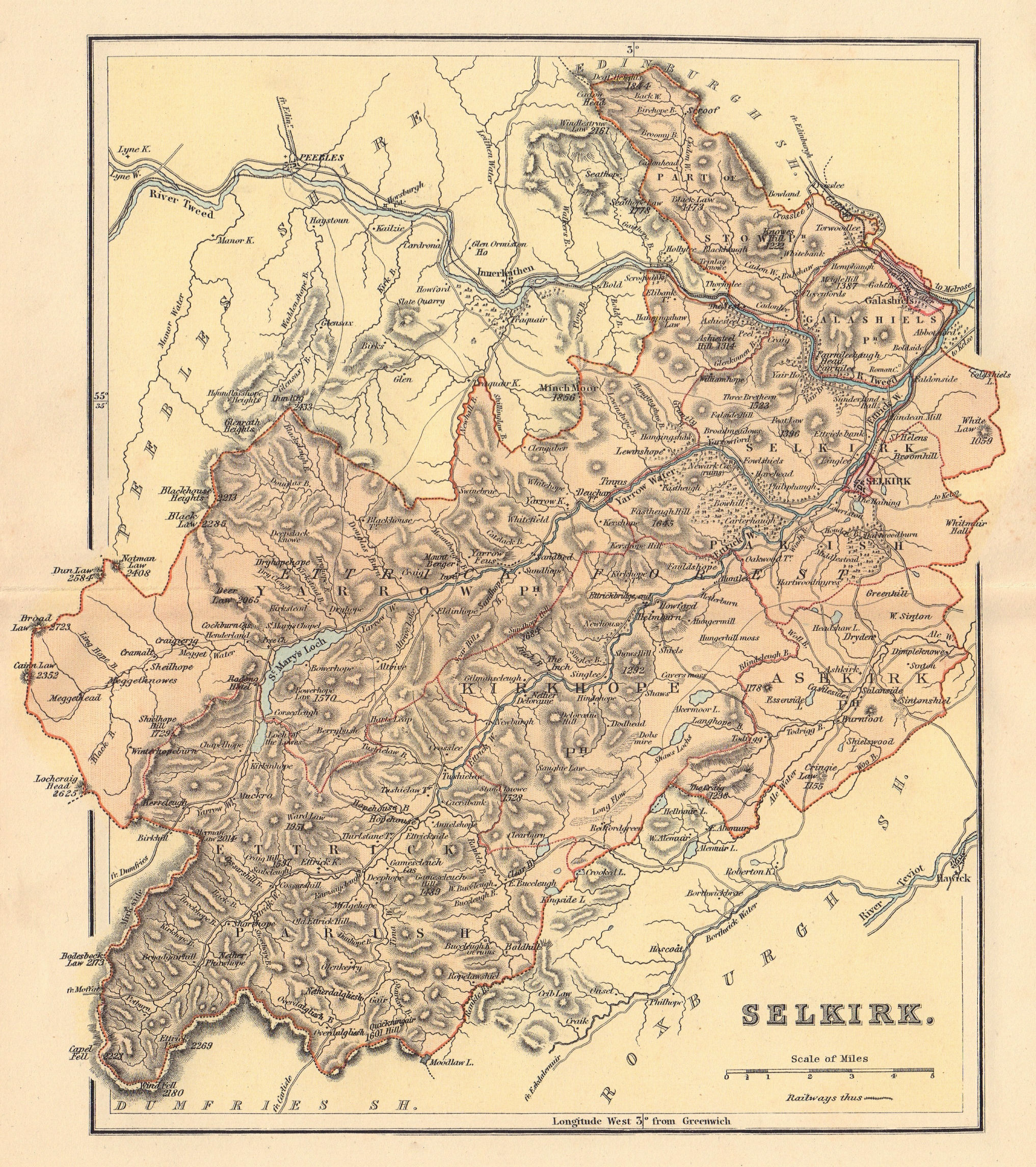
Yarrow itself is a narrow river which is a tributary of the River Tweed. Here’s a late 19th-century map to help you to locate it—find St Mary’s Loch and follow the river line towards the Tweed.
And here’s the Yarrow in full spate—appropriately in a rather stark early 20th-century photo—

The original ballad—and there are a lot of variant forms—tells the story of a lady to be fought over by a series of lords—and their rival, in some versions, a “plough-boy lad of Yarrow” (to see variants, here are those published in FJ Child’s, 1825-1896, The English and Scottish Popular Ballads, 1882-1898, known as “Child 214” and by the title “The Braes of Yarrow” (that is, “The Hillsides of Yarrow”): https://sacred-texts.com/neu/eng/child/ch214.htm ) The rival defeats the lords, but is then treacherously stabbed from behind, often by the lady’s brother. (You can hear the version I first heard and learned, sung by Ewan McColl, here: https://www.youtube.com/watch?v=Vfsv8zUdqKM Be warned: this performance is in line with older traditional performances, which I’ve always preferred, but might be rough, if you’re used to smoother folk singers.)
Wordsworth, and his sister, Dorothy, (1771-1855)
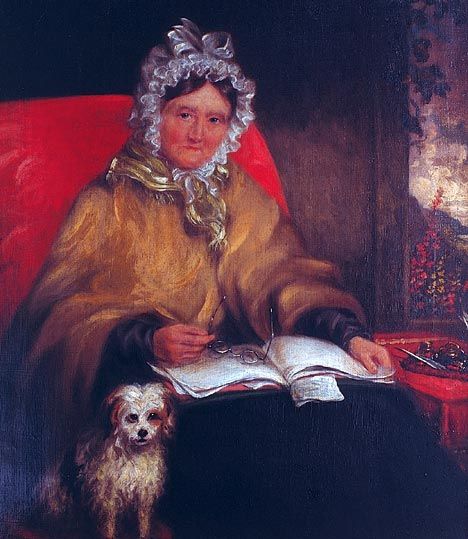
had made a brief tour of southern Scotland in the late summer of 1803 and had met Walter Scott there, fresh from publishing the first edition of Minstrelsy. I suspect that the combination of their tour, that meeting, and Scott’s collection all came together in a poem which Wordsworth then wrote, probably in the early fall of 1803, “Yarrow Unvisited”. I’ve always liked this poem because it’s not about what Wordsworth and Dorothy did see (this becomes the subject of the later “Yarrow Visited” of 1814—a good background article: https://en.wikipedia.org/wiki/Yarrow_poems_(Wordsworth) ), but the fact that, because they didn’t see Yarrow, they could still imagine it—perhaps imagination, Wordsworth even suggests, is better, and seeing might spoil it—and because there was always the future possibility of actually seeing it. (I am a big fan of Dorothy’s work—she had a wonderful eye for the natural world and a shrewd eye for people—and you can read her “Recollections of a Tour Made in Scotland” here: https://www.gutenberg.org/files/42856/42856-h/42856-h.htm )
Here’s Wordsworth’s poem, the “winsome Marrow” is Dorothy, the word “marrow” meanIng “equal/match”, being a description of the lady in the ballad:
“FROM Stirling Castle we had seen
The mazy Forth unravell’d,
Had trod the banks of Clyde and Tay
And with the Tweed had travell’d;
And when we came to Clovenford,
Then said my “winsome Marrow,”
“Whate’er betide, we’ll turn aside,
And see the Braes of Yarrow.”
“Let Yarrow folk, frae Selkirk town,
Who have been buying, selling,
Go back to Yarrow, ’tis their own,
Each maiden to her dwelling!
On Yarrow’s banks let herons feed,
Hares couch, and rabbits burrow;
But we will downward with the Tweed,
Nor turn aside to Yarrow.
“There’s Gala Water, Leader Haughs,
Both lying right before us;
And Dryburgh, where with chiming Tweed
The lintwhites sing in chorus;
There’s pleasant Tiviotdale, a land
Made blithe with plough and harrow:
Why throw away a needful day
To go in search of Yarrow?
“What’s Yarrow but a river bare
That glides the dark hills under?
There are a thousand such elsewhere
As worthy of your wonder.”—
Strange words they seem’d of slight and scorn;
My true-love sigh’d for sorrow,
And look’d me in the face, to think
I thus could speak of Yarrow!
“Oh, green,” said I, “are Yarrow’s holms,
And sweet is Yarrow flowing!
Fair hangs the apple frae the rock,
But we will leave it growing.
O’er hilly path and open strath
We’ll wander Scotland thorough;
But, though so near, we will not turn
Into the dale of Yarrow.
“Let beeves and home-bred kine partake
The sweets of Burn-mill meadow;
The swan on still Saint Mary’s Lake
Float double, swan and shadow!
We will not see them—will not go
To-day, nor yet to-morrow;
Enough if in our hearts we know
There’s such a place as Yarrow.
“Be Yarrow stream unseen, unknown!
It must, or we shall rue it:
We have a vision of our own,
Ah! why should we undo it?
The treasured dreams of times long past,
We’ll keep them, winsome Marrow!
For when we’re there, although ’tis fair
’Twill be another Yarrow!
“If Care with freezing years should come,
And wandering seem but folly,—
Should we be loth to stir from home,
And yet be melancholy;
Should life be dull, and spirits low,
’Twill soothe us in our sorrow
That earth has something yet to show,
The bonny holms of Yarrow!”
Although Wordsworth doesn’t use a ballad metre here, he cleverly echoes the sound of the 4-line stanzas in the older poem, keeping that word “Yarrow” at the end of each stanza, and rhyming or suggesting rhyme, in the second line to match it, following this Child version (214Q):
“There lived a lady in the West,
I ne’er could find her marrow;
She was courted by nine gentlemen,
And a plough-boy lad in Yarrow.”
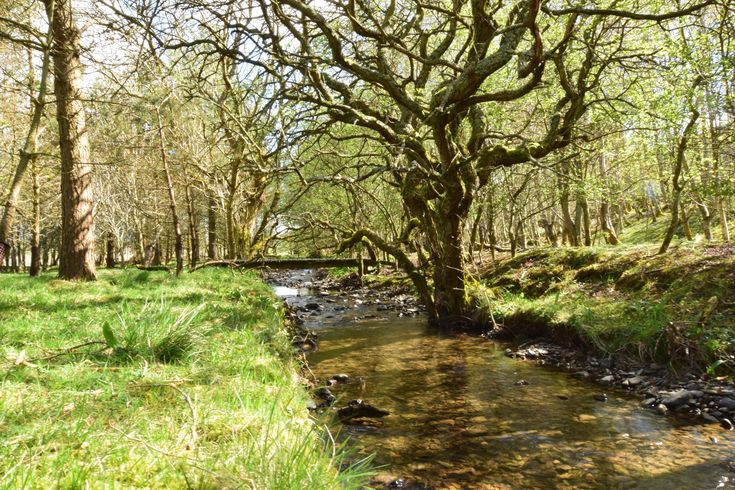
No “smash and glitter” here, but, in the ballad, grimness and plainness and even fierceness, and, in Wordsworth’s poem, a quiet, playful thoughtfulness and, in neither, what Tolkien said of his daughter, Priscilla’s efforts with “The Ballad of the White Horse”, a need to “wade through”—although, one could always wade the Yarrow…
As ever, thanks for reading.
Stay well,
Watch your back,
And remember that there’s always
MTCIDC
O
PS
So that you can decide for yourself about that “smash and glitter”, here’s Chesterton’s poem for you: https://www.gutenberg.org/files/1719/1719-h/1719-h.htm It’s interesting that JRRT comments that he doesn’t think that Chesterton knew anything about the “North”—a subject upon which Tolkien himself was passionate—see his anger at the Nazis for their pirating of the subject, in his letter to Michael Tolkien, 9 June, 1941, Letters, 77)—as Chesterton boldly states, in his “Prefatory Note” he’s perfectly willing to admit that what he writes isn’t really historical and that he’s accepting myth even as he is making his own:
“This ballad needs no historical notes, for the simple reason that it does not profess to be historical. All of it that is not frankly fictitious, as in any prose romance about the past, is meant to emphasize tradition rather than history. King Alfred is not a legend in the sense that King Arthur may be a legend; that is, in the sense that he may possibly be a lie. But King Alfred is a legend in this broader and more human sense, that the legends are the most important things about him.”
PPS
If you would like to see Scott’s version of the ballad, it’s here: https://www.gutenberg.org/ebooks/12882 All three volumes of the Scott are available here at Gutenberg. They appear to be the 3rd edition of 1806. For the various Child variants in Vol.3 of his collection, see: https://archive.org/details/englishandscott07unkngoog/page/n8/mode/2up This—and all 7 other volumes are available at the Internet Archive.
PPPS
A “holm” in the Wordsworth is—I’m quoting “Etymonline” here:
“small island in a river; river meadow,” late Old English, from Old Norse holmr “small island,” especially in a river or bay, or cognate Old Danish hulm, from Proto-Germanic *hul-maz, from PIE root *kel- (2) “to be prominent; hill.” Obsolete, but preserved in place names, where it has various senses derived from the basic one of “island:” “‘raised ground in marsh, enclosure of marginal land, land in a river-bend, river meadow, promontory'” [“Cambridge Dictionary of English Place-Names”].”
 doubtfulsea