Tags
Black Speech, Fantasy, lingua franca, lotr, Merry and Pippin, Native American sign language, Nazgul, Orcs, Orkish, the-black-speech, Tok Pisin, Tolkien
Welcome, dear readers, as always.
I begin this posting with a riddle: how are Tolkien and Sauron alike?
But we’ll come back to that.
Before that, I want to talk about the title of this posting.
When Boromir is killed by the Orcs.

(Ted Nasmith)
Merry and Pippin are captured and carried off across country,

(Denis Gordeev)
Pippin waking eventually to this—
“He struggled a little, quite uselessly. One of the Orcs sitting near laughed and said something to a companion in their abominable language.. ‘Rest while you can, little fool!’ he then said to Pippin, in the Common Speech, which he made almost as hideous as his own language.”
But what does that “abominable language” sound like? Another Orc, equally gentle, gives us an example.
“ ‘If I had my way, you’d wish that you were dead now,’ said the other….’Don’t draw attention to yourself, or I may forget my orders,’ he hissed. Curse the Isengarders! Ugluk u bagronk sha pushdug Saruman-glob bubhosh skai’: he passed into a long angry speech in his own tongue that slowly died away into muttering and snarling.”
One word is easy to pick out, of course—Saruman—but the rest calls for translating, something which Tolkien doesn’t provide in The Lord of the Rings, but there are, in fact, at least three translations:
1. “Ugluk to the cesspool, sha! the dungfilth; the great Saruman-fool, skai!” which comes from a draft of Appendix F of The Peoples of Middle-earth
2. “Ugluk to the dung-pit with stinking Saruman-filth—pig-guts, gah!” which is a translation by Carl Hostetter in Vinyar Tengwar 26
3. “Ugluk to torture(chamber) with stinking Saruman-filth. Dung-heap. Skai!” which is from Parma Eldalamberon XVII
(You can see the whole reference here: https://tolkiengateway.net/wiki/Ugl%C3%BAk_u_bagronk_sha_pushdug_Saruman-glob_b%C3%BAbhosh_skai For a bit more, including JRRT’s comment on Orkish, suggesting that he has bowdlerized this a bit in that 3rd translation, see: https://glaemscrafu.jrrvf.com/english/ugluk.html )
Pippin can’t understand a word of this—
“Terrified Pippin lay still, though the pain at his wrists and ankles was growing, and the stones beneath him were boring into his back. To take his mind off himself he listened intently to all that he could hear. There were many voices round about, and though orc-speech sounded at all times full of hate and anger, it seemed plain that something like a quarrel had begun, and was getting hotter.”
but still senses that there is strong emotion behind the Orcs’ words and part of how that “hate and anger” was conveyed to Pippin probably from the very sounds of the language—full of the hissing SH—sha, push-dug, bub-hosh—and words of only one or two syllables—Ug-luk, ba-gronk, sha, push-dug, bub-hosh, skai, making it sound abrupt. And you can then see that 3-syllable “Saruman” was clearly a foreign word, which was then turned into an Orkish compound with that final single-syllable “glob”.
And yet:
“To Pippin’s surprise he found that much of the talk was intelligible; many of the Orcs were using ordinary language.”
“ordinary language” here is Pippin’s tongue—the Common Speech of Middle-earth (“Westron”)—which is also the language in which The Lord of the Rings was supposed originally to have been written.
Dazed as he might be (“I suppose I was knocked on the head” he says to himself when he first wakes), Pippin, listening, comes to a clever conclusion as to why the Common Speech is employed by the Orcs who, after all, appear to have their own language:
“Apparently the members of two or three quite different tribes were present, and they could not understand one another’s orc-speech.” (all of the above quotations from The Fellowship of the Ring, Book Two, Chapter 3, “The Uruk-hai”)
It’s interesting to see what the Orcs are doing here: finding a way to converse because their own languages—or at least their dialects—are not mutually intelligible.
This has been a problem throughout history, wherever one people meets another with which it doesn’t share a language.
Several different approaches have been created.
On the Great Plains of the US West, for example,

Native Americans produced a kind of universal sign language, which employed standardized gestures for common concepts and ideas. Here’s a chart of a few of those gestures—
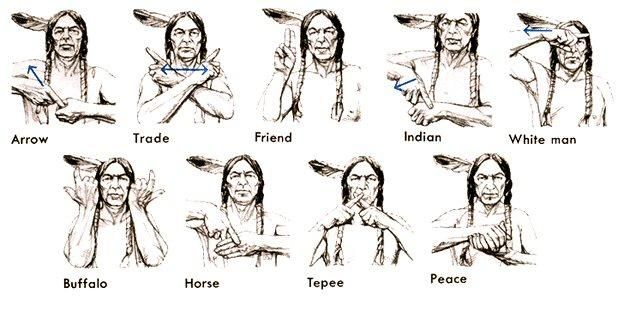
and here’s a possible extension—although I must say that it strikes me that it would take two very linguistically talented people, with a wide gesture vocabulary, to convey all of this.

(You can read about it here, which includes a wonderful piece of film in which various Native Americans and a seemingly-fluent US Government representative converse in gesture: https://en.wikipedia.org/wiki/Plains_Indian_Sign_Language )
Besides gesture, people have constructed what’s called a “lingua franca”—literally “French tongue”—that is, a kind of trade tongue, which might have a base in one language, but which then borrows words from other regional languages to build its working vocabulary. The term comes from such a language employed from the early medieval period up into the 19th century in the Mediterranean, “franca” being used really to mean not “French” so much as “foreign”. (You can read more about it here: https://en.wikipedia.org/wiki/Lingua_franca )
In contemporary Papua/New Guinea,

there is the English-based Tok Pisin, which has become so useful that it has become the first language of some groups. (For more, see: https://en.wikipedia.org/wiki/Tok_Pisin , which includes a demonstration of TP as spoken, although the background noise makes it a little difficult to hear. Fortunately, there are a fair number of YouTube videos, should you want to hear more—and I hope you do. YouTube is full of languages, both living and now no longer in use—I won’t say “dead”, because, if any language is still comprehensible, even if the last speakers are gone, I wouldn’t write an epitaph for it, myself– and we’re so lucky to be given so much to learn and understand.)
The Orcs, however, have simply resorted to employing another language entirely—although it would be interesting to see whether, had we more of their speech, we might find elements from other languages—there’s a clue in that “Saruman-glob”, where the speaker takes a word from another language and simply attaches an Orc word to it.
What was that “orc-speech”, which Pippin couldn’t understand?
“The Orcs were first bred by the Dark Power of the North in the Elder Days. It is said that they had no language of their own, but took what they could of other languages and perverted it to their own liking, yet they made only brutal jargons, scarcely sufficient even for their own needs, unless it were for curses and abuse. And these creatures, being filled with malice, hating even their own kind, quickly developed as many barbarous dialects as there were groups or settlements of their race, so that their Orkish speech was of little use to them in intercourse between different tribes.”
And so what we’re seeing is that the Orcs were actually developing a series of languages rather like linguae francae—basing them on whatever other language was locally available, then adding the odd curse or form of abuse which appealed to them, all of which turned their speech, even if once based upon a common borrowed language, into something incomprehensible to others from the same race.
It’s clear that Sauron, from whom Saruman got his definition of what Saruman claimed was always the goal of the Istari: “Knowledge, Rule, Order”, wished Rule and Order to be at the heart of his dominion and therefore:
“It is said that the Black Speech was devised by Sauron in the Dark Years, and that he desired to make it the language of all those who served him…”
but the power of the Linguae Orcae, as we can call them, won out:
“…but [Sauron] failed in that purpose. From the Black Speech, however, were derived many of the words that were in the Third Age wide-spread among the Orcs, such as ghash, ‘fire’, but after the first overthrow of Sauron this language in its ancient form was forgotten by all but the Nazgul.”
And so even their master’s invention became nothing more than a vocab pool, from which to draw that which the Orcs fancied—and we know their preferences.
It’s no wonder, then, that
“So it was that in the Third Age Orcs used for communication between breed and breed the Westron tongue; and many indeed of the older tribes, such as those that still lingered in the North and in the Misty Mountains, had long used the Westron as their native language…”—just like those for whom Tok Pisin had moved from a trade tongue to a first tongue—but here’s an Orkish difference: “though in such a fashion as to make it hardly less lovely than Orkish.” (all quotations from “The Orcs were first bred…” on from The Lord of the Rings, Appendix F)
And the answer to the riddle—I think that you’ve guessed it already: “How are Tolkien and Sauron alike?” Both were creators of languages, the difference being that it seems that virtually everyone in Middle-earth, from Elves to Dwarves to Ents to Orcs, speaks Westron, while no one speaks the Black Speech but Sauron’s last and soon to be lost, enslaved kings, the Nazgul.
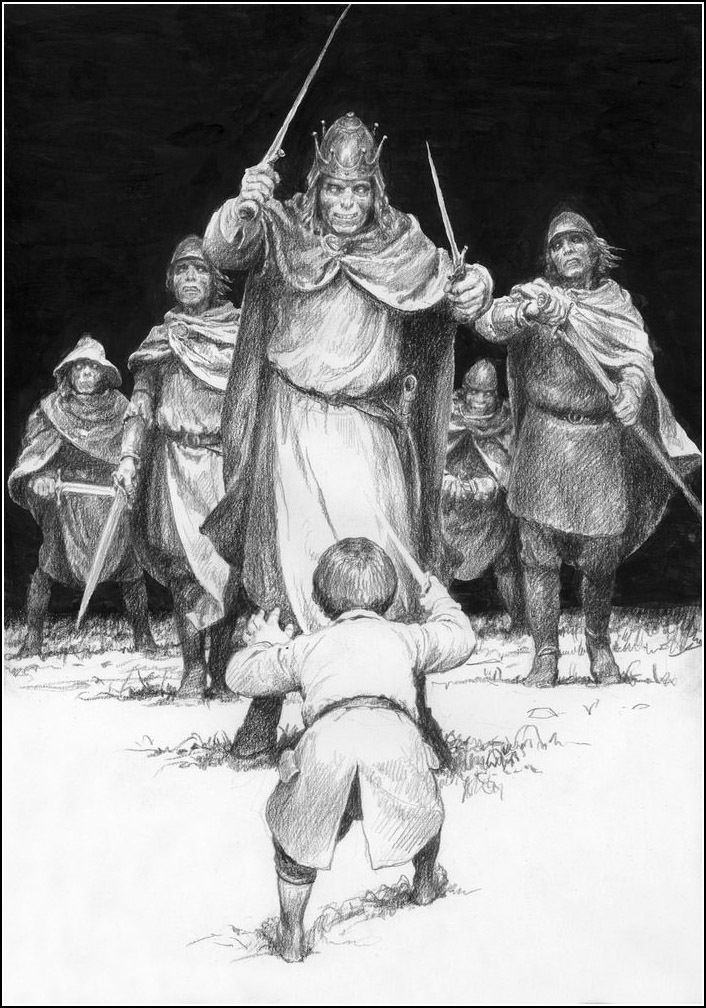
(Denis Gordeev)
Thanks, as always, for reading.
Stay well,
Consider the endless borrowings which English has made from world languages,
And remember that, as always, there’s
MTCIDC
O
 doubtfulsea