• About

doubtfulsea

~ adventure fantasy

Tag Archives: swords

Going Around in Cycles

17 Wednesday Sep 2025

Posted by Ollamh in Uncategorized

≈ Leave a comment

Tags

Barrow-wight, Finnegans Wake, Giambattista Vico, goblin king, James Joyce, La Scienza Nuova, lotr, Mirkwood spiders, Nazgul, Ouroboros, Palantir, runes, Shelob, swords, The Hobbit, The Lord of the Rings, The Return of the King, Tolkien, Tom Bombadil, Yogi Berra

“It’s déjà vue all over again.”

(attributed to Yogi Berra, US baseball player, but see:  https://quoteinvestigator.com/2013/10/08/deja-vu-again/ )

Dear readers, as always, welcome.

In later life, James Joyce, 1882-1941,
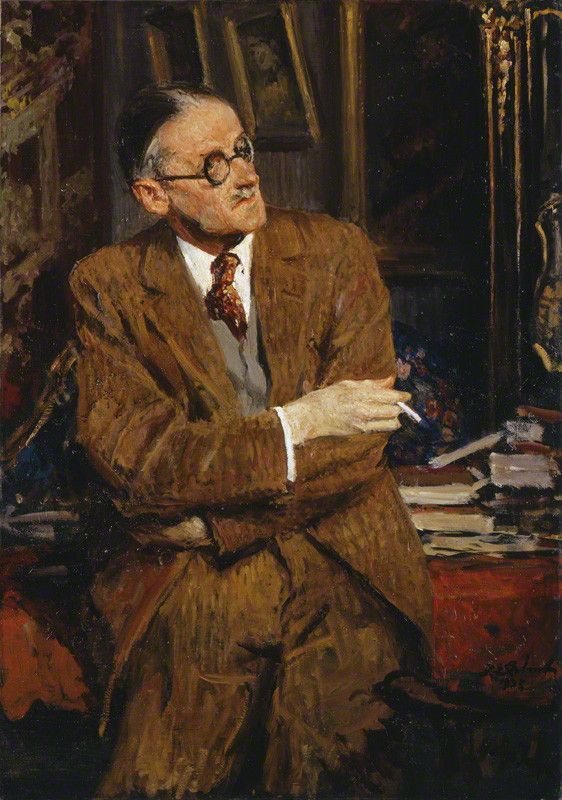
was interested in the work of the 17-18th-century philosopher (among other things) Giambattista Vico, 1668-1744,

and his idea that history followed a definite repeated pattern in three ages, Divine, Heroic, and Human, posited in his 1725-1744 work, La Scienza Nuova (“the new understanding, knowledge, learning”).

(For more on Vico, see:  https://www.philosopheasy.com/p/the-eternal-return-giambattista-vicos  This is, potentially, a very large subject, and even more so when Joyce is combined with Vico.  For an introductory view, see:  https://archive.org/details/vicojoyce00vere_0/page/n5/mode/2up ) 

Joyce incorporated his understanding of Vico in his last work, Finnegans Wake, 1939, in which

the idea of repeated patterns cycling throughout appears in the very opening—and closing– lines of the book:

“A way a lone a last a loved a long the / riverrun, past Eve and Adam’s, from swerve of shore to bend of bay, brings us by a commodius vicus of recirculation back to Howth Castle and Environs.” 

which, in fact, are reversed, the opening of the book being:

“…riverrun, past Eve and Adam’s, from swerve of shore to bend of bay, brings us by a commodius vicus of recirculation back to Howth Castle and Environs…”

and the last words of the book are:

“A way a lone a last a loved a long the…”

so that, by joining them, we have the effect of the serpent Ouroboros, tail/tale joined to mouth—and the book can begin again.

(For more on Finnegans Wake, see:  https://en.wikipedia.org/wiki/Finnegans_Wake  For more on the serpent, see:   https://en.wikipedia.org/wiki/Ouroboros )

I’ve always thought that leaving Tom Bombadil and the Barrow-wight
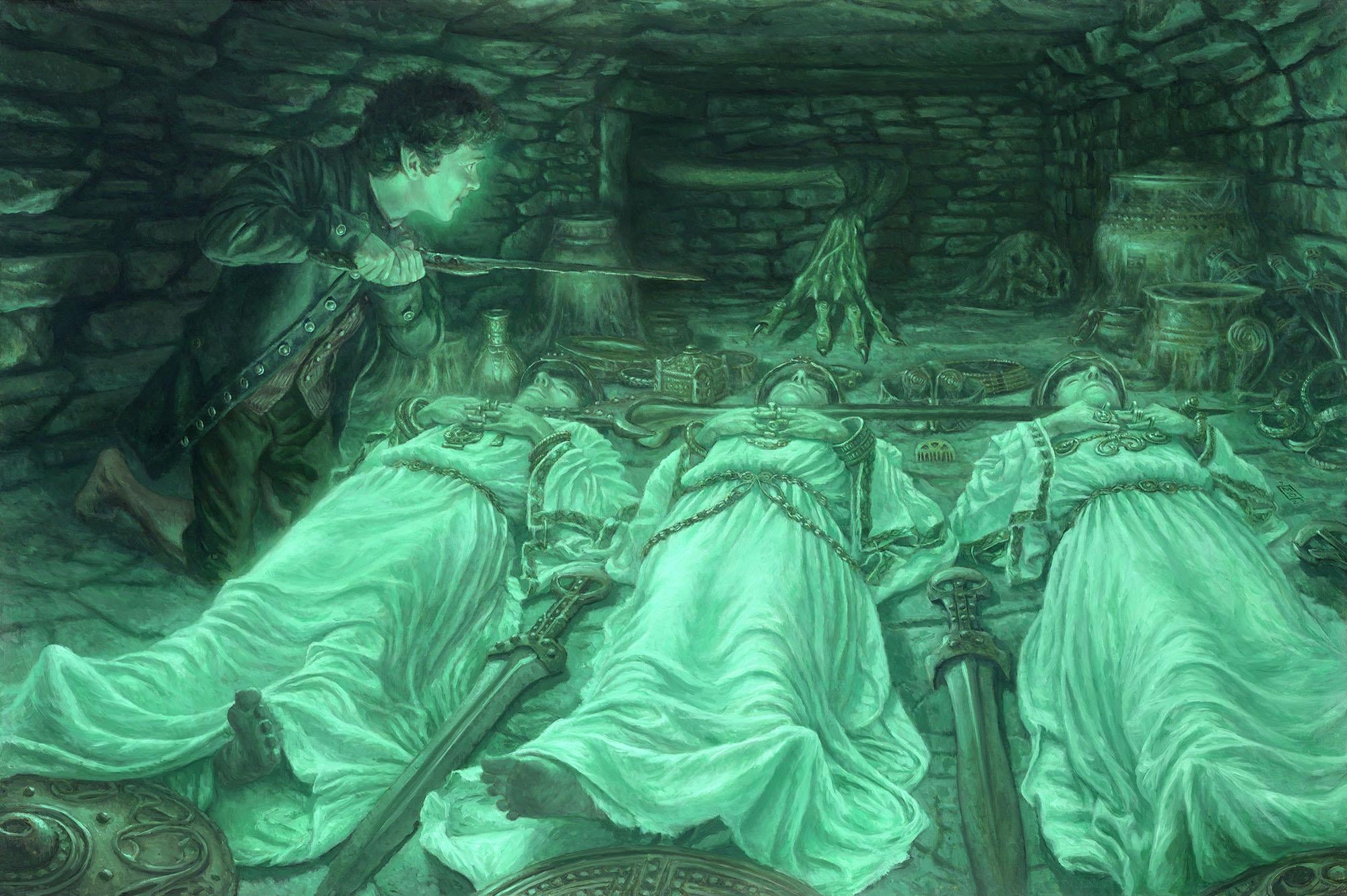
(Matthew Stewart—see more of his work here:  https://www.matthew-stewart.com/  See, in particular, his Middle-earth work, but then go through his other galleries to view his impressive ability to capture other imaginary worlds.)

out of the first Lord of the Rings film was a mistake, even though Tolkien himself once wrote:

“Tom Bombadil is not an important person—to the narrative.”  (letter to Naomi Mitchison, 25 April, 1954, Letters, 268—but read on, as JRRT has much more to say and, to my mind, justifies his position in the narrative, in fact, in a spiritual way.)

Tom is interesting in himself, being a kind of parallel for Treebeard, among other things (and the writers of the Rings of Power series thought highly enough of him to include him in their telling), but, for me, in the narrative, it’s what he gives them, particularly Merry, which is important—

“For each of the hobbits he chose a dagger, long, leaf-shaped, and keen, of marvelous workmanship…”

(probably something like this, but more elaborately-worked)

‘Old knives are long enough as swords for hobbit-people,’ he said…Then he told them that the blades were forged many long years ago by Men of Westernesse:  they were foes of the Dark Lord, but they were overcome by the evil king of Carn Dum in the Land of Angmar.”  (The Fellowship of the Ring, Book One,  Chapter 8, “Fog on the Barrow-downs”)

This is, of course, the weapon  which Merry uses to stab the chief of the Nazgul while he’s attacking Eowyn, the Nazgul being the very witch-king who had overcome the Men of Westernesse so long before.

(Ted Nasmith)

To keep Tom and the Barrow-wight in the film is then to underline the cyclic nature of much of the story.

 This unnamed but crucial sword is only one of the swords scattered throughout the later story of Middle-earth, however, and there is a cyclic potential for others, as well.

Think of the swords which Gandalf and Co. find in the trolls’ hideout in The Hobbit—

“…and among them were several swords of various makes, shapes, and sizes.  Two caught their eyes particularly, because of their beautiful scabbards and jeweled hilts…

‘These look like good blades,’ said the wizard, half drawing them and looking at them curiously.  ‘They were not made by any troll, nor by any smith among men in these parts and days; but when we can read the runes on them, we shall know more about them.’ “ (The Hobbit, Chapter Two, “Roast Mutton”)

In the next chapter, Elrond then identifies them:

“Elrond knew all about runes of every kind.  That day he looked at the swords they had brought from the trolls’ lair, and he said:  ‘These are not troll-make.  They are old swords, very old swords of the High Elves of the West, my kin.  They were made in Gondolin for the Goblin-wars.  They must have come from a dragon’s hoard or goblin plunder, for dragons and goblins destroyed that city many ages ago.  This, Thorin, the runes name Orcrist, the Goblin-cleaver in the ancient tongue of Gondolin; it was a famous blade.  This, Gandalf, is Glamdring, a Foe-hammer that the king of Gondolin once wore.’ “ (The Hobbit, Chapter Three.  “A Short Rest”)

And you’ll remember that Gandalf runs the king of later goblins through in the next chapter with that very sword:

“Suddenly a sword flashed in its own light.  Bilbo saw it go right through the Great Goblin as he stood dumb-founded in the middle of his rage.  He fell dead, and the goblin soldiers fled before the sword shrieking into the darkness.”  (The Hobbit, Chapter Four, “Over Hill and Under Hill”)

(Alan Lee)

The knife which Bilbo picks up from the trolls’ hoard “only a tiny pocket-knife for a troll, but it was as good as a short sword for the hobbit”, comes in handy later in The Hobbit, when Bilbo uses it to kill some of the spiders of Mirkwood,

(Oleksiy Lipatov—you can see more of his work here:  https://www.deviantart.com/lipatov/gallery/85631839/old-comic  )

but it will reappear many years later in The Lord of the Rings, when Frodo and Sam use it against another ancient evil, Shelob–

(Ted Nasmith again—and, unusually for his work, just plain weird—but vivid!)

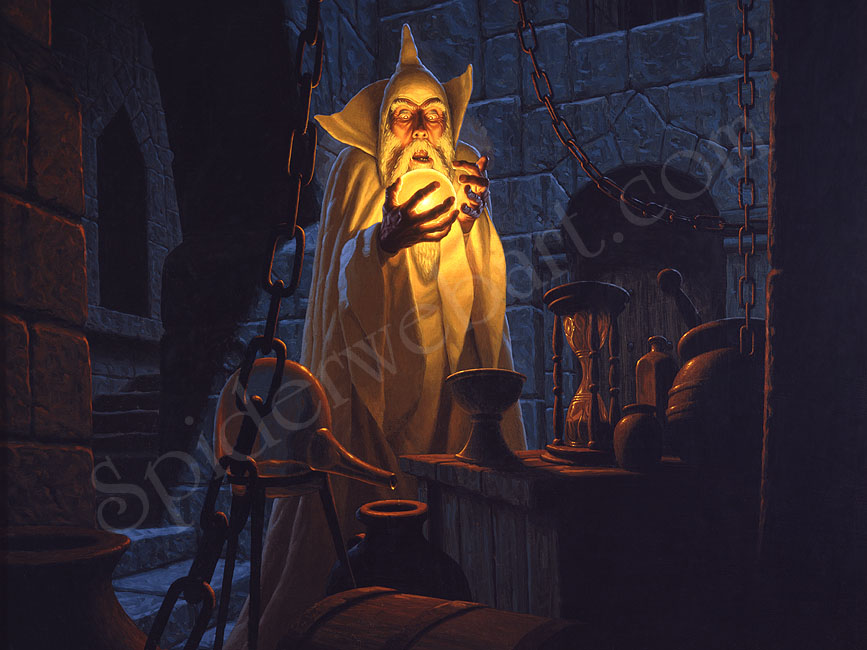
Perhaps the most consequential sword  to return, however, is that which maimed Sauron many centuries ago, causing him to lose the Ring, and which, reforged, Aragorn shows him in Saruman’s palantir
(the Hildebrandts)

(itself appearing from a far older world, being as Aragorn says, “For this assuredly is the palantir of Orthanc, from the treasury of Elendil, set here by the Kings of Gondor.”  The Two Towers, Book Three, Chapter 11, “The Palantir”):

“…The eyes in Orthanc did not see through the armour of Theoden; but Sauron has not forgotten Isildur and the sword of Elendil.  Now in the very hour of his great designs the heir of Isildur and the Sword are revealed; for I showed the blade re-forged to him.  He is not so mighty yet that he is above fear; nay doubt ever gnaws him.”  (The Return of the King, Book Five, Chapter 2, “The Passing of the Grey Company”)

And there are more cyclings.

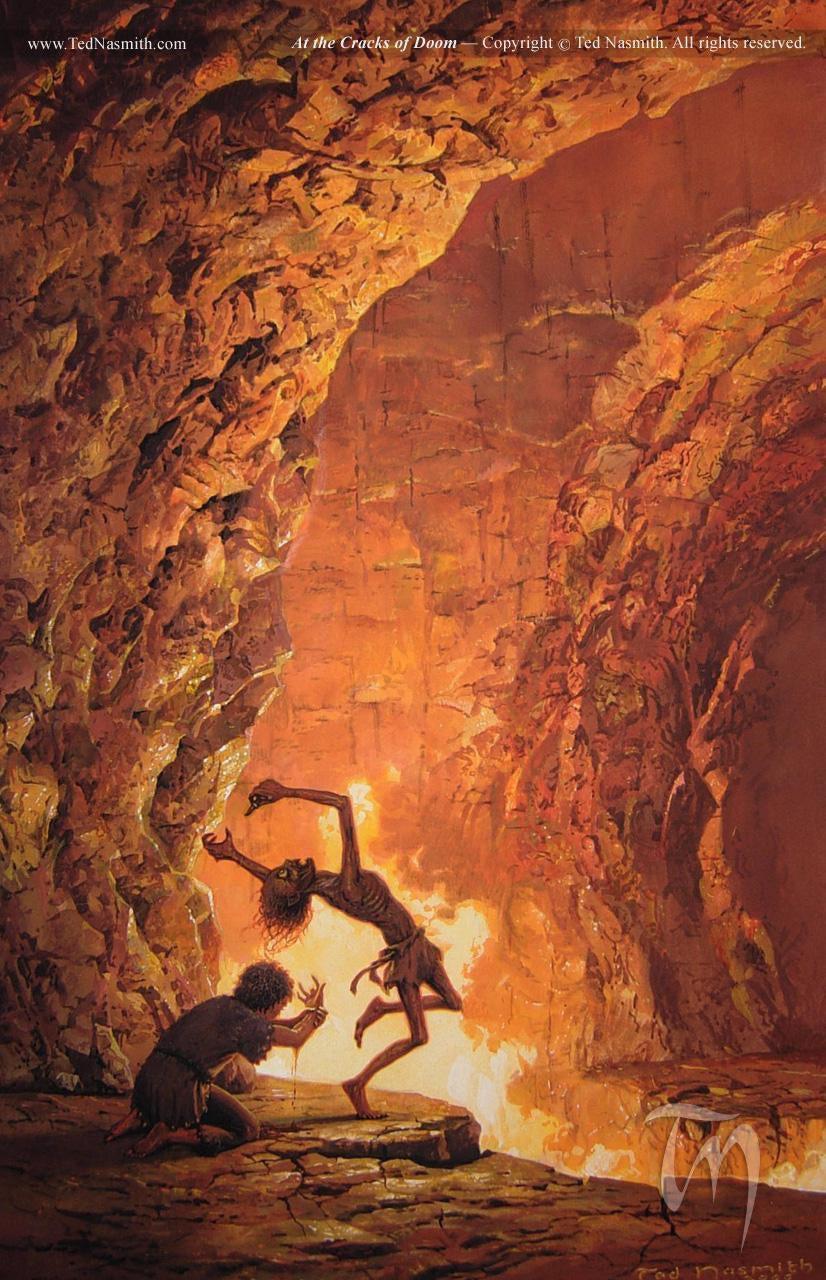
Consider the Ring itself:  forged in the fires of Mt Doom, it is eventually returned there and destroyed,
(another Ted Nasmith)

which causes the final end of Sauron, after several ages of struggle,

(and one more Ted Nasmith–and who better to paint a cataclysm?)

and which, in turn, brings the—return of the King.

(Denis Gordeev–and note that the artist has painted Aragorn’s crown as depicted by Tolkien in a letter to Rhona Beare, 14 October, 1958, see Letters, 401.)

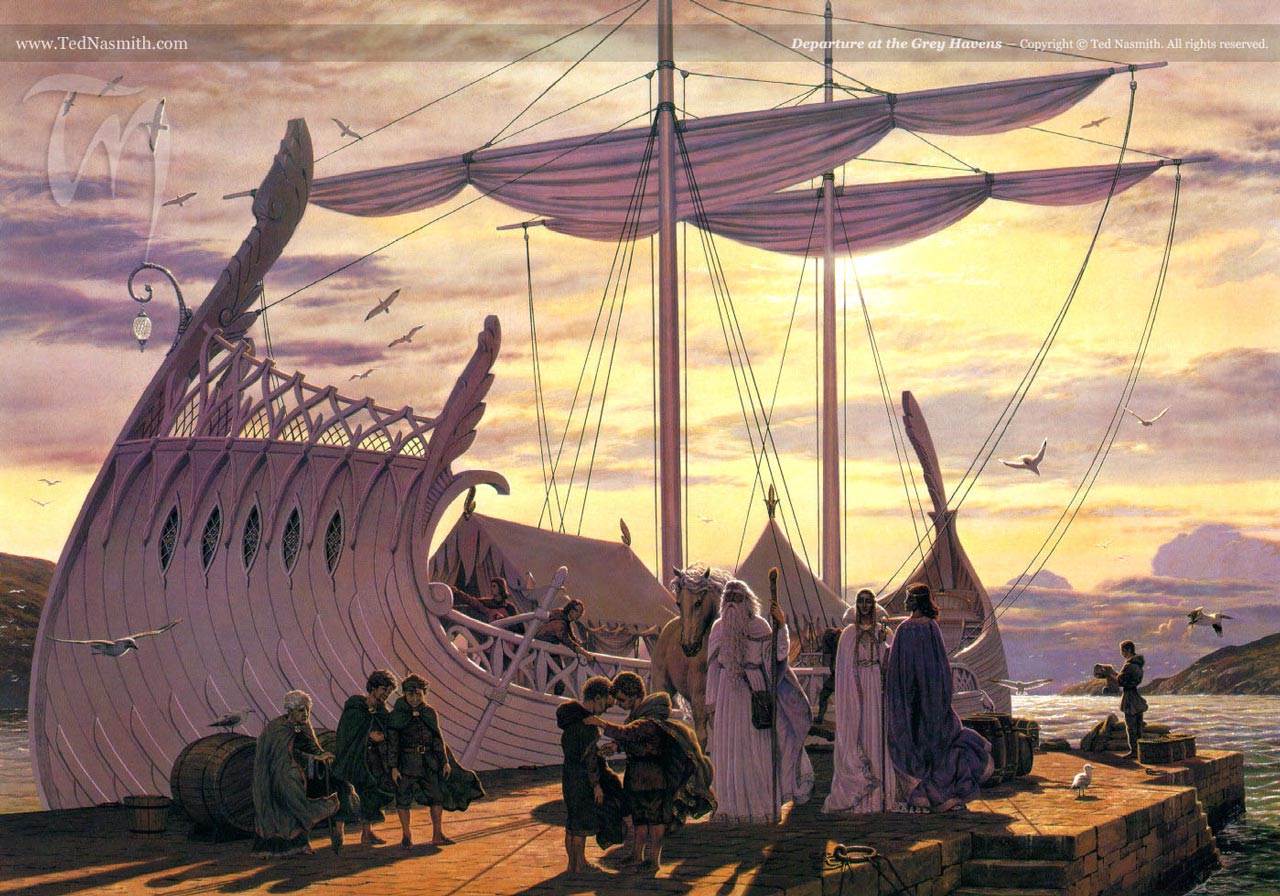
After thinking about this, I can see that there are even more cyclic events, like the movement of the elves westwards, and  Gandalf traveling the same way, originally sent eastwards to oppose Sauron,
(one more Ted Nasmith)

but I think that this is enough for one posting—though considering all of the cycles I’ve already identified,  I’ll end with another (supposed) quotation from Yogi Berra:

Thanks, as always, for reading.

Stay well,

Remember one more piece of Yogi wisdom

And remember, as well, that there’s always

MTCIDC

O

Swords Drawn

02 Wednesday Jul 2025

Posted by Ollamh in Uncategorized

≈ Leave a comment

Tags

Anduril, arthur-hughes, bent-swords, Fafnir, George Macdonald, Glamdring, Goblins, great-goblin, Howard Pyle, King Edward's Horse, NC Wyeth, Orcrist, Scimitar, Sigurd, Sigurd Portal, swords, The Hobbit, Tolkien, William Morris

Welcome, dear readers, as always.

Every time I read or teach The Hobbit, I come to this passage:

“There in the shadows on a large flat stone sat a tremendous goblin with a huge head, and armed goblins were standing round him carrying the axes and the bent swords which they use.”  (The Hobbit, Chapter 4, “Over Hill and Under Hill”)

and I wonder: what does Tolkien mean by “bent swords”?

As a medievalist, and as someone who grew up in the world of illustrators like Howard Pyle (1853-1911)

and NC Wyeth (1882-1945),

as well as an avid reader of the stories of William Morris (1834-1896),

it’s not surprising that Tolkien’s works so often include swords, although perhaps the first sword he met may have been in Andrew Lang’s (1844-1912) The Red Fairy Book, 1890, where, in the last chapter, he would have found Sigurd and a, to us, strangely-familiar sword—

“ONCE upon a time there was a King in the North who had won many wars, but now he was old. Yet he took a new wife, and then another Prince, who wanted to have married her, came up against him with a great army. The old King went out and fought bravely, but at last his sword broke, and he was wounded and his men fled. But in the night, when the battle was over, his young wife came out and searched for him among the slain, and at last she found him, and asked whether he might be healed. But he said ‘ No,’ his luck was gone, his sword was broken, and he must die. And he told her that she would have a son, and that son would be a great warrior, and would avenge him on the other King, his enemy. And he bade her keep the broken pieces of the sword, to make a new sword for his son, and that blade should be called Gram.”  (“The Story of Sigurd”, 357  If you don’t have your own copy of Lang’s collection, here it is for you:  https://archive.org/details/redfairybook00langiala/redfairybook00langiala/mode/2up courtesy of the invaluable Internet Archive.  If  you don’t know this source, and you enjoy this blog, you should check it out.  It has the most remarkable things, even including a very good selection of silent films and film classics, like Kurosawa’s “The Seven Samurai”, 1954, which, for me—and for George Lucas—is a model for adventure films and you can see it here for free:  https://archive.org/details/seven-samurai-1954_202402 )

Yes, “the sword that was broken”—Anduril—and Sigurd has it reforged—and uses it to kill Fafnir, the dragon.

(This is from the “Sigurd Portal” of a  lost stave—wooden—church from Hylestad, in Norway, dating c1200AD.  Fortunately, the doorway carvings were saved and they show in detail the story of Sigurd.  Here’s where you can read more:  https://sites.pitt.edu/~dash/sigurddoor.html#location and here:  https://en.wikipedia.org/wiki/Hylestad_stave_church )

In his own life, Tolkien would have been personally familiar with swords.  When he was a member, briefly, of King Edward’s Horse,

in 1912, he would have been issued with this, the Pattern 1908 cavalry sword.

To me, it’s rather a strange weapon, seemingly designed only to stab,

whereas earlier cavalry blades might be used both to stab and to slash (very useful in chasing off enemy infantry)

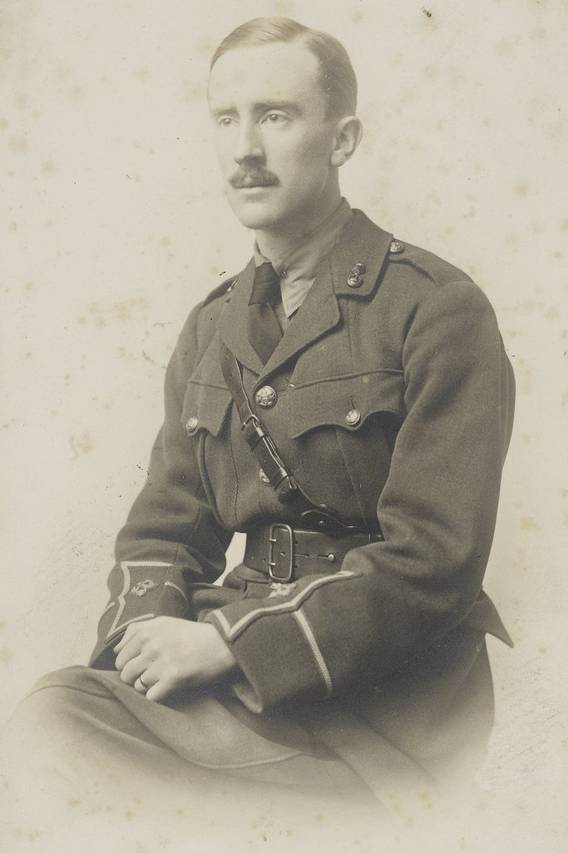
Then, a new 2nd lieutenant in 1915,

JRRT would have had to buy himself the Pattern 1897 infantry officer’s sword

(as there were an increasing number of new officers from families who couldn’t afford it, there was a kind of subscription created to help such officers acquire a required piece of equipment.  For more on just what was required of officers, who had to provide their own kit, see Field Service Manual 1914, pages 16-18, here (and yes, again, it’s from the Internet Archive):  https://archive.org/details/fieldservicemanu00greauoft/page/n11/mode/2up )

These, as you can see, are straight-bladed swords, however.

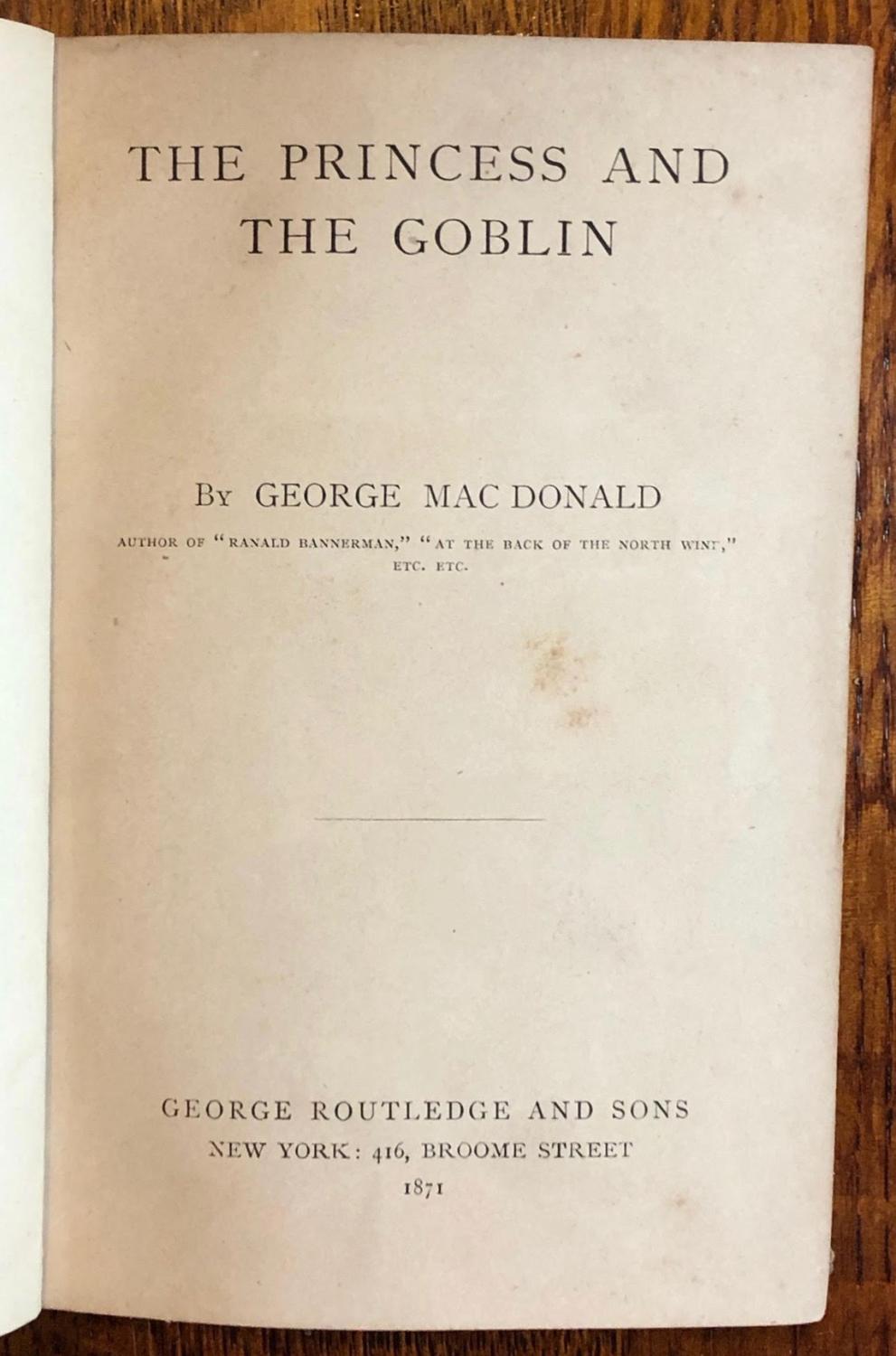
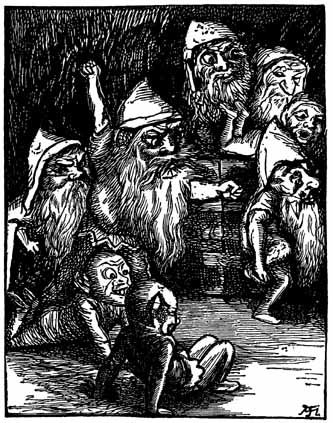
Tolkien’s earliest experience with goblins was probably with George MacDonald’s (1824-1905) The Princess and the Goblin (1871/2), and he likens his own later goblins/orcs to them (see Letters, 267, 279).

The illustrations are by Arthur Hughes (1832-1915) and, as far as I can see, there’s not a bent sword among them  (If you don’t know the story, here’s the text, but without its original illustrations, alas: https://www.gutenberg.org/cache/epub/708/pg708-images.html )

If we try some Tolkien goblin illustrators, we find Justin Gerard’s version of the scene with the Great Goblin, where there are a few pole arms off to the left, but the only sword must be Orcrist.

(Justin Gerard—you can see more of his work here:  https://www.artstation.com/justingerardillustration and here:  https://www.justingerard.com/the-art-of-justin-gerard )

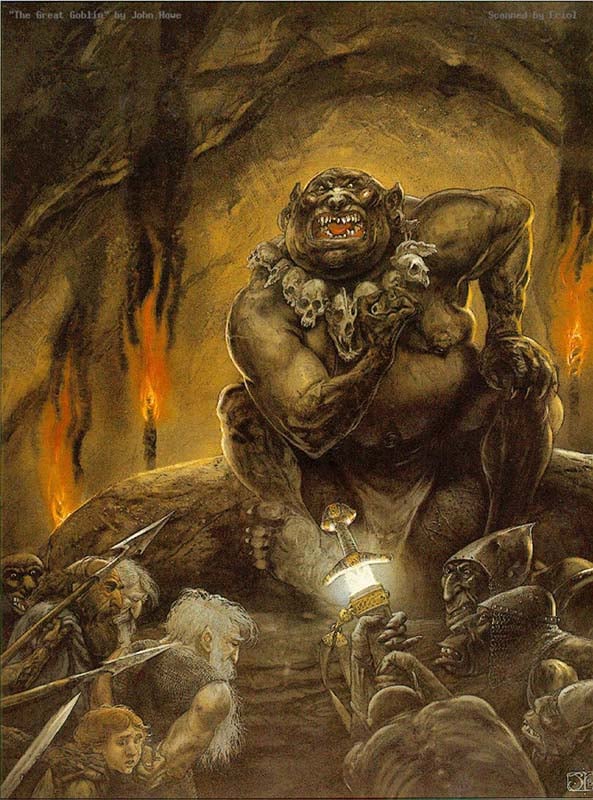
Here’s John Howe’s version of the scene—

with Orcrist peeking out of its scabbard and a straight sword and a couple of spears off to the left.

Then there’s Alan Lee’s, with the seemingly inevitable Orcrist, but with, just below it, perhaps a sabre—a curved sword

and we see this again in Lee’s depiction of Bilbo’s encounter with the goblin door guards.

In Michael Hague’s illustration for the escape from the Great Goblin’s throne room,

we see both Orcrist and Glamdring, along with one more seemingly curved sword.

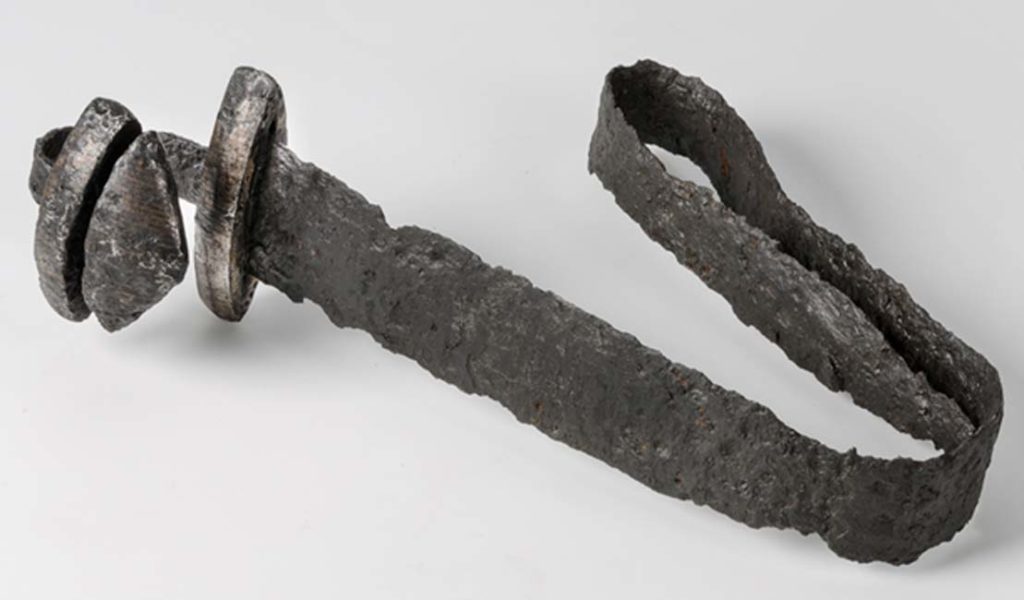
Are any of these, however, an example of a “bent sword”?  Archaeologists have discovered numerous ancient swords which appear to have been “sacrificed” by being bent–

but this is hardly what Tolkien meant.  Then there is what might be taken literally for a “bent sword”—

from Jackson’s The Lord of the Rings, but I must say, this looks pretty improbable as a sword—if you see how the grip is shaped, that spike at the end if pointing upwards:  what could it possibly be for?  In fact, when one sees a chart of swords from the films, I’m not sure about many of them as useful weapons—

Those to the left share patterns with swords from our Middle-earth, both those on the right look like they might be dramatic over a fireplace, but I’d question their use as practical weapons.

So what might this “bent sword” be?  Some of the swords in the illustrations above would suggest that their artists believed that, by “bent”, Tolkien meant “curved”.  One possibility:  we know that Tolkien had read or had read to him at least one of Andrew Lang’s fairy books (the Red Fairy Book, as mentioned above), but perhaps he had also seen Lang’s Arabian Nights Entertainments (1898) in which there are a number of illustrations with scimitars in them—

(Here’s a copy of the book for you:  https://archive.org/details/arabiannightsent00lang/page/n9/mode/2up )

Scimitars are curved and, barring silly ones like those in Disney’s Aladdin—which look more like something used for carving meat–

are both deadly and would seem very exotic, if not alien,

in contrast to very medieval swords like Orcrist and Glamdring.

I doubt that we’ll ever know exactly what JRRT had in mind, but, if I had to illustrate “armed goblins…carrying axes and the bent swords…” I might consider drawing—in both senses—such blades.

Stay well,

Avoid inviting caves, even if Stone Giants are playing dodge ball outside,

And remember that, as always, there’s

MTCIDC

O

PS

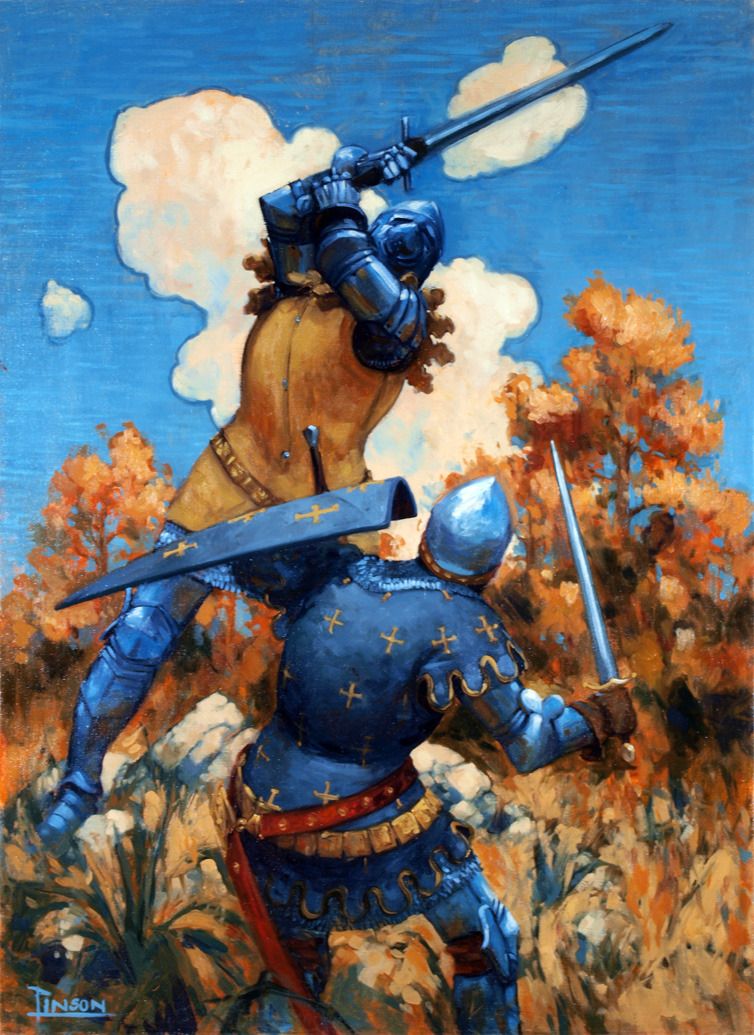
I’ve just discovered a contemporary illustrator who clearly enjoys the dramatic style of artists like Pyle and Wyeth, as well as French historical artists, like Meissonier (1815-1891).  This is Ugo Pinson (1987-) and here is a sample of his work.

He has illustrated book covers as well as several graphic novels and done illustrations for the “Witcher” series.  His sketches alone show his skill and talent.  You can see more samples here:  https://duckduckgo.com/?q=ugo+pinson&iar=images&iai=http%3A%2F%2Fbdzoom.com%2Fwp-content%2Fuploads%2F2016%2F07%2F13427953_10154226704759687_4371726455862878086_n.jpg 

A Tale of Two Swords

19 Wednesday Jun 2019

Posted by Ollamh in Fairy Tales and Myths, Imaginary History, Military History

≈ Leave a comment

Tags

Charles X, Crusades, Excalibur, French Revolution, Gesta Henrici II et Gesta Regis Ricardi, Glastonbury, King Arthur, King Tancred, Lady of the Lake, Lecce, Lionheart, Louis IX, Louis Philipe, Louis XIV, Louis XV, Louis XVI, Louis XVIII, Medieval, mosaic, Napoleon, Norman, Otranto, Rex Arturus, Richard I of England, Roger of Howden, swords, Third Crusade

So we were reading this really interesting book, Christopher Tyerman’sngcce How to Plan a Crusade, when, on pages 244-5, we came across this:  “While Louis prayed to the relics of the Passion, Richard had carried the sword Excalibur.”  And we said, “What?  Excalibur?”

Welcome, as always, dear readers.  In this post, we want to talk a bit about two historic—or mythical– swords, inspired, as we were, by that reference and by two kings involved with them.

The “Louis” in the passage above is Louis IX (1214-1270) of France,

image1sealoflouisix.jpg

aka St Louis, a saint of both the Catholic and Anglican churches, who led several crusades in the mid-13th century, but not very successfully, being taken prisoner during the first (1250) and dying of a fever during the second (1270).

The “Richard” is Richard I of England (1157-1199), also called “Lionheart”.

image2rich.jpg

He was also a crusader, having been one of the dominant figures in the earlier Third Crusade (1189-1192).

image3crus.jpg

But how do we know that Richard had “Excalibur”?  And how did he acquire it?

We begin with the passage from a contemporary of Richard’s, Roger of Howden (?-1201?), who has left us a history known as Gesta Henrici II et Gesta Regis Ricardi, “The Deeds/Acts of Henry II and the Deeds/Acts of King Richard”.  This begins in the 8th century and covers the period up to 1201, which is presumed to be the year of Roger’s death.  Roger went on the Third Crusade with Richard, although he left it early.  He either observed or heard about this event, which took place in 1191:

“Et contra rex Angliae dedit regi Tancredo gladium illum optimum quem Britones Caliburne[m?] vocant qui fuerat gladius Arthuri quondam nobilis regis Angliae.”

“And, in return, the King of England gave to King Tancred that best of swords, which the Britons call ‘Calibern’, which had been the sword of Arthur, the one-time noble king of England.”

(The Latin text comes from page 392 of a collection of earlier English historians, entitled “Rerum Anglicarum Scriptores Post Bedam Praecipui”,–something like, “Writers of/on English Affairs in Particular After Bede”–which was published in London in 1596).

“King Tancred” (1138-1194) was the Norman ruler of Sicily from 1189-1194, just when Richard and his fellow Crusaders had reached that part of the world on their way eastward.

image4tanc.jpg

Tancred gave Richard a number of ships to help with transport and we might suppose that this was part of a reciprocal process.  Remarkably for this early time, we have what appears to be concrete evidence not only that King Arthur was a well-known figure in southern Italy, but perhaps known to Tancred himself.

Tancred had been born in 1138 in Lecce (on the right-hand side of the map, just inland)

image5map.jpg

and just a few miles south is Otranto, with its cathedral (below Lecce on the map).

image6otrantocathedral.jpg

The main floor of that cathedral is covered by an enormous mosaic, installed between 1163 and 1165.

image7mosaic.jpg

image8mosaic.jpg

In that mosaic is a figure labeled “Rex Arturus”.

image9rexarturus.jpg

We’ve answered our first question, sort of:  “How do we know that Richard had Excalibur?”  But, again, how did he acquire it?  Unfortunately, the only reference to Richard and the sword is the one we’ve quoted.

One thought, however.  About 1191, the monks of Glastonbury Abbey

image10glastonbury.jpg

excavated a grave which

image11tombsite.jpg

supposedly included a lead cross which read:

“Hic jacet sepultus inclytus rex Arthurius in insula avallonia cum Wennevereia uxore sua secunda”

“Here lies buried the renowned king Arthurius on the Avalonian island with Guinevere his second wife”

(Latin text from Giraldus Cambrensis, Speculum Ecclesiae, Chapter IX.)

Giraldus himself had been shown this cross by the Abbot, as he tells us.  (For a more complete version of this story, in an English translation, please see this LINK.)

Modern research suggests that this was a fake, intended to boost the fortunes of a fading religious site, badly damaged by fire in 1184, but suppose that, to increase their patronage, the monks had added another level to their sham and “found” a sword, which they had then sent to Richard, who carried it off on his journey to the East.

(For more on the fakery, see, for example, this LINK.)

Louis IX, as we mentioned, died on campaign in 1270.  His son, Philip, was with him at the time, but sailed back to France after his father’s death and was crowned Philip III in 1271.  Our sources are vague here (they don’t always get the year right, for example), but all report that, for the first time, a special sword was used in the coronation ceremony.  This was the so-called “sword of Charlemagne”, named “Joyeuse” (the “happy one”), which is mentioned in the 11th-century Chanson de Roland:

“Si ad vestut sun blanc osberc sasfret,
Laciet sun elme, ki est a or gemmet,
Ceinte Joiuse, unches ne fut sa per,
Ki cascun jur muet.XXX. clartez.”

“[Charlemagne] was wearing his fine white coat of mail and his helmet with gold-studded stones; by his side hung Joyeuse, and never was there a sword to match it; its colour changed thirty times a day.”

(The translator for this was not identified at the site and we would make one small change—“clartez” might be better as “sheen/brightness” instead of “colour”.)

image12sword.jpg

This, one of the few remaining pieces of the royal regalia, is, in fact, a mixture of a number of different periods, all the way up to Charles X (reigned 1824-1830), and experts argue over whether it is actually possible to date any part of it as early as Charlemagne’s time (see this LINK for more).

What isn’t questioned is that some version of this sword, at least, was used as part of the crowning ritual of French kings for centuries and its association with Charlemagne was as important for French history as linking something to King Arthur for English.

We haven’t managed to locate any medieval manuscript illustration which depicts a French coronation with the sword in place, but, when it comes to “The Sun King”, that is, Louis XIV, you can see that’s its hanging from his left side.

image13louisxiv.jpg

The same is true for Louis XV

image14louisxv.jpeg

and for that most unwarlike monarch, Louis XVI.

imagexvlouisxvi.jpg

The French Revolution brought the crowning of kings to a halt, of course,

image16execution.jpg

but Napoleon, all too aware both of the past and of his need to establish himself as the legitimate heir to the previous kings, brought it back, as you can see in this really over the top portrait.

image17nappy.jpg

When the younger brothers of the executed Louis XVI, Louis XVIII (1755-1824)

image18louisxviii.jpg

and Charles X (1757-1836)

image19chas.jpg

became king successively in 1814 and 1824, one can still see the sword—although apparently Napoleon’s craftsmen had fiddled with it, as did those of Charles.   His successor, Louis Philipe (1773-1850), who belonged to a cousin branch of the royal family, broke the tradition for good and the sword disappeared into history—and the Louvre, where it’s now on display.

And this brings us back to Excalibur.  The tradition is a little murky, but the medieval sources are pretty clear that Excalibur had come from “The Lady of the Lake” and, as Arthur lay, gravely, perhaps fatally wounded, he commanded one of his knights, Griflet or Bedivere, according to the tradition, to return it to the Lady, which he finally, and very reluctantly, did.

image20lake.jpg

With this, Excalibur disappears from the story—until Richard is reported giving it to the king of Sicily and our story—briefly—begins again.

Thanks, as always, for reading and

MTCIDC

CD

The Doubtful Sea Series Facebook Page

The Doubtful Sea Series Facebook Page

  • Ollamh

Categories

  • Artists and Illustrators
  • Economics in Middle-earth
  • Fairy Tales and Myths
  • Films and Music
  • Games
  • Heroes
  • Imaginary History
  • J.R.R. Tolkien
  • Language
  • Literary History
  • Maps
  • Medieval Russia
  • Military History
  • Military History of Middle-earth
  • Narnia
  • Narrative Methods
  • Poetry
  • Research
  • Star Wars
  • Terra Australis
  • The Rohirrim
  • Theatre and Performance
  • Tolkien
  • Uncategorized
  • Villains
  • Writing as Collaborators
Follow doubtfulsea on WordPress.com

Across the Doubtful Sea

Recent Postings

  • Heffalumps? December 31, 2025
  • We Three Kings December 24, 2025
  • A Moon disfigured December 17, 2025
  • On the Roads Again—Once More December 10, 2025
  • (Not) Crossing Bridges December 3, 2025
  • On the Road(s) Again—Again November 26, 2025
  • On the Road(s) Again November 19, 2025
  • To Bree (Part 2) November 12, 2025
  • To Bree (Part 1) November 5, 2025

Blog Statistics

  • 103,987 Views

Posting Archive

  • December 2025 (5)
  • November 2025 (4)
  • October 2025 (5)
  • September 2025 (4)
  • August 2025 (4)
  • July 2025 (5)
  • June 2025 (4)
  • May 2025 (4)
  • April 2025 (5)
  • March 2025 (4)
  • February 2025 (4)
  • January 2025 (5)
  • December 2024 (4)
  • November 2024 (4)
  • October 2024 (5)
  • September 2024 (4)
  • August 2024 (4)
  • July 2024 (5)
  • June 2024 (4)
  • May 2024 (5)
  • April 2024 (4)
  • March 2024 (4)
  • February 2024 (4)
  • January 2024 (5)
  • December 2023 (4)
  • November 2023 (5)
  • October 2023 (4)
  • September 2023 (4)
  • August 2023 (5)
  • July 2023 (4)
  • June 2023 (4)
  • May 2023 (5)
  • April 2023 (4)
  • March 2023 (5)
  • February 2023 (4)
  • January 2023 (4)
  • December 2022 (4)
  • November 2022 (5)
  • October 2022 (4)
  • September 2022 (4)
  • August 2022 (5)
  • July 2022 (4)
  • June 2022 (5)
  • May 2022 (4)
  • April 2022 (4)
  • March 2022 (5)
  • February 2022 (4)
  • January 2022 (4)
  • December 2021 (5)
  • November 2021 (4)
  • October 2021 (4)
  • September 2021 (5)
  • August 2021 (4)
  • July 2021 (4)
  • June 2021 (5)
  • May 2021 (4)
  • April 2021 (4)
  • March 2021 (5)
  • February 2021 (4)
  • January 2021 (4)
  • December 2020 (5)
  • November 2020 (4)
  • October 2020 (4)
  • September 2020 (5)
  • August 2020 (4)
  • July 2020 (5)
  • June 2020 (4)
  • May 2020 (4)
  • April 2020 (5)
  • March 2020 (4)
  • February 2020 (4)
  • January 2020 (6)
  • December 2019 (4)
  • November 2019 (4)
  • October 2019 (5)
  • September 2019 (4)
  • August 2019 (4)
  • July 2019 (5)
  • June 2019 (4)
  • May 2019 (5)
  • April 2019 (4)
  • March 2019 (4)
  • February 2019 (4)
  • January 2019 (5)
  • December 2018 (4)
  • November 2018 (4)
  • October 2018 (5)
  • September 2018 (4)
  • August 2018 (5)
  • July 2018 (4)
  • June 2018 (4)
  • May 2018 (5)
  • April 2018 (4)
  • March 2018 (4)
  • February 2018 (4)
  • January 2018 (5)
  • December 2017 (4)
  • November 2017 (4)
  • October 2017 (4)
  • September 2017 (4)
  • August 2017 (5)
  • July 2017 (4)
  • June 2017 (4)
  • May 2017 (5)
  • April 2017 (4)
  • March 2017 (5)
  • February 2017 (4)
  • January 2017 (4)
  • December 2016 (4)
  • November 2016 (5)
  • October 2016 (6)
  • September 2016 (5)
  • August 2016 (5)
  • July 2016 (5)
  • June 2016 (5)
  • May 2016 (4)
  • April 2016 (4)
  • March 2016 (5)
  • February 2016 (4)
  • January 2016 (4)
  • December 2015 (5)
  • November 2015 (5)
  • October 2015 (4)
  • September 2015 (5)
  • August 2015 (4)
  • July 2015 (5)
  • June 2015 (5)
  • May 2015 (4)
  • April 2015 (3)
  • March 2015 (4)
  • February 2015 (4)
  • January 2015 (4)
  • December 2014 (5)
  • November 2014 (4)
  • October 2014 (6)
  • September 2014 (1)

Blog at WordPress.com.

  • Subscribe Subscribed
    • doubtfulsea
    • Join 78 other subscribers
    • Already have a WordPress.com account? Log in now.
    • doubtfulsea
    • Subscribe Subscribed
    • Sign up
    • Log in
    • Report this content
    • View site in Reader
    • Manage subscriptions
    • Collapse this bar
 

Loading Comments...