Tags
Cruella de Vil, Ebenezer Balfour, Gollum, Jafar, Prince John, Robin Hood, Sauron, Sheriff of Nottingham, Villains
Dear Readers,
Welcome!
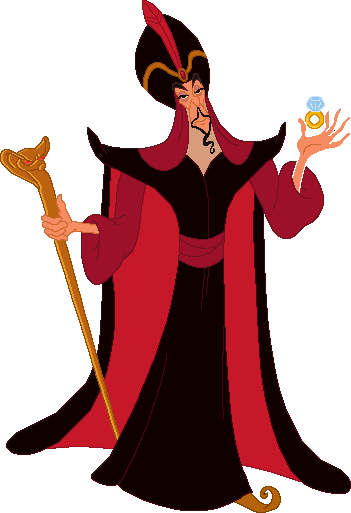
Is an adventure possible without a villain? Not an “antagonist”—that’s for serious essays on subjects like “the nature of evil”—but someone tall and devious, like Jafar
or stumpy and seedy like Uncle Ebenezer in Kidnapped

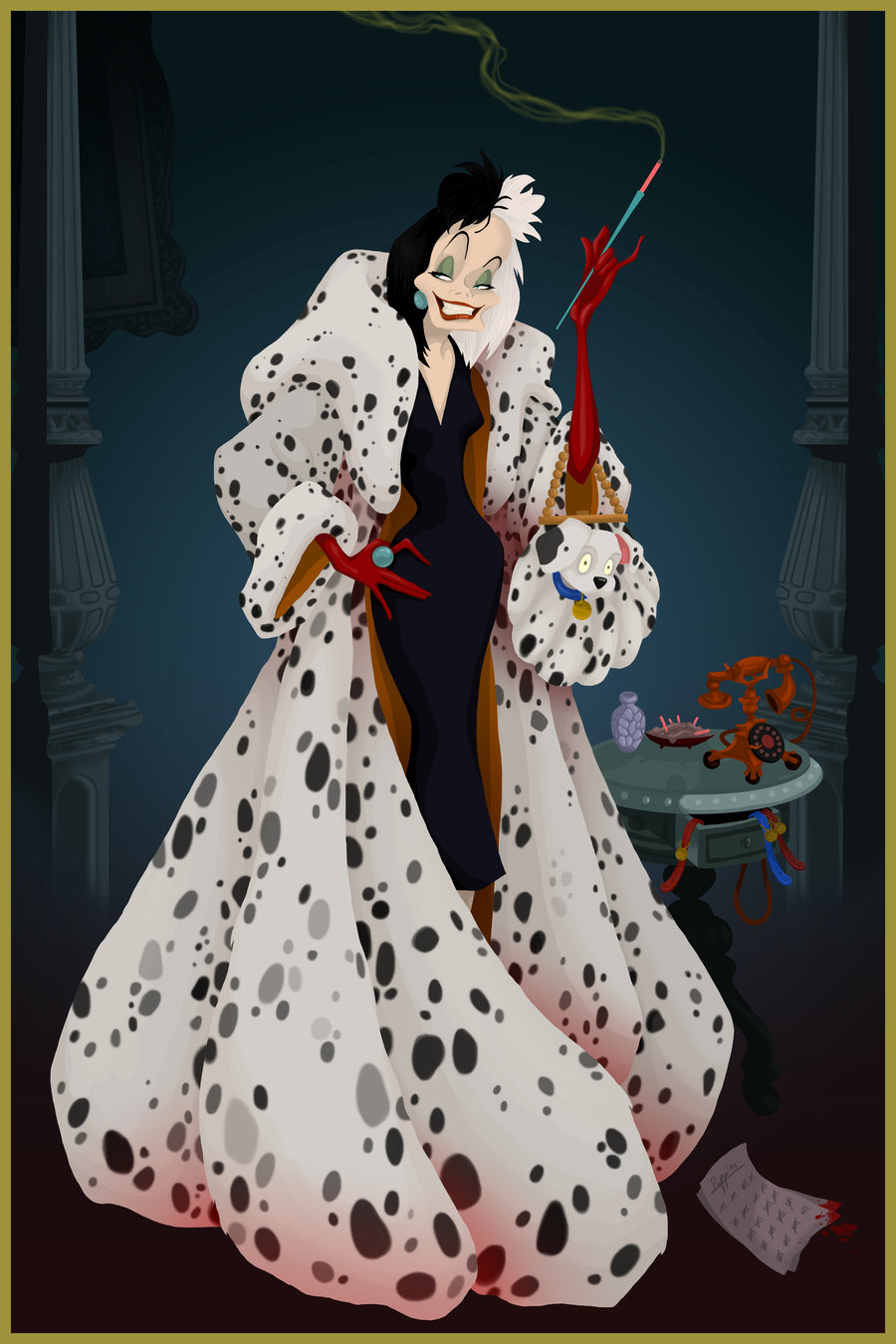
or skinny and smoky, like Cruella de Vil.
Whatever the figure, on the one hand, he/she provides the kind of friction which can set a story in motion and keep it there. On the other, villains can add a certain stature to a story. When the villain is an oaf, the story is in danger of being, or becoming, oafish. The Hobbit with only the stone trolls,

for example, would quickly become something out of Monty Python’s gumbies, at best.

An ancient and smooth-talking dragon makes the story bigger and gives it more weight.

(To see how a quiet and amiable dragon affects a story, see Kenneth Grahame’s “The Reluctant Dragon” from Dream Days (1898—available for free at Gutenberg)

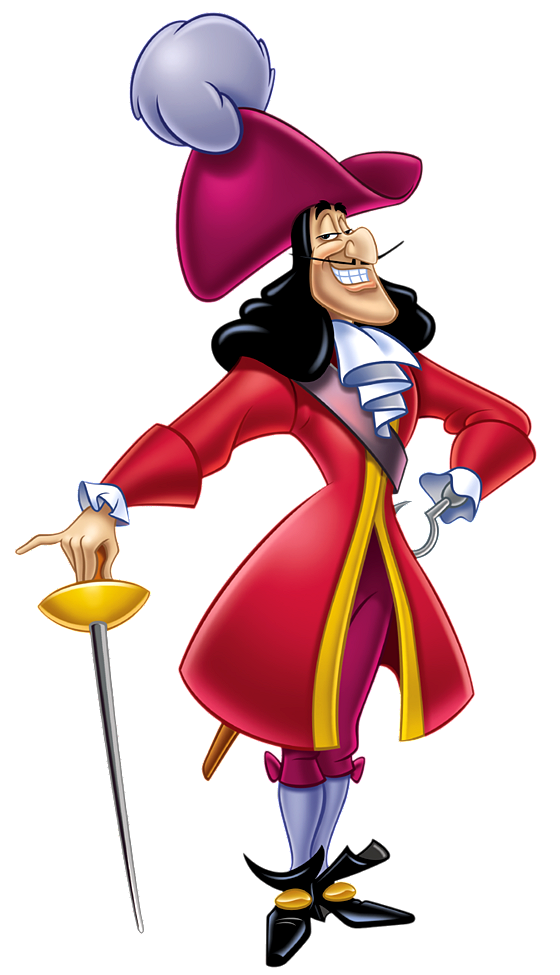
An elegant villain can make a story more elegant, as Captain Hook would insist.
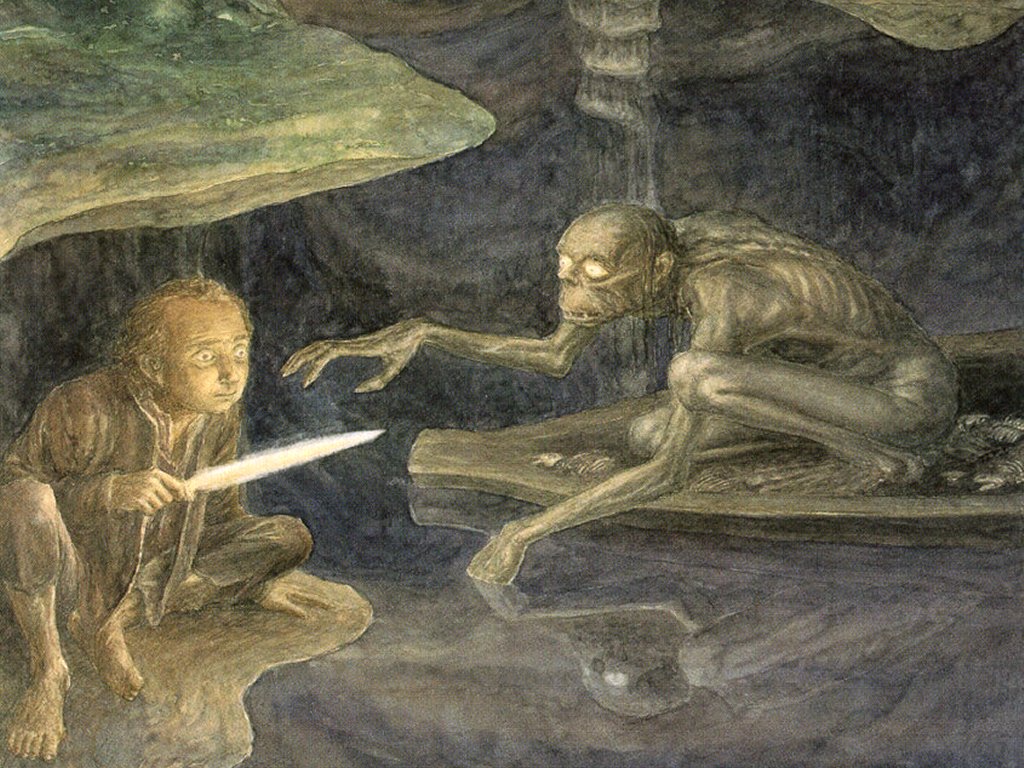
As a way of testing this premise, imagine a Lord of the Rings in which the main villain is Gollum. It might be entertaining, but how much smaller the drama than that which we see as grand, in part because of the size and menace of the villain.
(A note: while we have shown you the various villains we’ve mentioned so far, when it comes to Sauron, we’re stuck. We know that he is embodied in some form and that he was once “comely” (that is, good to look at) and he was of a size to fight Gil-Galad & Co., but, otherwise, it’s hard to know quite what to show: certainly not the searchlight from the Jackson films. His and his writers’ difficulty is obvious: how do you make what, in the books, is more a kind of watching, brooding evil feeling than a form (with the exception of that eye) into something visible? We don’t believe, however, that their choice was successful, but, in fact, diminished the menace. We intend to discuss further the idea of “the invisible villain”, however, in a further part of this series.)
What adds to the power of a villain is a certain primal nature: this is someone driven to be who he/she is because of what she/he wants—and the converse is true: what he/she wants can define who he/she is. What is Cruella, for instance, apart from her lust for a fur coat made from Dalmatians?
In the case of Robin Hood, even if we had never heard him say a word, we would know what Prince John wants—that word “Prince” might serve as giveaway. He wants to be King John.

It perfectly suits his ambitions that his brother, Richard, the real king of England, is being held for ransom in Austria. It’s even an opportunity to look pious—you’re rescuing your brother with that huge sum of money—when, in reality, you’re simply increasing your own revenues. And your chief collector (in the tradition), the Sheriff of Nottingham, is thus nothing but a function in the story of John: the actual hand in the people’s purse, but he’s doing it for the sake of his master.
(Here’s the Sheriff—both images from the classic Errol Flynn 1938 The Adventures of Robin Hood.)

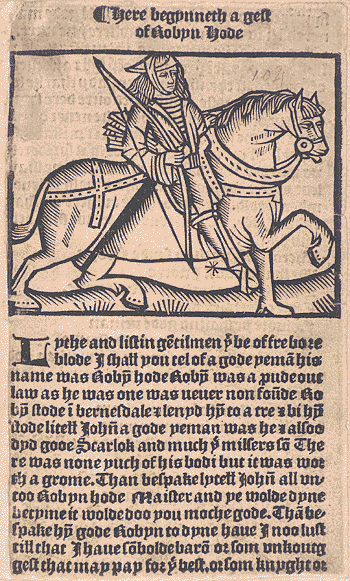
As long as Richard doesn’t return, there will be John (and his—quite literal—extension, the Sheriff). And thus he is what we might call an open-ended villain, someone who can be employed again and again to apply the friction. This fits perfectly with his role in the Robin Hood stories as, unlike a novel, with its elaborate built-in sense and need of resolution brought about by the author, the original Robin Hood stories were folktales and folksongs—brief, their initial goal a short narrative from set-up to resolution. Villains here could be reused, their resolution not necessarily requiring their complete destruction. This can also have the side benefit of allowing singers/tellers to give villains a sense of depth from the number of experiences (usually very bad ones!) with the hero they have. The urge towards development of this sort, both for villain and hero, might, in fact, be a reason for A Gest of Robyn Hode, a collection of Robin Hood stories roughly made into one long tale and printed somewhere between 1492 and 1534. (For more, see the useful Wiki site.)
The opposite of a character like Prince John would be what we might call a terminal villain. He/she appears and the story’s action begins. With his/her disappearance, the story, effectively, ends, even if there’s a coda: once Darth Vader/Anakin tosses the Emperor over the railing, what’s left but funerals, ghostly reunions, and fireworks? And, even if you clone the Emperor for a rematch, the original has been eliminated and his complex and long-developing relationship with his star pupil, Vader, has been resolved.
This is, of course, only the beginning of our discussion of villains. Next, we want to ask, faintly echoing Freud, “What do villains want?”
Thanks, as ever, for reading and, as always, we welcome questions and comments!
MTCIDC
CD
 doubtfulsea