Tags
Claudius, ear, Fantasy, Gandalf, Grima, Hamlet, henbane, lotr, Palantir, poison, Saruman, Theoden, Tolkien
Welcome, dear readers, as always.
No matter how often I read or see the play, I’m always struck by how multifacted Hamlet is—a revenge tragedy, a murder mystery, a psychological study, a ghost story, all in one (and probably more than this list besides). Tolkien was not a big fan of reading Shakespeare, but, seeing a performance in 1944, he wrote to his son, Christopher: “Plain news is on the airgraph [a form of letter photographed onto microfilm, shipped, then printed out at its destination—called “V-Mail” in the US—a useful background: https://rarehistoricalphotos.com/v-mail-photos/ ]; but the only event worth of talk was the performance of Hamlet which I had been to just before I wrote last. I was full of it then…It was a very good performance, with a young rather fierce Hamlet; it was played fast without cuts; and it came out as a very exciting play.” (letter to Christopher Tolkien, 28 July, 1944, Letters, 126)
That ghost story is the explanation for the murder mystery, the victim being Hamlet’s father, Hamlet Senior, and the murderer being his brother, Claudius, the ghost telling Hamlet:
“Sleeping within my orchard,
My custom always of the afternoon,
Upon my secure hour, thy uncle stole
With juice of cursèd hebona in a vial,
And in the porches of my ears did pour
The lep’rous distillment, whose effect
Holds such an enmity with blood of man
That swift as quicksilver it courses through
The natural gates and alleys of the body,
And with a sudden vigor it doth possess
And curd like eager droppings into milk
The thin and wholesome blood; so did it mine,
And a most instant tetter barked about
Most lazarlike with vile and loathsome crust
All my smooth body.” (Hamlet, Act 1, Scene 5 from the 2nd Quarto, 1604—this is from my go-to Shakespeare internet site, which you can visit here: https://internetshakespeare.uvic.ca/doc/Ham_Q2/scene/index.html )

“Hebona” has been argued about for years, some scholars, seeing what appears to be a linguistic similarity with “henbane”,

have suggested that, as the poison, and, seeing its effects, I’m not surprised:
“As a result of this distinct chemical and pharmacological profile, overdoses can result not only in delirium, but also severe anticholinergic syndrome, coma, respiratory paralysis, and death.” (see: https://en.wikipedia.org/wiki/Toxidrome#Anticholinergic for lots more distressing symptoms on the way to the end—although some of the above description doesn’t appear to be present in such poisoning—“tetter” means a kind of skin eruption, which is why Hamlet Sr. uses“lazarlike”, meaning “leprous”. For more on other possible poisons, see: https://en.wikipedia.org/wiki/Hebenon And for more on Shakespeare’s drugs, see: https://www.bbc.com/future/article/20140416-do-shakespeares-poisons-work )
One can see why Uncle Claudius uses the method he does: he’s assuming that, if all the poison is absorbed, there will be no outside traces, which is why Hamlet Senior says, “’Tis given out that, sleeping in my orchard/A serpent stung me” (although, given the usual nature of bites, one might have thought that someone would have checked for a snake bite wound, suggesting that Claudius was already prepared with a quick explanation for what had happened to his brother—“it is given out” sounds like palace propaganda, doesn’t it?).

Hamlet’s father is poisoned through the ear with an actual toxic substance, whatever it was, and that supposedly left no trace of the crime, but, in Tolkien’s own work, we see another ear poison, which also leaves no obvious physical trace, being administered by this—
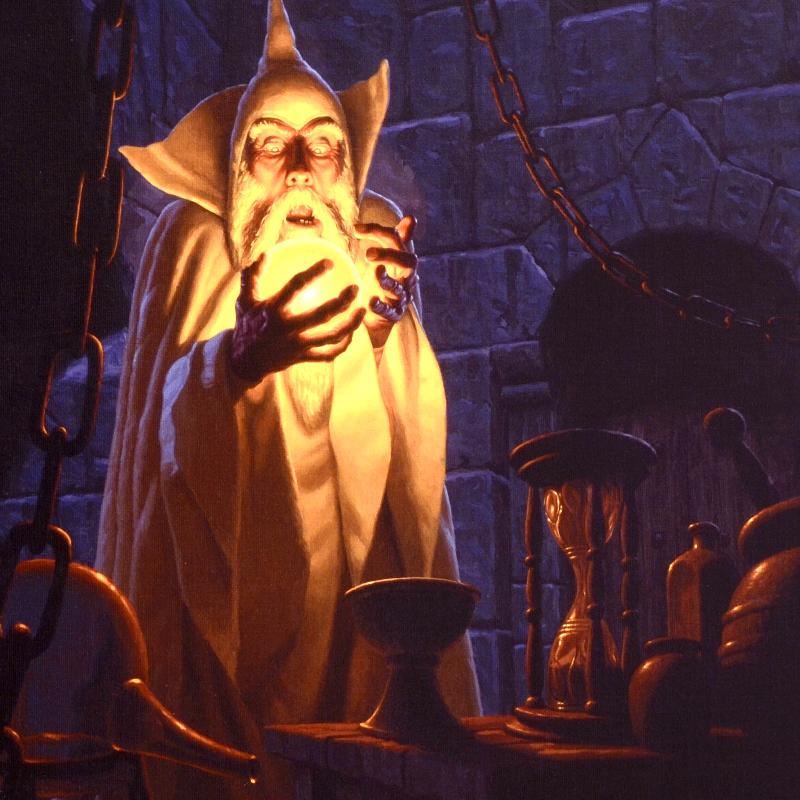
(the Hildebrandts)
but which is just as deadly—spiritually.
We know from Gandalf (and the chapter title) that Saruman has an unusual weapon:
“ ‘What’s the danger?’ asked Pippin. ‘Will he shoot at us, and pour fire out of the windows; or can he put a spell on us from a distance?’
‘The last is most likely, if you ride to his door with a light heart,’ said Gandalf…. ‘And Saruman has powers you do not guess: Beware of his voice!’ “ (The Two Towers, Book Three, Chapter 10, “The Voice of Saruman”)
We then see that voice in operation:
“ ‘But come now,’ said the soft voice. ‘Two at least of you I know by name. Gandalf I know too well to have much hope that he seeks help or counsel here. But you, Theoden Lord of the Mark of Rohan, are declared by your noble devices, and still more by the fair countenance of the House of Eorl. O worthy son of Thengel the Thrice-renowned! Why have you not come before, and as a friend? Much have I desired to see you, mightiest king of western lands, and especially in these latter years, to save you from the unwise and evil counsels that beset you! Is it yet too late? Despite the injuries that have been done to me, in which the men of Rohan, alas! have had some part, still I would save you, and deliver you from the ruin that draws nigh inevitably, if you ride upon this road which you have taken. Indeed I alone can aid you now.’ “
The effect of this upon the Rohirrim is just what Saruman must have hoped for—and it underlines his method of address:
“The Riders stirred at first, murmuring with approval of the words of Saruman; and then they too were silent, as men spell-bound. It seemed to them that Gandalf had never spoken so fair and fittingly to their lord. Rough and proud now seemed all his dealings with Theoden. And over their hearts crept a shadow, the fear of a great danger: the end of the Mark in a darkness to which Gandalf was driving them, while Saruman stood beside a door of escape, holding it half open so that a ray of light came through…”
Saruman has, by:
1. addressing Theoden in a stately way, almost overdoing it with his “Lord”, “noble”, “fair”, “worthy”, “mightiest”, suggesting that he has only the greatest respect for him
2. mentioning the defeat of his ravaging army and the destruction of his mini-Mordor as if they were “wrongs” done to him, rather than the treasonous behavior they actually represented
3. threatening doom awaiting the Mark
4. offering himself as the only savior,
turns himself from the Sauron he aspires to be into the gentle, admiring friend, who, though he has been harmed, is still willing to be that friend—and, in fact, the only friend for Theoden. And, as the Rohirrim are meant to understand, this is all designed to be in contrast to Gandalf, that false savior.
(It’s clear that Saruman has been working to undercut Gandalf’s position in Rohan for some time previously: see Theoden’s original greeting to Gandalf—prompted—and poisoned—by Grima in The Two Towers, Book Three, Chapter 6, “The King of the Golden Hall”.)

(Alan Lee)
Eomer, seeing Theoden silent, hesitating, tries to intervene, only to have that Voice—angered, but quickly controlled, turn everything rightly said against him into the “you do it, too” argument:
“ ‘But my lord of Rohan, am I to be called a murderer, because valiant men have fallen in battle? If you go to war, needlessly, for I did not desire it, then men will be slain. But if I am a murderer on that account, then all the House of Eorl is stained with murder; for they have fought many wars, and assailed many who defied them.’ “
It’s not just Saruman’s voice that one should be wary of–he is so skilled in deception—or so he thinks–that he can try to use such a cheap argument, then turn it around into what is intended to sound like a reasonable proposal:
“ ‘Yet with some they have afterwards made peace, none the worse for being politic. I say, Theoden King: shall we have peace and friendship, you and I? It is ours to command.’ “
And notice how it’s now not “you”, but “we” and “ours”—any attack is being turned into “being politic” and not “you do it, too”, but “we all do it sometimes” and then we make peace and everything is fine.
Theoden’s response is not what Saruman expected, although, because Theoden had remained silent, we can imagine that Saruman was smiling quietly to himself in admiration of his own powers:
“ ‘We will have peace,’ said Theoden at last thickly and with an effort…’Yes, we will have peace,’ he said, now in a clear voice, ‘we will have peace, when you and all your works have perished—and the works of your dark master to whom you would deliver us. You are a liar, Saruman, and a corrupter of men’s hearts…When you hang from a gibbet at your own window for the sport of your own crows, I will have peace with you and Orthanc…Turn elsewhither. But I fear your voice has lost its charm.”
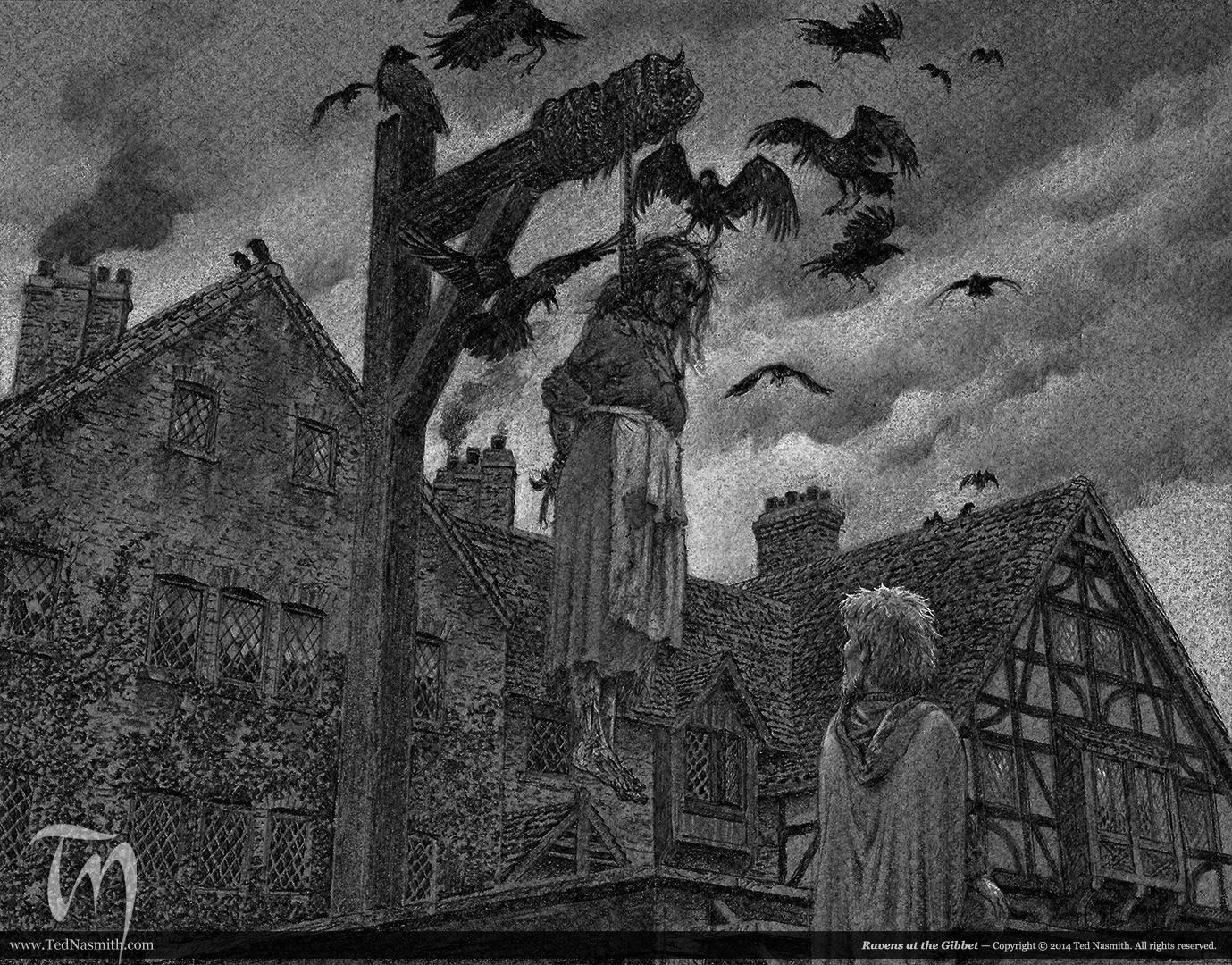
(Ted Nasmith—another side of this excellent artist)
The magic of that voice still lingers for a moment:
“The Riders gazed up at Theoden like men startled out of dream. Harsh as an old raven’s their master’s voice sounded in their ears after the music of Saruman.”
But there is then a change in that music:
“But Saruman for a while was beside himself with wrath. He leaned over the rail as if he would simite the King with his staff. To some suddenly it seemed that they saw a snake coiling itself to strike.”
And Saruman becomes even more serpentine:
“ ‘Gibbets and crows!’ he hissed and they shuddered at the hideous change.’ “
Thwarted, we see him basically reverse his address to Theoden. Where before Theoden was “Lord”, “noble”, “fair”, “worthy”, “mightiest”, now he is “dotard” and his “noble”, “fair” family becomes “the house of Eorl…but a thatched barn where brigands drink in the reek, and their brats roll on the floor among the dogs”.
He isn’t quite finished, however—
“ ‘But you, Gandalf! For you at least I am grieved, feeling for your shame. How comes it that you can endure such company? For you are proud, Gandalf—and not without reason, having a noble mind and eyes that look both deep and far. Even now will you not listen to my counsel?’ “
Theoden’s eventual reply was bitter—and biting—but Gandalf’s reaction is of a different sort altogether—though it still has a sting:
“Gandalf stirred, and looked up. ‘What have you to say that you did not say at our last meeting?’ he asked. ‘Or, perhaps, you have things to unsay?’ “
That last meeting saw Gandalf Saruman’s prisoner on the top of Orthanc–
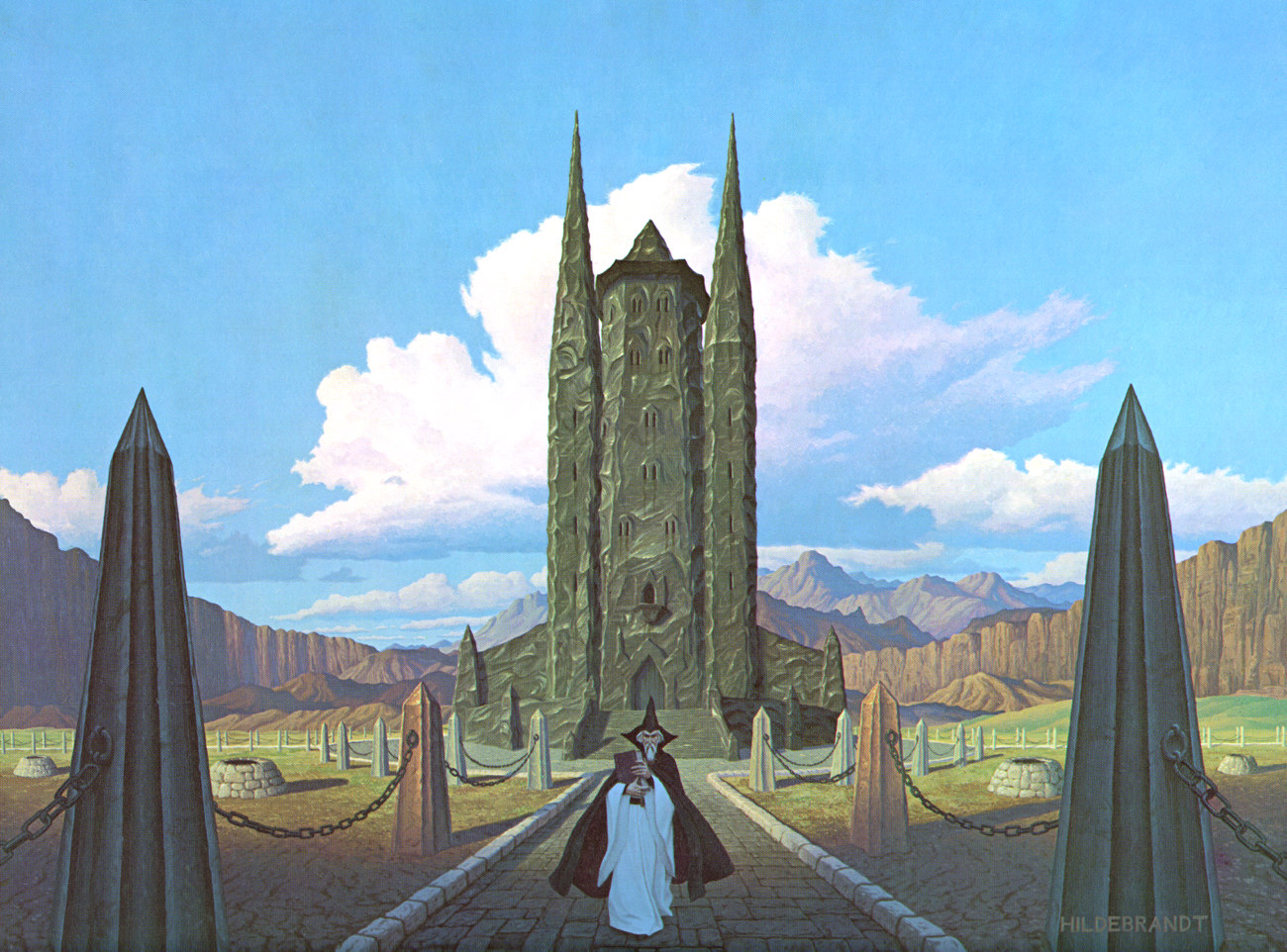
(the Hildebrandts)
but what was it which Saruman said, how was it put, and what or who might lie behind it, will be the subject of Part 2 of this posting.
Thanks for reading, as always.
Stay well,
Remember that line from another Shakespeare play, “All that glisters is not gold”,

And also remember that, as always, there’s
MTCIDC
O
 doubtfulsea