• About

doubtfulsea

~ adventure fantasy

Tag Archives: cannon

Fourth Age—Big Bang Theory

17 Wednesday Feb 2016

Posted by Ollamh in Economics in Middle-earth, Heroes, Imaginary History, J.R.R. Tolkien, Literary History, Military History, Military History of Middle-earth, Narrative Methods

≈ Leave a comment

Tags

American Civil War, Battle of Crecy, Battle of the Somme, cannon, Siege Warfare, The Lord of the Rings, The War of the Ring, Tolkien, World War I

Welcome, dear readers, as always!

In this posting, we are going to do something a little different:  speculate.  It’s about a possible military development in the years after the War of the Ring and, if you have enjoyed our past postings on military issues in Middle Earth, we hope that you will enjoy this one.

Our inspiration for this posting came from two sources:  The Lord of the Rings and the history of the later western Middle Ages and it began like this–

The-Two-Towers-Explosion-helms-deep-2.jpg

“Even as they spoke there came a blare of trumpets.  Then there was a crash and a flash of flame and smoke. The waters of the Deeping-stream poured out hissing and foaming:  they were choked no longer, a gaping hole was blasted in the wall.  A host of dark shapes poured in.” (The Two Towers, Chapter 7, “Helm’s Deep”)

Aragorn calls this “the fire of Orthanc”, but I think that we can guess that it was an explosive device and our immediate thought was the use of mines over the centuries of siege warfare.  Originally, the idea was to undermine an enemy’s wall by digging a tunnel below it.   The next step was either to use the finished tunnel as a passageway into an inner courtyard or, alternatively, to prop up the wall, fill the area below with flammable materials, torch the materials, then clear out to watch the section of wall tumble down when the fire burn away the props before charging in.
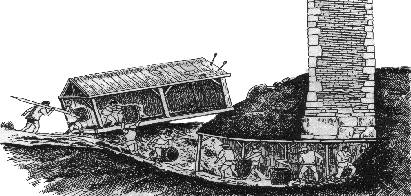
mining1.gif

Once gunpowder was available, this technique could be improved upon by tunneling under a wall, planting a large stock of explosives, setting a very long fuse, clearing out, then watching it blow a large hole in the enemy’s fortification.

Two of the most spectacular such mines in our experience are during the American Civil War, at Petersburg, on 30 July, 1864—
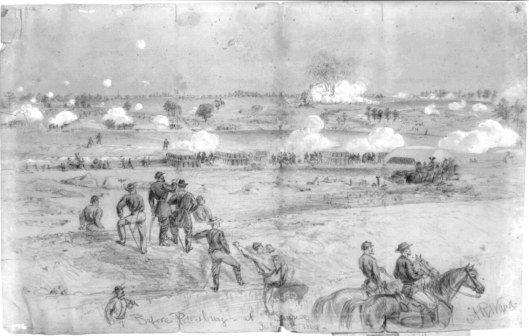
Waud-Petersburg-Crater.jpeg

and the first day of the Somme, 1 July, 1916, in World War 1—
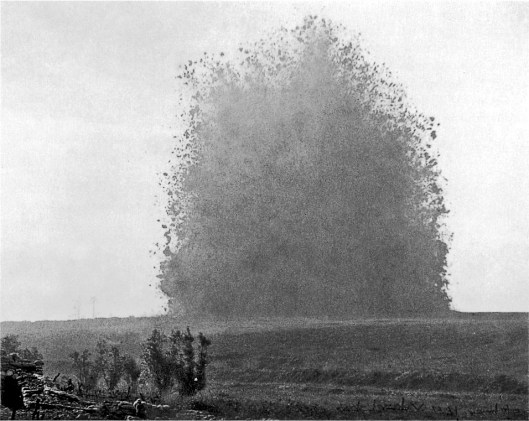
Hawthorn_Ridge_mine_1_July_1916.jpg

Sauron’s orcs appear to use the same technique when facing the protective wall around Gondor, the Rammas Echor:

“The bells of day had scarcely rung out again, a mockery of the unlightened dark, when far away he saw fires spring up, across the dim spaces where the walls of the Pelennor stood.  The watchmen cried aloud, and all men in the City stood to arms.  Now ever and anon there was a red flash, and slowly through the heavy air dull rumbles could be heard.” (The Return of the King, Chapter 4, “The Siege of Gondor”)

As we thought about the future, we considered what had happened in our Middle Ages.  Although gunpowder had been mentioned in the mid-13th century, our first illustration of a weapon based upon it dates from about 1327.
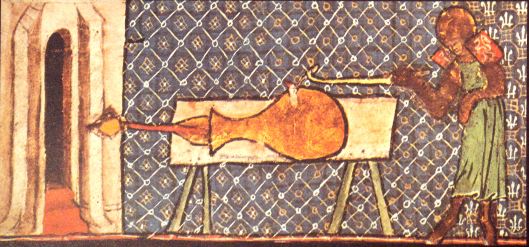
EarlyCannonDeNobilitatibusSapientiiEtPrudentiisRegumManuscriptWalterdeMilemete1326.jpg

By the mid-14th century, there appear to have been cannon of some sort used against the Scots in 1327 and at the Battle of Crecy (1346) against the French and, by the early 15th c. they are becoming a regular feature of battles and sieges.
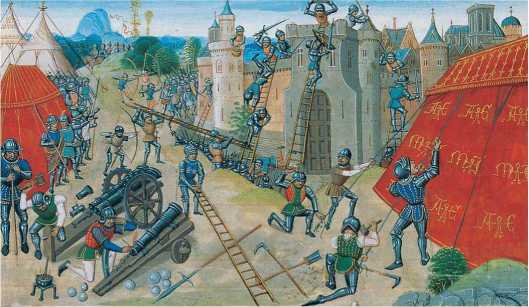
medievalsiege.jpg

Very early cannon were very simple, being a tube of any length fastened to a wooden bed of some sort.
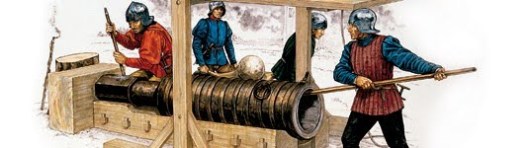
FortMedeival.jpg

The tubes were made of long bars of iron hammered together and then secured with a series of iron rings.

25_slash_57.JPG

The technology for this looks like it came from barrel-making:  long staves of wood pressed together, then wrapped with iron bands
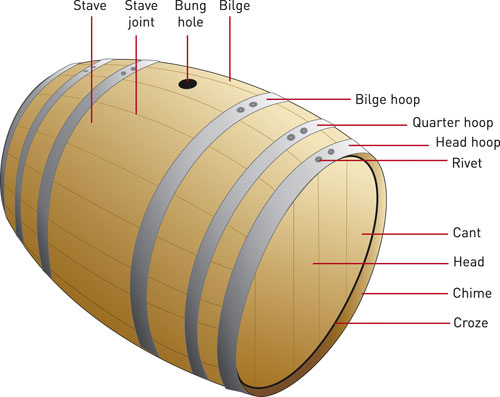
winebarrelanatomy.jpg

When we think of barrels in Middle Earth, what better evidence do we have than this, one of our favorite JRRT illustrations from The Hobbit?
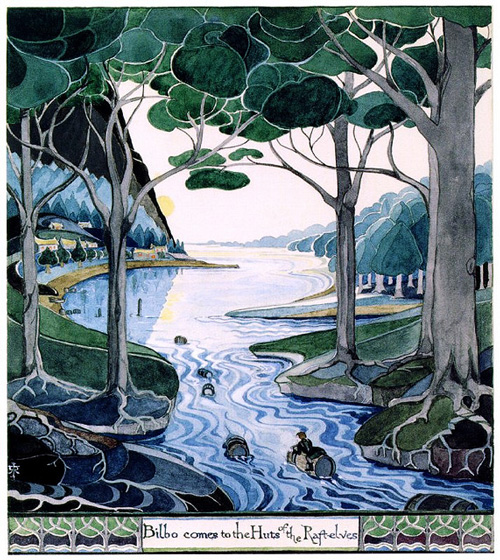
barrel-riding.jpg

A well-known technical skill in the Middle Ages was that of casting church bells:  making molds, pouring in metal, letting it cool, and producing sometimes quite large ones.
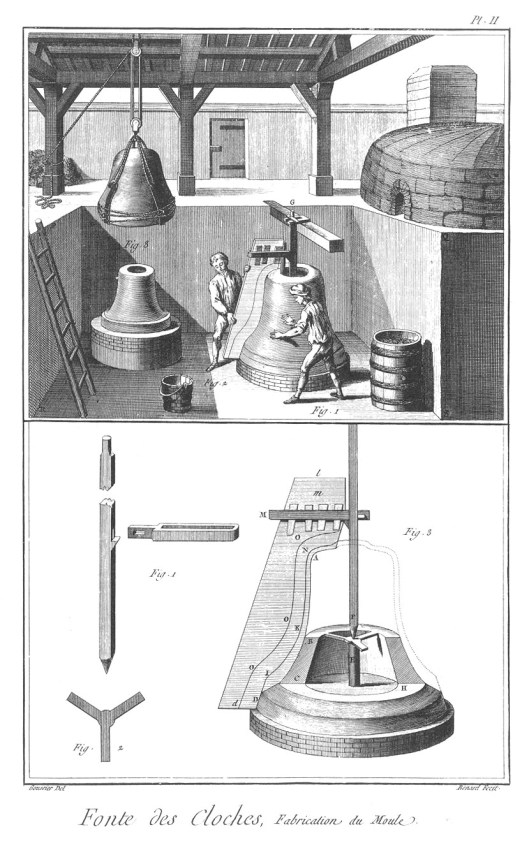
bellfounding.jpeg

This led to making cannon the same way.
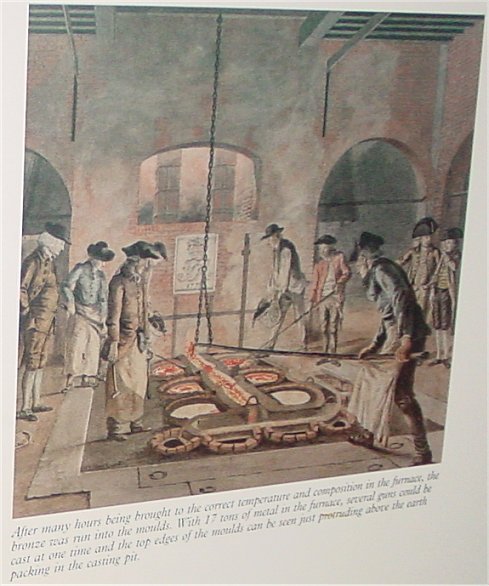
foundry-church-cannon-casting.jpg

Sometimes, early cannon were so large that they were cast at the site of their first use, as large bells occasionally were.  For the Ottoman siege of Constantinople in 1453, this was said to be true.

Illustration-of-angus-mcbride-showing-the-ottoman-cannon-basilica-during-the-siege-of-constantinople-in-1453-ad.jpg

You’ll notice here, by the way, that this isn’t an iron gun, but a bronze one.  After the first iron guns, gun-founders had begun experimenting with bronze and for several centuries, until all guns would be made out of steel, there was discussion among both gunners and military theoreticians over the value of each metal.

As for Middle Earth, well, we know that there were barrels and the ability to cast large (going by medieval bells) objects in metal.  Now the speculation begins.  Suppose, when Saruman was defeated and later left Orthanc, he had left behind his papers (he doesn’t appear to have anything like them when he is met on the road by Gandalf and the others in “Many Partings”).  In those papers would have been the recipe for gunpowder.  Sometime after Isengard had been taken over by the allies, those papers had come to Minas Tirith and someone, remembering what he had heard about the attack on Helm’s Deep, went through them, found that recipe, and, just as in medieval Europe, soon these began to appear—

medgun.jpg

What do you think, dear readers?

Thanks, as always, for reading.

MTCIDC

CD

The Doubtful Sea Series Facebook Page

The Doubtful Sea Series Facebook Page

  • Ollamh

Categories

  • Artists and Illustrators
  • Economics in Middle-earth
  • Fairy Tales and Myths
  • Films and Music
  • Games
  • Heroes
  • Imaginary History
  • J.R.R. Tolkien
  • Language
  • Literary History
  • Maps
  • Medieval Russia
  • Military History
  • Military History of Middle-earth
  • Narnia
  • Narrative Methods
  • Poetry
  • Research
  • Star Wars
  • Terra Australis
  • The Rohirrim
  • Theatre and Performance
  • Tolkien
  • Uncategorized
  • Villains
  • Writing as Collaborators
Follow doubtfulsea on WordPress.com

Across the Doubtful Sea

Recent Postings

  • A Moon disfigured December 17, 2025
  • On the Roads Again—Once More December 10, 2025
  • (Not) Crossing Bridges December 3, 2025
  • On the Road(s) Again—Again November 26, 2025
  • On the Road(s) Again November 19, 2025
  • To Bree (Part 2) November 12, 2025
  • To Bree (Part 1) November 5, 2025
  • A Plague o’ Both—No, o’ All Your Houses! October 29, 2025
  • It’s in Writing (2:  I’st a Prologue, or a Poesie for a Ring?) October 22, 2025

Blog Statistics

  • 103,208 Views

Posting Archive

  • December 2025 (3)
  • November 2025 (4)
  • October 2025 (5)
  • September 2025 (4)
  • August 2025 (4)
  • July 2025 (5)
  • June 2025 (4)
  • May 2025 (4)
  • April 2025 (5)
  • March 2025 (4)
  • February 2025 (4)
  • January 2025 (5)
  • December 2024 (4)
  • November 2024 (4)
  • October 2024 (5)
  • September 2024 (4)
  • August 2024 (4)
  • July 2024 (5)
  • June 2024 (4)
  • May 2024 (5)
  • April 2024 (4)
  • March 2024 (4)
  • February 2024 (4)
  • January 2024 (5)
  • December 2023 (4)
  • November 2023 (5)
  • October 2023 (4)
  • September 2023 (4)
  • August 2023 (5)
  • July 2023 (4)
  • June 2023 (4)
  • May 2023 (5)
  • April 2023 (4)
  • March 2023 (5)
  • February 2023 (4)
  • January 2023 (4)
  • December 2022 (4)
  • November 2022 (5)
  • October 2022 (4)
  • September 2022 (4)
  • August 2022 (5)
  • July 2022 (4)
  • June 2022 (5)
  • May 2022 (4)
  • April 2022 (4)
  • March 2022 (5)
  • February 2022 (4)
  • January 2022 (4)
  • December 2021 (5)
  • November 2021 (4)
  • October 2021 (4)
  • September 2021 (5)
  • August 2021 (4)
  • July 2021 (4)
  • June 2021 (5)
  • May 2021 (4)
  • April 2021 (4)
  • March 2021 (5)
  • February 2021 (4)
  • January 2021 (4)
  • December 2020 (5)
  • November 2020 (4)
  • October 2020 (4)
  • September 2020 (5)
  • August 2020 (4)
  • July 2020 (5)
  • June 2020 (4)
  • May 2020 (4)
  • April 2020 (5)
  • March 2020 (4)
  • February 2020 (4)
  • January 2020 (6)
  • December 2019 (4)
  • November 2019 (4)
  • October 2019 (5)
  • September 2019 (4)
  • August 2019 (4)
  • July 2019 (5)
  • June 2019 (4)
  • May 2019 (5)
  • April 2019 (4)
  • March 2019 (4)
  • February 2019 (4)
  • January 2019 (5)
  • December 2018 (4)
  • November 2018 (4)
  • October 2018 (5)
  • September 2018 (4)
  • August 2018 (5)
  • July 2018 (4)
  • June 2018 (4)
  • May 2018 (5)
  • April 2018 (4)
  • March 2018 (4)
  • February 2018 (4)
  • January 2018 (5)
  • December 2017 (4)
  • November 2017 (4)
  • October 2017 (4)
  • September 2017 (4)
  • August 2017 (5)
  • July 2017 (4)
  • June 2017 (4)
  • May 2017 (5)
  • April 2017 (4)
  • March 2017 (5)
  • February 2017 (4)
  • January 2017 (4)
  • December 2016 (4)
  • November 2016 (5)
  • October 2016 (6)
  • September 2016 (5)
  • August 2016 (5)
  • July 2016 (5)
  • June 2016 (5)
  • May 2016 (4)
  • April 2016 (4)
  • March 2016 (5)
  • February 2016 (4)
  • January 2016 (4)
  • December 2015 (5)
  • November 2015 (5)
  • October 2015 (4)
  • September 2015 (5)
  • August 2015 (4)
  • July 2015 (5)
  • June 2015 (5)
  • May 2015 (4)
  • April 2015 (3)
  • March 2015 (4)
  • February 2015 (4)
  • January 2015 (4)
  • December 2014 (5)
  • November 2014 (4)
  • October 2014 (6)
  • September 2014 (1)

Blog at WordPress.com.

  • Subscribe Subscribed
    • doubtfulsea
    • Join 78 other subscribers
    • Already have a WordPress.com account? Log in now.
    • doubtfulsea
    • Subscribe Subscribed
    • Sign up
    • Log in
    • Report this content
    • View site in Reader
    • Manage subscriptions
    • Collapse this bar
 

Loading Comments...