Tags
Aetius, Attila, Chalons, Denethor, Faramir, Gandalf, lotr, Middle-earth, Palantir, Pippin, Saruman, Sauron, Tolkien
As ever, welcome, dear readers.
I’ve always admired the way in which JRRT shows the slow descent of Denethor into darkness, from someone who rules Gondor
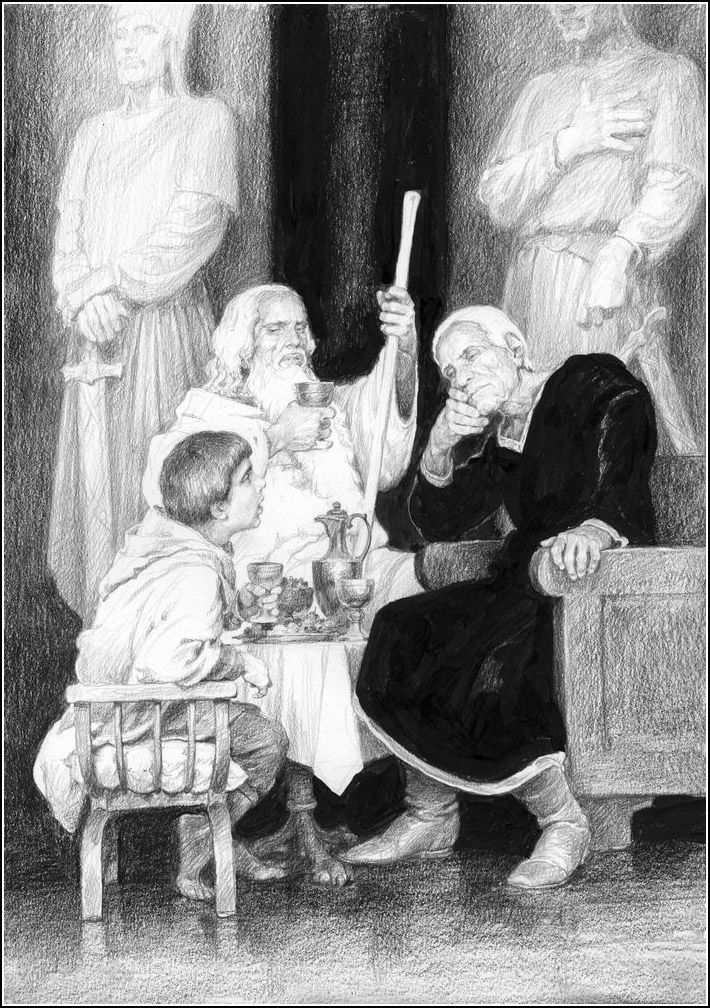
(Denis Gordeev)
as if he were its rightful king, accepting Pippin’s offer of allegiance,
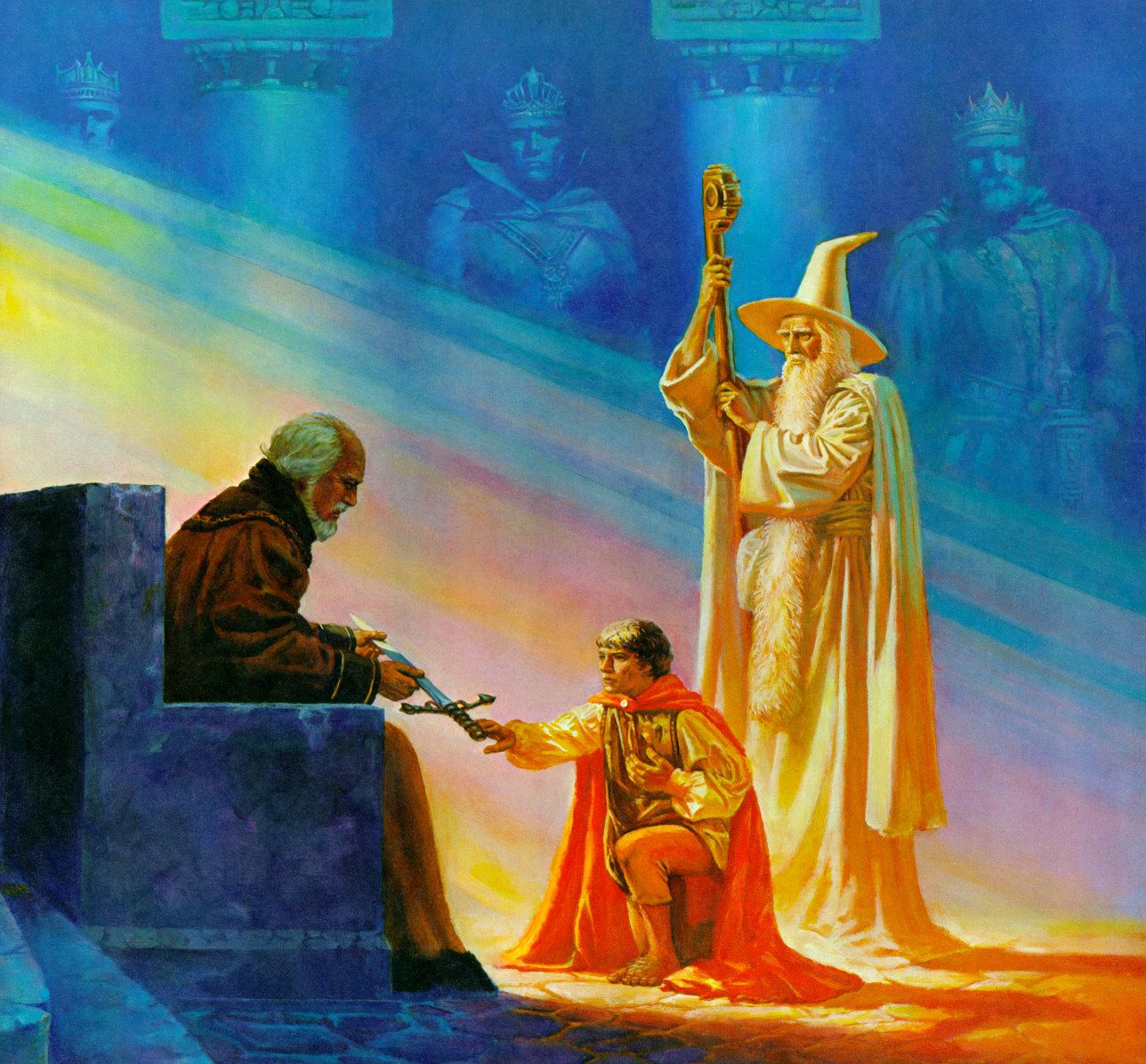
(Douglas Beekman—a prolific sci-fi fantasy illustrator. You can see numbers of his illustrations here: https://www.isfdb.org/cgi-bin/ea.cgi?23068 This catalogue if from the Internet Speculative Fiction Data Base, a wonderfully rich site if you have an interest in sci-fi.)
to the pensive and grieving father,
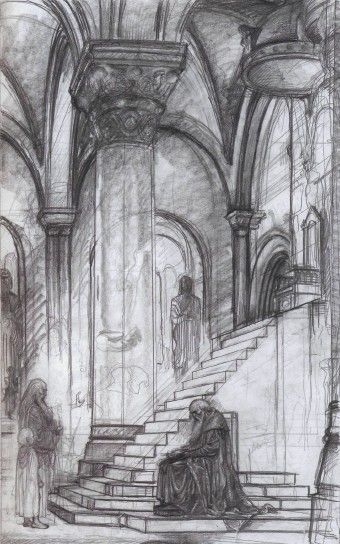
(an Alan Lee sketch)
to the desperate madman of his last scene—

(artist? so far, I can’t locate one)
But that last scene has always impressed me as Tolkien at his dramatic best.
It begins with the setting:
“There Pippin, staring uneasily around him, saw that he was in a wide vaulted chamber, draped as it were with the great shadows that the little lantern threw upon its shrouded walls. And dimly to be seen were many rows of tables, carved of marble; and upon each table lay a sleeping form, hands folded, head pillowed upon stone. But one table near at hand stood broad and bare. Upon it at a sign from Denethor they laid Faramir and his father side by side, and covered them with one covering, and stood then with bowed heads as if mourners beside a bed of death.”
I think that we can imagine that JRRT’s image here is based upon any number of medieval English churches, with their tombs, usually along the walls, or,
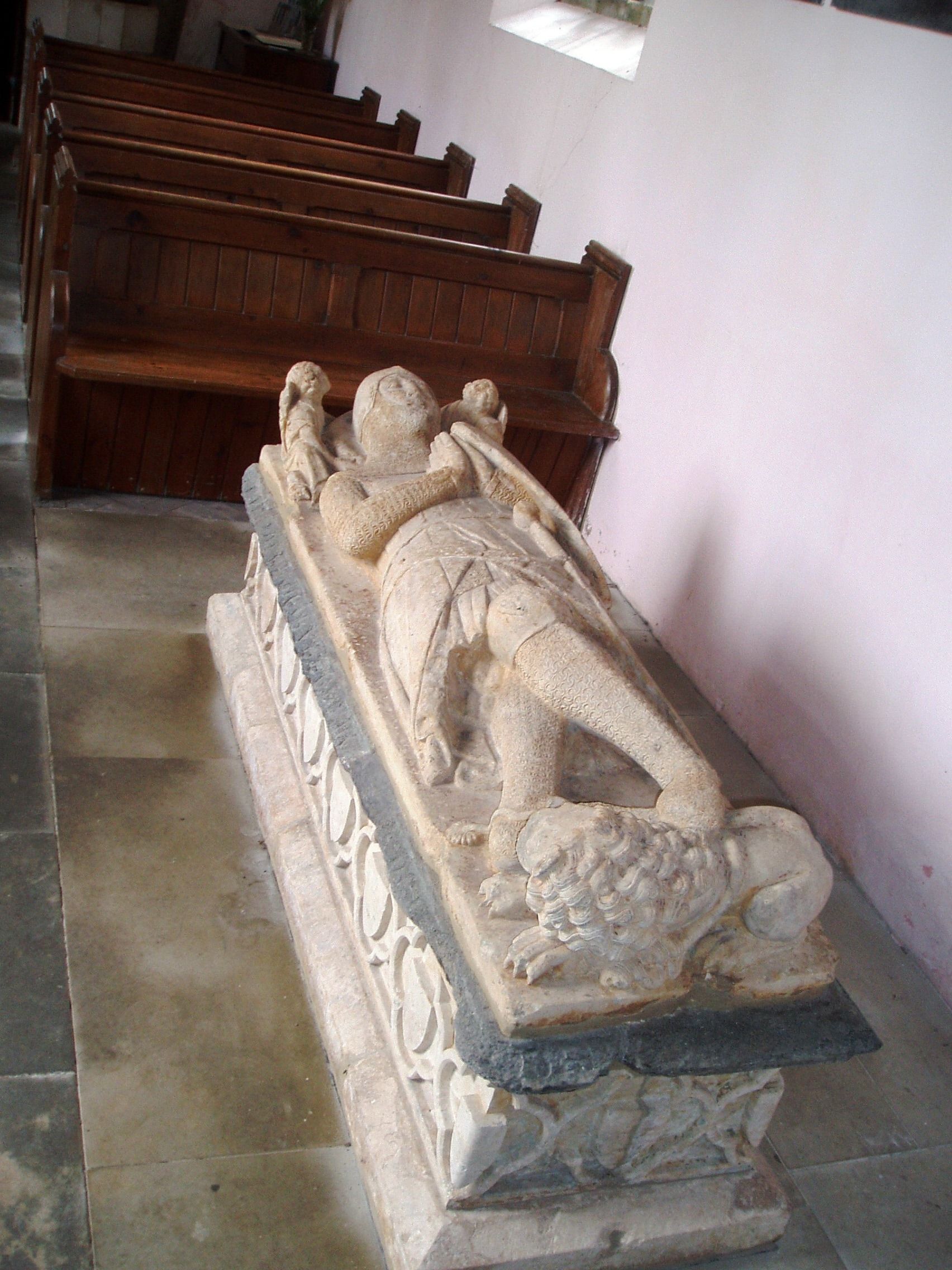
more grandly, the basilica of St Denis, in a northern suburb of Paris,


of which he might have seen a photo. (As I haven’t found a reference that he had actually visited the place.)
What happens next, however, has a different model—or, rather, perhaps two.
After having himself and Faramir placed on that empty table, Denethor then makes the terrible command:
“ ‘Here we will wait,’ he said. ‘But send not for the embalmers. Bring us wood quick to burn, and lay it all about us, and beneath; and pour oil upon it. And when I bid you thrust in a torch.’ “ (all of the above from The Return of the King, Book Five, Chapter 4, “The Siege of Gondor”)
What’s going on here? When Gandalf, summoned by Pippin attempts to stop this, Gandalf says to Denethor:
“ ‘Authority is not given to you, Steward of Gondor, to order the hour of your death,’…And only the heathen kings, under the domination of the Dark Power, did thus, slaying themselves in pride and despair, murdering their kin to ease their own death.’” (The Return of the King, Book Five, Chapter 7, “The Pyre of Denethor”)
“Heathen”, from Old English haethen, came into English with the meaning “non-believer (in Christianity)” and seems, at first, rather an odd word for Gandalf to have employed, as Tolkien has written himself that “…the ‘Third Age’ was not a Christian world.” (letter to the Houghton Mifflin Co., 30 June, 1955, Letters, 319)
I wonder, however, whether JRRT was remembering something from early medieval history, which he might have read in conjunction with his early avid study of Gothic (which almost ruined his academic career—see his letter to Christopher of 2 January, 1969 (Letters, 558).
It’s in the account by the 6th-century Gothic historian, Jordanes, of the Battle of the Catalaunian Plains (also known as the Battle of Chalons), between Roman and their Germanic allies, including Visigoths, led by the Roman general, Aetius, and an invading army of Huns and their subject peoples, led by Attila, a battle fought on 20 June, 451.
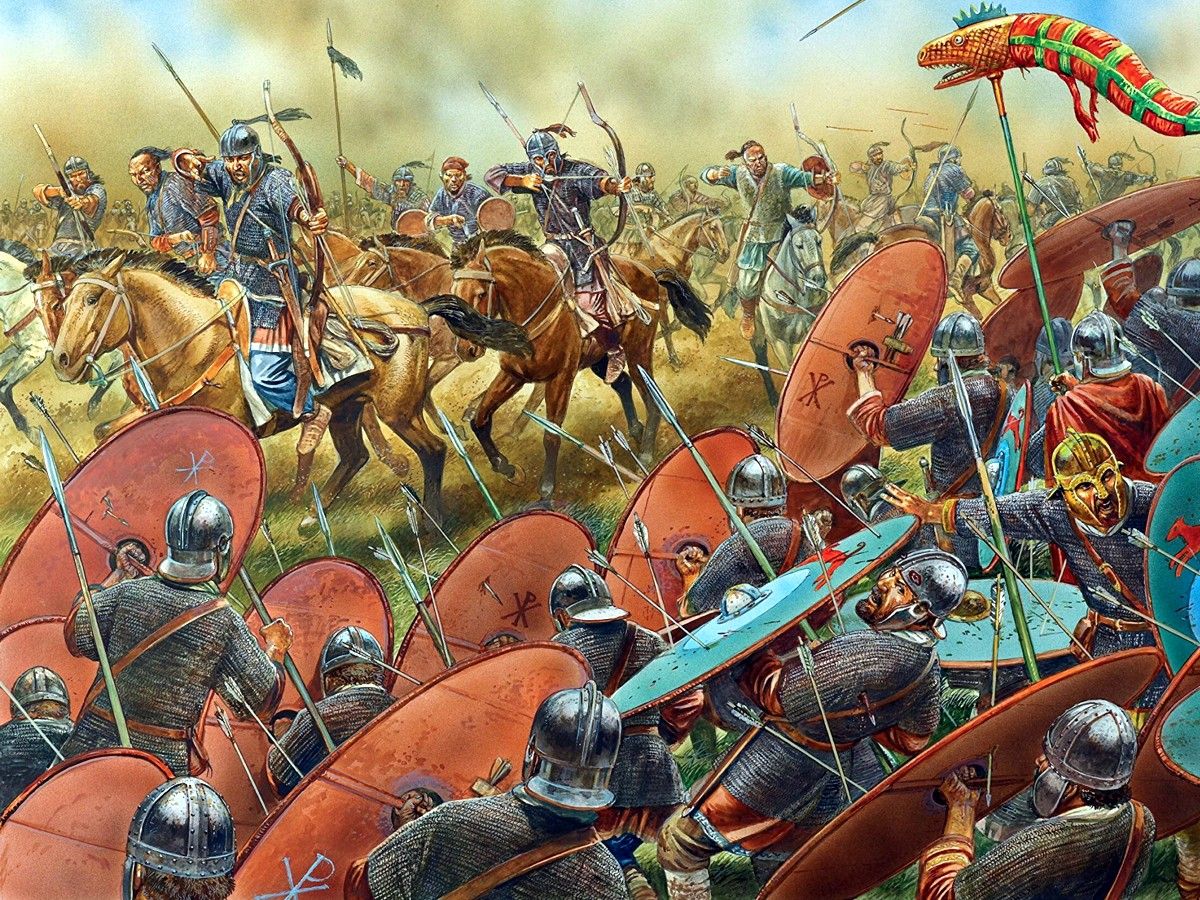
(by Peter Dennis, one of my favorite contemporary military artists)
The battle was very much a back-and-forth affair, but late in it, the Huns had been driven back to their camp and Attila, usually the soul of confidence, was troubled–and this is where Jordanes’ description comes in:
Fertur autem desperatis rebus praedictum regem adhuc et suppraemo magnanimem equinis sellis construxisse pyram seseque, si adversarii inrumperent, flammis inicere voluisse, ne aut aliquis eius vulnere laetaretur aut in potestate hostium tantarum gentium dominus perveniret. (Jordanes, De Origine Actibusque Getarum, XL, 213—my translation)
“It is said, moreover, that things were [so] despaired of, that the king [that is, Attila] still supremely brave, commanded at this point that [they] build a pyre from horse saddles and, should the enemy break in [to his camp], he wished to throw himself into the flames lest either anyone take joy in wounding [him] or lest he, the master of so many peoples come into the power of the enemy.”
None of Attila’s kin is involved in this potential self-immolation, but certainly the pride is there and even despair (as in that “desperatis rebus”) which Gandalf mentions.
But, as I said earlier, there might be another model—and perhaps an even darker one. Notice that
“But one table near at hand stood broad and bare.”
What immediately came to mind was that it resembled an altar—not a Christian one, but something from a different world, in which the symbolic sacrifice of the Christian religion was a real sacrifice—
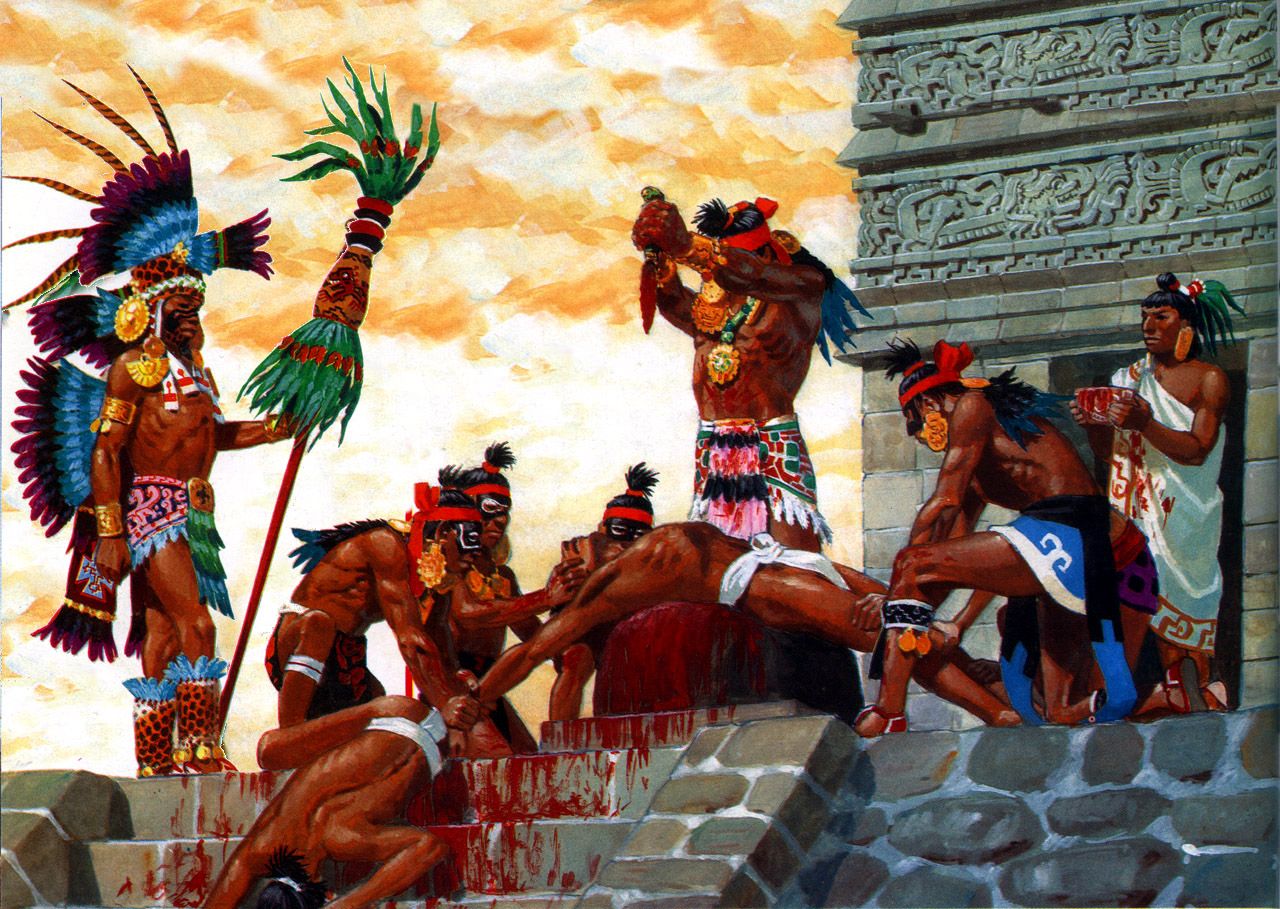
(artist unknown)
I thought of this because of something which Tolkien had written about Sauron, who has become the prisoner of the Numenorean king Tar-Calion:
“…and seduces the king and most of the lords and people with his lies. He denies the existence of God, saying that the One is a mere invention of the jealous Valar of the West, the oracle of their own wishes. The chief of the gods is he that dwells in the Void, who will conquer in the end, and in the void make endless realms for his servants…
A new religion, and worship of the Dark, with its temple under Sauron arises. The Faithful are persecuted and sacrificed.” (letter to Milton Waldman, late 9n 1951, Letters, 216)
Why, we might ask, is Denethor so prepared to make a fiery end to himself and his son?
“ ‘Come!’ said Gandalf. ‘We are needed. There is much that you can yet do.’
Then suddenly Denethor laughed. He stood up tall and proud again, and stepping swiftly back to the table he lifted from it the pillow on which his head had lain. Then coming to the doorway he drew aside the covering, and lo! he had between his hands a palantir. And as he held it up, it seemed to those that looked on that the globe began to glow with an inner flame, so that the lean face of the Lord was lit as with a red fire, and it seemed cut out of hard stone, sharp with black shadows, noble, proud, and terrible. His eyes glittered.
‘Pride and despair!’ he cried. ‘Didst thou think that the eyes of the White Tower were blind? Nay, I have seen more than thou knowest, Grey Fool. For thy hope is but ignorance. Go then and labour in healing! Go forth and fight! Vanity….The West has failed. It is time for all to depart who would not be slaves.”
And the answer is in that palantir. As it had earlier corrupted Saruman,

(the Hildebrandts)
and nearly driven Pippin mad with only one look into it, so it has shown Denethor exactly what Sauron had wanted him to see and, deluded, we might imagine that, in his action, he was not only destroying the current ruler of Gondor and his son, but was also acting like the Numenoreans who were his ancestors, making a sacrifice which Sauron had once demanded of them.
And, although Faramir is rescued, Denethor:
“…leaped upon the table, and standing wreathed in fire and smoke he took up the staff of his stewardship that lay at his feet and broke it on his knee. Casting the pieces into the blaze he bowed and laid himself on the table, clasping the palantir with both hands upon his breast. And it was said that ever after, if any man looked in that Stone, unless he had a great strength of will to turn it to other purpose, he saw only two aged hands withering in flame.”
And so Sauron had his sacrifice.
Thanks, as ever, for reading.
Stay well,
And remember that, as always, there’s
MTCIDC
O
 doubtfulsea