Ugluk Orckins

As always, dear readers, welcome.

It has been discussed, both elsewhere in print and on this blog, what an Orc is.

 Treebeard’s definition is often cited, saying of Saruman:

“ ‘He has taken up with foul folk, with the Orcs.  Brm, hoom!  Worse than that:  he has been doing something to them; something dangerous.  For these Isengarders are more like wicked Men.  It is a mark of evil things that came in the Great Darkness that they cannot abide the Sun; but Saruman’s Orcs can endure it, even if they hate it.  I wondered what he has done?  Are they Men he has ruined, or has he blended the races of Orcs and Men?  That would be a black evil!’ ”  (The Two Towers, Book Three, Chapter 4, “Treebeard”)

When asked about Orcs, JRRT offered several clues, saying:

1. “Also the Orcs (goblins) and other monsters bred by the First Enemy…” (letter to Milton Waldman, late 1951? Letters, 151)—so, somehow created by Morgoth, Sauron’s master

2.  “But since they are servants of the Dark Power, and later of Sauron, neither of whom could, or would, produce living things, they must be ‘corruptions’.” (letter to Naomi Mitchison, 25 April, 1951, Letters, 178)

3. “Treebeard does not say that the Dark Lord ‘created’ Trolls and Orcs.  He says he ‘made’ them in counterfeit of certain creatures pre-existing.  There is, to me, a wide gulf between the two statements…It is not true actually of the Orcs—who are fundamentally a race of ‘rational incarnate’ creatures, though horribly corrupted…” (draft of letter to Peter Hastings, September, 1954, Letters, 190)—in this same letter, he also quotes Frodo:  “ ‘The Shadow that bred them can only mock, it cannot make real new things of its own.  I don’t think it gave life to the Orcs, it only ruined them and twisted them.’ “ (The Return of the King, Book Six, Chapter 1, “The Tower of Cirith Ungol”)

4. “I have represented at least the Orcs as pre-existing real beings on whom the Dark Lord has exerted the fullness of his power in remodeling and corrupting them, not making them.”  (from the same draft to Peter Hastings)

5. “Elves may turn into Orcs, and if this required the special pervasive malice of Morgoth, still Elves themselves could do evil deeds.” (continuation of draft of letter sent to Rhona Beare, 14 October, 1958, Letters, 287)

As these are remarks by the creator (well, “sub-creator”, as JRRT would say), then they must be true, but I would offer another detail—not as to who or what Orcs are, but on whom they might be based.

Humphrey Carpenter, in his 1977 biography of Tolkien, quotes him as writing:

“My ‘Sam Gamgee’ is indeed a reflexion of the English soldier, of the privates and batmen I knew in the 1914 war…” (Carpenter, 89)

Such a soldier was called a “Tommy” (short for “Tommy Atkins”) in the Great War, and, although there is, as is often the case with nicknames (just try looking up the old name for a US soldier, “Doughboy”) controversy, it seems to have been a generic name for “infantryman” as early as the 1740s. 

JRRT’s Tommies in 1916 would have looked like this—

although very often more like this—

(A “batman”, by the way, isn’t what you might think

but an officer’s servant, called, it seems, after the pack saddle—in French “un bat”—on which rested an officer’s worldly goods in the field.)

Over the Tommies was a massive hierarchy, beginning with the army’s commander-in-chief—from late December, 1915, Douglas Haig,

down through a Tommy’s regimental commander, a colonel or lieutenant colonel,

to his company commander, a captain,

down to his platoon commander, a second lieutenant, like the one so often written about on this blog.

While a lieutenant might march at the head of the parade, however

the Tommy’s real boss was the man behind him, the sergeant, in the pre-Great War days, usually a senior soldier, with much experience, on battlefields and in barracks, who stood between the men and the officers, often as a kind of interpreter, and, to junior officers, as a kind of mentor.

At the beginning of the Great War, in 1914, senior officers were often men with long experience, many veterans of colonial wars across the globe,

and they commanded an all-volunteer army.

To meet the massive German army, swollen with reservists called up for active duty,

the British government initially relied upon patriotic calls for more volunteers, and got them.

So many soldiers needed many officers to control them and the government called in reservists and retired officers, but also depended upon boys who had been trained at their private schools in earlier student cadet organizations and then the OTC (Officer Training Corps), one such organization being formed at King Edward’s School, in Birmingham.

Such officers came from the middle and upper classes and therefore would have sounded very different from  their (mostly) lower class soldiers.  Officers were “gentlemen” and, even in the later years of the War, when replacements had to be found lower down the social scale, those promoted were coached in how to act as if they had come from much farther up that scale—hence the (really rather insulting) initials,“TG”, attached to them—“Temporary Gentlemen”.

Sergeants, however, were usually of the same social class as the men and would have sounded like them, as well as shared their values.

Which brings us to our Orcs.

Here is the sound of one of Sauron’s upper-class commanders—perhaps this is the Dark Lord’s Field Marshall Haig– on the field of battle:

“ ‘Come not between the Nazgul and his prey!  Or he will not slay thee in thy turn.  He will bear thee away to the houses of lamentation, beyond all darkness, where thy flesh will be devoured, and thy shriveled mind be left naked to the Lidless Eye.’ “ (The Return of the King, Book Five, Chapter 6, “The Battle of the Pelennor Fields”)

And here is what I would suggest is an Orc sergeant, Ugluk:

“ ‘You’ll run with me behind you…Run! Or you’ll never see your beloved holes again.  By the White Hand!  What’s the use of sending out mountain-maggots on a trip, only half trained.  Run, curse you!  Run while night lasts!’ “ (The Two Towers, Book Three, Chapter 3, “The Uruk-hai”)

And, if that’s an Orc sergeant, then, although they carry swords, spears, and bows,

rather than modern magazine rifles and bayonets

mightn’t we see those whom Ugluk is driving before him, as Tolkien says of Sam Gamgee, a “reflexion of the British soldier”, but now corrupted and twisted, as the Orcs were by Morgoth and Sauron, into the infantry of the Dark Lord?

Thanks, as always, for reading.

Stay well,

And in your ranks,

And remember that, as ever, there’s

MTCIDC

O

Scuttlebutt

“ ‘What are they wanted for?’ asked several voices. ‘Why alive?  Do they give good sport?’

‘No!  I heard that one of them has got something, something that’s wanted for the War, some Elvish plot or other.’ “ (The Two Towers, Book  Three, Chapter 3, “The Uruk-hai”)

As ever, dear readers, welcome.

 Pippin and Merry are in a bad spot.  After Boromir’s death,

they have been dragged off by the Orcs who killed him.

The Orc leaders, Ugluk, of Isengard, and Grishnakh, of Mordor, had been given orders to capture Hobbits, but the orders are rather vague, which is not surprising, considering who gave them and their ultimate purpose.  On the one hand, there is Saruman,

who we know from his attempt at corrupting Gandalf is aware that the Ring exists and is associated with the Shire. (The Felllowship of the Ring, Book Two, Chapter 2, “The Council of Elrond).

On the other is the original owner of the Ring,

who has learned from a tortured Gollum of the name Baggins, also associated with the Shire,

and has dispatched not only a band of Orcs to find Hobbits, under Grishnakh, but also several of “the apple of the Great Eye”, as Grishnakh puts it, the Nazgul.

(a wonderfully atmospheric depiction by Anato Finnstark)

Each of these two, Saruman and Sauron, is determined to obtain the Ring for himself, but also very cautious about the kind of thinking expressed by one of the anonymous Orc voices quoted above: 

“ ‘Is that all you know?  Why don’t we search them and find out?  We might find something that we could use ourselves.’ “

Grishnakh’s orders, as he states them, reflect Sauron’s caution:  “The prisoners are NOT to be searched or plundered…”  And Ugluk’s are, basically, the same:  “Alive and as captured, no spoiling.”

With such lack of specificity even for those in charge of the operation, it’s not surprising that mostly what the ordinary Orc soldiers know can be summed up in the title of this posting, scuttlebutt, originally a naval term, for the gossip which sailors spread when they spent time around the ship’s water barrel, a butt being an old name for a big wooden container for liquids.

It’s a given that JRRT’s reading influenced his writing (we only have to think about how much of Beowulf appears in The Hobbit).  It’s also true that his life on the Western Front, brief as it was (June to October, 1916),

also had its influence and here, in this Orcish scuttlebutt, we have a good example, which is really as much derived from  his experience of the War in general as from his overseas service. 

Those in charge of waging the War were, from early on—and this was true for both sides—very aware of the influence of the media upon people’s opinions.  Although there was no internet yet, or television, or radio, there was still the press–books, magazines, and, most of all, newspapers–as well as film, though still in its infancy.   A hit movie of 1916, in fact, was the “documentary” (the British War Office was behind it, so it was hardly likely to be impartial) The Battle of the Somme.

(You can see this film for yourself here:  https://archive.org/details/TheBattleOfTheSomme1916Film  This comes from the Internet Archive, which has a large collection of silent films, all for free and is one of the best cultural resources on the planet, as far as I’m concerned.)

Censorship was practiced worldwide, and sometimes extremely aggressively:  penalties for anything from conveying government-controlled information to simply voicing opposition to the War could be severe.  And such censorship was comprehensive:

“Mail, telegrams, pamphlets and books, news and newspapers, plays, photographs, films, and speech were all subject to censorship – or restrictions – during the First World War.”

This is from a website called “JanetPanic” and is describing the situation in the US, but it sums up just how far governments, both of the Allies and the Central Powers, were willing to go both to protect not only militarily sensitive information, but also their citizens’ perception of what was going on at the Front, wherever that Front happened to be.

At the Front, soldiers in the British Army were forbidden to keep diaries (the public explanation being that, if captured, they might convey all sorts of military information to the enemy, but, the unspoken, which was also true, was that conditions in the trenches were so horrendous

that governments preferred to keep the public from knowing too much about day-to-day life in what many thought was Hell—or beyond).   Private cameras were forbidden by March, 1915 and those found taking pictures were to be arrested.  (See this very interesting article:  https://historynewsnetwork.org/article/173470 )

Soldiers’ mail was censored, beginning by their own officers (JRRT developed a private code to be used with Edith so that she might learn at least a little more),

 but, to ease the minds of those at home, this postcard was developed—a little piece of closely-monitored truth:

As well, informers were encouraged—just look at the sixth “DON’T” in this poster’s list—

And we can hear an echo of this in Grishnakh’s words to Ugluk:

“You have spoken more than enough, Ugluk…I wonder how they would like it in Lugburz.  They might think that Ugluk’s shoulders needed relieving of a swollen head.  They might ask where his strange ideas came from.  Did they come from Saruman, perhaps?  Who does he think he is, setting up on his own with his filthy white badges?  They might agree with me, with Grishnakh their trusted messenger; and I Grishnakh say this:  Saruman is a fool, and a dirty treacherous fool.  But the Great Eye is on him.”

When information about the real situation is closely guarded, rumor—scuttlebutt—is what soldiers—Tommies or Orcs—have to go on and, with heavy censorship, it would have been easy for JRRT, like his Orcs, to feel that the Great Eye was upon him, as well.

Thanks, as ever, for reading,

Stay well,

If you know anything about the Ring, do as this poster suggests—

And know as well that—and this, I hope, is no secret—there’s always

MTCIDC

O

ps

(Here’s a very good introductory article on the subject of censorship in the Great War:  https://encyclopedia.1914-1918-online.net/article/censorship  This is from the extremely useful  “1914-1918-Online:   International Encyclopedia of the First World War”.)

I.D.?

Welcome, as always, dear readers.

I’ve just finished teaching The Odyssey once more and, because it’s such a complex work (after all, it’s made up of a number of songs by a number of singers over generations, all then put together as a single poem in the Hellenistic world), that I always find new things to think about.

This time, I began with a recurring difficulty for Odysseus.

In the 19 years he’s been away from home, he’s had no end of other difficulties, beginning with the demand by Agamemnon that he join the expedition against Troy.

He tried to dodge that by pretending to be mad, plowing the beach, but that attempt was scuttled by someone almost as clever as he, Palamedes, who placed the infant Telemachos on the beach in front of the plow and, when Odysseus swerved to avoid him, Odysseus, clearly sane, was then forced to join the other Greeks.

After ten years and the final fall of Troy,

Odysseus’ problems had just begun, including such as the Lotos-eaters (although he himself did not indulge),

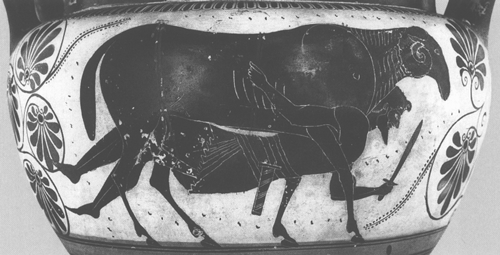
a very large humanoid with a taste for human flesh,

almost becoming pork luncheon meat,

visiting the dead in the Otherworld,

avoiding Sirens (while still listening to them),

and the twin dangers of snaky Scylla and shaky Charybdis,

as well as being shipwrecked not once, but twice.

Even when he reaches home, he will have to confront over 100 suitors, all pursuing his wife.

But, besides those problems, he has another:  proving to people that he is who he says he is.  

This shouldn’t be surprising, of course.  After all, he’s been gone almost 20 years, so he’s a little like Washington Irving’s Rip van Winkle,    

who fell into a deep sleep after drinking heavily during a game of bowls with some strange little men

and woke up 20 years later, only to find that the world had changed significantly, from the days of King George to those of George Washington.  People in his village think that he’s strange, if not mad, and his sanity is no longer doubted only when two elderly locals identify him.                         

(If you don’t know this story, here’s Arthur Rackham’s beautifully-illustrated version from 1905 for you:  https://archive.org/details/ripvanwinkle00irvirich or, if you’d prefer, here’s N.C. Wyeth’s equally beautiful 1921 edition:   https://archive.org/details/ripvanwinkle00irvi   I can’t resist adding this, which is the frontispiece to the Wyeth.)

For Odysseus, now back on his home island, and because he is potentially in great danger from those suitors, even if he has the goddess Athena on his side,

just revealing his identity is tricky, but proving it depends mainly upon two things:  his ability to remember the past and to encourage others to do the same, and a deep scar he had received as a young man in a boar hunt with his grandfather, Autolycus.

For his wife, Penelope, there is one more proof:  a very special bed he once made for them, which included part of an olive tree as a bedpost.

(This is someone’s clever modern reconstruction.)

Although he hasn’t been asleep or away from home for twenty years, Aragorn

(An Alan Lee illustration, at the moment when Eowyn gives Aragorn what’s called a “stirrup cup”.)

 would appear to have a similar problem of identification, but with a twist.  Unlike Rip van Winkle, who is a nobody, and more like Odysseus, who is the headman of Ithaka, if he is really who he says he is, he has a claim to the throne of Gondor, which has been vacant for 969 years.  But how to prove that?

He has Gandalf’s backing, of course,

(I would be glad to credit the author of this very good portrait, but the signature is just too small to read, unfortunately!)

who knows his—and his people’s—history, as he says to Frodo:

“ ‘But there are few left in Middle-earth like Aragorn son of Arathorn.  The race of the Kings from over the Sea is nearly at an end.  It may be that this War of the Ring will be their last adventure.’

‘Do you really mean that Strider is one of the people of the old Kings?’ said Frodo in wonder.  ‘I thought they had all vanished long ago.  I thought he was only a Ranger.’

‘Only a Ranger!’ cried Gandalf.  ‘My dear Frodo, that is just what the Rangers are:  the last remnant in the North of the great people, the Men of the West.’ “ (The Fellowship of the Ring, Book Two, Chapter 1, “Many Meetings”)

Gandalf’s word alone would never be enough, however, as the bitter words of Denethor much later in the story—though clearly poisoned by Sauron through the palantir—show us:

“Do I not know thee, Mithrandir?  Thy hope is to rule in my stead, to stand behind every throne, north, south, or west.  I have read thy mind and its policies…With the left hand thou wouldst use me for a while as a shield against Mordor, and with the right bring up this Ranger of the North to supplant me.” (The Return of the King, Book Five, Chapter 7, “The Pyre of Denethor”)

Aragorn, however, has a series of other proofs at hand.

First, he has the sword of Elendil, Narsil, broken under him when he was killed at the siege of the Barad-dur,

and which is the subject of a kind of prophecy made in a dream more than once to Faramir and once to Boromir, in which “I heard a voice, remote but clear, crying:

‘Seek for the Sword that was broken:

 In Imladris it dwells;

There shall be counsels taken

 Stronger than Morgul-spells.

There shall be shown a token

 That Doom is near at hand,

For Isildur’s Bane shall waken,

 And the Halfling forth shall stand.’ “

(The Fellowship of the Ring, Book Two, Chapter 2, “The Council of Elrond”)

Aragorn then immediately confirms the first half of this prophecy:

“ ‘And here in the house of Elrond more shall be made clear to you,’ said Aragorn, standing up.  He cast his sword upon the table that stood before Elrond, and the blade was in two pieces.  ‘Here is the Sword that was Broken!’ he said.

‘And who are you, and what have you to do with Minas Tirith?’ asked Boromir, looking in wonder at the lean face of the Ranger in his weather-stained cloak.

‘He is Aragorn son of Arathorn,’ said Elrond; ‘and he is descended through many fathers from Isildur Elendil’s son of Minas Ithil…’ “

The second proof lies in his claim on the palantir tossed from Orthanc

by Grima:

“ ‘You have looked in that accursed stone of wizardry!’ exclaimed Gimli with fear and astonishment in his face…

‘You forget to whom you speak,’ said Aragorn sternly, and his eyes glinted…’Nay, my friends, I am the lawful master of the Stone, and I had both the right and strength to use it…’ (The Return of the King, Book Five, Chapter 2, “The Passing of the Grey Company”)

The third proof is derived from the first and second.  When Aragorn used the palantir to contact Sauron, he never spoke, but:

“ ‘And he beheld me.  Yes, Master Gimli, he saw me, but in other guise than you see me here…To know that I lived and walked the earth was a blow to his heart, I deem; for he knew it not till now. ..Sauron had not forgotten Isildur and the sword of Elendil.  Now in the very hour of his great designs the heir of Isildur and the Sword are revealed; for I showed the blade re-forged to him.  He is not so mighty yet that he is above fear; nay, doubt ever gnaws him.’ “

And by Sauron’s reaction, it would seem that Aragorn’s claim to be the rightful king is confirmed:  by the enemy.

The fourth proof is also confirmed by others.  In one of the grimmest chapters, for me, of the whole story, Aragorn and his company ride The Paths of the Dead and, deep in the mountain, Aragorn summons the Oath-Breakers, who had deserted Isildur and were cursed by him never to find peace until called upon once more to fulfill their oath.  Aragorn claims their aid, saying:

 “ ‘The hour is come at last.  Now I go to Pelargir upon Anduin, and ye shall come after me.  And when all this land is clean of the servants of Sauron, I will hold the oath fulfilled, and ye shall have peace and depart for ever.  For I am Elessar, Isildur’s heir of Gondor.’ “

The dead follow him, sweeping down upon the fleet of the Corsairs, and, again, that they do so, confirms once more Aragorn’s claim.

There may be other details throughout the text I haven’t thought of—there often are!—but I want to conclude with perhaps the gentlest proof. 

In the chapter entitled “The Houses of Healing”, Faramir, Eowyn, and Merry all lie at the point of death—and all are saved by Aragorn, and here is a final confirmation as Gandalf says:

“ ‘Let us enter!  For it is only in the coming of Aragorn that any hope remains for the sick that lie in the House.  Thus spake Ioreth, wise-woman of Gondor:  “The hands of the king are the hands of a healer, and so shall the rightful king be known.” ‘ “ (The Return of the King, Book Five, Chapter 8, “The Houses of Healing”)

Proof enough for me.

Thanks for reading, as ever.

Stay well,

Let us all hope for healing in this troubled time,

And know that, as always, there’s

MTCIDC

O

No (Gondorian) Man’s Land

As always, dear readers, welcome.

More than once, people have likened Mordor to the Black Country of central England,

or perhaps even to the blighted landscape of the Western Front,

but could we extend that even farther west, to the long approach by which Frodo and Sam, led by Gollum, make their way towards Minas Morgul?

Faramir, who has captured Frodo and Sam

while setting an ambush for a column of Sauron’s allies, including their oliphaunts,

 is now trying to warn Frodo both from traveling with Gollum and from going that route to Mordor as Gollum has proposed, saying,

“The valley of Minas Morgul passed into evil very long ago, and it was a menace and a dread while the banished Enemy dwelt yet far away, and Ithilien was still for the most part in our keeping.  As you know, that city was once a strong place, proud and fair, Minas Ithil, the twin sister of our own city.  But it was taken by fell men whom the Enemy in his first strength had dominated, and who wandered homeless and masterless after his fall…After his going they took Minas Ithil and dwelt there, and they filled it, and all the valley about, with decay:  it seemed empty and was not so, for a shapeless fear lived within the ruined walls.”  (The Two Towers, Book Four, Chapter 6, “The Forbidden Pool”)

Rereading this, then, the first image which came to my mind was not this—

but this—

and what the new Second Lieutenant Tolkien

must have seen when he arrived in the trenches

as a signals officer

in June, 1916.

At first, it would simply have been the view beyond the trenches, which was grim:  acres (hectares) of barbed wire would block seeing much farther than the lip of the entrenchment.

And, because enemy snipers with specialized rifles were just waiting for a soldier to poke his head up, it wasn’t really a good idea to do that anyway.

(There’s even a mocking song on the subject from 1918, a British soldier suggesting to his enemy counterpart that keeping your head down was the only way to survive.  This is the chorus:

“Late last night in the pale moon light
I saw you, I saw you!
You were fixing your barb’d wire
When we opened up – rapid fire!
If you want to see your Vater in the Vaterland
Keep your head down Fritzie boy
Keep your Head down Fritzie Boy!”

(You can hear a period performance here:  https://www.youtube.com/watch?v=J2eSiTvVlEs )

As is true with many Great War soldiers’ songs, it’s a parody of a 1913 hit “Hold Your Hand Out, Naughty Boy”)

(And here’s the original:  https://www.youtube.com/watch?v=PtWC5L1sXt8 )

Although those trenches were grim,

the world beyond those trenches, could JRRT have seen it—and he would have seen a little of it as his unit moved forward during the vast battle called “the Somme”–was an even bleaker one.  Several years of war and the pounding of big guns, both German

and British

had destroyed trees,

houses,

churches,

whole villages

and even towns.

The ruined landscape between the Allied and German trenches was commonly called “No Man’s Land”, rather like a withered version of the Ithilien in which Faramir fights his war, but it was actually a sort of everyman’s land as, once darkness fell, one might see soldiers of both sides at various tasks.

All of that barbed wire needed replacement and extension and wiring parties (a duty soldiers hated as, in the dark, they were as likely to be shot at by their own side as by the enemy) slipped out to work on their entanglements.

Then there were always patrols—

small groups whose job it was to prevent the enemy from slipping across the broken ground to spy or even to make minor attacks, called “trench raids”,

meant both to keep the other side nervous and to gather information, through prisoners or captured documents or even from what might seem like a minor item, like the badge from a cap.

Such badges, like this one, could carry distinctive regimental emblems, providing the raiders with a sense of what regiment was facing them and thus adding to the more general picture of enemy movements on their own side of No Man’s Land.  (This is, in fact, the badge of JRRT’s own regiment, the Lancashire Fusiliers.)

It’s easy, then, to imagine Faramir and his men in their camouflage suddenly appearing here:

“Four tall Men stood there.  Two had spears in their hands with broad bright heads.  Two had great bows, almost of their own height, and great quivers of long green-feathered arrows.  All had swords at their sides, and were clad in green and brown of varied hues, as if the better to walk unseen in the glades of Ithilien.  Green gauntlets covered their hands, and their faces were hooded and masked with green, except for their eyes, which were very keen and bright.”  (

And, when the Germans withdrew to a second position, in 1917, the “Hindenburg Line”, they left behind them much more destruction, even cutting down fruit trees to deny them to the Allies.

As Frodo and Sam move eastward, I can imagine them walking through that same landscape

until they came to this—

at the crossroads—

north to the Morannon, south to Harad, west to Minas Tirith through ruined Osgiliath, east to Mordor—where they found:

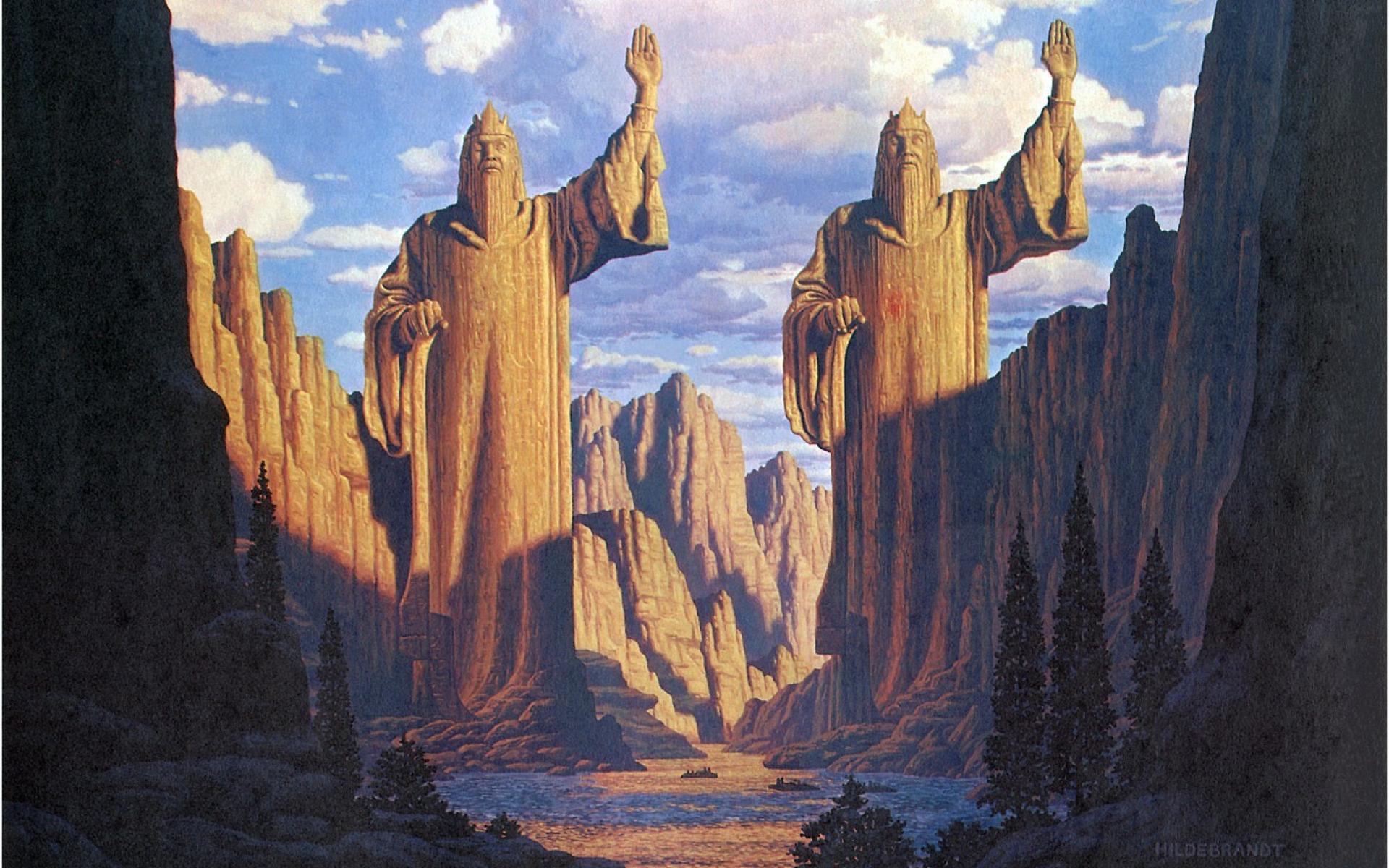
“The brief glow fell upon a huge sitting figure, still and solemn as the great stone kings of Argonath.  The years had gnawed it, and violent hands had maimed it.  Its head was gone, and in its place was set in mockery a round rough-hewn stone, rudely painted by savage hands in the likeness of a grinning face with one large red eye in the midst of its forehead.  Upon its knees and mighty chair, and all about the pedestal, were idle scrawls mixed with the foul symbols that the maggot-folk of Mordor used.” (The Two Towers, Book Four, Chapter 7, “Journey to the Cross-Roads”)

If Tolkien could visit the same area over which both sides struggled in the summer of 1916, instead of endless blight—

he would see, among the overgrown trenches,

and the still-discovered remains of century-old bombardments,

this—

and perhaps, in hopes of a world more like the latter, he would add to that description of the maimed king:

“Suddenly, caught by the level beams, Frodo saw the old king’s head:  it was lying rolled away by the roadside.  ‘Look, Sam!’ he cried, startled into speech.  ‘Look!  The king has got a crown again!’

The eyes were hollow and the carven beard was broken, but above the high stern forehead there was a coronal of silver and gold.  A trailing plant with flowers like small white stars had bound itself across the brows as if in reverence for the fallen king, and in the crevices of his stony hair yellow stonecrop gleamed.

‘They cannot conquer for ever!’ said Frodo.” (The Two Towers, Book Four, Chapter 7, “Journey to the Cross-Roads”)

Thanks, as always, for reading.

Stay well,

Mistrust guides with ulterior motives,

And know that, as ever, there’s

MTCIDC

O

Gondor, Angria, Gondal, and Boxen

As ever, dear readers, welcome.

I suspect that anyone who has spent any time with Tolkien has probably seen this passage:

“The ‘stories’ were made rather to provide a world for the languages than the reverse.  To me a name comes first and the story follows.” (letter to Houghton Mifflin, 30 June, 1955—with a rather complicated history—see Letters 219 for the quotation and 218 for an explanation)

As a rather sceptical person, I’ve always then looked at the extensive appendices to my copy of The Lord of the Rings,

which cover pages 1033-1138, and then at the many volumes subsequently edited and published by Christopher Tolkien,

and thought, “That’s an awful lot of ‘story’ for the bits and pieces of Elvish, Dwarfish, and even Black Speech, which are to be found there.”

And so I wondered if JRRT, for all of his language passion, hadn’t also a passion for world-creating and was somehow misrepresenting himself and his creativity.  As a young grown-up, he certainly once had large plans, as he explained in this 1951 letter to Milton Waldman:

“But once upon a time (my crest has long since fallen) I had a mind to make a body of more or less connected legend, ranging from the large and cosmogonic, to the level of romantic fairy-story, the lesser drawing splendour from the vast backcloths…” (Letters, 144)

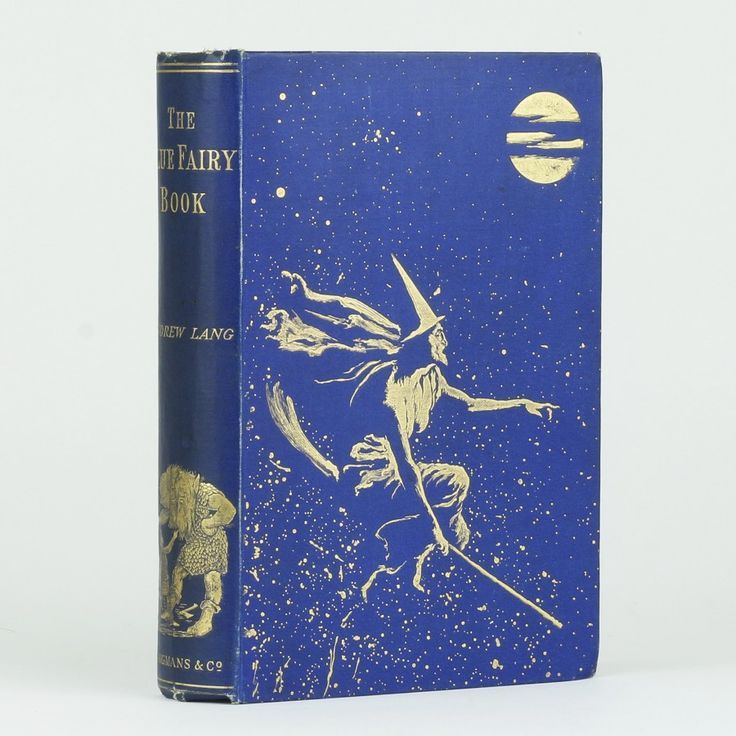
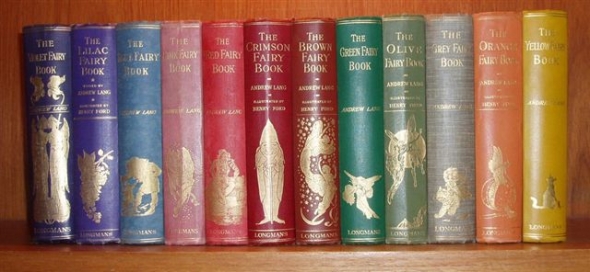
We know that, as a child, he was given those “fairy-stories”, from books like Andrew Lang’s The Red Fairy Book (1890),

and it’s clear that he once even tried his hand at writing such a story:

“I first tried to write a story when I was about seven.  It was about a dragon.  I remember nothing about it except a philological fact.  My mother said nothing about the dragon, but pointed out that one could not say ‘a green great dragon’, but had to say ‘a great green dragon’.  I wondered why, and still do.  The fact that I remember this is possibly significant, as I do not think I ever tried to write a story again for many years…”  (letter of 7 June, 1955, to W.H. Auden, Letters, 214)

(This lovely beast is by “Deskridge”—that’s Daniel Eskridge–at Deviant Art—I couldn’t resist including it.  If you’d like to see more of his work, you can find it at: https://daniel-eskridge.pixels.com/featured/green-dragon-daniel-eskridge.html  )

When he took up story telling again, however, it was, by his own account “Say 1912 to 1913.”, when he was a student at Oxford.

(He’s easy to spot, isn’t he?  In the far back, clinging to that rather elderly vine.)

And, to my sceptical mind, the question was always, why?

After all, in contrast to JRRT’s one attempt at such things at seven, and then not again till his very late teens, early twenties, we have two literary families who began very early at world-building.

The first began in a rather bleak part of England in 1826

with a gift of wooden soldiers

by a priest father

to his son

and his three daughters.

The soldiers became characters in a place first called “Glasstown”, then the “Glasstown Confederacy” which was then extended by two of the four children, Branwell Bronte (1817-1848)

and his sister, Charlotte (1816-1855),

into the more complex world of “Angria”,

of which Charlotte has left us a series of short story accounts of some of its characters and events.

The two younger sisters, Anne (1820-1849)

and Emily (1818-1848)

were soon relegated to minor positions in this world and, in time, seceded, perhaps about 1834, creating their own world, Gondal.

(I found this recreation at the website of “Merricat Mulwray”, credited to “Bruce Poulsen”.  Here’s the website, should you like to read the attached essay:  https://merricatmulwray.com/2019/10/11/the-brontes-paracosm-gondal/ )

We appear to have much more about Angria, thanks to Charlotte, but some Gondal material survives, in bits and pieces, as well as in a series of poems by Emily, found in a manuscript and first printed in their original form in 1938.  (Some, heavily edited by Charlotte, had appeared earlier.)

The older children seem to have abandoned Angria with childhood, but Anne and Emily continued their creation into adulthood—here is a wonderful sketch, by Emily, of the two sisters at work in 1837.

Another literary pair, almost a century later, lived in a house in northern Ireland

which appears to have been piled high with books.  As one of a pair of children, C.S. Lewis (1898-1963)

described it in his autobiography, Surprised by Joy (1956:)

“There were books in the study, books in the drawing-room, books in the cloakroom, books (two deep) in the great bookcase on the landing, books in a bedroom, books piled as high as my shoulder in the cistern attic, books of all kinds reflecting every transient stage of my parents’ interests, books readable and unreadable, books suitable for children and books most emphatically not.” (quoted in Lewis and Lewis, Boxen, 348-349)

This was a world of rainy day reading, in a place where there were many rainy days, at a time when middle-class children like the Lewises,

were watched closely for signs of childhood illnesses and kept at home, just in case.  These two children, the older, Warren (1895-1973),

dubbed forever “Warnie” by his brother, and Clive, who, as a child renamed himself “Jack”, practically immured at times, read and read and began to evolve new worlds from what they found in books and their imaginations.  The initial result was Warnie’s “India” and Jack’s “Animal-Land”, which were then blended into the more comprehensive “Boxen”.  Characters and situations came from their reading and from the political world around them (this would have been in the years of rising international tension before the Great War of 1914-1918, in which both served, and when there was increasing debate over whether Ireland would have home rule, or continue to be governed from London) and the material eventually gathered and published in 1985

sometimes reads like a comic nightmare version of the sort of history from which Stephen Daedalus was trying to awaken in Ulysses—itself begun in 1907.   Perhaps one of my favorite characters combines a monarch at a time when virtually all of Europe was in the hands of royal families (many of them the descendants of Queen Victoria),

with a character from the world of Beatrix Potter,

to produce King Bunny.

(imagine his tam-o-shanter replaced with a crown)

Such childish creativity brings me back to that “green great dragon”.  It’s clear from the mass of later material that Tolkien had the ability to create worlds even more complex than Angria, Gondal, or Boxen:  why didn’t he begin to do so until his university days?  Perhaps because the Brontes had each other to bounce ideas off, as did the Lewises?  JRRT’s own brother, Hillary, is a shadowy figure, especially in contrast to the almost hyperactive and endlessly creative Brontes.  I wonder, however, if along with being on his own creatively, Tolkien also lacked the very stimulus to create such worlds with which I began this essay.  In my quotation, I left off what might be a crucial clue:

“The fact that I remember this [the green great dragon problem] is possibly significant, as I do not think I ever tried to write a story again for many years, and was taken up with language.”  (Italics mine)

Tolkien had already told Auden in that letter that:

“All this only as a background to the stories, though languages and names are for me inextricable from the stories.  They are and were so to speak an attempt to give a background or a world in which my impressions of linguistic taste could have a function.  The stories were comparatively late in coming.”

So, although the capacity for world-building was always there, something was lacking—and then it appeared:

“I mentioned Finnish, because that set the rocket off in story.  I was immensely attracted by something in the air of the Kalevala, even in Kirby’s poor translation…the beginning of the legendarium, of which the Trilogy is part (the conclusion), was in an attempt to reorganize some of the Kalevala, especially the tale of Kullervo the hapless, into a form of my own.”

The rocket went off,

Middle-earth began to appear, and sceptical I began to believe.

Thanks, as always, for reading.

Stay well,

Remember that Hillary built his own little world in his garden and orchard,

And know that, as ever, there’s

MTCIDC

O

Paws in Posting

Paws in Posting

Yesterday, melanoma finally took Minerva, the little Siberian cat.

 She was a quiet, sweet little person, who, when she was younger, used to sleep on the back of the couch where I often work, and I’d sometimes hear a cheerful prrrrr as I was typing.  She will be much missed.

In her memory, I was thinking what I might do and, as this is a literary kind of blog, I began to think about cats in books and poems I’ve read.

Cats, as far as is currently known, have been with us in the Western world since perhaps 7500BC—in other words, from the Neolithic Era–a complete cat burial being discovered, along with a human, on the island of Cyprus (here’s a really interesting article on the subject:  https://www.thearchaeologist.org/blog/neolithic-cat-burial-in-cyprus-the-oldest-known-evidence-of-cat-taming )

It used to be believed that the Egyptians were the original domesticators and it’s clear that, from everything from wall paintings

to large numbers of cat mummies

to numerous different goddesses with feline features like     

Mafdet,

and the best known, Bastet,

that cats were part of Egyptian daily life.  (For a fun article on feline divinities in Egypt see: http://www.landofpyramids.org/cat-goddesses.htm )

The first cat piece—a poem—which comes to mind, however is much later in time and is dedicated to his cat, Pangur Ban, “Pangur the White”, by the 9th-century AD Irish monk who owned her.  It appears in what is called the “Reichenauer Primer”, a collection of all sorts of information, like grammar texts and Latin hymns, but it also contains poems in Old Irish, including this one.  Here’s the page with “Pangur Ban” on the left-hand side, at the bottom. 

And here’s the first English translation, by Whitley Stokes and John Strachan, from 1903:

I and Pangur Bán, each of us two at his special art:
his mind at hunting (mice), my own mind is in my special craft.
I love to rest—better than any fame—at my booklet with diligent science:
not envious of me is Pangur Bán: he himself loves his childish art.
When we are—tale without tedium—in our house, we two alone,
we have—unlimited (is) feat-sport—something to which to apply our acuteness.
It is customary at times by feat of valour, that a mouse sticks in his net,
and for me there falls into my net a difficult dictum with hard meaning.
His eye, this glancing full one, he points against the wall-fence:
I myself against the keenness of science point my clear eye, though it is very feeble.
He is joyous with speedy going where a mouse sticks in his sharp-claw:
I too am joyous, where I understand a difficult dear question.
Though we are thus always, neither hinders the other:
each of us two likes his art, amuses himself alone.
He himself is the master of the work which he does every day:
while I am at my own work, (which is) to bring difficulty to clearness.

(This is a flat prose translation, but to give you a little flavor of the rhythm of the original, the opening goes roughly something like this—my own version–

I and Pangur Ban, my cat,

Each has craft which he is at—

To hunting mice he puts his mind

While bookish meaning’s what I find.)

I make a big hop here from the 9th century to the 18th, and what must have been a rather peculiar, but perhaps quite lovable man, the English poet, Christopher Smart (1722-1771).

His “cat work” is in a remarkable free verse poem, written between 1758 and 1763, which sat in manuscript

until its first publication, in 1939, under the odd title Rejoice in the Lamb:  A Song from Bedlam.  “Bedlam” is shorthand for a series of London-area asylums for the mentally disturbed, originally part of the medieval Priory of Our Lady of Bethlehem, and located at Bishopsgate, just beyond London’s wall. 

Here is its incarnation at the time of the composition of Smart’s poem.

Smart had, indeed, been committed to an asylum–not to this one, but rather to St Luke’s Hospital for Lunatics,

but the point was being clearly made by the editor, W.F. Stead, that this was a poem composed by someone possibly not in his right mind.  There is scholarly argument as to why Smart was in any asylum, but, luckily for us, he was not alone, as his cat, Jeoffry accompanied him and his observations of Jeoffry in the manuscript of Jubilate Agno (Smart’s title) form the basis of our second selection.  It’s a very long passage, so I’ll only include an excerpt, but point you to this website, where you will find the whole manuscript and all the lines about Jeoffry in Fragment B, 4:  https://www.pseudopodium.org/repress/jubilate/

“For I will consider my Cat Jeoffry.

For he is the servant of the Living God duly and daily serving him.

For at the first glance of the glory of God in the East he worships in his way.

For is this done by wreathing his body seven times round with elegant quickness.

For then he leaps up to catch the musk, which is the blessing of God upon his prayer.

For he rolls upon prank to work it in.

For having done duty and received blessing he begins to consider himself.

For this he performs in ten degrees.

For first he looks upon his fore-paws to see if they are clean.

For secondly he kicks up behind to clear away there.

For thirdly he works it upon stretch with the fore paws extended.

For fourthly he sharpens his paws by wood.

For fifthly he washes himself.

For Sixthly he rolls upon wash.

For Seventhly he fleas himself, that he may not be interrupted upon the beat.

For Eighthly he rubs himself against a post.

For Ninthly he looks up for his instructions.

For Tenthly he goes in quest of food.”

For me, there is a playfulness in this and in the other lines which suggests that, if Smart was mad, he still retained both a powerful mind and a great creativity, besides a deep affection for his cat, viewing him as much a fellow creature in the world as the anonymous Irish monk saw Pangur Ban.

But madness brings us to a third literary–Victorian–cat.

This is, of course, the Cheshire Cat from Lewis Carroll/C. L. Dodgson’s (1832-1898)

Alice’s Adventures in Wonderland (1865),

in which the cat makes several appearances, each time both mocking and disturbing.

“ The Cat only grinned when it saw
Alice. It looked good-natured, she
thought; still it had very long claws
and a great many teeth, so she felt that
it ought to be treated with respect.
‘Cheshire Puss,’ she began, rather timidly, as she did not at all know whether
it would like the name; however, it only grinned a little wider. ‘Come, it’s pleased
so far,’ thought Alice, and she went on, ‘would you tell me, please, which way
I ought to go from here?’
‘That depends a good deal on where you want to get to,’ said the Cat.
‘I don’t much care where – ’ said Alice.
‘Then it doesn’t matter which way you go,’ said the Cat.
‘ – so long as I get somewhere,’ Alice added as an explanation.
‘Oh, you’re sure to do that,’ said the Cat, ‘if you only walk long enough.’
Alice felt that this could not be
denied, so she tried another question,
‘What sort of people live about here?’
‘In that direction,’ the Cat said,
waving its right paw round, ‘lives
a Hatter; and in that direction,’ wav-
ing the other paw, ‘lives a March
Hare. Visit either you like: they’re
both mad.’
‘But I don’t want to go among mad people,’ Alice re-
marked.
‘Oh, you can’t help that,’ said the Cat, ‘we’re all mad
here. I’m mad. You’re mad.’
‘How do you know I’m mad?’ said Alice.
‘You must be,’ said the Cat, ‘or you wouldn’t have come
here.’
Alice didn’t think that proved it at all; however, she went
on, ‘And how do you know that you’re mad?’
‘To begin with,’ said the Cat, ‘a dog’s not mad. You
grant that?’
‘I suppose so,’ said Alice.
‘Well, then,’ the Cat went on, ‘you see, a dog growls when it’s angry, and wags
its tail when it’s pleased. Now I growl when I’m pleased, and wag my tail when
I’m angry. Therefore I’m mad.’
‘I call it purring, not growling,’ said Alice.
‘Call it what you like,’ said the Cat, ‘Do you play croquet with the Queen
to-day?’
‘I should like it very much,’ said Alice, ‘but I haven’t been invited yet.’
‘You’ll see me there,’ said the Cat and vanished.
Alice was not much surprised at this, she was getting so used to queer things
happening. While she was looking at the place where it had been, it suddenly
appeared again.
‘By-the-bye, what became of the baby?’ said the Cat, ‘I’d nearly forgotten to
ask.’
‘It turned into a pig,’ Alice quietly said, just as if it had come back in a natural
way.
‘I thought it would,’ said the Cat and vanished again.
Alice waited a little, half expecting to see it again, but it did not appear, and
after a minute or two she walked on in the direction in which the March Hare was
said to live. ‘I’ve seen hatters before,’ she said to herself, ‘the March Hare will be
much the most interesting, and perhaps as this is May it won’t be raving mad – at

least not so mad as it was in March.’ As she said this, she looked up, and there
was the Cat again, sitting on a branch of a tree.
‘Did you say pig or fig?’ said the Cat.
‘I said pig,’ replied Alice, ‘and I wish you wouldn’t keep appearing and van-
ishing so suddenly: you make one quite giddy.’
‘All right,’ said the Cat; and this
time it vanished quite slowly, begin-
ning with the end of the tail, and
ending with the grin which remained
some time after the rest of it had gone.
‘Well! I’ve often seen a cat with-
out a grin,’ thought Alice, ‘but a grin
without a cat! It’s the most curious
thing I ever saw in my life!’ “

(Apologies for the odd placement on the page—I had hoped to include the illustrations, which are set into the text, but I’m afraid that my cut-and-paste appears to have been heavier on the cut than the paste!  Here’s a LINK, by the way, to a painstaking digital version of that first, 1865 edition:  https://www.adobe.com/be_en/active-use/pdf/Alice_in_Wonderland.pdf )

If we jump from the Victorians to the 20th century, there are lots of possibilities:

George Herriman’s (1880-1944)           

surreal Krazy Kat comic strip from 1913 to 1944

or Don Marquis’ (1878-1937) 

newspaper column chronicle from 1916 to the 1930s of the free-verse poet–and cockroach–Archy and his girlfriend, Mehitabel, the cat, a reincarnation of Cleopatra.

We might even include T.S. Eliot’s (1888-1965)

Old Possum’s Book of Practical Cats (1939),

but I want to end with one more item from the 20th century.  It’s a remark of Gandalf’s about Aragorn, which I hope will be true as well of Minerva, as she finds her way perhaps to the goddess Bastet and a new rebirth:

“He will not go astray—if there is any path to find.  He has led us in here against our fears, but he will lead us out again, at whatever cost to himself.  He is surer of finding the way home in a blind night than the cats of Queen Beruthiel.” (The Fellowship of the Ring, Book Two, Chapter 4, “A Journey in the Dark”)

As ever, thanks for reading.

Stay well,

Remember that all cats are not, indeed, grey, in the dark,

And know, as well, that there will be

MTCIDC,

O

Sci-Fi

As always, dear readers, welcome.

In my last, I was discussing Tolkien’s

reading as mentioned in his comments to the draft of an interview with him in The Daily Telegraph Magazine for 22 March, 1958.

In a footnote to his comments, JRRT mentions that he particularly enjoyed the historical novels of “Mary Renault” (her pen name–she was actually Eileen Mary Challans, 1905-1983).

Tolkien began by writing:

“I read quite a lot—or more truly, try to read many books.”

and then adds in parentheses:  “(notably so-called Science Fiction and Fantasy)”, which he footnotes as “I enjoy the S.F. of Isaac Azimov.” (from Letters, 377—excerpts from all of his comments appear on pages 372-378)

Isaac Asimov (the correct spelling–1920-1992),

was actually Dr. Isaac Asimov, Professor of Biochemistry at Boston University, but also the author numerous novels, in particular three series,

Foundation (1951-1993),

Galactic Empire (1950-1952)

and Robot (1954-1985)

over 380 short stories, as well as other works. 

As Tolkien isn’t specific, and Asimov was prolific, it’s probably impossible to know, at the present time, which books by Asimov Tolkien enjoyed.  I find it a little odd, however, that, when he mentions Science Fiction, JRRT doesn’t include the work of his friend and encourager, C.S. Lewis (1898-1963),

who, between 1938 and 1945, produced his own trilogy:  Out of the Silent Planet (1938), Perelandra (1943), and That Hideous Strength (1945).

As well, although Tolkien wasn’t specific in his mention of Asimov, Lewis has given us a few clues to his Science Fiction reading in an essay, “On Science Fiction”, which appears in the posthumous collection Of Other Worlds (1966) (Here’s a LINK to your own copy:  https://www.catholicculture.org/culture/library/view.cfm?recnum=9116 )

For me, Lewis is the kind of writer with whom you may disagree but, because he never writes anything without quiet wit and deep thoughtfulness, you read because you may disagree and therefore can learn more about what you know—or think you do.

In this essay, Lewis makes distinctions among subgenres, mentioning

1. novels set in the future—and he further subdivides those into

 a. works which are imaginatively set in time to come, in which differences from the present are important to the narrative (and he condemns the author who, having presented a future as a backdrop, “then proceeds to develop an ordinary love-story, spy-story, wreck-story, or crime-story”, suggesting that such writers are “Displaced Persons—commercial authors who did not really want to write science fiction at all, but who availed themselves of its popularity by giving a veneer of science fiction to their normal kind of work”)

 b. works which are “satiric or prophetic”, using that future to reflect upon the consequences of present actions

2. that which Lewis calls “the fiction of Engineers”, explaining:

It is written by people who are primarily interested in space‑travel, or in other undiscovered techniques, as real possibilities in the actual universe. They give us in imaginative form their guesses as to how the thing might be done.”

3. a third whose motive Lewis is at some pains to describe, the essence being that the author, living in a world in which elements like science and exploration have removed the marvelous from the everyday around us, employs fiction to take readers to places of wonder or terror.  As he puts it:

 It is not difficult to see why those who wish to visit strange regions in search of such beauty, awe, or terror as the actual world does not supply have increasingly been driven to other planets or other stars. It is the result of increasing geographical knowledge. The less known the real world is, the more plausibly your marvels can be located near at hand. As the area of knowledge spreads, you need to go further afield: like a man moving his house further and further out into the country as the new building estates catch him up. Thus in Grimm’s Märchen, stories told by peasants in wooded country, you need only walk an hour’s journey into the next forest to find a home for your witch or ogre.”

Lewis then subdivides this genre, although confessing that:

But here sub-species and sub-sub-species break out in baffling multitude. The impossible—or things so immensely improbable that they have, imaginatively, the same status as the impossible—can be used in literature for many different purposes.”

Those purposes might include:

 a. “It may represent the intellect, almost completely free from emotion, at play.

 b. “the impossible may be simply a postulate to liberate farcical consequences

 c. “Sometimes it is a postulate which liberates consequences very far from comic

4. “Eschatological”—“This kind gives an imaginative vehicle to speculations about the ultimate destiny of  our species.

So far, these subgenres are clearly defined.  The last Lewis discusses seems more impressionistic. 

5. “in the next type (and the last I shall deal with) the marvelous is in the grain of the whole work. We are, throughout, in another world. What makes that world valuable is not, of course, mere multiplication of the marvelous either for comic effect… or for mere astonishment… but its quality, its flavor. If good novels are comments on life, good stories of this sort (which are very much rarer) are actual additions to life; they give, like certain rare dreams, sensations we never had before, and enlarge our conception of the range of possible experience.

But when he begins to list works which, to his mind, fit this category, the essay might better have been called “Fantasy/Science Fiction”, since the list includes works like The Odyssey,  “The Rime of the Ancient Mariner”, and even The Lord of the Rings.  There are a certain number of actual Science Fiction works scattered throughout the essay, however, and, as one, David Lindsay’s (1876-1945)

A Voyage to Arcturus (1920)

JRRT once wrote that he had read “with avidity” (Letters, 34), we might imagine at least some of the others might have appeared on Tolkien’s shelves or at least on his library card.  Here’s a list in the order the books (and occasional short story or novella) appear in the text (more or less—I group more than one work by the same author together—I’ve also included LINKS to any work out of copyright):

John Collier (1901-1980), Tom’s A-Cold (1933)

George Orwell (Eric Blair) (1903-1950), Nineteen Eighty-four (1949)

Aldous Huxley (1894-1963), Brave New World (1932)

Jules Verne (1828-1905), Twenty Thousand Leagues Under the Sea (1869-70)  https://www.gutenberg.org/files/2488/2488-h/2488-h.htm

Arthur C. Clarke (1917-2008), Prelude to Space (1951); Childhood’s End (1953)

H.G. Wells (1866-1946), “The Land Ironclads” (1903) (https://gutenberg.net.au/ebooks06/0604041h.html ); The Sleeper Awakes (1899/1910) (https://ia902606.us.archive.org/26/items/sleeperawakes00welluoft/sleeperawakes00welluoft.pdf ) ; The Time Machine (1895) (https://archive.org/details/ost-english-timemachineinven00welluoft )  ; The First Men in the Moon (1901) (https://www.gutenberg.org/ebooks/1013 )

Olaf Stapledon (1886-1950), Last and First Men (1930)

Edwin Abbott Abbott (1808-1882), Flatland (1884)   (https://archive.org/details/flatlandromanceo00abbouoft )

Charles Williams (1886-1945), Many Dimensions (1931)

W.H. Hodgson (1877-1918), The Night Land (1912)     ( https://gutenberg.org/ebooks/10662  )   ,

“Ray Bradbury’s stories” (unspecified)

If you take these as “recommended by Lewis” and you haven’t read some, or even any of them, why not start at the top and read all the way down?  Here’s a great place to do it–

And thanks, as always, for reading this.

Stay well,

Remember—use bookmarks—no dog-earing!

And know that, as ever, there’s

MTCIDC

O

Fan Mail

As ever, dear readers, welcome.

In the March 22, 1968 issue of The Daily Telegraph Magazine, you will find an interview with Tolkien.

It’s not a very good piece—being very much of its time:  surface-y and obviously desperate to sound “hip”–but with a few interesting quotations from JRRT.  (Here’s a reprint from a later issue—2015–so that you can read it and judge for yourself:  https://www.telegraph.co.uk/books/authors/tolkien-interview-its-easier-to-film-the-odyssey/ )  What I find much more interesting are Tolkien’s original comments on the draft of the interview, which you will find on pages 372-378 of Carpenter’s The Letters of J.R.R. Tolkien.

It’s clear from Tolkien’s comments that in 1967, when the interview was conducted, he was not a happy man.  As he says, referring to his current home, but easily read as a broader statement:

“I am caught here in acute discomfort; but the dislocation of a removal and the rearrangement of my effects cannot be contemplated, until I have completed my contracted work.  When and if I do so, if I am still in health, I hope to go away to an address that will appear in no directory or reference book.”  (Letters, 373)

Among those comments is this:

“I read quite a lot—or more truly, try to read many books…But I seldom find any modern books that hold my attention.”

To which he added this footnote:

“Above these [other works], I was recently deeply engaged in the books of Mary Renault; especially the two about Theseus, The King Must Die, and The Bull from the Sea.”

Mary Renault (1905-1983),

who was actually Eileen Mary Challans, was originally a writer of contemporary fiction, but who, from 1956 to 1981, produced a series of historical novels set in the classical Greek past, both mythical, as in the two books mentioned by Tolkien, and historical, with volumes in which Socrates, Plato, the 6th-century poet Simonides, and Alexander the Great appear.

Although I enjoy them all, my personal favorites of these are The Mask of Apollo (1966),

which recreates the world of early Greek drama, and The Praise Singer (1978),

which follows the life of the ancient Greek poet, Simonides of Keos (c.556-468BC).

Historical novels in English literature might be said to stretch all the way back to writers like Thomas Malory (c.1415-1471), with La Morte d’Arthur,

(This is a page from Caxton’s original edition of 1485)

or maybe to Horace Walpole’s (1717-1797)

(with his crazily wonderful “castle”, Strawberry Hill, in the background)

 pre-Romantic “gothic story” of The Castle of Otranto (1764),

but perhaps a firmer claim might be that of Jane Porter (1776-1850)’s

extremely popular novel of 1810, The Scottish Chiefs about the life of the Scottish independence fighter, William Wallace (c1270-1305), a caricatured version of which appears in M Gibson’s Braveheart.  (If you’re a fan of this movie, I apologize for what I hope is unaccustomed harshness, but the actual Wallace was a southern Scottish knight, who didn’t wear kilts or paint his face blue and would have been very surprised to see himself so depicted.)

(the first American edition of 1812)

And I can’t resist adding the 1921 edition,

with illustrations by N.C. Wyeth (1882-1945), for those very illustrations.  Here are the endpapers, just to give you an idea–      

Here’s the LINK so that you can own your own copy:  https://archive.org/details/scottishchiefs00port/page/n3/mode/2up

As the Porter novel was published in 1810, it actually pre-dated Sir Walter Scott’s (1771-1832)

1814 novel, Waverley,

with its complex and dramatic story of the last Jacobite rebellion of 1745-46,

although I would bet that Scott, probably now not read outside specialty English courses, is, at present, the better-known.

Scott’s succeeding historical novels, in fact, seemed to have opened the proverbial flood gates, even inspiring beginning authors from across the ocean as, only seven years after Waverley, James Fenimore Cooper (1789-1851),

produced the first successful American historical novel, The Spy, set during the American Revolution,

beginning a career which would make him wealthy and well-known, not only in the US, but in Europe, as well. 

And, beyond Cooper, there was a full century of historical fiction, including authors like George Eliot, Charles Dickens, Robert Louis Stevenson, and Arthur Conan Doyle, as well as a host of people who are now only names, at best.

(For an interesting, but too short, piece on the multitude of such authors, see: https://www.oxfordbibliographies.com/view/document/obo-9780199799558/obo-9780199799558-0098.xml   )
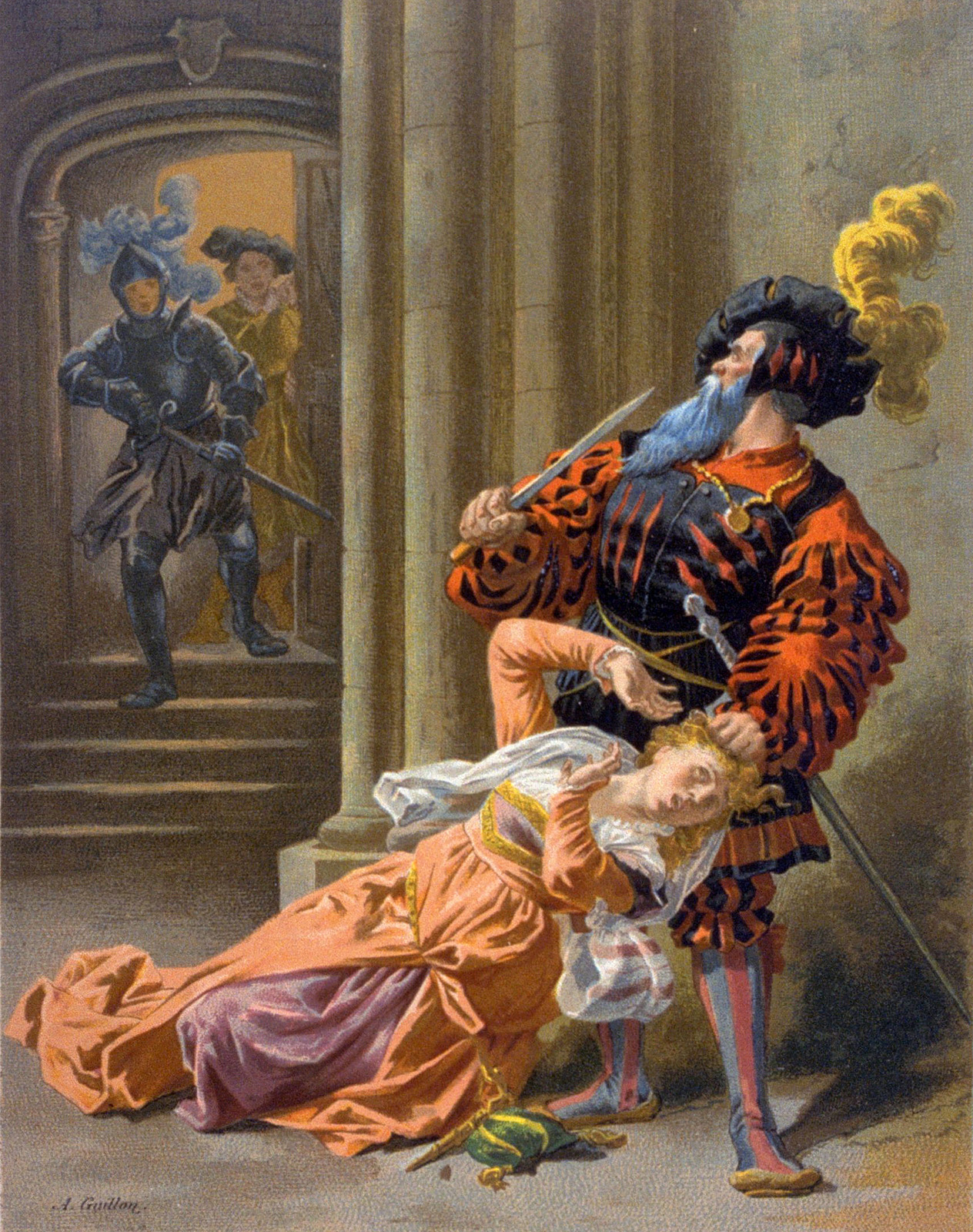
With the 20th century, the number of books set in the past—whether Robert Graves’ Julio-Claudian Rome or Kenneth Roberts’ 18th-century America, among nearly-countless others, can appear quite overwhelming and this leads me back to Tolkien’s quotation:  “I read quite a lot—or more truly, try to read many books…But I seldom find any modern books that hold my attention.”

His explanation for this combines being “under ‘inner’ pressure to complete my own work—and because [as he states in the interview] ‘I am looking for something I can’t find.’ “

And yet he could be “deeply engaged in the books of Mary Renault”. 

He provides no explanation for this.  We might guess that in the two Theseus novels, Renault depicts a troubled hero in a world of myth and speculate about Frodo as another such figure, but, that is just that, a guess.

And yet there is one more bit of the Tolkien quotation which I haven’t cited.

In the interview published in 1968, there is this:

“Any hobbit would trust this man, any dragon quail before him, any elf name him friend.  Effortlessly, he compels you to admire as much as–and herein lies his charm–he clearly admires himself.”

In his comments on the manuscript draft of the interview, just after his mentioning his engagement with novels by Renault, Tolkien adds:

“A few days ago I actually received a card of appreciation from her; perhaps the piece of ‘Fan-mail’ that gives me most pleasure.”

Might we say that, along with the solid literary pleasure of The King Must Die and The Bull from the Sea, there was the added pleasure that he was admiring the work of someone who admired his work?

Thanks for reading, as always.

Stay well,

Remember that you, too, are in history,

And know that, as ever, there’s

MTCIDC

O

Marcho and Hengist and… Romulus?

As ever, dear readers, welcome.

At the end of the 4th century AD, the westernmost Roman province, Britannia, was in serious trouble.

Founded after a long conquest in the 1st century AD,

it had gradually become stable, in part because there were Roman military outposts throughout the province,

not to mention the 90 miles of wall which separated the province from its not always friendly neighbors to the north.

Stability—as well as security—came with the garrisons of such places, however,

and, late in the 4th century, these were being withdrawn.

It had really started with Magnus Maximus (c.335-388AD),

a general who would become emperor of the West in 383AD, in part with the aid of troops which he had withdrawn from those garrisons.

A second would-be emperor, who called himself “Constantine III” (?-411AD),

drew even further upon the troops in Britain in 406AD, seemingly pulling out the last of the regulars.

Britannia had already been suffering from coastal raids by pirates and Germanic peoples and the later Roman government had constructed a number of coastal defenses, the so-called “Saxon Shore Forts”,

but, without those troops, Britannia was about to be on her own when it came to defense.  The last straw came about 410AD, when the Western emperor, Honorius (384-423AD),

sent a letter (an “imperial rescript”), which appears to reply to an appeal by the province for help, in which he addressed the leaders of the cities (he calls them “civitates”)–rather than his own government’s officials, which looks like a bad sign–telling them that they need to take up arms themselves, implying that no imperial soldiers will be sent.

This, and what came before it, plunged Britannia into an era of raids from several directions,

including Ireland,

the north of England,

and Germanic tribesmen from the east.

Amidst this chaos, we have mention of a local king, Vortigern, who, with the idea of “set a thief to catch a thief” hired some Germanic invaders who’ve been living on coast to add muscle to his own fighters.

These mercenaries were led by two brothers, called “Hengist” and “Horsa”

and Vortigern soon regretted his offer, as Hengist and Horsa sent for their relatives from across the North Sea and, within a few years, southern and central Britain were overrun with Germanic peoples.

Magnus Maximus, Constantius III, and Honorius were real people, from the historical record.  Vortigern, Hengist, and Horsa are from a very murky period in early British history and may be nothing more than a way to explain the explosion of Germanic colonization of southern Britain in the next couple of centuries.

In Tolkien commentaries, Hengist and Horsa and their part in Germanicizing Britain are often equated with this:

“About this time legend among the Hobbits first becomes history with a reckoning of years.  For it was in the one thousand six hundred and first year of the Third Age that the Fallohide brothers, Marcho and Blanco, set out from Bree; and having obtained permission from the high king at Fornost, they crossed the brown river Baranduin with a great following of Hobbits.  They passed over the Bridge of Stonebows…and they took all the land beyond to dwell in, between the river and the Far Downs.” (The Lord of the Rings, Prologue, I, “Concerning Hobbits”)

This was, of course, the founding of the Shire

and thus, it is suggested, Marcho and Blanco equal Hengist and Horsa, two sets of brothers involved in creating new settlements—but I’m not so sure.

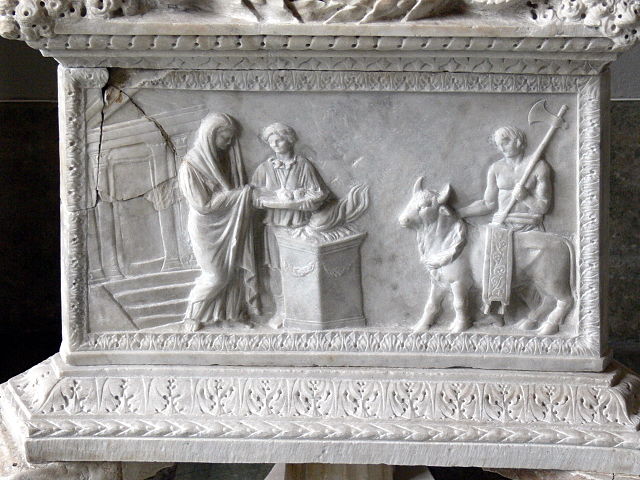
That JRRT associated the Hobbits with the mercenaries is possible, of course—after all, Tolkien would certainly have been well aware of early British history, but I would add another possible duo, one of which he had known since his first days studying Latin at King Edward’s School in Birmingham:  the founders of Rome, Romulus and Remus.

If you’re not familiar with their story, in brief it goes like this:

Their mother was a priestess, Rhea Silvia, and their father may have been the Roman war god, Mars.

Their grandfather, Numitor, had been the king of Alba Longa, the forerunner of Rome, but had been forced out of power by his brother, Amulius.  When his grandnephews, Romulus and Remus were born, Amulius saw them as a potential threat, and so he had them put into a basket and dropped into the Tiber, thus—or so he hoped—removing the kin blood guilt he would have suffered had he killed them himself.

The god of the Tiber, however, was on the side of the family of the rightful king, and the basket was washed ashore, where the twins were adopted by a local she wolf.

They were then discovered by a local shepherd and raised among the flocks, only to be discovered, in time, as the missing princes.  Their wicked great uncle was overthrown and their grandfather was restored to the throne, but the restless boys, instead of waiting to inherit the throne, set out to found their own city.  They later quarreled and Romulus killed Remus,

and so Romulus alone was the builder of Rome.

But why add Romulus and Remus to this foundation myth?

The land which became the Shire, although part of the northern realm of Gondor, was abandoned when the Hobbits arrived, empty of all people, although the East Road and the Great Bridge survived and were still in use (part of the King’s grant to the Hobbits had included the obligation of keeping them in repair—The Lord of the Rings, Prologue I, “Concerning Hobbits”).  Romulus and Remus, like the Hobbit brothers, left the inhabited part of Latium and their grandfather’s city, just as the Hobbits left Bree, to create a new settlement on empty land.  (For more on this, see Livy, Ab Urbe Condita, Book 1, Sections 3-7—here’s a LINK so that you can refer to it yourself:  https://www.perseus.tufts.edu/hopper/text?doc=Perseus%3Atext%3A1999.02.0151%3Abook%3D1%3Achapter%3D3 )  Thus, like Marcho and Blanco, Romulus and Remus were founders, characters Tolkien would have known about from his early teens.

In contrast, Hengist and Horsa were leaders of a violent invasion of land which had been settled long before the Roman arrival in 43BC and still was, in the early 5th century, AD.  They were conquerors, then, not founders, and thus perhaps less likely models.  So far as I know, however—at least from the Letters—JRRT makes no connection between the Hobbits and the Germanic invaders or the proto-Roman twins, so perhaps we can imagine both as (rather distant) models for the founders of the Shire?

Thanks, as always, for reading,

Stay well,

Be careful whom you invite to help you with invaders,

And

Know that there’s always

MTCIDC

O

Ringing False (3)

Saruman

although he declares himself “Saruman the Wise, Saruman Ring-maker, Saruman of Many Colours!” (The Fellowship of the Ring, Book Two, Chapter 2, “The Council of Elrond”)

is not so wise as he thinks.  In his lust for the Ring, he has made a number of mistakes.  In one conversation with Gandalf, he has:

1. revealed a deep jealousy of his fellow Maia, saying scornfully, “…one so cunning and so wise, wandering about the lands, and concerning himself in every business, whether it belongs to him or not.”

2. mocked a second Maia, Radagast, as “the Bird-tamer, Radagast the Simple!  Radagast the Fool!”

3. laid bare his own desire not just to provide counsel for the people of Middle-earth against Sauron which was the purpose for which he had been sent there, but to control them:  “…but our time is at hand:  the world of Men, which we must rule.  But we must have power, power to order all things as we will, for that good which only the Wise can see.”

4. made clear that he is not only in contact with Sauron, but admires and fears him:  “A new Power is rising.  Against it the old allies and policies will not avail us at all.  There is no hope left in Elves or dying Numenor.  This then is one choice before you, before us.  We may join with that Power.  It would be wise, Gandalf.  There is hope that way.  Its victory is at hand; and there will be rich reward for those that aided it.”

5. given away the fact that he has been spying on the Shire:  “For I have many eyes in my service, and I believe that you know where this precious thing now lies.  Is it not so?  Or why do the Nine ask for the Shire, and what is your business there?”

And, in admitting to his suspicion that the Ring may be somehow tied to the Shire, Saruman also admits to his own desire for the Ring:  “Why not?  The Ruling Ring?  If we could command that, then the Power would pass to us.”

Welcome, dear readers, as ever.

In the last two postings, I’ve been playing a game which historians and fantasy/sci-fi writers call “What If?”

In this game, they take a known situation:  that, for instance, the Nazis never invaded England, but, in Len Deighton’s (1929-) 1978 novel,

 SS-GB,

they now occupy the country. 

Now we’ve come to “What if Saruman got the Ring?”

It’s interesting that Saruman has already so strongly identified himself with Sauron that he’s called himself “Ring-maker” and, as Gandalf has noticed, “He wore a ring on his finger.”   What Saruman hasn’t realized, however, is that Sauron is well aware of Saruman’s thoughts on the subject of becoming the new Sauron, even without the Ring, as is evident in the speech of Sauron’s Orc captain, Grishnakh.   He has been arguing with Saruman’s Uruk-hai leader, Ugluk, on what’s best to do with Merry and Pippin.  Ugluk has tried to take command, saying, “We are the servants of Saruman the Wise, the White Hand…”  Grishnakh then makes a very interesting reply:

“You have spoken more than enough, Ugluk…I wonder how they would like it in Lugburz [the Barad-dur]…They might ask where his strange ideas came from.  Did they come from Saruman, perhaps?  Who does he think he is, setting up on his own with his filthy white badges?  They might agree with me, with Grishnakh their trusted messenger; and I Grishnakh say this:  Saruman is a fool, and a dirty treacherous fool.  But the Great Eye is on him.”  (The Two Towers, Book Three,  Chapter 3, “The Uruk-hai”)

That Great Eye is more than on him—Saruman is also unaware that he’s being manipulated by Sauron through the Orthanc Palantir

as we hear in that conversation which so reveals his true self and intent to Gandalf.  Is he really speaking for himself when he launches into what he believes is a logical laying-out of the path both he and Gandalf should take?   As Gandalf describes him:

“He drew himself up then and began to declaim, as if he were making a speech long rehearsed.  ‘The Elder Days are gone.  The Middle Days are passing.  The Younger Days are beginning.  The time of the Elves is over, but our time is at hand:  the world of Men, which we must rule.  But we must have power, power to order all things as we will, for that good which only the Wise can see.’ “

Elrond has said that the Ring can only be wielded by one with great power already, but that “It belongs to Sauron and was made by him alone, and is altogether evil…The very desire of it corrupts the heart.  Consider Saruman.  If any of the Wise should with this Ring overthrow the Lord of Mordor, using his own arts, he would then set himself up on Sauron’s throne, and yet another Dark Lord would appear.” (The Fellowship of the Ring, Book Two, Chapter 2, “The Council of Elrond”)

And it’s clear that this is Saruman’s plan, even as he tries to persuade Gandalf to join him, sharing joint custody of the Ring, to which Gandalf wisely replies:

“Saruman…only one hand at a time can wield the One, and you know that well, so do not trouble to say we.”

Saruman is, unknowingly, already corrupt and much less in control than he believes and I wonder if, once he had the Ring, a winged Nazgul would appear and soon either his head and/or the Ring would be on its way to its true master in Lugburz.

Immune to Saruman’s combination of wheedling and threats, Gandalf has refused either to join Saruman or confirm his suspicions about the Ring, declaring, “But I would not give it, nay, I would not give even news of it to you, now that I learn your mind.  You were head of the White Council, but you have unmasked yourself at last.”

And, when offered the Ring himself by Frodo,

his reaction is the very opposite of what we might expect of Saruman’s—and here we see the answer to “What if Gandalf got the Ring?”:

“ ‘No!’ cried Gandalf, springing to his feet.  ‘With that power I should have power too great and terrible.  And over me the Ring would gain a power still greater and more deadly.’  His eyes flashed and his face was as if lit by a fire within.  ‘Do not tempt me!  For I do not wish to become like the Dark Lord himself.” (The Fellowship of the Ring, Book One, Chapter 2, “The Shadow of the Past”)

Saruman would gladly grasp the Ring so that he—and Gandalf, perhaps, at this point, since Saruman is still unsure of Gandalf’s response—would achieve “the high and ultimate purpose:  Knowledge, Rule, Order; all the things that we have so far striven in vain to accomplish…There need not be, there would not be, any real change in our designs, only in our means.”  Or so he says.  In fact, his “high and ultimate purpose” is sheer mastery:  “Why not?  The Ruling Ring?  If we could command that, then the Power would pass to us.”

In contrast, Gandalf refuses the Ring because “…the way of the Ring to my heart is by pity, pity for weakness and a desire to do good.” 

And Galadriel’s rejection is much like Gandalf’s:

“ ‘…You will give me the Ring freely!  In place of the Dark Lord you will set up a Queen.  And I shall not be dark, but beautiful and terrible as the Morning and the Night!  Fair as the Sea and the Sun and the Snow upon the Mountain!  Dreadful as the Storm and the Lightning!  Stronger than the foundations of the earth.  All shall love me and despair!’

She lifted up her hand and from the ring that she wore there issued a great light that illumined her alone and left all else dark…Then she let her hand fall, and the light faded, and suddenly she laughed again, and lo! She was shrunken:  a slender elf-woman, clad in simple white, whose gentle voice was soft and sad.

‘I pass the test,’ she said.  ‘I will diminish, and go into the West, and remain Galadriel.’ “ (The Fellowship of the Ring, Book Two, Chapter 7, “The Mirror of Galadriel”)

Galadriel has already had her own “What if?”, telling Frodo:

“I do not deny that my heart has greatly desired to ask what you offer.  For many long years I had pondered what I might do, should the Great Ring come into my hands, and behold!  It was brought within my grasp.”

But she, like Gandalf, and like Elrond, knows that Sauron’s Ring is nothing more than a kind of poison, offering power, but taking control and corrupting as it does so.  As she says:  “The evil that was devised long ago works on in many ways, whether Sauron himself stands or falls.”

I began this little series with Faramir’s rejection of the Ring, even though he was unsure of what exactly it was:

“I would not take this thing, if it lay by the highway.  Not were Minas Tirith falling in ruin and I alone could save her, so, using the weapon of the Dark Lord for her good and my glory.  No, I do not wish for such triumphs, Frodo son of Drogo.” (The Two Towers, Book Four, Chapter 5, “The Window on the West”)

Bilbo, with Gandalf’s help, let the Ring go.  Frodo tried to give it to both Gandalf and Galadriel, and each refused.  Saruman coveted it, but probably could never have kept it, at the best surrendering it to its rightful owner, at the worst ruined and driven mad, like Gollum, and still losing it in the end, just as Gollum did.  I would like, however, to add perhaps the oddest possible recipient to this list, Tom Bombadil.

Early in the story, after Tom has rescued them from Old Man Willow, he suddenly asks to see the Ring and Frodo, to his own surprise, immediately hands it to him.  And, although Frodo is a little miffed by it, Tom’s reaction is to clown with it, peeking through it, putting it on and not disappearing, even doing a little disappearing trick with it, all of which confirms something Gandalf will later say, when it’s suggested that the Ring be sent to him for safe-keeping:

“Say rather that the Ring has no power over him.  He is his own master…And if he were given the Ring, he would soon forget it, or most likely throw it away.  Such things have no hold on his mind.” (The Fellowship of the Ring, Book Two, Chapter 2, “The Council of Elrond”)

It’s never clear why the Ring has no power over Tom, and a “What if?” would clearly only end in disaster, but I’ve included him because of that last remark:  “Such things have no hold on his mind.”  On the minds of good characters and bad, with Tom as the one exception, the Ring has a hold and that strong attraction lies at the center of the story, making a game of “What if?” possible.  And that’s one reason why “What if” is a good game to play.  We know what actually happens, of course, but, when we suppose different outcomes, we can gain a clearer sense of why it happens.  On the one hand, it shows us the protagonists as deeply thoughtful people, more concerned for those around them than their own power—with the strong exception of Saruman.  On the other, it points up the terrible power of the Ring that Frodo a good person, at the last minute of dropping the Ring into the Cracks of Doom, suddenly seems much closer to the Ring’s maker than to the Hobbit who has barely survived a terrible quest to erase the very thing he now declines to destroy.

As always, thanks for reading,

Stay well,

Look for yellow boots if you’re lost in the forest,

And know that, as ever, there’s

MTCIDC

O