Many Happy Returns (II)

Welcome, dear readers, as always.

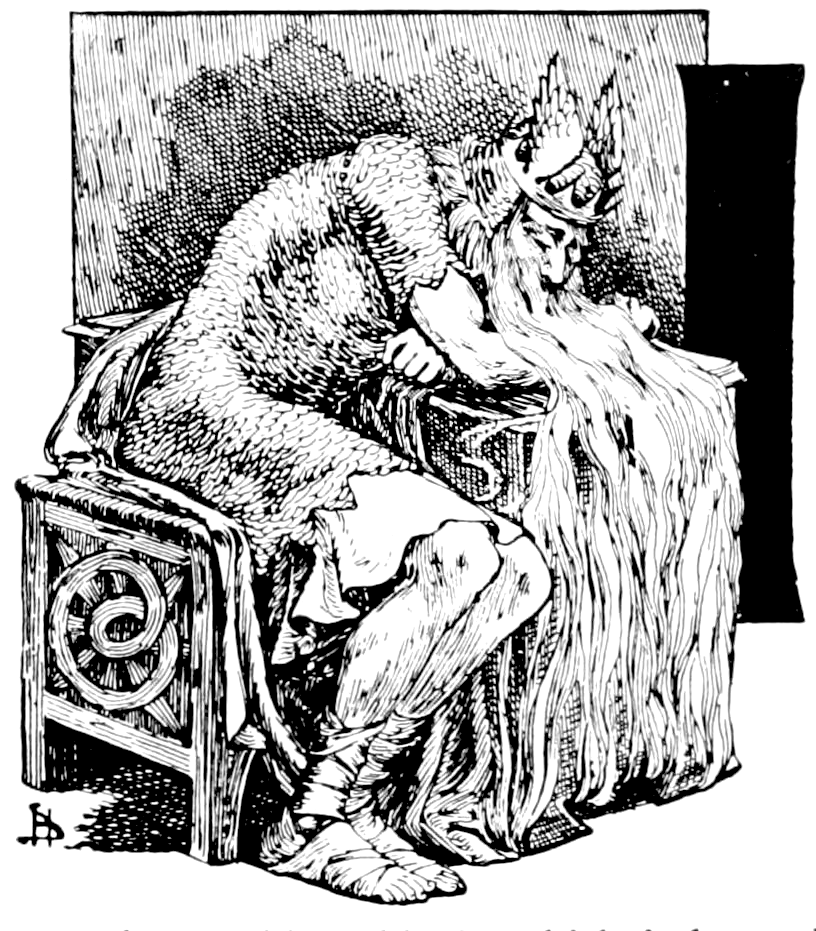
In the previous posting, I began to discuss a common folktale motif, called “The Kyffhaeuser  motif” or “the king under the mountain”, “the king asleep in the mountain” and several more titles as well.   The basic idea is that a culture hero, rather than die, either naturally, or after battle, say, disappears to a distant place and remains there, usually asleep, until awakened by the need of his people or country, when he will reappear as a savior.  (For more on this, see:   https://en.wikipedia.org/wiki/King_asleep_in_mountain )

Western heroes include everyone from Charlemagne to the Irish hero Finn Mac Cool to King Arthur, who, although seemingly mortally wounded, was carried off to the Isle of Avalon to be restored, with the possible suggestion that he will return, like the others in the pattern, if needed.

We know that Tolkien came to have rather mixed feelings about Arthurian material.  Humphrey Carpenter says that, as a child, “The Arthurian legends also excited him”, Carpenter, Tolkien,24), but Tolkien himself later wrote:  “Of course there was and is all the Arthurian world, but powerful as it is, it is imperfectly naturalized, associated with the soil of Britain, but not with English…for one thing its ‘faerie’ is too lavish, and fantastical, incoherent and repetitive.”  (letter to Milton Waldman, “probably written late in 1951”, Letters, 144).  Even saying so, he embarked, in the 1930s, on his own Arthurian poem “The Fall of Arthur”, eventually abandoned.  Christopher Tolkien published the manuscript with commentary in 1985 (you can read about it here:  https://en.wikipedia.org/wiki/The_Fall_of_Arthur ).

This is one Tolkien work which I have yet to read, but, judging from summaries, it appears that it breaks off before Arthur’s end.  That JRRT was aware of the folkloric tradition of Arthur can be seen, however, in a letter  to Naomi Mitchison, in which he discusses the ultimate fate of mortals like Frodo and Sam, who are allowed to travel to Valinor, he mentions that other possibility for Arthur:

“…this is strictly only a temporary reward:  a healing and redress of suffering.  They cannot abide for ever, and though they cannot return to mortal earth, they can and will ‘die’—of free will, and leave the world.  (In this setting the return of Arthur would be quite impossible, a vain imagining.”  (letter to Naomi Mitchison, 25 September, 1954, Letters,, 198-199)

And there is another way in which, perhaps, we can see a small Arthurian/folklore influence upon Tolkien, even to one other name for Thompson’s  Kyffhaeuser  motif, “The King Under the Mountain”. 

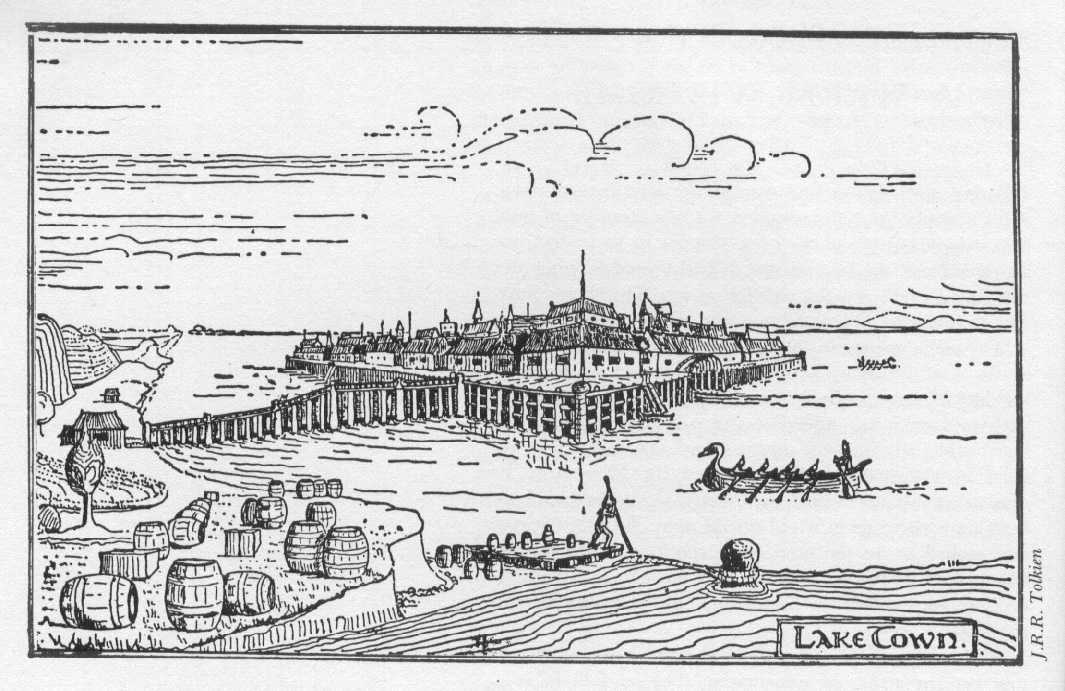
When Bilbo and the much-battered dwarves seek to gain admittance to Lake-town,
(JRRT)

Thorin announces to the startled guards at the gate that he is “Thorin son of Thrain son of Thror King under the Mountain. ..I have come back.”

He subsequently repeats this to the Master and his court:  “I am Thorin son of Thrain son of Thror King under the Mountain!   I return!”  (The Hobbit, Chapter 10, “A Warm Welcome”)

And here we can see JRRT slip right into the second part of the motif, the return of the hero:

“Some began to sing snatches of old songs concerning the return of the King under the Mountain; that it was Thror’s grandson not Thror himself that had come back did not bother them at all.  Others took up the song and it rolled loud and high over the lake:

The King beneath the mountains,

The King of Carven stone,

The Lord of silver fountains

Shall come into his own!

His crown shall be upholden,

His harp shall be restrung,

His halls shall echo golden

To songs of yore re-sung.

The woods shall wave on mountains

And grass beneath the sun;

His wealth shall flow in fountains

And the rivers golden run.

The streams shall run in gladness,

The lakes shall shine and burn,

All sorrow fail and sadness

At the Mountain-king’s return!”

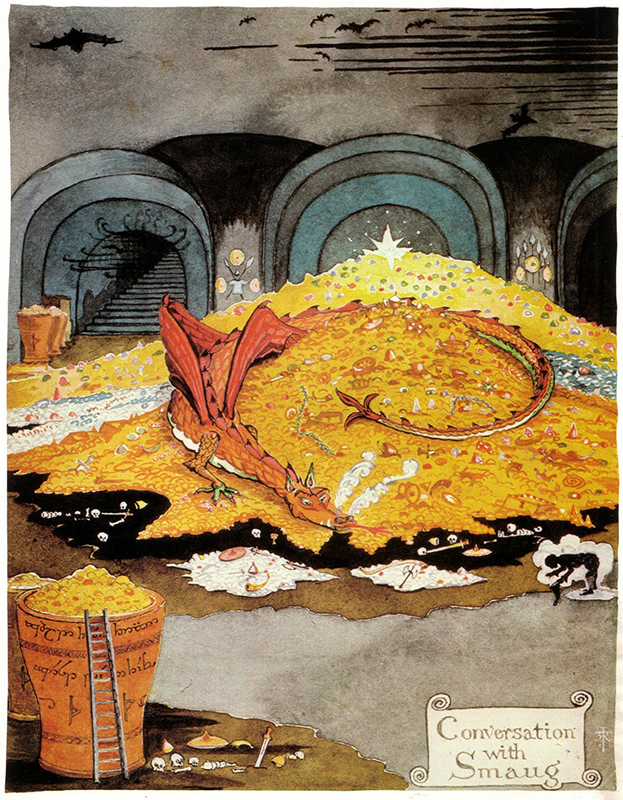
As for the savior part of this motif, something is implied, rather than stated:  the reason that there is no current king is that the last one was driven out by Smaug, after killing (and presumably eating) many of his people.
(JRRT)

If the king is really to return,  then, he must deal with the current occupant.   The Master of Lake-town, who, at first, cynically welcomed the dwarves, “but believed they were frauds who would sooner or later be discovered and be turned out”  then appears to change his mind and “…wondered if Thorin was after all really a descendant of the old kings”.  Still cynical, however, he tells Thorin “What help we can offer shall be yours…” even while thinking, “Let them go and bother Smaug, and see how he welcomes them!” 

Although the return of the king does not turn out quite as the Master—or the dwarves—expected, Smaug dying after destroying Lake-town,

(JRRT)

still, even after Thorin’s death in the Battle of the Five Armies, he remains what he claimed to have been as”  They buried Thorin deep beneath the Mountain, and Bard laid the Arkenstone upon his breast.” (The Hobbit, Chapter 18, “The Return Journey”)
(Alan Lee)

But, in the previous posting, I mentioned ravens.

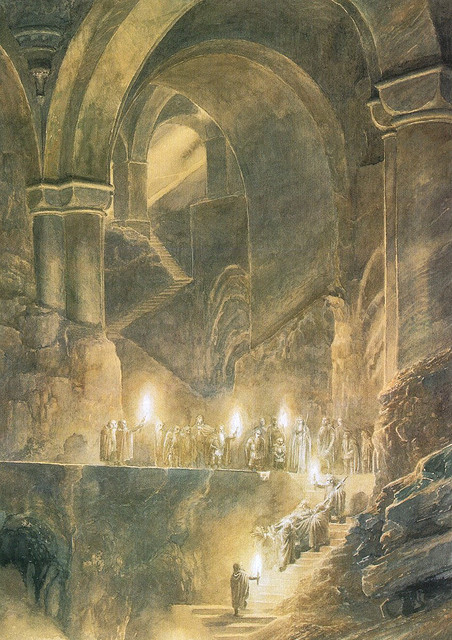
(I include this just as much because it’s such a beautiful image as it’s relevant…)

The Holy Roman Emperor, Frederick I, called “Barbarossa”, is one of the many heroes who appear in a  version of “the king under the mountain” and, among the variants told of him is this one, to be found in the Grimm brothers Deutsche Sagen,  (“German Legends”) where it’s reported that  when a dwarf led a shepherd under the mountain, Barbarossa stood up and asked, “Are the ravens still flying around the mountain?”   At the shepherd’s affirmation, he cried, “Now must I sleep yet a hundred years longer!” 

(Brothers Grimm, Deutsche Sagen, Number 23, Vol.1, page 30, my translation.  You can find the text here:  https://books.google.com/books?id=SRcFAAAAQAAJ&pg=PR1#v=onepage&q&f=false   ) 

After Smaug has flown off to Lake-town and his doom, the dwarves and Bilbo emerge from the Lonely Mountain, where they are met by the same thrush which had helped in finding and opening the back door, as prescribed in the moon letters on Thror’s map.

He twitters excitedly at them, but they can’t understand him and Balin exclaims, “I only wish he was a raven!”

When Bilbo replies, “I thought you did not like them!  You seemed very shy of them, when we came this way before.”

To which Balin responds: 

“Those were crows!  And nasty suspicious-looking creatures at that, and rude as well.  You must have heard the ugly names they were calling after us.  But the ravens are different.  There used to be great friendship between them and the people of Thror; and they often brought us secret news, and were rewarded with such bright things as they coveted to hide in their dwellings.” (The Hobbit, Chapter 15, “The Gathering of the Clouds”)

The thrush flies off and an ancient raven appears, Roac, son of Carc, who says to Thorin:

“Now I am chief of the great ravens of the Mountain.  We are few, but we remember still the king that was of old.”

Did Tolkien know this legend?  If you consult indices to both Carpenter’s biography and  his edition of Tolkien’s letters, there is no trace to be found there under everything from “Barbarossa” to “raven” and yet the confluence of “king under the mountain” and that mountain hosting ravens would seem suggestive, I think.  Or perhaps a little bird told him…
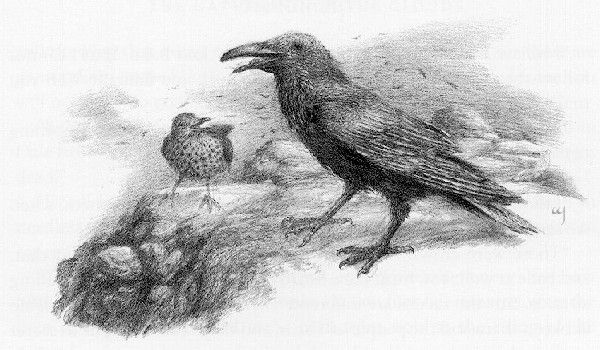
(Alan Lee)

As ever, thanks for reading.

Stay well,

When a raven speaks, it’s wise to listen,

And remember that, as always, there’s

MTCIDC

O

PS

Which reminds me of a famous old ballad, “The Three Ravens” (Child Ballad #26) which you can read about here:   https://en.wikipedia.org/wiki/The_Three_Ravens  and listen to here:   https://www.youtube.com/watch?v=T8ZASCwSRN0

Many Happy Returns (I)

As ever, dear readers, welcome.

It’s a sad fact, perhaps, but, sometimes, even authors we really enjoy don’t quite succeed and, with the best will in the world, it’s hard not to think, “I was following along and enjoying the book and then came the conclusion and…”

For me, in the latest read of my science fiction project, such was the case with Fletcher Pratt and  L. Sprague de Camp’s The Land of Unreason (first published in Unknown Worlds, October, 1941,

then expanded into book form in 1942).

It began with an interesting premise:  an American in early wartime Britain, makes the mistake of violating the custom of leaving out food and drink for “the Good People” (that is, the “Fee”).  This causes him to fall into a world in which “reason” has laws of its own and much of the fun, for me, was in watching the protagonist attempt to figure out how to deal with this.  (You can read a full summary here:  https://en.wikipedia.org/wiki/Land_of_Unreason )  It was a bit uneven here and there, but not enough to trouble, so long as it kept moving, but then came that ending, where the protagonist, “Fred Barber”, is revealed to be the Holy Roman Emperor, Frederick I (also known as “Barbarossa”, 1122-1190)

(This is a reliquary—a place to store a sacred relic or two–and was supposedly modeled on old Fred himself—for more see:  https://en.wikipedia.org/wiki/Frederick_Barbarossa  )

and there the story rather abruptly ends.

If you only knew that Frederick was the Holy Roman Emperor, this would be puzzling—why should that matter in resolving the plot?–but perhaps what the authors wanted the readers to remember is that Fred, as Frederick, belonged to a folklore tradition, called by the folklorist, Stith Thompson, “the Kyffhaeuser type” or “the king under the mountain” (also known as “the king asleep in the mountain” , No.1960.2 in Thompson’s motif index)

In this tradition, a once-famous culture hero, like Frederick, is said not to be dead, but, instead, away somewhere else, often sleeping, but, given the right moment—usually when his country is in danger–he will awaken, or be awakened, and then come to the rescue. Perhaps the authors were suggesting a sequel?

Legend has it, for example, that Frederick is drowsing under a German mountain, either the Untersberg, between Austria and Germany,

or the central German hill range of the Kyffhaeuser (hence Thompson’s name for the motif type).

The latter has been decorated—or marred, depending upon your taste—with a gigantic monument, dedicated in 1896, combining an image of Frederick, deep in slumber still, with an equestrian statue of Kaiser Wilhelm I (1797-1888) posed above him (the idea being that now there’s a German empire—ruled by Wilhelm I’s grandson, the erratic and trouble-making Wilhelm II—Barbarossa can continue to doze).

An interesting side detail about the Barbarossa story can be found in the Grimm brothers Deutsche Sagen,  (“German Legends”) where it’s reported that  when a dwarf led a shepherd under the mountain, Barbarossa stood up and asked, “Are the ravens still flying around the mountain?”   At the shepherd’s affirmation, he cried, “Now must I sleep yet a hundred years longer!” 

(Brothers Grimm, Deutsche Sagen, Number 23, Vol.1, page 30, my translation.  You can find the text here:  https://books.google.com/books?id=SRcFAAAAQAAJ&pg=PR1#v=onepage&q&f=false   )  Those ravens will return in Part II.

This motif is surprisingly common (there’s a whole WIKI article devoted to it here:   https://en.wikipedia.org/wiki/King_asleep_in_mountain ), including , in the West, everyone from Ogier the Dane, who is involved in the medieval Charlemagne stories

(and who even turns up the in a fairy tale of Hans Christian Andersen, from an 1899 translation of which this illustration appears—you can read it here: https://ia800505.us.archive.org/26/items/fairytalesofhans00ande/fairytalesofhans00ande.pdf  )

to the early Irish hero, Fionn mac Cumhaill (who, in English, becomes ”Finn mac Cool”—if you’d like to read more about him, you might begin with Lady Gregory’s fiercely-named Gods and Fighting Men, 1913, available for you here:   https://archive.org/details/godsfightingmens00greg  )

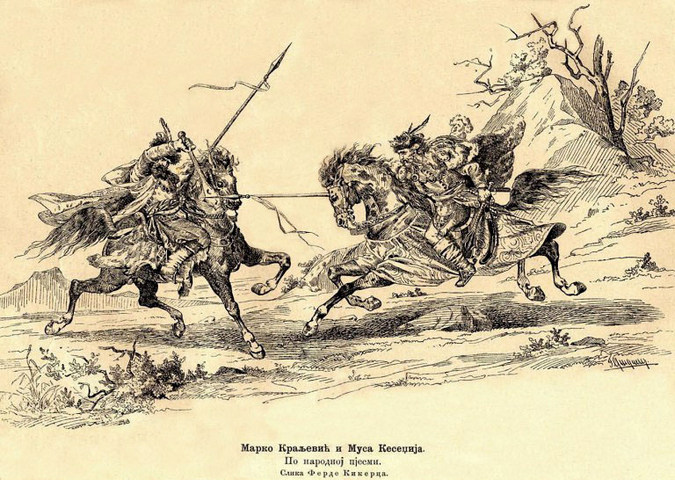
to the South Slavic Marko Kraljevic (KRAL-jeh-vitch—“Kingson”, so, “Prince Marko” )

who has the most wonderful horse, Sarac (SHA-rats—in English “roan”, a sort of reddish-brown—although the word has a fairly wide meaning, and illustrations, like the one here, depict him as what appears to be what we’d call a “piebald”), with whom he shares his wine—you can read about them here:  https://archive.org/details/BalladsOfMarkoKraljevic/page/n3/mode/2up  Although, in this translation of ballads about Marko, he dies, after killing Sarac so that he can’t be turned into a beast of burden by Marko’s enemies.  See this article for his sleeping, as well as the good news that Sarac isn’t killed:  https://en.wikipedia.org/wiki/Prince_Marko )

to a very familiar figure, King Arthur.

Our earliest-known reference to Arthur’s disappearance, Geoffrey of Monmouth’s (c.1095-c.1155)  Historia Regum Britanniae (“History of the Kings of Britain”, c.1130s), has only this to say:

Sed et inclytus ille Arturus rex letaliter vulneratus est, qui illine ad sananda vulnera sua in insulam Avallonis advectus,

“But  that famous king Arthur was mortally wounded, too, and who was carried from there [Cornwall]  for the healing of his wound to the island of Avalon…”

 (Geoffrey of Monmouth, Historia Regum BritanniaeHistoria Regum Britanniae, Book XI, Chapter II, my translation—and you can read a very useful English summary/translation of the Arthurian bits of Geoffrey here:   https://d.lib.rochester.edu/camelot/text/geoffrey  This comes from the University of Rochester (NY, not UK), “Camelot Project”, which is invaluable if you’re interested in things Arthurian.)

By the late 15th century, it appears that this tradition has been extended and that it begins to have more the look of the “king under the mountain”:

“Yet somme men say in many partyes of Englond that  kyng Arthur is not deed / But had by the wylle of our lord Ihefu in to another place / and men say that he shal come ageyn & he shal wynne the holy croffe . I wyl not say that it shal be so / but rather I wyl say here in thys world he chaunged his lyf / but many men say that there is wryton vpon his tombe this vers  Hic iacet Arthurus Rex quondam Rex que futurus /”

(Sir Thomas Malory (?  There is much discussion about who he was and when he lived, but a manuscript says that the text was completed by 1470),  Le Morte d’Arthur,  Book XXI, Chapter VII—this is from the 1889 edition of Oskar Sommer, which reprints the first printed edition of 1485 of William Caxton—and here it is for you:  https://archive.org/details/lemortedarthuror00malouoft/page/n5/mode/2up   If you read this blog regularly, you know that I always prefer the earliest edition of a work which I can find, as I believe that earlier English, both the language and the printing, is so much more interesting and memorable. )

(one of the only two copies of that first printing—it’s in the Morgan Library in New York)

That cross, with its inscription, is a monkish fake from 1190/1, (See a chatty but useful article here:  https://arstechnica.com/science/2016/03/medieval-monks-used-king-arthurs-grave-as-an-attraction-to-raise-money/  as well as an article about all sorts of possibilities for Arthur’s burial here:  http://www.badarchaeology.com/controversies/looking-for-king-arthur/the-archaeology-of-arthur/ ) but there seem to be two versions of it, one, reported by Gerald of Wales, c.1146-c.1223, in his Speculum Ecclesiae—“The Mirror of the Church”—Part II, Sections VIII-X , and presumably the earlier version, says nothing about “quondam” or “futurus”, that is, “one-time” and “to be” , quoting the inscription to say (my translation):

“Hic jacet sepultus inclytus rex Arturius in insula Avallonia  cum Wennevereia uxore sua secunda”

“Here lies buried the famous king Arthur in the island of Avalon with Guinevere his second wife”

(You can find the full text in Latin here:   https://ia902902.us.archive.org/10/items/giraldicambrensi04gira/giraldicambrensi04gira.pdf  and an English translation of the relevant parts here:   https://www.earlybritishkingdoms.com/sources/gerald02.html  )

As you can see, no “quondam” (“one-time”) and no “futurus” (“to be”).  So where did they come from?  As far as we know, this appears only in Malory, although Malory cites “his tombe”.  When the supposed Arthur was reburied, in the presence of Edward I and Eleanor of Aquitaine, in 1278, he was given what must have been a rather showy tomb—

The royal visit to Glastonbury Abbey in 1331. © Dominic Andrews http://www.archaeoart.co.uk

(This is a reconstruction by the Department of Archeology at Reading, which has done major work for the study of Glastonbury from its ancient roots at least to the end of the ecclesiastical period.  See:   https://research.reading.ac.uk/glastonburyabbeyarchaeology/digital/arthurs-tomb-c-1331/arthurs-tomb/ )

Although, with the dissolution by Henry VIII of Glastonbury Abbey in  1539, the tomb was lost, but  the early antiquary, John Leland (c,1503-1552), has left us a partial description in his Itineraries (notebooks of his travels around England—really remarkable stuff for the 1530s, when his extensive journeying would have been extremely difficult, and sometimes perhaps even dangerous).  He says of it that it had: 

1. a crucifix at the head

2. an image of Arthur at the foot

3. a cross on the tomb

4. lions at the head and foot

5. two inscriptions, at least the first of which was written by Henry Swansey an abbot of Glastonbury

The first inscription reads:

“Hic jacet Arturus flos regum gloria regni

Quem mores probitas commendant laude perenni”

“Here lies Arthur the flower of kings, the glory of the kingdom,

Whom his character and uprightness commend for eternal praise.”

and the second, at the foot of the tomb says:

Arturi  jacet hic conju[n]x tumulata secunda

Quae meruit coelos virtutum prole secunda”

“Here lies buried the second wife of Arthur,

Who has deserved Heaven from the fortunate offspring of [her] virtues.” (a wordplay—“secunda” can mean both “second” and “lucky”)

(my translations from John Leland, The Itinerary of John Leland, Parts I to III, edited by Lucy Toulmin Smith, 1907, page 288 and it’s right here for you:  https://archive.org/details/itineraryjohnle02lelagoog/page/n11/mode/2up )

No “quondam” and no “futurus” here, either, and, presumably, this is the “tombe” which Mallory mentions.  Did he make that inscription up?  Certainly Mallory assembled a large body of previous work and not all of his sources are traceable.  Perhaps this will remain a mystery, along with the reported disappearance and subsequent non-reappearance of Arthur?

But the influence of Arthur, or, at least of his motif type, will appear in the second (and I hope fortunate) part of this posting.  I’ll provide a hint here—someone once lived under another mountain before a new and destructive tenant arrived…

Thanks, as ever, for reading.

Stay well,

May you be both quondam and futurus/a,

And remember that, as always, there’s

MTCIDC

O

Busting Into Mars

Welcome, as always, dear readers.

I was reminded of my last posting by seeing this on the back bumper of a car—

Mars to me is this—

and this—

which hardly makes it look worth busting for, or even visiting, for all of the scientific curiosity about it which could be satisfied by extensive exploration, if not colonization.

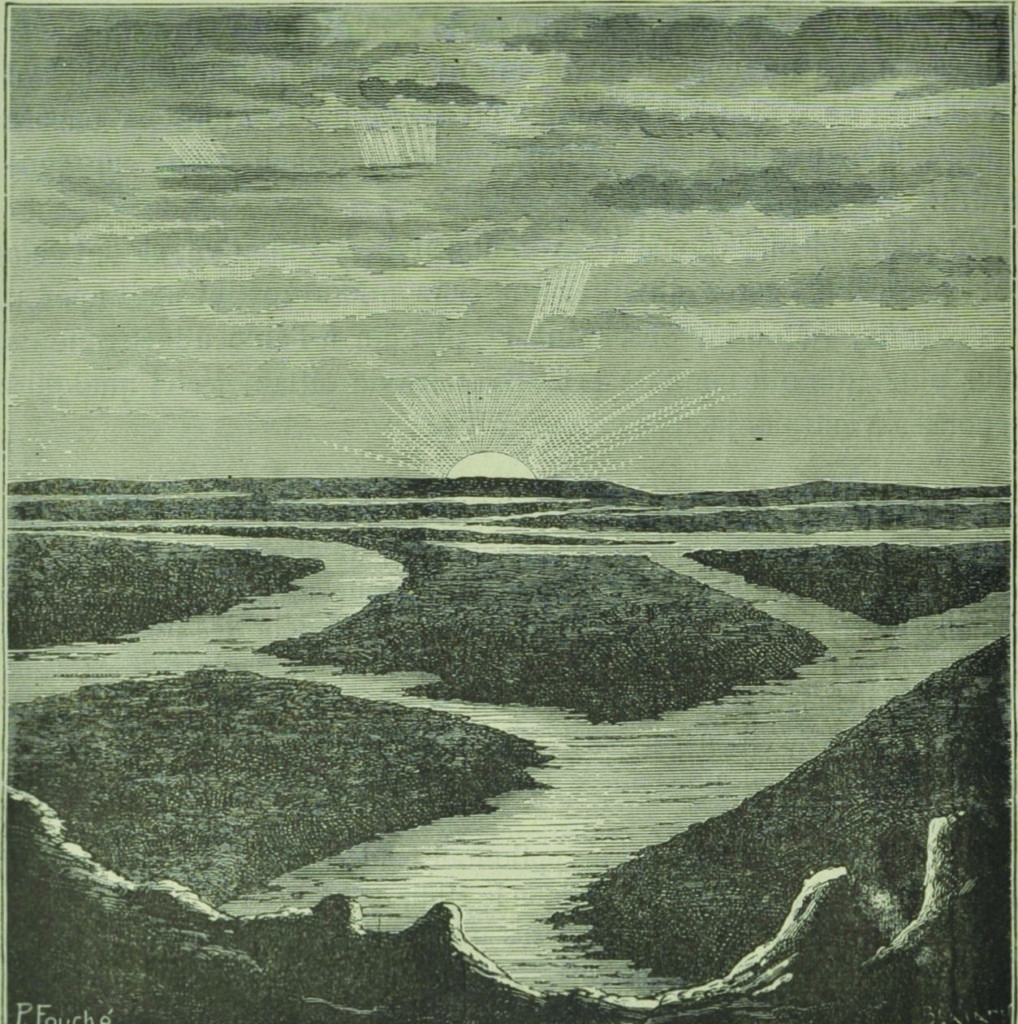
Suppose, however, it looked like this—

or this—

(This is from https://www.erbzine.com/mag33/3387.html  a fan magazine devoted to the works of Edgar Rice Burroughs—about whom more shortly!)

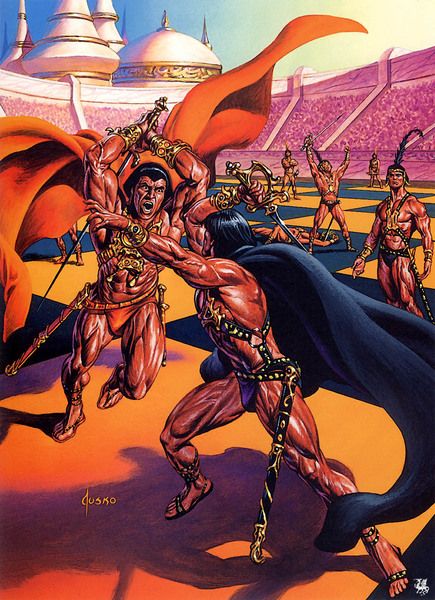
 or this—

(Joe Jusko—you can visit his website here:  http://www.joejusko.com/default.asp )

Beginning in the 1870s, these latter views were the basis of science—and science fiction.

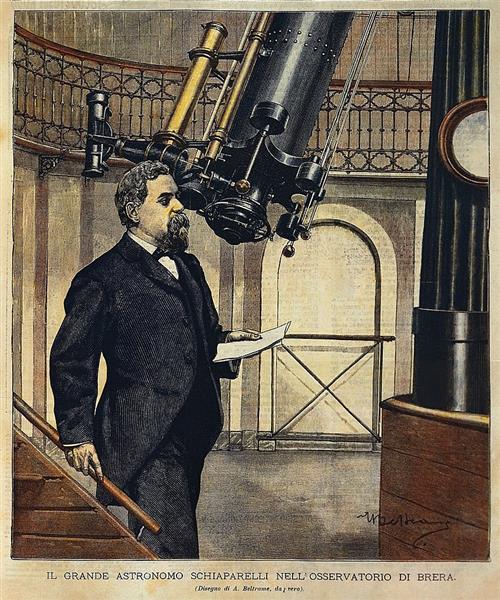
The first figure to put forward such a view of Mars was Giovanni Schiaparelli (1835-1910),

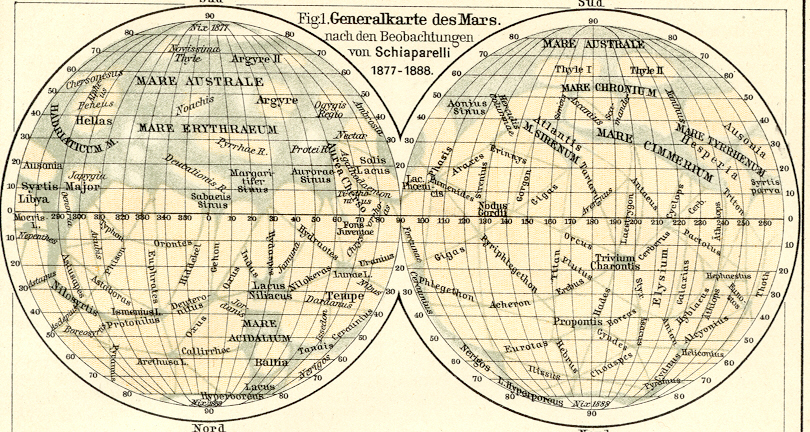
who, turning his telescope towards the Red Planet, believed that he saw patterns of crisscross lines across its surface, which he called canali, in Italian, and which can mean everything from the anatomical  “duct” to (now) a television channel, to “canal” (as in i canali di Venezia),in an 1877 publication.

It’s important here to note that Schiaparelli was no crackpot, but a well-known and well-respected astronomer, and this will be true for the prominent men who furthered the idea that Mars was inhabited by sentient beings with engineering and architectural skills.  The texts which such men wrote are carefully-reasoned, based on the latest science known to them.  The basic problem was that Schiaparelli hadn’t seen canals at all, even as he produced maps of Mars’ surface which included them

and wrote articles about the potential inhabitants (see https://www.gutenberg.org/cache/epub/7781/pg7781.html  La Vita sul Pianeta Marte, extracts from the journal “Natura ed Arte” from 1893, 1895, 1909 ) in scientific journals.

He was followed by the splendidly-named Camille Flammarion (1842-1925),

another prominent astronomer and the author of numerous books on the subject, including

La planete Mars et ses conditions d’habitabilite (1892)  and which is available here: https://archive.org/details/laplantemarset01flam   For a complete translation into English of this work, log in to the Internet Archive and take out the Patrick Moore version here:  https://archive.org/details/camilleflammario0000flam  For a brief review of Flammarion’s ideas in English, see:    https://ia903207.us.archive.org/33/items/jstor-25118640/25118640.pdf   The North American Review, 1 May, 1896, 546-557, “Mars and Its Inhabitants” .

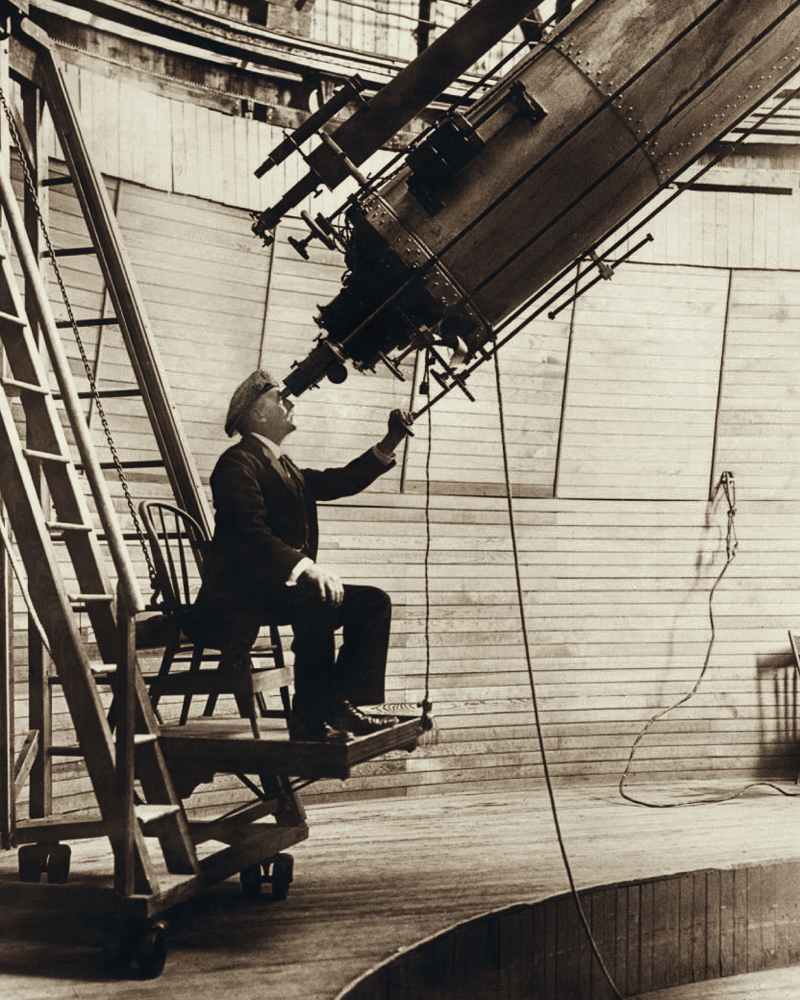
For English-speakers, the scientist who probably had the greatest effect upon popular views of Mars was Percival Lowell (1855-1916),

who, besides lectures and scholarly articles, produced three extensive works on the subject:  Mars (1895—available here:   https://archive.org/details/mars01lowegoog/page/n12/mode/2up  ), Mars and Its Canals (1906—dedicated to Schiaparelli and available here:   https://archive.org/details/marsanditscanals00loweiala/mode/2up  ), and  Mars As the Abode of Life (1908 and available here:   https://archive.org/details/marsasabodelife03lowegoog/mode/2up    ).

What I find particularly interesting about the approach over time to the subject of Mars, its inhabitants, and its architecture is that this was believed to be an archaic civilization and may even be in serious decline, a fact which was picked up—among other details–by a man who was about to make his name by basing a series of fictional works upon the scientific research and publications of such scientists, Edgar Rice Burroughs (1875-1950).

In February, 1912, Burroughs published the first of six installments of a series entitled “Under the Moons of Mars” in The All-Story (and which you can read here:   https://archive.org/details/all-story-v-022n-02-1912-02-ifc-ibc-ufikus-dpp )

It concerns the adventures of John Carter, an ex-Confederate, who after the war, turns prospector in the American Southwest, only to be mysteriously whisked to what he in time discovers is called “Barsoom”, but is based upon the Mars of the Victorian/Edwardian astronomers, dying civilization, canals, and all.

It has two main races, a more human one, who were the city-builders, and a larger and more barbaric humanoid  green-skinned race, who are nomads, but who inhabit the deserted human cities during their wanderings.

(by Adam C. Moore, a wonderfully-talented artist who can seemingly draw anything and who goes by LAEMEUR—visit his website at:  https://laemeur.com/illustration/ )

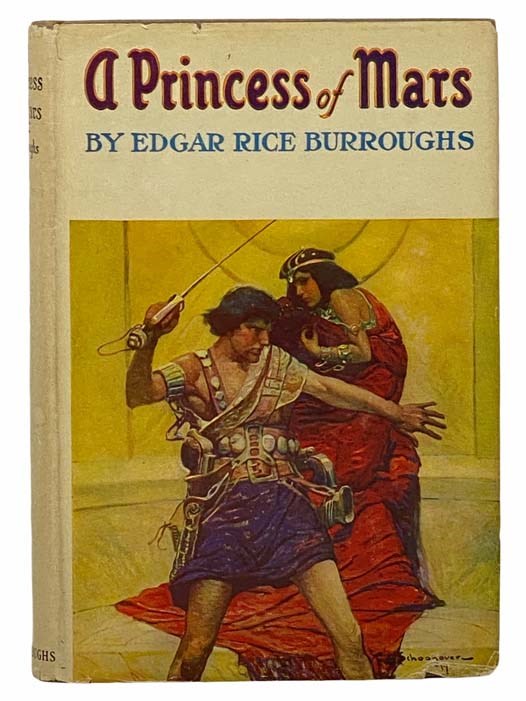
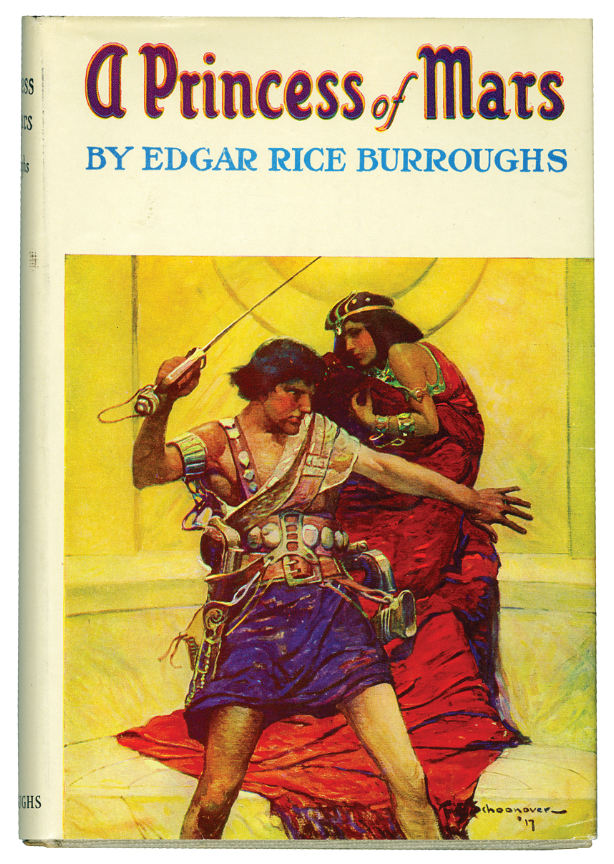
Although I’ve always known that Burroughs was an early science fiction, fantasy writer, I hadn’t read a word of his work until, in my current slow study of science fiction, I added “Under the Moons of Mars” in its 1917 novel form, A Princess of Mars, to my reading list (and you can add it to your list here:   https://archive.org/details/aprincessmars00burrgoog/page/n9/mode/2up 

It didn’t take more than a chapter or two before I found myself with a page-turner.  Although the characters are familiar from any high adventure novel—the man of his hands dropped into a new and strange situation, the proud princess in need of rescue, etc—Burroughs, for me, had set these against a backdrop which, though based upon period popular scientific thought, he made his own by taking what he’d found and expanding it into something more dynamic, both in setting and in the politics and conflicts of what might be a dying world. 

So far, I’ve only read the first book, but there are 9 more stories in novel form to come, from 1918 (The Gods of Mars) to 1948 (Llana of Gathol—for a listing, see:  https://en.wikipedia.org/wiki/Barsoom ) to look forward to and Burroughs wrote other series, including one which he began publishing in the same year and in the same magazine as “Under the Moons of Mars” and which probably brought him more fame and wealth than the adventures of John Carter—

(This is also from the Burroughs website which, if Burrough’s work interests you, and you don’t know the site, I encourage you to visit and browse its extensive archive.)

As ever, thanks for reading.

Stay well,

If dropped onto another planet, hope that its gravity is lighter,

And remember that, as always, there’s

MTCIDC

O

(In)Compleat

As always, welcome, dear readers.

Spelling, in English, which can cause non-native English-speakers to wonder just how crazy we are, began to become standardized only in the 18th century.  Before this, one might, for example, see two competing spellings of the main word in the title of this piece:  “Compleat” and “Complete”, both considered valid, at least by the spellers.

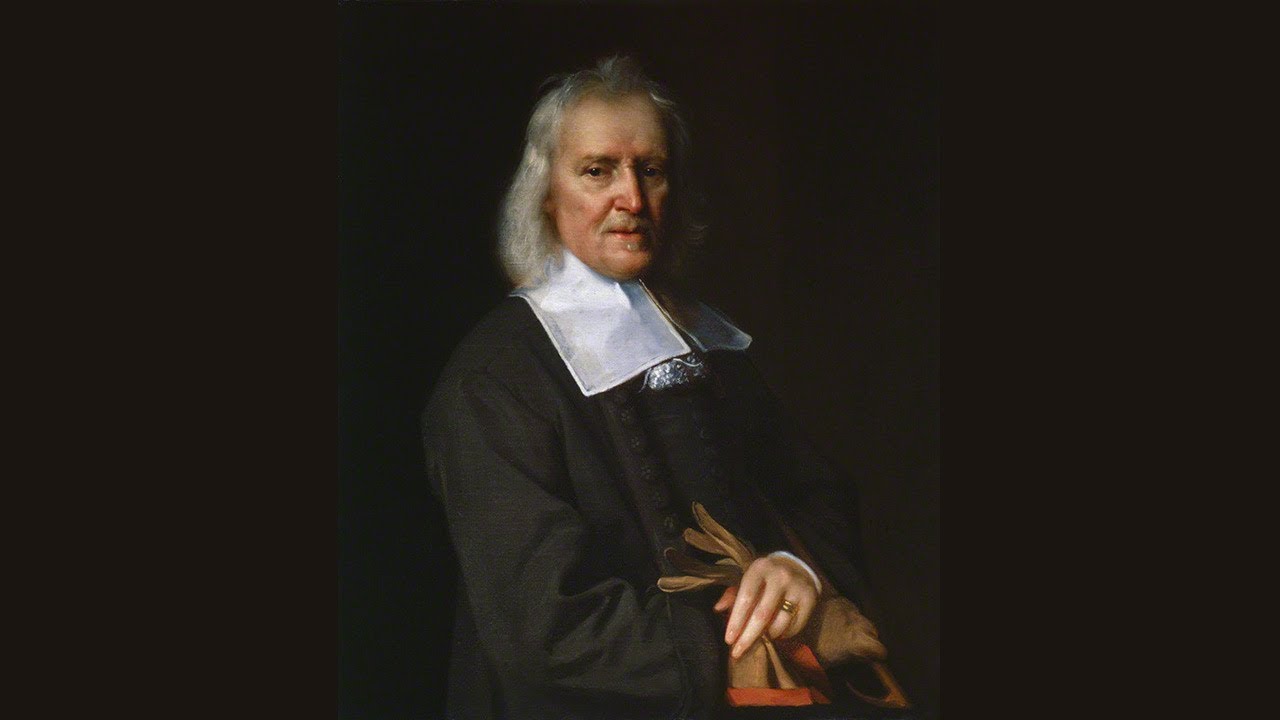
Although the spelling “compleat” might have been commonly acceptable in the 17th century, it is one work, in particular, which has continued to provide us with that competing spelling, Izaak Walton’s (1593-1683)

well-known fishing manual, The Compleat Angler,

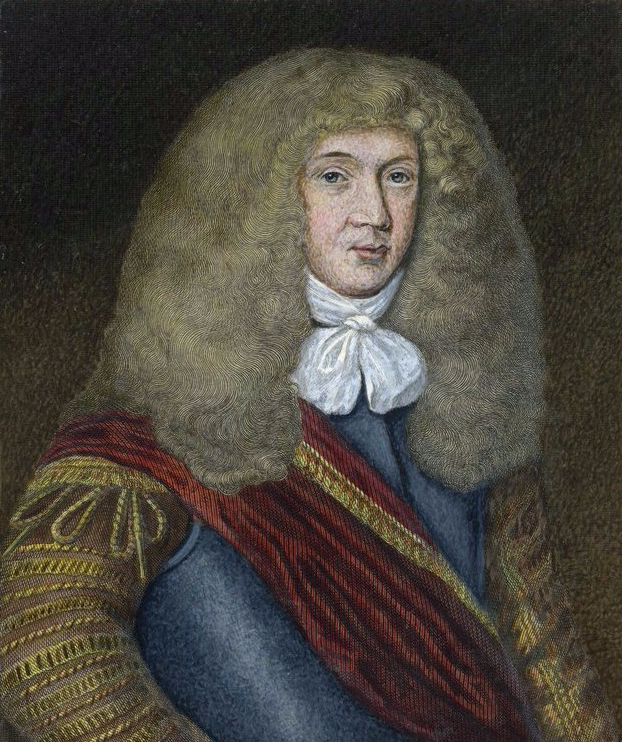
first published in 1653, with various later editions, including one with an extensive addition, in 1676, by Walton’s friend, and fellow-angler, Charles Cotton (1630-1687),

to whom was attributed, in the 18th century, another “Compleat”, The Compleat Gamester (1674).

(This is the 1680 edition.  If you’d like to learn how to play such card games as “Lanterloo” and “Bragg”, here’s the 1725 edtiion to show you the way:   https://ia902708.us.archive.org/6/items/bim_eighteenth-century_the-compleat-gamester-o_cotton-charles_1725/bim_eighteenth-century_the-compleat-gamester-o_cotton-charles_1725.pdf  For myself, the cockfighting is distasteful and I’d avoid it. For the Walton/Cotton, here’s a wonderfully leisurely 1897 edition, heavily illustrated with handsome engravings, and based upon that 1676 edition:  https://archive.org/details/compleatangler00gallgoog/page/24/mode/2up   One of my favorite illustrators, Arthur Rackham, made an illustrated edition, but, as it’s from 1931, it’s still locked in copyright, but you can see images from it if you write in:  “Compleat Angler Rackham”.)

I most recently happened upon this spelling in a completely/compleatly different context:

This is a collection of short novels or novellas jointly written by L(yon) Sprague de Camp (1907-2000)

and Fletcher Pratt (1897-1956),

2 prolific fantasy/science fiction authors of the mid-to later 20th century.  (For a very partial list of de Camp’s works, see:   https://en.wikipedia.org/wiki/L._Sprague_de_Camp ;  for the same for Pratt—who also wrote a number of historical works—see:   https://en.wikipedia.org/wiki/Fletcher_Pratt )

Although there are three novellas in this collection, “The Roaring Trumpet”, “The Mathematics of Magic”, and “The Castle of Iron”, there is a fourth, published as “Wall of Serpents”.   And these were not their original publication—or forms—as  all had been previously published in fantasy/science fiction magazines of the 1940s and early 1950s, like Unknown (about which you can read a wonderfully detailed account here:   https://en.wikipedia.org/wiki/Unknown_(magazine) ).

In these stories, the main character, Harold Shea, a psychologist by training, travels, with various colleagues, to a series of worlds based upon mythology and literary sources, “The Roaring Trumpet” upon Norse legends,

(the original cover of Unknown where the story first appeared)

“The Mathematics of Magic”, in which the characters fall into the world of Edmund Spenser’s (1552-1599)

The Fairy Queen,

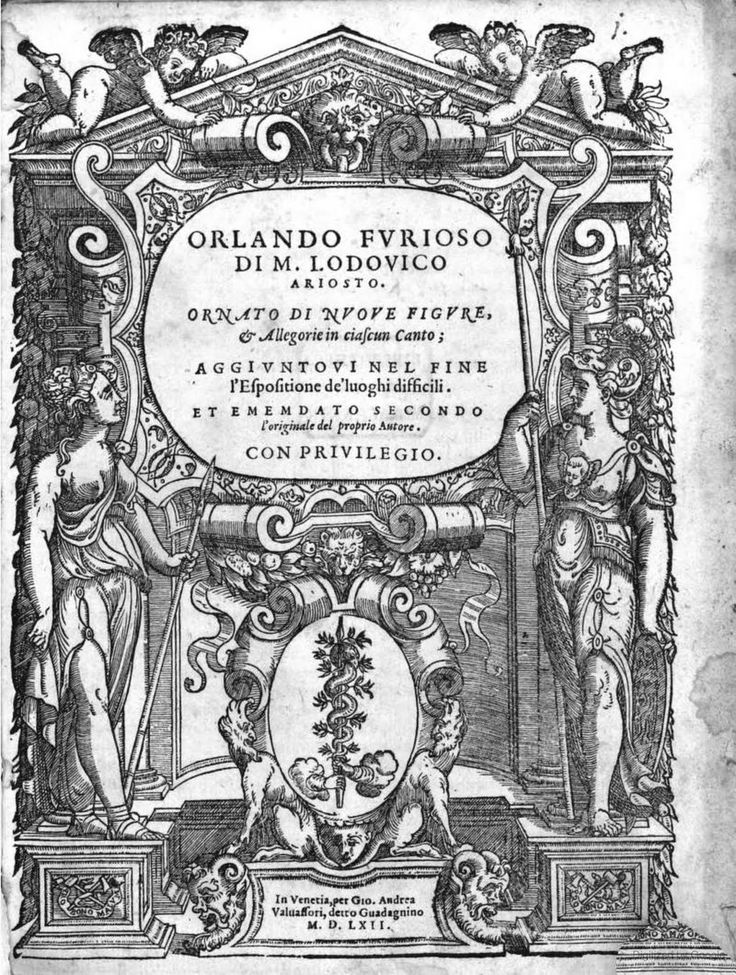
“The Castle of Iron” into the world of Ludovico Ariosto’s (1474-1533)

Orlando Furioso

(originally published in 1532, this is an early edition from 1562)

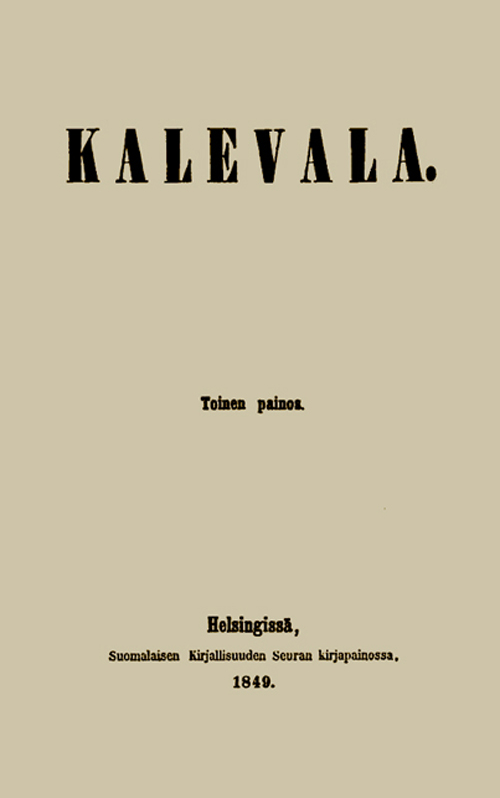
and Wall of Serpents, into the land of Finnish myth from Elias Loenrot’s (1802-1884)

Kalevala,

(This is the more complete edition of 1849, Loenrot had published an earlier version in 1835.)

but, in mid-book, the main characters are suddenly transported from ancient Finland to ancient Ireland, where they spend time with characters out of the Ulster Cycle, the main charmer being the hero Cu Chulainn.

(This is actually a rather subdued portrait of “the Hound of Ulster”, most of those I’ve seen have absolutely no relation to the figure we know from Old Irish Literature.  If you’re interested, you might try Lady Gregory’s  Cuchulain of Muirthemne, 1903, here:  https://archive.org/details/cuchulainofmuirt00greg_0  bearing in the mind that Lady G was a late-Victorian and the original stories can be a bit raunchier than she will translate them. )

Although the original editor, John W. Campbell, as we learn from the article on Unknown cited above, wanted  “the fantasy elements in a story to be developed logically”, I confess that I have no idea as to how the characters are transferred to these places.  The theory behind the transference is discussed in “The Roaring Trumpet” , but my eyes crossed when I tried to follow it.  The method is really quite beside the point, however, as, once the characters are dropped into each world, the narrative roars by, and, although there are in-jokes, if you know the originals (parts of Wall of Serpents, for example, are written in the same metre as the original Finnish text), the stories are solid enough in themselves to be enjoyable without doing anything more than following along. (If you’d like to read them—and I would encourage you to—you can read the first three by joining the Internet Archive and borrowing a copy of The Compleat Enchanter here:  https://archive.org/details/compleatenchante00deca  )

The title of this piece is “Incompleat”, however, and refers, in fact, to a larger project I’ve set myself.  Although I’ve read a certain amount of fantasy and science fiction, I’ve never done this systematically.  Consequently, I decided to give myself a better education, beginning with science fiction, compiling a list of books, novellas, and short stories in chronological order which I intend to read.  I admit to doing a bit of skipping around as I fill things in, so I still have to read Jules Verne’s De la Terre a la Lune (“From the Earth to the Moon”, 1865, first English translation, 1867), for example, but I’d gotten caught by de Camp/Pratt after reading earlier things like Edgar Rice Burrough’s (1875-1950) A Princess of Mars (1912/17, which you can read here:  https://archive.org/details/aprincessmars00burrgoog/page/n9/mode/2up ),

about which I’m definitely going to write in the future.  The field is vast (and fantasy is just as large—go to any decent bookstore and look at the shelves and shelves of the stuff), so I want to be selective, trying to find what’s most representative of different eras and trends.  This will mean that I’ll definitely wind up with some less than masterpieces, but it’s important, to understand the field, to see just what has been considered noteworthy in the past.

I doubt that I’ll ever write a posting with the title “Compleat”, but I’m sure to find much that’s worth the read and, when I do, I’ll be glad to pass it on to you.

Stay well,

Beware any enchanter who claims compleatness,

And remember that there’s always

MTCIDC

O

PS

And, if you read this blog for Tolkien, not to worry—he’s always there and always will be.  After all, he himself was a fan of the work of Isaac Asimov.

(Old) Guys

As always, welcome, dear readers.

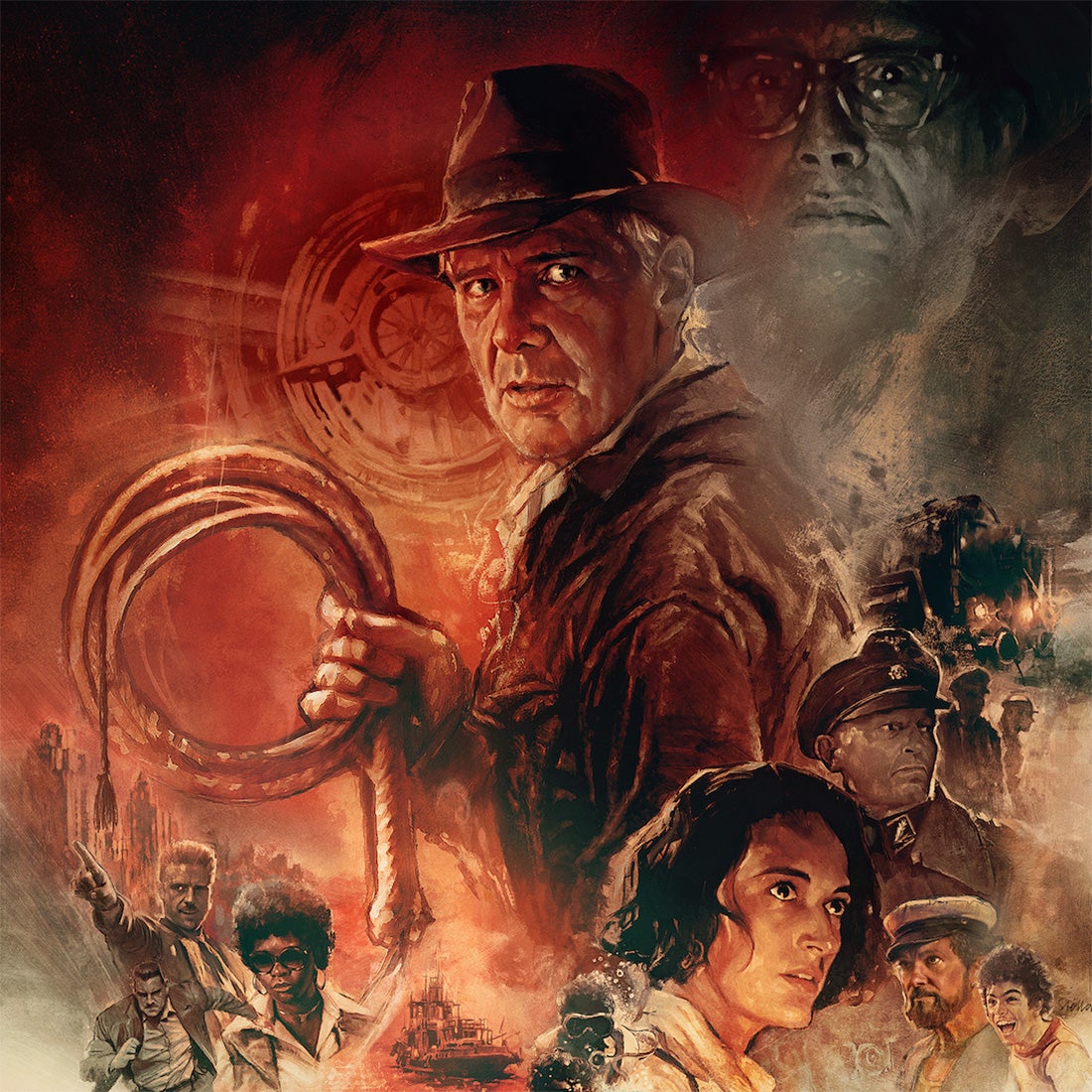
When I saw the new Indiana Jones film the first time,

I was a bit concerned that the actor’s actual age—80—might be an impediment to the action and certain remarks, mainly made early in the film–the character called “Teddy” initially addresses him as “old timer” and his co-star, “Helena”, remarks to him, “I like the hat, by the way.  Makes you look at least two years younger.”  as well as later calling him “an aging grave robber”—made me wary, but, once the action set in, age was mostly ignored, even though Jones’ character in the film was supposedly 70.

At the same time, I was disappointed that, when his old friend, Sallah, appeared,

after a brief scene, he was told, “This is not an adventure, Sallah.  Those days have come and gone.” and he was dismissed from the film, only to reappear briefly as a grandfatherly figure at the end.

To me, this seemed like the waste of an interesting character, who had twice helped Jones against Nazis,  and, as Jones was on his way to Tangier, it would seem that Sallah, a native Arabic-speaker, might have been of real use there, as well.  Was the actor (John Rhys Davies’) actual age (79) against him, especially if Jones is supposed to be older, as well?

This set me thinking about the ages of heroes in adventure.  Are there more like Indiana Jones?  And would that mean a second chance for Sallah?

Adventure is obviously a giant subject, and growing larger all the time, so I’ll restrict my questions for the moment to what I’m teaching this fall:  the Odyssey, Beowulf, and The Hobbit.

Beginning with the hero of the first of these, how old is Odysseus, for instance?  Athena, to protect him from being initially overwhelmed by the 100+ suitors and their minions,

 turns him into an old beggar

(This may be an Alan Lee?)

when he arrives on Ithaka, which presumably suggests he will be at least somewhat different from his  actual age.  (Odyssey, Book 13.397-403)  Although the text never provides a definite answer, we might do a little creative arithmetic, using the few facts we have about Odysseus’ early life.

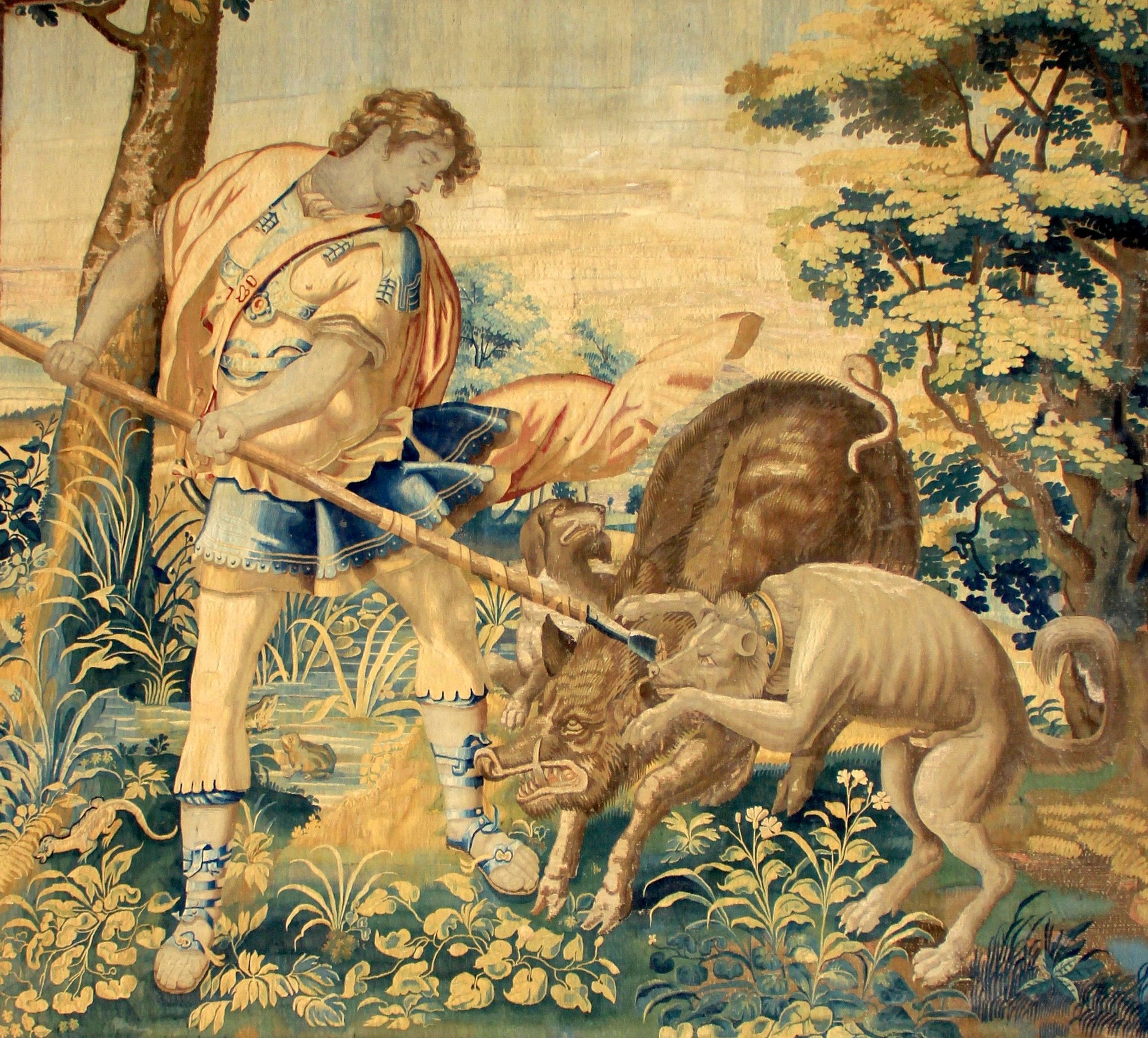
1. His first adventure appears to be recorded in the Odyssey.  His grandfather had instructed his parents to send the boy to him when he first entered adulthood, so might we guess 18 to 20?  While staying with his grandfather, Odysseus was wounded during a boar hunt

and carried the scar with him into his later adult life, as its recognition, many years later, by his old nurse, Eurykleia,

almost gives away his disguise.  (Odyssey, Book 19, 386-490)

Of other early events, we learn of Odysseus winning Penelope in a footrace (Pausanias, Description of Greece, 3.12.2, 3.12.4—which you can read at:  https://www.theoi.com/Text/Pausanias3A.html ), although we have no idea of how old either Odysseus or Penelope was at that time.  There has been, as you can imagine, lots of scholarly discourse on when people in ancient Greece married, but there may be some consensus that girls would marry after about the age of 14 or 15—although the age of men is much less firm.  One ancient source suggests that girls should be about 19 and men about 30 (Hesiod, Works and Days, 695-699—for one view of the question, see:  https://talesoftimesforgotten.com/2023/02/28/at-what-age-did-ancient-greek-women-typically-marry/ )

Beyond this event, we see Odysseus acquiring a bow from Iphitos, which he receives on a trip upon which his father, Laertes, and the elders of Ithaka had sent him (Odyssey, Book 21, 1-41), suggesting that he is still young enough to be under his father’s authority.  (This is the bow with which he later deals with the suitors.)

And we learn that his son, Telemakhos, was a baby when Odysseus left for the Trojan War.  (Apollodorus, Epitome, E 3.7, see:  https://www.theoi.com/Text/ApollodorusE.html  and Hyginus, Fabulae, 95, see:  https://topostext.org/work/206 )

Odysseus goes off to the War for ten years and spends a further 9 years coming home, adding 20 years to whatever total we can imagine.  He might have been about 40, then, or, considering the passage from Hesiod above, maybe fifty—although this would go against the idea that Athena has turned him into an old beggar.  Even if we settle upon 40, Odysseus, in a world where life expectancy may have been relatively short (lots of scholarly argument on this—just read through the Wiki article on “Life Expectancy” here:  https://en.wikipedia.org/wiki/Life_expectancy ), was rather far along in his life and, though vigorous (with Athena’s help), perhaps about the equivalent of Indiana Jones in Dial.  (For a long, detailed look at Odysseus, see:  https://mythopedia.com/topics/odysseus )

We don’t know very accurately the ages of the title character in Beowulf when he’s involved in his major conflicts, but we do know that, when he finally faces the dragon, near the poem’s end,

he’s been king of his people for “fifty winters” (fiftig wintra, Beowulf, 2208—for a very useful translation, with the original Old English text placed parallel and lots of notes, see:  https://heorot.dk/beowulf-rede-text.html ).  Presuming that he was a young man when he fought Grendel and his mother earlier in the poem, I think that it’s safe to assume that he’s at least in his very late 60s or early 70s.

In the case of Bilbo, in The Hobbit, we are on firmer ground.  When Gandalf in April, TA2941, arrives to recruit Bilbo for the adventure Bilbo initially says he wants no part of,

(the Hildebrandts—and one of my all-time favorite illustrations by them)

Bilbo was 50, having been born in TA2890 (Bilbo’s birthday, as we know, is in September—for the date of Gandalf’s arrival, see “The Quest for Erebor”in Douglas Anderson’s The Annotated Hobbit, 375).

Hobbits, however, seem to have a longer life expectancy than humans, so that Bilbo’s 50 is probably not our 50—after all, hobbits only came of age at 33—although Bilbo’s state of preservation at 99 did cause remark in the Shire (see The Fellowship of the Ring, Book One, Chapter 1, “A Long-expected Party”).

Odysseus, in his 40s or even 50s, is able, with the aid of his son, Telemachus, and two slaves and a little help from Athena, to slaughter over a hundred suitors.  Beowulf, perhaps in his 70s, with the assistance of a single young warrior, Wiglaf, kills a fearsome dragon.  Even if Bilbo is a young fifty, he still manages to survive trolls, goblins, spiders, hostile elves, and a dragon and live another 80 years (we don’t know how much the Ring may have had to do with that longevity—after all, the Old Took manages 130 without it).  That being the case, perhaps the writers of The Dial of Destiny were a little premature in relegating Sallah to the sidelines?

Thanks for reading, as always.

Stay well,

Remember:  “It’s not the years, it’s the mileage”,

And remember, as well, that there’s always

MTCIDC

O

These Guys

Welcome, as ever, dear readers.

The title of this posting is actually only part of a quotation—here’s the full line—

It’s Indiana Jones, of course, in The Last Crusade (1989),

who has just come upon a German operations center in an Austrian castle.

In my two-part review of the final Indiana Jones movie, The Dial of Destiny,

(“Jonesing for Indiana”, 24 July, 2023, 3 August, 2023)

I summed up the series’ villains, in which, out of five films in all, one (The Temple of Doom) has an evil prime minister,

one (Crystal Skull), has a Soviet agent,

(with that very odd sword—although she actually uses it at one point, it has always struck me as more of an obvious plot device than something natural to the character and particularly to the story)

one (The Dial of Destiny) has an ex-Nazi (really, a kind of Nazi in semi-retirement, with plans),

and two (Raiders of the Lost Ark)

and (The Last Crusade)

with active Nazis in uniform.

And yet, the more I’ve thought about it, the more it seemed that the Nazis weren’t really the villains at all, only the muscle for the real antagonists.

The basic premise for all three Nazi films was that Hitler was a collector of what he believed to be sources of power from the ancient world, including

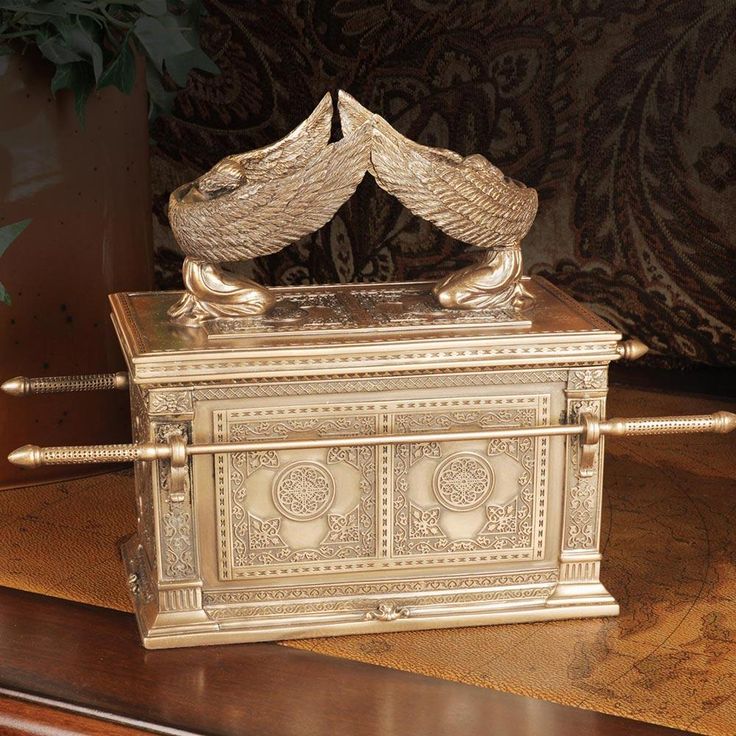
the Ark of the Covenant from the Judeo-Christian tradition (Raiders),

the Holy Grail, from the Christian tradition (Crusade),

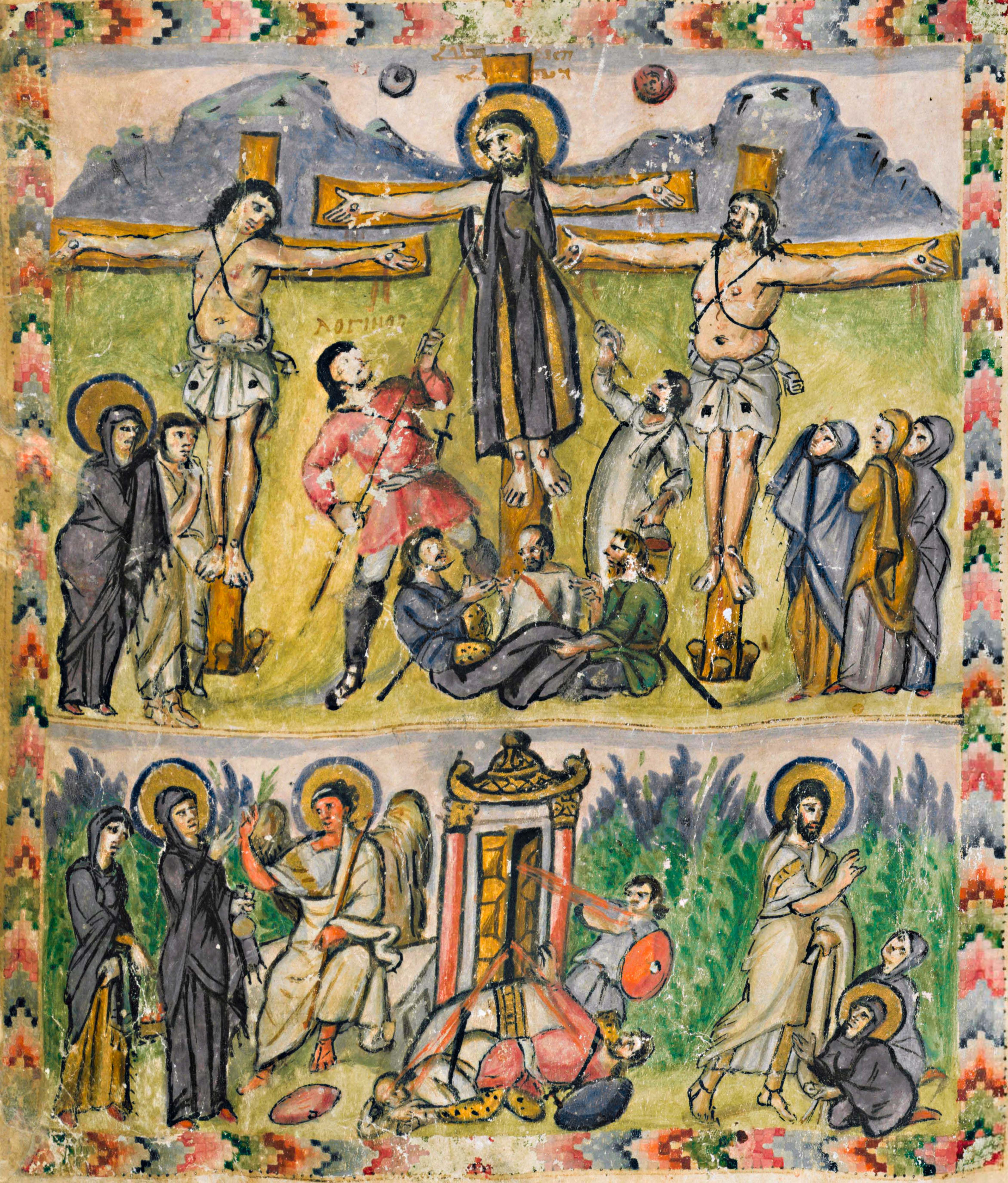
and the Lance of Longinus, also from the Christian tradition.

(If we can believe Mein Kampf, where Hitler refers to the Lance—and a nail attached to it—as “magical relics”, perhaps this is the basis for the idea in the films as to why he’s a collector?  I’m sorry that I’m relying upon an early translation here, rather than, as I normally do, making my own translation of the German text, but, so far, I haven’t been able to locate the original German passage—perhaps “magische Relikte ”?  It’s interesting, by the way, that both the villain of Dial and Indiana determine that the Lance which is being carried off in a train full of loot is a fake.  The history of various objects claimed to be the actual “Lance of Longinus” is long and complicated, but at least one of the leading candidates has been determined, by the latest scientific tests, to be inauthentic, something the two film characters seem to be able to do by eyesight alone.  For more, see:  https://en.wikipedia.org/wiki/Holy_Lance )

It’s never said what Hitler intends to do with these objects, but here’s where, I suggest, these real villains appear.

The first is Rene Belloque, a rather dodgy French archaeologist, who appears in the initial episode of Raiders, where, backed by “Hovitos” Native Americans, he takes the golden idol from Jones which Jones, in a memorable scene, has managed to extract from its deposit site.

He then reappears later in the film as director of a German (it’s 1936, which means Nazi) archaeological project in Egypt, employed to oversee the excavation of the “lost city of Tanis”—and to discover the whereabouts of the Ark.  (For more on the real city of Tanis, which was actually rediscovered in the 1860s, see:  https://en.wikipedia.org/wiki/Tanis )

When the Ark is in his hands, however, his behavior is hardly that of an archaeologist.  Instead of making drawings and taking photographs at each stage (unfortunately, archaeology, even as it discovers, is forced to destroy, so careful records are crucial to the understanding of a site or an object), he dresses up as a high priest

and recites what sound like prayers in Hebrew.  (In fact, it is a prayer—see this website for an explanation:  https://www.jta.org/jewniverse/2016/why-indiana-joness-nazi-loving-enemy-said-a-torah-prayer.  )  To me, this allows for the possibility that, at this stage, he’s abandoned his obligations to his sinister employers

and looks to be attempting to tap into what he believes to be the power of the Ark, or its contents, for himself, and, as we know, this leads to an unexpected consequence—

This, in turn, foreshadows the behavior—and fate–of Walter Donovan

in The Last Crusade.

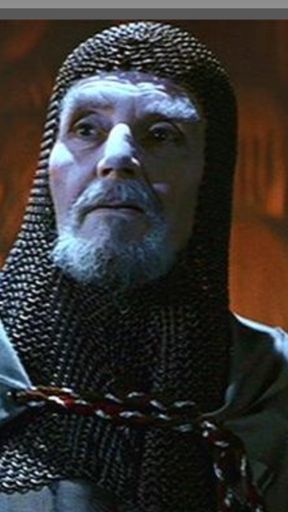
He, too, although appearing to work for the Nazis, has his own agenda:  immortal life from drinking from the Holy Grail,

which goes awry, just as Rene’s attempt to use the Ark has been less than successful.

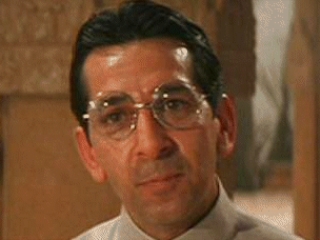
This leaves us with our retired Nazi in Dial of Destiny, “Juergen Voller”.

As I discussed in my two-part review, although Voller was once a Nazi,

or at least was surrounded by them, his ultimate goal is somewhat murky:  it appears that he’s going to use the “Dial” to cross time, arrive in Berlin just in time to assassinate Hitler and take his place, winning a war which, through his mistakes, Hitler lost.  He assumes—we’re never told why—that the “Dial” (aka “the antikythera”)

is a time-traveling device (and how it works is also never clearly explained, but it seems to have something to do with the weather) and it will transport him and his entourage to his chosen site at the moment of his choosing (and how this is supposed to happen is also not clear—and, at this point, I think that Indiana Jones’ remark in the first film—

is true for the writers of what I’m afraid is a pretty shaky script).

If you haven’t read my review, and are interested, turn back to “Jonesing for Indiana”, 24 July, 2023, 3 August, 2023, for more, but here, I would say that, as in the case of Belloque and Donovan, his villainy is more about him than about the cause of his employers.  It’s never mentioned directly, but, once he’s dealt with Hitler, doesn’t this assume that Voller will then be the new Fuehrer?  After all, he could use his time traveling, if it were real, to tweak history here and there wherever he wished, taking a backseat, but, controlling, role.  Instead, he will be front and center, suggesting less a German patriot than a would-be megalomaniac, rather like the man he intends to replace and this certainly fits in with the idea that these films aren’t about confronting the Nazis, but rather about foiling the massive egos of three men for whom the Nazis are nothing more than employers and enforcers.

Thanks, as ever, for reading.

Stay well,

As I’ve cautioned before, always choose wisely,

And know that, as always, there’s

MTCIDC

O

PS

While I always try to be as fair as I can be in reviews—after all, the majority of those creating films really do believe in their projects and aren’t simply trying to cheat the viewers—this last Indiana Jones film seems, for all the time and money spent, compromised by what is really very sloppy writing. I’ve mentioned some things, both here and in my review, but, as I was writing this, another example occurred to me.   Unlike Belloque and Donovan’s ends, Voller’s death is treated almost as an afterthought, as if the villain was nothing more than a plot device picked up, used, then discarded, as we simply see his body sprawled next to the ruined aircraft.  Archimedes goes over to the body and removes Voller’s wristwatch, putting it on his own wrist.  Possibly he thinks that this is just a nice addition to his jewelry collection, but, beyond that:

1. after such a crash, it would probably have been broken and therefore would no longer register time (although it seems to be in perfect condition—not even rusted—when it’s discovered by Jones in Archimedes’ tomb over 2000 years later) and how would Archimedes even understand that that was its function as

2. Archimedes, like other Greeks, used the letters of his alphabet for numbers—if the dial had Roman numerals, they would probably have meant nothing to him and, if it had Arabic numerals, not only would they have meant nothing, but they would also have been an anachronism, as Arabic numerals—which were, in fact, invented in India—only appeared in western Europe in the 10th century AD—see this useful article:  https://en.wikipedia.org/wiki/Arabic_numerals

All of which makes me sad:  I’ve always looked forward to the next Indiana Jones film, ever since the first one and, although I’ve been disappointed by 2 and 4, I had real hopes for 5 and, given better writers, who knows what we might have seen at the end of his long, adventurous career?

V(&)ILC(s)

As ever, dear readers, welcome.

Although Tolkien often protested that The Lord of the Rings was never meant to be allegorical (allegory being something he didn’t care for), yet:

“That there is no allegory does not, of course, say there is no applicability.  There always is.  And since I have not made the struggle unequivocal…there is I suppose applicability in my story to present times.”  (from a letter to Herbert Schiro, 17 November, 1957, Letters, 262)

As a case in point, let me cite for you Lotho Sackville-Baggins.

The title of this posting, although it may appear to be the acronym for some large, anonymous corporation, is actually a piece of shorthand adapted from one of Tolkien’s letters:

“We knew Hitler was a vulgar and ignorant little cad, in addition to any other defects (or the source of them)…” (letter to Christopher Tolkien, 23-25 September, 1944, Letters, 93)

That Tolkien had no love for Hitler, his view of him he makes very clear in an earlier letter written to his second son, Michael:

“Anyway, I have in this War a burning private grudge—which would probably make me a better soldier at 49 than I was at 22:  against that ruddy little ignoramus Adolf Hitler…”  (letter to Michael Tolkien, 9 June, 1941, Letters, 55)

Tolkien goes on in that later letter, however:

… but there seem to be many v. and i.l. cads who don’t speak German…”

and this leads us in a very interesting direction:

“…and who given the same chance would show most of the other Hitlerian characteristics.”

This, in turn, is what leads me to think immediately of Lotho, the son of Otho and Lobelia Sackville-Baggins, whom we first see in the last chapter of The Hobbit, where, having believed that Bilbo was dead, they seem to have hoped to inherit Bag End, appearing at the auction of its contents and, to Bilbo’s mind, intent upon acquiring more than the real estate:

“Many of his silver spoons mysteriously disappeared and were never accounted for.  Personally he suspected the Sackville-Bagginses.”

They were clearly personally affronted that Bilbo survived his adventure:

“On their side they never admitted that the returned Baggins was genuine, and they were not on friendly terms with Bilbo ever after.  They really had wanted to live in his nice hobbit-hole so very much.”  (The Hobbit, Chapter 19, “The Last Stage”)

Although not on friendly terms, perhaps, they were invited to Bilbo’s birthday party, but they presumed upon this, when Bilbo had disappeared, to confront Frodo:

“The Sackville-Bagginses were rather offensive.  They began by offering him bad bargain-bargain prices (as between friends) for various valuable and unlabelled things.  When Frodo replied that the only things specially directed by Bilbo were being given away, they said the whole affair was very fishy.

‘Only one thing is clear to me,’ said Otho, ‘and that is that you are doing exceedingly well out of it.  I insist on seeing the will.”

And now we see what has been festering since that moment, sixty years before, when Bilbo had reappeared to stop the auction:

“Otho would have been Bilbo’s heir, but for the adoption of Frodo.”

He reads the will, finds it ironclad, and is more than disappointed:

“ ‘Foiled again!’ he said to his wife.  ‘And after waiting sixty years.  Spoons?  Fiddlesticks!’  He snapped his fingers under Frodo’s nose and stumped off.  But Lobelia was not so easily got rid of.  A little later Frodo came out of the study to see how things were getting on, and found her still about the place, investigating nooks and corners, and tapping the floors.  He escorted her firmly off the premises, after he relieved her of several small (but rather valuable) articles that had somehow fallen inside her umbrella.”

(Otho might have been waiting for sixty years to gain Bag End, but Bilbo had not forgotten his suspicion of the Sackville-Bagginses’ earlier behavior, leaving a gift for her:

For LOBELIA SACKVILLE-BAGGINS, as a PRESENT on a case of silver spoons.”  The Fellowship of the Ring, Book One, Chapter 1, “A Long-expected Party”)

Although Otho had died in the interim, Lobelia survived to buy—not inherit—Bag End, and it was still in her—, or rather, her son, Lotho’s—hands when Saruman, aka “Sharkey”, arrived to continue his plan either to convert the Shire into an early industrial center or to ruin it (Tolkien might have said, “Both”, considering his aversion to what the Industrial Revolution had done to his beloved countryside).  

(Denis Gordeev—for an interesting article on Soviet artists’ attempts to bring Tolkien to Russia, see:  https://foreignpolicy.com/2021/07/24/soviet-union-tolkien-art-dissidents/  )

In the meantime, Lotho—the son of rather less than decent folk, his own popularity in the Shire gauged by his nickname, “Pimple”—has somehow done very well for himself:

“ ‘It all began with Pimple, as we call him,’ said Farmer Cotton; ‘and it began as soon as you’d gone off, Mr. Frodo.  He’d funny ideas, had Pimple.  Seems he wanted to own everything himself, and then order other folk about.  It soon came out that he already did own a sight more than was good for him; and he was always grabbing more, though where he got the money was a mystery:  mills and malt-houses and inns, and farms, and leaf-plantations.  He’d already bought Sandyman’s mill before he came to Bag End, seemingly.’ “

Things quickly went from bad to worse, as:

“ ‘A lot of Men, ruffians mostly, came with great wagons, some to carry off the goods south-away, and others to stay.  And more came.  And before we knew where we were they were planted here and there all over the Shire, and were felling trees and digging and building themselves sheds and houses just as they liked.  At first goods and damage was paid for by Pimple; but soon they began lording it around and taking what they wanted.

Then there was a bit of trouble, but not enough.  Old Will the Mayor set off for Bag End to protest, but he never got there.  Ruffians laid hands on him and took and locked him up in a hole in Michel Delving, and there he is now.  And after that, it would be after New Year, there wasn’t no more Mayor, and Pimple called himself Chief Shirriff, or just Chief, and did as he liked…’ “ (The Return of the King, Book Six, Chapter 8, “The Scouring of the Shire”)

So, from being simply the son of greedy, self-important hobbits, Lotho (and, yes, that has to be a joke on “Loathe-0”) has become, at least until Saruman appears, the dictator of the Shire:

“ ‘…and if anyone got “uppish” as they called it, they followed Will.’ “

Earlier in this same letter to Christopher, Tolkien had written:

“There was a solemn article in the local paper seriously advocating systematic exterminating of the entire German nation as the only proper course after military victory:  because, if you please, they are rattlesnakes, and don’t know the difference between good and evil!”

Tolkien, who was a decent and extremely fair-minded man, refuted that, saying:

“The Germans have just as much right to declare the Poles and Jews exterminable vermin, subhuman, as we have to select the Germans:  in other words, no right, whatever they have done.”

At the same time, he was well aware that those who may appear ordinary, but who harbor such terrible ideas, may, in time come into positions of control, like Lotho:

“The Vulgar and Ignorant Cad is not yet a boss with power; but he is a very great deal nearer to becoming one in this green and pleasant isle than he was.”

And, if such thinking weren’t wicked enough in itself, there is the added danger:


“You can’t fight the Enemy with his own Ring without turning into an Enemy; but unfortunately Gandalf’s wisdom seems long ago to have passed with him into the True West…”

This seems too much, even for Tolkien, horrified that letters which sound like Nazi propaganda translated into English should appear in the public press and has already written to Christopher that:

“Still you’re not the only one who want to let off steam or bust, sometimes; and I could make steam, if I opened the throttle, compared with which (as the Queen said to Alice) this would be only a scent-spray.”

(a half-quotation from Through the Looking Glass, 1871, where, in Chapter 2, Alice has a conversation with the Red Queen in which the Queen several times uses the expression, “I’ve seen/heard…compared with which…”)

But perhaps there is some consolation in the ultimate fate of Lotho and of his master, Saruman?  “Where is that miserable Lotho hiding?” Merry had asked and Saruman later answered:

“ ‘But did I hear someone ask where poor Lotho is hiding?  You know, don’t you, Worm?  Will you tell them?’

Wormtongue cowered down and whimpered:  ‘No, no!’

‘Then I will,’ said Saruman.  ‘Worm killed your Chief, poor little fellow, you nice little Boss.  Didn’t you, Worm?  Stabbed him in his sleep, I believe.  Buried him, I hope; though Worm has been very hungry lately…”

This is too much, even for Grima/Wormtongue:

“…suddenly Wormtongue rose up, drawing a hidden knife, and with a snarl like a dog he sprang on Saruman’s back, jerked his head back, cut his throat, and with a yell ran off down the lane.” 

In 1944, Tolkien had no idea what would happen to Hitler and his allies by 1945, but one wonders what he might have said about applicability then?

Thanks for reading, as always.

Stay well,

Beware of the self-righteous,

And remember that there’s always

MTCIDC

O

Wimseycal

As always, welcome, dear readers.

In his own field, Tolkien was, not surprisingly, a very well-read scholar, and, in certain areas beyond his field, like Celtic Studies, he was informed, if not expert. 

Oronzo Cilli’s wonderfully detailed work, Tolkien’s LibraryAn Annotated Checklist,

using a variety of sources, from correspondence, to the comments of his friends, to books surviving in university collections, to sale catalogues, to library books recorded to have been checked out by him, supplies us with hundreds of titles owned or consulted by Tolkien.

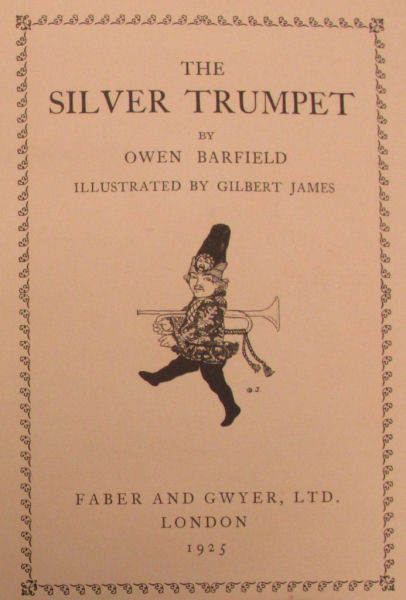
For a person who often wrote that he was overwhelmed with academic work year-round, however, Tolkien appears to have enough leisure to accumulate and read quite a number of non-scholarly works, as well, and leafing through the pages of Cilli’s book, one finds everything from Owen Barfield’s The Silver Trumpet

to James Joyce’s Finnegans Wake

(although Cilli misspells it with an apostrophe, which Joyce intentionally didn’t employ)

to E.A. Wyke-Smith’s The Marvellous Land of Snergs.

(missing its definite article in Cilli)

Among his listings are these:

Busman’s Honeymoon,

Clouds of Witness,

The Five Red Herrings,

(also missing its definite article in Cilli)

Gaudy Night,

Have His Carcase,

Murder Must Advertise,

Strong Poison,

The Nine Tailors,

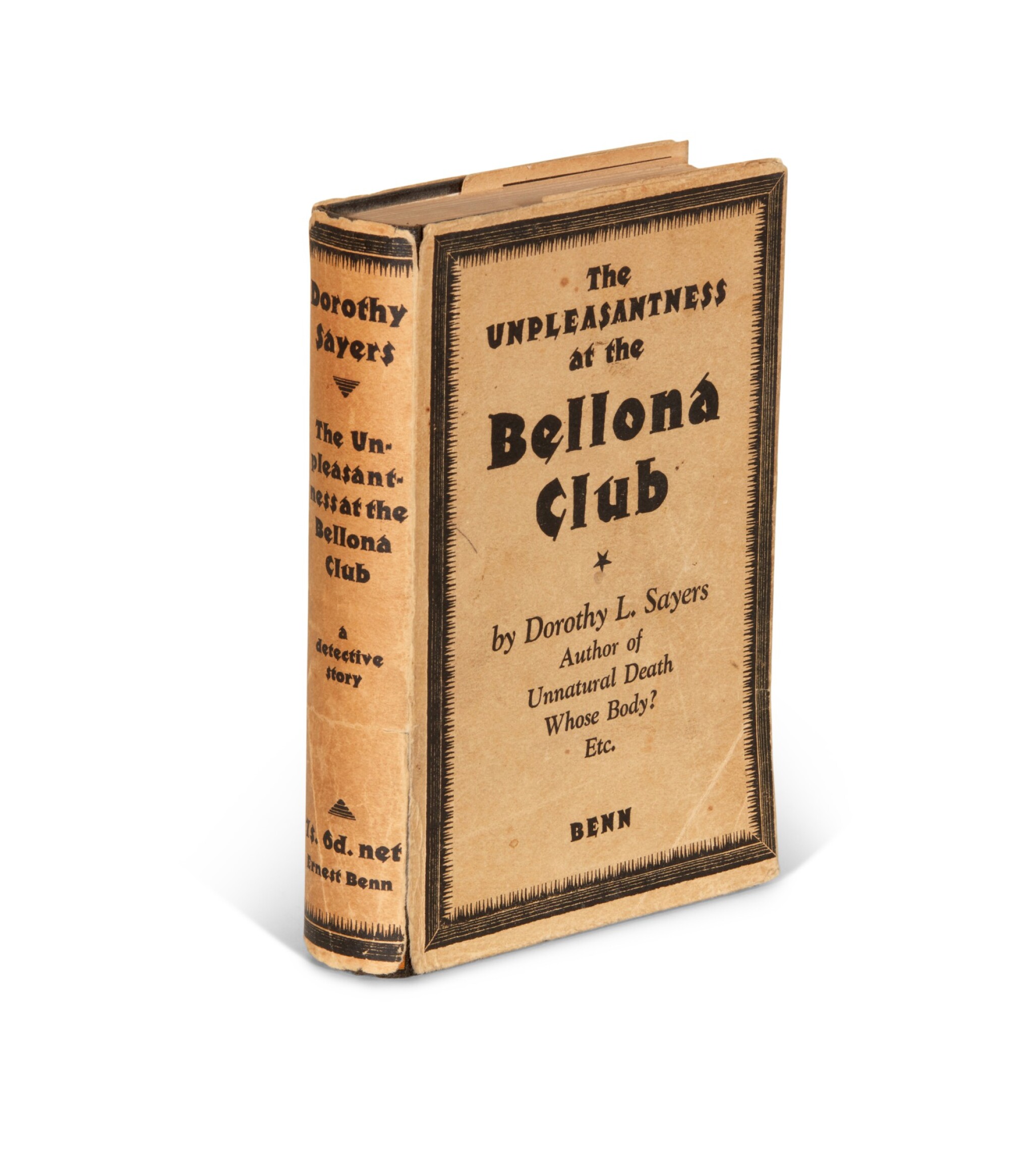
The Unpleasantness at the Bellona Club,

and Whose Body?,

all detective novels by Dorothy L. Sayers (1893-1957).

In these novels, the detective is a wealthy, titled man, Lord Peter Wimsey,

who has a kind of Watson in his personal valet, Bunter (a sergeant in his regiment in the Great War, who rescued him on the battlefield), and who eventually marries—of all people—a young mystery writer, Harriet Vane, after he rescues her from the gallows in Strong Poison (1930)–although not immediately.  In a very believable rejection, Harriet refuses him at first because she doesn’t believe that gratitude is enough of a basis for a lasting relationship.  It takes two more adventures—Have His Carcase, 1932, and Gaudy Night, 1935, before she finally agrees.  And, in Sayers’ last Wimsey novel, Busman’s Honeymoon, 1937, we see them just after their marriage.

Besides being a successful mystery writer, Sayers was also a dramatist, essayist, and translator, her major work being her highly-annotated translation of the first two parts of Dante’s Commedia (the third part, unfinished at her death, was completed by Barbara Reynolds). 

Both Tolkien and C.S. Lewis knew and liked her, as Humphrey Carpenter tells us (see The Inklings, 189), and, among her works, her series of Christian radio plays, The Man Born to Be King (1941-42), impressed them, but Lewis tried Gaudy Night and didn’t enjoy it, and Tolkien, who appears to have owned and read almost all of her novels (only missing from the list is Unnatural Death, 1927) ultimately wrote this:

“I could not stand Gaudy Night,  I followed P. Wimsey from his attractive beginnings so far, by which time I conceived a loathing for him (and his creatix) not surpassed by any other character in literature known to me, unless by his Harriet.  The honeymoon one (Busman’s H.?) was worse.  I was sick.”  (airgraph to Christopher Tolkien, 25 May 1944, Letters, 82)

What had gone wrong?  Gaudy Night (1935) is set at a reunion of Harriet Vane’s imaginary Oxford college, “Shrewsbury College”, based upon Sayers’ actual college, Somerville, and concerns mysterious acts of anti-feminist vandalism which come to border on open violence.  The college head invites Harriet, as a former member of the college, to investigate, which she does against rather significant opposition from some of the faculty.  The plot also concerns Peter Wimsey, who, although off on a diplomatic mission for the British government at the beginning of the story, returns in time to participate in the detecting of the guilty party and her motive later in the novel.  We don’t know why this turned Tolkien off—perhaps Lewis’ reaction?  Perhaps the love story and Harriet’s ultimate agreement to marry Peter?  (He did say that he’d come to loathe her, but doesn’t mention her appearance in two earlier novels.)  And what had happened to his liking for Sayers herself?  Such extreme reactions seem as mysterious as Sayers’ novels and perhaps it would take a literary detective of the quality of Peter Wimsey himself to unravel it.

Thanks for reading, as always.

Stay well,

The science of deduction or induction—which does Holmes practice really?

And know that, as always, there’s

MTCIDC,

O

PS

Unlike Tolkien, I’ve always enjoyed Sayers’ novels, Harriet Vane being a particular favorite character—I wish that Sayers had written at least one book in which she solves a mystery on her own—and, if you’d like to know more about her and her work, try:  https://www.sayers.org.uk/  If Peter Wimsey interests you, besides the books, there are two very good and very different television series available:

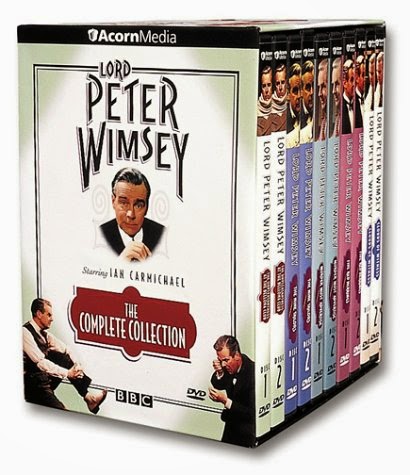
1. Ian Carmichael played the character in a series created in the 1970s

2. Edward Petherbridge was Wimsey in a briefer series in the late 1980s

There are partisans for each.  I enjoy both, Carmichael having the kind of bounce and flair with quotation which makes Wimsey appealing, and Petherbridge displays the inherent melancholy which is Wimsey’s other side (he still has nightmares about the Great War).

Terms

Welcome, as ever, dear readers.

Although Tolkien never wanted readers to see The Lord of the Rings as allegory about his own time—writing to Joanna de Bortadano that “my story is not an allegory of Atomic power” (letter to Joanna de Bortadano, April, 1956, Letters, 246), he also wrote to Rhona Beare that, “I have, I suppose, constructed an imaginary time, but kept my feet on my own mother-earth for place” (letter to Rhona Beare, 14 October, 1958, Letters, 283) and, in the years in which he was writing the novel, it would have been difficult not to have felt some influence from what was going on around him in that place.

This certainly applies, I would suggest, when it comes to the words of the Mouth of Sauron,

(Douglas Beekman)

dictating terms to Gandalf:

“The rabble of Gondor and its deluded allies shall withdraw at once beyond the Anduin, first taking oaths never again to assail Sauron the Great in arms, open or secret.  All lands east of the Anduin shall be Sauron’s for ever, solely.  West of the Anduin as far as the Misty Mountains and the Gap of Rohan shall be tributary to Mordor, and men there shall bear no weapons, but shall have leave to govern their own affairs.  But they shall help to rebuild Isengard which they have wantonly destroyed, and that shall be Sauron’s, and there his lieutenant shall dwell:  not Saruman, but one more worthy of trust.”  (The Return of  the King, Book Five, Chapter 10, “The Black Gate Opens”)

Although it would lead to a permanent cessation of combat, the armistice of 11 November, 1918, agreed upon in a railway car in Compiegne in northern France,

was not a surrender on the part of the Central Powers (Germany, Austria-Hungary, Bulgaria, Turkey), but only an agreement to cease active engagement with the Allies.  As fighting stopped, more or less, at that time, at least on the Western Front, people in the West, especially soldiers, certainly rejoiced as if the Great War/World War I had actually ended.

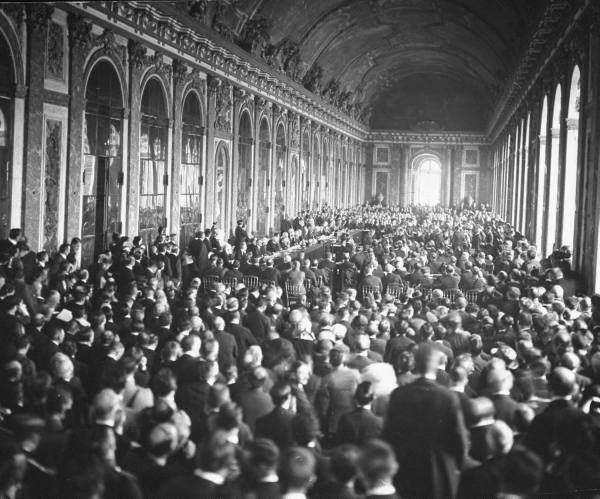
The real surrender occurred the next June, however, in the Hall of Mirrors at Versailles, outside Paris.

As might be expected from a large gathering of disparate powers, there was a great deal of wrangling, of pushing various agendas, and argument over how Germany, which was almost universally blamed for the outbreak of war in 1914, was to be dealt with.  The final form of the treaty was complex, but here are some of the main points:

Reading through these points, and many more, it’s hard not to think that Lieutenant Tolkien

would not have also read through them with interest—note things like:

1. disarmament

2. loss of territory

3. to which we might add outside control of territory, in that the Allies gave themselves the right to occupy the heavy industrial areas called the Rhineland and the Ruhr valley until 1934 (the occupation, in fact, was ended in 1930),

as well as returning to France territory which she had lost to German troops in the War of 1870-1, Alsace and Lorraine.

The severe terms of this treaty, it has often been written, were a major reason for the rise of Hitler and the rearmament of Germany in the 1930s

and even a reason for a new war, even longer than the first, from 1939 to 1945, as Hitler worked his way west, in what was called a Blitzkrieg, or “lightning war”, which, in late spring, 1940, rolled over Norway, Denmark, the Netherlands, Belgium, and moved into France, where it rapidly defeated both a British expeditionary force and the French army.

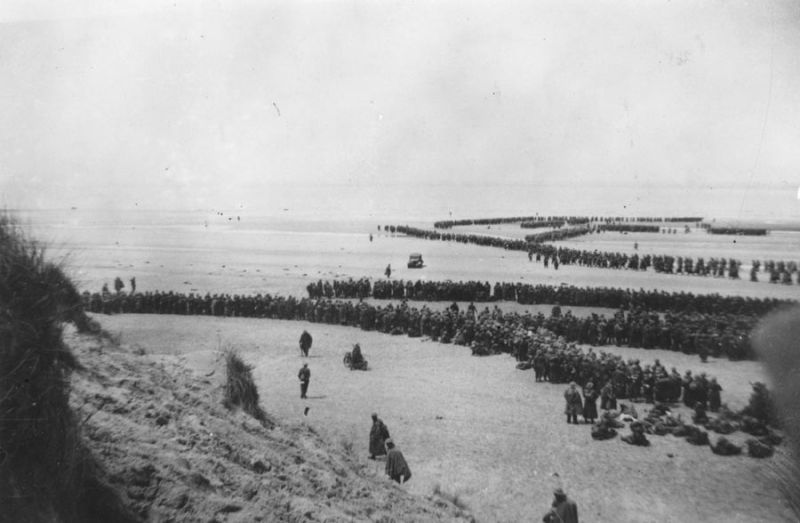
The majority of the British, along with a number of Belgian and French soldiers, were rescued at Dunkirk,

but the majority of the French were forced south and then became part of a general armistice, the terms of which would seem familiar to those who remembered the Treaty of Versailles:

“The 1940 Armistice agreement comprised 24 articles, notably: :

n°1 : The French army must immediately lay down its arms

n°2 : The German occupation of a large portion of France.

n°4 : The demobilization of the French army.

n°6 : The heavy armaments of the free French zone are to be delivered in good condition to the Germans. 

n°8 : The French navy is to be demobilized and disarmed.

n°11: Commercial boats must remain in port.

n°12: All planes are grounded.

n°19: Designated German nationals must be handed over to Germany.

n°20: French prisoners of war are to remain in Germany. 

n°24: The armistice agreement remains valid until the signing of a peace treaty”

(from the website Memorial Armistice here:  https://armistice-museum.com/ )

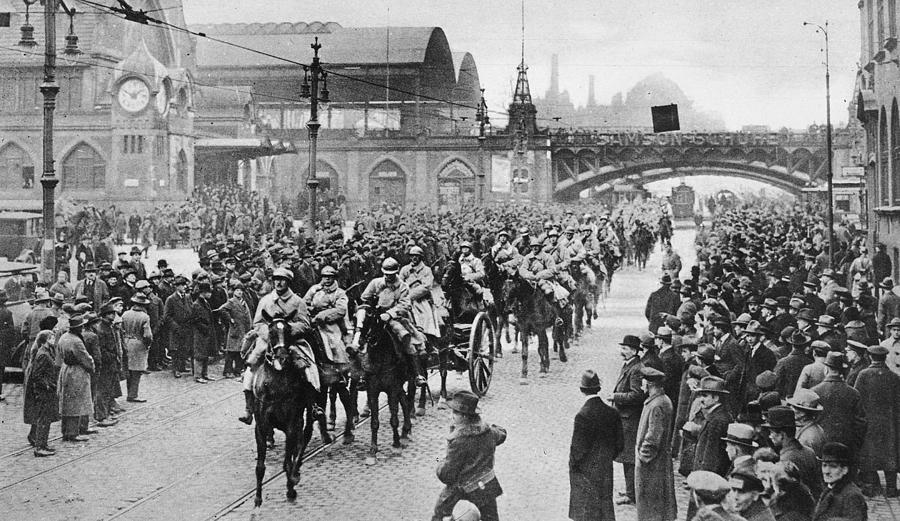
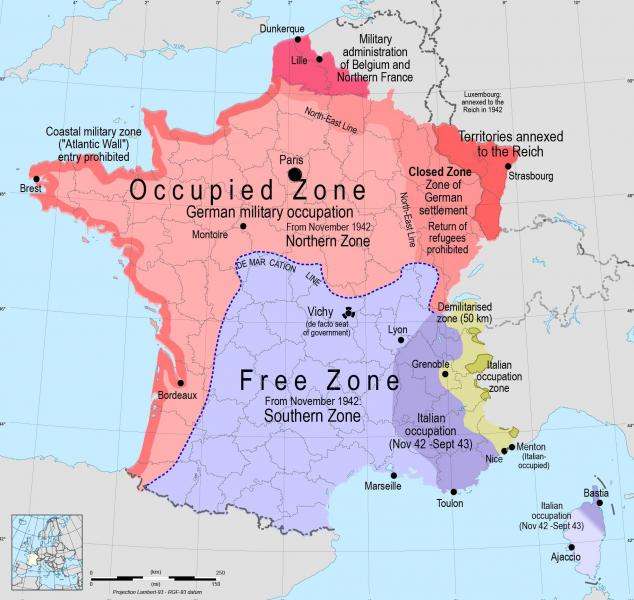
This occupation also sounds much like Sauron’s terms, France initially looking like this—

(for more on the occupation, see an extensive article here:  https://en.wikipedia.org/wiki/Vichy_France#Bibliography )

The terms of the Versailles Treaty were harsh, but their ultimate goal was—or at least some of those involved hoped so—to prevent such horrendous wars in the future (see this detailed article for more:  https://en.wikipedia.org/wiki/Treaty_of_Versailles ).  The Nazi terms for an armistice were, on the one hand, Hitler’s sneering response to the Treaty of Versailles (he even had it arranged that the terms would be presented and agreed to in the same location—see more at:  https://armistice-museum.com/  ), but, on the other, simply a method to gain control of all of France, its industries, and even its labor force, in time—the condition that the armistice terms would hold until a peace treaty was signed proved totally false, as there was never a treaty.  That artificially-determined border was erased and the Nazis occupied all of France, as this map sequence shows.

And this is in line with something which the narrator tells us of the reaction of Gandalf and his companions to the words of the Mouth of Sauron:

“Looking in the Messenger’s eyes, they read his thought.  He was to be that lieutenant, and gather all that remained of the West under his sway; he would be their tyrant and they his slaves.”

Tolkien, a reluctant civilian during that second war (see his letter to Michael Tolkien of 9 June, 1941, Letters, 55), was always clearly well aware of current events, especially to do with that war (there are over 100 citations to war-related items in Letters alone) and, although he might model Sauron’s terms on what he might have read in 1919 or 1940, I can imagine that it was the terms of the 1940 armistice and their ultimate veracity which was in his mind when he wrote Gandalf’s words in response to the demands of Sauron and his Mouth:

“But as for your terms, we reject them utterly.  Get you gone, for your embassy is over and death is near to you.  We did not come here to waste words in treating with Sauron, faithless and accursed; still less with one of his slaves.  Begone!”

As always, thanks for reading.

Stay well,

Never trust an emissary with his own agenda,

And remember, that, as ever, there is

MTCIDC,

O

Well Met By Dayelight

Dear Readers, welcome, as always.

This is the 469th posting of Doubtfulsea.com and, with it, this blog enters its tenth year.

This calls for a little rejoicing,

(no peacock, however)

but there’s another reason for rejoicing, as will present itself—or, rather, himself–later.

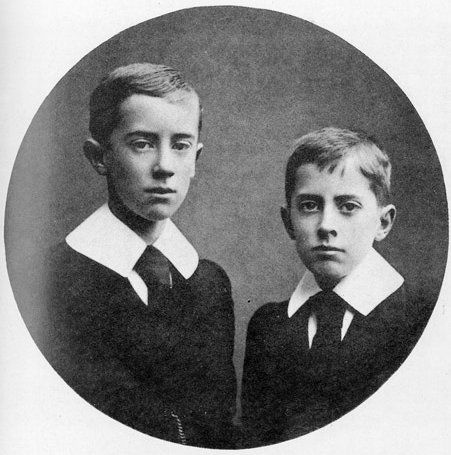
As I’ve discussed in earlier postings, lthough, in later life, Tolkien enjoyed at least one Shakespeare performance (see a letter to Christopher Tolkien, 28 July, 1944, Letters, 88), as a schoolboy,

(in 1905, with his younger brother, Hilary)

he disliked Shakespeare “cordially” (see letter to W.H. Auden, 7 June, 1955, Letters, 213).  His ire was directed towards two plays in particular:

1. Macbeth, because, as he tells us, he was disappointed that Birnam Wood wasn’t an actual wood which marched on Macbeth’s stronghold, but merely camouflage for Macduff’s soldiers (see  JRRT’s own footnote to his letter to W.H. Auden of 7 June, 1955, Letters, 212)

(modern camouflage, but you get the idea)

2. A Midsummer Night’s Dream because of the miniaturization of the fairies (see his footnote to a letter to Milton Waldman, “late 1951”, Letters, 143, where he remarks:  “…a murrain [plague] on Will Shakespeare and his damned cobwebs”  )

I don’t mind Tolkien’s disappointment about Birnam Wood because it gave us Treebeard and the Ents, to me one of his most marvelous creations,

(Alan Lee)

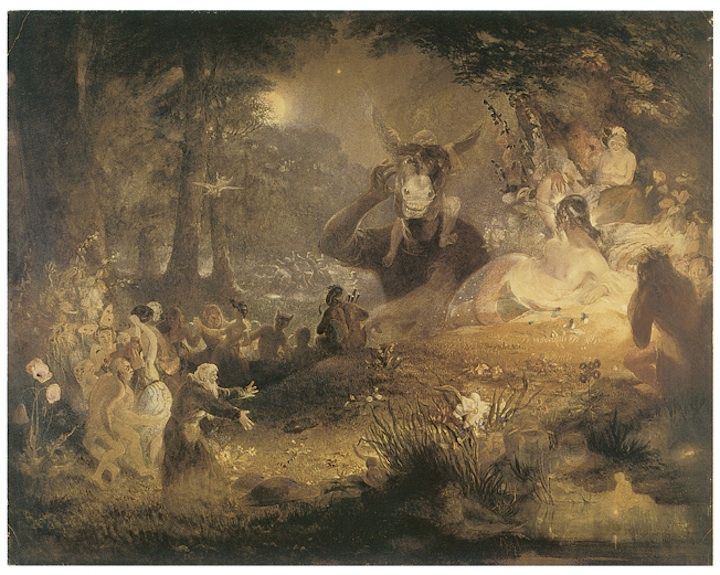
but, although the “cutsie” aspect of Victorian depictions of fairies, which clearly Tolkien had seen and disliked, as the descendants of Shakespeare’s fairies, I find more than a little disturbing—like this depiction, by Richard “Dicky” Doyle (1824-1883), famous for his fairy illustrations–

it has never stopped me from loving the play and, if you, like me, have Shakespeare in your head (it can get a little crowded in there, I admit, so I exclude dubious things like Henry VIII), you’ll recognize the title of this posting as based upon the opening line of the meeting of the Fairy King and Queen

in Act II of A Midsommer nights dreame, as the First Quarto (1600) spells it.

“Ob. Ill met by moonelight, proud Tytania.

Qu. What, Iealous Oberon? Fairy skippe hence.

I haue forsworne his bedde, and company.

Ob. Tarry, rash wanton. Am not I thy Lord?”

(I really prefer Elizabethan/Jacobean spelling, myself, so, if you’d like to read the play in that edition:  https://internetshakespeare.uvic.ca/doc/MND_Q1/scene/2.1/index.html  A very mild caution:  if you’re used to modern editions and haven’t used the earliest publications, this Quarto may surprise you, as it has no line numbers, scene or act markers, but just rolls along with no breaks.  It’s actually perfectly easy to read, however, as you’ll see.)

The King of the Fairies is Oberon, a name which is believed to be derived from a Germanic form “alf-rih”, “elf-king/ruler” (you can see the same construction in the name of the Ostrogothic king, Theodoric, which is actually “theuda-reiks”, “people ruler”), but which first appears in the early 13th century chanson de geste (a kind of heroic poem) of Les Prouesses et faitz du noble Huon de Bourdeaux as Auberon.  (For more on this see :  https://en.wikipedia.org/wiki/Huon_of_Bordeaux )Shakespeare may have picked up the name from the early 16th-century  translation by John Bouchier, Lord Berners, The Boke of Duke Huon of Burdeux (printed about 1534—you can read the Early English Text Society edition of 1882 here :  https://ia600502.us.archive.org/35/items/TheBokeOfDukeHuonOfBurdeux1/The_Boke_of_Duke_Huon_of_Burdeux_1.pdf or an 1895 retelling, in the style of William Morris here :  https://archive.org/details/huonofbordeauxdo00bernuoft/page/n9/mode/2up ) It’s interesting that Auberon is diminutive, but handsome, in the Huon story, so perhaps Shakespeare scaled down the rest of the fairies to fit him ?  (Other Elizabethan/Jacobean authors also depict the fairies as tiny—see, for example,  Michael Drayton’s Nymphidia, 1627, which Tolkien hated—On Fairy Stories–and which you can read here :  https://archive.org/details/selectionfrompoe00dani/page/124/mode/2up

If you know the play, you probably also know the incidental music which Felix Mendelssohn (1809-1847) composed for a performance in of it in Berlin in 1842, having written an overture years before, in 1826, when he was 17 (I almost put an exclamation point there).  So you can hear something of what audiences in 1826 would have heard, here’s a really beautiful performance of that overture on instruments of the period, conducted by Franz Brueggen :  https://www.youtube.com/watch?v=qxC17tNhN7c

At about the same time, another Romantic composer, Carl Maria von Weber (1786-1826),

(This is sometimes cited as the first illustration of a conductor using the equivalent of a baton to conduct.)

was in London, creating an opera based upon a libretto loosely founded upon that 13th century French poem of Huon.  That libretto was written by a man often thought of as the forerunner to W.S. Gilbert in English comic operetta, James Robinson Planche (1796-1880),

but who was actually a dynamo of the Georgian and early Victorian theatre in general, being involved in everything from authentic historical costuming to introducing vampires to the English stage in 1820.

The libretto combines spoken dialogue with music, the kind of opera which the French call an opera comique, like Bizet’s (1838-1875) Carmen, 1875, as opposed to an opera completely sung, opera lyrique, or grand opera, and the plot probably would seem pretty weak to us (you can read a summary here :  https://en.wikipedia.org/wiki/Oberon_(Weber) ), but it was an immediate success in 1826,

although von Weber died in London shortly afterwards.  Here’s the overture to it, again with period instruments, conducted by John Eliot Gardiner : //www.youtube.com/watch?v=fHI7Yc66SFk

so that you can hear a little of what excited London theatre-goers.

Now, you are probably wondering, how does all of this, as interesting as I hope you find it, tie in with that idea of festivity?

Back in May, I posted a piece which ended on the sad note that my 9-year-old Bernese Mountain Dog, Bellerophon, had left us (see Beato Te, 31 May, 2023).

A month or so ago, a new Berner appeared, a 2-month-old puppy, named—I’ll bet you’ll guess this already–Oberon.

At 3 months, he’s curious, lively, and promises, if not to be a powerful fairy king, like his namesake, certainly to provide as much delight as the Shakespeare play from which his name comes.

As always, thanks for reading.

Stay well,

Beware the Puck,

And remember that, as always, there’s

MTCIDC

O

PS

If you liked the image of Puck and the meeting of Oberon and Tytania earlier in the posting, you might have a look at Arthur Rackham’s 1908 illustrated version of Shakepeare’s play here:  https://ia902806.us.archive.org/33/items/midsummernightsd00shakrich/midsummernightsd00shakrich.pdf