• About

doubtfulsea

~ adventure fantasy

Author Archives: Ollamh

 Things You/They Know That Ain’t

18 Wednesday Jan 2023

Posted by Ollamh in Uncategorized

≈ Leave a comment

“I am not the type to faint
When things are odd or things are quaint
But seeing things you know that ain’t
Can certainly give you an awful fright!
What a sight!”

(Dumbo, 1941)

Dumbo the elephant and his friend, Timothy, the mouse, are having a rather bad moment,

being haunted by a vision of PINK ELEPHANTS.

(Here’s the surrealistic scene from the Disney film, in case you haven’t seen it:  https://www.youtube.com/watch?v=jcZUPDMXzJ8 )

They can blame this on the fact that they have accidentally been imbibing.

(Proofpudding)

What kind of explanation, however, can you produce when there appears to be no valid reason for seeing something which, in your country, officially, doesn’t even exist?

We’re not talking about Area 51 and its secrets,

but about events which took place in Stalinist Moscow sometime in the late 1920s, early 1930s,

when the Communist government insisted upon an atheistic state and worked energetically to eradicate both churches and clergy.    


(For a short but useful article on Stalinist aggressive atheism, see:  https://www.history.com/news/joseph-stalin-religion-atheism-ussr )

But then Satan appears,

with some very destructive assistants,

including a cat with a taste for vodka.


(And perhaps this gives a new meaning to the German word for “hangover”:   Katzenjammer—“the wailing of cats”.)

What can be the official line when non-existent Satan and those assistants turn Moscow upside down?

What I’m describing here is, in fact, not history, but Soviet-era fiction, in Mikhail Bulgakov’s (1891-1940)

The Master and Margarita (1928-1940).

It’s a very strange and entertaining book which, unfortunately, as least for the near future, I’m doomed to read in any number of English translations, beginning with the first, Mirra Ginsburg’s,

then Michael Glenny’s,

and, just recently, Richard Pevear and Larissa Volokhonsky’s.

(For an excellent article comparing translations, see:  https://welovetranslations.com/2022/10/31/whats-the-best-translation-of-the-master-and-margarita/ )

It’s also a very complex book, in which, although Satan (calling himself “Woland”) is a major worker within the plot, that plot also includes:

1. the (otherwise unnamed) Master, a novelist, who has written a novel about Pontius Pilate and character called “Yeshua” but who, suffering from despair, destroys the manuscript and ends up in a Moscow asylum,

2. the dealings of Pilate with Yeshua—and with Yeshua’s disciple, Matthew Levi,

3. the Master’s heroic mistress, Margarita,

4. the poet, Ivan Homeless, who has had an early encounter with Woland and appears in the same Moscow asylum as the Master

5. a large cast of minor characters, many of them from the Moscow theatrical world, who become entangled in the story through Satan/Woland’s one-night appearance at a Moscow theatre

For a plot summary and much more, see:  https://en.wikipedia.org/wiki/The_Master_and_Margarita

Although we see the Soviet state incapable of dealing realistically with Satan and his mischief, it did its usual—short of Gulag or execution—with Bulgakov, a venereologist turned novelist/dramatist, insuring that very little of his work ever reached publication or the stage.  In fact, Bulgakov became so desperate that he actually wrote to the head of all state persecutors, Stalin, asking to be allowed to emigrate, as he couldn’t work as a writer in his own country.  (The inevitable answer was, of course, no.)  Oddly, that same persecutor continued to spare Bulgakov, having loved one of his few literary pieces to appear, his play The Days of the Turbins (1926), reportedly seeing it at least 15 times.

(a photo from the original production)

The play was based upon Bulgakov’s 1925 novel, The White Guard,

which, ironically and like so much of Bulgakov’s work, never achieved publication in Russia in his lifetime.  It was begun serially in a magazine (Rossiya), which was closed down before more than the first two parts of the novel could appear.  (The title page above is from an edition published in Riga in 1927.)

In a way, it was Bulgakov’s own fault that he remained in publishing limbo.  Considering that The White Guard makes heroes of the Whites—that is, the anti-Bolsheviks at the time of the Russian Civil War (1917-1923)—

a second unpublished work from 1925, The Heart of a Dog,

(the first English translation)

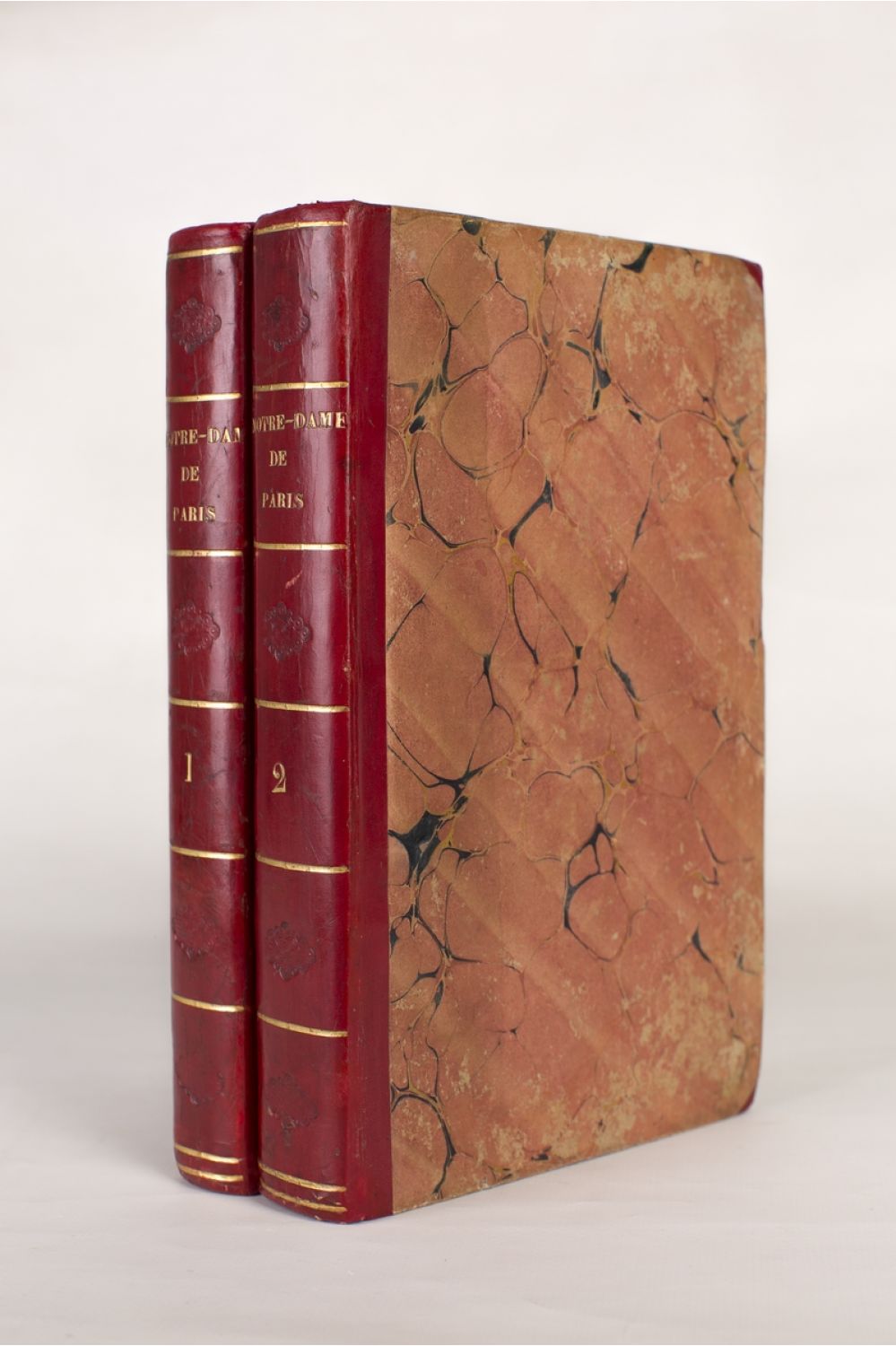
details the adventures of a stray mutt initially called Sharik, who is turned into a brutal Soviet citizen, Poligraph Poligrafovich Sharikov, and The Master and Margarita shows in outline both the tangled bureaucracy of the new Russia, as well as the police state always just out of sight, but always present, it’s not surprising that Stalin’s literary henchmen would block Bulgakov’s attempts to bring his work to the reading public. 

I find these wonderful, crazy works, but I can also imagine the Soviet censors, faced with such elegant, imaginative criticism, and unable to offer any believable counter-criticism, would behave just as the lyric of that song with which I began puts it, shouting:

“What a sight!

Chase ‘em away!  Chase ‘em away!”

Thanks, as always, for reading.

Stay well,

If you encounter those elephants, best just to close your eyes,

And know that, as ever, there’s

MTCIDC

O

Sympathy for a Devil?

11 Wednesday Jan 2023

Posted by Ollamh in Uncategorized

≈ Leave a comment

As ever, dear readers, welcome.

I suspect that every reader of The Lord of the Rings comes to “The Grey Havens” chapter

with that same sense of sadness, having seen Frodo’s gradual decline, and then reads this:

“ ‘Where are you going, Master?’ cried Sam, though at last he understood what was happening.

‘To the Havens, Sam’ said Frodo.

‘And I can’t come.’

‘No, Sam.  Not yet anyway, not further than the Havens…’

‘But,’ said Sam, and tears started in his eyes, ‘I thought that you were going to enjoy the Shire, too, for years and years, after all you have done.’

‘So I thought too, once.  But I have been too deeply hurt, Sam.  I tried to save the Shire, and it has been saved, but not for me.’ “ (The Return of the King, Book Six, Chapter 9, “The Grey Havens”)

We can feel both for Frodo and for Sam and it’s easy to do so, after we had followed their adventures so far, from leaving the Shire, to their long journey with Gollum,

(by Nacho Castro)

to that terrible last crawl to Mt Doom

(a wonderful Ted Nasmith)

and that moment when the Ringbearer, almost becomes the Ringwearer until Gollum reenters the picture.

(another great Nasmith)

For me, there is another possible such moment in The Lord of the Rings, perhaps a very surprising one, I think, but one I had been prepared for by another work entirely, Bram Stoker’s (1847-1912) Dracula (1897), which I’ve just finished teaching once more.

No one in the novel has more reason to hate Dracula and want him dead than Mina Harker.

(by Robert M. Place)

Throughout the novel, she has had her best friend, Lucy Westenra, turn into a vampire, her husband-to-be, Jonathan, held prisoner, then almost turned into a vampire, and she herself initiated into vampirism, all by the evil count.

(by Tony Harris—this image, in my opinion, is so much closer to what Bram Stoker described that I wish that Harris had done an entire illustrated edition of the book)

And yet, she can say this to that same Jonathan, now part of a group determined to eradicate him:

“ ‘Jonathan,’  she said, and the word sounded like music on her lips it was so full of love and tenderness, ‘Jonathan dear, and you all my true, true friends, I want you to bear something in mind through all this dreadful time. I know that you must fight—that you must destroy even as you destroyed the false Lucy so that the true Lucy might live hereafter; but it is not a work of hate. That poor soul who has wrought all this misery is the saddest case of all. Just think what will be his joy when he, too, is destroyed in his worser part that his better part may have spiritual immortality. You must be pitiful to him, too, though it may not hold your hands from his destruction.’ ”  (Dracula, Chapter XXIII)

Pity for a monster?  And this isn’t the end.  In the concluding chapter of the book, just as she sees Dracula turning from Undead to dead, she writes:

“But, on the instant, came the sweep and flash of Jonathan’s great knife. I shrieked as I saw it shear through the throat; whilst at the same moment Mr. Morris’s bowie knife plunged into the heart.

It was like a miracle; but before our very eyes, and almost in the drawing of a breath, the whole body crumbled into dust and passed from our sight.

I shall be glad as long as I live that even in that moment of final dissolution, there was in the face a look of peace, such as I never could have imagined might have rested there.” (Dracula, Chapter XXVII)

Mina’s friend, Lucy, has been a Victorian novelist’s standard victim:  young, beautiful, helpless.  In contrast, Mina has been energetic, enterprising, organized, and courageous, her spirit being behind the destruction of Dracula, practically at every turn.  At the same time, she has something which makes her even more remarkable:  she is able to see beyond Dracula’s current evil, to understand him as being as much a victim of vampirism as he has made Lucy and plans to make her and so can feel what might be seen as a surprising compassion.

This brings me to that other moment.

Saruman, along with the 4 other Istari (Gandalf, Radagast, and the two “Blue Wizards”) has been sent to Middle-earth to counter Sauron.

(the Hildebrandts)

It appears that Saruman, initially, as leader of the Order (as Gandalf calls it), did his job, but, at some point, he became more and more like the very enemy he was supposed to oppose, in part, at least, because he had acquired a palantir, and

this had connected him directly with Sauron, who has clearly turned his mind to the point that he could say to Gandalf:

“ ‘A new Power is rising…We may join with that Power.  It would be wise, Gandalf…We can bide our time, we can keep our thoughts in our hearts, deploring maybe the evils done by the way, but approving the high and ultimate purpose:  Knowledge, Rule, Order; all the things that we have so far striven in vain to accomplish…’ “  (The Fellowship of the Ring, Book Two, Chapter 2, “The Council of Elrond”)

This leads eventually, as we know, to his ruin, his home, Isengard, devasted by the Ents,

(another Nasmith)

his power removed by Gandalf,

(?  I’m not sure whose work this is)

and himself reduced to being what appears at first to be a wandering beggar on the road, followed by his sole servant, Grima.

(and another Nasmith—whose work I highly value, not only for its own qualities, but for his wide range—he often picks scenes no one else has, not only from The Lord of the Rings, but from the Silmarillion)

He’s not really wandering, however, but on his way to the Shire to continue, in a petty way, the work of his departed master, Sauron, turning the hobbits’ homeland into an early industrial wasteland.  When confronted, stopped, and, in an attempt at vengeance, draws a dagger, Frodo says something which might remind us of Mina:

“ ‘No, Sam!’ said Frodo.  ‘Do not kill him even now.  For he has not hurt me.  And in any case I do not wish him to be slain in this evil mood.  He was great once, of a noble kind that we should not dare to raise our hands against.  He is fallen, and his cure is beyond us, but I would still spare him, in the hope that he may find it.’ ”  (The Return of the King, Book Six, Chapter 8, “The Scouring of the Shire”)

(Inger Edelfeldt)

Saruman wants no cure, but before he can even leave the scene of this mercy, Grima stabs him and here, to me, is the surprising sadness:

“To the dismay of those that stood by, about the body of Saruman a grey mist gathered, and rising slowly to a great height like smoke from a fire, as a pale shrouded figure it loomed over the Hill.  For a moment it wavered, looking to the West; but out of the West came a cold wind, and it bent away, and with a sigh dissolved into nothing.”

(J Wyatt)

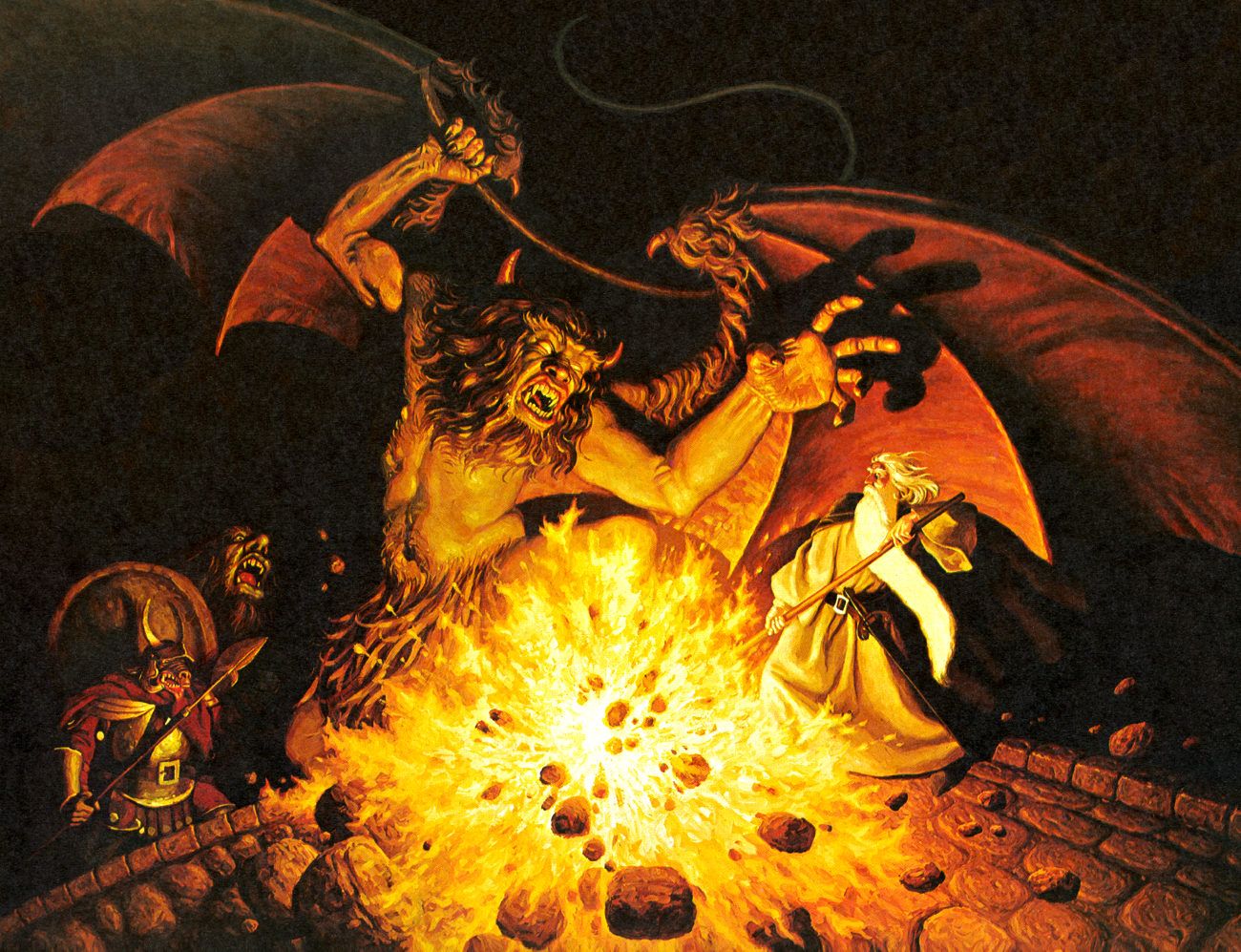
Because Saruman was one of the Maiar, what we might think of as lesser angels, we would expect that bodily destruction was temporary, as it was after Gandalf had met and defeated the Balrog,

(the Hildebrandts)

and, presumably, Saruman, by turning westward, was appealing to the Valar, the Maiar’s superiors, or perhaps even to Eru, the supreme god, but “out of the West came a cold wind” and:

“Frodo looked down at the body with pity and horror for as he looked it seemed that long years of death were suddenly revealed in it, and it shrank, and the shrivelled face became rags of skin upon a hideous skull.  Lifting up the skirt of the dirty cloak that sprawled beside it, he covered it over, and turned away.”

Might this be an echo of Dracula?

“It was like a miracle; but before our very eyes, and almost in the drawing of a breath, the whole body crumbled into dust and passed from our sight.”

(And, loving Tangled, how could I not think of Mother Gothel’s end?)

It’s that “with a sigh” which has always affected me, as it suggests that, although Saruman rejects Frodo’s mercy, he is still aware of what he has now lost by betraying the trust of those who had originally sent him to Middle-earth.

And there’s an interesting contrast here with one more moment, at least visually related to Saruman’s end, which occurs to another powerful figure. 

“And as the Captains gazed south to the Land of Mordor, it seemed to them that, black against the pall of cloud, there rose a huge shape of shadow, impenetrable, lightning-crowned, filling all the sky.  Enormous it reared above the world, and stretched out towards them a vast threatening hand, terrible but impotent:  for even as it leaned over them, a great wind took it, and it was all blown away, and passed; and then a hush fell.”  (The Return of the King, Book Six, Chapter 4, “The Field of Cormallen”)

(a final Nasmith)

No one in the book ever speaks of him as “of a noble kind”, yet Sauron was also once one of the Maiar, and there’s this passage in one of Tolkien’s letters which made me wonder, at least briefly, about his end:

“In my story I do not deal in Absolute Evil.  I do not think there is such a thing, since that is Zero.  I do not think that at any rate any ‘rational being’ is wholly evil…In my story Sauron represents as near an approach to the wholly evil will as is possible.  He had gone the way of all tyrants:  beginning well, at least at the level that while desiring to order things according to his own wisdom he still at first considered the (economic) well-being of other inhabitants of the Earth…” (Response to W.H. Auden’s review of The Return of the King, from some time in 1956, Letters, 243)

And we have this in a letter from 1954:

“Sauron was of course not ‘evil’ in origin.  He was a ‘spirit’ corrupted by the Prime Dark Lord (the Prime sub-creative Rebel) Morgoth.  He was given an opportunity of repentance, when Morgoth was overcome, but could not face the humiliation of recantation, and suing for pardon; and so his temporary turn to good and ‘benevolence’ ended in a greater relapse…But at the beginning of the Second Age he was still beautiful to look at…and was not indeed wholly evil, not unless all ‘reformers’ who want to hurry up with ‘reconstruction’ and ‘reorganization’ are wholly evil, even before pride and lust to exert their will eat them up…” (letter to Peter Hastings, September, 1954, Letters, 190)

But here there’s no sigh—if anything, there’s that threatening hand, impotent, but we can imagine an expression of that “pride and lust to exert [his] will” which Tolkien mentions and if we continue reading down the page in Tolkien’s response quoted above we find:

“Sauron desired to be a God-King, and was held to be this by his servants; if he had been victorious he would have demanded divine honour from all rational creatures and absolute temporal power over the whole world.”

Saruman, sent to Middle-earth to do good (and not for “Rule, Knowledge, Order”—more likely Sauron’s words, simply parroted by Saruman), was corrupted by Sauron, just as Sauron had been corrupted by Morgoth.  His nobility was lost, but at least, at the end, he understood what he had lost.  Sauron, broken, had nothing but regret—but regret only for power lost for good.

Thanks, as always, for reading.

Stay well,

Beware of rushing reformers,

And know that, as ever, there’s

MTCIDC

O

PS

If you don’t have your own copy of that remarkable Victorian novel, Dracula, here’s the original US publication of 1897 for you, thanks to Gutenberg:   https://www.gutenberg.org/files/345/345-h/345-h.htm )

Trumpeting

04 Wednesday Jan 2023

Posted by Ollamh in Uncategorized

≈ Leave a comment

Welcome, as always, dear readers.

In a letter of 28 June, 1936, C.S. Lewis wrote to the author that his book had “scored a direct hit” with the children of a friend.

The book was The Silver Trumpet,

its author was Owen Barfield (1898-1997),

and that friend was Tolkien.

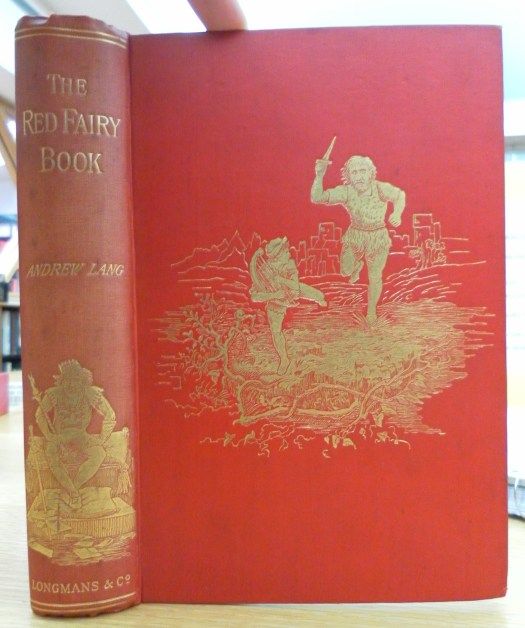
If you read this blog regularly, you know that I’m always interested in reading things which JRRT read, from The Red Fairy Book (1890)

to The Marvellous Land of Snergs (1927)

to the novels of Mary Renault, such as The King Must Die (1958).

The Silver Trumpet is available on-line (https://archive.org/details/silvertrumpet –but without its illustrations), so, now that the Holidays have provided a break, I’ve read it—twice.

Barfield was a long-time friend of Lewis’, the two having met at Oxford sometime just after the Great War.  Barfield met Tolkien for the first time sometime from 1926 on and Barfield’s much later description of that first meeting is interesting reading:

“We dined together at the Eastgate Hotel, nearly opposite Magdalen College, Oxford. In those days there was as yet no Hobbit, no Lord of the Rings, no Screwtape, no Inklings even. For some reason Tolkien was in a ridiculously combative mood and seemed to me to contradict nearly everything I said—or more often what he (wrongly) assumed I was just going to say—before I had even got as far as saying it. But although Lewis actually apologised for him when we were alone afterwards, there was no occasion for it. The whole conversation was so entirely good-humoured and enjoyable; and his random belligerence had only made me laugh. That together with Tolkien’s hurried, low-pitched and sometimes almost inaudible utterance, is what I best remember. I have never had a conversation quite like it before or since.” (quoted from “Was Owen Barfield an Inkling?” by Bradley J. Birzer in The Imaginative Conservative, 25 July, 2019.  Tolkien was aware that he could speak quickly and perhaps even occasionally mumble—see his very gentle letter to Charlotte and Denis Plimmer, 8 February, 1967, Letters, 372)

In time, they became friends (JRRT later even going on a walking tour with him and Lewis) and Tolkien later testified to Barfield’s influence on Tolkien’s ideas of language (see Humphrey Carpenter, The Inklings, 42), but The Silver Trumpet came before all of that.

Unlike The Hobbit, the title object is not the object of the story, although it does appear several times.  Instead, this is a kind of generational fairy tale, which begins with twin sisters, named Violetta and Gambetta, who are so alike that their father, the King, appoints an official, the Lord High Teller of the Other from Which, whose job it is to tell them apart.  He immediately decides that their names are too similar and shortens the one to Violet and the other to Gamboy (although why to “Gamboy” is never explained).  At their christening, Miss Thomson, who is a stand-in for the fairies who appear at Sleeping Beauty’s christening, and who “was growing a sort of witchery woman in her old age”, gives them two magical gifts:

1. identity (a bit puzzling, this, as they are twins, after all)

2. the seemingly-cryptic “As long as you both live, you shall love each other more than all else in the world. As long as one of you is living, both shall be.”

As much as they look alike, the princesses are diametrically opposed in behavior, Violet being sweet and Gamboy being sour and always critical. 

Then the prince of the first generation arrives:  Prince Courtesy, who is the original bringer of the silver trumpet of the title.  It is, clearly, a magic horn, as everyone who hears it is immediately charmed—and even Gamboy becomes positively dreamy.

(This is an illustration from the 1968 second edition, by Betty Beeby, but the trumpet seems more like it’s been slapped together from a plumber’s toolkit than like the enchanted instrument in the book—here’s a close-up–)

Other than being a hornist, Courtesy is the usual fairy tale prince come in search of a princess for a bride and he’s helped by an odd little character, a dwarf called “Little Fat Podger”.  (I’m guessing that this name is, in fact, a tautology, as a “podge”, in British English, is a short, fat person.  Perhaps Barfield picked it for the rhythm?)

Little Fat Podger is the court jester, and his speech—and behavior—are peppered with what appear to be dance moves, like “Up—up—up—and again!”  He is devoted to Violet and is delighted when she is taken with Courtesy.

Needless to say, then, Prince Courtesy, in time, becomes King Courtesy, having married Violet, and the second generation appears in the form of Princess Lily, but two things go badly wrong:

1. Princess Gamboy, even more sour than before, and jealous of her sister’s happiness, attempts, in disguise, to stir up trouble among the common people against the throne

2. a famine overtakes the kingdom, making Gamboy’s job easier, as she suggests that the royals have no problems with starvation

This revolt falls apart, however, when, for a reason I’m not going to explain, Queen Violet suddenly dies, leaving King Courtesy with the baby Princess.

Over the next few years, the King and his daughter become very close, much to the displeasure of Gamboy, who eventually figures out a way to isolate the Princess (again—I’m not going to explain, leave it that it has to do with toads…)

(And yes, it’s clear that Barfield has fun with “The Frog-Prince”—“Der Froschkoenig”—actually, in German, “The Frog King” and the full title is “Der Froschkoenig oder der eisener Heinrich”– which is the first tale in the Grimms’ original Kinder- und Hausmaerchen of 1812—for a translation, see:  https://etc.usf.edu/lit2go/175/grimms-fairy-tales/3066/the-frog-prince/ )

Gamboy then proceeds to bewitch the King into marrying her—but then Prince #2, Prince Peerio, turns up, who, having seen a portrait of Princess Lily, travels the world (a little confusedly, having no map, but only a compass) in search of her.  This being a fairy tale, there are more complications, someone returns from the dead—in fact, two someones—and the story ends—do we need a SPOILER ALERT?—happily.

It’s a lovely book—Barfield, always with fairy tale conventions in mind, as well as story-telling patterns—keeps the narrative moving along and I particularly liked Little Fat Podger and Prince Peerio, who is perfectly prepared to put aside being a prince to find and win Princess Lily.  The second reading was as much fun as the first and I can readily understand why, in his diary, C.S. Lewis wrote of the book (then in manuscript), “nothing in its kind can be imagined better”.  (20 October, 1923—found at:  https://www.owenbarfield.org/read-online/the-silver-trumpet/ )

Thanks, as always, for reading.

Stay well,

Be prepared to pucker up to a toad if it’s your duty,

And remember that, as ever, there’s

MTCIDC

O

Seating

28 Wednesday Dec 2022

Posted by Ollamh in Uncategorized

≈ Leave a comment

Welcome, dear readers, as always.

Anyone who reads The Lord of the Rings must have scenes which haunt them.  For me, it’s everything from the Mines of Moria

(Angus McBride)

to that moment when Frodo almost doesn’t destroy the ring,

(Ted Nasmith)

but one of the most poignant for me is that place in their journey to Mordor when Frodo and Sam stand at the crossroads in Ithilien:

“…In the very center four ways met.  Beyond them lay the road to the Morannon; before them it ran out again upon its long journey south; to their right the road from old Osgiliath came climbing up, and crossing, passed out eastward into darkness; the fourth way, the road they were to take.

Standing there for a moment filled with dread Frodo became aware that a light was shining; he saw it glowing on Sam’s face beside him…The brief glow fell upon a huge sitting figure, still and solemn as the great stone kings of Argonath.  The years had gnawed it, and violent hands had maimed it.  Its head was gone, and in its place was set in mockery a round rough-hewn stone, rudely painted by savage hands in the likeness of a grinning face with one large red eye in the midst of its forehead.  Upon its knees and  mighty chair, and all about the pedestal, were idle scrawls mixed with the foul symbols that the maggot- folk of Mordor used.”  (The Two Towers, Book Four, Chapter 7, “Journey to the Cross-roads”)

(another Ted Nasmith)

The image of the headless king, seated on his throne, covered by orc graffiti, led me to this quotation:

“Napoleon or someone said you could always turn tragedy into comedy by sittin’ down.”

(Dorothy L. Sayers, The Unpleasantness at the Bellona Club, 1928)

This is spoken by the hero of the book, the noble detective Lord Peter Wimsey, (seen here played by Ian Carmichael) and is meant to calm down a suspect,

but it has made me wonder if the opposite might be true:  suppose sitting down can produce tragedy.  Certainly the seated king at the crossroads, the image of a once-powerful king of Gondor, has suffered from the depredation of the orcs, a symbol of Gondor’s flickering power and loss of the eastern bank of the Anduin to Sauron.  But might the opposite also be possible, and standing up produce, if not comedy, at least a lightening of the mood?

If this seated figure suggests tragedy, what about other such sittings in The Lord of the Rings?

Certain figures are shown simply sitting:

“The chamber was filled with a soft light; its walls were green and silver and its roof of gold.  Many Elves were seated there.  On two chairs beneath the bole of the tree and canopied by a living bough there sat, side by side, Celeborn and Galadriel.”  (The Fellowship of the Ring, Book Two, Chapter 7, “The Mirror of Galadriel”—although “They stood up to greet their guests, after the manner of Elves…)


“They were like great figures seated upon thrones.  Each had three joined bodies, and three heads facing outward, and inward, and across the gateway.  The heads had vulture-faces, and on their great knees were laid clawlike hands.” (The Return of the King, Book Six, Chapter 1, “The Tower of Cirith Ungol”)

(the Hildebrandts)

For two others, however, there seems to be greater weight to their positions, which, as we read, clearly comes from the same sort of baleful influence as that which produced the headless king.  First, think of Denethor, the Steward of Gondor, in his initial appearance.

(Alan Lee)

“At the far end upon a dais of many steps was set a high throne under a canopy of marble shaped like a crowned helm; behind it was carved upon the walls and set with gems an image of a tree in flower.  But the throne was empty.  At the foot of the dais, upon the lowest step which was broad and deep, there was a stone chair, black and unadorned, and on it sat an old man gazing at his lap.  In his hand was a white rod with a golden knob.  He did not look up…

‘Hail, Lord and Steward of Minas Tirith, Denethor son of Ecthelion!  I am come with counsel and tidings in this dark hour.’ “

This suggests a penalty for sitting—the empty throne above, the lower seat, suggesting the lesser office, the old man who doesn’t look up, all so completely silent and grim and then Denethor speaks:

“ ‘Dark indeed is the hour,’ said the old man, ‘and at such times you are wont to come, Mithrandir.  But though all the signs forebode that the doom of Gondor is drawing nigh, less now to me is that darkness than my own darkness.’ “ (The Return of the King, Book Five, Chapter 1, “Minas Tirith”)

In time, we’ll see Denethor as an even a grimmer figure:   jealous of Gandalf and hostile to his surviving son, Faramir, sending him to near-certain death and we’ll learn that something which he then says to Gandalf will be more meaningful than perhaps he thinks: 

“ ‘Yea…for though the Stones be lost, they say, still the lords of Gondor have keener sight than lesser men, and many messages come to them.’ “

If Denethor is said to be old, Theoden, King of Rohan, is described as decrepit, in contrast to his great hall and its throne:

“At the far end of the house, beyond the hearth and facing north towards the doors, was a dais with three steps; and in the middle of the dais was a great gilded chair.  Upon it sat a man so bent with age that he seemed almost a dwarf…

There was a silence.  The old man did not move in his chair.  At length Gandalf spoke.  ‘Hail, Theoden son of Thengel!  I have returned.  For behold!  The storm comes, and now all friends should gather together, lest each singly be destroyed.’ “

(Alan Lee)

Theoden replies—and, as in the later case of Denethor, the greeting he offers is hardly a warm one:

“ ‘I greet you,’ he said, ‘and maybe you look for welcome.  But truth to tell your welcome is doubtful here, Master Gandalf.  You have ever been a herald of woe.  Troubles follow you like crows, and ever the oftener the worse.  I will not deceive you:  when I heard that Shadowfax had come back riderless, I rejoiced at the return of the horse,, but still more at the lack of the rider…’ “ (The Two Towers, Book Three, Chapter 6, “The King of the Golden Hall”)

If such figures, sitting, present such a depressed and depressing picture, can we turn the saying around again and find that their standing up will lead, if not toc omedy, at least to relief from what we’ve seen so far?  Galadriel and Celeborn stand, though only in greeting, but the Watchers of Cirith Ungol, those vulture-headed creatures, remain immobile, yet, even so, appear to give a shriek of alarm:

“[Sam] sprang past them; but even as he did so, thrusting the phial back into his bosom, he was aware as plainly as if a bar of steel had snapped to behind him, that their vigilance was renewed.  And from those evil heads there came a high shrill cry that echoed in the towering walls before him.”

And, in the case of Denethor, his getting up turns to more active negative behavior than that of the Watchers, though driven by the same evil force.   Corrupted by the Palantir he hints at having, when Faramir is wounded in the action which his father had demanded and appears to be dying, Denethor is stirred from his throne, but not to action for the sake of the Minas Tirith which it is his task to protect.  Instead, he plots suicide, taking his son with him until rescue comes in the form of Pippin, Gandalf, and a member of the Steward’s own guard, although Denethor persists in his madness and perishes.

(? I’m not sure who the artist here is)

For Theoden, however, standing has a completely different effect, once the baleful influence of Grima Wormtongue is removed:

“ ‘It is not so dark here,’ said Theoden.

‘No,’ said Gandalf.  ‘Nor does age lie so heavily on your shoulders as some would have you think.  Cast aside your prop!’

From the king’s hand the black staff fell clattering on the stones.  He drew himself up, slowly as a man that is stiff from long bending over some dull toil.  Now tall and straight he stood, and his eyes were blue as he looked into the opening sky.”  

So far, then, the answer to the idea of standing vs sitting would appear to be 50/50. 

But, it being the turn of the year, and, as I always try in this blog to strike a positive note, let’s return to our opening scene and complete the image which haunts me–

(by Darrell Sweet)

The nameless, headless king seems to be a sad ruin, and, as a statue, will never arise, and yet:

“Suddenly, caught by the level beams, Frodo saw the old king’s head; it was lying rolled away by the roadside.  ‘Look, Sam!’ he cried, startled into speech.  ‘Look!  The king has got a crown again!’

The eyes were hollow and the carven beard was broken, but about the high stern forehead there was a coronal of silver and gold.  A trailing plant with flowers like small white stars had bound itself across the brows as if in reverence for the fallen king, and in the crevices of his stony head yellow stonecrop gleamed.

‘They cannot conquer for ever!’ said Frodo.”

Somehow, even without standing, the sitting king has provided as much hope as the risen Theoden, so perhaps the opposite of Wimsey’s statement, at least in modified form, may be found in The Lord of the Rings, tragedy may sometimes be lightened, and, whatever the forces of darkness may be, they cannot conquer for ever.

Thanks for reading, as always.

Stay well,

May the New Year bring more comedy than tragedy,

And remember that, as ever, there’s

MTCIDC

O

PS

On the Gregorian calendar, it’s about to be New Year’s Eve, which is traditionally a time for exuberant celebration (for some a euphemism).  In keeping with the season, here’s another chair scene, but hardly a solemn one.

The Spanish Inquisition has burst onto the scene, grabbing a nice old lady and accusing her of heresy.  She is, not surprisingly, a bit confused and so they begin a series of horrible tortures, including–

“Ximinez [angrily hurling away the cushions]: Hm! She is made of harder stuff! Cardinal Fang! Fetch…THE COMFY CHAIR!

[JARRING CHORD]

[Zoom into Fang’s horrified face]

Fang [terrified]: The…Comfy Chair?

[Biggles pushes in a comfy chair — a really plush one]

Ximinez: So you think you are strong because you can survive the soft cushions. Well, we shall see. Biggles! Put her in the Comfy Chair!

[They roughly push her into the Comfy Chair]

Ximinez [with a cruel leer]: Now — you will stay in the Comfy Chair until lunch time, with only a cup of coffee at eleven. [aside, to Biggles] Is that really all it is?
Biggles: Yes, lord.
Ximinez: I see. I suppose we make it worse by shouting a lot, do we? Confess, woman. Confess! Confess! Confess! Confess!”

(There are two major variations of this—here’s one:  https://www.youtube.com/watch?v=FAxkcPoLYcQ )

Yule?

21 Wednesday Dec 2022

Posted by Ollamh in Uncategorized

≈ Leave a comment

As always, readers, welcome.

Teaching The Hobbit is always a pleasure and part of that pleasure is that students surprise me with new views and questions every time.  This time, it was a question about a passage in Chapter 18, “The Return Journey”:

“Anyway by mid-winter Gandalf and Bilbo had come all the way back, along both edges of the Forest, to the doors of Beorn’s house; and there for a while they both stayed.  Yule-tide was warm and merry there; and men came from far and wide to feast at Beorn’s bidding.”

“I know ‘Yule-tide’ from a Christmas carol,” a student said, “as in ‘Troll the ancient Yule-tide carol’, and I know that ‘Yule’ is Christmas, but what’s Christmas doing in The Hobbit?”

Tolkien himself saw The Lord of the Rings as a kind of expression of his Christianity, writing to Robert Murray, SJ, in 1953:

“The Lord of the Rings is a fundamentally religious and Catholic work; unconsciously so at first, but consciously in the revision.” (letter to Robert Murray, SJ, 2 December, 1953, Letters, 172)

But did this extend back into the 1930s when he was writing The Hobbit?

Time to do some research, clearly.

As always with The Hobbit, my first stop is my copy of Douglas A. Anderson’s The Annotated Hobbit.

Note 5, next to the text, reads:

“In Appendix D (“The Shire Calendar”) to The Lord of the Rings, the Calendar in the Shire is shown to have two Yuledays, the last day of the year and the first of the next year.  Yuletide is described as six days long, including the last three and first three days of each year.” (Anderson, 353)

Okay, then, we can presume that “Yule-tide” at Beorn’s

(Tolkien)

is from the Shire calendar and has nothing to do—overtly, at least—with the Christian holiday. (“tide”, by the way, is from Old English tid, which has a number of close meanings, all seeming to indicate “time” as “occasion”.) 

But why is the English “Yule-tide” there at all?  As JRRT explains in Appendix D:

“I have used our modern names for both months and weekdays, though of course neither the Eldar nor the Dunedain nor the Hobbits actually did so.” ( The Lord of the Rings, Appendix D)

Unfortunately, it does not appear that he then provided us with the original Hobbitish term, but “Yule” has its own ancient pedigree, appearing in the Anglo-Saxon scholar Bede’s (672-735AD) De Temporum Ratione, which is commonly translated as “On/Concerning/About the Reckoning of Time”.  In 71 chapters, Bede (often referred to as “the Venerable Bede”, Beda Venerabilis—“Bede Worthy of Reverence”, a term attached to him as early as the 9th century) lays out an enormous amount of information about calendars and dates.  In Chapter XV he writes about the system in use in England before his own time:

December Giuli, eodem Januarius nomine, vocatur. Incipiebant autem annum ab octavo Calendarum Januariarum die, ubi nunc natale Domini celebramus. Et ipsam noctem nunc nobis sacrosanctum, tunc gentili vocabulo Modranicht, id est, matrum noctem, appellabant, ob causam, ut suspicamur. ceremoniarum quas in ea pervigiles agebant.  (Bede, De  Temporum Ratione, Caput XV, “De Mensibus Anglorum”  You can see the full chapter here:  http://www.nabkal.de/beda/beda_15.html

“December is called Giuli by the same name as January.  They used to begin the year, however, from the eighth day back from the calends of January, when now we celebrate the birth of the Lord.  And that very night now so very holy to us, then they used to call in the common speech “Modranicht”—that is, night of the mothers, because, as I suppose, on that night, they used to conduct some all-night vigils of sacred rites.” (my translation)

(The calends is January 1st, and, counting backwards 8 days, gives us 25 December—but we need really to go back to 24 December to include Christmas Eve, which is clearly Modranicht. Anglo-Saxons reckoned that the old day ended at sunset, so, by their method, Christmas Eve is actually part of the 25th, rather than the 24th, as we see it.)

G followed by iu would be pronounced “Yu”, hence “Yule” and so Tolkien, placing Gandalf and Bilbo in Beorn’s hall at mid-winter, has had them celebrate a hobbit festival , as he tells us:

“The Lithedays and the Yuledays were the chief holidays and times of feasting.” (Appendix D)

using a venerable (in more ways than one) English word.

In the use of “Lithedays”, which are the midsummer equivalent of Yule-tide, Tolkien is pointing us back to that same Chapter XV of Bede, where the Anglo-Saxon months of June and July are both called lid (where the final d is said like the th in “then”—“Junius Lida, Julius similiter Lida”).  Bede offers us two explanations, based upon two near-homonyms:   lid (with the th at the end), “gentle/mild” and lid (with a d at the end), “ship”:

Lida dicitur blandus, sive navigabilis, quod in utroque mense et blanda sit serenitas aurarum, et navigari soleant aequora.

“Lida means soft/gentle/mild, or navigable, because in both months, both the calmness of the winds may be gentle and the seas may be accustomed to be sailed.”

In fact, if we match Chapter XV against the Shire names of the months, we find that it’s not just “Yule” and “Lithe” which have been borrowed from the Anglo-Saxon calendar, but the names of many of the months, as well.

So I think that you can see now why teaching The Hobbit provides a kind of double pleasure—the fun of the story and all of the extra learning which can come from a simple—or not so simple, it turns out—question.

To which I might add a little more.

Some Christmas songs seem to date back for ever—like “Veni, Veni, Immanuel”, whose verses possibly may date from the 12th century, set in the 19th century to a 13th century melody.

But one, which, from its language, seems older, surprisingly only dates from 1862 and that’s the carol the student quoted, “Deck the Halls” (originally “Deck the Hall”), which first appeared in Volume 2 of John Thomas’ Welsh Melodies.

(For more, see:   https://en.wikipedia.org/wiki/Deck_the_Halls )

Thanks for reading, as ever.

Stay well,

If so inclined, troll a carol or two,

And remember that, as always, there’s

MTCIDC

O

ps

But—there is another version of “Deck the Hall/s” which should be included here, although of an even more recent date.

It  is stirringly sung, with a number of variants, here: https://www.youtube.com/watch?v=SL0lPcNwRqQ

Sequels and Prequel

14 Wednesday Dec 2022

Posted by Ollamh in Uncategorized

≈ Leave a comment

Welcome, as ever, dear readers,

Robert Louis Stevenson (1850-94)

—or, rather “Captain George North”, as he called himself– had had some success publishing “Treasure Island; or, the Mutiny of the Hispaniola” in Young Folks in 1881-82. 

(for a wonderful description by Stevenson of the origins of the story, see:  “My First Book:  ‘Treasure Island’, originally published in Britain in The Idler, August, 1894,and in the US in McClure’s Magazine for September, 1894, but which you can find here:  https://readandripe.com/my-first-book-treasure-island-by-robert-louis-stevenson/  or, if you’d prefer to read the American publication—I recommend it, not only for the article itself, but for seeing how impressive a late-Victorian magazine could be–here it is:  https://babel.hathitrust.org/cgi/pt?id=mdp.39015009324834&view=1up&seq=291 )

In 1883, he published it as a book, his first commercial success, as he tells us, although he had published a good deal previously (for a man who had only begun serious publication at 21 and died at 44, he created at a furious rate, the Scribner edition of 1907, for example, is in 27 volumes—if you’d like a complete list of his work—and much more, see:  https://robert-louis-stevenson.org/ )

Stevenson was very candid about his influences and sources, beginning with “Captain Charles Johnson’s” A General History of the Robberies and Murders of the most notorious Pyrates

(first edition 1724, with a number of subsequent editions—you can read the first volume of the second edition at:  https://archive.org/details/generalhistoryof00defo/page/n3/mode/2up?view=theater and the second volume of the fourth edition at:  https://digital.lib.ecu.edu/encore/ncgre000/00000018/00017002/00017002.pdf   I’ve put the author’s name in quotation marks because this is believed to be a nom de plume, perhaps for the period author Daniel Defoe, who had published his own sea-adventure story, The Life and Strange Surprizing Adventures of Robinson Crusoe, of York, Mariner… in 1719.),

and including everyone from Edgar Allan Poe’s “The Gold Bug”

(1843—which you can read transcribed from the original publication here:  https://www.eapoe.org/works/tales/goldbga2.htm)

to Washington Irving’s Tales of a Traveler,

 (1824, which has, in Volume II, Part IV, both “Kidd the Pirate” and “Wolfert Webber, or Golden Dreams”—which you can read, in a later edition, here:  https://gutenberg.org/cache/epub/13514/pg13514-images.html )

to Charles Kingsley’s At Last:  a Christmas in the West Indies (1871,

which you can read here:  https://www.gutenberg.org/cache/epub/10669/pg10669-images.html ).

For us, in this posting, however, it’s not the sources and influences so much as it’s the desire either to keep the story going, either with sequels or—but we’ll come to that soon—which is of greater interest.

There is a remarkable list of sequels to be found at:  https://robert-louis-stevenson.org/wp-content/uploads/retellings.html , which begins with Sir Arthur Quiller Couch’s—himself a writer of adventure fiction– imitation, Poison Island (1907—and here it is:  https://archive.org/details/poisonisland00quil ), then there’s a gap, but sequels pick up in 1935, with H.A. Callahan’s Back to Treasure Island (unless you care to include Floyd Gottfredson’s 1932 “Mickey Mouse Sails for Treasure Island” comic strip), and then, with a second gap, we find everything from Leonard Wibberly’s  Flint’s Island (1972) to Andrew Motion’s second sequel The New World (2014)—where this list stops, but I’m willing to bet that there are more subsequently, as it seems that, unlike the silver mines of the New World, which the Spanish eventually exhausted, Treasure Island still beckons to would-be future Stevensons.

The list also has a few “prequels” (a silly word, since “sequel” comes from the Latin verb sequor, “to follow”, whereas there’s no verb prequor, but it’s still a useful term), of which there is one, the first, which I would recommend.  This is A. D. Howden Smith’s (1887-1945)

(an image of Smith as a young man at the time of the Balkan Wars—the later image one sees of him appears to be actually a picture of Woodrow Wilson which someone has seemingly whimsically inserted, perhaps because there is no surviving later picture of him?)

1924 Porto Bello Gold.

(Here it is:  https://archive.org/details/portobellogold0000unse/ )

Smith was such an admirer of Stevenson and the original book that he wrote to Stevenson’s stepson and executor, Lloyd Osbourne (who, as the school boy in “My First Book”, mentioned above, had been involved in the initial creation of the novel), and asked permission to use some of the characters from the original book.  Osbourne was so impressed that he agreed and so we see Long John Silver, Blind Pew, Billy Bones, and Black Dog, in particular, appear, along with Captain Flint, long dead by the time of Stevenson’s book, but a vivid memory for surviving members of his crew on The Walrus, and whose name also turns up as the name of Long John Silver’s parrot. 

The story also introduces new characters, in the form of the main protagonist, Robert Ormerod, his friend (and sometime protector), Peter Corlaer, a potential love interest, Moira O’Donnell, and, to me, the most interesting character, Andrew Murray, Robert’s great-uncle.  Murray is elegant, beautifully spoken, and deadly, suggesting that, in another context, he might be a protagonist, instead of the main antagonist.  He is also a committed Jacobite.

In case “Jacobite” isn’t in your vocabulary, these are people who believed that the Stuarts were the eternally-rightful rulers of Great Britain, the last Stuart to sit on the throne being James II,

Kneller, Godfrey; King James II (1633-1701); Government Art Collection; http://www.artuk.org/artworks/king-james-ii-16331701-28596

(reigned 1685-1688), who had been ejected from his kingdom by a coalition of English and Dutch conspirators, the Dutch being led by William of Orange, who had married James’ daughter, Mary.  Mary herself went along with the plot and, after James was removed, ruled Great Britain with her husband as William (III) and Mary (II).

There were several attempts by the followers of James and his son, James, “the Old Pretender”,

to return to England and take back the throne, from 1689 to 1746, all of them failures, the last, from 1745 to 1746 coming the closest to success, but ending with a spectacular final defeat at Culloden, on April 16, 1746.

The Latin for “James” is Jacobus, and so the followers of James and his family were called “Jacobites”.

In brief, Murray, who is partners with Captain Flint, kidnaps Robert, both to make him his heir, and to help him in his dealings with Flint, who is suspicious of his partner.  Murray plans to attack a Spanish treasure galleon,

plunder its riches,

keep some for himself, give some to Flint, and the rest will go to further the Jacobite cause.

(The Spanish had been looting the New World since Cortes had arrived in Mexico in 1519, most years sending fabulous riches back to Spain in one or more ships.  It was the dream, both of pirates and hostile governments, to capture a whole fleet, or even one of these ships, as the wealth in one alone could be enormous.  In 1687, a Bostonian treasure hunter, William Phips, excavating the remains of Nuestra Senora de la Concepcion, sunk in 1641, recovered over 34 tons of treasure, valued then at L205,536, which would be nearly 14 million dollars in today’s money, although the buying power of a single pound in 1681 would have been far greater than in 2022, the British pound of 1680 having the value of about 172 pounds today.  See this excellent site for more:   https://www.measuringworth.com/calculators/ukcompare/relativevalue.php )

No spoiler here—just that, although the plan succeeds, Murray’s ambitious scheme ultimately fails, and, although the treasure reaches the island which is the center of Murray’s plot, it is left there, to become the focus of Stevenson’s novel. 

For reasons unexplained, Tolkien did not enjoy Treasure Island (see Carpenter, Tolkien, page 24), but perhaps, if he had read Porto Bello Gold first, he might have changed his mind.

As ever, thanks for reading.

Stay well,

Remember International Talk Like a Pirate Day (September 19),

And know that, as always, there’s

MTCIDC

O

Rascals

07 Wednesday Dec 2022

Posted by Ollamh in Uncategorized

≈ Leave a comment

Welcome, as always, dear readers.

I don’t know why, but I find sometimes that I have a soft spot for villains, well, some villains, in fiction.  It pleases me, for example, that Captain Hook may elude the ticking crocodile

and that Long John Silver

escapes at the end of Treasure Island, even though he’s been the ringleader and inspirer of the mutiny which causes all the trouble.  (It doesn’t bother me in the least that Blind Pew meets his end so early in the book,

or that Jim Hawkins shoots Black Dog right out of the rigging, however.)

(These illustrations come from the 1911 edition, illustrated by one of my favorites, N.C. Wyeth.  Here’s  a copy for you:  https://ia600901.us.archive.org/20/items/treasureisland00stev/treasureisland00stev.pdf )

And so, looking back on a number of earlier postings, I must admit that I have a sneaking fondness for orcs.  Not the ghastly things from Jackson’s films, like the almost-ludicrous “Azog the Defiler” from The Hobbit, with his twig for an arm as if he were attempting to become an Ent on an installment plan, and who should have been called “Azog the Anachronism” as the actual figure had been killed 150 years before Bilbo set out for the Lonely Mountain (for the story of the real Azog—and it’s a harrowing one—see:  The Lord of the Rings, Appendix A, III, “Durin’s Folk”),

but the ordinary orcs we see throughout The Lord of the Rings,

and who, I suggested in an earlier posting (“Ugluk Orckins”, 3 November, 2021), were, like Sam Gamgee, a reflection of Tolkien’s experience among the British infantry in the Great War:

“My ‘Sam Gamgee’ is indeed a reflection of the English soldier, of the privates and batmen I knew in the 1914 war…”  (Carpenter, Tolkien, 91—“batmen” are officers’ servants from the French word “bat”, meaning a pack saddle, suggesting that the servants tended to officers’ baggage horses)

It’s easy, in fact, to hear JRRT bringing these men back to life in the voice of Ugluk the chief of Saruman’s orcs, who sounds like a Great War British sergeant:

“ ‘Don’t stand slavering there!  Get your rabble together!  The other swine are legging it to the forest.  You’d better follow.  You wouldn’t get back to the Great River alive.  Right off the mark!  Now!  I’ll be on your heels.’ “ (The Two Towers, Book Three, Chapter 3, “The Uruk-hai”)

This is how I always imagine them, although Tolkien, being Tolkien, having made the orcs, couldn’t leave them as Saruman’s

(the Hildebrandts)

minions

(no—not those minions)

or as a main infantry component of Sauron’s armies,

(Alan Lee)

but had to consider them, outside The Lord of the Rings, as moral (or not) beings.  This included thinking about who, in his legendarium had created them and what that might have implied.  Middle-earth was a monotheistic world, as he believed his own world to be (See, for instance, his 2 December, 1953, letter to Robert Murray, Letters, 172), and he reserved the right of creation to Eru Iluvatar, his version of the Judeo-Christian God.  That being understood, he underlined Eru’s possession of this right in the story of the Vala Aule’s making of dwarves:

“The One rebuked Aule, saying that he had tried usurp the Creator’s power; but he could not give independent life to his makings.  He had only one life, his own derived from the One, and could at most only distribute it.”  (see Tolkien’s continuation of a letter to Rhona Beare 14 October, 1958, Letters, 287)

There seems little possibility, then, that anyone other than Eru could have brought the orcs into being and yet, in a letter to Naomi Mitchison of 25 April, 1954, Tolkien writes:

“Orcs…are nowhere clearly stated to be of any particular origin.  But since they are servants of the Dark Power [that is, of Morgoth/Melkor, the rebel Vala], and later of Sauron [Morgoth’s servant, a Maia, one of the lesser divine figures], neither of whom could, or would, produce living things, they must be ‘corruptions’.” (Letters, 178)

And Frodo says of them to Sam:

“The Shadow that bred them can only mock, it cannot make:  not real new things of its own.  I don’t think it gave life to the orcs, it only ruined them and twisted them…” (The Return of the King, Book Six, Chapter 1, “The Tower of Cirith-Ungol”)

Treebeard suggests a parallel with Trolls:

“But Trolls are only counterfeits, made by the Enemy in the Great Darkness, in mockery of Ents, as Orcs were of Elves.”  (The Two Towers, Book Three, Chapter 4, “Treebeard”)

And Tolkien extends this explanation in the draft of a letter to Peter Hastings of September, 1954:

“Treebeard does not say that the Dark Lord ‘created’ Trolls and Orcs.  He says he ‘made’ them in counterfeit of certain creatures pre-existing.  There is, to me, a wide gulf between the two statements, so wide that Treebeard’s statement could (in my world) have possibly been true.  It is not true, actually, of the Orcs—who are fundamentally of ‘rational incarnate’ creatures, though horribly corrupted…” (Letters, 190)

Tolkien, although clear on “make” versus “create”, seems a bit vague on just how this corruption came about, but there is a hint in the same letter to Peter Hastings:

“I have represented at least the Orcs as pre-existing real beings on whom the Dark Lord has exerted the fullness of his power in remodeling and corrupting them, not making them.  That God would ‘tolerate’ that seems no worse theology than the toleration of the calculated dehumanizing of Men by tyrants that goes on today.” (Letters, 195)

If nothing else, then, almost by definition, if orcs exist, they must be “corrupt”.

To me, however, all of this talk about what orcs might have been previously and how they might have been changed is beside the point,

Instead, I ask myself, what’s to like about these creatures? 

And my answer is:  I believe I like them because they’re corrupt, but seemingly happily so.  They can be rascals:  that is, not black villains, like Sauron, who seems rather overfocused, if not over the top (thank goodness that JRRT had the wisdom to leave him only as a menacing shadow—can you imagine him in person, monologuing, as Saruman does to Gandalf, about his diabolical schemes?), but creatures who take a certain pleasure in being evil.  Captain Hook, for example, certainly has this rascality, as we can see when he’s about to make many of the major characters walk the plank and is positively cheerful about it—

“HOOK (communing with his ego). How still the night is; nothing sounds alive. Now is the hour when children in their homes are a-bed; their lips bright-browned with the good-night chocolate, and their tongues drowsily searching for belated crumbs housed insecurely on their shining cheeks. Compare with them the children on this boat about to walk the plank. Split my infinitives, but ’tis my hour of triumph!”

(J.M. Barrie, Peter Pan, Act V, Scene 1)

(costume design for the first production of Peter Pan in 1904)

Can we imagine the Dark Lord exclaiming “Split my infinitives, but ‘tis my hour of triumph!”?

Instead, listen to Gorbag and Shagrat:

“ ‘What d’you say?—if we get a chance, you and me’ll slip off and set up somewhere on our own with a few trusty lads, somewhere where there’s good loot nice and handy, and no big bosses.’

‘Ah!’ said Shagrat.  ‘Like old times!’” (The Two Towers, Book Four, Chapter 10, “The Choices of Master Samwise”)

Sadly, Gorbag and Shagrat fall out, Shagrat knifing Gorbag before escaping the Tower of Cirith Ungol (The Return of the King, Book Six, Chapter 1, “The Tower of Cirith Ungol”)—even some rascals pay the price for their rascality—but at least :

“Silver was gone…But this was not all.  The sea-cook had not gone empty-handed.  He had cut through a bulkhead unobserved and had removed one of the sacks of coin, worth perhaps three or four hundred guineas, to help him on his further wanderings.”

But I, for one, would not agree with Jim Hawkins, the narrator, that:

“I think we were all pleased to be so cheaply quit of him.” (R.L. Stevenson, Treasure Island, Chapter XXXIV, “And Last”)

Thanks, as ever, for reading.

Stay well,

Beware of the Nazgul waiting on the other side of the Great River,

And remember that, as always, there’s

MTCIDC

O

Mounts

30 Wednesday Nov 2022

Posted by Ollamh in Uncategorized

≈ Leave a comment

As always, welcome, dear readers.

A few weeks ago, I did a posting on a once-influential poem, G.F. Buerger’s (1747-1794) Lenore,

with a line so famous that Bram Stoker (1847-1912) quotes it in Chapter 1 of Dracula, over a century after its original publication:

“Hurrah!  die Todten reiten schnell.”

“Hurrah!  the Dead ride swiftly.”

(For his purpose, Stoker changes the line’s beginning to “Denn die Todten reiten schnell”, which he translates as “For the dead travel fast”.)

But, with Stoker’s work in mind, in this posting I want to discuss how the Undead—specifically, the Nazgul—ride and more so what they ride.

We first see one of their number in early pursuit of Frodo:

“Round the corner came a black horse, no hobbit-pony but a full-sized horse; and on it sat a large man, who seemed to crouch in the saddle, wrapped in a great black cloak and hood, so that only his boots in the high stirrups showed below; his face was shadowed and invisible.” (The Fellowship of the Ring, Book One, Chapter 3, “Three is Company”)

(by John Howe)

And this pursuit is unremitting, following the hobbits to Crickhollow,

(an early illustration by the military artist Angus McBride)

to Bree,

(possibly an Alan Lee?)

to Weathertop,

(Denis Gordeev)

and would undoubtedly have continued but that the waters of the Bruinen swept their horses away,

(by Ted Nasmith)

and, as Gandalf says of the now-united Nazgul:

“It is rash to be too sure, yet I think that we may hope now that the Ringwraiths were scattered, and have been obliged to return as best they could to their Master in Mordor, empty and shapeless.”  (The Fellowship of the Ring, Book Two, Chapter 3, “The Ring Goes South”)

Because, later in the story, we see the chief of the Nazgul leaving Minas Morgul on horseback (The Two Towers, Book Four, Chapter8, “The Stairs of Cirith Ungol”)

(an Alan Lee)

and then see him mounted confronting Gandalf at the fallen gate of Minas Tirith (The Return of the King, Book Five, Chapter 4, “The Siege of Gondor),

(another Angus McBride)

we must assume that, having returned to Mordor, he has obtained a new mount there, as Gandalf tells Frodo earlier about such steeds:

“…these horses are born and bred to the service of the Dark Lord in Mordor.”  (The Fellowship of the Ring, Book Two, Chapter 1, “Many Meetings”)

The Nazgul chief has another means of transport, however:

“The great shadow descended like a falling cloud.  And behold it was a winged creature:  if bird, then greater than all other birds, and it was naked, and neither quill nor feather did it bear, and its vast pinions were as webs of hide between horned fingers; and it stank.” (The Return of the King, Book Five, Chapter 6, “The Battle of the Pelennor Fields”)

Needless to say, this has been a very popular subject for illustrators over the years, from the Hildebrandts

to Angus McBride

to Alan Lee

to John Howe

to Ted Nasmith,

as well as many very good artists, but who have not yet attained the prominence of those I’ve just listed, like Matthew Stewart

and Jake Murray. (I very much like both of these and the Murray has the added attraction that it looks like it could have been an illustration from a work by William Morris.)

JRRT hasn’t given artists a lot to go on, however:

1. featherless

2. leathery wings

3. and, shortly, we have a little more as it attempts to attack Eowyn:

“Again it leaped into the air, and then swiftly fell down upon Eowyn, shrieking, striking with beak and claw.”

So far, then, it’s something very large, with a naked body, leathery wings, claws, and a beak.

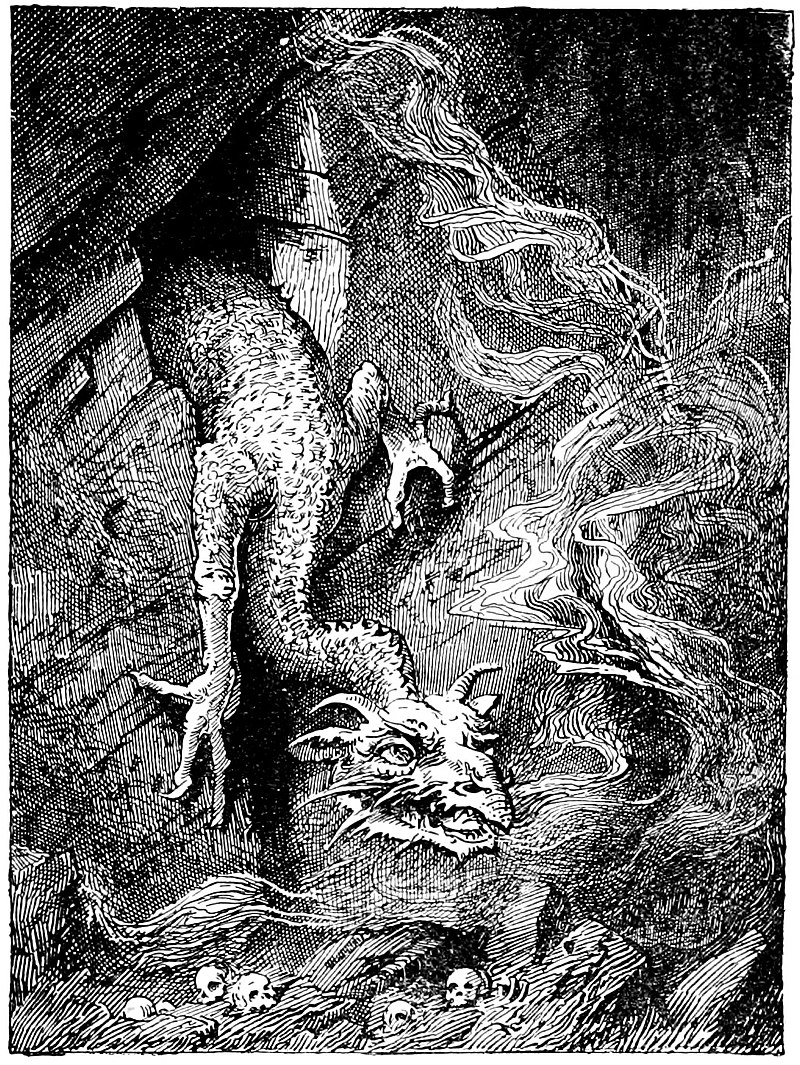
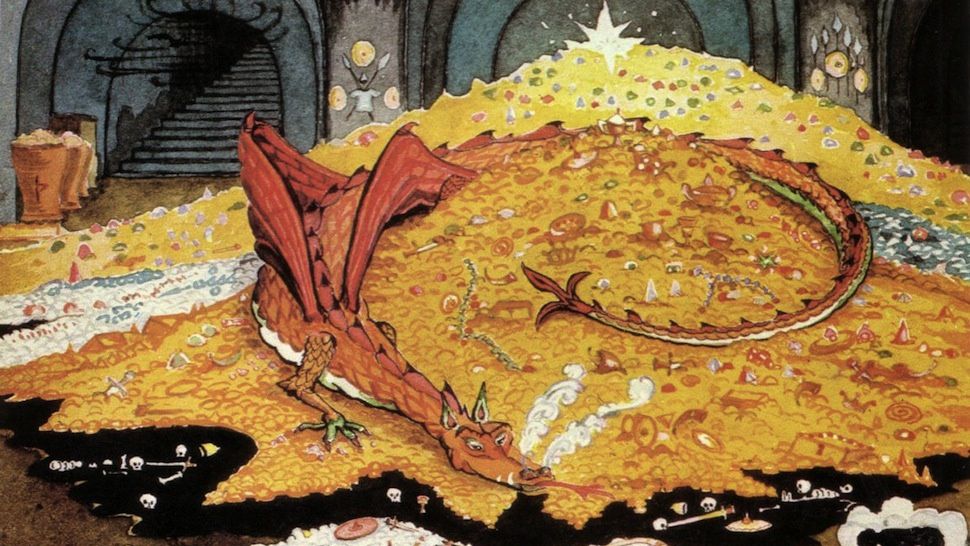
The various illustrations above all seem to suggest something dragonish to me, although, if we might match them against some of Tolkien’s own illustrations of Smaug,

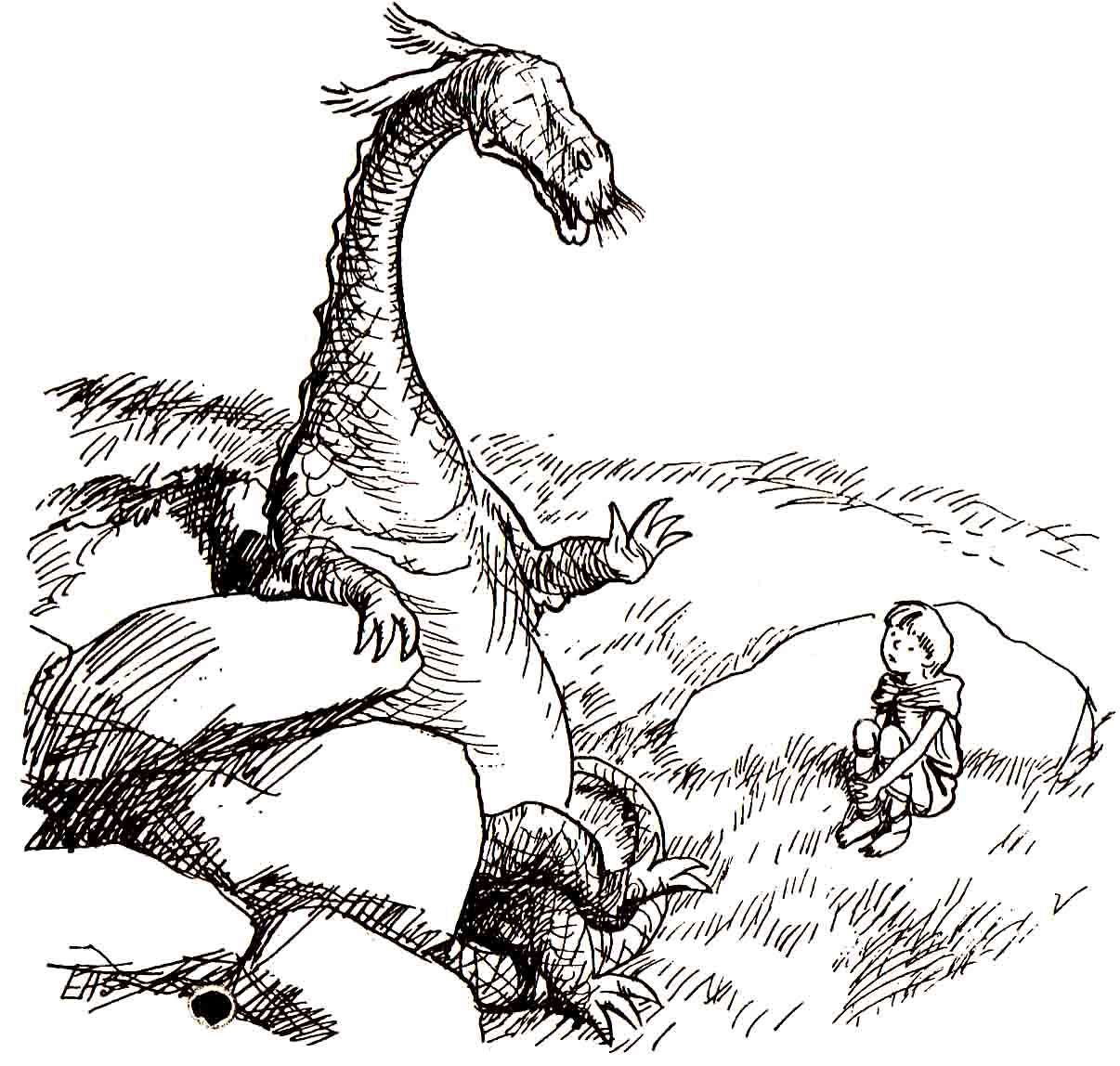
Tolkien’s dragon seems more like E.H. Shepard’s (1879-1976) illustration of the Reluctant Dragon, from Kenneth Grahame’s (1859-1932) Dream Days (1898) than the destroyer of Dale.

(If you haven’t read “The Reluctant Dragon”, here’s a LINK to the 1902 republication of Dream Days, with illustrations by Maxfield Parrish:  https://www.gutenberg.org/files/35187/35187-h/35187-h.htm   Shepard illustrated a 1930 reprint. )

That being the case, does JRRT give us anything more?

“A creature of an older world maybe it was, whose kind, lingering in forgotten mountains cold beneath the Moon, outstayed their day, and in hideous eyrie bred this last untimely brood, apt to evil.  And the Dark Lord took it, and nursed it with fell meats, until it grew beyond the measure of all other things that fly; and he gave it to his servant to be his steed.”

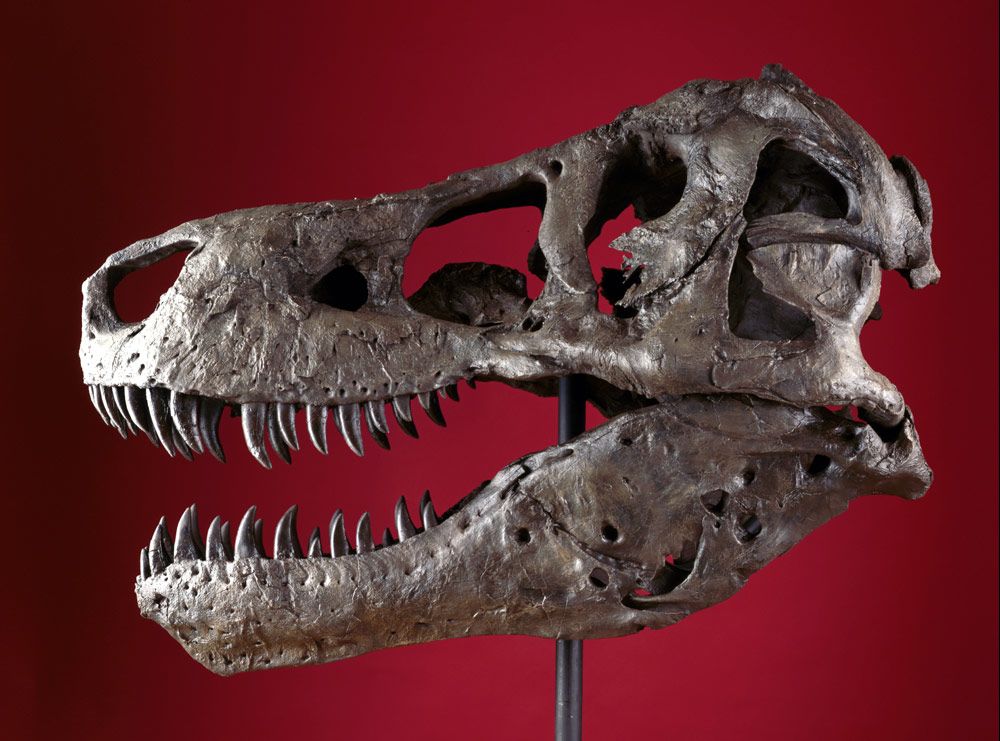
In 1784, the Italian scientist (although he probably called himself a “natural philosopher”), Cosimo Collini, published the first report on a strange new creature whose skeleton had been discovered in Bavaria, where he was the curator of the natural history collections of the Elector.

There then began intense discussion:  what was this?  A bird?  Mammal?  Lizardish thing?  (For lots more on this see:  https://en.wikipedia.org/wiki/Pterodactylus )

Eventually, it was decided that it was a flying reptile, to be called Pterodactylus (“wing-fingered”).  Other differing flying reptiles began to appear, forming a whole class of pterosaurs (“winged lizards”), many resembling something like this, in which the leathery wings were attached to the claws (hence that “wing-fingered”), this being a Rhamphorynchus (“beak-snout”—for more on them, see:  https://en.wikipedia.org/wiki/Rhamphorhynchus )

If we consider its look and perhaps the look of the class in general—those wings, that beak, and, of course, the great age (from the Jurassic Period, 200,000,000 to 145,000,000 years ago)—might this have been an inspiration for Tolkien’s creation of whatever this thing—we don’t appear to have any name for it except “foul beast”–upon which the chief Nazgul rode?

Then again, perhaps there is another inspiration, one which Tolkien might have carried about quite unconsciously.  He had been introduced to the Alice books as a child (see Carpenter’s Tolkien, 24) and, among the original illustrations by Tenniel for the second volume is this—

set it against that very familiar scene on the fields of the Pelennor and, minus a Nazgul, is there very much difference?

(by Arkady Roytman)

Thanks, as ever, for reading.

Stay well,

Avoid Tulgey Woods,

And know that, as always, there’s

MTCIDC

O
Downs Time (II)

23 Wednesday Nov 2022

Posted by Ollamh in Uncategorized

≈ Leave a comment

Welcome, as always, dear readers.

It all began with Tom Bombadil,

his being left out of almost all adaptations of The Lord of the Rings, both radio and film, and how, although I believed, as Tolkien suggested, that Tom had a part to play in the story, it was the Barrow-downs I missed because of that omission, as much because I find the chapter in which they play a major role a really well-crafted piece of story-telling—and a chilling one, at that.


(This is an image you can see on various Tolkien websites and, for my taste, although it’s nicely done, it has a few too many standing stones, although, to do the artist justice, he/she is probably modeling it on some spots on Dartmoor, where such things can tend to congregate.)

In the first installment of this posting, we and the hobbits had left Tom’s house with the intent to reach the East Road, which will take us to Bree.

This required a straight line, more or less, due north, skirting the Old Forest to the west (to our left)

and the Barrow-Downs to the east (to our right—an important fact and well worth keeping in mind for what’s to come).

While doing so, we’ve encountered a rather strange earthwork, a so-called “saucer barrow”,

with a single standing stone in its midst (although no barrow).

From the lip of this earthwork, the hobbits believe that they can make out the East Road, not so much farther to the north:

“Then their hearts rose; for it seemed plain that they had come further already than they had expected.  Certainly the distances had now all become hazy and deceptive, but there could be no doubt that the Downs were coming to an end.  A long valley lay below them winding away northwards, until it came to an opening between two steep shoulders.  Beyond, there seemed to be no more hills.  Due north they faintly glimpsed a long dark line.  ‘That is a line of trees,’ said Merry, ‘and that must mark the Road.  All along it for many leagues east of the Bridge there are trees growing.  Some say they were planted in the old days.’ “ (All quotations in this posting are from The Fellowship of the Ring, Book One, Chapter 8, “Fog on the Barrow-downs”)

(a Van Gogh pen and ink sketch from 1888.  Such tree-lined roads remind me of long stretches of highways in France—here’s a short history of why they look the way they do:   https://archive.macleans.ca/article/1914/3/1/french-roads-and-their-trees)

And, lulled by what so far seems a mild day, we and the hobbits stop for an impromptu picnic—

“But they were now hungry, and the sun was still at the fearless noon; so they set their backs against the east side of the stone.  It was cool, as if the sun had had no power to warm it; but at that time this seemed pleasant.  There they took food and drink, and made as good a noon-meal under the open sky as anyone could wish; for the food came from ‘down under Hill’.  Tom had provided them with plenty for the comfort of the day.  Their ponies unburdened strayed upon the grass.”

But, although Tom may have provided lunch, he also gave the hobbits a warning:

“Tom reckoned the Sun would shine tomorrow, and it would be a glad morning, and setting out would be hopeful.  But they would do well to start early; for weather in that country was a thing that even Tom could not be sure of for long, and it would change sometimes quicker than he could change his jacket.  ‘I am no weather-master,’ said he, ‘nor is aught that goes on two legs.’”

And now they found that Tom was right:

“Riding over the hills, and eating their fill, the warm sun and the scent of turf, lying a little too long, stretching out their legs and looking at the sky above their noses:  these things are, perhaps, enough to explain what happened.  However that may be:  they woke suddenly and uncomfortably from a sleep they had never meant to take.  The standing stone was cold, and it cast a long pale shadow that stretched eastward over them.  The sun, a pale and watery yellow, was gleaming through the mist just above the west wall of the hollow in which they lay; north, south, and east, beyond the wall the fog was thick, cold and white.  The air was silent, heavy and chill.  Their ponies were standing crowded together with their heads down.”

As they had left Tom Bombadil’s, Goldberry had said to them:  “North with the wind in the left eye and a blessing on your purpose.  Make haste while the Sun shines!”, but now:

“The hobbits sprang to their feet in alarm, and ran to the western rim.  They found that they were upon an island in the fog.  Even as they looked out in dismay towards the setting sun, it sank before their eyes into a white sea, and a cold grey shadow sprang up in the East behind.  The fog rolled up to the walls and rose above them, and as it mounted it bent over their heads until it became a roof:  they were shut in a hall of mist whose central pillar was the standing stone.”

(And I wonder if this last bit of description isn’t a foreshadowing of the inside of the main chamber in a barrow?  Here’s the partially-reconstructed late-Neolithic barrow at Belas Knap for a comparison.)

As I wrote in Part I of this posting, I’m interested in watching the way in which Tolkien entangles both the hobbits and us, the readers, in this ghostly and unstable world.  The hobbits have been lulled into being too leisurely and now the change of weather has begun to ensnare them.  Their route was due north, but, without Goldberry’s sun, how might they know which way was north?

“They felt as if a trap was closing about them; but they did not quite lose heart.  They still remembered the hopeful view that had had of the line of the Road ahead, and they still knew in which direction it lay.”

But did they?

“The valley seemed to stretch on endlessly.  Suddenly Frodo saw a hopeful sign.  On either side ahead a darkness began to loom through the mist; and he guessed that they were at last approaching the gap in the hills, the north-gate of the Barrow-downs.  If they could pass that, they would be free…But his hope soon changed to bewilderment and alarm.  The dark patches grew darker, but they shrank; and suddenly he saw, towering ominous before him and leaning slightly towards one another like the pillars of a headless door, two huge standing stones.  He could not remember having seen any sign of these in the valley, when he looked out from the hill in the morning.”

But he might have seen them, and what they lead to, just not making the immediate connection with his earlier optimistic view of their progress:

“ ‘Splendid!’ said Frodo.  ‘If we make as good going this afternoon as we have done this morning, we shall have left the Downs before the Sun sets and be jogging on in search of a camping place.’ But even as he spoke he turned his glance eastwards, and he saw that on that side the hills were higher and looked down upon them, and all those hills were crowned with green mounds, and on some were standing stones, pointing upwards like jagged teeth out of green gums.”

“…like the pillars of a headless door…”—but a door leading to what?  Here, I’m reminded of the cave now called “Oweynagat” (translated either as “Cave of the Cats”, or, probably more likely, “Cave of the Battles”) at Cruachan Ai (modern Rathcroghan) in Eire, which was believed to be an entrance to the Otherworld…

(although in both Old Irish and Middle Welsh literature, at times it seems that one might step from one world into the other without even knowing it—see, for example, the story of Pwyll here:  https://sacred-texts.com/neu/celt/mab/mab20.htm#page_339 )

And now, disoriented by the fog and in increasing panic, Frodo makes a mistake—and his pony is well aware of it:

“He had passed between them almost before he was aware:  and even as he did so darkness seemed to fall round him.  His pony reared and snorted, and he fell off.  When he looked back he found that he was alone:  the others had not followed him.”

Frodo runs back between the pillars, but, hearing what he believes to be a distant cry–

“It was away eastward, on his left as he stood under the great stones, staring and straining into the gloom.  He plunged off in the direction of the call, and found himself going steeply uphill.”

Now, looking once more at a map, we see that Frodo, coming to those standing stones, has become completely turned around—east is not to his right, as when the hobbits began their passage of the Barrow-downs, but to his left and Frodo is now running south, back into the Downs—and towards those barrows he had spotted that morning—has he, going between those standing stones, entered another world?  If so, it’s a very menacing one.

And now, as Tom had warned them, the weather changes again:

“The mist was flowing past him now in shreds and tatters.  His breath was smoking, and the darkness was less near and thick.  He looked up and saw with surprise that faint stars were appearing overhead amid the strands of hurrying cloud and fog.  The wind began to hiss over the grass…and even as he went forward the mist was rolled up and thrust aside, and the starry sky was unveiled.”

Where had Frodo come to?

“A glance showed him that he was now facing southwards and was on a round hill-top, which he must have climbed from the north.  Out of the east a biting wind was blowing.  To his right there loomed against the westward stars a dark black shade.  A great barrow stood there.”

We know what happens next—the Barrow-wight seizes the paralyzed Frodo and he wakes up among his friends, about to be sacrificed–until he defends himself

(a Ted Nasmith)

and then calls for Tom Bombadil—who arrives, drives out the Wight, and it’s almost as if we’re back to where we began—although perhaps warier and Merry has that sword with which he wounds the chief of the Nazgul, once the Witch King of Angmar—

“Then he told them that the blades were forged many long years ago by Men of Westernesse:  they were foes of the Dark Lord, but they were overcome by the evil king of Carn Dum in the Land of Angmar.”

Eowyn and the Lord of the Nazgul, by Ted Nasmith

(another Ted Nasmith)

Peter Jackson, explaining his decision to drop Tom Bombadil, Old Man Willow, and the Barrow-downs is quoted as saying:

“In the plot of ‘The Lord of the Rings,’ in our movie, in its most simple form, is Frodo carrying the Ring. Eventually, he has to go to Mordor and destroy the Ring. So, you know, what does Old Man Willow contribute to the story of Frodo carrying the Ring? What does Tom Bombadil ultimately really have to do with the Ring? I know there’s Ring stuff in the Bombadil episode, but it’s not really advancing our story. It’s not really telling us things we need to know.”  (quoted from:  https://www.msn.com/en-us/movies/news/why-peter-jackson-cut-tom-bombadil-from-the-lord-of-the-rings/ar-AAVCAT4 )

Although I understand what Jackson means, for me, “things we need to know” does not necessarily include only the “Ring stuff”, but also the wider, deeper picture which JRRT is at such pains to provide us with, an ancient world, inhabited by ancient good, in the form of Tom Bombadil, but also ancient evil in the Barrow-wight and the Downs which he—and presumably others—haunt.  When I reread The Lord of the Rings, “Fog on the Barrow-downs” is a chapter to which I look forward, both to enjoy the story-telling and to be as haunted as the Downs themselves are, as well.

Thanks for reading, as ever.

Stay well,

Keep the wind in your left eye,

And know, that, as always, there’s

MTCIDC

O

Downs Time (I)

16 Wednesday Nov 2022

Posted by Ollamh in Uncategorized

≈ Leave a comment

Welcome, dear readers, as always.

Adapters of The Lord of the Rings, with rare exceptions, have never liked Tom Bombadil.

(the Hildebrandts)

And Tolkien himself had to find ways to explain his presence in the story, even admitting, in one letter that:

“Tom Bombadil is not an important person—to the narrative.  I suppose he has some importance as a ‘comment’.  I mean, I do not really write like that:  he is just an invention…and he represents something that I find important, though I would not be prepared to analyze the feeling precisely.  I would not, however, have left him in, if he did not have some kind of function.” (letter to Naomi Mitchison, 25 April, 1954, Letters, 178)

For me, he has a number of functions:

1. he presents a brief slowing-down of the narrative—with the exception of that close encounter with Old Man Willow, of course—

(the Hildebrandts)

from the initial pursuit of the hobbits by the Nazgul–

(a Denis Gordeev)

to their attack on the Hobbits in Bree and their relentless pursuit afterwards.

(a second Gordeev)

2. he represents, as JRRT is always at pains to do, something from an older time on Middle-earth, always suggesting to us that traveling across a Third Age landscape means moving above many earlier layers of history (something which any traveler to the UK today must always feel).

3. he adds an element of mystery to Middle-earth—who is he?  Where is he from?  Why has he such great power that the Ring, which makes even Gandalf nervous, means nothing to him?

4. he also provides a link with an element which, in adaptations, disappears as he disappears:  the Barrow Downs,

which combine that sense of deeper past, the supernatural, and even how the past can help the present, in Merry’s sword, which can pierce the Chief Nazgul, the ancient Witch King of Angmar.

(Ted Nasmith)

(For more on this and on Tom in general, see “Jolly Tom.1”, 9 September, 2015, and “Jolly Tom.2”, 16 September, 2015)

Although I miss the pause, I think that I miss much more those Downs, haunted as they are and the way in which Tolkien’s narrative gradually pulls us into them, just as the hobbits are pulled in.

We are told that the hobbits were already aware of them:

“Even in the Shire the rumour of the Barrow-wights of the Barrow-downs beyond the Forest had been heard.” 

Tom, however, provides a fuller picture:

“Suddenly Tom’s talk left the woods…wandering at last up on to the Downs.  They heard of the Great Barrows, and the green mounds, and the stone-rings upon the hills and in the hollows among the hills…Gold was piled on the biers of dead kings and queens; and mounds covered them, and the stone doors were shut; and the grass grew over them all.”

Such mounds had appeared in Tolkien’s own literary life from his student days, when he would have read this in Beowulf:

“Through the dark of the night-tide, a drake, to
hold sway,
In a howe high aloft watched over an hoard,
A stone-burg full steep ; thereunder a path sty’d
Unknown unto men…”

(Lines 2211-2214–This is from William Morris’ 1895 translation, with A.J. Wyatt, and, knowing how much Tolkien loved Morris’ work, I imagine that he had read this, along with other translations, before he could read it in the original.  For the complete text, see:  https://ia800501.us.archive.org/25/items/taleofbeowulfsom00morr/taleofbeowulfsom00morr.pdf  You can also see Morris’ proof sheets at:   https://exhibitions.lib.cam.ac.uk/linesofthought/artifacts/beowulf/   Proof sheets, for me, are magical, just like hand-written drafts, as they reveal the author in the process of creation—or correction!  For a list of Beowulf translations, by the way, see:  https://en.wikipedia.org/wiki/List_of_translations_of_Beowulf   )

Beyond the literary, Tolkien could have seen barrows practically everywhere around him in southern England, perhaps the most dramatic one near him at Oxford being West Kennet Long Barrow, which is only about 50 miles (about 80km) southwest,

in countryside which has all sorts of mounds, including the very odd Silbury Hill,

what may have been stone-bordered processional ways,

and at least one surviving stone circle with a ditch and rampart.

When they leave Tom Bombadil, the hobbits ride into a rolling landscape

which, to me, already sounds just this side of mazy:

“Their way wound along the floor of the hollow, and round the green feet of a steep hill into another deeper and broader valley, and then over the shoulders of further hills, and down their long limbs, and up their smooth sides again, up on to new hill-tops and down into new valleys.”

By Tom’s advice,

“…they decided to make nearly due North from his house, over the western and lower slopes of the Downs:  they might hope in that way to strike the East Road in a day’s journey, and avoid the Barrows…”

And here a map might help—

(by Astrogator, from Deviant Art)

It’s not very detailed, when it comes to their trip, so let’s add this one—

(by someone named Don Hitchcock)

Basically, they intended to ride to the west of the Downs as best they could, while holding towards the north—as Goldberry has said to them, “And hold to your purpose!  North with the wind in the left eye…”.  At mid-day, however, they rode into what appears to be, in terms of ancient landscape, what is called a “saucer barrow”,

although, in place of a central mound, there is this:

“In the midst of it there stood a single stone, standing tall under the sun above, and at this hour casting no shadow.”

This almost sounds like the gnomon—that’s the thing which casts a shadow–on a sun dial,

as if, at this moment, the hobbits are standing in the middle of time—but time will pass more quickly than they think and that stone may be more than an ancient monument:

“It was shapeless and yet significant:  like a landmark, or a guarding finger, or more like a warning.”

As we’ll see in Part II of this posting next week.

As ever, thanks for reading.

Stay well,

“Make haste while the Sun shines!” as Goldberry reminds us,

(the Hildebrandts)

And know that, as always, there’s

MTCIDC

O

← Older posts
Newer posts →

The Doubtful Sea Series Facebook Page

The Doubtful Sea Series Facebook Page

  • Ollamh

Categories

  • Artists and Illustrators
  • Economics in Middle-earth
  • Fairy Tales and Myths
  • Films and Music
  • Games
  • Heroes
  • Imaginary History
  • J.R.R. Tolkien
  • Language
  • Literary History
  • Maps
  • Medieval Russia
  • Military History
  • Military History of Middle-earth
  • Narnia
  • Narrative Methods
  • Poetry
  • Research
  • Star Wars
  • Terra Australis
  • The Rohirrim
  • Theatre and Performance
  • Tolkien
  • Uncategorized
  • Villains
  • Writing as Collaborators
Follow doubtfulsea on WordPress.com

Across the Doubtful Sea

Recent Postings

  • Subterranean April 22, 2026
  • Serendipity? April 15, 2026
  • Serendipity April 8, 2026
  • Verisimilitude April 1, 2026
  • Goblins and Goblin March 25, 2026
  • Crowing and Raven March 18, 2026
  • The Damage of Dragons March 11, 2026
  • Encouragement March 4, 2026
  • Eavesdropping February 25, 2026

Blog Statistics

  • 112,222 Views

Posting Archive

  • April 2026 (4)
  • March 2026 (4)
  • February 2026 (4)
  • January 2026 (4)
  • December 2025 (5)
  • November 2025 (4)
  • October 2025 (5)
  • September 2025 (4)
  • August 2025 (4)
  • July 2025 (5)
  • June 2025 (4)
  • May 2025 (4)
  • April 2025 (5)
  • March 2025 (4)
  • February 2025 (4)
  • January 2025 (5)
  • December 2024 (4)
  • November 2024 (4)
  • October 2024 (5)
  • September 2024 (4)
  • August 2024 (4)
  • July 2024 (5)
  • June 2024 (4)
  • May 2024 (5)
  • April 2024 (4)
  • March 2024 (4)
  • February 2024 (4)
  • January 2024 (5)
  • December 2023 (4)
  • November 2023 (5)
  • October 2023 (4)
  • September 2023 (4)
  • August 2023 (5)
  • July 2023 (4)
  • June 2023 (4)
  • May 2023 (5)
  • April 2023 (4)
  • March 2023 (5)
  • February 2023 (4)
  • January 2023 (4)
  • December 2022 (4)
  • November 2022 (5)
  • October 2022 (4)
  • September 2022 (4)
  • August 2022 (5)
  • July 2022 (4)
  • June 2022 (5)
  • May 2022 (4)
  • April 2022 (4)
  • March 2022 (5)
  • February 2022 (4)
  • January 2022 (4)
  • December 2021 (5)
  • November 2021 (4)
  • October 2021 (4)
  • September 2021 (5)
  • August 2021 (4)
  • July 2021 (4)
  • June 2021 (5)
  • May 2021 (4)
  • April 2021 (4)
  • March 2021 (5)
  • February 2021 (4)
  • January 2021 (4)
  • December 2020 (5)
  • November 2020 (4)
  • October 2020 (4)
  • September 2020 (5)
  • August 2020 (4)
  • July 2020 (5)
  • June 2020 (4)
  • May 2020 (4)
  • April 2020 (5)
  • March 2020 (4)
  • February 2020 (4)
  • January 2020 (6)
  • December 2019 (4)
  • November 2019 (4)
  • October 2019 (5)
  • September 2019 (4)
  • August 2019 (4)
  • July 2019 (5)
  • June 2019 (4)
  • May 2019 (5)
  • April 2019 (4)
  • March 2019 (4)
  • February 2019 (4)
  • January 2019 (5)
  • December 2018 (4)
  • November 2018 (4)
  • October 2018 (5)
  • September 2018 (4)
  • August 2018 (5)
  • July 2018 (4)
  • June 2018 (4)
  • May 2018 (5)
  • April 2018 (4)
  • March 2018 (4)
  • February 2018 (4)
  • January 2018 (5)
  • December 2017 (4)
  • November 2017 (4)
  • October 2017 (4)
  • September 2017 (4)
  • August 2017 (5)
  • July 2017 (4)
  • June 2017 (4)
  • May 2017 (5)
  • April 2017 (4)
  • March 2017 (5)
  • February 2017 (4)
  • January 2017 (4)
  • December 2016 (4)
  • November 2016 (5)
  • October 2016 (6)
  • September 2016 (5)
  • August 2016 (5)
  • July 2016 (5)
  • June 2016 (5)
  • May 2016 (4)
  • April 2016 (4)
  • March 2016 (5)
  • February 2016 (4)
  • January 2016 (4)
  • December 2015 (5)
  • November 2015 (5)
  • October 2015 (4)
  • September 2015 (5)
  • August 2015 (4)
  • July 2015 (5)
  • June 2015 (5)
  • May 2015 (4)
  • April 2015 (3)
  • March 2015 (4)
  • February 2015 (4)
  • January 2015 (4)
  • December 2014 (5)
  • November 2014 (4)
  • October 2014 (6)
  • September 2014 (1)

Blog at WordPress.com.

  • Subscribe Subscribed
    • doubtfulsea
    • Join 75 other subscribers
    • Already have a WordPress.com account? Log in now.
    • doubtfulsea
    • Subscribe Subscribed
    • Sign up
    • Log in
    • Report this content
    • View site in Reader
    • Manage subscriptions
    • Collapse this bar
 

Loading Comments...