As always, dear readers, welcome.
As Gondor prepares to meet Sauron’s massive assault, it calls in troops from the south:
“And so the companies came and were hailed and cheered through the Gate, men of the Outlands marching to defend the City of Gondor in a dark hour…The men of Ringlo Vale behind the son of their lord, Dervorin striding on foot: three hundreds…From the Anfalas, the Langstrand far away, a long line of men of many sorts…scantily equipped save for the household of Golasgil their lord…” (The Return of the King, Book Five, Chapter 1, “Minas Tirith”)
When the text repeatedly says, “their lord”, what, precisely, does that mean?
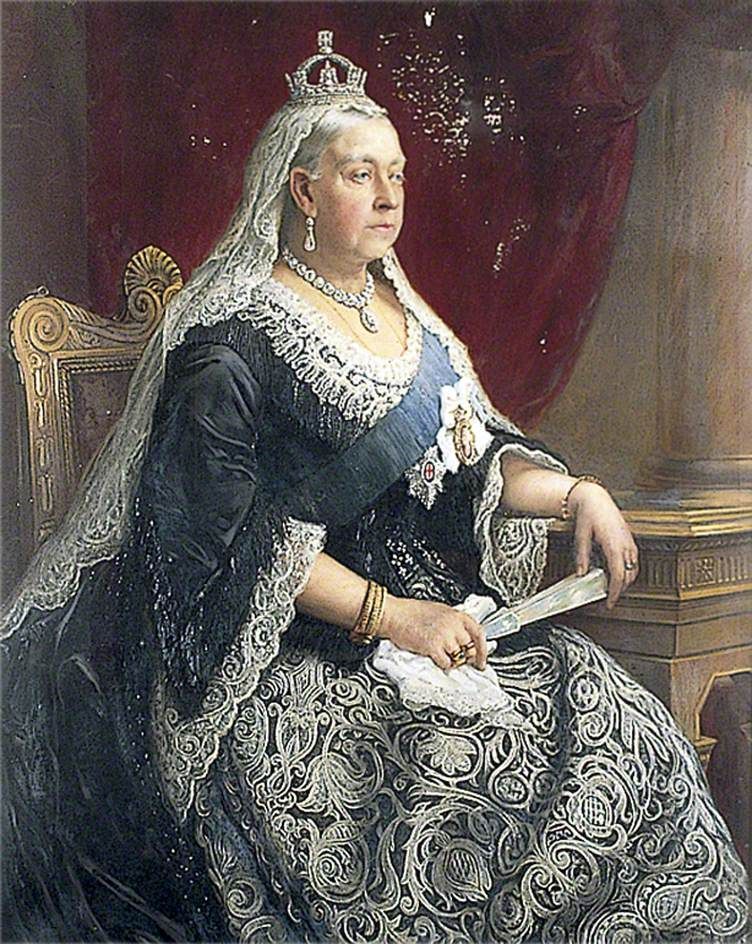
Although born in 1892, during the last years of the reign of Victoria (1819-1901),
Tolkien was not a convinced monarchist, writing to his son, Christopher:
“Give me a king whose chief interest in life is stamps, railways, or race-horses; and who has the power to sack his Vizier (or whatever you care to call him) if he does not like the cut of his trousers.” (letter to Christopher Tolkien, 29 November, 1943, Letters, 90)
At the same time, he was not a passionate democrat, either, referring to the Prime Minister, Winston Churchill (1874-1965),
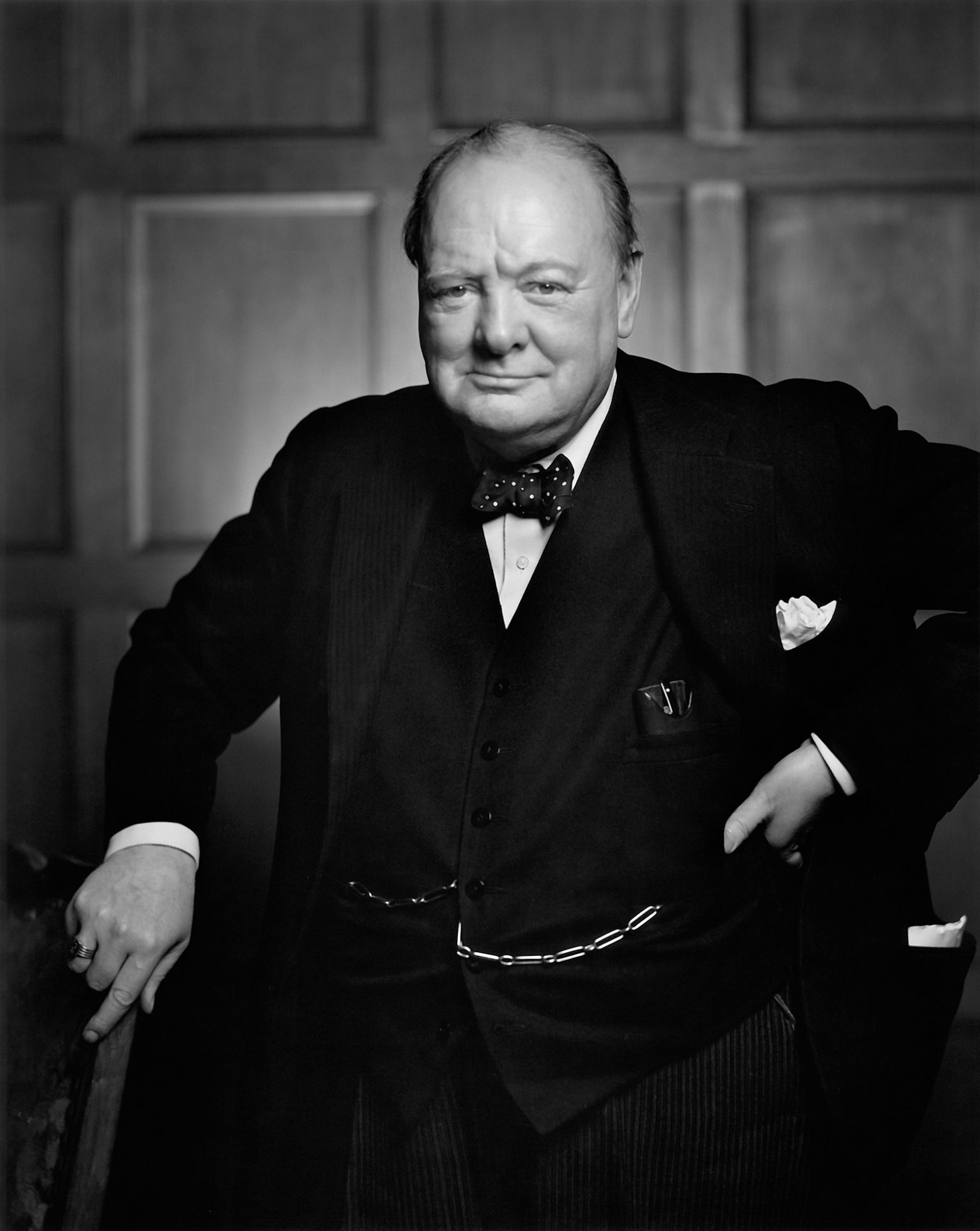
in the same letter as ‘Winston and his gang’,
having said that his own “…political opinions lean more and more to Anarchy (philosophically understood, meaning abolition of control not whiskered men with bombs)”.

And yet, in creating Middle-earth, he shows a preference for a medieval world, and, for his homeland, England, this means the form of government from which the Victorian government descended, feudalism.
Feudalism comes from Anglo-Norman French fe, which, at base, means “trust/faith”, and, in a secondary meaning, is the basis for “fief”—that is, an estate, a parcel of land given in trust. (For more on meanings and forms, see the extremely useful Anglo-Norman French dictionary here: https://anglo-norman.net/entry/fe )
It comes from Anglo-Norman because it was the Normans under Duke William of Normandy (c.1028-1087)

who introduced the concept to their newly-conquered country after 1066AD.

The foundation of the concept is that:
1. all the land in a kingdom belongs to the king—who has received it from God
2. he then parcels the land out to his chief followers, who then
3. parcel it out to their main followers
In return, all the followers in #3 owe military service to those in #2, who, in turn, owe military service to #1. This creates a kind of pyramid, like this–

(correct the spelling of “fife” to “fief”)
Those in #3 would then collect those below them to form the units they would bring with them when their overlords, at the king’s demand, would gather forces for whatever the king had in mind.

(by Eugene Leliepvre, one of my favorite 20th century French military illustrators)
You’ll notice, of course, that those at the bottom of the pyramid—the 99% in modern terms—had no say in any of this: when called, they were forced to go.
This was because they were the conquered. When the Normans invaded and defeated the previous government, in the form of the death of the Anglo-Saxon king, Harold Godwinson,

they then spread out across the landscape, ousting the previous Anglo-Saxon owners and setting up forts, called “motte and baileys”,

to control the land and the locals, who, at first at least, were simply possessions. (Feudalism became much more complicated over time, including grades of the 99%, who could be freemen, but who still had feudal obligations.)
The same idea of conquest, in some sense, must have been true of the ancestors of the men of Gondor, who were not indigenous to Middle-earth, but had come from the wreckage of Numenor and who gradually came to dominate the western lands, driving the older peoples—the Dunlendings and the Woses–
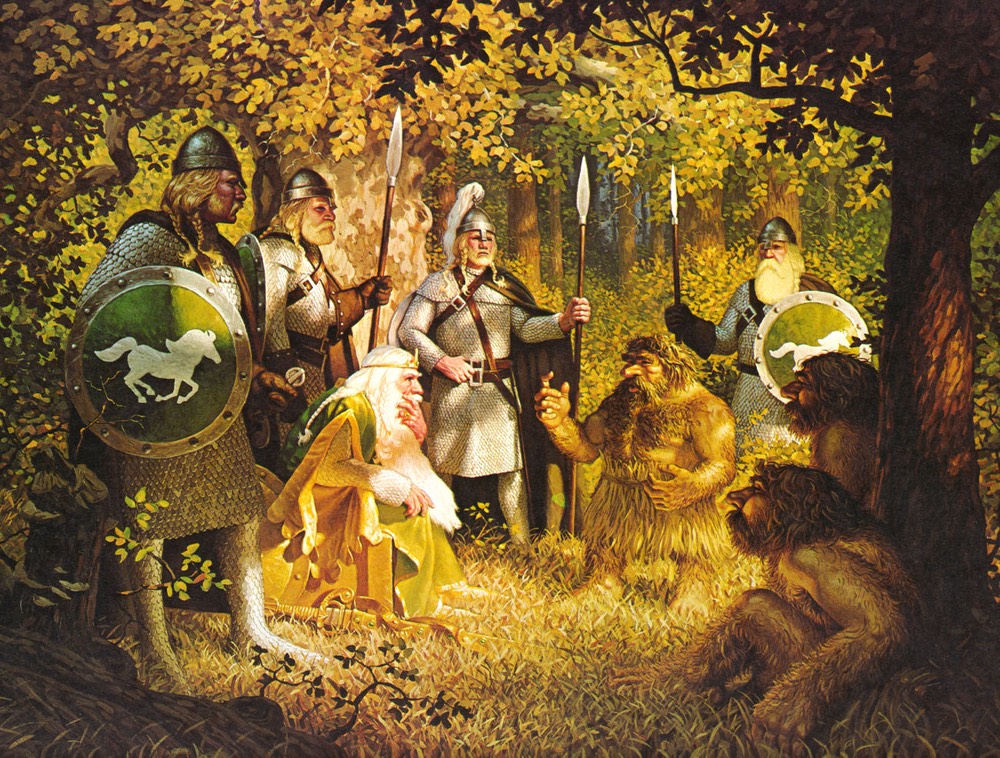
(the Hildebrandts)
into exile in mountain and forest, rather than enslaving them, as the Normans did the Anglo-Saxons.
From those words “their lord”, however, it’s clear that lesser Gondorians had become part of a similar socio-economic system.
In a letter to Naomi Mitchison, JRRT has this to say about such:
“I am not incapable of or unaware of economic thought; and I think as far as the ‘mortals’ go, Men, Hobbits, and Dwarfs, that the situations are so devised that economic likelihood is there and could be worked out: Gondor has sufficient ‘townlands’ and fiefs with a good water and road approach to provide for its population…” (letter to Naomi Mitchison, 25 September, 1954, Letters, 292)
And there’s that word “fief”and all that it implies about rulers and ruled, both in Norman England and Gondor: a comfortable life for those at the top,

but endless hard work, taxes, and military service for those—the great majority—at the bottom.
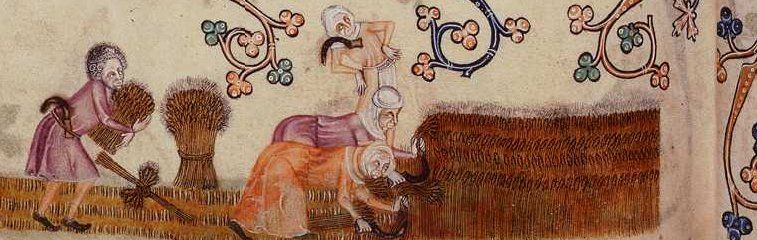
The British troops who surrounded Tolkien in the trenches in 1916

were, in a sense, the descendants of that feudal 99% and, although, when called upon, could be fearsomely brave, they were also well aware that they were still peasants to many of those in charge and so had songs with lyrics like:
“If you want to find the colonel,
I know where he is.
If you want to find the colonel,
I know where he is.
He’s sitting in comfort, stuffing his bloody gut.
I saw him. I saw him,
Sitting in comfort, stuffing his bloody gut.”
(from “Hanging on the Old Barbed Wire”—you can hear a recording of some of the many mocking verses to this by the English group “Chumbawamba” here: https://www.youtube.com/watch?v=zZhzV68U48w )
So, although Tolkien describes
“…Imrahil, Prince of Dol Amroth…and a company of knights in full harness riding grey horses; and behind them seven hundreds of men at arms, tall as lords, grey-eyed, dark-haired, singing as they came.”
we might wonder if JRRT, self-described as leaning “more and more to Anarchy”, could still hear the privates of 1916, and, if so, just what those men slogging along on foot behind “knights in full harness riding grey horses” might actually have been singing? Could it have been something as subversive as “Hanging on the Old Barbed Wire”, or maybe this couplet from an actual English peasant revolt in 1381:
“When Adam delved [dug]
And Eve span [spun],
Who was then
The gentleman?”

Thanks, as ever, for reading.
Stay well,
Remember the Golden Rule,

(from the comic strip “The Wizard of Id”)
And remember, as well, that there’s
MTCIDC
O
 doubtfulsea