Ad haec Caesar respondit: se magis consuetudine sua quam merito eorum civitatem conservaturum, si prius quam murum aries attigisset se dedidissent;
“Caesar replies to these things that he would preserve their town, more by his own custom than by [their] deserving it, if they would have surrendered before the ram had touched the [town] wall.” (Caesar, De Bello Gallico, 2.32. My translation.)
The Aduatuci (or Atuatuci) were a Germanic tribe in what is now eastern Belgium and they were in trouble. Involved in resisting Julius Caesar’s conquest of their region, they found themselves besieged by a Roman army long-experienced in dealing with fortified towns like this one. Appalled by the preparations they could see being made, they quickly agreed upon terms with Caesar—on his condition, as stated above, the idea being that, once the ram had touched the wall, it would knock it down and everyone inside would be at the mercy of the Romans (murdered on the spot or sold into slavery. We have no idea what the town looked like, but if its walls were of the sort called murus gallicus,

as Caesar himself describes the building technique, it was his obvious preparations and chilly threat which caused the capitulation, Caesar admitting that such walls would have stymied Roman rams. See for more: https://en.wikipedia.org/wiki/Murus_gallicus Just after their surrender, the Aduatuci made the mistake of trying to trick the Romans and paid dearly for it. See: https://www.livius.org/articles/battle/oppidum-aduatucorum-57-bce/ )
Among those preparations would have been a siege weapon in use at least as far back as the Neo-Assyrians (10th through 7th century BC), as this relief from the edge of a bronze vessel demonstrates.

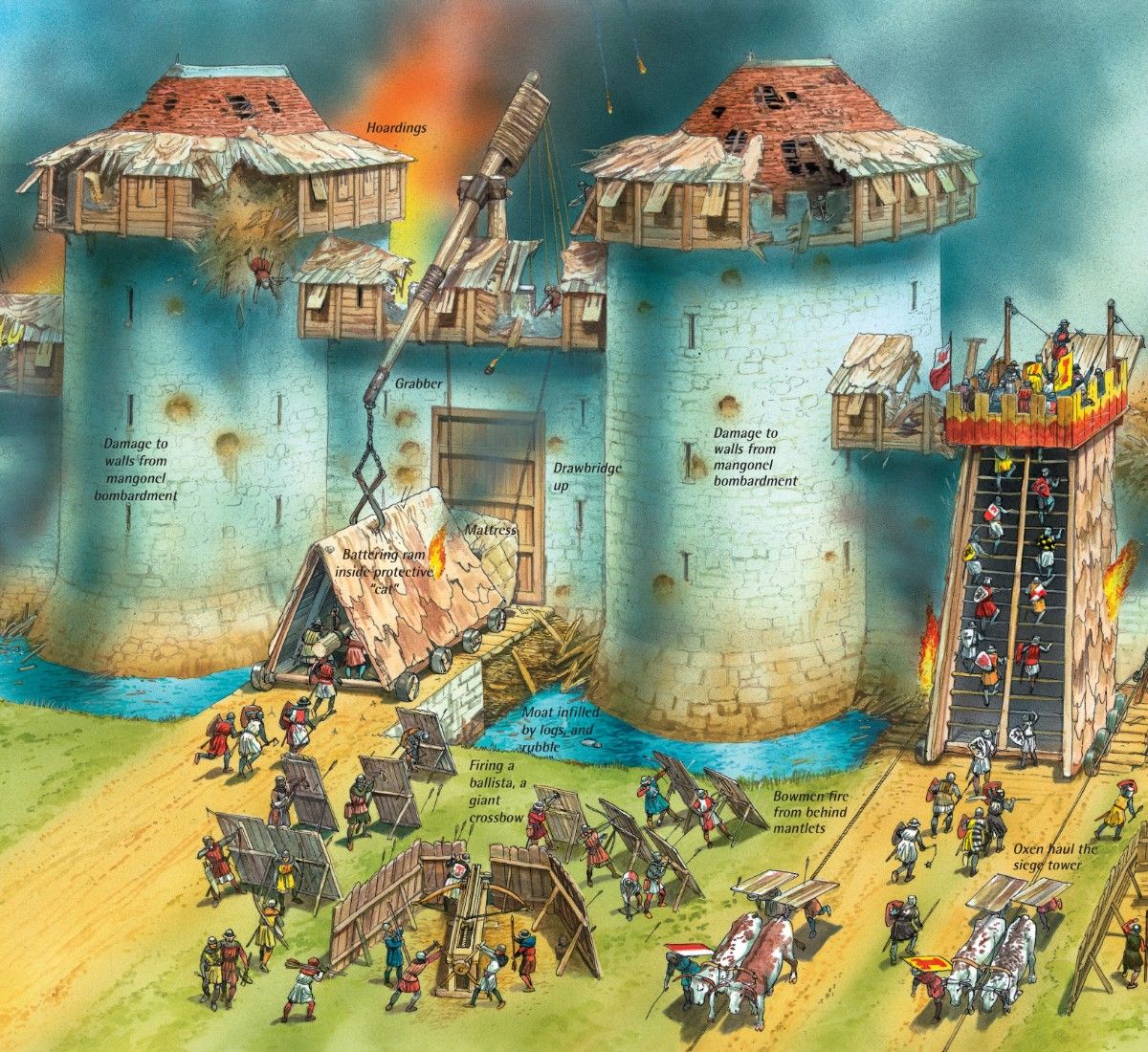
Caesar’s threat suggests that his weapon would be aimed at a wall, but, the Assyrian relief is aimed at what, I think, we’ve come to expect from medieval illustrations—
and from adventure movies—see this scene from Braveheart (1995) as an example: https://www.youtube.com/watch?v=7PXrVUaoEEc —
a gate, it being the weakest part of a defensive wall.
As always, welcome, dear readers.
What’s going on here, that we begin, as Horace (65-8BC) put it in his Ars Poetica, 146-149, when cautioning poets about trying to tackle bigger subjects that they can possibly manage, in medias res, “in the middle of the action”?
Because this posting is really about being in mediam portam, “in the middle of the gate”, as Tolkien says of the main gate of Minas Tirith:
“Very strong it might be, wrought of steel and iron, and guarded with towers and bastions of indomitable stone, yet it was the key, the weakest point in all that high and impenetrable wall.” (The Return of the King, Book Five, Chapter 4, “The Siege of Gondor”)
What’s attacking that gate is a monstrous ram:
“…in the midst was a huge ram, great as a forest-tree a hundred feet in length, swinging on mighty chains. Long had it been forging in the dark smithies of Mordor, and its hideous head, founded of black steel, was shaped in the likeness of a ravening wolf, on its[,] spells of ruin lay. Grond they named it, in memory of the Hammer of the Underworld of old.”

(from Jackson’s Return of the King, and, as usual, it varies from the text—this time, instead of simply having a wolf’s head, the whole thing appears to be a wolf—and it seems to have ingested a George Forman grill, as well)
“Grond” is glossed as “the Hammer of the Underworld” and, elsewhere, as Morgoth’s mace—
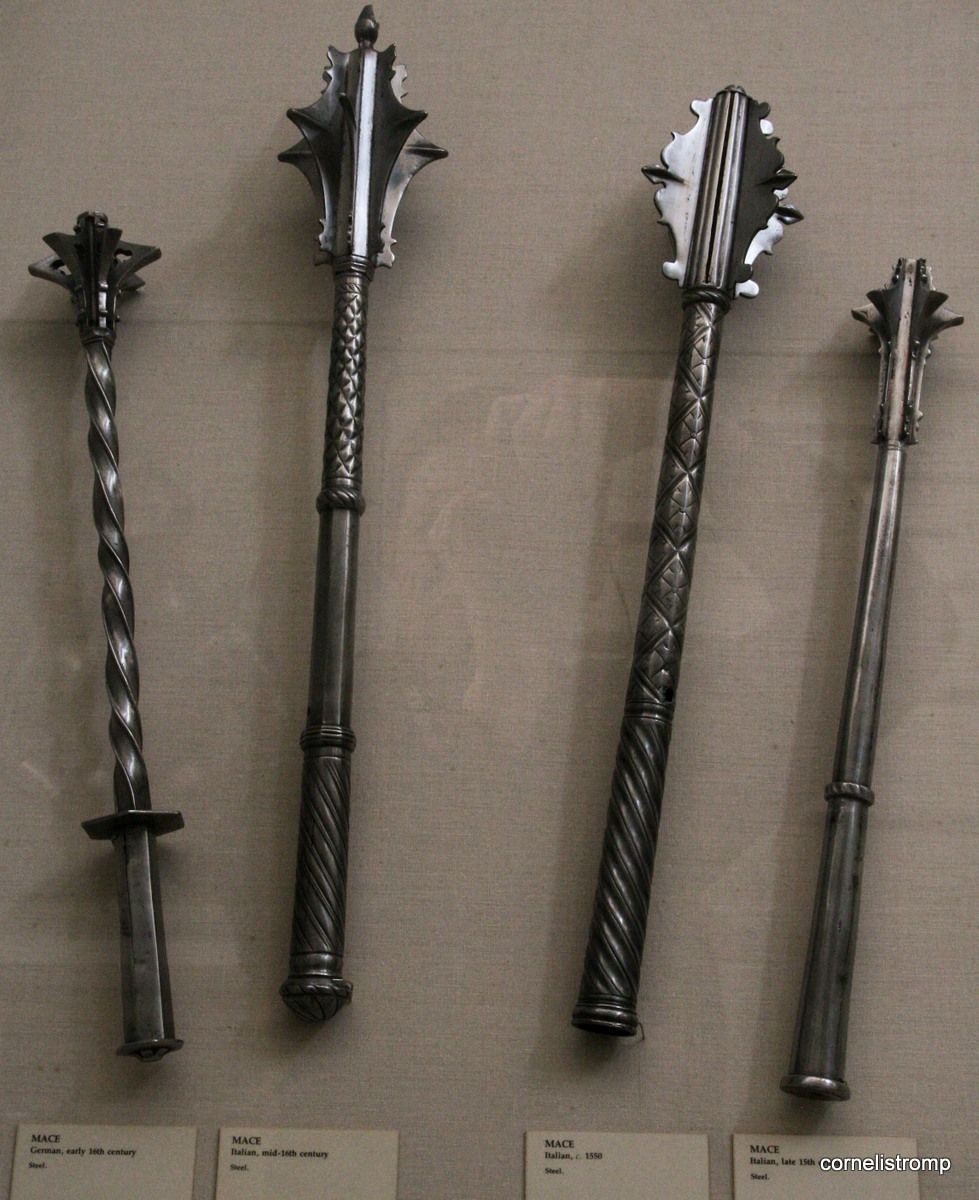
but I’ve wondered about two non-Middle-earth influences upon its creation.
The first is to be found in something I suspect JRRT could have read at some point in his academic career, the Chronicle of Piers de Langtoft. This is a early 14th-century compilation of earlier English history, combined with what is thought to be “Peter of Langtoft’s” own work, written in Norman French verse. In his narration of events, the author includes an account of Edward I’s siege of Stirling Castle in 1304.
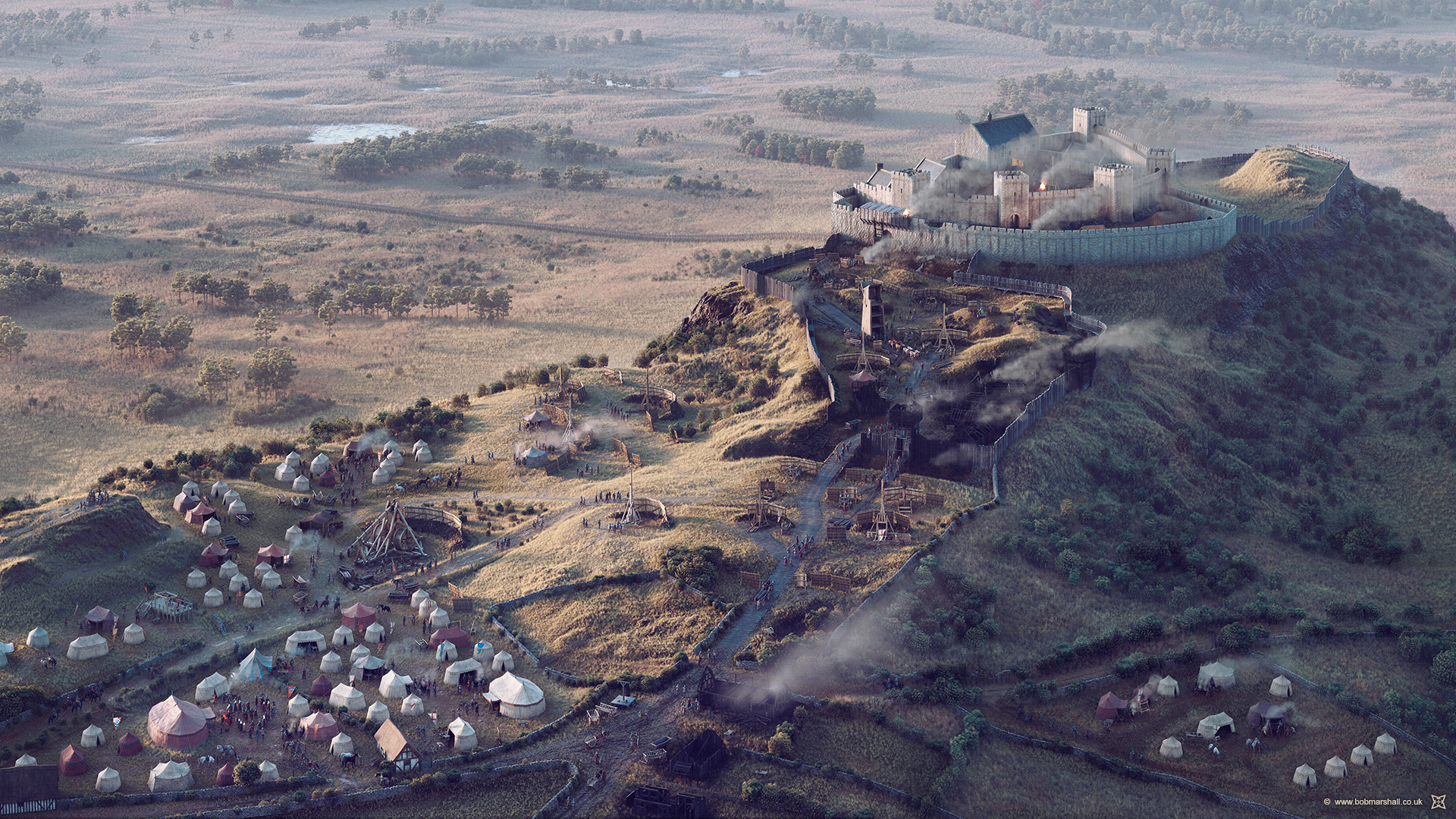
(This breathtaking reconstruction of the siege is by Bob Marshall, whose site is here: https://www.bobmarshall.co.uk/stirlingcastle/ I recommend this site for: a. the wonderful artwork; b. the excellent research and thinking behind it. You can see more of his work—and it’s all as impressive as this—here: https://bobmarshall.co.uk/) Among the siege weapons Edward employed was something of which Piers/Peter writes:
“Entre ses aferes le reys fet carpenter
Une engine orrible, et Ludgar appeler
Et cel a son hurtir crevant le mur enter.”
“Among these events, the king had made of wood
A terrible device, and to be called ‘Ludgar’
And that [one] at its hit breaking down the whole wall.”
(my translation)
This “Ludgar” has been interpreted as being a large stone-thrower, called a trebuchet,

but it’s not its function which interested me, but what “Ludgar” is actually a shortened form of: “Loup de Guerre”—“War Wolf”. Could this have sparked Tolkien’s imagination to combine that name with another siege weapon?
(You can have your own copy of the text here: https://ia801500.us.archive.org/5/items/chronicleofpierr02pete/chronicleofpierr02pete.pdf )
And that wolf leads me to my second possible influence, perhaps rather more unusual than the first.
Neither The Letters of JRR Tolkien nor Oronzo Cilli’s impressive Tolkien’s Library has any mention of Bram Stoker (1847-1912)
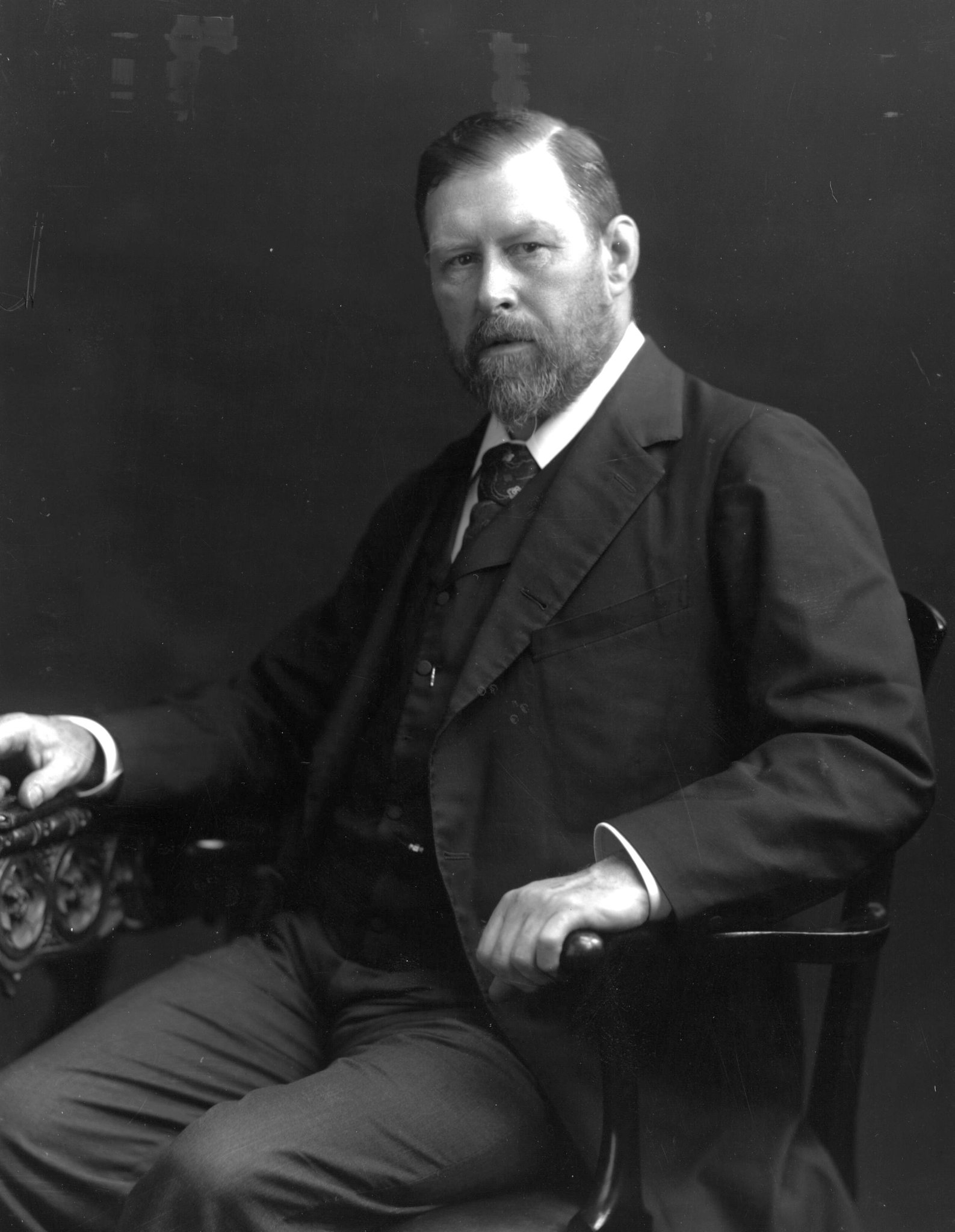
or his 1897 masterpiece, Dracula,
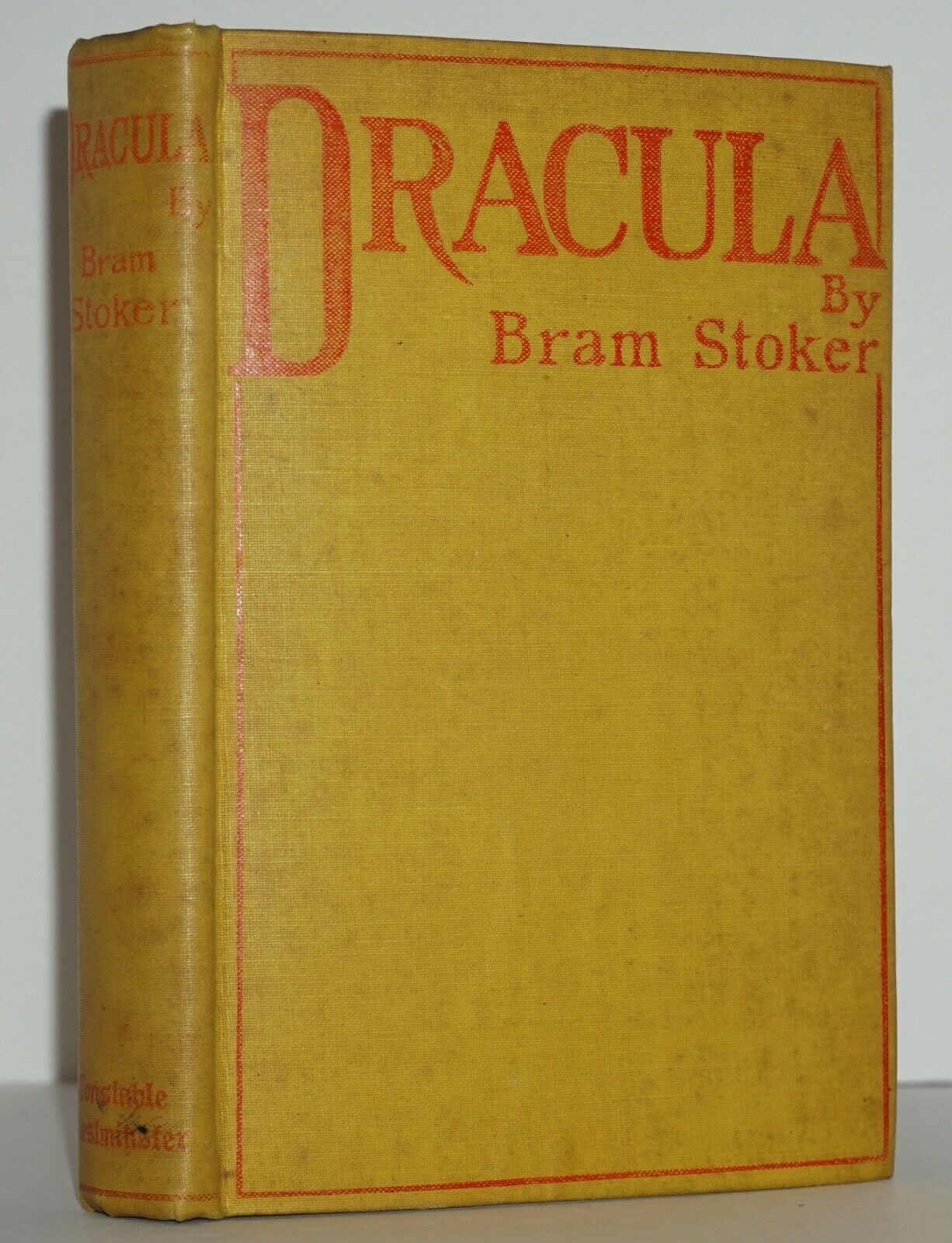
but, as I’m currently finishing reading it with a class, I noticed another wolf—with a similar task to that of Grond—in Stoker’s novel.

Please pardon the quick plot summary, if you’ve read the book.
Lucy Westenra is Dracula’s first victim in his one-man invasion of England. To protect her, Dr Van Helsing surrounds her with garlic, including among other things, a garland for her neck and for the window of her first floor bedroom. Lucy feels safe and her mother, who has a weak heart, comes to join her in bed.

Thwarted by Van Helsing’s work, Dracula picks a weapon from the London Zoological Gardens and–

“After a while there was the low howl again out in the shrubbery, and shortly after there was a crash at the window, and a lot of broken glass was hurled on the floor. The window blind blew back with the wind that rushed in, and in the aperture of the broken panes there was the head of a great, gaunt grey wolf. Mother cried out in a fright, and struggled up into a sitting posture, and clutched wildly at anything that would help her. Amongst other things, she clutched the wreath of flowers that Dr. Van Helsing insisted on my wearing round my neck, and tore it away from me. For a second or two she sat up, pointing at the wolf, and there was a strange and horrible gurgling in her throat; then she fell over—as if struck with lightning, and her head hit my forehead and made me dizzy for a moment or two. The room and all round seemed to spin round. I kept my eyes fixed on the window, but the wolf drew his head back, and a whole myriad of little specks seemed to come blowing in through the broken window, and wheeling and circling round like the pillar of dust that travellers describe when there is a simoon in the desert. I tried to stir, but there was some spell upon me, and dear mother’s poor body, which seemed to grow cold already—for her dear heart had ceased to beat—weighed me down; and I remembered no more for a while.” (Dracula, Chapter XII, “Memorandum left by Lucy Westenra”)

(Abigail Rorer from the Folio Society edition)
Perhaps not so grand as:
“…Thrice the great ram boomed. And suddenly upon the last stroke the Gate of Gondor broke. As if stricken by some blasting spell it burst asunder: there was a flash of searing lightning, and the doors tumbled in riven fragments to the ground.
In rode the Lord of the Nazgul.”
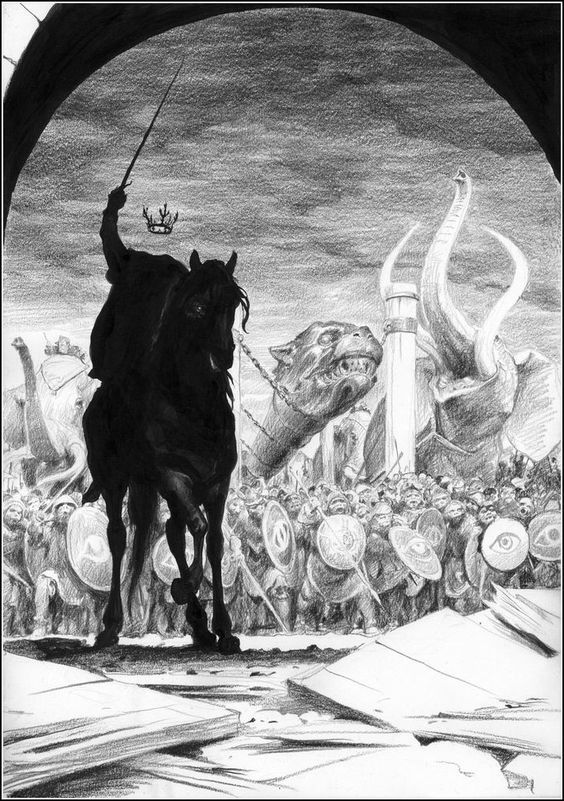
(Denis Gordeev)
but equally effective and, as the Witch King of Agmar stands at the ruined gate, so Dracula stands at the broken window. The difference is, the Witch King is thwarted by the advent of the Rohirrim,

(Julia Alexeeva)
while Dracula slips in and begins Lucy’s final transformation into a vampire.
So, could an early 14th century text and a late 19th-century horror novel have given Tolkien inspiration? If an 1890 children’s book can offer him a talking dragon (“The Story of Sigurd” in Andrew Lang’s The Red Fairy Book, which you can read here: https://archive.org/details/redfairybook00langiala/redfairybook00langiala/ )

why not?
Thanks, as ever, for reading.
Stay well,
Even if garlic might not keep out vampires, it’s good in bread,
And remember that, as always, there’s
MTCIDC
O
PS
In case you haven’t read Dracula, here’s your chance in a copy of the first American edition of 1897: https://www.gutenberg.org/cache/epub/345/pg345-images.html
 doubtfulsea