• About

doubtfulsea

~ adventure fantasy

Category Archives: Uncategorized

V(&)ILC(s)

30 Wednesday Aug 2023

Posted by Ollamh in Uncategorized

≈ Leave a comment

As ever, dear readers, welcome.

Although Tolkien often protested that The Lord of the Rings was never meant to be allegorical (allegory being something he didn’t care for), yet:

“That there is no allegory does not, of course, say there is no applicability.  There always is.  And since I have not made the struggle unequivocal…there is I suppose applicability in my story to present times.”  (from a letter to Herbert Schiro, 17 November, 1957, Letters, 262)

As a case in point, let me cite for you Lotho Sackville-Baggins.

The title of this posting, although it may appear to be the acronym for some large, anonymous corporation, is actually a piece of shorthand adapted from one of Tolkien’s letters:

“We knew Hitler was a vulgar and ignorant little cad, in addition to any other defects (or the source of them)…” (letter to Christopher Tolkien, 23-25 September, 1944, Letters, 93)

That Tolkien had no love for Hitler, his view of him he makes very clear in an earlier letter written to his second son, Michael:

“Anyway, I have in this War a burning private grudge—which would probably make me a better soldier at 49 than I was at 22:  against that ruddy little ignoramus Adolf Hitler…”  (letter to Michael Tolkien, 9 June, 1941, Letters, 55)

Tolkien goes on in that later letter, however:

… but there seem to be many v. and i.l. cads who don’t speak German…”

and this leads us in a very interesting direction:

“…and who given the same chance would show most of the other Hitlerian characteristics.”

This, in turn, is what leads me to think immediately of Lotho, the son of Otho and Lobelia Sackville-Baggins, whom we first see in the last chapter of The Hobbit, where, having believed that Bilbo was dead, they seem to have hoped to inherit Bag End, appearing at the auction of its contents and, to Bilbo’s mind, intent upon acquiring more than the real estate:

“Many of his silver spoons mysteriously disappeared and were never accounted for.  Personally he suspected the Sackville-Bagginses.”

They were clearly personally affronted that Bilbo survived his adventure:

“On their side they never admitted that the returned Baggins was genuine, and they were not on friendly terms with Bilbo ever after.  They really had wanted to live in his nice hobbit-hole so very much.”  (The Hobbit, Chapter 19, “The Last Stage”)

Although not on friendly terms, perhaps, they were invited to Bilbo’s birthday party, but they presumed upon this, when Bilbo had disappeared, to confront Frodo:

“The Sackville-Bagginses were rather offensive.  They began by offering him bad bargain-bargain prices (as between friends) for various valuable and unlabelled things.  When Frodo replied that the only things specially directed by Bilbo were being given away, they said the whole affair was very fishy.

‘Only one thing is clear to me,’ said Otho, ‘and that is that you are doing exceedingly well out of it.  I insist on seeing the will.”

And now we see what has been festering since that moment, sixty years before, when Bilbo had reappeared to stop the auction:

“Otho would have been Bilbo’s heir, but for the adoption of Frodo.”

He reads the will, finds it ironclad, and is more than disappointed:

“ ‘Foiled again!’ he said to his wife.  ‘And after waiting sixty years.  Spoons?  Fiddlesticks!’  He snapped his fingers under Frodo’s nose and stumped off.  But Lobelia was not so easily got rid of.  A little later Frodo came out of the study to see how things were getting on, and found her still about the place, investigating nooks and corners, and tapping the floors.  He escorted her firmly off the premises, after he relieved her of several small (but rather valuable) articles that had somehow fallen inside her umbrella.”

(Otho might have been waiting for sixty years to gain Bag End, but Bilbo had not forgotten his suspicion of the Sackville-Bagginses’ earlier behavior, leaving a gift for her:

“For LOBELIA SACKVILLE-BAGGINS, as a PRESENT on a case of silver spoons.”  The Fellowship of the Ring, Book One, Chapter 1, “A Long-expected Party”)

Although Otho had died in the interim, Lobelia survived to buy—not inherit—Bag End, and it was still in her—, or rather, her son, Lotho’s—hands when Saruman, aka “Sharkey”, arrived to continue his plan either to convert the Shire into an early industrial center or to ruin it (Tolkien might have said, “Both”, considering his aversion to what the Industrial Revolution had done to his beloved countryside).  

(Denis Gordeev—for an interesting article on Soviet artists’ attempts to bring Tolkien to Russia, see:  https://foreignpolicy.com/2021/07/24/soviet-union-tolkien-art-dissidents/  )

In the meantime, Lotho—the son of rather less than decent folk, his own popularity in the Shire gauged by his nickname, “Pimple”—has somehow done very well for himself:

“ ‘It all began with Pimple, as we call him,’ said Farmer Cotton; ‘and it began as soon as you’d gone off, Mr. Frodo.  He’d funny ideas, had Pimple.  Seems he wanted to own everything himself, and then order other folk about.  It soon came out that he already did own a sight more than was good for him; and he was always grabbing more, though where he got the money was a mystery:  mills and malt-houses and inns, and farms, and leaf-plantations.  He’d already bought Sandyman’s mill before he came to Bag End, seemingly.’ “

Things quickly went from bad to worse, as:

“ ‘A lot of Men, ruffians mostly, came with great wagons, some to carry off the goods south-away, and others to stay.  And more came.  And before we knew where we were they were planted here and there all over the Shire, and were felling trees and digging and building themselves sheds and houses just as they liked.  At first goods and damage was paid for by Pimple; but soon they began lording it around and taking what they wanted.

Then there was a bit of trouble, but not enough.  Old Will the Mayor set off for Bag End to protest, but he never got there.  Ruffians laid hands on him and took and locked him up in a hole in Michel Delving, and there he is now.  And after that, it would be after New Year, there wasn’t no more Mayor, and Pimple called himself Chief Shirriff, or just Chief, and did as he liked…’ “ (The Return of the King, Book Six, Chapter 8, “The Scouring of the Shire”)

So, from being simply the son of greedy, self-important hobbits, Lotho (and, yes, that has to be a joke on “Loathe-0”) has become, at least until Saruman appears, the dictator of the Shire:

“ ‘…and if anyone got “uppish” as they called it, they followed Will.’ “

Earlier in this same letter to Christopher, Tolkien had written:

“There was a solemn article in the local paper seriously advocating systematic exterminating of the entire German nation as the only proper course after military victory:  because, if you please, they are rattlesnakes, and don’t know the difference between good and evil!”

Tolkien, who was a decent and extremely fair-minded man, refuted that, saying:

“The Germans have just as much right to declare the Poles and Jews exterminable vermin, subhuman, as we have to select the Germans:  in other words, no right, whatever they have done.”

At the same time, he was well aware that those who may appear ordinary, but who harbor such terrible ideas, may, in time come into positions of control, like Lotho:

“The Vulgar and Ignorant Cad is not yet a boss with power; but he is a very great deal nearer to becoming one in this green and pleasant isle than he was.”

And, if such thinking weren’t wicked enough in itself, there is the added danger:


“You can’t fight the Enemy with his own Ring without turning into an Enemy; but unfortunately Gandalf’s wisdom seems long ago to have passed with him into the True West…”

This seems too much, even for Tolkien, horrified that letters which sound like Nazi propaganda translated into English should appear in the public press and has already written to Christopher that:

“Still you’re not the only one who want to let off steam or bust, sometimes; and I could make steam, if I opened the throttle, compared with which (as the Queen said to Alice) this would be only a scent-spray.”

(a half-quotation from Through the Looking Glass, 1871, where, in Chapter 2, Alice has a conversation with the Red Queen in which the Queen several times uses the expression, “I’ve seen/heard…compared with which…”)

But perhaps there is some consolation in the ultimate fate of Lotho and of his master, Saruman?  “Where is that miserable Lotho hiding?” Merry had asked and Saruman later answered:

“ ‘But did I hear someone ask where poor Lotho is hiding?  You know, don’t you, Worm?  Will you tell them?’

Wormtongue cowered down and whimpered:  ‘No, no!’

‘Then I will,’ said Saruman.  ‘Worm killed your Chief, poor little fellow, you nice little Boss.  Didn’t you, Worm?  Stabbed him in his sleep, I believe.  Buried him, I hope; though Worm has been very hungry lately…”

This is too much, even for Grima/Wormtongue:

“…suddenly Wormtongue rose up, drawing a hidden knife, and with a snarl like a dog he sprang on Saruman’s back, jerked his head back, cut his throat, and with a yell ran off down the lane.” 

In 1944, Tolkien had no idea what would happen to Hitler and his allies by 1945, but one wonders what he might have said about applicability then?

Thanks for reading, as always.

Stay well,

Beware of the self-righteous,

And remember that there’s always

MTCIDC

O

Wimseycal

23 Wednesday Aug 2023

Posted by Ollamh in Uncategorized

≈ Leave a comment

As always, welcome, dear readers.

In his own field, Tolkien was, not surprisingly, a very well-read scholar, and, in certain areas beyond his field, like Celtic Studies, he was informed, if not expert. 

Oronzo Cilli’s wonderfully detailed work, Tolkien’s Library,  An Annotated Checklist,

using a variety of sources, from correspondence, to the comments of his friends, to books surviving in university collections, to sale catalogues, to library books recorded to have been checked out by him, supplies us with hundreds of titles owned or consulted by Tolkien.

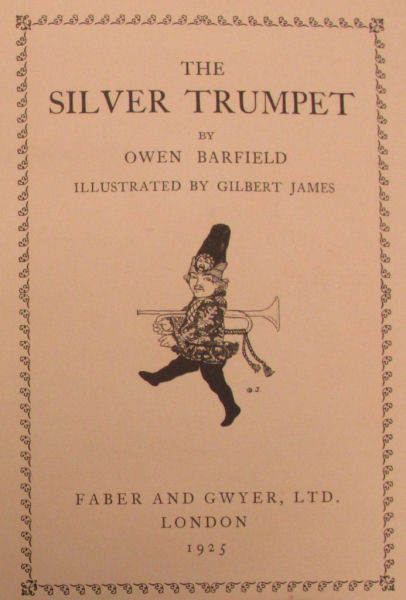
For a person who often wrote that he was overwhelmed with academic work year-round, however, Tolkien appears to have enough leisure to accumulate and read quite a number of non-scholarly works, as well, and leafing through the pages of Cilli’s book, one finds everything from Owen Barfield’s The Silver Trumpet

to James Joyce’s Finnegans Wake

(although Cilli misspells it with an apostrophe, which Joyce intentionally didn’t employ)

to E.A. Wyke-Smith’s The Marvellous Land of Snergs.

(missing its definite article in Cilli)

Among his listings are these:

Busman’s Honeymoon,

Clouds of Witness,

The Five Red Herrings,

(also missing its definite article in Cilli)

Gaudy Night,

Have His Carcase,

Murder Must Advertise,

Strong Poison,

The Nine Tailors,

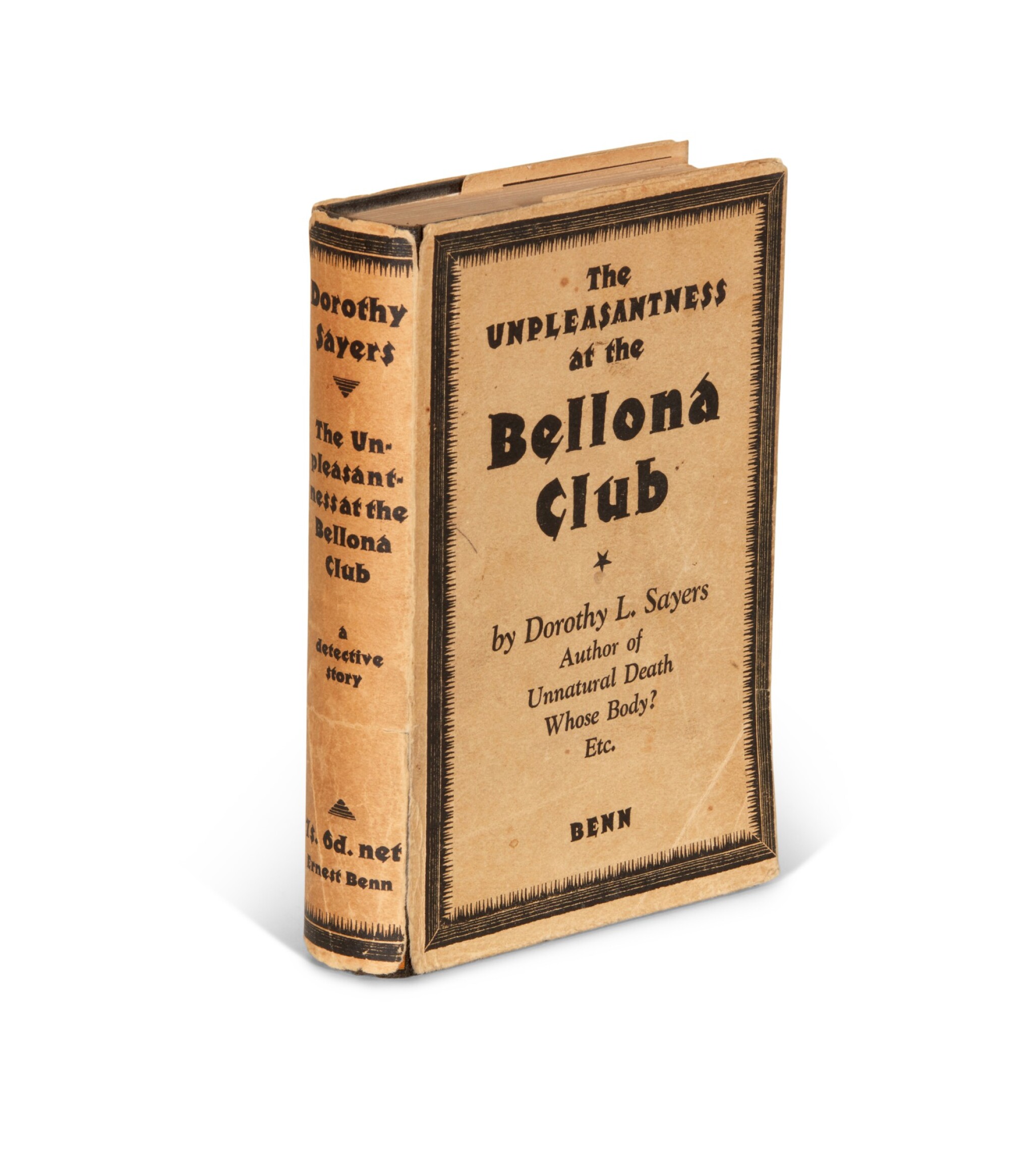
The Unpleasantness at the Bellona Club,

and Whose Body?,

all detective novels by Dorothy L. Sayers (1893-1957).

In these novels, the detective is a wealthy, titled man, Lord Peter Wimsey,

who has a kind of Watson in his personal valet, Bunter (a sergeant in his regiment in the Great War, who rescued him on the battlefield), and who eventually marries—of all people—a young mystery writer, Harriet Vane, after he rescues her from the gallows in Strong Poison (1930)–although not immediately.  In a very believable rejection, Harriet refuses him at first because she doesn’t believe that gratitude is enough of a basis for a lasting relationship.  It takes two more adventures—Have His Carcase, 1932, and Gaudy Night, 1935, before she finally agrees.  And, in Sayers’ last Wimsey novel, Busman’s Honeymoon, 1937, we see them just after their marriage.

Besides being a successful mystery writer, Sayers was also a dramatist, essayist, and translator, her major work being her highly-annotated translation of the first two parts of Dante’s Commedia (the third part, unfinished at her death, was completed by Barbara Reynolds). 

Both Tolkien and C.S. Lewis knew and liked her, as Humphrey Carpenter tells us (see The Inklings, 189), and, among her works, her series of Christian radio plays, The Man Born to Be King (1941-42), impressed them, but Lewis tried Gaudy Night and didn’t enjoy it, and Tolkien, who appears to have owned and read almost all of her novels (only missing from the list is Unnatural Death, 1927) ultimately wrote this:

“I could not stand Gaudy Night,  I followed P. Wimsey from his attractive beginnings so far, by which time I conceived a loathing for him (and his creatix) not surpassed by any other character in literature known to me, unless by his Harriet.  The honeymoon one (Busman’s H.?) was worse.  I was sick.”  (airgraph to Christopher Tolkien, 25 May 1944, Letters, 82)

What had gone wrong?  Gaudy Night (1935) is set at a reunion of Harriet Vane’s imaginary Oxford college, “Shrewsbury College”, based upon Sayers’ actual college, Somerville, and concerns mysterious acts of anti-feminist vandalism which come to border on open violence.  The college head invites Harriet, as a former member of the college, to investigate, which she does against rather significant opposition from some of the faculty.  The plot also concerns Peter Wimsey, who, although off on a diplomatic mission for the British government at the beginning of the story, returns in time to participate in the detecting of the guilty party and her motive later in the novel.  We don’t know why this turned Tolkien off—perhaps Lewis’ reaction?  Perhaps the love story and Harriet’s ultimate agreement to marry Peter?  (He did say that he’d come to loathe her, but doesn’t mention her appearance in two earlier novels.)  And what had happened to his liking for Sayers herself?  Such extreme reactions seem as mysterious as Sayers’ novels and perhaps it would take a literary detective of the quality of Peter Wimsey himself to unravel it.

Thanks for reading, as always.

Stay well,

The science of deduction or induction—which does Holmes practice really?

And know that, as always, there’s

MTCIDC,

O

PS

Unlike Tolkien, I’ve always enjoyed Sayers’ novels, Harriet Vane being a particular favorite character—I wish that Sayers had written at least one book in which she solves a mystery on her own—and, if you’d like to know more about her and her work, try:  https://www.sayers.org.uk/  If Peter Wimsey interests you, besides the books, there are two very good and very different television series available:

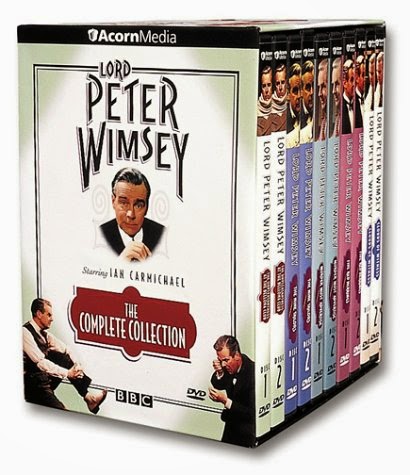
1. Ian Carmichael played the character in a series created in the 1970s

2. Edward Petherbridge was Wimsey in a briefer series in the late 1980s

There are partisans for each.  I enjoy both, Carmichael having the kind of bounce and flair with quotation which makes Wimsey appealing, and Petherbridge displays the inherent melancholy which is Wimsey’s other side (he still has nightmares about the Great War).

Terms

16 Wednesday Aug 2023

Posted by Ollamh in Uncategorized

≈ Leave a comment

Welcome, as ever, dear readers.

Although Tolkien never wanted readers to see The Lord of the Rings as allegory about his own time—writing to Joanna de Bortadano that “my story is not an allegory of Atomic power” (letter to Joanna de Bortadano, April, 1956, Letters, 246), he also wrote to Rhona Beare that, “I have, I suppose, constructed an imaginary time, but kept my feet on my own mother-earth for place” (letter to Rhona Beare, 14 October, 1958, Letters, 283) and, in the years in which he was writing the novel, it would have been difficult not to have felt some influence from what was going on around him in that place.

This certainly applies, I would suggest, when it comes to the words of the Mouth of Sauron,

(Douglas Beekman)

dictating terms to Gandalf:

“The rabble of Gondor and its deluded allies shall withdraw at once beyond the Anduin, first taking oaths never again to assail Sauron the Great in arms, open or secret.  All lands east of the Anduin shall be Sauron’s for ever, solely.  West of the Anduin as far as the Misty Mountains and the Gap of Rohan shall be tributary to Mordor, and men there shall bear no weapons, but shall have leave to govern their own affairs.  But they shall help to rebuild Isengard which they have wantonly destroyed, and that shall be Sauron’s, and there his lieutenant shall dwell:  not Saruman, but one more worthy of trust.”  (The Return of  the King, Book Five, Chapter 10, “The Black Gate Opens”)

Although it would lead to a permanent cessation of combat, the armistice of 11 November, 1918, agreed upon in a railway car in Compiegne in northern France,

was not a surrender on the part of the Central Powers (Germany, Austria-Hungary, Bulgaria, Turkey), but only an agreement to cease active engagement with the Allies.  As fighting stopped, more or less, at that time, at least on the Western Front, people in the West, especially soldiers, certainly rejoiced as if the Great War/World War I had actually ended.

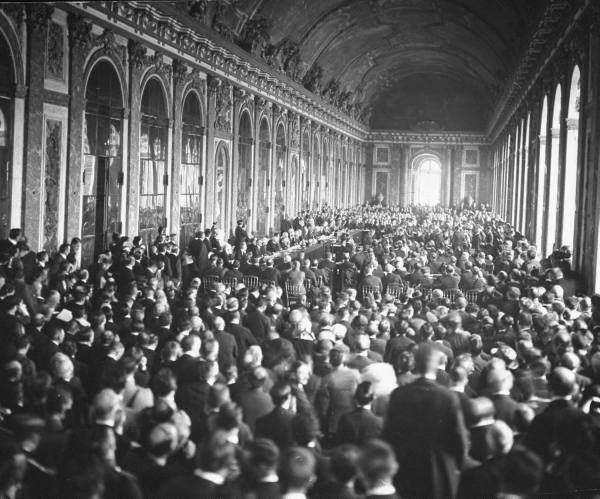
The real surrender occurred the next June, however, in the Hall of Mirrors at Versailles, outside Paris.

As might be expected from a large gathering of disparate powers, there was a great deal of wrangling, of pushing various agendas, and argument over how Germany, which was almost universally blamed for the outbreak of war in 1914, was to be dealt with.  The final form of the treaty was complex, but here are some of the main points:

Reading through these points, and many more, it’s hard not to think that Lieutenant Tolkien

would not have also read through them with interest—note things like:

1. disarmament

2. loss of territory

3. to which we might add outside control of territory, in that the Allies gave themselves the right to occupy the heavy industrial areas called the Rhineland and the Ruhr valley until 1934 (the occupation, in fact, was ended in 1930),

as well as returning to France territory which she had lost to German troops in the War of 1870-1, Alsace and Lorraine.

The severe terms of this treaty, it has often been written, were a major reason for the rise of Hitler and the rearmament of Germany in the 1930s

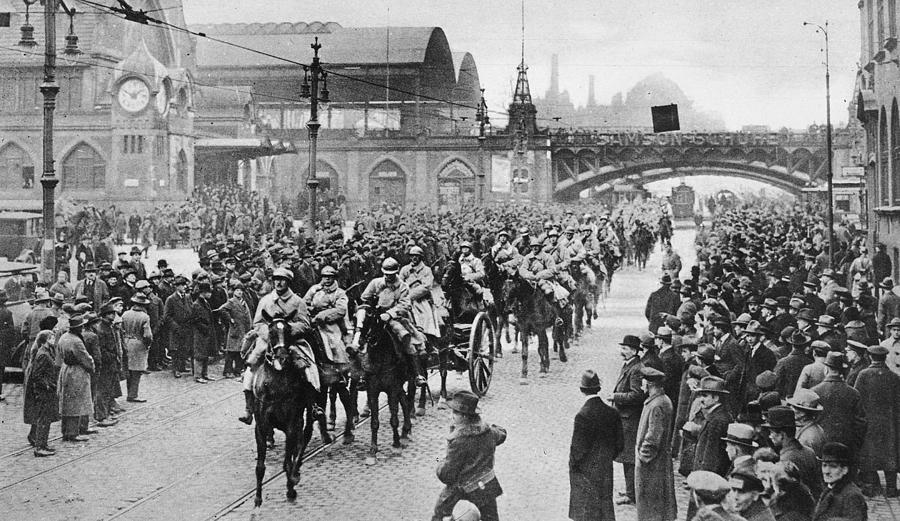
and even a reason for a new war, even longer than the first, from 1939 to 1945, as Hitler worked his way west, in what was called a Blitzkrieg, or “lightning war”, which, in late spring, 1940, rolled over Norway, Denmark, the Netherlands, Belgium, and moved into France, where it rapidly defeated both a British expeditionary force and the French army.

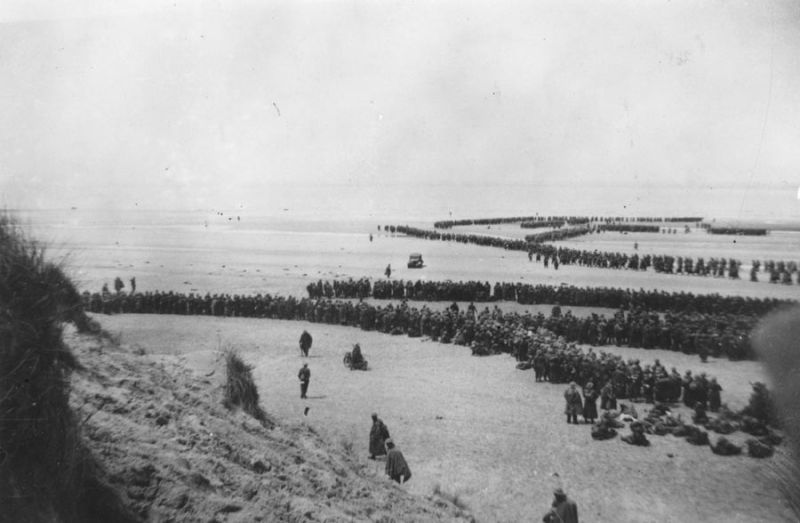
The majority of the British, along with a number of Belgian and French soldiers, were rescued at Dunkirk,

but the majority of the French were forced south and then became part of a general armistice, the terms of which would seem familiar to those who remembered the Treaty of Versailles:

“The 1940 Armistice agreement comprised 24 articles, notably: :

n°1 : The French army must immediately lay down its arms

n°2 : The German occupation of a large portion of France.

n°4 : The demobilization of the French army.

n°6 : The heavy armaments of the free French zone are to be delivered in good condition to the Germans. 

n°8 : The French navy is to be demobilized and disarmed.

n°11: Commercial boats must remain in port.

n°12: All planes are grounded.

n°19: Designated German nationals must be handed over to Germany.

n°20: French prisoners of war are to remain in Germany. 

n°24: The armistice agreement remains valid until the signing of a peace treaty”

(from the website Memorial Armistice here:  https://armistice-museum.com/ )

This occupation also sounds much like Sauron’s terms, France initially looking like this—

(for more on the occupation, see an extensive article here:  https://en.wikipedia.org/wiki/Vichy_France#Bibliography )

The terms of the Versailles Treaty were harsh, but their ultimate goal was—or at least some of those involved hoped so—to prevent such horrendous wars in the future (see this detailed article for more:  https://en.wikipedia.org/wiki/Treaty_of_Versailles ).  The Nazi terms for an armistice were, on the one hand, Hitler’s sneering response to the Treaty of Versailles (he even had it arranged that the terms would be presented and agreed to in the same location—see more at:  https://armistice-museum.com/  ), but, on the other, simply a method to gain control of all of France, its industries, and even its labor force, in time—the condition that the armistice terms would hold until a peace treaty was signed proved totally false, as there was never a treaty.  That artificially-determined border was erased and the Nazis occupied all of France, as this map sequence shows.

And this is in line with something which the narrator tells us of the reaction of Gandalf and his companions to the words of the Mouth of Sauron:

“Looking in the Messenger’s eyes, they read his thought.  He was to be that lieutenant, and gather all that remained of the West under his sway; he would be their tyrant and they his slaves.”

Tolkien, a reluctant civilian during that second war (see his letter to Michael Tolkien of 9 June, 1941, Letters, 55), was always clearly well aware of current events, especially to do with that war (there are over 100 citations to war-related items in Letters alone) and, although he might model Sauron’s terms on what he might have read in 1919 or 1940, I can imagine that it was the terms of the 1940 armistice and their ultimate veracity which was in his mind when he wrote Gandalf’s words in response to the demands of Sauron and his Mouth:

“But as for your terms, we reject them utterly.  Get you gone, for your embassy is over and death is near to you.  We did not come here to waste words in treating with Sauron, faithless and accursed; still less with one of his slaves.  Begone!”

As always, thanks for reading.

Stay well,

Never trust an emissary with his own agenda,

And remember, that, as ever, there is

MTCIDC,

O

Well Met By Dayelight

09 Wednesday Aug 2023

Posted by Ollamh in Uncategorized

≈ Leave a comment

Dear Readers, welcome, as always.

This is the 469th posting of Doubtfulsea.com and, with it, this blog enters its tenth year.

This calls for a little rejoicing,

(no peacock, however)

but there’s another reason for rejoicing, as will present itself—or, rather, himself–later.

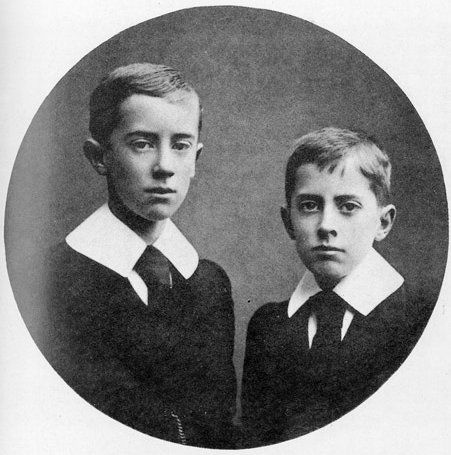
As I’ve discussed in earlier postings, lthough, in later life, Tolkien enjoyed at least one Shakespeare performance (see a letter to Christopher Tolkien, 28 July, 1944, Letters, 88), as a schoolboy,

(in 1905, with his younger brother, Hilary)

he disliked Shakespeare “cordially” (see letter to W.H. Auden, 7 June, 1955, Letters, 213).  His ire was directed towards two plays in particular:

1. Macbeth, because, as he tells us, he was disappointed that Birnam Wood wasn’t an actual wood which marched on Macbeth’s stronghold, but merely camouflage for Macduff’s soldiers (see  JRRT’s own footnote to his letter to W.H. Auden of 7 June, 1955, Letters, 212)

(modern camouflage, but you get the idea)

2. A Midsummer Night’s Dream because of the miniaturization of the fairies (see his footnote to a letter to Milton Waldman, “late 1951”, Letters, 143, where he remarks:  “…a murrain [plague] on Will Shakespeare and his damned cobwebs”  )

I don’t mind Tolkien’s disappointment about Birnam Wood because it gave us Treebeard and the Ents, to me one of his most marvelous creations,

(Alan Lee)

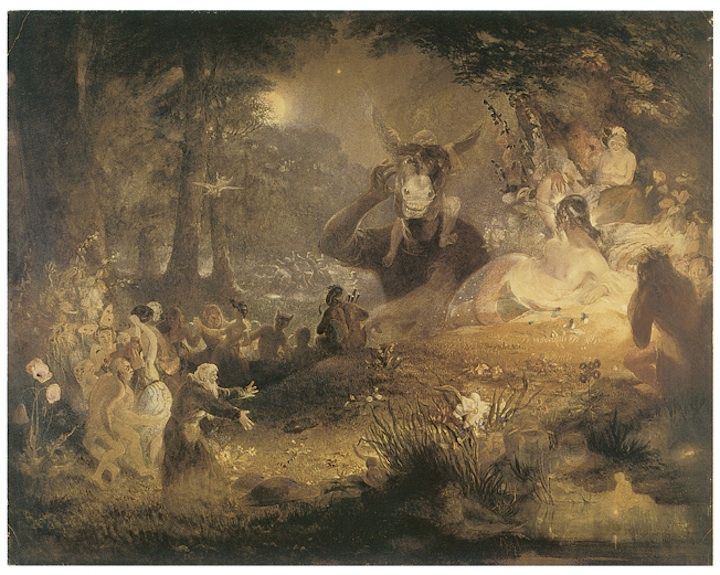
but, although the “cutsie” aspect of Victorian depictions of fairies, which clearly Tolkien had seen and disliked, as the descendants of Shakespeare’s fairies, I find more than a little disturbing—like this depiction, by Richard “Dicky” Doyle (1824-1883), famous for his fairy illustrations–

it has never stopped me from loving the play and, if you, like me, have Shakespeare in your head (it can get a little crowded in there, I admit, so I exclude dubious things like Henry VIII), you’ll recognize the title of this posting as based upon the opening line of the meeting of the Fairy King and Queen

in Act II of A Midsommer nights dreame, as the First Quarto (1600) spells it.

“Ob. Ill met by moonelight, proud Tytania.

Qu. What, Iealous Oberon? Fairy skippe hence.

I haue forsworne his bedde, and company.

Ob. Tarry, rash wanton. Am not I thy Lord?”

(I really prefer Elizabethan/Jacobean spelling, myself, so, if you’d like to read the play in that edition:  https://internetshakespeare.uvic.ca/doc/MND_Q1/scene/2.1/index.html  A very mild caution:  if you’re used to modern editions and haven’t used the earliest publications, this Quarto may surprise you, as it has no line numbers, scene or act markers, but just rolls along with no breaks.  It’s actually perfectly easy to read, however, as you’ll see.)

The King of the Fairies is Oberon, a name which is believed to be derived from a Germanic form “alf-rih”, “elf-king/ruler” (you can see the same construction in the name of the Ostrogothic king, Theodoric, which is actually “theuda-reiks”, “people ruler”), but which first appears in the early 13th century chanson de geste (a kind of heroic poem) of Les Prouesses et faitz du noble Huon de Bourdeaux as Auberon.  (For more on this see :  https://en.wikipedia.org/wiki/Huon_of_Bordeaux )Shakespeare may have picked up the name from the early 16th-century  translation by John Bouchier, Lord Berners, The Boke of Duke Huon of Burdeux (printed about 1534—you can read the Early English Text Society edition of 1882 here :  https://ia600502.us.archive.org/35/items/TheBokeOfDukeHuonOfBurdeux1/The_Boke_of_Duke_Huon_of_Burdeux_1.pdf or an 1895 retelling, in the style of William Morris here :  https://archive.org/details/huonofbordeauxdo00bernuoft/page/n9/mode/2up ) It’s interesting that Auberon is diminutive, but handsome, in the Huon story, so perhaps Shakespeare scaled down the rest of the fairies to fit him ?  (Other Elizabethan/Jacobean authors also depict the fairies as tiny—see, for example,  Michael Drayton’s Nymphidia, 1627, which Tolkien hated—On Fairy Stories–and which you can read here :  https://archive.org/details/selectionfrompoe00dani/page/124/mode/2up ) 

If you know the play, you probably also know the incidental music which Felix Mendelssohn (1809-1847) composed for a performance in of it in Berlin in 1842, having written an overture years before, in 1826, when he was 17 (I almost put an exclamation point there).  So you can hear something of what audiences in 1826 would have heard, here’s a really beautiful performance of that overture on instruments of the period, conducted by Franz Brueggen :  https://www.youtube.com/watch?v=qxC17tNhN7c

At about the same time, another Romantic composer, Carl Maria von Weber (1786-1826),

(This is sometimes cited as the first illustration of a conductor using the equivalent of a baton to conduct.)

was in London, creating an opera based upon a libretto loosely founded upon that 13th century French poem of Huon.  That libretto was written by a man often thought of as the forerunner to W.S. Gilbert in English comic operetta, James Robinson Planche (1796-1880),

but who was actually a dynamo of the Georgian and early Victorian theatre in general, being involved in everything from authentic historical costuming to introducing vampires to the English stage in 1820.

The libretto combines spoken dialogue with music, the kind of opera which the French call an opera comique, like Bizet’s (1838-1875) Carmen, 1875, as opposed to an opera completely sung, opera lyrique, or grand opera, and the plot probably would seem pretty weak to us (you can read a summary here :  https://en.wikipedia.org/wiki/Oberon_(Weber) ), but it was an immediate success in 1826,

although von Weber died in London shortly afterwards.  Here’s the overture to it, again with period instruments, conducted by John Eliot Gardiner : //www.youtube.com/watch?v=fHI7Yc66SFk

so that you can hear a little of what excited London theatre-goers.

Now, you are probably wondering, how does all of this, as interesting as I hope you find it, tie in with that idea of festivity?

Back in May, I posted a piece which ended on the sad note that my 9-year-old Bernese Mountain Dog, Bellerophon, had left us (see Beato Te, 31 May, 2023).

A month or so ago, a new Berner appeared, a 2-month-old puppy, named—I’ll bet you’ll guess this already–Oberon.

At 3 months, he’s curious, lively, and promises, if not to be a powerful fairy king, like his namesake, certainly to provide as much delight as the Shakespeare play from which his name comes.

As always, thanks for reading.

Stay well,

Beware the Puck,

And remember that, as always, there’s

MTCIDC

O

PS

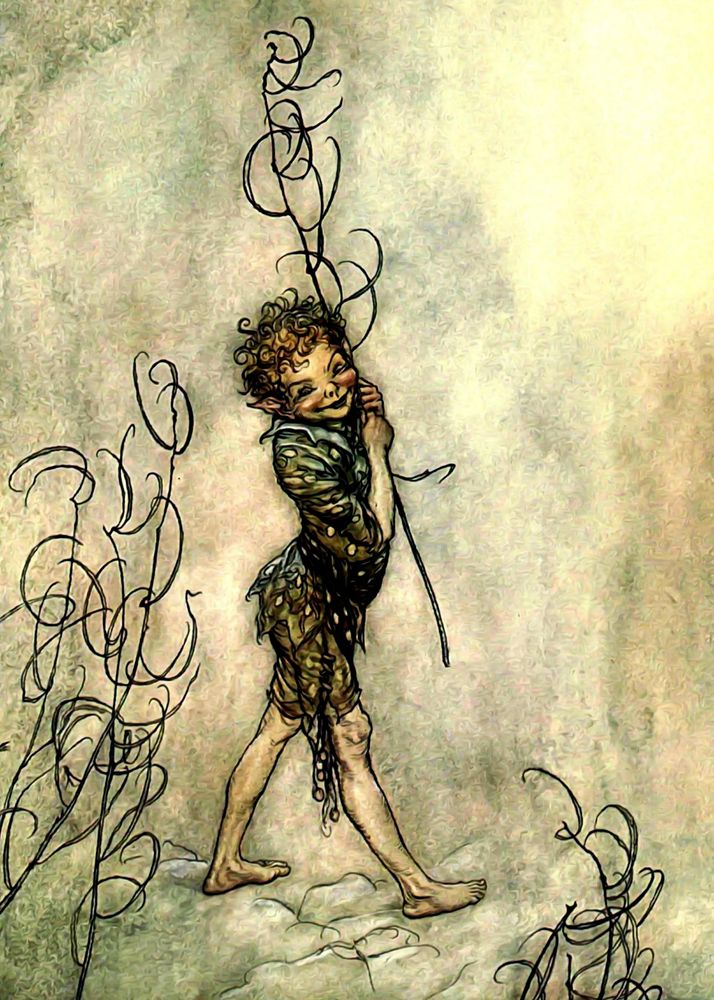
If you liked the image of Puck and the meeting of Oberon and Tytania earlier in the posting, you might have a look at Arthur Rackham’s 1908 illustrated version of Shakepeare’s play here:  https://ia902806.us.archive.org/33/items/midsummernightsd00shakrich/midsummernightsd00shakrich.pdf

Jonesing for Indiana (II)

02 Wednesday Aug 2023

Posted by Ollamh in Uncategorized

≈ 1 Comment

Dear readers, welcome, as always.

In my last, I was beginning a review of the new Indiana Jones film.

In that last, I began with background on just what that film was based upon and now I want to discuss the film itself.  (And, considering how much of it is revealed here, I suppose that I should shout SPOILER ALERT!!! in case you haven’t seen it.  If you haven’t, go, and I hope that, afterwards, you’ll find my two postings useful in your own thoughts about the film.)

It had been long known that this would be the final Indiana Jones film.  The lead, after all, is now 80 (though, in the Indiana Jones chronology, he was born 1 July, 1899, meaning that, at the time of this film, he’s actually supposed to be 70) and, though clearly a tough old bird, as he adlibbed in Raiders, “It’s not the years:  it’s the mileage”. 

The questions facing the creators then, must have been things like:

1. how can we end the series in a memorable way?

2. what will be the goal?

3. who will be the villains?

4. when will it take place?

We’ll begin in reverse order. 

There was already a certain time-frame established within the series, the first three films taking place in the 1930s (The Temple of Doom in 1935, Raiders in 1936, and The Last Crusade in 1938).

The next film, Crystal Skull, takes place in 1957—so it would be natural, then, that the action of this final film might happen beyond that time.  And, in fact, it is set in 1969, the year of the first moon landing. 

(After 1969, although there won’t be any further adventures, Dr. Jones survives perhaps another 25 years, as the made-for-television “The Young Indiana Jones Chronicles”, shows him alive in the early 1990s.  See this article for a useful chronology:  https://www.looper.com/763148/the-entire-indiana-jones-timeline-explained/ )

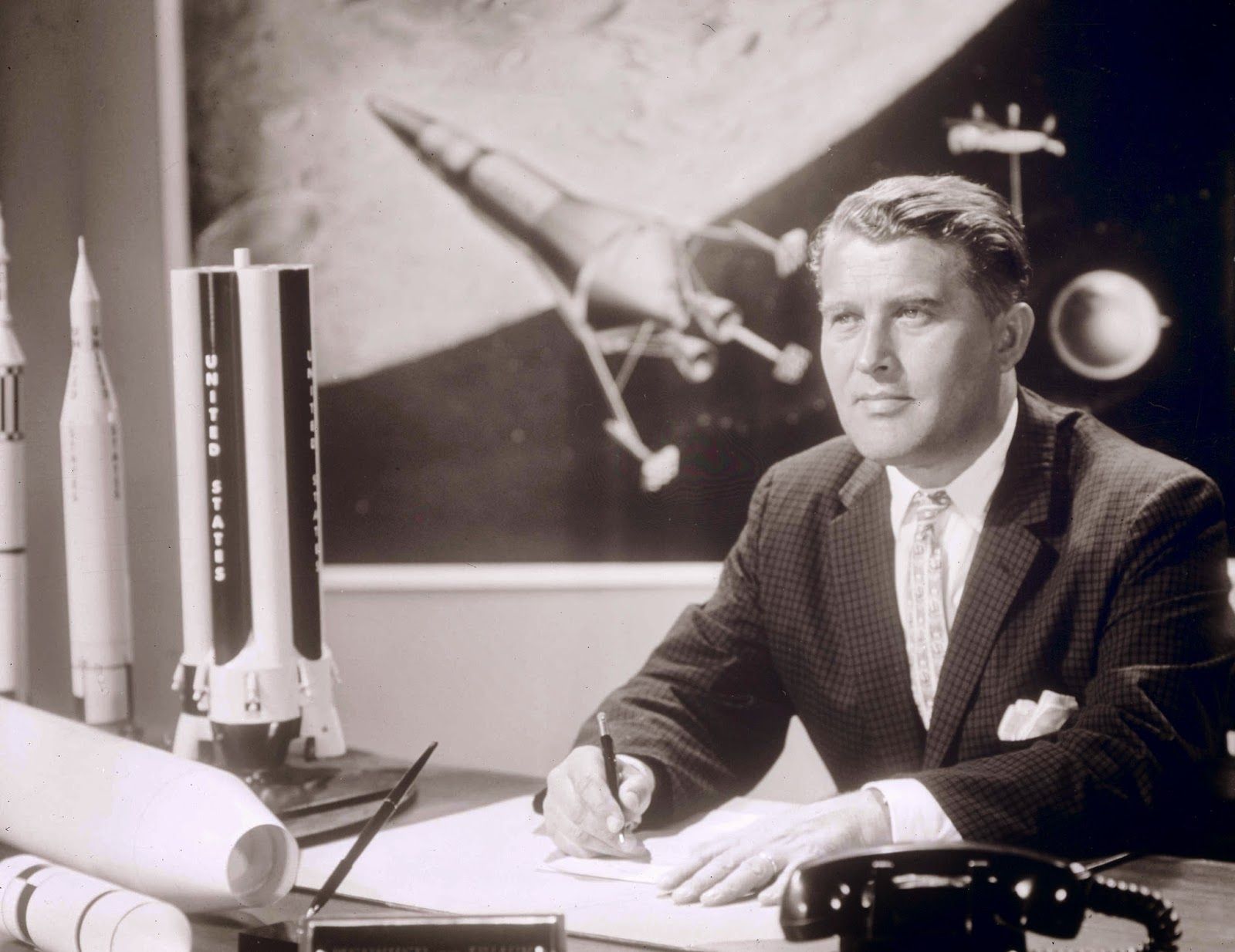
Once we’ve established the time, then choosing the villains may be a little easier:  in the 1930s, the Nazis were a ready possibility—although Temple chose, instead, a sinister prime minister of a small Indian hill state.  In 1957, we’re in the middle of the Cold War, so Soviet agents make sense in Skull.  In 1969, it could still have been the Soviets, but the writers, in a sense, returned to the time of the first films, and so the villain is, in fact, a one-time Nazi scientist—and a particular kind of scientist, of a sort which both the East and the West were grabbing up at the end of the war:  those with a specialty in rocketry, like Wernher von Braun (1912-1977).

It’s not surprising, then, that this one-time Nazi scientist is involved in the “space race” of the period, in the pay of the US Government (which is about to award him a medal).  Past villains in the series appear to have had state funding for their evil projects–the Nazis for Raiders and Crusade, the Soviets for Skull, and even that sinister prime minister in Temple would presumably have had the wealth of his rajah to back him:  are we to believe that this evil-doer will be backed in his wickedness by the US?  Although he has CIA minders in the film’s beginning, he “goes rogue” later in the film and even hints to Jones that he has become independent—but clearly has the resources to build (or at least rent) his own air base and uniform its personnel in German WW2 uniforms.  And this, to me, hints at where I believe the plot begins to show cracks, but let’s continue.

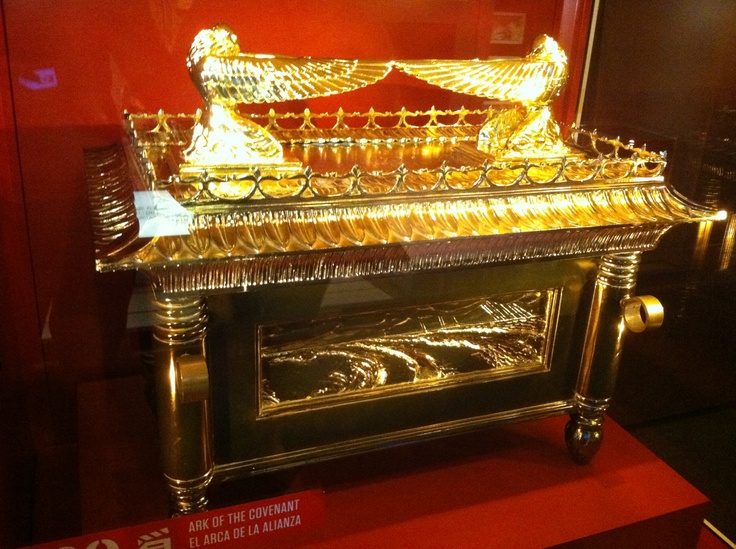
In a number of past films, Jones has been on a quest:  to find the Ark of the Covenant,

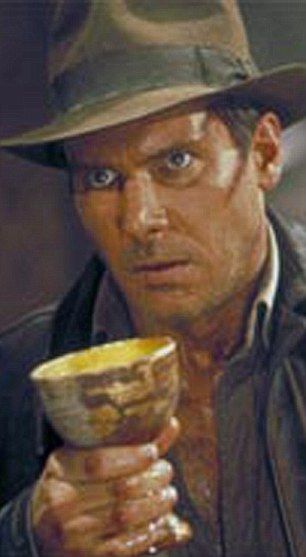
to find the Holy Grail,

and, less clearly, in terms of the plot, to locate the Shankara Stone

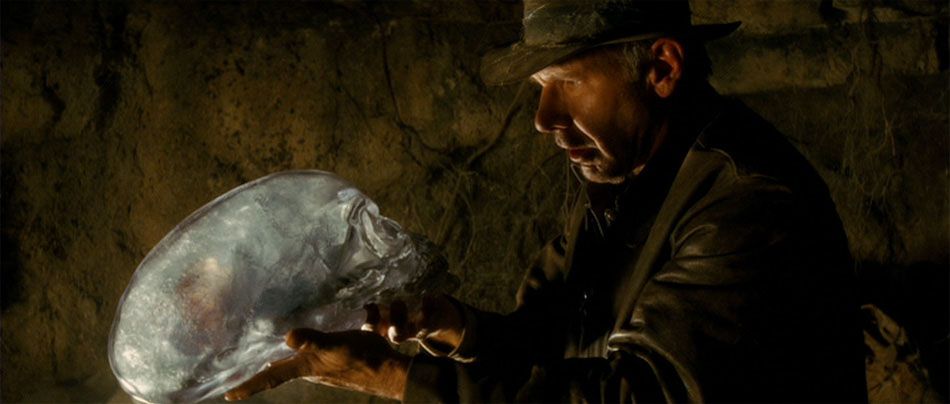
and a crystal skull.

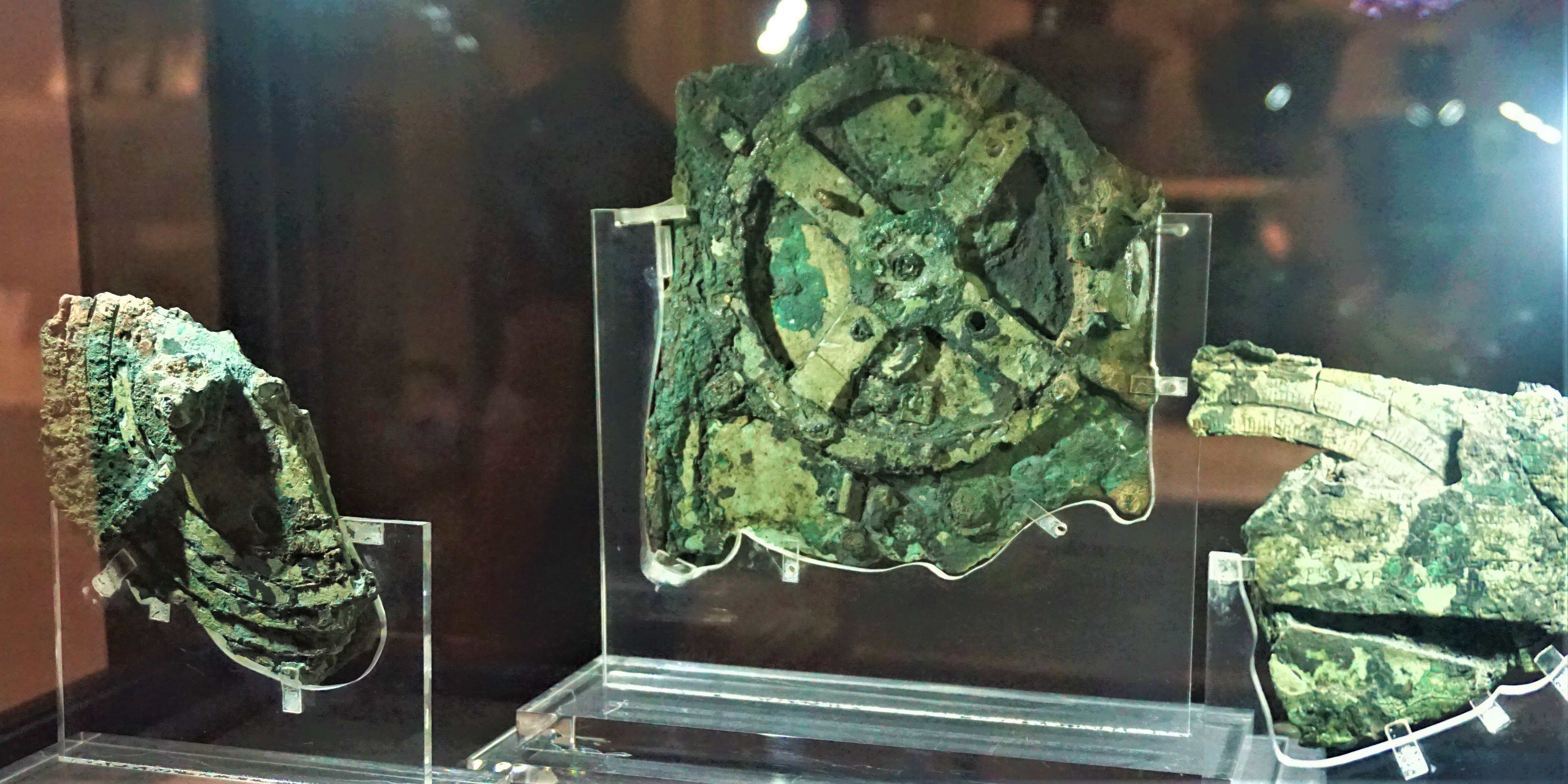
As I said in the last posting, each of these may be fictional or not, depending upon what one chooses to believe, but Indiana Jones and the Dial of Destiny is based upon an actual device dredged up from the floor of the Mediterranean, the so-called Antikythera Mechanism.

For more on this, please see the last posting.  For now, we’ll go with the film’s premise, that this was:

1. invented by Archimedes, the 3rd century BC Greek (Syracusan) mathematician, inventor, scientist

2. originally built to investigate/predict “weather anomalies” (? even after seeing the film twice, I’m not absolutely clear about this), Archimedes discovers that it can also do something similar with time—even allowing someone to pass through it

We now step back to 1944, where, somehow, this former Nazi scientist has become aware of what Archimedes had ascertained and briefly has his hands on the mechanism—or, actually, only half of it—before losing it to Indiana Jones on a speeding train filled with looted antiquities.  These include the so-called “spear of Longinus” (which has its own complicated history—see this article for more:  https://en.wikipedia.org/wiki/Holy_Lance ) which Jones and his colleague, Basil Shaw, are shown to be after—only to discover that it’s a modern fake, which the Nazi scientist had already realized.  Whole earlier films had been dedicated to finding early religious symbols for Hitler, but here, what might have been the basis of the plot, is rapidly discarded in favor of something else, about which Jones and Shaw clearly have no real knowledge—and which Shaw, so the subsequent film informs us, studies obsessively for years until Jones, concerned for Shaw’s apparent declining mental health because of his studies, arrives at his Oxford residence to carry off—and then, although promising to destroy it, simply caches in the archives of his college, where it sits for some years.

But the ex-Nazi has the CIA to help him locate it—through Shaw’s daughter, Helena, who is, without any explanation, called “Wombat” by Jones, and who, with a degree in archaeology and a DPhil (the equivalent of a PhD in the US) project about the mechanism (or so she says, she turning out to be much shiftier than she first appears), has come to Jones for help.

And, so far, we have three unexplained items:

1. how the ex-Nazi funds his plan

2. how he is already aware, in 1944, of what the mechanism can do (something which takes Basil Shaw years of research and perhaps his sanity to understand)

3. why “Wombat” (a minor detail, but, still, why?  Here’s a picture of an actual wombat—and of Helena—is there a resemblance I don’t see?)

And then we have an inconsistency:  although we’re told that Helena has watched her father work on the mechanism for years, she’s memorized her father’s notes, and, at twelve has seen Jones remove it from her father’s house, she comes to him with the story that it still remains in the river where her father and Jones jumped to escape the antiquities train.  The DPhil project appears to be a lie—we subsequently find out that she’s an underground antiquities dealer and wants the mechanism to auction off—but this river story appears to be her actual belief, all the evidence I’ve cited above to the contrary.

At this stage, the indomitable villain, using the CIA, appears to seize the half-mechanism, only to be thwarted by Helena who snatches it and makes off across the rooftops of New York City, leaving Jones to the ex-Nazi and his CIA allies–but, of course, Jones escapes on a stolen police horse and, with the help of his old friend, Sallah, now a New York taxi driver, sets off to Tangiers, where Helena is set to auction off the stolen gadget.  And so the plot is now not about finding a lost and precious object, but recovering it (as becomes the goal in Raiders).

There is another complication—in fact, two—here:

1. as I mentioned above, this is really only half of the mechanism.  We are, at one point, told that Archimedes, fearing that the Romans might steal and employ it, has broken it into two parts, concealing one half (somehow—we’re not told how—the Romans seem to have obtained the other half)

2. the clue to finding that other half lies with something called “the graphikos”, which Basil Shaw’s notes reveal is on the very ship on which the one half the Romans had acquired was discovered—only farther down the underwater slope than the half which held the mechanism, indicating that the Romans had already gotten their hands on the clue

And here we have more unexplained items:

1. how the Romans obtained the gadget

2. how they acquired the “graphikos”

3. and, more important, how the Romans, whose technological expertise stretched only as far as the multiple watermill,

might understand and employ the device even if they had solved the clue and located the other half of it.

Needless to say, the ex-Nazi appears in Tangiers and makes off with the half-mechanism, but Jones and Helena pursue—she knows the location of the “graphikos” (Jones providing a ship and divers), the “graphikos” changes hands, Jones and Helena obtain it once more and it leads them to Syracuse, the home of Archimedes and his tomb, which is, for the sake of the plot, lost completely.  (In fact, the real Archimedes was buried in Syracuse and the last-century BC orator and author, Cicero, records that, not only had he located the site, but restored it.  See:  https://math.nyu.edu/~crorres/Archimedes/Tomb/Cicero.html  This is part of a much larger website which I recommend, if the real Archimedes interests you.) 

The villain arrives, picks up the other half of the mechanism, adds a kind of key found in the tomb, but not mentioned anywhere before (another unexplained item), and sets off with it—and with Jones.  (Unexplained why he’s taken, except that this is an Indiana Jones film.  In a more realistic film, Jones would have been done away with here, probably with a line like, “Archimedes’ tomb, Jones, a good last resting place for a relic like you”.)

And now we finally find out the ex-Nazi’s plan:

1. he asserts that Hitler, not Germany, lost the war

2. that he intends to go back to 1939 to do away with Hitler and, presumably, run the war more effectively himself (although, considering the ambitious monsters around Hitler, one wonders why he wouldn’t have been immediately arrested and executed, while Hitler’s ministers struggled to succeed der Fuehrer)

3. for reasons never explained, the way to do this is to use the mechanism while flying into the midst of a wild thunderstorm (a weather anomaly of the sort the device was originally intended to investigate?), somehow using map coordinates to guide the airplane to Berlin at the right time—through time

Logically, this makes one wonder:  even if Archimedes had discovered that his gadget could do something about time, without 20th century technology, how was he to be able to fly up into such a storm, as the villain intended?  (One might also wonder about the Romans, less scientifically advanced than Archimedes.)

This doesn’t work—supposedly because of something which Jones shouts out to the villain about “continental drift” which would mean that the map coordinates would be off—because Archimedes, not being aware of continental drift, would have employed incorrect figures.  And here, adapting something which a former student of mine used to say when he no longer understood something, the film “fell off the sled”.

1. in Archimedes’ time, the concepts of latitude and longitude were thought about, but were very hazy and were certainly not charted (for the complicated history of longitude alone see:  https://en.wikipedia.org/wiki/History_of_longitude )

2. continental drift is exceedingly slow and, over the period from the 3rd century BC Archimedes to 1969AD would have been so minimal as not to make a difference (see this clever video map of shifts over long periods:  https://www.youtube.com/watch?v=OGdPqpzYD4o )

But, in the film, the villain—and Jones—find themselves flying into a war zone:  Syracuse, 214-12BC, when the Romans were besieging it and Archimedes (see the previous posting) was a major part of the defense.  The plane crashes, killing the ex-Nazi (a rather tame ending for such an evil sort) and allowing Jones—and Helena, who had stolen aboard—to meet Archimedes himself and to speak to him in rather strange Greek (as a Corinthian, Archimedes spoke Doric, a very different dialect from their combination of pseudo-Attic and modern Greek which, even so, Archimedes seems to understand) and it transpires that—and, again, after seeing the film twice, I’m not really clear about this—Archimedes has invented the device to bring help from the future to his besieged home city.  How he would have known where to look and how the device would have done this are also left unexplained.  (In fact, the city was captured in 212BC and Archimedes was murdered by a Roman soldier in the aftermath.)

It’s assumed that Jones and Helena return through time as the final scene in the film shows Jones’ shabby apartment with him in bed, bandaged from an earlier wound and, next to the bed, the complete mechanism, which brings us back to my #1 above:  how can we end the series in a memorable way? Jones lying in bed in his shirt and underwear, even with the device (and Helena) nearby seems even lower key that the joke of the Ark of the Covenant being rolled into a vast government warehouse, or Jones father and son riding into the sunset, but, just as 5 follows 4 chronologically, so it follows it sentimentally:  4 ends with the wedding of Jones and Marion, the estranged Marion appears at the end of 5 and they reenact the (almost) romantic scene in 1, where they come very close to a passionate moment and, for me, this works better than many earlier moments in the film, as hectic as they can be.

As for the rest of the film, as you can see from my comments above, I find that much of the plot is based upon elements which must be taken for granted, which, to me, is a very sloppy or lazy way to create a film, not one in which the plot is carefully built up (as, for instance, in Raiders), especially one which has a rather convoluted plot, which, done well as in Crusade, can take us from Jones’ childhood through Venice to Nazi Germany to the Near East without a lot of nagging why’s.  So, to the question:  have the creators succeeded in making a memorable last film for a very memorable series?  I would say, reluctantly, that, for all of the action scenes along the way, the film seems to me to suffer so much from insufficiently-based plotting (see everything from the villain’s early knowledge of the power of the mechanism through that continental drift idea) that it doesn’t, to my mind, rate as highly as my favorites,  Raiders and Crusade and, remembering the conclusion of Crusade, we might turn back that “dial of destiny” and conclude the series with that final scene—

Thanks, as ever, for reading.

Stay well,

Think how satisfying it was to see Jones and Marion finally kissing,

And remember that, as always, there’s

MTCIDC

O

Jonesing for Indiana (I)

24 Monday Jul 2023

Posted by Ollamh in Uncategorized

≈ 1 Comment

As always, dear readers, welcome.

I’ve just been to see the new Indiana Jones film for the second time in about a week. 

I wanted to see it at least twice before I wrote about it as, if you regularly read this blog, you know that, when I review something, I try to begin with what I understand the creators of the film were trying to do, then, going from there, attempt to see how well they succeeded, at least in my own mind.  This film was complex enough that I’m going to break my review into two parts, the first being mostly background, the second being my reaction.

I begin by saying that I have been a fan of the series since Raiders and have looked forward to this film since it was originally announced, some time ago.

Of the (now) 5 Indiana Jones films, my favorites have always been the first

and the third.

For me, the first is a combination of likeable characters and a plot which, although, in fact, carefully worked out,

seems, somehow, improvised, following Jones’ own remark, just before he mounts a white horse to chase the Nazis who have the Ark, 

“I’m making this up as I go along”.

The third, for me, has the most comedy

(here’s Henry Jones, Senior, having just accidentally shot off the tail of their plane, straight-facedly saying to Henry Jones, Junior, “Son, they got us.”)

as well as the byplay between demanding father and son who feels that he can never meet his father’s standard, but eventually does.

In contrast, two, for me, has a splendid opening,

(and the quiet joke that this is the “Club Obi Wan”)

 but the film itself is then compromised by a heroine who spends most of the film screaming and running—a strong contrast to the feisty Marion Ravenwood of the first film.

(This is not to attack the actress, by the way, as she was only following what the script asked of her.)

As for the fourth one, I must say that, as in number two, there was a wild opening scene,

but, also, as in the case of two, for me, it didn’t fulfill the promise of that first scene.  It may be that the extraterrestrial angle simply didn’t appeal.  I also wasn’t convinced by Henry Jones the third (aka “Mutt”), who was being considered, I’ve read, as the lead character in further adventures, but simply lacked the rugged charm of Harrison Ford, who is clearly a more versatile actor, being able to do both action and comedy. 

This brings us to five, Indiana Jones and the Dial of Destiny. 

Earlier films have had their goals:  one had the Ark of the Covenant,

two had a sacred stone (although it disappeared for most of the film, making it hard to remember that goal),

 the third had the Holy Grail,

the fourth (I’d guess) a crystal skull, although it seemed that the skull was really only a key to a location—a giant space ship. 

As these are adventure films, they don’t have to answer to hard reality, so any goals are really only there to move the plot along, and we can choose to believe that the actual objects are grounded in history or not.

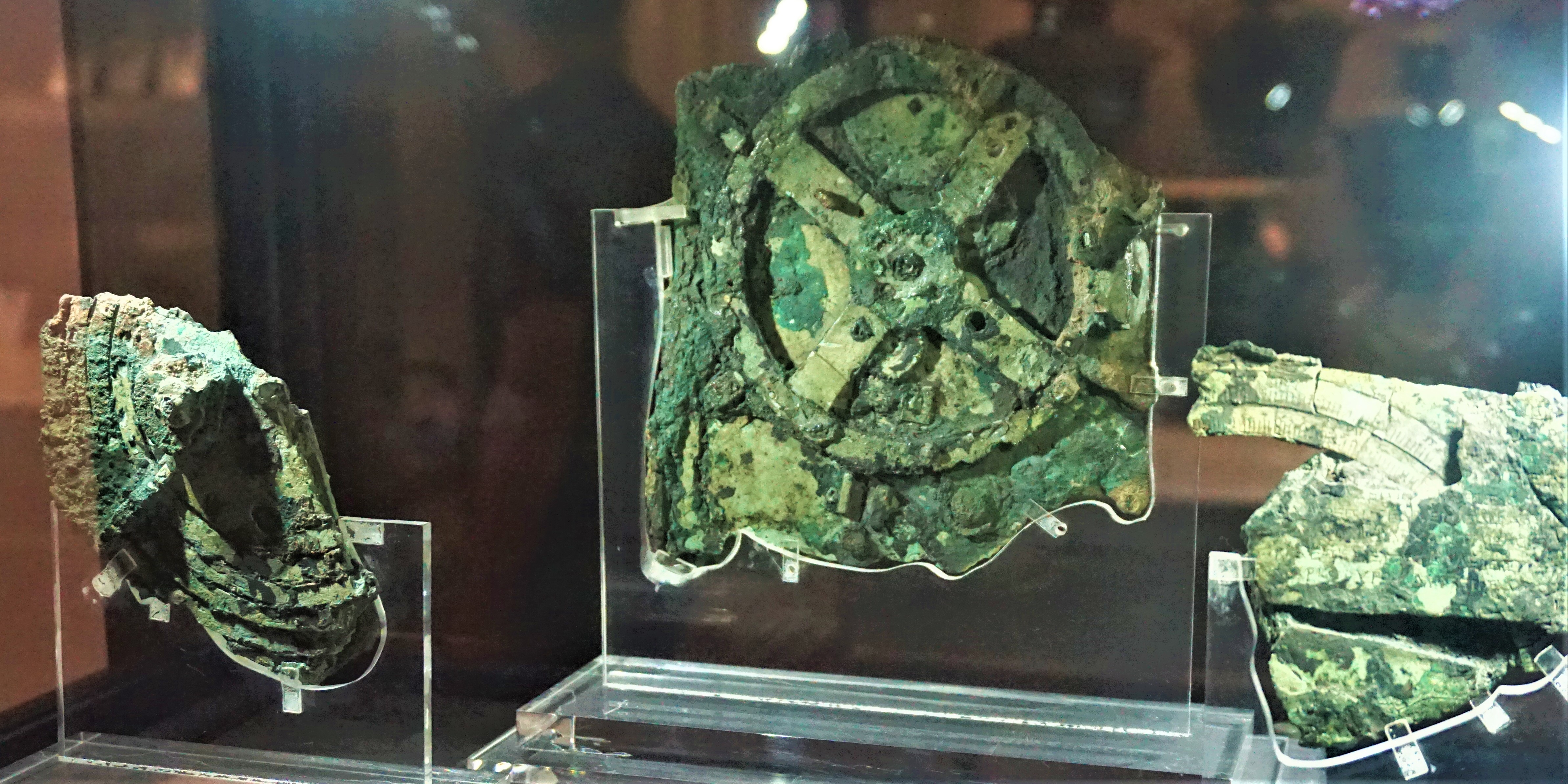
That “Dial of Destiny” is based upon an actual object, however, the so-called “Antikythera mechanism”.

This gadget was found by Greek sponge divers in a shipwreck off the coast of the small Greek island of Antikythera, to the southeast of the island of Kythera, in 1901 (the film mistakenly says 1902—for more on the wreck, see:  https://en.wikipedia.org/wiki/Antikythera_wreck ).

As you can see, it is hardly a working model, having been underwater from the last century, BC, dating coming from coins discovered at the site, and parts appear to be missing.

There is also much discussion about dating the thing itself, anything from c.200BC to not long before the shipwreck (one of the most respected theorists, Derek de Solla Price, maintains, based upon a number of factors, including inscriptions found on it, that it was built about 87BC—if you have access to JSTOR, his extremely detailed and informative article can be found there under “Gears from the Greeks”.)

Taking any suggested model, however–and some seem more fantastic than others–the craftsmanship appears almost supernatural for any mechanical device that complex from the last century—or centuries—BC.   (And you know that, just as in the case of things like the pyramids, there are always those who choose to offer and believe extraterrestrial origins, rather than accept the fact that people from this planet can sometimes make or do extraordinary things.  The evidence that Egyptians built the pyramids is everywhere to be found around them.)

Its actual function/s has/have been the subject of a number of reconstructions, as well as a number of theories, but, currently, the consensus seems to be that it’s a kind of orrery—and type of planetarium– which can be used to do things like predict solar eclipses (for more on this, see the very well informed article here:   https://en.wikipedia.org/wiki/Antikythera_mechanism ) As to its maker, this is a complete question mark.

But not in this film.  Here, it is the work of the 3rd-century BC mathematician/inventor, Archimedes (c.287-c.212BC).  Although the historical dating for the device would probably not match the actual dates of Archimedes, the idea that such a brilliant man might come up with such a thing strikes me as not beyond the realm of belief.  Jones himself mentions Archimedes in discussing the Roman siege of Syracuse in 214-212BC. 

In the film, he mentions Archimedes’ invention of huge “grabbers” to snatch up Roman galleys and drop them, upturned, into the sea,

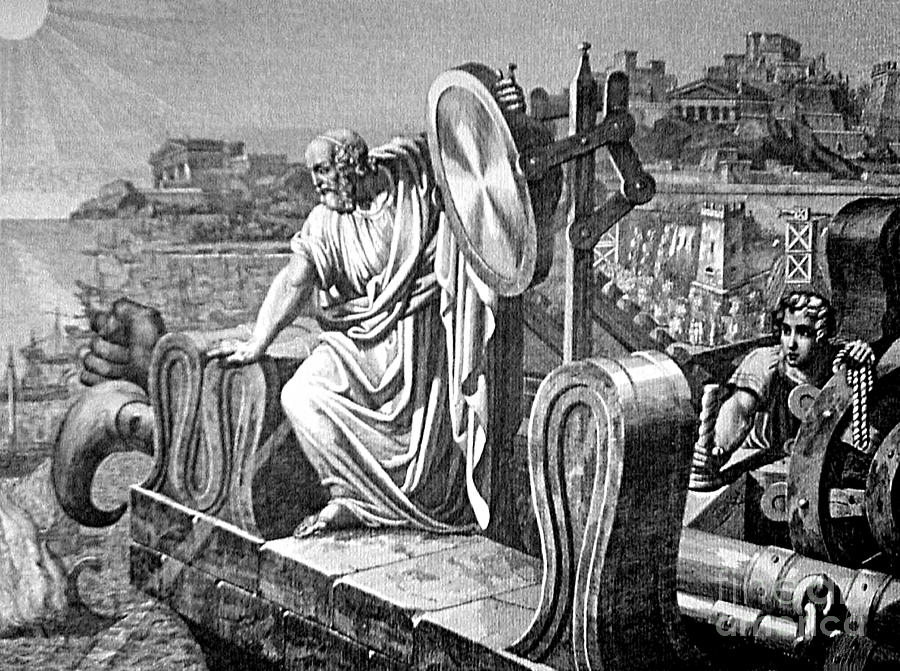
as well as huge mirrors, which would focus the rays of the sun on the Roman ships and set fire to them.

(Would such mirrors actually work?  See:  https://www.realclearscience.com/blog/2021/10/28/did_archimedes_death_ray_actually_work_799152.html#! And:  https://history.howstuffworks.com/historical-figures/archimedes-death-ray.htm For more on Archimedes’ efforts, see:  https://math.nyu.edu/~crorres/Archimedes/Siege/Livy.html  which is from part of Livy’s fragmentary history of Rome; see, as well, Plutarch’s biography of the conqueror of Syracuse, the Roman general, Marcellus (268-208BC), here:  https://classics.mit.edu/Plutarch/marcellu.html ); the story of the mirrors appears for the first time in Dio Cassius’ histories here:  https://math.nyu.edu/~crorres/Archimedes/Siege/DioCassius.html  although, unfortunately, in later Byzantine summaries.) 

From history, however, the film then spills over into the realm of fantasy, as this mechanism, if I understand the plot correctly, can not only chart what are called “weather anomalies”, but also “time anomalies”, which means that, with the right calculations, one might discover the equivalent of cracks in time into which one might slip.  And here I begin to have questions—but we’ll talk about that in Part II.

Thanks for reading, as always.

Stay well,

Always have time—for adventure,

And remember that, as always, there’s

MTCIDC

O

PS

For more on Archimedes, go to:  https://math.nyu.edu/~crorres/Archimedes/contents.html  Archimedes was almost spookily modern and this site shows how.

Glittering

19 Wednesday Jul 2023

Posted by Ollamh in Uncategorized

≈ Leave a comment

As always, welcome, dear readers.

I wonder if you, like me, have seen something like this on a bumper in a parking lot?

Or possibly stuck on the inside of a car’s back window?

If so, and you are a Tolkien reader, you know right away that it’s one line from a poem by Bilbo, first read in a letter Gandalf has left at The Prancing Pony (The Fellowship of the Ring, Book One, Chapter 10, “Strider”) and repeated by Bilbo himself  who, at the council of Elrond, “Standing up suddenly…burst[s] out”:

All that is gold does not glitter,

Not all those who wander are lost;

The old that is strong does not wither,

Deep roots are not reached by the frost.

From the ashes a fire shall be woken,

A light from the shadows shall spring;

Renewed shall be blade that was broken:

The crownless again shall be king.”  (The Fellowship of the Ring, Book Two, Chapter 2, “The Council of Elrond”)

He’s referring to Aragorn, of course, responding both to a dream Boromir has just repeated, as well as to what seems like the beginning of a tussle between Boromir and Aragorn.  In his dream, Boromir “heard a voice, remote but clear, crying:

Seek for the Sword that was broken:

In Imladris it dwells;

There shall be counsels taken

Stronger than Morgul-spells.

There shall be shown a token

That Doom is near at hand,

For Isildur’s Bane shall waken,

And the Halfling forth shall stand.”

The broken blade is Narsil, Elendil’s sword, which broke when, killed by Sauron, he fell on it.  Isildur then used the shard to cut the Ring (which became “Isildur’s Bane”, or curse) from Sauron’s hand and so the Ring and the shattered sword are forever linked.

Bilbo’s poem then acts as a kind of second stanza to Boromir’s dream verses, suggesting that the shattering of the sword is not the end of the story and that its remaking will be involved in the Doom of Boromir’s poem. 

For all the weight in these words, the line which caught my attention this time was:  “All that is gold does not glitter”. 

This is, of course, based upon “all that glitters isn’t gold”, from the proverbial expression, believed to originate in the Parabolae, “Proverbs”, of the 12th century French cleric Alain de Lille, who wrote:

Non teneas aurum totum quod splendet ut aurum
nec pulchrum pomum quodlibet esse bonum;

“Do not take for gold all which shines like gold

Nor a good-looking apple, if you will, to be a good one.” (Liber Parabolarum, 3.1, my translation)

And yet there is something odd here—instead of saying what the proverb warns:  “don’t trust surfaces”, Bilbo is suggesting that “Some things which don’t glitter are gold”, implying that an unlikely surface may hide something worthy and there is more to the rough-looking Aragorn than Boromir—or anyone else in the room who doesn’t know his history—may understand.

It might be thought that Tolkien didn’t like Shakespeare, and this idea comes, I would guess, from this quotation in particular:

“I went to King Edward’s School and spent most of my time learning Latin and Greek; but I also learned English.  Not English Literature!  Except Shakespeare (which I disliked cordially)…”  (letter to W.H. Auden, 7 June, 1955, Letters, 213)

And yet he later records enjoying a performance of Hamlet—and here, I think, we can see that what he might dislike isn’t Shakespeare per se, but reading him as one might read a novel:

“…but the only event worth of talk was the performance of Hamlet which I had been to just before I wrote last.  I was full of it at the time…But it emphasized more strongly than anything I have ever seen the folly of reading Shakespeare (and annotating him in the study), except as a concomitant of seeing his plays acted.” (letter to Christopher Tolkien, 28 July, 1944, Letters, 88)

And I wonder, then, if Bilbo’s line, and his point, weren’t, in fact, influenced by another Shakespeare play.

(The First Quarto, 1600—and here it is for you:  https://internetshakespeare.uvic.ca/doc/MV_Q1/complete/index.html )

As with all of Shakespeare’s plays, there is a complicated plot, but there is one element, as old as the 13th century Gesta Romanorum, “The Deeds of the Romans” (which Shakespeare probably read in the 1577 Certain Selected Histories for Christian Recreations.  You can read the story, Number XLVIII, here:  https://ia600902.us.archive.org/15/items/gestaromanorum02hoopgoog/gestaromanorum02hoopgoog.pdf pages XLIV-XLVII ) which involves a kind of contest for the daughter/heiress of a wealthy man.  Her father has arranged three caskets, one of gold, one of silver, and one of lead, with a riddling, ironic label on each and the suitor who picks the correct one (which has the daughter, Portia’s, portrait inside) gains her hand.  We in the present cynical world would roll our eyes and say, “It’s the lead one, of course!” but Shakespeare’s audience would be as well aware of this as we are.  The point is really about the revelation of character, the choice each of the suitors makes reveals his quality as we overhear each talking to himself before making his decision (and this is one reason why this play was called “The comical Historie of the Merchant of Venice” on the first page of the text, for all that it has its moments of passion and even danger).

The first, Morochus (as he’s called in the First Quarto), chooses the casket of gold because:

“One of these three containes her heauenly picture.

Ist like that leade containes her, twere damnation

to thinke so base a thought, it were too grosse

to ribb her serecloth in the obscure graue,

Or shall I thinke in siluer shees immurd

beeing tenne times vndervalewed to tride gold,

O sinful thought, neuer so rich a Iem

was set in worse then gold.” (Act II, Scene 7—this is a later division of the text, the First Quarto runs straight through)

He’s wrong, of course, but what’s telling is that he can only see the outside of the casket, as he really only sees—and values– the outside of Portia, thus revealing his shallowness.  He opens the casket and finds only this mocking message:

“All that glisters is not gold,

Often haue you heard that told,

Many a man his life hath sold

But my outside to behold,

Guilded timber doe wormes infold:

Had you beene as wise as bold,

Young in limbs, in iudgement old,

Your aunswere had not beene inscrold,

Fareyouwell, your sute is cold.”

The second suitor, the Prince of Arragon, chooses the silver casket, and he, too, fails.  It’s only the third, Bassanio, whom Portia really likes, who makes the correct choice, finding her portrait in the casket of lead and, in his reasoning and choice, we see that he is a far different character from the two previous suitors, as his enclosed poem says:

“You that choose not by the view

Chaunce as faire, and choose as true:

Since this fortune falls to you,

Be content, and seeke no new.

If you be well pleasd with this,

and hold your fortune for your blisse,

Turne you where your Lady is,

And claime her with a louing kis.”

The key here is that first line:  “You that choose not by the view”—and this brings us back to something which Frodo had said of Strider/Aragorn long before:

“ ‘You have frightened me several times tonight, but never in the way that servants of the Enemy would, or so I imagine.  I think one of his spies would—well, seem fairer and feel fouler, if you understand.’

‘I see,’ laughed Strider.  ‘I look foul and feel fair.  Is that it?  All that is gold does not glitter, not all those who wander are lost.’” (The Fellowship of the Ring, Book One, Chapter 10, “Strider”)

For all that JRRT might write, “a murrain on Will Shakespeare and his damned cobwebs”, perhaps, somewhere in those cobwebs, was caught a moment of inspiration?

As ever, thanks for reading,

Stay well,

Choose wisely,

And remember that there’s always

MTCIDC

O

PS

Here’s another bumper sticker which I sometimes feel is true for me—and perhaps for you, as well?

Knowledge, Rule, Order (II): III. Order

12 Wednesday Jul 2023

Posted by Ollamh in Uncategorized

≈ Leave a comment

Welcome, dear readers, as always.

In my last, I continued a brief series based upon my second thoughts (the first appeared as “Knowledge, Rule, Order”, 6 January, 2016 at Doubtfulsea.com) about the words in the title.

The original speaker was Saruman, who uses those three words in his proposal of alliance with Gandalf.

“A new Power is rising…We may join with that Power.  It would be wise, Gandalf.  There is hope that way…As the Power grows, its proved friends will also grow; and the Wise, such as you and I, may with patience come at last to direct its courses, to control it.  We can bide our time…deploring maybe evils done by the way, but approving the high and ultimate purpose:  Knowledge, Rule, Order. All the things that we have so far striven in vain to accomplish…There need not be, there would not be, any real change in our designs, only in our means.”  (The Fellowship of the Rings, Book Two, Chapter 2, “The Council of Elrond”)

Although Gandalf immediately dismisses Saruman’s attempt, saying “I have heard speeches of this kind before, but only in the mouths of emissaries sent from Mordor to deceive the ignorant…” , in the previous two postings of this little series, I’ve spent some time considering the first two of his three words, “Knowledge” and “Rule”, which Saruman has claimed as one of “the things we have so far striven in vain to accomplish”. 

It’s easy to see why Gandalf would have been so quick to reply in the negative:   the five Istari, the five “wizards”, were originally sent to Middle-earth by the Valar as a kind of counterbalance to Sauron.  As far as I understand their mission, that was their goal, with no mention of “the high and ultimate purpose:  Knowledge, Rule, Order”, so Saruman’s words would have immediately sounded false—and not even his own, which Gandalf recognizes, saying of Saruman:

“He drew himself up then and began to declaim, as if he were making a speech long rehearsed.”  (The Fellowship of the Ring, Book Two, Chapter 2, “The Council of Elrond”)

In the last two postings, then, I suggested that

1. what Saruman believed was his abstract “Knowledge” had actually become Sauron’s knowledge—as, when Saruman came into possession of Isengard and its palantir,

(the Hildebrandts)

he had come under the spell of Sauron, and thus had become nothing more than Sauron’s servant.

2. under Sauron’s control, Saruman had changed Isengard:

“A strong place and wonderful was Isengard…But Saruman had slowly shaped it to his shifting purposes, and made it better, as he thought, being deceived—for all those arts and subtle devices, for which he forsook his former wisdom, and which he fondly imagined were his own, came but from Mordor; so that what he made was naught, only a little copy, a child’s model or a slave’s flattery, of that vast fortress, armoury, prison, furnace of great power, Barad-dur, the Dark Tower…”  (The Two Towers, Book Three,  

And thus, the “rule” Saruman believed was his was only in actuality nothing more than an imitation of his master’s kingdom and his master’s control—deceived, Saruman was not the ruler, but the ruled.

And now we come to “Order”. 

And here I must differ a little from something which both Frodo and Saruman have to say.

In the next-to-last chapter of The Return of the King, ”The Scouring of the Shire”, Sam says of the Shire to which he and the other hobbits have returned, “This is worse than Mordor!”  To which Frodo replies:

“Yes, this is Mordor…Just one of its works.  Saruman was doing its work all the time, even when he thought that he was working for himself.  And the same with those that Saruman tricked, like Lotho.”  (The Return of the King, Book Six, Chapter 8, “The Scouring of the Shire”)

As I’ve mentioned above, Saruman was certainly not his own man—or wizard—although he clearly believed that he was, but I think that there’s something more going on here—and it’s not just what Saruman says subsequently to Frodo:

“ ‘…if they’re [meaning the hobbits] such fools, I will get ahead of them and teach them a lesson.  One ill turn deserves another…’ It would have been a sharper lesson, if only you had given me a little more time and more Men.  Still I have already done much that you will find it hard to mend or undo in your lives.  And it will be pleasant to think of that and set it against my injuries.”

This would suggest that what’s happened to the Shire has been a kind of spur of the moment vengeance, but I think that, contrary to what Saruman says, there has been more going on here—and for longer and, in fact, the mention of Lotho gives us a clue.

In a much earlier chapter of The Lord of the Rings, Merry and Pippin have been explaining events at Isengard to Aragorn and their friends

(Michael Herring)

and have mentioned Pipe-weed, to which Aragorn has replied:

“ ‘…leaf from the Southfarthing in Isengard.  The more I consider it, the more curious I find it. I have never been in Isengard, but I have journeyed in this land, and I know well the empty countries that lie between Rohan and the Shire.  Neither goods nor folk have passed this way for many a long year, not openly.  Saruman had secret dealings with someone in the Shire, I guess.  Wormtongues may be found in other houses than King Theoden’s.  Was there a date on the barrel?’

‘Yes,’ said Pippin.  ‘It was the 1417 crop, that is last year’s; no, the year before, of course, now:  a good year.’ “  (The Two Towers, Book Three, Chapter 9, “Flotsam and Jetsam”)

It we combine this with Farmer Cotton’s explanation of the change in the Shire, we see just who that “Wormtongue” must have been:

“It all began with Pimple, as we call him…He’d funny ideas, had Pimple.  Seems he wanted to own everything himself, and then order other folk about.  It soon came out that he already did own a sight more than was good for him; and he was always grabbing more, though where he got the money was a mystery:  mills and malt-houses and inns, and farms, and leaf-plantations…

Of course he started with a lot of property in the Southfarthing which he had from his dad; and it seems he’d been selling a lot of the best leaf, and sending it away quietly for a year or two.  But at the end o’ last year he began sending away loads of stuff, not only leaf.  Things began to get short, and winter coming on, too.  Folk got angry, but he had his answer.  A lot of Men, ruffians mostly, came with great waggons, some to carry off the goods south-away, and others to stay.  And more came.  And before we knew where we were they were planted here and there all over the Shire, and were felling trees and digging and building themselves sheds and houses just as they liked…” 

Those shipments had clearly been going to Isengard and had been doing so for at least the last two years, as we can see from the combination of the date on the pipe-weed barrel and from Farmer Cotton’s words.  Thus, we can see that there’s a chain here:

1. Saruman has picked the weak, but arrogant Lotho Sackville-Baggins to be his agent

2. he has then used him first to siphon goods out of the Shire (and now we might see, along with his slave farms, how Saruman’s army could have been supplied) and, then, by providing Lotho with “muscle”, he has overturned the Shire’s simple government (including putting the Mayor, Will Whitfoot, in the Lockholes) and installing Lotho in his place as “the Chief”

All of this would have been happening before Saruman’s fall, suggesting that, in fact, what he was doing to the Shire was not just spiteful revenge after the fact, as he says, but another plan altogether, and here’s where, I think, “Order” comes in.

Sauron’s Mordor was, basically, a military state based upon slavery with Sauron as lord, emperor, master, whatever title he chose to assume.   Saruman, in imitating Sauron, would have thought of himself in similar terms and his Isengard, then, would have been the same sort of state.  What happens in the Shire strikes me as something somewhat different, however.

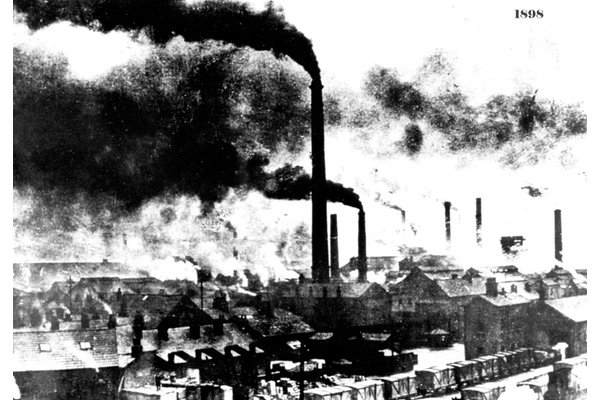
Certain aspects are similar:  as Saruman has industrialized Isengard, he was in the process of industrializing the Shire, as the hobbits soon see:

“And looking with dismay up the road towards Bag End they saw a tall chimney of brick in the distance.  It was pouring out black smoke into the evening air.”

(Alan Lee)

And hear about from Farmer Cotton:

“Take Sandyman’s mill now.  Pimple knocked it down almost as soon as he came to Bag End.  Then he brought in a lot o’ dirty-looking Men to build a bigger one and fill it full o’ wheels and outlandish contraptions.” 

But this is only the beginning:

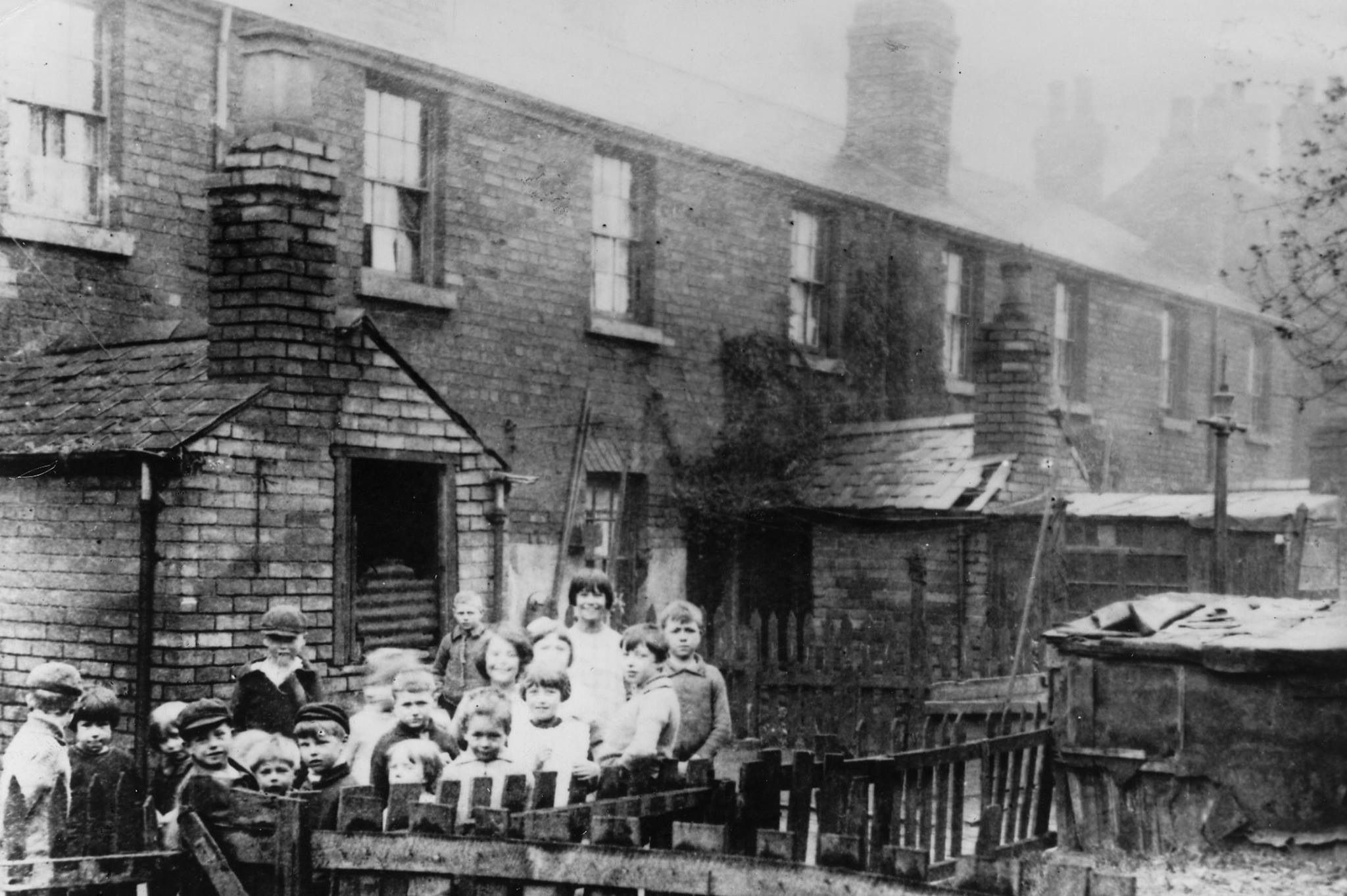
“The pleasant row of old hobbit-holes in the bank on the north side of the Pool were deserted, and their little gardens that used to run down bright to the water’s edge were rank with weeds.  Worse, there was a whole line of ugly new houses all along Pool Side, where the Hobbiton Road ran close to the bank.”

On the one hand, what Tolkien is recreating is the poorer areas of industrial Birmingham, where he grew up in the late-Victorian/Edwardian world,

but, on the other, he’s showing us what Saruman has been up to:  turning the Shire into a kind of communist state with:

1. an unelected leader, Lotho/Pimple (“And after that, it would be soon after New Year, there wasn’t no more Mayor, and Pimple called himself Chief Shirriff, or just chief, and did as he liked…” )

2. the equivalent of the NKVD (“A lot of Men, ruffians mostly, came with great waggons…and others to stay…”

3. local collaborators (Robin Smallburrow tells Sam:  “There’s hundreds of Shirriffs all told, and they want more, with all these new rules.  Most of them are in it against their will, but not all.  Even in the Shire there are some as like minding other folk’s business and talking big.”)

4. a spy service (Robin continues:  “And there’s worse than that:  there’s a few as do spy-work for the Chief and his Men.”)

5. the equivalent of concentration camps/gulags (Farmer Cotton describes them:  “And then there’s the Lockholes, as they call ‘em:  the old storage-tunnels at Michel Delving that they’ve made into prisons for those as stand up to them.”)

6. a long set of often seemingly arbitrary rules, mostly designed to keep hobbits from assembling, as in

  a. the closing of all the pubs

  b. the requirement of an internal travel document (Robin again:  “And he [Lotho] doesn’t hold with folk moving about; so if they will or they must, then they has to go to the Shirriff-house and explain their business.”)

7. the aggressive seizing of all supplies in the manner of communist states (Farmer Cotton says:  “…and everything except Rules got shorter and shorter, unless one could hide a bit of one’s own when the ruffians went round gathering stuff up ‘for fair distribution’…”

8. the reducing of the population to conformist workers—hence destroying the old dwellings and putting up rows of new houses—which would also make it easier to keep an eye on the population, forcing them into government accommodations

So far, then, this would appear to be a long-term, thought-out plan by Saruman to create not another Mordor, but a modern industrial state along Russian lines—but then something goes wrong—and we know what it is:  the failure of Saruman’s schemes, both in the defeat of his army at Helm’s Deep and the destruction of his little model state at Isengard by the Ents,

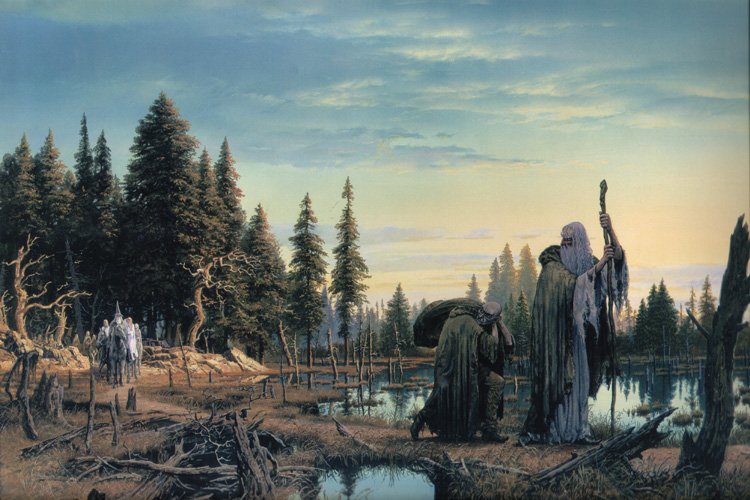
(Ted Nasmith)

forcing him to take to the road with his only remaining slave, Grima.

(another Nasmith—and you can see why I so value his work—he can choose scenes that no other artist seems even to have considered)

Denied Knowledge, unable to maintain Rule, Saruman, arriving in the Shire, abandons Order, turning his thugs loose to do exactly what he says to Frodo about a “sharper lesson”, as Farmer Cotton describes it:

“The biggest ruffian o’ the lot, seemingly…It was about last harvest, end o’ September maybe, that we first heard of him.  We’ve never seen him, but he’s up at Bag End, and he’s the real Chief now, I guess.  All the ruffians do what he says, and what he says is mostly:  hack, burn, and ruin; and now it’s come to killing.  There’s no longer even any bad sense in it.  They cut down trees and let ‘em lie, they burn houses and build no more…It they want to make the Shire into a desert, they’re going the right way about it.”

As a spoiler, Saruman is temporarily successful, but loses first his “high and ultimate purpose” and then his life, when one of those he has corrupted in his quest for it, is kicked once too often and—

(Joan Wyatt)

As ever, thanks for reading.

Stay well,

Sic semper tyrannis,

And know that, as always, there’s

MTCIDC

O
Knowledge, Rule, Order (II): II. Rule

05 Wednesday Jul 2023

Posted by Ollamh in Uncategorized

≈ Leave a comment

As ever, dear readers, welcome.

In my last, I began a brief series based upon my second thoughts (the first appeared as “Knowledge, Rule, Order”, 6 January, 2016 at Doubtfulsea.com) about the words in the title.

The original speaker was Saruman, who uses those three words in his proposal of alliance with Gandalf.

“A new Power is rising…We may join with that Power.  It would be wise, Gandalf.  There is hope that way…As the Power grows, its proved friends will also grow; and the Wise, such as you and I, may with patience come at last to direct its courses, to control it.  We can bide our time…deploring maybe evils done by the way, but approving the high and ultimate purpose:  Knowledge, Rule, Order. All the things that we have so far striven in vain to accomplish…There need not be, there would not be, any real change in our designs, only in our means.”  (The Fellowship of the Rings, Book Two, Chapter 2, “The Council of Elrond”)

Gandalf immediately dismisses Saruman’s attempt, saying “I have heard speeches of this kind before, but only in the mouths of emissaries sent from Mordor to deceive the ignorant…”  but, in the first of this little series, I spent some time considering the first of his three words, “Knowledge”, which Saruman has claimed as one of “the things we have so far striven in vain to accomplish”. 

We know that the five Istari, the five “wizards”, were originally sent to Middle-earth by the Valar as a kind of counterbalance to Sauron.  As far as I understand their mission, that was their goal, with no mention of “the high and ultimate purpose:  Knowledge, Rule, Order”.  In last week’s posting, I suggested that what Saruman believed was that that abstract “Knowledge” had actually become Saruman’s knowledge—a knowledge he meant to employ not just to counter Sauron, but to become Sauron, wielding the rediscovered Ring as the new master of Middle-earth.  Ironically, however, through a combination of his own growing arrogance and by Sauron’s clever manipulation of it, by means of the palantir which had come into Saruman’s possession,

Saruman’s knowledge had become Sauron’s knowledge and Saruman only a deluded henchman of the creature he had been sent to oppose.

But what about “Rule”?

It’s important to remember that Tolkien was born into a world where almost all of the major—and most of the minor—European powers were controlled by monarchies.  In 1914, just before war broke out, not only was the British Empire in the hands of George V,

but his cousin, Wilhelm, ruled the German Empire,

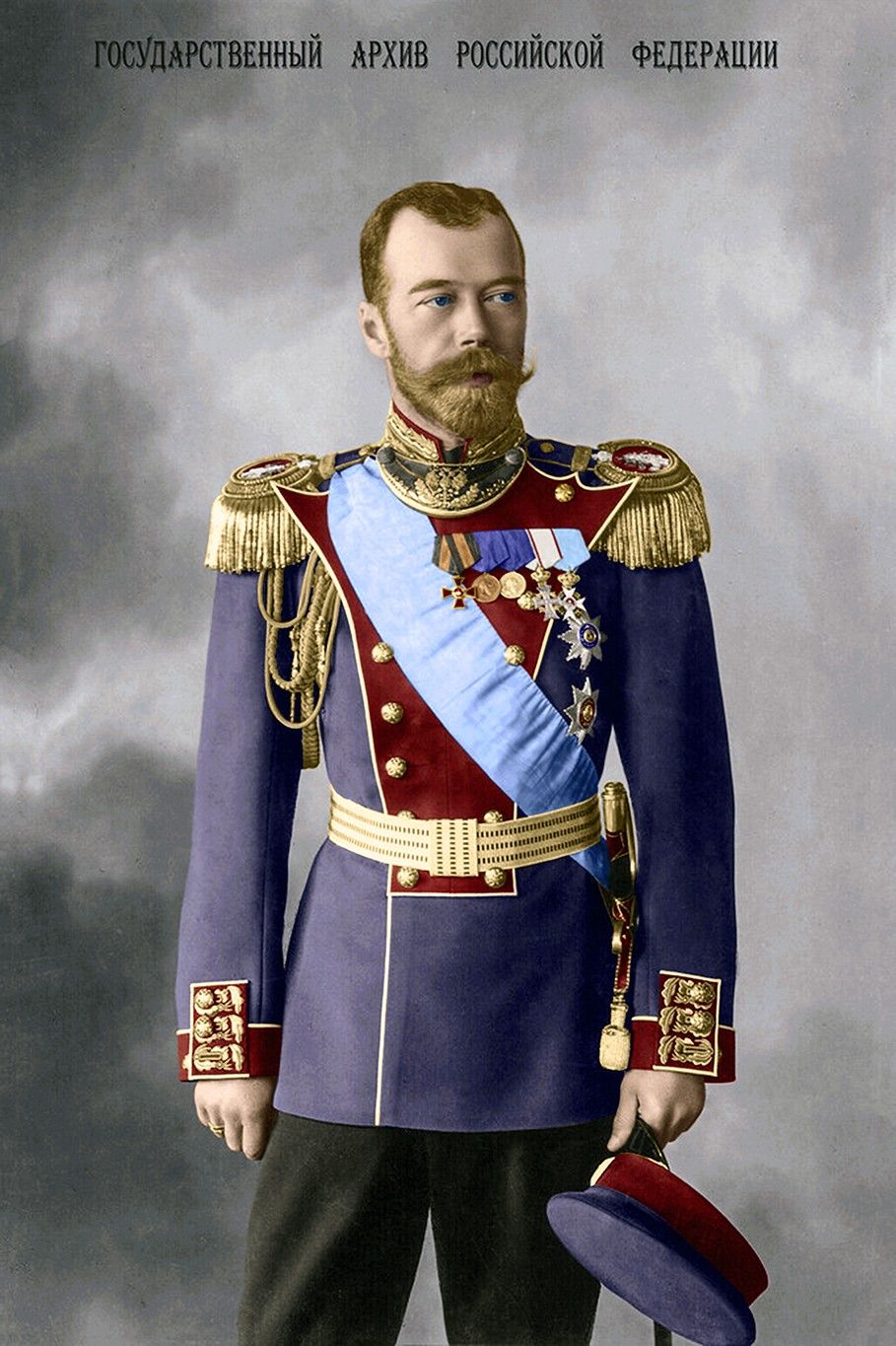
and another cousin, Nicholas, ruled the Russian Empire.

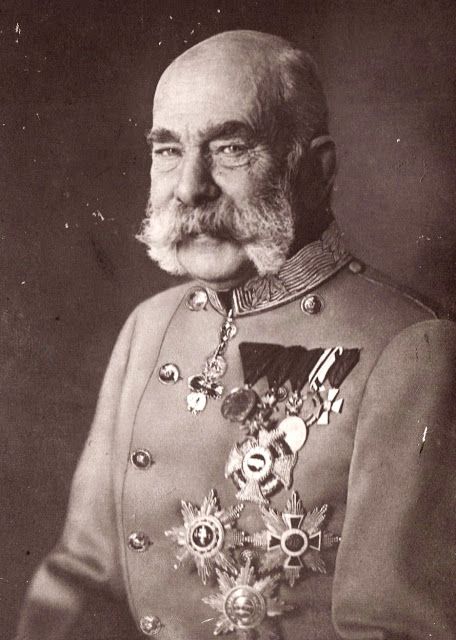
And this is to name only what we might call “the big three”—to which we should add the Emperor of Austria-Hungary, Franz Josef.

There were also monarchs from Norway

to Belgium

to Italy

to Spain,

with rulers in Greece

and many other smaller countries, like Serbia

and Bulgaria.

This is not all of such folk (the Netherlands had a queen, for example), but we might also include the Turkish sultan, Mehmed V.

Of all the European countries, only Switzerland and France were democracies, in fact.  That being the case, when JRRT used the word “Rule”, we can easily imagine what must have come to mind.  (And yet we should also keep in mind what he once wrote to his son, Christopher:  “My political opinions lean more and more to Anarchy”—although he goes on to add “or to ‘unconstitutional Monarchy…Give me a king whose chief interest in life is stamps, railways, or race-horses…”, all of which suggests that he had come, at least by the 1940s, to have serious doubts about royal rule.  See letter to Christopher Tolkien, 29 November, 1943, Letters, 63-64)

For Saruman, there were three models readily to hand:  Rohan, Gondor, and Mordor.  As for Rohan, he doesn’t appear to have much respect, saying,

“What is the house of Eorl but a thatched barn where brigands drink in the reek, and their brats roll on the floor among the dogs?”  (The Two Towers, Book Three, Chapter 10, “The Voice of Saruman”)

It would appear that he has no more respect for Gondor, as he refers to it, in his attempt to enlist Gandalf, as “dying Numenor”.

And this leaves us with Mordor and it’s clear that this has become Saruman’s model, albeit not quite the impressive alternate version he believes it to be.   As the narrator says of Isengard:

“A strong place and wonderful was Isengard…But Saruman had slowly shaped it to his shifting purposes, and made it better, as he thought, being deceived—for all those arts and subtle devices, for which he forsook his former wisdom, and which he fondly imagined were his own, came but from Mordor; so that what he made was naught, only a little copy, a child’s model or a slave’s flattery, of that vast fortress, armoury, prison, furnace of great power, Barad-dur, the Dark Tower…”  (The Two Towers, Book Three, Chapter 8, “The Road to Isengard”)

As well, Saruman imitates Mordor’s economy, which is slave-based, as the narrator tells us of Sam and his master:

“Neither he nor Frodo knew anything of the great slave-worked fields away south in this wide realm, beynd the fumes of the Mountain by the dark sad waters of Lake Nurnen; nor of the great roads that ran away east and south to tributary lands, from the which the soldiers of the Tower brought long wagon-trains of goods and booty and fresh slaves.”  (The Return of the King, Book Six, Chapter 2, “The Land of Shadow”)

And the narrator says of Isengard:

“That was a sheltered valley, open only to the South.  Once it had been fair and green…It was not so now.  Beneath the walls of Isengard there still were acres tilled by the slaves of Saruman…”  (The Two Towers, Book Three, Chapter 8, “The Road to Isengard”)

Kings in fairy tales sometimes have chancellors or viziers and perhaps faceless servants to fetch and carry, but real medieval kings could have full bureaucracies, with officials of all sorts and clerks and messengers to keep records and maintain contact with royal officials working away from the palace.

Unfortunately, we seem to lack much information about the court structure of Mordor.   At its center is Sauron, directing things from the Barad-dur, which he doesn’t appear to leave, employing the Nazgul as senior officers (who, after all, themselves had once been kings),

(Artist?)

as well as a Lieutenant of the Tower, who also acts as a kind of public interpreter or chancellor of some sort, “the Mouth of Sauron”,

(Douglas Beekman)

but, as for more structure, this looks like an interesting subject for further research and a future posting—or perhaps two.

Although Saruman has spies (Grima immediately springs to mind, although he has others),

(Alan Lee)

and a good-sized army of orcs and men (Merry thinks that “there must have been ten thousand at the very least”—The Two Towers, Book Three, Chapter 9, “Flotsam and Jetsam”), he doesn’t appear to have the equivalent of the Nazgul or the Mouth, directing everything himself (which, considering his arrogance, shouldn’t surprise us), being more like a fairy tale king than the head of 10,000 soldiers and what might be a fairly advanced technological infrastructure below the ground in Isengard (ten thousand soldiers need arms and armor, as well as durable rations, after all)—and all a pale copy of Sauron.

(the Hildebrandts)

So now we see just how unreal Saruman’s expectations have become:  his “Knowledge” is at the disposal of a being Saruman isn’t aware controls him, and his “Rule” is nothing more than a petty version of the world of that controller.  What will his “Order” be?

As ever, thanks for reading.

Stay well,

Practice aggressive self-awareness (or don’t get involved with devious Maiar),

And remember that, as always, there’s

MTCIDC

O
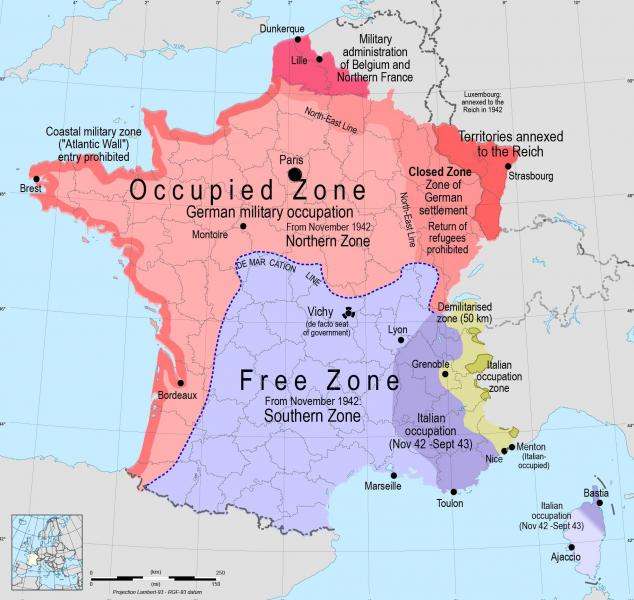
Knowledge, Rule, Order (II): I.Knowledge

28 Wednesday Jun 2023

Posted by Ollamh in Uncategorized

≈ Leave a comment

Welcome, as ever, dear readers.

Years ago, CD (the forerunner to the present creator of this blog), uploaded a posting with the same title, (see “Knowledge, Rule, Order”, 6 January, 2016 at Doubtfulsea.com), but in the intervening seven years, I’ve continued to wonder about just what those three words might mean, both consciously and unconsciously, for the original speaker of them:  are they simply abstract?  Or might they possibly mean something different from what that speaker intended?

That original speaker was Saruman, who uses those three terms in his more than a little slippery attempt to persuade Gandalf into helping him to replace Sauron.

“A new Power is rising…We may join with that Power.  It would be wise, Gandalf.  There is hope that way…As the Power grows, its proved friends will also grow; and the Wise, such as you and I, may with patience come at last to direct its courses, to control it.  We can bide our time…deploring maybe evils done by the way, but approving the high and ultimate purpose:  Knowledge, Rule, Order. All the things that we have so far striven in vain to accomplish…There need not be, there would not be, any real change in our designs, only in our means.”  (The Fellowship of the Rings, Book Two, Chapter 2, “The Council of Elrond”)

Gandalf will have none of this:

“Saruman…I have heard speeches of this kind before, but only in the mouths of emissaries sent from Mordor to deceive the ignorant.” 

For me, this is one of the most revealing speeches in The Lord of the Rings, not only for how thoroughly it shows us the corrupted Saruman, but also for how it reflects the period when Tolkien began to write the novel, when such grand, but intentionally vague, themes or some very much like them, were in the air.

(“Work, Freedom, Bread”—for the National Socialist Party in 1928)

When Hitler became head of the German state in 1933,

he had learned from experience that open attempts to seize power were iffy at best, his first try, in 1923, ending in failure and an all-too-brief time in prison for him.

Subsequently, he turned to becoming a statesman, using such themes as “rebuilding Germany” to cover his real purposes. 

Violence was never ruled out, as we know too well, but politicking and political pressure appeared to gain him more, spawning followers and friends all over the world, as well as imitators, like the British Sir Oswald Mosley,

mocked by the comic novelist, P.G. Wodehouse (1881-1975) as Roderick Spode,

and once described by one of Wodehouse’s characters as “the amateur dictator”.  Such people had definitely heard “speeches…in the mouths of emissaries sent from Mordor to deceive the ignorant” but, unlike Gandalf, had believed them and worked towards their fulfillment. 

I want to begin with that first “high and ultimate purpose”:  “Knowledge”.

As is well-known, Saruman’s name suggests that he was, in fact, formed to be knowing:  Old English searu, upon which the name is based, means “skill/craft/cleverness”  + mann, “man”, so “man of craft”.

But what is this “Knowledge” which Saruman claims has been a major goal of the Istari, the Maiar sent to Middle-earth? 

Saruman himself doesn’t clarify what he means by this, which is, in this context, not surprising, but Gandalf tells us something about his past:

“…Saruman has long studied the arts of the Enemy himself, and thus we have often been able to forestall him.  It was by the devices of Saruman that we drove him from Dol Guldur.” 

We might also understand that he has been collecting information about Middle-earth itself, knowledge which he gathers from folk like Treebeard:

“I used to talk to him.  There was a time when he was always walking about my woods.  He was polite in those days, always asking my leave (at least when he met me); and always eager to listen.  I told him many things that he would never have found out by himself…”

We can imagine, then, that all of Saruman’s knowledge once had been for the task for which he and the other Istari have been sent to Middle-earth:  to protect it and its peoples from Sauron.

Old English searu has another meaning, however:  “plot/trick/deceit”, so searumann potentially means not only “man of craft”, but also “man of deceit”.  And something which Treebeard adds suggests that Saruman’s knowledge-gathering had, at some point, taken a different turn:

“…but he never repaid me in like kind.  I cannot remember that he ever told me anything.  And he got more and more like that; his face, as I remember it—I have not seen it for many a day—became like windows in a stone wall:  windows with shutters inside.”  (The Two Towers, Book Three, Chapter 4, “Treebeard”)

This simile of a stone wall might remind us of something which Treebeard said just prior to this:

“He gave up wandering about and minding the affairs of Men and Elves, some time ago—you would call it a very long time ago, and he settled down at Angrenost, or Isengard as the Men of Rohan call it.”

(the Hildebrandts)

Of the five Istari,

(? I haven’t found the artist for this useful illustration.)

two disappeared to the south, leaving us with almost no information about them.  The other three, Saruman, Gandalf, and Radagast, must initially have been wanderers across the north of Middle-earth, perhaps acting like the Rangers, as patrolling protectors.

It’s revealing, then, that Treebeard expresses that occupation of Isengard as giving up “wandering about and minding the affairs of Men and Elves” as those appear to have been the very things the Valar had sent him to Middle-earth to do and which suggests that, by the time he took charge of Isengard, about 250 years before the present story, Saruman was already on his way to the corruption so evident in his appeal to Gandalf. 

We don’t really know when the moral rot first set in, but we can certainly understand what pushed it along:  the “Orthanc-stone”, one of the palantiri, the so-called “seeing-stones”, of which one was established at Isengard and came into the hands of Saruman, much to his ruin.

(a second Hildebrandts)

The stone provided a direct connection to Sauron, and so, if nothing else, this must have sped that corruption.  We have only to hear Sauron’s direction to Pippin, however:

“Tell Saruman that this dainty is not for him.  I will send for it at once.  Do you understand?  Say just that!” (The Two Towers, Book Three, Chapter 11, “The Palantir”)

to understand that, if Saruman believes, as he assures Gandalf, that they—really he—can control Sauron, he is completely deceived.  Sauron is so much the master that he doesn’t even bother dealing with Saruman directly, ordering someone he clearly believes to be a nonentity to pass a message on.

In this way we see that Saruman’s learning the ways of the Enemy has brought him too close to that very enemy, allowing the enemy to gain a knowledge of which Saruman appears to be completely unaware:  a knowledge of Saruman’s own weakness—vanity, which makes him believe that only he is a “man of craft”—or, as he puts it, “the Wise”—and powerful enough to deal with Sauron.  Even so, he needs help, and here we see where his quest for knowledge has ultimately taken him:

“Why not?  The Ruling Ring?  If we could command that, then the Power would pass to us.  That is why I brought you here.  For I have many eyes in my service, and I believe that you know where this precious thing now lies.  Or why do the Nine ask for the Shire, and what is your business there?”

From being, as Gandalf has said, “the greatest of my order”, who had gathered great learning for the goal of countering the evil which has come into Middle-earth, he is now one who, swollen with arrogance, believes that he can use his knowledge not for the good for which he had originally employed it, but as a tool to help him to replace one form of evil with another, all the while never realizing that he has become no more than a tool himself. 

As ever, thanks for reading.

Stay well,

Don’t just do no evil, but, as Gandalf would encourage us, do positive good,

And know that, as always, there’s

MTCIDC

O

← Older posts
Newer posts →

The Doubtful Sea Series Facebook Page

The Doubtful Sea Series Facebook Page

  • Ollamh

Categories

  • Artists and Illustrators
  • Economics in Middle-earth
  • Fairy Tales and Myths
  • Films and Music
  • Games
  • Heroes
  • Imaginary History
  • J.R.R. Tolkien
  • Language
  • Literary History
  • Maps
  • Medieval Russia
  • Military History
  • Military History of Middle-earth
  • Narnia
  • Narrative Methods
  • Poetry
  • Research
  • Star Wars
  • Terra Australis
  • The Rohirrim
  • Theatre and Performance
  • Tolkien
  • Uncategorized
  • Villains
  • Writing as Collaborators
Follow doubtfulsea on WordPress.com

Across the Doubtful Sea

Recent Postings

  • The Damage of Dragons March 11, 2026
  • Encouragement March 4, 2026
  • Eavesdropping February 25, 2026
  • Do You Speak Villain? (Part 3) February 18, 2026
  • Do You Speak Villain? (2) February 11, 2026
  • Do You Speak Villain? (Part 1) February 4, 2026
  • Towering January 28, 2026
  • Tolkien Among the Indians January 21, 2026
  • Thin and Stretched January 14, 2026

Blog Statistics

  • 108,999 Views

Posting Archive

  • March 2026 (2)
  • February 2026 (4)
  • January 2026 (4)
  • December 2025 (5)
  • November 2025 (4)
  • October 2025 (5)
  • September 2025 (4)
  • August 2025 (4)
  • July 2025 (5)
  • June 2025 (4)
  • May 2025 (4)
  • April 2025 (5)
  • March 2025 (4)
  • February 2025 (4)
  • January 2025 (5)
  • December 2024 (4)
  • November 2024 (4)
  • October 2024 (5)
  • September 2024 (4)
  • August 2024 (4)
  • July 2024 (5)
  • June 2024 (4)
  • May 2024 (5)
  • April 2024 (4)
  • March 2024 (4)
  • February 2024 (4)
  • January 2024 (5)
  • December 2023 (4)
  • November 2023 (5)
  • October 2023 (4)
  • September 2023 (4)
  • August 2023 (5)
  • July 2023 (4)
  • June 2023 (4)
  • May 2023 (5)
  • April 2023 (4)
  • March 2023 (5)
  • February 2023 (4)
  • January 2023 (4)
  • December 2022 (4)
  • November 2022 (5)
  • October 2022 (4)
  • September 2022 (4)
  • August 2022 (5)
  • July 2022 (4)
  • June 2022 (5)
  • May 2022 (4)
  • April 2022 (4)
  • March 2022 (5)
  • February 2022 (4)
  • January 2022 (4)
  • December 2021 (5)
  • November 2021 (4)
  • October 2021 (4)
  • September 2021 (5)
  • August 2021 (4)
  • July 2021 (4)
  • June 2021 (5)
  • May 2021 (4)
  • April 2021 (4)
  • March 2021 (5)
  • February 2021 (4)
  • January 2021 (4)
  • December 2020 (5)
  • November 2020 (4)
  • October 2020 (4)
  • September 2020 (5)
  • August 2020 (4)
  • July 2020 (5)
  • June 2020 (4)
  • May 2020 (4)
  • April 2020 (5)
  • March 2020 (4)
  • February 2020 (4)
  • January 2020 (6)
  • December 2019 (4)
  • November 2019 (4)
  • October 2019 (5)
  • September 2019 (4)
  • August 2019 (4)
  • July 2019 (5)
  • June 2019 (4)
  • May 2019 (5)
  • April 2019 (4)
  • March 2019 (4)
  • February 2019 (4)
  • January 2019 (5)
  • December 2018 (4)
  • November 2018 (4)
  • October 2018 (5)
  • September 2018 (4)
  • August 2018 (5)
  • July 2018 (4)
  • June 2018 (4)
  • May 2018 (5)
  • April 2018 (4)
  • March 2018 (4)
  • February 2018 (4)
  • January 2018 (5)
  • December 2017 (4)
  • November 2017 (4)
  • October 2017 (4)
  • September 2017 (4)
  • August 2017 (5)
  • July 2017 (4)
  • June 2017 (4)
  • May 2017 (5)
  • April 2017 (4)
  • March 2017 (5)
  • February 2017 (4)
  • January 2017 (4)
  • December 2016 (4)
  • November 2016 (5)
  • October 2016 (6)
  • September 2016 (5)
  • August 2016 (5)
  • July 2016 (5)
  • June 2016 (5)
  • May 2016 (4)
  • April 2016 (4)
  • March 2016 (5)
  • February 2016 (4)
  • January 2016 (4)
  • December 2015 (5)
  • November 2015 (5)
  • October 2015 (4)
  • September 2015 (5)
  • August 2015 (4)
  • July 2015 (5)
  • June 2015 (5)
  • May 2015 (4)
  • April 2015 (3)
  • March 2015 (4)
  • February 2015 (4)
  • January 2015 (4)
  • December 2014 (5)
  • November 2014 (4)
  • October 2014 (6)
  • September 2014 (1)

Blog at WordPress.com.

  • Subscribe Subscribed
    • doubtfulsea
    • Join 78 other subscribers
    • Already have a WordPress.com account? Log in now.
    • doubtfulsea
    • Subscribe Subscribed
    • Sign up
    • Log in
    • Report this content
    • View site in Reader
    • Manage subscriptions
    • Collapse this bar
 

Loading Comments...