• About

doubtfulsea

~ adventure fantasy

Author Archives: Ollamh

Riddles in the (Not So) Dark

11 Wednesday May 2022

Posted by Ollamh in Uncategorized

≈ Leave a comment

As ever, dear readers, welcome.

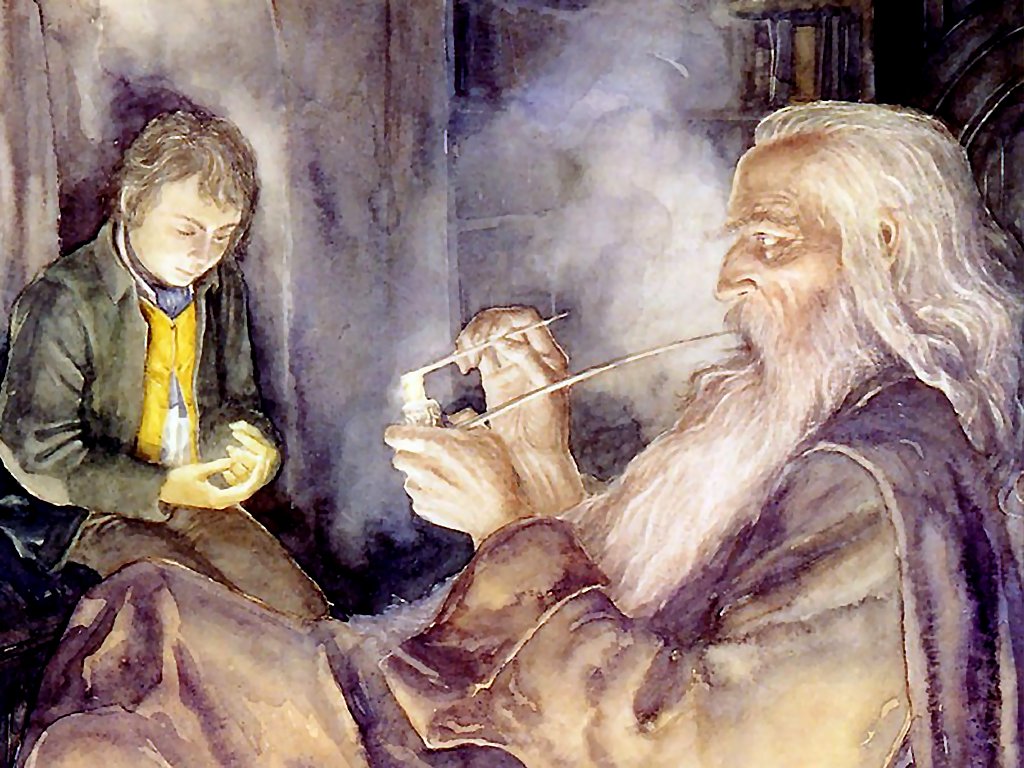
We all know just how perilous that Ring of Power is—

Gandalf

won’t take it:

“Do not tempt me!  For I do not wish to become like the Dark Lord himself…Do not tempt me!  I dare not take it, not even to keep it safe, unused.”  (The Fellowship of the Ring, Book One, Chapter 2, “The Shadow of the Past”)

Galadriel,

offered it, like Gandalf, is aware of its seductive strength, regretfully declines it–

“I pass the test…I will diminish, and go into the West, and remain Galadriel.”  (The Fellowship of the Ring, Book Two, Chapter 7, “The Mirror of Galadriel”)

Faramir,

who only has a dim understanding of it, won’t touch it:

“Not if I found it on the highway would I take it I said.  Even if I were such a man as to desire this thing, and even though I knew not clearly what this thing was when I spoke, still I should take those words as a vow, and be held by them.”  (The Two Towers, Book Four, Chapter 5, “The Window on the West”)

There are others, however, with a different view—and it corrupts them:

“ ‘And why not, Gandalf?’ he whispered. ‘Why not?  The Ruling Ring?  If we could command that, then the Power would pass to us.”  (The Fellowship of the Ring, Book Two, Chapter 2, “The Council of Elrond”)

And that power has its effect, as well, on the author himself.
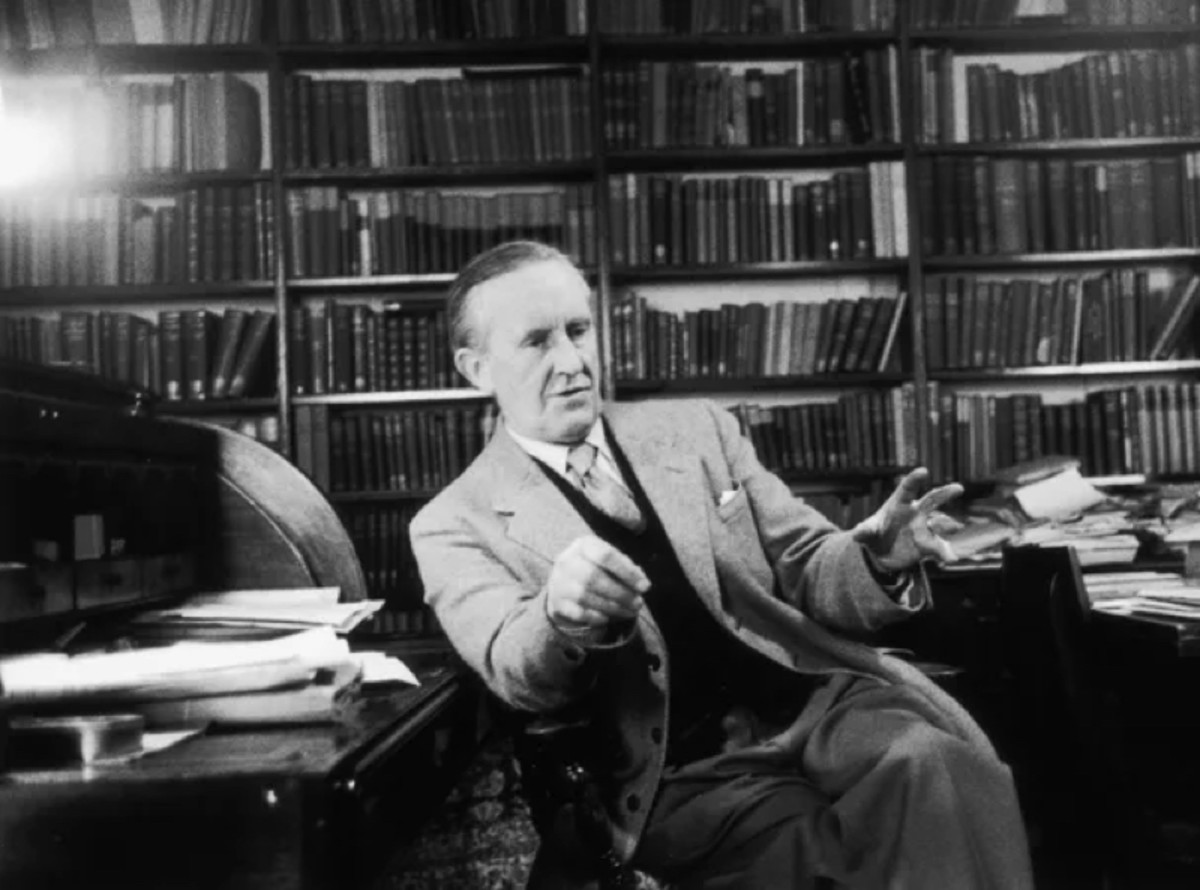
I don’t mean, of course, that Tolkien turned into Saruman or even Gollum,

(by Alan Lee)

but the Ring had its influence over him, as I discovered when reading, for the first time, the 1937 Hobbit.
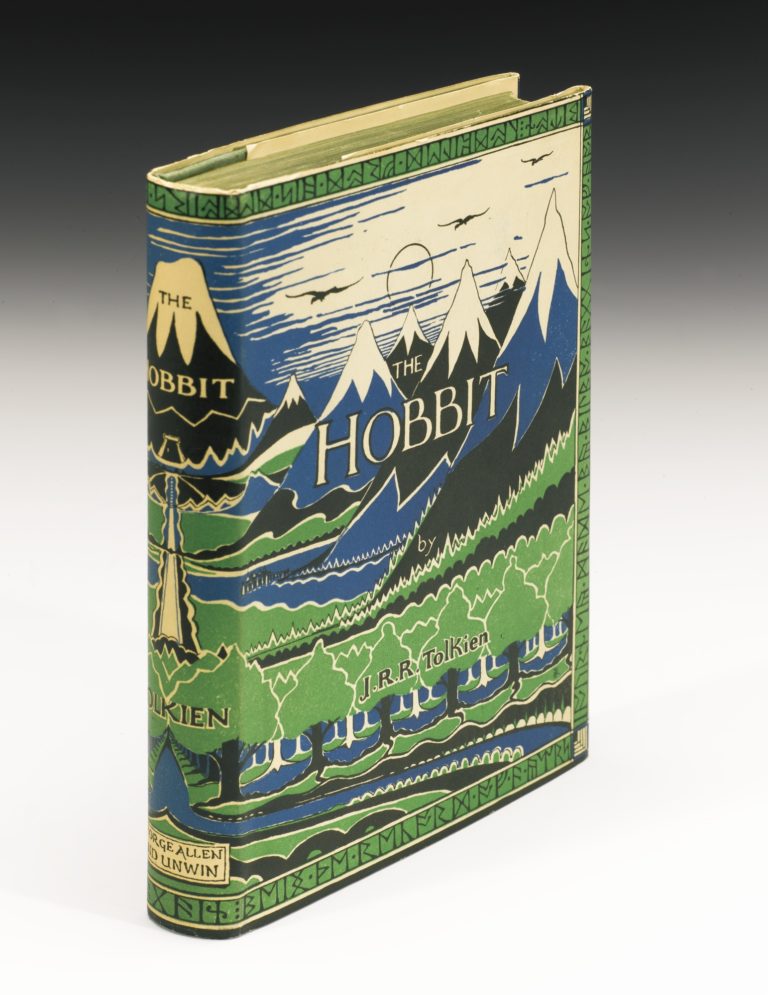
and, in particular, the original Chapter 5, “Riddles in the Dark”.  I had read the sections quoted in the margins of Douglas Anderson’s The Annotated Hobbit,
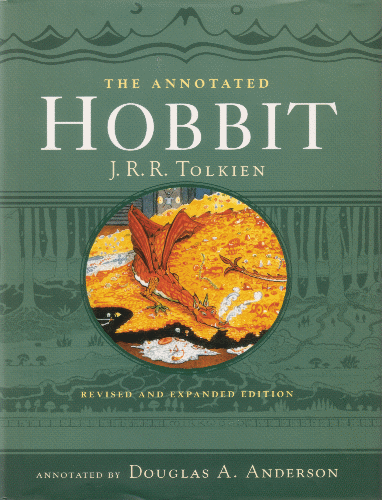
which I can’t recommend highly enough, if you’re interested in more than just Tolkien’s story, but it was only in reading the whole chapter in the reprinted facsimile edition that I was struck by what a different book, potentially, it was.

It’s not that the Ring is different—it’s still just the little circle of gold with the power to make one disappear which Bilbo picks up and puts into his pocket at the beginning of the chapter—it’s that Gollum is different. 

So much is just the same, riddles and all, but note the initial conditions of the contest:

“ ‘Does it guess easy?  It must have a competition with us, my preciouss!  If precious asks, and it doesn’t answer, we eats it, my preciousss.  If it asks us, and we doesn’t answer, we gives it a present, gollum!’ ”  (“Riddles in the Dark”, 1937, 85)

Then the contest proceeds, including “What have I got in my pocket?” and Gollum’s attempt to cheat with two guesses, but then things go in a completely different direction:

“ ‘Both wrong,’ cried Bilbo very much relieved; and he jumped at once to his feet, put his back to the nearest wall, and held out his little sword.  But funnily enough he need not have been alarmed.  For one thing Gollum had learned long long ago was never, never, to cheat at the riddle-game, which is a sacred one and of immense antiquity.  Also there was the sword.  He simply sat and whispered.” (91)

In the later, 1951, edition, the condition if Gollum lost was that he was then obliged to guide Bilbo out of the goblin tunnels and, while actually thinking to use the Ring to come back, avoid that sword, and kill and presumably then eat Bilbo, he says that he has to go to his island “…[to] go and get some things first, yes, things to help us.”

In 1937, Gollum has, surprisingly, a fragment of a conscience, saying to himself:

“ ‘Must we give it the thing, preciouss?  Yess, we must!  We must fetch it, preciouss, and give it the present we promised.’ ” (91)

He finds the Ring gone, of course, and he is upset, but it seems that his emotional disturbance is more about not being able to fulfill the conditions of the contest than the loss of the Ring itself:

“I don’t know how many times Gollum begged Bilbo’s pardon.  He kept on saying:  ‘We are ssorry; we didn’t mean to cheat, we meant to give it our only only present, if it won the competition.’  He even offered to catch Bilbo some nice juicy fish to eat as a consolation.” (92)

Bilbo declines the fish, and, instead, requests that Gollum guide him out of the tunnels—but that tone of abject apology now has an undertone which reminds us of the later Gollum:

“Now Gollum had to agree to this, if he was not to cheat.  He still very much wanted just to try what the stranger tasted like; but now he had to give up all idea of it.  Still there was that little sword; and the stranger was wide awake and on the look out, not unsuspecting as Gollum like to have the things which he attacked.  So perhaps it was best after all.” (93)

Gollum then leads him through a complex pattern of lefts and rights until:

“So Bilbo slipped under the arch, and said good-bye to the nasty miserable creature; and very glad he was.  He did not feel comfortable until he felt quite sure it was gone, and he kept his head out in the main tunnel listening until the flip-flap of Gollum going back to the boat died away in the darkness.” (94)

This is a far cry, of course, from that moment in the later version, when the frightened Bilbo, invisible and sword in hand, thinks:

“He must get away, out of this horrible darkness, while he had any strength left.  He must fight.  He must stab the foul thing, put its eyes out, kill it.” (1951)

We know that Tolkien rewrote whole sections of this chapter as early as 1944 and “sent [them] to Allen & Unwin in 1947 as a way to bring the earlier book into harmony with its sequel…” (Rateliff, The History of the Hobbit, “The 1947 Hobbit”, 731—this whole section of Rateliffe’s book, 731-762, is worth careful study to understand how, as he was deep in The Lord of the Rings, JRRT was thinking how to create a greater whole, using the earlier work.)  And, if you grew up reading the later version of the story (as well as Bilbo’s falsifications as noted in “The Shadow of the Past”), it’s a shock to see Tolkien’s original version, but it’s a good shock, as it shows so clearly not only the growth of the story, but JRRT’s growth as a writer, as well.  The Gollum of 1937 is small and spiteful and, for one chapter, dangerous, but, aside from providing the Ring which Bilbo uses again and again in his role as “burglar”, he is more the agent for providing that Ring than a major character.  In the revised version, perhaps his most important role is to provoke the inherent—and saving—humanity first of Bilbo and then, in turn, of Frodo.  When, wearing the Ring, Bilbo fleeing Gollum, has the opportunity to do away with his pursuer, this comes into Bilbo’s mind:

“No, not a fair fight.  He was invisible now.  Gollum had no sword.  Gollum had not actually threatened to kill him, or tried to yet.  And he was miserable, alone, lost.  A sudden understanding, a pity mixed with horror, welled up in Bilbo’s heart:  a glimpse of endless unmarked days without light or hope of betterment, hard stone, cold fish, sneaking and whispering.  All of these thoughts passed in a flash of a second.  He trembled.”  (1951)

And, instead, he leaps over Gollum’s head and is on his way to escape—perhaps in more ways than one.

 As Gandalf replies when Frodo says “…I do not feel any pity for Gollum” and that “He deserves death.”—

“ ‘Deserves it!  I daresay he does.  Many that live deserve death.  And some that die deserve life.  Can you give it to them?  Then do not be too eager to deal out death in judgement.  For even the very wise cannot see all ends.   I have not much hope that Gollum can be cured before he dies, but there is a chance of it.  And he is bound up with the fate of the Ring.  My heart tells me that he has some part to play yet, for good or ill, before the end; and when that comes, the pity of Bilbo may rule the fate of many—yours not least.”  (The Fellowship of the Ring, Book One, Chapter 2, “The Shadow of the Past”)

Besides that humanity, what would have happened if Gollum had remained that small agent when  Frodo, in the depths of Mount Doom, had been allowed to go through with his terrible statement:

“  I have come…But I do not choose now to do what I came to do.  I will not do this deed.  The Ring is mine!” ?  (The Return of the King, Book 6, Chapter 3, “Mount Doom”)

At the Cracks of Doom, by Ted Nasmith

Thanks, as always, for reading,

Stay well,

Look –and think—before you leap,

And know that there’s always

MTCIDC

O

ps

For a very useful side-by-side comparison of 1937 and 1951 , see:  https://www.ringgame.net/riddles.html
Feeling Blue (II)

05 Thursday May 2022

Posted by Ollamh in Uncategorized

≈ Leave a comment

Welcome, dear readers, as always.

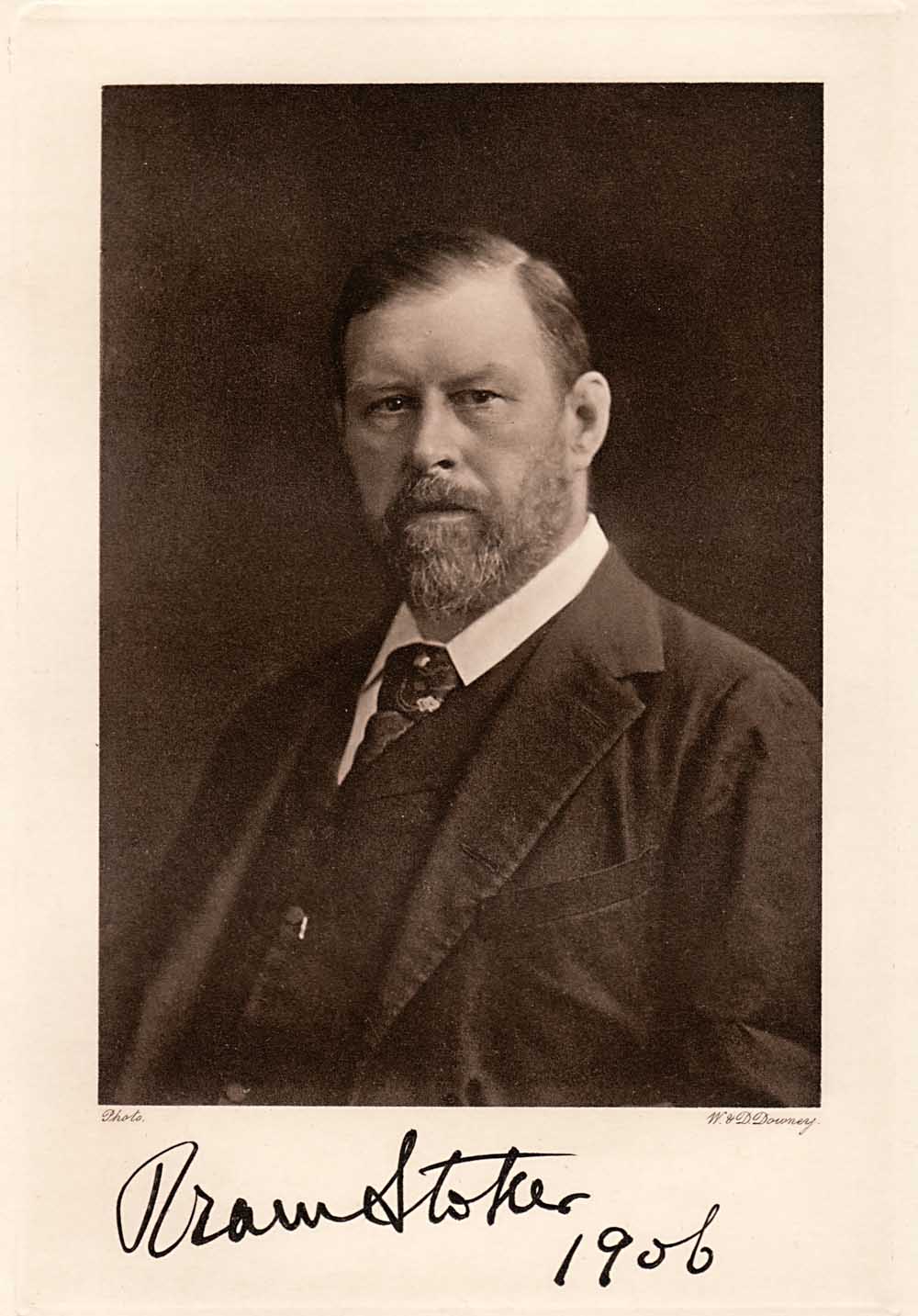
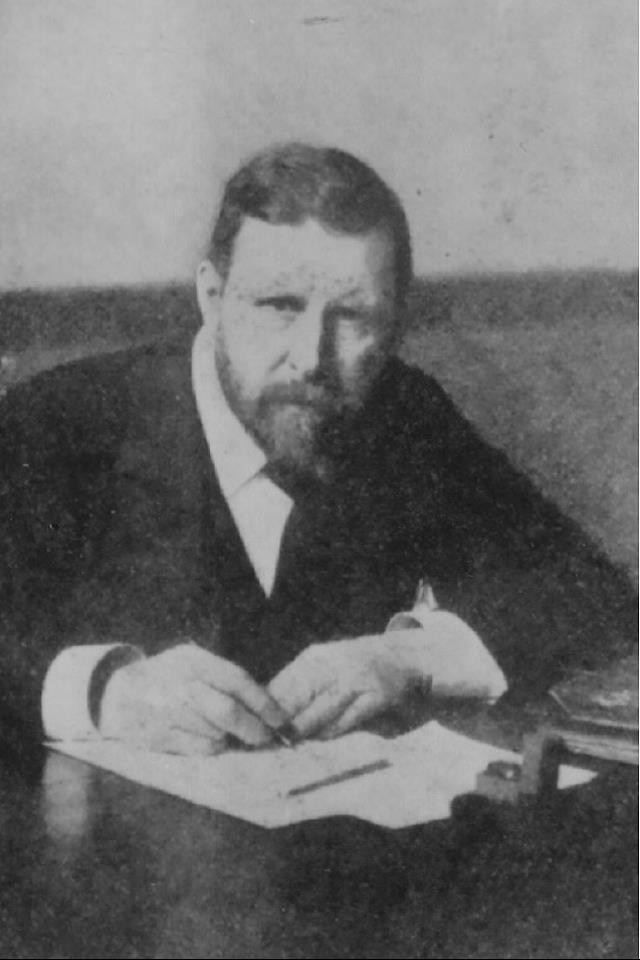
In my last, I had noticed that Bram Stoker (1847-1912)

appeared to have been influenced by the fairy tale of Blue Beard in certain details of his novel, Dracula (1897).

In that fairy tale, a young woman, newly married to a very odd man, is given a key she’s not supposed to use for a room she’s not supposed to enter. 

She does use it and almost loses her life because of it.

In Stoker’s novel, a young man, staying as a guest in a ruined castle is cautioned about doors and even more about sleeping in strange rooms:

“ ‘Let me advise you, my dear young friend—nay, let me warn you with all seriousness, that should you leave these rooms you will not by any chance go to sleep in any other part of the castle. It is old, and has many memories, and there are bad dreams for those who sleep unwisely. Be warned! Should sleep now or ever overcome you, or be like to do, then haste to your own chamber or to these rooms, for your rest will then be safe. But if you be not careful in this respect, then’—He finished his speech in a gruesome way, for he motioned with his hands as if he were washing them.” (Dracula, Chapter III)

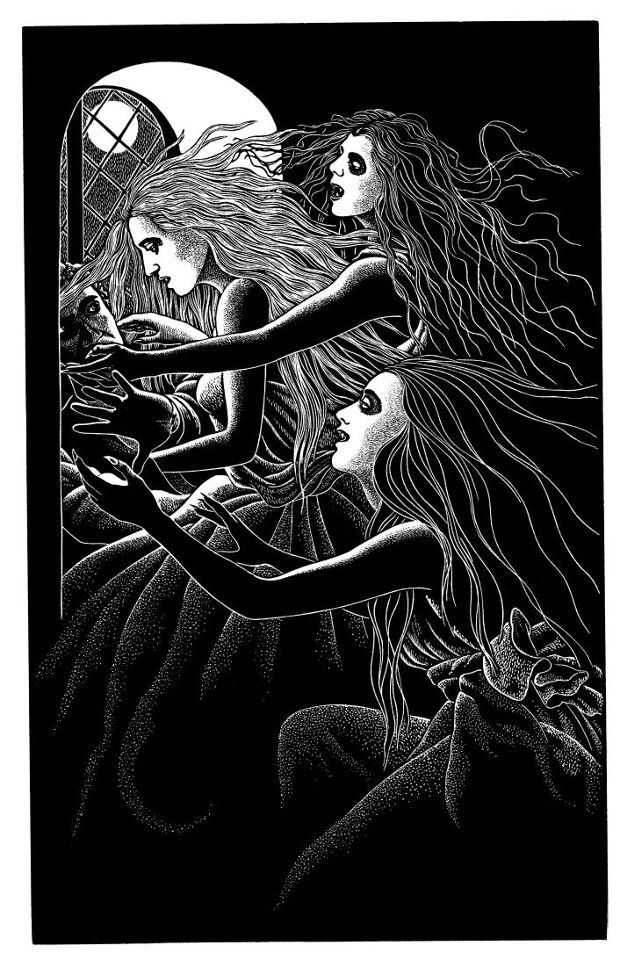
Like the young woman, the young man disobeys, falls asleep in a room he should never have entered, and is nearly attacked by three voluptuous female vampires.

From these details, I would suggest that Stoker knew the story, but, remembering Stoker’s background, it may not have been that he had read either the original source—Charles Perrault’s  (1628-1703)

Histoires ou Contes du Temps Passe avec des Moralites (“Stories or Fairy Tales of Time Past with Some Moral Lessons”) of 1697,

or its first appearance in English, in 1719,

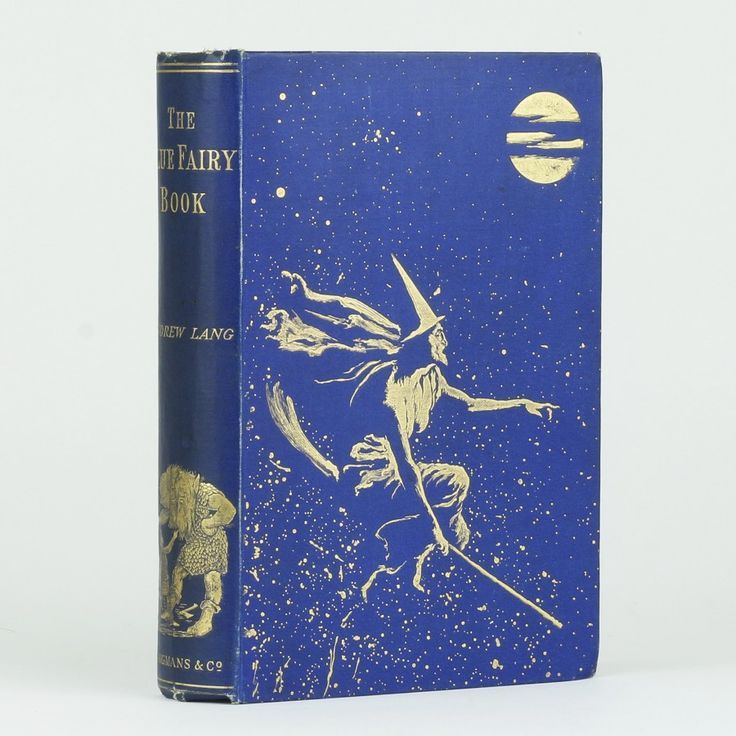
or its many later publications or republications, including one Tolkien might have read, in Andrew Lang’s The Blue Fairy Book (1889).

(It’s clear, from certain references, that, as a boy, JRRT had read, or had  had read to him, The Red Fairy Book, its sequel,

and, in a previous posting—“Roll Out the Barrel”, Wednesday, 13 April, 2022—I suggested a possible link between his work and the earlier Lang volume.)

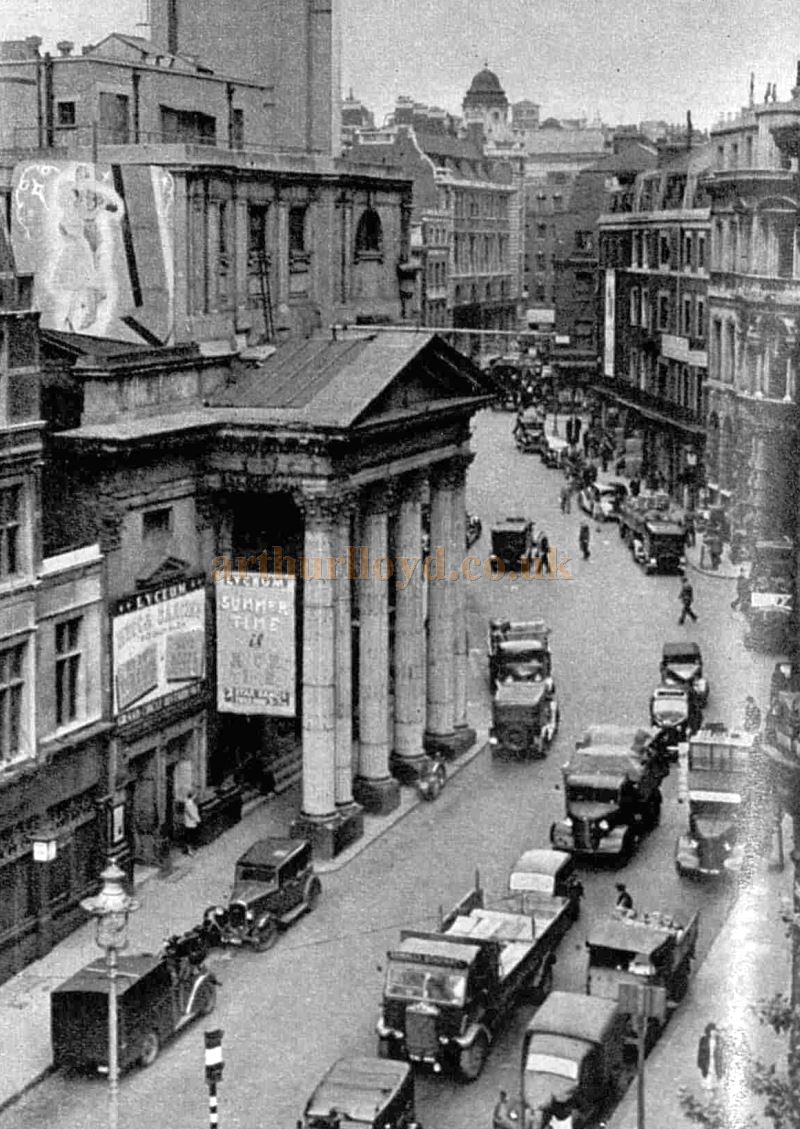
Stoker had been interested in the theatre from his student days in Dublin and later became  the business manager of Sir Henry Irving, one of the most distinguished English actors,

at his theatre, the Lyceum.

There had been theatrical productions of the Blue Beard story from at least 1789, when Andre Gretry (1741-1813)

presented his opera, Raoul Barbe Bleue in Paris, just on the eve of the Revolution.  Gretry billed it as a comedy, and, though later successful, initially it appears that critics had had a very mixed view, at least one suggesting that such a story was hardly a subject for joking.  (For an interesting, but not always quite accurate, essay on the subject, see:  https://repertoire-explorer.musikmph.de/prefaces/2116.html  And you can hear the overture with its what I think rather creepy opening, here:  https://repertoire-explorer.musikmph.de/prefaces/2116.html  

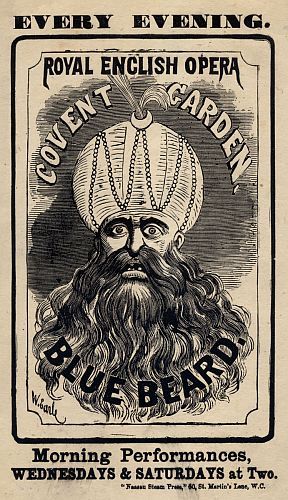
In England, it was a subject for joking, in the form of pantomime, a traditional entertainment often based upon popular fairy tales.  As early as 1791—just 2 years after Gretry’s comedy—Karl Friedrich Baumgarten  (c.1740-1824) premiered Bluebeard, or The Flight of Harlequin at Covent Garden.

(For more on pantomime, see:   https://sites.google.com/site/ibworldtheatreresearch/english-pantomime )

And, throughout the 19th century, Bluebeard became a common subject for such entertainment.

The French, in the form of Jacques Offenbach (1819-1880),

even returned to the comic side of Bluebeard with Barbe-bleue in 1866. 

This is my favorite of the various treatments, in part because Bluebeard is, for all that he’s a bloodthirsty serial killer (or so he thinks), such a cheerful fellow, as one can see in the first verse of his introductory song.  Here’s that verse in French and then my prose translation, which gives no sense of the merriment in the song, although  Bluebeard’s carefree attitude about the disappearance of those to whom he was presumably attached comes through—I hope!

Bluebeard enters with some of his troops and addresses them in a kind of lament–

Encore une, soldats, belle parmi les belles !
Pourquoi donc le destin les mets-il sur mes
pas,
Ces femmes qu’aussitôt des morts accidentel-

les
Arrachent de mes bras !

but then breaks into a very cheerful tune.

              Ma première femme est morte,

Et que le diable m’emporte,

Si j’ai jamais su comment !

La deuxième et la troisième,

Ainsi que la quatrième,

Je les pleure également.

La cinquième m’était chère,

Mais, la semaine dernière,

À mon grand étonnement,

Sans aucun motif plausible,

Les trois Parques, c’est horrible !

L’ont cueillie en un moment…

Je suis Barbe-Bleue, ô gué !

Jamais veuf ne fut plus gai !

Once again, soldiers, a beauty among the beauties!

Why then does Destiny put them in my way,

These women whom soon some accidental deaths

Tear from my arms!

My first wife is dead

And devil take me

If  I’ve ever known how!

The second and the third

As well as the fourth

I wept for equally.

The fifth was dear to me

But, last week,

To my great astonishment,

Without any plausible cause,

The three Fates—it’s horrible!—

Have plucked her in a moment…

I’m Blue Beard, hooray!

Never was a widower more merry!

Here’s my second translation which tries to stick to the French rhythm, if not to every French word:

My first wife was quickly hist’ry,

But how she died’s a myst’ry—

Devil take me if I see!

Then the second and the third one

And  then the fourth was soon done–

I mourned them equally!

The fifth to me was just as charming,

But, just last week there came alarming

News—no cause at all to see–

That the Fates—it’s horrifying—

In a moment she was dying—

Had plucked that wife from me!

I am that Blue Beard—hooray!

No widower more merry today!

And here’s a performance, so that you can hear both the French and the jolly tune to which it’s set.

Offenbach’s operetta was first performed in England within the same year as its premiere in Paris, and, as pantomimes and that 19th-century English dramatic art form called the “burlesque”—here’s F.C. Burnand’s 1883 “Blue Beard or the Hazard of the Dye”—

continued to employ the Blue Beard plot throughout the later 19th century,  I think that it can be easily seen that, surrounded as he was by so many theatrical treatments, even if he had never read a page of the French or an English translation, the story, in some form, must have been readily available to Stoker. 

(For more on 19th-century English burlesque, see:  https://en.wikipedia.org/wiki/Victorian_burlesque    W.S. Gilbert got his start writing such things, the first being Dulcamara, or the Little Duck and the Great Quack, 1866.  In one of those odd coincidences which sometimes turn up in these postings, Henry Irving, Bram Stoker’s boss at the Lyceum, was the stage director for this early Gilbert effort.)

Blue Beard as a subject lived beyond its possible influence upon Stoker’s novel and even beyond pantomime and burlesque, moving into the 20th century and film, his first appearance  being in a short film by the Lumiere Brothers in 1897-8.

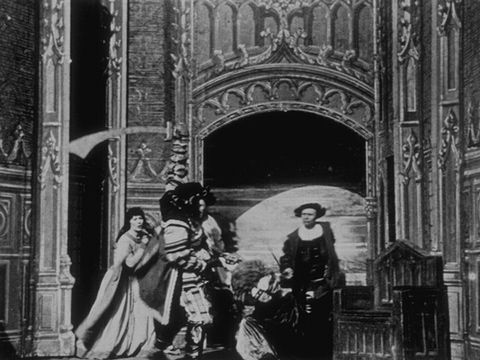
I can’t give you a link to that, but here’s Georges Melies’ (1861-1938)

nearly 11-minute-long version from 1901: https://www.youtube.com/watch?v=6uMctQFV3JI ,t

just over 20 years before the first Dracula film, F.W. Murnau’s (1888-1931)

wonderfully creepy Nosferatu of 1922.

(And here’s a LINK to it:  https://archive.org/details/Nosferatu1922 )

And there are more films, including Charlie Chaplin’s 1947 Monsieur Verdoux,

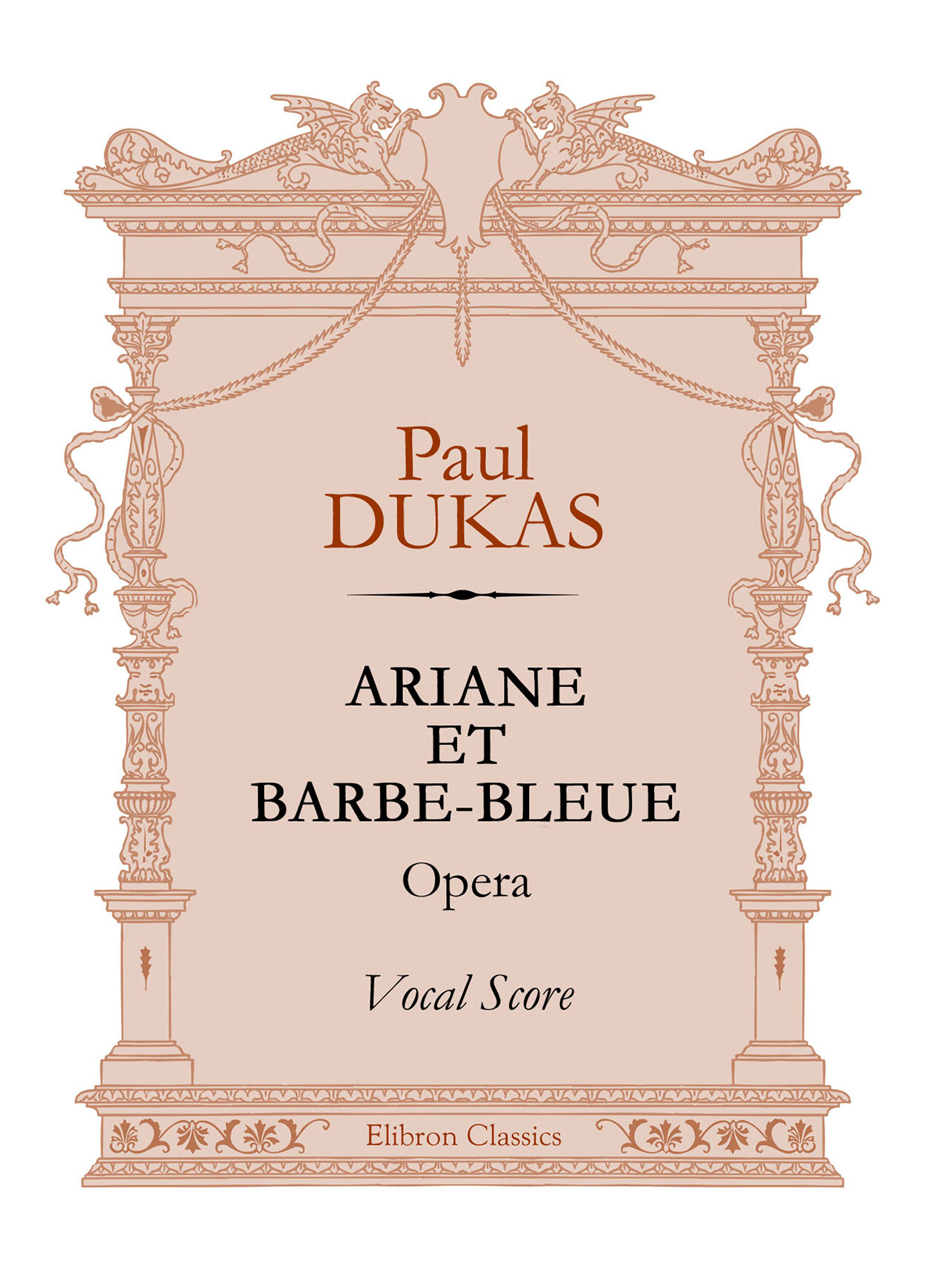
as well as more operas beyond Gretry’s—Paul Dukas’ Ariane et Barbe-bleue (1907)

and Bela Bartok’s Blue Beard’s Castle (1918),

but, it appears that I could talk till I’m blue in the face on the subject, doesn’t it?

DocuImage 620s

(This is from Gustave Dore’s 1862 illustrated edition of Perrault.  So far, I’ve only been able to locate a 1921 German translation with Dore’s pictures, but, even if you can’t read German, the stories are so familiar that you can simply follow the illustrations:  https://www.gutenberg.org/files/42900/42900-h/42900-h.htm )

Stay well,

Avoid locked room mysteries,

And know that, as ever, there’s

MTCIDC

O

Feeling  Blue (I)

27 Wednesday Apr 2022

Posted by Ollamh in Uncategorized

≈ Leave a comment

Welcome, as always, dear readers.

I’m teaching Dracula again,

Bram  Stoker’s  (1847 -1912)

wonderfully-imagined novel of 1897,  and, as always when I teach a work more than once, something new pops out at me.   This time it was a passage from Chapter II.  Jonathan Harker, clerk for Peter Hawkins, a solicitor, who has an office in Exeter, in southwest England, has been sent by his employer  across Europe to Transylvania (now part of Romania), to help  the new owner of an English estate with the necessary paperwork.  This owner is a nobleman of the region and lives in a semi-ruined castle.  At first, he seems a charming host, saying to Jonathan:

“You may go anywhere you wish in the castle, except where the doors are locked, where of course you will not wish to go. There is reason that all things are as they are, and did you see with my eyes and know with my knowledge, you would perhaps better understand.”

And this is what caught my attention.  Where had I read something like this before?  And then Andrew Lang’s The Blue Fairy Book (1889)

fell off the shelf, opening to this:

“Here,” said he, “are the keys of the two great wardrobes, wherein I have my best furniture; these are of my silver and gold plate, which is not every day in use; these open my strong boxes, which hold my money, both gold and silver; these my caskets of jewels; and this is the master-key to all my apartments. But for this little one here, it is the key of the closet at the end of the great gallery on the ground floor. Open them all; go into all and every one of them, except that little closet, which I forbid you, and forbid it in such a manner that, if you happen to open it, there’s nothing but what you may expect from my just anger and resentment.” 

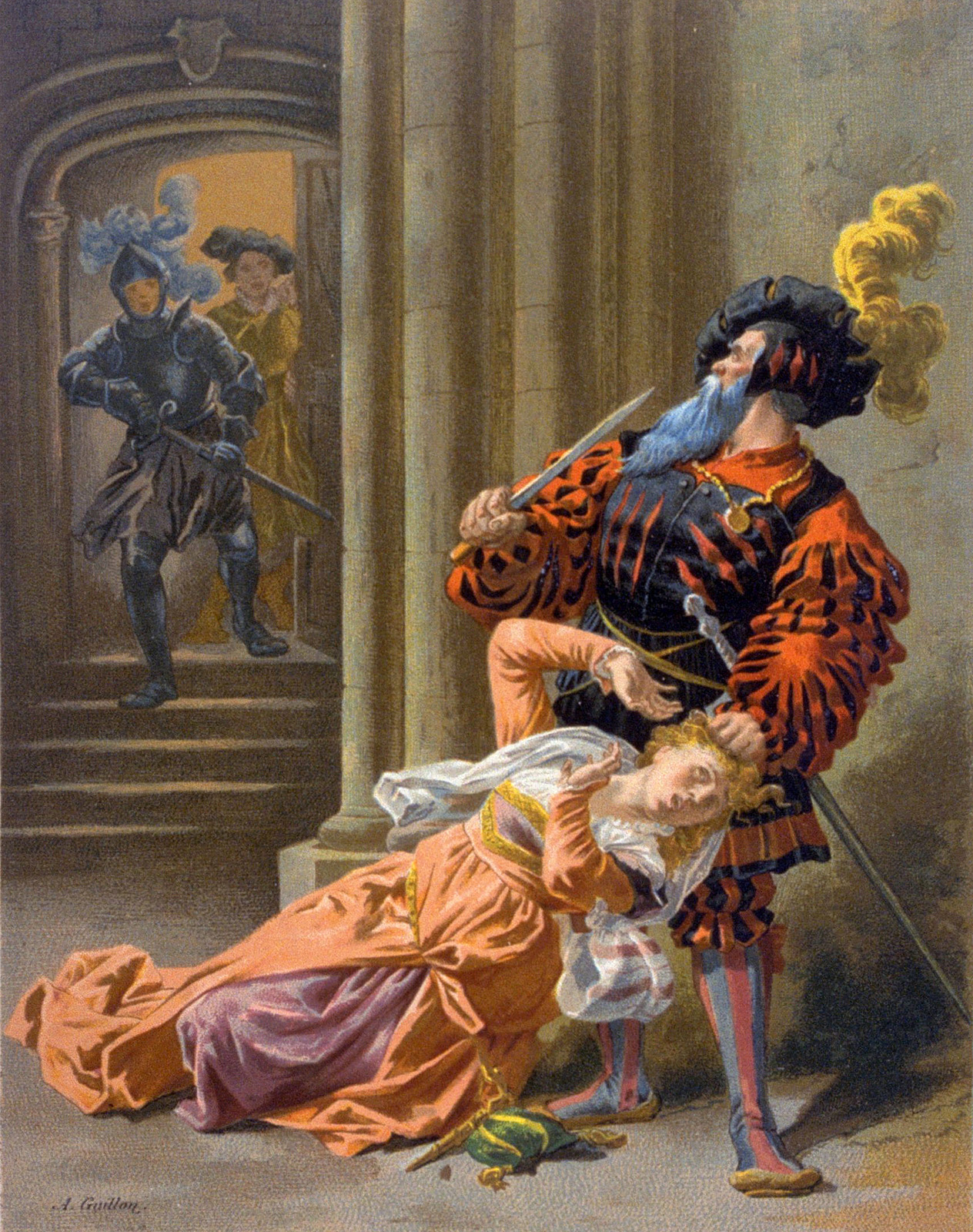
The speaker here is rather unusual in appearance, in regard to his facial hair.

Portrait of a Blue Beard, a colour illustration. Bluebeard a French literary folktale written by Charles Perrault. The tale tells the story of a nobleman who murders his wives.’ Author Charles Perrault, Illustrated by John Orlando Parry.

So—Stoker also knew Blue Beard. 

Although the story has earlier antecedents, including folktales, the modern form first appears in Charles Perrault’s (1628-1703)

Histoires ou Contes de Temps Passe avec des Moralites (“Stories or Fairy Tales of Time Past with Some  Moral Lessons”) with a subtitle:  Les Contes de ma Mere L’Oye (“The Fairy Tales of My Mother Goose”)

If you’re unfamiliar with the story, the main points are:

1. a wealthy nobleman tries to marry one of two sisters, who are put off by his beard and by the fact that, although the nobleman is known to have been married before—and more than once–no one seems to know what happened to those former wives.

2. eventually, the younger of the two, having seen the nobleman’s lavish life style, is persuaded to accept him.

3. after the wedding, he tells her that he must leave for a time, on business, entrusting her with a set of keys for various rooms in his castle.

4. he tells her that she may use any key to enter any room but one—and then sets off on his trip.

5. she invites female relatives, including her sister, Anne, to visit and see what luxury she now commands—but can’t stop thinking about that one room.

6. she slips away from her relatives, key in hand, opens the door, and steps into a room the floor of which is covered in congealed blood and at the walls are the bodies of those previous wives.

7. In her surprise and terror, she drops the key and it’s immediately coated with blood.  She desperately tries to clean it, but it’s a magic key and, when the nobleman returns and demands his keys, he discovers the blood and says that she must now join the other wives.

8. she begs for a few moments of prayer with her sister, which he reluctantly grants, and is rescued at the very last moment by the arrival of her two brothers,

who kill the nobleman, leaving her a widow with a large fortune—and a back room in need of a drastic cleaning.

It’s interesting that Stoker, having, it seems, made use of the idea of locked rooms in Chapter II, continues the idea of danger in forbidden rooms in Chapter III, where he warns Jonathan:

“ ‘Let me advise you, my dear young friend—nay, let me warn you with all seriousness, that should you leave these rooms you will not by any chance go to sleep in any other part of the castle. It is old, and has many memories, and there are bad dreams for those who sleep unwisely. Be warned! Should sleep now or ever overcome you, or be like to do, then haste to your own chamber or to these rooms, for your rest will then be safe. But if you be not careful in this respect, then’—He finished his speech in a gruesome way, for he motioned with his hands as if he were washing them.”

Needless to say, Jonathan goes exploring, forces a door which is not actually locked, spends time in the room within, and—but perhaps, like Stoker, I should maintain the suspense and we’ll continue this in our next post…

Thanks, as always, for reading,

Stay well,

Avoid temptation, when possible,

And know that, as ever, there’s

MTCIDC

O

PS

(If you’d like to see Perrault’s original French text, here it is:  https://fr.m.wikisource.org/wiki/Histoires_ou_Contes_du_temps_pass%C3%A9_(1697)/Original/La_Barbe_bleue    Here’s the Blue Fairy Book, as well:   https://www.gutenberg.org/ebooks/503    )

Not In Fane(s)

20 Wednesday Apr 2022

Posted by Ollamh in Uncategorized

≈ Leave a comment

Welcome, dear readers, as always.

Although Tolkien maintained that there was religion—and monotheistic religion—under the surface of The Lord of the Rings, saying to one correspondent:

“The Lord of the Rings is of course a fundamentally religious and Catholic work; unconsciously so at first, but consciously in the revision.”

yet he added:

“That is why I have not put in, or have cut out, practically all references to anything like ‘religion’, to cults or practices, in the imaginary world.”

Those “practically all references” usually pointed to are:

1. when attacked by a mumak, Damrod the ranger of South Ithilien calls upon the Valar (The Two Towers, Book Four, Chapter 4, “Of Herbs and Stewed Rabbit”)

(by Alan Lee)

2. when Faramir and his men, before eating, face west in silence (The Two Towers, Book Four, Chapter 5, “The Window on the West”)

(a Ted Nasmith)

3. mentions of the Vala Varda (Elbereth), to whom the Elves seem to feel especially devoted, and to whom Sam almost instinctively appeals when he battles Shelob (The Two Towers, Book Four, Chapter 10, “The Choices of Master Samwise”)

(the Hildebrandts)

Tolkien goes on to explain:

“For the religious element is absorbed into the story and the symbolism.” (letter to Robert Murray, SJ, 2 December, 1955, Letters 172)

Because this is what the author tells us, we must, of course, accept it and, although he claims that “that is very clumsily put”, behind that explanation is JRRT’s wariness of overt religion appearing in stories like The Lord of the Rings, as he writes:

“For reasons which I will not elaborate, that seems to me fatal.  Myth and fairy-story must, as all art, reflect and contain in solution elements of moral and religious truth (or error), but not explicit, not in the known form of the primary “real” world.”  (The Silmarillion, xii)

To emphasize this “in solution” method of setting religion into Middle-earth, as Tolkien explained in a footnote to a draft of a letter to Peter Hastings from 1954:

“There are thus no temples or ‘churches’ or fanes in this ‘world’ among ‘good’ people.” (draft of letter to Peter Hastings, September, 1954, Letters, 193)

Again, the author makes his intentions clear—and yet I am always haunted by the remains of previous ages still apparent on the surface in the Third Age.  There are the East Road and its bridge over the Brandywine, which the King of Arnor has charged the hobbits to maintain (The Lord of the Rings, Prologue, I, Concerning Hobbits),

(This is the Pont Julien, a surviving Roman bridge in France—I always imagine that Numenorean structures in Middle-earth had an imperial look to them),

there’s the Greenway,

(a bit of Roman road)

and Weathertop,

(an Alan Lee)

and Amon Hen,

(not sure of the artist here—Scott Peery?)

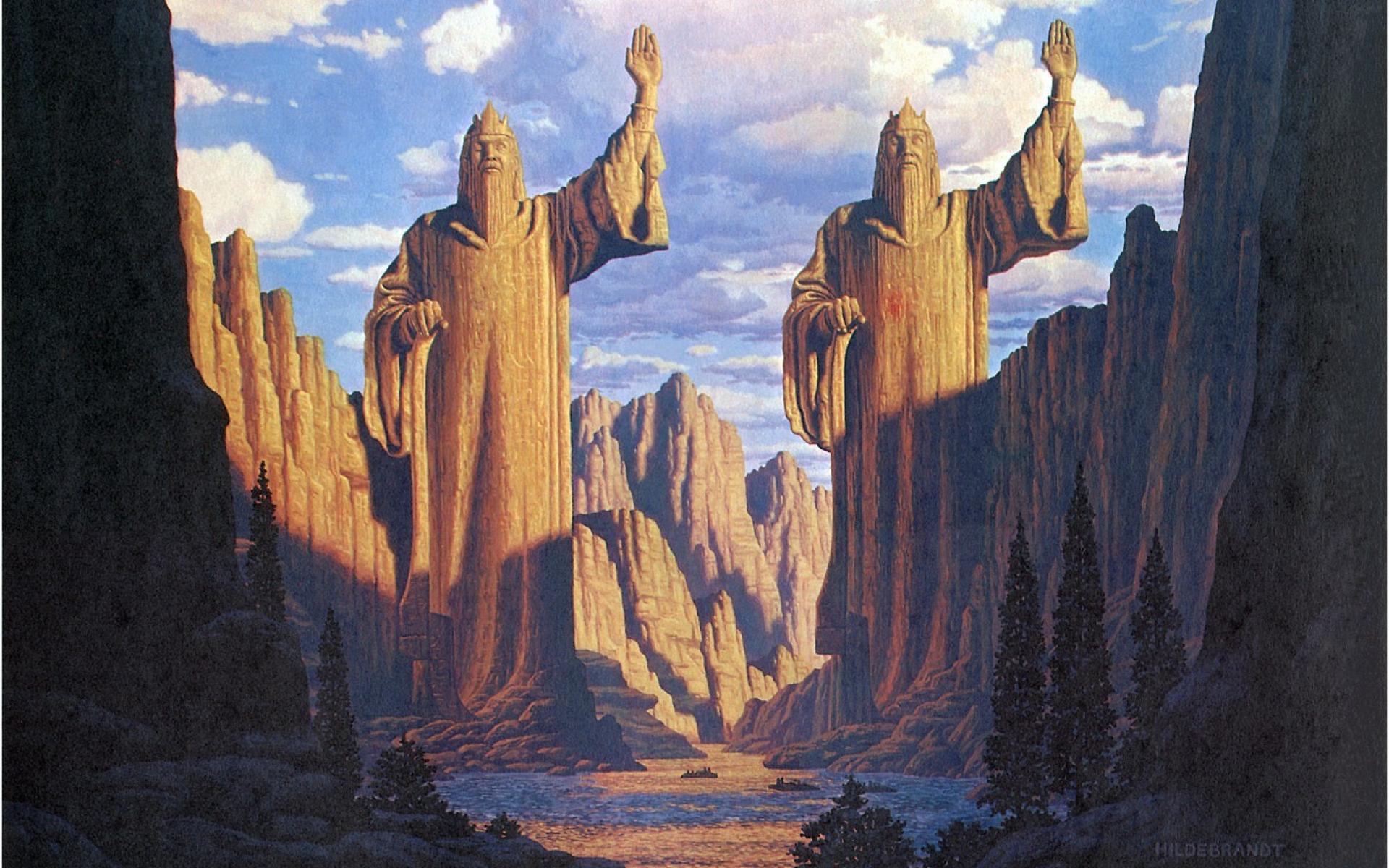
and, grandest of all, the Argonath.

(the Hildebrandts—although I could easily have picked others, this being a subject which has inspired a good number of excellent artists)

So, if for a moment we might put aside JRRT’s remarks, why might we not see at least the remains of temples or fanes (another word for “temple” or “shrine” from Latin fanum) in Middle-earth?

In our world, Greco-Roman temples survive, either as now remote ruins, like the temple of Apollo at Bassae, in Greece,

or as a fragment, like this corner of  the “ temple of Iupiter Tonans” (actually the one surviving piece of a temple dedicated to the emperor Vespasian and his older son, Titus) in the Roman Forum.

(Abandoned for centuries, the Forum had gradually become so silted up and overgrown that it had become known as the “cow pasture” (Campo Vaccino ).  This is how the temple looked in the 18th century, long before the beginnings of the official excavation of the Forum in 1898.  Here’s what it looks like today–)

Other shrines had been repurposed as Christian churches, like this temple originally dedicated to the Roman emperor Antoninus Pius and his wife, Faustina, but now the Chiesa di San Lorenzo in Miranda, also in the Forum,

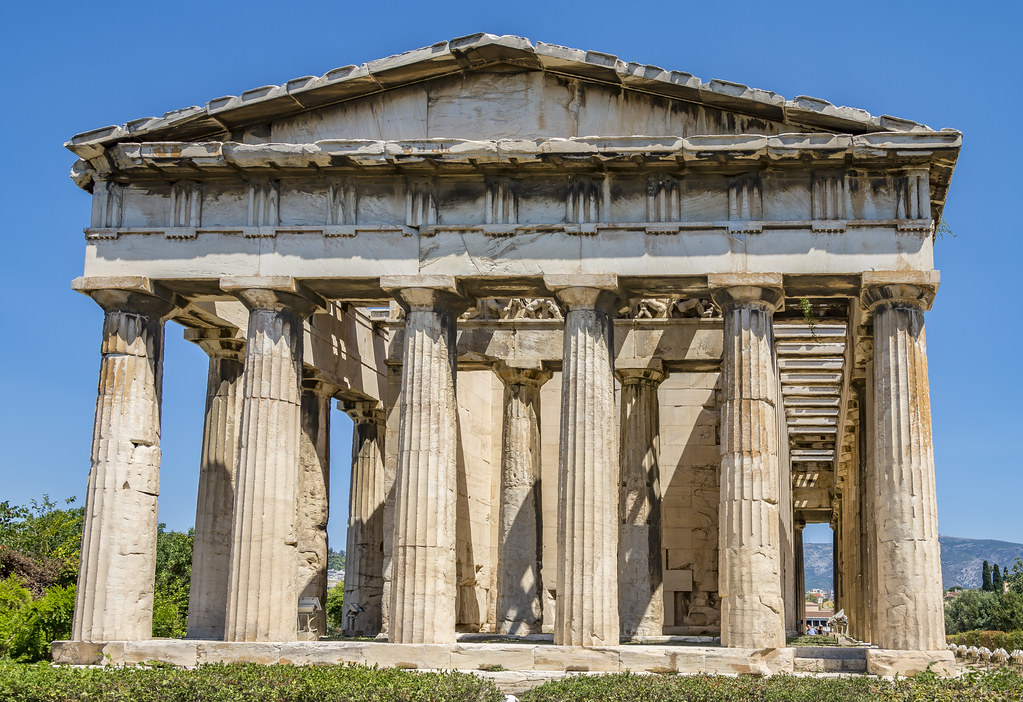
or the temple at the edge of the Agora in Athens, originally a temple of Hephaistos, but, in later times, dedicated to Saint George, which is why it has survived so beautifully.

After the Ottoman conquest in 1453, most Christian churches in Constantinople were converted to mosques, like that dedicated originally to Saints Sergius and Bacchus,

or the grand Church of Holy Wisdom (Hagia Sophia).

It’s a nice fantasy, then, and would go very well with the genuine fallen monuments of Middle-earth,

(a favorite Ted Nasmith)

but, realistically, we have to accept the author at his word, when he talks about the later peoples of Middle-earth:

“They had little or no ‘religion’ in the sense of worship.  For help they may call upon a Vala (as Elbereth), as a Catholic might on a Saint, though no doubt knowing in theory as well as he that the power of the Vala was limited and derivative.  But this is a ‘primitive age’ and these folk may be said to view the Valar as children view their parents or immediate adult superiors, and though they know they are subjects of the King he does not live in their country nor have there any dwelling.”  (draft of letter to Peter Hastings, September, 1954, Letters, 193)

As ever, thanks for reading.

Stay well,

Revere the Valar,

And remember that there’s always

MTCIDC

O

PS

That image of the temple of Vespasian and Titus is by Giovanni Battista Piranesi (1720-1778) and one of a long series of striking engravings of Rome which he made through his later creative years.  If you would like to see more of them, here’s a LINK to a useful collection from 1779:   https://ia803406.us.archive.org/7/items/piranesi-vedvte-di-roma-t.-1-2-1779/Piranesi%2C%20Vedvte%20di%20Roma%2C%20t.1-2%2C%201779%2B.pdf   

 A mild warning:   Piranesi often does things like distort perspective, shrinking people and swelling buildings in order to make his depictions more dramatic.  In fact, they could be so dramatic that 18th-century tourists, having first seen his engravings, sometimes found themselves a little disappointed that the real sites weren’t quite so impressive as Piranesi’s views of them! 

Roll Out the Barrel

13 Wednesday Apr 2022

Posted by Ollamh in Uncategorized

≈ Leave a comment

“Roll out the barrel, we'll have a barrel of fun.
Roll out the barrel, we've got the blues on the run.
Zing boom tararrel, ring out a song of good cheer.
Now's the time to roll the barrel, for the gang's all here.”

(Melody:  Jaromir Vejvoda; English lyrics:  Lew Brown, Vladimir Timm—perhaps the first famous US performance was by the Andrews Sisters 
in 1939—here’s a recording:  https://www.youtube.com/watch?v=7KRc-ceWE2E )
As ever, welcome, dear readers.

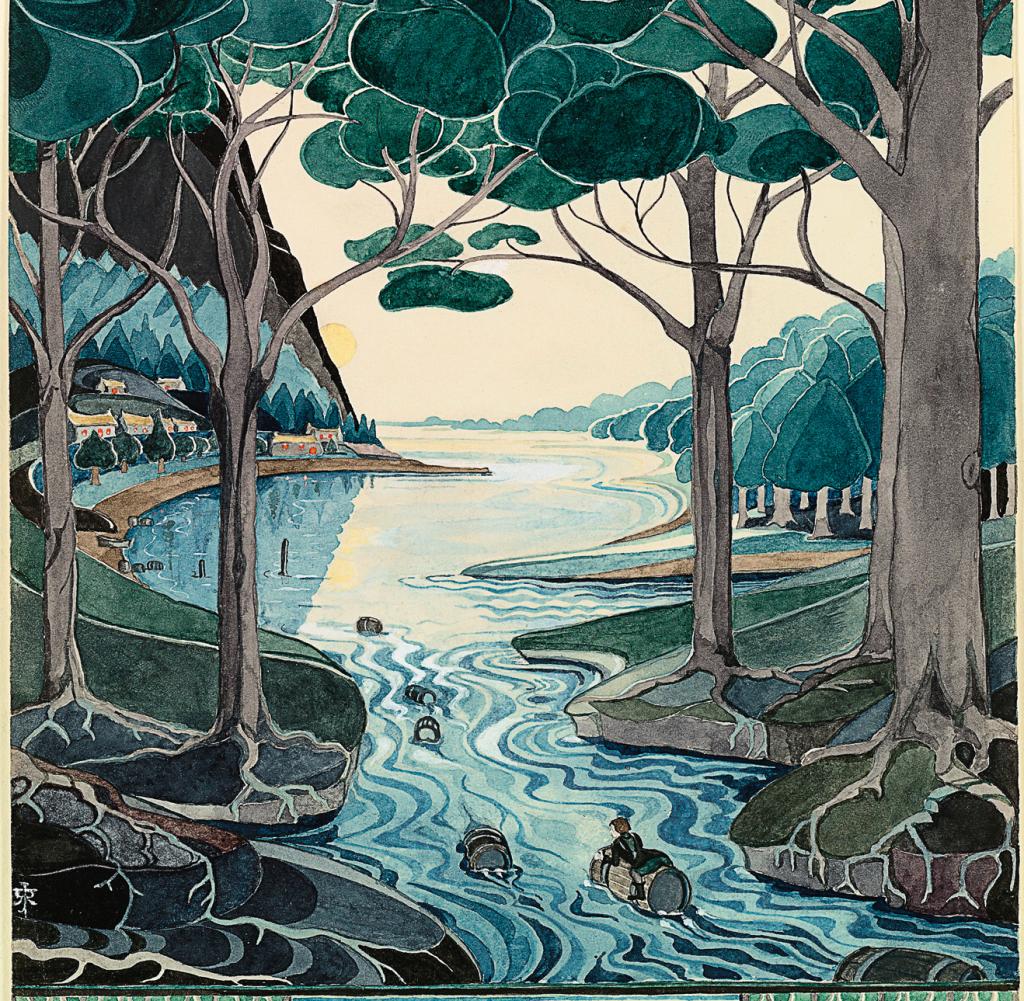
This is the 400th posting of doubtfulsea.com and perhaps a small rolling out of barrels is due, but “barrels” has immediately made me think of another kind of barrel rolling—
and, as always, I wonder about sources:  where might the idea of escape by barrel have come from?
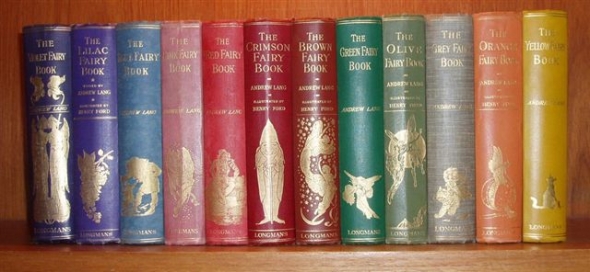
It seems certain that Tolkien had had read to him or had read to himself Andrew Lang’s Red Fairy Book (1890),
which has in it “Storia Moria Castle” and the dragon which was probably the one which sparked his imagination as he recounted in his long, rich letter to W. H. Auden of 7 June, 1955 (see Letters, 214).  Had he also encountered the first book in Lang’s long series of colored fairy books,
 the Blue Fairy Book (1889),
he would have heard the story “The Forty Thieves”, probably known to you as to me as “Ali Baba and the Forty Thieves”.
 If you’re unfamiliar with this story, in brief (very brief—the story is a bit more complicated than this) it goes like this:
1. Ali Baba works as a wood cutter for a living.
2. one day, he hears horsemen approaching where he’s working and he climbs into a tree to watch.
3. they approach and he watches one, seemingly the chief, dismount, step to a cliff face, and murmur “Open Sesame!”
4. a door opens and the chief goes inside, followed by his other—39—Ali Baba counts them—men.
And yes, this does have the echo of something else, doesn’t it?  (See The Fellowship of the Ring, Book Two, Chapter 4, “A Journey in the Dark”)  Perhaps this might be evidence that JRRT did know Lang’s volume?
 
5. after the 40 leave, Ali Baba slips down, tries the password, and finds himself in a cave stuffed with riches.
6. loading up his mules with treasure, he takes home a selection of what he found in the cave.
7.  in time, the chief realizes that the cave has been looted and that Ali Baba did it and, disguised as an oil merchant, he gains access to Ali Baba’s house, his men concealed in a cargo of oil jars.
 8. unfortunately for his men, Ali Baba has a clever slave named Morgiana, who discovers what’s in the jars and fills them with burning oil, thereby removing the chief’s band.
And so we see that those jars might someday turn into barrels.
(an Alan Lee illustration)
As I’ve written before, Tolkien began his academic life intending to become a Classicist, and so another rather unusual escape story might also have been in the back of his mind.
Odysseus and his men are in terrible trouble, trapped in a cave with a one-eyed giant, a Cyclops, who, over about two days, has eaten six of those men.
They can’t kill him and escape because the Cyclops seals the door with an enormous boulder, which only he can push out of the way.  In a flash of the genius which makes him “polymetis”, “manyplans”, as he’s called in the Odyssey, Odysseus gets the Cyclops drunk, and, when he collapses in a stupor, blinds him.
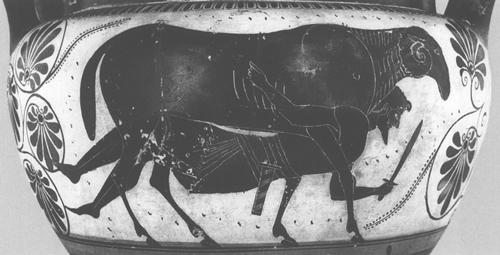
The Cyclops is a herder of sheep and goats and, in the morning, he is due to let them out out of his cave so that they can proceed to graze.  Odysseus realizes this and binds his men under six of the biggest sheep (figuring that, if the Cyclops searches for escaping men, he’ll pass his hands across the sheeps’ backs), then clings to the underside of a big ram and follows them out (after a hairy moment when the Cyclops stops the ram—his favorite, it turns out—and has a brief chat with it). 
Although using neither pots nor barrels, might we see a familiar pattern here, rescuer sending the rescued ahead, then, clinging to something, tagging behind? 
Thanks, for reading, as ever, and
Stay well,
Have an escape route,
And remember that there’s always
MTCIDC
O
ps
Here’s your copy of the first edition of the Blue Fairy Book: https://archive.org/details/bluefairybook00langiala/mode/2up  “The Forty Thieves” is on pages 242-250. 

pps
My apologies for the weird typeface and the spacing.  As I move on to #401, I assure you that I'm not making a change!  I have no idea what's happened--perhaps it's that mention of the Andrews sisters?  Certainly, this type makes the posting look like it dates from 1939.

Flooded Out

06 Wednesday Apr 2022

Posted by Ollamh in Uncategorized

≈ Leave a comment

Dear readers, welcome, as ever.

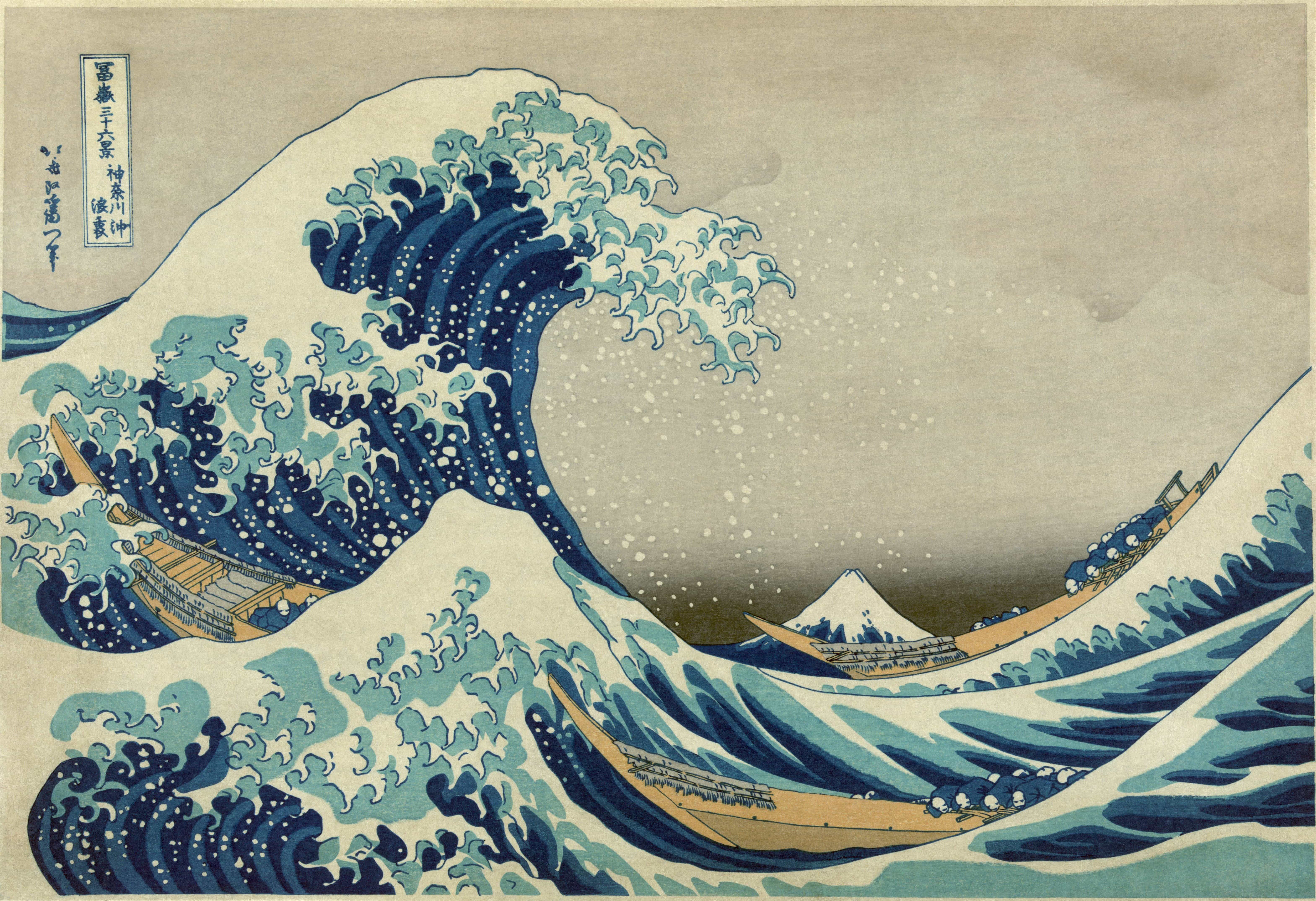
You probably recognize the illustration above, Hokusai’s (1760-1849)

“Great Wave Off Kanagawa” from “Thirty-Six Views of Mt Fuji”, (c.1830-1833).  It seemed a very appropriate illustration for this posting, which is about very high tides and worse.  The posting itself began when I reread this:

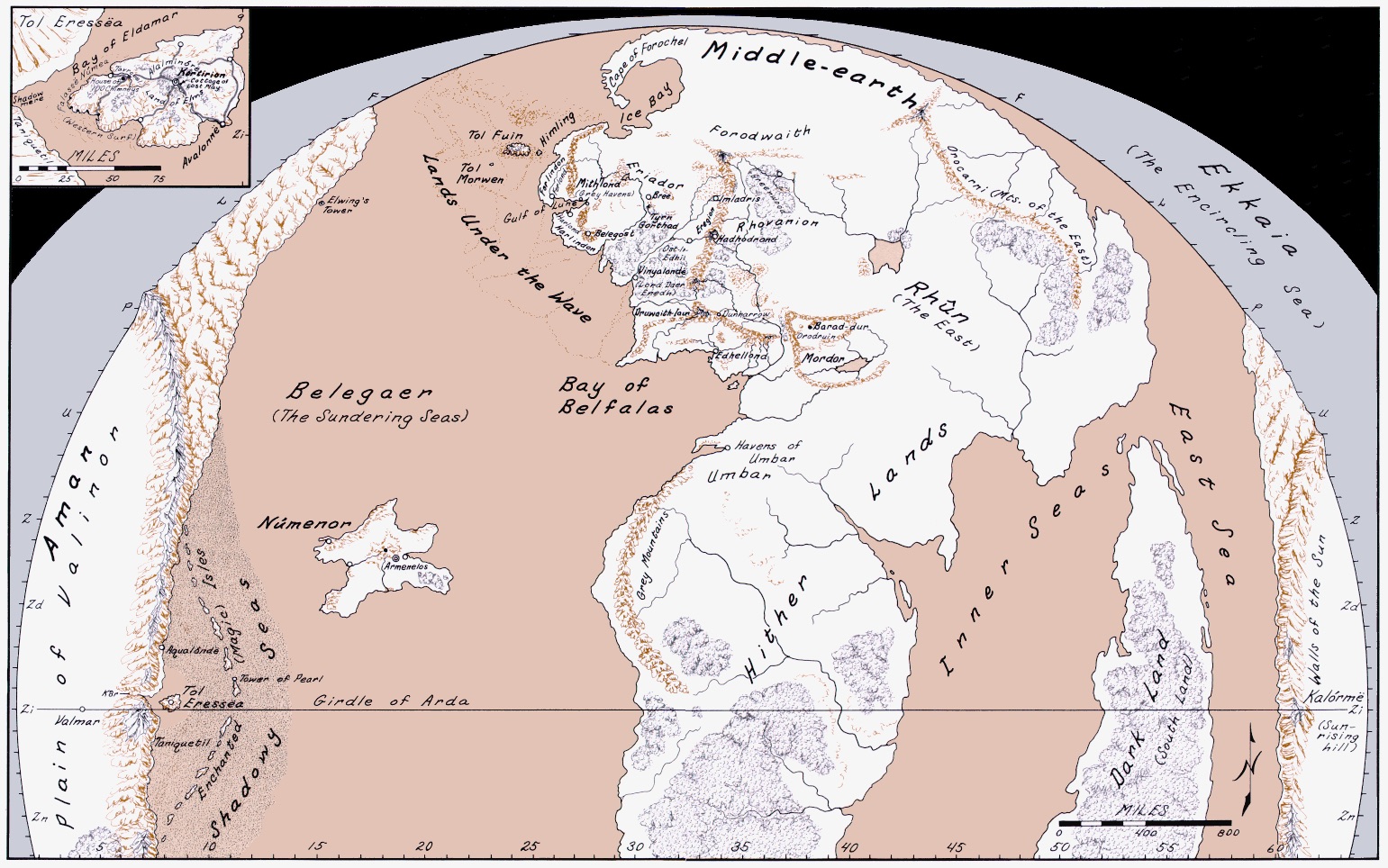
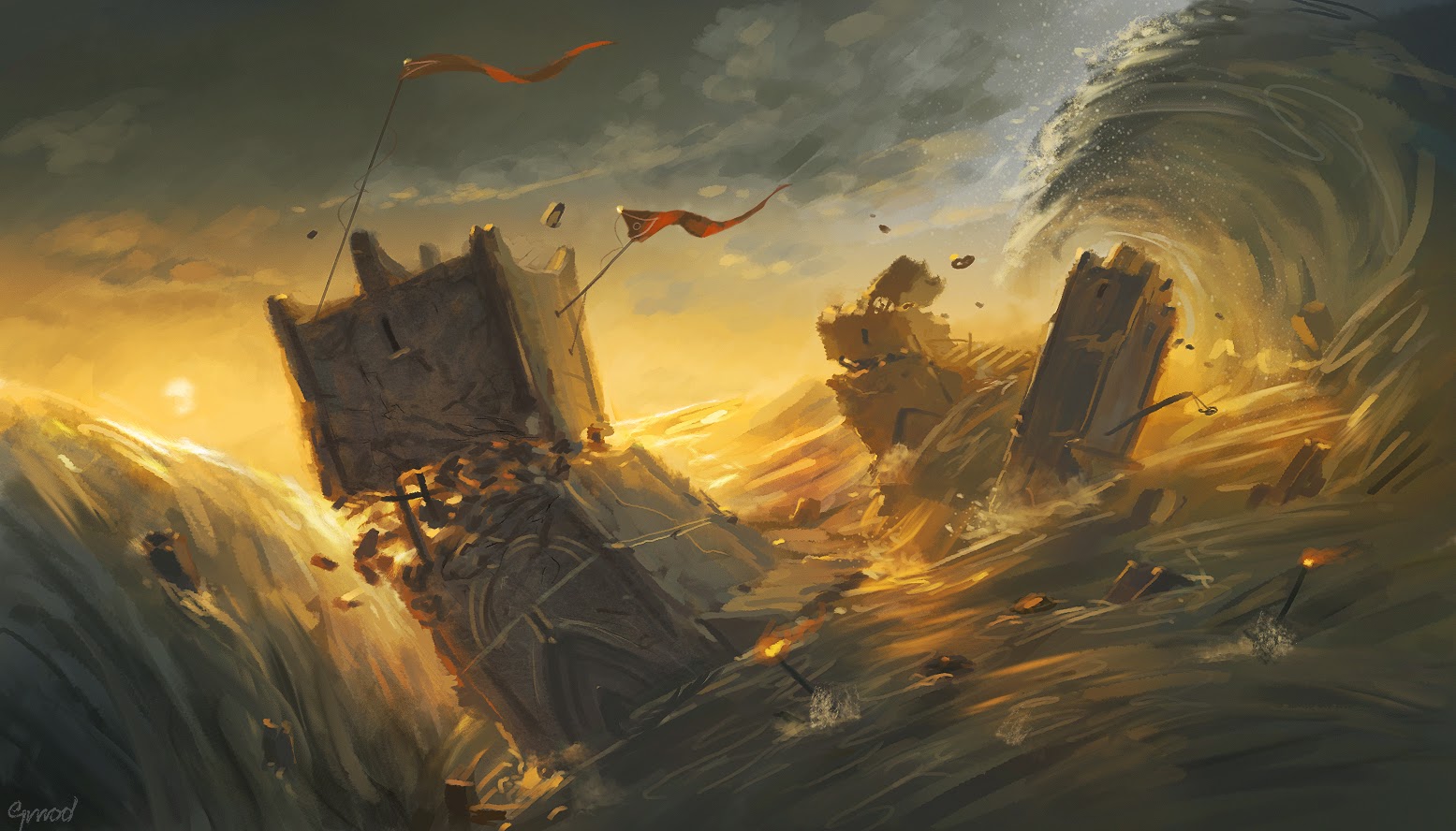
“At length Ar-Pharazon listened to this counsel, for he felt the waning of his days and was besotted by the fear of Death.  He prepared then the greatest armament that the world had seen, and when all was ready he sounded his trumpets and set sail; and he broke the Ban of the Valar, going up with war to wrest everlasting life from the Lords of the West.  But when Ar-Pharazon set foot upon the shores of Aman the Blessed, the Valar laid down their Guardianship and called upon the One, and the world was changed.  Numenor

was thrown down and swallowed in the Sea,

and the Undying Lands were removed for ever from the circles of the world.  So ended the glory of Numenor.”  (The Lord of the Rings, Appendix A, I “The Numenorean Kings”)

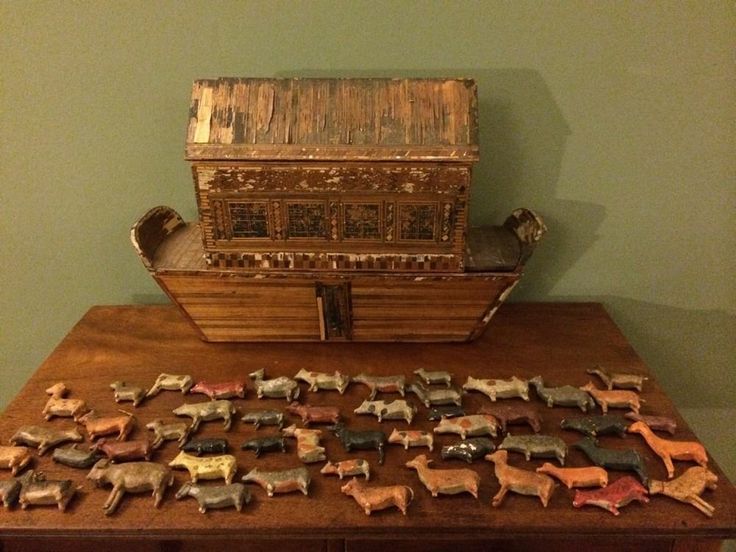
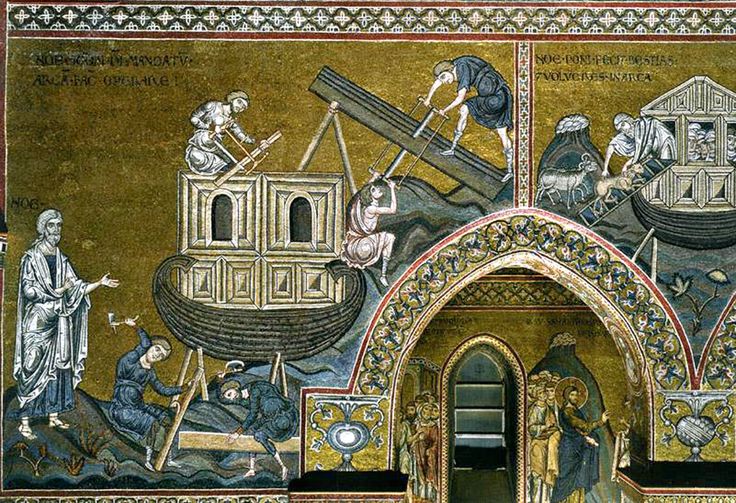
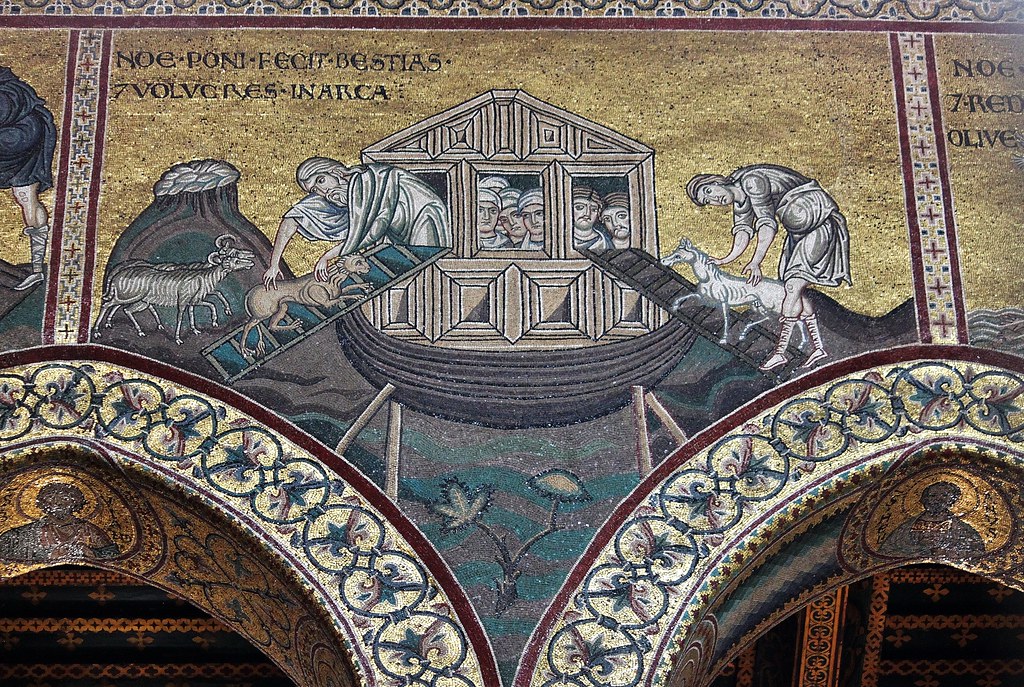
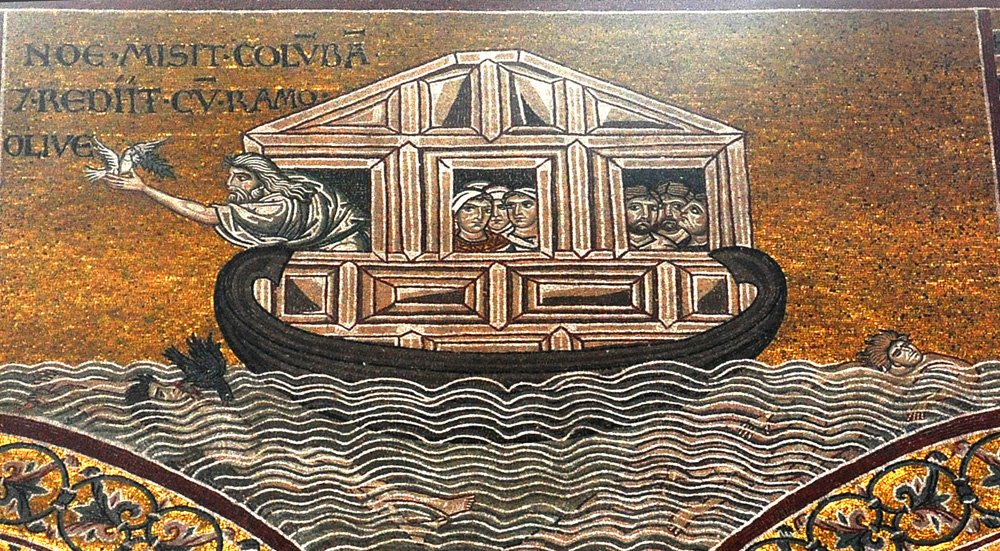
I’m always interested in where Tolkien’s ideas come from and, although he himself related this to the myth of Atlantis (see the letter to Naomi Mitchison, 25 September, 1954, Letters (197-198), If you’ve grown up in the sort of culture, both religious and general, in which Tolkien grew up (and so did I, for that matter) probably your first thought is:  “Hey—it’s Genesis, Chapters 6-8!  The story of Noah’s Ark and the flood!”

(a Victorian children’s toy—pious people thought that somehow play was like work and so children were not allowed to play with their usual toys on Sunday—instead, this toy was brought out)

which is wonderfully illustrated in a series of mosaics in the late 12th-century cathedral of Monreale in Palermo, Sicily.  Here’s Noah and family building the Ark

and Noah gathering the animals

and, hoping that the flood is finally over, Noah is sending out a dove as a scout—and the dove returns.  The Latin text, expanded, reads:  “Noah sent a dove and it returned with the branch of an olive.”  (This is actually rushing things a bit—Noah sent the dove out twice and it was only on the second trip that it came back with the twig.)

The Dove Returns to the Ark

(We can also note the gross realism of including several drowned people in the scene.)

I think, however, that we can see two more potential influences upon JRRT which might lie behind this story of a flooded world. 

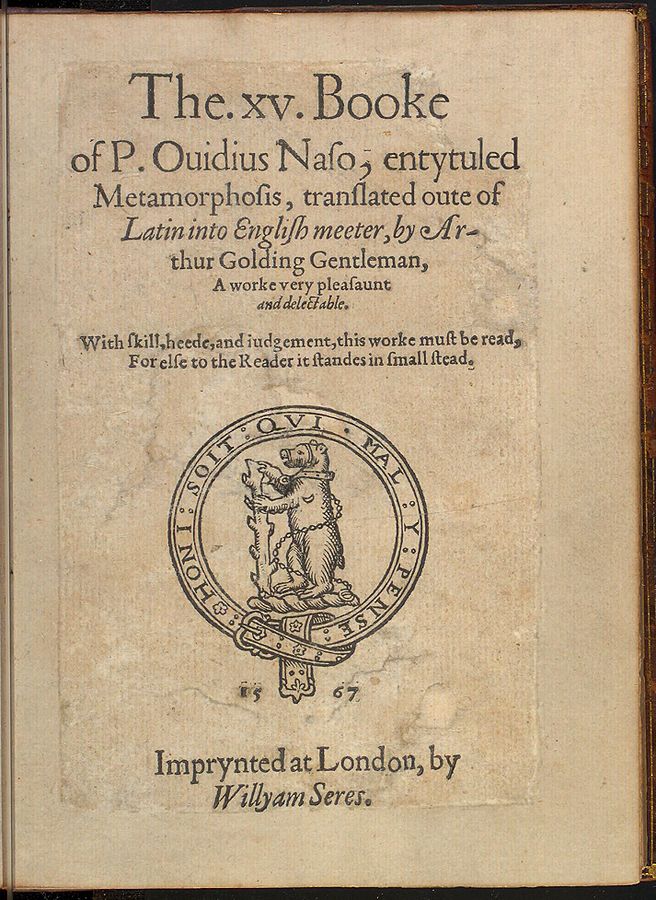
First, JRRT began his academic life as an aspiring Classicist, which means that, probably fairly early on in his training, he had encountered Ovid’s (43BC-17AD) story of the only survivors of a Greco-Roman flood, to be found in Book I, lines 163-415 of Ovid’s Metamorphoses.

(This is Arthur Golding’s translation of 1567, which was the one which Shakespeare must have thumbed through, looking for usable poetic material.)

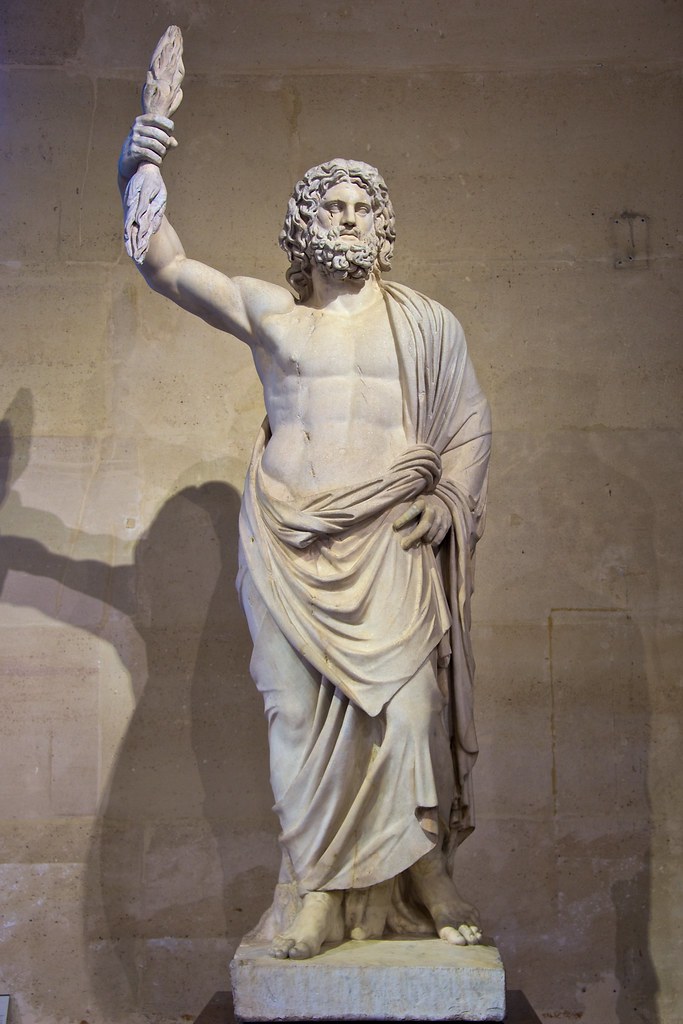
 Jupiter, disgusted with the Age of Bronze (and with the particularly loathsome Lycaon—for more on him see:  https://en.wikipedia.org/wiki/Lycaon_(king_of_Arcadia) ),

floods the earth, leaving only two humans, Pyrrha and Deucalion. 

(Noah and family’s repopulating the now-drying earth is well-known, being done by more or less human—and animal—means, but what happened to recreate the people of Ovid’s world is so surprising that it seemed to me worth a little detour here.

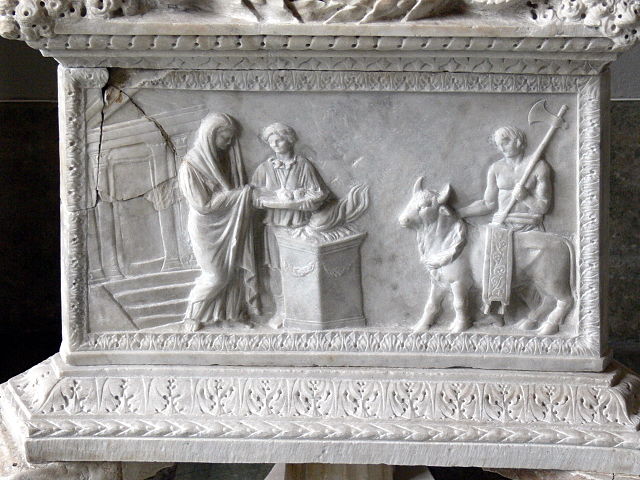
Despairing that they will be the last of their race, Pyrrha and Deucalion consult the goddess Themis (whose temple has survived, although more than a little worse for wear) and she tells them (381-382):

 “discedite templo
et velate caput cinctasque resolvite vestes
ossaque post tergum magnae iactate parentis!”

“Leave the temple

And cover your heads and loose your bound robes

And throw behind you the bones of your great mother!”

(Parens can be masculine or feminine, but the adjective modifying it is feminine, so clearly the goddess here means “mother”.)

Or, if you’d prefer Arthur Golding’s version:

“Depart you hence: Go hide your heads, and let your garmentes slake,
And both of you your Graundames bones behind your shoulders cast.”

(If you’d like your own copy of Golding, here’s W.H.D. Rouse’s 1904 facsimile for you:  https://sourcetext.files.wordpress.com/2018/01/golding_ovid.pdf )

At first, the two are stumped:  disturbing a parent’s bones is a form of sacrilege and these are pious people (which is why they’ve survived).  Then it occurs to Deucalion that Themis is speaking in metaphors (393-394): 

“magna parens terra est: lapides in corpore terrae
ossa reor dici; iacere hos post terga iubemur.”

“Our great mother is the earth:  I think that the stones of the earth

Are meant to be [her] bones; we are bid to throw those behind us.”

Or

“I take our Graundame for the earth, the stones within hir hid
I take for bones, these are the bones the which are meaned heere.”

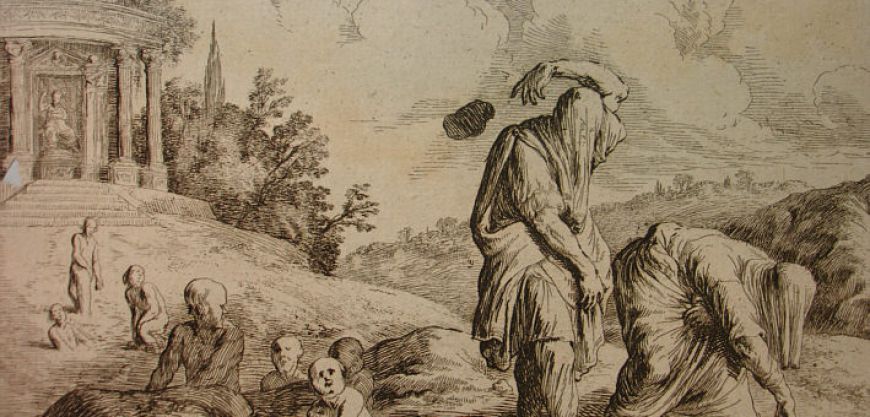
They begin picking up stones and tossing them and, very soon, humans are back. 

Probably this is understood as a form of religious magic and Pyrrha and Deucalion are not supposed to see it at work, which is why:

1. they cover their heads, which is what Romans do at religious ceremonies

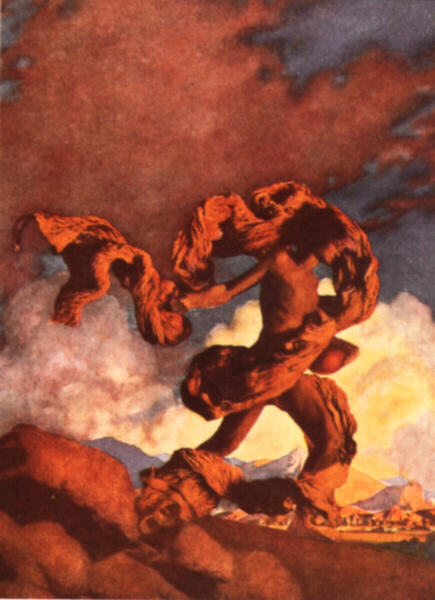
2. they throw the stones over their shoulders, rather than toss them in front of them.  In a way, it reminds me both of the story of Cadmus and the dragon’s teeth, by which he acquired help in founding Thebes, and Aeetes’ challenge to Jason to sow dragon’s teeth which turned into warriors which Jason was then supposed to fight, both stories appearing, among other places, in the latter part of Apollonius’ Argonautica, Book 3.

(This is a 1908 illustration by Maxfield Parrish, 1870-1966, and depicts Cadmus at work.)

As for loosing their garments, perhaps it is related to birthing customs?  When Hera wants to delay the birth of Herakles, Lucina, a childbirth goddess, sits with her legs and fingers crossed to stop the process (Ovid, Metamorphoses, Book 9, lines297-300).  So might loosing what was bound on Pyrrha and Deucalion allow for the free “birth” of people from the stones?)

Beyond Classics, and back to our main topic, we know that Tolkien had an abiding affection for Welsh (“I did not learn any Welsh till I was an undergraduate, and found in it an abiding linguistic-aesthetic satisfaction…” he wrote to W. H. Auden in June, 1955—Letters, 213) and there’s a medieval Welsh legend, involving two characters, named Dwyfan and Dwyfach, who survive their own flood, when a lake monster, the Afanc, inundates the world and the two, along with two of each species of animal which they’ve loaded into a boat (the boat being called Nefyd Naf Neifion—“Celestial Lord Neptune”?), are the only survivors.  The story appears in a medieval collection called Trioedd Ynys Prydain, “The Triads of the Island of Britain”, printed and translated by William Probert as an appendix to his The Ancient Laws of Cambria, 1823.

“13.  There were three awful events in the Isle of Britain.  The first was the bursting of the Lake of Floods, and the rushing of an inundation over all the lands, until all persons were destroyed except Dwyvan and Dwyvach who escaped in an open vessel; and from them the Isle of Britain was re-peopled.” (The Ancient Laws of Cambria, page 379)

This should be read in conjunction with part of Number 97:

“the ship of Nwydd Nav Neivion, which brought in it a male and a female of all living things when the lake of floods burst forth…” (page 466)

(For your own copy of the text:  https://archive.org/details/ancientlawscamb01probgoog )

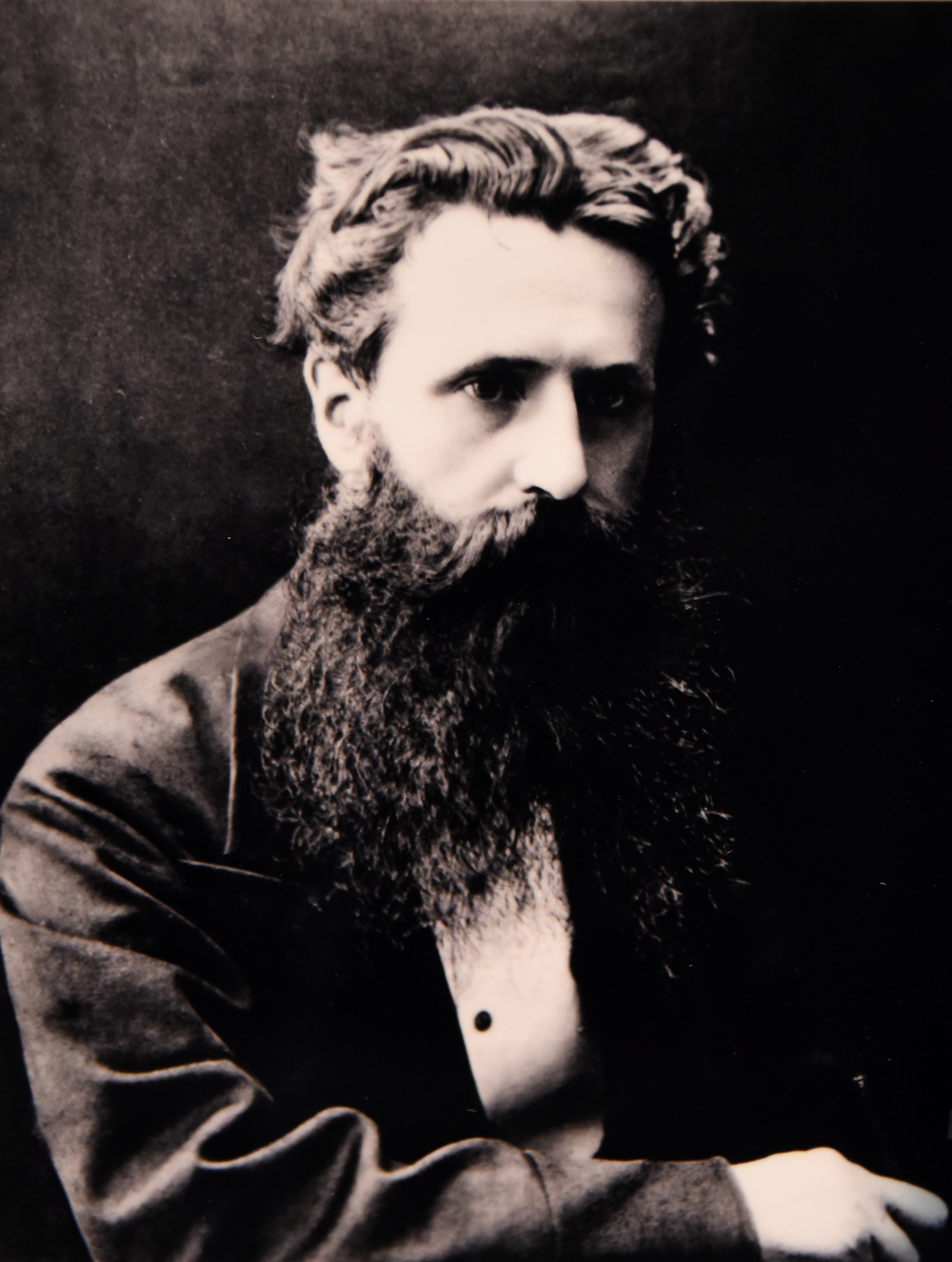
Latin or Welsh were two languages with which Tolkien had significant experience, but is there yet another possible influence?  In 1873, the Assyriologist George Smith (1840-1876)

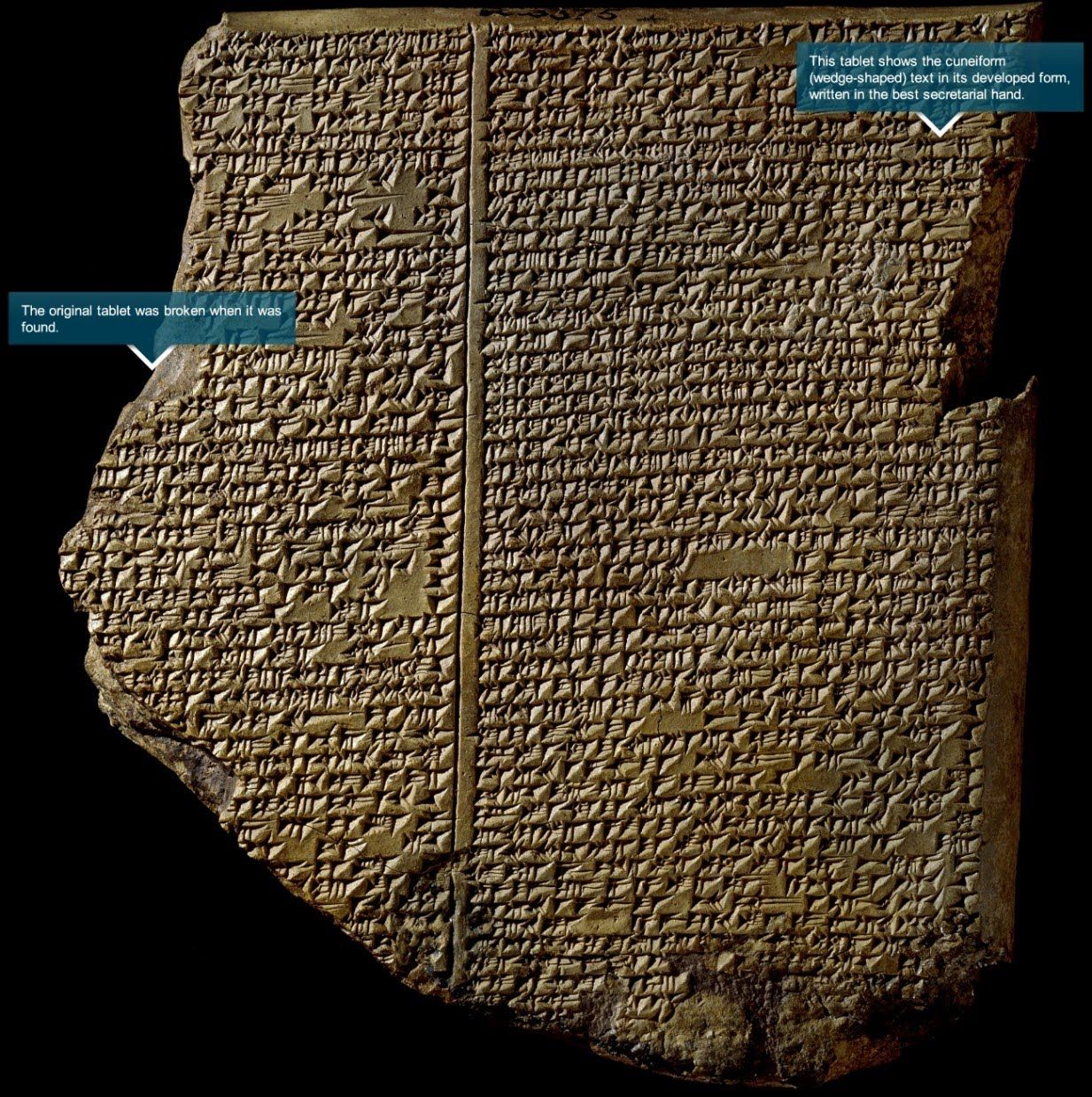
published an essay in Transactions of the Society of Biblical Archaeology (here it is:  https://sacred-texts.com/ane/chad/chad.htm ) which later formed part of book  which caused a great deal of controversy at the time.  Entitled “The Chaldean Account of the Deluge”, it included a translation of this cuneiform tablet–

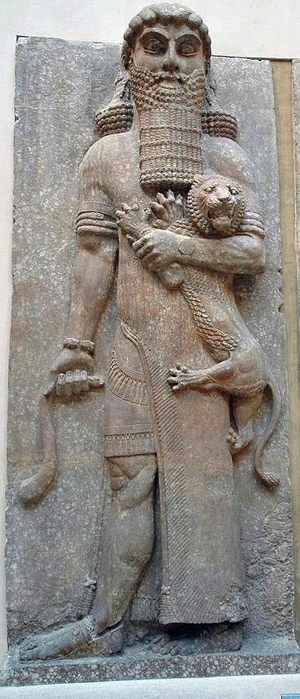
The tablet was dated to the 7th century BC  and formed part of the story of the ancient Mesopotamian  hero, Gilgamesh.  This particular tablet carried a text which described a Noah-like figure, the boat he built, his collecting of animals to stock the boat, and the flood which that boat then survived. 

(Here’s a copy of the very book for you:  https://ia800900.us.archive.org/27/items/chaldeanaccounto00smit/chaldeanaccounto00smit.pdf  If you want to look at the translation of material relevant to the flood, see pages 263- 273.   The tablet itself is in the British Museum and you can read more about it at:  https://www.britishmuseum.org/collection/object/W_K-3375 )

That controversy was in the Victorian world, almost 20 years before Tolkien’s birth, but as an active scholar—and active Bible-reader (there are 19 references to it in Letters and JRRT was even once involved in the production of the Jerusalem Bible—see his self-deprecating comment to Charlotte and Denis Plimmer, February, 1967, Letters, 378), perhaps it wouldn’t seem surprising if he were aware of an ancient Near Eastern parallel to the familiar story of Noah—although from his reactions in his correspondence, which ranged from the frustrated to the downright hostile, to some of the parallels readers and critics attempted to draw between his work and other matters, I will not suggest that there might be any connection between the questing hero of a Sumerian text and certain hobbits…

Thanks, as ever, for reading.

Stay well,

Consider what creatures you might leave off your ark,

And remember that there’s always

MTCIDC

O

ps

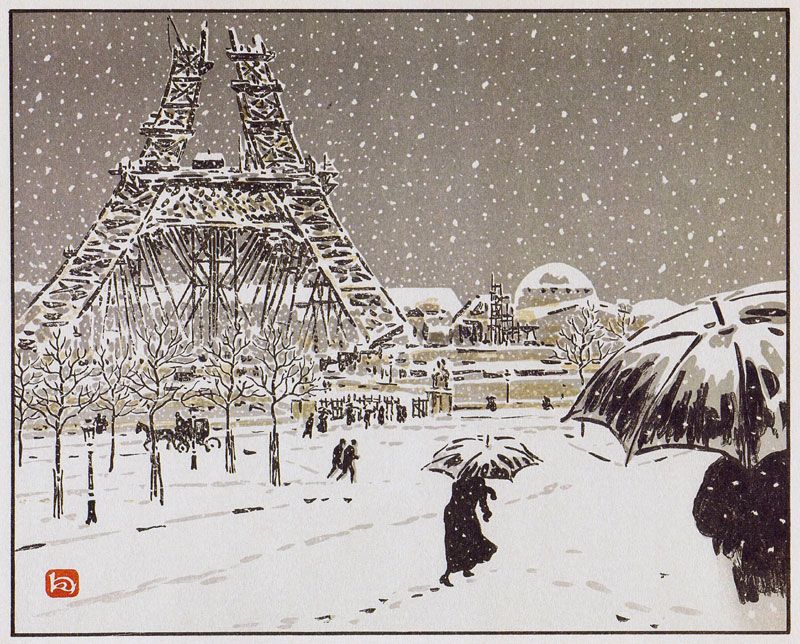
If you enjoy the Hokusai, you might also enjoy Henri Riviere’s (1864-1951) turn-of-the-century “36 Views of the Eiffel Tower” which was obviously influenced by the earlier Japanese work.  A useful website is:  https://armstrongfineart.com/blogs/news/henri-riviere-the-thirty-six-views-of-the-eiffel-tower  And here is one of the set—

Weeping—no, Eating?—Willow

30 Wednesday Mar 2022

Posted by Ollamh in Uncategorized

≈ 1 Comment

Des. The poore Soule sat singing, by a Sicamour tree.

Sing all a greene Willough:

Her hand on her bosome her head on her knee,

Sing Willough, Willough, Wtllough.

(Shakespeare, Othello, Act 4, Scene 3, from the First Folio, 1623—here’s a LINK to the Folio:  https://internetshakespeare.uvic.ca/doc/Oth_F1/complete/index.html  You can also see, from that last line, that printers weren’t always so accurate as they might be! )

 As always, dear readers, welcome.

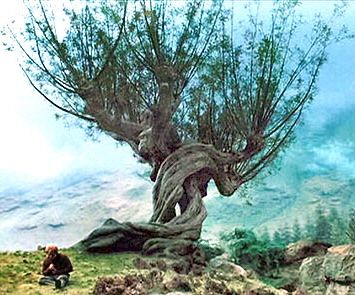
Old Man Willow,

for all that he obeys Tom Bombadil

(a lovely piece by Roger Garland)

to free Merry and Pippin:

“You let them out again, Old Man Willow!…What be you a-thinking of?  You should not be waking.  Eat earth!  Dig deep!  Drink water!  Go to sleep!  Bombadil is talking!”  (The Fellowship of the Ring, Book One, Chapter 6, “The Old Forest”)

seems, like the Watcher in the Water, in the pool to the east of the Mines of Moria,

to remain a kind of brooding menace.   As the author describes him:

“But none were more dangerous than the Great Willow:  his heart was rotten, but his strength was green; and he was cunning, and a master of winds, and his song and thought ran through the woods on both sides of the river.  His grey thirsty spirit drew power out of the earth and spread in fine root-threads in the ground, and invisible twig-fingers in the air, till it had under its dominion nearly all of the trees of the Forest from the Hedge to the Downs.”  (The Fellowship of the Ring, Book One, Chapter 7, “In the House of Tom Bombadil”)

(JRRT’s drawing, which seems remarkably peaceful for such a threatening creature.  Perhaps  he is striving to suggest that the surface was that of a willow, but within was that rotten heart?  Or did his love of trees prevent him from depicting the real OMW?)

As well, like Tom and like Treebeard and the Ents (and Entwives), he is, for me, one of the ancient mysteries of Middle-earth.   What is he really?  Where does he come from?  Why is he there?

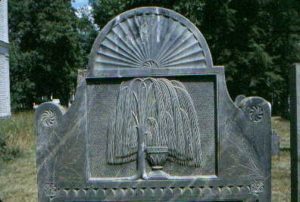
Two earlier postings (“Never a Willow”, 8/7/19 and “Never That Willow”, 8/14/19) had much to say about Old Man Willow in particular and about willows in general, including their use, for centuries, as a symbol of mourning—

(An especially beautifully-carved example)

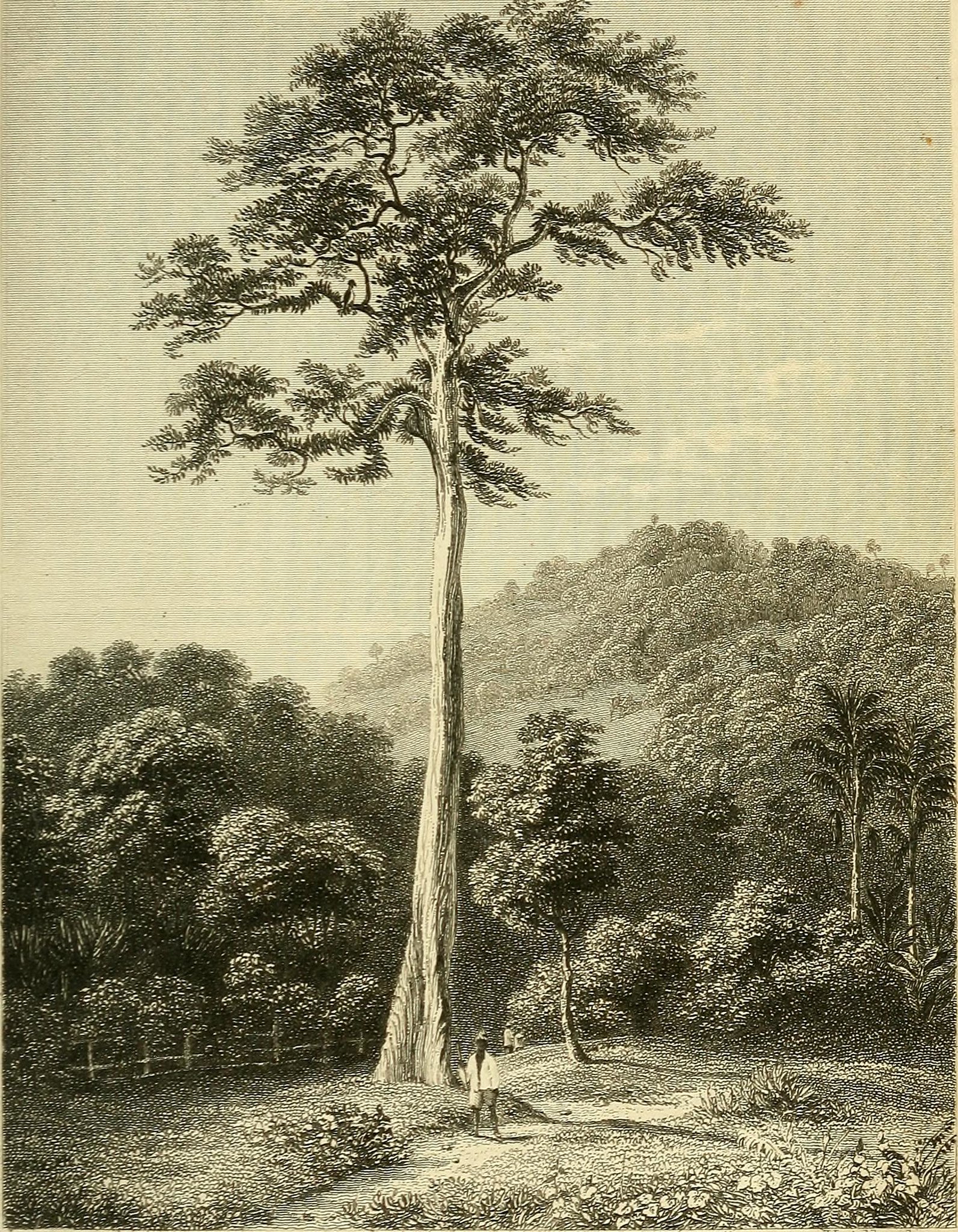
Old Man Willow’s behavior, however, suggests  that, rather than being a symbol for mourning, he can become a source of mourning and, as such, he falls into a category of deadly plants like the once ill-famed upas tree.

This is a widespread variety of tree, Antiaris toxicaria, which can be found from Africa all the way across to the western Pacific.

(This illustration is from a highly-informative and surprisingly jolly website, considering its subject matter, entitled “Nature’s Poisons”:   https://naturespoisons.com/ )

Travelers’ tales reported that the plant gave off a kind of noxious fume which poisoned the landscape for 10 miles around, leaving the vicinity empty save for the bones of unwary animals and people.  Although this was proven to be more than an exaggeration in the early 19th century, a deadly poison can be extracted from the tree and was used by various indigenous peoples to tip their darts and arrows.

(For more on this, see the article at “Nature’s Poisons”:   https://naturespoisons.com/2019/07/17/antiarin-upas-tree-antiaris-toxicaria/ )

An even more spectacular tree—if possible—was the so-called “Man-eating tree of Madagascar”.

This was actually a hoax, first perpetrated, it seems, in an article by someone called Edmund Spencer for The New York World, first published on April 26th, 1874.  As was the custom in the 18th and 19th centuries, the story was reprinted in other newspapers, including this description, which I have from The South Australian Register from later the same year.  Here, the (now known to be imaginary) Mkodo tribe made the sacrifice of a woman to the tree–

“The slender delicate palpi, with the fury of starved serpents, quivered a moment over her head, then as if instinct with demoniac intelligence fastened upon her in sudden coils round and round her neck and arms; then while her awful screams and yet more awful laughter rose wildly to be instantly strangled down again into a gurgling moan, the tendrils one after another, like great green serpents, with brutal energy and infernal rapidity, rose, retracted themselves, and wrapped her about in fold after fold, ever tightening with cruel swiftness and savage tenacity of anacondas fastening upon their prey.”

(quotation from The South Australian Register  as found on the Nova  Online Adventure website in part 2 of an article on “A Forest Full of Frights”:   https://www.pbs.org/wgbh/nova/madagascar/surviving/frights2.html   Warning:  if things which threaten your eyes disturb you, DO NOT READ THE SECTION ENTITLED “EYE SORE”!)
This sounds rather like an acrobatic variety of Venus flytrap, a predator plant I was surprised to learn was not a jungle plant, but grows in subtropical areas of the US, in North and South Carolina.

An insect victim walks across its sensitive pad centers and it instantly closes around it, then beginning the digestive process.

This makes me wonder what would have happened to Merry and Pippin, had there been no Tom Bombadil…

As ever, thanks for reading.

Stay well,

Never drowse near a carnivorous willow,

And remember that, as always, there’s

MTCIDC

O

PS

For an especially disturbing short story about such things, read Algernon Blackwood’s “The Willows”  (from his 1907collection, The Listener and Other Stories here:  http://algernonblackwood.org/Z-files/Willows.pdf  )

PPS

And a friend reminds me that there’s another very destructive, if not carnivorous, willow I should mention.

PPPS

For more on poisonous plants, see:  https://www.learnaboutnature.com/plants/carnivorous/

Character Development

23 Wednesday Mar 2022

Posted by Ollamh in Uncategorized

≈ Leave a comment

Welcome, dear readers, as ever.

Where do characters come from?  Sometimes, it seems, out of the air.  As Tolkien

wrote of Aragorn:

“So the essential Quest started at once.  But I met a lot of things along the way that astonished me. .. Strider sitting in the corner of the inn was a shock, and I had no more idea of who he was than had Frodo.” (a wonderfully interesting letter to W.H. Auden, 7 June, 1955, Letters, 216)

But even with such a surprise—and the letter goes on to detail more–Tolkien was always working with a deeper purpose, as we know from this familiar passage:

“The invention of language is the foundation.  The ‘stories’ were made rather to provide a world for the languages than the reverse.  To me a name comes first and the story follows it.” (“To the Houghton Mifflin Co.” nd, but sometime in mid-1955, Letters, 219)

Language needed speakers perhaps as much as stories needed characters.

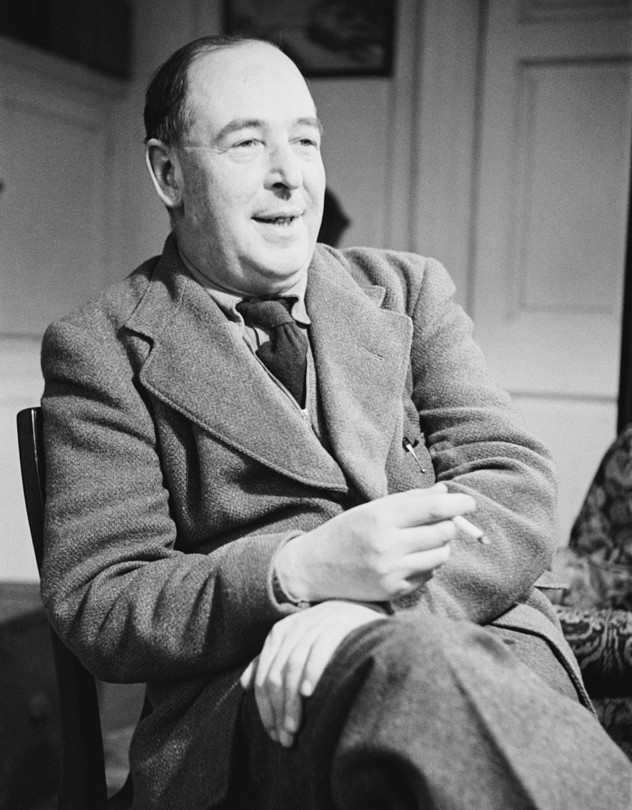
Tolkien’s friend,  C.S. Lewis,

had a different approach:

“One thing I am sure of.  All my seven Narnia books, and my three science-fiction books, began with seeing pictures in my head.   At first they were not a story, just pictures.  The Lion all began with a picture of a Faun carrying an umbrella and parcels in a snowy wood.  This picture had been in my mind since I was about sixteen.”  (“It All Began with a Picture” in Of Other Worlds, 67)

But recently I’ve been thinking about a somewhat earlier author, L. Frank Baum (1856-1919)

who once wrote:

“A lot of thought is required on one of these fairy tales.  The odd characters are a sort of inspiration, liable to strike at any time, but the plot and plan of adventures takes me considerable time to develop.  When I get at a thing of that sort I live with it day by day, jotting down on odd slips of paper the various ideas that occur and in this way getting my material together.  The new Oz book is in this stage…But…it’s a long way from being ready for the printer yet.  I must rewrite it, stringing the incidents into consecutive order, elaborating the characters, etc.” (letter to Sumner C. Britton, 23 January, 1916, quoted in M.P. Hearn, The Annotated Wizard of Oz, xxxvi-xxxvii)

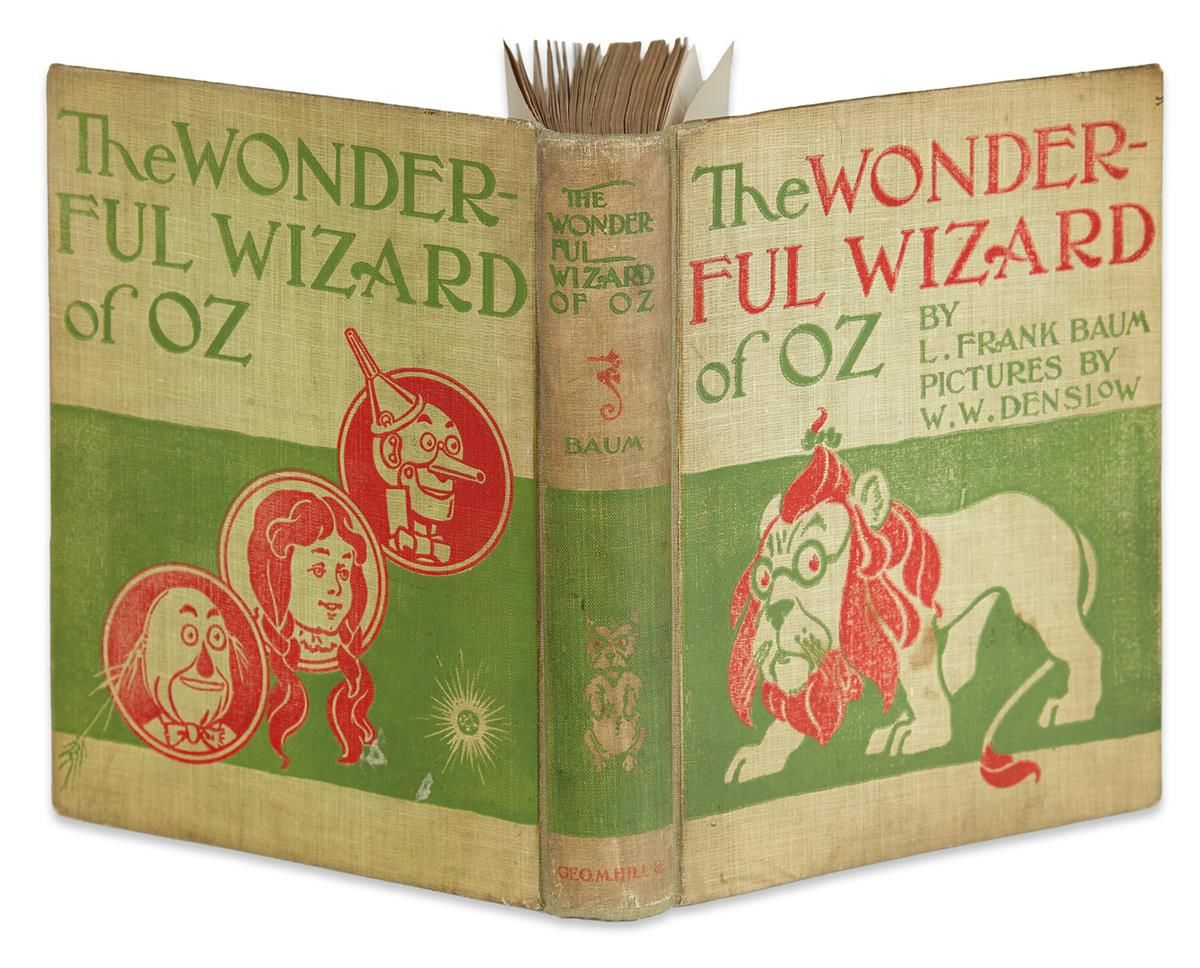
The first of these Oz books was, of course, The Wonderful Wizard of Oz, published in 1900.

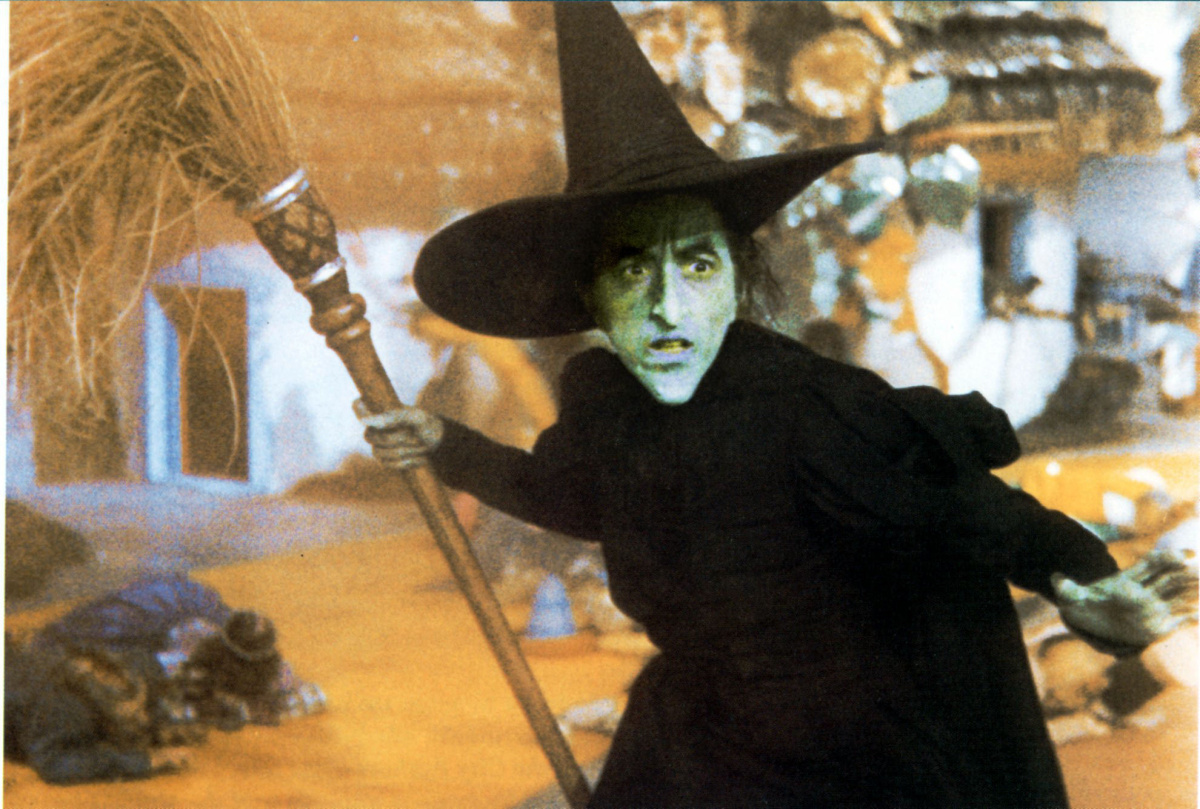
If you grew up with the 1939 musical movie,

before ever reading the original book, as I did, you were surprised to see just how different the two were, everything from the “ruby slippers”,

which were silver in the book,

to the whirlwind appearance and disappearance of the Wicked Witch of the West fairly early in the film.

In the book, she appears late—and it’s not only that there’s no appearance/disappearance, but also her actual appearance is so radically different.

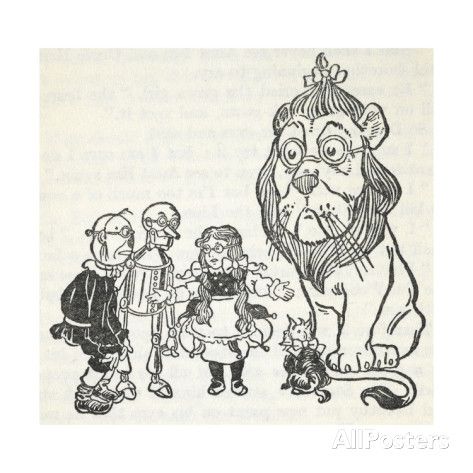
One thing which hadn’t been fundamentally changed, however, were those four principal characters, Dorothy, the Scarecrow, the Tin Woodsman, and the Cowardly Lion,

even if their appearance had.

The bibliography on Baum and his books is huge, not to mention websites devoted to him and his works—the Oz Club link will show you one such, with tons of information about every facet of author and books:  https://www.ozclub.org/ .  There are also, as you can imagine, interpretations, from the literary to the Freudian and back, but I, for one, tend not to read such things, preferring to form my own opinion of what the author might intend.

In the case of Dorothy’s three main friends, they strike me as immediately falling into the standard folktale category of “animal/magic helpers”.  The Lion

has always seemed the easiest to interpret—since antiquity, lions have always been a symbol of courage—why would Richard I of England (1157-1199) be “Richard the Lionheart” otherwise?

(This is the seal of Richard and it’s characteristic of the man, not much of a king perhaps, considering how little time he spent as monarch in England—maybe only 6 months, it is thought–but certainly a warrior.)

 I think that we can imagine that Baum held the traditional view, but, by reversing it, we have a fresh character, who, at first, may seem a less than magical helper, since his reputation is based upon nothing more than his roar:

“I learned that if I roared very loudly every living thing was frightened and got out of my way.” (The Annotated Wizard of Oz, Chapter VI, 109)

Always the optimist, however, Dorothy says:

“You will be very welcome…for you will help to keep away the other wild beasts.  It seems to me they must be more cowardly than you to scare them so easily.”  (The Annotated Wizard of Oz, Chapter VI, 112)

We know that Tolkien very much resisted any symbolic or allegoric readings being attached to his work.  As he once wrote:

“There is no ‘symbolism’ or conscious allegory in my story.  Allegory of the sort ‘five wizards=five senses’ is wholly foreign to my way of thinking.  There were five wizards and that is just a unique part of history.  To ask if the Orcs ‘are’ Communists is to me as sensible as asking if Communists are Orcs.” (letter to Herbert Schiro, 17 November, 1957, Letters, 262)

In the same letter, however, he goes on to say:

“That there is no allegory does not, of course, say there is no applicability.  There always is.”

And I would use this as the basis of a possible interpretation of the other two “magical helpers”, the Scarecrow and the Tin Woodman.

If the Lion, usually understood to signify “Courage”, could be inverted initially to stand for “Cowardice”, I wonder if we might understand that, at some level, these two might signify two sides of the US at the turn of the century as Baum might have seen them.

The Industrial Revolution had come to the country as early as the young republic, first appearing in the Slater Mill, which harnessed water power to spin cotton thread, in 1793.

Throughout the 19th century, the northern US in particular was gradually moving towards a machine world, with railroads,

the telegraph,

and bigger and bigger factories, driven by steam, rather than waterpower,

turning out identical items on assembly lines.

(This last is from Charlie Chaplin’s 1936 film Modern Times and here’s the LINK to the whole scene which I think pretty much sums up the consequences of humans turned into parts of a machine:  https://www.youtube.com/watch?v=giJ0YMaAc8s )

And so it might seem natural that one of the helpers  is a kind of mechanical man, suggesting that industrial world which the US was  fast becoming in 1900.

And perhaps it’s significant that he’s missing a heart?

Baum, although living most of his life in towns and cities, saw himself as coming from the other America, the agrarian world in which the country had begun and which, in 1900, much of the country still was.

Scarecrows were in every cornfield,

so they would have been a significant part of the landscape—if a creepy part, perhaps, to an imaginative boy:

“When I was a boy, I was tremendously interested in scarecrows.  They always seemed to my childish imagination as just about to wave their arms, straighten up and stalk across the field on their long legs.  I lived on a farm, you know.  It was natural then, that my first character in this animated life series was the Scarecrow, on whom I have taken revenge for all the mystic feeling he once inspired.”  (The Annotated Wizard of Oz, 64, quoting an interview in the North American, 3 October, 1904)

But, as the Tin Woodman is missing a heart, should we think about the fact that the Scarecrow is lacking brains?

I’m always wary to take such things too far after all, that’s just the sort of thing which I avoid reading —but, when we group the three together, we find one who says that he has no sense, one who has no emotions, and one who has no courage, and yet they all aspire to gain such, as if there is always the possibility for self-improvement.

We know that Tolkien, although he clearly enjoyed the story-making, also had the goal of giving his languages context and Lewis is pretty plain in saying that the Narnia  books have a religious goal in the midst of the exciting narrative (see “Sometimes Fairy Stories May Say Best What’s To Be Said” in Of Other Worlds).  Baum had seemingly no greater goal than entertainment, but, just like The Lord of the Rings, The Wonderful Wizard of Oz is a Quest.

Baum himself was a self-made man, having been everything from a dry goods store proprietor to a traveling salesman to a newspaper reporter to a dramatist to an expert on shop display windows before eventually becoming a very successful children’s book author.  I don’t believe that he would have wanted to take this image too far, but could I at least suggest that we might see the possibility that, to Baum, American agriculture and industrialism each lack something, but perhaps, with the self-awareness that each of his characters possesses, combined with courage, they might—as in the book and the film—gain what they feel they are missing and become whole?

Thanks, as ever, for reading.

Stay well,

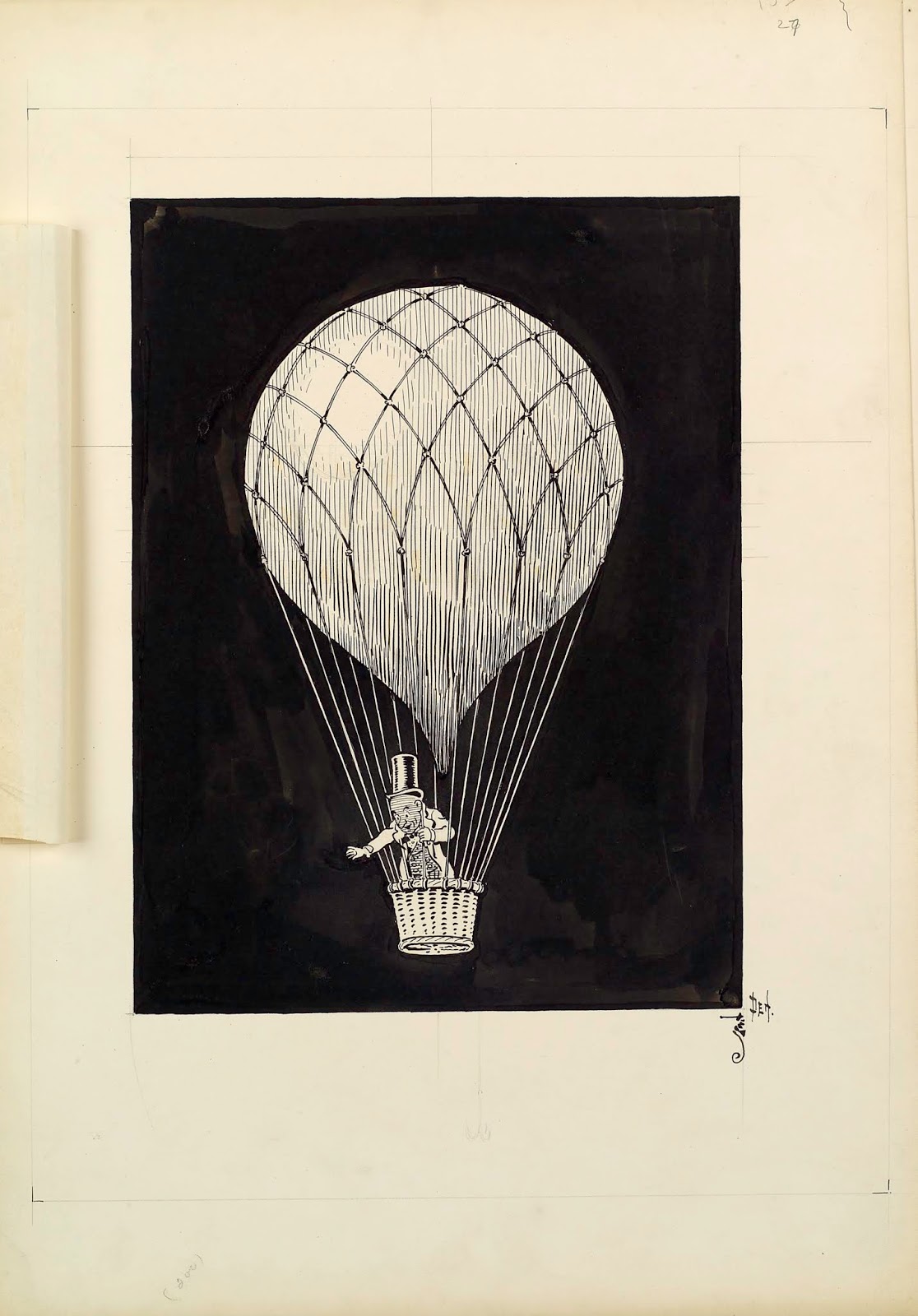
Avoid aircraft vulnerable to gusts of wind

And know that, as always, there’s

MTCIDC

O

PS

In case you still don’t have your own copy of the original Oz book of 1900 with Denslow’s illustrations, here’s a LINK :   https://archive.org/details/wonderfulwizardo00baumiala

Wars of the Angels

16 Wednesday Mar 2022

Posted by Ollamh in Uncategorized

≈ Leave a comment

As always, welcome, dear readers.

With a background in the Greco-Roman world, I’m never surprised that the divine seems always a part of human endeavors in ancient literature and even history.  Gods are regularly assumed to be behind the actions of humans, either to benefit  human worshippers (and sometimes their own semi-divine children) or to act on their own behalf (often to oppose the actions of their divine opponents).   Gods are always being worshipped, prayed to, sacrificed to, or blamed.

It has always puzzled me, then, that the movie Troy (2004),

with the exception of Achilles’ mom, Thetis,

left out the entire pantheon of gods,

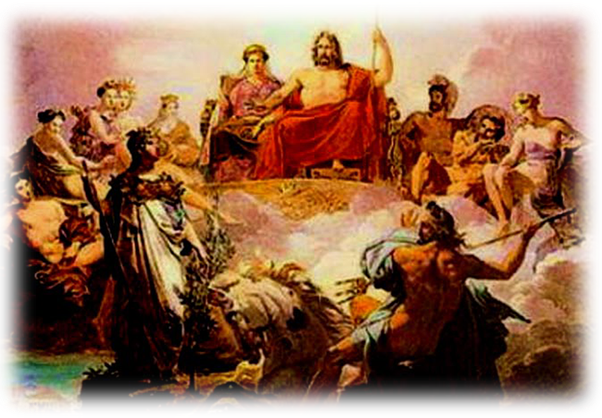
who actually make up half the cast of major characters in the original story.

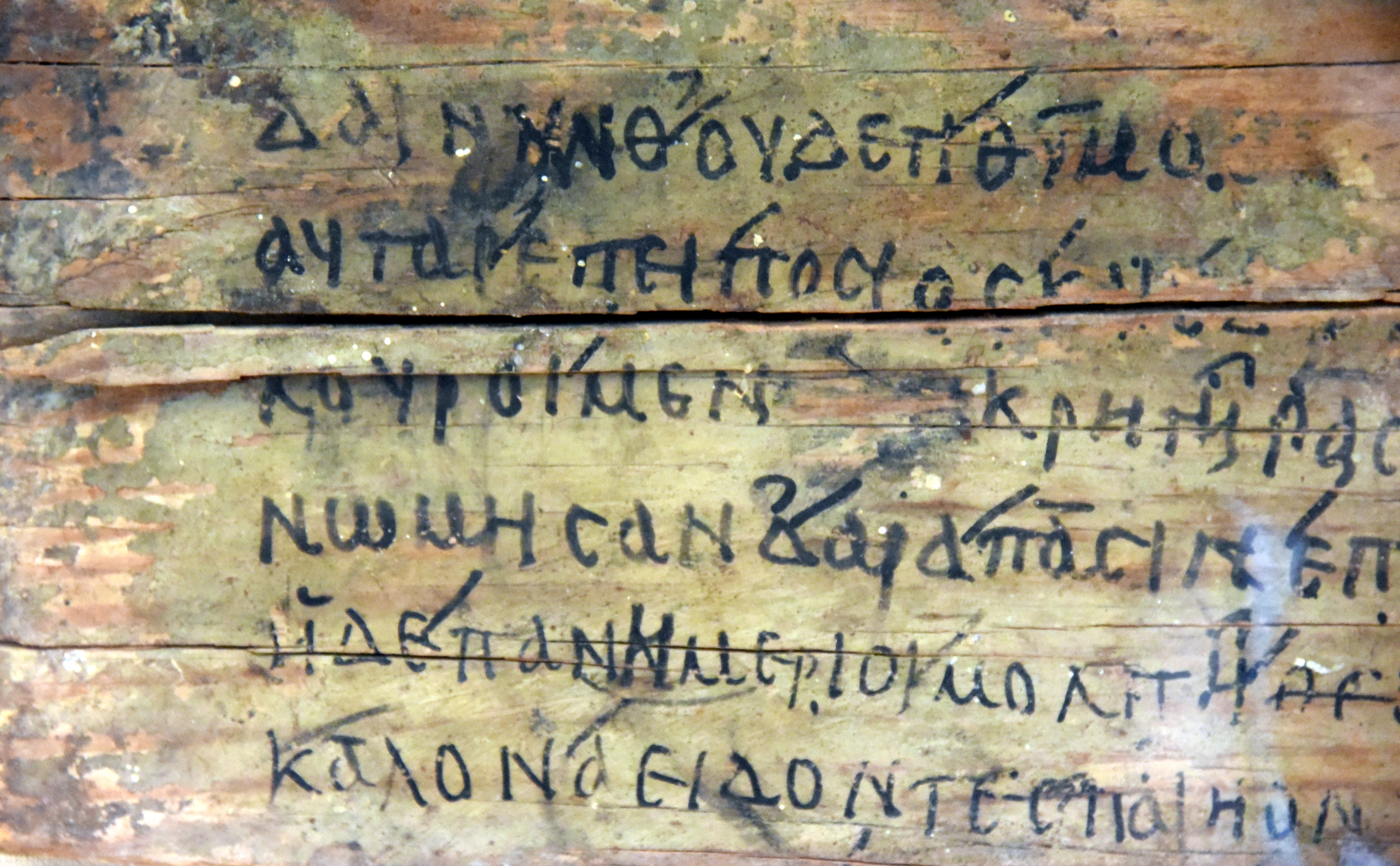
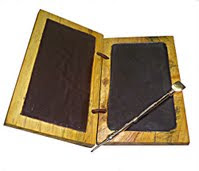
(This is a part of what would have been a pair of writing tablets

recovered from Egypt, c.400-500AD.  It contains lines 468-473 of Book 1 of the Iliad.)

In fact, the Trojan War itself was caused by gods when:

1. Zeus forced Thetis to marry a mortal, Peleus.

(in one version of the story, Thetis is a shape-shifter and Peleus has to catch her)

2. At the wedding of the two, the goddess Eris, who, because, she is the divine form of strife, wasn’t invited, rolls in a golden ball/apple which is labeled “for the most beautiful”.

(there is a wedding procession on the top band of the vase here)

(Eris is dropping the ball/apple from above, rather than bowling it.)

3. Athena, Hera, and Aphrodite all claim it.

4. When Zeus wisely refuses to choose, they go to a (presumably) unbiased mortal, Paris, a shepherd

5. who is offered,  by Aphrodite, Helen,“the most beautiful woman in the world”, but who just happens to be married to Menelaus, the younger brother of the main king of the Greeks, Agamemnon.  Helen, depending upon the version you prefer, is stolen/elopes with Paris, who turns out not to be a shepherd, but a Trojan prince.

(clearly a stolen Helen version here)

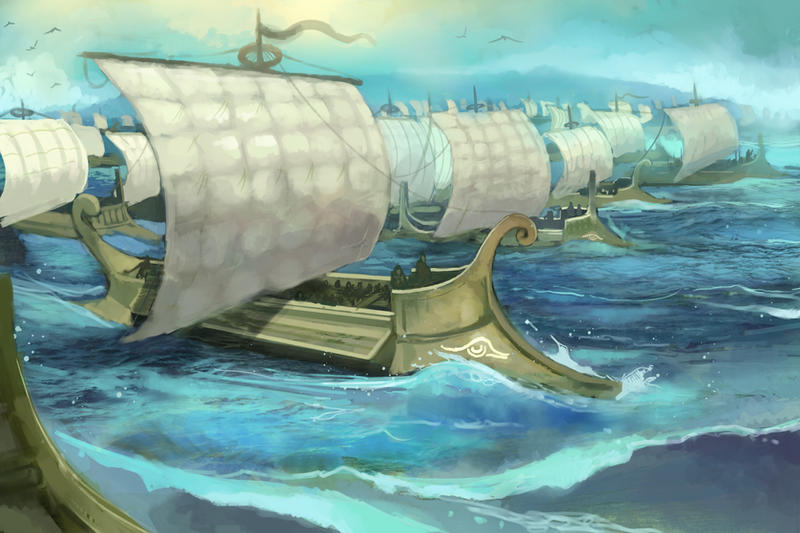
6. Menelaus calls on his big brother for help, and suddenly there are those 1000 ships.

(by Jon Hodgson—have a look at his webpage at Deviant Art:  https://www.deviantart.com/jonhodgson/gallery   He seems able to paint/draw/design anything in fantasy—see his website at:  https://jonhodgsondesign.com/about-jon-hodgson/  for more.)

7. The war which follows is on two levels, the humans—Trojans versus Greeks—and the gods, roughly divided between Hera, Athena, and Poseidon on the Greek side and Apollo, Aphrodite (surprise!), and Ares on the Trojan, with Zeus in the middle.

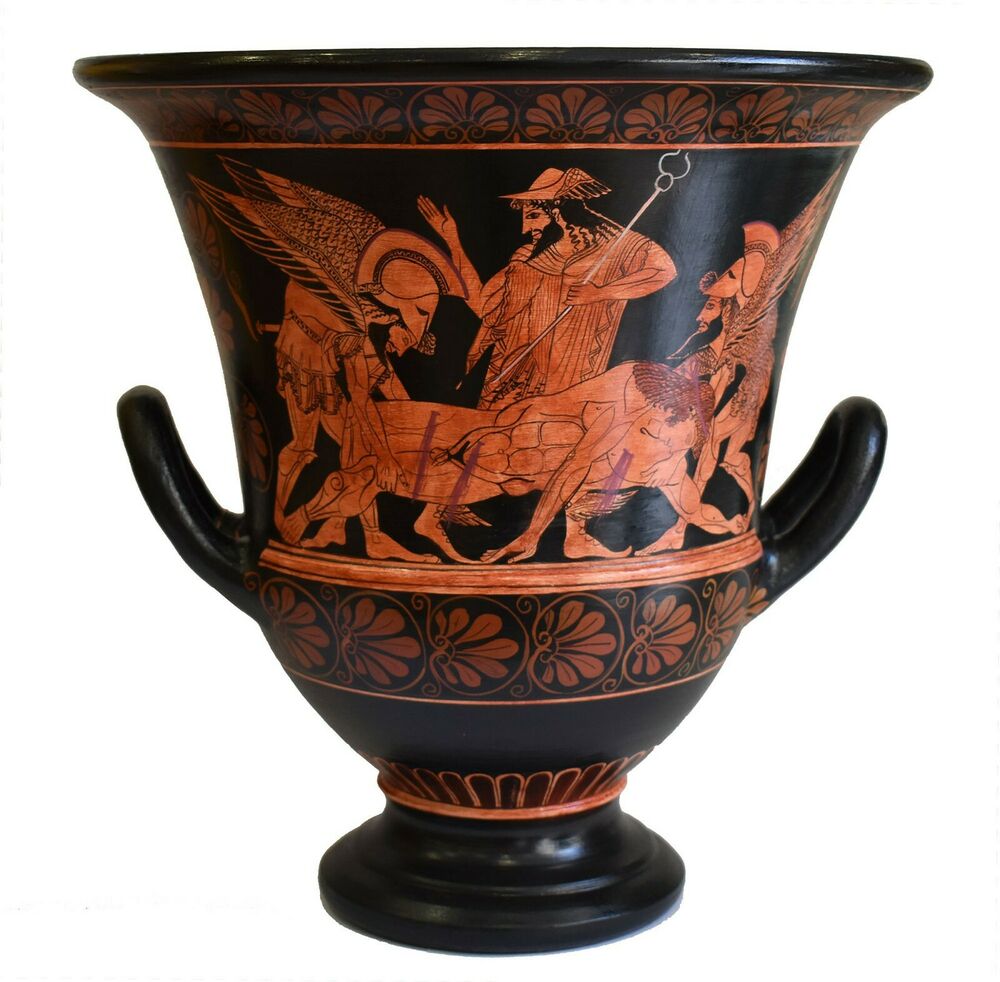
The Iliad is full of the gods’ interference, one of the saddest moments being when Zeus is forced to watch one of his favorite mortal children, Sarpedon, be killed and is warned by Hera not to intervene lest all of the other gods begin favoring their children (which they sometimes do anyway).

(Here Sarpedon’s body is being carried off by the twins, Sleep and Death, while Hermes directs.)

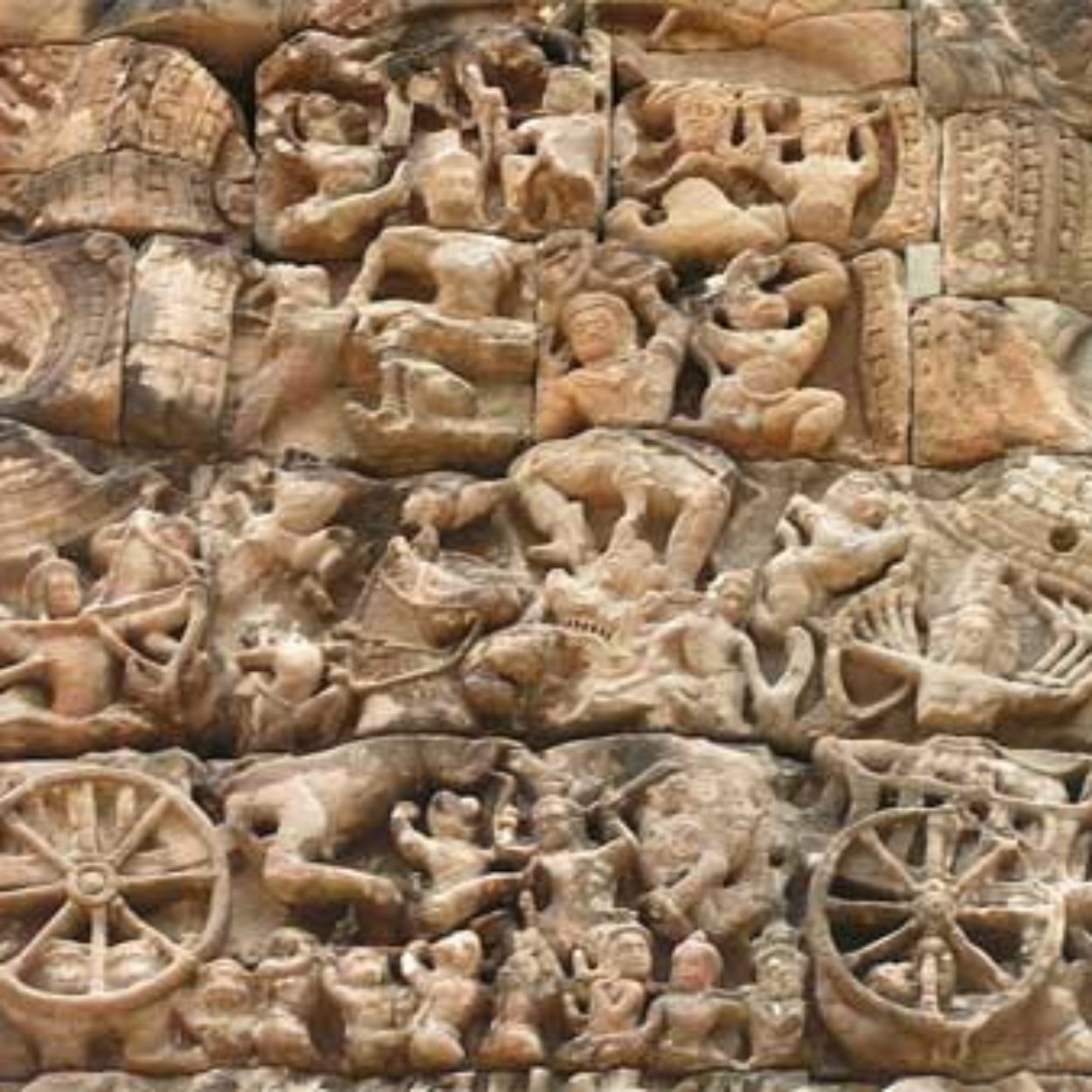
The Iliad is not the only ancient story with such divine/human interaction.  The Indian epic, the Ramayana, has, as its main character the god Vishnu,

who has himself born as a human prince, Rama,

in order to combat Ravana, the 10-headed king

of the Rakshasas, or demons,

as the demons have made themselves invulnerable to the gods, but have foolishly allowed a loophole in their agreement with them, so that humans and–certain animals–have not been included. 

(If you’d like an easy introduction, my favorite is the very sophisticated children’s version by Bulbul Sharma.)

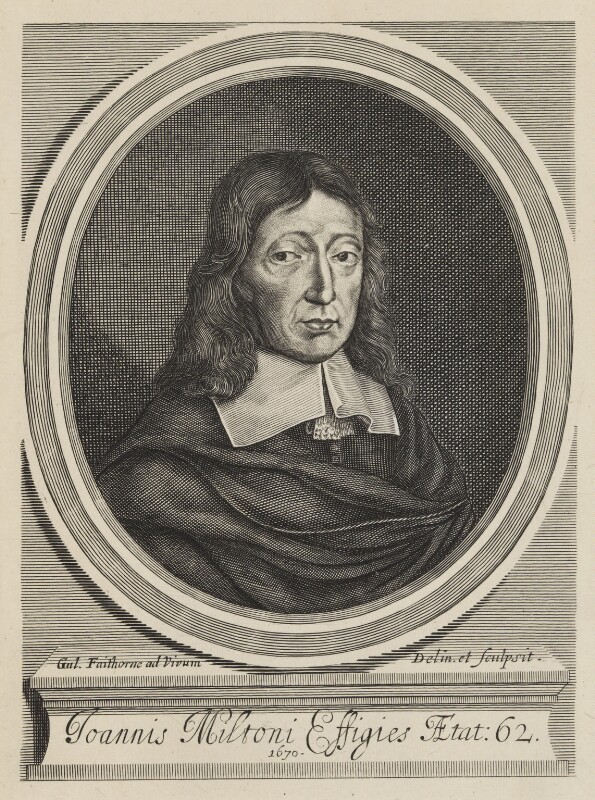
And then there is the actual war among divine figures which we see in the Judeo-Christian Bible, with the Archangel Michael and his angels on one side and Satan (sometimes in the form of a dragon) and his angels on the other.  This is depicted in a series of fragmentary scenes scattered between Old and New Testaments, but John Milton (1608-1674)

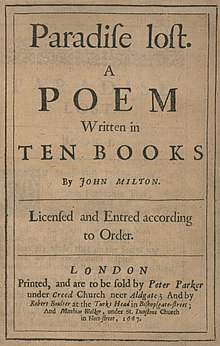
produced a wonderfully dramatic and coherent version in Books V and VI  of his long poem, Paradise Lost (1667/1674).

(Here’s a LINK to the 1667 edition:  https://scholarsbank.uoregon.edu/xmlui/bitstream/handle/1794/767/lost.pdf?sequence=1  If you read this blog regularly, you know that I always prefer original texts, especially for Renaissance works, as, using them always makes me feel a little closer to the author and his/her original intent.)

What isn’t surprising, then, is to see an author who had originally intended to become a Classicist and who was a practicing Christian, when creating his own world and its mythology, depict the same sort of struggles as in Homer and the Bible, if not in the Ramayana.  Consider the situation:  on the one side, there is a fallen angel, a Maia, Sauron,

(JRRT’s unfinished drawing)

and, potentially on the other, five more angels, the Maiar Istari, on the other.

(These are Hero Forge miniatures—I wonder what they would look like painted?)

The five have been sent to counterbalance the one, but, whereas the one builds up fortresses and vast armies of men and others,

two of the five disappear before the story begins, one has a connection with the animal world, one leads and counsels but rarely commands,

(an Alan Lee)

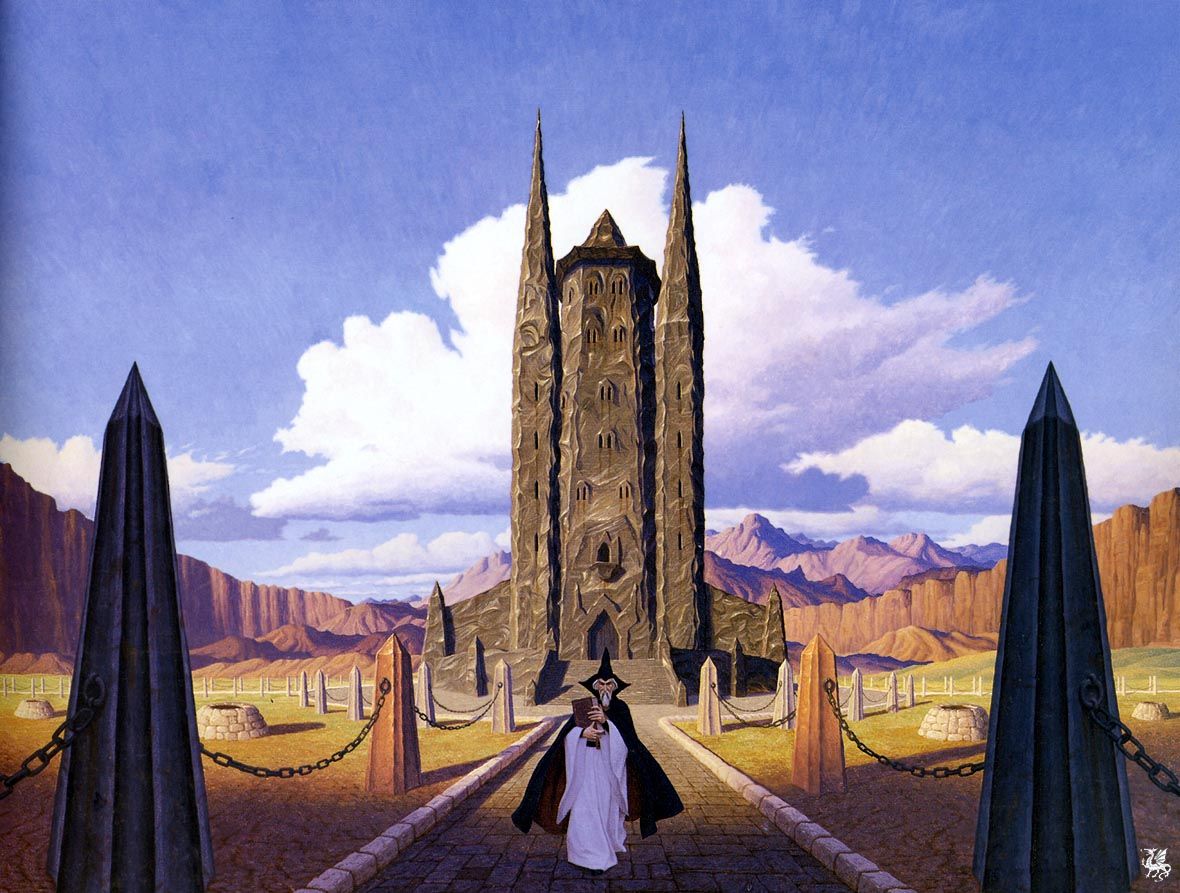
and the fifth is corrupted and attempts to imitate the fallen one, with his own fortress

(the Hildebrandts at work)

and his own armies.

(a Ted Nasmith)

The one—and his imitator—are both eventually defeated and, when they are, much of it is through the agency of the counselor, who then appears to return to the Middle-earth equivalent of heaven.

(another beautiful Ted Nasmith)

To someone who is also steeped in the Classics, what could be more satisfying?

Thanks, as always, for reading.

Stay well,

Be as pius as Aeneas,

And believe—that there is always

MTCIDC

O

In Circles

09 Wednesday Mar 2022

Posted by Ollamh in Uncategorized

≈ Leave a comment

Welcome, dear readers, as always.  I’ve been teaching the Odyssey again and, as I am hardly the first to say (about the ten millionth, at least, I’d guess, from its initial general circulation, probably in the 4th to 3rd centuries BC):  “Every time I read it, I find something new.”

In this case, it was in a passing remark made by Odysseus to his Phaeacian hosts while telling them the long story of “How I Still Haven’t Gotten Home”.  We are in Book 12 and Odysseus and his men are on the ill-fated island of Thrinakia (“Tridentia” in English) where Helios keeps his pet cattle.

and flocks and from which Odysseus has been warned away by Circe. 

Odysseus and his men have dragged their ship ashore to a cave “there where the pretty dancing places of the nymphs and [their] seats were”.  (Odyssey, Book 12, line 318, my translation)

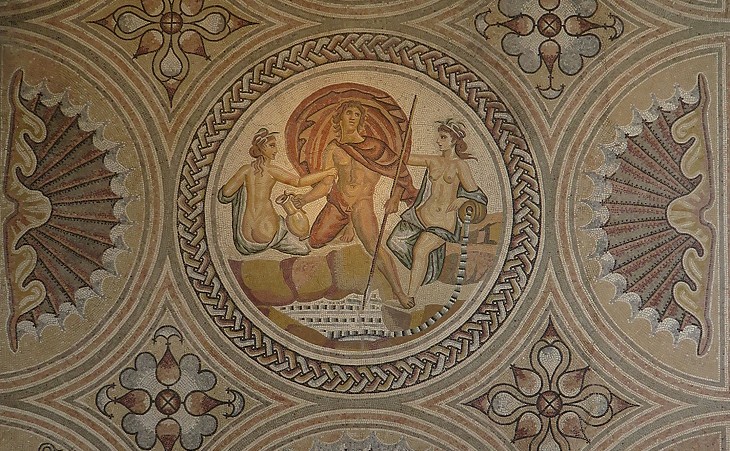
In the early Greco-Roman world, it was believed that there were spirits in everything and “nymph” had a wide meaning, from those who lived in springs, Naiads,

(This is from the story of the Golden Fleece, where Herakles’ companion, Hylas, is abducted by several naiads as he tries to get water from a spring.)

to those who lived in trees,  Dryads and Hamadryads,

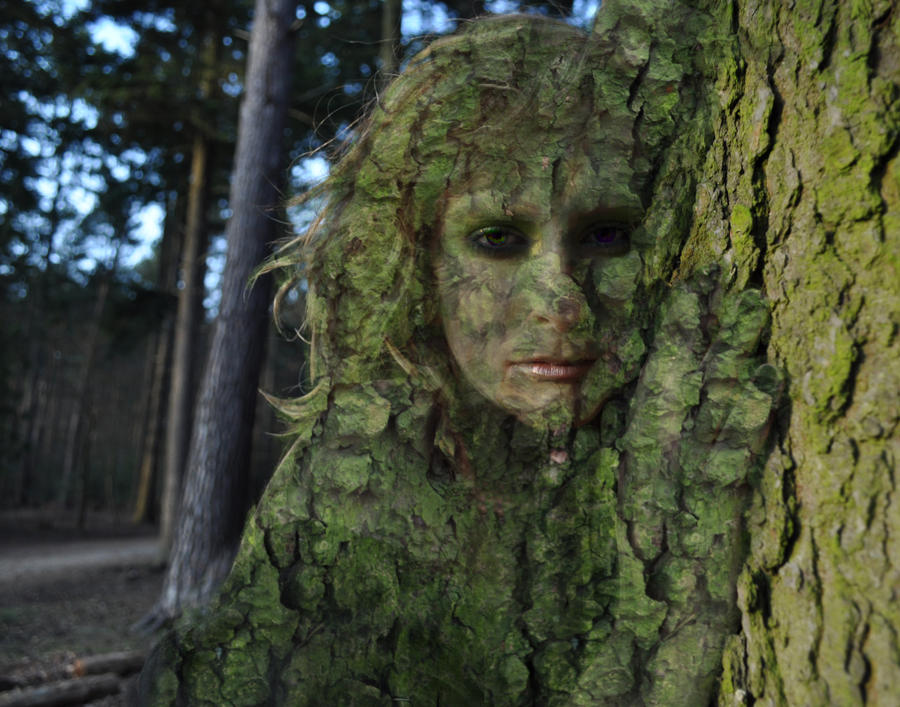
(This is a very spooky and convincing work by SamanthaCatherine at Deviant Art.  Here’s her website:  https://www.deviantart.com/samanthacatherine )

to those who live in the sea, Oceanids and Nereids.

In the line quoted, there is simply the word “of nymphs”, but, as there is a cave, and a similar cave on Ithaka, in Book 13, has Naiads, (Odyssey,  Book 13, lines 347-348) I’m going to guess that these are Naiads, too. 

The word for “dancing places” is, transliterated, khoroi, and it can also mean  “round dances”, suggesting that the nymphs were doing what in the South Slavic world is called the kolo

or in modern Greece, a syrtaki,

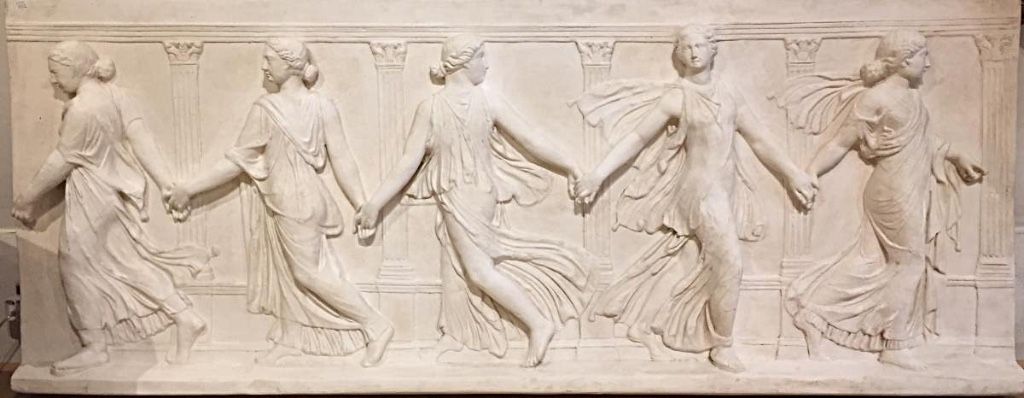
although both of these may also be danced in a line.  And we can see the suggestion of this round pattern in ancient illustrations, like the so-called “Borghese dancers”, from the 2nd-3rd century AD—

(A later plaster copy)

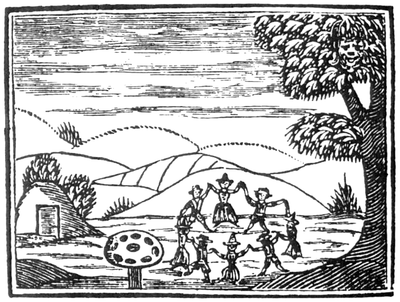
But the idea of supernatural dances to me suggests another tradition, that of “fairy rings”.

Who these fairies were isn’t an answerable question.  Perhaps the descendants in belief from the ancient idea of spirits in everything?   Certainly they dance in circular patterns like the nymphs on Odysseus’ Ithaka,

but, in this later tradition, unthinking people can be lured into such rings and be made to join in the dancing till they not only lose track of time, but lose time itself—a common motif about mortals who enter the Otherworld.  In more modern times, W.B. Yeats (1865-1939) included the idea in his long poem, The Wanderings of Ossian (1889), and C.S. Lewis  (1898-1963) has visitors to Narnia find that there is a great difference between time back home in England and that in Narnia.

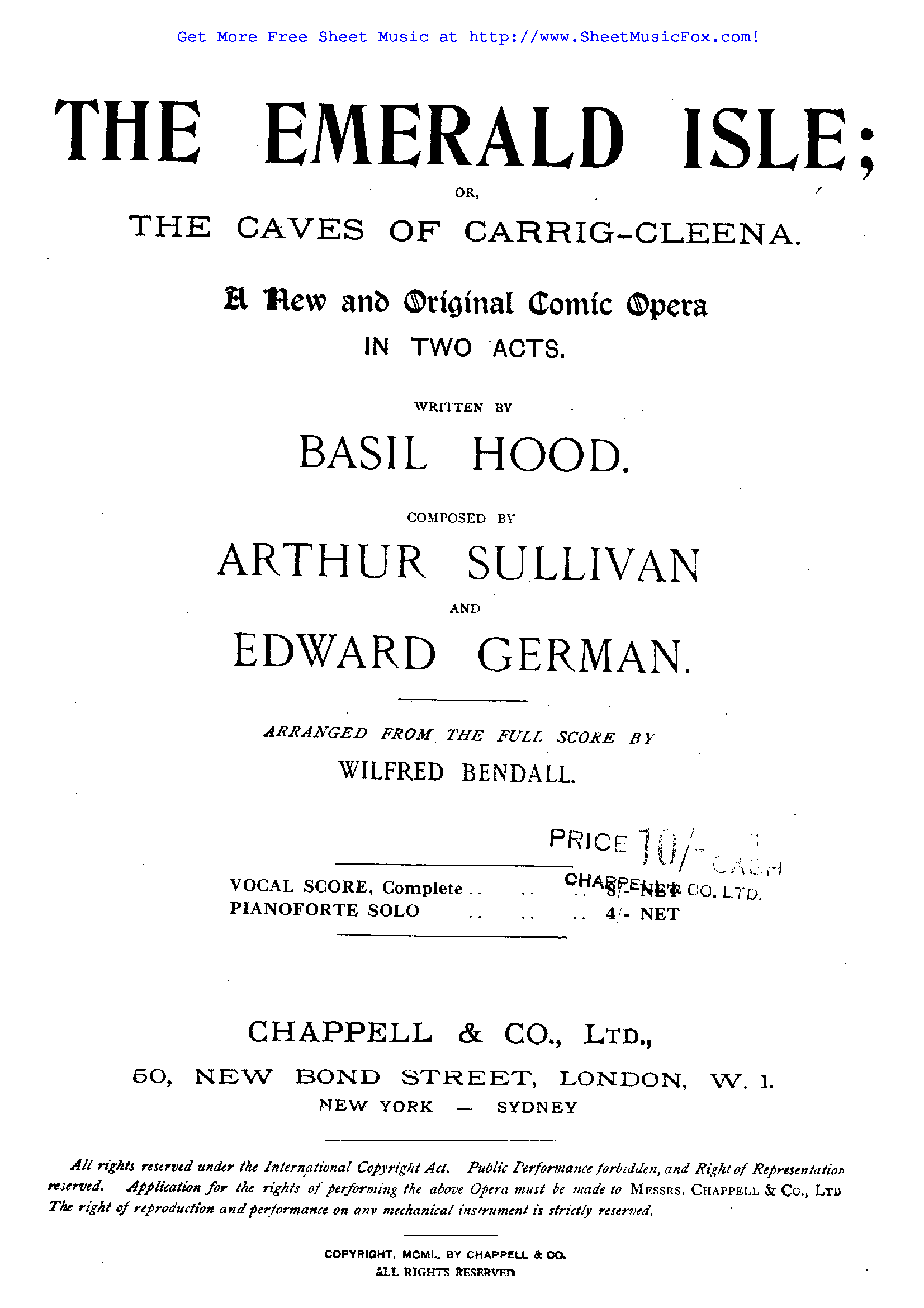
As one illustration, here’s a late appearance of the idea—in comic form–in Basil Hood and Arthur Sullivan’s (completed by Edward German after Sullivan’s death) operetta, The Emerald Isle (1901).

The story, set in 1801 in Ireland, is a complicated one with Irish rebels (or patriots, depending) and the British Lord Lieutenant and his redcoats.  Into the middle of it comes Professor Bunn,

who appears to be pulled back and forth between the two sides.  At one point, however, he is on the Irish side and, disguised as an ancient man,

he tries to scare off the redcoats by telling them what happened to him when he was lured into such a ring.

“BUNN.          Many years ago I strode

               Down the Carrig-Cleena road;

               Night coming on, tired out, I lay

               Where the legend says the fairies play!

               But the tales I had heard of fairy tricks

                    Were never believed by me;

               Then I was a youth of twenty-six,

                    But now I’m eighty-three!

ALL.                Now he’s eighty-three!

BUNN.          Round and round the fairy ring,

               There I heard the fairies sing;

               This is the fairy song I heard,

               Do I remember it?  — every word.

                    Da Luan, da mort, da Luan, da mort

                    Angus da Dardine!

               Many, many people may

               Disbelieve what I do say —

               Once I was young and foolish, too,

               And an ignoramus, just like you;

               But whenever you hear of fairy tricks,

                    Don’t laugh at ’em any more.

               Then I was a youth of twenty-six,

                    But now I’m ninety-four!

ALL.                Now he’s ninety four!

BUNN.          Dancing round the fairy ring

               All that time I’ve had to sing;

               Though you may not believe a word,

               This is exactly what occurred,

                    Da Luan, da mort, da Luan, da mort

                    Angus da Dardine!”

(The words to the fairies’ song are almost as mysterious in English as they’re meant to sound in Irish:  “Monday, Tuesday, Monday, Tuesday, and Wednesday!”  These words appear to be taken from a well-known Irish folktale, “The Legend of Knockgrafton”, where they are spelled in this fashion, including some spelling mistakes.  In Modern Irish, this would be “De Luain, De Mairt, De Luain, De Mairt, agus De Ceaodaoin”.   Thomas Crofton Croker (1798-1854) first published it in Fairy Legends and Traditions of the South of Ireland, 1825.  This went through many editions, but you can read it yourself in the second edition of 1838 here:   https://archive.org/details/fairylegendstrad00crokiala/page/n7/mode/2up   If you’d like to hear this sung—and I recommend it for its jaunty little tune–go to:  https://www.youtube.com/watch?v=-t6Q9aAmhcA   and run it over to about 6:28.  At the moment, there’s no professional recording, but this was a production by The Prince Consort in 1982 which is on Pearl CD Gems 0189, along with a previous late Sullivan work with Basil Hood, The Rose of Persia. )

Odysseus seems to assume that nymphs and their dances are a natural part of the landscape and I imagine that so did the early audiences for the epic and from the songs and stories from which it came.  Yeats claimed to believe in these Otherworld folk and included the Croker story in his Folk and Fairy Tales of the Irish Peasantry (1888).  (You can read the book here:   https://sacred-texts.com/neu/yeats/fip/index.htm  You can also read it at the Internet Archive, but I wanted to give you this LINK because it puts you into the Sacred Texts site, which is full of good things for people interested in traditional stories.)

Unfortunately, modern science not only doesn’t believe in fairies, but explains fairy rings

as:

 “a naturally occurring ring of fungi that can produce rings or arcs of dead grass, lush green grass that grows quicker than the rest of the lawn, or mushrooms.”  (This is from the Garden Seeker website, under the title, “Fairy Rings in Your Lawn?  How to Remove Them and Prevent Them Returning”.)

Spoilsports.

Thanks for reading, as always.

Stay well,

Avoid seductive circles, particularly under a full moon,

And know that, as ever, there’s

MTCIDC

O

← Older posts
Newer posts →

The Doubtful Sea Series Facebook Page

The Doubtful Sea Series Facebook Page

  • Ollamh

Categories

  • Artists and Illustrators
  • Economics in Middle-earth
  • Fairy Tales and Myths
  • Films and Music
  • Games
  • Heroes
  • Imaginary History
  • J.R.R. Tolkien
  • Language
  • Literary History
  • Maps
  • Medieval Russia
  • Military History
  • Military History of Middle-earth
  • Narnia
  • Narrative Methods
  • Poetry
  • Research
  • Star Wars
  • Terra Australis
  • The Rohirrim
  • Theatre and Performance
  • Tolkien
  • Uncategorized
  • Villains
  • Writing as Collaborators
Follow doubtfulsea on WordPress.com

Across the Doubtful Sea

Recent Postings

  • The Damage of Dragons March 11, 2026
  • Encouragement March 4, 2026
  • Eavesdropping February 25, 2026
  • Do You Speak Villain? (Part 3) February 18, 2026
  • Do You Speak Villain? (2) February 11, 2026
  • Do You Speak Villain? (Part 1) February 4, 2026
  • Towering January 28, 2026
  • Tolkien Among the Indians January 21, 2026
  • Thin and Stretched January 14, 2026

Blog Statistics

  • 108,988 Views

Posting Archive

  • March 2026 (2)
  • February 2026 (4)
  • January 2026 (4)
  • December 2025 (5)
  • November 2025 (4)
  • October 2025 (5)
  • September 2025 (4)
  • August 2025 (4)
  • July 2025 (5)
  • June 2025 (4)
  • May 2025 (4)
  • April 2025 (5)
  • March 2025 (4)
  • February 2025 (4)
  • January 2025 (5)
  • December 2024 (4)
  • November 2024 (4)
  • October 2024 (5)
  • September 2024 (4)
  • August 2024 (4)
  • July 2024 (5)
  • June 2024 (4)
  • May 2024 (5)
  • April 2024 (4)
  • March 2024 (4)
  • February 2024 (4)
  • January 2024 (5)
  • December 2023 (4)
  • November 2023 (5)
  • October 2023 (4)
  • September 2023 (4)
  • August 2023 (5)
  • July 2023 (4)
  • June 2023 (4)
  • May 2023 (5)
  • April 2023 (4)
  • March 2023 (5)
  • February 2023 (4)
  • January 2023 (4)
  • December 2022 (4)
  • November 2022 (5)
  • October 2022 (4)
  • September 2022 (4)
  • August 2022 (5)
  • July 2022 (4)
  • June 2022 (5)
  • May 2022 (4)
  • April 2022 (4)
  • March 2022 (5)
  • February 2022 (4)
  • January 2022 (4)
  • December 2021 (5)
  • November 2021 (4)
  • October 2021 (4)
  • September 2021 (5)
  • August 2021 (4)
  • July 2021 (4)
  • June 2021 (5)
  • May 2021 (4)
  • April 2021 (4)
  • March 2021 (5)
  • February 2021 (4)
  • January 2021 (4)
  • December 2020 (5)
  • November 2020 (4)
  • October 2020 (4)
  • September 2020 (5)
  • August 2020 (4)
  • July 2020 (5)
  • June 2020 (4)
  • May 2020 (4)
  • April 2020 (5)
  • March 2020 (4)
  • February 2020 (4)
  • January 2020 (6)
  • December 2019 (4)
  • November 2019 (4)
  • October 2019 (5)
  • September 2019 (4)
  • August 2019 (4)
  • July 2019 (5)
  • June 2019 (4)
  • May 2019 (5)
  • April 2019 (4)
  • March 2019 (4)
  • February 2019 (4)
  • January 2019 (5)
  • December 2018 (4)
  • November 2018 (4)
  • October 2018 (5)
  • September 2018 (4)
  • August 2018 (5)
  • July 2018 (4)
  • June 2018 (4)
  • May 2018 (5)
  • April 2018 (4)
  • March 2018 (4)
  • February 2018 (4)
  • January 2018 (5)
  • December 2017 (4)
  • November 2017 (4)
  • October 2017 (4)
  • September 2017 (4)
  • August 2017 (5)
  • July 2017 (4)
  • June 2017 (4)
  • May 2017 (5)
  • April 2017 (4)
  • March 2017 (5)
  • February 2017 (4)
  • January 2017 (4)
  • December 2016 (4)
  • November 2016 (5)
  • October 2016 (6)
  • September 2016 (5)
  • August 2016 (5)
  • July 2016 (5)
  • June 2016 (5)
  • May 2016 (4)
  • April 2016 (4)
  • March 2016 (5)
  • February 2016 (4)
  • January 2016 (4)
  • December 2015 (5)
  • November 2015 (5)
  • October 2015 (4)
  • September 2015 (5)
  • August 2015 (4)
  • July 2015 (5)
  • June 2015 (5)
  • May 2015 (4)
  • April 2015 (3)
  • March 2015 (4)
  • February 2015 (4)
  • January 2015 (4)
  • December 2014 (5)
  • November 2014 (4)
  • October 2014 (6)
  • September 2014 (1)

Blog at WordPress.com.

  • Subscribe Subscribed
    • doubtfulsea
    • Join 78 other subscribers
    • Already have a WordPress.com account? Log in now.
    • doubtfulsea
    • Subscribe Subscribed
    • Sign up
    • Log in
    • Report this content
    • View site in Reader
    • Manage subscriptions
    • Collapse this bar
 

Loading Comments...