As always, welcome, dear readers.
The title of this posting might lead you to think, if you’re a fan of fantasy/romantic comedies, of Fat Freddie,

the feckless elder brother of Tom Hanks in

In fact, although the name is the same, where it comes from is from a different category altogether.
As his correspondence shows us more than once, Tolkien was very particular about names, both of places and people, in his work.
“I hope you and the Foreign Rights Dept., will forgive my now at length writing to you about the Dutch translation. The matter is (to me) important; it has disturbed and annoyed me greatly…
In principle I object as strongly as is possible to the ‘translation’ of the nomenclature at all (even by a competent person)…
May I say now at once that I will not tolerate any similar tinkering with the personal nomenclature.” (from a letter to Rayner Unwin, 3 July, 1956, Letters, 359, 361)
Although it seems obvious why he might feel this way—it was his work, after all, and why would he approve of anyone making changes to it?–he adds another cogent reason—implying, as he does so, who would be competent enough to match his work–and would be able to take the time to develop it?
“That this is a ‘imaginary’ world does not give him [a translator] any right to remodel it according to his fancy, even if he could in a few months create a new coherent structure which it took me years to work out.”
Of course, Tolkien, maintaining the fiction that he is the editor and translator, rather than author, of his work, himself translated names, as he tells us that Samwise was actually Banazir, for instance (see The Lord of the Rings, Appendix F, II, “On Translation”).
But numbers of the personal names in Tolkien’s work are not translations—or even his creations—and their sources always interest me, as I began to talk about in “Drogo?”, 26 February, 2025.
We know that the names of The Hobbit’s dwarves and even Gandalf’s name come from the Old Norse of the Voeluspa (the “Prophecy of the Seeress”) in the Poetic Edda (you can read more about that here: https://en.wikipedia.org/wiki/V%C3%B6lusp%C3%A1 and you can read an older translation—1906–of it here: https://www.gutenberg.org/files/14726/14726-h/14726-h.htm#VOLUSPA_THE_VALAS_PROPHECY ).
Another Tolkien source for names, however, is pure Germanic. As JRRT tells us in Appendix F, II, “On Translation” of The Lord of the Rings:
“In some old families, especially those of Fallohide origin, such as the Tooks and the Bolgers, it was, however, the custom to give high-sounding first-names. Since most of these seem to have been drawn from legends of the past, of Men as well as of Hobbits, and many while now meaningless to Hobbits closely resembled the names of Men in the Vale of Anduin, or in Dale, or in the Mark, I have turned them into those old names, largely of Frankish or Gothic origin, that are still used by us or are met in our histories.”
So, take the “Freddie” of this posting’s title. This is Fredegar Bolger—“Fatty”—the friend of Frodo, who is involved in his removal to Crickhollow (see The Fellowship of the Rings, Book One, Chapter 3, “Three is Company” ).
I can locate no reference to its origins in Tolkien’s Letters, usually a good source for all sorts of background material, but, taking his hint of his use of “old names, largely of Frankish or Gothic origin”, we find the well-known 7th-century AD Chronicle of Fredegar, a 4-book compilation of Frankish history,
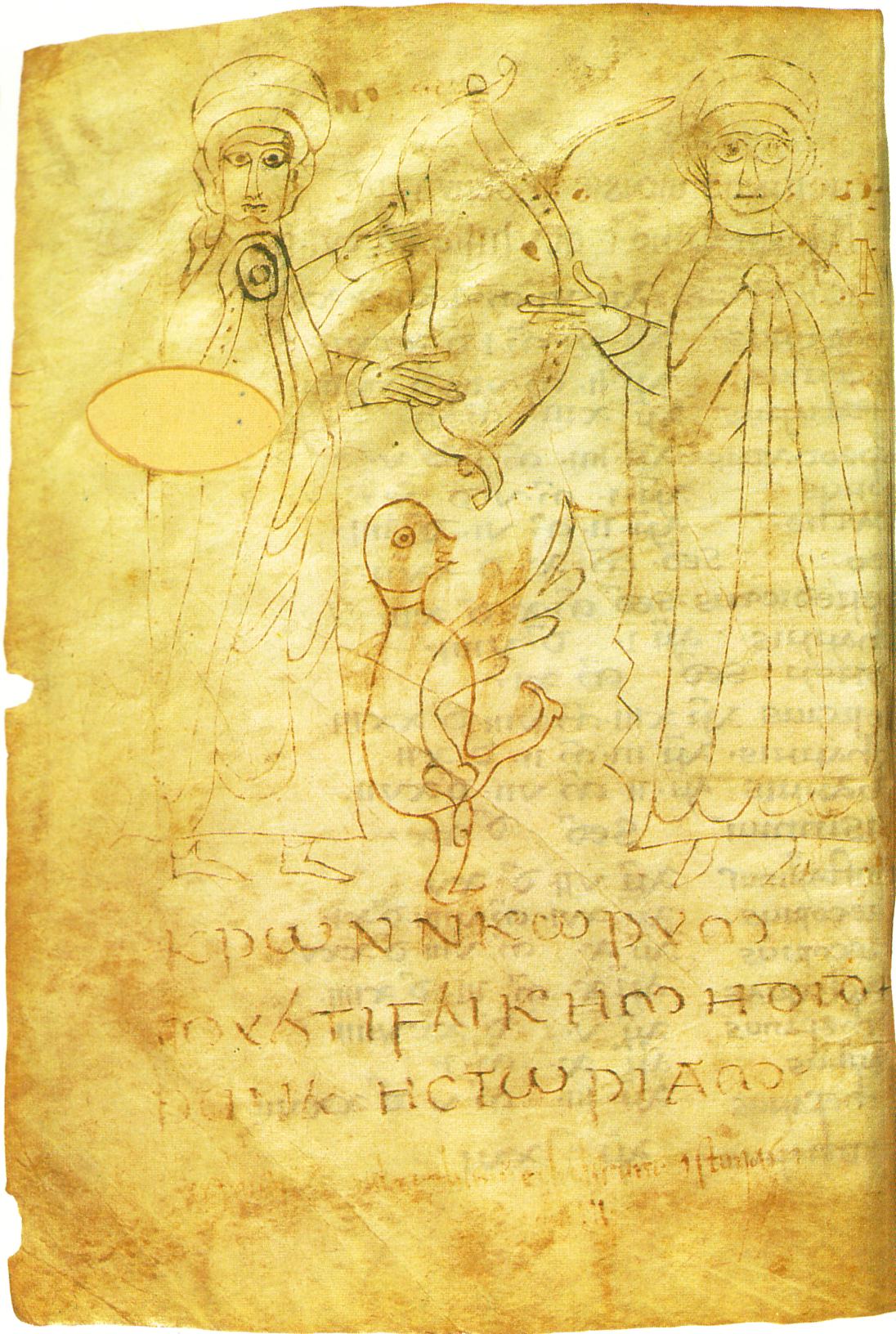
which we can certainly imagine Tolkien the medievalist would have known about—especially as he says—and shows–a distinct taste for other early Germanic names in the Bolger family: Adalbert, Adalgar, Alfrida, Filibert, Gerda, Gundabald, Gundabad, Gundahar, Heribald, Herugar, Odovacar, Rudibert, Rudigar, Rudolph, Theobald, Wilibald, Wilimar. He’s also slipped in a famous name: Odovacar—aka Odovacer or Odoacer, the late 5th-century AD Gothic
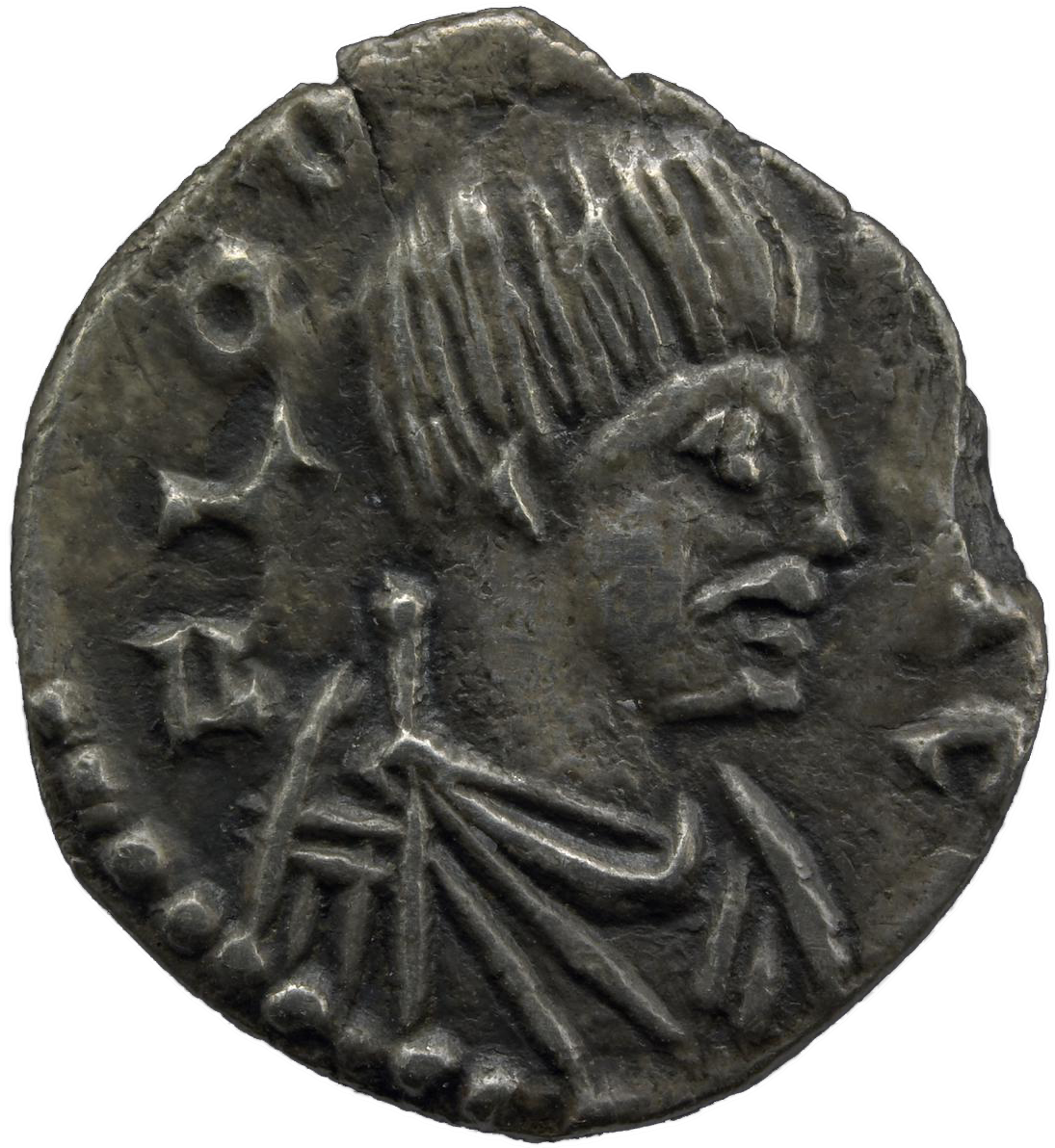
(There’s argument about his origins—see: https://en.wikipedia.org/wiki/Odoacer ), ruler of northern Italy under the eastern Romans. He deposed Romulus, the last western emperor, in 476, replacing him with—himself,
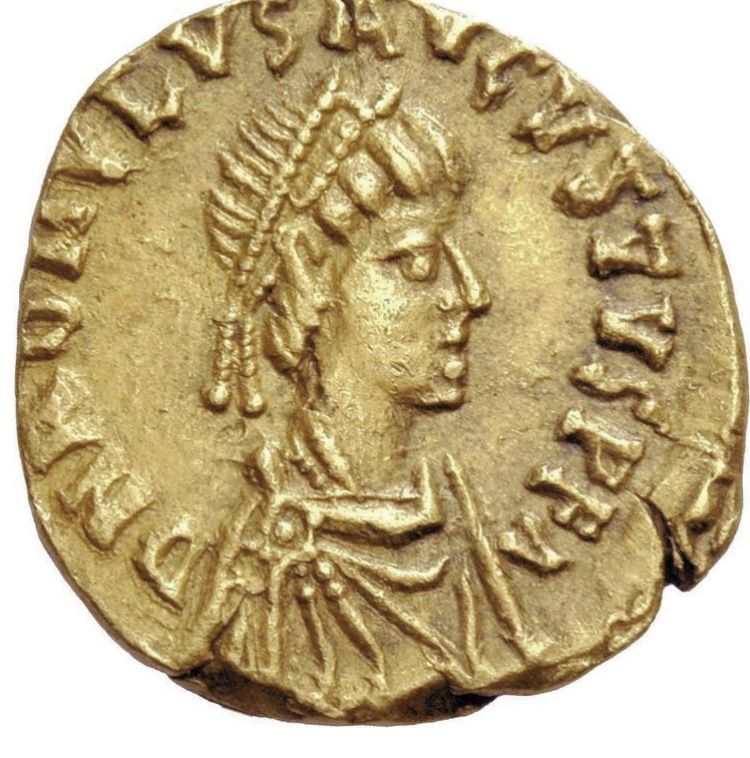
but, who was, in turn, replaced by Theodoric—reportedly by being cut nearly in two by Theodoric himself (this detail being from the early 7th-century Byzantine historian, John of Antioch—you can read a translation of his depiction of the murder here: https://eprints.whiterose.ac.uk/id/eprint/195321/1/10.1515_ang-2022-0056.pdf on pages 382-383.)

(I’ve always valued this coin as a perfect example of the shift of power from Roman to Germanic rulers in the West. On the surface, it looks late Roman:
1. its inscription is in Latin: “Rex Theodoricus Pius Princ[eps] I[nvictus] S[emper]”—“King Theodoric Righteous Head of State Always Unbeaten”
2. he’s dressed for the part—with late Roman armor and a military cloak over his left shoulder and pinned on the right—like the Eastern emperor, Justinian, on this medallion
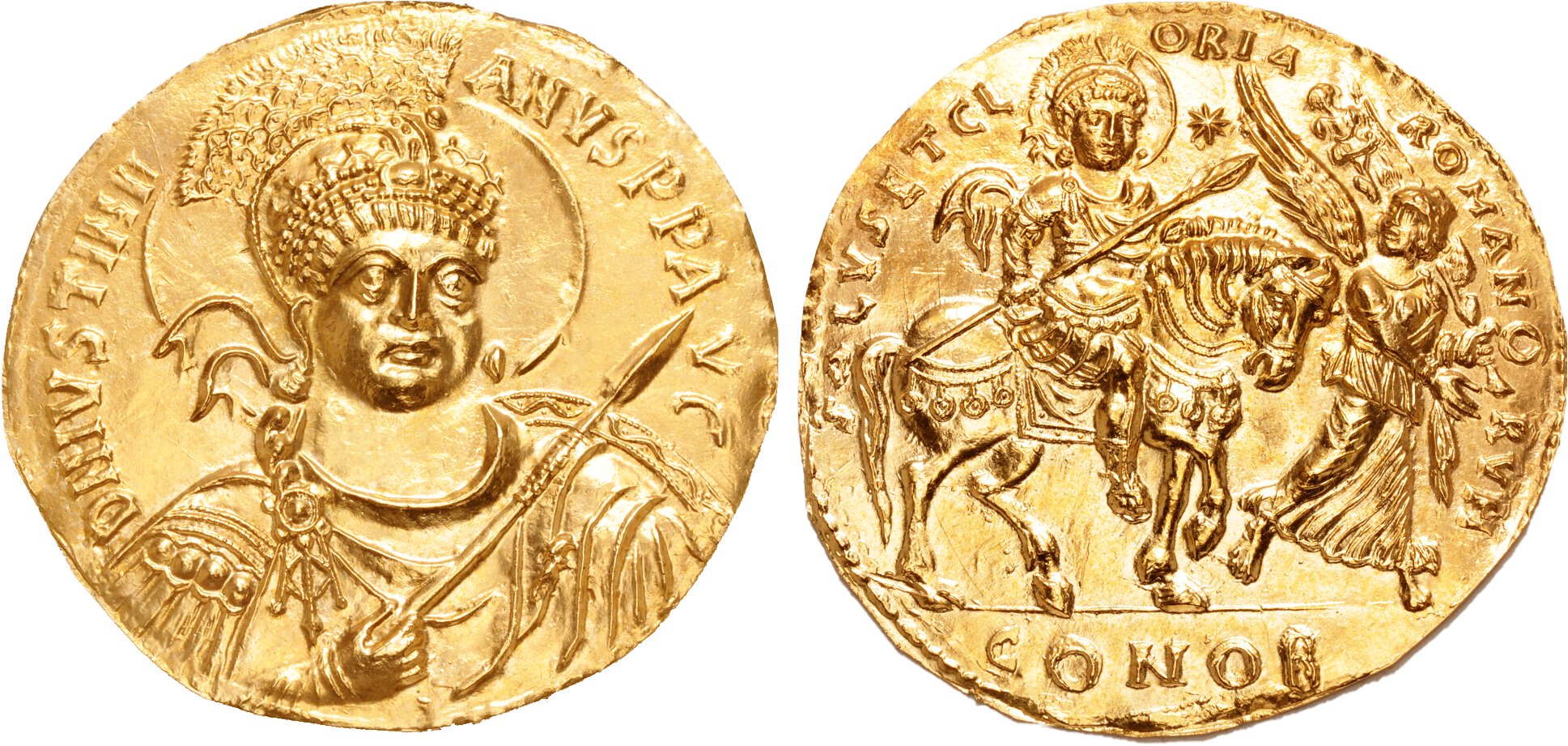
3. he has, perched (probably on a scepter) on his left hand like a pet bird, a figure of Nike, the ancient goddess of victory—and you can see her dancing in front of Justinian
4. but then there are those touches of something else—
a. the word “rex” was not a word a Roman ruler would ever use of himself, from the overthrow of the last of the Etruscan kings in 509BC being a term synonymous with “bloody tyrant”—which is why the later rulers of Rome from Augustus’ successor, Tiberius on, used “imperator”—“holder of state authority” instead
b. Theodoricus looks like a good Greco-Roman name, combining “theos”, “god (Zeus originally)” with the root “dor-“ “gift”, so “Giftofgod”, but there is another possibility: this could also be a Gothic compound—“theuda”—“of the people”—and “reiks”—“ruler”—another way of saying “king”
c. and notice Theodoric’s upper lip—a droopy Germanic mustache like this one worn by the later Harold, last Anglo-Saxon king of England–

to our right is William, Duke of Normandy, distinguished by not wearing a Germanic mustache. You’ll also notice that Odoacer also displays such a characteristic piece of lip-decoration.)
There is another Freddie associated with Fredegar’s work. This is Fredegunda (often referred to in modern texts as “Fredegund”),

(A very worn portrait on her tomb in the Basilica of St Denis, Paris)
wife of Chilperic I, king of that part of the Frankish world called Neustria,

in the later 6th century AD. Unlike Fredegar Bolger, seemingly a peaceful person, Fredegunda was credited with about a dozen assassinations (including that of Bishop Praetextatus, stabbed while, of all times, celebrating Easter mass in his cathedral at Rouen in 586AD.)
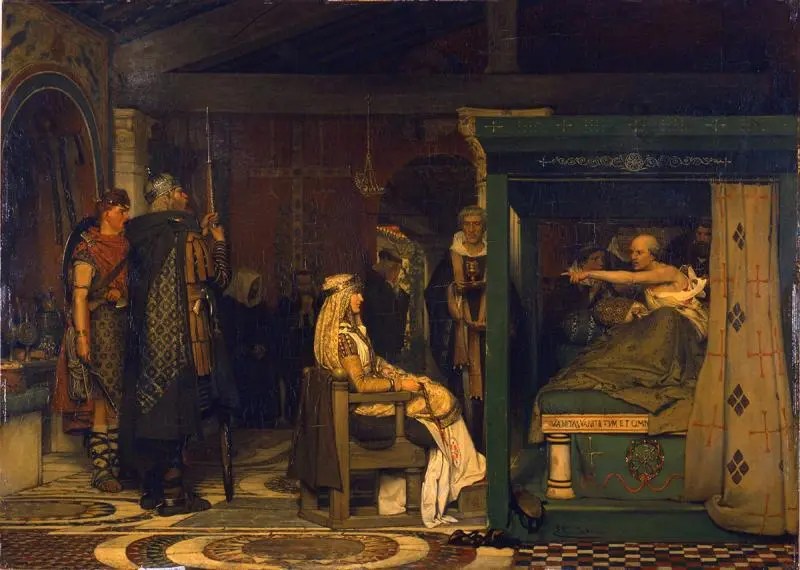
(A wonderfully sinister scene by the Victorian historical painter, Lawrence Alma-Tadema, 1836-1912. It’s based upon one of Fredegar’s sources, the Historia Francorum, “The History of the Franks”, by Gregory of Tours, 538-594. In this telling, Fredegunda comes to Praetextatus’ deathbed and offers him medical help, while calmly listening to him curse his murderer.)
She seems to have been quite a monster, even attempting to murder her own daughter, Rigunth[a] in a fit of jealousy by trying to break her neck while she was reaching into a treasure chest—

For more on her, see: https://en.wikipedia.org/wiki/Fredegund The queen’s assassination and visit to the dying bishop is in Gregory, Book VIII, Chapter 31, which, if you’re a Latin reader, you can find here: https://www.thelatinlibrary.com/gregorytours/gregorytours8.shtml
But her impressive violence reminded me of another Freddie—or Freddy–
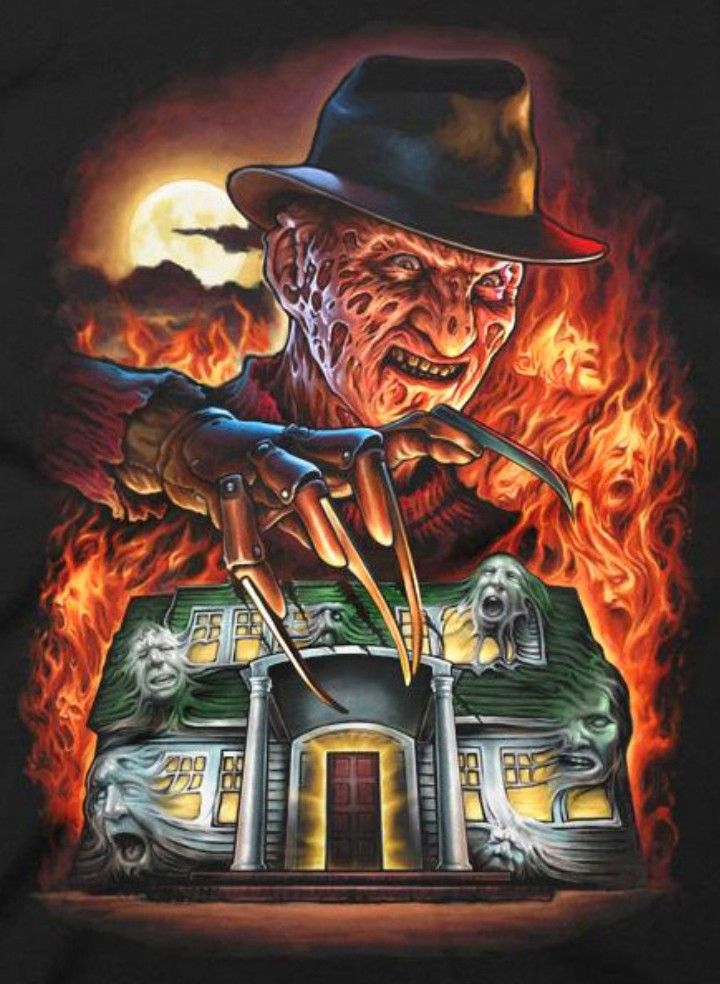
from not just one film, but from a series,


and I wonder if the queen, who also seems to have been a bit of a seductress, might have found that Mr. Krueger, though not in her social circle, was a tempting conquest—or, better, collaborator—although, if I were he, I would always be a little anxious when the queen played with knives.
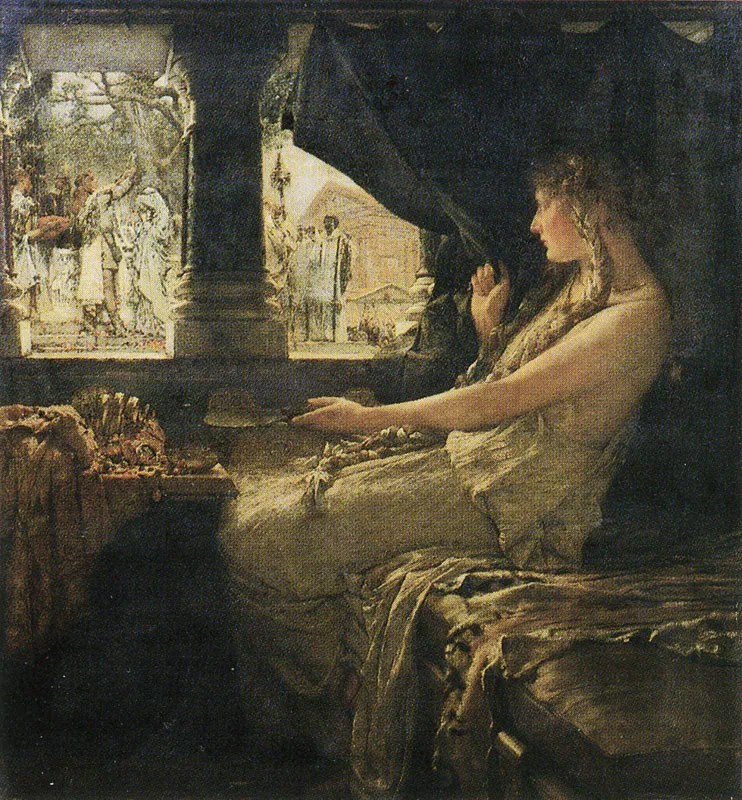
(another Alma-Tadema—here we see Fredegunda, who has just been dumped by Chilperic for a Visigothic princess, Galswintha, watching their wedding—and thinking…)
As ever, thanks for reading.
Stay well,
That old furnace in the basement is just that: an old furnace,
And remember that, as always, there’s
MTCIDC
O
PS
A funny little detail, but which might have been a private joke for JRRT: in the Bolger family tree, in Appendix C of The Lord of the Rings, we note that Willibald Bolger married Prisca Baggins. Prisca was JRRT’s pet name for his daughter, Priscilla—
 doubtfulsea