• About

doubtfulsea

~ adventure fantasy

Monthly Archives: October 2023

Several  (at least temporarily) Unhappy Returns (2)

25 Wednesday Oct 2023

Posted by Ollamh in Uncategorized

≈ Leave a comment

As ever, dear readers, welcome.

In my last, in contrast to the previous two postings (on happy returns, or at least the expectation of them), I began discussing returns which were not quite as expected.

In that posting, I began with Agamemnon, who came home victorious from the Trojan War only to be murdered by his wife, Clytemnestra, and her BF and Agamemnon’s cousin, Aegisthus.
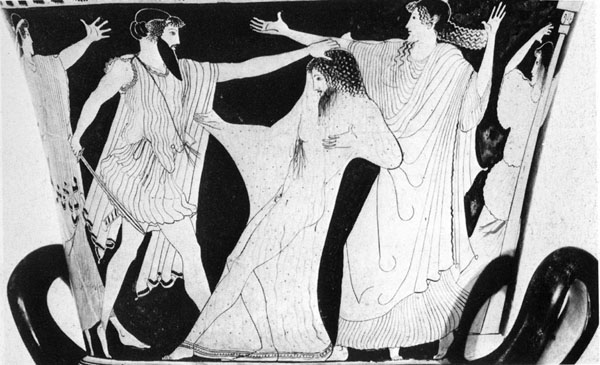
(In one version of the story, as seen here, killed when stepping out of his bath)

This is a fate which haunts the text I went on to next, the Odyssey, which I have just finished teaching.  Over and over, Agamemnon’s betrayal and death are mentioned, each time seeming to point to what could be Odysseus’ fate, if his wife, Penelope,

pestered by over a hundred suitors, should prove as faithless as Clytemnestra.  In the end, of course, she is faithful, those suitors meet a bloody end, and Odysseus and Penelope are happily reunited.

(Alan Lee—as good at Homer as he is at Tolkien!)

I had said, in that last posting, that I would move on in the next to what I’ll be teaching in the near future, The Hobbit, but, before that, I wanted to pause at another JRRT work, the title of which immediately suggests why:  “The Homecoming of Beorhtnoth Beorhthelm’s Son”, first published in 1953 in Volume 6 of Essays and Studies by Members of the English Association (New Series)—
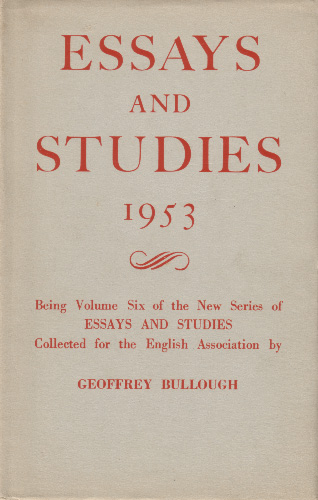
which you can check out from the Internet Archive here:  https://archive.org/details/essaysstudies1950000geof

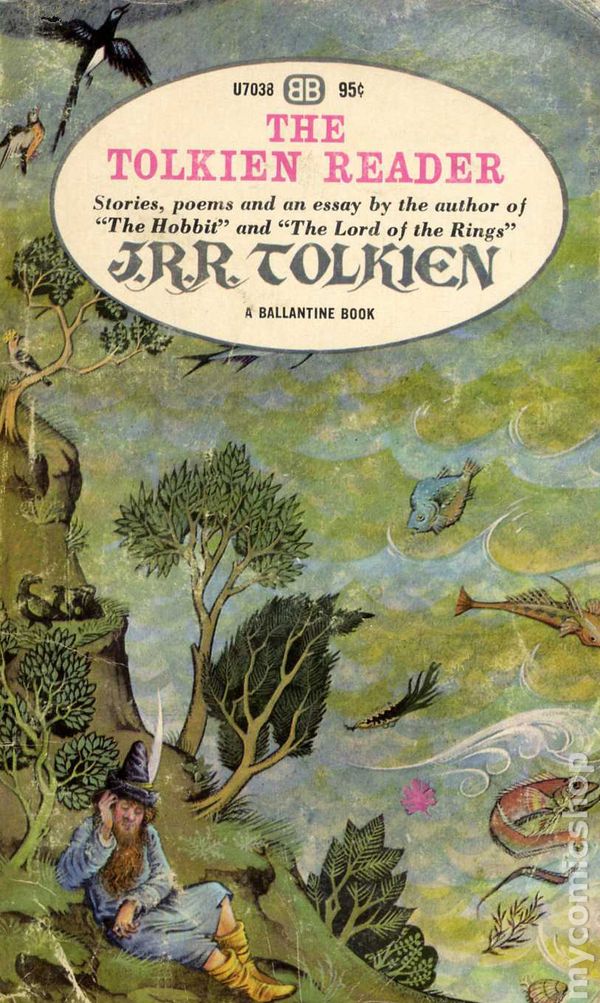
This was republished in 1966 in The Tolkien Reader
and, in the 1975 edition of Tree and Leaf,

as well as in the 2023 The Battle of Maldon.

That title immediately links Tolkien’s work with an actual historical event, as well as an Old English poem about it.

In 991AD, a Viking raiding force, which had been moving along the English coast, had paused on Northey Island, poised to attack the local town of Maldon.

Our main source for what happened next comes from that (fragmentary) Old English poem, “The Battle of Maldon”, a translation by Tolkien being included in that recent volume, along with “The Homecoming…”.

The Vikings were opposed by the local Anglo-Saxon leader, or ealdorman, Byrhtnoth (Beerht-nawth, approximately, where the “h” is like the “ch” in Bach—Tolkien uses an alternative spelling,).  There was a landbridge between the island and the mainland at low tide

and, if we can believe the poem, the Vikings, initially repelled by the Anglo-Saxons under Byrhtnoth, then suggested that they be allowed to cross that landbridge to fight it out with their opponents on the mainland.  Byrhtnoth accepts this proposal (there is a lot of scholarly discussion on why, including byTolkien, in an afterpiece called “Ofermod”), the Vikings cross, and, although the poem doesn’t tell us this, it appears , from other sources, that the ensuing battle ends with Byrhtnoth dead and his men driven from the battlefield, although the Vikings suffered heavily for their victory.

(by Peter Dennis, one of my favorite contemporary military artists)

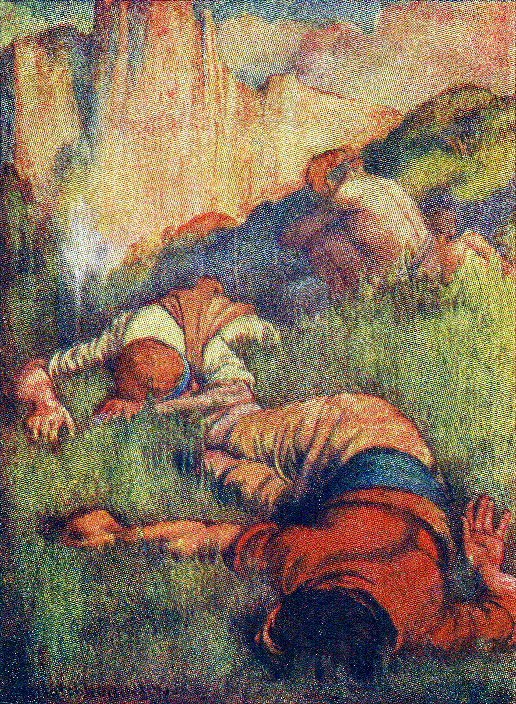
Tolkien’s “The Homecoming…” is a short verse play (the text suggests even a radio play) which is a dialogue between two characters,  Tidwald (Tida) and  Torhthelm (Tota), Anglo-Saxon servants of Byrhtnoth, who have come to the battlefield to collect his body.  The verse is mostly of a loose alliterative kind, approximating Old English verse and, upon occasion, even using real Old English verse, as well as a number of mentions of its subjects.  The themes of the play include a traditional one—searching a battlefield for a lost loved one—as well as a potential criticism of the ealdorman for agreeing to the Viking proposal and its consequences:

“Tidwald:  …Alas, my friend, our lord was at fault…

                     Too proud!  Too princely!”

(You can read about the poem “tThe Battle of Maldon”  here:   https://en.wikipedia.org/wiki/The_Battle_of_Maldon  and read a translation here:  https://oldenglishpoetry.camden.rutgers.edu/battle-of-maldon/    For the Old English, see:   https://www.youtube.com/watch?v=ToAu_tyafp4    For a modern historical view of the battle see:   https://www.youtube.com/watch?v=x6Nqp-I1BIY    For a Lego reenactment, which uses the poem itself as the narrative, see:  https://www.youtube.com/watch?v=Cbpc3nsJ3ec  )

Byrhtnoth’s return was not a happy one, his body recovered, but headless, was taken to the religious establishment at Ely for burial—and reburial and reburial, as Ely became a major cathedral.

Here’s his latest tomb—

Bilbo’s anticipated return also had its darker moment.

From the beginning of the story, Bilbo had been pulled between the traits of his paternal and maternal inheritance.  His father’s side (the Bagginses)—well, I’ll let JRRT tell you:

“The Bagginses had lived in the neighbourhood of The Hill for time out of mind, and people considered them very respectable, not only because most of them were rich, but also because they never had any adventures or did anything unexpected:  you could tell what a Baggins would say on any question without the bother of asking him.”

His mother’s side (the Tooks) were of a very different order indeed:

“It was said (in other families) that long ago one of the Took ancestors must have taken a fairy wife.  That was, of course, absurd, but certainly there was still something not entirely hobbitlike about them, and once in a while members of the Took-clan would go and have adventures.  They discreetly disappeared, and the family hushed it up; but the fact remained that the Tooks were not as respectable as the Bagginses, though they were undoubtedly richer.”  (The Hobbit, Chapter 1, “An Unexpected Party”)

Throughout the novel, we see these two sides struggle for dominance, although, by the latter part of the book, t he Took side is clearly in control.  After the Battle of the Five Armies, the death of Thorin, and return of the dwarves to the Lonely Mountain, however, he begins his journey home at last as

“The Tookish part was getting very tired, and the Baggins was daily getting stronger.” (The Hobbit, Chapter 18, “The Return Journey”)

But when Bilbo and Gandalf

”…came right back to Bilbo’s own door…There was a great commotion, and people of all sorts, respectable and unrespectable, were thick round the door, and many were going in and out—not even wiping their feet on the mat, as Bilbo noticed with annoyance.

If he was surprised, they were more surprised still.  He had arrived back in the middle of an auction!  There was a large notice in black and red hung on the gate, stating that on June the Twenty-second Messrs Grubb, Grubb, and Burrowes would sell by auction the effects of the late Bilbo Baggins Esquire, of Bag-End, Underhill, Hobbiton.” 
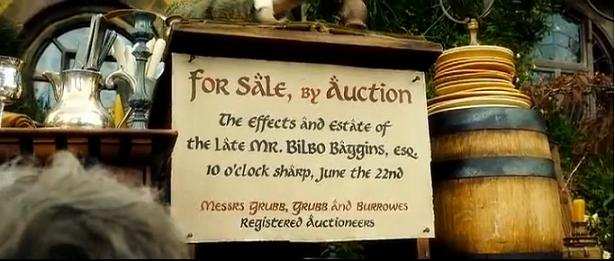
Bilbo is put to some trouble in reestablishing himself in the Shire:

“It was quite a long time before Mr. Baggins was in fact admitted to be alive again…and in the end to save time Bilbo had to buy back quite a lot of his own furniture.”

This is, on the one hand, mildly comic—after so many death-defying adventures—trolls, goblins, wargs, Smaug—Bilbo has to prove to people who had known and seen him all his life that he was really himself and still alive?  On the other hand, why might people be so ready to believe him dead after a single year?  (The number of years differs significantly around the world—in Italy, it appears that 20 years must pass.  See this for more:   https://en.wikipedia.org/wiki/Legal_death   )

Students always ask me about this.  It’s an excellent question and the best answer I can offer at the moment is that Bilbo, on his return, has become a kind of Castor and Pollux.

In a complex ancient myth, these are twin brothers who share one immortality and one death, each alternating between the two, and perhaps we can see Bilbo, both Baggins and Took, as someone similar.  As a Took, he was dead to his Baggins side, but, as a Baggins, it was the Took who died.  In his return to the Shire, that transition might be signified by the question of his mortal status and also by the fact that, although

“…he was quite content; and the sound of the kettle on his hearth was ever after more musical than it had been even in the quiet days before the Unexpected Party…”

yet

“He took to writing poetry and visiting the elves…”

As Gandalf said, “My dear Bilbo!…Something is the matter with you!  You are not the hobbit that you were.”

I want to conclude, however, with one more return and, from our viewpoint, one of the happiest, although, on a personal  level , it began with misery.  JRRT had been on the Western Front in time for the Battle of the Somme, in which one of his friends was killed on the first day, 1 July, 1916 (among nearly 60,000 other British casualties on that day alone), when Second Lieutenant J.R.R. Tolkien

became a casualty, on 27 October, 1916.  It was not from a German bullet or shell, however, but from the bite of this–Pediculus humanus humanus—in plain terms, a louse–

This led to an intermittent fever, with all sorts of pains and complications for which a common name was “trench fever”  (for more, see:    https://en.wikipedia.org/wiki/Trench_fever )   and, effectively, it removed him from France and active participation in the Great War till its end, so that, although Tolkien was promoted to temporary Lt. 6 Jan 1918—see London Gazette (under 21 March, 1918 here:    https://www.thegazette.co.uk/London/issue/30588/supplement/3561  ), he spent the rest of the war in England, happily resigning his commission  in 1920 as this entry from the Gazette for 2 November, 1920 tells us:

“The undermentioned temp. Lts. relinquish their commissions on completion of service, 3 Nov. 1920, and retain the rank of Lt.: — J. R. .R. Tolkien…”

(for the complete entry, see:    Page 10711 | Supplement 32110, 2 November 1920 | London Gazette | The Gazette )

And I would imagine that, even after his brief experience on the Western Front, Tolkien would agree with his Tidwald from “The Homecoming…”:

“Bitter taste has iron, and the bite of swords

Is cruel and cold, when you come to it.”

and be glad to be done with it and home.
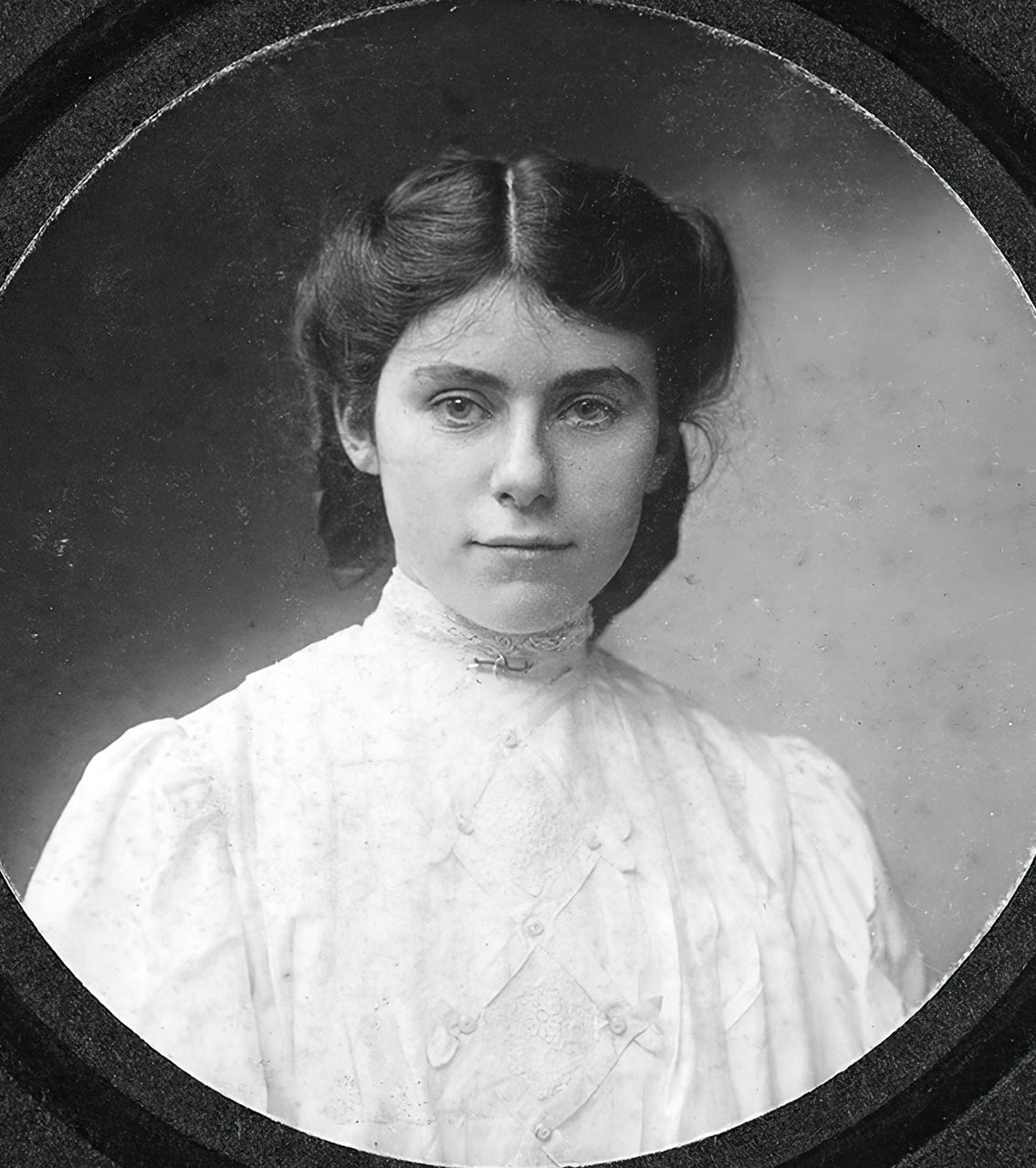
Thanks, as ever, for reading.

Stay well,

May your returns always be happy ones,

And remember that, as always, there’s

MTCIDC

O

And, next week, HALLOWEEN!

Several  (at least temporarily) Unhappy Returns (I)

18 Wednesday Oct 2023

Posted by Ollamh in Uncategorized

≈ Leave a comment

As always, dear readers, welcome.

My last two postings have discussed the idea of the mythic/folkloric figure sometimes referred to as “the king under the mountain”, who, the story goes, instead of dying, seems either to take himself off or is carried off to another place, where he stays, usually sleeping, until some need awakens him (often his native land is in danger) and he will return to the world of the living to save the day.

In my latest teaching, however, which includes both the Odyssey and The Hobbit, people definitely return, but the day does not quite go as planned.

Although Odysseus is the main character of the Odyssey, a figure who haunts the text is Agamemnon, the Greek high king, who organizes the expedition to Troy.  While he is gone, his wife, Clytemnestra, is seduced by Agamemnon’s cousin, Aegisthus, and, upon Agamemnon’s return, he and his men are lulled into a false sense of security by Aegisthus at a banquet and then murdered.

(This is a depiction—on the right—of an alternate version of Agamemnon’s death, just after leaving a bath—and, on the left, the death of Aegisthus some years later by Agamemnon’s son, Orestes.  It’s on a red figure krater, a wine-mixing bowl, at the Boston Museum of Fine Arts.  You can learn more about it here:  https://collections.mfa.org/objects/153661 )

Why should this man, now long dead and far from Odysseus’ home on Ithaka, be such a dominant figure in the story? 

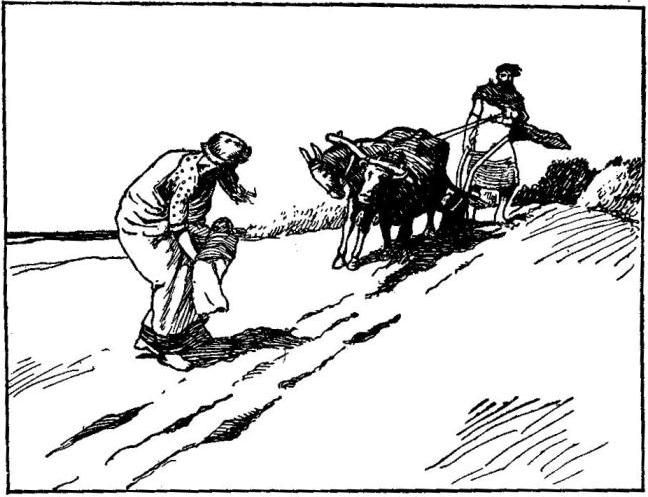
Odysseus was reluctant to go off to the Trojan War.  To escape, he pretended to be mad, plowing the beach of his home island, Ithaka, as if it were real arable land—and doing so with the combination of a mule and an ox–

The Greeks might have believed in his insanity if another Greek, Palamedes, hadn’t intervened, snatching up Odysseus new-born son, Telemachus, and putting him directly in Odysseus’ path.  Odysseus swerved, of course, but this suggested that he wasn’t so mad as he looked and soon he was off on a boat for Asia Minor.  (In several later stories, Odysseus gets his revenge by planting evidence that Palamedes was actually in the pay of the Trojans and he dies in several unpleasant ways:  stoning and drowning.  As the ancient Greek travel writer, Pausanias, c.110-c.180AD, tells us that Palamedes had invented dice, we might think that he would have been a bit more careful about chance!  This is in Pausanias’ tour of Argos—The Description of Greece 2.20.3—which you can read in an English translation here:   https://www.theoi.com/Text/Pausanias2B.html )

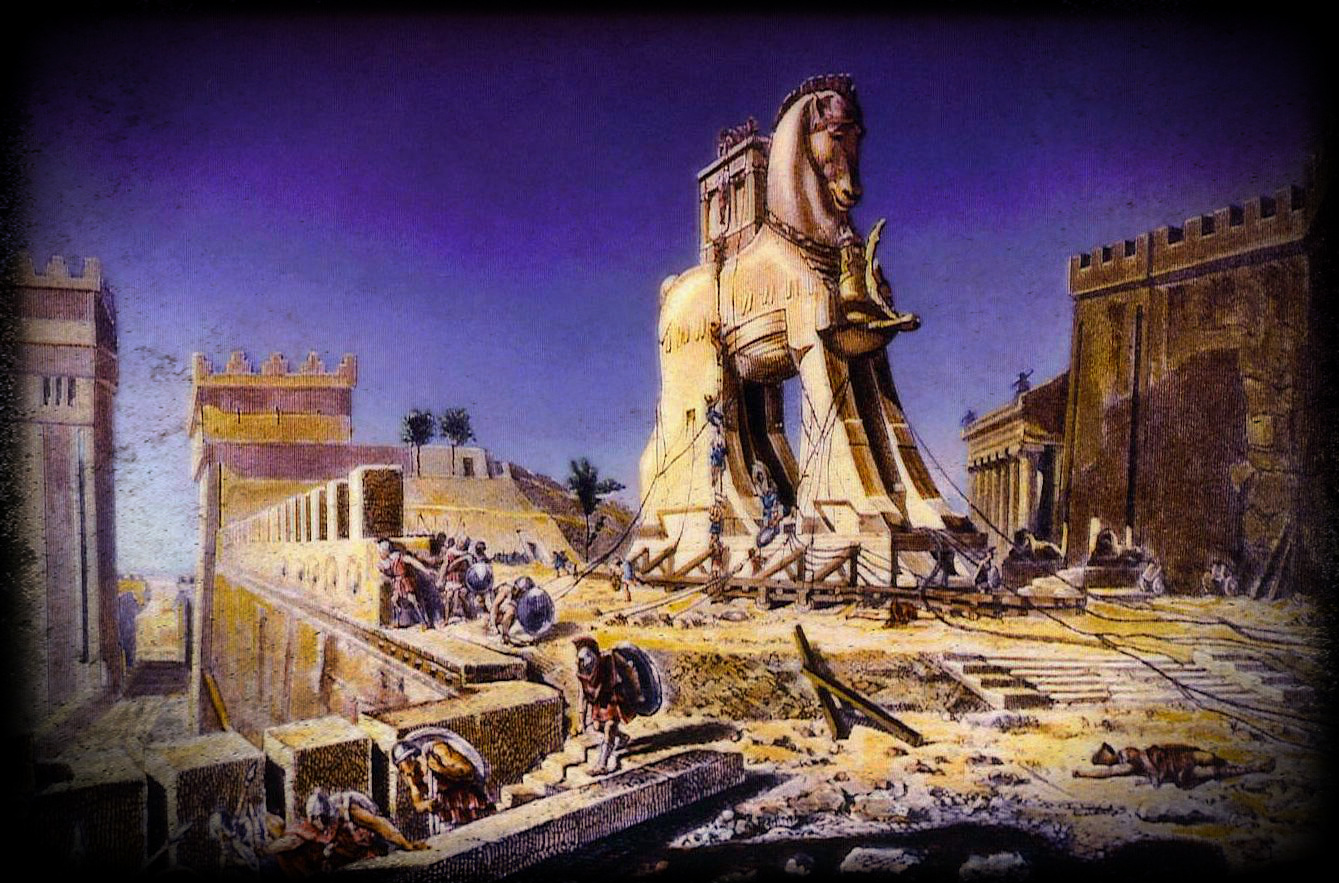
10 years go by, Troy falls, thanks to a trick which might have been invented by Odysseus himself,

but, for the Odyssey, that’s only backstory.  Now Odysseus will spend another 9 years struggling to get home, slowed on his way by

1. eaters of a substance which makes people forget about going home,

2. a large hominid with one eye and a taste for human flesh,

3. a group of giants who eat most of Odysseus’ fleet,

4. a sorceress who amuses herself with animal transformations,

5. not to mention a trip to the Land of the Dead,

6. Sirens,

7. clashing rocks

(James Gurney—and what a beauty!  Here’s his website for more:  https://jamesgurney.com/ )

8. a thing with six barking heads across from a whirlpool,

(Stephen Somers—about as frightful as they come—here’s his website:  https://stephen_somers.artstation.com/store/art_posters/Mokp/scylla-and-charybdis   He’s the art director for Fantasy Flight Games, which might interest you, if you don’t know their work:   https://www.fantasyflightgames.com/en/index/ )

9. as well as a minor goddess, who keeps Odysseus as a prisoner on her island for 7 years.

Meanwhile, for the past 4 years, Odysseus’ home on Ithaka has been invaded by over 100 young local men who are in hot pursuit of Odysseus’ wife, Penelope.

(by John William Waterhouse, 1849-1917)

They are convinced—or at least pretend—that Odysseus is long dead and that Penelope, a widow, should marry one of them—which brings us back to the ghost of Agamemnon, which, as I said, haunts the Odyssey.  Agamemnon left his wife to go off to Troy and, coming home, found himself betrayed and murdered.  And, in the Troy tradition, he’s not the only one:   another major Greek, often paired at Troy with Odysseus, is Diomedes—we  see him here as he appears in Book 10 of the Iliad, when he and Odysseus make off with the horses of the Thracian prince, Rhesus, having killed the horses’ owner in the process.

Within the tradition of the Nostoi—that is the “homecomings” of the Greeks from Troy—there exists a version of the homecoming of Diomedes, which almost mirrors that of Agamemnon and might foreshadow that of Odysseus.  While he was away at Troy, his wife, Aegialia, takes one of several possible lovers—or several at once—and, when he returns, Diomedes barely escapes with his life.

And so, through Agamemnon’s fate, the theme is set:  what will happen to you when you come home after so many years away?  Is your wife still faithful?   Or will you suffer as Agamemnon did and Diomedes might have?

In fact, Penelope has been faithful these 19 years, even, when the suitors arrived nearly 4 years before, putting them off by explaining that, until she had finished weaving a shroud (burial garment) for her father-in-law, Laertes, (still quite alive) she can’t even think about remarrying.  So she says.  During the day, she weaves, but, during the night, she unweaves,

(This is the fragment of a needlework by Dora Wheeler Keith, 1856-1940, showing Penelope doing her un-doing.  It’s in the Metropolitan Museum of Art in New York City and you can read about it here:   https://www.metmuseum.org/art/collection/search/16951  Dora and her mother, Candace, were remarkable craftspeople and you can read about them here:   https://en.wikipedia.org/wiki/Candace_Wheeler  and https://en.wikipedia.org/wiki/Dora_Wheeler_Keith  There’s also the American impressionist William Merritt Chase’s beautiful portrait of Dora at the Dora Wheeler Keith wiki site)

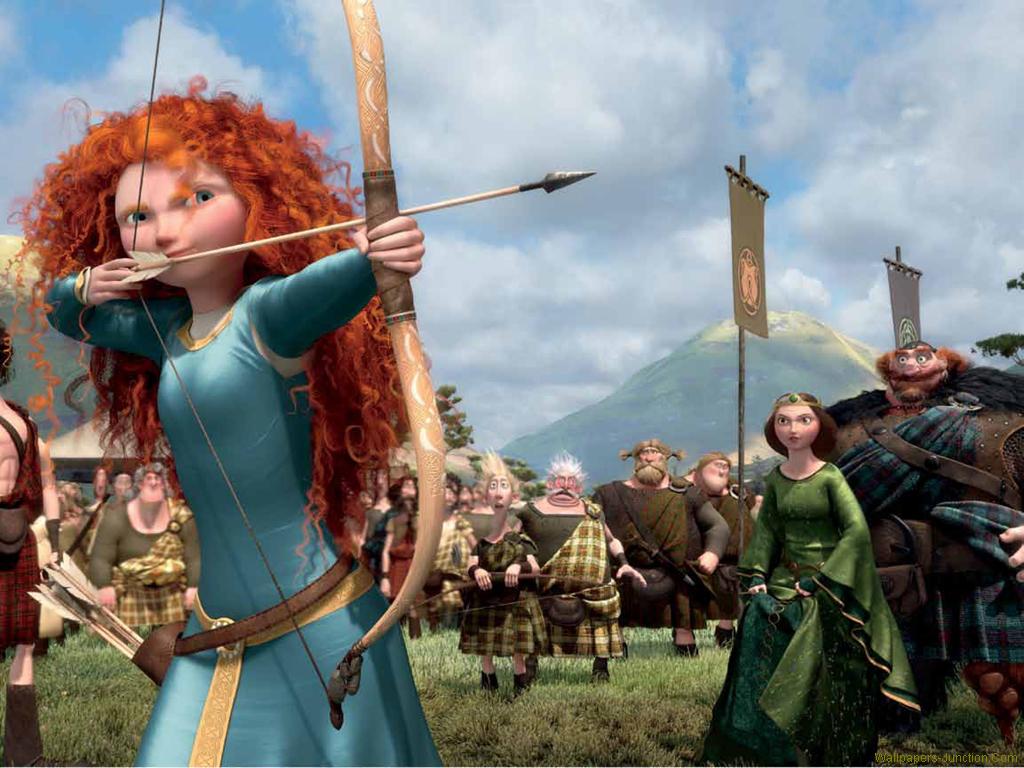
continuing (literally) to string the suitors along for several years before one of her maids tells the suitors what’s really going on and they force her to finish.  Thus, when Odysseus returns, although Agamemnon’s ghost makes a final reappearance near the very end of the story (Book 24) to discuss his own death, Odysseus is at least safe from his wife.  The suitors, however, are another matter, but, with the inadvertent aid of Penelope, he—with his son, Telemachus, two loyal slaves, and Athena—defeats and kills all 100+.  It’s a fairly complicated process, including what looks a bit like the archery contest in the Robin Hood story

(this is by NC Wyeth, 1882-1945—you can find my favorite edition of the Robin Hood story—illustrated by Wyeth here:   https://archive.org/details/robinhood00cresrich  )

or the Pixar movie Brave (2012),

but the story (nearly) concludes with a heap of dead suitors

(by Fyodor Petrovich Tolstoy, 1783-1873)

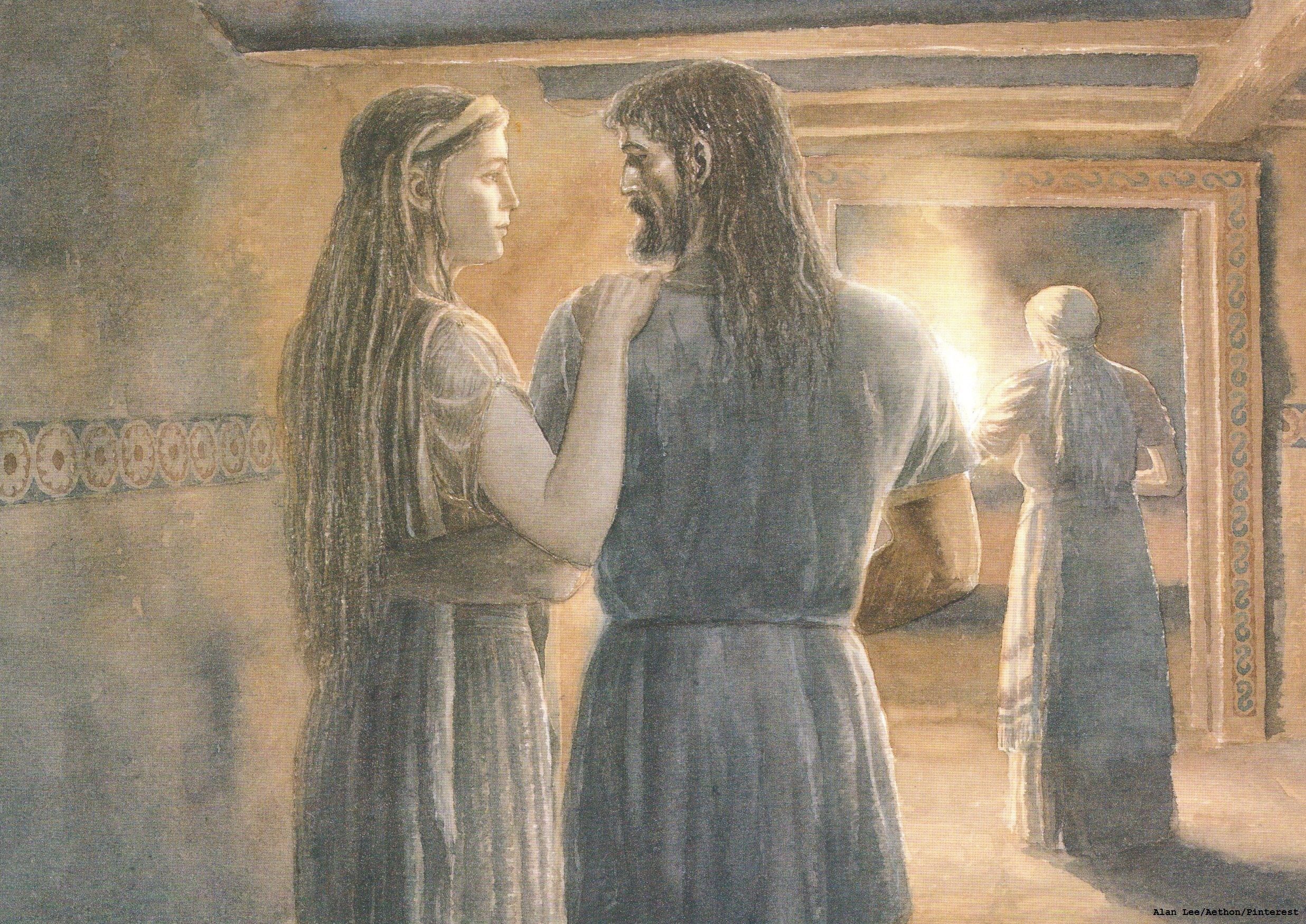
and the happy reunion of Penelope and Odysseus (which Athena thoughtfully prolongs by extending the night).

(by Alan Lee, who clearly does Homer just as well as he does JRRT)

But what about JRRT and his returns, happy or otherwise?

That’s for the second part of this posting.

Thanks, as ever, for reading.

Stay well,

Listen to ghosts—they may have good advice,

And remember, as well, that there’s

MTCIDC

O

Many Happy Returns (II)

11 Wednesday Oct 2023

Posted by Ollamh in Uncategorized

≈ Leave a comment

Welcome, dear readers, as always.

In the previous posting, I began to discuss a common folktale motif, called “The Kyffhaeuser  motif” or “the king under the mountain”, “the king asleep in the mountain” and several more titles as well.   The basic idea is that a culture hero, rather than die, either naturally, or after battle, say, disappears to a distant place and remains there, usually asleep, until awakened by the need of his people or country, when he will reappear as a savior.  (For more on this, see:   https://en.wikipedia.org/wiki/King_asleep_in_mountain )

Western heroes include everyone from Charlemagne to the Irish hero Finn Mac Cool to King Arthur, who, although seemingly mortally wounded, was carried off to the Isle of Avalon to be restored, with the possible suggestion that he will return, like the others in the pattern, if needed.

We know that Tolkien came to have rather mixed feelings about Arthurian material.  Humphrey Carpenter says that, as a child, “The Arthurian legends also excited him”, Carpenter, Tolkien,24), but Tolkien himself later wrote:  “Of course there was and is all the Arthurian world, but powerful as it is, it is imperfectly naturalized, associated with the soil of Britain, but not with English…for one thing its ‘faerie’ is too lavish, and fantastical, incoherent and repetitive.”  (letter to Milton Waldman, “probably written late in 1951”, Letters, 144).  Even saying so, he embarked, in the 1930s, on his own Arthurian poem “The Fall of Arthur”, eventually abandoned.  Christopher Tolkien published the manuscript with commentary in 1985 (you can read about it here:  https://en.wikipedia.org/wiki/The_Fall_of_Arthur ).

This is one Tolkien work which I have yet to read, but, judging from summaries, it appears that it breaks off before Arthur’s end.  That JRRT was aware of the folkloric tradition of Arthur can be seen, however, in a letter  to Naomi Mitchison, in which he discusses the ultimate fate of mortals like Frodo and Sam, who are allowed to travel to Valinor, he mentions that other possibility for Arthur:

“…this is strictly only a temporary reward:  a healing and redress of suffering.  They cannot abide for ever, and though they cannot return to mortal earth, they can and will ‘die’—of free will, and leave the world.  (In this setting the return of Arthur would be quite impossible, a vain imagining.”  (letter to Naomi Mitchison, 25 September, 1954, Letters,, 198-199)

And there is another way in which, perhaps, we can see a small Arthurian/folklore influence upon Tolkien, even to one other name for Thompson’s  Kyffhaeuser  motif, “The King Under the Mountain”. 

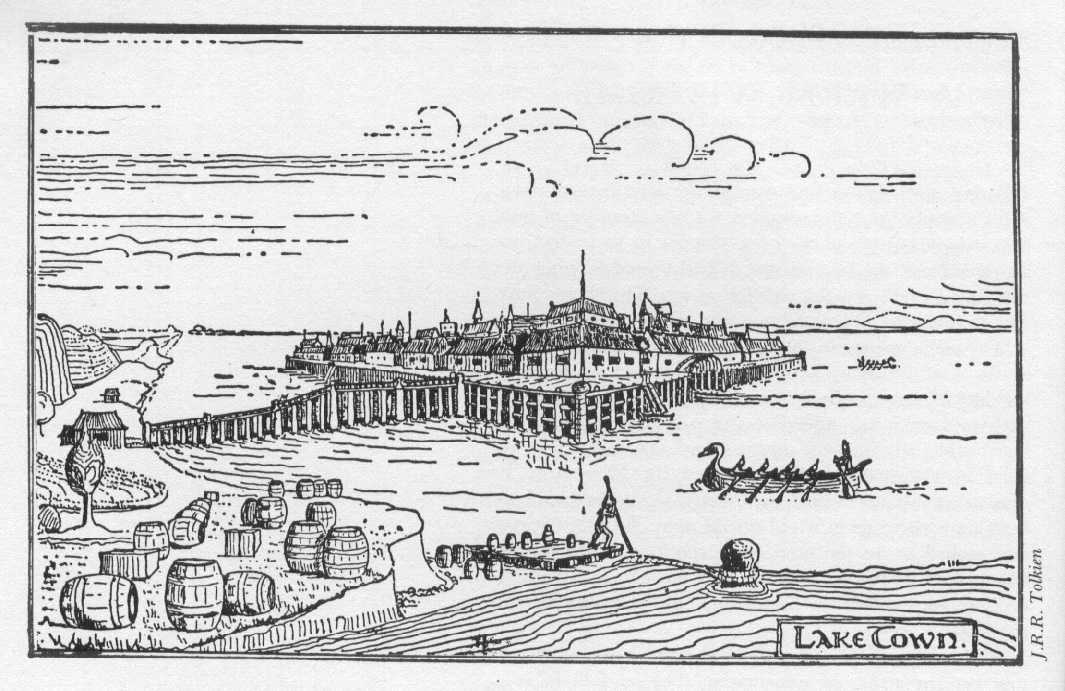
When Bilbo and the much-battered dwarves seek to gain admittance to Lake-town,

(JRRT)

Thorin announces to the startled guards at the gate that he is “Thorin son of Thrain son of Thror King under the Mountain. ..I have come back.”

He subsequently repeats this to the Master and his court:  “I am Thorin son of Thrain son of Thror King under the Mountain!   I return!”  (The Hobbit, Chapter 10, “A Warm Welcome”)

And here we can see JRRT slip right into the second part of the motif, the return of the hero:

“Some began to sing snatches of old songs concerning the return of the King under the Mountain; that it was Thror’s grandson not Thror himself that had come back did not bother them at all.  Others took up the song and it rolled loud and high over the lake:

The King beneath the mountains,

The King of Carven stone,

The Lord of silver fountains

Shall come into his own!

His crown shall be upholden,

His harp shall be restrung,

His halls shall echo golden

To songs of yore re-sung.

The woods shall wave on mountains

And grass beneath the sun;

His wealth shall flow in fountains

And the rivers golden run.

The streams shall run in gladness,

The lakes shall shine and burn,

All sorrow fail and sadness

At the Mountain-king’s return!”

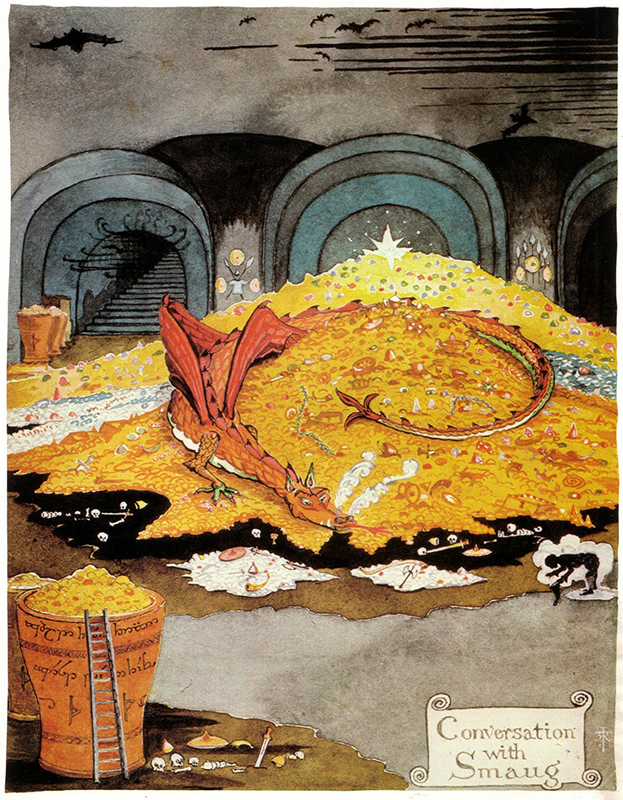
As for the savior part of this motif, something is implied, rather than stated:  the reason that there is no current king is that the last one was driven out by Smaug, after killing (and presumably eating) many of his people.

(JRRT)

If the king is really to return,  then, he must deal with the current occupant.   The Master of Lake-town, who, at first, cynically welcomed the dwarves, “but believed they were frauds who would sooner or later be discovered and be turned out”  then appears to change his mind and “…wondered if Thorin was after all really a descendant of the old kings”.  Still cynical, however, he tells Thorin “What help we can offer shall be yours…” even while thinking, “Let them go and bother Smaug, and see how he welcomes them!” 

Although the return of the king does not turn out quite as the Master—or the dwarves—expected, Smaug dying after destroying Lake-town,

(JRRT)

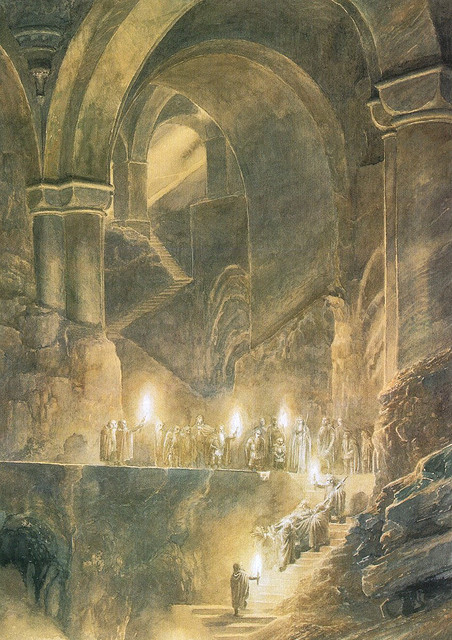
still, even after Thorin’s death in the Battle of the Five Armies, he remains what he claimed to have been as”  They buried Thorin deep beneath the Mountain, and Bard laid the Arkenstone upon his breast.” (The Hobbit, Chapter 18, “The Return Journey”)

(Alan Lee)

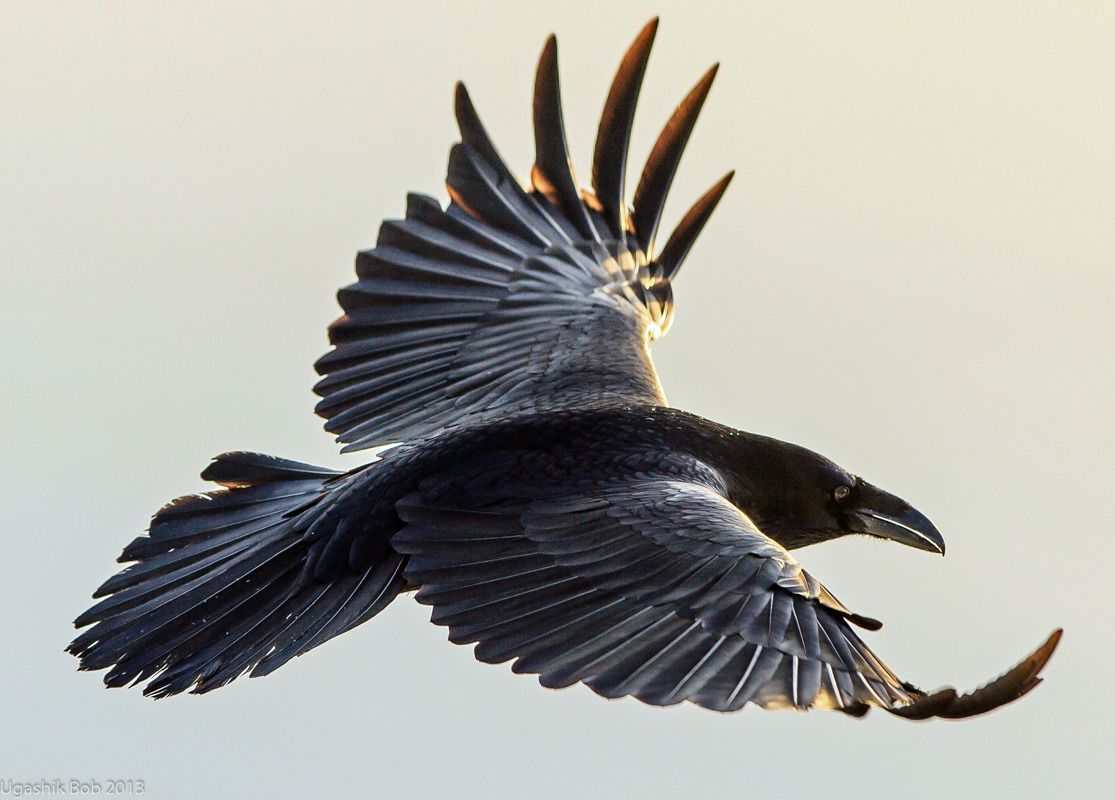
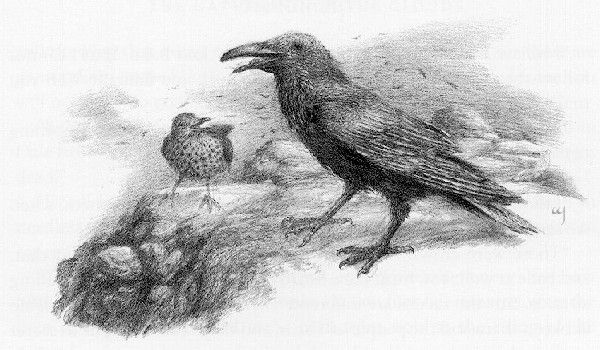
But, in the previous posting, I mentioned ravens.

(I include this just as much because it’s such a beautiful image as it’s relevant…)

The Holy Roman Emperor, Frederick I, called “Barbarossa”, is one of the many heroes who appear in a  version of “the king under the mountain” and, among the variants told of him is this one, to be found in the Grimm brothers Deutsche Sagen,  (“German Legends”) where it’s reported that  when a dwarf led a shepherd under the mountain, Barbarossa stood up and asked, “Are the ravens still flying around the mountain?”   At the shepherd’s affirmation, he cried, “Now must I sleep yet a hundred years longer!” 

(Brothers Grimm, Deutsche Sagen, Number 23, Vol.1, page 30, my translation.  You can find the text here:  https://books.google.com/books?id=SRcFAAAAQAAJ&pg=PR1#v=onepage&q&f=false   ) 

After Smaug has flown off to Lake-town and his doom, the dwarves and Bilbo emerge from the Lonely Mountain, where they are met by the same thrush which had helped in finding and opening the back door, as prescribed in the moon letters on Thror’s map.

He twitters excitedly at them, but they can’t understand him and Balin exclaims, “I only wish he was a raven!”

When Bilbo replies, “I thought you did not like them!  You seemed very shy of them, when we came this way before.”

To which Balin responds: 

“Those were crows!  And nasty suspicious-looking creatures at that, and rude as well.  You must have heard the ugly names they were calling after us.  But the ravens are different.  There used to be great friendship between them and the people of Thror; and they often brought us secret news, and were rewarded with such bright things as they coveted to hide in their dwellings.” (The Hobbit, Chapter 15, “The Gathering of the Clouds”)

The thrush flies off and an ancient raven appears, Roac, son of Carc, who says to Thorin:

“Now I am chief of the great ravens of the Mountain.  We are few, but we remember still the king that was of old.”

Did Tolkien know this legend?  If you consult indices to both Carpenter’s biography and  his edition of Tolkien’s letters, there is no trace to be found there under everything from “Barbarossa” to “raven” and yet the confluence of “king under the mountain” and that mountain hosting ravens would seem suggestive, I think.  Or perhaps a little bird told him…

(Alan Lee)

As ever, thanks for reading.

Stay well,

When a raven speaks, it’s wise to listen,

And remember that, as always, there’s

MTCIDC

O

PS

Which reminds me of a famous old ballad, “The Three Ravens” (Child Ballad #26) which you can read about here:   https://en.wikipedia.org/wiki/The_Three_Ravens  and listen to here:   https://www.youtube.com/watch?v=T8ZASCwSRN0

Many Happy Returns (I)

04 Wednesday Oct 2023

Posted by Ollamh in Uncategorized

≈ Leave a comment

As ever, dear readers, welcome.

It’s a sad fact, perhaps, but, sometimes, even authors we really enjoy don’t quite succeed and, with the best will in the world, it’s hard not to think, “I was following along and enjoying the book and then came the conclusion and…”

For me, in the latest read of my science fiction project, such was the case with Fletcher Pratt and  L. Sprague de Camp’s The Land of Unreason (first published in Unknown Worlds, October, 1941,

then expanded into book form in 1942).

It began with an interesting premise:  an American in early wartime Britain, makes the mistake of violating the custom of leaving out food and drink for “the Good People” (that is, the “Fee”).  This causes him to fall into a world in which “reason” has laws of its own and much of the fun, for me, was in watching the protagonist attempt to figure out how to deal with this.  (You can read a full summary here:  https://en.wikipedia.org/wiki/Land_of_Unreason )  It was a bit uneven here and there, but not enough to trouble, so long as it kept moving, but then came that ending, where the protagonist, “Fred Barber”, is revealed to be the Holy Roman Emperor, Frederick I (also known as “Barbarossa”, 1122-1190)

(This is a reliquary—a place to store a sacred relic or two–and was supposedly modeled on old Fred himself—for more see:  https://en.wikipedia.org/wiki/Frederick_Barbarossa  )

and there the story rather abruptly ends.

If you only knew that Frederick was the Holy Roman Emperor, this would be puzzling—why should that matter in resolving the plot?–but perhaps what the authors wanted the readers to remember is that Fred, as Frederick, belonged to a folklore tradition, called by the folklorist, Stith Thompson, “the Kyffhaeuser type” or “the king under the mountain” (also known as “the king asleep in the mountain” , No.1960.2 in Thompson’s motif index)

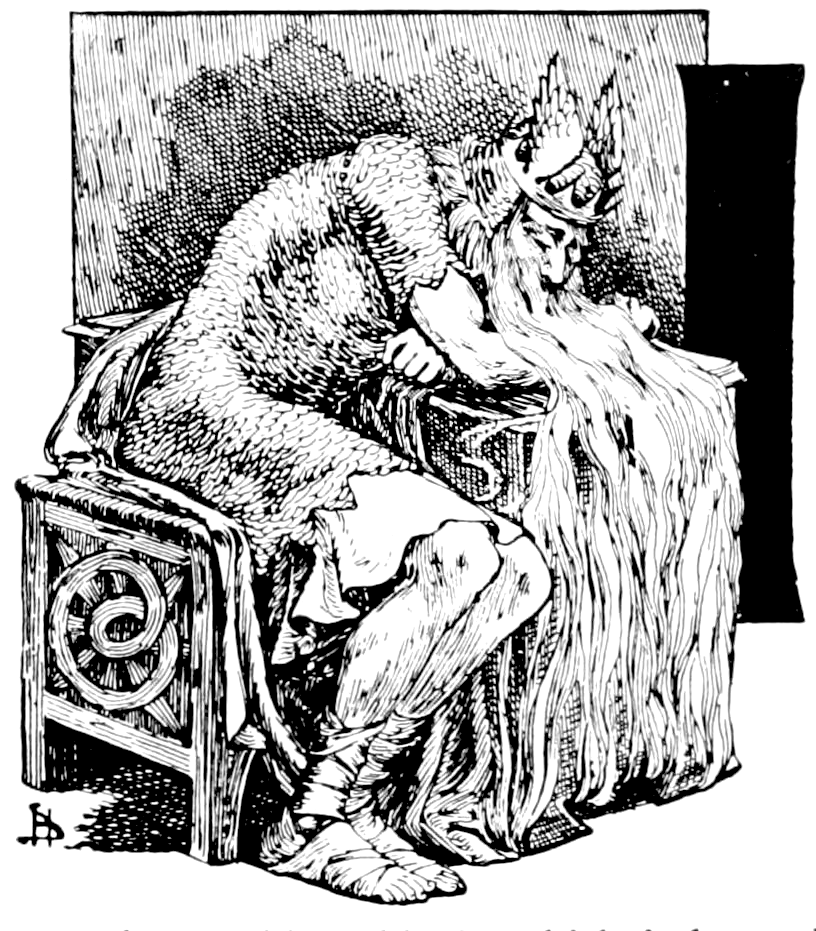
In this tradition, a once-famous culture hero, like Frederick, is said not to be dead, but, instead, away somewhere else, often sleeping, but, given the right moment—usually when his country is in danger–he will awaken, or be awakened, and then come to the rescue. Perhaps the authors were suggesting a sequel?

Legend has it, for example, that Frederick is drowsing under a German mountain, either the Untersberg, between Austria and Germany,

or the central German hill range of the Kyffhaeuser (hence Thompson’s name for the motif type).

The latter has been decorated—or marred, depending upon your taste—with a gigantic monument, dedicated in 1896, combining an image of Frederick, deep in slumber still, with an equestrian statue of Kaiser Wilhelm I (1797-1888) posed above him (the idea being that now there’s a German empire—ruled by Wilhelm I’s grandson, the erratic and trouble-making Wilhelm II—Barbarossa can continue to doze).

An interesting side detail about the Barbarossa story can be found in the Grimm brothers Deutsche Sagen,  (“German Legends”) where it’s reported that  when a dwarf led a shepherd under the mountain, Barbarossa stood up and asked, “Are the ravens still flying around the mountain?”   At the shepherd’s affirmation, he cried, “Now must I sleep yet a hundred years longer!” 

(Brothers Grimm, Deutsche Sagen, Number 23, Vol.1, page 30, my translation.  You can find the text here:  https://books.google.com/books?id=SRcFAAAAQAAJ&pg=PR1#v=onepage&q&f=false   )  Those ravens will return in Part II.

This motif is surprisingly common (there’s a whole WIKI article devoted to it here:   https://en.wikipedia.org/wiki/King_asleep_in_mountain ), including , in the West, everyone from Ogier the Dane, who is involved in the medieval Charlemagne stories

(and who even turns up the in a fairy tale of Hans Christian Andersen, from an 1899 translation of which this illustration appears—you can read it here: https://ia800505.us.archive.org/26/items/fairytalesofhans00ande/fairytalesofhans00ande.pdf  )

to the early Irish hero, Fionn mac Cumhaill (who, in English, becomes ”Finn mac Cool”—if you’d like to read more about him, you might begin with Lady Gregory’s fiercely-named Gods and Fighting Men, 1913, available for you here:   https://archive.org/details/godsfightingmens00greg  )

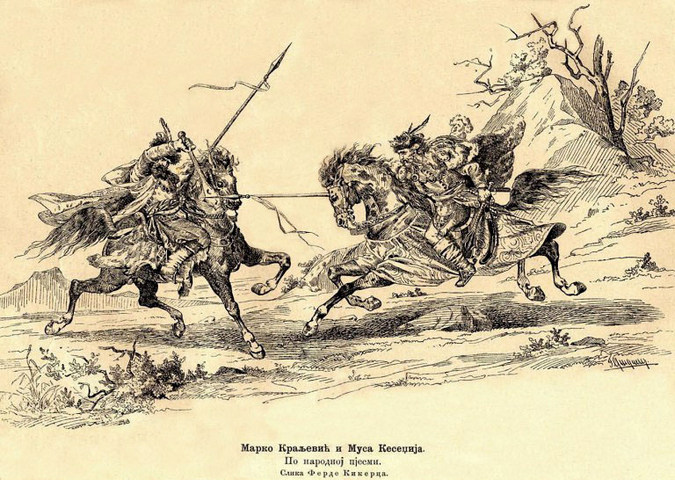
to the South Slavic Marko Kraljevic (KRAL-jeh-vitch—“Kingson”, so, “Prince Marko” )

who has the most wonderful horse, Sarac (SHA-rats—in English “roan”, a sort of reddish-brown—although the word has a fairly wide meaning, and illustrations, like the one here, depict him as what appears to be what we’d call a “piebald”), with whom he shares his wine—you can read about them here:  https://archive.org/details/BalladsOfMarkoKraljevic/page/n3/mode/2up  Although, in this translation of ballads about Marko, he dies, after killing Sarac so that he can’t be turned into a beast of burden by Marko’s enemies.  See this article for his sleeping, as well as the good news that Sarac isn’t killed:  https://en.wikipedia.org/wiki/Prince_Marko )

to a very familiar figure, King Arthur.

Our earliest-known reference to Arthur’s disappearance, Geoffrey of Monmouth’s (c.1095-c.1155)  Historia Regum Britanniae (“History of the Kings of Britain”, c.1130s), has only this to say:

Sed et inclytus ille Arturus rex letaliter vulneratus est, qui illine ad sananda vulnera sua in insulam Avallonis advectus,

“But  that famous king Arthur was mortally wounded, too, and who was carried from there [Cornwall]  for the healing of his wound to the island of Avalon…”

 (Geoffrey of Monmouth, Historia Regum BritanniaeHistoria Regum Britanniae, Book XI, Chapter II, my translation—and you can read a very useful English summary/translation of the Arthurian bits of Geoffrey here:   https://d.lib.rochester.edu/camelot/text/geoffrey  This comes from the University of Rochester (NY, not UK), “Camelot Project”, which is invaluable if you’re interested in things Arthurian.)

By the late 15th century, it appears that this tradition has been extended and that it begins to have more the look of the “king under the mountain”:

“Yet somme men say in many partyes of Englond that  kyng Arthur is not deed / But had by the wylle of our lord Ihefu in to another place / and men say that he shal come ageyn & he shal wynne the holy croffe . I wyl not say that it shal be so / but rather I wyl say here in thys world he chaunged his lyf / but many men say that there is wryton vpon his tombe this vers  Hic iacet Arthurus Rex quondam Rex que futurus /”

(Sir Thomas Malory (?  There is much discussion about who he was and when he lived, but a manuscript says that the text was completed by 1470),  Le Morte d’Arthur,  Book XXI, Chapter VII—this is from the 1889 edition of Oskar Sommer, which reprints the first printed edition of 1485 of William Caxton—and here it is for you:  https://archive.org/details/lemortedarthuror00malouoft/page/n5/mode/2up   If you read this blog regularly, you know that I always prefer the earliest edition of a work which I can find, as I believe that earlier English, both the language and the printing, is so much more interesting and memorable. )

(one of the only two copies of that first printing—it’s in the Morgan Library in New York)

That cross, with its inscription, is a monkish fake from 1190/1, (See a chatty but useful article here:  https://arstechnica.com/science/2016/03/medieval-monks-used-king-arthurs-grave-as-an-attraction-to-raise-money/  as well as an article about all sorts of possibilities for Arthur’s burial here:  http://www.badarchaeology.com/controversies/looking-for-king-arthur/the-archaeology-of-arthur/ ) but there seem to be two versions of it, one, reported by Gerald of Wales, c.1146-c.1223, in his Speculum Ecclesiae—“The Mirror of the Church”—Part II, Sections VIII-X , and presumably the earlier version, says nothing about “quondam” or “futurus”, that is, “one-time” and “to be” , quoting the inscription to say (my translation):

“Hic jacet sepultus inclytus rex Arturius in insula Avallonia  cum Wennevereia uxore sua secunda”

“Here lies buried the famous king Arthur in the island of Avalon with Guinevere his second wife”

(You can find the full text in Latin here:   https://ia902902.us.archive.org/10/items/giraldicambrensi04gira/giraldicambrensi04gira.pdf  and an English translation of the relevant parts here:   https://www.earlybritishkingdoms.com/sources/gerald02.html  )

As you can see, no “quondam” (“one-time”) and no “futurus” (“to be”).  So where did they come from?  As far as we know, this appears only in Malory, although Malory cites “his tombe”.  When the supposed Arthur was reburied, in the presence of Edward I and Eleanor of Aquitaine, in 1278, he was given what must have been a rather showy tomb—

The royal visit to Glastonbury Abbey in 1331. © Dominic Andrews http://www.archaeoart.co.uk

(This is a reconstruction by the Department of Archeology at Reading, which has done major work for the study of Glastonbury from its ancient roots at least to the end of the ecclesiastical period.  See:   https://research.reading.ac.uk/glastonburyabbeyarchaeology/digital/arthurs-tomb-c-1331/arthurs-tomb/ )

Although, with the dissolution by Henry VIII of Glastonbury Abbey in  1539, the tomb was lost, but  the early antiquary, John Leland (c,1503-1552), has left us a partial description in his Itineraries (notebooks of his travels around England—really remarkable stuff for the 1530s, when his extensive journeying would have been extremely difficult, and sometimes perhaps even dangerous).  He says of it that it had: 

1. a crucifix at the head

2. an image of Arthur at the foot

3. a cross on the tomb

4. lions at the head and foot

5. two inscriptions, at least the first of which was written by Henry Swansey an abbot of Glastonbury

The first inscription reads:

“Hic jacet Arturus flos regum gloria regni

Quem mores probitas commendant laude perenni”

“Here lies Arthur the flower of kings, the glory of the kingdom,

Whom his character and uprightness commend for eternal praise.”

and the second, at the foot of the tomb says:

Arturi  jacet hic conju[n]x tumulata secunda

Quae meruit coelos virtutum prole secunda”

“Here lies buried the second wife of Arthur,

Who has deserved Heaven from the fortunate offspring of [her] virtues.” (a wordplay—“secunda” can mean both “second” and “lucky”)

(my translations from John Leland, The Itinerary of John Leland, Parts I to III, edited by Lucy Toulmin Smith, 1907, page 288 and it’s right here for you:  https://archive.org/details/itineraryjohnle02lelagoog/page/n11/mode/2up )

No “quondam” and no “futurus” here, either, and, presumably, this is the “tombe” which Mallory mentions.  Did he make that inscription up?  Certainly Mallory assembled a large body of previous work and not all of his sources are traceable.  Perhaps this will remain a mystery, along with the reported disappearance and subsequent non-reappearance of Arthur?

But the influence of Arthur, or, at least of his motif type, will appear in the second (and I hope fortunate) part of this posting.  I’ll provide a hint here—someone once lived under another mountain before a new and destructive tenant arrived…

Thanks, as ever, for reading.

Stay well,

May you be both quondam and futurus/a,

And remember that, as always, there’s

MTCIDC

O

The Doubtful Sea Series Facebook Page

The Doubtful Sea Series Facebook Page

  • Ollamh

Categories

  • Artists and Illustrators
  • Economics in Middle-earth
  • Fairy Tales and Myths
  • Films and Music
  • Games
  • Heroes
  • Imaginary History
  • J.R.R. Tolkien
  • Language
  • Literary History
  • Maps
  • Medieval Russia
  • Military History
  • Military History of Middle-earth
  • Narnia
  • Narrative Methods
  • Poetry
  • Research
  • Star Wars
  • Terra Australis
  • The Rohirrim
  • Theatre and Performance
  • Tolkien
  • Uncategorized
  • Villains
  • Writing as Collaborators
Follow doubtfulsea on WordPress.com

Across the Doubtful Sea

Recent Postings

  • A Moon disfigured December 17, 2025
  • On the Roads Again—Once More December 10, 2025
  • (Not) Crossing Bridges December 3, 2025
  • On the Road(s) Again—Again November 26, 2025
  • On the Road(s) Again November 19, 2025
  • To Bree (Part 2) November 12, 2025
  • To Bree (Part 1) November 5, 2025
  • A Plague o’ Both—No, o’ All Your Houses! October 29, 2025
  • It’s in Writing (2:  I’st a Prologue, or a Poesie for a Ring?) October 22, 2025

Blog Statistics

  • 103,189 Views

Posting Archive

  • December 2025 (3)
  • November 2025 (4)
  • October 2025 (5)
  • September 2025 (4)
  • August 2025 (4)
  • July 2025 (5)
  • June 2025 (4)
  • May 2025 (4)
  • April 2025 (5)
  • March 2025 (4)
  • February 2025 (4)
  • January 2025 (5)
  • December 2024 (4)
  • November 2024 (4)
  • October 2024 (5)
  • September 2024 (4)
  • August 2024 (4)
  • July 2024 (5)
  • June 2024 (4)
  • May 2024 (5)
  • April 2024 (4)
  • March 2024 (4)
  • February 2024 (4)
  • January 2024 (5)
  • December 2023 (4)
  • November 2023 (5)
  • October 2023 (4)
  • September 2023 (4)
  • August 2023 (5)
  • July 2023 (4)
  • June 2023 (4)
  • May 2023 (5)
  • April 2023 (4)
  • March 2023 (5)
  • February 2023 (4)
  • January 2023 (4)
  • December 2022 (4)
  • November 2022 (5)
  • October 2022 (4)
  • September 2022 (4)
  • August 2022 (5)
  • July 2022 (4)
  • June 2022 (5)
  • May 2022 (4)
  • April 2022 (4)
  • March 2022 (5)
  • February 2022 (4)
  • January 2022 (4)
  • December 2021 (5)
  • November 2021 (4)
  • October 2021 (4)
  • September 2021 (5)
  • August 2021 (4)
  • July 2021 (4)
  • June 2021 (5)
  • May 2021 (4)
  • April 2021 (4)
  • March 2021 (5)
  • February 2021 (4)
  • January 2021 (4)
  • December 2020 (5)
  • November 2020 (4)
  • October 2020 (4)
  • September 2020 (5)
  • August 2020 (4)
  • July 2020 (5)
  • June 2020 (4)
  • May 2020 (4)
  • April 2020 (5)
  • March 2020 (4)
  • February 2020 (4)
  • January 2020 (6)
  • December 2019 (4)
  • November 2019 (4)
  • October 2019 (5)
  • September 2019 (4)
  • August 2019 (4)
  • July 2019 (5)
  • June 2019 (4)
  • May 2019 (5)
  • April 2019 (4)
  • March 2019 (4)
  • February 2019 (4)
  • January 2019 (5)
  • December 2018 (4)
  • November 2018 (4)
  • October 2018 (5)
  • September 2018 (4)
  • August 2018 (5)
  • July 2018 (4)
  • June 2018 (4)
  • May 2018 (5)
  • April 2018 (4)
  • March 2018 (4)
  • February 2018 (4)
  • January 2018 (5)
  • December 2017 (4)
  • November 2017 (4)
  • October 2017 (4)
  • September 2017 (4)
  • August 2017 (5)
  • July 2017 (4)
  • June 2017 (4)
  • May 2017 (5)
  • April 2017 (4)
  • March 2017 (5)
  • February 2017 (4)
  • January 2017 (4)
  • December 2016 (4)
  • November 2016 (5)
  • October 2016 (6)
  • September 2016 (5)
  • August 2016 (5)
  • July 2016 (5)
  • June 2016 (5)
  • May 2016 (4)
  • April 2016 (4)
  • March 2016 (5)
  • February 2016 (4)
  • January 2016 (4)
  • December 2015 (5)
  • November 2015 (5)
  • October 2015 (4)
  • September 2015 (5)
  • August 2015 (4)
  • July 2015 (5)
  • June 2015 (5)
  • May 2015 (4)
  • April 2015 (3)
  • March 2015 (4)
  • February 2015 (4)
  • January 2015 (4)
  • December 2014 (5)
  • November 2014 (4)
  • October 2014 (6)
  • September 2014 (1)

Blog at WordPress.com.

  • Subscribe Subscribed
    • doubtfulsea
    • Join 78 other subscribers
    • Already have a WordPress.com account? Log in now.
    • doubtfulsea
    • Subscribe Subscribed
    • Sign up
    • Log in
    • Report this content
    • View site in Reader
    • Manage subscriptions
    • Collapse this bar
 

Loading Comments...