• About

doubtfulsea

~ adventure fantasy

Monthly Archives: July 2023

Jonesing for Indiana (I)

24 Monday Jul 2023

Posted by Ollamh in Uncategorized

≈ 1 Comment

As always, dear readers, welcome.

I’ve just been to see the new Indiana Jones film for the second time in about a week. 

I wanted to see it at least twice before I wrote about it as, if you regularly read this blog, you know that, when I review something, I try to begin with what I understand the creators of the film were trying to do, then, going from there, attempt to see how well they succeeded, at least in my own mind.  This film was complex enough that I’m going to break my review into two parts, the first being mostly background, the second being my reaction.

I begin by saying that I have been a fan of the series since Raiders and have looked forward to this film since it was originally announced, some time ago.

Of the (now) 5 Indiana Jones films, my favorites have always been the first

and the third.

For me, the first is a combination of likeable characters and a plot which, although, in fact, carefully worked out,
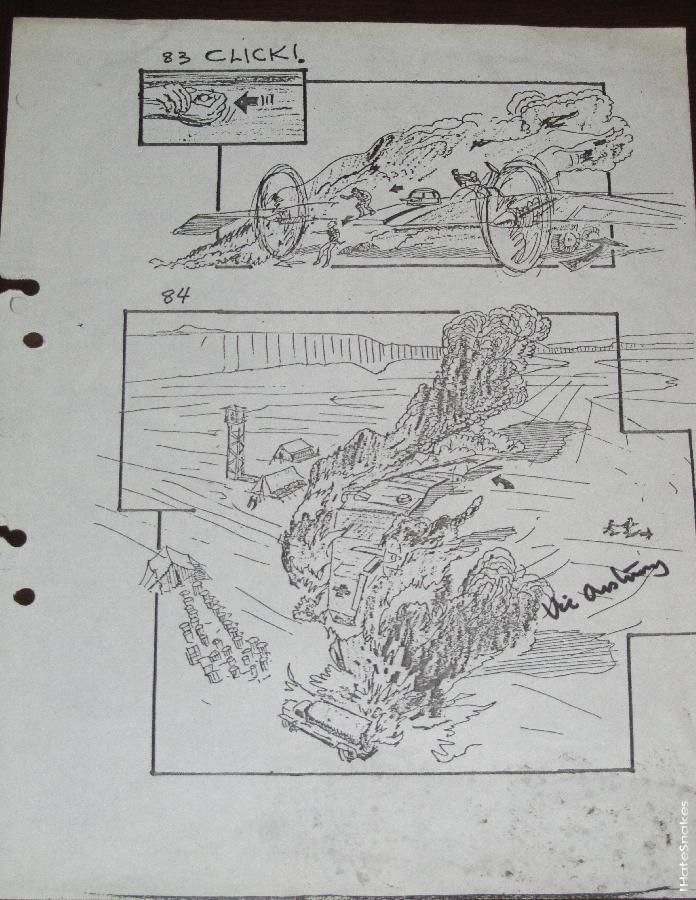
seems, somehow, improvised, following Jones’ own remark, just before he mounts a white horse to chase the Nazis who have the Ark, 

“I’m making this up as I go along”.

The third, for me, has the most comedy

(here’s Henry Jones, Senior, having just accidentally shot off the tail of their plane, straight-facedly saying to Henry Jones, Junior, “Son, they got us.”)

as well as the byplay between demanding father and son who feels that he can never meet his father’s standard, but eventually does.

In contrast, two, for me, has a splendid opening,

(and the quiet joke that this is the “Club Obi Wan”)

 but the film itself is then compromised by a heroine who spends most of the film screaming and running—a strong contrast to the feisty Marion Ravenwood of the first film.

(This is not to attack the actress, by the way, as she was only following what the script asked of her.)

As for the fourth one, I must say that, as in number two, there was a wild opening scene,

but, also, as in the case of two, for me, it didn’t fulfill the promise of that first scene.  It may be that the extraterrestrial angle simply didn’t appeal.  I also wasn’t convinced by Henry Jones the third (aka “Mutt”), who was being considered, I’ve read, as the lead character in further adventures, but simply lacked the rugged charm of Harrison Ford, who is clearly a more versatile actor, being able to do both action and comedy. 

This brings us to five, Indiana Jones and the Dial of Destiny. 

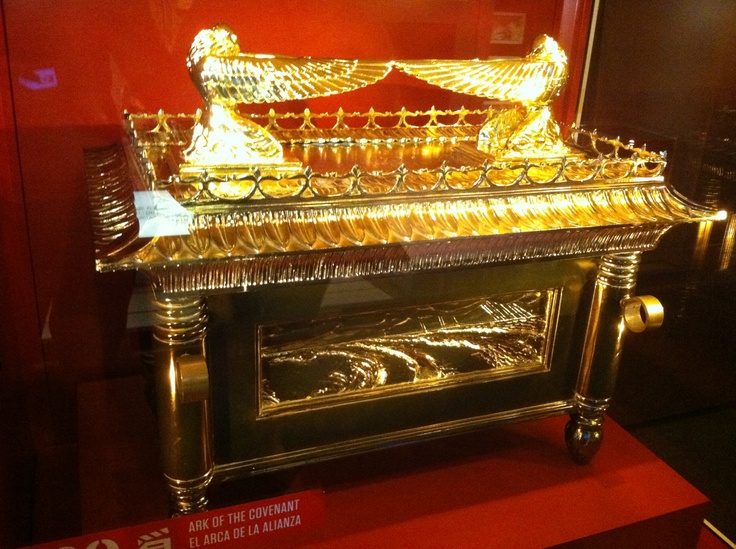
Earlier films have had their goals:  one had the Ark of the Covenant,
two had a sacred stone (although it disappeared for most of the film, making it hard to remember that goal),

 the third had the Holy Grail,

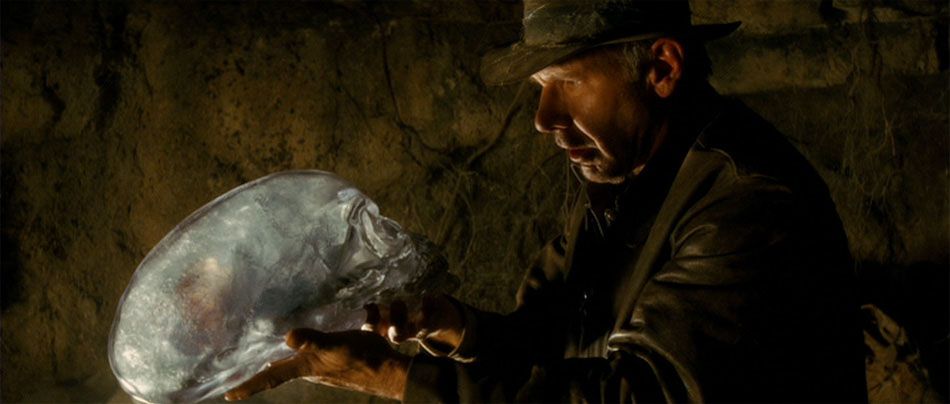
the fourth (I’d guess) a crystal skull, although it seemed that the skull was really only a key to a location—a giant space ship. 
As these are adventure films, they don’t have to answer to hard reality, so any goals are really only there to move the plot along, and we can choose to believe that the actual objects are grounded in history or not.

That “Dial of Destiny” is based upon an actual object, however, the so-called “Antikythera mechanism”.
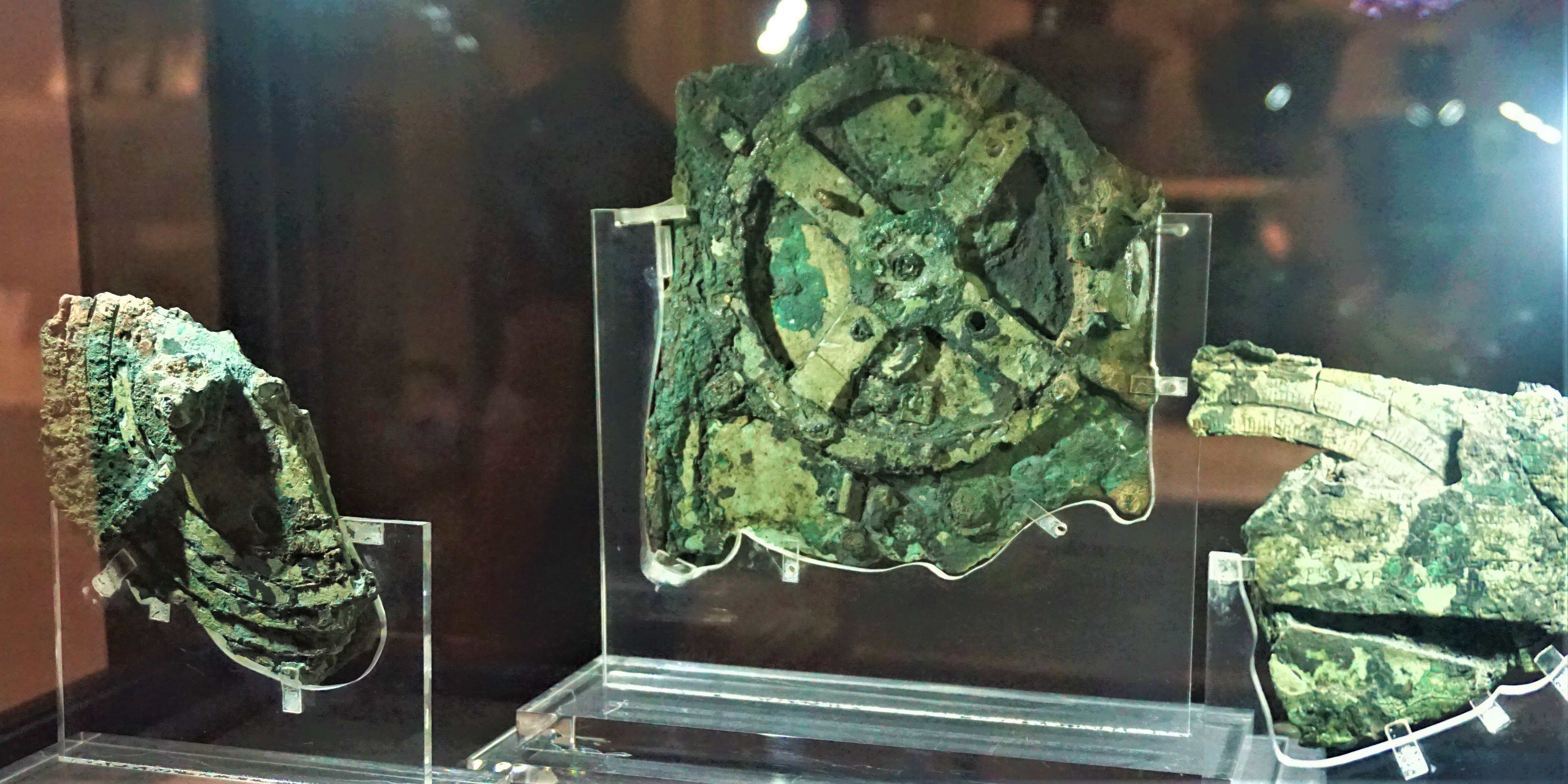
This gadget was found by Greek sponge divers in a shipwreck off the coast of the small Greek island of Antikythera, to the southeast of the island of Kythera, in 1901 (the film mistakenly says 1902—for more on the wreck, see:  https://en.wikipedia.org/wiki/Antikythera_wreck ).

As you can see, it is hardly a working model, having been underwater from the last century, BC, dating coming from coins discovered at the site, and parts appear to be missing.

There is also much discussion about dating the thing itself, anything from c.200BC to not long before the shipwreck (one of the most respected theorists, Derek de Solla Price, maintains, based upon a number of factors, including inscriptions found on it, that it was built about 87BC—if you have access to JSTOR, his extremely detailed and informative article can be found there under “Gears from the Greeks”.)

Taking any suggested model, however–and some seem more fantastic than others–the craftsmanship appears almost supernatural for any mechanical device that complex from the last century—or centuries—BC.   (And you know that, just as in the case of things like the pyramids, there are always those who choose to offer and believe extraterrestrial origins, rather than accept the fact that people from this planet can sometimes make or do extraordinary things.  The evidence that Egyptians built the pyramids is everywhere to be found around them.)

Its actual function/s has/have been the subject of a number of reconstructions, as well as a number of theories, but, currently, the consensus seems to be that it’s a kind of orrery—and type of planetarium– which can be used to do things like predict solar eclipses (for more on this, see the very well informed article here:   https://en.wikipedia.org/wiki/Antikythera_mechanism ) As to its maker, this is a complete question mark.

But not in this film.  Here, it is the work of the 3rd-century BC mathematician/inventor, Archimedes (c.287-c.212BC).  Although the historical dating for the device would probably not match the actual dates of Archimedes, the idea that such a brilliant man might come up with such a thing strikes me as not beyond the realm of belief.  Jones himself mentions Archimedes in discussing the Roman siege of Syracuse in 214-212BC. 

In the film, he mentions Archimedes’ invention of huge “grabbers” to snatch up Roman galleys and drop them, upturned, into the sea,

as well as huge mirrors, which would focus the rays of the sun on the Roman ships and set fire to them.
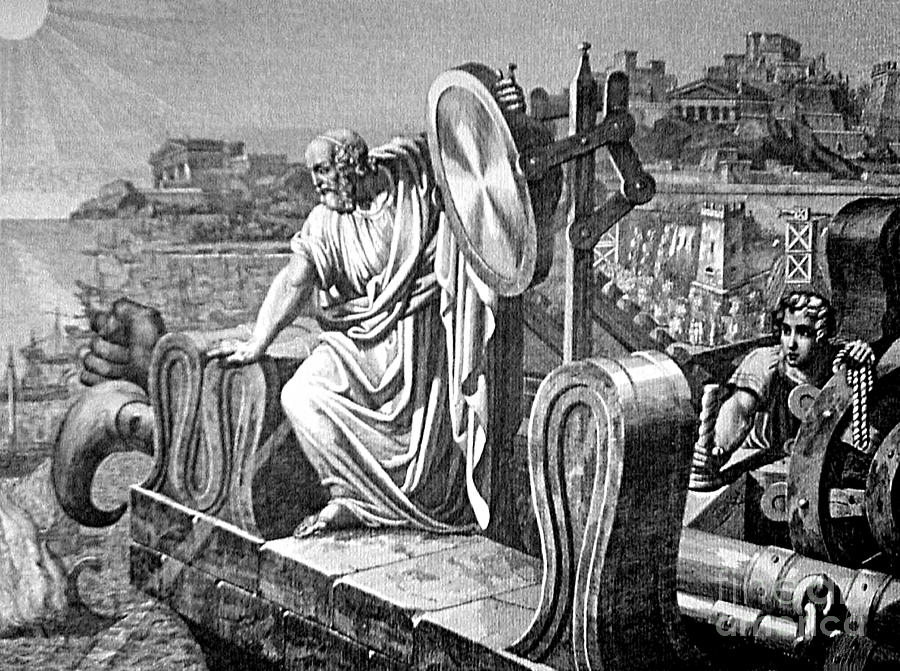
(Would such mirrors actually work?  See:  https://www.realclearscience.com/blog/2021/10/28/did_archimedes_death_ray_actually_work_799152.html#! And:  https://history.howstuffworks.com/historical-figures/archimedes-death-ray.htm For more on Archimedes’ efforts, see:  https://math.nyu.edu/~crorres/Archimedes/Siege/Livy.html  which is from part of Livy’s fragmentary history of Rome; see, as well, Plutarch’s biography of the conqueror of Syracuse, the Roman general, Marcellus (268-208BC), here:  https://classics.mit.edu/Plutarch/marcellu.html ); the story of the mirrors appears for the first time in Dio Cassius’ histories here:  https://math.nyu.edu/~crorres/Archimedes/Siege/DioCassius.html  although, unfortunately, in later Byzantine summaries.) 

From history, however, the film then spills over into the realm of fantasy, as this mechanism, if I understand the plot correctly, can not only chart what are called “weather anomalies”, but also “time anomalies”, which means that, with the right calculations, one might discover the equivalent of cracks in time into which one might slip.  And here I begin to have questions—but we’ll talk about that in Part II.

Thanks for reading, as always.

Stay well,

Always have time—for adventure,

And remember that, as always, there’s

MTCIDC

O

PS

For more on Archimedes, go to:  https://math.nyu.edu/~crorres/Archimedes/contents.html  Archimedes was almost spookily modern and this site shows how.

Glittering

19 Wednesday Jul 2023

Posted by Ollamh in Uncategorized

≈ Leave a comment

As always, welcome, dear readers.

I wonder if you, like me, have seen something like this on a bumper in a parking lot?

Or possibly stuck on the inside of a car’s back window?

If so, and you are a Tolkien reader, you know right away that it’s one line from a poem by Bilbo, first read in a letter Gandalf has left at The Prancing Pony (The Fellowship of the Ring, Book One, Chapter 10, “Strider”) and repeated by Bilbo himself  who, at the council of Elrond, “Standing up suddenly…burst[s] out”:

All that is gold does not glitter,

Not all those who wander are lost;

The old that is strong does not wither,

Deep roots are not reached by the frost.

From the ashes a fire shall be woken,

A light from the shadows shall spring;

Renewed shall be blade that was broken:

The crownless again shall be king.”  (The Fellowship of the Ring, Book Two, Chapter 2, “The Council of Elrond”)

He’s referring to Aragorn, of course, responding both to a dream Boromir has just repeated, as well as to what seems like the beginning of a tussle between Boromir and Aragorn.  In his dream, Boromir “heard a voice, remote but clear, crying:

Seek for the Sword that was broken:

In Imladris it dwells;

There shall be counsels taken

Stronger than Morgul-spells.

There shall be shown a token

That Doom is near at hand,

For Isildur’s Bane shall waken,

And the Halfling forth shall stand.”

The broken blade is Narsil, Elendil’s sword, which broke when, killed by Sauron, he fell on it.  Isildur then used the shard to cut the Ring (which became “Isildur’s Bane”, or curse) from Sauron’s hand and so the Ring and the shattered sword are forever linked.

Bilbo’s poem then acts as a kind of second stanza to Boromir’s dream verses, suggesting that the shattering of the sword is not the end of the story and that its remaking will be involved in the Doom of Boromir’s poem. 

For all the weight in these words, the line which caught my attention this time was:  “All that is gold does not glitter”. 

This is, of course, based upon “all that glitters isn’t gold”, from the proverbial expression, believed to originate in the Parabolae, “Proverbs”, of the 12th century French cleric Alain de Lille, who wrote:

Non teneas aurum totum quod splendet ut aurum
nec pulchrum pomum quodlibet esse bonum;

“Do not take for gold all which shines like gold

Nor a good-looking apple, if you will, to be a good one.” (Liber Parabolarum, 3.1, my translation)

And yet there is something odd here—instead of saying what the proverb warns:  “don’t trust surfaces”, Bilbo is suggesting that “Some things which don’t glitter are gold”, implying that an unlikely surface may hide something worthy and there is more to the rough-looking Aragorn than Boromir—or anyone else in the room who doesn’t know his history—may understand.

It might be thought that Tolkien didn’t like Shakespeare, and this idea comes, I would guess, from this quotation in particular:

“I went to King Edward’s School and spent most of my time learning Latin and Greek; but I also learned English.  Not English Literature!  Except Shakespeare (which I disliked cordially)…”  (letter to W.H. Auden, 7 June, 1955, Letters, 213)

And yet he later records enjoying a performance of Hamlet—and here, I think, we can see that what he might dislike isn’t Shakespeare per se, but reading him as one might read a novel:

“…but the only event worth of talk was the performance of Hamlet which I had been to just before I wrote last.  I was full of it at the time…But it emphasized more strongly than anything I have ever seen the folly of reading Shakespeare (and annotating him in the study), except as a concomitant of seeing his plays acted.” (letter to Christopher Tolkien, 28 July, 1944, Letters, 88)

And I wonder, then, if Bilbo’s line, and his point, weren’t, in fact, influenced by another Shakespeare play.

(The First Quarto, 1600—and here it is for you:  https://internetshakespeare.uvic.ca/doc/MV_Q1/complete/index.html )

As with all of Shakespeare’s plays, there is a complicated plot, but there is one element, as old as the 13th century Gesta Romanorum, “The Deeds of the Romans” (which Shakespeare probably read in the 1577 Certain Selected Histories for Christian Recreations.  You can read the story, Number XLVIII, here:  https://ia600902.us.archive.org/15/items/gestaromanorum02hoopgoog/gestaromanorum02hoopgoog.pdf pages XLIV-XLVII ) which involves a kind of contest for the daughter/heiress of a wealthy man.  Her father has arranged three caskets, one of gold, one of silver, and one of lead, with a riddling, ironic label on each and the suitor who picks the correct one (which has the daughter, Portia’s, portrait inside) gains her hand.  We in the present cynical world would roll our eyes and say, “It’s the lead one, of course!” but Shakespeare’s audience would be as well aware of this as we are.  The point is really about the revelation of character, the choice each of the suitors makes reveals his quality as we overhear each talking to himself before making his decision (and this is one reason why this play was called “The comical Historie of the Merchant of Venice” on the first page of the text, for all that it has its moments of passion and even danger).

The first, Morochus (as he’s called in the First Quarto), chooses the casket of gold because:

“One of these three containes her heauenly picture.

Ist like that leade containes her, twere damnation

to thinke so base a thought, it were too grosse

to ribb her serecloth in the obscure graue,

Or shall I thinke in siluer shees immurd

beeing tenne times vndervalewed to tride gold,

O sinful thought, neuer so rich a Iem

was set in worse then gold.” (Act II, Scene 7—this is a later division of the text, the First Quarto runs straight through)

He’s wrong, of course, but what’s telling is that he can only see the outside of the casket, as he really only sees—and values– the outside of Portia, thus revealing his shallowness.  He opens the casket and finds only this mocking message:

“All that glisters is not gold,

Often haue you heard that told,

Many a man his life hath sold

But my outside to behold,

Guilded timber doe wormes infold:

Had you beene as wise as bold,

Young in limbs, in iudgement old,

Your aunswere had not beene inscrold,

Fareyouwell, your sute is cold.”

The second suitor, the Prince of Arragon, chooses the silver casket, and he, too, fails.  It’s only the third, Bassanio, whom Portia really likes, who makes the correct choice, finding her portrait in the casket of lead and, in his reasoning and choice, we see that he is a far different character from the two previous suitors, as his enclosed poem says:

“You that choose not by the view

Chaunce as faire, and choose as true:

Since this fortune falls to you,

Be content, and seeke no new.

If you be well pleasd with this,

and hold your fortune for your blisse,

Turne you where your Lady is,

And claime her with a louing kis.”

The key here is that first line:  “You that choose not by the view”—and this brings us back to something which Frodo had said of Strider/Aragorn long before:

“ ‘You have frightened me several times tonight, but never in the way that servants of the Enemy would, or so I imagine.  I think one of his spies would—well, seem fairer and feel fouler, if you understand.’

‘I see,’ laughed Strider.  ‘I look foul and feel fair.  Is that it?  All that is gold does not glitter, not all those who wander are lost.’” (The Fellowship of the Ring, Book One, Chapter 10, “Strider”)

For all that JRRT might write, “a murrain on Will Shakespeare and his damned cobwebs”, perhaps, somewhere in those cobwebs, was caught a moment of inspiration?

As ever, thanks for reading,

Stay well,

Choose wisely,

And remember that there’s always

MTCIDC

O

PS

Here’s another bumper sticker which I sometimes feel is true for me—and perhaps for you, as well?

Knowledge, Rule, Order (II): III. Order

12 Wednesday Jul 2023

Posted by Ollamh in Uncategorized

≈ Leave a comment

Welcome, dear readers, as always.

In my last, I continued a brief series based upon my second thoughts (the first appeared as “Knowledge, Rule, Order”, 6 January, 2016 at Doubtfulsea.com) about the words in the title.

The original speaker was Saruman, who uses those three words in his proposal of alliance with Gandalf.

“A new Power is rising…We may join with that Power.  It would be wise, Gandalf.  There is hope that way…As the Power grows, its proved friends will also grow; and the Wise, such as you and I, may with patience come at last to direct its courses, to control it.  We can bide our time…deploring maybe evils done by the way, but approving the high and ultimate purpose:  Knowledge, Rule, Order. All the things that we have so far striven in vain to accomplish…There need not be, there would not be, any real change in our designs, only in our means.”  (The Fellowship of the Rings, Book Two, Chapter 2, “The Council of Elrond”)

Although Gandalf immediately dismisses Saruman’s attempt, saying “I have heard speeches of this kind before, but only in the mouths of emissaries sent from Mordor to deceive the ignorant…” , in the previous two postings of this little series, I’ve spent some time considering the first two of his three words, “Knowledge” and “Rule”, which Saruman has claimed as one of “the things we have so far striven in vain to accomplish”. 

It’s easy to see why Gandalf would have been so quick to reply in the negative:   the five Istari, the five “wizards”, were originally sent to Middle-earth by the Valar as a kind of counterbalance to Sauron.  As far as I understand their mission, that was their goal, with no mention of “the high and ultimate purpose:  Knowledge, Rule, Order”, so Saruman’s words would have immediately sounded false—and not even his own, which Gandalf recognizes, saying of Saruman:

“He drew himself up then and began to declaim, as if he were making a speech long rehearsed.”  (The Fellowship of the Ring, Book Two, Chapter 2, “The Council of Elrond”)

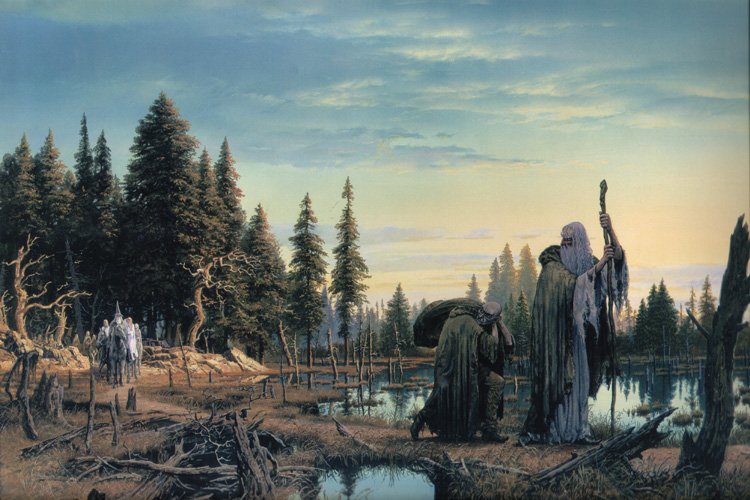
In the last two postings, then, I suggested that

1. what Saruman believed was his abstract “Knowledge” had actually become Sauron’s knowledge—as, when Saruman came into possession of Isengard and its palantir,

(the Hildebrandts)

he had come under the spell of Sauron, and thus had become nothing more than Sauron’s servant.

2. under Sauron’s control, Saruman had changed Isengard:

“A strong place and wonderful was Isengard…But Saruman had slowly shaped it to his shifting purposes, and made it better, as he thought, being deceived—for all those arts and subtle devices, for which he forsook his former wisdom, and which he fondly imagined were his own, came but from Mordor; so that what he made was naught, only a little copy, a child’s model or a slave’s flattery, of that vast fortress, armoury, prison, furnace of great power, Barad-dur, the Dark Tower…”  (The Two Towers, Book Three,  

And thus, the “rule” Saruman believed was his was only in actuality nothing more than an imitation of his master’s kingdom and his master’s control—deceived, Saruman was not the ruler, but the ruled.

And now we come to “Order”. 

And here I must differ a little from something which both Frodo and Saruman have to say.

In the next-to-last chapter of The Return of the King, ”The Scouring of the Shire”, Sam says of the Shire to which he and the other hobbits have returned, “This is worse than Mordor!”  To which Frodo replies:

“Yes, this is Mordor…Just one of its works.  Saruman was doing its work all the time, even when he thought that he was working for himself.  And the same with those that Saruman tricked, like Lotho.”  (The Return of the King, Book Six, Chapter 8, “The Scouring of the Shire”)

As I’ve mentioned above, Saruman was certainly not his own man—or wizard—although he clearly believed that he was, but I think that there’s something more going on here—and it’s not just what Saruman says subsequently to Frodo:

“ ‘…if they’re [meaning the hobbits] such fools, I will get ahead of them and teach them a lesson.  One ill turn deserves another…’ It would have been a sharper lesson, if only you had given me a little more time and more Men.  Still I have already done much that you will find it hard to mend or undo in your lives.  And it will be pleasant to think of that and set it against my injuries.”

This would suggest that what’s happened to the Shire has been a kind of spur of the moment vengeance, but I think that, contrary to what Saruman says, there has been more going on here—and for longer and, in fact, the mention of Lotho gives us a clue.

In a much earlier chapter of The Lord of the Rings, Merry and Pippin have been explaining events at Isengard to Aragorn and their friends

(Michael Herring)

and have mentioned Pipe-weed, to which Aragorn has replied:

“ ‘…leaf from the Southfarthing in Isengard.  The more I consider it, the more curious I find it. I have never been in Isengard, but I have journeyed in this land, and I know well the empty countries that lie between Rohan and the Shire.  Neither goods nor folk have passed this way for many a long year, not openly.  Saruman had secret dealings with someone in the Shire, I guess.  Wormtongues may be found in other houses than King Theoden’s.  Was there a date on the barrel?’

‘Yes,’ said Pippin.  ‘It was the 1417 crop, that is last year’s; no, the year before, of course, now:  a good year.’ “  (The Two Towers, Book Three, Chapter 9, “Flotsam and Jetsam”)

It we combine this with Farmer Cotton’s explanation of the change in the Shire, we see just who that “Wormtongue” must have been:

“It all began with Pimple, as we call him…He’d funny ideas, had Pimple.  Seems he wanted to own everything himself, and then order other folk about.  It soon came out that he already did own a sight more than was good for him; and he was always grabbing more, though where he got the money was a mystery:  mills and malt-houses and inns, and farms, and leaf-plantations…

Of course he started with a lot of property in the Southfarthing which he had from his dad; and it seems he’d been selling a lot of the best leaf, and sending it away quietly for a year or two.  But at the end o’ last year he began sending away loads of stuff, not only leaf.  Things began to get short, and winter coming on, too.  Folk got angry, but he had his answer.  A lot of Men, ruffians mostly, came with great waggons, some to carry off the goods south-away, and others to stay.  And more came.  And before we knew where we were they were planted here and there all over the Shire, and were felling trees and digging and building themselves sheds and houses just as they liked…” 

Those shipments had clearly been going to Isengard and had been doing so for at least the last two years, as we can see from the combination of the date on the pipe-weed barrel and from Farmer Cotton’s words.  Thus, we can see that there’s a chain here:

1. Saruman has picked the weak, but arrogant Lotho Sackville-Baggins to be his agent

2. he has then used him first to siphon goods out of the Shire (and now we might see, along with his slave farms, how Saruman’s army could have been supplied) and, then, by providing Lotho with “muscle”, he has overturned the Shire’s simple government (including putting the Mayor, Will Whitfoot, in the Lockholes) and installing Lotho in his place as “the Chief”

All of this would have been happening before Saruman’s fall, suggesting that, in fact, what he was doing to the Shire was not just spiteful revenge after the fact, as he says, but another plan altogether, and here’s where, I think, “Order” comes in.

Sauron’s Mordor was, basically, a military state based upon slavery with Sauron as lord, emperor, master, whatever title he chose to assume.   Saruman, in imitating Sauron, would have thought of himself in similar terms and his Isengard, then, would have been the same sort of state.  What happens in the Shire strikes me as something somewhat different, however.

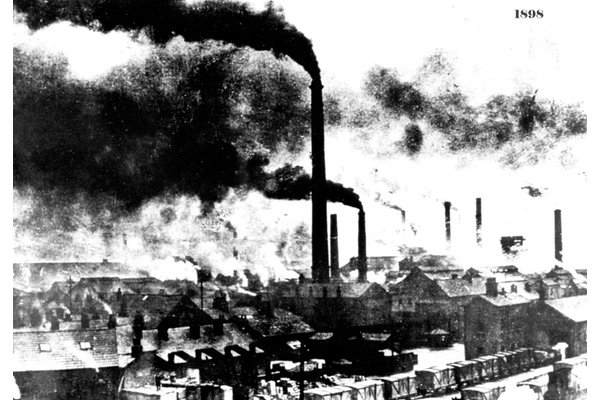
Certain aspects are similar:  as Saruman has industrialized Isengard, he was in the process of industrializing the Shire, as the hobbits soon see:

“And looking with dismay up the road towards Bag End they saw a tall chimney of brick in the distance.  It was pouring out black smoke into the evening air.”

(Alan Lee)

And hear about from Farmer Cotton:

“Take Sandyman’s mill now.  Pimple knocked it down almost as soon as he came to Bag End.  Then he brought in a lot o’ dirty-looking Men to build a bigger one and fill it full o’ wheels and outlandish contraptions.” 

But this is only the beginning:

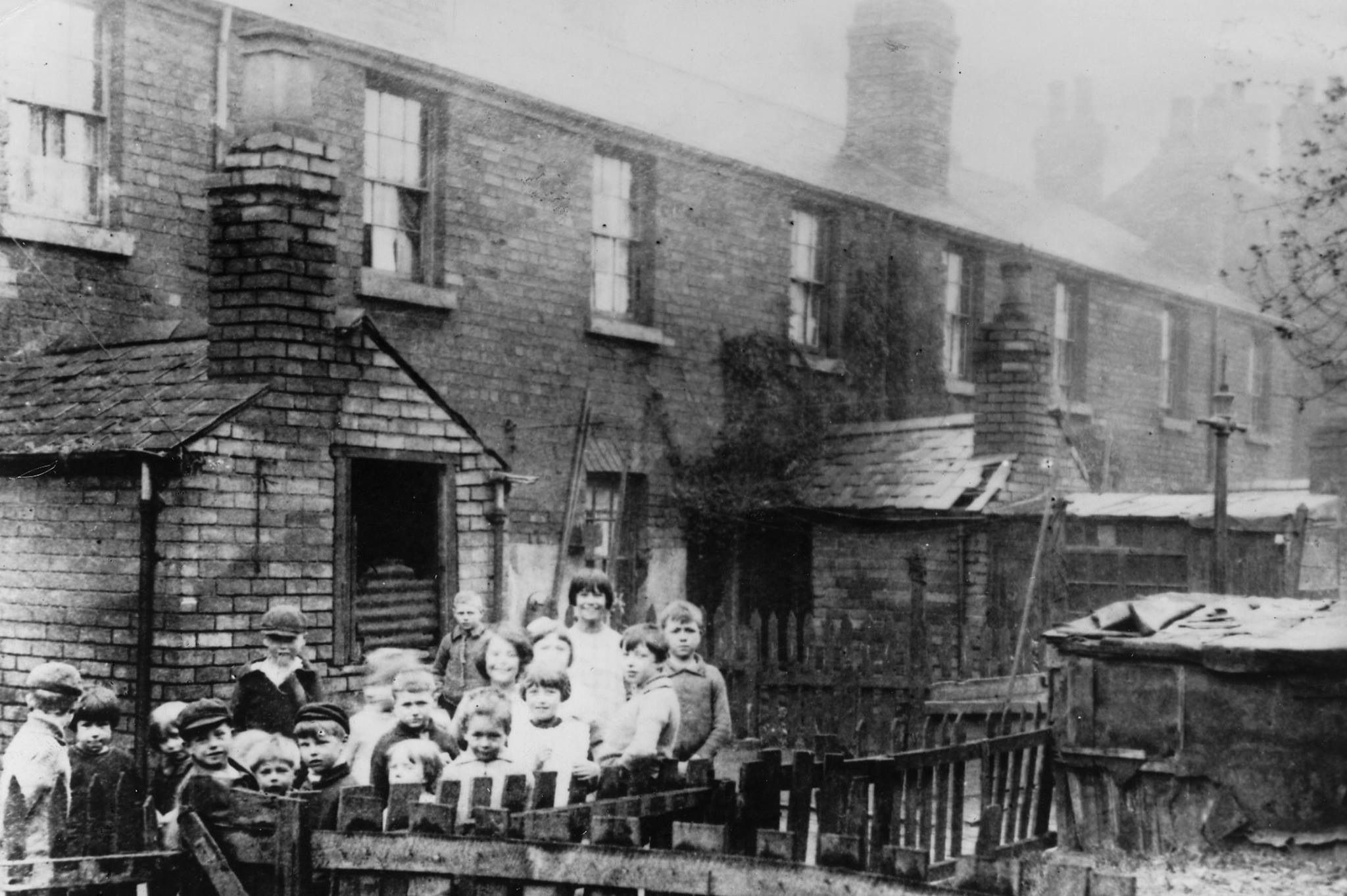
“The pleasant row of old hobbit-holes in the bank on the north side of the Pool were deserted, and their little gardens that used to run down bright to the water’s edge were rank with weeds.  Worse, there was a whole line of ugly new houses all along Pool Side, where the Hobbiton Road ran close to the bank.”

On the one hand, what Tolkien is recreating is the poorer areas of industrial Birmingham, where he grew up in the late-Victorian/Edwardian world,

but, on the other, he’s showing us what Saruman has been up to:  turning the Shire into a kind of communist state with:

1. an unelected leader, Lotho/Pimple (“And after that, it would be soon after New Year, there wasn’t no more Mayor, and Pimple called himself Chief Shirriff, or just chief, and did as he liked…” )

2. the equivalent of the NKVD (“A lot of Men, ruffians mostly, came with great waggons…and others to stay…”

3. local collaborators (Robin Smallburrow tells Sam:  “There’s hundreds of Shirriffs all told, and they want more, with all these new rules.  Most of them are in it against their will, but not all.  Even in the Shire there are some as like minding other folk’s business and talking big.”)

4. a spy service (Robin continues:  “And there’s worse than that:  there’s a few as do spy-work for the Chief and his Men.”)

5. the equivalent of concentration camps/gulags (Farmer Cotton describes them:  “And then there’s the Lockholes, as they call ‘em:  the old storage-tunnels at Michel Delving that they’ve made into prisons for those as stand up to them.”)

6. a long set of often seemingly arbitrary rules, mostly designed to keep hobbits from assembling, as in

  a. the closing of all the pubs

  b. the requirement of an internal travel document (Robin again:  “And he [Lotho] doesn’t hold with folk moving about; so if they will or they must, then they has to go to the Shirriff-house and explain their business.”)

7. the aggressive seizing of all supplies in the manner of communist states (Farmer Cotton says:  “…and everything except Rules got shorter and shorter, unless one could hide a bit of one’s own when the ruffians went round gathering stuff up ‘for fair distribution’…”

8. the reducing of the population to conformist workers—hence destroying the old dwellings and putting up rows of new houses—which would also make it easier to keep an eye on the population, forcing them into government accommodations

So far, then, this would appear to be a long-term, thought-out plan by Saruman to create not another Mordor, but a modern industrial state along Russian lines—but then something goes wrong—and we know what it is:  the failure of Saruman’s schemes, both in the defeat of his army at Helm’s Deep and the destruction of his little model state at Isengard by the Ents,

(Ted Nasmith)

forcing him to take to the road with his only remaining slave, Grima.

(another Nasmith—and you can see why I so value his work—he can choose scenes that no other artist seems even to have considered)

Denied Knowledge, unable to maintain Rule, Saruman, arriving in the Shire, abandons Order, turning his thugs loose to do exactly what he says to Frodo about a “sharper lesson”, as Farmer Cotton describes it:

“The biggest ruffian o’ the lot, seemingly…It was about last harvest, end o’ September maybe, that we first heard of him.  We’ve never seen him, but he’s up at Bag End, and he’s the real Chief now, I guess.  All the ruffians do what he says, and what he says is mostly:  hack, burn, and ruin; and now it’s come to killing.  There’s no longer even any bad sense in it.  They cut down trees and let ‘em lie, they burn houses and build no more…It they want to make the Shire into a desert, they’re going the right way about it.”

As a spoiler, Saruman is temporarily successful, but loses first his “high and ultimate purpose” and then his life, when one of those he has corrupted in his quest for it, is kicked once too often and—

(Joan Wyatt)

As ever, thanks for reading.

Stay well,

Sic semper tyrannis,

And know that, as always, there’s

MTCIDC

O

Knowledge, Rule, Order (II): II. Rule

05 Wednesday Jul 2023

Posted by Ollamh in Uncategorized

≈ Leave a comment

As ever, dear readers, welcome.

In my last, I began a brief series based upon my second thoughts (the first appeared as “Knowledge, Rule, Order”, 6 January, 2016 at Doubtfulsea.com) about the words in the title.

The original speaker was Saruman, who uses those three words in his proposal of alliance with Gandalf.

“A new Power is rising…We may join with that Power.  It would be wise, Gandalf.  There is hope that way…As the Power grows, its proved friends will also grow; and the Wise, such as you and I, may with patience come at last to direct its courses, to control it.  We can bide our time…deploring maybe evils done by the way, but approving the high and ultimate purpose:  Knowledge, Rule, Order. All the things that we have so far striven in vain to accomplish…There need not be, there would not be, any real change in our designs, only in our means.”  (The Fellowship of the Rings, Book Two, Chapter 2, “The Council of Elrond”)

Gandalf immediately dismisses Saruman’s attempt, saying “I have heard speeches of this kind before, but only in the mouths of emissaries sent from Mordor to deceive the ignorant…”  but, in the first of this little series, I spent some time considering the first of his three words, “Knowledge”, which Saruman has claimed as one of “the things we have so far striven in vain to accomplish”. 

We know that the five Istari, the five “wizards”, were originally sent to Middle-earth by the Valar as a kind of counterbalance to Sauron.  As far as I understand their mission, that was their goal, with no mention of “the high and ultimate purpose:  Knowledge, Rule, Order”.  In last week’s posting, I suggested that what Saruman believed was that that abstract “Knowledge” had actually become Saruman’s knowledge—a knowledge he meant to employ not just to counter Sauron, but to become Sauron, wielding the rediscovered Ring as the new master of Middle-earth.  Ironically, however, through a combination of his own growing arrogance and by Sauron’s clever manipulation of it, by means of the palantir which had come into Saruman’s possession,

Saruman’s knowledge had become Sauron’s knowledge and Saruman only a deluded henchman of the creature he had been sent to oppose.

But what about “Rule”?

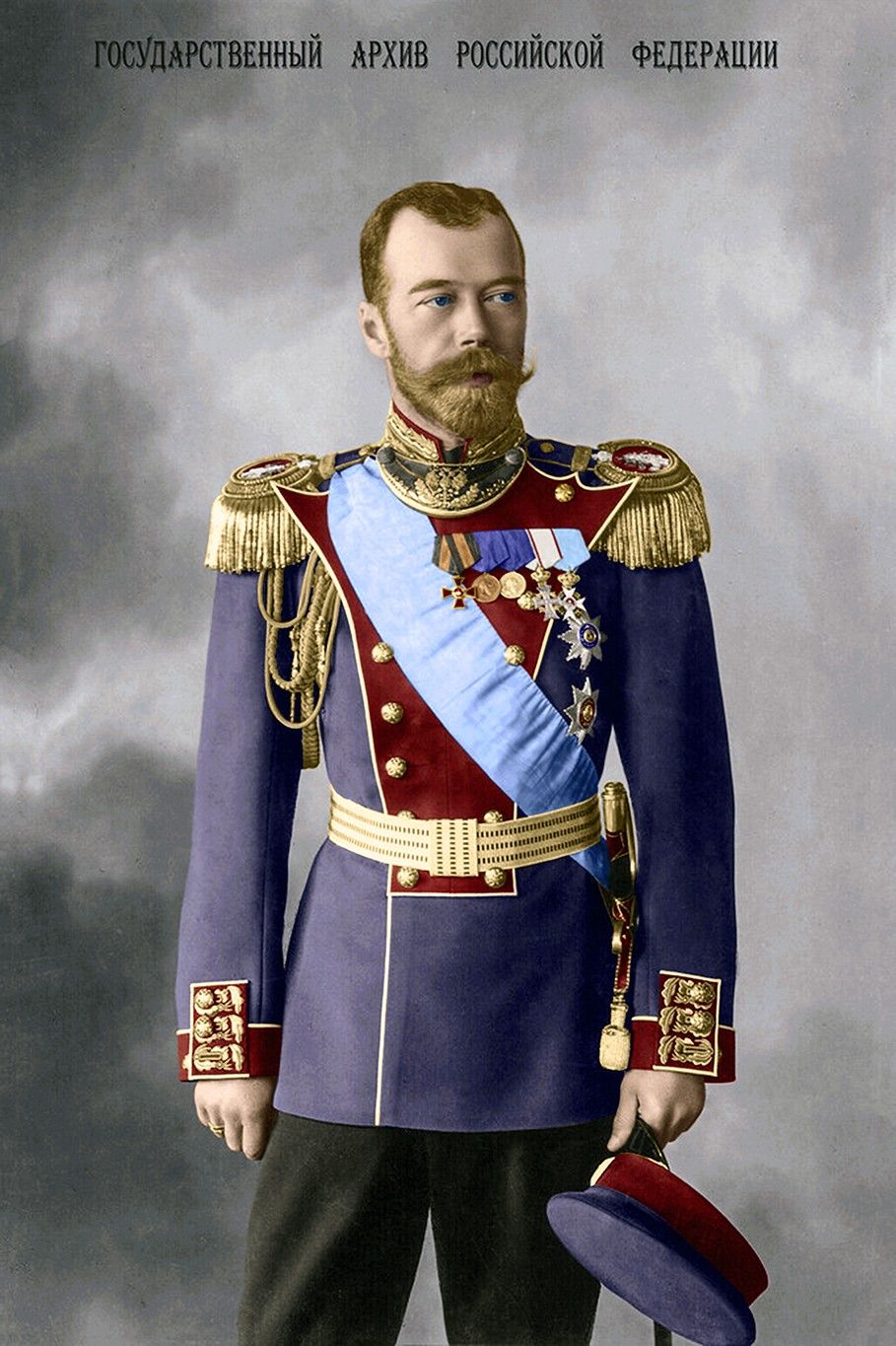
It’s important to remember that Tolkien was born into a world where almost all of the major—and most of the minor—European powers were controlled by monarchies.  In 1914, just before war broke out, not only was the British Empire in the hands of George V,

but his cousin, Wilhelm, ruled the German Empire,

and another cousin, Nicholas, ruled the Russian Empire.

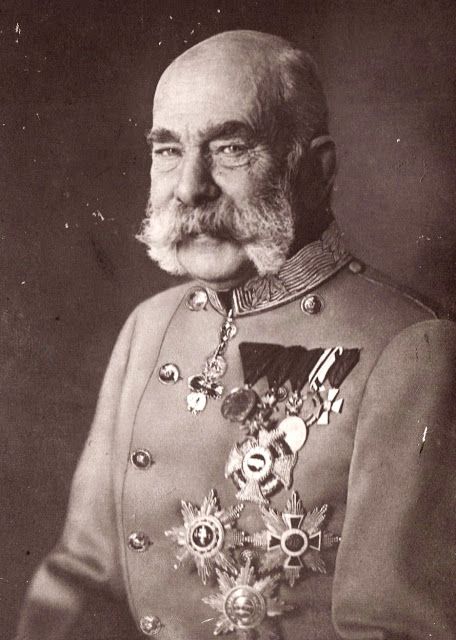
And this is to name only what we might call “the big three”—to which we should add the Emperor of Austria-Hungary, Franz Josef.

There were also monarchs from Norway

to Belgium

to Italy

to Spain,

with rulers in Greece

and many other smaller countries, like Serbia

and Bulgaria.

This is not all of such folk (the Netherlands had a queen, for example), but we might also include the Turkish sultan, Mehmed V.

Of all the European countries, only Switzerland and France were democracies, in fact.  That being the case, when JRRT used the word “Rule”, we can easily imagine what must have come to mind.  (And yet we should also keep in mind what he once wrote to his son, Christopher:  “My political opinions lean more and more to Anarchy”—although he goes on to add “or to ‘unconstitutional Monarchy…Give me a king whose chief interest in life is stamps, railways, or race-horses…”, all of which suggests that he had come, at least by the 1940s, to have serious doubts about royal rule.  See letter to Christopher Tolkien, 29 November, 1943, Letters, 63-64)

For Saruman, there were three models readily to hand:  Rohan, Gondor, and Mordor.  As for Rohan, he doesn’t appear to have much respect, saying,

“What is the house of Eorl but a thatched barn where brigands drink in the reek, and their brats roll on the floor among the dogs?”  (The Two Towers, Book Three, Chapter 10, “The Voice of Saruman”)

It would appear that he has no more respect for Gondor, as he refers to it, in his attempt to enlist Gandalf, as “dying Numenor”.

And this leaves us with Mordor and it’s clear that this has become Saruman’s model, albeit not quite the impressive alternate version he believes it to be.   As the narrator says of Isengard:

“A strong place and wonderful was Isengard…But Saruman had slowly shaped it to his shifting purposes, and made it better, as he thought, being deceived—for all those arts and subtle devices, for which he forsook his former wisdom, and which he fondly imagined were his own, came but from Mordor; so that what he made was naught, only a little copy, a child’s model or a slave’s flattery, of that vast fortress, armoury, prison, furnace of great power, Barad-dur, the Dark Tower…”  (The Two Towers, Book Three, Chapter 8, “The Road to Isengard”)

As well, Saruman imitates Mordor’s economy, which is slave-based, as the narrator tells us of Sam and his master:

“Neither he nor Frodo knew anything of the great slave-worked fields away south in this wide realm, beynd the fumes of the Mountain by the dark sad waters of Lake Nurnen; nor of the great roads that ran away east and south to tributary lands, from the which the soldiers of the Tower brought long wagon-trains of goods and booty and fresh slaves.”  (The Return of the King, Book Six, Chapter 2, “The Land of Shadow”)

And the narrator says of Isengard:

“That was a sheltered valley, open only to the South.  Once it had been fair and green…It was not so now.  Beneath the walls of Isengard there still were acres tilled by the slaves of Saruman…”  (The Two Towers, Book Three, Chapter 8, “The Road to Isengard”)

Kings in fairy tales sometimes have chancellors or viziers and perhaps faceless servants to fetch and carry, but real medieval kings could have full bureaucracies, with officials of all sorts and clerks and messengers to keep records and maintain contact with royal officials working away from the palace.

Unfortunately, we seem to lack much information about the court structure of Mordor.   At its center is Sauron, directing things from the Barad-dur, which he doesn’t appear to leave, employing the Nazgul as senior officers (who, after all, themselves had once been kings),

(Artist?)

as well as a Lieutenant of the Tower, who also acts as a kind of public interpreter or chancellor of some sort, “the Mouth of Sauron”,

(Douglas Beekman)

but, as for more structure, this looks like an interesting subject for further research and a future posting—or perhaps two.

Although Saruman has spies (Grima immediately springs to mind, although he has others),

(Alan Lee)

and a good-sized army of orcs and men (Merry thinks that “there must have been ten thousand at the very least”—The Two Towers, Book Three, Chapter 9, “Flotsam and Jetsam”), he doesn’t appear to have the equivalent of the Nazgul or the Mouth, directing everything himself (which, considering his arrogance, shouldn’t surprise us), being more like a fairy tale king than the head of 10,000 soldiers and what might be a fairly advanced technological infrastructure below the ground in Isengard (ten thousand soldiers need arms and armor, as well as durable rations, after all)—and all a pale copy of Sauron.

(the Hildebrandts)

So now we see just how unreal Saruman’s expectations have become:  his “Knowledge” is at the disposal of a being Saruman isn’t aware controls him, and his “Rule” is nothing more than a petty version of the world of that controller.  What will his “Order” be?

As ever, thanks for reading.

Stay well,

Practice aggressive self-awareness (or don’t get involved with devious Maiar),

And remember that, as always, there’s

MTCIDC

O

The Doubtful Sea Series Facebook Page

The Doubtful Sea Series Facebook Page

  • Ollamh

Categories

  • Artists and Illustrators
  • Economics in Middle-earth
  • Fairy Tales and Myths
  • Films and Music
  • Games
  • Heroes
  • Imaginary History
  • J.R.R. Tolkien
  • Language
  • Literary History
  • Maps
  • Medieval Russia
  • Military History
  • Military History of Middle-earth
  • Narnia
  • Narrative Methods
  • Poetry
  • Research
  • Star Wars
  • Terra Australis
  • The Rohirrim
  • Theatre and Performance
  • Tolkien
  • Uncategorized
  • Villains
  • Writing as Collaborators
Follow doubtfulsea on WordPress.com

Across the Doubtful Sea

Recent Postings

  • On the Road(s) Again—Again November 26, 2025
  • On the Road(s) Again November 19, 2025
  • To Bree (Part 2) November 12, 2025
  • To Bree (Part 1) November 5, 2025
  • A Plague o’ Both—No, o’ All Your Houses! October 29, 2025
  • It’s in Writing (2:  I’st a Prologue, or a Poesie for a Ring?) October 22, 2025
  • It’s in Writing (1) October 15, 2025
  • King Trotter? October 8, 2025
  • The Voices in His Head  October 2, 2025

Blog Statistics

  • 102,147 Views

Posting Archive

  • November 2025 (4)
  • October 2025 (5)
  • September 2025 (4)
  • August 2025 (4)
  • July 2025 (5)
  • June 2025 (4)
  • May 2025 (4)
  • April 2025 (5)
  • March 2025 (4)
  • February 2025 (4)
  • January 2025 (5)
  • December 2024 (4)
  • November 2024 (4)
  • October 2024 (5)
  • September 2024 (4)
  • August 2024 (4)
  • July 2024 (5)
  • June 2024 (4)
  • May 2024 (5)
  • April 2024 (4)
  • March 2024 (4)
  • February 2024 (4)
  • January 2024 (5)
  • December 2023 (4)
  • November 2023 (5)
  • October 2023 (4)
  • September 2023 (4)
  • August 2023 (5)
  • July 2023 (4)
  • June 2023 (4)
  • May 2023 (5)
  • April 2023 (4)
  • March 2023 (5)
  • February 2023 (4)
  • January 2023 (4)
  • December 2022 (4)
  • November 2022 (5)
  • October 2022 (4)
  • September 2022 (4)
  • August 2022 (5)
  • July 2022 (4)
  • June 2022 (5)
  • May 2022 (4)
  • April 2022 (4)
  • March 2022 (5)
  • February 2022 (4)
  • January 2022 (4)
  • December 2021 (5)
  • November 2021 (4)
  • October 2021 (4)
  • September 2021 (5)
  • August 2021 (4)
  • July 2021 (4)
  • June 2021 (5)
  • May 2021 (4)
  • April 2021 (4)
  • March 2021 (5)
  • February 2021 (4)
  • January 2021 (4)
  • December 2020 (5)
  • November 2020 (4)
  • October 2020 (4)
  • September 2020 (5)
  • August 2020 (4)
  • July 2020 (5)
  • June 2020 (4)
  • May 2020 (4)
  • April 2020 (5)
  • March 2020 (4)
  • February 2020 (4)
  • January 2020 (6)
  • December 2019 (4)
  • November 2019 (4)
  • October 2019 (5)
  • September 2019 (4)
  • August 2019 (4)
  • July 2019 (5)
  • June 2019 (4)
  • May 2019 (5)
  • April 2019 (4)
  • March 2019 (4)
  • February 2019 (4)
  • January 2019 (5)
  • December 2018 (4)
  • November 2018 (4)
  • October 2018 (5)
  • September 2018 (4)
  • August 2018 (5)
  • July 2018 (4)
  • June 2018 (4)
  • May 2018 (5)
  • April 2018 (4)
  • March 2018 (4)
  • February 2018 (4)
  • January 2018 (5)
  • December 2017 (4)
  • November 2017 (4)
  • October 2017 (4)
  • September 2017 (4)
  • August 2017 (5)
  • July 2017 (4)
  • June 2017 (4)
  • May 2017 (5)
  • April 2017 (4)
  • March 2017 (5)
  • February 2017 (4)
  • January 2017 (4)
  • December 2016 (4)
  • November 2016 (5)
  • October 2016 (6)
  • September 2016 (5)
  • August 2016 (5)
  • July 2016 (5)
  • June 2016 (5)
  • May 2016 (4)
  • April 2016 (4)
  • March 2016 (5)
  • February 2016 (4)
  • January 2016 (4)
  • December 2015 (5)
  • November 2015 (5)
  • October 2015 (4)
  • September 2015 (5)
  • August 2015 (4)
  • July 2015 (5)
  • June 2015 (5)
  • May 2015 (4)
  • April 2015 (3)
  • March 2015 (4)
  • February 2015 (4)
  • January 2015 (4)
  • December 2014 (5)
  • November 2014 (4)
  • October 2014 (6)
  • September 2014 (1)

Blog at WordPress.com.

  • Subscribe Subscribed
    • doubtfulsea
    • Join 78 other subscribers
    • Already have a WordPress.com account? Log in now.
    • doubtfulsea
    • Subscribe Subscribed
    • Sign up
    • Log in
    • Report this content
    • View site in Reader
    • Manage subscriptions
    • Collapse this bar
 

Loading Comments...