• About

doubtfulsea

~ adventure fantasy

Monthly Archives: April 2023

Coffee Break

26 Wednesday Apr 2023

Posted by Ollamh in Uncategorized

≈ Leave a comment

Welcome, dear readers, as always.

“At never may return he began to feel a shriek coming up inside, and very soon it burst out like the whistle of an engine coming out of a tunnel.” (The Hobbit, Chapter 1, “An Unexpected Party”)

In later years, there were things in the first edition of The Hobbit, published in 1937,
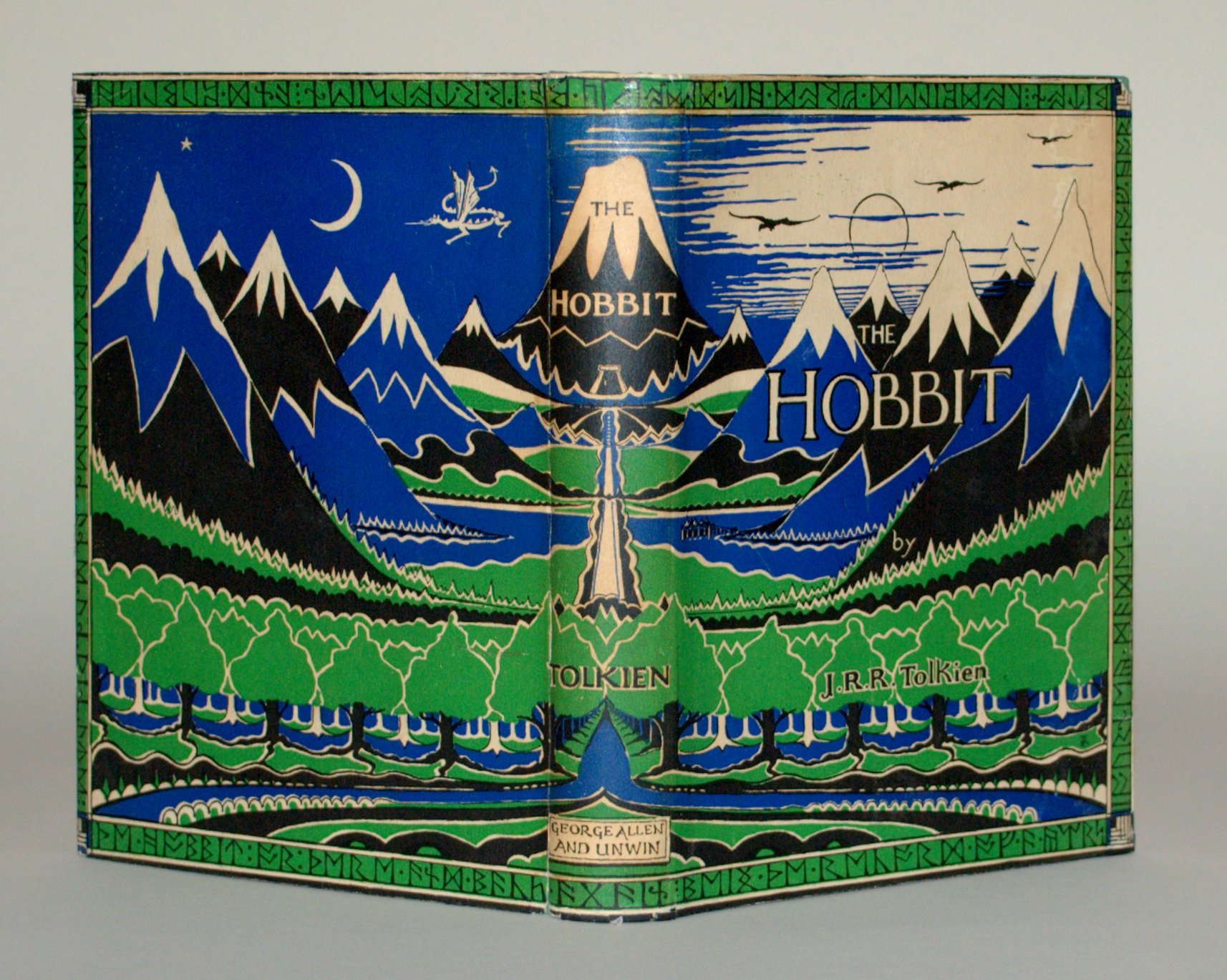
which the author found less satisfying and wished to change, or actually changed.

The most striking change was the revision of Chapter 5, “Riddles in the Dark”, in which the Gollum of 1937 is moved towards the later Gollum of The Lord of the Rings, in order to synchronize the earlier story of the Ring with its reappearance in the later book. 

A smaller change occurred in Chapter 1, “An Unexpected Party”, where Gandalf’s “And just bring out the cold chicken and tomatoes!” became “the cold chicken and pickles!” 

In contrast to the need to revamp Gollum, such a change seems so minor.  Why make it?

In a typescript of 1955,Tolkien says:

“ ‘Middle-earth’, by the way, is not the name of a never-never land…And though I have not attempted to relate the shape of the mountains and land-masses to what geologists may say or surmise about the nearer past, imaginatively this ‘history’ is supposed to take place in a period of the actual Old World of this planet.”  (from the typescript of a letter written by Tolkien to the Houghton Mifflin Company, May? 1955, Letters, 220)

In which case, if, by “Old World” he is implying—and the general look of Middle-earth in both The Hobbit and The Lord of the Rings would appear to back this up—that this is a medieval world, then tomatoes would be an anachronism, as the tomato only appeared in Europe after the Spanish conquistadores brought them back from Mexico in the early 16th century, where it was first described in Pietro Andrea Mattioli’s (1501-1577) I Discorsi in 1544.

(This is the 1568 edition, where you can find a description at the very bottom of page 1136 under “pomi d’oro”, which differentiates between two sub-varieties, one being the color of blood, the other golden—hence that name “apples of gold”.  If you’d like to read it for yourself, here’s that edition:  https://archive.org/details/gri_33125014246561/page/1136/mode/2up )

Once the tomatoes go, there are several other New World plants which have somehow found their way to Middle-earth, all of which would also fall into that category of anachronism.

First, there is tobacco, which is mentioned in a number of early 16th-century Spanish documents, including Gonzalo Fernandez de Oviedo y Valdes’ (1478-1557) Historia general de las Indias (1535-), where he describes local Native Americans smoking an herb. (Here is the reference:  https://archive.org/details/gri_33125007267921/page/130/mode/2up  Oviedo’s work is apparently a bit of a mess and this version was a mid-19th-century attempt to straighten it out.)

(How could I resist the first known image of someone smoking?  This is from Anthony Chute’s 1595 pamphlet, Tabaco, a document so enthusiastic that it might have been produced by the advertising department of a tobacco company.  Because tobacco was initially an expensive import, early pipes were, in fact, relatively small.  This reproduction will give you an idea–)

It’s seems that JRRT was a little uncomfortable with tobacco, but not enough to remove all of the references to smoking in The Lord of the Rings, where he simply turned tobacco into “pipeweed” and everyone from the Shire to Gondor could then light up on a regular—often meditative—basis. 

(Michael Herring)

(And he even included a section on the subject in the Prologue—“2  Concerning Pipe-weed”.  Of course, when one thinks of how many images we have of him with a pipe in his mouth, are we surprised?)

Then there are Sam Gamgee’s “taters”.

As with tomatoes and tobacco, it seems that it was the Spanish, as they increasingly spread through and occupied the Caribbean and points south, who imported the potato to Europe, possibly as early as the 1570s.  Certainly by Thomas Johnson’s 1633 revision of John Gerard’s 1597 The Herball, or Generall Historie of Plantes

we find this toothsome recommendation:

“The temperature and virtues be referred unto the common Potatoes, being
likewise a food, as also a meat for pleasure, equal in goodness and wholesomeness
unto the same, being either roasted in the embers, or boiled and eaten with oil,
vinegar, and pepper, or dressed any other way by the hand of some cunning in
cookery.”  (This is from Book 4, Chapter 350, page 54, of a modernized text which you can find here:  https://www.exclassics.com/herbal/herbalv4.pdf )

L0064345 Illustration of Potato of Virginia Credit: Wellcome Library, London. Wellcome Images images@wellcome.ac.uk http://wellcomeimages.org Illustration of Potato of Virginia from The herball or, generall historie of plantes / Gathered by John Gerarde 1597 The herball or, generall historie of plantes / John Gerard Published: 1597. Copyrighted work available under Creative Commons Attribution only licence CC BY 4.0 http://creativecommons.org/licenses/by/4.0/

(as is this illustration)

To these, I add one more item, which, I admit, I only spotted while teaching The Hobbit this spring:

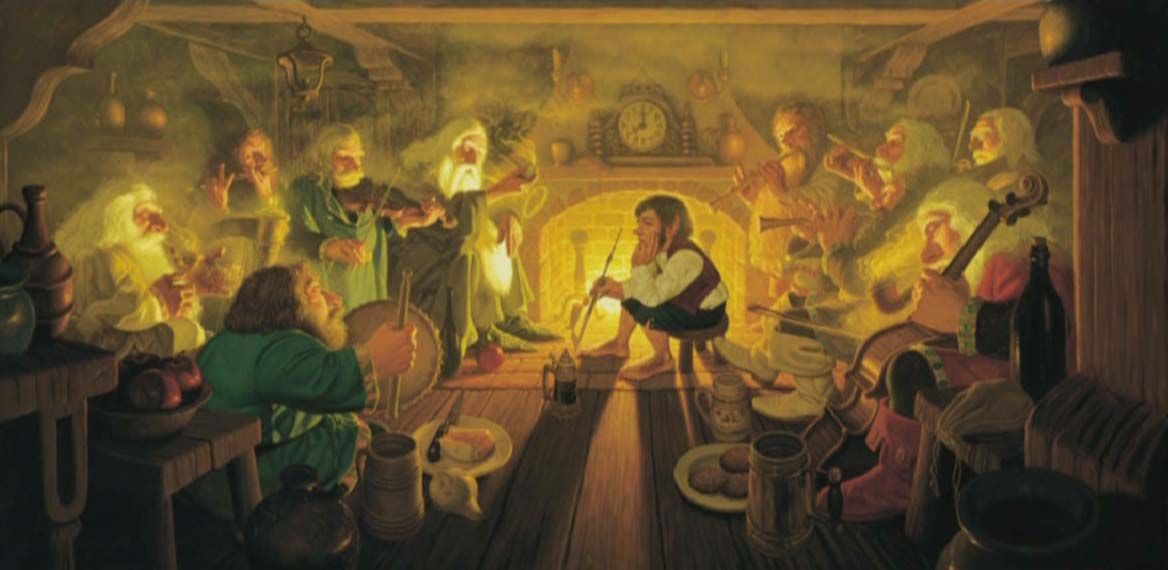
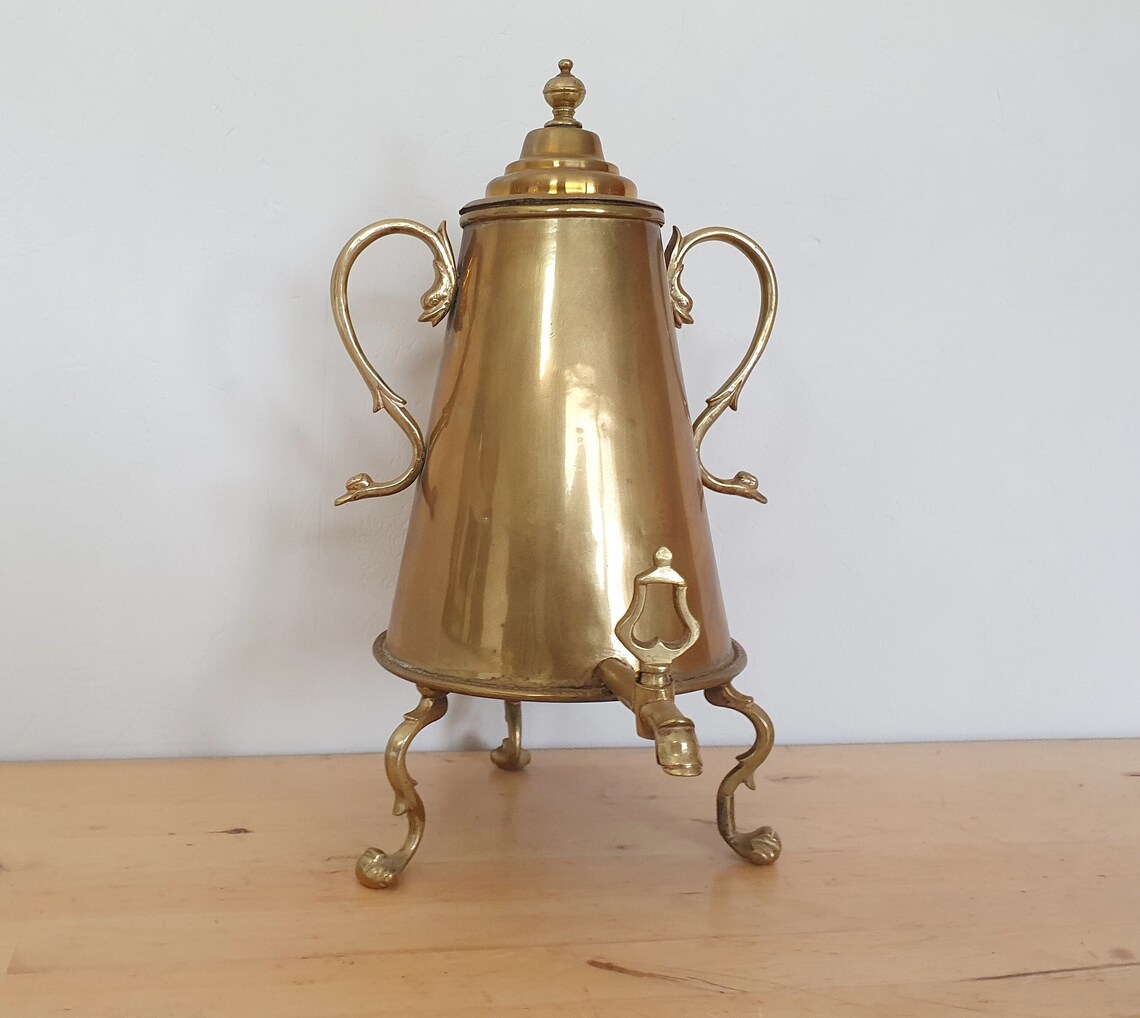
“A big jug of coffee had just been set in the hearth… (The Hobbit, Chapter 1, “An Unexpected Party”)

Coffee’s origins are a little murky, but one thing is clear:  this was not introduced from the New World by the Spanish.  Instead, the cultivated variety seems to come from Ethiopia and was introduced to eastern Europe in the 1520s by the Ottomans and to western Europe somewhat later, perhaps first by Dutch merchants.  The first coffeehouse in London dates from the early 1650s.  Here’s an advertisement from the owner of that first establishment, Pascua Rosee—

and here’s an early coffeehouse, although, by the dress of the drinkers, of perhaps a decade or so later.
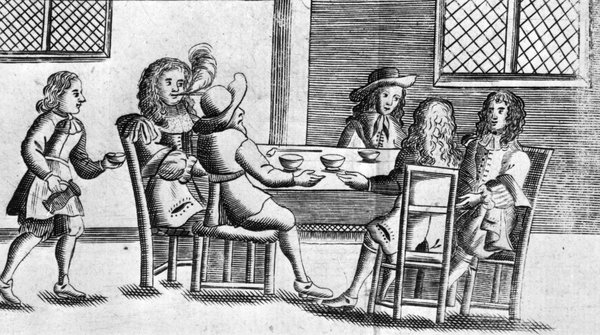
From whomever and whenever it first appeared, it certainly was not available in our medieval world and, if we continue the reasoning that Tolkien’s Middle-earth as depicted in The Hobbit and The Lord of the Rings corresponds to that medieval world, then, along with removing tomatoes, tobacco, and potatoes, that jug of coffee should have been dumped out and its contents replaced with ale—which, in fact, Bilbo’s dwarvish guests request—along with cakes–and more of that non-existent beverage:

“ ‘And more cakes—and ale—and coffee, if you don’t mind,’ called the other dwarves through the door.”  
(the Hildebrandts)

But what about that steam engine with which this posting began?  If the replacement of tomatoes with pickles shows that Tolkien himself became aware of the dangers of anachronism, certainly steam engines should have joined them in being replaced.  In fact, we learn from Douglas Anderson’s The Annotated Hobbit that:

“For the 1966 revision of the text, Tolkien carefully considered the spacing of a possible replacement line here—‘like the whee of a rocket going up into the sky’—but in the end rejected it.”  (The Annotated Hobbit, 47, note 35)

But why?  Anderson offers the possibility that:

“This usage need not be viewed as an anachronism, for Tolkien as narrator was telling this story to his children in the early 1930s, and they lived in a world where railway trains were a very important feature of life.” (note 35)

And, as Tolkien didn’t change it, I suppose that we might accept this—but a small part of me still wonders, “Yes, but what about that coffee?”
Thanks, as ever, for reading,

Stay well,

I’ll take mine black,

And remember that there’s always

MTCIDC

O

PS

For a cheerful song about coffee from the time of the Great Depression, here’s Irving Berlin’s “Let’s Have Another Cup of Coffee” from the 1932 review “Face the Music”– https://www.youtube.com/watch?v=K8kGjrjAKt4
Changing Horses

19 Wednesday Apr 2023

Posted by Ollamh in Uncategorized

≈ Leave a comment

Welcome, dear readers, as always.

Two weeks ago or so, I was working on the posting which I called “Horsing Around”, all about white horses in The Lord of the Rings (uploaded 5 April).

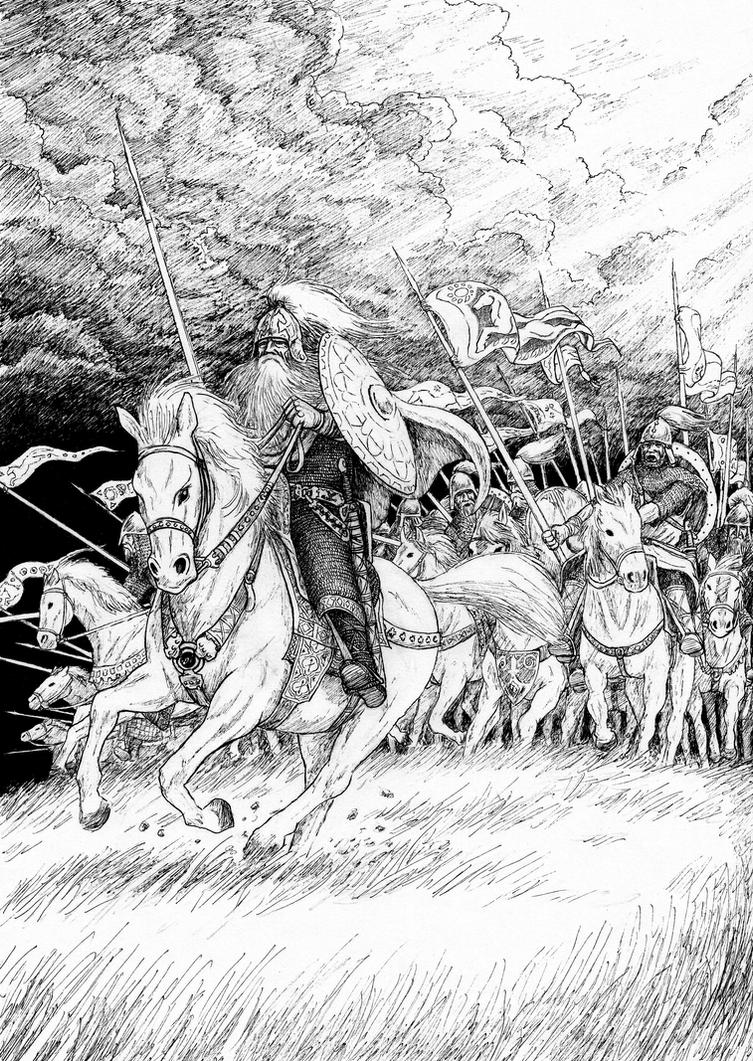
Among the horses which I mentioned was Theoden’s Snowmane.

(Joon Tulikoura)

The other horses, including Shadowfax,

(Angus McBride)

seem to have weathered the last tense moments of the War of the Ring and survived.  Snowmane, however, was a different matter:

“But Snowmane wild with terror stood up on high, fighting with the air, and then with a great scream he crashed upon his side:  a black dart had pierced him.  The King fell beneath him.”  (The Return of the King, Book Five, Chapter 6, “The Battle of the Pelennor Fields”)

(Craig J. Spearing)

Because he had fallen in battle, even though his fall had brought down Theoden, Snowmane was honored with a mound, like those of the Rohirric kings which lined the approach to Edoras,

adding to it

“a stone upon which was carved in the tongues of Gondor and the Mark:

Faithful servant yet master’s bane,

Lightfoot’s foal, swift Snowmane.”

And so the association of Rohan, white horse, and death, had stuck with me for the next week or two.  And then I came upon this:

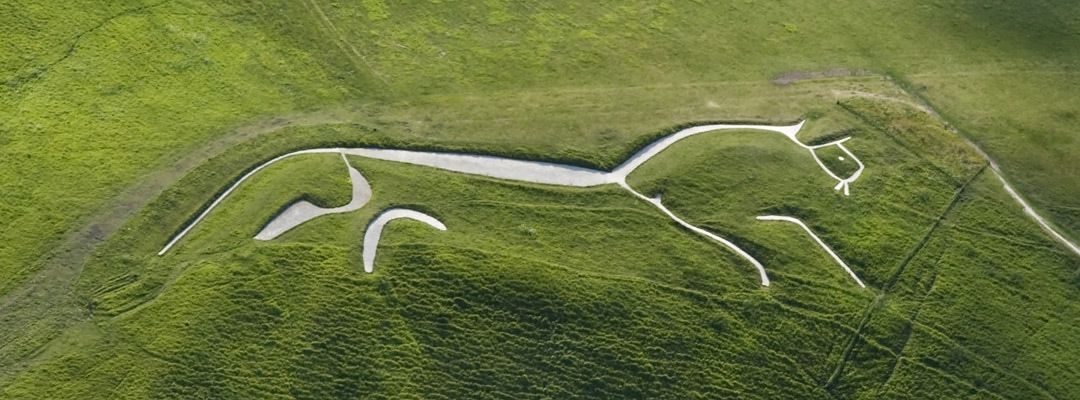
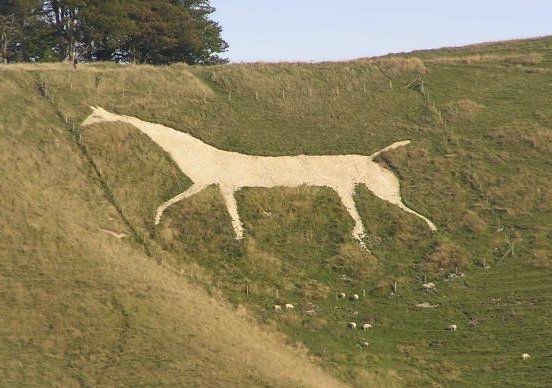
“In Anglo-Saxon times the natives of Worcestershire and Warwickshire and Oxfordshire, and many other counties, would have told anyone who asked that they lived in the Mark, and also their own particular Shire:  names and at once both ancient and modern, indeed unchanging.  As for the white horse this is the emblem of the Mark, like Bree and the Barrow-downs it lies less than a day’s walk from Tolkien’s study, and the White Horse of Uffington,

cut into the chalk a short stroll from the great Stone Age barrow of Wayland’s Smithy.”   


(Tom Shippey, J.R.R. Tolkien:  Author of the Century, 92)

(Shippey mentions the White Horse as the boundary marker for the Mark again in The Road to Middle-earth, 132.)

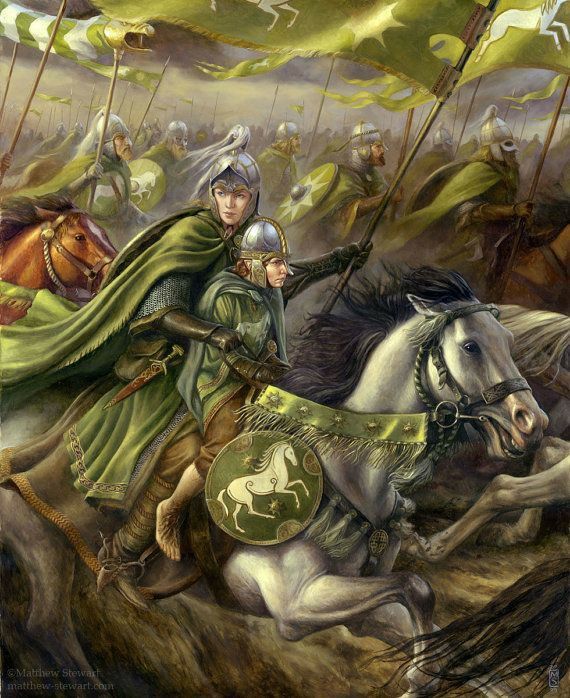
Although he doesn’t draw a direct parallel, I think that the suggestion here is that the Uffington White Horse might have been an inspiration for Tolkien for the emblem of the Rohirrim,

(Matthew Stewart)

as it is for the area of England which includes the counties Shippey mentions in his list (which would have also been included in what is known as Anglo-Saxon Mercia, itself a Latin form of Old English Marc.)

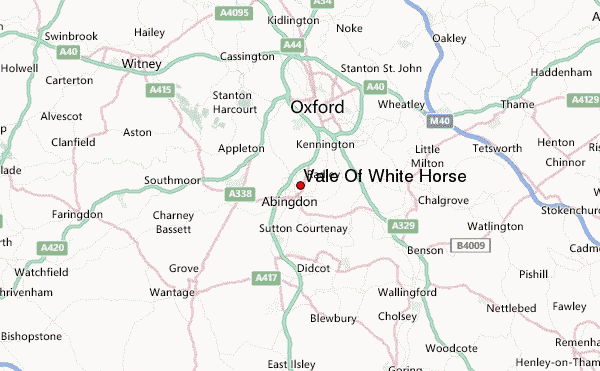
If  you’re not familiar with it, the White Horse is a huge (360 feet—110 metres–long) image cut into a chalky hillside about a 30-minute drive south from Oxford.

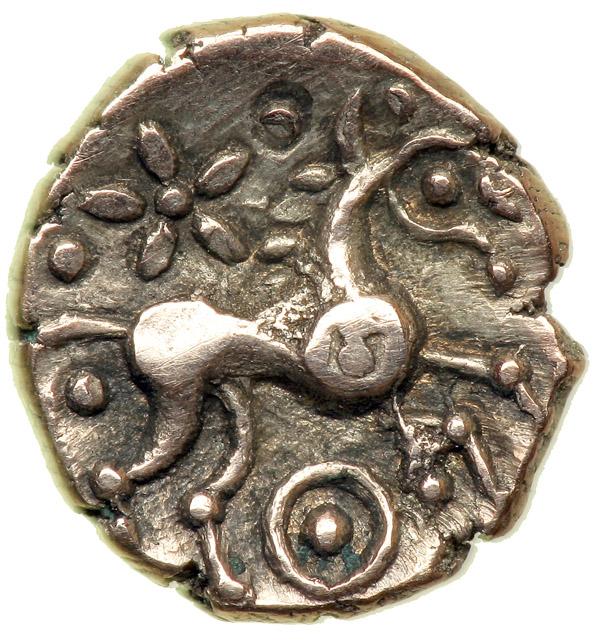
The latest dating of the site places it between 1380 and 550BC and it may be linked to the image on pre-Roman coins—

(for a cheerful brief article on the Horse, see:  https://www.smithsonianmag.com/history/3000-year-old-uffington-horse-looms-over-english-countryside-180963968/ )

This horse appears to have been an inspiration for other horses cut in hillsides, like the Cherhill horse, cut in 1780,

like that at Osmington, created in 1802,

or, at late as 1999, the Devizes White Horse, a celebration of the Millenium.

No one knows why the horse was originally cut into the hillside at Uffington—one theory is that it’s a tribute to the sun-chariot and its horse

(possibly a representation, possibly just a chariot warrior?  2nd century BC)

as seen in the so-called “Trundholm sun chariot” of c.1400BC—

(for a 360 degree view of this and more on the chariot, see:  https://en.wikipedia.org/wiki/Trundholm_sun_chariot )

One might also wonder about the description of a kingship ceremony celebrated in Celtic Ireland by Giraldus Cambrensis (Gerald of Wales) in his 12th-century Topographia Hibernica:

Est igitur in boreali et ulteriori Ultonite parte, scilicet

apud. Kenelcunuil, gens quaedam, quae barbaro

nimis et abominabili ritu sic sibi regem creare solet.

Collecto in unum universo terrae illius populo, in medium

producitur jumentum candidum. Ad quod sublimandus

ille non in principem sed in beluam, non in

regem sed exlegem, coram omnibus bestialiter accedens,

non minus – impudenter quam imprudenter se quoque

bestiam profitetur. Et statim jumento interfecto, et

frustatim in aqua decocto, in eadem aqua balneum ei

paratur. Cui insidens, de carnibus illis sibi allatis,

circumstante populo suo et convescente, comedit ipse.

De jure quoque quo lavatur, non vase aliquo, non manu,

sed ore tantum circumquaque haurit et bibit. Quibus

ita rite, non recte completis, regnum illius et dominium

est confirmatum.

“There is, therefore, a certain people in a northern and remote part of Ireland, that is at Kenelcunuil [glossed as Tirconnel, modern Donegal], which is accustomed to create a king for itself by a ceremony [which is] extremely barbarous and revolting.  When the whole people of that land has been gathered into one body, a shiny white mare is brought out into the midst.  To which [place] that one to be raised [to the throne] approaching like an animal [probably meaning “on all fours”] openly to all, not less shamelessly than rashly, he confesses himself [to be] a beast, as well.  And immediately, when the mare has been killed and, [cut into] pieces, has been cooked, a bath is prepared for him [the candidate] in the same water.  Sitting in which, with the populace standing around, and sharing with him, he himself eats some of the flesh brought to him.  By law, as well, he drains and drinks from which he is bathed not by any vessel nor with his hand, but only with his mouth from every side.  Thus, when these things have been completed by ritual, not by propriety, the kingship and lordship of that man has been confirmed.”

(Topographia Hibernica, Distinctio III, Capitulum XXV—my translation–if you would like to see the whole chapter in Latin, see:  https://archive.org/details/giraldicambrensi05gira/page/168/mode/2up ; in English:  https://ia800301.us.archive.org/5/items/historicalworkso00girauoft/historicalworkso00girauoft.pdf )

Could it be that that horse was placed there on that hillside to remind people of a similar British Iron Age ceremony?

(For more on horse sacrifice, see:  https://en.wikipedia.org/wiki/Horse_sacrifice If you love horses, as I do, this is not recommended reading!)

Then I picked up this, from a WIKI article on “White Horses in Mythology”:

“The white horse is a recurring motif in Ibsen’s play Rosmersholm, making use of the common Norse folklore that its appearance was a portent of death. The basis for the superstition may have been that the horse was a form of Church Grim, buried alive at the original consecration of the church building.” (https://en.wikipedia.org/wiki/White_horses_in_mythology )

A horse sacrifice is already grim—but what’s this? I wondered.  A “Church Grim”?  if it’s “common Norse folklore that its appearance was a portent of death”, then is that meaning of “Grim” related to the Old English word grima (2), “a spectre, goblin, nightmare”?  If so, where might we find something about “common Norse folklore”?  I went to Benjamin Thorpe’s Northern Mythology (3 volumes, London, 1851), where, in Volume II , we find:

“THE CHURCH-GRIM AND THE CHURCH-LAMB.

Heathen superstition did not fail to show itself in the construction of Christian churches. In laying the foundation, the people would retain something of their former religion, and sacrificed to their old deities, whom they could not forget, some animal, which they buried alive, either

under the foundation or without the wall. The spectre of this animal is said to wander about the churchyard by night, and is called the Kyrkogrim, or Church-grim. A tradition has also been preserved, that under the altar in the first Christian churches a lamb was usually buried, which imparted security and duration to the edifice. This is an emblem of the genuine Church-lamb, the Saviour of

the world, who is the sacred corner-stone of his church and congregation. When any one enters a church at a time when there is no service, he may chance to see a little lamb spring across the quire and vanish. That is the Church-lamb. When it appears to a person in the church yard, particularly to the gravediggers, it is said to forebode the death of a child that shall be next laid in the earth.” (page 102)

(if you’d like to read more, these three volumes are available at the wonderful Internet Archive.  Here’s the LINK for Volume II:  https://archive.org/details/northernmytholog02thor )

So, if we put all of this together, might we imagine that, for the Rohirrim, after Theoden’s death, that white horse on their banner may have taken on added meaning:  not only symbol of their land, but also of sacrifice, both of their king and his white horse, in order to protect that land from future invasion, as the Church Grim defends the church and its burying ground?

(Matthew Stewart)

Thanks for reading, as ever.

Stay well,

Churchyards at night?  Probably not.

And remember that, as always, there’s

MTCIDC

O

PS

Just a footnote—another meaning of grima in Old English is “mask”.  Perhaps this is why JRRT chose that as the name for Theoden’s traitorous counselor?

(Alan Lee)

Sigilry

12 Wednesday Apr 2023

Posted by Ollamh in Uncategorized

≈ Leave a comment

Sigilry

As always, dear readers, welcome.

When I first read Tolkien’s poem “Errantry” (originally published in The Oxford Magazine, 9 November, 1933), as an undergraduate, I loved the slipperiness of it, the way it danced from rhyme to rhyme (something JRRT later confessed that he couldn’t do twice—see the letter to Rayner Unwin of 22 June, 1952 in Letters, 162-3).

Some of the words took looking up, but, as someone who had some Latin and who read a lot of medieval literature, I thought I knew, from these lines:

“So long he studied wizardry
And sigaldry and smithying”

that “sigaldry” had to do with sigils, that is, with little seals, or maybe with the bigger idea of standards  (the word is a diminutive of Latin signum, among the meanings of which is both “seal” and “military standard”—as in the common military expression signum ferre “to advance”—literally “to carry the standard”) and so I thought that it probably had to do with heraldry.

But it turns out that I was completely misled.  In fact, it is listed in the OED (Oxford English Dictionary) as “obs. rare” with the meaning “Enchantment, sorcery” and is certainly rare as it has a bare minimum of sources cited, including a circa-1300 poem about Alexander the Great (Kyng Alisaunder) and the 14th-century (?) mystery play, Crucifixion, from the Chester Cycle of Mysteries.   (Appropriately, I looked the word up in the 1933 edition, which is available for free on-line at the wonderful Internet Archive:  https://archive.org/details/the-oxford-english-dictionary-1933-all-volumes/The%20Oxford%20English%20Dictionary%20Volume%209%20-%20Variant/page/26/mode/2up )

This meaning of the word certainly fits better with the plot at this point in the poem—the protagonist is attempting to woo a butterfly (for the whole poem see:  https://genius.com/J-r-r-tolkien-errantry-lyrics  ) and perhaps sorcery might help—but I think that I assumed that it was related to heraldry not only by the “medieval” quality of the poem’s plot, but also because heraldry turns up so often in The Lord of the Rings.

Heraldry comes from the medieval military world, from a time when, fully covered in chain mail, it would be impossible to identify one warrior from another.

(by Gerry Embleton)

In fact, at the Battle of Hastings, in October, 1066, the Norman leader, Duke William, when there was a rumor that he had been killed, was forced to ride across his forces lifting his helmet so that his men could see that he was still with them.

A system was gradually devised by which combinations of patterns and colors could be put upon armor and clothing and even horses to indicate who was inside that armor.

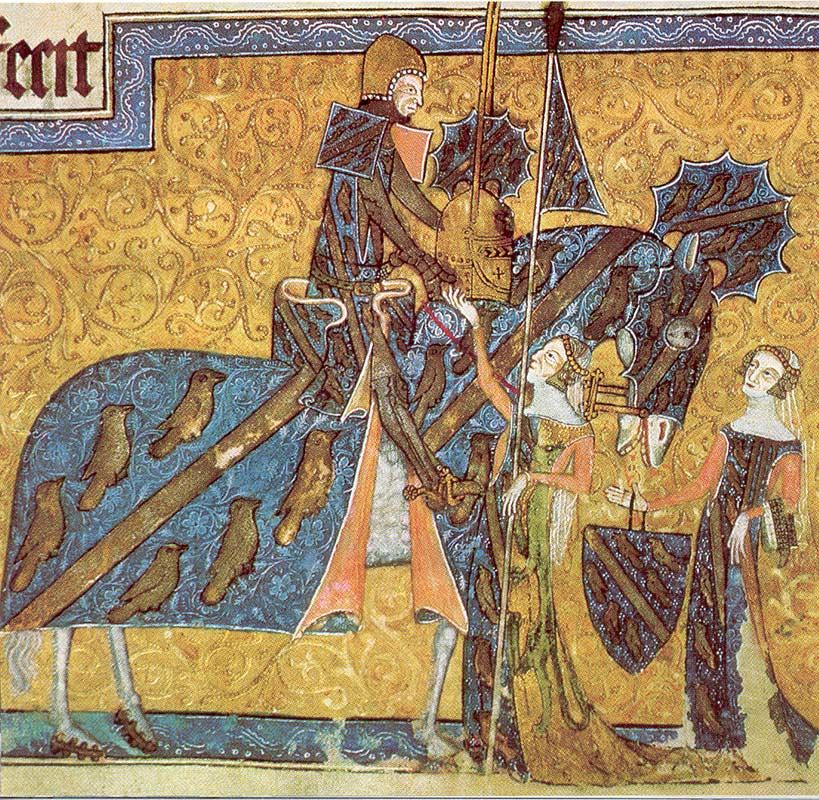
This is from the early 14th  century psaltery—psalm book–of Sir Geoffrey Luttrell, one of my favorite medieval manuscripts.  (For more on this particular marvelous example of a manuscript, see:  https://en.wikipedia.org/wiki/Luttrell_Psalter If you would like to see the manuscript itself, see:  https://www.bl.uk/manuscripts/Viewer.aspx?ref=add_ms_42130_fs001ar )

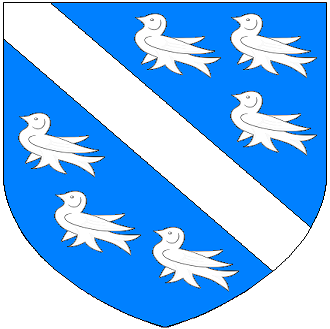
Depicted is Sir Geoffrey Luttrell (1276-1345) himself, with his wife, Agnes de Sutton, and his daughter-in-law, Beatrice le Scrope.  His arms—that is, the pattern you see on his horse’s trapper (that big drape of cloth which covers the horse) are “azure, a bend between six martlets argent”, which means “on a blue field, six martlets in silver divided by a band”—like this

Marlets were supposed, at this time, to be tireless birds who are born in flight and never stopped till they died, suggesting to the knowing who saw Sir Geoffrey that he was just as tireless as this imaginary creature.  He might also have wanted to avoid the meaning of his own name, which appears to be a diminutive of the French loutre, “otter”, suggesting that the founder of his family was a pelt-hunter.

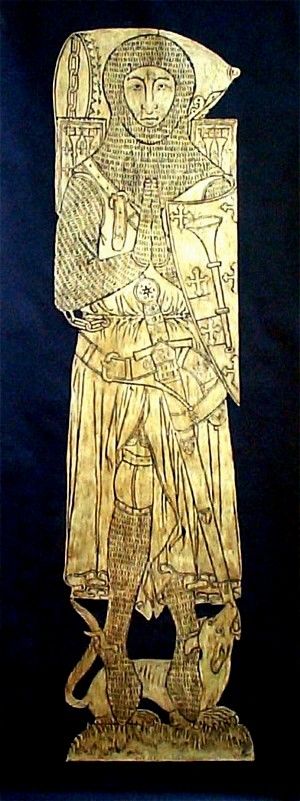
Patterns could be taken from current mythology—as in the case of Sir Geoffrey—or could even be rather like visual puns—here’s Sir Roger de Trumpington (died 1289)—

where you can see that his emblem is a trumpet—or Robert de Septvans (c.1250-1306)

whose emblem was 7 winnowing baskets (“van” being related to “fan”, as such baskets were used in dividing the grain from its covering, called “chaff”).

In time, there was so much of this that specialists began to appear, called heralds.

As with many old words, there is discussion over where the word comes from, but, in the later medieval military world, he was an important figure, whose jobs included things like identifying noble dead on battlefields, determining captives for ransom, and acting as messengers, because they were held to be neutrals.  You may remember the French herald, Montjoy, in Shakespeare’s Henry V.

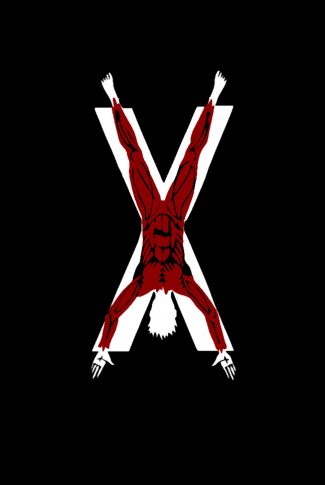
If you’re a fan of Game of Thrones, you’ll certainly have heard “sigils” being mentioned here and there—emblems like the Stark family wolf

or the ghastly flayed man of the Bolton family.

In The Lord of the Rings, we see a number of these emblems—

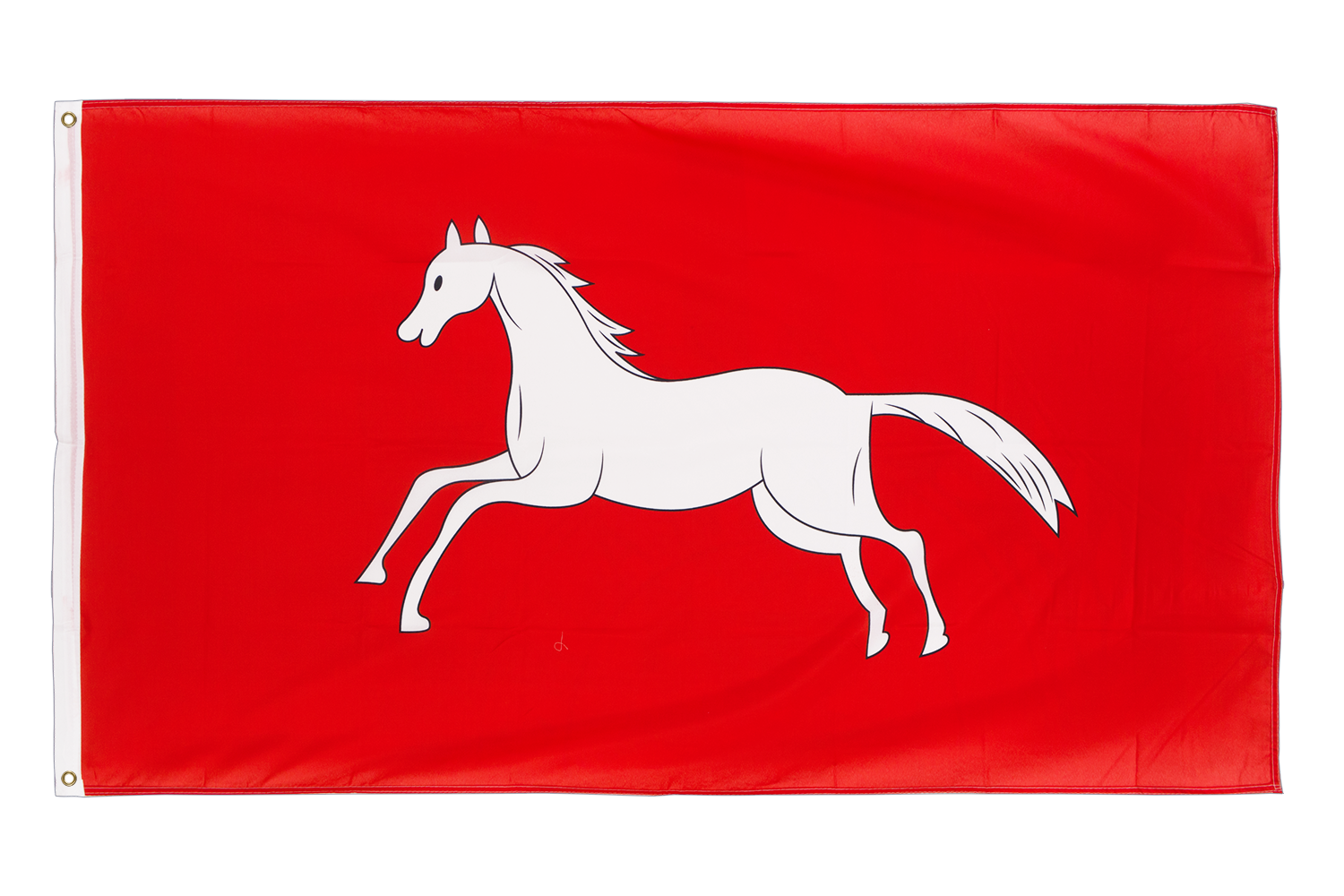
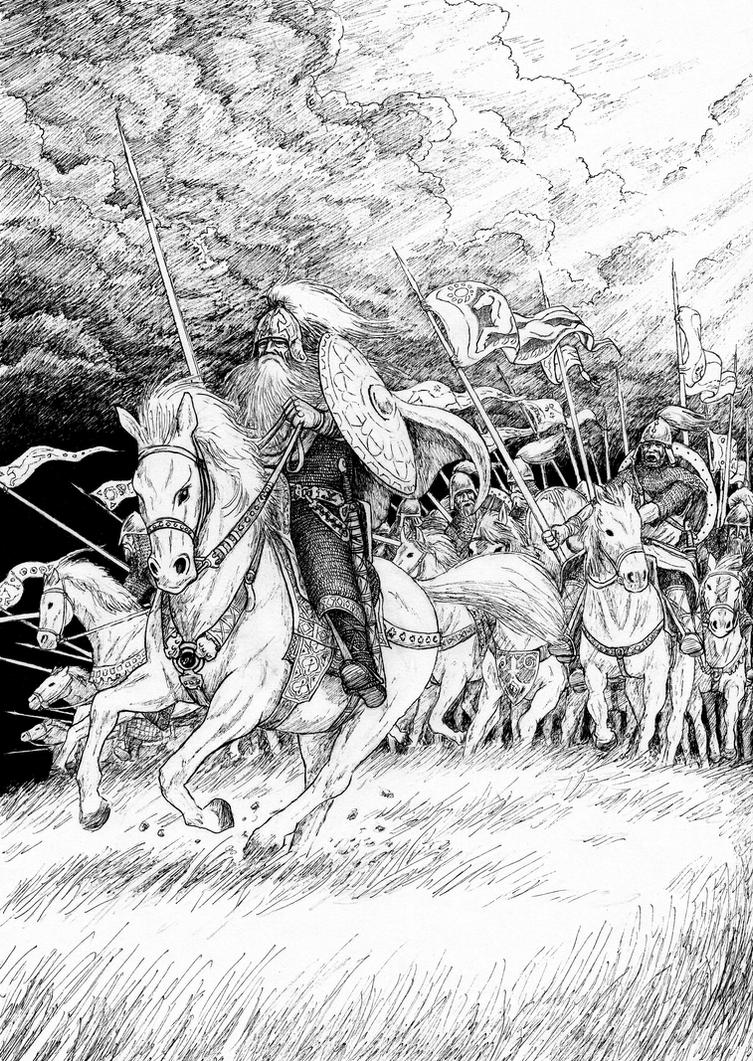
the running white horse of the Rohirrim–

(Ted Nasmith)

which reminds me of the emblem of the old Electorate/Kingdom of Hannover—

the silver swan-ship of the Prince of Dol Amroth–

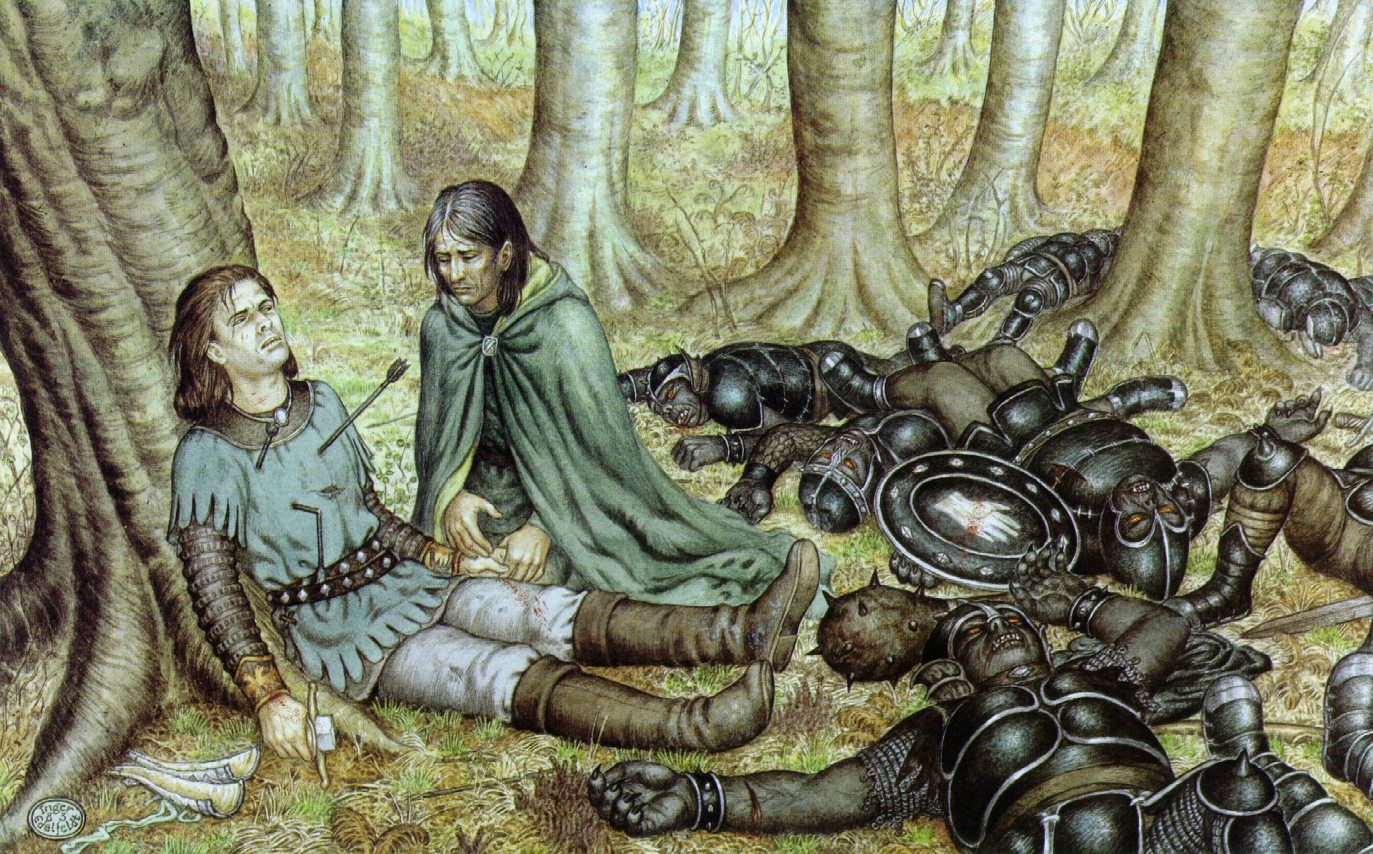
and, of course, the White Hand of Saruman—

(Inger Edelfeldt)

and the Red Eye of Sauron–

(Angus McBride)

and, triumphant over all, the seven stars and white tree of Gondor.

All of the above came from a misunderstanding of an obscure word in a dancy little poem by JRRT—perhaps sometimes “creative misreading” can lead in interesting directions. In which case, if someone proposed a sigil for me, it would be something “azure, mark of interrogation argent”—

As ever, thanks for reading.

Stay well,

Question everything,

And remember that there’s always

MTCIDC

O

PS

In 1967, “Errantry” was set to music by the English composer, Donald Swan (1923-1994), and you can hear it here:  https://www.youtube.com/watch?v=M6jVR6pF_0E Swan actually set a small series of Tolkien’s poems—with Tolkien’s permission and help—in a volume—and LP– called The Road Goes Ever On.

You can hear the whole LP at:  https://www.youtube.com/watch?v=M6jVR6pF_0E  The series begins at 27:15—but the previous 26 minutes are JRRT himself reading/reciting. I grew up hearing and singing these settings–see if they stick in your memory as well.

Horsing Around

05 Wednesday Apr 2023

Posted by Ollamh in Uncategorized

≈ Leave a comment

Welcome, as ever, dear readers.

As I was thinking and writing about Icelandic horses, a couple of postings ago, Gandalf popped into my mind—rather like William Morris of that posting—bearded and on horseback,

(a caricature by his friend, Edward Burne-Jones)

(the Hildebrandts?)

although a bit more imposing.

In this illustration, as in many, he’s mounted on Shadowfax, whose name appears to be based upon two Old English words, scead, “shade/shadow” and feax, “hair/mane”, suggesting “Shadowmane” in English, just as Theoden’s fatal horse is “Snowmane” (combining Old English snaw/snawa with feax?).

(by Joon Tulikoura)

Although his mane may be shadowy, Shadowfax appears to be white, with a silvery sheen, as Gandalf describes him:

“The horses of the Nine cannot vie with him; tireless, swift as the flowing wind.  Shadowfax they called him.  By day his coat glistens like silver; and by night it is like a shade, and he passes unseen.”  (The Fellowship of the Ring, Book Two, Chapter 2, “The Council of Elrond”)

These are not the only white horses in The Lord of the Rings.  When Glorfindel appears, his horse, Asfaloth, is also white and, astride it, on the far side of the Ford of Bruinen, as the river begins to rise, Frodo thinks he sees:

“…a plumed cavalry of waves.  White flames seemed to Frodo to flicker on their crests, and he half fancied that he saw amid the water white riders upon white horses with frothing manes.”  (The Fellowship of the Ring, Book One, Chapter 12, “Flight to the Ford”)

(Ted Nasmith)

(We later find out that, although Elrond commanded the waters of the river to rise, Gandalf “…added a few touches of my own:  you may not have noticed, but some of the waves took the form of great white horses with shining white riders.”  The Fellowship of the Ring, Book Two, Chapter 1, “Many Meetings”)

I’ve always imagined that Shadowfax is white because

1. he’s the descendant of the horse ridden by Eorl the Young, as we see him in the tapestry in Meduseld—

“Many woven cloths were hung upon the walls, and over the wide spaces marched figures of ancient legend, some dim with years, some darkling in the shade.  But upon one form the sunlight fell:  a young man upon a white horse.  He was blowing a great horn, and his yellow hair was flying in the wind.  The horse’s head was lifted, and its nostrils were wide and red as it neighed, smelling battle afar.  Foaming water, green and white, rushed and curled about its knees.

‘Behold Eorl the Young!’ said Aragorn.  ‘Thus he rode out of the North to the Battle of the Field of Celebrant.’ “ (The Two Towers, Book Three, Chapter 6, “The King of the Golden Hall”)

(Alan Lee)

2. he now matches Gandalf, who has become Gandalf the White,

(the Hildebrandts)

as Aragorn hails him:

“Then suddenly [Gandalf] threw back his grey cloak, and cast aside his hat, and leaped to horseback.  He wore no helm nor mail.  His snowy hair flew free in the wind, his white robes shone dazzling in the sun.

‘Behold the White Rider!’ cried Aragorn, and all took up the words.”  (The Two Towers, Book Three, Chapter 5, “The White Rider”)

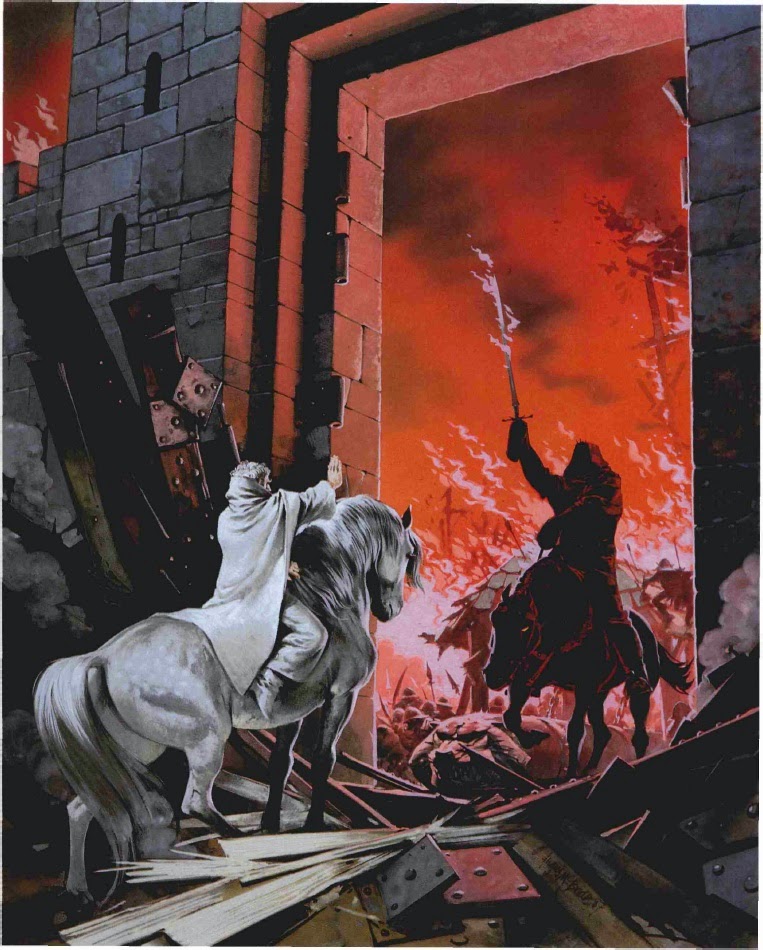
3. the whiteness of the two is a strong contrast to the blackness of the chief of the Nazgul when Gandalf encounters him at the gate of Minas Tirith—

“In rode the Lord of the Nazgul.  A great black shape against the fires beyond he loomed up, grown to a vast menace of despair.  In rode the Lord of the Nazgul, under the archway which no enemy ever yet had passed, and all fled before his face.

All save one.  There waiting, silent and still in the space before the Gate, sat Gandalf upon Shadowfax.  Shadowfax, who alone among the free horses of the earth endured the terror, unmoving, steadfast as a graven image in Rath Dinen.” (The Return of the King, Book Five, Chapter 4, “The Siege of Gondor”)

Of course, important people on white horses appear all the time in history.

Here, for instance, is Napoleon, painted on his white Arabian horse, “Marengo”—

(Baron Gros)

and George Washington, on an unnamed horse.

(John Faed—for an interesting article on Washington’s horses, see:  https://www.mountvernon.org/george-washington/farming/the-animals-on-george-washingtons-farm/horses/ )

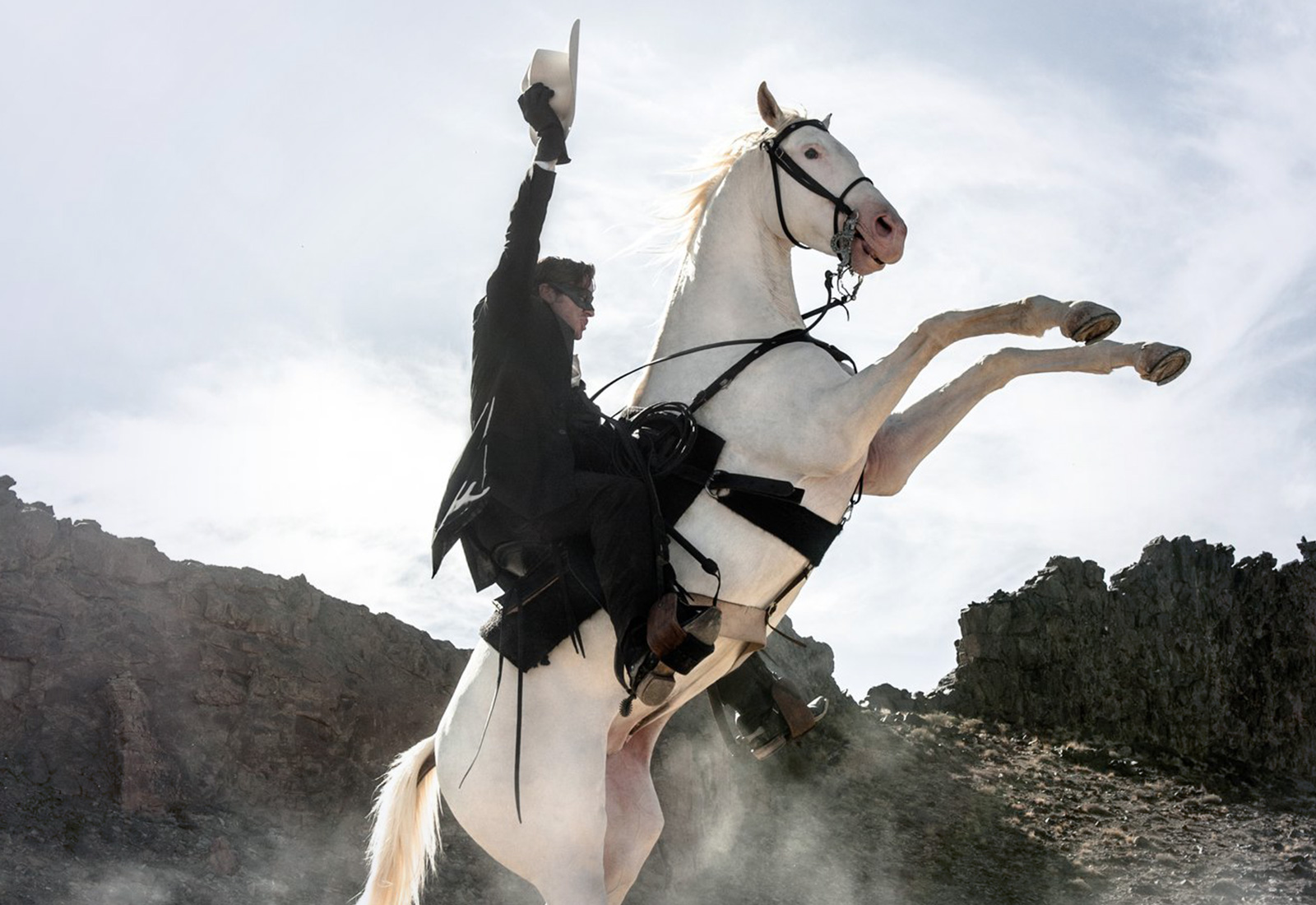
And how could we forget the Lone Ranger’s horse, “Silver”, both in his 1950s form

and his 2013 reincarnation?

But there’s a more sinister white horse which might also have been in the back of Tolkien’s mind as a long-time Bible reader:

“6 And I saw when the Lamb opened one of the seals, and I heard, as it were the noise of thunder, one of the four beasts saying, Come and see.

2 And I saw, and behold a white horse: and he that sat on him had a bow; and a crown was given unto him: and he went forth conquering, and to conquer.” (The Book of Revelation, Chapter 6, Verses 1-2)

(V.M.Vasnetsov)

There has been much discussion for centuries as to what this figure signifies, but, at his confrontation with the Nazgul, Gandalf says:

“ ‘You cannot enter here…Go back to the abyss prepared for you!  Go back!  Fall into the nothingness that awaits you and your master.  Go!’ “(The Return of the King, Book Five, Chapter 4, “The Siege of Gondor”)

The Lord of the Nazgul laughs at this, but, soon after, over the body of Theoden and his fallen white horse, Gandalf’s words come true and he who thinks to conquer is himself conquered.

(This is from an older site called “Shadowcore”, where the artist, Craig J. Spearing, presents a very informative picture of himself at work:  https://shadowcoreillustration.blogspot.com/2011/10/eowyn-nazgul-process.html )

As ever, thanks for reading.

Stay well,

Plan to bluff a Nazgul,

And remember that there’s always

MTCIDC

O

The Doubtful Sea Series Facebook Page

The Doubtful Sea Series Facebook Page

  • Ollamh

Categories

  • Artists and Illustrators
  • Economics in Middle-earth
  • Fairy Tales and Myths
  • Films and Music
  • Games
  • Heroes
  • Imaginary History
  • J.R.R. Tolkien
  • Language
  • Literary History
  • Maps
  • Medieval Russia
  • Military History
  • Military History of Middle-earth
  • Narnia
  • Narrative Methods
  • Poetry
  • Research
  • Star Wars
  • Terra Australis
  • The Rohirrim
  • Theatre and Performance
  • Tolkien
  • Uncategorized
  • Villains
  • Writing as Collaborators
Follow doubtfulsea on WordPress.com

Across the Doubtful Sea

Recent Postings

  • A Moon disfigured December 17, 2025
  • On the Roads Again—Once More December 10, 2025
  • (Not) Crossing Bridges December 3, 2025
  • On the Road(s) Again—Again November 26, 2025
  • On the Road(s) Again November 19, 2025
  • To Bree (Part 2) November 12, 2025
  • To Bree (Part 1) November 5, 2025
  • A Plague o’ Both—No, o’ All Your Houses! October 29, 2025
  • It’s in Writing (2:  I’st a Prologue, or a Poesie for a Ring?) October 22, 2025

Blog Statistics

  • 103,189 Views

Posting Archive

  • December 2025 (3)
  • November 2025 (4)
  • October 2025 (5)
  • September 2025 (4)
  • August 2025 (4)
  • July 2025 (5)
  • June 2025 (4)
  • May 2025 (4)
  • April 2025 (5)
  • March 2025 (4)
  • February 2025 (4)
  • January 2025 (5)
  • December 2024 (4)
  • November 2024 (4)
  • October 2024 (5)
  • September 2024 (4)
  • August 2024 (4)
  • July 2024 (5)
  • June 2024 (4)
  • May 2024 (5)
  • April 2024 (4)
  • March 2024 (4)
  • February 2024 (4)
  • January 2024 (5)
  • December 2023 (4)
  • November 2023 (5)
  • October 2023 (4)
  • September 2023 (4)
  • August 2023 (5)
  • July 2023 (4)
  • June 2023 (4)
  • May 2023 (5)
  • April 2023 (4)
  • March 2023 (5)
  • February 2023 (4)
  • January 2023 (4)
  • December 2022 (4)
  • November 2022 (5)
  • October 2022 (4)
  • September 2022 (4)
  • August 2022 (5)
  • July 2022 (4)
  • June 2022 (5)
  • May 2022 (4)
  • April 2022 (4)
  • March 2022 (5)
  • February 2022 (4)
  • January 2022 (4)
  • December 2021 (5)
  • November 2021 (4)
  • October 2021 (4)
  • September 2021 (5)
  • August 2021 (4)
  • July 2021 (4)
  • June 2021 (5)
  • May 2021 (4)
  • April 2021 (4)
  • March 2021 (5)
  • February 2021 (4)
  • January 2021 (4)
  • December 2020 (5)
  • November 2020 (4)
  • October 2020 (4)
  • September 2020 (5)
  • August 2020 (4)
  • July 2020 (5)
  • June 2020 (4)
  • May 2020 (4)
  • April 2020 (5)
  • March 2020 (4)
  • February 2020 (4)
  • January 2020 (6)
  • December 2019 (4)
  • November 2019 (4)
  • October 2019 (5)
  • September 2019 (4)
  • August 2019 (4)
  • July 2019 (5)
  • June 2019 (4)
  • May 2019 (5)
  • April 2019 (4)
  • March 2019 (4)
  • February 2019 (4)
  • January 2019 (5)
  • December 2018 (4)
  • November 2018 (4)
  • October 2018 (5)
  • September 2018 (4)
  • August 2018 (5)
  • July 2018 (4)
  • June 2018 (4)
  • May 2018 (5)
  • April 2018 (4)
  • March 2018 (4)
  • February 2018 (4)
  • January 2018 (5)
  • December 2017 (4)
  • November 2017 (4)
  • October 2017 (4)
  • September 2017 (4)
  • August 2017 (5)
  • July 2017 (4)
  • June 2017 (4)
  • May 2017 (5)
  • April 2017 (4)
  • March 2017 (5)
  • February 2017 (4)
  • January 2017 (4)
  • December 2016 (4)
  • November 2016 (5)
  • October 2016 (6)
  • September 2016 (5)
  • August 2016 (5)
  • July 2016 (5)
  • June 2016 (5)
  • May 2016 (4)
  • April 2016 (4)
  • March 2016 (5)
  • February 2016 (4)
  • January 2016 (4)
  • December 2015 (5)
  • November 2015 (5)
  • October 2015 (4)
  • September 2015 (5)
  • August 2015 (4)
  • July 2015 (5)
  • June 2015 (5)
  • May 2015 (4)
  • April 2015 (3)
  • March 2015 (4)
  • February 2015 (4)
  • January 2015 (4)
  • December 2014 (5)
  • November 2014 (4)
  • October 2014 (6)
  • September 2014 (1)

Blog at WordPress.com.

  • Subscribe Subscribed
    • doubtfulsea
    • Join 78 other subscribers
    • Already have a WordPress.com account? Log in now.
    • doubtfulsea
    • Subscribe Subscribed
    • Sign up
    • Log in
    • Report this content
    • View site in Reader
    • Manage subscriptions
    • Collapse this bar
 

Loading Comments...