As ever, dear readers, welcome.
It was that sad moment: I’d come to the last page of an enjoyable book: Terry Pratchett’s Feet of Clay, 1996.

But there was a sadder moment: I’d finally read the entire “Disc World” series, all 41 novels.

I came late to the work of (Sir) Terry Pratchett (1948-2015)

and Disc World, which he came clearly on time to, in 1983, with the first in the long series, The Colour of Magic.

It has been through numerous reprintings since, with all sorts of covers, but this is the first edition and the cover is significant, being a depiction of just what Disc World looks like:
1. at base, a monstrous turtle, Great A’Tuin, who is swimming through space
2. mounted on Great A’Tuin are four elephants—Berilia, Tubul, Great T’Phon, and Jerakeen
3. and, placed atop the pachyderms is Disc World itself, which is a couple of continents, a scattering of islands, and seas, always with the danger of being swept off at the edge
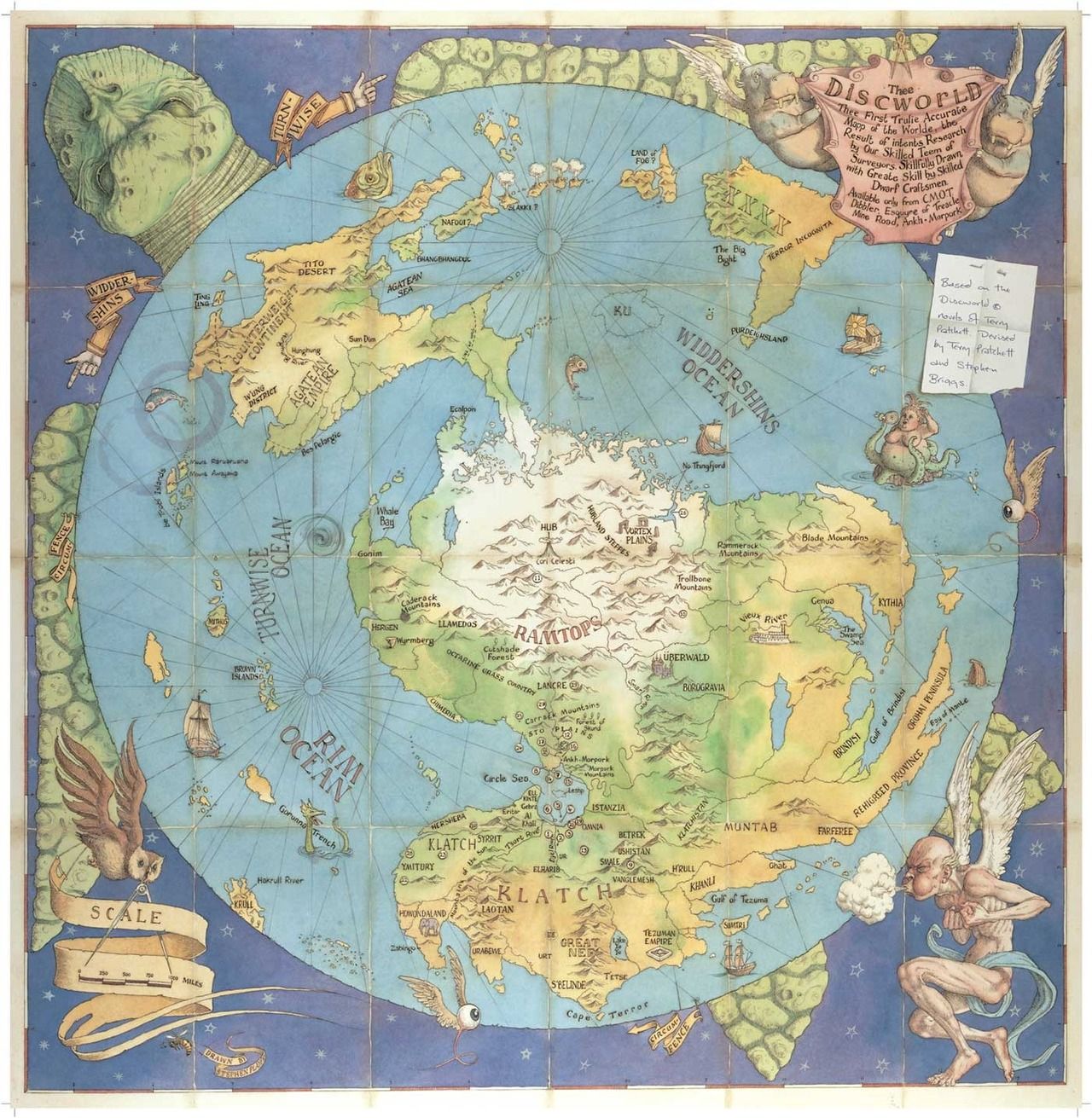
And on the surface lie the towns and cities, a major one being Ankh-Morpork, the scene of numerous volumes in the series,
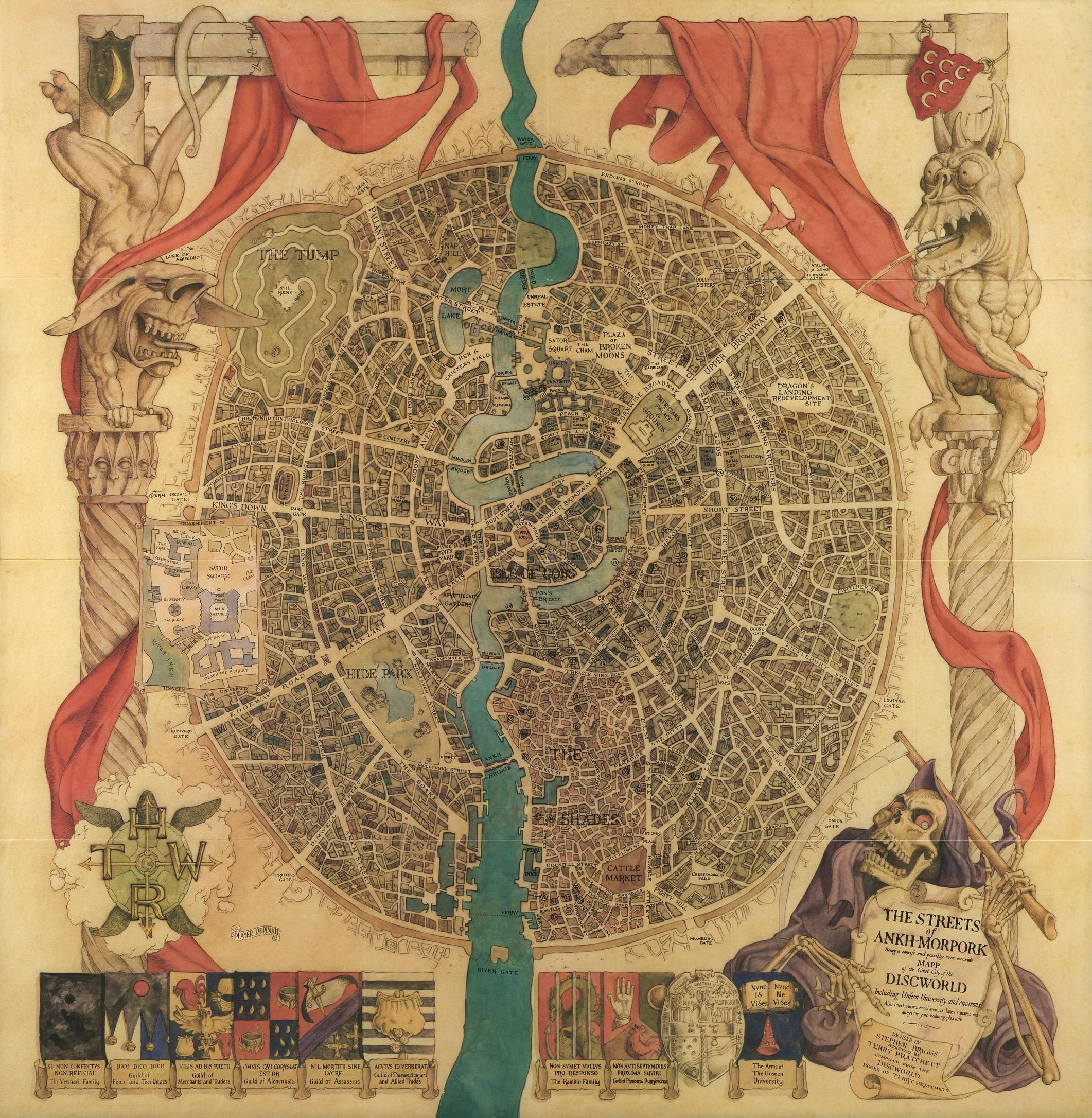
an ancient conurbation dissected by a river, the Ankh, which is, at best, mostly slow-flowing sludge. On one bank lie the affluent, on the other, the effluent, as Pratchett might say, all under the direction of the Patrician, an unelected replacement for a line of increasingly difficult kings and his modest force of peace-keepers, the Watch, directed, in time, by Samuel Vimes, who not only becomes Sir in the course of the books, but is also discovered to be directly descended from the reason Ankh-Morpork no longer suffers under difficult kings—oh, and he marries a duchess, who, among other things, is involved in a dragon-adoption charity.

(Which painting bears a faint resemblance to a certain lesser-known work by the obscure Dutch painter, Rembrandt)

As you can see from the chart above, there is a certain method in what could easily appear to be madness: a series of series-within-series, based upon sets of characters: wizards, witches, Tiffany Aching (and her sometime-allies the Nac Mac Feegle), Death, the City Watch, and Moist von Lipwig. Wizards, the City Watch, and Moist Von Lipwig are all associated (sometimes rather loosely) with Ankh-Morpork. Witches andTiffany are more or less country people and Death (who ALWAYS SPEAKS IN CAPITAL LETTERS) is, as in real life, alas, everywhere.
As you can tell, Pratchett is given to rather bizarre names, and it was with one of these, Moist Von Lipwig, that I began my Pratchettry in the first novel in which he appears, Going Postal, 2004.

You can also see that book titles can vary from the mystical I Shall Wear Midnight to suggestive plays on words, like Equal Rites and the present Going Postal, which, although it doesn’t include homicidal mail workers, does have to do with Ankh-Morpork’s postal system and how the ingenious conman, Moist Von Lipwig, saves it with the help of everyone from another charity worker (and chain-smoker) Adora Belle to a Golem, Mr. Pump.
(Footnote on “golem”: if you’re not acquainted with this term, it comes from Jewish religious and folklore: a creature made, commonly, from earth (clay, mud) and given animation, if not life, often for a specific task. For more—lots more—see: https://en.wikipedia.org/wiki/Golem . I first met a golem in a still from the 1915 horror film, Der Golem, which, unfortunately, doesn’t survive complete.

You can see a fragment here: https://archive.org/details/silent-der-golem-aka-the-golem This was actually eventually a trilogy, along with The Golem and the Dancing Girl, 1917, which is lost, and the 1920 The Golem and How He Came Into the World which you can see complete here: https://www.youtube.com/watch?v=vmSoAq80HcM If you’re not familiar with silent film, dialogue is conveyed by printed cards and by (for us) rather exaggerated acting, and there was music commonly played—just like a modern soundtrack—during the film. This music was live, from an improviser at piano or organ to, in the case of rather grand films, a score especially written for the film and played by an orchestra, like that for D.W. Griffith’s 1916 Intolerance.
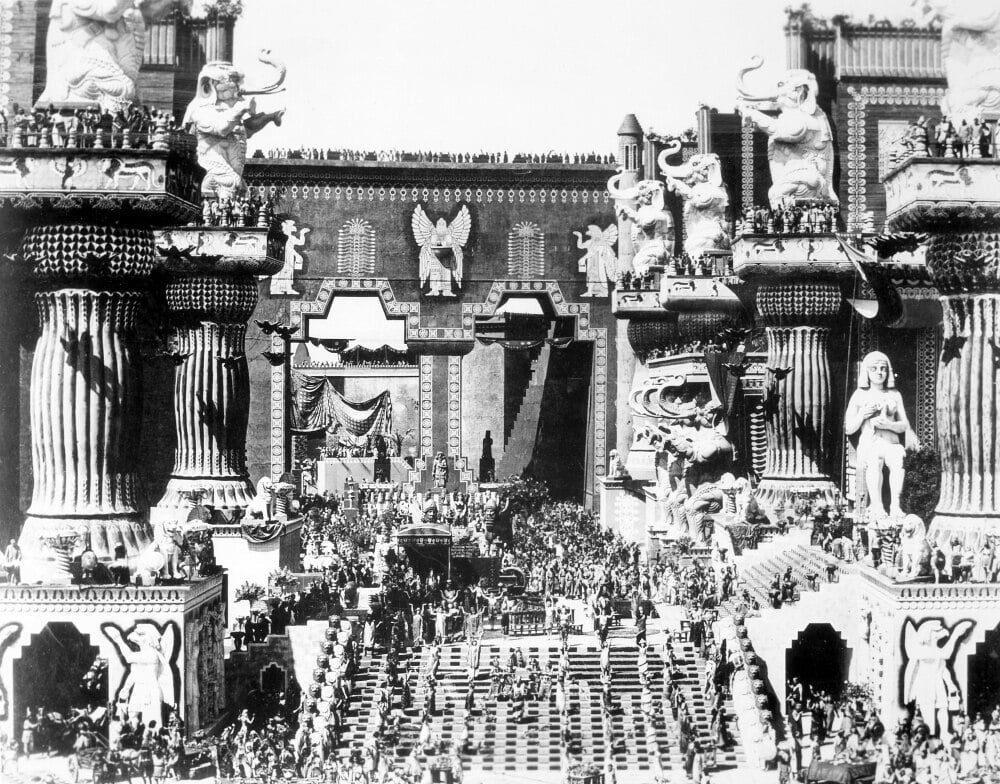
And you can see Griffith’s film here: https://www.youtube.com/watch?v=lv6u3d99SKk Again, if you’re not used to silent film, it might take a while to get used to, often being sentimental to the point of being soppy, by our standards, but it’s a wonderful art form, coming directly from the late Victorian stage, and certainly worth your time. )
Golems are only one form of supernatural to appear regularly in Pratchett’s work. There are also vampires (many who have taken “the pledge” and no longer drink human blood) and werewolves and entire complex communities of dwarves, as well.
What I especially have enjoyed in these novels, besides the very thoughtful way in which Pratchett constructs characters—often people—even vampires—with worries and doubts, is the humor—much of it appearing in footnotes—and the occasional philosophic moments. Tiffany Aching’s Nac Mac Feegle—first seen in The Wee Free Men, 2003, for example,
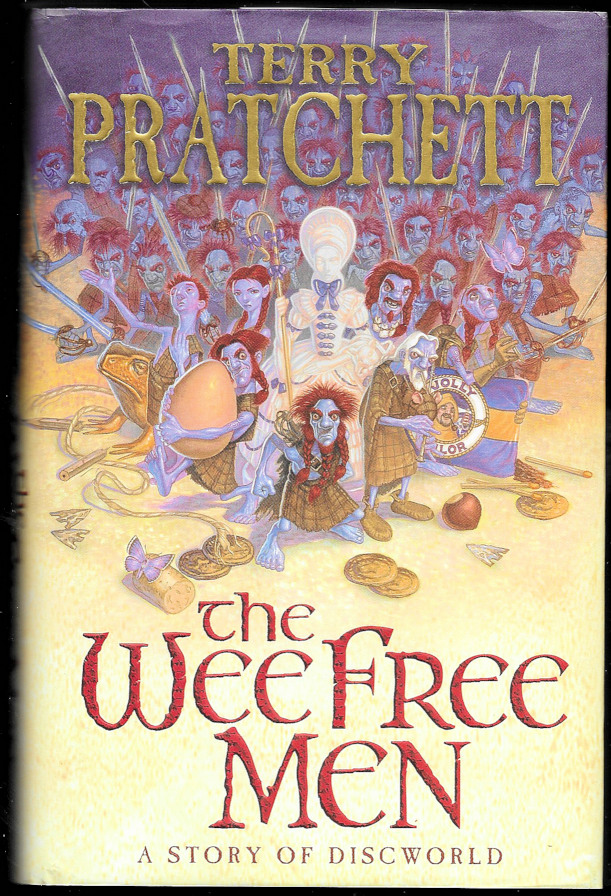
tiny, feisty creatures who speak a kind of Lallans—that is, Scots English—and are fantastically brave, primarily because they have made the decision to believe, unlike people in this world in general, that, rather than being alive and fearing death, they are already dead and that, consequently, anything goes (and usually does).
Summarizing a Pratchett novel is possible—see, for example: https://en.wikipedia.org/wiki/Going_Postal –but, to me, this seems like the sort of thing he would mock—probably in a footnote, and it’s better to try one out for yourself. I have a number of favorites I would recommend, starting with Going Postal, to which I would add Interesting Times, The Wee Free Men, and Small Gods. There is a very good film adaptation of Going Postal, which I would also recommend.

But—in very much a Pratchetty situation—I’ve just looked back at that chart and realized that—I’ve somehow miscounted. Where did The Amazing Maurice and His Educated Rodents, 2001, come from?

Somehow, I’ve managed to miss this and so have only read 40 of 41 novels. I suppose that this is what Tolkien calls a “eucatastrophe”—that is, a situation in which things look glum, but then suddenly turn out for the best, something which I think Pratchett would approve of (with an ironic footnote, however).
Thanks, as ever, for reading,
Stay well,
Consider adopting the philosophic position of the Nac Mac Feegle,
And know that, as always, there’s
MTCIDC
O
 doubtfulsea