Welcome, as ever, dear readers.
Last night, I rewatched Pixar/Disney’s Brave.

I hadn’t seen it in some years and, as I’ve been in the midst of archery recently, it fell off the DVD shelf into my hands.
If it’s not a film you’ve seen, I want to recommend it immediately, for the story of a young woman trying find her way in a rigid medieval world which sees her more as a pawn than a person.
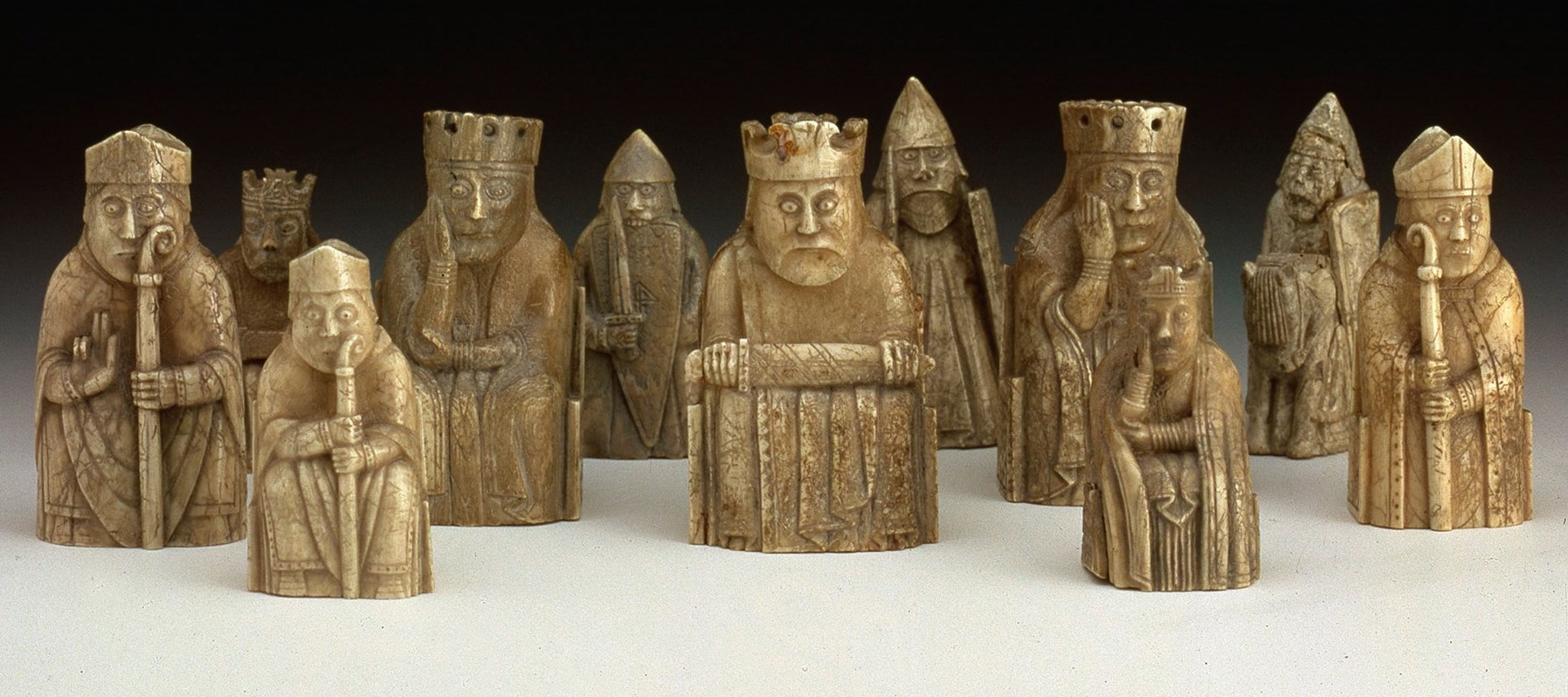
(The famous “Lewis Chessmen”, 12th-century walrus ivory and whale teeth carvings found in a kist (stone box) at Uig—Oo-ig–on the island of Lewis off the west coast of Scotland. To read more, here’s a site actually devoted to them: https://www.isleoflewischessset.co.uk/ From what culture we’re shown in Brave, these might be roughly contemporary with the story. In 2010, there appeared the theory that they were carved in Iceland by Margret en Haga—Margaret the Handy/Dexterous—she is mentioned as a skilled worker in ivories in the 13th century “Pols Saga” which you can read here on page 528 of Vigfusson and Powell, Origines Islandicae, 1905, where her name is translated “Margaret the Skilfull”: https://ia904602.us.archive.org/4/items/originesislandic01guiala/originesislandic01guiala.pdf )
It’s also funny and just absolutely pictorially beautiful, in the way a Miyazaki film can be.

Early in the film, the heroine, Merida, who is to be the pawn in a marriage alliance, alters things with a demand for a bride-contest in her specialty, archery, and

when one of her hapless suitors accidentally hits the bullseye, she promptly splits his arrow—and suddenly I’m in another story. It’s 1938

and Robin Hood, played by Errol Flynn, disguised as a tinker, is about to win a golden arrow in an archery contest—and to be captured by a collection of villains.
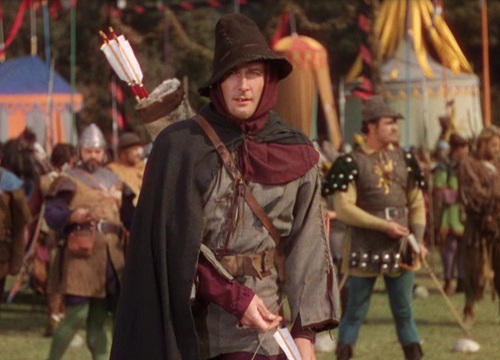

He wins by—yes, you guessed it—splitting his final opponent’s arrow in two.
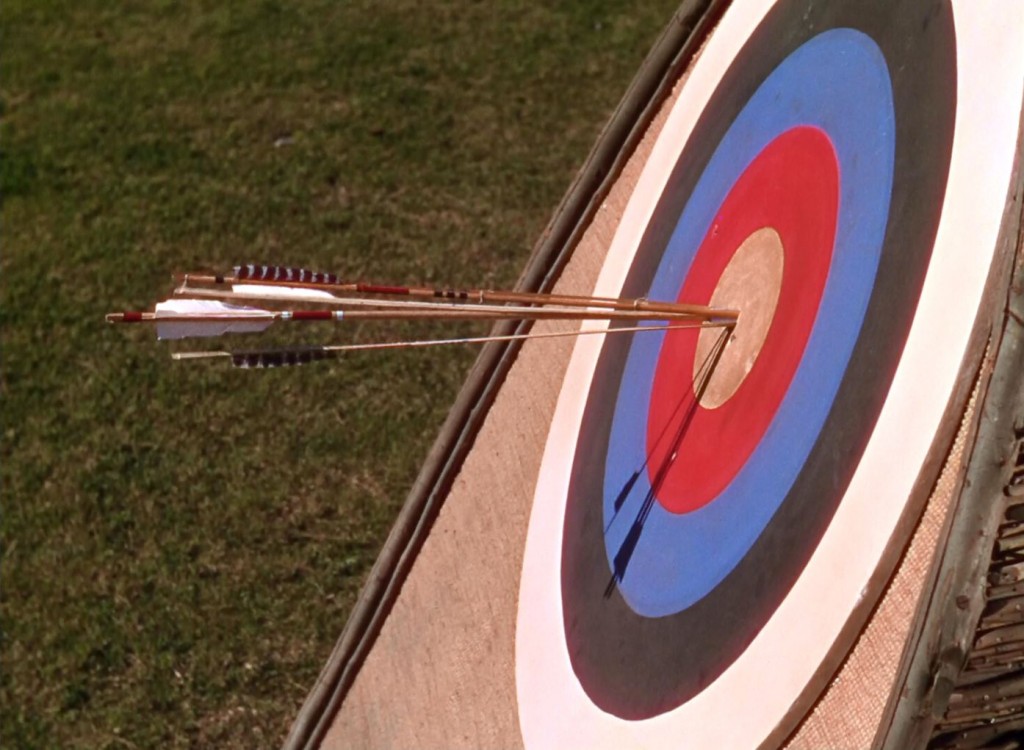
(This is from a useful article on the subject of arrow-splitting, which you can find here: https://www.goldengatejoad.com/2012/07/how-hard-split-arrow-longbow/ and you can see the contest here: https://www.youtube.com/watch?v=y4gnNwVftp4 )
The idea for this may have come from the early 16th-century “A Gest of Robyn Hode”, the “Fyfth Fytte”, in which Robin, in a contest at Nottingham, splits a series of wands with his shots—see F.J. Child, The English and Scottish Popular Ballads, Volume III, page 70 here: https://archive.org/details/englishandscotti03chiluoft/page/70/mode/2up (Robin, in Howard Pyle’s 1883 The Merry Adventures of Robin Hood, trims the fletching off one side of his opponent’s shaft—see: https://archive.org/details/merryadventureso00pylerich/page/30/mode/2up )
This wonderful shot, however, also reminded me of another kind of contest, rather like that which Merida sets up, this time in a much earlier era.
A few weeks ago, I finished teaching the Odyssey and I was reminded of a scene late in the story where Penelope, pestered for nearly 4 years by a gang of obnoxious suitors,

(J.W. Waterhouse)
sets up a rather peculiar sort of tournament, first telling Odysseus (in disguise as an old beggar), that she intends to reenact something her husband used to do for fun. He would set up a dozen axe heads and fire an arrow through them.
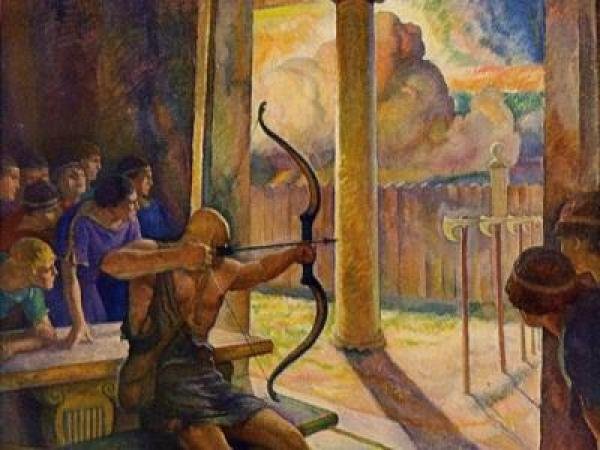
(N.C. Wyeth)
It’s unclear in the text what’s really happening: does he shoot through the axe blades? Some have suggested (but it’s not in the text) that there were rings on the axes and he shot through them.

The real point, I suspect, isn’t the axes at all, but Odysseus’ bow.

(Alan Lee)
Penelope announces that the one who can string it—then do whatever it is with the axes, can have her hand. And, although Telemachus (probably a sign that he’s Odysseus’ son, something he was very worried about at the beginning of the Odyssey) almost strings it—until Odysseus signals him not to—none of the suitors comes even close, which is humiliating for them, since it demonstrates quite graphically that, whatever their pretensions to be Penelope’s second husband, they will never come close to rivaling her first one.
At the same time, this contest has another outcome. Odysseus easily strings the bow

(Peter Connolly)
and shoots (through?) the axes, but then begins picking off the suitors, beginning with one of the principal ones, Antinoos.

Thus, he is the successful participant in the contest for Penelope’s hand in three ways:
1. he strings the bow
2. he does whatever with the axes
3. he begins the elimination of any possible rivals

But I said at the opening that I was in the midst of archery these days—not only in the Odyssey, but, having just finished The Hobbit, I would add one more string to my bow—Bard the archer.
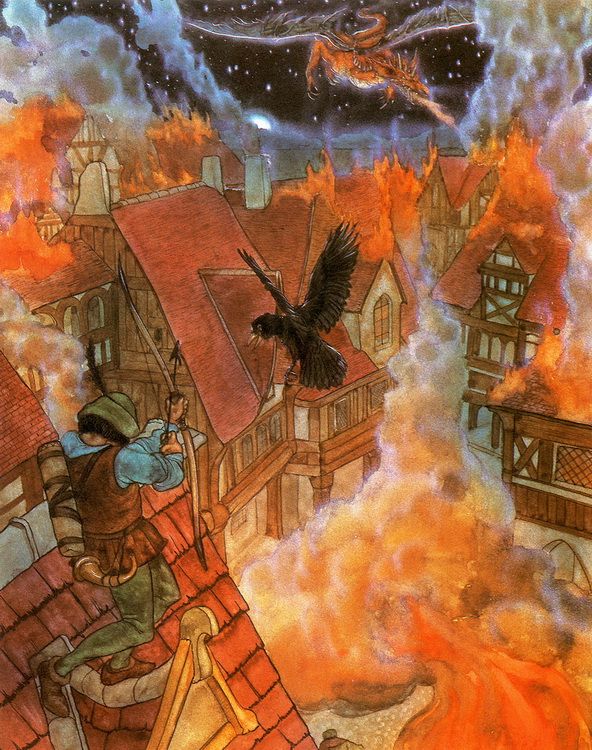
(Michael Hague from his beautiful illustrations)
Although it’s not a contest in the same sense, like Merida’s, Robin’s, and Odysseus’, his one shot is a tricky one, and the prize isn’t a bride, a golden arrow, or a wife, but life for him and much of the population of Lake-town, which he wins when his arrow (perhaps a magic one?) hits the one exposed spot on his enemy’s hide.

(JRRT)
Thanks for reading, as always.
Stay well,
Don’t let yourself be strung along,
And remember that, as always, there’s
MTCIDC
O
PS
If you’d like a comprehensive collection of early Robin Hood material, try this 1885 edition of the antiquarian Joseph Ritson’s 1795 Robin Hood: https://www.gutenberg.org/files/56926/56926-h/56926-h.htm If you’d like to see what I think are the best Robin Hood book illustrations see Paul Creswick’s Robin Hood, 1917, for which the artist was N.C. Wyeth: https://ia801603.us.archive.org/15/items/robinhood00cresrich/robinhood00cresrich.pdf The Howard Pyle cited above has the most wonderfully elaborate illustrations and was, I suspect, an inspiration for the 1938 film.
 doubtfulsea