Welcome, as ever, dear readers.
Although Tolkien never wanted readers to see The Lord of the Rings as allegory about his own time—writing to Joanna de Bortadano that “my story is not an allegory of Atomic power” (letter to Joanna de Bortadano, April, 1956, Letters, 246), he also wrote to Rhona Beare that, “I have, I suppose, constructed an imaginary time, but kept my feet on my own mother-earth for place” (letter to Rhona Beare, 14 October, 1958, Letters, 283) and, in the years in which he was writing the novel, it would have been difficult not to have felt some influence from what was going on around him in that place.
This certainly applies, I would suggest, when it comes to the words of the Mouth of Sauron,

(Douglas Beekman)
dictating terms to Gandalf:
“The rabble of Gondor and its deluded allies shall withdraw at once beyond the Anduin, first taking oaths never again to assail Sauron the Great in arms, open or secret. All lands east of the Anduin shall be Sauron’s for ever, solely. West of the Anduin as far as the Misty Mountains and the Gap of Rohan shall be tributary to Mordor, and men there shall bear no weapons, but shall have leave to govern their own affairs. But they shall help to rebuild Isengard which they have wantonly destroyed, and that shall be Sauron’s, and there his lieutenant shall dwell: not Saruman, but one more worthy of trust.” (The Return of the King, Book Five, Chapter 10, “The Black Gate Opens”)
Although it would lead to a permanent cessation of combat, the armistice of 11 November, 1918, agreed upon in a railway car in Compiegne in northern France,

was not a surrender on the part of the Central Powers (Germany, Austria-Hungary, Bulgaria, Turkey), but only an agreement to cease active engagement with the Allies. As fighting stopped, more or less, at that time, at least on the Western Front, people in the West, especially soldiers, certainly rejoiced as if the Great War/World War I had actually ended.

The real surrender occurred the next June, however, in the Hall of Mirrors at Versailles, outside Paris.
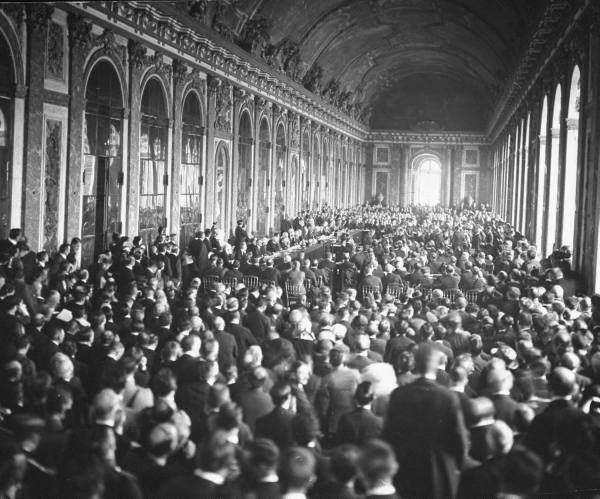
As might be expected from a large gathering of disparate powers, there was a great deal of wrangling, of pushing various agendas, and argument over how Germany, which was almost universally blamed for the outbreak of war in 1914, was to be dealt with. The final form of the treaty was complex, but here are some of the main points:

Reading through these points, and many more, it’s hard not to think that Lieutenant Tolkien

would not have also read through them with interest—note things like:
1. disarmament
2. loss of territory
3. to which we might add outside control of territory, in that the Allies gave themselves the right to occupy the heavy industrial areas called the Rhineland and the Ruhr valley until 1934 (the occupation, in fact, was ended in 1930),
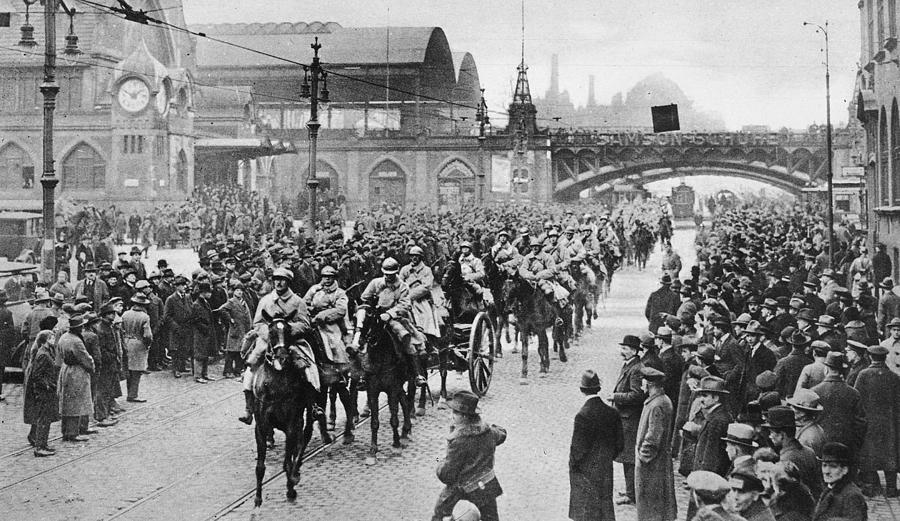

as well as returning to France territory which she had lost to German troops in the War of 1870-1, Alsace and Lorraine.
The severe terms of this treaty, it has often been written, were a major reason for the rise of Hitler and the rearmament of Germany in the 1930s

and even a reason for a new war, even longer than the first, from 1939 to 1945, as Hitler worked his way west, in what was called a Blitzkrieg, or “lightning war”, which, in late spring, 1940, rolled over Norway, Denmark, the Netherlands, Belgium, and moved into France, where it rapidly defeated both a British expeditionary force and the French army.

The majority of the British, along with a number of Belgian and French soldiers, were rescued at Dunkirk,
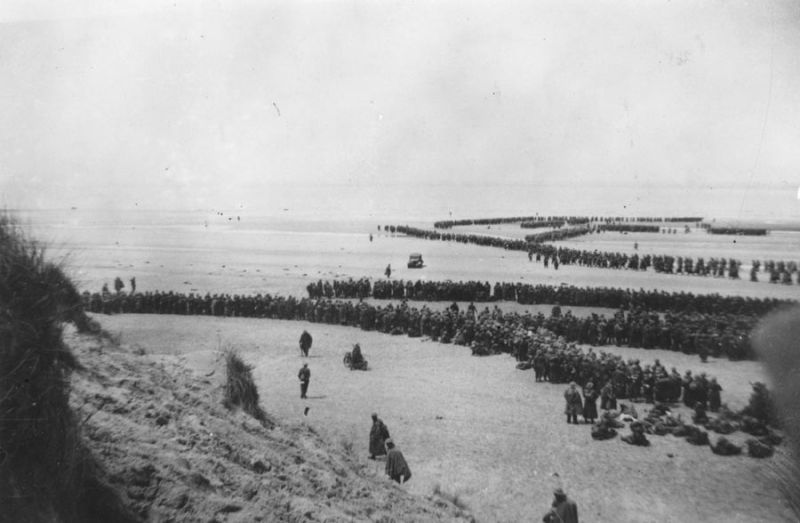
but the majority of the French were forced south and then became part of a general armistice, the terms of which would seem familiar to those who remembered the Treaty of Versailles:
“The 1940 Armistice agreement comprised 24 articles, notably: :
n°1 : The French army must immediately lay down its arms
n°2 : The German occupation of a large portion of France.
n°4 : The demobilization of the French army.
n°6 : The heavy armaments of the free French zone are to be delivered in good condition to the Germans.
n°8 : The French navy is to be demobilized and disarmed.
n°11: Commercial boats must remain in port.
n°12: All planes are grounded.
n°19: Designated German nationals must be handed over to Germany.
n°20: French prisoners of war are to remain in Germany.
n°24: The armistice agreement remains valid until the signing of a peace treaty”
(from the website Memorial Armistice here: https://armistice-museum.com/ )
This occupation also sounds much like Sauron’s terms, France initially looking like this—
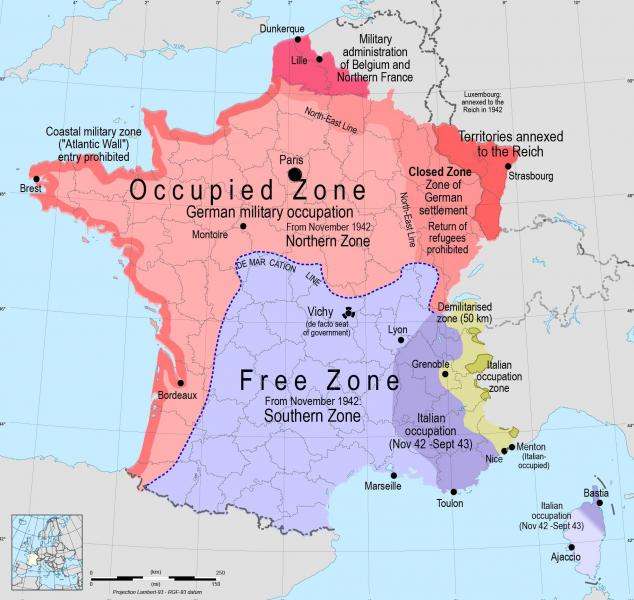
(for more on the occupation, see an extensive article here: https://en.wikipedia.org/wiki/Vichy_France#Bibliography )
The terms of the Versailles Treaty were harsh, but their ultimate goal was—or at least some of those involved hoped so—to prevent such horrendous wars in the future (see this detailed article for more: https://en.wikipedia.org/wiki/Treaty_of_Versailles ). The Nazi terms for an armistice were, on the one hand, Hitler’s sneering response to the Treaty of Versailles (he even had it arranged that the terms would be presented and agreed to in the same location—see more at: https://armistice-museum.com/ ), but, on the other, simply a method to gain control of all of France, its industries, and even its labor force, in time—the condition that the armistice terms would hold until a peace treaty was signed proved totally false, as there was never a treaty. That artificially-determined border was erased and the Nazis occupied all of France, as this map sequence shows.

And this is in line with something which the narrator tells us of the reaction of Gandalf and his companions to the words of the Mouth of Sauron:
“Looking in the Messenger’s eyes, they read his thought. He was to be that lieutenant, and gather all that remained of the West under his sway; he would be their tyrant and they his slaves.”
Tolkien, a reluctant civilian during that second war (see his letter to Michael Tolkien of 9 June, 1941, Letters, 55), was always clearly well aware of current events, especially to do with that war (there are over 100 citations to war-related items in Letters alone) and, although he might model Sauron’s terms on what he might have read in 1919 or 1940, I can imagine that it was the terms of the 1940 armistice and their ultimate veracity which was in his mind when he wrote Gandalf’s words in response to the demands of Sauron and his Mouth:
“But as for your terms, we reject them utterly. Get you gone, for your embassy is over and death is near to you. We did not come here to waste words in treating with Sauron, faithless and accursed; still less with one of his slaves. Begone!”
As always, thanks for reading.
Stay well,
Never trust an emissary with his own agenda,
And remember, that, as ever, there is
MTCIDC,
O
 doubtfulsea