Dear Readers, welcome, as always.
This is the 469th posting of Doubtfulsea.com and, with it, this blog enters its tenth year.
This calls for a little rejoicing,

(no peacock, however)
but there’s another reason for rejoicing, as will present itself—or, rather, himself–later.
As I’ve discussed in earlier postings, lthough, in later life, Tolkien enjoyed at least one Shakespeare performance (see a letter to Christopher Tolkien, 28 July, 1944, Letters, 88), as a schoolboy,
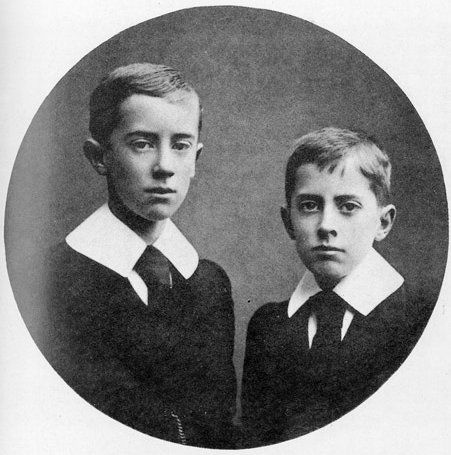
(in 1905, with his younger brother, Hilary)
he disliked Shakespeare “cordially” (see letter to W.H. Auden, 7 June, 1955, Letters, 213). His ire was directed towards two plays in particular:
1. Macbeth, because, as he tells us, he was disappointed that Birnam Wood wasn’t an actual wood which marched on Macbeth’s stronghold, but merely camouflage for Macduff’s soldiers (see JRRT’s own footnote to his letter to W.H. Auden of 7 June, 1955, Letters, 212)

(modern camouflage, but you get the idea)
2. A Midsummer Night’s Dream because of the miniaturization of the fairies (see his footnote to a letter to Milton Waldman, “late 1951”, Letters, 143, where he remarks: “…a murrain [plague] on Will Shakespeare and his damned cobwebs” )
I don’t mind Tolkien’s disappointment about Birnam Wood because it gave us Treebeard and the Ents, to me one of his most marvelous creations,

(Alan Lee)
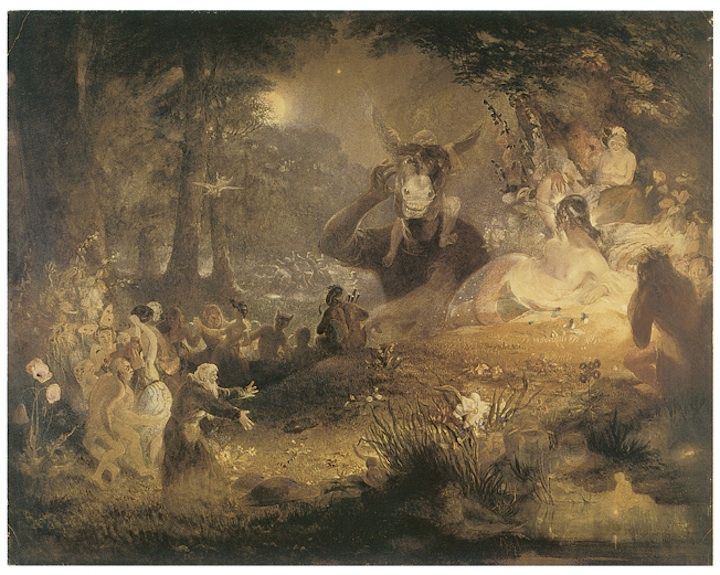
but, although the “cutsie” aspect of Victorian depictions of fairies, which clearly Tolkien had seen and disliked, as the descendants of Shakespeare’s fairies, I find more than a little disturbing—like this depiction, by Richard “Dicky” Doyle (1824-1883), famous for his fairy illustrations–

it has never stopped me from loving the play and, if you, like me, have Shakespeare in your head (it can get a little crowded in there, I admit, so I exclude dubious things like Henry VIII), you’ll recognize the title of this posting as based upon the opening line of the meeting of the Fairy King and Queen
in Act II of A Midsommer nights dreame, as the First Quarto (1600) spells it.

“Ob. Ill met by moonelight, proud Tytania.
Qu. What, Iealous Oberon? Fairy skippe hence.
I haue forsworne his bedde, and company.
Ob. Tarry, rash wanton. Am not I thy Lord?”
(I really prefer Elizabethan/Jacobean spelling, myself, so, if you’d like to read the play in that edition: https://internetshakespeare.uvic.ca/doc/MND_Q1/scene/2.1/index.html A very mild caution: if you’re used to modern editions and haven’t used the earliest publications, this Quarto may surprise you, as it has no line numbers, scene or act markers, but just rolls along with no breaks. It’s actually perfectly easy to read, however, as you’ll see.)
The King of the Fairies is Oberon, a name which is believed to be derived from a Germanic form “alf-rih”, “elf-king/ruler” (you can see the same construction in the name of the Ostrogothic king, Theodoric, which is actually “theuda-reiks”, “people ruler”), but which first appears in the early 13th century chanson de geste (a kind of heroic poem) of Les Prouesses et faitz du noble Huon de Bourdeaux as Auberon. (For more on this see : https://en.wikipedia.org/wiki/Huon_of_Bordeaux )Shakespeare may have picked up the name from the early 16th-century translation by John Bouchier, Lord Berners, The Boke of Duke Huon of Burdeux (printed about 1534—you can read the Early English Text Society edition of 1882 here : https://ia600502.us.archive.org/35/items/TheBokeOfDukeHuonOfBurdeux1/The_Boke_of_Duke_Huon_of_Burdeux_1.pdf or an 1895 retelling, in the style of William Morris here : https://archive.org/details/huonofbordeauxdo00bernuoft/page/n9/mode/2up ) It’s interesting that Auberon is diminutive, but handsome, in the Huon story, so perhaps Shakespeare scaled down the rest of the fairies to fit him ? (Other Elizabethan/Jacobean authors also depict the fairies as tiny—see, for example, Michael Drayton’s Nymphidia, 1627, which Tolkien hated—On Fairy Stories–and which you can read here : https://archive.org/details/selectionfrompoe00dani/page/124/mode/2up )
If you know the play, you probably also know the incidental music which Felix Mendelssohn (1809-1847) composed for a performance in of it in Berlin in 1842, having written an overture years before, in 1826, when he was 17 (I almost put an exclamation point there). So you can hear something of what audiences in 1826 would have heard, here’s a really beautiful performance of that overture on instruments of the period, conducted by Franz Brueggen : https://www.youtube.com/watch?v=qxC17tNhN7c
At about the same time, another Romantic composer, Carl Maria von Weber (1786-1826),

(This is sometimes cited as the first illustration of a conductor using the equivalent of a baton to conduct.)
was in London, creating an opera based upon a libretto loosely founded upon that 13th century French poem of Huon. That libretto was written by a man often thought of as the forerunner to W.S. Gilbert in English comic operetta, James Robinson Planche (1796-1880),

but who was actually a dynamo of the Georgian and early Victorian theatre in general, being involved in everything from authentic historical costuming to introducing vampires to the English stage in 1820.

The libretto combines spoken dialogue with music, the kind of opera which the French call an opera comique, like Bizet’s (1838-1875) Carmen, 1875, as opposed to an opera completely sung, opera lyrique, or grand opera, and the plot probably would seem pretty weak to us (you can read a summary here : https://en.wikipedia.org/wiki/Oberon_(Weber) ), but it was an immediate success in 1826,

although von Weber died in London shortly afterwards. Here’s the overture to it, again with period instruments, conducted by John Eliot Gardiner : //www.youtube.com/watch?v=fHI7Yc66SFk
so that you can hear a little of what excited London theatre-goers.
Now, you are probably wondering, how does all of this, as interesting as I hope you find it, tie in with that idea of festivity?
Back in May, I posted a piece which ended on the sad note that my 9-year-old Bernese Mountain Dog, Bellerophon, had left us (see Beato Te, 31 May, 2023).

A month or so ago, a new Berner appeared, a 2-month-old puppy, named—I’ll bet you’ll guess this already–Oberon.

At 3 months, he’s curious, lively, and promises, if not to be a powerful fairy king, like his namesake, certainly to provide as much delight as the Shakespeare play from which his name comes.
As always, thanks for reading.
Stay well,
Beware the Puck,
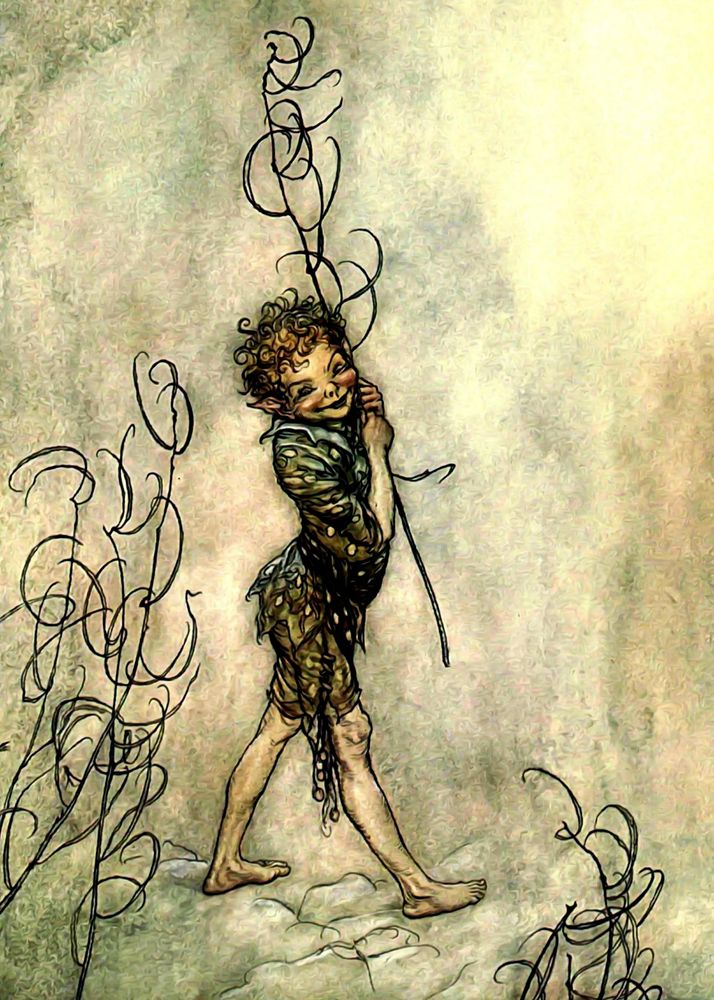
And remember that, as always, there’s
MTCIDC
O
PS
If you liked the image of Puck and the meeting of Oberon and Tytania earlier in the posting, you might have a look at Arthur Rackham’s 1908 illustrated version of Shakepeare’s play here: https://ia902806.us.archive.org/33/items/midsummernightsd00shakrich/midsummernightsd00shakrich.pdf
 doubtfulsea