Dear readers, welcome, as always.
In my last, I was beginning a review of the new Indiana Jones film.

In that last, I began with background on just what that film was based upon and now I want to discuss the film itself. (And, considering how much of it is revealed here, I suppose that I should shout SPOILER ALERT!!! in case you haven’t seen it. If you haven’t, go, and I hope that, afterwards, you’ll find my two postings useful in your own thoughts about the film.)
It had been long known that this would be the final Indiana Jones film. The lead, after all, is now 80 (though, in the Indiana Jones chronology, he was born 1 July, 1899, meaning that, at the time of this film, he’s actually supposed to be 70) and, though clearly a tough old bird, as he adlibbed in Raiders, “It’s not the years: it’s the mileage”.
The questions facing the creators then, must have been things like:
1. how can we end the series in a memorable way?
2. what will be the goal?
3. who will be the villains?
4. when will it take place?
We’ll begin in reverse order.
There was already a certain time-frame established within the series, the first three films taking place in the 1930s (The Temple of Doom in 1935, Raiders in 1936, and The Last Crusade in 1938).
The next film, Crystal Skull, takes place in 1957—so it would be natural, then, that the action of this final film might happen beyond that time. And, in fact, it is set in 1969, the year of the first moon landing.
(After 1969, although there won’t be any further adventures, Dr. Jones survives perhaps another 25 years, as the made-for-television “The Young Indiana Jones Chronicles”, shows him alive in the early 1990s. See this article for a useful chronology: https://www.looper.com/763148/the-entire-indiana-jones-timeline-explained/ )
Once we’ve established the time, then choosing the villains may be a little easier: in the 1930s, the Nazis were a ready possibility—although Temple chose, instead, a sinister prime minister of a small Indian hill state. In 1957, we’re in the middle of the Cold War, so Soviet agents make sense in Skull. In 1969, it could still have been the Soviets, but the writers, in a sense, returned to the time of the first films, and so the villain is, in fact, a one-time Nazi scientist—and a particular kind of scientist, of a sort which both the East and the West were grabbing up at the end of the war: those with a specialty in rocketry, like Wernher von Braun (1912-1977).
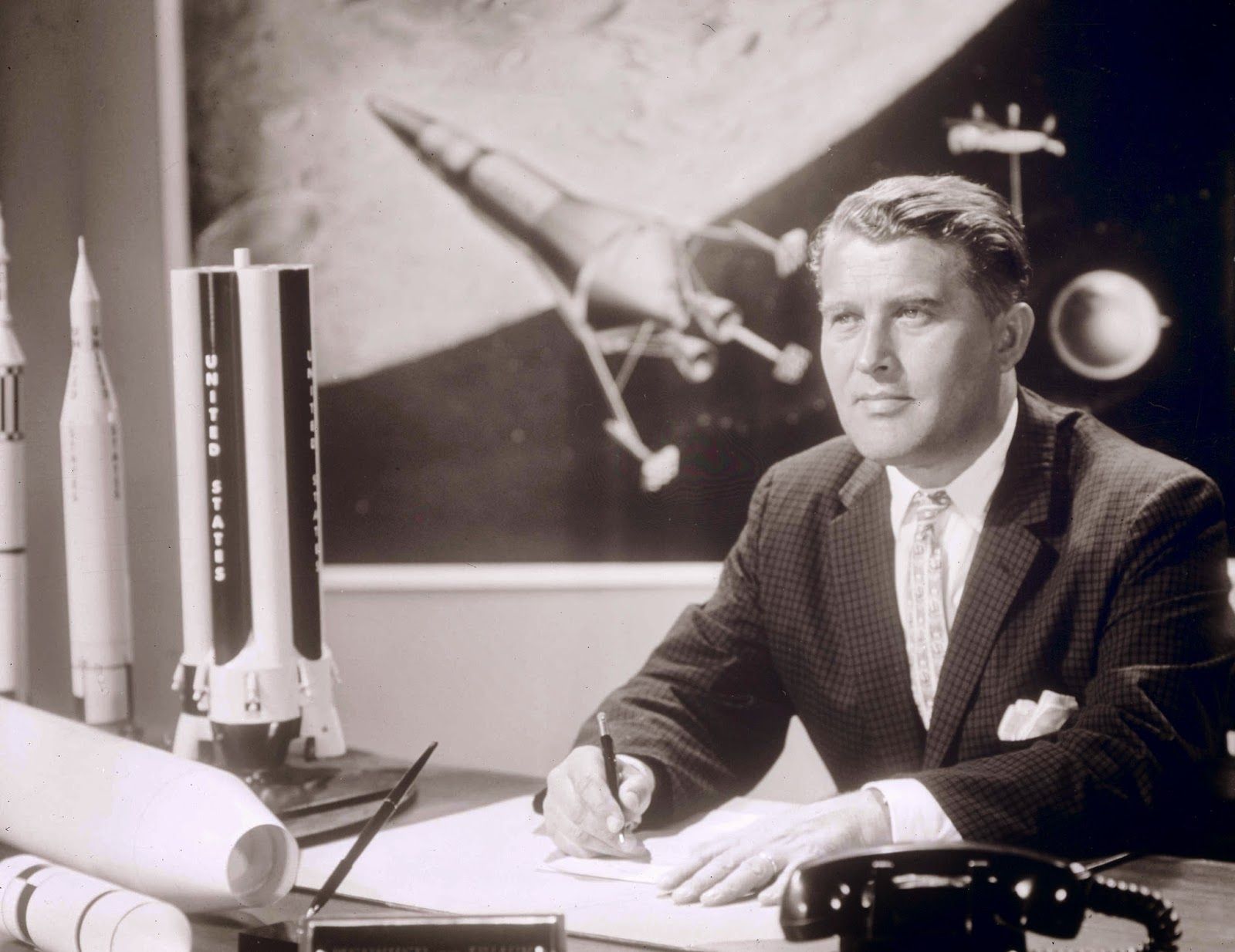
It’s not surprising, then, that this one-time Nazi scientist is involved in the “space race” of the period, in the pay of the US Government (which is about to award him a medal). Past villains in the series appear to have had state funding for their evil projects–the Nazis for Raiders and Crusade, the Soviets for Skull, and even that sinister prime minister in Temple would presumably have had the wealth of his rajah to back him: are we to believe that this evil-doer will be backed in his wickedness by the US? Although he has CIA minders in the film’s beginning, he “goes rogue” later in the film and even hints to Jones that he has become independent—but clearly has the resources to build (or at least rent) his own air base and uniform its personnel in German WW2 uniforms. And this, to me, hints at where I believe the plot begins to show cracks, but let’s continue.
In a number of past films, Jones has been on a quest: to find the Ark of the Covenant,

to find the Holy Grail,

and, less clearly, in terms of the plot, to locate the Shankara Stone

and a crystal skull.

As I said in the last posting, each of these may be fictional or not, depending upon what one chooses to believe, but Indiana Jones and the Dial of Destiny is based upon an actual device dredged up from the floor of the Mediterranean, the so-called Antikythera Mechanism.
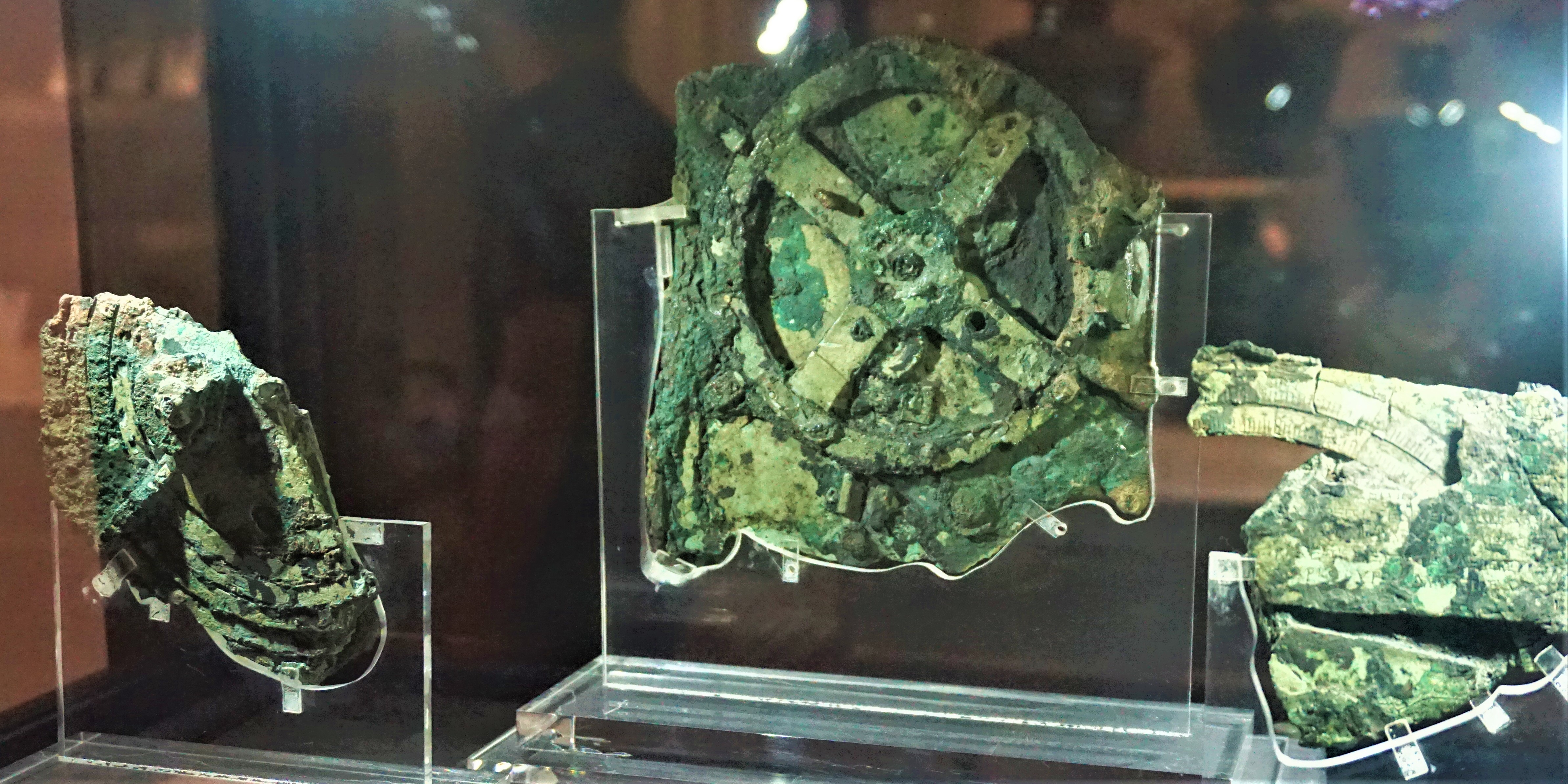
For more on this, please see the last posting. For now, we’ll go with the film’s premise, that this was:
1. invented by Archimedes, the 3rd century BC Greek (Syracusan) mathematician, inventor, scientist
2. originally built to investigate/predict “weather anomalies” (? even after seeing the film twice, I’m not absolutely clear about this), Archimedes discovers that it can also do something similar with time—even allowing someone to pass through it
We now step back to 1944, where, somehow, this former Nazi scientist has become aware of what Archimedes had ascertained and briefly has his hands on the mechanism—or, actually, only half of it—before losing it to Indiana Jones on a speeding train filled with looted antiquities. These include the so-called “spear of Longinus” (which has its own complicated history—see this article for more: https://en.wikipedia.org/wiki/Holy_Lance ) which Jones and his colleague, Basil Shaw, are shown to be after—only to discover that it’s a modern fake, which the Nazi scientist had already realized. Whole earlier films had been dedicated to finding early religious symbols for Hitler, but here, what might have been the basis of the plot, is rapidly discarded in favor of something else, about which Jones and Shaw clearly have no real knowledge—and which Shaw, so the subsequent film informs us, studies obsessively for years until Jones, concerned for Shaw’s apparent declining mental health because of his studies, arrives at his Oxford residence to carry off—and then, although promising to destroy it, simply caches in the archives of his college, where it sits for some years.
But the ex-Nazi has the CIA to help him locate it—through Shaw’s daughter, Helena, who is, without any explanation, called “Wombat” by Jones, and who, with a degree in archaeology and a DPhil (the equivalent of a PhD in the US) project about the mechanism (or so she says, she turning out to be much shiftier than she first appears), has come to Jones for help.
And, so far, we have three unexplained items:
1. how the ex-Nazi funds his plan
2. how he is already aware, in 1944, of what the mechanism can do (something which takes Basil Shaw years of research and perhaps his sanity to understand)
3. why “Wombat” (a minor detail, but, still, why? Here’s a picture of an actual wombat—and of Helena—is there a resemblance I don’t see?)


And then we have an inconsistency: although we’re told that Helena has watched her father work on the mechanism for years, she’s memorized her father’s notes, and, at twelve has seen Jones remove it from her father’s house, she comes to him with the story that it still remains in the river where her father and Jones jumped to escape the antiquities train. The DPhil project appears to be a lie—we subsequently find out that she’s an underground antiquities dealer and wants the mechanism to auction off—but this river story appears to be her actual belief, all the evidence I’ve cited above to the contrary.
At this stage, the indomitable villain, using the CIA, appears to seize the half-mechanism, only to be thwarted by Helena who snatches it and makes off across the rooftops of New York City, leaving Jones to the ex-Nazi and his CIA allies–but, of course, Jones escapes on a stolen police horse and, with the help of his old friend, Sallah, now a New York taxi driver, sets off to Tangiers, where Helena is set to auction off the stolen gadget. And so the plot is now not about finding a lost and precious object, but recovering it (as becomes the goal in Raiders).
There is another complication—in fact, two—here:
1. as I mentioned above, this is really only half of the mechanism. We are, at one point, told that Archimedes, fearing that the Romans might steal and employ it, has broken it into two parts, concealing one half (somehow—we’re not told how—the Romans seem to have obtained the other half)
2. the clue to finding that other half lies with something called “the graphikos”, which Basil Shaw’s notes reveal is on the very ship on which the one half the Romans had acquired was discovered—only farther down the underwater slope than the half which held the mechanism, indicating that the Romans had already gotten their hands on the clue
And here we have more unexplained items:
1. how the Romans obtained the gadget
2. how they acquired the “graphikos”
3. and, more important, how the Romans, whose technological expertise stretched only as far as the multiple watermill,

might understand and employ the device even if they had solved the clue and located the other half of it.
Needless to say, the ex-Nazi appears in Tangiers and makes off with the half-mechanism, but Jones and Helena pursue—she knows the location of the “graphikos” (Jones providing a ship and divers), the “graphikos” changes hands, Jones and Helena obtain it once more and it leads them to Syracuse, the home of Archimedes and his tomb, which is, for the sake of the plot, lost completely. (In fact, the real Archimedes was buried in Syracuse and the last-century BC orator and author, Cicero, records that, not only had he located the site, but restored it. See: https://math.nyu.edu/~crorres/Archimedes/Tomb/Cicero.html This is part of a much larger website which I recommend, if the real Archimedes interests you.)
The villain arrives, picks up the other half of the mechanism, adds a kind of key found in the tomb, but not mentioned anywhere before (another unexplained item), and sets off with it—and with Jones. (Unexplained why he’s taken, except that this is an Indiana Jones film. In a more realistic film, Jones would have been done away with here, probably with a line like, “Archimedes’ tomb, Jones, a good last resting place for a relic like you”.)
And now we finally find out the ex-Nazi’s plan:
1. he asserts that Hitler, not Germany, lost the war
2. that he intends to go back to 1939 to do away with Hitler and, presumably, run the war more effectively himself (although, considering the ambitious monsters around Hitler, one wonders why he wouldn’t have been immediately arrested and executed, while Hitler’s ministers struggled to succeed der Fuehrer)
3. for reasons never explained, the way to do this is to use the mechanism while flying into the midst of a wild thunderstorm (a weather anomaly of the sort the device was originally intended to investigate?), somehow using map coordinates to guide the airplane to Berlin at the right time—through time
Logically, this makes one wonder: even if Archimedes had discovered that his gadget could do something about time, without 20th century technology, how was he to be able to fly up into such a storm, as the villain intended? (One might also wonder about the Romans, less scientifically advanced than Archimedes.)
This doesn’t work—supposedly because of something which Jones shouts out to the villain about “continental drift” which would mean that the map coordinates would be off—because Archimedes, not being aware of continental drift, would have employed incorrect figures. And here, adapting something which a former student of mine used to say when he no longer understood something, the film “fell off the sled”.
1. in Archimedes’ time, the concepts of latitude and longitude were thought about, but were very hazy and were certainly not charted (for the complicated history of longitude alone see: https://en.wikipedia.org/wiki/History_of_longitude )
2. continental drift is exceedingly slow and, over the period from the 3rd century BC Archimedes to 1969AD would have been so minimal as not to make a difference (see this clever video map of shifts over long periods: https://www.youtube.com/watch?v=OGdPqpzYD4o )
But, in the film, the villain—and Jones—find themselves flying into a war zone: Syracuse, 214-12BC, when the Romans were besieging it and Archimedes (see the previous posting) was a major part of the defense. The plane crashes, killing the ex-Nazi (a rather tame ending for such an evil sort) and allowing Jones—and Helena, who had stolen aboard—to meet Archimedes himself and to speak to him in rather strange Greek (as a Corinthian, Archimedes spoke Doric, a very different dialect from their combination of pseudo-Attic and modern Greek which, even so, Archimedes seems to understand) and it transpires that—and, again, after seeing the film twice, I’m not really clear about this—Archimedes has invented the device to bring help from the future to his besieged home city. How he would have known where to look and how the device would have done this are also left unexplained. (In fact, the city was captured in 212BC and Archimedes was murdered by a Roman soldier in the aftermath.)
It’s assumed that Jones and Helena return through time as the final scene in the film shows Jones’ shabby apartment with him in bed, bandaged from an earlier wound and, next to the bed, the complete mechanism, which brings us back to my #1 above: how can we end the series in a memorable way? Jones lying in bed in his shirt and underwear, even with the device (and Helena) nearby seems even lower key that the joke of the Ark of the Covenant being rolled into a vast government warehouse, or Jones father and son riding into the sunset, but, just as 5 follows 4 chronologically, so it follows it sentimentally: 4 ends with the wedding of Jones and Marion, the estranged Marion appears at the end of 5 and they reenact the (almost) romantic scene in 1, where they come very close to a passionate moment and, for me, this works better than many earlier moments in the film, as hectic as they can be.
As for the rest of the film, as you can see from my comments above, I find that much of the plot is based upon elements which must be taken for granted, which, to me, is a very sloppy or lazy way to create a film, not one in which the plot is carefully built up (as, for instance, in Raiders), especially one which has a rather convoluted plot, which, done well as in Crusade, can take us from Jones’ childhood through Venice to Nazi Germany to the Near East without a lot of nagging why’s. So, to the question: have the creators succeeded in making a memorable last film for a very memorable series? I would say, reluctantly, that, for all of the action scenes along the way, the film seems to me to suffer so much from insufficiently-based plotting (see everything from the villain’s early knowledge of the power of the mechanism through that continental drift idea) that it doesn’t, to my mind, rate as highly as my favorites, Raiders and Crusade and, remembering the conclusion of Crusade, we might turn back that “dial of destiny” and conclude the series with that final scene—

Thanks, as ever, for reading.
Stay well,
Think how satisfying it was to see Jones and Marion finally kissing,
And remember that, as always, there’s
MTCIDC
O
 doubtfulsea
Pingback: Best Thing I Read This Week – Gabe’s Gabs