Welcome, dear readers, as always.
In my last, I continued a brief series based upon my second thoughts (the first appeared as “Knowledge, Rule, Order”, 6 January, 2016 at Doubtfulsea.com) about the words in the title.
The original speaker was Saruman, who uses those three words in his proposal of alliance with Gandalf.
“A new Power is rising…We may join with that Power. It would be wise, Gandalf. There is hope that way…As the Power grows, its proved friends will also grow; and the Wise, such as you and I, may with patience come at last to direct its courses, to control it. We can bide our time…deploring maybe evils done by the way, but approving the high and ultimate purpose: Knowledge, Rule, Order. All the things that we have so far striven in vain to accomplish…There need not be, there would not be, any real change in our designs, only in our means.” (The Fellowship of the Rings, Book Two, Chapter 2, “The Council of Elrond”)
Although Gandalf immediately dismisses Saruman’s attempt, saying “I have heard speeches of this kind before, but only in the mouths of emissaries sent from Mordor to deceive the ignorant…” , in the previous two postings of this little series, I’ve spent some time considering the first two of his three words, “Knowledge” and “Rule”, which Saruman has claimed as one of “the things we have so far striven in vain to accomplish”.
It’s easy to see why Gandalf would have been so quick to reply in the negative: the five Istari, the five “wizards”, were originally sent to Middle-earth by the Valar as a kind of counterbalance to Sauron. As far as I understand their mission, that was their goal, with no mention of “the high and ultimate purpose: Knowledge, Rule, Order”, so Saruman’s words would have immediately sounded false—and not even his own, which Gandalf recognizes, saying of Saruman:
“He drew himself up then and began to declaim, as if he were making a speech long rehearsed.” (The Fellowship of the Ring, Book Two, Chapter 2, “The Council of Elrond”)
In the last two postings, then, I suggested that
1. what Saruman believed was his abstract “Knowledge” had actually become Sauron’s knowledge—as, when Saruman came into possession of Isengard and its palantir,

(the Hildebrandts)
he had come under the spell of Sauron, and thus had become nothing more than Sauron’s servant.
2. under Sauron’s control, Saruman had changed Isengard:
“A strong place and wonderful was Isengard…But Saruman had slowly shaped it to his shifting purposes, and made it better, as he thought, being deceived—for all those arts and subtle devices, for which he forsook his former wisdom, and which he fondly imagined were his own, came but from Mordor; so that what he made was naught, only a little copy, a child’s model or a slave’s flattery, of that vast fortress, armoury, prison, furnace of great power, Barad-dur, the Dark Tower…” (The Two Towers, Book Three,
And thus, the “rule” Saruman believed was his was only in actuality nothing more than an imitation of his master’s kingdom and his master’s control—deceived, Saruman was not the ruler, but the ruled.
And now we come to “Order”.
And here I must differ a little from something which both Frodo and Saruman have to say.
In the next-to-last chapter of The Return of the King, ”The Scouring of the Shire”, Sam says of the Shire to which he and the other hobbits have returned, “This is worse than Mordor!” To which Frodo replies:
“Yes, this is Mordor…Just one of its works. Saruman was doing its work all the time, even when he thought that he was working for himself. And the same with those that Saruman tricked, like Lotho.” (The Return of the King, Book Six, Chapter 8, “The Scouring of the Shire”)
As I’ve mentioned above, Saruman was certainly not his own man—or wizard—although he clearly believed that he was, but I think that there’s something more going on here—and it’s not just what Saruman says subsequently to Frodo:
“ ‘…if they’re [meaning the hobbits] such fools, I will get ahead of them and teach them a lesson. One ill turn deserves another…’ It would have been a sharper lesson, if only you had given me a little more time and more Men. Still I have already done much that you will find it hard to mend or undo in your lives. And it will be pleasant to think of that and set it against my injuries.”
This would suggest that what’s happened to the Shire has been a kind of spur of the moment vengeance, but I think that, contrary to what Saruman says, there has been more going on here—and for longer and, in fact, the mention of Lotho gives us a clue.
In a much earlier chapter of The Lord of the Rings, Merry and Pippin have been explaining events at Isengard to Aragorn and their friends

(Michael Herring)
and have mentioned Pipe-weed, to which Aragorn has replied:
“ ‘…leaf from the Southfarthing in Isengard. The more I consider it, the more curious I find it. I have never been in Isengard, but I have journeyed in this land, and I know well the empty countries that lie between Rohan and the Shire. Neither goods nor folk have passed this way for many a long year, not openly. Saruman had secret dealings with someone in the Shire, I guess. Wormtongues may be found in other houses than King Theoden’s. Was there a date on the barrel?’
‘Yes,’ said Pippin. ‘It was the 1417 crop, that is last year’s; no, the year before, of course, now: a good year.’ “ (The Two Towers, Book Three, Chapter 9, “Flotsam and Jetsam”)
It we combine this with Farmer Cotton’s explanation of the change in the Shire, we see just who that “Wormtongue” must have been:
“It all began with Pimple, as we call him…He’d funny ideas, had Pimple. Seems he wanted to own everything himself, and then order other folk about. It soon came out that he already did own a sight more than was good for him; and he was always grabbing more, though where he got the money was a mystery: mills and malt-houses and inns, and farms, and leaf-plantations…
Of course he started with a lot of property in the Southfarthing which he had from his dad; and it seems he’d been selling a lot of the best leaf, and sending it away quietly for a year or two. But at the end o’ last year he began sending away loads of stuff, not only leaf. Things began to get short, and winter coming on, too. Folk got angry, but he had his answer. A lot of Men, ruffians mostly, came with great waggons, some to carry off the goods south-away, and others to stay. And more came. And before we knew where we were they were planted here and there all over the Shire, and were felling trees and digging and building themselves sheds and houses just as they liked…”
Those shipments had clearly been going to Isengard and had been doing so for at least the last two years, as we can see from the combination of the date on the pipe-weed barrel and from Farmer Cotton’s words. Thus, we can see that there’s a chain here:
1. Saruman has picked the weak, but arrogant Lotho Sackville-Baggins to be his agent
2. he has then used him first to siphon goods out of the Shire (and now we might see, along with his slave farms, how Saruman’s army could have been supplied) and, then, by providing Lotho with “muscle”, he has overturned the Shire’s simple government (including putting the Mayor, Will Whitfoot, in the Lockholes) and installing Lotho in his place as “the Chief”
All of this would have been happening before Saruman’s fall, suggesting that, in fact, what he was doing to the Shire was not just spiteful revenge after the fact, as he says, but another plan altogether, and here’s where, I think, “Order” comes in.
Sauron’s Mordor was, basically, a military state based upon slavery with Sauron as lord, emperor, master, whatever title he chose to assume. Saruman, in imitating Sauron, would have thought of himself in similar terms and his Isengard, then, would have been the same sort of state. What happens in the Shire strikes me as something somewhat different, however.
Certain aspects are similar: as Saruman has industrialized Isengard, he was in the process of industrializing the Shire, as the hobbits soon see:
“And looking with dismay up the road towards Bag End they saw a tall chimney of brick in the distance. It was pouring out black smoke into the evening air.”

(Alan Lee)
And hear about from Farmer Cotton:
“Take Sandyman’s mill now. Pimple knocked it down almost as soon as he came to Bag End. Then he brought in a lot o’ dirty-looking Men to build a bigger one and fill it full o’ wheels and outlandish contraptions.”
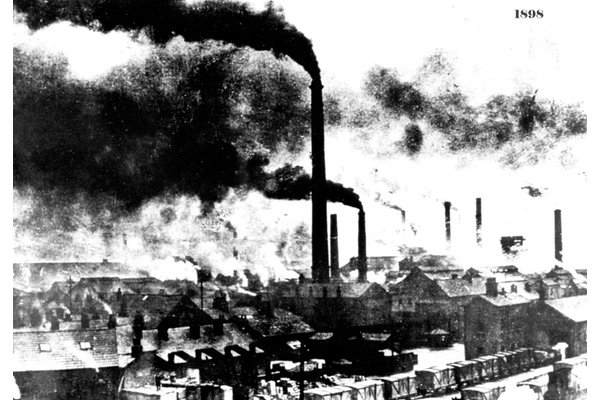
But this is only the beginning:
“The pleasant row of old hobbit-holes in the bank on the north side of the Pool were deserted, and their little gardens that used to run down bright to the water’s edge were rank with weeds. Worse, there was a whole line of ugly new houses all along Pool Side, where the Hobbiton Road ran close to the bank.”

On the one hand, what Tolkien is recreating is the poorer areas of industrial Birmingham, where he grew up in the late-Victorian/Edwardian world,
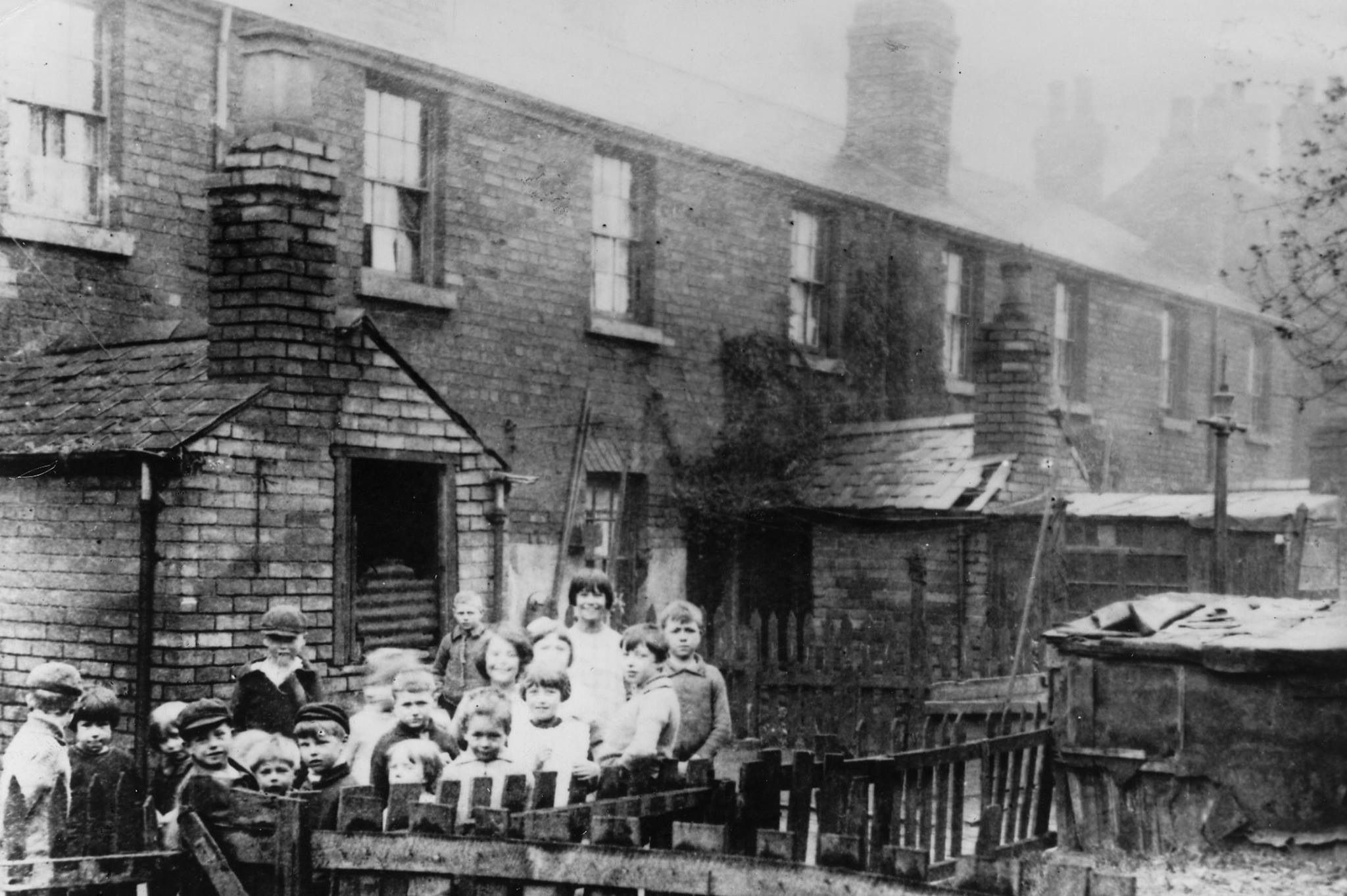
but, on the other, he’s showing us what Saruman has been up to: turning the Shire into a kind of communist state with:
1. an unelected leader, Lotho/Pimple (“And after that, it would be soon after New Year, there wasn’t no more Mayor, and Pimple called himself Chief Shirriff, or just chief, and did as he liked…” )
2. the equivalent of the NKVD (“A lot of Men, ruffians mostly, came with great waggons…and others to stay…”
3. local collaborators (Robin Smallburrow tells Sam: “There’s hundreds of Shirriffs all told, and they want more, with all these new rules. Most of them are in it against their will, but not all. Even in the Shire there are some as like minding other folk’s business and talking big.”)
4. a spy service (Robin continues: “And there’s worse than that: there’s a few as do spy-work for the Chief and his Men.”)
5. the equivalent of concentration camps/gulags (Farmer Cotton describes them: “And then there’s the Lockholes, as they call ‘em: the old storage-tunnels at Michel Delving that they’ve made into prisons for those as stand up to them.”)
6. a long set of often seemingly arbitrary rules, mostly designed to keep hobbits from assembling, as in
a. the closing of all the pubs
b. the requirement of an internal travel document (Robin again: “And he [Lotho] doesn’t hold with folk moving about; so if they will or they must, then they has to go to the Shirriff-house and explain their business.”)
7. the aggressive seizing of all supplies in the manner of communist states (Farmer Cotton says: “…and everything except Rules got shorter and shorter, unless one could hide a bit of one’s own when the ruffians went round gathering stuff up ‘for fair distribution’…”
8. the reducing of the population to conformist workers—hence destroying the old dwellings and putting up rows of new houses—which would also make it easier to keep an eye on the population, forcing them into government accommodations
So far, then, this would appear to be a long-term, thought-out plan by Saruman to create not another Mordor, but a modern industrial state along Russian lines—but then something goes wrong—and we know what it is: the failure of Saruman’s schemes, both in the defeat of his army at Helm’s Deep and the destruction of his little model state at Isengard by the Ents,

(Ted Nasmith)
forcing him to take to the road with his only remaining slave, Grima.
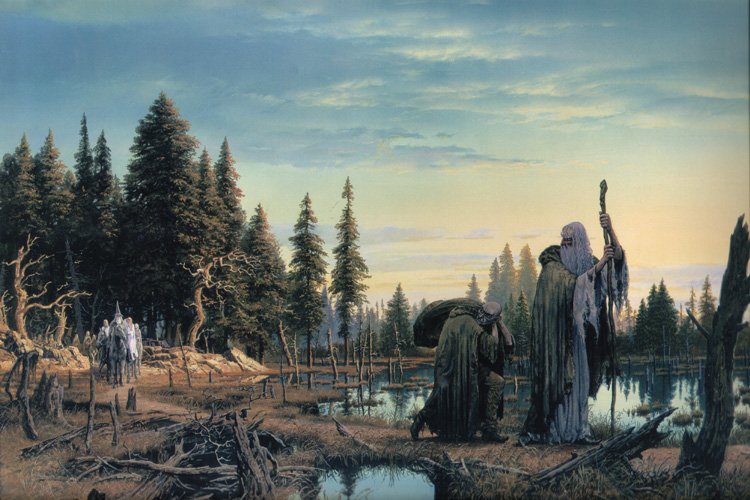
(another Nasmith—and you can see why I so value his work—he can choose scenes that no other artist seems even to have considered)
Denied Knowledge, unable to maintain Rule, Saruman, arriving in the Shire, abandons Order, turning his thugs loose to do exactly what he says to Frodo about a “sharper lesson”, as Farmer Cotton describes it:
“The biggest ruffian o’ the lot, seemingly…It was about last harvest, end o’ September maybe, that we first heard of him. We’ve never seen him, but he’s up at Bag End, and he’s the real Chief now, I guess. All the ruffians do what he says, and what he says is mostly: hack, burn, and ruin; and now it’s come to killing. There’s no longer even any bad sense in it. They cut down trees and let ‘em lie, they burn houses and build no more…It they want to make the Shire into a desert, they’re going the right way about it.”
As a spoiler, Saruman is temporarily successful, but loses first his “high and ultimate purpose” and then his life, when one of those he has corrupted in his quest for it, is kicked once too often and—

(Joan Wyatt)
As ever, thanks for reading.
Stay well,
Sic semper tyrannis,
And know that, as always, there’s
MTCIDC
O
 doubtfulsea